

Facial emotion discrimination: II. Behavioral findings in depression
Open accessThe DOI matches its Crossref record; 17 of the 18 references it cites were found in a registry or an index.
Abstract
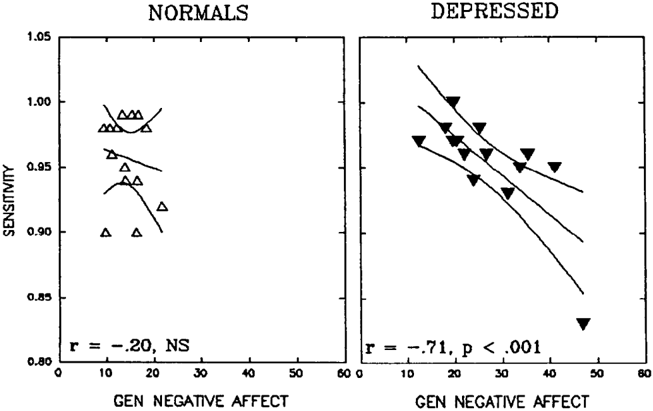
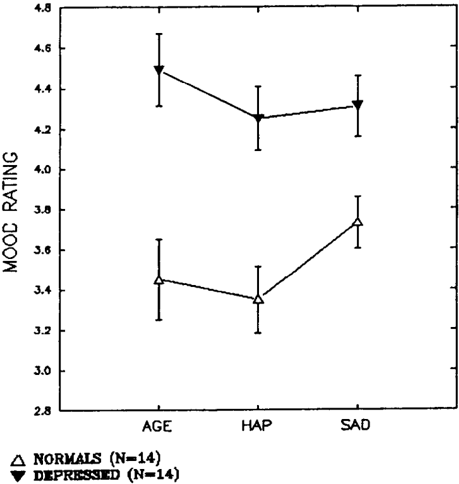
The facial discrimination tasks described in part I (Erwin et al., 1992) were administered to a sample of 14 patients with depression and 14 normal controls matched for sex (12 women, 2 men) and balanced for age and sociodemographic characteristics. Patients performed more poorly on measures of sensitivity for happy discrimination and specificity for sad discrimination, and had a higher negative bias across tasks. Severity of negative affect was correlated with poorer performance for patients. The results suggest that depression is associated with an impaired ability to recognize facial displays of emotion.
Overview
The claims and statistics of this paper haven’t been checked yet.
Free: it reads the open-access text and checks the first 5 claims that cite a source we can check. Create a free account to check every claim.
Integrity signals
Registry
Cites
Statistics
Figures
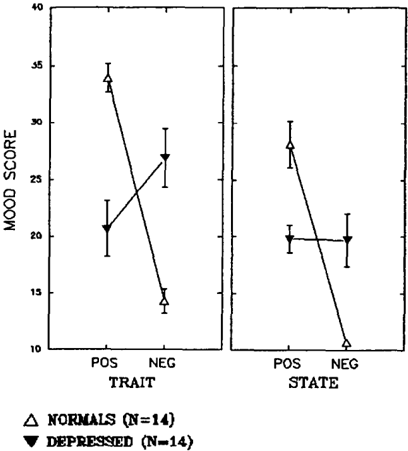
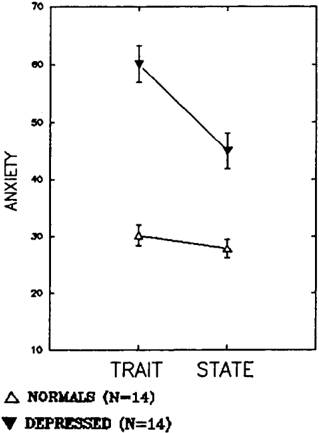
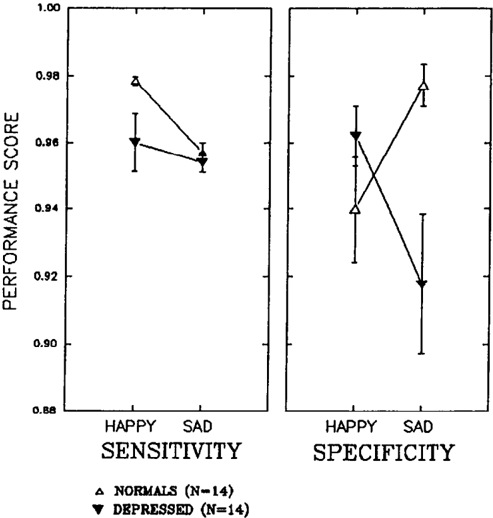
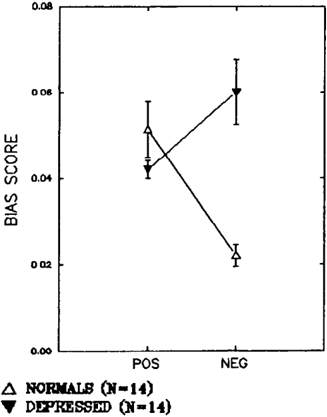
Verification
Claims the paper makes
The claims and statistics of this paper haven’t been checked yet.
Free: it reads the open-access text and checks the first 5 claims that cite a source we can check. Create a free account to check every claim.
Claims other papers make about this one
Each is checked against this paper’s own text: does it say what the citing paper says it does?
The cited source doesn’t support the claim as written.
In the citing paper
“Enhanced recognition of sad facial expressions has also been consistently reported in acutely depressed patients.73,[143][144][145][146][147][148]”
From Systematic review of the neural basis of social cognition in patients with mood disorders (2012) · cites this paper as [144]
Checked by a reasoning model — may be wrong.
Experimental — accuracy not yet measuredThe source backs part of the claim, not all of it — or backs it for a different population, condition or comparison.
In the citing paper
“studies examining patients with bipolar disorder in a depressed phase of illness reveal a mood congruent bias in emotion perception tasks, including difficulties labelling happy faces 97,102 and a tendency to misinterpret neutral facial stimuli as sad 144,183 and happy faces as angry.”
From Systematic review of the neural basis of social cognition in patients with mood disorders (2012) · cites this paper as [144]
Experimental — accuracy not yet measuredIn the citing paper
“others have argued that depressed patients exhibit negative biases in identifying facial emotions; patients are more likely to interpret neutral faces as sad and happy faces as neutral, resulting in an overall negative bias compared to controls (Gur et al., 1992;Surguladze et al. 2004).”
From Affective Cognition and its Disruption in Mood Disorders (2011) · cites this paper as Gur et al., 1992
In the citing paper
“Depression has long been associated with a pattern of cognition biased towards negative information, with depressed individuals showing a tendency to remember negative items and to rate experiences or stimuli as more negative than do controls (e.g.Gur et al., 1992;Mogg et al., 1995).”
From Affective Cognition and its Disruption in Mood Disorders (2011) · cites this paper as Gur et al., 1992
Self-check
Percentages, sums and reported differences re-computed from the paper’s own numbers.
The self-check needs the paper’s full text.
Citations
Cites
Statistical Power Analysis for the Behavioral Sciences
Muller, K. (1989) · Technometrics · doi:10.1080/00401706.1989.10488618 · Cited by 99,167
Statistical power analysis for the behavioral sciences
(1990) · Computers, Environment and Urban Systems · doi:10.1016/0198-9715(90)90050-4 · Cited by 65,269
An inventory for measuring depression
BECK, A. T. (1961) · Archives of General Psychiatry · doi:10.1001/archpsyc.1961.01710120031004 · Cited by 38,032
Statistical Power Analysis for the Behavioral Sciences (2nd ed.).
Lachenbruch, P. A., & Cohen, J. (1989) · Journal of the American Statistical Association · doi:10.2307/2290095 · Cited by 37,395
Hamilton, M. (1960) · Journal of Neurology, Neurosurgery & Psychiatry · doi:10.1136/jnnp.23.1.56 · Cited by 32,817
(1970) · Cited by 24,983
The structure of mood change: An idiographic/nomothetic analysis.
Zevon, M. A., & Tellegen, A. (1982) · Journal of Personality and Social Psychology · doi:10.1037//0022-3514.43.1.111 · Cited by 740
Facial Discrimination and Emotional Recognition in Schizophrenia and Affective Disorders
Feinberg, T. E. (1986) · Archives of General Psychiatry · doi:10.1001/archpsyc.1986.01800030094010 · Cited by 363 · cited 1×
“Patients with affective illness have often been used as a psychiatric control group (Cutting, 1981; Feinberg et al., 1986; Zuroff and Colussy, 1986; Gessler et al., 1989).”
MethodFacial emotion discrimination: I. Task construction and behavioral findings in normal subjects
Erwin, R. J., Gur, R. C., Gur, R. E., Skolnick, B., Mawhinney-Hee, M., & Smailis, J. (1992) · Psychiatry Research · doi:10.1016/0165-1781(92)90115-j · Cited by 275
Self-citationDeficits in Facial-affect Recognition and Schizophrenia
Morrison, R. L., Bellack, A. S., & Mueser, K. T. (1988) · Schizophrenia Bulletin · doi:10.1093/schbul/14.1.67 · Cited by 202
Research works printed but not linked: 1
- American Psychiatric Association. DSM-III-R: Diagnostic and Statistical Manual of Mental Disorders. 3rd ed., revised. Washington, DC: American Psychiatric Press, 1987.
Cited by
Items 301–400 of 592
Yu, F., Zhou, X., Wu, Q., Li, D., Li, J., Chen, X., Ji, G., Dong, Y., Luo, Y., Zhu, C., et al. (2016) · Psychiatry Research Neuroimaging · doi:10.1016/j.pscychresns.2016.10.013 · Cited by 23
Alteration of complex negative emotions induced by music in euthymic patients with bipolar disorder
Choppin, S., Trost, W. J., Dondaine, T., Millet, B., Drapier, D., Vérin, M., Robert, G. H., & Grandjean, D. (2015) · Journal of Affective Disorders · doi:10.1016/j.jad.2015.10.063 · Cited by 23
The effect of acute tryptophan depletion on emotional distraction and subsequent memory
Wang, L., Mullette-Gillman, O. A., Gadde, K. M., Kuhn, C. M., McCarthy, G., & Huettel, S. A. (2009) · Social Cognitive and Affective Neuroscience · doi:10.1093/scan/nsp025 · Cited by 23
Impairments in Judgment of Chimeric Faces by Schizophrenic and Affective Patients
Lior, R., & Nachson, I. (1999) · International Journal of Neuroscience · doi:10.3109/00207459909000660 · Cited by 23
Bouhuys, A. L., Meesters, Y., Jansen, J. H. C., & Bloem, G. M. (1994) · Journal of Affective Disorders · doi:10.1016/0165-0327(94)90125-2 · Cited by 23
The Relationship Between Facial Expression and Cognitive Function in Patients With Depression
Ma, R., Hua, G., Zhao, M., Chen, N., Liu, P., Liu, S., Jing, S., Yunlong, T., Tan, S., Fude, Y., et al. (2021) · Frontiers in Psychology · doi:10.3389/fpsyg.2021.648346 · Cited by 22
Meiser, S., Zietlow, A., Reck, C., & Träuble, B. (2015) · Archives of Women s Mental Health · doi:10.1007/s00737-015-0519-y · Cited by 23
Bone, J. K., Lewis, G., Button, K. S., Duffy, L., Harmer, C. J., Munafo, M. R., Penton‐Voak, I. S., Wiles, N., & Lewis, G. (2019) · Journal of Affective Disorders · doi:10.1016/j.jad.2019.06.025 · Cited by 24
Differences in Facial Expression Recognition Between Unipolar and Bipolar Depression
Ma, R., Zhao, M., Chen, N., Liu, P., Hua, G., Liu, S., Jing, S., Ke, Z., Yunlong, T., Tan, S., et al. (2021) · Frontiers in Psychology · doi:10.3389/fpsyg.2021.619368 · Cited by 22
Marshall, A. D., Sippel, L. M., & Belleau, E. L. (2011) · The Journal of Psychology · doi:10.1080/00223980.2011.599822 · Cited by 22
Social skill imbalances in mood disorders and schizophrenia
Pérez, J. E., Riggio, R. E., & Kopelowicz, A. J. (2006) · Personality and Individual Differences · doi:10.1016/j.paid.2006.05.011 · Cited by 22
Relationships Between Facial Discrimination and Social Adjustment in Mental Retardation
Rojahn, J., Esbensen, A. J., & Hoch, T. A. (2006) · American Journal on Mental Retardation · doi:10.1352/0895-8017(2006)111[366:rbfdas]2.0.co;2 · Cited by 22
Automatic recognition of self-reported and perceived emotion: does joint modeling help?
Zhang, B., Essl, G., & Mower Provost, E. (2016) · Proceedings of the 18th ACM International Conference on Multimodal Interaction · doi:10.1145/2993148.2993173 · Cited by 21
Rutter, L. A., Passell, E. J., Scheuer, L., & Germine, L. T. (2020) · Journal of Affective Disorders · doi:10.1016/j.jad.2020.07.006 · Cited by 21
Vehlen, A., Kellner, A., Normann, C., Heinrichs, M., & Domes, G. (2023) · Journal of Psychiatric Research · doi:10.1016/j.jpsychires.2023.01.016 · Cited by 21
Zhang, D., You, Y., Cai, L., Zhang, W., Zhang, K., & Wu, Y. (2024) · Psychology Research and Behavior Management · doi:10.2147/prbm.s486192 · Cited by 20
Ketamine Alters Electrophysiological Responses to Emotional Faces in Major Depressive Disorder
Lundin, N. B., Sepe-Forrest, L., Gilbert, J. R., Carver, F. W., Furey, M. L., Zarate, C. A., & Nugent, A. C. (2020) · Journal of Affective Disorders · doi:10.1016/j.jad.2020.10.007 · Cited by 20
Gozansky, E., Moscona, G., & Okon‐Singer, H. (2021) · Frontiers in Psychology · doi:10.3389/fpsyg.2021.680768 · Cited by 20
Ehlers, C. L., Phillips, E., Wills, D. N., Benedict, J., & Sánchez-Alavez, M. (2019) · Addiction Biology · doi:10.1111/adb.12732 · Cited by 20
Sripada, C., & Silk, K. R. (2007) · Current Psychiatry Reports · doi:10.1007/s11920-007-0008-8 · Cited by 20
Emotion-related abilities and depressive symptoms in Latina mothers and their children
Arsenio, W. F., SESIN, M., & Siegel, L. J. (2004) · Development and Psychopathology · doi:10.1017/s0954579404044426 · Cited by 20
Geerts, E., Kouwert, E., Bouhuys, N., Meesters, Y., & Jansen, J. (2000) · Journal of Affective Disorders · doi:10.1016/s0165-0327(99)00139-1 · Cited by 20
The double burden of age and major depressive disorder on the cognitive control network
Rao, J. A., Kassel, M. T., Weldon, A. L., Avery, E. T., Briceno, E. M., Mann, M., Cornett, B., Kales, H. C., Zubieta, J.-K., Welsh, R. C., et al. (2015) · Psychology and Aging · doi:10.1037/pag0000027 · Cited by 19
“The efficiency ratio is computed with the following formula: percentage correct/ reaction time*100 (Gur et al., 1992; Langenecker, et al., 2005).”
MethodMcDonald, S., Rosenfeld, J., Henry, J. D., Togher, L., Tate, R., & Bornhofen, C. (2011) · Brain Impairment · doi:10.1375/brim.12.3.165 · Cited by 19
Panaite, V., Whittington, A., & Hindash, A. C. (2017) · Cognition & Emotion · doi:10.1080/02699931.2017.1388216 · Cited by 19
5HTTLPR predicts left fusiform gyrus activation to positive emotional stimuli
Demaree, H. A., Pu, J., Jesberger, J. A., Feeny, N. C., Jeng, L. B., Everhart, D. E., Duerk, J. L., & Tkach, J. A. (2008) · Magnetic Resonance Imaging · doi:10.1016/j.mri.2008.08.006 · Cited by 19
Serra, M., Salgado‐Pineda, P., Delaveau, P., Fakra, É., Gastó, C., & Blin, O. (2006) · Clinical Neuropharmacology · doi:10.1097/01.wnf.0000214799.25044.ea · Cited by 19
Cognitive Control as a 5-HT1A-Based Domain That Is Disrupted in Major Depressive Disorder
Langenecker, S. A., Mickey, B. J., Eichhammer, P., Sen, S., Elverman, K. H., Kennedy, S. E., Heitzeg, M. M., Ribeiro, S. M., Love, T. M., Hsu, D. T., et al. (2019) · Frontiers in Psychology · doi:10.3389/fpsyg.2019.00691 · Cited by 18
Attention Bias to Sad Faces and Images: Which Is Better for Predicting Depression?
Ajilchi, B., & Nejati, V. (2013) · Open Journal of Depression · doi:10.4236/ojd.2013.23005 · Cited by 18
Way, E., & Rojahn, J. (2012) · Journal of Developmental and Physical Disabilities · doi:10.1007/s10882-012-9269-1 · Cited by 18
Presentations of depression in bipolar illness
Post, R. M., Denicoff, K. D., Leverich, G. S., Altshuler, L. L., Frye, M. A., Suppes, T. M., Keck, P. E., McElroy, S. L., Kupka, R., Nolen, W. A., et al. (2002) · Clinical Neuroscience Research · doi:10.1016/s1566-2772(02)00039-7 · Cited by 19
Intracranial stimulation and EEG feature analysis reveal affective salience network specialization
Metzger, B. A., Kalva, P., Mocchi, M. M., Cui, B., Adkinson, J. A., Wang, Z., Mathura, R. K., Kanja, K., Gavvala, J. R., Krishnan, V., et al. (2023) · Brain · doi:10.1093/brain/awad200 · Cited by 17
Luebbe, A. M., Fussner, L. M., Kiel, E. J., Early, M. C., & Bell, D. J. (2013) · Emotion · doi:10.1037/a0033923 · Cited by 17
Relationship between coping styles and perceptual asymmetry.
Compton, R. J., Fisher, L., Koenig, L. M., McKeown, R., & Muñoz, K. E. (2003) · Journal of Personality and Social Psychology · doi:10.1037/0022-3514.84.5.1069 · Cited by 17
THE IMPACT OF DEPRESSION ON MATERNAL RESPONSES TO INFANT FACES IN PREGNANCY
Macrae, J. A., Pearson, R. M., Lee, R., Chauhan, D., Bennert, K., Burns, A., Baxter, H., & Evans, J. (2015) · Infant Mental Health Journal · doi:10.1002/imhj.21538 · Cited by 16
Yılmaz, O., MIRÇIK, A. B., Kunduz, M., ÇOMBAŞ, M., Öztürk, A., Deveci, E., & Kırpınar, İ. (2019) · Psychiatry Investigation · doi:10.30773/pi.2019.03.14 · Cited by 16
Biases in emotional processing are associated with vulnerability to eating disorders over time
Pringle, A., Harmer, C. J., & Cooper, M. (2010) · Eating Behaviors · doi:10.1016/j.eatbeh.2010.08.003 · Cited by 16
Berlim, M. T., Mcgirr, A., Beaulieu, M.-M., & Turecki, G. (2012) · The World Journal of Biological Psychiatry · doi:10.3109/15622975.2011.615861 · Cited by 15
“For example, when asked to judge facial expressions, depressed and/or dysphoric individuals tend to perceive signifi cantly higher levels of negative emotions than controls (Mandal and Bhattacharya 1985; Gur et al. 1992; Rubinow and Post 1992; Bouhuys et al. 1997, 1999; Hale 1998).”
BackgroundWang, S., Kim, Y., Yeon, B., Lee, H., Kweon, Y., Lee, C. T., & Lee, K. (2013) · Psychiatry and Clinical Neurosciences · doi:10.1111/pcn.12039 · Cited by 15
Assessing Pragmatic Language Skills in Adults with Major Depressive Disorder: An Exploratory Study
Zurlo, M. C., & Ruggiero, M. (2021) · Psychopathology · doi:10.1159/000513270 · Cited by 16
Watters, A. J., Korgaonkar, M. S., Carpenter, J. S., Harris, A. W. F., Gross, J. J., & Williams, L. M. (2017) · Journal of Affective Disorders · doi:10.1016/j.jad.2017.11.067 · Cited by 15
L’analyse des visages dans la dépression
Bediou, B., Saoud, M., Harmer, C. J., & Krolak‐Salmon, P. (2009) · L Évolution Psychiatrique · doi:10.1016/j.evopsy.2008.12.015 · Cited by 15
Emotion Recognition Ability and Mild Depressive Symptoms in Late Adulthood
Orgeta, V. (2014) · Experimental Aging Research · doi:10.1080/0361073x.2014.857535 · Cited by 15
Jaworska, N., Thompson, A. L., Shah, D. K., Fisher, D. J., Ilivitsky, V., & Knott, V. (2010) · European Neuropsychopharmacology · doi:10.1016/j.euroneuro.2010.03.002 · Cited by 15
Schräder, J., Herzberg, L., Jo, H., Hernandez‐Pena, L., Koch, J., Habel, U., & Wagels, L. (2024) · Biological Psychiatry Cognitive Neuroscience and Neuroimaging · doi:10.1016/j.bpsc.2024.07.005 · Cited by 15
Effects of sertraline, duloxetine, vortioxetine, and idazoxan in the rat affective bias test
Refsgaard, L. K., Haubro, K., Pickering, D. S., Stuart, S. A., Robinson, E. S. J., & Andreasen, J. T. (2016) · Psychopharmacology · doi:10.1007/s00213-016-4407-6 · Cited by 15
Consciousness about own and others' affects
Lech, B. (2012) · DiVA (Linkoping University) · Cited by 16
FMRI study of implicit emotional face processing in patients with MDD with melancholic subtype
Kustubayeva, A., Eliassen, J. C., Matthews, G., & Nelson, E. B. (2023) · Frontiers in Human Neuroscience · doi:10.3389/fnhum.2023.1029789 · Cited by 13
Emotion regulation in Premenstrual Dysphoric Disorder and Premenstrual Syndrome: a systematic review
Lambert, E. R., Hunter, M. S., Cocker, H., Gurvich, C., & Chalder, T. (2025) · BMC Psychology · doi:10.1186/s40359-025-03587-y · Cited by 13
Haipt, A., Rosenbaum, D., Fuhr, K., Giese, M. A., Batra, A., & Ehlis, A. (2022) · European Archives of Psychiatry and Clinical Neuroscience · doi:10.1007/s00406-021-01348-7 · Cited by 14
Slaney, C., Hinchcliffe, J. K., & Robinson, E. S. J. (2018) · Current topics in behavioral neurosciences · doi:10.1007/7854_2018_44 · Cited by 13
Sleep, inflammation, and perception of sad facial emotion: A laboratory-based study in older adults
Piber, D., Eisenberger, N. I., Olmstead, R., Cho, H. J., Breen, E. C., Boyle, C. C., Karmarkar, E. N., Guzman, M., Kim, H., & Irwin, M. R. (2020) · Brain Behavior and Immunity · doi:10.1016/j.bbi.2020.06.011 · Cited by 13
Affective Computing and Emotion-Sensing Technology for Emotion Recognition in Mood Disorders
Sinha, N. (2021) · Studies in fuzziness and soft computing · doi:10.1007/978-3-030-70111-6_16 · Cited by 13
Rózsa, S., Kálmán, R., Kő, N., Nagy, H., Fiáth, T., Mägi, A., Eisinger, A., & Oláh, A. (2012) · Pszichológia · doi:10.1556/pszicho.32.2012.3.4 · Cited by 15
Criado, J. R., & Ehlers, C. L. (2007) · Pharmacology Biochemistry and Behavior · doi:10.1016/j.pbb.2007.07.019 · Cited by 13
Scarpina, F., Melzi, L., Castelnuovo, G., Mauro, A., Marzoli, S. B., & Molinari, E. (2018) · Frontiers in Psychology · doi:10.3389/fpsyg.2018.00494 · Cited by 14
Influence of Alcohol on Electrophysiological Responses to Facial Stimuli
Orozco, S., Wall, T. L., & Ehlers, C. L. (1999) · Alcohol · doi:10.1016/s0741-8329(98)00061-5 · Cited by 13
Jackson, M. G., & Robinson, E. S. J. (2022) · Emerging Topics in Life Sciences · doi:10.1042/etls20220004 · Cited by 12
Lee, S. A., Kim, C.-Y., & Lee, S. (2016) · Psychiatry Investigation · doi:10.4306/pi.2016.13.2.165 · Cited by 12
Emotion processing bias and age of seizure onset among epilepsy patients with depressive symptoms
Brand, J. G., Mindt, M. R., Schaffer, S. G., Alper, K., Devinsky, O., & Barr, W. (2012) · Epilepsy & Behavior · doi:10.1016/j.yebeh.2012.09.031 · Cited by 12
Houshmand, K., Bräunig, P., Gauggel, S., Kliesow, K., Sarkar, R., & Krüger, S. (2010) · Acta Neuropsychiatrica · doi:10.1111/j.1601-5215.2010.00451.x · Cited by 12
Sánchez-López, Á., Romero, N., Maurage, P., & Raedt, R. D. (2017) · Journal of Behavior Therapy and Experimental Psychiatry · doi:10.1016/j.jbtep.2017.05.002 · Cited by 11
Chaves, A. C. S., dos Reis, F. J. J., Bandeira, P. M., Fernandes, O., & Sanchez, T. A. (2021) · Scandinavian Journal of Pain · doi:10.1515/sjpain-2020-0132 · Cited by 11
Furlong, L. S., Rossell, S. L., Karantonis, J. A., Cropley, V., Hughes, M. E., & Rheenen, T. E. V. (2021) · Journal of Neuropsychology · doi:10.1111/jnp.12267 · Cited by 11
Characteristics of cognitive impairment in schizophrenia
Harvey, P. D. (2013) · Cambridge University Press eBooks · doi:10.1017/cbo9781139003872.002 · Cited by 11
Tantalizing Fantasies: Positive Imagery Induces Negative Mood in Individuals High in Fear of Failure
Langens, T. A. (2002) · Imagination Cognition and Personality · doi:10.2190/hgh6-3rm6-2vcg-ycqh · Cited by 11
Improving the Translational Validity of Methods Used to Study Depression in Animals
Robinson, E. S. J. (2016) · Psychopathology Review · doi:10.5127/pr.034713 · Cited by 11
Smoking history, and not depression, is related to deficits in detection of happy and sad faces
Meyers, K. K., Crane, N. A., O’Day, R., Zubieta, J., Giordani, B., Pomerleau, C. S., Horowitz, J. C., & Langenecker, S. A. (2014) · Addictive Behaviors · doi:10.1016/j.addbeh.2014.10.012 · Cited by 11
Kumar, P., Harmer, C. J., & Dourish, C. T. (2012) · Elsevier eBooks · doi:10.1016/b978-0-12-386945-6.00012-3 · Cited by 11
Liu, C., Li, L., Pan, W., Zhu, D., Lian, S., Liu, Y., Ren, L., Mao, P., Ren, Y., & Ma, X. (2023) · Frontiers in Aging Neuroscience · doi:10.3389/fnagi.2023.1107320 · Cited by 10
Le trouble bipolaire : pathologie des cognitions et des émotions
Besnier, N. (2008) · L information psychiatrique · doi:10.1684/ipe.2008.0293 · Cited by 10
Rojahn, J., Kroeger, T. L., & McElwain, D. C. (1995) · Journal of Developmental and Physical Disabilities · doi:10.1007/bf02578432 · Cited by 10
Depressed Subjects Have Decreased rCBF Activation During Facial Emotion Recognition
George, M. S., Ketter, T. A., Parekh, P. I., Gill, D. S., Marangell, L. B., Pazzaglia, P. J., Herscovitch, P., & Post, R. M. (1997) · CNS Spectrums · doi:10.1017/s1092852900011081 · Cited by 10
Visual attention toward emotional stimuli: Anxiety symptoms correspond to distinct gaze patterns
Rutter, L. A., Norton, D. J., & Brown, T. A. (2021) · PLoS ONE · doi:10.1371/journal.pone.0250176 · Cited by 9
Li, D., Liu, R., Ye, F., Li, R., Li, X., Liu, J., Zhang, X., Zhou, J., & Wang, G. (2024) · Journal of Psychiatric Research · doi:10.1016/j.jpsychires.2024.05.045 · Cited by 10
Yuan, Z., Lin, X., Li, P., Gao, Y., Yuan, K., Yan, W., Zhang, Y., Liu, L., Zhu, X.-M., Zhang, Y.-J., et al. (2023) · Frontiers in Psychiatry · doi:10.3389/fpsyt.2022.1090369 · Cited by 9
An association between negatively biased response to neutral stimuli and antidepressant nonadherence
Keeley, R. D., Davidson, A. J., Crane, L. A., Matthews, B., & Pace, W. D. (2007) · Journal of Psychosomatic Research · doi:10.1016/j.jpsychores.2006.12.006 · Cited by 9
Alqahtani, M. M. J. (2015) · Postępy Psychiatrii i Neurologii · doi:10.1016/j.pin.2015.11.003 · Cited by 9
College students’ perceptions of depressed mood: Exploring accuracy and associations.
Geisner, I. M., Kirk, J. L., Mittmann, A. J., Kilmer, J. R., & Larimer, M. E. (2015) · Professional Psychology Research and Practice · doi:10.1037/pro0000039 · Cited by 11
Reconocimiento de Emociones Faciales en Adultos Mayores de la Ciudad de Córdoba
Narambuena, L., Vaiman, M., & Pereno, G. L. (2016) · Psykhe (Santiago) · doi:10.7764/psykhe.25.1.791 · Cited by 9
Le modèle triadique des aspects neurobiologiques des comportements motivés à l’adolescence
Ernst, M., Pine, D. S., & Hardin, M. G. (2009) · PSN · doi:10.1007/s11836-009-0094-2 · Cited by 9
Early life stress is associated with reduced avoidance of threatening facial expressions
Kirkham, E., & Levita, L. (2019) · Development and Psychopathology · doi:10.1017/s095457941900110x · Cited by 9
The early stage of face detection in patients with major depressive disorder: an ERP study
Yin, G., Zhao, L., & Li, H. (2019) · Neuroreport · doi:10.1097/wnr.0000000000001305 · Cited by 10
How schizophrenia and depression disrupt reward circuitry
Holcomb, H. H., & Rowland, L. M. (2007) · Current Treatment Options in Neurology · doi:10.1007/s11940-007-0021-6 · Cited by 10
The role of the ventral prefrontal cortex in mood disorders
Fredericks, C. A., Kalmar, J. H., & Blumberg, H. P. (2006) · Oxford University Press eBooks · doi:10.1093/acprof:oso/9780198565741.003.0021 · Cited by 9
Miola, A., Trevisan, N., Salvucci, M., Minerva, M., Valeggia, S., Manara, R., & Sambataro, F. (2023) · European Archives of Psychiatry and Clinical Neuroscience · doi:10.1007/s00406-023-01649-z · Cited by 8
Concurrent Validity Studies of the Facial Discrimination Task
Rojahn, J., Singh, N. N., Singh, S. D., Baker, J. A., Lawrence, M. A., & Davis, C. M. (2002) · Journal of Child and Family Studies · doi:10.1023/a:1015129726221 · Cited by 8
A Systems Neuroscience Approach to the Pathophysiology of Pediatric Mood and Anxiety Disorders
Tseng, W., Leibenluft, E., & Brotman, M. A. (2013) · Current topics in behavioral neurosciences · doi:10.1007/7854_2013_252 · Cited by 8
Biased Perception of Mean Emotion in Abstinent Heroin Abusers
Zhang, M., Wang, X., Hu, C., Liao, H., Yang, T., & Shen, M. (2015) · Journal of Psychoactive Drugs · doi:10.1080/02791072.2015.1101181 · Cited by 8
Le basi neurali della cognizione sociale nel disturbo bipolare
Turchi, F., Amodeo, G., Favaretto, E., Righini, S., Mellina, E., Mela, C. L., & Fagiolini, A. M. (2016) · Rivista di psichiatria · doi:10.1708/2476.25886 · Cited by 8
Emotional recognition in depressed epilepsy patients
Brand, J. G., Burton, L. A., Schaffer, S. G., Alper, K., Devinsky, O., & Barr, W. (2009) · Epilepsy & Behavior · doi:10.1016/j.yebeh.2009.04.021 · Cited by 8
Hollender, A. E., Elsayed, N. M., Vogel, A. C., Tillman, R., Barch, D. M., Luby, J. L., & Gilbert, K. (2024) · Emotion · doi:10.1037/emo0001248 · Cited by 8
Amos, T. J., Guragai, B., Rao, Q., Li, W., Jin, Z., Zhang, J., & Li, L. (2024) · NeuroImage · doi:10.1016/j.neuroimage.2024.120715 · Cited by 7
Rethinking Inconsistent Context and Imbalanced Regression in Depression Severity Prediction
Huang, G., Li, J., Lu, H., Guo, M., & Chen, S. (2024) · IEEE Transactions on Affective Computing · doi:10.1109/taffc.2024.3405584 · Cited by 7
The relationship between residual symptoms of depression and emotional information processing
Strand, M., Sætrevik, B., Lund, A., & Hammar, Å. (2012) · Nordic Journal of Psychiatry · doi:10.3109/08039488.2012.711857 · Cited by 7
Don't Dwell on it: The Impact of Rumination on Emotional Sensitivity
Johnston, L. C., Carter, J., & McLellan, T. (2011) · Journal of Social and Clinical Psychology · doi:10.1521/jscp.2011.30.5.506 · Cited by 7
Malcolm‐Smith, S., Thomas, K. G. F., Ipser, J., Stein, D. J., van Honk, J., & Solms, M. (2013) · Neuropsychoanalysis · doi:10.1080/15294145.2013.10799826 · Cited by 7
Visual evoked potentials in humans during recognition of emotional facial expressions
Михайлова, Е. С., & Davydov, D. V. (1999) · Neuroscience and Behavioral Physiology · doi:10.1007/bf02462485 · Cited by 7
Weiss, E. M., Kohler, C., Brensinger, C., Bilker, W., Loughead, J., Delazer, M., & Nolan, K. (2007) · European psychiatry (Ed Española) · doi:10.1017/s1134066500004550 · Cited by 6
Sukhapure, M. (2019) · Otago University Research Archive (University of Otago) · Cited by 7
Metadata
- Authors
- Gur, R. C., Erwin, R. J., Gur, R. E., Zwil, A. S., Heimberg, C., & Kraemer, H. C.
- Affiliations
- University of Pennsylvania (US)
- Thomas Jefferson University (US)
- Stanford University (US)
- Corresponding author
- Gur, Ruben C.
- Venue
- Psychiatry Research
- Publisher
- Elsevier BV
- Published
- 1992-06
- Volume
- 42
- Issue
- 3
- Pages
- 241-251
- ISSN
- 0165-1781 (ISSN-L)
- OpenAlex
- W2091936017
- Semantic Scholar
- 5b9df7fb4f352fac01a9362e9de58fe0dca4160b
- Cited by
- 500
- References
- 18
- Citations by year
- 2026: 3 · 2025: 11 · 2024: 17 · 2023: 14 · 2022: 9 · 2021: 12 · 2020: 8 · 2019: 16 · 2018: 14 · 2017: 15 · 2016: 21 · 2015: 27 · 2014: 19 · 2013: 35 · 2012: 25
- FWCI
- 2.33
- Type
- journal article
- Language
- en
- Open access
- hybrid
- doi.org
- Licence
- cc-by-nc-nd
- www.elsevier.com/tdm/userlicense/1.0/ (tdm)
- www.elsevier.com/legal/tdmrep-license (tdm)
- creativecommons.org/licenses/by-nc-nd/4.0/ (vor, 4013 d)
- Locations
- Psychiatry Research (publishedVersion, cc-by-nc-nd)
- PubMed (publishedVersion)
- Funders
- John D. and Catherine T. MacArthur Foundation
- National Institutes of Health (5r29mh045113-03, 2k02mh000586-06)
- National Institute of Mental Health (MH 00586, MH45113, MH 43880)
- Topics
- Life Sciences › Neuroscience › Cognitive Neuroscience › Face Recognition and Perception
- Social Sciences › Psychology › Experimental and Cognitive Psychology › Anxiety, Depression, Psychometrics, Treatment, Cognitive Processes
- Life Sciences › Neuroscience › Cognitive Neuroscience › Neural and Behavioral Psychology Studies
- Keywords
- facial emotion recognition, depression, emotion discrimination, negative affect, negative bias, facial expression perception
- MeSH terms
- Adult, Aged, Attention, Bipolar Disorder, Brain Mapping, Depressive Disorder, Discrimination Learning, Emotions, Facial Expression, Female, Humans, Male, Middle Aged, Pattern Recognition, Visual, Personality Assessment
About these checks
Registry, retraction, Cites and statistics results are computed, not judged, with one exception: a printed reference that no index lists is read once by a model before it counts as a citation error. Claims are extracted by a model and kept only when their quote appears verbatim in the text; each cited source is then checked, with a model’s help, for whether it says what the claim relies on. Those verdicts can be wrong — read the claim’s quote and the cited source before relying on one.
Statistics and arithmetic are recomputed, not judged.
Confidence bands are shown only for fields calibrated on our annotated test set. None is calibrated yet, so no band is shown.
What counts as a claim ›How we measure confidence ›How we check this ›
Are you an author, or do you see a problem with this page? Request a review
Data sources
Bibliographic data: Semantic Scholar, OpenAlex, Crossref.
Contains information from the Semantic Scholar Academic Graph Datasets, made available under the ODC Attribution License (ODC-BY 1.0).
Semantic Scholar’s data is described in: Kinney, R., et al. (2023). The Semantic Scholar Open Data Platform. arXiv:2301.10140.
