

Facial emotion discrimination: II. Behavioral findings in depression
Open accessThe DOI matches its Crossref record; 17 of the 18 references it cites were found in a registry or an index.
Abstract
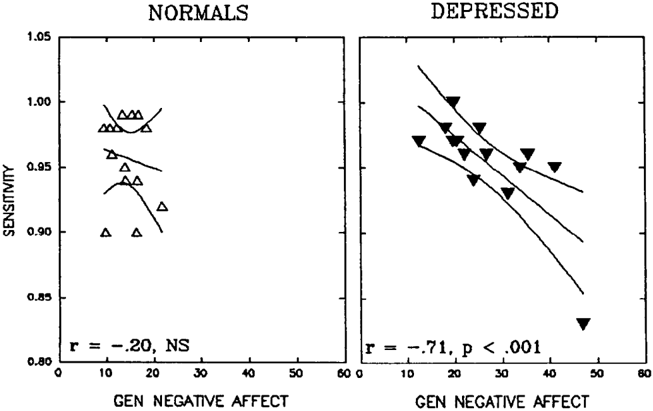
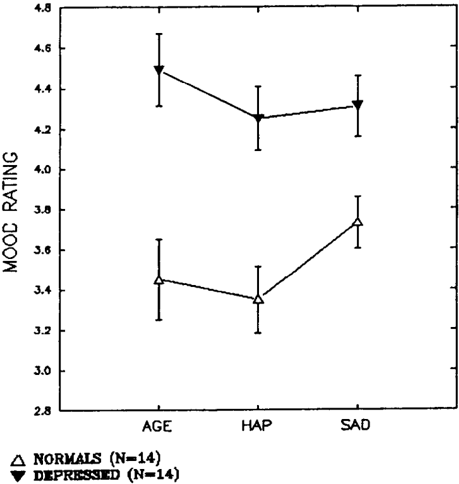
The facial discrimination tasks described in part I (Erwin et al., 1992) were administered to a sample of 14 patients with depression and 14 normal controls matched for sex (12 women, 2 men) and balanced for age and sociodemographic characteristics. Patients performed more poorly on measures of sensitivity for happy discrimination and specificity for sad discrimination, and had a higher negative bias across tasks. Severity of negative affect was correlated with poorer performance for patients. The results suggest that depression is associated with an impaired ability to recognize facial displays of emotion.
Overview
The claims and statistics of this paper haven’t been checked yet.
Free: it reads the open-access text and checks the first 5 claims that cite a source we can check. Create a free account to check every claim.
Integrity signals
Registry
Cites
Statistics
Figures
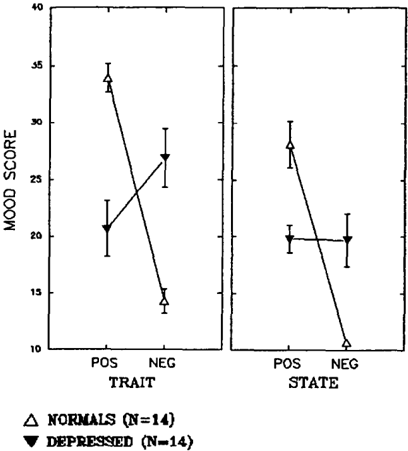
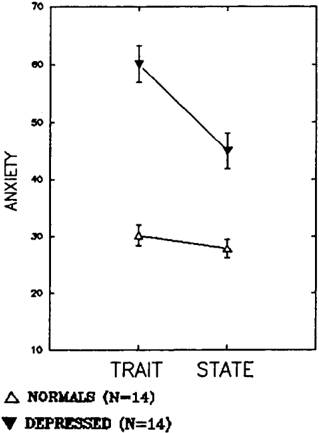
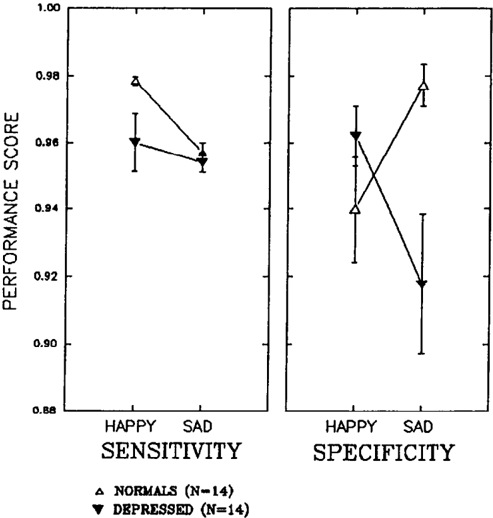
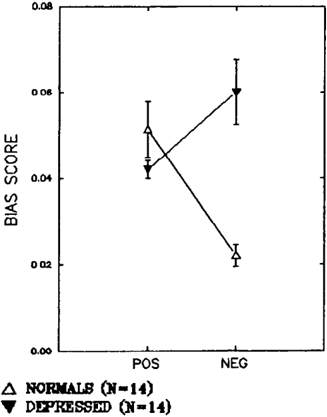
Verification
Claims the paper makes
The claims and statistics of this paper haven’t been checked yet.
Free: it reads the open-access text and checks the first 5 claims that cite a source we can check. Create a free account to check every claim.
Claims other papers make about this one
Each is checked against this paper’s own text: does it say what the citing paper says it does?
The cited source doesn’t support the claim as written.
In the citing paper
“Enhanced recognition of sad facial expressions has also been consistently reported in acutely depressed patients.73,[143][144][145][146][147][148]”
From Systematic review of the neural basis of social cognition in patients with mood disorders (2012) · cites this paper as [144]
Checked by a reasoning model — may be wrong.
Experimental — accuracy not yet measuredThe source backs part of the claim, not all of it — or backs it for a different population, condition or comparison.
In the citing paper
“studies examining patients with bipolar disorder in a depressed phase of illness reveal a mood congruent bias in emotion perception tasks, including difficulties labelling happy faces 97,102 and a tendency to misinterpret neutral facial stimuli as sad 144,183 and happy faces as angry.”
From Systematic review of the neural basis of social cognition in patients with mood disorders (2012) · cites this paper as [144]
Experimental — accuracy not yet measuredIn the citing paper
“others have argued that depressed patients exhibit negative biases in identifying facial emotions; patients are more likely to interpret neutral faces as sad and happy faces as neutral, resulting in an overall negative bias compared to controls (Gur et al., 1992;Surguladze et al. 2004).”
From Affective Cognition and its Disruption in Mood Disorders (2011) · cites this paper as Gur et al., 1992
In the citing paper
“Depression has long been associated with a pattern of cognition biased towards negative information, with depressed individuals showing a tendency to remember negative items and to rate experiences or stimuli as more negative than do controls (e.g.Gur et al., 1992;Mogg et al., 1995).”
From Affective Cognition and its Disruption in Mood Disorders (2011) · cites this paper as Gur et al., 1992
Self-check
Percentages, sums and reported differences re-computed from the paper’s own numbers.
The self-check needs the paper’s full text.
Citations
Cites
Statistical Power Analysis for the Behavioral Sciences
Muller, K. (1989) · Technometrics · doi:10.1080/00401706.1989.10488618 · Cited by 99,167
Statistical power analysis for the behavioral sciences
(1990) · Computers, Environment and Urban Systems · doi:10.1016/0198-9715(90)90050-4 · Cited by 65,269
An inventory for measuring depression
BECK, A. T. (1961) · Archives of General Psychiatry · doi:10.1001/archpsyc.1961.01710120031004 · Cited by 38,032
Statistical Power Analysis for the Behavioral Sciences (2nd ed.).
Lachenbruch, P. A., & Cohen, J. (1989) · Journal of the American Statistical Association · doi:10.2307/2290095 · Cited by 37,395
Hamilton, M. (1960) · Journal of Neurology, Neurosurgery & Psychiatry · doi:10.1136/jnnp.23.1.56 · Cited by 32,817
(1970) · Cited by 24,983
The structure of mood change: An idiographic/nomothetic analysis.
Zevon, M. A., & Tellegen, A. (1982) · Journal of Personality and Social Psychology · doi:10.1037//0022-3514.43.1.111 · Cited by 740
Facial Discrimination and Emotional Recognition in Schizophrenia and Affective Disorders
Feinberg, T. E. (1986) · Archives of General Psychiatry · doi:10.1001/archpsyc.1986.01800030094010 · Cited by 363 · cited 1×
“Patients with affective illness have often been used as a psychiatric control group (Cutting, 1981; Feinberg et al., 1986; Zuroff and Colussy, 1986; Gessler et al., 1989).”
MethodFacial emotion discrimination: I. Task construction and behavioral findings in normal subjects
Erwin, R. J., Gur, R. C., Gur, R. E., Skolnick, B., Mawhinney-Hee, M., & Smailis, J. (1992) · Psychiatry Research · doi:10.1016/0165-1781(92)90115-j · Cited by 275
Self-citationDeficits in Facial-affect Recognition and Schizophrenia
Morrison, R. L., Bellack, A. S., & Mueser, K. T. (1988) · Schizophrenia Bulletin · doi:10.1093/schbul/14.1.67 · Cited by 202
Research works printed but not linked: 1
- American Psychiatric Association. DSM-III-R: Diagnostic and Statistical Manual of Mental Disorders. 3rd ed., revised. Washington, DC: American Psychiatric Press, 1987.
Cited by
Items 401–500 of 592
Konoike, N., Iwaoki, H., & Nakamura, K. (2020) · Frontiers in Behavioral Neuroscience · doi:10.3389/fnbeh.2020.00156 · Cited by 5
The effect of emotion recognition and mindfulness on depression symptoms: A case–control study
Aydın, O., Tvrtković, S., Çakıroğlu, E., Ünal‐Aydın, P., & Danacı, A. E. (2023) · Scandinavian Journal of Psychology · doi:10.1111/sjop.12992 · Cited by 6
La neuropsychologie des émotions musicales
Samson, S., & Dellacherie, D. (2010) · Presses universitaires de Rennes eBooks · doi:10.4000/books.pur.60638 · Cited by 7
The cognitive neuropsychological model of antidepressant response
Walsh, A. E. L., & Harmer, C. J. (2015) · Current Opinion in Psychology · doi:10.1016/j.copsyc.2014.12.022 · Cited by 6
A Pilot Study on the Decoding of Dynamic Emotional Expressions in Major Depressive Disorder
Esposito, A. A., Scibelli, F., & Vinciarelli, A. (2016) · Smart innovation, systems and technologies · doi:10.1007/978-3-319-33747-0_19 · Cited by 6
Rutter, L. A., Norton, D. J., Brown, B. S., & Brown, T. A. (2018) · Cognitive Therapy and Research · doi:10.1007/s10608-018-9974-x · Cited by 7
Kornreich, C., & Philippot, P. (2006) · Psychologica Belgica · doi:10.5334/pb-46-1-2-79 · Cited by 6
Esteve, E. B., Such, A. F., & Giorgi, G. (2013) · LA Referencia (Red Federada de Repositorios Institucionales de Publicaciones Científicas) · Cited by 6
Emotional contagion and its relationship to mood
Arakawa, D. R. (2013) · PsycEXTRA Dataset · doi:10.1037/e574802013-349 · Cited by 6
Comparing the mental effects of interacting with farm animals and walking in a botanical garden
Temesi, A., Kubinyi, E., Pogány, Á., Bereczky, B. M., & Miklósi, Á. (2024) · PLoS ONE · doi:10.1371/journal.pone.0312021 · Cited by 6
Associations between attentional biases for emotional images and rumination in depression
Quigley, L., Russell, K., Yung, C., Dobson, K. S., & Sears, C. R. (2024) · Cognition & Emotion · doi:10.1080/02699931.2024.2434158 · Cited by 5
Understanding basic and social emotions in Alzheimer's disease and frontotemporal dementia
Sola, C., Zanelli, V., Molinari, M. A., Casadio, C., Ricci, F., Carpentiero, O., Tondelli, M., Lui, F., Nichelli, P., & Benuzzi, F. (2025) · Frontiers in Psychology · doi:10.3389/fpsyg.2025.1535722 · Cited by 5
Jeon, G., Choi, H.-S., Jung, D.-U., Moon, S., Kim, G., Kim, S.-J., Moon, J., Kim, Y.-S., & Jeon, D.-W. (2021) · Asian Journal of Psychiatry · doi:10.1016/j.ajp.2021.102974 · Cited by 5
Guapo, V. G. (2013) · Digital Library of Theses and Dissertations (Universidade de São Paulo) · doi:10.11606/t.17.2013.tde-22022013-091339 · Cited by 5
Neuropsychological Deficits of Primary Affective Illness: Implications for Therapy
Post, R. M., Denicoff, K. D., Leverich, G. S., Huggins, T., Post, S. W., & Luckenbaugh, D. A. (2000) · Psychiatric Annals · doi:10.3928/0048-5713-20000701-09 · Cited by 5
Multimodal Local Global Interaction Networks for Automatic Depression Severity Estimation
Niu, M., Shao, Z., He, Y., Tao, J., & Schuller, B. W. (2025) · IEEE Transactions on Circuits and Systems for Video Technology · doi:10.1109/tcsvt.2025.3612697 · Cited by 5
Peripheral inflammation is associated with impaired sadness recognition in euthymic bipolar patients
Chang, C.-Y., Chang, H. H., Wu, C. Y., Tsai, Y. T., Lu, T., Chang, W. H., Hsu, C., Chen, P. S., & Tseng, H. (2024) · Journal of Psychiatric Research · doi:10.1016/j.jpsychires.2024.03.049 · Cited by 4
Comparing the Recall to Pleasant and Unpleasant Face Pictures in Depressed and Manic Individuals
Mehran, S. (2014) · Psychology · doi:10.4236/psych.2014.51004 · Cited by 4
Cognitive Biomarkers in Depression
Robinson, O. J., & Sahakian, B. J. (2013) · Oxford University Press eBooks · doi:10.1093/med/9780199796816.003.0035 · Cited by 4
Weise, T., Pérez-Toro, P. A., Deitermann, A., Hoffmann, B., Demir, K. C., Straetz, T., Nöth, E., Maier, A., Kallert, T. W., & Yang, S. H. (2023) · Lecture notes in computer science · doi:10.1007/978-3-031-47679-2_3 · Cited by 4
Neuropsychological investigation in mood disorders
Keedwell, P. A., Surguladze, S. A., & Philips, M. (2009) · Cambridge University Press eBooks · doi:10.1017/cbo9780511642197.029 · Cited by 4
Neuroscience and Mental Illness
Nair, A., & Pariante, C. M. (1992) · Science · doi:10.1126/science.257.5078.1867 · Cited by 4
Sarkheil, P., Kilian-Hütten, N., Mickartz, K., Vornholt, T., & Mathiak, K. (2018) · Cognitive Neuropsychiatry · doi:10.1080/13546805.2018.1444596 · Cited by 4
Chartier, G. (2013) · doi:10.71781/29539 · Cited by 5
Neurobehavioural Substrates of Mood Induction
Schneider, F. W., & Weiss, U. (1998) · KARGER eBooks · doi:10.1159/000058880 · Cited by 4
Székely, E. (2013) · RePub (Erasmus University Rotterdam) · Cited by 4
Sarrazin, V., Suen, P. J. C., Cavendish, B., Martens, M., da Silva, P. H. R., Britto, A., Ramos, M. R. F., Baptista, M., Brunoni, A. R., & O’Shea, J. (2026) · Molecular Psychiatry · doi:10.1038/s41380-026-03485-8 · Cited by 4
Comparative impairments across schizophrenia and bipolar disorder
Bowie, C. R., Holshausen, K., & Gupta, M. (2013) · Cambridge University Press eBooks · doi:10.1017/cbo9781139003872.004 · Cited by 3
Zhao, Q., Sun, J., Cong, F., Chen, S., Tang, Y., & Tong, S. (2013) · Annual International Conference of the IEEE Engineering in Medicine and Biology Society (EMBC) · doi:10.1109/embc.2013.6610916 · Cited by 3
Rotenberg, V. S. (2010) · Activitas Nervosa Superior · doi:10.1007/bf03379566 · Cited by 3
The Impact of Expressive Flexibility and Context Sensitivity on Distress
Southward, M. W. (2014) · OhioLink ETD Center (Ohio Library and Information Network) · Cited by 3
Olivas, C. A. N., & Solís, E. E. P. (2009) · Cuadernos de neuropsicología · Cited by 3
Emotionale Kompetenz – der Einfluss von kognitiver Beeinträchtigung und Depression im Alter
Steixner, R., Moser, B., Kemmler, G., Freudenthaler, H. H., Papousek, I., Deisenhammer, E., & Weiss, E. M. (2015) · Zeitschrift für Neuropsychologie · doi:10.1024/1016-264x/a000149 · Cited by 3
SELECTIVE ATTENTION HYPOTHESIS IN IRANIAN PATIENTS WITH DEPRESSIVE DISORDER
Mohammadkhani, P., Eskandari, E., Mehrabi, A., & Bagheri, M. (2015) · Practice in Clinical Psychology · Cited by 3
Tempo nos dispositivos eletrônicos e reconhecimento das expressões faciais emocionais em crianças
Vale, N. R. F., de Medeiros, É. D., Alves, N. T., de Medeiros, P. C. B., & de Oliveira, A. R. S. (2024) · PSI UNISC · doi:10.17058/psiunisc.v8i1.18472 · Cited by 2
Michalik, K., & Kucharska, K. (2020) · Advances in intelligent systems and computing · doi:10.1007/978-3-030-52243-8_14 · Cited by 2
Negative affect related to door‐in‐the‐face strategy
Martinie, M., Bordas, B., & Gil, S. (2023) · Scandinavian Journal of Psychology · doi:10.1111/sjop.12997 · Cited by 2
Alexithymia: State of the Art and Controversies. Clinical and Neuroscientific Evidence.
CASTELLI, L., Goerlich, K. S., Hosoi, M., & Tesio, V. (2019) · Frontiers research topics · doi:10.3389/978-2-88963-106-3 · Cited by 2
van Belkum, S. M., Opmeer, E. M., Geugies, H., de Boer, M. K., Schoevers, R. A., & Aleman, A. (2024) · European Archives of Psychiatry and Clinical Neuroscience · doi:10.1007/s00406-024-01797-w · Cited by 2
Affective bias predicts changes in depression during deep brain stimulation therapy
Cui, B., Mocchi, M. M., Metzger, B. A., Kalva, P., Magnotti, J. F., Fiedorowicz, J. G., Waters, A., Kovach, C. K., Reed, Y. Y., Mathura, R. K., et al. (2025) · Frontiers in Human Neuroscience · doi:10.3389/fnhum.2025.1539857 · Cited by 2
Accuracy in perceiving facial expressions of emotion in psychopathology
Griffiths, P., & Ashwin, C. (2016) · Cambridge University Press eBooks · doi:10.1017/cbo9781316181959.009 · Cited by 2
Modulation of Emotional Faces Processing and Its Implication for Depression and Anxiety
Marta, C., & Guilherme, F. (2010) · Sciyo eBooks · doi:10.5772/9880 · Cited by 2
Postnatal Depression and Emotion: The Misfortune of Mother-Infant Interactions
Gil, S., Droit‐Volet, S., Laval, V., & Teissdre, F. (2012) · InTech eBooks · doi:10.5772/30838 · Cited by 2
Cognitive Psychology and Neuroscience
Downey, G., Zaki, J., Berenson, K. R., Gur, R. C., & Brodkin, E. S. (2015) · Wiley eBooks · doi:10.1002/9781118753378.ch26 · Cited by 2
Self-citationThe relationship between emotion perception and theory of mind in children with Autism
Averill, C. M. (1999) · OhioLink ETD Center (Ohio Library and Information Network) · Cited by 2
Moosavian, E., & Nejati, S. F. (2018) · Practice in Clinical Psychology · doi:10.29252/nirp.jpcp.6.2.83 · Cited by 2
Implicit Measure of Emotions: Distinguishing among Emotions of the Same Valence
Bartoszek, G. (2012) · Figshare · Cited by 2
Early effects of fluoxetine on emotional processing: implications for adolescent depression
Capitão, L. P. (2014) · Oxford University Research Archive (ORA) (University of Oxford) · doi:10.5287/ora-4rr2wkqbd · Cited by 2
The Experience of feelings in depression
Lefforge, N. L. (2010) · Digital Scholarship - UNLV (University of Nevada Reno) · doi:10.34917/2229000 · Cited by 2
Quigley, L. (2017) · Libraries and Cultural Resources (University of Calgary) · doi:10.11575/prism/24876 · Cited by 2
Emotion Perception in Borderline Personality Disorder
Daros, A. R. (2012) · TSpace (University of Toronto) · Cited by 2
Emotional biases in mood disorders : study of olfaction in mice models of depression and mania
Bigot, M. (2021) · theses.fr (ABES) · doi:10.70675/f69d7295z699fz468fz95f9zb41f25eacac2 · Cited by 2
Bakerman, D. (2013) · uO Research (University of Ottawa) · doi:10.20381/ruor-2951 · Cited by 2
Fernández‐García, X., Inchausti, F., Pérez‐Albéniz, A., Sierra, J. O., Falcó, R., & Fonseca‐Pedrero, E. (2024) · International Journal of Methods in Psychiatric Research · doi:10.1002/mpr.2035 · Cited by 1
Differential Mental Disorder Detection with Psychology-Inspired Multimodal Stimuli
Zhou, Z., Wu, J., Lei, Z., Guo, J., Yu, Z., Chu, Y., Zhang, X., Zhao, Q., Wang, Q., Hao, S., et al. (2026) · ACM International Conference on Multimedia (ACM MM) · doi:10.1145/3767308.3836529 · Cited by 1
Facial emotion recognition in schizophrenia: neuropsychological and psychosocial correlates
Jaracz, J., Grzechowiak, M., Raczkowiak, L., & RYBAKOWSKI, J. K. (2010) · Annals of General Psychiatry · doi:10.1186/1744-859x-9-s1-s206 · Cited by 1
Therapeutic Potential of Tachykinin Receptor Antagonists in Depression and Anxiety Disorders
Rupniak, N. M. J. (2004) · Handbook of experimental pharmacology · doi:10.1007/978-3-642-18891-6_11 · Cited by 1
Bridoux, A., & Granato, P. (2010) · Annales Médico-psychologiques revue psychiatrique · doi:10.1016/j.amp.2009.11.005 · Cited by 1
Non-Verbal Approach to Screening Diagnostics of Depression and Anxiety
Guekht, A. B., Polunina, A. G., Sidnyaeva, E., Гудкова, А. А., & Golukhova, E. Z. (2013) · Research in Neurology An International Journal · doi:10.5171/2013.791259 · Cited by 1
Facial emotion recognition in a sample of psychotic depressives from Anambra state Nigeria
Ucheagwu, V. A., Udoh, F. U., Ugokwe-Ossai, R., Ezeokana, J. O., & Ossai, J. P. (2016) · International Journal of Research Studies in Psychology · doi:10.5861/ijrsp.2016.1293 · Cited by 1
The Potential Benefit of Cartoon Stimuli for Depression
Kong, R. (2019) · doi:10.35248/2167-1044.19.8.341 · Cited by 1
Castillo, M. G. R. (2012) · InTech eBooks · doi:10.5772/1282 · Cited by 1
Consequences: Social Development
Miller, S. A. (2022) · Oxford University Press eBooks · doi:10.1093/oso/9780197573174.003.0007 · Cited by 1
Waters, S., Giorgi, R. D., Quinton, A. M. G., Gillespie, A. L., Murphy, S. E., Cowen, P. J., & Harmer, C. J. (2023) · BJPsych Open · doi:10.1192/bjo.2023.44 · Cited by 1
Chung, S., Hwang, H., Kim, H. J., Hong, J. S., Kim, S. M., & Han, D. H. (2025) · PLoS ONE · doi:10.1371/journal.pone.0326204 · Cited by 1
The Psychophysiological Correlates of Emotion Processing in Dysphoria
Jaspers‐Fayer, F. (2014) · Summit (Simon Fraser University) · Cited by 2
Psychometric properties of a multichannel battery for the assessment of emotional perception
Krause, W. H. (2014) · CUNY Academic Works (City University of New York) · Cited by 1
Muir, K. (2011) · UC Research Repository (University of Canterbury) · doi:10.26021/7119 · Cited by 1
Schicktanz, P. (2016) · heiDOK (Heidelberg University) · doi:10.11588/heidok.00021581 · Cited by 1
Anxiety, depression and comorbidity: a comparison of cognitive function in young adults
Quinn, Z. (2017) · ResearchOnline - JCU (James Cook University) · doi:10.4225/28/5afa6b32b90fd · Cited by 1
A study of emotional intelligence in individuals with bipolar disorder
Arowolo, I. (2019) · Nottingham Trent University's Institutional Repository (Nottingham Trent Repository) · Cited by 1
Tang, B. L. (2020) · Digital Archive @ GSU · doi:10.57709/15169716 · Cited by 1
Die Kompetenz von Borderline-Patientinnen zur Dekodierung von Emotionen aus dem mimischen Ausdruck
Scheffler, S. N. (2010) · heiDOK (Heidelberg University) · doi:10.11588/heidok.00010760 · Cited by 1
Horne, C. M., & Norbury, R. (2017) · PsyArXiv (OSF Preprints) · doi:10.31234/osf.io/m5qsb · Cited by 1
O reconhecimento emocional de faces em pessoas com experiência de perturbação obsessivo-compulsiva
Lima, J. A. S. (2012) · Portuguese National Funding Agency for Science, Research and Technology (RCAAP Project by FCT) · doi:10.34626/ff4j-kz54 · Cited by 1
Computational dissection of schizotypy: differential contingency weighting
Castiello, S. (2022) · Oxford University Research Archive (ORA) (University of Oxford) · doi:10.5287/ora-2rerbaz1g · Cited by 1
Raslescu, A. (2024) · Oxford University Research Archive (ORA) (University of Oxford) · doi:10.5287/ora-pv8avbxdq · Cited by 1
Terrien, S. (2016) · theses.fr (ABES) · doi:10.70675/8429884az553bz4362z9b45z5514b8e66777 · Cited by 1
Neuropsychobiology of trait-state factors of depressive disorders and Neuroticism
Moll, P. P., & Maria, J. (2005) · Dipòsit Digital de la Universitat de Barcelona (Universitat de Barcelona)
Dmitrzak‐Węglarz, M. (2012) · Wielkopolska Digital Library
Manipulating serotonin function in depression
Merens, W. (2003) · Leiden Repository (Leiden University)
Neuroimaging of Depression and Other Emotional States
Matthews, S. C., & Lane, R. D. (2010) · Springer eBooks · doi:10.1007/978-0-387-09488-5_52
Kreher, D. A. (2011) · ScholarWorks@UMassAmherst (University of Massachusetts Amherst) · doi:10.7275/2394113
Theory of Mind and Empathic Responding in Patients with Mood Disorders
Cusi, A. M. (2012) · MacSphere (McMaster University) · doi:10.71548/8919
Functional imaging of major depression
Surguladze, S. A., & Phillips, M. L. (2010) · Cambridge University Press eBooks · doi:10.1017/cbo9780511782091.011
The bipolar puzzle, adding new pieces
Kahn, R. S., Nolen, W. A., Vonk, R. J., & van der Schot, A. C. (2000)
Briceño, E. M. (2013) · Human Biology
Solà, M. L. (2010) · Dipòsit Digital de la Universitat de Barcelona (Universitat de Barcelona)
Dieterich, M. (2013) · Universitätsbibliothek der FU Berlin Hochschulschriftenstelle u. Dokumentenserver · doi:10.17169/refubium-16858
Vulnerability to depression and emotional processing
Chan, S. W. Y. (2008) · Oxford University Research Archive (ORA) (University of Oxford) · doi:10.5287/ora-7r89b7oxk
Efeitos do escitalopram sobre a identificação de expressões faciais
Alves-Neto, W. C. (2008) · Digital Library of Theses and Dissertations (Universidade de São Paulo) · doi:10.11606/d.17.2008.tde-25032009-210215 · Cited by 1
Facial Expression Discrimination in Adults Experiencing Posttraumatic Stress Symptoms
Lee, B. N. (2011) · TopSCHOLAR (Western Kentucky University)
Role of the endocannabinoid system in human brain functions relevant for psychiatric disorders
Bossong, M. G. (2008) · Utrecht University Repository (Utrecht University) · Cited by 1
Lang, C. J. (2011) · UC Research Repository (University of Canterbury) · doi:10.26021/6486
Allgemeine, A., Direktor, Ä., & Fallgatter, A. J. (2010)
Shateri, L., Bakhshipour, A., Hashemi, T., & Fanam, A. (2012) · Majallah-i dānishgāh-i ̒ulūm-i pizishkī-i Māzandarān/Journal of Mazandaran University of Medical Sciences
Adults' responses to infant vocalisations: a neurobehavioural investigation
Young, K. S., & Young, K. (2013) · Oxford University Research Archive (ORA) (University of Oxford) · doi:10.5287/ora-7ryvdyqvg
Emotion recognition in parents attending Child and Adolescent Mental Health Services
Donnelly, K. F. (2015) · UPT. Syiah Kuala University Library (Syiah Kuala University)
Metadata
- Authors
- Gur, R. C., Erwin, R. J., Gur, R. E., Zwil, A. S., Heimberg, C., & Kraemer, H. C.
- Affiliations
- University of Pennsylvania (US)
- Thomas Jefferson University (US)
- Stanford University (US)
- Corresponding author
- Gur, Ruben C.
- Venue
- Psychiatry Research
- Publisher
- Elsevier BV
- Published
- 1992-06
- Volume
- 42
- Issue
- 3
- Pages
- 241-251
- ISSN
- 0165-1781 (ISSN-L)
- OpenAlex
- W2091936017
- Semantic Scholar
- 5b9df7fb4f352fac01a9362e9de58fe0dca4160b
- Cited by
- 500
- References
- 18
- Citations by year
- 2026: 3 · 2025: 11 · 2024: 17 · 2023: 14 · 2022: 9 · 2021: 12 · 2020: 8 · 2019: 16 · 2018: 14 · 2017: 15 · 2016: 21 · 2015: 27 · 2014: 19 · 2013: 35 · 2012: 25
- FWCI
- 2.33
- Type
- journal article
- Language
- en
- Open access
- hybrid
- doi.org
- Licence
- cc-by-nc-nd
- www.elsevier.com/tdm/userlicense/1.0/ (tdm)
- www.elsevier.com/legal/tdmrep-license (tdm)
- creativecommons.org/licenses/by-nc-nd/4.0/ (vor, 4013 d)
- Locations
- Psychiatry Research (publishedVersion, cc-by-nc-nd)
- PubMed (publishedVersion)
- Funders
- John D. and Catherine T. MacArthur Foundation
- National Institutes of Health (5r29mh045113-03, 2k02mh000586-06)
- National Institute of Mental Health (MH 00586, MH45113, MH 43880)
- Topics
- Life Sciences › Neuroscience › Cognitive Neuroscience › Face Recognition and Perception
- Social Sciences › Psychology › Experimental and Cognitive Psychology › Anxiety, Depression, Psychometrics, Treatment, Cognitive Processes
- Life Sciences › Neuroscience › Cognitive Neuroscience › Neural and Behavioral Psychology Studies
- Keywords
- facial emotion recognition, depression, emotion discrimination, negative affect, negative bias, facial expression perception
- MeSH terms
- Adult, Aged, Attention, Bipolar Disorder, Brain Mapping, Depressive Disorder, Discrimination Learning, Emotions, Facial Expression, Female, Humans, Male, Middle Aged, Pattern Recognition, Visual, Personality Assessment
About these checks
Registry, retraction, Cites and statistics results are computed, not judged, with one exception: a printed reference that no index lists is read once by a model before it counts as a citation error. Claims are extracted by a model and kept only when their quote appears verbatim in the text; each cited source is then checked, with a model’s help, for whether it says what the claim relies on. Those verdicts can be wrong — read the claim’s quote and the cited source before relying on one.
Statistics and arithmetic are recomputed, not judged.
Confidence bands are shown only for fields calibrated on our annotated test set. None is calibrated yet, so no band is shown.
What counts as a claim ›How we measure confidence ›How we check this ›
Are you an author, or do you see a problem with this page? Request a review
Data sources
Bibliographic data: Semantic Scholar, OpenAlex, Crossref.
Contains information from the Semantic Scholar Academic Graph Datasets, made available under the ODC Attribution License (ODC-BY 1.0).
Semantic Scholar’s data is described in: Kinney, R., et al. (2023). The Semantic Scholar Open Data Platform. arXiv:2301.10140.
