

The DOI matches its Crossref record; 65 of the 67 references it cites were found in a registry or an index; 44 of the 60 sources its claims cite were checked for support.
Cerebrospinal fluid p-tau231 as an early indicator of emerging pathology in Alzheimer's disease
Open accessPublished version of a preprint
Abstract
Abstract Biomarkers for early phosphorylation of tau constitute an unmet need for disease modifying intervention in early stages of Alzheimer’s disease (AD). Recent advances in targeted mass spectrometry and immunoassays have revealed phosphorylation sites, in the cerebrospinal fluid (CSF), with potentially greater utility as preclinical and diagnostic biomarkers as compared to the well validated biomarker – phosphorylated tau at threonine 181 (p-tau181). Phosphorylated tau (p-tau) epitopes in cerebrospinal fluid (CSF) are highly accurate biomarkers for Alzheimer’s disease (AD) neuropathology and are already increased before cognitive symptoms have manifested. However, it is unknown if these preclinical increases transpire earlier, prior to amyloid-beta (Aβ) positivity threshold, and if an ordinal sequence of p-tau epitopes occurs at this incipient phase. In this study, we measured cerebrospinal (CSF) p-tau181, p-tau217 and p-tau231 in 171 participants across the AD continuum compared to AD neuropathology as indexed by Ab ([18F]AZD4694) and tau ([18F]MK6240) position emission tomography. CSF P-tau217 and p-tau231 predicted Aβ and tau at the preclinical and dementia stages to a similar degree but p-tau231 attained abnormal levels first. P-tau231 was more sensitive to the earliest changes in Aβ in the medial orbitofrontal, precuneus and posterior cingulate cortices before global Aβ PET positivity had been achieved. Our findings demonstrate that CSF p-tau231 increases early in development of AD pathology and is a principal candidate for detecting incipient Aβ pathology for therapeutic trial application.
Overview
AI snapshot
Written from the paper’s full text.
TL;DR
In 171 TRIAD participants across the AD continuum, CSF p-tau231, p-tau217, and p-tau181 all predicted AD-related PET and clinical outcomes, but p-tau231 showed the earliest abnormality and strongest regional association with emerging Aβ deposition. CSF p-tau231 became abnormal before global Aβ PET positivity, particularly in medial orbitofrontal, precuneus, and posterior cingulate regions.
Key findings
- All CSF p-tau biomarkers predicted cognitive impairment, but p-tau217 showed the largest fold-changes: 6-fold higher in CI Aβ+ vs CU Aβ−, 4.7-fold in CI Aβ+ vs CI Aβ−, and 5.9-fold in MCI Aβ+ and 7.1-fold in AD vs CU Aβ−; versus non-AD, MCI Aβ+ was 4.8-fold and AD 5.8-fold.
- p-tau231 and p-tau217 had similar correlations with Aβ PET (r = 0.81 and 0.79) and tau PET (r = 0.74 and 0.73), both stronger than p-tau181 (r = 0.70 for Aβ PET; r = 0.66 for tau PET). For Aβ PET status, AUC was 0.95 for p-tau231, 0.95 for p-tau217, and 0.88 for p-tau181; in CU individuals, p-tau231 AUC was 0.91 vs 0.82 for p-tau181.
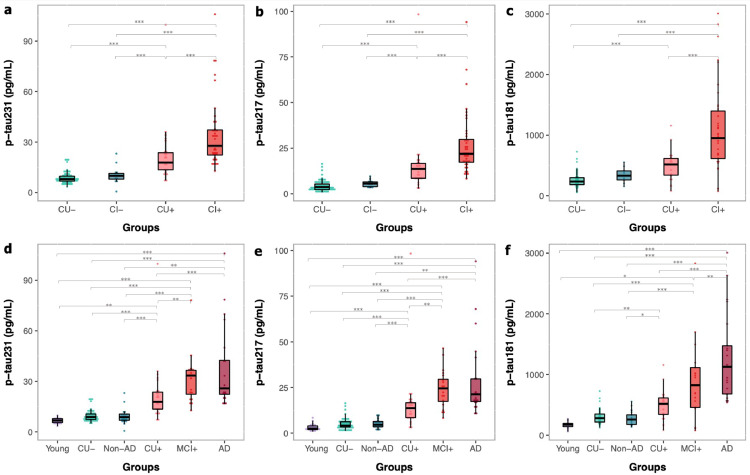
- p-tau231 reached abnormal levels first: in the whole cohort at approximately Centiloid 37, followed by p-tau181 at 47 and p-tau217 at 50; within CU individuals, p-tau231 became abnormal at Centiloid 38.3 while p-tau217 and p-tau181 became abnormal at Centiloids >50.
- In CU Aβ− individuals, p-tau231 showed focal associations with [18F]AZD4694 uptake in the medial orbitofrontal, precuneus, and posterior/isthmus cingulate cortices before global Aβ PET positivity.
Methods
- Cross-sectional study from the TRIAD cohort including 171 participants (27 young <30 years; 82 CU; 20 MCI; 21 AD; 21 non-AD) with CSF and PET imaging available; Aβ PET used [18F]AZD4694 and tau PET used [18F]MK6240, alongside clinical assessment.
- CSF p-tau181 and p-tau217 were measured by Simoa assays; p-tau231 was measured by a research ELISA. Analyses included Spearman correlations, linear models adjusted for age and sex, ROC/AUC with DeLong tests, voxel-wise VoxelStats analyses with random field theory correction, and locally weighted polynomial regression using Aβ PET Centiloids as a disease-progression proxy.
Limitations
- Stated: the cross-sectional design cannot definitively describe an ordinal sequence of CSF p-tau biomarkers; longitudinal studies are required. The main p-tau231 finding is based on 83 CU Aβ− individuals and should be replicated in an independent cohort not enriched for AD; Aβ42/p-tau ratios need larger cohorts.
- Stated: cross-sectional Aβ PET Centiloids as a proxy of disease time may not indicate a more advanced disease state; p-tau biomarkers were measured on different platforms/antibody configurations (Simoa vs ELISA), so subtle performance differences could reflect platform or antibody effects, and the specific abundance of toxic cis p-tau231 species was not determined.
- Evident from the text: diagnostic subgroups are small (20 MCI, 21 AD, 21 non-AD) and the study draws from a single TRIAD cohort, which limits precision and generalizability; the authors do not list these as limitations.
Model-written summary. Check it against the paper before relying on it.
Integrity signals
Registry
Cites
Statistics
Figures
Verification
Claims the paper makes
60 Own result · 17 Partly supported · 13 Own interpretation · 12 Own method · 9 Supported · 4 No full text of the sources · 3 No basis given · 1 Mixed support · 1 Sources not found · accuracy not yet measured
The cited sources support only part of this claim — read each source’s verdict below.
In the paper
“Increased concentrations of extracellular soluble phosphorylated tau (p-tau) and total tau (t-tau) constitute a reliable index of this intracellular process in mild cognitive impairment due to AD2,3 and AD dementia.2,4”
§ Cerebrospinal fluid p-tau231 as an early indicator of emerging pathology in Alzheimer's disease > Introduction
What the sources say
- Partly supportedcites [2] Olsson, 2016, CSF and blood biomarkers for the diagnosis of Alzheimer's disease: a systematic review and meta-analysis, Lancet Neurol sourceExperimental — accuracy not yet measured
The Introduction (page unavailable) says elevated P-tau reflects cortical tangle formation, but attributes elevated T-tau to cortical neuronal loss, not tangles. The Core biomarkers section and the MCI-AD comparison (pages unavailable) report elevated levels of both in AD and MCI-AD. Thus the concentration finding is supported, but treating both as reliable indices of the NFT process is not. (LLM, conf=0.90)
- Not checked — no full text of the sourcecites [3] Hansson, 2006, Association between CSF biomarkers and incipient Alzheimer's disease in patients with mild cognitive impairment: a follow-up study, Lancet Neurol source
- Partly supportedcites [4] Shaw, 2009, Cerebrospinal fluid biomarker signature in Alzheimer's disease neuroimaging initiative subjects, Ann Neurol sourceExperimental — accuracy not yet measured
The Results report higher CSF p-tau and t-tau in MCI than in cognitively normal subjects, with further increases in AD. The Interpretation links CSF tau to neurons that harbor tangles, but describes that link as a proposed explanation and identifies tau together with reduced Aβ1-42—not tau alone—as the diagnostic biomarker signature. It does not establish that elevated soluble tau is a reliable index of the intracellular NFT process in either group. (LLM, conf=0.86)
boostedcorrelational- Asserted: passes — The authors put it forward as true.
- Checkable: passes — It can be checked against evidence.
- Load-bearing: passes — The paper’s conclusions depend on it.
- Based: passes — The paper gives a reason why it holds.
- Partly supported
The cited sources support only part of this claim — read each source’s verdict below.
In the paper
“CSF tau species precede tau positron emission tomography (PET) abnormalities by a decade.18,19”
§ Cerebrospinal fluid p-tau231 as an early indicator of emerging pathology in Alzheimer's disease > Introduction
What the sources say
- Supportedcites [18] Barthelemy, 2020, A soluble phosphorylated tau signature links tau, amyloid and the evolution of stages of dominantly inherited Alzheimer's disease, Nat Med source
The paper’s indexed text states that tau-PET abnormalities in Alzheimer’s disease primarily increase 10–15 years after soluble tau begins to rise (Abstract; page unavailable). Extended Data Fig. 6 likewise places the tau-PET increase near symptom onset, later than increases in multiple soluble CSF phospho-tau species. (LLM, conf=0.90)
- Partly supportedcites [19] Sato, 2018, Tau kinetics in neurons and the human central nervous system, Neuron sourceExperimental — accuracy not yet measured
The Discussion (page unavailable) proposes that CSF tau increases at an asymptomatic stage before aggregated tau is detectable by PET at a very mild AD stage. It presents this sequence as a hypothesis and gives no ten-year interval; the Results (page unavailable) do not establish that timing. (LLM, conf=0.86)
plaincorrelational- Asserted: passes — The authors put it forward as true.
- Checkable: passes — It can be checked against evidence.
- Load-bearing: passes — The paper’s conclusions depend on it.
- Based: passes — The paper gives a reason why it holds.
- Supported
The cited sources support only part of this claim — read each source’s verdict below.
In the paper
“longitudinal studies have demonstrated that soluble p-tau and t-tau are increased already in preclinical disease (e.g., no cognitive impairment but evidence of AD pathology).5,6”
§ Cerebrospinal fluid p-tau231 as an early indicator of emerging pathology in Alzheimer's disease > Introduction
What the sources say
- Partly supportedcites [5] Vos, 2013, Preclinical Alzheimer's disease and its outcome: a longitudinal cohort study, Lancet Neurol sourceExperimental — accuracy not yet measured
The Methods sections on CSF markers and NIA-AA classification report that cognitively normal participants could have abnormal CSF t-tau or p-tau 181 at preclinical AD stage 2. But stage 2 required only one of the two tau markers to be abnormal, and stage 1 required neither; the paper does not establish that both are increased throughout preclinical AD. Page numbers were not available in our copy. (LLM, conf=0.86)
- Supportedcites [6] Schindler, 2019, Emerging cerebrospinal fluid biomarkers in autosomal dominant Alzheimer's disease, Alzheimers Dement source
The Results section (‘Divergence in baseline levels and rates of change’; page unavailable) reports that CSF tTau and pTau were significantly higher in autosomal dominant Alzheimer’s mutation carriers 15–19 years before estimated symptom onset. Clinical and cognitive measures did not become significantly worse until shortly before symptom onset, supporting the claim that tau elevations occur in the preclinical phase. (LLM, conf=0.90)
boosteddirect- Asserted: passes — The authors put it forward as true.
- Checkable: passes — It can be checked against evidence.
- Load-bearing: passes — The paper’s conclusions depend on it.
- Based: passes — The paper gives a reason why it holds.
- Partly supported
The cited sources support only part of this claim — read each source’s verdict below.
In the paper
“Instead, evidence now documents active secretion of tau in normal and disease conditions.19,65”
§ Cerebrospinal fluid p-tau231 as an early indicator of emerging pathology in Alzheimer's disease > Discussion
What the sources say
- Supportedcites [19] Sato, 2018, Tau kinetics in neurons and the human central nervous system, Neuron source
The Introduction states that recent studies indicate tau is actively secreted into extracellular space under physiological and pathological conditions. This directly supports the cited claim about normal and disease conditions. (LLM, conf=0.94)
- Partly supportedcites [65] Pooler, 2013, Physiological release of endogenous tau is stimulated by neuronal activity, EMBO Rep sourceExperimental — accuracy not yet measured
The Introduction and Results and Discussion show regulated tau release from healthy neurons, supporting active secretion under normal conditions. The Introduction describes tau transfer in disease models, but the Results and Discussion say that presynaptic release in those models *could* explain it and that increased release in affected brain areas has not been examined. The paper therefore does not establish active secretion in disease conditions as firmly as the claim suggests. (LLM, conf=0.85)
boosteddirect- Asserted: passes — The authors put it forward as true.
- Checkable: passes — It can be checked against evidence.
- Load-bearing: passes — The paper’s conclusions depend on it.
- Based: passes — The paper gives a reason why it holds.
- Supported
Every source the paper cites for this claim was checked and supports it.
In the paper
“This finding was even reported in individuals with seemingly normal levels of Aβ in both PET and CSF biomarkers (PET-/CSF-) but who later progressed to exhibiting abnormal levels of CSF Aβ (PET-/CSF+).”
§ Cerebrospinal fluid p-tau231 as an early indicator of emerging pathology in Alzheimer's disease > Discussion
What the sources say
- Supportedcites [59] Palmqvist, 2017, Earliest accumulation of beta-amyloid occurs within the default-mode network and concurrently affects brain connectivity, Nat Commun source
The Introduction says the study examined early regional Aβ accumulation in people with normal CSF Aβ42 and Aβ PET at baseline who later developed abnormal CSF Aβ42 while PET remained normal. The Results section, “Early Aβ accumulating regions in CSF converters,” reports this CSF−/PET− to CSF+/PET− group and its regional Aβ accumulation findings. (LLM, conf=0.92)
plaincorrelational- Asserted: passes — The authors put it forward as true.
- Checkable: passes — It can be checked against evidence.
- Load-bearing: passes — The paper’s conclusions depend on it.
- Based: passes — The paper gives a reason why it holds.
- Supported
Every source the paper cites for this claim was checked and supports it.
In the paper
“Previously, Palmqvist et al.59 showed that Aβ fibrils begin to accumulate early in core regions of default mode network (DMN), namely precuneus, posterior cingulate cortex, and orbitofrontal cortex.”
§ Cerebrospinal fluid p-tau231 as an early indicator of emerging pathology in Alzheimer's disease > Discussion
What the sources say
- Supportedcites [59] Palmqvist, 2017, Earliest accumulation of beta-amyloid occurs within the default-mode network and concurrently affects brain connectivity, Nat Commun source
The Discussion identifies the precuneus, posterior cingulate cortex, and medial orbitofrontal cortex as the most prominent early Aβ-accumulating regions. It also says the early Aβ regions were mainly within the default mode network. (LLM, conf=0.92)
plain- Asserted: passes — The authors put it forward as true.
- Checkable: passes — It can be checked against evidence.
- Load-bearing: passes — The paper’s conclusions depend on it.
- Based: passes — The paper gives a reason why it holds.
- Supported
The cited sources support only part of this claim — read each source’s verdict below.
In the paper
“At the time of tau positivity, during neurodegeneration and cognitive abnormalities phases, CSF p-tau epitopes have largely reached a plateau.66”
§ Cerebrospinal fluid p-tau231 as an early indicator of emerging pathology in Alzheimer's disease > Discussion
What the sources say
- Partly supportedcites [66] Sutphen, 2018, Longitudinal decreases in multiple cerebrospinal fluid biomarkers of neuronal injury in symptomatic late onset Alzheimer's disease, Alzheimers Dement sourceExperimental — accuracy not yet measured
The Discussion reports no statistically significant change in CSF pTau in amyloid-positive MCI, which is consistent with a plateau during that early symptomatic stage. But the Results (Elecsys pTau; page not provided) report a significant decline in the AD+ group, not a plateau across the later cognitive-abnormality phase. The paper also does not establish when pTau first becomes positive. (LLM, conf=0.84)
plain- Asserted: passes — The authors put it forward as true.
- Checkable: passes — It can be checked against evidence.
- Load-bearing: passes — The paper’s conclusions depend on it.
- Based: passes — The paper gives a reason why it holds.
- The authors state this as an assumption: Aβ PET Centiloids can serve as a proxy of time/disease progression in AD.
- Partly supported
A result the paper reports from its own data — it cites no other source for it, so there is none to check. The quote shows it is in the paper.
In the paper
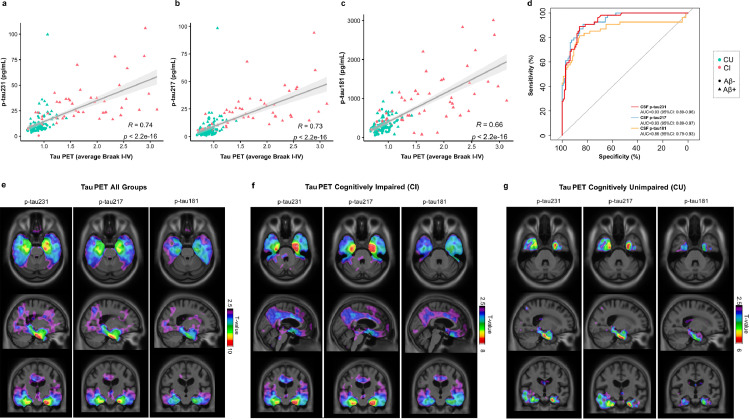
“A similar correlation coefficient was observed between CSF p-tau231 (r = 0.74, P < 0.001, Figure 2a) and CSF p-tau217 (r = 0.73, P < 0.001, Figure 2b) with Braak stage I-IV.”
§ Cerebrospinal fluid p-tau231 as an early indicator of emerging pathology in Alzheimer's disease > Results > Associations between CSF p-tau biomarkers with tau PET
plaincorrelationaln = 171- Asserted: passes — The authors put it forward as true.
- Checkable: passes — It can be checked against evidence.
- Load-bearing: passes — The paper’s conclusions depend on it.
- Based: passes — The paper gives a reason why it holds.
A result the paper reports from its own data — it cites no other source for it, so there is none to check. The quote shows it is in the paper.
In the paper
“p-tau231 attained abnormal levels first.”
- Also stated in: § Funding · plain
“amongst the biomarkers tested, is the first to achieve abnormal values.”
§ Cerebrospinal fluid p-tau231 as an early indicator of emerging pathology in Alzheimer's disease > Abstract > Findings
plaincorrelational- Asserted: passes — The authors put it forward as true.
- Checkable: passes — It can be checked against evidence.
- Load-bearing: passes — The paper’s conclusions depend on it.
- Based: passes — The paper gives a reason why it holds.
- Also stated in: § Funding · plain
A result the paper reports from its own data — it cites no other source for it, so there is none to check. The quote shows it is in the paper.
In the paper
“No significant difference was found between CSF p-tau231, CSF p-tau217 and CSF Aβ42/40 in the prediction of Aβ PET status.”
§ Cerebrospinal fluid p-tau231 as an early indicator of emerging pathology in Alzheimer's disease > Results > Associations between CSF p-tau biomarkers with Aβ PET
plainn = 171- Asserted: passes — The authors put it forward as true.
- Checkable: passes — It can be checked against evidence.
- Load-bearing: passes — The paper’s conclusions depend on it.
- Based: passes — The paper gives a reason why it holds.
A result the paper reports from its own data — it cites no other source for it, so there is none to check. The quote shows it is in the paper.
In the paper
“CSF Aβ42/40 was also a significantly better predictor of Aβ PET status than p-tau181 (AUC= 94%; 95% CI: 90-99%; PAβ42/40 vs p-tau181= 0.003).”
§ Cerebrospinal fluid p-tau231 as an early indicator of emerging pathology in Alzheimer's disease > Results > Associations between CSF p-tau biomarkers with Aβ PET
plaincorrelationaln = 171- Asserted: passes — The authors put it forward as true.
- Checkable: passes — It can be checked against evidence.
- Load-bearing: unclear — It is unclear whether the paper’s conclusions depend on it.
- Based: passes — The paper gives a reason why it holds.
A result the paper reports from its own data — it cites no other source for it, so there is none to check. The quote shows it is in the paper.
In the paper
“When groups were evaluated as CI (Figure 2f) and CU (Figure 2g) separately, broad associations were found in the CI group (TCI>3.25; PCI<0.05, Figure 2f), where high concentrations of CSF biomarkers were associated with high [18F]MK6240 binding in the temporal lobes, cingulate regions, and orbitofrontal cortices, encompassing Braak stage regions I-VI.”
§ Cerebrospinal fluid p-tau231 as an early indicator of emerging pathology in Alzheimer's disease > Results > Associations between CSF p-tau biomarkers with tau PET
plaincorrelational- Asserted: passes — The authors put it forward as true.
- Checkable: passes — It can be checked against evidence.
- Load-bearing: passes — The paper’s conclusions depend on it.
- Based: passes — The paper gives a reason why it holds.
A result the paper reports from its own data — it cites no other source for it, so there is none to check. The quote shows it is in the paper.
In the paper
“This analysis further demonstrated that CSF p-tau217 had a superior fold change to other p-tau biomarkers (P < 0.02) when specifically comparing MCI Aβ+ and AD dementia with CU Aβ- (MCI Aβ+, 5.9-fold; AD, 7.1-fold) and non-AD neurodegenerative disorders (MCI Aβ+, 4.8-fold; AD, 5.8-fold).”
§ Cerebrospinal fluid p-tau231 as an early indicator of emerging pathology in Alzheimer's disease > Results > CSF p-tau biomarkers biomarker defined groups
boostedcorrelational- Asserted: passes — The authors put it forward as true.
- Checkable: passes — It can be checked against evidence.
- Load-bearing: passes — The paper’s conclusions depend on it.
- Based: passes — The paper gives a reason why it holds.
A result the paper reports from its own data — it cites no other source for it, so there is none to check. The quote shows it is in the paper.
In the paper
“High concentrations of all CSF p-tau biomarkers were associated with increased retention of [18F]MK6240 composite Braak stage I-IV.”
§ Cerebrospinal fluid p-tau231 as an early indicator of emerging pathology in Alzheimer's disease > Results > Associations between CSF p-tau biomarkers with tau PET
plaincorrelationaln = 171- Asserted: passes — The authors put it forward as true.
- Checkable: passes — It can be checked against evidence.
- Load-bearing: passes — The paper’s conclusions depend on it.
- Based: passes — The paper gives a reason why it holds.
A result the paper reports from its own data — it cites no other source for it, so there is none to check. The quote shows it is in the paper.
In the paper
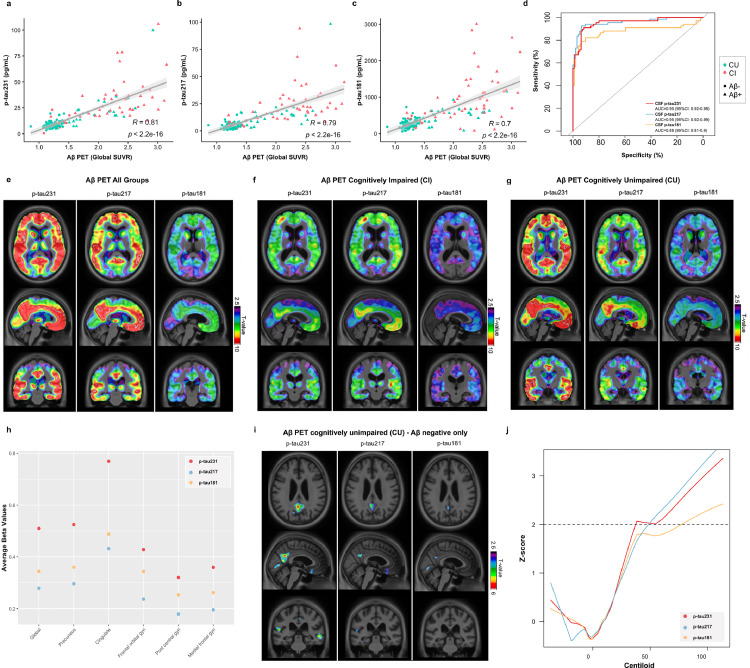
“In a similar findings to tau PET, correlation coefficients where strongest between [18F]AZD4694 global retention and CSF p-tau231 (r = 0.81, P < 0.001, Figure 3a) and CSF p-tau217 (r = 0.79, P < 0.001, Figure 3b).”
§ Cerebrospinal fluid p-tau231 as an early indicator of emerging pathology in Alzheimer's disease > Results > Associations between CSF p-tau biomarkers with Aβ PET
plaincorrelationaln = 171- Asserted: passes — The authors put it forward as true.
- Checkable: passes — It can be checked against evidence.
- Load-bearing: passes — The paper’s conclusions depend on it.
- Based: passes — The paper gives a reason why it holds.
A result the paper reports from its own data — it cites no other source for it, so there is none to check. The quote shows it is in the paper.
In the paper
“CSF p-tau231 and p-tau217 predicted Aβ and tau to a similar degree”
§ Cerebrospinal fluid p-tau231 as an early indicator of emerging pathology in Alzheimer's disease > Abstract > Findings
plaincorrelational- Asserted: passes — The authors put it forward as true.
- Checkable: passes — It can be checked against evidence.
- Load-bearing: passes — The paper’s conclusions depend on it.
- Based: passes — The paper gives a reason why it holds.
A result the paper reports from its own data — it cites no other source for it, so there is none to check. The quote shows it is in the paper.
In the paper
“In a ROC analysis, CSF p-tau181 was the best performer in distinguishing between CU and AD, when Aβ and tau PET status were unknown (AUC = 0.97; 95% CI, 0.95-0.99).”
§ Cerebrospinal fluid p-tau231 as an early indicator of emerging pathology in Alzheimer's disease > Results > Performance of CSF p-tau in clinically defined groups
plaincorrelational- Asserted: passes — The authors put it forward as true.
- Checkable: passes — It can be checked against evidence.
- Load-bearing: unclear — It is unclear whether the paper’s conclusions depend on it.
- Based: passes — The paper gives a reason why it holds.
A result the paper reports from its own data — it cites no other source for it, so there is none to check. The quote shows it is in the paper.
In the paper
“In contrast, significantly inferior correlations (Pp-tau231 vs p-tau181= 0.004; Pp-tau217 vs p-tau181= 0.02) were observed for CSF p-tau181 (r = 0.66, P < 0.001, Figure 2c).”
§ Cerebrospinal fluid p-tau231 as an early indicator of emerging pathology in Alzheimer's disease > Results > Associations between CSF p-tau biomarkers with tau PET
plaincorrelationaln = 171- Asserted: passes — The authors put it forward as true.
- Checkable: passes — It can be checked against evidence.
- Load-bearing: passes — The paper’s conclusions depend on it.
- Based: passes — The paper gives a reason why it holds.
A result the paper reports from its own data — it cites no other source for it, so there is none to check. The quote shows it is in the paper.
In the paper
“When assessing groups as either CU or CI, all CSF p-tau biomarkers were significantly increased in Aβ+ groups as compared to Aβ- groups.”
§ Cerebrospinal fluid p-tau231 as an early indicator of emerging pathology in Alzheimer's disease > Results > CSF p-tau biomarkers biomarker defined groups
plaincorrelational- Asserted: passes — The authors put it forward as true.
- Checkable: passes — It can be checked against evidence.
- Load-bearing: passes — The paper’s conclusions depend on it.
- Based: passes — The paper gives a reason why it holds.
The paper states this without a source or data behind it here, so there is nothing to check it against. The quote shows it is in the paper.
In the paper
“all p-tau epitopes have high diagnostic capability for biomarker defined AD”
§ Cerebrospinal fluid p-tau231 as an early indicator of emerging pathology in Alzheimer's disease > Abstract > Funding
plaincorrelational- Asserted: passes — The authors put it forward as true.
- Checkable: passes — It can be checked against evidence.
- Load-bearing: passes — The paper’s conclusions depend on it.
- Based: unclear — It is unclear why the paper says it holds.
A result the paper reports from its own data — it cites no other source for it, so there is none to check. The quote shows it is in the paper.
In the paper
“This included CSF Aβ42/40 which also had high accuracy to distinguish tau PET status (AUC 0.91; 95% CI, 86-97%).”
§ Cerebrospinal fluid p-tau231 as an early indicator of emerging pathology in Alzheimer's disease > Results > Associations between CSF p-tau biomarkers with tau PET
plaincorrelationaln = 171- Asserted: passes — The authors put it forward as true.
- Checkable: passes — It can be checked against evidence.
- Load-bearing: unclear — It is unclear whether the paper’s conclusions depend on it.
- Based: passes — The paper gives a reason why it holds.
A result the paper reports from its own data — it cites no other source for it, so there is none to check. The quote shows it is in the paper.
In the paper
“P-tau231 was sensitive to the earliest changes of Aβ in the medial orbitofrontal, precuneus and posterior cingulate before global Aβ PET positivity was reached”
- Also stated in: § Funding · boosted
“CSF p-tau231 was shown to have markedly stronger focal associations Aβ PET retention in medial orbitofrontal, precuneus and posterior cingulate in CU individuals yet to reach the threshold of positive global Aβ burden.”
§ Cerebrospinal fluid p-tau231 as an early indicator of emerging pathology in Alzheimer's disease > Abstract > Findings
boostedcorrelational- Asserted: passes — The authors put it forward as true.
- Checkable: passes — It can be checked against evidence.
- Load-bearing: passes — The paper’s conclusions depend on it.
- Based: passes — The paper gives a reason why it holds.
- Also stated in: § Funding · boosted
A result the paper reports from its own data — it cites no other source for it, so there is none to check. The quote shows it is in the paper.
In the paper
“Older age was associated with higher levels of all CSF p-tau.”
§ Cerebrospinal fluid p-tau231 as an early indicator of emerging pathology in Alzheimer's disease > Results > Participants
plaincorrelationaln = 171- Asserted: passes — The authors put it forward as true.
- Checkable: passes — It can be checked against evidence.
- Load-bearing: unclear — It is unclear whether the paper’s conclusions depend on it.
- Based: passes — The paper gives a reason why it holds.
A result the paper reports from its own data — it cites no other source for it, so there is none to check. The quote shows it is in the paper.
In the paper
“All CSF p-tau biomarkers were accurate predictors of cognitive impairment”
§ Cerebrospinal fluid p-tau231 as an early indicator of emerging pathology in Alzheimer's disease > Abstract > Findings
plaincorrelational- Asserted: passes — The authors put it forward as true.
- Checkable: passes — It can be checked against evidence.
- Load-bearing: passes — The paper’s conclusions depend on it.
- Based: passes — The paper gives a reason why it holds.
The paper states this without a source or data behind it here, so there is nothing to check it against. The quote shows it is in the paper.
In the paper
“p-tau epitopes identify Aβ and tau pathologies at all stages of the AD continuum”
§ Cerebrospinal fluid p-tau231 as an early indicator of emerging pathology in Alzheimer's disease > Abstract > Funding
plaincorrelational- Asserted: passes — The authors put it forward as true.
- Checkable: passes — It can be checked against evidence.
- Load-bearing: passes — The paper’s conclusions depend on it.
- Based: passes — The paper gives a reason why it holds.
A result the paper reports from its own data — it cites no other source for it, so there is none to check. The quote shows it is in the paper.
In the paper
“CSF p-tau231 displays the largest effect size in relation to Aβ deposition, both globally and regionally”
§ Cerebrospinal fluid p-tau231 as an early indicator of emerging pathology in Alzheimer's disease > Abstract > Funding
plaincorrelational- Asserted: passes — The authors put it forward as true.
- Checkable: passes — It can be checked against evidence.
- Load-bearing: passes — The paper’s conclusions depend on it.
- Based: passes — The paper gives a reason why it holds.
A result the paper reports from its own data — it cites no other source for it, so there is none to check. The quote shows it is in the paper.
In the paper
“Performing a ratio of p-tau231 and p-tau217 with CSF Aβ42 showed no statistically significance difference than p-tau alone.”
§ Cerebrospinal fluid p-tau231 as an early indicator of emerging pathology in Alzheimer's disease > Results > Associations between CSF p-tau biomarkers with Aβ PET
plain- Asserted: passes — The authors put it forward as true.
- Checkable: passes — It can be checked against evidence.
- Load-bearing: unclear — It is unclear whether the paper’s conclusions depend on it.
- Based: passes — The paper gives a reason why it holds.
A result the paper reports from its own data — it cites no other source for it, so there is none to check. The quote shows it is in the paper.
In the paper
“We also confirm that CSF p-tau do not increase in non-AD dementias or cognitive impairment with absent or minimal Aβ burden.”
§ Cerebrospinal fluid p-tau231 as an early indicator of emerging pathology in Alzheimer's disease > Discussion
plain- Asserted: passes — The authors put it forward as true.
- Checkable: passes — It can be checked against evidence.
- Load-bearing: passes — The paper’s conclusions depend on it.
- Based: passes — The paper gives a reason why it holds.
A result the paper reports from its own data — it cites no other source for it, so there is none to check. The quote shows it is in the paper.
In the paper
“CSF p-tau231 was the biomarker that best associated with [18F]AZD4694 uptake (TCU->3.19; PCU-<0.05, Figure 3i) which was significantly superior to CSF p-tau217 and CSF p-tau181 biomarkers in this analysis.”
§ Cerebrospinal fluid p-tau231 as an early indicator of emerging pathology in Alzheimer's disease > Results > CSF p-tau231 in emerging amyloid-beta pathology
plaincorrelational- Asserted: passes — The authors put it forward as true.
- Checkable: passes — It can be checked against evidence.
- Load-bearing: passes — The paper’s conclusions depend on it.
- Based: passes — The paper gives a reason why it holds.
A result the paper reports from its own data — it cites no other source for it, so there is none to check. The quote shows it is in the paper.
In the paper
“These associated areas were very focal and included the medial orbitofrontal, precuneus and posterior/isthmus cingulate cortices.”
§ Cerebrospinal fluid p-tau231 as an early indicator of emerging pathology in Alzheimer's disease > Results > CSF p-tau231 in emerging amyloid-beta pathology
plaincorrelational- Asserted: passes — The authors put it forward as true.
- Checkable: passes — It can be checked against evidence.
- Load-bearing: unclear — It is unclear whether the paper’s conclusions depend on it.
- Based: passes — The paper gives a reason why it holds.
A result the paper reports from its own data — it cites no other source for it, so there is none to check. The quote shows it is in the paper.
In the paper
“Results of the voxel-wise analysis showed high CSF biomarker levels being associated with high [18F]AZD4694 binding in frontal, precuneus, posterior cingulate and temporal cortices (Tall>3.14; Pall<0.05, Figure 3e).”
§ Cerebrospinal fluid p-tau231 as an early indicator of emerging pathology in Alzheimer's disease > Results > Associations between CSF p-tau biomarkers with Aβ PET
plaincorrelational- Asserted: passes — The authors put it forward as true.
- Checkable: passes — It can be checked against evidence.
- Load-bearing: passes — The paper’s conclusions depend on it.
- Based: passes — The paper gives a reason why it holds.
A result the paper reports from its own data — it cites no other source for it, so there is none to check. The quote shows it is in the paper.
In the paper
“Again, no significant difference was observed between the inflection point of these biomarkers however, abnormality of CSF p-tau231 were observed far earlier (Centiloid 38.3) than whilst CSF p-tau217 and CSF p-tau181 (Centiloids >50).”
§ Cerebrospinal fluid p-tau231 as an early indicator of emerging pathology in Alzheimer's disease > Results > CSF p-tau231 in emerging amyloid-beta pathology
plain- Asserted: passes — The authors put it forward as true.
- Checkable: passes — It can be checked against evidence.
- Load-bearing: passes — The paper’s conclusions depend on it.
- Based: passes — The paper gives a reason why it holds.
A result the paper reports from its own data — it cites no other source for it, so there is none to check. The quote shows it is in the paper.
In the paper
“No difference between the inflection point of these biomarkers was identified.”
§ Cerebrospinal fluid p-tau231 as an early indicator of emerging pathology in Alzheimer's disease > Results > Associations between CSF p-tau biomarkers with Aβ PET
plain- Asserted: passes — The authors put it forward as true.
- Checkable: passes — It can be checked against evidence.
- Load-bearing: unclear — It is unclear whether the paper’s conclusions depend on it.
- Based: passes — The paper gives a reason why it holds.
A result the paper reports from its own data — it cites no other source for it, so there is none to check. The quote shows it is in the paper.
In the paper
“At the voxel level, however, CSF p-tau231 had a markedly stronger relationship with Aβ pathology in CU individuals.”
§ Cerebrospinal fluid p-tau231 as an early indicator of emerging pathology in Alzheimer's disease > Discussion
boostedcorrelational- Asserted: passes — The authors put it forward as true.
- Checkable: passes — It can be checked against evidence.
- Load-bearing: passes — The paper’s conclusions depend on it.
- Based: passes — The paper gives a reason why it holds.
A result the paper reports from its own data — it cites no other source for it, so there is none to check. The quote shows it is in the paper.
In the paper
“T-parametric maps (i) show the voxel-wise association between CSF biomarkers (p-tau231, p-tau217 and p-tau181) and [18F]AZD4694 in Aβ-negative CU subjects.”
§ Cerebrospinal fluid p-tau231 as an early indicator of emerging pathology in Alzheimer's disease > Results > Associations between CSF p-tau biomarkers with Aβ PET
plaincorrelational- Asserted: passes — The authors put it forward as true.
- Checkable: passes — It can be checked against evidence.
- Load-bearing: passes — The paper’s conclusions depend on it.
- Based: passes — The paper gives a reason why it holds.
A result the paper reports from its own data — it cites no other source for it, so there is none to check. The quote shows it is in the paper.
In the paper
“Furthermore, at the voxel-wise level, CSF p-tau231 demonstrated substantially higher associations with [18F]AZD4694 retention than CSF p-tau217 in CU individuals.”
§ Cerebrospinal fluid p-tau231 as an early indicator of emerging pathology in Alzheimer's disease > Discussion
boostedcorrelational- Asserted: passes — The authors put it forward as true.
- Checkable: passes — It can be checked against evidence.
- Load-bearing: passes — The paper’s conclusions depend on it.
- Based: passes — The paper gives a reason why it holds.
A result the paper reports from its own data — it cites no other source for it, so there is none to check. The quote shows it is in the paper.
In the paper
“In the CI group analyses, there was no difference between the associations of [18F]AZD4694 with CSF p-tau231 and CSF p-tau-217 (TCI>3.25; PCI<0.05; Figure 3f).”
§ Cerebrospinal fluid p-tau231 as an early indicator of emerging pathology in Alzheimer's disease > Results > Associations between CSF p-tau biomarkers with Aβ PET
plain- Asserted: passes — The authors put it forward as true.
- Checkable: passes — It can be checked against evidence.
- Load-bearing: unclear — It is unclear whether the paper’s conclusions depend on it.
- Based: passes — The paper gives a reason why it holds.
A result the paper reports from its own data — it cites no other source for it, so there is none to check. The quote shows it is in the paper.
In the paper
“In contrast, in the CU group, there was an evident difference between CSF p-tau231 and the other biomarkers (Figure 3g), despite there not being an evident difference in the whole set of participants (TCU>3.16; PCU<0.05).”
§ Cerebrospinal fluid p-tau231 as an early indicator of emerging pathology in Alzheimer's disease > Results > Associations between CSF p-tau biomarkers with Aβ PET
plain- Asserted: passes — The authors put it forward as true.
- Checkable: passes — It can be checked against evidence.
- Load-bearing: passes — The paper’s conclusions depend on it.
- Based: passes — The paper gives a reason why it holds.
A result the paper reports from its own data — it cites no other source for it, so there is none to check. The quote shows it is in the paper.
In the paper
“Even though there was a topographical overlap of the significantly associated regions between the CSF biomarkers evaluated, a markedly stronger association was observed for CSF p-tau231 when the whole sample was analyzed (Figure 3e).”
§ Cerebrospinal fluid p-tau231 as an early indicator of emerging pathology in Alzheimer's disease > Results > Associations between CSF p-tau biomarkers with Aβ PET
plaincorrelational- Asserted: passes — The authors put it forward as true.
- Checkable: passes — It can be checked against evidence.
- Load-bearing: unclear — It is unclear whether the paper’s conclusions depend on it.
- Based: passes — The paper gives a reason why it holds.
A result the paper reports from its own data — it cites no other source for it, so there is none to check. The quote shows it is in the paper.
In the paper
“For all the regions evaluated, CSF p-tau231 had the highest beta values as compared to the other biomarkers globally and in all ROIs (Figure 3h).”
§ Cerebrospinal fluid p-tau231 as an early indicator of emerging pathology in Alzheimer's disease > Results > Associations between CSF p-tau biomarkers with Aβ PET
plaincorrelational- Asserted: passes — The authors put it forward as true.
- Checkable: passes — It can be checked against evidence.
- Load-bearing: passes — The paper’s conclusions depend on it.
- Based: passes — The paper gives a reason why it holds.
A result the paper reports from its own data — it cites no other source for it, so there is none to check. The quote shows it is in the paper.
In the paper
“Again, no significant difference was observed between the inflection point of these biomarkers however, abnormality of CSF p-tau231 were observed far earlier (Centiloid 38.3) than whilst CSF p-tau217 and CSF p-tau181 (Centiloids >50).”
§ Cerebrospinal fluid p-tau231 as an early indicator of emerging pathology in Alzheimer's disease > Results > CSF p-tau231 in emerging amyloid-beta pathology
plaincorrelational- Asserted: passes — The authors put it forward as true.
- Checkable: passes — It can be checked against evidence.
- Load-bearing: passes — The paper’s conclusions depend on it.
- Based: passes — The paper gives a reason why it holds.
A result the paper reports from its own data — it cites no other source for it, so there is none to check. The quote shows it is in the paper.
In the paper
“Even though there was a topographical overlap of the significantly associated regions between the CSF biomarkers evaluated, a markedly stronger association was observed for CSF p-tau231 when the whole sample was analyzed (Figure 3e).”
§ Cerebrospinal fluid p-tau231 as an early indicator of emerging pathology in Alzheimer's disease > Results > Associations between CSF p-tau biomarkers with Aβ PET
boostedcorrelational- Asserted: passes — The authors put it forward as true.
- Checkable: passes — It can be checked against evidence.
- Load-bearing: passes — The paper’s conclusions depend on it.
- Based: passes — The paper gives a reason why it holds.
A result the paper reports from its own data — it cites no other source for it, so there is none to check. The quote shows it is in the paper.
In the paper
“A ratio of CSF Aβ42 with p-tau181 improved the prediction of amyloid status in CU participants (p-tau181/Aβ42, AUC=90%; 95% CI, 82-99%; Pp-tau181/Aβ42 vs p-tau181= 0.03).”
§ Cerebrospinal fluid p-tau231 as an early indicator of emerging pathology in Alzheimer's disease > Results > Associations between CSF p-tau biomarkers with Aβ PET
plaincorrelational- Asserted: passes — The authors put it forward as true.
- Checkable: passes — It can be checked against evidence.
- Load-bearing: unclear — It is unclear whether the paper’s conclusions depend on it.
- Based: passes — The paper gives a reason why it holds.
A result the paper reports from its own data — it cites no other source for it, so there is none to check. The quote shows it is in the paper.
In the paper
“This is seemingly more apparent for CSF p-tau231, which changes with Aβ deposition in the medial orbitofrontal, precuneus and posterior cingulate cortices before Aβ PET positivity is achieved.”
§ Cerebrospinal fluid p-tau231 as an early indicator of emerging pathology in Alzheimer's disease > Discussion
hedgedcorrelational- Asserted: passes — The authors put it forward as true.
- Checkable: passes — It can be checked against evidence.
- Load-bearing: passes — The paper’s conclusions depend on it.
- Based: passes — The paper gives a reason why it holds.
A conclusion the paper draws from its own results — it cites no other source for it, so there is none to check. The quote shows it is in the paper.
In the paper
“our evidence suggests that p-tau231 has an advantage over other p-tau epitope to highlight this early preclinical population.”
§ Cerebrospinal fluid p-tau231 as an early indicator of emerging pathology in Alzheimer's disease > Abstract > Funding
hedgedcorrelational- Asserted: passes — The authors put it forward as true.
- Checkable: passes — It can be checked against evidence.
- Load-bearing: passes — The paper’s conclusions depend on it.
- Based: passes — The paper gives a reason why it holds.
- Rests on an assumption: Disease-modifying drug candidates have a better opportunity to show effectiveness if initiated before symptom onset or even before overt Aβ plaque load.
A conclusion the paper draws from its own results — it cites no other source for it, so there is none to check. The quote shows it is in the paper.
In the paper
“and is a principal candidate for detecting incipient Aβ pathology for therapeutic trial application”
§ Cerebrospinal fluid p-tau231 as an early indicator of emerging pathology in Alzheimer's disease > Abstract > Interpretation
plaincorrelational- Asserted: passes — The authors put it forward as true.
- Checkable: passes — It can be checked against evidence.
- Load-bearing: passes — The paper’s conclusions depend on it.
- Based: passes — The paper gives a reason why it holds.
- Rests on an assumption: Disease-modifying drug candidates have a better opportunity to show effectiveness if initiated before symptom onset or even before overt Aβ plaque load.
A claim is checked only against the cited paper’s full text, never its abstract, and none is available for its sources.
In the paper
“Preclinical studies provide compelling evidence supporting early brain amyloidosis as a driver of tau hyperphosphorylation in AD.14,15”
§ Cerebrospinal fluid p-tau231 as an early indicator of emerging pathology in Alzheimer's disease > Introduction
What the sources say
- Not checked — no full text of the sourcecites [14] Maia, 2013, Changes in amyloid-beta and Tau in the cerebrospinal fluid of transgenic mice overexpressing amyloid precursor protein, Sci Transl Med source
- Not checked — no full text of the sourcecites [15] Schelle, 2017, Prevention of tau increase in cerebrospinal fluid of APP transgenic mice suggests downstream effect of BACE1 inhibition, Alzheimers Dement source
boosteddirect- Asserted: passes — The authors put it forward as true.
- Checkable: passes — It can be checked against evidence.
- Load-bearing: passes — The paper’s conclusions depend on it.
- Based: passes — The paper gives a reason why it holds.
A conclusion the paper draws from its own results — it cites no other source for it, so there is none to check. The quote shows it is in the paper.
In the paper
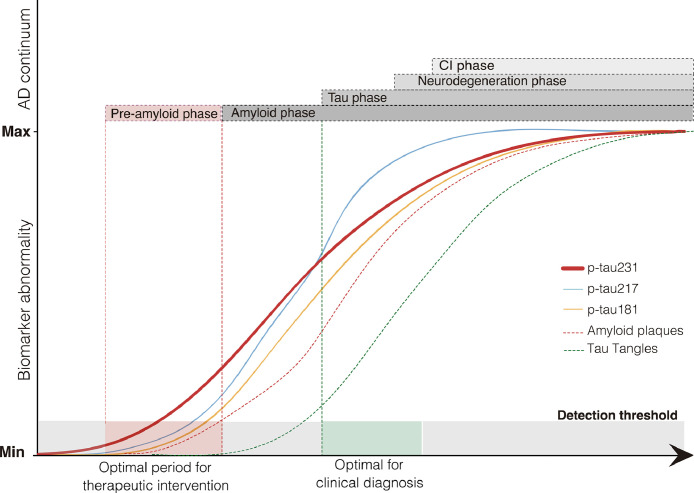
“On the basis of the evidence presented above, we propose a theoretical framework in which CSF p-tau epitopes become abnormal in a temporally ordered manner as the disease progresses (Figure 4).”
§ Cerebrospinal fluid p-tau231 as an early indicator of emerging pathology in Alzheimer's disease > Discussion
hedgeddirect- Asserted: passes — The authors put it forward as true.
- Checkable: passes — It can be checked against evidence.
- Load-bearing: passes — The paper’s conclusions depend on it.
- Based: passes — The paper gives a reason why it holds.
- The authors state this as an assumption: Aβ PET Centiloids can serve as a proxy of time/disease progression in AD.
A conclusion the paper draws from its own results — it cites no other source for it, so there is none to check. The quote shows it is in the paper.
In the paper
“Our main finding suggests that CSF p-tau231 abnormality arises during the lag phase of Aβ protein aggregation in the brain as shown by markedly stronger focal associations of CSF p-tau231 and Aβ PET in CU individuals without positive global Aβ burden.”
§ Cerebrospinal fluid p-tau231 as an early indicator of emerging pathology in Alzheimer's disease > Discussion
hedgeddirect- Asserted: passes — The authors put it forward as true.
- Checkable: passes — It can be checked against evidence.
- Load-bearing: passes — The paper’s conclusions depend on it.
- Based: passes — The paper gives a reason why it holds.
A conclusion the paper draws from its own results — it cites no other source for it, so there is none to check. The quote shows it is in the paper.
In the paper
“Therefore, now that we can monitor the in vivo development of Aβ and tau pathologies by PET, it is not surprising that our analysis concludes that CSF p-tau231 is an early marker of emerging AD pathology in the phase when only subtle brain amyloidosis is apparent.”
§ Cerebrospinal fluid p-tau231 as an early indicator of emerging pathology in Alzheimer's disease > Discussion
boostedcorrelational- Asserted: passes — The authors put it forward as true.
- Checkable: passes — It can be checked against evidence.
- Load-bearing: passes — The paper’s conclusions depend on it.
- Based: passes — The paper gives a reason why it holds.
- Probably not a substantial claim. 24
- It may state two separate claims as one. 58
- The quote only partly states this claim. 1
Some cited sources support this claim and some don’t — read each source’s verdict below.
In the paper
“Interestingly, evidence from AD neuronal culture models indicate that soluble Aβ oligomers (AβOs) induce tau hyperphosphorylation in multiple sites.16,17”
§ Cerebrospinal fluid p-tau231 as an early indicator of emerging pathology in Alzheimer's disease > Introduction
What the sources say
- Supportedcites [16] De Felice, 2008, Alzheimer's disease-type neuronal tau hyperphosphorylation induced by A beta oligomers, Neurobiol Aging source
The Discussion reports that soluble Aβ oligomers induced tau hyperphosphorylation at five AD-characteristic epitopes in cultured neurons. The Results section 3.6 also reports increased tau phosphorylation in hippocampal neuronal cultures treated with soluble AD-brain extract containing Aβ oligomers. (LLM, conf=0.94)
- Disputedcites [17] Sackmann, 2020, Oligomeric amyloid-beta induces early and widespread changes to the proteome in human iPSC-derived neurons, Sci Rep sourceExperimental — accuracy not yet measured
The Discussion reports increased tau phosphorylation at Ser208 after oligomeric Aβ exposure, but says other canonical tau phosphorylation sites were not remarkably altered after 24 hours. Its finding is therefore contrary to the attributed claim of hyperphosphorylation at multiple sites. (LLM, conf=0.88)
Checked by a reasoning model — may be wrong.
hedgeddirect- Asserted: passes — The authors put it forward as true.
- Checkable: passes — It can be checked against evidence.
- Load-bearing: fails — The paper’s conclusions may not depend on it.
- Based: passes — The paper gives a reason why it holds.
Probably not a substantial claim. The paper’s conclusions may not depend on it.
- Supported
Every source the paper cites for this claim was checked and supports it.
In the paper
“Specifically, CSF concentrations of t-tau and p-tau are proposed to reflect neurodegeneration and tau pathology in the form of NFTs, respectively.7”
§ Cerebrospinal fluid p-tau231 as an early indicator of emerging pathology in Alzheimer's disease > Introduction
What the sources say
- Supportedcites [7] Jack, 2018, NIA-AA Research Framework: Toward a biological definition of Alzheimer's disease, Alzheimers Dement source
Section 9.3 says CSF T-tau reflects the intensity of neuronal damage, while elevated CSF P-tau reflects a pathologic state associated with paired-helical-filament tau formation. This supports the proposed distinction. Section 9.1 clarifies that CSF P-tau is not a direct measure of accumulated tau deposits. (LLM, conf=0.90)
hedgedcorrelational- Asserted: passes — The authors put it forward as true.
- Checkable: passes — It can be checked against evidence.
- Load-bearing: passes — The paper’s conclusions depend on it.
- Based: passes — The paper gives a reason why it holds.
It may state two separate claims as one.
- Supported
Every source the paper cites for this claim was checked and supports it.
In the paper
“Recent reports have suggested that CSF p-tau217 might better discriminate AD from other neurodegenerative diseases24,27, 28, 29, 30 than CSF p-tau181.”
§ Cerebrospinal fluid p-tau231 as an early indicator of emerging pathology in Alzheimer's disease > Introduction
What the sources say
- Supportedcites [24] Janelidze, 2020, Cerebrospinal fluid p-tau217 performs better than p-tau181 as a biomarker of Alzheimer's disease, Nat Commun source
The Results section, “Diagnostic accuracy of CSF p-tau217 and p-tau181,” reports that p-tau217 had a significantly higher AUC than p-tau181 for distinguishing AD dementia from non-AD neurodegenerative disorders. The Discussion states the same conclusion directly; the citing sentence’s cautious “might” does not overstate it. (LLM, conf=0.95)
- Supportedcites [27] Barthelemy, 2020, Cerebrospinal fluid phospho-tau T217 outperforms T181 as a biomarker for the differential diagnosis of Alzheimer's disease and PET amyloid-positive patient identification, Alzheimers Res Ther source
The Results section (Montpellier AD cohort) reports that pT181 values overlapped between AD and non-AD patients with disorders including PSP, LBD, and FTLD, whereas pT217 values strongly discriminated between the groups. The Conclusions also describe pT217 as a more accurate biomarker than pT181, consistent with the citing sentence’s cautious wording. (LLM, conf=0.94)
- Supportedcites [28] Karikari, 2020, Head-to-head comparison of clinical performance of CSF phospho-tau T181 and T217 biomarkers for Alzheimer's disease diagnosis, Alzheimers Dement source
The Introduction and Discussion report that earlier studies suggested p-tau217 could distinguish AD from non-AD disorders better than p-tau181, supporting the citing sentence’s hedged description of recent reports. This paper’s own head-to-head Results found similar accuracy for the biomarkers in distinguishing AD dementia from non-AD dementia; page numbers were not supplied. (LLM, conf=0.86)
- Supportedcites [29] Mielke, 2021, Comparison of CSF phosphorylated tau 181 and 217 for cognitive decline, Alzheimers Dement source
The Background states that multiple studies suggest CSF p-tau217 is better than p-tau181 at distinguishing AD from non-AD neurodegenerative diseases. It also notes that the advantage may depend on the p-tau181 antibodies used, which is consistent with the citing sentence’s cautious wording. (LLM, conf=0.92)
- Supportedcites [30] Leuzy, 2021, Comparing the clinical utility and diagnostic performance of CSF P-Tau181, P-Tau217, and P-Tau231 Assays, Neurology source
The paper’s background explicitly states that CSF p-tau217 more accurately distinguished AD dementia from non-AD neurodegenerative disorders than p-tau181. Its Discussion also reports greater discriminative accuracy for p-tau217 than the p-tau181 assays tested. (LLM, conf=0.93)
hedgedcorrelational- Asserted: passes — The authors put it forward as true.
- Checkable: passes — It can be checked against evidence.
- Load-bearing: fails — The paper’s conclusions may not depend on it.
- Based: passes — The paper gives a reason why it holds.
Probably not a substantial claim. The paper’s conclusions may not depend on it.
- Supported
Every source the paper cites for this claim was checked and supports it.
In the paper
“In addition, CSF p-tau217 correlates better with Aβ and tau PET imaging than CSF p-tau181.24,30”
§ Cerebrospinal fluid p-tau231 as an early indicator of emerging pathology in Alzheimer's disease > Introduction
What the sources say
- Supportedcites [24] Janelidze, 2020, Cerebrospinal fluid p-tau217 performs better than p-tau181 as a biomarker of Alzheimer's disease, Nat Commun source
The Discussion states that CSF p-tau217 had higher correlations than p-tau181 with [18F]flortaucipir (tau PET) and [18F]flutemetamol (amyloid-β PET) retention. The Results section also reports significantly higher correlation coefficients for p-tau217 across the tau PET regions studied. Page numbers were not supplied in the passages. (LLM, conf=0.94)
- Supportedcites [30] Leuzy, 2021, Comparing the clinical utility and diagnostic performance of CSF P-Tau181, P-Tau217, and P-Tau231 Assays, Neurology source
The Results section (‘Correlations Between CSF P-Tau and Aβ and Tau-PET’) reports stronger correlations for CSF p-tau217Lilly than for the tested p-tau181 assays with both Aβ-PET and tau-PET. The Discussion explicitly summarizes the same comparison. The finding is based on the assays and participant groups studied, rather than every possible p-tau assay or population. (LLM, conf=0.94)
plaincorrelational- Asserted: passes — The authors put it forward as true.
- Checkable: passes — It can be checked against evidence.
- Load-bearing: fails — The paper’s conclusions may not depend on it.
- Based: passes — The paper gives a reason why it holds.
Probably not a substantial claim. The paper’s conclusions may not depend on it.
- Supported
Every source the paper cites for this claim was checked and supports it.
In the paper
“We have recently reported that CSF p-tau231 increases early in the AD continuum and, therefore, may detect preclinical AD among cognitively unimpaired (CU) individuals.31”
§ Cerebrospinal fluid p-tau231 as an early indicator of emerging pathology in Alzheimer's disease > Introduction
What the sources say
- Supportedcites [31] Suarez-Calvet, 2020, Novel tau biomarkers phosphorylated at T181, T217 or T231 rise in the initial stages of the preclinical Alzheimer's continuum when only subtle changes in Abeta pathology are detected, EMBO Mol Med source
The Discussion reports that CSF Mid-p-tau231 increases prominently early in the Alzheimer’s continuum, including when Aβ pathology is subtle. It also reports that the biomarker differentiates Aβ-positive from Aβ-negative cognitively unimpaired individuals, supporting the hedged claim that it may detect preclinical AD. Page numbers are not provided in our copy. (LLM, conf=0.94)
hedgeddirect- Asserted: passes — The authors put it forward as true.
- Checkable: passes — It can be checked against evidence.
- Load-bearing: passes — The paper’s conclusions depend on it.
- Based: passes — The paper gives a reason why it holds.
It may state two separate claims as one.
- Supported
The cited sources support only part of this claim — read each source’s verdict below.
In the paper
“However, these biomarkers remain at normal concentrations in other neurodegenerative disorders with substantial neurodegeneration,8, 9, 10 and also those with tau pathology.11, 12, 13”
§ Cerebrospinal fluid p-tau231 as an early indicator of emerging pathology in Alzheimer's disease > Introduction
What the sources say
- Not checked — no full text of the sourcecites [8] Riemenschneider, 2003, Phospho-tau/total tau ratio in cerebrospinal fluid discriminates Creutzfeldt-Jakob disease from other dementias, Mol Psychiatry source
- Not checked — no full text of the sourcecites [9] Skillback, 2014, Diagnostic performance of cerebrospinal fluid total tau and phosphorylated tau in Creutzfeldt-Jakob disease: results from the Swedish mortality registry, JAMA Neurol source
- Not checked — no full text of the sourcecites [10] Schoonenboom, 2012, Cerebrospinal fluid markers for differential dementia diagnosis in a large memory clinic cohort, Neurology source
- Not checked — no full text of the sourcecites [11] Hampel, 2004, Measurement of phosphorylated tau epitopes in the differential diagnosis of Alzheimer disease: a comparative cerebrospinal fluid study, Arch Gen Psychiatry source
- Could not verifycites [12] Leuzy, 2020, Diagnostic performance of RO948 F 18 tau positron emission tomography in the differentiation of Alzheimer disease from other neurodegenerative disorders, JAMA Neurol sourceExperimental — accuracy not yet measured
The Introduction (page unavailable) says that tau pathology occurs in non-Alzheimer neurodegenerative disorders, and the Conclusions (page unavailable) discuss the diagnostic performance of CSF p-tau181. Neither passage establishes that CSF t-tau and p-tau remain at normal concentrations in those disorders, including those with tau pathology. Searches for their concentrations in non-Alzheimer disorders did not find that result in our copy. (LLM, conf=0.73)
- Partly supportedcites [13] La Joie, 2018, Associations between [(18)F]AV1451 tau PET and CSF measures of tau pathology in a clinical sample, Neurology sourceExperimental — accuracy not yet measured
The Abstract (page unavailable) reports that CSF p-tau distinguishes Alzheimer disease from non-AD neurodegenerative conditions, lending support to a difference in biomarker levels. It does not establish that both p-tau and t-tau remain at normal concentrations in disorders with tau pathology; that stronger, disorder-specific claim is unsupported by the passages in our copy. (LLM, conf=0.76)
plain- Asserted: passes — The authors put it forward as true.
- Checkable: passes — It can be checked against evidence.
- Load-bearing: passes — The paper’s conclusions depend on it.
- Based: passes — The paper gives a reason why it holds.
It may state two separate claims as one.
Every source the paper cites for this claim was checked and supports it.
In the paper
“a recent study in transgenic mice suggests that early removal of Aβ seeds, before Aβ deposition becomes detectable, led to a significant reduction of Aβ accumulation and downstream pathologies.32”
§ Cerebrospinal fluid p-tau231 as an early indicator of emerging pathology in Alzheimer's disease > Introduction
What the sources say
- Supportedcites [32] Uhlmann, 2020, Acute targeting of pre-amyloid seeds in transgenic mice reduces Alzheimer-like pathology later in life, Nat Neurosci source
The Discussion reports that targeting Aβ seeds before amyloid formation was detectable significantly reduced Aβ deposition and associated pathologies six months later in a mouse model. The Abstract likewise reports reduced deposition and downstream pathologies after antibody treatment at the pre-amyloid stage. (LLM, conf=0.94)
hedgeddirect- Asserted: passes — The authors put it forward as true.
- Checkable: passes — It can be checked against evidence.
- Load-bearing: passes — The paper’s conclusions depend on it.
- Based: passes — The paper gives a reason why it holds.
Probably not a substantial claim.
- Supported
The cited sources support only part of this claim — read each source’s verdict below.
In the paper
“Thus, it is suggested that CSF p-tau biomarkers likely indicate an active process of tau secretion, and one that is correlated with cerebral Aβ deposition in early disease.20, 21, 22”
§ Cerebrospinal fluid p-tau231 as an early indicator of emerging pathology in Alzheimer's disease > Introduction
What the sources say
- Partly supportedcites [20] Bateman, 2012, Clinical and biomarker changes in dominantly inherited Alzheimer's disease, N Engl J Med sourceExperimental — accuracy not yet measured
The Methods (Biochemical Analysis; page unavailable) say the study measured CSF phosphorylated tau. The Results (Combined Model; page unavailable) place increased CSF tau and cerebral Aβ deposition about 15 years before expected symptom onset in mutation carriers. These findings support their early co-occurrence, but the paper does not establish active tau secretion or a correlation specifically between CSF p-tau and cerebral Aβ deposition. (LLM, conf=0.82)
- Partly supportedcites [21] Toledo, 2013, Longitudinal change in CSF Tau and Abeta biomarkers for up to 48 months in ADNI, Acta Neuropathol sourceExperimental — accuracy not yet measured
The Results and Discussion (page unavailable) report that low baseline CSF Aβ1–42 was associated with subsequent increases in CSF p-tau181, supporting a relationship between the biomarkers in the studied cohort. They do not establish that p-tau indicates active tau secretion or directly show a correlation with cerebral Aβ deposition; the association measured here was with CSF Aβ1–42. (LLM, conf=0.86)
- Partly supportedcites [22] Brunello, 2020, Mechanisms of secretion and spreading of pathological tau protein, Cell Mol Life Sci sourceExperimental — accuracy not yet measured
The Cell-to-cell transfer of tau section says CSF in AD contains elevated phosphorylated tau and that active cellular processes contribute to tau secretion. The paper also discusses amyloid pathology as a possible trigger for tau release, but it does not state that CSF p-tau biomarkers correlate with cerebral Aβ deposition in early disease. Page numbers are unavailable in our copy. (LLM, conf=0.86)
hedgedcorrelational- Asserted: passes — The authors put it forward as true.
- Checkable: passes — It can be checked against evidence.
- Load-bearing: passes — The paper’s conclusions depend on it.
- Based: passes — The paper gives a reason why it holds.
It may state two separate claims as one.
- Partly supported
The cited sources support only part of this claim — read each source’s verdict below.
In the paper
“Our data, like prior studies,18,28,31 shows an increase of CSF p-tau epitopes in the preclinical phase of the disease, prior to symptom onset and before substantial tau PET ligand retention.”
§ Cerebrospinal fluid p-tau231 as an early indicator of emerging pathology in Alzheimer's disease > Discussion
What the sources say
- Supportedcites [18] Barthelemy, 2020, A soluble phosphorylated tau signature links tau, amyloid and the evolution of stages of dominantly inherited Alzheimer's disease, Nat Med source
The Discussion reports an early rise in CSF pT217/T217 and pT181/T181 before clinical symptoms. Extended Data Fig. 6 reports little tau-PET elevation until estimated symptom onset in dominantly inherited Alzheimer’s disease, placing the soluble p-tau increase before substantial tau-PET retention. (LLM, conf=0.93)
- Partly supportedcites [28] Karikari, 2020, Head-to-head comparison of clinical performance of CSF phospho-tau T181 and T217 biomarkers for Alzheimer's disease diagnosis, Alzheimers Dement sourceExperimental — accuracy not yet measured
The Introduction reports that CSF p-tau217 begins to increase in preclinical familial Alzheimer’s disease, supporting an increase before symptoms. The Discussion also describes early increases in N-terminal p-tau biomarkers. Neither passage establishes that these increases precede substantial tau-PET ligand retention; the Introduction reports a correlation with tau-PET, not that timing. (LLM, conf=0.84)
- Supportedcites [31] Suarez-Calvet, 2020, Novel tau biomarkers phosphorylated at T181, T217 or T231 rise in the initial stages of the preclinical Alzheimer's continuum when only subtle changes in Abeta pathology are detected, EMBO Mol Med source
The Discussion reports that CSF p-tau increases earlier in Alzheimer’s disease than tau PET, citing prior timing studies. The study’s Conclusion reports increases in several CSF p-tau biomarkers in cognitively unimpaired people at an early preclinical stage. Tau PET timing is discussed rather than directly measured in this study. (LLM, conf=0.90)
boosteddirect- Asserted: passes — The authors put it forward as true.
- Checkable: passes — It can be checked against evidence.
- Load-bearing: passes — The paper’s conclusions depend on it.
- Based: passes — The paper gives a reason why it holds.
It may state two separate claims as one.
- Supported
The cited sources support only part of this claim — read each source’s verdict below.
In the paper
“P-tau231 levels in blood have also recently been demonstrated to increase earlier than p-tau18160 (Tissot et al., 2022), however, a direct comparison with p-tau217 in early preclinical disease is not currently available.”
§ Cerebrospinal fluid p-tau231 as an early indicator of emerging pathology in Alzheimer's disease > Discussion
What the sources say
- Supportedcites [60] Ashton, 2021, Plasma p-tau231: a new biomarker for incipient Alzheimer's disease pathology, Acta Neuropathol source
The ‘Plasma p-tau231 as an early markers of AD pathology’ section reports that plasma p-tau231 increased earlier than plasma p-tau181 as a function of Aβ deposition. The Discussion explicitly says the study could not directly compare plasma p-tau231 with plasma p-tau217; its p-tau217 comparison used CSF instead. (LLM, conf=0.93)
- Not matchedcites Tissot et al., 2022
Couldn’t be matched to a paper in Crossref, so it can’t be checked.
boosteddirect- Asserted: passes — The authors put it forward as true.
- Checkable: passes — It can be checked against evidence.
- Load-bearing: fails — The paper’s conclusions may not depend on it.
- Based: passes — The paper gives a reason why it holds.
Probably not a substantial claim. The paper’s conclusions may not depend on it. It may state two separate claims as one.
- Supported
The cited sources support only part of this claim — read each source’s verdict below.
In the paper
“Thus, in relation to sporadic AD, this study adds further support to the hypothesis that CSF p-tau is closely related to Aβ-mediated tau release from neurons19 and challenges the notion of being simply a state marker of NFT.”
§ Cerebrospinal fluid p-tau231 as an early indicator of emerging pathology in Alzheimer's disease > Discussion
What the sources say
- Partly supportedcites [19] Sato, 2018, Tau kinetics in neurons and the human central nervous system, Neuron sourceExperimental — accuracy not yet measured
The Results section reports that CSF tau production, including synthesis and release, correlates with amyloid burden; the Discussion proposes that this increase can precede tau aggregation. But the amyloid–release analysis concerns tau overall, not specifically CSF p-tau, and it does not establish that Aβ causes neuronal p-tau release. The paper therefore supports the broader hypothesis, but not the claim at that level of specificity. (LLM, conf=0.84)
plaincorrelational- Asserted: passes — The authors put it forward as true.
- Checkable: passes — It can be checked against evidence.
- Load-bearing: passes — The paper’s conclusions depend on it.
- Based: passes — The paper gives a reason why it holds.
It may state two separate claims as one.
- Partly supported
The cited sources support only part of this claim — read each source’s verdict below.
In the paper
“Previous neuropathological findings, which motivated the CSF assay development of p-tau231, highlighted that a key component of pre-tangle pathology was phosphorylation at threonine 23155 and that CSF p-tau231 is an important discriminant of Braak 0-I from more advanced Braak stages.56”
§ Cerebrospinal fluid p-tau231 as an early indicator of emerging pathology in Alzheimer's disease > Discussion
What the sources say
- Not checked — no full text of the sourcecites [55] Augustinack, 2002, Specific tau phosphorylation sites correlate with severity of neuronal cytopathology in Alzheimer's disease, Acta Neuropathol source
- Partly supportedcites [56] Ercan-Herbst, 2019, A post-translational modification signature defines changes in soluble tau correlating with oligomerization in early stage Alzheimer's disease brain, Acta Neuropathol Commun sourceExperimental — accuracy not yet measured
The Discussion links pT231 to pre-tangle structures, and the Results report higher pT231 in brain tissue at Braak III–IV than at Braak 0–I. The paper also says CSF pT231 is increased in AD patients, but it does not show that CSF p-tau231 discriminates between Braak stages; its Braak comparison used brain tissue. In the citing sentence, the citation to this paper is attached to the CSF discrimination claim. (LLM, conf=0.84)
plaincorrelational- Asserted: passes — The authors put it forward as true.
- Checkable: passes — It can be checked against evidence.
- Load-bearing: passes — The paper’s conclusions depend on it.
- Based: passes — The paper gives a reason why it holds.
It may state two separate claims as one.
The cited sources support only part of this claim — read each source’s verdict below.
In the paper
“[18F]MK6240 detects paired helical filament (PHF) tau and has shown a high binding affinity for brain homogenate rich in NFTs.61”
§ Cerebrospinal fluid p-tau231 as an early indicator of emerging pathology in Alzheimer's disease > Discussion
What the sources say
- Partly supportedcites [61] Malarte, 2020, Characterization of MK6240, a tau PET tracer, in autopsy brain tissue from Alzheimer's disease cases, Eur J Nucl Med Mol Imaging sourceExperimental — accuracy not yet measured
The Introduction reports high affinity of MK6240 for NFT-rich brain homogenate, and the paper’s binding assays support high affinity for tau deposits in Alzheimer’s disease tissue. The copy describes binding to tau fibrils but does not specifically identify the detected tau as paired helical filament (PHF) tau. Its own tissue-binding experiments used 3H-MK6240 rather than 18F-MK6240. (LLM, conf=0.84)
plaincorrelational- Asserted: passes — The authors put it forward as true.
- Checkable: passes — It can be checked against evidence.
- Load-bearing: fails — The paper’s conclusions may not depend on it.
- Based: passes — The paper gives a reason why it holds.
Probably not a substantial claim. The paper’s conclusions may not depend on it. It may state two separate claims as one.
- Partly supported
The cited sources support only part of this claim — read each source’s verdict below.
In the paper
“Tau phosphorylation at threonine 231 is one of the earliest events in the cascade of phosphorylation,57 that modulates tubulin assembly.58”
§ Cerebrospinal fluid p-tau231 as an early indicator of emerging pathology in Alzheimer's disease > Discussion
What the sources say
- Partly supportedcites [57] Castellani, 2019, Tau biology, tauopathy, traumatic brain injury, and diagnostic challenges, J Alzheimers Dis sourceExperimental — accuracy not yet measured
In “Tau protein phosphorylation and hyperphosphorylation” (page unavailable), the paper discusses phosphorylated tau at the Thr231 proline motif, but does not say Thr231 phosphorylation is among the earliest events in a phosphorylation cascade. “Normal tau function” (page unavailable) says tau promotes tubulin polymerization, but does not link that effect specifically to Thr231 phosphorylation; the citing sentence attaches a separate citation to its assembly clause. (LLM, conf=0.78)
- Not checked — no full text of the sourcecites [58] Amniai, 2009, Alzheimer disease specific phosphoepitopes of Tau interfere with assembly of tubulin but not binding to microtubules, FASEB J source
plaindirect- Asserted: passes — The authors put it forward as true.
- Checkable: passes — It can be checked against evidence.
- Load-bearing: passes — The paper’s conclusions depend on it.
- Based: passes — The paper gives a reason why it holds.
It may state two separate claims as one.
- Partly supported
Every source the paper cites for this claim was checked and supports it.
In the paper
“Thus, one could propose that increases in CSF p-tau231 are related to early Aβ seeds and could act as a key biomarker for the recently described “pre-amyloid phase” of AD, which occurs before Aβ deposition threshold.32”
§ Cerebrospinal fluid p-tau231 as an early indicator of emerging pathology in Alzheimer's disease > Discussion
What the sources say
- Supportedcites [32] Uhlmann, 2020, Acute targeting of pre-amyloid seeds in transgenic mice reduces Alzheimer-like pathology later in life, Nat Neurosci source
The citation supports the description of a pre-amyloid phase, not the citing authors’ proposed role for CSF p-tau231. The Discussion (page unavailable) describes Aβ seeds before amyloid formation is detectable; the Results place an increase in insoluble Aβ before deposits become detectable by histology or PET. (LLM, conf=0.90)
hedgedcorrelational- Asserted: passes — The authors put it forward as true.
- Checkable: passes — It can be checked against evidence.
- Load-bearing: passes — The paper’s conclusions depend on it.
- Based: passes — The paper gives a reason why it holds.
It may state two separate claims as one.
- Supported
The cited sources support only part of this claim — read each source’s verdict below.
In the paper
“Specifically, CSF p-tau231 becomes abnormal first and seems the principal p-tau candidate to identify early Aβ seeds in the recently proposed “pre-amyloid phase”,32 which is currently seen as the optimal period for therapeutic intervention.”
§ Cerebrospinal fluid p-tau231 as an early indicator of emerging pathology in Alzheimer's disease > Discussion
What the sources say
- Partly supportedcites [32] Uhlmann, 2020, Acute targeting of pre-amyloid seeds in transgenic mice reduces Alzheimer-like pathology later in life, Nat Neurosci sourceExperimental — accuracy not yet measured
The Abstract and Discussion describe a pre-amyloid phase with targetable Aβ seeds and propose intervention before detectable deposition, based on a mouse model. They do not establish that CSF p-tau231 becomes abnormal first or is the principal marker of those seeds; the Discussion also says the efficacy of early seed removal in humans has not been established. (LLM, conf=0.88)
hedgedcorrelational- Asserted: passes — The authors put it forward as true.
- Checkable: passes — It can be checked against evidence.
- Load-bearing: passes — The paper’s conclusions depend on it.
- Based: passes — The paper gives a reason why it holds.
It may state two separate claims as one.
- Rests on an assumption: The pre-amyloid phase is the optimal period for therapeutic intervention.
- Partly supported
The cited sources support only part of this claim — read each source’s verdict below.
In the paper
“CSF p-tau231 has been widely reported as a biomarker to detect AD at both the MCI and dementia stages of disease11,49, 50, 51, 52, 53 but often it has been concluded these changes are not different from CSF p-tau181 when directly compared.54”
§ Cerebrospinal fluid p-tau231 as an early indicator of emerging pathology in Alzheimer's disease > Discussion
What the sources say
- Not checked — no full text of the sourcecites [11] Hampel, 2004, Measurement of phosphorylated tau epitopes in the differential diagnosis of Alzheimer disease: a comparative cerebrospinal fluid study, Arch Gen Psychiatry source
- Not checked — no full text of the sourcecites [49] Santos, 2019, Validation of a prototype tau Thr231 phosphorylation CSF ELISA as a potential biomarker for Alzheimer's disease, J Neural Transm source
- Partly supportedcites [50] Spiegel, 2016, Greater specificity for cerebrospinal fluid P-tau231 over P-tau181 in the differentiation of healthy controls from Alzheimer's disease, J Alzheimers Dis sourceExperimental — accuracy not yet measured
The Introduction reports that one meta-analysis found P-tau181 and P-tau231 comparably good for AD diagnosis, supporting the claim that a direct comparison has found them similar. But it does not establish that this was often concluded, and the paper’s Discussion concludes that P-tau231 was superior at separating AD patients from normal controls. Page numbers are unavailable in our copy. (LLM, conf=0.85)
plain- Asserted: passes — The authors put it forward as true.
- Checkable: passes — It can be checked against evidence.
- Load-bearing: passes — The paper’s conclusions depend on it.
- Based: passes — The paper gives a reason why it holds.
Probably not a substantial claim. It may state two separate claims as one.
The cited sources support only part of this claim — read each source’s verdict below.
In the paper
“Increases in CSF p-tau occur before both tau PET20,63,64 and established measures of neuronal death (e.g., neurofilament light, magnetic resonance imaging or [18F]FDG PET), thus CSF p-tau cannot merely reflect NFT leakage from dying neurons.”
§ Cerebrospinal fluid p-tau231 as an early indicator of emerging pathology in Alzheimer's disease > Discussion
What the sources say
- Partly supportedcites [20] Bateman, 2012, Clinical and biomarker changes in dominantly inherited Alzheimer's disease, N Engl J Med sourceExperimental — accuracy not yet measured
The Results (Biochemical Measures and Combined Model; page not provided) report increased CSF tau about 15 years before expected symptom onset, preceding FDG-PET hypometabolism at about 10 years. But brain atrophy was detected at the same time as increased CSF tau, not later. The paper measured phosphorylated tau but does not establish the claimed sequence relative to tau PET or neurofilament light, or the conclusion about NFT leakage. (LLM, conf=0.87)
- Supportedcites [63] Mattsson-Carlgren, 2020, Abeta deposition is associated with increases in soluble and phosphorylated tau that precede a positive Tau PET in Alzheimer's disease, Sci Adv source
The citation is attached to the tau PET portion of the sentence. The Results section ('Longitudinal CSF tau levels increase in preclinical AD before Tau PET becomes positive'; page not supplied) reports rising CSF p-tau in amyloid-positive, cognitively unimpaired people whose later tau PET scans were almost all negative. The sentence does not attach this citation specifically to the separate claim about measures of neuronal death. (LLM, conf=0.94)
- Partly supportedcites [64] Gordon, 2019, Tau PET in autosomal dominant Alzheimer's disease: relationship with cognition, dementia and other biomarkers, Brain sourceExperimental — accuracy not yet measured
The Discussion says CSF measures of tauopathy likely become abnormal before tau PET measures, supporting the timing comparison to which this citation is attached. It also says the timing results are qualitative and that larger studies are needed to establish the order definitively; the citing sentence states that order as fact. (LLM, conf=0.86)
plaindirect- Asserted: passes — The authors put it forward as true.
- Checkable: passes — It can be checked against evidence.
- Load-bearing: passes — The paper’s conclusions depend on it.
- Based: passes — The paper gives a reason why it holds.
It may state two separate claims as one.
- Partly supported
Every source the paper cites for this claim was checked and supports it.
In the paper
“While no statistical superiority was demonstrated for p-tau217 over p-tau231, we did observe higher fold changes between AD and all other clinical groups for p-tau217 which is consistent with more recent findings.30”
§ Cerebrospinal fluid p-tau231 as an early indicator of emerging pathology in Alzheimer's disease > Discussion
What the sources say
- Supportedcites [30] Leuzy, 2021, Comparing the clinical utility and diagnostic performance of CSF P-Tau181, P-Tau217, and P-Tau231 Assays, Neurology source
The Results section (CSF P-Tau Levels by Diagnostic Group; page unavailable) reports larger fold increases for p-tau217 than p-tau231 across the diagnostic groups it compares. The statement that the citing authors found no statistical superiority describes their own analysis, not a finding attributed to this source. (LLM, conf=0.90)
plain- Asserted: passes — The authors put it forward as true.
- Checkable: passes — It can be checked against evidence.
- Load-bearing: unclear — It is unclear whether the paper’s conclusions depend on it.
- Based: passes — The paper gives a reason why it holds.
It may state two separate claims as one.
- Supported
The cited sources support only part of this claim — read each source’s verdict below.
In the paper
“Interestingly, soluble AβOs are known to enhance kinase activity triggering tau hyperphosphorylation at threonine 231 in primary neuronal cultures.16”
§ Cerebrospinal fluid p-tau231 as an early indicator of emerging pathology in Alzheimer's disease > Discussion
What the sources say
- Partly supportedcites [16] De Felice, 2008, Alzheimer's disease-type neuronal tau hyperphosphorylation induced by A beta oligomers, Neurobiol Aging sourceExperimental — accuracy not yet measured
Results §§3.3 and 3.5 show that Aβ oligomers induced tau phosphorylation at Thr231 in primary hippocampal neuronal cultures and that Src-family kinase and PI3K inhibitors blocked it. The inhibitor results implicate kinase signaling, but the paper does not establish that the oligomers enhanced kinase activity; the Discussion presents pathway activation as a possibility. (LLM, conf=0.85)
boosteddirect- Asserted: passes — The authors put it forward as true.
- Checkable: passes — It can be checked against evidence.
- Load-bearing: fails — The paper’s conclusions may not depend on it.
- Based: passes — The paper gives a reason why it holds.
Probably not a substantial claim. The paper’s conclusions may not depend on it.
- Partly supported
A result the paper reports from its own data — it cites no other source for it, so there is none to check. The quote shows it is in the paper.
In the paper
“Conversely, in CI individuals, no CSF p-tau was found to be significantly superior, although CSF p-tau217 had numerically the highest AUC (0.99; 95% CI, 0.99-1.00).”
§ Cerebrospinal fluid p-tau231 as an early indicator of emerging pathology in Alzheimer's disease > Results > Associations between CSF p-tau biomarkers with Aβ PET
plain- Asserted: passes — The authors put it forward as true.
- Checkable: passes — It can be checked against evidence.
- Load-bearing: unclear — It is unclear whether the paper’s conclusions depend on it.
- Based: passes — The paper gives a reason why it holds.
It may state two separate claims as one.
A result the paper reports from its own data — it cites no other source for it, so there is none to check. The quote shows it is in the paper.
In the paper
“No significant differences were found between the CSF biomarkers when predicting tau PET positivity and all demonstrated comparable AUC values (AUC = 0.86-0.93, Figure 2d).”
§ Cerebrospinal fluid p-tau231 as an early indicator of emerging pathology in Alzheimer's disease > Results > Associations between CSF p-tau biomarkers with tau PET
plainn = 171- Asserted: passes — The authors put it forward as true.
- Checkable: passes — It can be checked against evidence.
- Load-bearing: passes — The paper’s conclusions depend on it.
- Based: passes — The paper gives a reason why it holds.
It may state two separate claims as one.
A result the paper reports from its own data — it cites no other source for it, so there is none to check. The quote shows it is in the paper.
In the paper
“All biomarkers had high accuracies (AUC > 0.96) in separating AD from non-AD and no biomarker was found to be statistically superior in this comparison.”
§ Cerebrospinal fluid p-tau231 as an early indicator of emerging pathology in Alzheimer's disease > Results > Performance of CSF p-tau in clinically defined groups
plain- Asserted: passes — The authors put it forward as true.
- Checkable: passes — It can be checked against evidence.
- Load-bearing: passes — The paper’s conclusions depend on it.
- Based: passes — The paper gives a reason why it holds.
It may state two separate claims as one.
A result the paper reports from its own data — it cites no other source for it, so there is none to check. The quote shows it is in the paper.
In the paper
“No marked difference was observed between CSF p-tau231 and CSF p-tau217, whilst CSF p-tau181 indicated weaker associations narrowed to reduced regions if compared to the other biomarkers (Figure 2e).”
§ Cerebrospinal fluid p-tau231 as an early indicator of emerging pathology in Alzheimer's disease > Results > Associations between CSF p-tau biomarkers with tau PET
plain- Asserted: passes — The authors put it forward as true.
- Checkable: passes — It can be checked against evidence.
- Load-bearing: passes — The paper’s conclusions depend on it.
- Based: passes — The paper gives a reason why it holds.
It may state two separate claims as one.
A result the paper reports from its own data — it cites no other source for it, so there is none to check. The quote shows it is in the paper.
In the paper
“Once more, correlations were inferior for CSF p-tau181 (r = 0.70, P < 0.001, Figure 3c) which were significantly different to other p-tau biomarkers (Pp-tau231 vs p-tau181< 0.001; Pp-tau217 vs p-tau181= 0.01).”
§ Cerebrospinal fluid p-tau231 as an early indicator of emerging pathology in Alzheimer's disease > Results > Associations between CSF p-tau biomarkers with Aβ PET
plaincorrelationaln = 171- Asserted: passes — The authors put it forward as true.
- Checkable: passes — It can be checked against evidence.
- Load-bearing: passes — The paper’s conclusions depend on it.
- Based: passes — The paper gives a reason why it holds.
It may state two separate claims as one.
A result the paper reports from its own data — it cites no other source for it, so there is none to check. The quote shows it is in the paper.
In the paper
“Similarly, CSF p-tau217 demonstrated the largest fold increase between CI Aβ+ and CI Aβ- (4.7-fold, P < 0.002; supplementary table 2). However, this was not significantly different to other CSF p-tau biomarkers.”
§ Cerebrospinal fluid p-tau231 as an early indicator of emerging pathology in Alzheimer's disease > Results > CSF p-tau biomarkers biomarker defined groups
boosted- Asserted: passes — The authors put it forward as true.
- Checkable: passes — It can be checked against evidence.
- Load-bearing: unclear — It is unclear whether the paper’s conclusions depend on it.
- Based: passes — The paper gives a reason why it holds.
It may state two separate claims as one.
A result the paper reports from its own data — it cites no other source for it, so there is none to check. The quote shows it is in the paper.
In the paper
“CSF p-tau217 was 6-fold higher in CI Aβ+ than in CU Aβ-, which was a significantly larger increase than other p-tau biomarkers (Pp-tau231=0.002; Pp-tau181=0.01; supplementary table 2).”
§ Cerebrospinal fluid p-tau231 as an early indicator of emerging pathology in Alzheimer's disease > Results > CSF p-tau biomarkers biomarker defined groups
plaincorrelational- Asserted: passes — The authors put it forward as true.
- Checkable: passes — It can be checked against evidence.
- Load-bearing: passes — The paper’s conclusions depend on it.
- Based: passes — The paper gives a reason why it holds.
It may state two separate claims as one.
A result the paper reports from its own data — it cites no other source for it, so there is none to check. The quote shows it is in the paper.
In the paper
“A stronger relationship between [18F]MK6240 and CSF p-tau231 and CSF p-tau217 (TCU>3.16; PCU<0.05) were found in CU participants, with significant associations confined to temporal regions corresponding to Braak stage regions I-IV (Figure 2g).”
§ Cerebrospinal fluid p-tau231 as an early indicator of emerging pathology in Alzheimer's disease > Results > Associations between CSF p-tau biomarkers with tau PET
plaincorrelational- Asserted: passes — The authors put it forward as true.
- Checkable: passes — It can be checked against evidence.
- Load-bearing: passes — The paper’s conclusions depend on it.
- Based: passes — The paper gives a reason why it holds.
It may state two separate claims as one.
A result the paper reports from its own data — it cites no other source for it, so there is none to check. The quote shows it is in the paper.
In the paper
“CSF P-tau231 (AUC = 0.95; 95% CI, 0.92-0.98) and CSF p-tau217 (AUC = 0.95; 95% CI, 0.92-0.99) were significantly better predictors of Aβ PET status than CSF p-tau181 (AUC = 0.88; 95% CI, 0.81-0.94; both P < 0.01, Figure 3d).”
§ Cerebrospinal fluid p-tau231 as an early indicator of emerging pathology in Alzheimer's disease > Results > Associations between CSF p-tau biomarkers with Aβ PET
plaincorrelationaln = 171- Asserted: passes — The authors put it forward as true.
- Checkable: passes — It can be checked against evidence.
- Load-bearing: passes — The paper’s conclusions depend on it.
- Based: passes — The paper gives a reason why it holds.
It may state two separate claims as one.
A result the paper reports from its own data — it cites no other source for it, so there is none to check. The quote shows it is in the paper.
In the paper
“A noticeable decline in performance was observed for CSF p-tau181 when distinguishing MCI from non-AD (AUC = 0.83; 95% CI, 0.67-0.99) and MCI from CU (AUC = 0.81; 95% CI, 0.66-0.96) which was significantly different to p-tau231 and p-tau217 (P < 0.05 [DeLong's]).”
§ Cerebrospinal fluid p-tau231 as an early indicator of emerging pathology in Alzheimer's disease > Results > Performance of CSF p-tau in clinically defined groups
plaincorrelational- Asserted: passes — The authors put it forward as true.
- Checkable: passes — It can be checked against evidence.
- Load-bearing: passes — The paper’s conclusions depend on it.
- Based: passes — The paper gives a reason why it holds.
It may state two separate claims as one.
A result the paper reports from its own data — it cites no other source for it, so there is none to check. The quote shows it is in the paper.
In the paper
“CSF p-tau217 demonstrated the largest fold-changes in AD patients in comparison to non-AD dementias and cognitively unimpaired individuals.”
- Also stated in: § Funding · plain
“p-tau217 exhibits larger fold-changes when symptomatic disease is apparent”
§ Cerebrospinal fluid p-tau231 as an early indicator of emerging pathology in Alzheimer's disease > Abstract > Findings
boostedcorrelational- Asserted: passes — The authors put it forward as true.
- Checkable: passes — It can be checked against evidence.
- Load-bearing: unclear — It is unclear whether the paper’s conclusions depend on it.
- Based: passes — The paper gives a reason why it holds.
It may state two separate claims as one. The quote only partly states this claim.
- Also stated in: § Funding · plain
A result the paper reports from its own data — it cites no other source for it, so there is none to check. The quote shows it is in the paper.
In the paper
“There was no association between sex and p-tau biomarkers when adjusting for age and diagnosis.”
§ Cerebrospinal fluid p-tau231 as an early indicator of emerging pathology in Alzheimer's disease > Results > Participants
plainn = 171- Asserted: passes — The authors put it forward as true.
- Checkable: passes — It can be checked against evidence.
- Load-bearing: fails — The paper’s conclusions may not depend on it.
- Based: passes — The paper gives a reason why it holds.
Probably not a substantial claim. The paper’s conclusions may not depend on it.
A result the paper reports from its own data — it cites no other source for it, so there is none to check. The quote shows it is in the paper.
In the paper
“In CU individuals, CSF p-tau231 (AUC = 0.91; 95% CI, 0.84-0.98) was significantly superior to CSF p-tau181 (AUC = 0.82; 95% CI, 0.71-0.93; P = 0.02) but not CSF p-tau217 (AUC = 0.90; 95% CI, 0.83-0.98; P=0.75).”
§ Cerebrospinal fluid p-tau231 as an early indicator of emerging pathology in Alzheimer's disease > Results > Associations between CSF p-tau biomarkers with Aβ PET
plain- Asserted: passes — The authors put it forward as true.
- Checkable: passes — It can be checked against evidence.
- Load-bearing: passes — The paper’s conclusions depend on it.
- Based: passes — The paper gives a reason why it holds.
It may state two separate claims as one.
A result the paper reports from its own data — it cites no other source for it, so there is none to check. The quote shows it is in the paper.
In the paper
“At the voxel level, CSF biomarkers were associated with higher [18F]MK6240 uptake in the inferior, medial and lateral temporal regions (Tall>3.14; Pall<0.05, Figure 2E), with associated areas overlapping between CSF biomarkers.”
§ Cerebrospinal fluid p-tau231 as an early indicator of emerging pathology in Alzheimer's disease > Results > Associations between CSF p-tau biomarkers with tau PET
plaincorrelational- Asserted: passes — The authors put it forward as true.
- Checkable: passes — It can be checked against evidence.
- Load-bearing: passes — The paper’s conclusions depend on it.
- Based: passes — The paper gives a reason why it holds.
It may state two separate claims as one.
A result the paper reports from its own data — it cites no other source for it, so there is none to check. The quote shows it is in the paper.
In the paper
“This significantly outperformed CSF p-tau231 (P < 0.01[DeLong's]) but not CSF p-tau217 (P=0.13[DeLong's]).”
§ Cerebrospinal fluid p-tau231 as an early indicator of emerging pathology in Alzheimer's disease > Results > Performance of CSF p-tau in clinically defined groups
plain- Asserted: passes — The authors put it forward as true.
- Checkable: passes — It can be checked against evidence.
- Load-bearing: passes — The paper’s conclusions depend on it.
- Based: passes — The paper gives a reason why it holds.
It may state two separate claims as one.
A result the paper reports from its own data — it cites no other source for it, so there is none to check. The quote shows it is in the paper.
In the paper
“CSF p-tau231 (Figure 1a) and CSF p-tau217 (Figure 1b) were significantly increased in CU Aβ+ as compared to CI Aβ- but this was not observed for CSF p-tau181 (Figure 1c).”
§ Cerebrospinal fluid p-tau231 as an early indicator of emerging pathology in Alzheimer's disease > Results > CSF p-tau biomarkers biomarker defined groups
plain- Asserted: passes — The authors put it forward as true.
- Checkable: passes — It can be checked against evidence.
- Load-bearing: passes — The paper’s conclusions depend on it.
- Based: passes — The paper gives a reason why it holds.
It may state two separate claims as one.
A result the paper reports from its own data — it cites no other source for it, so there is none to check. The quote shows it is in the paper.
In the paper
“Furthermore, we demonstrated that CSF p-tau231 displays the largest effect size in relation to Aβ deposition, both globally and regionally, and, amongst the biomarkers tested, is the first to achieve abnormal values.”
§ Cerebrospinal fluid p-tau231 as an early indicator of emerging pathology in Alzheimer's disease > Discussion
boostedcorrelationaln = 171- Asserted: passes — The authors put it forward as true.
- Checkable: passes — It can be checked against evidence.
- Load-bearing: passes — The paper’s conclusions depend on it.
- Based: passes — The paper gives a reason why it holds.
It may state two separate claims as one.
A result the paper reports from its own data — it cites no other source for it, so there is none to check. The quote shows it is in the paper.
In the paper
“Contrarily, CSF biomarkers showed to become abnormal at different pathological stages, with CSF p-tau231 status being positive at approximately Centiloid 37, followed by CSF p-tau181 at Centiloid 47 and CSF p-tau217 at Centiloid 50.”
§ Cerebrospinal fluid p-tau231 as an early indicator of emerging pathology in Alzheimer's disease > Results > Associations between CSF p-tau biomarkers with Aβ PET
plaincorrelational- Asserted: passes — The authors put it forward as true.
- Checkable: passes — It can be checked against evidence.
- Load-bearing: passes — The paper’s conclusions depend on it.
- Based: passes — The paper gives a reason why it holds.
It may state two separate claims as one.
A result the paper reports from its own data — it cites no other source for it, so there is none to check. The quote shows it is in the paper.
In the paper
“This was further substantiated by CSF p-tau231 having the largest beta values in relation to Aβ deposition and seemingly becoming abnormal before CSF p-tau217 and CSF p-tau181 when the pathophysiological progression was delineated by Aβ PET Centiloids.”
§ Cerebrospinal fluid p-tau231 as an early indicator of emerging pathology in Alzheimer's disease > Discussion
hedgedcorrelational- Asserted: passes — The authors put it forward as true.
- Checkable: passes — It can be checked against evidence.
- Load-bearing: passes — The paper’s conclusions depend on it.
- Based: passes — The paper gives a reason why it holds.
It may state two separate claims as one.
A result the paper reports from its own data — it cites no other source for it, so there is none to check. The quote shows it is in the paper.
In the paper
“Using the ratio of Aβ42 to p-tau did not largely change our results but produced higher AUC's, which should be further investigated in larger cohort sizes or utilized if the optimal p-tau is not available, as highlighted in this study.”
§ Cerebrospinal fluid p-tau231 as an early indicator of emerging pathology in Alzheimer's disease > Limitations
plaindirect- Asserted: passes — The authors put it forward as true.
- Checkable: passes — It can be checked against evidence.
- Load-bearing: unclear — It is unclear whether the paper’s conclusions depend on it.
- Based: passes — The paper gives a reason why it holds.
It may state two separate claims as one.
The paper states this without a source or data behind it here, so there is nothing to check it against. The quote shows it is in the paper.
In the paper
“In conclusion, this study documents the pronounced preclinical increases of CSF p-tau biomarkers but specifically highlights CSF p-tau231 which begins to associate with Aβ deposition before the threshold of Aβ PET positivity has occurred and strongly associates with known early Aβ accumulating regions in the DMN.”
§ Cerebrospinal fluid p-tau231 as an early indicator of emerging pathology in Alzheimer's disease > Limitations
boostedcorrelational- Asserted: passes — The authors put it forward as true.
- Checkable: passes — It can be checked against evidence.
- Load-bearing: passes — The paper’s conclusions depend on it.
- Based: passes — The paper gives a reason why it holds.
It may state two separate claims as one.
A result the paper reports from its own data — it cites no other source for it, so there is none to check. The quote shows it is in the paper.
In the paper
“Although CSF p-tau231 demonstrated numerically identical AUC's to CSF p-tau217 in the prediction of Aβ PET at CU stage of the AD continuum, only CSF p-tau231 and not CSF p-tau217 was significantly superior to CSF p-tau181.”
§ Cerebrospinal fluid p-tau231 as an early indicator of emerging pathology in Alzheimer's disease > Discussion
boostedcorrelational- Asserted: passes — The authors put it forward as true.
- Checkable: passes — It can be checked against evidence.
- Load-bearing: passes — The paper’s conclusions depend on it.
- Based: passes — The paper gives a reason why it holds.
It may state two separate claims as one.
A result the paper reports from its own data — it cites no other source for it, so there is none to check. The quote shows it is in the paper.
In the paper
“However, a numerical advantage was observed in CU participants (p-tau231/Aβ42, AUC = 0.96; 95% CI, 92-99%; p-tau217/Aβ42, AUC=95%; 95% CI, 91-99%).”
§ Cerebrospinal fluid p-tau231 as an early indicator of emerging pathology in Alzheimer's disease > Results > Associations between CSF p-tau biomarkers with Aβ PET
hedgedcorrelational- Asserted: passes — The authors put it forward as true.
- Checkable: passes — It can be checked against evidence.
- Load-bearing: passes — The paper’s conclusions depend on it.
- Based: passes — The paper gives a reason why it holds.
It may state two separate claims as one.
A result the paper reports from its own data — it cites no other source for it, so there is none to check. The quote shows it is in the paper.
In the paper
“We demonstrate that CSF p-tau231 and CSF p-tau217 biomarkers have a similar relationship with [18F]MK6240 and [18F]AZD4694, being both better predictors of PET status in comparison with CSF p-tau181.”
§ Cerebrospinal fluid p-tau231 as an early indicator of emerging pathology in Alzheimer's disease > Discussion
boostedcorrelationaln = 171- Asserted: passes — The authors put it forward as true.
- Checkable: passes — It can be checked against evidence.
- Load-bearing: passes — The paper’s conclusions depend on it.
- Based: passes — The paper gives a reason why it holds.
It may state two separate claims as one.
A result the paper reports from its own data — it cites no other source for it, so there is none to check. The quote shows it is in the paper.
In the paper
“In this study, we found that CSF p-tau231 and CSF p-tau217 associated with [18F]MK6240 to the same degree in the whole group and at both CI and CU stages, whereas CSF p-tau181 had weaker associations.”
§ Cerebrospinal fluid p-tau231 as an early indicator of emerging pathology in Alzheimer's disease > Discussion
plaincorrelational- Asserted: passes — The authors put it forward as true.
- Checkable: passes — It can be checked against evidence.
- Load-bearing: passes — The paper’s conclusions depend on it.
- Based: passes — The paper gives a reason why it holds.
It may state two separate claims as one.
A result the paper reports from its own data — it cites no other source for it, so there is none to check. The quote shows it is in the paper.
In the paper
“We further performed a voxel-wise analysis in CU participants without prominent Aβ pathology (Aβ-) and demonstrated focal associations of CSF p-tau231 with emerging Aβ pathology in the medial orbitofrontal, precuneus and posterior/isthmus cingulate cortices which were stronger than what was observed for p-tau217 and absent for p-tau181.”
§ Cerebrospinal fluid p-tau231 as an early indicator of emerging pathology in Alzheimer's disease > Discussion
boostedcorrelational- Asserted: passes — The authors put it forward as true.
- Checkable: passes — It can be checked against evidence.
- Load-bearing: passes — The paper’s conclusions depend on it.
- Based: passes — The paper gives a reason why it holds.
It may state two separate claims as one.
What the paper did — it cites no source for this, so there is none to check. The quote shows it is in the paper.
In the paper
“Voxel-based linear regression models evaluated the correlation between log transformed CSF values and PET biomarkers adjusting for age, sex, and diagnosis, when necessary.”
§ Cerebrospinal fluid p-tau231 as an early indicator of emerging pathology in Alzheimer's disease > Methods > Statistical analysis
plaincorrelational- Asserted: passes — The authors put it forward as true.
- Checkable: passes — It can be checked against evidence.
- Load-bearing: passes — The paper’s conclusions depend on it.
- Based: passes — The paper gives a reason why it holds.
Probably not a substantial claim.
What the paper did — it cites no source for this, so there is none to check. The quote shows it is in the paper.
In the paper
“Both methods demonstrated intra and inter assay variation <8%.”
§ Cerebrospinal fluid p-tau231 as an early indicator of emerging pathology in Alzheimer's disease > Methods > CSF analysis
boosted- Asserted: passes — The authors put it forward as true.
- Checkable: passes — It can be checked against evidence.
- Load-bearing: fails — The paper’s conclusions may not depend on it.
- Based: passes — The paper gives a reason why it holds.
Probably not a substantial claim. The paper’s conclusions may not depend on it. It may state two separate claims as one.
What the paper did — it cites no source for this, so there is none to check. The quote shows it is in the paper.
In the paper
“The mean age of the population was 62.77 years, with CI participants being older than CU (CU = 59.82; CI = 67.78; P < 0.001) owing to a proportion of the CU being < 30 years.”
§ Cerebrospinal fluid p-tau231 as an early indicator of emerging pathology in Alzheimer's disease > Results > Participants
plaindirectn = 171- Asserted: passes — The authors put it forward as true.
- Checkable: passes — It can be checked against evidence.
- Load-bearing: fails — The paper’s conclusions may not depend on it.
- Based: passes — The paper gives a reason why it holds.
Probably not a substantial claim. The paper’s conclusions may not depend on it. It may state two separate claims as one.
What the paper did — it cites no source for this, so there is none to check. The quote shows it is in the paper.
In the paper
“APOE-ε4 carriers and males were also more common in the CI group.”
§ Cerebrospinal fluid p-tau231 as an early indicator of emerging pathology in Alzheimer's disease > Results > Participants
plaincorrelational- Asserted: passes — The authors put it forward as true.
- Checkable: passes — It can be checked against evidence.
- Load-bearing: fails — The paper’s conclusions may not depend on it.
- Based: passes — The paper gives a reason why it holds.
Probably not a substantial claim. The paper’s conclusions may not depend on it. It may state two separate claims as one.
What the paper did — it cites no source for this, so there is none to check. The quote shows it is in the paper.
In the paper
“Linear regression models also tested the association between log-transformed CSF p-tau and other biomarkers always adjusting by age and gender.”
§ Cerebrospinal fluid p-tau231 as an early indicator of emerging pathology in Alzheimer's disease > Methods > Statistical analysis
plaincorrelational- Asserted: passes — The authors put it forward as true.
- Checkable: passes — It can be checked against evidence.
- Load-bearing: fails — The paper’s conclusions may not depend on it.
- Based: passes — The paper gives a reason why it holds.
Probably not a substantial claim. The paper’s conclusions may not depend on it.
A conclusion the paper draws from its own results — it cites no other source for it, so there is none to check. The quote shows it is in the paper.
In the paper
“We demonstrate that CSF p-tau231 increases early in development of AD pathology”
- Also stated in: § Funding · hedged
“Our novel finding suggests that CSF p-tau231 levels are raised earliest in preclinical AD.”
§ Cerebrospinal fluid p-tau231 as an early indicator of emerging pathology in Alzheimer's disease > Abstract > Interpretation
boosteddirect- Asserted: passes — The authors put it forward as true.
- Checkable: passes — It can be checked against evidence.
- Load-bearing: passes — The paper’s conclusions depend on it.
- Based: passes — The paper gives a reason why it holds.
It may state two separate claims as one.
- The authors state this as an assumption: Aβ PET Centiloid values serve as a proxy of disease progression.
- Rests on an assumption: Cross-sectional differences in CSF p-tau and Aβ PET reflect the temporal ordering of biomarker changes in AD.
- Also stated in: § Funding · hedged
In the paper
“Random field theory46 was used to correct the resulting t parametric maps for multiple comparisons (one-sided).”
§ Cerebrospinal fluid p-tau231 as an early indicator of emerging pathology in Alzheimer's disease > Methods > Statistical analysis
What the sources say
- Not checked — no full text of the sourcecites [46] Worsley, 2004, Unified univariate and multivariate random field theory, Neuroimage source
plain- Asserted: passes — The authors put it forward as true.
- Checkable: passes — It can be checked against evidence.
- Load-bearing: passes — The paper’s conclusions depend on it.
- Based: passes — The paper gives a reason why it holds.
Probably not a substantial claim.
In the paper
“Neurofibrillary tangles (NFTs), primarily composed of abnormal hyperphosphorylated tau, are a key pathological hallmark of Alzheimer's disease (AD).”
§ Cerebrospinal fluid p-tau231 as an early indicator of emerging pathology in Alzheimer's disease > Introduction
What the sources say
- Not checked — no full text of the sourcecites [1] Scheltens, 2016, Alzheimer's disease, Lancet source
plain- Asserted: passes — The authors put it forward as true.
- Checkable: passes — It can be checked against evidence.
- Load-bearing: passes — The paper’s conclusions depend on it.
- Based: passes — The paper gives a reason why it holds.
Probably not a substantial claim.
What the paper did — it cites no source for this, so there is none to check. The quote shows it is in the paper.
In the paper
“positivity was visually defined by two neurologists blinded to clinical diagnosis.”
§ Cerebrospinal fluid p-tau231 as an early indicator of emerging pathology in Alzheimer's disease > Methods > Imaging analysis
plain- Asserted: passes — The authors put it forward as true.
- Checkable: passes — It can be checked against evidence.
- Load-bearing: passes — The paper’s conclusions depend on it.
- Based: passes — The paper gives a reason why it holds.
Probably not a substantial claim.
What the paper did — it cites no source for this, so there is none to check. The quote shows it is in the paper.
In the paper
“As expected, the CI group had a lower MMSE scores, and higher Aβ PET and tau PET load as compared to the CU group (Table 1).”
§ Cerebrospinal fluid p-tau231 as an early indicator of emerging pathology in Alzheimer's disease > Results > Participants
plaincorrelationaln = 171- Asserted: passes — The authors put it forward as true.
- Checkable: passes — It can be checked against evidence.
- Load-bearing: unclear — It is unclear whether the paper’s conclusions depend on it.
- Based: passes — The paper gives a reason why it holds.
It may state two separate claims as one.
A conclusion the paper draws from its own results — it cites no other source for it, so there is none to check. The quote shows it is in the paper.
In the paper
“No such changes were observed for other biomarkers demonstrating that CSF p-tau181 is not sensitive to early pathological changes but an accurate biomarker at late-stage disease.”
§ Cerebrospinal fluid p-tau231 as an early indicator of emerging pathology in Alzheimer's disease > Results > Performance of CSF p-tau in clinically defined groups
boosted- Asserted: passes — The authors put it forward as true.
- Checkable: passes — It can be checked against evidence.
- Load-bearing: passes — The paper’s conclusions depend on it.
- Based: passes — The paper gives a reason why it holds.
It may state two separate claims as one.
What the paper did — it cites no source for this, so there is none to check. The quote shows it is in the paper.
In the paper
“CSF p-tau biomarkers in this study are compared on two different platforms, with differing detection and capture antibody configurations: N-terminally derived CSF p-tau181 and CSF p-tau217 on the Simoa platform, Mid-terminal CSF p-tau231 by ELISA.”
§ Cerebrospinal fluid p-tau231 as an early indicator of emerging pathology in Alzheimer's disease > Limitations
plain- Asserted: passes — The authors put it forward as true.
- Checkable: passes — It can be checked against evidence.
- Load-bearing: passes — The paper’s conclusions depend on it.
- Based: passes — The paper gives a reason why it holds.
Probably not a substantial claim. It may state two separate claims as one.
In the paper
“CSF p-tau, regardless of phosphorylation site, has been considered as a biomarker of NFT pathology, while other studies propose CSF p-tau as a state marker for brain tau phosphorylation,62 yet the direct association between CSF p-tau and tau PET has been inconsistent.”
§ Cerebrospinal fluid p-tau231 as an early indicator of emerging pathology in Alzheimer's disease > Discussion
What the sources say
- Not checked — no full text of the sourcecites [62] Blennow, 2003, CSF markers for incipient Alzheimer's disease, Lancet Neurol source
plaincorrelational- Asserted: passes — The authors put it forward as true.
- Checkable: passes — It can be checked against evidence.
- Load-bearing: passes — The paper’s conclusions depend on it.
- Based: passes — The paper gives a reason why it holds.
Probably not a substantial claim. It may state two separate claims as one.
In the paper
“In agreement to this, Janelidze et al. previously described that CSF p-tau217 had a consistently greater regional association to tau PET than CSF p-tau181 but CSF p-tau231 was not analyzed in this particular study.”
§ Cerebrospinal fluid p-tau231 as an early indicator of emerging pathology in Alzheimer's disease > Discussion
What the sources say
- Not matchedcites Janelidze et al.
Couldn’t be matched to a paper in Crossref, so it can’t be checked.
plaincorrelational- Asserted: passes — The authors put it forward as true.
- Checkable: passes — It can be checked against evidence.
- Load-bearing: fails — The paper’s conclusions may not depend on it.
- Based: passes — The paper gives a reason why it holds.
Probably not a substantial claim. The paper’s conclusions may not depend on it. It may state two separate claims as one.
- Not matched
A conclusion the paper draws from its own results — it cites no other source for it, so there is none to check. The quote shows it is in the paper.
In the paper
“However, while it is presumed that p-tau secretion, and subsequent increase in CSF, occurs after globally aggregated Aβ, our data shows that CSF p-tau already changes with subtle Aβ pathology and therefore occurs considerably earlier than previously anticipated.”
§ Cerebrospinal fluid p-tau231 as an early indicator of emerging pathology in Alzheimer's disease > Discussion
boosteddirect- Asserted: passes — The authors put it forward as true.
- Checkable: passes — It can be checked against evidence.
- Load-bearing: passes — The paper’s conclusions depend on it.
- Based: passes — The paper gives a reason why it holds.
It may state two separate claims as one.
What the paper did — it cites no source for this, so there is none to check. The quote shows it is in the paper.
In the paper
“In addition, the ADx253 antibody utilized in the p-tau231 ELISA was determined to simulate cis-selectivity however it cannot be determined the specific abundance of the toxic cis p-tau231 species in this assay format.”
§ Cerebrospinal fluid p-tau231 as an early indicator of emerging pathology in Alzheimer's disease > Limitations
plain- Asserted: passes — The authors put it forward as true.
- Checkable: passes — It can be checked against evidence.
- Load-bearing: fails — The paper’s conclusions may not depend on it.
- Based: passes — The paper gives a reason why it holds.
Probably not a substantial claim. The paper’s conclusions may not depend on it. It may state two separate claims as one.
A conclusion the paper draws from its own results — it cites no other source for it, so there is none to check. The quote shows it is in the paper.
In the paper
“Thus, CSF p-tau231 is a novel candidate for detecting early and emerging Aβ pathology in individuals for the recruitment into therapeutic trials, act as a target engagement biomarker to monitor the effect of Aβ therapeutics or supports the notion of therapeutically targeting tau epitopes in preclinical disease before tau aggregation can be visualized by tau PET.”
§ Cerebrospinal fluid p-tau231 as an early indicator of emerging pathology in Alzheimer's disease > Limitations
plaincorrelational- Asserted: passes — The authors put it forward as true.
- Checkable: passes — It can be checked against evidence.
- Load-bearing: passes — The paper’s conclusions depend on it.
- Based: passes — The paper gives a reason why it holds.
It may state two separate claims as one.
- Rests on an assumption: The pre-amyloid phase is the optimal period for therapeutic intervention.
A conclusion the paper draws from its own results — it cites no other source for it, so there is none to check. The quote shows it is in the paper.
In the paper
“This finding further supports a model of active soluble tau release by cells into the CSF which is related to early Aβ deposition, likely induced by early Aβ seeds.”
§ Cerebrospinal fluid p-tau231 as an early indicator of emerging pathology in Alzheimer's disease > Limitations
hedgedconditional- Asserted: passes — The authors put it forward as true.
- Checkable: passes — It can be checked against evidence.
- Load-bearing: passes — The paper’s conclusions depend on it.
- Based: passes — The paper gives a reason why it holds.
It may state two separate claims as one.
A conclusion the paper draws from its own results — it cites no other source for it, so there is none to check. The quote shows it is in the paper.
In the paper
“Consequently, CSF p-tau231 could be a useful indicator of early Aβ deposition, which can have practical implications for highlighting early AD risk and enrich the enrollment of individuals in the pre-amyloid phase in clinical trials.”
§ Cerebrospinal fluid p-tau231 as an early indicator of emerging pathology in Alzheimer's disease > Discussion
hedgedcorrelational- Asserted: passes — The authors put it forward as true.
- Checkable: passes — It can be checked against evidence.
- Load-bearing: passes — The paper’s conclusions depend on it.
- Based: passes — The paper gives a reason why it holds.
It may state two separate claims as one.
- Rests on an assumption: The pre-amyloid phase is the optimal period for therapeutic intervention.
A conclusion the paper draws from its own results — it cites no other source for it, so there is none to check. The quote shows it is in the paper.
In the paper
“As Aβ accumulates toward Aβ positivity, other p-tau epitopes (p-tau217 and p-tau181) then become abnormal with p-tau217 changing at quicker rate.”
§ Cerebrospinal fluid p-tau231 as an early indicator of emerging pathology in Alzheimer's disease > Discussion
plaindirect- Asserted: passes — The authors put it forward as true.
- Checkable: passes — It can be checked against evidence.
- Load-bearing: passes — The paper’s conclusions depend on it.
- Based: passes — The paper gives a reason why it holds.
It may state two separate claims as one.
- The authors state this as an assumption: Aβ PET Centiloids can serve as a proxy of time/disease progression in AD.
A conclusion the paper draws from its own results — it cites no other source for it, so there is none to check. The quote shows it is in the paper.
In the paper
“This demonstrates that Aβ fibrils start to accumulate predominantly within certain parts of the DMN in preclinical AD and our data reveals that CSF p-tau231 is a stronger correlate to these early accumulating regions.”
§ Cerebrospinal fluid p-tau231 as an early indicator of emerging pathology in Alzheimer's disease > Discussion
boostedcorrelational- Asserted: passes — The authors put it forward as true.
- Checkable: passes — It can be checked against evidence.
- Load-bearing: passes — The paper’s conclusions depend on it.
- Based: passes — The paper gives a reason why it holds.
It may state two separate claims as one.
What the paper did — it cites no source for this, so there is none to check. The quote shows it is in the paper.
In the paper
“Further to this, our main finding of early of pre-amyloid changes of p-tau231 is based on 83 CU Aβ- individuals and should be replicated in an independent cohort which is not enriched for AD with exclusion criteria's.”
§ Cerebrospinal fluid p-tau231 as an early indicator of emerging pathology in Alzheimer's disease > Limitations
plainn = 83- Asserted: passes — The authors put it forward as true.
- Checkable: passes — It can be checked against evidence.
- Load-bearing: passes — The paper’s conclusions depend on it.
- Based: passes — The paper gives a reason why it holds.
Probably not a substantial claim. It may state two separate claims as one.
What the paper did — it cites no source for this, so there is none to check. The quote shows it is in the paper.
In the paper
“Furthermore, the use of cross‐sectional Aβ PET Centiloids as a proxy of time in the disease was employed and while a gradual Aβ accumulation is observed though AD development, it is not certain that a greater Aβ PET SUVR is indicative of more advanced disease state.”
§ Cerebrospinal fluid p-tau231 as an early indicator of emerging pathology in Alzheimer's disease > Limitations
hedged- Asserted: passes — The authors put it forward as true.
- Checkable: passes — It can be checked against evidence.
- Load-bearing: passes — The paper’s conclusions depend on it.
- Based: passes — The paper gives a reason why it holds.
Probably not a substantial claim. It may state two separate claims as one.
What the paper did — it cites no source for this, so there is none to check. The quote shows it is in the paper.
In the paper
“Thus, it cannot be ruled out that subtle changes in biomarkers performances are determined by platform differences or antibody superiority.”
§ Cerebrospinal fluid p-tau231 as an early indicator of emerging pathology in Alzheimer's disease > Limitations
hedgedconditional- Asserted: passes — The authors put it forward as true.
- Checkable: passes — It can be checked against evidence.
- Load-bearing: fails — The paper’s conclusions may not depend on it.
- Based: passes — The paper gives a reason why it holds.
Probably not a substantial claim. The paper’s conclusions may not depend on it.
The paper relies on this without support.
Disease-modifying drug candidates have a better opportunity to show effectiveness if initiated before symptom onset or even before overt Aβ plaque load.
“as it is anticipated that disease-modifying drug candidates have a better opportunity to show effectiveness if initiated before symptom onset or even before overt Aβ plaque load has been achieved.”
“It is anticipated that disease-modifying drug candidates have a better opportunity to show effectiveness if initiated before symptom onset or even before overt Aβ plaque load.”
The authors state this as an assumption.
Aβ PET Centiloid values serve as a proxy of disease progression.
“CSF biomarkers were also plotted as a function of Aβ PET, which served as a proxy of disease progression.”
The paper relies on this without support.
Cross-sectional differences in CSF p-tau and Aβ PET reflect the temporal ordering of biomarker changes in AD.
“This cross-sectional study was based on data from the Translational Biomarkers in Aging and Dementia (TRIAD) cohort”
The paper relies on this without support.
Most previous studies comparing CSF p-tau231 and CSF p-tau181 did not evaluate the cognitively unimpaired phases of the AD continuum.
“Yet, most of these studies did not evaluate the cognitively unimpaired phases of the AD continuum.”
The authors state this as an assumption.
Aβ PET Centiloids can serve as a proxy of time/disease progression in AD.
“we used Aβ PET (in Centiloids) as a proxy of AD progression”
The paper relies on this without support.
The pre-amyloid phase is the optimal period for therapeutic intervention.
“which is currently seen as the optimal period for therapeutic intervention.”
Claims other papers make about this one
Each is checked against this paper’s own text: does it say what the citing paper says it does?
The cited source says what the claim attributes to it.
In the citing paper
“CSF p-tau231 showed the earliest change in association with Aβ pathology in the AD brain9,14.”
From Plasma p-tau231 and p-tau217 as state markers of amyloid-β pathology in preclinical Alzheimer’s disease (2022) · cites this paper as [14]
Self-check
Percentages, sums and reported differences re-computed from the paper’s own numbers.
Rated minor: it would not touch a result — a value no result rests on, a p-value that stays on the same side of the significance level, or a conflict that is clerical, resolved elsewhere in the paper, or outside its own findings.
In the paper
“CU (n = 109 [23% Aβ PET+])”
§ Cerebrospinal fluid p-tau231 as an early indicator of emerging pathology in Alzheimer's disease > Results > Participants
Reported 23 · recomputed 23.853211
Citations
Cites
Neuropathological stageing of Alzheimer-related changes.
Braak, H., & Braak, E. (1991) · Acta Neuropathologica · doi:10.1007/bf00308809 · Cited by 16,123
NIA‐AA Research Framework: Toward a biological definition of Alzheimer's disease
Jack, C. R., Bennett, D. A., Blennow, K., Carrillo, M. C., Dunn, B., Haeberlein, S. B., Holtzman, D. M., Jagust, W., Jessen, F., Karlawish, J., et al. (2018) · Alzheimer's & Dementia · doi:10.1016/j.jalz.2018.02.018 · Cited by 10,537
Self-citationClinical and biomarker changes in dominantly inherited Alzheimer's disease
Bateman, R. J., Xiong, C., Benzinger, T. L. S., Fagan, A. M., Goate, A., Fox, N. C., Marcus, D. S., Cairns, N. J., Xie, X., Blazey, T. M., et al. (2012) · New England Journal of Medicine · doi:10.1056/nejmoa1202753 · Cited by 3,814
Braak, H., Alafuzoff, I., Arzberger, T., Kretzschmar, H., & Del Tredici, K. (2006) · Acta Neuropathologica · doi:10.1007/s00401-006-0127-z · Cited by 3,172
Scheltens, P., Blennow, K., Breteler, M. M. B., de Strooper, B., Frisoni, G. B., Salloway, S., & Van der Flier, W. M. (2016) · The Lancet · doi:10.1016/s0140-6736(15)01124-1 · Cited by 3,125
Self-citationCerebrospinal fluid biomarker signature in Alzheimer's disease neuroimaging initiative subjects
Shaw, L. M., Vanderstichele, H., Knapik‐Czajka, M., Clark, C. M., Aisen, P. S., Petersen, R. C., Blennow, K., Soares, H., Simon, A., Lewczuk, P., et al. (2009) · Annals of Neurology · doi:10.1002/ana.21610 · Cited by 2,065
Self-citationOlsson, B., Lautner, R., Andreasson, U., Öhrfelt, A., Portelius, E., Bjerke, M., Hölttä, M., Rosén, C., Olsson, C., Strobel, G., et al. (2016) · The Lancet Neurology · doi:10.1016/s1474-4422(16)00070-3 · Cited by 2,049
Self-citationHansson, O., Zetterberg, H., Buchhave, P., Londos, E., Blennow, K., & Minthon, L. (2006) · The Lancet Neurology · doi:10.1016/s1474-4422(06)70355-6 · Cited by 1,700
Self-citationThe Centiloid Project: standardizing quantitative amyloid plaque estimation by PET
Klunk, W. E., Koeppe, R. A., Price, J. C., Benzinger, T. L., Devous, M. D., Jagust, W. J., Johnson, K. A., Mathis, C. A., Minhas, D., Pontecorvo, M. J., et al. (2015) · Alzheimer's & Dementia · doi:10.1016/j.jalz.2014.07.003 · Cited by 1,348
CSF markers for incipient Alzheimer's disease
Blennow, K., & Hampel, H. (2003) · The Lancet Neurology · doi:10.1016/s1474-4422(03)00530-1 · Cited by 1,291
Self-citation
Research works printed but not linked: 1
- De Vos, 2016, A novel conformational, phospho-Threonine 231 specific assay for CSF protein tau, J Prev Alzheimers Dis
Cited by
Sorted by citations
Diagnostic Accuracy of a Plasma Phosphorylated Tau 217 Immunoassay for Alzheimer Disease Pathology
Ashton, N. J., Brum, W. S., Di Molfetta, G., Benedet, A. L., Arslan, B., Jonaitis, E., Langhough, R. E., Cody, K., Wilson, R., Carlsson, C. M., et al. (2024) · JAMA Neurology · doi:10.1001/jamaneurol.2023.5319 · Cited by 884
Self-citationPlasma p-tau231: a new biomarker for incipient Alzheimer’s disease pathology.
Ashton, N. J., Pascoal, T. A., Karikari, T. K., Benedet, A. L., Lantero-Rodriguez, J., Brinkmalm, G., Snellman, A., Schöll, M., Troakes, C., Hye, A., et al. (2021) · Acta Neuropathologica · doi:10.1007/s00401-021-02275-6 · Cited by 719
Self-citationAshton, N. J., Janelidze, S., Mattsson-Carlgren, N., Binette, A. P., Strandberg, O., Brum, W. S., Karikari, T. K., González-Ortiz, F., Di Molfetta, G., Meda, F. J., et al. (2022) · Nature Medicine · doi:10.1038/s41591-022-02074-w · Cited by 436
“Data from CSF studies have also shown that p-tau217 exhibits larger fold-changes in symptomatic phases 30 , while subtle changes of p-tau231 are observed with regional Aβ deposition 31 and these results now translate to blood.”
Self-citationMilà-Alomà, M., Ashton, N. J., Shekari, M., Salvadó, G., Ortiz-Romero, P., Montoliu-Gaya, L., Benedet, A. L., Karikari, T. K., Lantero-Rodriguez, J., Vanmechelen, E., et al. (2022) · Nature Medicine · doi:10.1038/s41591-022-01925-w · Cited by 353
Self-citationBlood phospho-tau in Alzheimer disease: analysis, interpretation, and clinical utility
Karikari, T. K., Ashton, N. J., Brinkmalm, G., Brum, W. S., Benedet, A. L., Montoliu‐Gaya, L., Lantero‐Rodriguez, J., Pascoal, T. A., Suárez‐Calvet, M., Rosa‐Neto, P., et al. (2022) · Nature Reviews Neurology · doi:10.1038/s41582-022-00665-2 · Cited by 333
Self-citation
Metadata
- Authors
- Ashton, N. J., Benedet, A. L., Pascoal, T. A., Karikari, T. K., Lantero-Rodriguez, J., Brum, W. S., Mathotaarachchi, S., Therriault, J., Savard, M., Chamoun, M., Stoops, E., Francois, C., Vanmechelen, E., Gauthier, S., Zimmer, E. R., Zetterberg, H., Blennow, K., & Rosa-Neto, P.
- Affiliations
- King's College London (GB)
- McGill University Research Centre for Studies in Aging (CA)
- University of Pittsburgh (US)
- Universidade Federal do Rio Grande do Sul (BR)
- McGill University (CA)
- ADx NeuroSciences
- Centre intégré universitaire de santé et de services sociaux de l'Ouest-de-l’Île-de-Montréal (CA)
- Sahlgrenska University Hospital (SE)
- ORCID
- Venue
- eBioMedicine
- Publisher
- Elsevier BV
- Published
- 2022-02
- Volume
- 76
- Pages
- 103836
- ISSN
- 2352-3964 (ISSN-L)
- PMC
- PMC8850760
- OpenAlex
- W4211082869
- Semantic Scholar
- 8a97a2789042b4a5678af8f6eb450cccb79eecfa
- Cited by
- 184
- References
- 67
- Citations by year
- 2026: 29 · 2025: 42 · 2024: 56 · 2023: 35 · 2022: 18
- FWCI
- 22.56
- Type
- journal article
- Language
- en
- Open access
- gold
- doi.org
- Licence
- Locations
- EBioMedicine (publishedVersion, cc-by)
- Research Square (acceptedVersion, cc-by)
- PubMed (publishedVersion)
- Lume (Universidade Federal do Rio Grande do Sul) (submittedVersion, cc-by-nc-sa)
- PubMed Central (submittedVersion, cc-by-nc-nd)
- DOAJ (DOAJ: Directory of Open Access Journals) (submittedVersion, cc-by-sa)
- UCL Discovery (University College London) (submittedVersion)
- Funders
- Alzheimer's Drug Discovery Foundation (2016862, FO2017-0243, 201809, 2017-00915, #ALFGBG-715986, 201809–2016862, 860197, 201809-2016615, #RDAPB‐201809‐2016615, AF-742881)
- BrightFocus Foundation (AF-930627, A2020812F)
- McGill University (162303, MOP-11-51-31, RFN 152985, 159815)
- Fondation Brain Canada (860197, 2020-VICO-279314, 34874, 33397)
- Gun och Bertil Stohnes Stiftelse
- Demensförbundet
- Weston Brain Institute (MOP-11-51-31)
- Consortium canadien en neurodégénérescence associée au vieillissement (MOP-11-51-31)
- Cerveau Technologies
- Alzheimer Society
- European Commission (201809-2016862, 860197)
- Hjärnfonden (FO2017‑0243, FO2017, ALFGBG-715986, #FO2020-0240, 860197)
- Vetenskapsrådet (860197, 2017-00915, (#ALFGBG-715986, -201809-2016615, 201809-2016862, 681712, 02532, 2018-, ALFGBG-720931, FO2017-0243, 2018-02532)
- Sahlgrenska Universitetssjukhuset (ALFGBG-715986)
- Göteborgs Universitet
- Alzheimerfonden (#AF-930627, -742881, AF-742881, -715986, -0243, FO2017-0243)
- UK Dementia Research Institute (#2017-00915, ALFGBG-715986, RDAPB-201809-2016615, FO2017-0243, -0243, -201809-2016615, -715986)
- Demensfonden
- Parkinsonfonden (1252/20)
- Alzheimer Society Research Program
- Canadian Institutes of Health Research (#MOP-11-51-31, 33397, 201809, 152985, 159815, RFN 152,985, 162303)
- Fonds de Recherche du Québec - Santé (159815, 162303, 279314, 2020-VICO-279314)
- Wallenberg Centre for Molecular and Translational Medicine
- H2020 European Research Council (681712)
- Topics
- Health Sciences › Medicine › Psychiatry and Mental health › Dementia and Cognitive Impairment Research
- Life Sciences › Neuroscience › Cellular and Molecular Neuroscience › Alzheimer's disease research and treatments
- Health Sciences › Medicine › Clinical Neurology › Cerebrospinal fluid and hydrocephalus
- Keywords
- Alzheimer's disease, cerebrospinal fluid biomarkers, phosphorylated tau, p-tau231, p-tau217, p-tau181, amyloid-beta, preclinical Alzheimer's disease, amyloid PET, tau PET, cognitive impairment
- MeSH terms
- Alzheimer Disease, Canada, Humans, Phosphorylation, Tomography, X-Ray Computed, Biomarkers, Amyloid beta-Peptides, tau Proteins, Positron-Emission Tomography
About these checks
Registry, retraction, Cites and statistics results are computed, not judged, with one exception: a printed reference that no index lists is read once by a model before it counts as a citation error. Claims are extracted by a model and kept only when their quote appears verbatim in the text; each cited source is then checked, with a model’s help, for whether it says what the claim relies on. Those verdicts can be wrong — read the claim’s quote and the cited source before relying on one.
A language model drew the claims from the paper on 2026-10-27, under version 3 of the claim definition (model deepseek-v4.1-flash, prompt extract-v3).
A second model labelled each claim on 2026-10-27 (model jev-1.13-20260917, definition revision gold-guideline-v0.2).
Cited sources are checked with a language model’s help (gpt-6-sol).
Statistics and arithmetic are recomputed, not judged.
Confidence bands are shown only for fields calibrated on our annotated test set. None is calibrated yet, so no band is shown.
What counts as a claim ›How we measure confidence ›How we check this ›
Are you an author, or do you see a problem with this page? Request a review
