

The DOI matches its Crossref record; 77 of the 77 references it cites were found in a registry or an index; 25 of the 60 sources its claims cite were checked for support.
Mars global simulant MGS-1: A Rocknest-based open standard for basaltic martian regolith simulants
Abstract
Abstract The composition and physical properties of martian regolith are dramatically better understood compared to just a decade ago, particularly through the use of X-ray diffraction by the Curiosity rover. Because there are no samples of this regolith on Earth, researchers and engineers rely on terrestrial simulants to test future hardware and address fundamental science and engineering questions. Even with eventual sample return, the amount of material brought back would not be enough for bulk studies. Many existing Mars simulants were designed 10 or 20 years ago based on a more rudimentary understanding of martian surface materials. Here, we describe the Mars Global Simulant (MGS-1), a new open standard designed as a high fidelity mineralogical analog to global basaltic regolith on Mars, as represented by the Rocknest windblown deposit at Gale crater. We developed prototype simulants using the MGS-1 standard and characterized their basic physical properties, bulk chemistry, spectral properties, and volatile content. The MGS-1 based simulant compares favorably to rover and remote sensing observations from Mars, and offers dramatic improvements over past simulants in many areas. Modest amounts of simulant will be produced by the Center for Lunar & Asteroid Surface Science (CLASS) Exolith Lab to distribute to other researchers. By publishing the mineral recipe and production methods, we anticipate that other groups can re-create the simulant and modify it as they see fit, leading to a more sustainable model for simulant production and the possibility of extending the simulant for different regions on Mars or for different applications.
Overview
AI snapshot
Written from the paper’s full text.
TL;DR
The paper introduces MGS-1, an open-standard mineralogical analog for global basaltic martian regolith based on the Rocknest windblown deposit at Gale crater. Prototype simulants made to the MGS-1 recipe show favorable spectral, volatile, and physical-property comparisons to Mars observations and improve on older simulants such as JSC Mars-1 and MMS.
Key findings
- The MGS-1 standard is a mineral recipe with crystalline phases: plagioclase 29.4 wt.%, pyroxene 20.5 wt.%, olivine 16.2 wt.%, magnetite 1.5 wt.%, anhydrite 1.1 wt.%, hematite 0.8 wt.%; amorphous phases: basaltic glass 20.0 wt.%, Fe-sulfate 6.0 wt.%, ferrihydrite 2.7 wt.%, Fe-carbonate 1.9 wt.%.
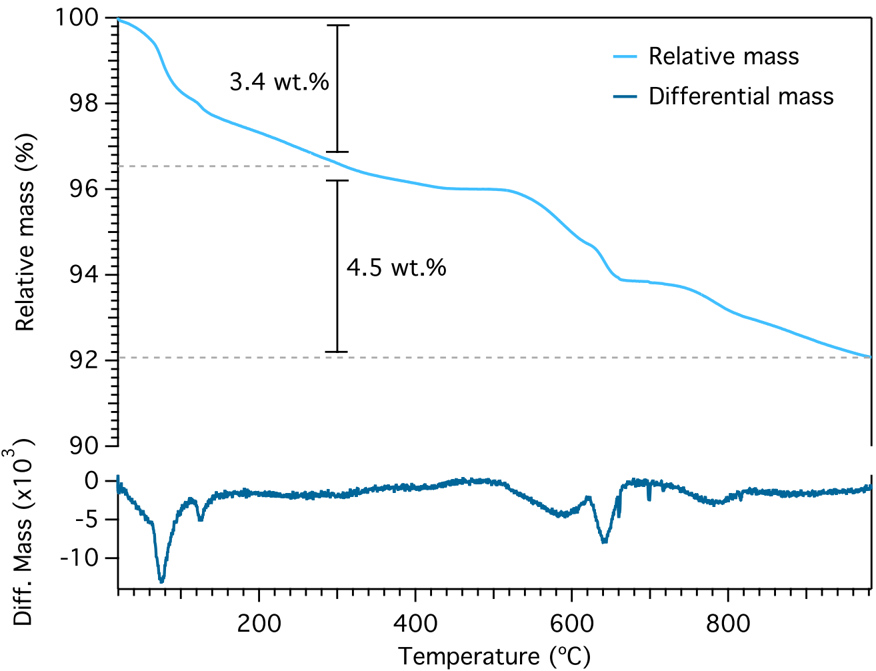
- Prototype MGS-1 simulant had grain density 2.72 g/cm³, bulk density 1.23 g/cm³, and porosity 55%; TGA showed 3.4% mass loss below 300 °C and an additional 4.5% between 300 and 1000 °C.
- Calculated MGS-1 bulk chemistry was within ~2 wt.% of bulk Rocknest for all major oxide species, though prototype XRF measurements deviated most in CaO, FeO, and MgO due to the terrestrial silicate crystal chemistries used.
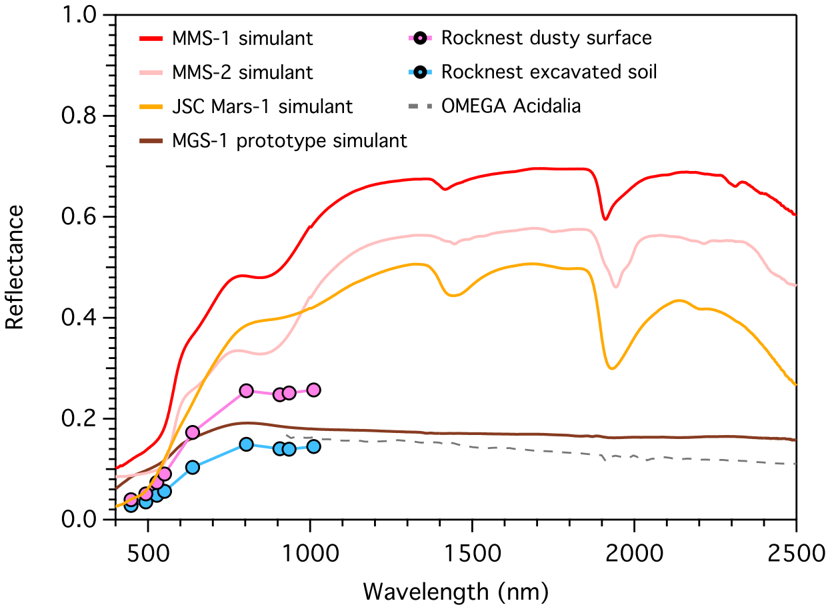
- MGS-1 spectra were similar to Rocknest Mastcam spectra from 400–1100 nm and to low-albedo OMEGA regions at longer wavelengths, but the simulant was brighter and had a weaker negative spectral slope >1000 nm; JSC Mars-1, MMS-1, and MMS-2 were not close matches to Rocknest or low-albedo OMEGA terrains.
Methods
- The standard was designed from mineralogy, using CheMin XRD constraints on crystalline Rocknest soil and inferences about the amorphous component, then re-normalized to a 30% amorphous content.
- Prototype simulants were produced by mixing plagioclase, pyroxene, olivine, basaltic glass, magnetite, and hematite with water and sodium metasilicate pentahydrate in a 100:20:2 ratio, microwaving to form solid cobbles, grinding them, and mixing in water-soluble phases: iron(III) sulfate, ferrihydrite, anhydrite, and siderite.
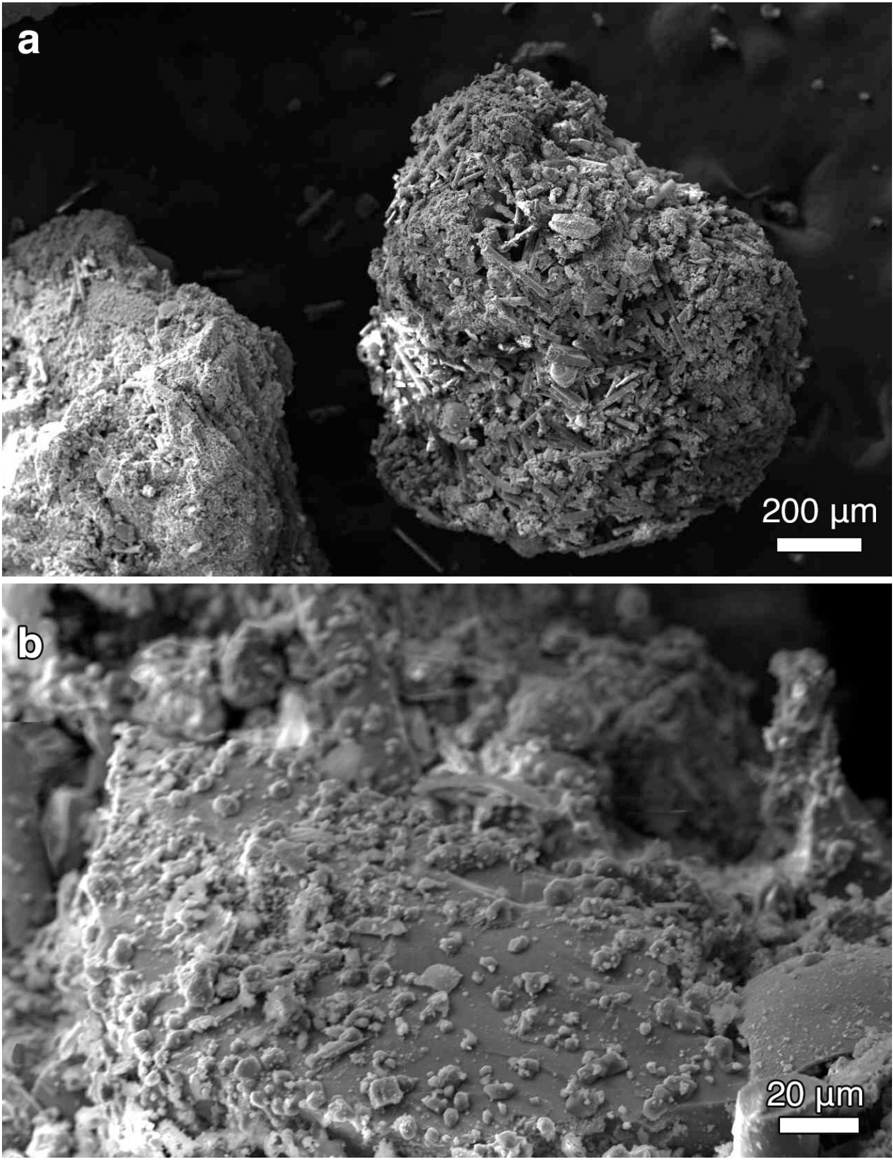
- Characterization included SEM imaging, grain and bulk density measurements, XRF bulk chemistry, VNIR spectroscopy from 320–2550 nm, and TGA to 1000 °C at 30 °C/min; results were compared with Mars rover, orbital, and older simulant data.
Limitations
- The paper states MGS-1 is not a perfect standard: trace species such as phosphates, sulfides, chromates, and oxalates are not represented, shocked silicates are not accounted for, and the exact nature and amount of the amorphous component in martian soils remains uncertain.
- The authors state that terrestrial source minerals differ in crystal chemistry from Rocknest, affecting CaO, FeO, and MgO; XRF has difficulty measuring Na and S; TGA comparisons to Mars data require care because of different pressures, atmospheric compositions, and ramp rates.
- The paper states MGS-1 is not recommended for detailed geochemical studies such as aqueous alteration experiments, and that geotechnical properties of actual martian regolith are poorly constrained, particle shape was not controlled, and initial physical-properties measurements were limited.
Model-written summary. Check it against the paper before relying on it.
Integrity signals
Registry
Cites
Statistics
Figures
Verification
Claims the paper makes
29 Own interpretation · 26 No basis given · 22 Own result · 17 No full text of the sources · 9 Partly supported · 8 Supported · 6 Supported so far · 6 Own method · 3 Not checked yet · accuracy not yet measured
Every source the paper cites for this claim was checked and supports it.
In the paper
“The detected crystalline phases in Rocknest include plagioclase, pyroxene, olivine, magnetite, anhydrite, hematite, ilmenite, sanidine, and quartz (Bish et al., 2013).”
What the sources say
- Supportedcites Bish et al., 2013 source
Table 1 (Rocknest scoop 5) lists plagioclase, forsterite (olivine), augite and pigeonite (pyroxenes), magnetite, anhydrite, hematite, ilmenite, sanidine, and quartz. The paper notes that several minor phases are at or near detection limits, but the claim does not imply otherwise. (LLM, conf=0.94)
plain- Asserted: passes — The authors put it forward as true.
- Checkable: passes — It can be checked against evidence.
- Load-bearing: passes — The paper’s conclusions depend on it.
- Based: passes — The paper gives a reason why it holds.
- Supported
The cited sources support only part of this claim — read each source’s verdict below.
In the paper
“In contrast, martian soils are a subequal mixture of crystalline and amorphous phases, as revealed by the CheMin instrument on the Mars Science Laboratory (MSL) (Bish et al., 2013; Dehouck et al., 2014).”
What the sources say
- Partly supportedcites Bish et al., 2013 sourceExperimental — accuracy not yet measured
The “Amorphous or Poorly Ordered Components” section (page not specified) reports that CheMin found both crystalline and amorphous phases in Rocknest soil, but estimates the amorphous fraction at 27 wt%, leaving roughly 73 wt% crystalline—not a subequal mixture by the central estimates. The Discussion suggests the results may apply to other Martian soils, but does not establish the same proportions for Martian soils generally. (LLM, conf=0.88)
- Not checked — no full text of the sourcecites Dehouck et al., 2014 source
plain- Asserted: passes — The authors put it forward as true.
- Checkable: passes — It can be checked against evidence.
- Load-bearing: passes — The paper’s conclusions depend on it.
- Based: passes — The paper gives a reason why it holds.
- Partly supported
Every source the paper cites for this claim was checked and supports it.
In the paper
“The crystalline fraction of Rocknest is well constrained by XRD (Bish et al., 2013).”
What the sources say
- Supportedcites Bish et al., 2013 source
The Crystalline Components section (page not available) reports that XRD analyses and Rietveld refinements identified Rocknest’s major crystalline minerals, clarified their abundances, and excluded many candidate minerals. It notes uncertainty for several minor phases, but this does not undermine the broad claim that XRD constrains the crystalline fraction. (LLM, conf=0.89)
boosted- Asserted: passes — The authors put it forward as true.
- Checkable: passes — It can be checked against evidence.
- Load-bearing: passes — The paper’s conclusions depend on it.
- Based: passes — The paper gives a reason why it holds.
- Supported
The cited sources support only part of this claim — read each source’s verdict below.
In the paper
“Rocknest is the bestcharacterized martian soil to date (Bish et al., 2013; Blake et al., 2013; Leshin et al., 2013; Minitti et al., 2013; Archer et al., 2014; Sutter et al., 2017)”
What the sources say
- Partly supportedcites Bish et al., 2013 sourceExperimental — accuracy not yet measured
The Discussion (page not provided) reports a rich inventory of crystalline and amorphous phases in Rocknest soil and says the XRD results provide critical ground-truth information. This supports Rocknest being well characterized mineralogically, but the paper does not establish that it is the best-characterized Martian soil overall or to date. (LLM, conf=0.83)
- Not checked — no full text of the sourcecites Blake et al., 2013 source
- Partly supportedcites Leshin et al., 2013 sourceExperimental — accuracy not yet measured
The opening Rocknest sampling passage and the Isotopes section document extensive analyses of Rocknest fines, including mineralogy, volatiles, and isotopes. They support that Rocknest was well characterized, but the paper does not compare the extent of its characterization with all other Martian soils or establish the 'best-characterized to date' superlative. (LLM, conf=0.82)
plain- Asserted: passes — The authors put it forward as true.
- Checkable: passes — It can be checked against evidence.
- Load-bearing: passes — The paper’s conclusions depend on it.
- Based: passes — The paper gives a reason why it holds.
- Partly supported
Every source the paper cites for this claim was checked and supports it.
In the paper
“This is consistent with the 1.5 wt.% water equivalent hydrogen in the upper layer of Rocknest materials measured by DAN (Jun et al., 2013).”
What the sources say
- Supportedcites Jun et al., 2013 source
Section 6, paragraph [34], reports a best-fit two-layer model for DAN data at Rocknest with 1.5 wt.% water-equivalent hydrogen in the top layer. The preceding paragraph identifies DAN active data as the basis for the Rocknest estimate. The paper does not itself assess SAM water release; the cited claim uses its DAN estimate as the comparison. (LLM, conf=0.92)
plaincorrelational- Asserted: passes — The authors put it forward as true.
- Checkable: passes — It can be checked against evidence.
- Load-bearing: passes — The paper’s conclusions depend on it.
- Based: passes — The paper gives a reason why it holds.
- Supported
The sources with a verdict support this claim; the rest weren’t checked yet, have no full text we could read, or their verdicts aren’t rated yet.
In the paper
“We adopt most of the same mineral proportions reported by Bish et al. (2013) (Table 1), re-normalized for a 30% amorphous content that is intermediate between low and high estimates of how much amorphous material is present (Bish et al., 2013; Dehouck et al., 2014).”
What the sources say
- Supportedcites Bish et al. (2013) source
Table 1 reports the crystalline mineral proportions used as the basis for the citing authors’ mixture. The “Amorphous or Poorly Ordered Components” section reports an average amorphous content of 27 wt%, with substantial uncertainty, consistent with the authors’ choice to re-normalize the proportions to 30%. The 30% formulation is the citing authors’ choice, not a value Bish et al. report. (LLM, conf=0.88)
- Not checked — no full text of the sourcecites Dehouck et al., 2014 source
plain- Asserted: passes — The authors put it forward as true.
- Checkable: passes — It can be checked against evidence.
- Load-bearing: passes — The paper’s conclusions depend on it.
- Based: passes — The paper gives a reason why it holds.
- Supported
Every source the paper cites for this claim was checked and supports it.
In the paper
“At shorter wavelengths, the MGS-1 based simulant is similar in shape and albedo to the Rocknest spectra acquired by Mastcam (Wellington et al., 2017).”
What the sources say
- Supportedcites Wellington et al., 2017 source
The Rocknest section (page unavailable) reports Mastcam multispectral observations of Rocknest and describes the resulting reflectance spectra, including their visible-wavelength slope and overall reflectance. The citation identifies the Rocknest spectra used as the comparison; the simulant comparison is the citing authors’ own assessment. (LLM, conf=0.86)
plaincorrelational- Asserted: passes — The authors put it forward as true.
- Checkable: passes — It can be checked against evidence.
- Load-bearing: passes — The paper’s conclusions depend on it.
- Based: passes — The paper gives a reason why it holds.
- Supported
The sources with a verdict support this claim; the rest weren’t checked yet, have no full text we could read, or their verdicts aren’t rated yet.
In the paper
“We applied this mineral-based design philosophy for the MGS-1 standard, based on X-ray Diffraction (XRD) analyses for the crystalline portion of the Rocknest soil (Bish et al., 2013), and inferences for the amorphous component (Bish et al., 2013; Dehouck et al., 2014; Achilles et al. 2018).”
What the sources say
- Supportedcites Bish et al., 2013 source
The Crystalline Components and Discussion sections report XRD analyses identifying the crystalline minerals in Rocknest soil. The Amorphous or Poorly Ordered Components section explains how the amorphous component was estimated and why its identity remains uncertain. The MGS-1 design is the citing authors’ application of those findings, not a claim that Bish et al. developed the standard. (LLM, conf=0.92)
- Not checked — no full text of the sourcecites Dehouck et al., 2014 source
- Not checked — no full text of the sourcecites Achilles et al. 2018
plain- Asserted: passes — The authors put it forward as true.
- Checkable: passes — It can be checked against evidence.
- Load-bearing: passes — The paper’s conclusions depend on it.
- Based: passes — The paper gives a reason why it holds.
- Supported
A result the paper reports from its own data — it cites no other source for it, so there is none to check. The quote shows it is in the paper.
In the paper
“We found the characteristics of the MGS-1 based simulant compare favorably to rover- and remote sensing-based observations from Mars, and offer dramatic improvements over past simulants in many areas.”
plaincorrelational- Asserted: passes — The authors put it forward as true.
- Checkable: passes — It can be checked against evidence.
- Load-bearing: passes — The paper’s conclusions depend on it.
- Based: passes — The paper gives a reason why it holds.
None of the sources cited for this claim have been checked yet.
In the paper
“The crystal chemistry of the major silicates (plagioclase, pyroxene and olivine) differs between the prototype simulants and actual Rocknest measurements.”
plain- Asserted: passes — The authors put it forward as true.
- Checkable: passes — It can be checked against evidence.
- Load-bearing: passes — The paper’s conclusions depend on it.
- Based: passes — The paper gives a reason why it holds.
- It may state two separate claims as one. 43
- Probably not a substantial claim. 49
- The quote only partly states this claim. 1
Every source the paper cites for this claim was checked and supports it.
In the paper
“Crystalline carbonates were not detected in Rocknest, but evolved gas analysis suggests that one or more carbonate-bearing phases is present (Sutter et al., 2017), such that a mixture could be present, or the carbonates could be poorly crystalline.”
What the sources say
- Supportedcites Sutter et al., 2017 source
Section 4.6 (CO₂; page not provided) says the carbonate amounts inferred for Rocknest (RN), if present, are below CheMin detection limits. Section 5.2 (Rocknest/Gobabeb Eolian Sediments; page not provided) reports that about 30% of Rocknest’s evolved CO₂ is consistent with carbonate. Together, these support the distinction between no detected crystalline carbonate and evidence suggesting carbonate-bearing material. (LLM, conf=0.91)
hedged- Asserted: passes — The authors put it forward as true.
- Checkable: passes — It can be checked against evidence.
- Load-bearing: unclear — It is unclear whether the paper’s conclusions depend on it.
- Based: passes — The paper gives a reason why it holds.
It may state two separate claims as one.
- Supported
The cited sources support only part of this claim — read each source’s verdict below.
In the paper
“This suggests that a mixture of such salts is likely present, or they are present as amorphous/adsorbed species.”
What the sources say
- Partly supportedcites Archer et al., 2014 sourceExperimental — accuracy not yet measured
Section 3.3 (page unavailable) says evolved O₂ is consistent with decomposition of an oxychlorine salt such as perchlorate; it does not report detection of evolved ClO₄. Sections 3.1 and 3.2 favor Ca-perchlorate while leaving Mg-perchlorate possible, but do not conclude that a mixture is likely or that the salts occur as amorphous or adsorbed species. (LLM, conf=0.84)
hedgedcorrelational- Asserted: passes — The authors put it forward as true.
- Checkable: passes — It can be checked against evidence.
- Load-bearing: unclear — It is unclear whether the paper’s conclusions depend on it.
- Based: passes — The paper gives a reason why it holds.
It may state two separate claims as one.
- Partly supported
The cited sources support only part of this claim — read each source’s verdict below.
In the paper
“No crystalline (per)chlorate salts were detected in Rocknest above the ~1 wt.% detection limit, but evolved ClO4 was detected (Archer et al., 2014).”
What the sources say
- Partly supportedcites Archer et al., 2014 sourceExperimental — accuracy not yet measured
Section 3.1 (page unavailable) says CheMin did not detect a perchlorate salt in Rocknest and that estimated abundances were below its detection limits. Section 3.3 (page unavailable) reports evolved O₂ and chlorinated hydrocarbons consistent with perchlorate decomposition, not detection of evolved ClO₄. The cited passages also do not establish a ~1 wt.% detection limit for (per)chlorate salts. (LLM, conf=0.87)
plain- Asserted: passes — The authors put it forward as true.
- Checkable: passes — It can be checked against evidence.
- Load-bearing: passes — The paper’s conclusions depend on it.
- Based: passes — The paper gives a reason why it holds.
It may state two separate claims as one.
- Partly supported
The sources with a verdict support this claim; the rest weren’t checked yet, have no full text we could read, or their verdicts aren’t rated yet.
In the paper
“The soil itself has a basaltic composition (Yen et al., 2005; Ming and Morris, 2017), derived from a globally basaltic crust (McSween et al., 2009).”
What the sources say
- Not checked — no full text of the sourcecites Yen et al., 2005 source
- Supportedcites Ming and Morris, 2017
The Summary states that Martian soil and dust have basaltic compositions, directly supporting the clause attributed to Ming and Morris. The separate claim about a globally basaltic crust is cited to McSween et al., not to this source. The supplied copy does not give page numbers. (LLM, conf=0.94)
- Not checked — no full text of the sourcecites McSween et al., 2009 source
plaindirect- Asserted: passes — The authors put it forward as true.
- Checkable: passes — It can be checked against evidence.
- Load-bearing: passes — The paper’s conclusions depend on it.
- Based: passes — The paper gives a reason why it holds.
It may state two separate claims as one.
The sources with a verdict support this claim; the rest weren’t checked yet, have no full text we could read, or their verdicts aren’t rated yet.
In the paper
“Oxychlorine species are also present in martian soil and could include (per)chlorate salts (Hecht et al., 2009; Sutter et al., 2017) and/or peroxide species (Clancy et al., 2004; Crandall et al., 2017). Nitrates are also present (Stern et al., 2015).”
What the sources say
- Not checked — no full text of the sourcecites Hecht et al., 2009 source
- Supportedcites Sutter et al., 2017 source
Sutter et al.’s §4.8 (O₂; page not available in our copy) reports oxygen evolved from all examined Gale Crater samples, suggesting oxychlorine phases such as chlorate or perchlorate. That supports the (per)chlorate portion attached to this citation; the sentence cites other works for peroxide species and nitrates. (LLM, conf=0.93)
- Supportedcites Stern et al., 2015 source
The citation to Stern et al. (2015) supports the sentence's nitrate claim, not the preceding oxychlorine claim. The Significance of Results section reports nitrate in a sample representing martian dust/local soil and in two samples from a potential relict lakebed. (LLM, conf=0.92)
hedged- Asserted: passes — The authors put it forward as true.
- Checkable: passes — It can be checked against evidence.
- Load-bearing: fails — The paper’s conclusions may not depend on it.
- Based: passes — The paper gives a reason why it holds.
Probably not a substantial claim. The paper’s conclusions may not depend on it. It may state two separate claims as one.
The sources with a verdict support this claim; the rest weren’t checked yet, have no full text we could read, or their verdicts aren’t rated yet.
In the paper
“Unit cell parameters for Rocknest minerals indicate ~An57 plagioclase (Bish et al., 2013), a mixture of augite and pigeonite (Bish et al., 2013), and ~Fo40 olivine (Morris et al., 2015).”
What the sources say
- Supportedcites Bish et al., 2013 source
In Crystalline Components, the paper derives a plagioclase composition of Ca₀.₅₇Na₀.₄₃ from refined unit-cell parameters and reports pigeonite together with augite. Table 1 labels the plagioclase ~An57. The ~Fo40 olivine clause cites Morris et al. (2015), not this source, so it is outside this verdict. (LLM, conf=0.94)
- Not checked — no full text of the sourcecites Morris et al., 2015
hedged- Asserted: passes — The authors put it forward as true.
- Checkable: passes — It can be checked against evidence.
- Load-bearing: unclear — It is unclear whether the paper’s conclusions depend on it.
- Based: passes — The paper gives a reason why it holds.
It may state two separate claims as one.
- Supported
The cited sources support only part of this claim — read each source’s verdict below.
In the paper
“The surface of Mars is covered by an unconsolidated regolith produced by the combined action of impact comminution, physical erosion by wind, water, and lava, and chemical weathering by fluids and oxidants (mostly early in the history of Mars) (McCauley, 1973; Malin and Edgett, 2000; Golombek and Bridges, 2000; Goetz et al., 2005; Yen et al., 2005; Murchie et al., 2009).”
What the sources say
- Not checked — no full text of the sourcecites McCauley, 1973 source
- Not checked — no full text of the sourcecites Malin and Edgett, 2000 source
- Partly supportedcites Golombek and Bridges, 2000 sourceExperimental — accuracy not yet measured
The Martian Surface Layer discussion describes sand and dust on Mars and identifies impact, volcanic, and mechanical weathering as sources of sand; it also discusses wind erosion and evidence for a wetter past. It does not establish that Mars is covered by an unconsolidated regolith produced by all the listed processes, particularly erosion by lava and chemical weathering by fluids and oxidants. Page numbers are unavailable in our copy. (LLM, conf=0.86)
plaindirect- Asserted: passes — The authors put it forward as true.
- Checkable: passes — It can be checked against evidence.
- Load-bearing: fails — The paper’s conclusions may not depend on it.
- Based: passes — The paper gives a reason why it holds.
Probably not a substantial claim. The paper’s conclusions may not depend on it.
The cited sources support only part of this claim — read each source’s verdict below.
In the paper
“Most of the older simulant varieties contain almost no sulfur, whereas martian regolith contains up to 6 wt.% SO3 (assuming all S is in the form of sulfate; Yen et al., 2005; Ming and Morris, 2017).”
What the sources say
- Not checked — no full text of the sourcecites Yen et al., 2005 source
- Partly supportedcites Ming and Morris, 2017Experimental — accuracy not yet measured
The Chemical Properties section (Table 1; page unavailable) reports 4.90 wt.% SO3 for average Martian soil, supporting the presence of sulfur at roughly the claimed level. But it also reports 7.42 wt.% for dust and a soil maximum of 35.06 wt.%, so 6 wt.% is not an upper limit. The cited paper does not address sulfur in older simulants or state the assumption that all sulfur is sulfate. (LLM, conf=0.88)
plain- Asserted: passes — The authors put it forward as true.
- Checkable: passes — It can be checked against evidence.
- Load-bearing: passes — The paper’s conclusions depend on it.
- Based: passes — The paper gives a reason why it holds.
It may state two separate claims as one.
The cited sources support only part of this claim — read each source’s verdict below.
In the paper
“Martian dust is somewhat chemically distinct from the underlying soil, with a larger component of npOx responsible for its ochre hue (Morris et al., 2001; Berger et al., 2016).”
What the sources say
- Not checked — no full text of the sourcecites Morris et al., 2001 source
- Partly supportedcites Berger et al., 2016 sourceExperimental — accuracy not yet measured
The Results and Discussion report that Martian dust is compositionally similar to soil but enriched in Fe, S, and Cl; the Discussion also concludes that global dust is enriched in nanophase iron oxide (npOx). The cited paper does not say that npOx is responsible for the dust’s ochre hue. Page numbers are unavailable in our copy. (LLM, conf=0.85)
plaindirect- Asserted: passes — The authors put it forward as true.
- Checkable: passes — It can be checked against evidence.
- Load-bearing: fails — The paper’s conclusions may not depend on it.
- Based: passes — The paper gives a reason why it holds.
Probably not a substantial claim. The paper’s conclusions may not depend on it. It may state two separate claims as one.
The cited sources support only part of this claim — read each source’s verdict below.
In the paper
“Soil major element chemistry and mineralogy are quite similar at the Spirit, Opportunity, and Curiosity landing sites (Yen et al., 2013; Ming and Morris, 2017), supporting the presence of a global basaltic soil that may be locally to regionally enriched in rarer evolved volcanic compositions (e.g., Christensen et al., 2005) or alteration phases (e.g., Squyres et al., 2008).”
What the sources say
- Not checked — no full text of the sourcecites Yen et al., 2013
- Partly supportedcites Ming and Morris, 2017Experimental — accuracy not yet measured
The Chemical Properties section (page not supplied) says basaltic soil at the Spirit, Opportunity, and Curiosity landing sites has similar composition, supporting the claim about chemistry and a widespread basaltic soil. It also notes differences in local basaltic mineralogies; the Mineralogical Properties section describes minerals observed by the rovers but does not establish that mineralogy is quite similar across all three sites. (LLM, conf=0.83)
plaincorrelational- Asserted: passes — The authors put it forward as true.
- Checkable: passes — It can be checked against evidence.
- Load-bearing: passes — The paper’s conclusions depend on it.
- Based: passes — The paper gives a reason why it holds.
It may state two separate claims as one.
Every source the paper cites for this claim was checked and supports it.
In the paper
“the SAM instrument detected a broad H2O release in Rocknest starting at low temperatures, finding 2.0 ± 1.3 wt.% total evolved water averaged over four runs (Archer et al., 2014).”
What the sources say
- Supportedcites Archer et al., 2014 source
Section 3.1 (page unavailable) reports an average of 2.0 ± 1.3% water released from Rocknest material across four runs; its table identifies H₂O abundances in weight percent. The same section describes a broad H₂O release below 450°C, peaking at 250°C, which supports the low-temperature description. (LLM, conf=0.94)
plain- Asserted: passes — The authors put it forward as true.
- Checkable: passes — It can be checked against evidence.
- Load-bearing: passes — The paper’s conclusions depend on it.
- Based: passes — The paper gives a reason why it holds.
It may state two separate claims as one.
- Supported
Every source the paper cites for this claim was checked and supports it.
In the paper
“Mastcam data (filled circles) were reproduced from Fig. 5 in Wellington et al. (2017)”
What the sources say
- Supportedcites Wellington et al. (2017) source
The Figure 5 caption describes Mastcam reflectance images and a plot of spectra derived from the marked regions. This confirms that Wellington et al. (2017) Figure 5 is a source of Mastcam spectral data; the source paper alone cannot independently verify the citing paper’s reproduction of them. (LLM, conf=0.90)
plain- Asserted: passes — The authors put it forward as true.
- Checkable: passes — It can be checked against evidence.
- Load-bearing: fails — The paper’s conclusions may not depend on it.
- Based: passes — The paper gives a reason why it holds.
Probably not a substantial claim. The paper’s conclusions may not depend on it.
- Supported
The cited sources support only part of this claim — read each source’s verdict below.
In the paper
“Pike et al. (2011) reported that ~1 vol. % of the Phoenix surface materials were <4 µm”
What the sources say
- Partly supportedcites Pike et al. (2011) sourceExperimental — accuracy not yet measured
The Approach and Results section describes a cumulative-volume particle-size distribution for Phoenix soil, and the Discussion reports less than 0.05% by volume below 2 µm. The passages do not give a volume fraction below 4 µm, so they do not establish the claimed ~1 vol.%. (LLM, conf=0.78)
plain- Asserted: passes — The authors put it forward as true.
- Checkable: passes — It can be checked against evidence.
- Load-bearing: fails — The paper’s conclusions may not depend on it.
- Based: passes — The paper gives a reason why it holds.
Probably not a substantial claim. The paper’s conclusions may not depend on it.
- Partly supported
Every source the paper cites for this claim was checked and supports it.
In the paper
“Ming and Morris (2017) estimate that due to chemical alteration, 15-25 wt.% of typical soils should consist of clay-sized grains.”
What the sources say
- Supportedcites Ming and Morris (2017)
The discussion of clay-sized particles estimates that about 21% of typical Mars soil has undergone chemical alteration and concludes that its clay fraction is reasonably estimated at 15–25 wt.%. The Summary repeats the 15–25 wt.% estimate for martian soil. No page number is provided in our copy. (LLM, conf=0.94)
hedgeddirect- Asserted: passes — The authors put it forward as true.
- Checkable: passes — It can be checked against evidence.
- Load-bearing: fails — The paper’s conclusions may not depend on it.
- Based: passes — The paper gives a reason why it holds.
Probably not a substantial claim. The paper’s conclusions may not depend on it.
- Supported
The sources with a verdict support this claim; the rest weren’t checked yet, have no full text we could read, or their verdicts aren’t rated yet.
In the paper
“weighted by the proportions in Table 1, with the actual crystal chemistries of martian silicates from Bish et al. (2013) and Morris et al. (2015).”
What the sources say
- Supportedcites Bish et al. (2013) source
The Crystalline Components section gives estimated compositions for Rocknest olivine, plagioclase, pigeonite, and augite, derived from refined unit-cell parameters. These provide the martian silicate chemistries attributed to Bish et al.; the cited paper does not need to describe the citing authors’ MGS-1 weighting procedure. (LLM, conf=0.90)
- Not checked — no full text of the sourcecites Morris et al. (2015)
plain- Asserted: passes — The authors put it forward as true.
- Checkable: passes — It can be checked against evidence.
- Load-bearing: passes — The paper’s conclusions depend on it.
- Based: passes — The paper gives a reason why it holds.
Probably not a substantial claim.
- Supported
A result the paper reports from its own data — it cites no other source for it, so there is none to check. The quote shows it is in the paper.
In the paper
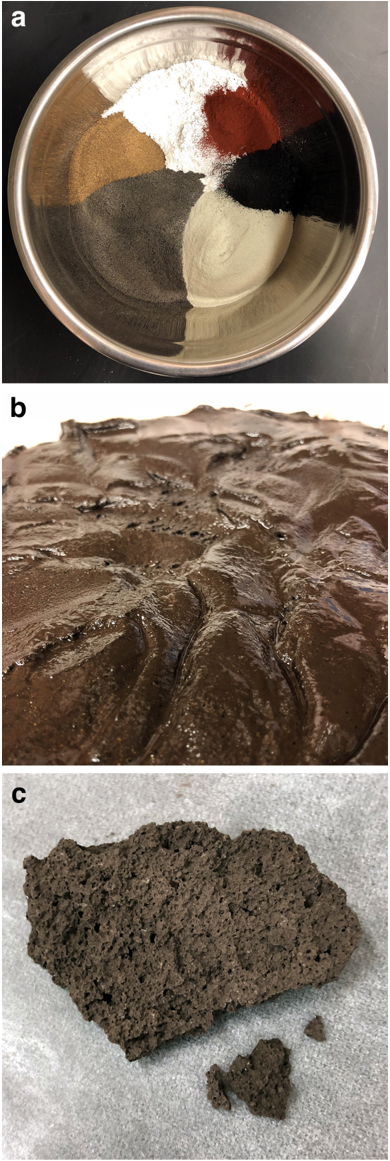
“Upon heating and drying, the sodium metasilicate forms a polymer network that acts as a binder, such that the resulting cobbles are solid and quite hard (Fig. 2c).”
plaindirect- Asserted: passes — The authors put it forward as true.
- Checkable: passes — It can be checked against evidence.
- Load-bearing: passes — The paper’s conclusions depend on it.
- Based: passes — The paper gives a reason why it holds.
It may state two separate claims as one.
The paper states this without a source or data behind it here, so there is nothing to check it against. The quote shows it is in the paper.
In the paper
“These species can be synthesized in amorphous form by evaporating appropriate solutions in vacuum, but they are prone to recrystallize in normal laboratory conditions.”
plaindirect- Asserted: passes — The authors put it forward as true.
- Checkable: passes — It can be checked against evidence.
- Load-bearing: fails — The paper’s conclusions may not depend on it.
- Based: fails — The paper may give no reason why it holds.
Probably not a substantial claim. The paper’s conclusions may not depend on it. The paper may give no reason why it holds. It may state two separate claims as one.
The paper states this without a source or data behind it here, so there is nothing to check it against. The quote shows it is in the paper.
In the paper
“JSC Mars-1 is not recommended for these applications because it has virtually none of the same minerals as actual Mars soil, and its volatile content (>20 wt.% H2O) is highly unrealistic.”
plain- Asserted: passes — The authors put it forward as true.
- Checkable: passes — It can be checked against evidence.
- Load-bearing: passes — The paper’s conclusions depend on it.
- Based: unclear — It is unclear why the paper says it holds.
It may state two separate claims as one.
A result the paper reports from its own data — it cites no other source for it, so there is none to check. The quote shows it is in the paper.
In the paper
“However, the negative spectral slope at wavelengths >1000 nm in the remote data is not as strong in the simulant, and the simulant is brighter.”
plain- Asserted: passes — The authors put it forward as true.
- Checkable: passes — It can be checked against evidence.
- Load-bearing: unclear — It is unclear whether the paper’s conclusions depend on it.
- Based: passes — The paper gives a reason why it holds.
It may state two separate claims as one.
A result the paper reports from its own data — it cites no other source for it, so there is none to check. The quote shows it is in the paper.
In the paper
“JSC Mars-1 has a significantly higher albedo than the remote measurements, with strong H2O- and OHrelated absorptions at 1400 and 1900 nm.”
boostedcorrelational- Asserted: passes — The authors put it forward as true.
- Checkable: passes — It can be checked against evidence.
- Load-bearing: passes — The paper’s conclusions depend on it.
- Based: passes — The paper gives a reason why it holds.
It may state two separate claims as one.
The paper states this without a source or data behind it here, so there is nothing to check it against. The quote shows it is in the paper.
In the paper
“The particle size distribution of simulants is highly adjustable through crushing and sieving.”
plaindirect- Asserted: passes — The authors put it forward as true.
- Checkable: passes — It can be checked against evidence.
- Load-bearing: fails — The paper’s conclusions may not depend on it.
- Based: passes — The paper gives a reason why it holds.
Probably not a substantial claim. The paper’s conclusions may not depend on it.
A result the paper reports from its own data — it cites no other source for it, so there is none to check. The quote shows it is in the paper.
In the paper
“Other elements such as SiO2, Al2O3, and SO3 are much closer to the measured values from Rocknest, and compare favorably to older martian simulants.”
plaincorrelational- Asserted: passes — The authors put it forward as true.
- Checkable: passes — It can be checked against evidence.
- Load-bearing: passes — The paper’s conclusions depend on it.
- Based: passes — The paper gives a reason why it holds.
It may state two separate claims as one.
A result the paper reports from its own data — it cites no other source for it, so there is none to check. The quote shows it is in the paper.
In the paper
“The MMS-1 and MMS-2 simulants from The Martian Garden company have even higher albedos than JSC-Mars 1, and at shorter wavelengths are dominated by the signature of hematite.”
plaincorrelational- Asserted: passes — The authors put it forward as true.
- Checkable: passes — It can be checked against evidence.
- Load-bearing: unclear — It is unclear whether the paper’s conclusions depend on it.
- Based: passes — The paper gives a reason why it holds.
It may state two separate claims as one.
A result the paper reports from its own data — it cites no other source for it, so there is none to check. The quote shows it is in the paper.
In the paper
“In the prototype simulants we added crystalline siderite.”
plain- Asserted: passes — The authors put it forward as true.
- Checkable: passes — It can be checked against evidence.
- Load-bearing: fails — The paper’s conclusions may not depend on it.
- Based: passes — The paper gives a reason why it holds.
Probably not a substantial claim. The paper’s conclusions may not depend on it.
A result the paper reports from its own data — it cites no other source for it, so there is none to check. The quote shows it is in the paper.
In the paper
“In the prototype simulants we added crystalline iron (III) sulfate pentahydrate.”
plain- Asserted: passes — The authors put it forward as true.
- Checkable: passes — It can be checked against evidence.
- Load-bearing: fails — The paper’s conclusions may not depend on it.
- Based: passes — The paper gives a reason why it holds.
Probably not a substantial claim. The paper’s conclusions may not depend on it.
The paper states this without a source or data behind it here, so there is nothing to check it against. The quote shows it is in the paper.
In the paper
“Again, due to apparent changes between MMS and MMS-1/2, we do not recommend these simulants.”
hedged- Asserted: passes — The authors put it forward as true.
- Checkable: passes — It can be checked against evidence.
- Load-bearing: passes — The paper’s conclusions depend on it.
- Based: fails — The paper may give no reason why it holds.
Probably not a substantial claim. The paper may give no reason why it holds.
A conclusion the paper draws from its own results — it cites no other source for it, so there is none to check. The quote shows it is in the paper.
In the paper
“The utility of these simulants (JSC Mars-1, MMS, and their updated versions) comes mostly from the fact that they are fine-grained, roughly basaltic composition materials: this may be appropriate for certain uses that do not require high fidelity simulants, but inappropriate for others.”
hedgeddirect- Asserted: passes — The authors put it forward as true.
- Checkable: passes — It can be checked against evidence.
- Load-bearing: passes — The paper’s conclusions depend on it.
- Based: passes — The paper gives a reason why it holds.
Probably not a substantial claim. It may state two separate claims as one.
The paper states this without a source or data behind it here, so there is nothing to check it against. The quote shows it is in the paper.
In the paper
“JSC Mars-1 is extremely hygroscopic, contains >20 wt.% H2O at ambient conditions, and is known to contain significant amounts of organic matter as well.”
boosted- Asserted: passes — The authors put it forward as true.
- Checkable: passes — It can be checked against evidence.
- Load-bearing: fails — The paper’s conclusions may not depend on it.
- Based: fails — The paper may give no reason why it holds.
Probably not a substantial claim. The paper’s conclusions may not depend on it. The paper may give no reason why it holds. It may state two separate claims as one.
A conclusion the paper draws from its own results — it cites no other source for it, so there is none to check. The quote shows it is in the paper.
In the paper
“Magnetite, anhydrite and hematite were also near the detection limit, but magnetite is important for magnetic properties, anhydrite for sulfur contents, and hematite for pigmenting properties.”
plaincorrelational- Asserted: passes — The authors put it forward as true.
- Checkable: passes — It can be checked against evidence.
- Load-bearing: passes — The paper’s conclusions depend on it.
- Based: passes — The paper gives a reason why it holds.
It may state two separate claims as one.
The paper states this without a source or data behind it here, so there is nothing to check it against. The quote shows it is in the paper.
In the paper
“As noted above, the MMS-2 simulant is spiked with sulfates and other phases to resolve discrepancies in bulk chemistry, but the composition on the package confusingly lists both mineral percentages and wt.% oxides in the same table, summing them to 100%.”
plaindirect- Asserted: passes — The authors put it forward as true.
- Checkable: passes — It can be checked against evidence.
- Load-bearing: fails — The paper’s conclusions may not depend on it.
- Based: passes — The paper gives a reason why it holds.
Probably not a substantial claim. The paper’s conclusions may not depend on it. It may state two separate claims as one.
A conclusion the paper draws from its own results — it cites no other source for it, so there is none to check. The quote shows it is in the paper.
In the paper
“By starting with the correct mineral constituents, the derived properties (geotechnical, spectral, chemical, etc.) should fall out of the final product, with adjustments made where necessary based on analyzing initial prototypes.”
hedgeddirect- Asserted: passes — The authors put it forward as true.
- Checkable: passes — It can be checked against evidence.
- Load-bearing: passes — The paper’s conclusions depend on it.
- Based: passes — The paper gives a reason why it holds.
It may state two separate claims as one.
None of the sources cited for this claim have been checked yet.
In the paper
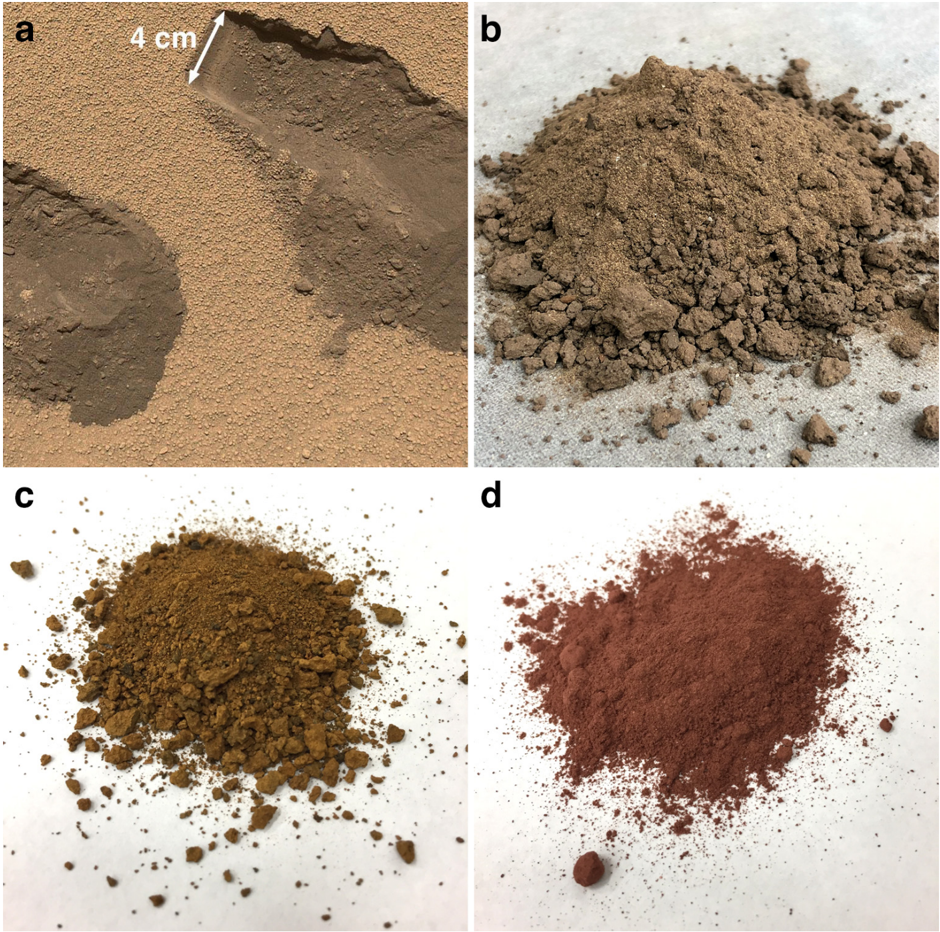
“However, The Martian Garden company had no contact with the creators of MMS, and their simulants do not resemble the original version (compare Fig. 1d with Fig. 2 in Peters et al. (2008)). The company is instead mining the highly altered red cinder material described by Beegle et al. (2007) instead of the original Saddleback Basalt.”
What the sources say
- Not checked — no full text of the sourcecites Peters et al. (2008) source
- Not matchedcites Beegle et al. (2007)
Couldn’t be matched to a paper in Crossref, so it can’t be checked.
plain- Asserted: passes — The authors put it forward as true.
- Checkable: passes — It can be checked against evidence.
- Load-bearing: unclear — It is unclear whether the paper’s conclusions depend on it.
- Based: passes — The paper gives a reason why it holds.
It may state two separate claims as one.
A conclusion the paper draws from its own results — it cites no other source for it, so there is none to check. The quote shows it is in the paper.
In the paper
“As well, silicate minerals are likely shocked to various degrees on Mars, whereas the basic MGS-1 standard does not account for this.”
hedged- Asserted: passes — The authors put it forward as true.
- Checkable: passes — It can be checked against evidence.
- Load-bearing: fails — The paper’s conclusions may not depend on it.
- Based: fails — The paper may give no reason why it holds.
Probably not a substantial claim. The paper’s conclusions may not depend on it. The paper may give no reason why it holds. It may state two separate claims as one.
None of the sources cited for this claim have been checked yet.
In the paper
“Other Mars simulants have also been developed based on terrestrial basalts, natural weathering profiles, and commercial sand products.”
plain- Asserted: passes — The authors put it forward as true.
- Checkable: passes — It can be checked against evidence.
- Load-bearing: fails — The paper’s conclusions may not depend on it.
- Based: passes — The paper gives a reason why it holds.
Probably not a substantial claim. The paper’s conclusions may not depend on it.
A conclusion the paper draws from its own results — it cites no other source for it, so there is none to check. The quote shows it is in the paper.
In the paper
“Here, we describe the Mars Global Simulant (MGS-1), a new open standard designed as a high fidelity mineralogical analog to global basaltic regolith on Mars, as represented by the Rocknest windblown deposit at Gale crater.”
plain- Asserted: passes — The authors put it forward as true.
- Checkable: passes — It can be checked against evidence.
- Load-bearing: passes — The paper’s conclusions depend on it.
- Based: passes — The paper gives a reason why it holds.
It may state two separate claims as one.
The paper states this without a source or data behind it here, so there is nothing to check it against. The quote shows it is in the paper.
In the paper
“Quantitative mineralogical analysis is not available for either JSC Mars-1, MMS, MMS-1, or MMS-2, although this is not really feasible for JSC Mars-1 due to its mostly amorphous character.”
plain- Asserted: passes — The authors put it forward as true.
- Checkable: passes — It can be checked against evidence.
- Load-bearing: fails — The paper’s conclusions may not depend on it.
- Based: passes — The paper gives a reason why it holds.
Probably not a substantial claim. The paper’s conclusions may not depend on it. It may state two separate claims as one.
In the paper
“The most prominent Mars simulant is Johnson Space Center JSC Mars-1 (Allen et al., 1998), which was later reproduced as JSC Mars-1A by Orbitec when the original supply ran out.”
What the sources say
- Not checked — no full text of the sourcecites Allen et al., 1998
plaindirect- Asserted: passes — The authors put it forward as true.
- Checkable: passes — It can be checked against evidence.
- Load-bearing: fails — The paper’s conclusions may not depend on it.
- Based: passes — The paper gives a reason why it holds.
Probably not a substantial claim. The paper’s conclusions may not depend on it.
A claim is checked only against the cited paper’s full text, never its abstract, and none is available for its sources.
In the paper
“Dehouck et al. (2014) and Morris et al. (2015) isolated the elemental chemistry of the amorphous component using a mass balance approach (Table 2), showing that it is deficient in SiO2, Al2O3, and CaO, and enriched in SO3 and H2O compared to the bulk soil.”
What the sources say
- Not checked — no full text of the sourcecites Dehouck et al. (2014) source
- Not checked — no full text of the sourcecites Morris et al. (2015)
plain- Asserted: passes — The authors put it forward as true.
- Checkable: passes — It can be checked against evidence.
- Load-bearing: unclear — It is unclear whether the paper’s conclusions depend on it.
- Based: passes — The paper gives a reason why it holds.
It may state two separate claims as one.
In the paper
“The other notable Mars simulant is Mojave Mars (MMS) (Peters et al., 2008), that is not currently available outside of NASA.”
What the sources say
- Not checked — no full text of the sourcecites Peters et al., 2008 source
plain- Asserted: passes — The authors put it forward as true.
- Checkable: passes — It can be checked against evidence.
- Load-bearing: fails — The paper’s conclusions may not depend on it.
- Based: passes — The paper gives a reason why it holds.
Probably not a substantial claim. The paper’s conclusions may not depend on it.
A result the paper reports from its own data — it cites no other source for it, so there is none to check. The quote shows it is in the paper.
In the paper
“We included crystalline nitrate and perchlorate salts in some of our initial prototypes designed for agricultural studies, but do not include them in the root MGS-1 standard.”
plain- Asserted: passes — The authors put it forward as true.
- Checkable: passes — It can be checked against evidence.
- Load-bearing: unclear — It is unclear whether the paper’s conclusions depend on it.
- Based: passes — The paper gives a reason why it holds.
It may state two separate claims as one.
The paper states this without a source or data behind it here, so there is nothing to check it against. The quote shows it is in the paper.
In the paper
“Martian soils have been examined in-situ at seven locations by landers and rovers, with supplemental information from orbital remote sensing.”
plain- Asserted: passes — The authors put it forward as true.
- Checkable: passes — It can be checked against evidence.
- Load-bearing: fails — The paper’s conclusions may not depend on it.
- Based: fails — The paper may give no reason why it holds.
Probably not a substantial claim. The paper’s conclusions may not depend on it. The paper may give no reason why it holds. It may state two separate claims as one.
In the paper
“Previous simulants often sacrificed accuracy for convenience, had poor documentation, and the resulting products have been assumed to be appropriate for all types of research.”
What the sources say
- Not checked — no full text of the sourcecites Taylor et al., 2016 source
plain- Asserted: passes — The authors put it forward as true.
- Checkable: passes — It can be checked against evidence.
- Load-bearing: passes — The paper’s conclusions depend on it.
- Based: passes — The paper gives a reason why it holds.
It may state two separate claims as one.
A conclusion the paper draws from its own results — it cites no other source for it, so there is none to check. The quote shows it is in the paper.
In the paper
“Mars Global is not meant to be a perfect standard for simulants (if such a thing exists), and there are almost certainly trace mineral species present in martian soil that aren't represented in MGS-1: these could include phosphates, sulfides, chromates, oxalates, and other rare species.”
hedged- Asserted: passes — The authors put it forward as true.
- Checkable: passes — It can be checked against evidence.
- Load-bearing: fails — The paper’s conclusions may not depend on it.
- Based: passes — The paper gives a reason why it holds.
Probably not a substantial claim. The paper’s conclusions may not depend on it. It may state two separate claims as one.
The paper states this without a source or data behind it here, so there is nothing to check it against. The quote shows it is in the paper.
In the paper
“These simulants have not yet been widely distributed or adopted.”
plain- Asserted: passes — The authors put it forward as true.
- Checkable: passes — It can be checked against evidence.
- Load-bearing: passes — The paper’s conclusions depend on it.
- Based: fails — The paper may give no reason why it holds.
Probably not a substantial claim. The paper may give no reason why it holds.
A conclusion the paper draws from its own results — it cites no other source for it, so there is none to check. The quote shows it is in the paper.
In the paper
“Simulants designed to match bulk chemistry might provide a close match to more readily available measurements (from Alpha Particle X-ray Spectrometer instruments, for example), but a simulant could be designed from infinite combinations of random compounds to reproduce the bulk chemistry of a reference material without having any of the right minerals inside of it.”
hedgedconditional- Asserted: passes — The authors put it forward as true.
- Checkable: passes — It can be checked against evidence.
- Load-bearing: passes — The paper’s conclusions depend on it.
- Based: passes — The paper gives a reason why it holds.
It may state two separate claims as one.
A conclusion the paper draws from its own results — it cites no other source for it, so there is none to check. The quote shows it is in the paper.
In the paper
“While we have chosen to add the plagioclase, pyroxene and olivine separately in our prototypes, they could also be added in the form of basalt or ultramafic rocks provided the mineral proportions are accurate.”
hedged- Asserted: passes — The authors put it forward as true.
- Checkable: passes — It can be checked against evidence.
- Load-bearing: fails — The paper’s conclusions may not depend on it.
- Based: fails — The paper may give no reason why it holds.
Probably not a substantial claim. The paper’s conclusions may not depend on it. The paper may give no reason why it holds.
A conclusion the paper draws from its own results — it cites no other source for it, so there is none to check. The quote shows it is in the paper.
In the paper
“Additional phases may be present in an amorphous or poorly-crystalline state, as discussed above.”
hedged- Asserted: passes — The authors put it forward as true.
- Checkable: passes — It can be checked against evidence.
- Load-bearing: fails — The paper’s conclusions may not depend on it.
- Based: passes — The paper gives a reason why it holds.
Probably not a substantial claim. The paper’s conclusions may not depend on it.
In the paper
“soils at the Pathfinder landing site had an estimated bulk density of 1.07-1.64/cm 3 (Moore et al., 1999)”
What the sources say
- Not checked — no full text of the sourcecites Moore et al., 1999 source
hedged- Asserted: passes — The authors put it forward as true.
- Checkable: passes — It can be checked against evidence.
- Load-bearing: fails — The paper’s conclusions may not depend on it.
- Based: passes — The paper gives a reason why it holds.
Probably not a substantial claim. The paper’s conclusions may not depend on it.
What the paper did — it cites no source for this, so there is none to check. The quote shows it is in the paper.
In the paper
“As well, in the prototypes we did not control for detailed aspects like particle shape that can be important in influencing geotechnical properties, and our initial physical properties measurements in this study are limited.”
plain- Asserted: passes — The authors put it forward as true.
- Checkable: passes — It can be checked against evidence.
- Load-bearing: fails — The paper’s conclusions may not depend on it.
- Based: passes — The paper gives a reason why it holds.
Probably not a substantial claim. The paper’s conclusions may not depend on it.
The paper states this without a source or data behind it here, so there is nothing to check it against. The quote shows it is in the paper.
In the paper
“The other phases in the MGS-1 standard are available in relatively pure forms from either natural sources or as synthetic chemical supplies.”
plain- Asserted: passes — The authors put it forward as true.
- Checkable: passes — It can be checked against evidence.
- Load-bearing: fails — The paper’s conclusions may not depend on it.
- Based: fails — The paper may give no reason why it holds.
Probably not a substantial claim. The paper’s conclusions may not depend on it. The paper may give no reason why it holds.
A conclusion the paper draws from its own results — it cites no other source for it, so there is none to check. The quote shows it is in the paper.
In the paper
“TGA data are not available for MMS-1 or MMS-2, but judging from their spectral properties (Fig. 4) these simulants have significant water contents, possibly on par with JSC Mars-1.”
hedgedcorrelational- Asserted: passes — The authors put it forward as true.
- Checkable: passes — It can be checked against evidence.
- Load-bearing: unclear — It is unclear whether the paper’s conclusions depend on it.
- Based: passes — The paper gives a reason why it holds.
It may state two separate claims as one.
A conclusion the paper draws from its own results — it cites no other source for it, so there is none to check. The quote shows it is in the paper.
In the paper
“These observed differences may be caused by a combination of differences in crystal chemistry, the specific amorphous compounds present on Mars, shock darkening, as well as the fact that the simulant spectra were measured at ambient laboratory conditions.”
hedgedconditional- Asserted: passes — The authors put it forward as true.
- Checkable: passes — It can be checked against evidence.
- Load-bearing: fails — The paper’s conclusions may not depend on it.
- Based: passes — The paper gives a reason why it holds.
Probably not a substantial claim. The paper’s conclusions may not depend on it.
A conclusion the paper draws from its own results — it cites no other source for it, so there is none to check. The quote shows it is in the paper.
In the paper
“For example, clay-rich Noachian regolith, or perchlorate and nitrate-bearing agricultural soils can be created by adding the desired additional components to the root simulant.”
plaindirect- Asserted: passes — The authors put it forward as true.
- Checkable: passes — It can be checked against evidence.
- Load-bearing: fails — The paper’s conclusions may not depend on it.
- Based: passes — The paper gives a reason why it holds.
Probably not a substantial claim. The paper’s conclusions may not depend on it. It may state two separate claims as one.
The paper states this without a source or data behind it here, so there is nothing to check it against. The quote shows it is in the paper.
In the paper
“In the past, simulant production has followed a now predictable lifecycle: the need for a specific simulant arose, a NASA center or private company produced an initial large batch of the simulant, then eventually the batch ran out, or national interest in a given planetary body faded and the simulant was discarded.”
plaindirect- Asserted: passes — The authors put it forward as true.
- Checkable: passes — It can be checked against evidence.
- Load-bearing: passes — The paper’s conclusions depend on it.
- Based: fails — The paper may give no reason why it holds.
Probably not a substantial claim. The paper may give no reason why it holds.
The paper states this without a source or data behind it here, so there is nothing to check it against. The quote shows it is in the paper.
In the paper
“However, the geotechnical properties of actual martian regolith are poorly constrained compared to returned lunar regolith that has been studied extensively on Earth.”
plain- Asserted: passes — The authors put it forward as true.
- Checkable: passes — It can be checked against evidence.
- Load-bearing: passes — The paper’s conclusions depend on it.
- Based: fails — The paper may give no reason why it holds.
Probably not a substantial claim. The paper may give no reason why it holds.
The paper states this without a source or data behind it here, so there is nothing to check it against. The quote shows it is in the paper.
In the paper
“NASA developed the concept of 'root' and 'branch' simulants for the Moon, where the root is a basic, well-characterized version of the simulant.”
plain- Asserted: passes — The authors put it forward as true.
- Checkable: passes — It can be checked against evidence.
- Load-bearing: fails — The paper’s conclusions may not depend on it.
- Based: fails — The paper may give no reason why it holds.
Probably not a substantial claim. The paper’s conclusions may not depend on it. The paper may give no reason why it holds.
A conclusion the paper draws from its own results — it cites no other source for it, so there is none to check. The quote shows it is in the paper.
In the paper
“Using more accurate Fe- and Ca-rich silicate compositions would result in higher densities.”
hedgeddirect- Asserted: passes — The authors put it forward as true.
- Checkable: passes — It can be checked against evidence.
- Load-bearing: fails — The paper’s conclusions may not depend on it.
- Based: fails — The paper may give no reason why it holds.
Probably not a substantial claim. The paper’s conclusions may not depend on it. The paper may give no reason why it holds.
In the paper
“drift material at the Viking 1 landing site had an estimated bulk density of 1.15±0.15 g/cm 3 (Moore and Jakosky, 1989)”
What the sources say
- Not checked — no full text of the sourcecites Moore and Jakosky, 1989 source
hedged- Asserted: passes — The authors put it forward as true.
- Checkable: passes — It can be checked against evidence.
- Load-bearing: fails — The paper’s conclusions may not depend on it.
- Based: passes — The paper gives a reason why it holds.
Probably not a substantial claim. The paper’s conclusions may not depend on it.
A conclusion the paper draws from its own results — it cites no other source for it, so there is none to check. The quote shows it is in the paper.
In the paper
“Natural, high-purity sources of fayalitic olivine, pigeonite, and unweathered calcic plagioclase are rare on Earth, but efforts to source them in the future will greatly improve the bulk chemistry of the simulants.”
plaindirect- Asserted: passes — The authors put it forward as true.
- Checkable: passes — It can be checked against evidence.
- Load-bearing: fails — The paper’s conclusions may not depend on it.
- Based: passes — The paper gives a reason why it holds.
Probably not a substantial claim. The paper’s conclusions may not depend on it. It may state two separate claims as one.
A conclusion the paper draws from its own results — it cites no other source for it, so there is none to check. The quote shows it is in the paper.
In the paper
“In this way, there is no batch of MGS-1 to run out, but a general standard to follow.”
plain- Asserted: passes — The authors put it forward as true.
- Checkable: passes — It can be checked against evidence.
- Load-bearing: passes — The paper’s conclusions depend on it.
- Based: passes — The paper gives a reason why it holds.
It may state two separate claims as one.
In the paper
“Indeed, a group at the Johnson Space Center is also developing a Rocknest-based version of the MMS simulant to be used for ISRU development (Archer et al., 2018).”
What the sources say
- Not checked — no full text of the sourcecites Archer et al., 2018
plain- Asserted: passes — The authors put it forward as true.
- Checkable: passes — It can be checked against evidence.
- Load-bearing: fails — The paper’s conclusions may not depend on it.
- Based: passes — The paper gives a reason why it holds.
Probably not a substantial claim. The paper’s conclusions may not depend on it.
What the paper did — it cites no source for this, so there is none to check. The quote shows it is in the paper.
In the paper
“None of the spectra have been offset or scaled.”
plain- Asserted: passes — The authors put it forward as true.
- Checkable: passes — It can be checked against evidence.
- Load-bearing: fails — The paper’s conclusions may not depend on it.
- Based: passes — The paper gives a reason why it holds.
Probably not a substantial claim. The paper’s conclusions may not depend on it.
In the paper
“MMS has recently been augmented further to achieve even more realistic volatile release patterns (Archer et al., 2018).”
What the sources say
- Not checked — no full text of the sourcecites Archer et al., 2018
plaindirect- Asserted: passes — The authors put it forward as true.
- Checkable: passes — It can be checked against evidence.
- Load-bearing: fails — The paper’s conclusions may not depend on it.
- Based: passes — The paper gives a reason why it holds.
Probably not a substantial claim. The paper’s conclusions may not depend on it.
In the paper
“The significant and unrealistic water contents of JSC Mars-1 were cited as a motivating factor in developing the original MMS simulant (Peters et al., 2008)”
What the sources say
- Not checked — no full text of the sourcecites Peters et al., 2008 source
plaindirect- Asserted: passes — The authors put it forward as true.
- Checkable: passes — It can be checked against evidence.
- Load-bearing: fails — The paper’s conclusions may not depend on it.
- Based: passes — The paper gives a reason why it holds.
Probably not a substantial claim. The paper’s conclusions may not depend on it.
What the paper did — it cites no source for this, so there is none to check. The quote shows it is in the paper.
In the paper
“Average of 5 measurements.”
plain- Asserted: passes — The authors put it forward as true.
- Checkable: passes — It can be checked against evidence.
- Load-bearing: fails — The paper’s conclusions may not depend on it.
- Based: passes — The paper gives a reason why it holds.
Probably not a substantial claim. The paper’s conclusions may not depend on it. The quote only partly states this claim.
In the paper
“Allen et al. (1998) reported that JSC Mars-1 lost 21.1 wt.% (mostly water) when heated to 600 °C”
What the sources say
- Not checked — no full text of the sourcecites Allen et al. (1998)
plaindirect- Asserted: passes — The authors put it forward as true.
- Checkable: passes — It can be checked against evidence.
- Load-bearing: passes — The paper’s conclusions depend on it.
- Based: passes — The paper gives a reason why it holds.
Probably not a substantial claim.
The paper states this without a source or data behind it here, so there is nothing to check it against. The quote shows it is in the paper.
In the paper
“However, sourcing this kind of material presents its own set of challenges, and usually requires a large capital investment if the right material is not already being mined.”
plainconditional- Asserted: passes — The authors put it forward as true.
- Checkable: passes — It can be checked against evidence.
- Load-bearing: fails — The paper’s conclusions may not depend on it.
- Based: fails — The paper may give no reason why it holds.
Probably not a substantial claim. The paper’s conclusions may not depend on it. The paper may give no reason why it holds. It may state two separate claims as one.
What the paper did — it cites no source for this, so there is none to check. The quote shows it is in the paper.
In the paper
“These minerals have been crushed into powders and analyzed by XRD, VNIR spectroscopy, and X-ray Fluorescence (XRF) to verify their identity and detect any contaminants present.”
plain- Asserted: passes — The authors put it forward as true.
- Checkable: passes — It can be checked against evidence.
- Load-bearing: fails — The paper’s conclusions may not depend on it.
- Based: passes — The paper gives a reason why it holds.
Probably not a substantial claim. The paper’s conclusions may not depend on it. It may state two separate claims as one.
In the paper
“The TEGA instrument did not a detect low temperature water release in soil samples at the Phoenix landing site (Smith et al., 2009), but did detect a minor H2O release starting at 295 °C and a major release starting at 735 °C.”
What the sources say
- Not checked — no full text of the sourcecites Smith et al., 2009 source
plain- Asserted: passes — The authors put it forward as true.
- Checkable: passes — It can be checked against evidence.
- Load-bearing: passes — The paper’s conclusions depend on it.
- Based: passes — The paper gives a reason why it holds.
It may state two separate claims as one.
What the paper did — it cites no source for this, so there is none to check. The quote shows it is in the paper.
In the paper
“The prototype simulants were analyzed using a variety of imaging techniques and bulk analyses. Results from these analyses were compared to relevant datasets from various orbital and in-situ spacecraft measurements as appropriate.”
plain- Asserted: passes — The authors put it forward as true.
- Checkable: passes — It can be checked against evidence.
- Load-bearing: passes — The paper’s conclusions depend on it.
- Based: passes — The paper gives a reason why it holds.
Probably not a substantial claim. It may state two separate claims as one.
In the paper
“The differences between the MGS-1 based simulant and Rocknest could be due to hygroscopicity in a humid terrestrial atmosphere, and the exact nature of the amorphous component in Rocknest is probably key to understanding the unique water release patterns measured by SAM (Archer et al., 2018).”
What the sources say
- Not checked — no full text of the sourcecites Archer et al., 2018
hedgedconditional- Asserted: passes — The authors put it forward as true.
- Checkable: passes — It can be checked against evidence.
- Load-bearing: fails — The paper’s conclusions may not depend on it.
- Based: passes — The paper gives a reason why it holds.
Probably not a substantial claim. The paper’s conclusions may not depend on it. It may state two separate claims as one.
In the paper
“Mojave Mars Simulant was developed specifically for geotechnical applications (Peters et al. 2008)”
What the sources say
- Not checked — no full text of the sourcecites Peters et al. 2008 source
plaindirect- Asserted: passes — The authors put it forward as true.
- Checkable: passes — It can be checked against evidence.
- Load-bearing: fails — The paper’s conclusions may not depend on it.
- Based: passes — The paper gives a reason why it holds.
Probably not a substantial claim. The paper’s conclusions may not depend on it.
A conclusion the paper draws from its own results — it cites no other source for it, so there is none to check. The quote shows it is in the paper.
In the paper
“MGS-1 will benefit from the same scheme, where the recipe in Table 1 forms the basic root, and various branches can be created either by us or others.”
plain- Asserted: passes — The authors put it forward as true.
- Checkable: passes — It can be checked against evidence.
- Load-bearing: fails — The paper’s conclusions may not depend on it.
- Based: passes — The paper gives a reason why it holds.
Probably not a substantial claim. The paper’s conclusions may not depend on it.
- Rests on an assumption: The mineral recipe in Table 1 accurately represents the mineralogy of average basaltic regolith on Mars.
In the paper
“Peters et al. (2008) report that MMS lost 1.7 wt.% by 100 °C and 7.2 wt.% by 500 °C.”
What the sources say
- Not checked — no full text of the sourcecites Peters et al. (2008) source
plain- Asserted: passes — The authors put it forward as true.
- Checkable: passes — It can be checked against evidence.
- Load-bearing: fails — The paper’s conclusions may not depend on it.
- Based: passes — The paper gives a reason why it holds.
Probably not a substantial claim. The paper’s conclusions may not depend on it. It may state two separate claims as one.
A conclusion the paper draws from its own results — it cites no other source for it, so there is none to check. The quote shows it is in the paper.
In the paper
“Unlike previous simulants sourced from landscaping material, Mars Global is meant to be assembled ab initio from pure components to provide an accurate match to the mineralogy of martian regolith.”
plain- Asserted: passes — The authors put it forward as true.
- Checkable: passes — It can be checked against evidence.
- Load-bearing: passes — The paper’s conclusions depend on it.
- Based: passes — The paper gives a reason why it holds.
It may state two separate claims as one.
- Rests on an assumption: Rocknest windblown soil is representative of average basaltic martian regolith for the purpose of defining a global Mars simulant standard.
- Rests on an assumption: The mineral recipe in Table 1 accurately represents the mineralogy of average basaltic regolith on Mars.
The paper relies on this without support.
Simulants have usually been produced in large batches, and when the initial batch runs out it can be difficult to re-create the original material.
“Perhaps more problematic is that simulants have usually been produced in large batches, and when the initial batch runs out it can be difficult to re-create the original material.”
The paper relies on this without support.
Rocknest windblown soil is representative of average basaltic martian regolith for the purpose of defining a global Mars simulant standard.
“We developed a new standard for a Mars simulant, MGS-1 Mars Global Simulant, based on the Rocknest soil examined by the Curiosity rover.”
“MGS-1 essentially means any simulant created based on the mineralogy of average basaltic regolith on Mars, as captured by the mineral recipe in Table 1.”
The paper relies on this without support.
The mineral recipe in Table 1 accurately represents the mineralogy of average basaltic regolith on Mars.
“MGS-1 essentially means any simulant created based on the mineralogy of average basaltic regolith on Mars, as captured by the mineral recipe in Table 1.”
“MGS-1 will benefit from the same scheme, where the recipe in Table 1 forms the basic root, and various branches can be created either by us or others.”
Claims other papers make about this one
Each is checked against this paper’s own text: does it say what the citing paper says it does?
The cited source says what the claim attributes to it.
In the citing paper
“The Mars surface is composed primarily of mafic rocks, usually basalts [28,29,30,31]”
From Mars Regolith Simulant Ameliorated by Compost as in situ Cultivation Substrate Improves Lettuce Growth and Nutritional Aspects (2020) · cites this paper as [31]
Citations
Cites
Detection of perchlorate and the soluble chemistry of martian soil at the phoenix lander site
Hecht, M. H., Kounaves, S. P., Quinn, R. C., West, S. J., Young, S. M. M., Ming, D. W., Catling, D. C., Clark, B. C., Boynton, W. V., Hoffman, J., et al. (2009) · Science · doi:10.1126/science.1172466 · Cited by 1,166
Phyllosilicates on Mars and implications for early martian climate
The Omega Team, Poulet, F., Bibring, J. P., Mustard, J. F., Gendrin, A., Mangold, N., Langevin, Y., Arvidson, R. E., Gondet, B., & Cécile Gomez, A. (2005) · Nature · doi:10.1038/nature04274 · Cited by 1,027
Sedimentary rocks of early Mars
Malin, M. C., & Edgett, K. S. (2000) · Science · doi:10.1126/science.290.5498.1927 · Cited by 842
Murchie, S. L., Mustard, J. F., Ehlmann, B. L., Milliken, R. E., Bishop, J. L., McKeown, N. K., Dobrea, E. Z. N., Seelos, F. P., Buczkowski, D. L., Wiseman, S. M., et al. (2009) · Journal of Geophysical Research Atmospheres · doi:10.1029/2009je003342 · Cited by 666
H 2 O at the Phoenix Landing Site
Smith, P. H., Tamppari, L. K., Arvidson, R. E., Bass, D., Blaney, D., Boynton, W. V., Carswell, A., Catling, D. C., Clark, B. C., Duck, T., et al. (2009) · Science · doi:10.1126/science.1172339 · Cited by 575
Proceedings of the 18th lunar and planetary science conference
Kissin, S. A. (1988) · Geochimica et Cosmochimica Acta · doi:10.1016/0016-7037(88)90170-6 · Cited by 519
Elemental composition of the martian crust
McSween, H. Y., Taylor, G. J., & Wyatt, M. B. (2009) · Science · doi:10.1126/science.1165871 · Cited by 506
Chloride-Bearing Materials in the Southern Highlands of Mars
Osterloo, M. M., Hamilton, V. E., Bandfield, J. L., Glotch, T. D., Baldridge, A. M., Christensen, P. R., Tornabene, L. L., & Anderson, F. S. (2008) · Science · doi:10.1126/science.1150690 · Cited by 483
Volatile, isotope, and organic analysis of Martian fines with the Mars Curiosity Rover
Leshin, L. A., Mahaffy, P. R., Webster, C. R., Cabane, M., Coll, P., Conrad, P. G., Archer, P. D., Atreya, S. K., Brunner, A. E., Buch, A., et al. (2013) · Science · doi:10.1126/science.1238937 · Cited by 458
Detection of Silica-Rich Deposits on Mars
Squyres, S. W., Arvidson, R. E., Ruff, S. W., Gellert, R., Morris, R. V., Ming, D. W., Crumpler, L. S., Farmer, J. D., Marais, D. J. D., Yen, A. S., et al. (2008) · Science · doi:10.1126/science.1155429 · Cited by 456
Cited by
Sorted by citations
Duri, L. G., Caporale, A. G., Rouphael, Y., Vingiani, S., Palladino, M., De Pascale, S., & Adamo, P. (2022) · Frontiers in Astronomy and Space Sciences · doi:10.3389/fspas.2021.747821 · Cited by 107
A review towards the design of extraterrestrial structures: From regolith to human outposts
Kalapodis, N. A., Kampas, G., & Ktenidou, O. (2020) · Acta Astronautica · doi:10.1016/j.actaastro.2020.05.038 · Cited by 95
Challenging the agricultural viability of martian regolith simulants
Eichler, A., Hadland, N., Pickett, D., Masaitis, D., Handy, D., Perez, A., Batcheldor, D., Wheeler, B., & Palmer, A. (2021) · Icarus · doi:10.1016/j.icarus.2020.114022 · Cited by 89
Self-citationVithanage, M. S., Kumarathilaka, P., Oze, C., Karunatilake, S., Seneviratne, M., Hseu, Z., Gunarathne, V., Dassanayake, M., Ok, Y. S., & Rinklebe, J. (2019) · Environment International · doi:10.1016/j.envint.2019.104974 · Cited by 85
Mills, J. N., Katzarova, M., & Wagner, N. J. (2022) · Advances in Space Research · doi:10.1016/j.asr.2021.10.045 · Cited by 83
Metadata
- Authors
- Cannon, K. M., Britt, D. T., Smith, T. M., Fritsche, R. F., & Batcheldor, D.
- Affiliations
- University of Central Florida (US)
- Kennedy Space Center (US)
- Florida Institute of Technology (US)
- Corresponding author
- Cannon, Kevin M.
- Venue
- Icarus
- Publisher
- Elsevier BV
- Published
- 2019-01
- Volume
- 317
- Pages
- 470-478
- ISSN
- 0019-1035 (ISSN-L)
- OpenAlex
- W2888719908
- Semantic Scholar
- d19bfae65f92942a53ba002e6654faf24ff6b324
- Cited by
- 243
- References
- 76
- Citations by year
- 2026: 44 · 2025: 51 · 2024: 46 · 2023: 27 · 2022: 26 · 2021: 27 · 2020: 16 · 2019: 6
- FWCI
- 6.60
- Type
- journal article
- Language
- en
- Open access
- closed
- Locations
- Icarus (publishedVersion)
- Funders
- Johnson Space Center
- Topics
- Physical Sciences › Earth and Planetary Sciences › Space and Planetary Science › Planetary Science and Exploration
- Physical Sciences › Earth and Planetary Sciences › Space and Planetary Science › Astro and Planetary Science
- Physical Sciences › Engineering › Automotive Engineering › Soil Mechanics and Vehicle Dynamics
- Keywords
- Gale Crater, open standards, bulk chemistry, spectral properties, volatile content, Mars sample return
About these checks
Registry, retraction, Cites and statistics results are computed, not judged, with one exception: a printed reference that no index lists is read once by a model before it counts as a citation error. Claims are extracted by a model and kept only when their quote appears verbatim in the text; each cited source is then checked, with a model’s help, for whether it says what the claim relies on. Those verdicts can be wrong — read the claim’s quote and the cited source before relying on one.
A language model drew the claims from the paper on 2026-11-03, under version 3 of the claim definition (model deepseek-v4.1-flash, prompt extract-v3).
A second model labelled each claim on 2026-11-03 (model jev-1.13-20260917, definition revision gold-guideline-v0.2).
Cited sources are checked with a language model’s help (gpt-6-sol).
Statistics and arithmetic are recomputed, not judged.
Confidence bands are shown only for fields calibrated on our annotated test set. None is calibrated yet, so no band is shown.
What counts as a claim ›How we measure confidence ›How we check this ›
Are you an author, or do you see a problem with this page? Request a review
