

The DOI matches its Crossref record; 34 of the 34 references it cites were found in a registry or an index.
Saturation in qualitative research: An evolutionary concept analysis
Open accessAbstract
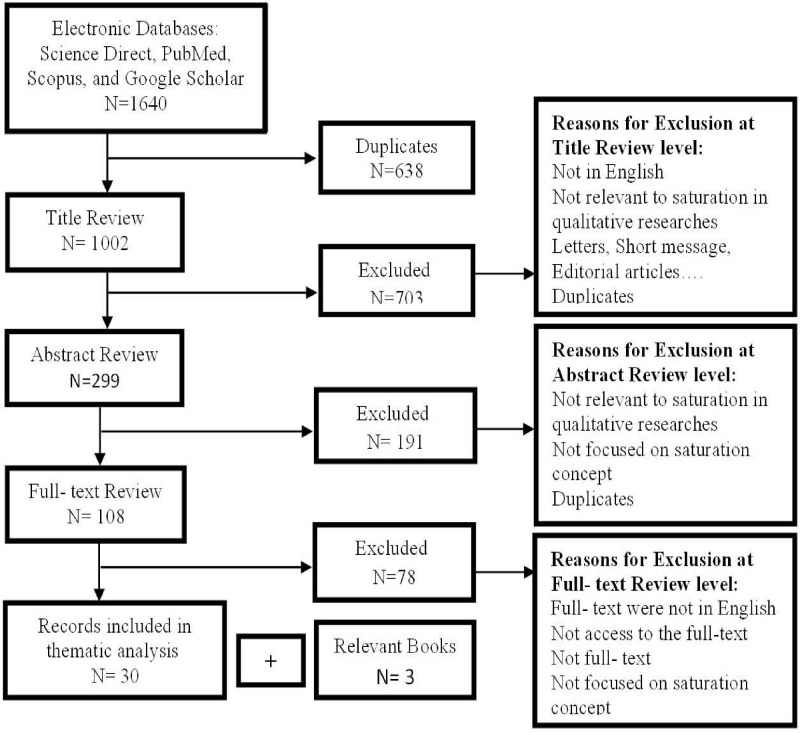
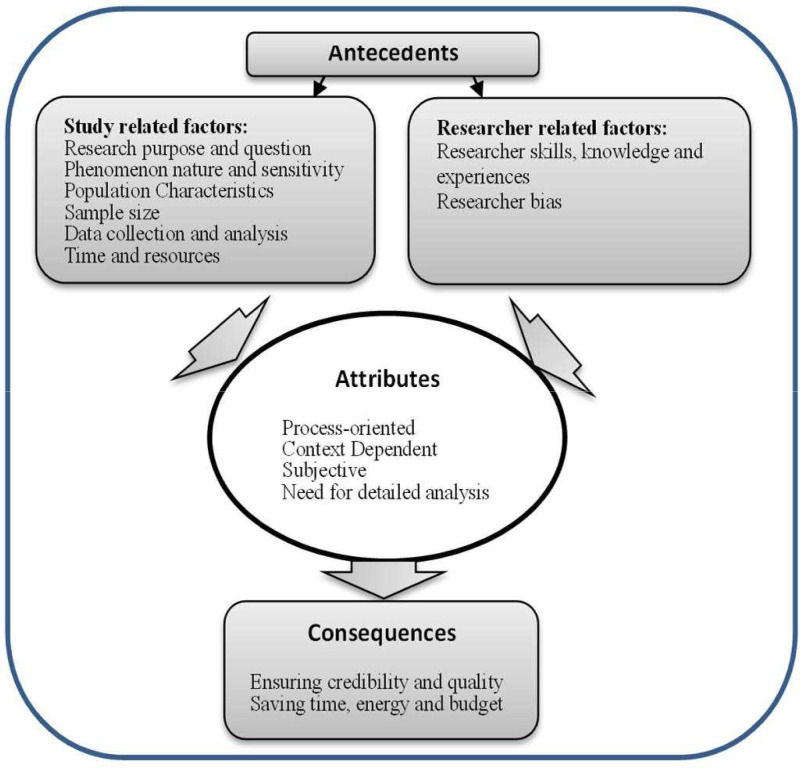
Background and Aim: Qualitative research plays an important role in improving nursing knowledge. Understanding the concept of saturation is essential to conducting rigorous qualitative research that contributes to evidence-based practice. The purpose of this study is to clarify the concept of saturation in qualitative research. Method: Evolutionary concept analysis was performed. A literature search was conducted using a variety of online databases for the years 2005- 2023. In total, 33 articles and books were analyzed using thematic analysis to identify the attributes, antecedents and consequences of saturation. The validity of the data was obtained by examining the analysis process by two independent researchers. Results: Saturation in qualitative research is a context-dependent, subjective process that requires detailed systematic analysis. Saturation is used in four ways in qualitative research: theoretical saturation, data saturation, code or thematic saturation, and meaning saturation. The antecedents of saturation were classified into two categories: study related factors and researcher related factors. The consequences of saturation were identified as: ensuring credibility and quality in qualitative research and time, energy and budget saving. Conclusion: This concept analysis serves to enhance the understanding of the concept of saturation, thereby offering valuable resources for qualitative researchers. By gaining a profound comprehension of saturation and its various types, researchers can ensure the validity of their studies while also optimizing time and resource allocation by avoiding redundant data collection. Future investigation warranted to elucidate how factors associated with reaching saturation impact estimations sample size.
Overview
The claims and statistics of this paper haven’t been checked yet.
Run the check — free, no account needed. It reads the open-access text and checks the sources it cites.
Integrity signals
Registry
Cites
Statistics
Figures
Verification
Claims the paper makes
The claims and statistics of this paper haven’t been checked yet.
Run the check — free, no account needed. It reads the open-access text and checks the sources it cites.
Claims other papers make about this one
Each is checked against this paper’s own text: does it say what the citing paper says it does?
The source backs part of the claim, not all of it — or backs it for a different population, condition or comparison.
In the citing paper
“The number of participating services in the research was determined by theoretical saturation from the qualitative analyses (25) in which the data collection was concluded when the information started to become redundant or repeated, even with the inclusion of new participants and services, as detected through a floating reading of the transcripts of the conducted interviews and fields diaries.”
From A mindfulness-based intervention for Substance Use Disorder in a Brazilian vulnerable population: a feasibility mixed method study (2024) · cites this paper as [25]
Experimental — accuracy not yet measured
Self-check
Percentages, sums and reported differences re-computed from the paper’s own numbers.
The self-check needs the paper’s full text.
Citations
Cites
Qualitative Inquiry and Research Design: Choosing Among Five Approaches
Lewis, S. (2015) · Health Promotion Practice · doi:10.1177/1524839915580941 · Cited by 22,105
How Many Interviews Are Enough?: An Experiment with Data Saturation and Variability
Guest, G., Bunce, A., & Johnson, L. (2006) · Field Methods · doi:10.1177/1525822x05279903 · Cited by 20,808 · cited 10×
“There are several reasons for pseudo-saturation, such as prematurely ending data collection, not exploring different perspectives or contexts, or overlooking important sources of information (Aldiabat & Le Navenec, 2018; Guest et al., 2006; Morse, 2015a).”
BackgroundInfluentialSaturation in qualitative research: exploring its conceptualization and operationalization
Saunders, B., Sim, J., Kingstone, T., Baker, S., Waterfield, J., Bartlam, B., Burroughs, H., & Jinks, C. (2018) · Quality & Quantity · doi:10.1007/s11135-017-0574-8 · Cited by 12,033 · cited 9×
“…still susceptible to false saturation due to the lack of discovery of relationships between codes and obtained themes, and still requires more data for the researcher to fully understand the depth, richness, and complexity of the phenomenon (Hennink et al., 2017; Low, 2019; Saunders et al., 2018).”
BackgroundMethodInfluentialBasics of Qualitative Research: Techniques and Procedures for Developing Grounded Theory
Wuetherick, B. (2010) · Canadian Journal of University Continuing Education · doi:10.21225/d5g01t · Cited by 8,333
(2011) · Cited by 7,157
Sample sizes for saturation in qualitative research: A systematic review of empirical tests
Hennink, M., & Kaiser, B. N. (2022) · Social Science & Medicine · doi:10.1016/j.socscimed.2021.114523 · Cited by 6,311 · cited 10×
“…still susceptible to false saturation due to the lack of discovery of relationships between codes and obtained themes, and still requires more data for the researcher to fully understand the depth, richness, and complexity of the phenomenon (Hennink et al., 2017; Low, 2019; Saunders et al., 2018).”
BackgroundMethodInfluentialBraun, V., & Clarke, V. (2021) · Qualitative Research in Sport, Exercise and Health · doi:10.1080/2159676x.2019.1704846 · Cited by 4,776 · cited 3×
“Information redundancy helps conceptualize saturation (Alam, 2021; Braun & Clarke, 2021; Bryman, 2006).”
BackgroundCode Saturation Versus Meaning Saturation: How Many Interviews Are Enough?
Hennink, M. M., Kaiser, B. N., & Marconi, V. C. (2017) · Qualitative Health Research · doi:10.1177/1049732316665344 · Cited by 4,597
Are We There Yet? Data Saturation in Qualitative Research
Fusch, P., & Ness, L. (2015) · The Qualitative Report · doi:10.46743/2160-3715/2015.2281 · Cited by 4,460
Sample size in qualitative research
Sandelowski, M. (1995) · Research in Nursing & Health · doi:10.1002/nur.4770180211 · Cited by 4,372 · cited 1×
“An important aspect of theoretical saturation is that in an iterative process, the researcher simultaneously engages in sampling, data collection, and data analysis (Sandelowski, 1995).”
Background
Research works printed but not linked: 3
- Aldiabat, 2018, Data saturation: The mysterious step in grounded theory methodology, The qualitative report, 23, 245
- Morse, 2015, 25, 587
- Thomson, 2010, Sample size and grounded theory. Thomson, SB (2010), Grounded Theory-Sample Size. Journal of Administration and Governance, 5, 45
Cited by
Sorted by citations
Items 101–200 of 555
Anzules-Falcones, W., Castilla, J. I. M., Tulcanaza-Prieto, A. B., & Caamana, D. (2024) · Sustainability · doi:10.3390/su162411202 · Cited by 3
Beverly, M., Munn, T., Young, T., Carroll‐Scott, A., Kinsey, E. W., Courts, K. A., Jannetti, M., de Cuba, S. E., & Lê‐Scherban, F. (2025) · Journal of the Academy of Nutrition and Dietetics · doi:10.1016/j.jand.2025.03.009 · Cited by 3
Wilson, H., Donkin, L., Harrison, J., Brackley, K., Lim, A. G., & Chan, A. H. Y. (2024) · Psychology and Health · doi:10.1080/08870446.2024.2391912 · Cited by 2
“To maintain transferability purposive sampling was used and data collection continued until the researchers were certain data saturation occurred, where previous data was being repeated and no new data to address the research question was being provided (Rahimi & Khatooni, 2024).”
Prioritizing Early Childhood Educators Health: Insights for Worksite Health Promotion Efforts
Carmona, B. A., Deng, L., Gilbert, C. F., Freimuth, E., Xie, R., & Bellows, L. L. (2025) · Childhood Obesity · doi:10.1089/chi.2024.0366 · Cited by 2
Qualitative analysis of Czech Women's views on maternity and childbirth care
Wilhelmová, R., Veselá, L., Korábová, I., Jokinen, M., Kameníková, M., & Pokorná, A. (2025) · Heliyon · doi:10.1016/j.heliyon.2025.e42908 · Cited by 2
Siu, J. Y., Chan, E. A., Li, A. S., & Lee, Y. M. (2025) · Health Expectations · doi:10.1111/hex.70236 · Cited by 2
“Additional interviews were conducted for both nondonors and lapsed donors to validate and expand the already identified patterns, concepts and themes [49].”
Harris, L. M., Skidmore, B. D., Nzama, N., Araydeh, M. A., Kerr, J., Hall, M. T., Reyes-Vega, A., Samanapally, H., Bkhet, A., Ghare, S. S., et al. (2025) · Journal of the Association of Nurses in AIDS Care · doi:10.1097/jnc.0000000000000541 · Cited by 2
Deng, J. M., Wekesa, C. W., Hakizimana, K. J. D. D., & Nzabahimana, J. (2025) · Energy Engineering · doi:10.32604/ee.2025.063398 · Cited by 2
“Key informants and community members who had been actively involved in energy initiatives were targeted to provide in-depth insights [32–34].”
Ethical and equity challenges in employment: Perspectives of international nursing graduates
Ghimire, A., & Qiu, Y. (2025) · Nursing Ethics · doi:10.1177/09697330251333397 · Cited by 2
Transforming Discarded Denim into Interior Art Through Box Furniture Design
Donkor, E. K., & Safo-Ankama, K. (2025) · TEXTILE · doi:10.1080/14759756.2025.2481541 · Cited by 2
Communication After Emergent Surgery by English Proficiency: An Exploratory Qualitative Study
Ogomori, K., Axelrod, J. K., Finlayson, E. V. A., Dohan, D. P., Dehlendorf, C. E., & Bongiovanni, T. (2025) · Journal of Surgical Research · doi:10.1016/j.jss.2025.03.022 · Cited by 2
Lam, M. H. A. (2025) · International Journal of Chinese Education · doi:10.1177/2212585x251344673 · Cited by 4
“…was achieved during the data analysis phase, indicating that when repetitive codes and themes were identi fi ed and no new information or relationships emerged, which ensured that the depth, richness, and complexity of the data were adequately captured in the study (Rahimi & Khatooni, 2024).”
Sandhu, S., Gill, M. K., Kakkar, R., Dhaliwal, K. K., Kamboj, V. S., Deol, I. S., & Puri, N. (2025) · Journal of Ethnicity in Substance Abuse · doi:10.1080/15332640.2025.2505748 · Cited by 2
Taking action, return-to-work strategies used by Iranian cancer survivors: a qualitative study
Zamanzadeh, V., Sadeghian, A., Valizadeh, L., Rahmani, A., Abbasdost, R., & Zirak, M. (2025) · BMJ Open · doi:10.1136/bmjopen-2024-097932 · Cited by 2
“23 All the interviews were digitally recorded and transcribed verbatim.”
Hollenberg, E., Shin, H. D., Reid, N., Stergiopoulos, V., Lestage, L., Nicoll, G., Walji, A., & Zaheer, J. (2025) · Journal of Clinical Medicine · doi:10.3390/jcm14124047 · Cited by 3
Falewicz, A., Kuncewicz, D. K., Kuncewicz, D., Szczęśniak, M., & Tongeren, D. R. V. (2025) · International Journal for the Psychology of Religion · doi:10.1080/10508619.2025.2521572 · Cited by 2
“As there are no strict criteria for determining group size in qualitative research methodology, in our initial assumption, we set a target of around 100 respondents to achieve both data and meaning saturation (Rahimi & Khatooni, 2024).”
Navigating global mobility: a comparative study of nursing education in Nepal and Australia
Ghimire, A., & Neupane, M. S. (2025) · International Journal of Nursing Education Scholarship · doi:10.1515/ijnes-2024-0108 · Cited by 2
Family caregivers’ perceptions of quality of dementia self‐care in Wakiso district, Uganda
Buwembo, D. R., Kiguli, J., Nakasujja, N., Makumbi, F. E., Sajatovic, M., Meyer, K., Lwere, K., Gumikirza‐Onoria, J. L., Kagaayi, J., Ddaaki, W. G., et al. (2025) · Alzheimer s & Dementia · doi:10.1002/alz.70510 · Cited by 2
Rishworth, A., Wilson, K., Charles, N., Adams, M., & Galloway, T. (2025) · Journal of Health Equity · doi:10.1080/29944694.2025.2522695 · Cited by 2
Gender discrimination in the emergency services: Female paramedic experiences in South Africa
Makkink, A. W., & Nkhoma, B. (2025) · African Journal of Primary Health Care & Family Medicine · doi:10.4102/phcfm.v17i1.4945 · Cited by 2
Ethical implications of nurse brain drain on undergraduate nursing students
Ghimire, A., & Neupane, M. S. (2025) · Nursing Ethics · doi:10.1177/09697330251374392 · Cited by 2
“Once it became evident that no further novel insights were emerging, a point commonly referred to as thematic saturation 40,41 — the researchers concluded that the essential phenomena had been thoroughly represented.”
Hounkpatin, H. O., Morrison, L. G., Richards, A., & Santer, M. (2025) · Health Expectations · doi:10.1111/hex.70335 · Cited by 2
“Data saturation was deemed as no further substantial themes or codes emerged after the 19th interview and themes were well ‐ developed and well ‐ understood [36, 37].”
Reñosa, M. D. C., Kulkarni, P., Steiner, L., Lamigo, C. E., Sornillo, B. J., Hechanova-Cruz, R. A., Dungca-Lorilla, A. M., Hapsari, A. F., Yunihastuti, E., Hasibuan, A. S., et al. (2025) · Implementation Science Communications · doi:10.1186/s43058-025-00776-z · Cited by 3
“While we remained attentive to signs of data saturation [30]–defined as the point when no new themes were identified-during these debriefings, we primarily drew on Malterud and colleagues’ concept of ‘infor-mation power’ to guide our sampling strategy [31].”
Tong, X., Phakdeephirot, N., & Jiang, S. (2025) · Sustainability · doi:10.3390/su17198786 · Cited by 2
Ratniyom, J., Boonphadung, S., Intaraprasit, M., & Chumkaeo, P. (2025) · Chemistry Teacher International · doi:10.1515/cti-2025-0048 · Cited by 3
“49 The interviews were conducted face-to-face using a semi-structured protocol, with probing techniques employed to encourage open sharing.”
Grounded Theory and Phenomenology
Almusaed, A., Almssad, A., & Yitmen, İ. (2025) · Springer eBooks · doi:10.1007/978-3-031-97393-2_11 · Cited by 2
Wright-Brown, T., Gaid, D., Najafizada, M., Schwartz, E., Cooper, T., Newell, W. J., Bishop, L. D., & Donnan, J. R. (2025) · PLoS ONE · doi:10.1371/journal.pone.0333706 · Cited by 3
“This approach aligns with established methods for assessing saturation in qualitative research, which emphasize systematic monitoring and team-based evaluation of theme emergence [48–50].”
The meaningful elements of the Camino: Toward understanding pilgrims' transformative experience
Johnmeyer, C., Xu, S., Stanis, S. A. W., & Morgan, M. (2025) · Annals of Tourism Research Empirical Insights · doi:10.1016/j.annale.2025.100201 · Cited by 3
Momand, P., Götrick, B., & Hansson, K. (2025) · BMC Oral Health · doi:10.1186/s12903-025-07064-1 · Cited by 2
“The authors considered data to be saturated when signs of redundancy began to emerge [27].”
Villegas, J. P., Pua, L. R., Vidláková, A., & Ceacero, F. (2025) · Animals · doi:10.3390/ani15233397 · Cited by 2
“The number of interviewees largely depends on theoretical saturation, achieved when no new information is obtainable from the interview records [28].”
Galway, L. P. (2025) · People and Nature · doi:10.1002/pan3.70220 · Cited by 2
“Recruitment ended after data saturation was met (that is, when the researcher determined that no new data significantly addressing the research objective was emerging from interviews (Rahimi & khatooni, 2024 )).”
Chepp, V., Skoczylas, M., & Gray, C. P. (2025) · Implementation Science Communications · doi:10.1186/s43058-025-00833-7 · Cited by 5
“This has involved the development of “hybrid” forms of saturation [22] and surrogate terms [5, 22, 23, 25, 27, 28].”
Understanding the process of becoming a family caregiver for stroke survivors
Fonseca-Mardones, I., & Hernández-Lanas, O. (2025) · Cadernos Brasileiros de Terapia Ocupacional · doi:10.1590/2526-8910.cto401339122 · Cited by 2
Barratt, J., Goss, H. R., Erskine, N., James, M. E., Töpfer, C., Pfeifer, K., Cairney, J., & Carl, J. (2026) · International Journal of Qualitative Studies on Health and Well-Being · doi:10.1080/17482631.2026.2613973 · Cited by 2
Idemili-Aronu, N., Okoli, I. A., Jemisenia, J. O., Olawepo, J. O., Onyeka, T. C., & Ezeanolue, E. E. (2026) · BMC Health Services Research · doi:10.1186/s12913-026-14029-9 · Cited by 2
“Saturation occurs when the collection of new data does not yield further insights (i.e., keywords, patterns, themes, and codes), indicating that sufficient data have been gathered to address the research questions [51–55].”
Exploring the lived socioeconomic experiences of teen mothers in Rwanda
Mizero, D., Shimwa, A., Dusingize, M. I., Uwimana, A., Yohannes, T., & Wong, R. (2026) · Reproductive Health · doi:10.1186/s12978-026-02278-0 · Cited by 2
“A combination of purposive and snowball sampling methods were used to recruit beneficiaries from the partnering organization (Nyampinga Ushoboye) until data saturation was reached [37, 38].”
Kagwanja, N., Oyando, R., Hassan, S., Diallo, B. A., Badjie, J., Lucinde, R. K., Mumba, N., Kinyanjui, S., Perel, P., Etyang, A. O., et al. (2026) · Health Policy and Planning · doi:10.1093/heapol/czag020 · Cited by 2
“Recruitment of participants stopped after achieving the pre-defined categories and attaining data saturation (Rahimi and Khatooni 2024).”
Ghimire, A., & Neupane, M. S. (2026) · Globalization and Health · doi:10.1186/s12992-026-01201-3 · Cited by 2
“Departing from the concept of data saturation, we aimed for analytical sufficiency, which was achieved when additional passes produced minimal conceptual novelty and no changes to the theme architecture within the data-set [43, 44].”
Hendrickson, Z. M., Bhaktaram, A. V., Wattree, J., Sluytman, L. G. V., Uzzi, M., Latkin, C. A., & Dayton, L. (2026) · Social Science & Medicine · doi:10.1016/j.socscimed.2026.119149 · Cited by 2
Bigirinama, R. N., Iwu, E., Mary, M., Abimiku, R. H., Chiribagula, C. Z., Israel-Isah, S., Ekambi, S., Mwene-Batu, P. L., Maina, C. P., Bisimwa, G. B., et al. (2026) · Global Public Health · doi:10.1080/17441692.2026.2640771 · Cited by 2
Harmuch, C., Laranjeira, C., Lima, A. L. S., Higarashi, I. H., Jaques, A. E., & Paiano, M. (2026) · Journal of Pediatric Nursing · doi:10.1016/j.pedn.2026.03.014 · Cited by 2
Herr, C. J., Bock, F. D., & Herrler, A. (2026) · BMC Health Services Research · doi:10.1186/s12913-026-14386-5 · Cited by 2
Nautwima, J. P., Romeo, A., & Johannes, H. N. (2026) · Discover Sustainability · doi:10.1007/s43621-026-03025-y · Cited by 2
Journalism Left Behind: What Former Journalists Miss Most and Re-Entry Motivations
Adjin-Tettey, T. D., & Asuman, M. K. A. (2026) · Journalism & Mass Communication Quarterly · doi:10.1177/10776990261436068 · Cited by 2
“By the 30th inter-view, we had met data saturation as previous data was repeated, and new data did not contribute anything new to address the research questions of the study (Rahimi & Khatooni, 2024).”
Sipiläinen, K., Heilala, V., Kiuru, N. H., Polet, J., Öz, Ş., Aro, M. T., Korja, R., & Hämäläinen, R. (2026) · Child & Youth Care Forum · doi:10.1007/s10566-026-09940-5 · Cited by 6
Ward, K., Jackson, T. M., Saad, S. L., White, S. J., Bartyn, J., Amanatidis, S., Hutchings, O., & Lau, A. Y. S. (2026) · Health Expectations · doi:10.1111/hex.70654 · Cited by 2
Lingham, S., Maye, D., & Manning, L. (2026) · Gastronomy · doi:10.3390/gastronomy4020012 · Cited by 3
“Evidence saturation was determined using Rahimi and Khatooni’s [37] rationale of theoretical saturation in grounded theory, i.e., evidence saturation is the point in iterative research when no additional evidence is found that allows for further development of the properties of the case, its…”
Adekunle, T. E., Yonker, J. E., Olanrewaju, S. A., Frambes, D., Lee, J., Moawad, M., Tsurho, M., & Yuniwo, E. (2026) · International Nursing Review · doi:10.1111/inr.70194 · Cited by 2
Khan, T. H., Sheikh, M. S., & MacEachen, E. (2026) · International Journal of Qualitative Methods · doi:10.1177/16094069261446123 · Cited by 2
LeBlanc, J.-A., Jones, W., & Harewood, H. C. (2024) · Frontiers in Psychiatry · doi:10.3389/fpsyt.2024.1372971 · Cited by 2
“This aligns with the literature, which supports the possibility of achieving saturation between the 9th and 17th participant, particularly when coupled with recruitment to achieve a maximally variable sample, thus enhancing data richness and diversity (67, 68).”
Patient Preferences and Expectations in Analgesia for First Trimester Surgical Abortion
Sharp, C. L. E. H., Biefeld, S. D., Singh, R. H., & Bayat, L. (2024) · American Journal of Qualitative Research · doi:10.29333/ajqr/15161 · Cited by 2
Agomor, K. S. (2024) · Journal of Legal Studies · doi:10.2478/jles-2024-0013 · Cited by 2
Mutasa, L. S., Ujakpa, M. M., Nyikana, W., Shaanika, I. N., & Iyamu, T. (2025) · Information Resources Management Journal · doi:10.4018/irmj.367274 · Cited by 2
Khosravi, S., IzadPanah, M., Mirzaei, S., Rahmani, H., & Oroomiei, N. (2025) · BMC Health Services Research · doi:10.1186/s12913-025-12223-9 · Cited by 2
Berhe, T. T., Feleke, A. K., Bekele, G. E., Gebrehiwot, E. M., Ali, Y. H., & Tedila, G. W. (2025) · Frontiers in Public Health · doi:10.3389/fpubh.2025.1538124 · Cited by 2
McErlean, G., Ashley, C., Pradhan, A., Yenson, V. M., Kerridge, I., & Halcomb, E. (2025) · Supportive Care in Cancer · doi:10.1007/s00520-025-09577-5 · Cited by 2
“Data saturation is defined as the point at which no new information, themes, or insights relevant to the research questions emerged from subsequent inter-views [15].”
The effects of spinal dysraphism on the quality of life of pediatric patients and their families
Rufus-Toye, R. M., Hussain, S. A., Gelfer, Y., Leo, D. G., & Bridgens, A. (2025) · Journal of Spinal Cord Medicine · doi:10.1080/10790268.2025.2510721 · Cited by 2
“Within the context of qualitative research, saturation refers to the point at which no new codes or themes emerge, even as the sample size increases (19).”
Cleofas, J. V., Dychangco, M. E. A., Olivar, J. J. R., & Vitug, P. Z. (2025) · Journal of Advanced Nursing · doi:10.1111/jan.70028 · Cited by 2
Sheena, D., Benoliel, P. S., & Berkovich, I. (2025) · Frontiers in Education · doi:10.3389/feduc.2025.1576165 · Cited by 2
Schroeder, K. L., Heaton, L. J., Martin, P., Cheung, H. J., Tranby, E. P., Rafia, K., & Tiwari, T. (2025) · BMC Oral Health · doi:10.1186/s12903-025-06388-2 · Cited by 2
“Once code saturation had been reached, no new study participants were invited to interview [16].”
Parajuli, S., Kaphle, H. P., Gahatraj, N. R., Poudel, S., Poudel, A., Bhatta, K., & Dahal, G. (2025) · Journal of Public Health · doi:10.1093/pubmed/fdaf079 · Cited by 2
van Zuydam, S. C., & Kempen, E. L. (2025) · Agriculture & Food Security · doi:10.1186/s40066-025-00543-2 · Cited by 2
“Thematic saturation or code saturation is specific to a stage in the data analysis phase of the research, where repetitive codes or themes are identified and where no new information emerges from the data set suggesting the existence of other relationships between the codes or themes [47].”
Uncovering Teachers’ Challenges in Teaching Qualitative Research: Basis for Innovation and Training
Torres, J. (2024) · Journal of interdisciplinary perspectives · doi:10.69569/jip.2024.0093 · Cited by 1
Muhihi, B. G. (2024) · Interdisciplinary journal of management sciences. · doi:10.38140/ijms-2024.vol1.13 · Cited by 1
“In their study, Rahimi and Khatooni (2024) explained that saturation in qualitative research is a context-dependent, subjective process that requires detailed systematic analysis.”
BackgroundAtim, F., Ndagire, R., Nampiima, C., Kiyinji, F., Lwanira, C. N., Nanyonga, R. C., & Orach-Meza, F. L. (2024) · International Journal of Global Health · doi:10.14302/issn.2693-1176.ijgh-24-5215 · Cited by 1
Spanish-Speaking Latinas with Pelvic Floor Disorders: Understanding the Misunderstood
Garcia, A. N., Propst, K. A., & Tyson, D. M. (2024) · International Urogynecology Journal · doi:10.1007/s00192-024-05980-4 · Cited by 1
“…size was large enough to reach thematic saturation (as no new information emerged), the authors agree that using thematic saturation as a basis for judging data saturation may be vulnerable to “false saturation due to the lack of discovery of relationships between codes and obtained themes” [25].”
Nkolola, N. B., & Phiri, A. (2024) · Journal of Water Sanitation and Hygiene for Development · doi:10.2166/washdev.2024.214 · Cited by 1
Agbejule, O. A., Joseph, R., Merchant, S., Johal, J., Ramsey, I., Bender, J. L., Jennings, C. A., Osborn, M., Crawford-Williams, F. M., & Chan, R. J. (2025) · Supportive Care in Cancer · doi:10.1007/s00520-025-09201-6 · Cited by 1
“Sample size was estimated to be sufficient based on the principle of meaning saturation [12], whereby no new information about the meaning of categories/themes and their relationships emerged.”
Grigoryan, Z., Hayrumyan, V., Sahakyan, S., Petrosyan, V., & Harutyunyan, A. (2025) · BMC Public Health · doi:10.1186/s12889-025-21776-7 · Cited by 1
Lindberg, J., Johansson, M., & Broström, L. (2025) · BMC Nephrology · doi:10.1186/s12882-025-04023-4 · Cited by 1
“Based on the results from the 14 interviews, data saturation was achieved [10].”
Hearing the city without vision: An exploratory study
Graven, T. (2025) · British Journal of Visual Impairment · doi:10.1177/02646196251330184 · Cited by 1
“Information-rich participants with no hearing difficulties, comorbidities, and/or cognitive delay or impairment were selected (Argyropoulos & Gentle, 2019; Gill, 2020; Ozturk et al., 2016; Rahimi & Khatooni, 2024).”
InfluentialKennedy, S. R., Stanley, I. H., Friedman, K., Meza, K., Johnson, M. L., Villarreal, R. I., & Betz, M. E. (2025) · The Journal of Behavioral Health Services & Research · doi:10.1007/s11414-025-09945-3 · Cited by 2
“Because it’s very fragmented, everything, in terms of suicide prevention and who oversees everything ” (P12, Navy civilian, female 37).”
Experiences of final-year nursing students on simulation: a qualitative study
Soyaslan, B. D., & Aykan, E. B. (2025) · Psychology Health & Medicine · doi:10.1080/13548506.2025.2497000 · Cited by 1
“Data saturation represents a broader concept and refers to the point in the data collection and analysis process where newly obtained data no longer provide meaningful contributions to answering the research question or merely repeat existing data (Rahimi & Khatooni, 2024).”
Ghimire, A., & Qiu, Y. (2025) · Journal of Transcultural Nursing · doi:10.1177/10436596251337062 · Cited by 2
“The analysis aims to achieve both code and thematic saturation (Naeem et al., 2024; Rahimi & Khatooni, 2024).”
Ertürk, E., & Özkurt, B. (2025) · The Online Journal of Recreation and Sport · doi:10.22282/tojras.1617484 · Cited by 1
Tan, J. Y., Marlow, L., Phillips, C., & McPherson, T. (2025) · British Journal of Dermatology · doi:10.1093/bjd/ljaf228 · Cited by 1
Navigating the shadows: The lived experiences of nursing students facing faculty incivility
Shali, M., Nasrabadi, A. N., Manookian, A., & Rahimi, S. (2025) · Teaching and learning in nursing · doi:10.1016/j.teln.2025.04.025 · Cited by 1
Patient-Reported Goals in Tricuspid Regurgitation
Coylewright, M. J., Alston, M., Arnold, S. V., Crowe, A., Byrd, K. D., McIlvennan, C. K., & Hahn, R. T. (2025) · JACC Advances · doi:10.1016/j.jacadv.2025.101982 · Cited by 1
Suslow, A., Chikhradze, N., Ditscheid, B., Giehl, C., Vollmar, H. C., Freytag, A., & Otte, I. C. (2025) · Zeitschrift für Evidenz Fortbildung und Qualität im Gesundheitswesen · doi:10.1016/j.zefq.2025.06.001 · Cited by 1
Managing risks and harms associated with the use of anabolic steroids: a qualitative study
Amaral, J., Kimergård, A., & Deluca, P. (2025) · Harm Reduction Journal · doi:10.1186/s12954-025-01269-x · Cited by 1
“Based on the cohort of similar studies [27–31], we estimated that a minimum of 20 participants would be required to achieve theoretical saturation, i.e., when further data collection would not provide additional theoretical insight to the analysis [32].”
Wirayuda, R. P., & Yahya, G. S. N. (2025) · Schrödinger Journal of Physics Education · doi:10.37251/sjpe.v6i2.1875 · Cited by 2
Li, X., Kongsuwan, W., & Barry, C. D. (2025) · Belitung Nursing Journal · doi:10.33546/bnj.3935 · Cited by 1
“However, saturation, according to qualitative research, was reached when no new themes or concepts emerged in the subsequent interviews (Rahimi, 2024).”
Hasim, M. A., Jabar, J. B., Isa, N. A. M., Vijayakumaran, N., & Sam, Y. H. (2025) · International Journal of Academic Research in Progressive Education and Development · doi:10.6007/ijarped/v14-i3/26066 · Cited by 1
de Hoop, A. M. S., Jäger, K., Dronkers, J. J., Veenhof, C., Ruurda, J. P. H., Krul, C. A. M., Pieters, R. H. H., & Valkenet, K. (2025) · Applied Sciences · doi:10.3390/app15158673 · Cited by 1
Less is sometimes more – constraint-based design principles for creativity support systems
Siemon, D., Pilcicki, R., & Lattemann, C. (2025) · Information Technology and People · doi:10.1108/itp-07-2024-0949 · Cited by 1
Indicators for allied healthcare needs after hospital discharge – a qualitative study
van Grootel, J. W. M., Bosman, I., Collet, R. J., van Dongen, J. M., van der Leeden, M., Geleijn, E., Ostelo, R., van der Schaaf, M., & Wiertsema, S. H. (2025) · Geriatric Nursing · doi:10.1016/j.gerinurse.2025.103585 · Cited by 1
Atout, M. M. W., Alrimawi, I., Hasan, A. A.-H., & Qashou, A. (2025) · Journal of Child Health Care · doi:10.1177/13674935251375126 · Cited by 1
“The number of participants was determined by data saturation, proceeding to the point where no new insights were gained from additional interviews (Rahimi and Khatooni, 2024).”
Okyere, E., Marfoh, K., Kabukeinamala, D., Goundar, R., Makutu, L., Odrovakavula, L., & Vasukinatavea, S. (2025) · PLoS ONE · doi:10.1371/journal.pone.0331794 · Cited by 1
“The data collection was halted when data saturation was reached [61].”
Kordi, G., & Salo, J. (2025) · Business Strategy & Development · doi:10.1002/bsd2.70214 · Cited by 2
Tuncer, G. Z., Duman, Z. Ç., & Alptekın, K. (2025) · Issues in Mental Health Nursing · doi:10.1080/01612840.2025.2544153 · Cited by 1
“The saturation point refers to the stage at which concepts and processes that could address the research questions start to recur (Rahimi & Khatooni, 2024).”
Research priorities through the lens of remote work in hospitality, leisure, sports, and tourism
Su, C., Wang, X., Hu, C.-F., Moriya, K., Lorgnier, N. G. A., Lan, Y.-F., & Liu, J. (2025) · Service Business · doi:10.1007/s11628-025-00593-3 · Cited by 1
“First, to generate a set of theme-concept-formed materials that are manageable for further rationalization with expert knowledge (Rahimi and Khatooni 2024), the ideal thematic modeling is theoretically free and is flexible in terms of the participants’ outlooks (Nowell et al. 2017).”
Archibald, M. M., Dart, A. B., Wicklow, B. A., Pundyk, K. J., Marks, S. D., & Sellers, E. A. C. (2025) · Journal of Advanced Nursing · doi:10.1111/jan.70230 · Cited by 1
“Data collection continued until data saturation was attained—as assessed during the interviews—and later confirmed by code saturation (Rahimi and Khatooni 2024).”
Towards agentic youth engagement: a youth participatory action research study
Williams, K. S., & Mian, R. (2025) · Qualitative Research in Organizations and Management An International Journal · doi:10.1108/qrom-08-2024-2794 · Cited by 1
Vulakh, G., Roth, J. F., & Freedman, S. (2025) · Israel Journal of Health Policy Research · doi:10.1186/s13584-025-00717-0 · Cited by 1
“Sample size was based on the principle of thematic saturation, defined as the point at which no new codes or themes emerged from successive interviews [25].”
The Imprints of Neonatal Death
Meral, D. K., Çalışkan, B. B., Çekiç, Y., Öztürk, G. K., & Bağ, B. (2025) · Advances in Neonatal Care · doi:10.1097/anc.0000000000001310 · Cited by 1
han, Y., & Ormond, K. E. (2025) · Orphanet Journal of Rare Diseases · doi:10.1186/s13023-025-04038-y · Cited by 1
“We conducted a sufficient number of interviews to reach thematic saturation, which was defined as the “stage in the data analysis process where repetitive codes or themes are identified, and no new information or relationships between them emerge” [18].”
A struggle for take-off: farmers’ perspectives on Rwanda's mushroom industry
Ndayisaba, F., Kansiime, J., & Teuber, R. (2025) · Agricultural and Food Economics · doi:10.1186/s40100-025-00419-w · Cited by 1
Mabiletsa, V., & Ramdass, K. R. (2025) · Journal of Environmental Protection · doi:10.4236/jep.2025.1610052 · Cited by 2
A Patient-Informed Framework of Financial Strain Among Adults with Multimorbidity
Sloan, C. E., Lourie, M. A., Bowling, C. B., Pignone, M. P., Houtven, C. H. V., & McDermott, C. L. (2025) · Journal of General Internal Medicine · doi:10.1007/s11606-025-09911-x · Cited by 1
Ghimire, A., & Neupane, M. S. (2025) · BMC Nursing · doi:10.1186/s12912-025-04012-w · Cited by 1
“Rather than pursuing “data saturation,” this study focused on achieving thematic saturation within the dataset [39], reflecting on Braun and Clarke’s [40] view of reflexive thematic analysis as an interpretive, iterative process.”
Metadata
- Authors
- Rahimi, S., & khatooni, M.
- Affiliations
- Qazvin University of Medical Sciences (IR)
- Corresponding author
- Rahimi, Sara
- Venue
- International Journal of Nursing Studies Advances
- Publisher
- Elsevier BV
- Published
- 2024-06
- Volume
- 6
- Pages
- 100174
- ISSN
- 2666-142X (ISSN-L)
- PMC
- PMC11080421
- OpenAlex
- W4390604507
- Cited by
- 560
- References
- 34
- Citations by year
- 2026: 273 · 2025: 236 · 2024: 51
- FWCI
- 704.99
- Type
- journal article
- Language
- en
- Open access
- gold
- doi.org
- Licence
- Locations
- International Journal of Nursing Studies Advances (publishedVersion, cc-by-nc-nd)
- PubMed Central (publishedVersion, cc-by)
- PubMed (publishedVersion)
- DOAJ (DOAJ: Directory of Open Access Journals) (submittedVersion)
- Funders
- Qazvin University of Medical Sciences
- Topics
- Social Sciences › Education › Qualitative Research Methods and Applications
- Social Sciences › Sociology and Political Science › Qualitative Research Methods and Ethics
- Social Sciences › Sociology and Political Science › Focus Groups and Qualitative Methods
- Keywords
- saturation, qualitative research, data saturation, theoretical saturation, research credibility, sample size determination, nursing research
About these checks
Registry, retraction, Cites and statistics results are computed, not judged, with one exception: a printed reference that no index lists is read once by a model before it counts as a citation error. Claims are extracted by a model and kept only when their quote appears verbatim in the text; each cited source is then checked, with a model’s help, for whether it says what the claim relies on. Those verdicts can be wrong — read the claim’s quote and the cited source before relying on one.
Statistics and arithmetic are recomputed, not judged.
Confidence bands are shown only for fields calibrated on our annotated test set. None is calibrated yet, so no band is shown.
What counts as a claim ›How we measure confidence ›How we check this ›
Are you an author, or do you see a problem with this page? Request a review
