

The DOI matches its Crossref record; 34 of the 34 references it cites were found in a registry or an index.
Saturation in qualitative research: An evolutionary concept analysis
Open accessAbstract
Background and Aim: Qualitative research plays an important role in improving nursing knowledge. Understanding the concept of saturation is essential to conducting rigorous qualitative research that contributes to evidence-based practice. The purpose of this study is to clarify the concept of saturation in qualitative research. Method: Evolutionary concept analysis was performed. A literature search was conducted using a variety of online databases for the years 2005- 2023. In total, 33 articles and books were analyzed using thematic analysis to identify the attributes, antecedents and consequences of saturation. The validity of the data was obtained by examining the analysis process by two independent researchers. Results: Saturation in qualitative research is a context-dependent, subjective process that requires detailed systematic analysis. Saturation is used in four ways in qualitative research: theoretical saturation, data saturation, code or thematic saturation, and meaning saturation. The antecedents of saturation were classified into two categories: study related factors and researcher related factors. The consequences of saturation were identified as: ensuring credibility and quality in qualitative research and time, energy and budget saving. Conclusion: This concept analysis serves to enhance the understanding of the concept of saturation, thereby offering valuable resources for qualitative researchers. By gaining a profound comprehension of saturation and its various types, researchers can ensure the validity of their studies while also optimizing time and resource allocation by avoiding redundant data collection. Future investigation warranted to elucidate how factors associated with reaching saturation impact estimations sample size.
Overview
The claims and statistics of this paper haven’t been checked yet.
Run the check — free, no account needed. It reads the open-access text and checks the sources it cites.
Integrity signals
Registry
Cites
Statistics
Figures
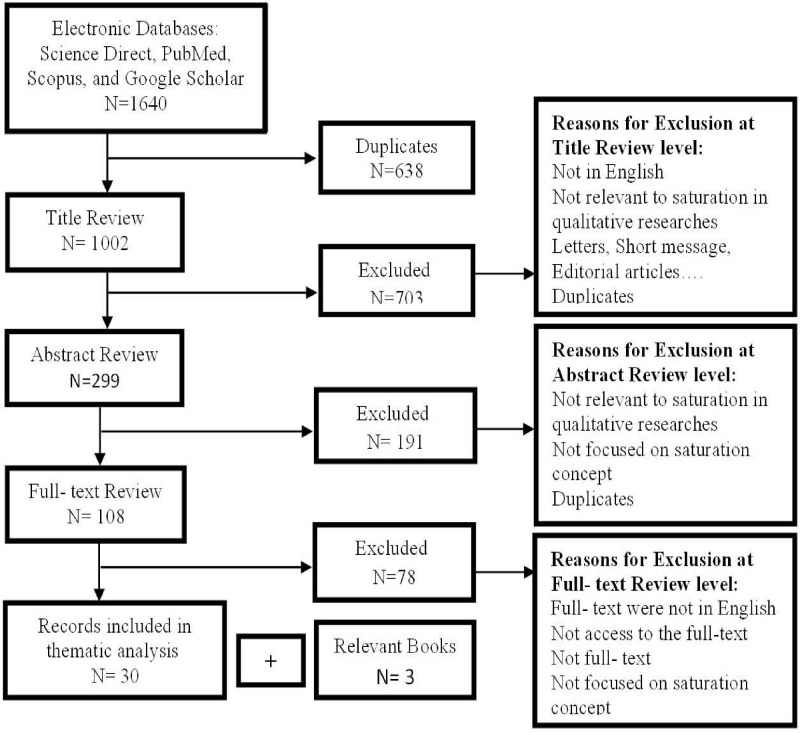
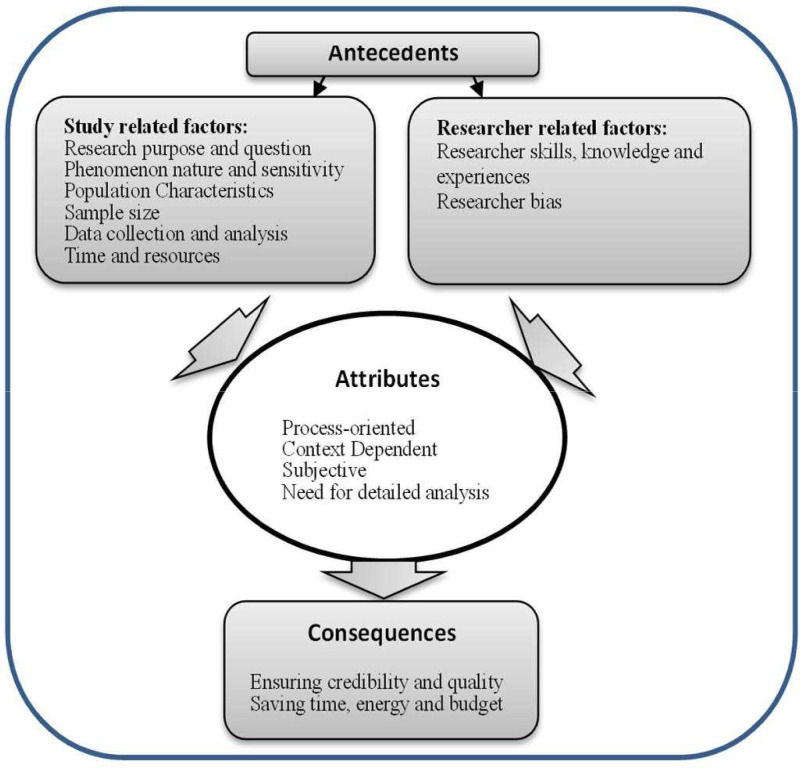
Verification
Claims the paper makes
The claims and statistics of this paper haven’t been checked yet.
Run the check — free, no account needed. It reads the open-access text and checks the sources it cites.
Claims other papers make about this one
Each is checked against this paper’s own text: does it say what the citing paper says it does?
The source backs part of the claim, not all of it — or backs it for a different population, condition or comparison.
In the citing paper
“The number of participating services in the research was determined by theoretical saturation from the qualitative analyses (25) in which the data collection was concluded when the information started to become redundant or repeated, even with the inclusion of new participants and services, as detected through a floating reading of the transcripts of the conducted interviews and fields diaries.”
From A mindfulness-based intervention for Substance Use Disorder in a Brazilian vulnerable population: a feasibility mixed method study (2024) · cites this paper as [25]
Experimental — accuracy not yet measured
Self-check
Percentages, sums and reported differences re-computed from the paper’s own numbers.
The self-check needs the paper’s full text.
Citations
Cites
Qualitative Inquiry and Research Design: Choosing Among Five Approaches
Lewis, S. (2015) · Health Promotion Practice · doi:10.1177/1524839915580941 · Cited by 22,105
How Many Interviews Are Enough?: An Experiment with Data Saturation and Variability
Guest, G., Bunce, A., & Johnson, L. (2006) · Field Methods · doi:10.1177/1525822x05279903 · Cited by 20,808 · cited 10×
“There are several reasons for pseudo-saturation, such as prematurely ending data collection, not exploring different perspectives or contexts, or overlooking important sources of information (Aldiabat & Le Navenec, 2018; Guest et al., 2006; Morse, 2015a).”
BackgroundInfluentialSaturation in qualitative research: exploring its conceptualization and operationalization
Saunders, B., Sim, J., Kingstone, T., Baker, S., Waterfield, J., Bartlam, B., Burroughs, H., & Jinks, C. (2018) · Quality & Quantity · doi:10.1007/s11135-017-0574-8 · Cited by 12,033 · cited 9×
“…still susceptible to false saturation due to the lack of discovery of relationships between codes and obtained themes, and still requires more data for the researcher to fully understand the depth, richness, and complexity of the phenomenon (Hennink et al., 2017; Low, 2019; Saunders et al., 2018).”
BackgroundMethodInfluentialBasics of Qualitative Research: Techniques and Procedures for Developing Grounded Theory
Wuetherick, B. (2010) · Canadian Journal of University Continuing Education · doi:10.21225/d5g01t · Cited by 8,333
(2011) · Cited by 7,157
Sample sizes for saturation in qualitative research: A systematic review of empirical tests
Hennink, M., & Kaiser, B. N. (2022) · Social Science & Medicine · doi:10.1016/j.socscimed.2021.114523 · Cited by 6,311 · cited 10×
“…still susceptible to false saturation due to the lack of discovery of relationships between codes and obtained themes, and still requires more data for the researcher to fully understand the depth, richness, and complexity of the phenomenon (Hennink et al., 2017; Low, 2019; Saunders et al., 2018).”
BackgroundMethodInfluentialBraun, V., & Clarke, V. (2021) · Qualitative Research in Sport, Exercise and Health · doi:10.1080/2159676x.2019.1704846 · Cited by 4,776 · cited 3×
“Information redundancy helps conceptualize saturation (Alam, 2021; Braun & Clarke, 2021; Bryman, 2006).”
BackgroundCode Saturation Versus Meaning Saturation: How Many Interviews Are Enough?
Hennink, M. M., Kaiser, B. N., & Marconi, V. C. (2017) · Qualitative Health Research · doi:10.1177/1049732316665344 · Cited by 4,597
Are We There Yet? Data Saturation in Qualitative Research
Fusch, P., & Ness, L. (2015) · The Qualitative Report · doi:10.46743/2160-3715/2015.2281 · Cited by 4,460
Sample size in qualitative research
Sandelowski, M. (1995) · Research in Nursing & Health · doi:10.1002/nur.4770180211 · Cited by 4,372 · cited 1×
“An important aspect of theoretical saturation is that in an iterative process, the researcher simultaneously engages in sampling, data collection, and data analysis (Sandelowski, 1995).”
Background
Research works printed but not linked: 3
- Aldiabat, 2018, Data saturation: The mysterious step in grounded theory methodology, The qualitative report, 23, 245
- Morse, 2015, 25, 587
- Thomson, 2010, Sample size and grounded theory. Thomson, SB (2010), Grounded Theory-Sample Size. Journal of Administration and Governance, 5, 45
Cited by
Sorted by citations
Items 301–400 of 555
Mabiletsa, V., & Ramdass, K. R. (2025) · Journal of Environmental Protection · doi:10.4236/jep.2025.1610053
Olifant, L. L., Phalane, E., Shiferaw, Y. A., Mhlophe, H., & Phaswana-Mafuya, N. R. (2025) · International Journal of Environmental Research and Public Health · doi:10.3390/ijerph22101602 · Cited by 1
“Moreover, this programme is led by the South African government to offer PrEP to HIV-negative sex workers and young women, along with life-saving antiretroviral treatment (ART), adherence support, and a full range of sexual and reproductive health services [27].”
A todo pulmon: co-designing a health initiative for pediatric asthma amid COVID-19
Vásquez-Guevara, D., Zavala-Sanchez, F., Cabrera, T. B., Avilés, A. M. O., & Donoso, S. (2025) · Journal of Communications In Healthcare · doi:10.1080/17538068.2025.2577049
“We applied the principle of coding saturation [63], explicitly focusing on thematic saturation [64], we examined recurring themes across participant groups to identify specific issues that needed to be addressed in the health initiative.”
Yusof, N., Liew, H. M., Adnani, K., & Zameni, A. (2025) · Environment-Behaviour Proceedings Journal · doi:10.21834/e-bpj.v10i33.7281
Online Discussions About Intrauterine Devices: A Qualitative Content Analysis of Global Reddit Posts
Breakey, G. R., & Chur-Hansen, A. (2025) · Perspectives on sexual and reproductive health · doi:10.1111/psrh.70040
Wenqing, C., Liu, J., Chen, Z., Li, Q., Baolin, Z., Keping, Z., & Su, Y. (2025) · International Journal of Qualitative Studies on Health and Well-Being · doi:10.1080/17482631.2025.2576005
“With the participants' consent, the interview contents were audio-recorded and verbatim transcribed within 24 h. Data collection continued until information saturation was achieved, defined as the point at which no new key information emerged (Rahimi and Khatooni, 2024).”
A comunicação como centralidade
Geraldo, G. B., Rauen, C. C., Portela, M. V. Z., & Silva, A. P. (2025) · Revista da SBPH · doi:10.57167/rev-sbph.2025.v28.701
Cottrell, M. A., & Winter, S. (2025) · Health Services Management Research · doi:10.1177/09514848251384284
Career development awards support early-stage researchers in life sciences entrepreneurship
Ong, J., Hill-Whilton, Z., Gillespie, C. C., Cobos, D., & Simson, G. G. (2025) · Nature Biotechnology · doi:10.1038/s41587-025-02899-z
Aledeh, M., Sokan‐Adeaga, A. A., Adam, H., Aledeh, S., & Kotera, Y. (2025) · Research Square · doi:10.21203/rs.3.rs-8125005/v1
Afenigus, A. D., & Sinshaw, M. A. (2025) · International Journal of Africa Nursing Sciences · doi:10.1016/j.ijans.2025.100924
Compact living, big impact: exploring micro housing for Sri Lankan middle-income households
Mannapperuma, M. M. N., Illeperuma, I. E., Disaratna, V., & Perera, B. A. K. S. (2025) · Housing Studies · doi:10.1080/02673037.2025.2588221
“Thematic saturation was achieved after the tenth interview, but two additional interviews were conducted to confirm and ensure the completeness of emerging themes (Rahimi & Khatooni, 2024).”
The human side of digitalization: psychosocial factors in Norway’s offshore petroleum industry
Wiberg, S., Bergh, L. I. V., & Mathisen, G. E. (2025) · Cognition Technology & Work · doi:10.1007/s10111-025-00845-2 · Cited by 1
“This indicated both thematic and meaning saturation, understood here as a context-dependent and processual judgment shaped by the study’s focused aim and relatively homogeneous population (Hennink and Kaiser 2022; Rahimi and Khatooni 2024).”
Xu, M., Smiley, A., Aboagye, A., Parker, T. N., Phillips, K., Oppong, K. D., Torke, A. M., Varner-Perez, S. E., Khalidi, S., Fitchett, G. A., et al. (2025) · PLoS ONE · doi:10.1371/journal.pone.0337436
“Constant comparison will be used throughout to refine codes, identify deviant cases, and develop robust thematic categories [52].”
A Bibliometric Analysis of Global Research on Self-Compassion and Mental Health from 2010 to 2025Preprint
Aledeh, M., Sokan‐Adeaga, A. A., Adam, H., Aledeh, S., & Kotera, Y. (2025) · Research Square · doi:10.21203/rs.3.rs-8139554/v1
Wang, R., Zheng, X., & Hou, Z. (2025) · Trans/Form/Ação · doi:10.1590/0101-3173.2025.v48.n5.e025202
Evaluating MiCA Framework via Industry Perceptions of Risks
Mukhamedov, A., de Azevedo, V. S., van Eeten, M. J. G., Ubacht, J., & Zhauniarovich, Y. (2025) · ACM Journal on Responsible Computing · doi:10.1145/3785002
“While we acknowledge that our sample size is at the low end of this spectrum due to the sensitivity and complexity of interview objective, we tried to minimize the impact on the validity of our results by considering the factors described by Rahimi and Khatooni [79] to increase saturation.”
Mniwasa, E. E. (2025) · Qualitative Research in Financial Markets · doi:10.1108/qrfm-10-2024-0309
Patel, D. M., Chandler, A. M., Strahley, A. E., White, K., Burciu, B., Crews, D. C., & Murea, M. (2025) · Kidney360 · doi:10.34067/kid.0000001072
Digital Minimalism in Business: Doing More with Less in the Age of Tech Overload
Kouskoura, A., Kalliontzi, E., & Bakouros, I. L. (2025) · Business, management and economics · doi:10.5772/intechopen.1013570
keer, I. V., Meys, E., Maes, B., & van der Putten, A. A. J. (2025) · Research in Developmental Disabilities · doi:10.1016/j.ridd.2025.105168
Salahudeen, S. M., Hasan, M., Hathi, M. B. A., Sultan, H., Sulaiman, J., Gousuddin, M., & Rao, A. S. (2025) · Research Journal of Pharmacy and Technology · doi:10.52711/0974-360x.2025.00608
Worthington, R., & Bennett, A. (2025) · Journal of Forensic Practice · doi:10.1108/jfp-03-2025-0031
Marisette, S., Permaul, J. A., Zeng, Z., Mei, J., Mutasingwa, D., Henry, M., Groff, A., & Homiak, K. (2025) · medRxiv · doi:10.64898/2025.12.01.25341083
Zinhle, M., Lowane, M. P., & Simbeni, T. V. (2025) · African Journal of Disability · doi:10.4102/ajod.v14i0.1765
Fonseca-Mardones, I., & Hernández-Lanas, O. (2025) · Cadernos Brasileiros de Terapia Ocupacional · doi:10.1590/2526-8910.cto401339123
Shmatkova, M., Buljan, I., Puljak, L., & Sapunar, D. (2025) · Studies in Higher Education · doi:10.1080/03075079.2025.2605099
Afenigus, A. D., & Kebede, A. T. (2025) · BMC Health Services Research · doi:10.1186/s12913-025-13887-z
Kahveci, A., & Yıldız, K. (2025) · Türk Deprem Araştırma Dergisi · doi:10.46464/tdad.1767902
Park, Y. A., & Kong, E. (2026) · BMC Medical Ethics · doi:10.1186/s12910-025-01366-3
Contextual Ethical Leadership as a Lever for Integrating and Engaging Expatriates
Morin, G., & Talbot, D. (2026) · Thunderbird International Business Review · doi:10.1002/tie.70075
Moale, A. C., Razskazovskiy, V., Rak, K. J., Richardson, A., Dhole, N., Butler, R. A., Nouraie, S. M., Ragavan, M. I., McGuier, E. A., & White, D. B. (2026) · Critical Care Explorations · doi:10.1097/cce.0000000000001365
“The interviews in the parent mixed-method study were conducted until thematic saturation was reached at each hospital, that is, the point at which no new codes or themes were generated across the four key topics described earlier (19).”
“We Are The Heartbeat of The School”: A Framework for Educator-to-Educator Relationships
Hsieh, T., Nappa, L., Scott, A. R., & Pezalla, A. E. (2026) · SAGE Open · doi:10.1177/21582440251408933
“The final codebook containing 36 codes, (Supplemental Material 3), which all coders felt achieved thematic saturation (Rahimi & Khatooni, 2024), was used to re-code the first half transcripts and code the remaining half of the transcripts.”
Juqu, F. Z., Kapcheb, D. E. L. M., Xulu-Kasaba, Z. N., & Baloyi, O. B. (2026) · F1000Research · doi:10.12688/f1000research.174876.1
Mueller, H. J., Barner, J. C., Odonkor, G., Brown, C. M., & Stewart, M. P. (2026) · American Journal of Health-System Pharmacy · doi:10.1093/ajhp/zxag003
Experiences of Older People Living at Home With Medication Use: A Qualitative Study From Lithuania
Jakavonytė-Akstinienė, A., & Ramanauskaite, R. (2026) · Cureus · doi:10.7759/cureus.101671
“The quality and validity of the study depend on data saturation [16].”
Bauernschmidt, D., Bieber, A., Hubrich, R., Wittmann, J., & Meyer, G. (2026) · Journal of Medical Internet Research · doi:10.2196/81669
“Recruitment was completed when no new information emerged from interviews indicating that data saturation was achieved [34,35].”
de Haan, A., Moeijes, J., Scheffers, M., & van der Wees, P. J. (2026) · Quality of Life Research · doi:10.1007/s11136-025-04119-2
“Due to the inclusion of the total number of groups and diverse participants in the study, data saturation [25, 26] was anticipated.”
Schmidt, F., Renner, J., Schröder, S.-I., Pregartbauer, L., Dekker, A., & Nieder, T. O. (2026) · BMC Health Services Research · doi:10.1186/s12913-026-14026-y
“However, the relatively small number of participants limited the extent to which data saturation could be achieved, particularly among network physicians and study therapists [80].”
Addressing stakeholder dynamics in megaprojects: a framework for governance
Uğural, M. N., & Aghili, S. (2026) · Engineering Construction & Architectural Management · doi:10.1108/ecam-07-2025-1219 · Cited by 2
Finding Home in the Foreign Land: Experience of Indonesian Nurses in Australia
Ferry, E., Pradipta, R. O., Makhfudli, M., McKenna, L., & Houghty, G. S. (2026) · Journal of Multidisciplinary Healthcare · doi:10.2147/jmdh.s562745
Thiaw, A., Ayihounton, G., Bajurny, V., Benabess, A., Bender, J. L., Boutin, D., Delorme, S., Dogba, M. J., Etienne, M., Gagnon, M., et al. (2026) · medRxiv · doi:10.64898/2026.01.30.25336170
Shamsi, A., Yarahmadi, S., Kar, A. A. Z., & Delshad, E. S. (2026) · BMJ Open · doi:10.1136/bmjopen-2025-102923
Nguyen, A. P.-U., Tran, T.-M., Tu, Q. V., Vo, T., Tran, C., Liu, Y. M., & Nguyen, T. H. (2026) · Diabetology · doi:10.3390/diabetology7020034
“The goal was to reach data saturation to the point where no new information is gained from interviews [17].”
Almughyiri, S. (2026) · Research in Developmental Disabilities · doi:10.1016/j.ridd.2026.105242
Saleem, F., Khilji, F. U. R., Haider, S., Iqbal, Q., Ibrahim, B., Shabaruddin, F. H., & Bashaar, M. (2026) · PLoS ONE · doi:10.1371/journal.pone.0342241
“The saturation was achieved at the eighth interview, but two additional interviews were conducted to ensure the saturation [34,35].”
ElKhalil, R., Adam, H., Bayoumi, R. R., Javaid, S. F., Albreiki, N., Naqvi, S. Z. F., Alam, Z., Ahmed, L. A., Al‐Rifai, R. H., Masuadi, E., et al. (2026) · Scientific Reports · doi:10.1038/s41598-026-38017-5
“Theoretical saturation was empirically confirmed when no new themes or subthemes emerged after conducting three additional interviews 29 .”
Silva, D., Alves, L., Reis, N. F. I., dos Santos, M. E. G., Mendes, E. C., & Castro, V. D. S. (2026) · PLoS ONE · doi:10.1371/journal.pone.0342911
“Qualitative data collection will follow the principle of theoretical saturation [37], assessed iteratively by the analysis team during coding.”
Perceptions of ischaemic heart disease risk among Indian migrants in Australia: a qualitative study
Kaur, K., Abu‐Qamar, M. Z., Rashidi, A., McKay, N., & Saunders, R. (2026) · Primary Health Care Research & Development · doi:10.1017/s1463423626100930
Experiences of woman- centered care among Iranian midwives and women: a qualitative study
Mashayekh‐Amiri, S., Mohammad‐Alizadeh‐Charandabi, S., Nourizadeh, R., Vaezi, M., Meedya, S., & Mirghafourvand, M. (2026) · Reproductive Health · doi:10.1186/s12978-026-02283-3
From Child-Focused to Family-Centered: Caregiver Perspectives on Success in Autism Treatment
Befi, M., Bemmel, V., Cook, I. C., Ikola, J., Schlueter, C., & Pfingston, B. (2026) · The Family Journal · doi:10.1177/10664807261420133
“Recent work distinguishes between code saturation (no new codes) and meaning saturation (no new insights), with the latter requiring larger samples for interpretive depth (Hennink et al., 2017; Hennink & Kaiser, 2022; Rahimi & Khatooni, 2024).”
Patel, J. D., Meng, J., Jimenez‐Moreno, C., Coerts, F. B., Venerus, M., Park, S., Haq, M. I.-U., Gorsh, B., & Tervonen, T. (2026) · Clinical Lung Cancer · doi:10.1016/j.cllc.2026.02.003
Vveinhardt, J., Deikus, M., & Carey, L. B. (2026) · Journal of Religion and Health · doi:10.1007/s10943-026-02590-w
“…agreed that theory building is a dynamic process; therefore, it is difficult to define in advance how many interviews will be needed in a particular case to achieve data saturation or to avoid information excess (Aldiabat & Le Navenec, 2018; Chiang et al., 2001; Rahimi & khatooni, 2024).”
da Rosa, R., dos Santos, J. L. G., Ross, R., de Lima, M. M., Wilhelm, L. A., & Costa, R. (2026) · Journal of Interprofessional Care · doi:10.1080/13561820.2026.2634234
Burke, J., Kissler, M. J., Nguyen, A. Q., Amass, T. H., & New, M. L. (2025) · Academic Medicine · doi:10.1093/acamed/wvaf083
Teixeira, B. R. F., Braga, C. C., Júnior, J. M. P., Singh, A., & Forte, F. D. S. (2026) · Journal of Interprofessional Care · doi:10.1080/13561820.2026.2633617
“The saturation criteria was applied upon realizing that the research question had been fully explored by the participants without new ideas emerging that could alter the desired theoretical understanding (Rahimi & Khatooni, 2024).”
Juqu, F. Z., Kapcheb, D. E. L. M., Xulu-Kasaba, Z. N., & Baloyi, O. B. (2026) · F1000Research · doi:10.12688/f1000research.174876.3
“27 According to the healthcare practitioners, these elements set the stage for upward referral and are often system-level or preparatory in nature.”
Dankwa, E. A., Wambura, C., Mubarokah, M. A., Matta, C. J., Gado, B., Komesuor, J., Savage, J. V., II, Makido, A., Baiden, F., & Noor, A. M. (2026) · PLOS Global Public Health · doi:10.1371/journal.pgph.0004981
“Saturation was determined by observing that interview summary notes for the last few interviews showed no new major themes, suggesting that additional data collection was unlikely to result in additional findings [13,14].”
Commodified Classrooms, Eroded Identities: The Emotional Woes of Indian School Teachers
Iyer, G., & Rajeev, P. N. (2026) · Emerald Group Publishing Limited eBooks · doi:10.1108/s1746-979120260000020012
Management et dynamiques sociétales en Afrique subsaharienne
Gobi, C. B. K., & Gueye, B. (2025) · doi:10.3917/ems.gueye.2025.01.0061
Collazo, A., Haltom, T. M., Luna, J., Olmeda, K., Mancera, A., Faustinella, F., Paasche‐Orlow, M. K., Landis‐Lewis, Z., Zoorob, R., Trautner, B. W., et al. (2026) · Antimicrobial Stewardship & Healthcare Epidemiology · doi:10.1017/ash.2026.10317
Beyond the checklist: structuring risk perception in high-altitude adventure cycling
Xie, T., Wu, X., Huang, R., Guo, W., & Shi, S. (2026) · Tourism Recreation Research · doi:10.1080/02508281.2026.2637465
Mpofu, F. Y., & Mudau, S. L. (2026) · Cogent Arts and Humanities · doi:10.1080/23311983.2026.2639313 · Cited by 5
Nzama, N., Harris, L. M., Skidmore, B. D., Mwenda, J. S., Kerr, J., Hall, M. T., Sedaghatshoar, S., Reyes-Vega, A., Deepti, F., Raghuram, A., et al. (2026) · Global Qualitative Nursing Research · doi:10.1177/23333936261429417
“The research team pursued a sample that provided a sufficiently diverse range of experiences to address the aims (Braun & Clarke, 2021; Thorne, 2025), and information redundancy was pursued to ensure thematic completeness (Braun & Clarke, 2021; Rahimi, 2024).”
Vezzani, F., Roberts, A., Campaña, C., Cabieses, B., Alexandra Obach, K., & Espinoza, M. (2026) · Health Research Policy and Systems · doi:10.1186/s12961-026-01468-3
“This is defined as the point at which no new themes or sub-themes relevant to the study objectives and key analytical dimensions (barriers, opportunities and recommendations) emerge [42, 43].”
Veilleux, M., Simard, P., Lapointe, M., Ore, R., Giguère, A.-F., Labbé, A., Ouellet, M., Best, K. L., & Turcotte, S. (2026) · BMC Geriatrics · doi:10.1186/s12877-026-07318-9
“However, the heterogeneity of participant groups and the limited number of eligible people may limit the feasibility of achieving complete data saturation [43].”
Understanding Undergraduate Students Desire to Study Psychiatric Rehabilitation: A Qualitative Study
Waynor, W. R., Banz, E., Banko, A., Basto, P. M., Rothpletz‐Puglia, P., Roy, S., Bonsu, Y., & Greco, S. H. (2026) · The Rehabilitation Professional · doi:10.70385/001c.159677
Traverso, D., Pacheco, G., Wong-Durand, S., Castañeda, P., & Andino, A. O. (2026) · Engineering Technology & Applied Science Research · doi:10.48084/etasr.14855
“This sample size aligns with the thematic saturation recommendations proposed in [40] and corroborated in [41], which place the saturation between 15 and 30 informants for exploratory studies of software quality perception (see Table V).”
Jakavonytė-Akstinienė, A., & Adomavičiūtė, K. (2026) · Nursing Reports · doi:10.3390/nursrep16040124
“The quality and validity of the study depended on data saturation [27].”
Bhatia, P., McLaren, H., & Huang, Y. (2026) · Journal of International Migration and Integration / Revue de l integration et de la migration internationale · doi:10.1007/s12134-026-01382-1
Repercussions of psychological literacy
Mailloux, D. (2026) · Psychology Teaching Review · doi:10.53841/bpsptr.2026.32.1.53
Shimizu, J. P. K., Dawson, S. J., Fitzpatrick, E. T., Tavares, I. M., Kempster, O., & Rosen, N. O. (2026) · LGBTQ+ Family An Interdisciplinary Journal · doi:10.1080/27703371.2026.2635395
Zhou, Q., Jiang, J., Yin, Z., & Liu, Y. P. (2026) · Frontiers in Psychology · doi:10.3389/fpsyg.2026.1767468
Private Practice Dietetics Workforce Development: What 45 Thought Leaders Agree On
Donnelly, J., Clark, P. W., Walsh, L., & Lane, R. (2026) · Journal of Human Nutrition and Dietetics · doi:10.1111/jhn.70247
“Nominal saturation determined the completion of recruitment [36, 40].”
Dental Provider Experiences with AI Radiograph Annotation: A Qualitative Case Study
Schroeder, K. L., Slashcheva, L. D., Heaton, L. J., Cheung, H. J., Prosa, B., Ferrian, N., Grantz, J., Jacobi, D., Helgeson, M. J., & Tranby, E. P. (2026) · JDR Clinical & Translational Research · doi:10.1177/23800844261429908
Hastuti, P., Effendy, K., Maryani, D., & Sartika, I. (2026) · Ilomata International Journal of Management · doi:10.61194/ijjm.v7i2.2227
“This number was determined based on the principle of data saturation, where additional informants no longer provide meaningful new information (Rahimi, 2024).”
Xiao, J., Xie, Y., Cheng, S., Lin, B., Chen, F., Luo, H., Zhou, Y., Qin, L., An, H., Xu, W., et al. (2026) · BMC Geriatrics · doi:10.1186/s12877-026-07581-w
“Data collection continued until the information collected reached the saturation point, and no new themes or information emerged from the interviews [29].”
Zhou, Y., Shu, W., Deng, L., Xie, C., Yan, Y., & Ye, X.-C. (2026) · BMC Geriatrics · doi:10.1186/s12877-026-07565-w
“Purposive sampling approach was conducted, and the sample size was determined based on data saturation, when no new concepts or themes emerge [19].”
Beyond the Screen: A 360-degree Study of User Experience and Behavior in Online Virtual Museum Tours
Shikhri, R., Lanir, J., & Maimon, A. (2026) · ACM International Symposium on Pervasive Displays (PerDis) · doi:10.1145/3797993.3798023
Chen, Y., Zhang, L., Du, H., Zhang, C., & Yang, W. (2026) · Land · doi:10.3390/land15050769
International students' belonging, acculturation, and integration at the University of Debrecen
Trujillo, J. P. C., & Dabney-Fekete, I. D. (2026) · The Hungarian Educational Research Journal · doi:10.1556/063.2026.00456
Mumuni, S., O’Donnell, C., & Doody, O. (2026) · Nursing Open · doi:10.1002/nop2.70585
Silent suffering: an exploration of menopausal attitudes and experiences among slum dwellers
Ahmed, S., & Kushwaha, N. (2026) · Menopause The Journal of The North American Menopause Society · doi:10.1097/gme.0000000000002810
Syed Ali Nawaid, A. L. A. M., & Adekunle, O. E. (2026) · European Business Review · doi:10.1108/ebr-11-2025-0432
Ghimire, A., & Neupane, M. S. (2026) · BMC Nursing · doi:10.1186/s12912-026-04722-9
“Analysis continued until no substantively new codes or theme refinements were identified, indicating adequate saturation for the study aims [69].”
Xu, Y., Zhang, B., Zhan, J., & Yang, M. (2026) · System · doi:10.1016/j.system.2026.104067
Guadarrama-Orozco, J. H., Mendoza, M. R., Mendoza-Martínez, M. G., Peláez-Ballestas, I. D. P., de Lara, A. M., & Muñoz-Pedraza, M. (2026) · BMC Palliative Care · doi:10.1186/s12904-026-02134-9
“Thematic saturation was reached when no new codes or themes were identified and their contents were redundant [24].”
Guili, H. E. (2026) · Studies in Business and Economics · doi:10.29117/sbe.2025.0166
Shirotriya, A. K., Chouhan, C., Vishwakarma, R., & Kumar, P. (2026) · International Journal of Educational Reform · doi:10.1177/10567879261446914
Retirement intentions of late-career female nurses: a phenomenological study
Aslan, Y., Zeybek, D. Ö., Zeybek, M. O., Atalay, H. N., & Güvensoy, T. (2026) · BMC Nursing · doi:10.1186/s12912-026-04746-1
“Recognizing this point is essential, as it indicates that further recruitment is unlikely to provide additional meaningful data [37, 38].”
Moreno, X., García, P., & Huerta, M. (2026) · Healthcare · doi:10.3390/healthcare14101341
“Thematic saturation was achieved after the eighth focus group, with no new codes or themes emerging from the analysis [51].”
Firooz, M., Yazdi, K., Mahmoodi‐Shan, G. R., & Zahedi, M. (2026) · SAGE Open Nursing · doi:10.1177/23779608261451612
“Saturation was reached when no new codes or themes emerged and the researchers had gained a comprehensive understanding of the phenomenon (Rahimi & khatooni, 2024).”
Tsuchida, R. E., Schwei, R. J., Boatright, D. B., & Padela, A. I. (2026) · Academic Emergency Medicine · doi:10.1111/acem.70322
Homicide Offenders’ Perceptions of Procedural Justice in Ghana’s Criminal Courts
Abrah, P. B., & Andoh–Arthur, J. (2026) · Deviant Behavior · doi:10.1080/01639625.2026.2672152
TRANSMISION DE LAS CANCIONES TRADIONALES EN LA CULTURA BEREBER
Kahlaoui, D. B. A. E. (2026) · MODULEMA Revista científica sobre Diversidad Cultural · doi:10.30827/modulema.v10i.35862
Lau, A., Han, C., Ludlow, K., Young, A., Miller, E. M., & Miller, M. D. (2026) · BMC Geriatrics · doi:10.1186/s12877-026-07672-8
“Data saturation was achieved when more recent participants expressed similar experiences and ideas to previous participants and limited new information was presented [32].”
Parikh, S., & Feldman, C. H. (2026) · Sustainability · doi:10.3390/su18105033
Iyer, G., Iyer, R., & Pandit, A. B. (2026) · Transactions of Indian National Academy of Engineering · doi:10.1007/s41403-026-00580-8
“Some qualitative research scholars argue that for relatively homogeneous populations, an average sample size of approximately 12–15 can help achieve theoretical saturation (Guest et al. 2006; Hennink and Kaiser 2022; Rahimi and Khatooni 2024).”
Provision of Bereavement Care for Siblings: Insights from Pediatric Palliative Care Teams Nationwide
Huy, N. T., Minh, P. Q., & Bich, L. T. (2024) · Journal of integrative nursing and palliative care · doi:10.51847/gnbvkooj4z
Training under planetary risk: planetary health ethics in clinical education and governance
Ghimire, A., & Neupane, M. S. (2026) · BMC Medical Education · doi:10.1186/s12909-026-09424-z
“Instead, we assessed whether the dataset provided sufficient information power and analytic depth to answer the narrowed research questions about student experiences, perceived preparedness, and curriculum-relevant suggestions within this setting [46, 47].”
Metadata
- Authors
- Rahimi, S., & khatooni, M.
- Affiliations
- Qazvin University of Medical Sciences (IR)
- Corresponding author
- Rahimi, Sara
- Venue
- International Journal of Nursing Studies Advances
- Publisher
- Elsevier BV
- Published
- 2024-06
- Volume
- 6
- Pages
- 100174
- ISSN
- 2666-142X (ISSN-L)
- PMC
- PMC11080421
- OpenAlex
- W4390604507
- Cited by
- 560
- References
- 34
- Citations by year
- 2026: 273 · 2025: 236 · 2024: 51
- FWCI
- 704.99
- Type
- journal article
- Language
- en
- Open access
- gold
- doi.org
- Licence
- Locations
- International Journal of Nursing Studies Advances (publishedVersion, cc-by-nc-nd)
- PubMed Central (publishedVersion, cc-by)
- PubMed (publishedVersion)
- DOAJ (DOAJ: Directory of Open Access Journals) (submittedVersion)
- Funders
- Qazvin University of Medical Sciences
- Topics
- Social Sciences › Education › Qualitative Research Methods and Applications
- Social Sciences › Sociology and Political Science › Qualitative Research Methods and Ethics
- Social Sciences › Sociology and Political Science › Focus Groups and Qualitative Methods
- Keywords
- saturation, qualitative research, data saturation, theoretical saturation, research credibility, sample size determination, nursing research
About these checks
Registry, retraction, Cites and statistics results are computed, not judged, with one exception: a printed reference that no index lists is read once by a model before it counts as a citation error. Claims are extracted by a model and kept only when their quote appears verbatim in the text; each cited source is then checked, with a model’s help, for whether it says what the claim relies on. Those verdicts can be wrong — read the claim’s quote and the cited source before relying on one.
Statistics and arithmetic are recomputed, not judged.
Confidence bands are shown only for fields calibrated on our annotated test set. None is calibrated yet, so no band is shown.
What counts as a claim ›How we measure confidence ›How we check this ›
Are you an author, or do you see a problem with this page? Request a review
