

The DOI matches its Crossref record; 34 of the 34 references it cites were found in a registry or an index.
Saturation in qualitative research: An evolutionary concept analysis
Open accessAbstract
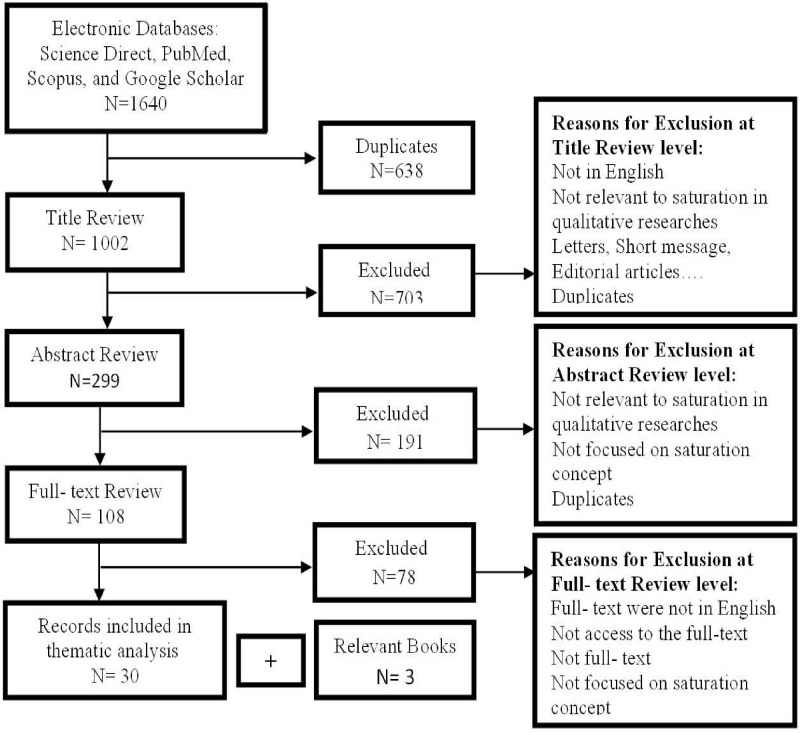
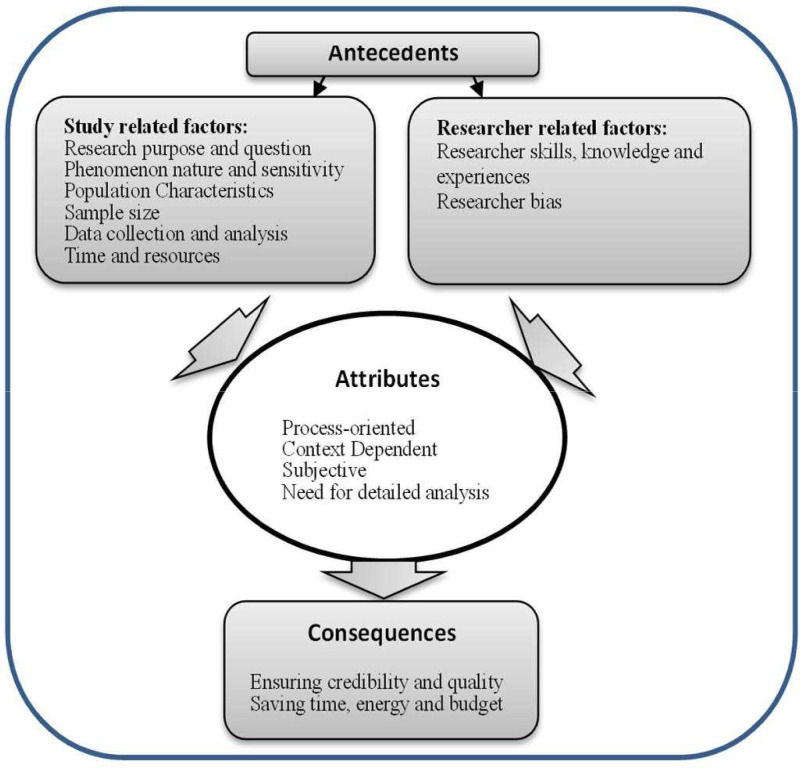
Background and Aim: Qualitative research plays an important role in improving nursing knowledge. Understanding the concept of saturation is essential to conducting rigorous qualitative research that contributes to evidence-based practice. The purpose of this study is to clarify the concept of saturation in qualitative research. Method: Evolutionary concept analysis was performed. A literature search was conducted using a variety of online databases for the years 2005- 2023. In total, 33 articles and books were analyzed using thematic analysis to identify the attributes, antecedents and consequences of saturation. The validity of the data was obtained by examining the analysis process by two independent researchers. Results: Saturation in qualitative research is a context-dependent, subjective process that requires detailed systematic analysis. Saturation is used in four ways in qualitative research: theoretical saturation, data saturation, code or thematic saturation, and meaning saturation. The antecedents of saturation were classified into two categories: study related factors and researcher related factors. The consequences of saturation were identified as: ensuring credibility and quality in qualitative research and time, energy and budget saving. Conclusion: This concept analysis serves to enhance the understanding of the concept of saturation, thereby offering valuable resources for qualitative researchers. By gaining a profound comprehension of saturation and its various types, researchers can ensure the validity of their studies while also optimizing time and resource allocation by avoiding redundant data collection. Future investigation warranted to elucidate how factors associated with reaching saturation impact estimations sample size.
Overview
The claims and statistics of this paper haven’t been checked yet.
Run the check — free, no account needed. It reads the open-access text and checks the sources it cites.
Integrity signals
Registry
Cites
Statistics
Figures
Verification
Claims the paper makes
The claims and statistics of this paper haven’t been checked yet.
Run the check — free, no account needed. It reads the open-access text and checks the sources it cites.
Claims other papers make about this one
Each is checked against this paper’s own text: does it say what the citing paper says it does?
The source backs part of the claim, not all of it — or backs it for a different population, condition or comparison.
In the citing paper
“The number of participating services in the research was determined by theoretical saturation from the qualitative analyses (25) in which the data collection was concluded when the information started to become redundant or repeated, even with the inclusion of new participants and services, as detected through a floating reading of the transcripts of the conducted interviews and fields diaries.”
From A mindfulness-based intervention for Substance Use Disorder in a Brazilian vulnerable population: a feasibility mixed method study (2024) · cites this paper as [25]
Experimental — accuracy not yet measured
Self-check
Percentages, sums and reported differences re-computed from the paper’s own numbers.
The self-check needs the paper’s full text.
Citations
Cites
Qualitative Inquiry and Research Design: Choosing Among Five Approaches
Lewis, S. (2015) · Health Promotion Practice · doi:10.1177/1524839915580941 · Cited by 22,105
How Many Interviews Are Enough?: An Experiment with Data Saturation and Variability
Guest, G., Bunce, A., & Johnson, L. (2006) · Field Methods · doi:10.1177/1525822x05279903 · Cited by 20,808 · cited 10×
“There are several reasons for pseudo-saturation, such as prematurely ending data collection, not exploring different perspectives or contexts, or overlooking important sources of information (Aldiabat & Le Navenec, 2018; Guest et al., 2006; Morse, 2015a).”
BackgroundInfluentialSaturation in qualitative research: exploring its conceptualization and operationalization
Saunders, B., Sim, J., Kingstone, T., Baker, S., Waterfield, J., Bartlam, B., Burroughs, H., & Jinks, C. (2018) · Quality & Quantity · doi:10.1007/s11135-017-0574-8 · Cited by 12,033 · cited 9×
“…still susceptible to false saturation due to the lack of discovery of relationships between codes and obtained themes, and still requires more data for the researcher to fully understand the depth, richness, and complexity of the phenomenon (Hennink et al., 2017; Low, 2019; Saunders et al., 2018).”
BackgroundMethodInfluentialBasics of Qualitative Research: Techniques and Procedures for Developing Grounded Theory
Wuetherick, B. (2010) · Canadian Journal of University Continuing Education · doi:10.21225/d5g01t · Cited by 8,333
(2011) · Cited by 7,157
Sample sizes for saturation in qualitative research: A systematic review of empirical tests
Hennink, M., & Kaiser, B. N. (2022) · Social Science & Medicine · doi:10.1016/j.socscimed.2021.114523 · Cited by 6,311 · cited 10×
“…still susceptible to false saturation due to the lack of discovery of relationships between codes and obtained themes, and still requires more data for the researcher to fully understand the depth, richness, and complexity of the phenomenon (Hennink et al., 2017; Low, 2019; Saunders et al., 2018).”
BackgroundMethodInfluentialBraun, V., & Clarke, V. (2021) · Qualitative Research in Sport, Exercise and Health · doi:10.1080/2159676x.2019.1704846 · Cited by 4,776 · cited 3×
“Information redundancy helps conceptualize saturation (Alam, 2021; Braun & Clarke, 2021; Bryman, 2006).”
BackgroundCode Saturation Versus Meaning Saturation: How Many Interviews Are Enough?
Hennink, M. M., Kaiser, B. N., & Marconi, V. C. (2017) · Qualitative Health Research · doi:10.1177/1049732316665344 · Cited by 4,597
Are We There Yet? Data Saturation in Qualitative Research
Fusch, P., & Ness, L. (2015) · The Qualitative Report · doi:10.46743/2160-3715/2015.2281 · Cited by 4,460
Sample size in qualitative research
Sandelowski, M. (1995) · Research in Nursing & Health · doi:10.1002/nur.4770180211 · Cited by 4,372 · cited 1×
“An important aspect of theoretical saturation is that in an iterative process, the researcher simultaneously engages in sampling, data collection, and data analysis (Sandelowski, 1995).”
Background
Research works printed but not linked: 3
- Aldiabat, 2018, Data saturation: The mysterious step in grounded theory methodology, The qualitative report, 23, 245
- Morse, 2015, 25, 587
- Thomson, 2010, Sample size and grounded theory. Thomson, SB (2010), Grounded Theory-Sample Size. Journal of Administration and Governance, 5, 45
Cited by
Sorted by citations
Items 401–500 of 555
Katz, A., Dewitt, M., Zeltzer, N., Daniel, B., Ury, B., Maxwell, Z., Acevedo, A. R., Tran, H., Thakkar, I., & Grigsby‐Toussaint, D. S. (2026) · Children · doi:10.3390/children13050662
“Transcripts were coded completely; however, they were only analyzed until code/ thematic saturation was reached [53].”
Hu, S., Liu, S., Hu, H., Hu, J., Batool, S., Chen, W., Yang, Q., Liu, G., Valimaki, M. A., & Li, X. (2026) · BMC Nursing · doi:10.1186/s12912-026-04779-6
“Because all trained nurses were invited, the sample size was determined by willingness to participate rather than data saturation [32].”
Mohlala, N. P., Chauke, N. P., Duah, E., & Maluleke, K. (2026) · Nursing Forum · doi:10.1155/nuf/1653051
Taşdemir, D., & Aksoy, N. (2026) · Journal of Religion and Health · doi:10.1007/s10943-026-02676-5
Piran, C. M. G., Laranjeira, C., Mori, M. M., Cargnin, A. V. E., Harmuch, C., Charepe, Z. B., & Furtado, M. D. (2026) · Journal of the Association of Nurses in AIDS Care · doi:10.1097/jnc.0000000000000650
Ghimire, A., Manandhar, M. D., Karki, S., & Bajracharya, K. (2026) · Energy Research & Social Science · doi:10.1016/j.erss.2026.104780
E-WOM and Tourist Experiential Values in the Sharing Economy: An Airbnb Case Study
Meral, I., & Özcan, C. C. (2026) · World · doi:10.3390/world7060092
Roots of responses: A qualitative study on intergenerational transmission of illness approaches
Hogendoorn, E., van der Ziel, S., Ballering, A., van Tol, D. G., & Rosmalen, J. G. M. (2026) · International Journal of Clinical and Health Psychology · doi:10.1016/j.ijchp.2026.100692
“After coding 15 to 20 interviews, the first signs of saturation became apparent as no new codes emerged (Hennink et al., 2017; Rahimi & Khatooni, 2024).”
Sanyaolu, O., Nabors, L., Reeves-Doyle, B., King, K., & Adabla, S. (2026) · Journal of International Students · doi:10.32674/tfbg6f81
“By the 17th interview, no new codes or themes emerged; subsequent interviews confirmed the absence of new insights (Rahimi & Khatooni, 2024; Saunders et al., 2018).”
Platform Thinking as a Catalyst for Circular Innovation in Low‐ and Medium‐Tech Industries
Köhler, J., Sönnichsen, S. D., Beske-Janssen, P., & Thuesen, C. (2026) · Business Strategy and the Environment · doi:10.1002/bse.71020
Miorin, J. D., Camponogara, S., Siqueira, B. M., Freitas, E. D. O., da Silva, R. R., & Forte, E. C. N. (2025) · Revista de Enfermagem UFPE on line · doi:10.5205/1981-8963.2025.266954
The Role of Projects and Programs in Large Technical Systems
Dei, G., Dotti, C., Ferri, T., & Locatelli, G. (2026) · Journal of Management in Engineering · doi:10.1061/jmenea.meeng-7170
Tantrongphak, K., Suriyaamarit, D., & Anantapong, K. (2026) · BMC Geriatrics · doi:10.1186/s12877-026-07784-1
Fleurke, M., Bouwman, L., Langius, J. A. E., & Moore, S. (2026) · Journal of Human Nutrition and Dietetics · doi:10.1111/jhn.70290
“The study involved the observation of eight dietitians, with a total of 31 observations conducted, after which additional observations no longer yielded new insights [27].”
Merabtine, T., Sognigbe, M. A., Marcellaud, E., Toniolo, J., Tarhini, Z., GANFON, H., Kpossou, A. R., Christou, N., Gnonlonfoun, D. D., & Jost, J. (2026) · Supportive Care in Cancer · doi:10.1007/s00520-026-10853-1
Bartholomaeus, T., Brown, S., Brömdal, A., Reyment, M., Erbacher, T., Mullens, A. B., McMillan, R. M., Ireland, R. E. E., & Fowler, J. A. (2026) · International Journal of Transgender Health · doi:10.1080/26895269.2026.2681667
Khan, M. E., Jamil, E., Abubakar, M., Javed, A., Abbas, D. R., Nawaz, E., Atiq, B., Razi, B. H., Saeed, A. R., Rasool, H., et al. (2026) · BMJ Open · doi:10.1136/bmjopen-2025-107828
Lule, H., Oguttu, B., Mugerwa, M., Wilson, M. L., & Posti, J. P. (2026) · JMIR Human Factors · doi:10.2196/84774
“Data collection was capped upon reaching saturation to optimize time and resources, thereby avoiding redundancy while ensuring the comprehensiveness of emerging themes from diverse professional contexts [32].”
Carvalho, J. M. S., Bártolo, A., & Araújo, A. M. (2026) · Child & Youth Care Forum · doi:10.1007/s10566-026-09959-8
Counsellors’ Perspectives on Psychosocial Risk Factors Contributing to Adolescent Delinquency
Ibharim, N. S., Kari, D. N. P. M., Harun, M. M., & Pei, A. K. Y. (2025) · Pertanika Journal of Counsellor Educator and Counselling Psychology · doi:10.47836/pjocecp.1.1.05
Lê‐Scherban, F., Norman, J., Ryan, V., Beverly, M., Rodrigues, N. M., Jannetti, M., Courts, K. A., Fusfeld, Z. H., Carroll‐Scott, A., Mayne, S. L., et al. (2026) · Annals of Epidemiology · doi:10.1016/j.annepidem.2026.110149
McLaughlin, S., Slavin, M. D., McGwin, M. B., Farahvash, Y., Patel, K. F., Romanowski, K. S. S., Schneider, J. C., Murphy, J. M., Stoddard, F. J., Kazis, L. E., et al. (2026) · Journal of Burn Care & Research · doi:10.1093/jbcr/irag098
Experiences of Iranian Nurses in Employing Nurse Assistants: A Descriptive Phenomenological Study
Piri, S., Khatony, A., & Jalali, R. (2026) · Iranian Journal of Nursing and Midwifery Research · doi:10.4103/ijnmr.ijnmr_319_24
“[27] Data saturation was reached during the fourteenth interview.”
Corr, P. G., Andrews, A., Andrews, R., & Frame, L. A. (2026) · Global Advances in Integrative Medicine and Health · doi:10.1177/27536130261457409
The Impact of Positive Peer Pressure on Academic Performance
Mampa, L. L., & Mavuso, M. F. (2026) · Journal of Education Society & Multiculturalism · doi:10.2478/jesm-2026-0007
How Probing for Problems and Bias Affects Perceptions of AI Chatbot Trustworthiness
Tolsdorf, J., Luo, A. F., Kodwani, M., Eum, J., Sharif, M., Mazurek, M. L., & Aviv, A. J. (2026) · ACM Conference on Fairness, Accountability, and Transparency (FAccT) · doi:10.1145/3805689.3806751
Yusof, N., & Liew, H. M. (2026) · The Malaysian Journal of Qualitative Research · doi:10.61211/mjqr120111
Wang, H. N., Zhang, R., Liu, X., & Yang, Z. (2026) · BMC Nursing · doi:10.1186/s12912-026-04924-1
“The findings may provide empirical evidence for improving the quality of VTE preventive nursing in neurosurgery and promoting the effective translation of evidence-based practice into clinical care [16].”
Tuncer, G. Z., & Kargın, K. (2026) · Journal of Psychosocial Nursing and Mental Health Services · doi:10.3928/02793695-20260618-03
Mokhua, M. B., Rasengane, T. A., Tsoka-Gwegweni, J. M., & Ndep, A. O. (2026) · African Journal of Disability · doi:10.4102/ajod.v15i0.1936
Wabuyele, B. M., Ongowo, E. O., & Flora, F. (2026) · Journal of Contemporary African Studies · doi:10.1080/02589001.2026.2674022
“This study set an initial target of 20 in-depth interview participants, based on established guidance that thematic saturation in similar studies typically occurs between 15 and 20 respondents (Rahimi and khatooni 2024).”
Alviri, S., Rahimi, S., & Pakzad, P. (2026) · BMJ Open · doi:10.1136/bmjopen-2026-116278
Exploring Prolonged Grief Experiences of Ethnoracial Minoritized Caregivers: An Emic Perspective
Dsouza, V. F., Reardon, B., & Giscombé, C. L. W. (2026) · Research in Nursing & Health · doi:10.1002/nur.70092
Osman, A., & Plessis, C. D. (2026) · Youth · doi:10.3390/youth6030085
“The final sample was considered adequate for this exploratory qualitative study because qualitative sample adequacy is determined by data richness and saturation rather than statistical representativeness (Rahimi & Khatooni, 2024; Hennink & Kaiser, 2022).”
Exploring Problem Finding and Formulation in Innovation Strategy: A Qualitative Study
Fonseca, C., Pereira, L., Dias, Á. L., & da Silva, R. V. (2026) · Journal of the Knowledge Economy · doi:10.1007/s13132-026-03386-9
“…to have been reached, once the data had converged and no new relevant information emerged, according to the methodological criterion of data saturation in qualitative research, which can occur at different levels such as data, codes or meaning (Naeem et al., 2024 ; Rahimi & Khatooni, 2024).”
Feldman, C. H., Alvarado, T., & Wunderlich, S. M. (2026) · British Food Journal · doi:10.1108/bfj-12-2025-1714
Communication Breakdown in Patients With Alzheimer Disease: An Evolutionary Concept Analysis
Rahimi, S., Momeni, M., & Khatooni, M. (2026) · Professional Case Management · doi:10.1097/ncm.0000000000000892
How nurses in acute care experience professional pride: a qualitative study
Ristau, J., Helbig, R., Schley, A., Ristau, P., Peifer, C., & Balzer, K. (2026) · International Journal of Nursing Studies Advances · doi:10.1016/j.ijnsa.2026.100624
Sul, A.-R., Lee, E. S., Ju, J., Seo, S., Jo, M., & Oh, I. (2026) · Digital Health · doi:10.1177/20552076261467833
Su, X., Feng, Q., Fu, Y., Wang, S., & Zhao, J. (2026) · Scientific Reports · doi:10.1038/s41598-026-58592-x
“As Rahimi and Khatooni 40 clarify in their evolutionary concept analysis, saturation in qualitative research is not a unitary concept but encompasses four distinct types—theoretical, data, code or thematic, and meaning—each with different implications for study design and quality assessment.”
InfluentialOdacı, N., & Kalanlar, B. (2026) · BMC Pregnancy and Childbirth · doi:10.1186/s12884-026-09615-y
“The sample size was guided by data and thematic saturation; thus, data collection and analysis were conducted concurrently via constant comparative analysis [14, 15].”
Nawaz, S., Bee, P., & Faija, C. (2026) · BMC Psychiatry · doi:10.1186/s12888-026-08135-5
“Theoretical sufficiency, in contrast, emphasises gathering enough rich and varied data to develop well-supported interpretations and theoretical insights [47, 48].”
Pfeifer, E., Stolterfoth, C., Aigner, S. E., & Ostermann, T. (2026) · Discover Psychology · doi:10.1007/s44202-026-00803-7
“Data saturation was achieved in the form of meaning saturation [29, 85].”
Shorting, T., Rastogi, J., Bensimon, C. M., Virani, A., Smith, M. J., Oczkowski, S. J. W., Godkin, D., Warren, M., Valiani, S., King, J., et al. (2026) · Canadian Journal of Bioethics · doi:10.7202/1126620ar
The impact of COVID-19 on psychological practitioners’ private practices in South Africa
Kungwane, K., Oosthuizen, R. M., & Steyn, L. (2026) · SA Journal of Industrial Psychology · doi:10.4102/sajip.v52i0.2322
Tsope, L., Chimoyi, L., Kennar, A. E., Rabothata, I., Sisay, S., Sithole, K., Kawaza, N., Apollo, T., Gwanzura, C., Dressie, S., et al. (2026) · BMJ Public Health · doi:10.1136/bmjph-2025-004163
Nurmala, M., Anandiar, I. N. A., Zafirah, K. S., Fadhilah, N., & Muis, M. (2026) · Al-Muyassar Journal of Arabic Education · doi:10.31000/b8hv4836
Benedito, F. C. S., Ferreira, V. G., Pinheiro, G. N. A., Machado, J. R. M., Leite, A. C. R. D. M., Brito, E. H. S. D., Nunes, R. D. M., & Leite, A. C. R. D. M. (2026) · RECIMA21 - Revista Científica Multidisciplinar · doi:10.47820/recima21.v7i7.8606
Experiences of Yemeni Nurses in Providing Trauma Care During Armed Conflict: A Qualitative Study
Taleb, F., Altaheri, A. T., Mohammed, A. M. Q., Alhemyari, R. M., & Mani, Z. A. (2026) · Nursing Open · doi:10.1002/nop2.70704
“Semi-structured interviews were chosen to provide flexibility while maintaining consistency across key domains (Rahimi and khatooni 2024).”
Harnessing Audiobranding in Yape to Engage Urban Audiences
Hidalgo-Chavez, M., & Gallardo-Echenique, E. E. (2026) · Lecture notes in networks and systems · doi:10.1007/978-3-032-32029-2_31
Key Success Factors and Management Strategies in the Outsourced Marketing of Industrial Land
Ho, L.-C., Chao, R.-F., Leong, H.-Y., & Lee, L.-C. (2026) · Communications in computer and information science · doi:10.1007/978-3-032-33381-0_24
Experiência de mulheres jovens com sífilis gestacional sob a ótica conceitual da esperança
Wernet, M., Charepe, Z. B., Festas, C., Silveira, A. O., & Nakao, P. A. (2026) · Revista da Escola de Enfermagem da USP · doi:10.1590/1980-220x-reeusp-2025-0118pt
The experience of young women with gestational syphilis from the conceptual perspective of hope
Wernet, M., Charepe, Z. B., Festas, C., Silveira, A. O., & Nakao, P. A. (2026) · Revista da Escola de Enfermagem da USP · doi:10.1590/1980-220x-reeusp-2025-0118en
“No new information or relationships emerged in the understanding of the study object (18) .”
Wernet, M., Charepe, Z. B., Festas, C., Silveira, A. O., & Nakao, P. A. (2026) · Revista da Escola de Enfermagem da USP · doi:10.1590/1980-220x-reeusp-2025-0118es
Deprem’in, Göç ve Narenciye İhracatı Yapan Firmalara Etkileri: Mersin Örneği
Kahveci, A., & Arslan, Z. (2026) · Meyve Bilimi · doi:10.51532/meyve.1765077
Li, X., Zhang, C., Liu, Y., & Zhou, P. (2026) · Frontiers in Psychology · doi:10.3389/fpsyg.2026.1877769
Israel-Isah, S., Mary, M., Bigirinama, R. N., Ekambi, S., Chiribagula, C. Z., Maina, C. P., Ayodeji, K. O., Abimiku, R. H., Elnakib, S., Mwene-Batu, P. L., et al. (2026) · medRxiv · doi:10.64898/2026.07.21.26358548
Beyond the land register: information scarcity and adaptive market practices in urban Ghana
Abubakari, Z., Salifu, F. W., & Nkrumah, S. A. M. (2026) · Survey Review · doi:10.1080/00396265.2026.2701413
Stokvis, C., Viste, D., Lemma, B., Su, L., Rioux, W., Ghosh, S. M., & VandenBerg, S. (2026) · BMJ Open · doi:10.1136/bmjopen-2025-111225
Peter, V. Z., Pillay, M., & Saman, Y. (2026) · BMJ Public Health · doi:10.1136/bmjph-2024-002517
“The analysis employed a pragmatic approach within an Ecological System Framework, 35 focusing on beliefs about the causes and practices of CDs. Data triangulation was achieved through multiple data sources (interviews and field notes) and methods (FG and IDI).”
InfluentialArdalan, H., Zohrevandi, B., Valiani, V., Roodsari, N. N., Kouchakinejad–Eramsadati, L., & Khodadadi‐Hassankiadeh, N. (2026) · Archives of Iranian Medicine · doi:10.34172/aim.35116
“26,27 In this study, purposive sampling was employed to recruit participants who possessed relevant lived experience and were able to provide rich and meaningful data aligned with the study objectives.”
de Andrade, E. G. R., Rodrigues, I. L. A., Nogueira, L. M. V., Pereira, A. A., da Silva, E. P., & dos Santos, A. A. M. (2026) · Revista Brasileira de Enfermagem · doi:10.1590/0034-7167-2025-0282pt
de Andrade, E. G. R., Rodrigues, I. L. A., Nogueira, L. M. V., Pereira, A. A., da Silva, E. P., & dos Santos, A. A. M. (2026) · Revista Brasileira de Enfermagem · doi:10.1590/0034-7167-2025-0282
“Thus, saturation was identified when the data proved satisfactory for achieving the objective and additions would likely not alter the understanding of the representational phenomenon (19) .”
de Oliveira, S. R. D. E., de Araújo, L. E. S., Compagnon, M. C., Santos, K. R. M., Barbosa, K. P. M., de Vasconcelos, E. M. R., & Monteiro, E. M. L. M. (2026) · Cogitare Enfermagem · doi:10.1590/ce.v31i0.101758en
de Oliveira, S. R. D. E., de Araújo, L. E. S., Compagnon, M. C., Santos, K. R. M., Barbosa, K. P. M., de Vasconcelos, E. M. R., & Monteiro, E. M. L. M. (2026) · Cogitare Enfermagem · doi:10.1590/ce.v31i0.101758pt
Sintema, E., Monrose, N. M., Ravalier, M., Squillace, J., Brown, K. H., & Cummings, L. (2026) · European Journal of Educational Research · doi:10.12973/eu-jer.15.4.1173
de Oliveira, S. R. D. E., de Araújo, L. E. S., Compagnon, M. C., Santos, K. R. M., Barbosa, K. P. M., de Vasconcelos, E. M. R., & Monteiro, E. M. L. M. (2026) · Cogitare Enfermagem · doi:10.1590/ce.v31i0.101758es
Otte, G., & Sachweh, P. (2026) · KZfSS Kölner Zeitschrift für Soziologie und Sozialpsychologie · doi:10.1007/s11577-026-01090-9
“As has been criticized, however, many researchers fail to report in a transparent way why they believe theoretical satura-tion—and thus Verstehen —has been reached (Saunders et al. 2018, p. 1904; Rahimi and Khatooni 2024, p. 2).”
Heydarikhayat, N., Ghanbarzehi, N., Moqaddam, M., & Darban, F. (2026) · BMC Nursing · doi:10.1186/s12912-026-05166-x
“In qualitative research, data collection typically continues until saturation is achieved, which ensures the comprehensiveness and depth of analysis [21, 22].”
Estratégias comunicacionais utilizadas em urologia pediátrica por profissionais especialistas
Salviano, C. F., & Martins, G. (2026) · Revista Brasileira de Enfermagem · doi:10.1590/0034-7167-2025-0325pt
Communication strategies used in pediatric urology by specialist professionals
Salviano, C. F., & Martins, G. (2026) · Revista Brasileira de Enfermagem · doi:10.1590/0034-7167-2025-0325
“The number of professionals included in the sample followed the data saturation criterion (13) .”
Michael, N. A., Mselle, L. T., Bureta, C. A., & Cao, Y. (2026) · PLoS ONE · doi:10.1371/journal.pone.0328334
“A sample size of approximately 10–20 participants per group was initially planned based on qualitative research guidance suggesting that this range is sufficient to achieve thematic saturation [23].”
Zerihun, T. E., Mussie, D. A., Kassaw, A. T., Agidew, M. M., Malkamu, B., Tarekegn, G. Y., Zewdu, W. S., Wondm, S. A., Ferede, Y. A., & Dagnew, S. B. (2026) · Therapeutic Advances in Reproductive Health · doi:10.1177/26334941261476652
Jose, A., Kumar, M., Cawley, A. F. M., Tortorella, G. L., Ijaz, M. F., Vassolo, R. S., Kumar, M., & Rich, N. (2026) · Information Systems Frontiers · doi:10.1007/s10796-026-10803-6
Marcoux, I., Allard, É., Lavigne, G. L., & Bravo, G. (2026) · BMC Psychology · doi:10.1186/s40359-026-05209-7
A Qualitative Description of the Cultural Phenomenon Black Fatigue in Ontario, Canada
Knight, S., & Vitoroulis, I. (2026) · Journal of Black Psychology · doi:10.1177/00957984261473917
Facilitators of Blood Pressure Control Among Treated Patients in Public Clinics in Botswana
Setlhare, V., Bogatsu, Y., Youssouf, N. F., & Mwita, J. C. (2026) · Public Health Challenges · doi:10.1002/puh2.70328
“Data saturation is a topic of debate in qualitative research [ 27, 28 ].”
Perney, P., Trouillet, R., Schuldiner, S., Donnadieu, H., Lehert, P., & Naassïla, M. (2026) · Frontiers in Nutrition · doi:10.3389/fnut.2026.1855019
Fernandes, S., & Holroyd, E. A. (2026) · Health Promotion Journal of Australia · doi:10.1002/hpja.70229
Sherman, A. D. F., Balthazar, M. S., Klepper, M., Szczech, M., Lawrence, C., Gadipudi, A., Febres‐Cordero, S., Gilfesky, Z., Coffman, J., Allure, K., et al. (2026) · SSRN Electronic Journal · doi:10.2139/ssrn.7228798
Pădurean, V.-A., Riegel, K., Barbre, G., Blake, M., Denny, P. C., Gotovos, A., Leinonen, J., MacNeil, S., Prather, J. E., & Singla, A. K. (2026) · ACM Conference on International Computing Education Research (ICER) · doi:10.1145/3765964.3811639 · Cited by 1
dos Santos, L. G. B., Nunes, M. D. R., Nascimento, L. C., da Silva, L. F., Silva‐Rodrigues, F. M., & de Araújo, B. B. M. (2026) · Revista Latino-Americana de Enfermagem · doi:10.1590/1518-8345.7822.4849
Uso do Buzzy ® em punção venosa: percepções de crianças e adolescentes com cardiopatias congênitas
dos Santos, L. G. B., Nunes, M. D. R., Nascimento, L. C., da Silva, L. F., Silva‐Rodrigues, F. M., & de Araújo, B. B. M. (2026) · Revista Latino-Americana de Enfermagem · doi:10.1590/1518-8345.7822.4850
Uso de Buzzy ® en venopunción: percepciones de niños y adolescentes con cardiopatías congénitas
dos Santos, L. G. B., Nunes, M. D. R., Nascimento, L. C., da Silva, L. F., Silva‐Rodrigues, F. M., & de Araújo, B. B. M. (2026) · Revista Latino-Americana de Enfermagem · doi:10.1590/1518-8345.7822.4848
Mardianti, E., Ghofiqi, M. D. A., Suaedi, F., Wardiyanto, B., Setijaningrum, E., & Sari, D. N. (2026) · Local Development & Society · doi:10.1080/26883597.2026.2714409
From Harm to Habit: The Proliferation of Acquiesced Toxicity in Chinese Gaming Communities
Sun, X., & Cao, Y. (2026) · Journal of Community Psychology · doi:10.1002/jcop.70138
Smit, S.-L., Bester, D. J., & Matthews, R. (2026) · Health SA Gesondheid · doi:10.4102/hsag.v31i0.3421
“Saturation was achieved prior to exhausting the eligible population, with no new codes or themes identified and increasing repetition in the data (Rahimi & Khatooni 2024).”
Xie, L., Yan, H., Xia, B., & Skitmore, M. (2026) · Habitat International · doi:10.1016/j.habitatint.2026.103952
Asare, K. Y., Mensah, J. V., Agyenim, J. B., & Tenkorang, E. Y. (2026) · PLoS ONE · doi:10.1371/journal.pone.0355691
“Data saturation is a point in data collection and analysis at which new data or information no longer contributes significantly to addressing the research objective, or when existing data is replicated [34,35].”
Constructing self-rated oral health among disadvantaged older African Americans
LUBORSKY, M. R., Ziglor, C., Byrappagari, D., Osika, J., Shay, K., & Jones, J. A. (2026) · Frontiers in Oral Health · doi:10.3389/froh.2026.1726866
“This size follows guidance for qualitative interview studies, where for a shared group condition, thematic saturation occurs at roughly 10 – 12 interviews and meaning saturation at 16 – 24 interviews (27, 28).”
Causes of crowdsourcing in science failures: a multi-level approach
Lenart, R., Najda-Janoszka, M., & Chen, J. (2026) · Technovation · doi:10.1016/j.technovation.2026.103667
Swathi, N. N. S., Jufri, A. W., Sukarso, A., Artayasa, I. P., & Rokhmat, J. (2026) · Jurnal Penelitian dan Pengembangan Pendidikan · doi:10.23887/jppp.v10i1.102390
Reconstructing Jesus’ pedagogy: an inclusive theological learning model in the era of pluralism
Tafonao, T., Togatorop, M. T., Sanjaya, Y., Wuwung, O. C., & Dami, Z. A. (2026) · British Journal of Religious Education · doi:10.1080/01416200.2026.2720353
Fan, H., Shao, S., Pan, S., & Wang, Y. (2026) · Frontiers in Psychology · doi:10.3389/fpsyg.2026.1871082
“Fifth, the interview data relied on participants’ retrospective recall of their collaborative experiences, which may be subject to memory biases and reinterpretations (Rahimi and Khatooni, 2024; Schwarz, 1999).”
Silva, P. C. S. E., & Garcia, L. D. S. (2026) · Estudios de derecho · doi:10.17533/udea.esde.v83n181a05
Interdisciplinariedad en la investigación jurídica: contenidos y métodos
Avellaneda-Vásquez, J. (2026) · Estudios de derecho · doi:10.17533/udea.esde.v83n181a03
Payer, R. C., Machado, T. D. B., & Eustachio, J. H. P. P. (2026) · Sustainability · doi:10.3390/su18168573
Canham, N., Davies, R., & Ballantyne, J. (2026) · International Journal of Music Education · doi:10.1177/02557614261475241
Žydžiūnaitė, V., Truš, M., & Brasaitė, I. (2026) · SAGE Open Nursing · doi:10.1177/23779608261478192
“Because these final four transcripts yielded no new analytical insights, recruitment concluded at 21 participants (Ahmed, 2024; Rahimi & Khatooni, 2024).”
Defining climate change acceptance in undergraduate science student populations: A Delphi study
Duke, J., & Holt, E. A. (2026) · PLoS ONE · doi:10.1371/journal.pone.0356374
“We continued collecting interviews until data saturation was reached (i.e., no new themes arose; [71]).”
Metadata
- Authors
- Rahimi, S., & khatooni, M.
- Affiliations
- Qazvin University of Medical Sciences (IR)
- Corresponding author
- Rahimi, Sara
- Venue
- International Journal of Nursing Studies Advances
- Publisher
- Elsevier BV
- Published
- 2024-06
- Volume
- 6
- Pages
- 100174
- ISSN
- 2666-142X (ISSN-L)
- PMC
- PMC11080421
- OpenAlex
- W4390604507
- Cited by
- 560
- References
- 34
- Citations by year
- 2026: 273 · 2025: 236 · 2024: 51
- FWCI
- 704.99
- Type
- journal article
- Language
- en
- Open access
- gold
- doi.org
- Licence
- Locations
- International Journal of Nursing Studies Advances (publishedVersion, cc-by-nc-nd)
- PubMed Central (publishedVersion, cc-by)
- PubMed (publishedVersion)
- DOAJ (DOAJ: Directory of Open Access Journals) (submittedVersion)
- Funders
- Qazvin University of Medical Sciences
- Topics
- Social Sciences › Education › Qualitative Research Methods and Applications
- Social Sciences › Sociology and Political Science › Qualitative Research Methods and Ethics
- Social Sciences › Sociology and Political Science › Focus Groups and Qualitative Methods
- Keywords
- saturation, qualitative research, data saturation, theoretical saturation, research credibility, sample size determination, nursing research
About these checks
Registry, retraction, Cites and statistics results are computed, not judged, with one exception: a printed reference that no index lists is read once by a model before it counts as a citation error. Claims are extracted by a model and kept only when their quote appears verbatim in the text; each cited source is then checked, with a model’s help, for whether it says what the claim relies on. Those verdicts can be wrong — read the claim’s quote and the cited source before relying on one.
Statistics and arithmetic are recomputed, not judged.
Confidence bands are shown only for fields calibrated on our annotated test set. None is calibrated yet, so no band is shown.
What counts as a claim ›How we measure confidence ›How we check this ›
Are you an author, or do you see a problem with this page? Request a review
