

The DOI matches its Crossref record; 113 of the 120 references it cites were found in a registry or an index, and 7 are not checked yet.
The application of large language models in medicine: A scoping review
Open accessAbstract
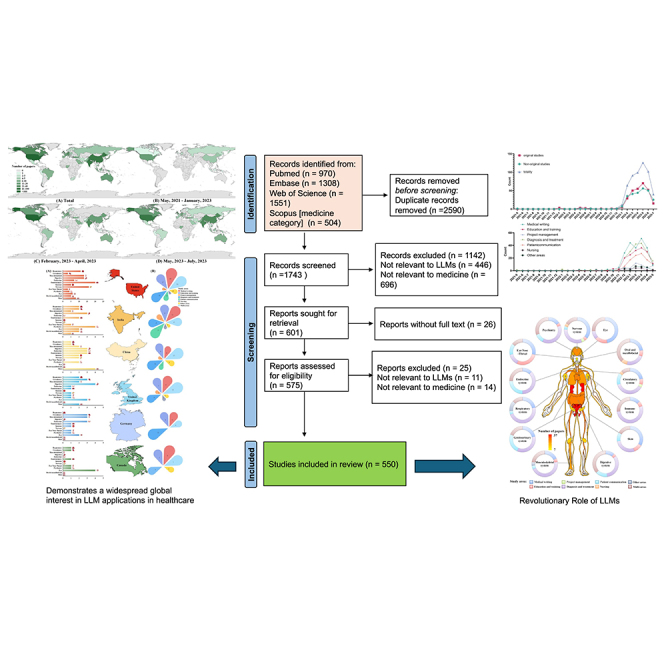
This study systematically reviewed the application of large language models (LLMs) in medicine, analyzing 550 selected studies from a vast literature search. LLMs like ChatGPT transformed healthcare by enhancing diagnostics, medical writing, education, and project management. They assisted in drafting medical documents, creating training simulations, and streamlining research processes. Despite their growing utility in assisted diagnosis and improving doctor-patient communication, challenges persisted, including limitations in contextual understanding and the risk of over-reliance. The surge in LLM-related research indicated a focus on medical writing, diagnostics, and patient communication, but highlighted the need for careful integration, considering validation, ethical concerns, and the balance with traditional medical practice. Future research directions suggested a focus on multimodal LLMs, deeper algorithmic understanding, and ensuring responsible, effective use in healthcare.
Overview
The claims and statistics of this paper haven’t been checked yet.
Run the check — free, no account needed. It reads the open-access text and checks the sources it cites.
Integrity signals
Registry
Cites
Statistics
Figures
Verification
Claims the paper makes
The claims and statistics of this paper haven’t been checked yet.
Run the check — free, no account needed. It reads the open-access text and checks the sources it cites.
Claims other papers make about this one
Each is checked against this paper’s own text: does it say what the citing paper says it does?
The cited source says what the claim attributes to it.
In the citing paper
“Large Language Models (LLMs) are increasingly used by healthcare professionals and patients for medical information synthesis.”
From Large Language Model Hallucinations in Spine Surgery: A Comparative Analysis of Clinician vs Patient-Level Prompts (2026) · cites this paper as [1]
The check wasn’t confident either way, so it gives no verdict — never disputed.
In the citing paper
“Existing reviews of LLMs in healthcare have largely neglected a deeper analysis of explainability methods.”
From Explainability of decoder-only clinical large language models: A scoping review (2026) · cites this paper as [48]
Experimental — accuracy not yet measured
Self-check
Percentages, sums and reported differences re-computed from the paper’s own numbers.
The self-check needs the paper’s full text.
Citations
Cites
Scoping studies: advancing the methodology
Levac, D., Colquhoun, H., & O'Brien, K. K. (2010) · Implementation Science · doi:10.1186/1748-5908-5-69 · Cited by 15,268
Chain-Of-Thought Prompting Elicits Reasoning in Large Language Models
Wei, J., Wang, X., Schuurmans, D., Bosma, M., Ichter, B., Xia, F., Chi, E., Le, Q. V., & Zhou, D. (2022) · Advances in Neural Information Processing Systems 35 · doi:10.52202/068431-1800 · Cited by 4,505
Self-citationTraining language models to follow instructions with human feedback
Ouyang, L., Wu, J., Jiang, X., Almeida, D., Wainwright, C. L., Mishkin, P., Zhang, C., Agarwal, S., Slama, K., Ray, A., et al. (2022) · arXiv · doi:10.48550/arxiv.2203.02155 · Cited by 4,208
Large language models encode clinical knowledge
Singhal, K., Azizi, S., Tu, T., Mahdavi, S. S., Wei, J., Chung, H. W., Scales, N., Tanwani, A., Cole-Lewis, H., Pfohl, S., et al. (2023) · Nature · doi:10.1038/s41586-023-06291-2 · Cited by 4,083
Large Language Models Encode Clinical Knowledge
Singhal, K., Azizi, S., Tu, T., Mahdavi, S. S., Wei, J., Chung, H. W., Scales, N., Tanwani, A., Cole-Lewis, H., Pfohl, S., et al. (2022) · arXiv · doi:10.48550/arxiv.2212.13138 · Cited by 4,083
Large language models in medicine
Thirunavukarasu, A. J., Ting, D. S. J., Elangovan, K., Gutierrez, L., Tan, T. F., & Ting, D. S. W. (2023) · Nature Medicine · doi:10.1038/s41591-023-02448-8 · Cited by 3,944
Revolutionizing healthcare: the role of artificial intelligence in clinical practice
Alowais, S. A., Alghamdi, S. S., Alsuhebany, N., Alqahtani, T., Alshaya, A. I., Almohareb, S. N., Aldairem, A., Alrashed, M., Bin Saleh, K., Badreldin, H. A., et al. (2023) · BMC Medical Education · doi:10.1186/s12909-023-04698-z · Cited by 3,146
Training Language Models to Follow Instructions with Human Feedback
Ouyang, L., Wu, J., Jiang, X., Almeida, D., Wainwright, C., Mishkin, P., Zhang, C., Agarwal, S., Slama, K., Ray, A., et al. (2022) · Advances in Neural Information Processing Systems 35 · doi:10.52202/068431-2011 · Cited by 3,117
A Survey of Large Language Models
Zhao, W. X., Zhou, K., Li, J., Tang, T., Dong, Z., Hou, Y., Zhang, B., Min, Y., Zhang, J., Liu, P., et al. (2026) · Frontiers of Computer Science · doi:10.1007/s11704-026-60308-3 · Cited by 2,093
Self-citationA Survey of Large Language Models
Zhao, W. X., Zhou, K., Li, J., Tang, T., Wang, X., Hou, Y., Min, Y., Zhang, B., Zhang, J., Dong, Z., et al. (2023) · arXiv · doi:10.48550/arxiv.2303.18223 · Cited by 2,090
Self-citation
Research works printed but not linked: 2
- Thirunavukarasu, 2023, Large language models in medicine, Nat. Med., 29, 1930, 10.1038/s41591-023-02448-8 · DOI · Paper page
- Chen, 2023, Large language models in biomedical natural language processing: benchmarks, baselines, and recommendations, arXiv
Cited by
Sorted by citations
Items 301–400 of 434
Mo, W., Singh, A., Ayobi, A., & Holloway, C. (2025) · International ACM SIGACCESS Conference on Computers and Accessibility · doi:10.1145/3663547.3746340 · Cited by 1
Ahmad, H. F., Sajid, J., Rasool, R. U., & Malik, A. W. (2025) · Cluster Computing · doi:10.1007/s10586-025-05793-0
Kormilitzin, A., Joyce, D. W., Tsiachristas, A., Borschmann, R., Kapur, N., & Geulayov, G. (2025) · medRxiv · doi:10.1101/2025.10.27.25338892
Unstructured Medical Data Entry System using Gaussian Probabilities and Large Language Models
Koo, S., & Choi, K. (2025) · The Journal of Korean Institute of Information Technology · doi:10.14801/jkiit.2025.23.10.23
Davenport, M. J., Hall, R. G., Kappala, S., Michelson, T. R., Mitchell, R., Winski, D., Hau, C., Leatherman, S. M., & Meng, F. (2025) · Information · doi:10.3390/info16110978
THE RISE OF LARGE LANGUAGE MODELS: A BEGINNER’S SURVEY
Mouzinho, G. D. A., Okimoto, L. Y. S., Camelo, L. Y. S., de Azevedo, N. D. S., Bragança, H. L. D. S., Fernandes, R. D. A., Seppe, F. R., Gomes, R. C. S., & Cardoso, F. D. S. (2025) · Aracê. · doi:10.56238/arev7n11-118
Kormilitzin, A., Joyce, D. W., Tsiachristas, A., Borschmann, R., Kapur, N., & Geulayov, G. (2025) · doi:10.2196/preprints.87586
Enhancing Regulation-Adherent Requirement Engineering with Contextual AI: An Industrial Study
Sirin, O., Sami, M. A., Granlund, T., Rasku, J., Zhang, Z., & Abrahamsson, P. (2025) · Lecture notes in computer science · doi:10.1007/978-3-032-12092-2_5
Tan, G., Cai, M., Lu, Y. Y., Liu, A. Y., Li, S., Xiao, G., Zhong, L., Li, L., Hu, Y., Liang, Q., et al. (2025) · Frontiers in Immunology · doi:10.3389/fimmu.2025.1661918
Foundational Models for Building Clinical Decision Support Systems: An Open-Source Models Comparison
D’Aniello, G., Fraenza, V., & Ritrovato, P. (2025) · IEEE International Conference on Consumer Electronics - Berlin (ICCE-Berlin) · doi:10.1109/icce-berlin67488.2025.11277904
Approach to Automatic Detection of Hate Speech Using LLM: A Study Case in Panama
Cedeño-Moreno, D., Montilla, N., & Vega, A. G. (2025) · Communications in computer and information science · doi:10.1007/978-3-032-11494-5_11
İş Mülakatlarında Büyük Dil Modellerinin Kullanımı
Seymen, Ö. F. (2025) · Özgür Yayınları eBooks · doi:10.58830/ozgur.pub1026.c4107
From diagnostics to education: Multi-domain evaluation of LLM chatbots in neurology
Battineni, G., Chintalapudi, N., Dhulipalla, V. R., & Amenta, F. (2025) · Journal of Taibah University Medical Sciences · doi:10.1016/j.jtumed.2025.11.004
Veri Çağında İnsan: Sosyal Bilimlerin Geleceği
Başarır, Ç., Yılmaz, Ö., Torun, N. K., Önalan, M., Seymen, Ö. F., Akgül, V., Aksoy, M., Yılmaz, Ö., Boz, B., Türkan, M., et al. (2025) · Özgür Yayınları eBooks · doi:10.58830/ozgur.pub1026
ERP Sistemlerinde Bütüncül Yaklaşım: İnsan, Teknoloji ve Süreç Entegrasyonu
Hatipoğlu, C. (2025) · Özgür Yayınları eBooks · doi:10.58830/ozgur.pub1026.c4114
Veri Çağında İnsan Merkezli Talep Tahmini
Tanrıverdi, İ. (2025) · Özgür Yayınları eBooks · doi:10.58830/ozgur.pub1026.c4112
Özaydın, O. (2025) · Özgür Yayınları eBooks · doi:10.58830/ozgur.pub1026.c4115
Dijital Çağda Deneyimsel Pazarlama Perspektifinden Turist Deneyiminin Dönüşümü
Aksoy, M., & Yılmaz, Ö. (2025) · Özgür Yayınları eBooks · doi:10.58830/ozgur.pub1026.c4109
Torun, N. K., & Önalan, M. (2025) · Özgür Yayınları eBooks · doi:10.58830/ozgur.pub1026.c4106
İç Hastalıkları Eğitiminde Chatbotların Performansının Değerlendirilmesi
Oflas, N. D., & Hakan, H. (2025) · İç Hastalıkları Dergisi · doi:10.5578/ichastaliklari.20250324
CareReport: An Empathetic AI-based RAG-driven Medical Report Assistant
Varenya, V., & Ruban, A. S. (2025) · International Conference on Intelligent Systems and Pioneering Innovations in Robotics and Electric Mobility (INSPIRE) · doi:10.1109/inspire67328.2025.11300586
Co‐designing a Large Language Model Benchmarking Dataset for Primary Care with Nurses in Kenya
Musau, W., Obong’o, C. O., Wanjiru, S., Otiangala, D., Emmanuel-Fabula, M., & Mateen, B. A. (2025) · Ethnographic Praxis in Industry Conference Proceedings · doi:10.1111/epic.70016
MeDRNet: A Knowledge-Augmented Multi-model Framework for Robust Medical Language Understanding
Long, X., Zhao, Y., & Liu, J. (2026) · Lecture notes in computer science · doi:10.1007/978-981-95-7081-2_22
Figueroa, C. A., Garikipati, K., Yang, H., & Capecelatro, J. (2026) · Annual Review of Biomedical Engineering · doi:10.1146/annurev-bioeng-081325-031501
A Hybrid Language Framework for Ontology-Based Clinical Concept Extraction
Eslami, B., Dligach, D., Azarvash, N., de la Peña, P., Strickland, B., & Tootooni, M. S. (2026) · Journal of Healthcare Informatics Research · doi:10.1007/s41666-026-00232-0
Gunter, M., Cho, D., Hammar, A. M., Matre, E. T. V., & Thaqi, M. (2026) · doi:10.2196/preprints.94531
AI-Powered Real-Time Voice-Activated First Aid Guidance System Using Large Language Models
Abo-Zahhad, M., Sharaf, F. M., Hafrag, H., Zakaria, M. N., Amer, Y. M., & Ismaiel, M. M. (2025) · International Japan-Africa Conference on Electronics, Communications, and Computations (JAC-ECC) · doi:10.1109/jac-ecc67970.2025.11417534
The Impact of Prompting Strategies on the Quality of LLM-Generated Biomedical Explanations
Kızılırrmak, M., Alper, B. M., Bon, M., & Nazlıoğlu, S. (2026) · International Informatics and Software Engineering Conference (IISEC) · doi:10.1109/iisec69317.2026.11418489
Small LLMs can be good coldstart recommenders
Noel, J., Monterola, C. P., & Tan, D. S. (2026) · Frontiers in Artificial Intelligence · doi:10.3389/frai.2026.1705245
Chandra, S., Kumar, V., & Thomas, P. (2026) · Research Square · doi:10.21203/rs.3.rs-8981384/v1
Hany, M., Zidan, M. H. E.-D., Parmar, C. D., Shahmiri, S. S., Altabbaa, H., Shamarka, A. E., Amgad, A., Abdelkhalek, I., Assal, A. A., Abdou, M. E., et al. (2026) · Obesity Surgery · doi:10.1007/s11695-026-08562-z
Ishadya, A. P. D., Withanaarachchi, A. S., & Jayalal, S. (2026) · International Conference on Advanced Research in Computing (ICARC) · doi:10.1109/icarc68737.2026.11453821
Lu, X., Wang, X., Liu, D., Zhang, Z., Zhang, Y., Zhang, T., Lü, D., Kuang, S., Lai, C., Piao, F., et al. (2026) · PLOS Digital Health · doi:10.1371/journal.pdig.0001317
Self-citationNazaretyan, L., & Kircher, M. (2026) · Trends in Genetics · doi:10.1016/j.tig.2026.02.007
Clinically grounded multi-agent artificial intelligence for preventive health managementPreprint
Lin, H., Zhang, Y., Ye, D., He, S., Du, Z., Yu, Y., Yu, X., Ren, L., Dong, N., Hu, F., et al. (2026) · Research Square · doi:10.21203/rs.3.rs-9150301/v1
Fatima, K., Singh, P., Alagarsamy, R., Chaudhary, G. R., Kharbanda, O. P., Lal, B., & Barathi, A. (2026) · The Cleft Palate-Craniofacial Journal · doi:10.1177/10556656261438912
INNOVITALS- a Healthcare Application Using Random Forest Algorithm
Karki, R., Goel, S., Kumari, S., Bhatnagar, R., & Kumar, R. (2026) · International Conference on Innovative Practices in Technology and Management (ICIPTM) · doi:10.1109/iciptm69057.2026.11466094
Yoon, H., Kim, Y. W., Kim, Y. H., Park, J., Kim, D., Baek, S., Park, J., Kim, K., Eom, H., Hong, J.-P., et al. (2026) · Muscle & Nerve · doi:10.1002/mus.70249
Heras, J. S. D. L., Molina, A. I., & Lacave, C. (2026) · Universal Access in the Information Society · doi:10.1007/s10209-026-01332-9
Han, G. C., Abdelati, A., Hanif, S., Godfrey, K., Malka, M. S., Hu, A., Truong, J., & Abrukin, L. (2026) · doi:10.2196/preprints.95849
Okada, N., Nakanishi, H., Sakamoto, Y., Hirayama, S., Liu, C., Mitarai, S., Mitarai, S., Yamamoto, G., & Okamoto, K. (2026) · JMIR Medical Informatics · doi:10.2196/preprints.96996
Use of Large Language Models to Enhance Failure Mode and Effects Analysis: A Case Study
Nair, S. S., Court, L. E., Douglas, R. J., Gay, S., Govyadinov, P. A., Netherton, T., Rhee, D. J., Pafeng, J., Zhang, L., Nguyen, C. M., et al. (2026) · Advances in Radiation Oncology · doi:10.1016/j.adro.2026.102060
Swee, S., Adam, I., Zheng, E. Y., Ji, E., Wang, D., Speier, W. F., Hsu, J., Chang, K.-W., Shivkumar, K., & Ping, P. (2026) · Intelligence-Based Medicine · doi:10.64898/2026.04.21.26351421
Carter, J., Anoruo, N., Rehman, N., Otaki, Y., Lydston, M., & BURKE, H. B. (2026) · Current Epidemiology Reports · doi:10.1007/s40471-026-00381-1
What and how should cardiologists learn in the era of artificial intelligence? Opinion on a problem
Shvarts, Y. G., Акимова, Н. С., Евгеньевна, К. Л., & Parkhoniuk, E. V. (2026) · Russian Journal of Cardiology · doi:10.15829/10.15829/1560-4071-2026-6903
A Resilient Federated Learning Framework for LLM Security in Healthcare
Annaiah, A. K. M., Perez, A., Riggan, M., & Rachakonda, L. (2025) · IEEE International Symposium on Smart Electronic Systems (iSES) · doi:10.1109/ises67504.2025.00077
Özmen, B. B., Almeida, V. F. A., Berber, I., Ha, J. Y., Duraes, E. F. R., Isakov, R., Bernard, S. L., Djohan, R. S., & Schwarz, G. S. (2026) · Plastic Surgery · doi:10.1177/22925503261446323
From Metrics to Meaning: LLM-Driven Lifestyle Intelligence for Personalized Obesity Prevention
Kim, H., & Kim, H. (2026) · IntechOpen eBooks · doi:10.5772/intechopen.1014980
Saji, J. G., Sreekumar, A., Abraham, S. V., & Antony, J. (2026) · Artificial Intelligence in Emergency Medicine · doi:10.1016/j.aiemed.2026.100020
Yasinetsky, A., Geniesse, C., & Ikonomovska, E. (2026) · bioRxiv (Cold Spring Harbor Laboratory) · doi:10.64898/2026.05.03.721751
Adithiyaa, D., Lakshhmi Narayanan, T., Saravanan, G., & Deepa Nivethika, S. (2026) · International Conference on Innovative Trends in Information Technology (ICITIIT) · doi:10.1109/icitiit68860.2026.11499722
Giacobbe, D. R., Grossi, A. A., Marelli, C., Muccio, M., Guastavino, S., Murgia, Y., Mora, S., Signori, A., Rosso, N., Giacomini, M. L., et al. (2026) · Infection and Drug Resistance · doi:10.2147/idr.s601126
Kalmring, M., Chmelar, S., Greimel, P., Kaider, M., Lang, C., & Roszipal, B. (2026) · BMC Medical Education · doi:10.1186/s12909-026-09374-6
He, K., Xiao, Q., Chen, W., Jing, L., Wang, Y., Li, S., Yang, D., Xu, H., Pang, K., Xiao, R., et al. (2026) · Journal of Medical Internet Research · doi:10.2196/92852
Self-citationExploring ChatGPT's clinical role in prosthodontics: a systematic review
García, V. D., Fernández, S. D., D’Albis, G., Capodiferro, S., Suarez, A., & Freire, Y. (2026) · Minerva Dental and Oral Science · doi:10.23736/s2724-6329.26.05257-5
Concerns of Using Large Language Models in Health Care Research and Practice: Umbrella Review
Yarar, F., Addis, P., Fairweather, M., Craig, D., & O’Keefe, H. (2026) · Journal of Medical Internet Research · doi:10.2196/87804 · Cited by 1
Pratama, M. Z., Suryana, B. P. P., Wahono, C. S., & Putri, R. K. (2026) · International Journal of Rheumatic Diseases · doi:10.1111/1756-185x.70713
Mansoor, M. (2026) · Pediatric Investigation · doi:10.1002/ped4.70066
Singh, S., Subburaj, B., Alagewaran, R., & Alphonse, S. (2026) · Frontiers in Artificial Intelligence · doi:10.3389/frai.2026.1807960
Real-World Data Needs Real-World Doctors: When Automation Advances Faster Than Clinical Workflow
Price, A. I., & Raesfeld, C. V. (2026) · Journal of Participatory Medicine · doi:10.2196/97972
Demir, Ş., & Demir, M. (2026) · Endouroloji Bulteni · doi:10.54233/endourolbull-1792399
Super, I., Bawa, H., & Asan, O. (2026) · JMIR Medical Informatics · doi:10.2196/91652
USE CASES FOR LARGE LANGUAGE MODEL AI IN HEALTHCARE DATA ANALYTICS
Ротар, О. (2026) · Наука і техніка сьогодні · doi:10.52058/2786-6025-2026-4(58)-2593-2604
Qi, H., Li, J. D., Ge, Y., Wu, H., Cai, Y., Che, S., Sheng, T., Zhao, Q., & Chen, C. (2026) · IEEE Transactions on Knowledge and Data Engineering · doi:10.1109/tkde.2026.3700611
Die Rolle von Large Language Modellen in der wissenschaftlichen Recherche
Lindner, T., Weber, M.-A., & Manzke, M. (2026) · RöFo - Fortschritte auf dem Gebiet der Röntgenstrahlen und der bildgebenden Verfahren · doi:10.1055/a-2868-7797
Expert Consensus on LLM Safety in Clinical Decision Support
Gayathri, K. V., Kanshiya, S., Saranraj, P., Lokeshwari, B., Vilmasen, P., & Wins, J. A. (2026) · Advances in computational intelligence and robotics book series · doi:10.4018/979-8-3373-7862-6.ch011
IMMUNIA: A Reasoning-Centered Framework for Immunoregulatory Surfaceome Discovery
Park, N., & Lee, J. H. (2026) · ACS Pharmacology & Translational Science · doi:10.1021/acsptsci.5c00756
Thomas, D., & Cardoso, E. M. (2026) · Elsevier eBooks · doi:10.1016/b978-0-443-33957-8.00003-2
Tonouchi, Y., Nakai, S., Murakami, K., & Kataoka, Y. (2026) · JMIR Medical Education · doi:10.2196/76924
Limaye, D., Shah, R., & Jonelgadda, C. (2026) · Research Square · doi:10.21203/rs.3.rs-10047888/v1
Transforming healthcare with large language models: Innovation, integration, and impact
Joshi, G., Ghai, B., Goutam, N., & Joshi, N. (2026) · Elsevier eBooks · doi:10.1016/b978-0-443-44344-2.00010-8
Mahmud, K., Kumar, M., Singh, D., & Saini, R. (2026) · Elsevier eBooks · doi:10.1016/b978-0-443-44344-2.00022-4
Automated iridocorneal angle classification using a multimodal large language model
Rubegni, G., Romano, D., Colizzi, B., Castellino, N., Cartocci, A., Luschi, A., Rabiolo, A., Cillà, S. D., Tosi, G. M., & Rossetti, L. M. (2026) · Graefe s Archive for Clinical and Experimental Ophthalmology · doi:10.1007/s00417-026-07333-x
Unyilmaz, C. (2026) · Frontiers in Pediatrics · doi:10.3389/fped.2026.1788952
Bayırlı, A. B., Uytun, M., Erdem, R., & Genç, Y. S. (2026) · Mugla Journal of Science and Technology · doi:10.22531/muglajsci.1862743
Ganesh, S., & Joseph, J. (2026) · Nepal Journal of Neuroscience · doi:10.3126/njn.v23i2.91054
Nadeem, F., Ibrahim, S. M., Taylor, S., Rawall, S., Mohammad, Z., Pirzadah, H., Ayala-Ortiz, J. L., & Rajaram, S. M. (2026) · Southern Medical Journal · doi:10.14423/smj.0000000000001989
Context aware knowledge discovery for clinical support using transfer learning
Paliwal, G., & Bunglowala, A. (2026) · Multimedia Tools and Applications · doi:10.1007/s11042-026-21765-x
Avlagi, G. K., Bilgin, S., Ozata, D., Alpay, K. C., Kandemir, T., Gedik, T. E., & Erdinçler, D. S. (2026) · Research Square · doi:10.21203/rs.3.rs-10193882/v1
Diagnostic performance of artificial intelligence in the syncope unit
van Zanten, S., Boel, T. T., de Jong, J. S. Y., Koomen, E. M., Bais, B., Dara, A., Giele, F., Geertsma, C., Sutton, R., Scheffer, M. G., et al. (2026) · Exploration of Cardiology · doi:10.37349/ec.2026.1012114
Evaluating Parameter-Efficient Fine-Tuning of Open-Weight LLMs for Medical Question Answering
Zidan, A. H., Uddin, B., Ema, N. J., Amin, M. H., Uddin, M. S., & Ahmed, T. (2026) · International Conference on Computational Intelligence and Communication Networks (CICN) · doi:10.1109/cicn70047.2026.11594337
Černý, M., Májovský, M., Lama, S., Guo, E., Hallak, H., Singh, R., Riva-Cambrin, H. A., Šustek, P., Široká, L., Tullett, I., et al. (2026) · JMIR Formative Research · doi:10.2196/92871
Research on the application of LLaVA model based on QLoRA fine-tuning in medical teaching
Zhou, S., & Qin, F. (2026) · PLoS ONE · doi:10.1371/journal.pone.0328408
Securing Federated Learning: A Hybrid Defense Against Poison Injection Attacks in LLM
Riggan, M., & Annaiah, A. K. M. (2026) · Lecture notes of the Institute for Computer Sciences, Social Informatics and Telecommunications Engineering · doi:10.1007/978-3-032-22542-9_24
Leveraging Advanced AI Frameworks for Dual PPAR α/γ Agonist Discovery in Alzheimer’s Disease
Chaturvedi, N., Mishra, V., Haque, S., Khatoon, S., Rawal, K., & Kumar, V. (2026) · ACS Chemical Neuroscience · doi:10.1021/acschemneuro.6c00148
Real‐world pharmacovigilance for anti‐Aβ therapies using a large language model
Fong, A., Tabaie, A., Paylor, S., Tran, T., Iqbal, R., Ratwani, R. M., Zafarí, Z., Bangerter, L. R., & Brandt, N. (2026) · Alzheimer s & Dementia Diagnosis Assessment & Disease Monitoring · doi:10.1002/dad2.70412
Can AI assist in reducing diagnostic error? A narrative review
Scott, I. A. (2026) · Diagnosis · doi:10.1515/dx-2026-0021
Mittal, S., Ajmera, A., Devine, H., Vijay, A., LaFiandra, L., & Gadewadikar, J. (2026) · IEEE International Conference on AI and Data Analytics (ICAD) · doi:10.1109/icad69378.2026.11608726
Alevizakos, V., Gaudin, R., Ghanad, I., von See, J., von See, T., Eggmann, F., & von See, C. (2026) · BMC Oral Health · doi:10.1186/s12903-026-09368-2
Amirrajab, S., Vehof, V., Bietenbeck, M., Akyol, N., Bouras, R., Isgandarova, K., Zlibut, A., Stalling, P., & Yılmaz, A. (2026) · Research Square · doi:10.21203/rs.3.rs-10456929/v1
Li, T., Ma, Z., Wang, B., Fan, N., Wang, A., & Zang, L. (2026) · Journal of Medical Internet Research · doi:10.2196/92931
Cangül, S., Adıgüzel, Ö., Tunç, T., Taşyürek, M., & Ortaç, H. (2026) · Acta Medica Nicomedia · doi:10.53446/actamednicomedia.1949463
Artificial Intelligence and our journal, "Einstein São Paulo"
Pasternak, J. (2026) · Einstein (São Paulo) · doi:10.31744/einstein_journal/2026ed2690
Artificial intelligence–mediated health communication on social media: A scoping review
Kayral, İ. H., Tanweer, A., Yılmaz, S. T., & Iqbal, U. (2026) · Health Policy and Technology · doi:10.1016/j.hlpt.2026.101293
Wang, L., & Poenaru, D. (2026) · medRxiv · doi:10.64898/2026.07.23.26358815
郑, 立., Lin, Z., Liu, X., Fan, Z., He, Z., Xu, J., & Yin, L. (2026) · Journal of Medical Internet Research · doi:10.2196/98026
Exploring Bias in Medical Applications of Large Language Models: Protocol for a Systematic Review
Rao, S. G., Boutrous, C., Kormilitzin, A., Tai, X. Y., Hotchkiss, L., Cong, C., Meinert, E., Liang, H., Dong, H., & Harrison, J. R. (2026) · JMIR Research Protocols · doi:10.2196/91348
Metadata
- Authors
- Meng, X., Yan, X., Zhang, K., Liu, D., Cui, X., Yang, Y., Zhang, M., Cao, C., Wang, J., Wang, X., Gao, J., Wang, Y.-G.-S., Ji, J.-M., Qiu, Z., Li, M., Qian, C., Guo, T., Ma, S., Wang, Z., Guo, Z., Lei, Y., Shao, C., Wang, W., Fan, H., & Tang, Y.-D.
- Affiliations
- Peking University (CN)
- Tianjin University (CN)
- Chinese Academy of Medical Sciences & Peking Union Medical College (CN)
- Hebei Medical University (CN)
- Peking University Third Hospital (CN)
- Beihang University (CN)
- Corresponding author
- Fan, Haojun
- Tang, Yi-Da
- ORCID
- Venue
- iScience
- Publisher
- Elsevier BV
- Published
- 2024-05
- Volume
- 27
- Issue
- 5
- Pages
- 109713
- ISSN
- 2589-0042 (ISSN-L)
- PMC
- PMC11091685
- OpenAlex
- W4395052272
- Cited by
- 414
- References
- 114
- Citations by year
- 2026: 188 · 2025: 188 · 2024: 38
- FWCI
- 9.44
- Type
- journal article
- Language
- en
- Open access
- gold
- doi.org
- Licence
- Locations
- iScience (publishedVersion, cc-by-nc-nd)
- PubMed Central (publishedVersion, cc-by-nc-nd)
- PubMed (publishedVersion)
- DOAJ (DOAJ: Directory of Open Access Journals) (submittedVersion)
- Funders
- National Key Research and Development Program of China Stem Cell and Translational Research (2020YFC2004705)
- National Natural Science Foundation of China (81825003, 82270376, 91957123)
- China Scholarship Council (CSCF2021A04)
- CAMS Innovation Fund for Medical Sciences
- Chinese Academy of Meteorological Sciences (2021-I2M-5-003, T-B-119)
- National Key Research and Development Program of China
- Beijing Municipal Science and Technology Commission, Adminitrative Commission of Zhongguancun Science Park
- Beijing Nova Program (Z201100006820002)
- Topics
- Health Sciences › Medicine › Health Informatics › Artificial Intelligence in Healthcare and Education
- Health Sciences › Health Professions › Health Information Management › Artificial Intelligence in Healthcare
- Physical Sciences › Computer Science › Artificial Intelligence › Machine Learning in Healthcare
- Keywords
- large language models, ChatGPT, medical applications of AI, medical diagnostics, medical writing, medical education, training simulation, physician-patient communication, overreliance on AI, multimodal large language models, ethics of AI in healthcare
About these checks
Registry, retraction, Cites and statistics results are computed, not judged, with one exception: a printed reference that no index lists is read once by a model before it counts as a citation error. Claims are extracted by a model and kept only when their quote appears verbatim in the text; each cited source is then checked, with a model’s help, for whether it says what the claim relies on. Those verdicts can be wrong — read the claim’s quote and the cited source before relying on one.
Statistics and arithmetic are recomputed, not judged.
Confidence bands are shown only for fields calibrated on our annotated test set. None is calibrated yet, so no band is shown.
What counts as a claim ›How we measure confidence ›How we check this ›
Are you an author, or do you see a problem with this page? Request a review
