

The DOI matches its Crossref record; 263 of the 281 references it cites were found in a registry or an index; 158 of the 267 sources its claims cite were checked for support.
NODDI in clinical research
Open accessAbstract
Diffusion MRI (dMRI) has proven to be a useful imaging approach for both clinical diagnosis and research investigating the microstructures of nervous tissues, and it has helped us to better understand the neurophysiological mechanisms of many diseases. Though diffusion tensor imaging (DTI) has long been the default tool to analyze dMRI data in clinical research, acquisition with stronger diffusion weightings beyond the DTI regimen is now possible with modern clinical scanners, potentially enabling even more detailed characterization of tissue microstructures. To take advantage of such data, neurite orientation dispersion and density imaging (NODDI) has been proposed as a way to relate the dMRI signal to tissue features via biophysically inspired modeling. The number of reports demonstrating the potential clinical utility of NODDI is rapidly increasing. At the same time, the pitfalls and limitations of NODDI, and general challenges in microstructure modeling, are becoming increasingly recognized by clinicians. dMRI microstructure modeling is a rapidly evolving field with great promise, where people from different scientific backgrounds, such as physics, medicine, biology, neuroscience, and statistics, are collaborating to build novel tools that contribute to improving human healthcare. Here, we review the applications of NODDI in clinical research and discuss future perspectives for investigations toward the implementation of dMRI microstructure imaging in clinical practice.
Overview
AI snapshot
Written from the paper’s full text.
TL;DR
NODDI is a three-compartment biophysical diffusion MRI model that estimates neurite density index (NDI), orientation dispersion index (ODI), and free water fraction, and this review surveys its clinical research applications across neurological and psychiatric diseases. It reports generally promising disease sensitivity and acceptable repeatability, but emphasizes unresolved model-specificity and validation limitations that keep NODDI short of routine clinical use.
Key findings
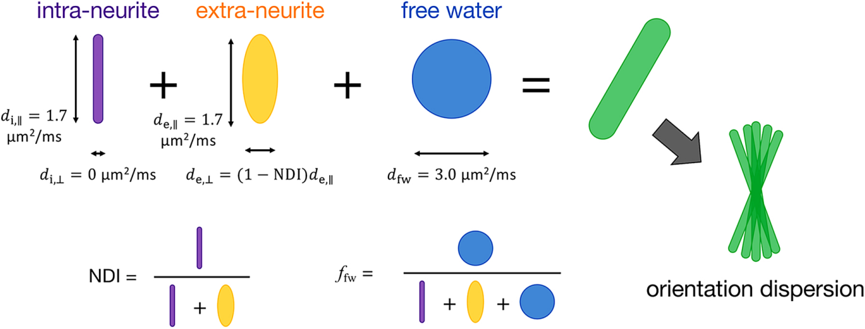
- NODDI uses NDI/intra-neurite fraction, ODI (0 for perfectly aligned straight fibers, 1 for completely isotropic), and free water fraction; it has 5 free parameters, one fewer than DTI, and imposes constraints including fixed parallel diffusivity 1.7 µm²/ms and a tortuosity model.
- Scan-rescan repeatability in brain is excellent for NDI and ODI, with intra-subject coefficients of variation mostly below 5%, comparable to DTI; free water fraction is less stable (10%–40% CoV). Field strength and scanner affect reproducibility.
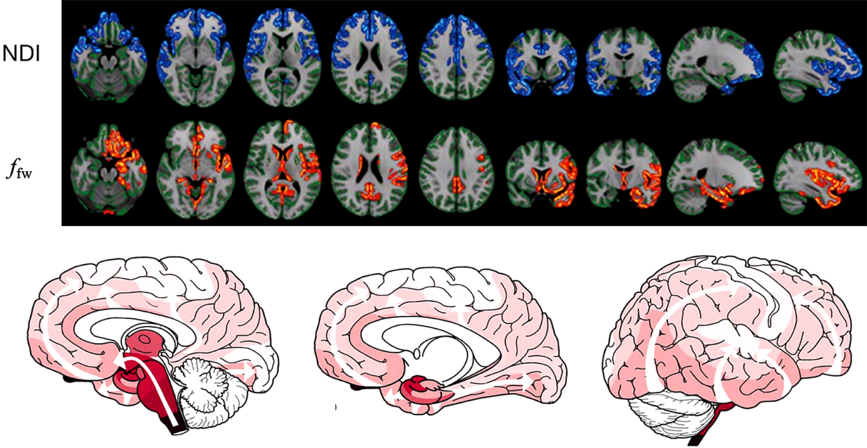
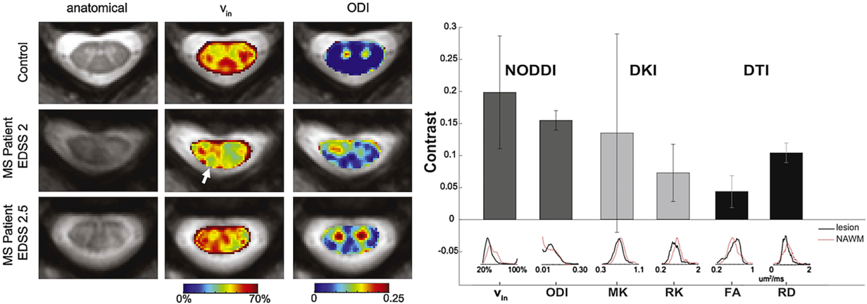
- Across diseases (Alzheimer’s, Parkinson’s, MS, ALS, epilepsy, ischemia, TBI, NF1, iNPH, schizophrenia, tumors, spondylotic myelopathy), NODDI often detects abnormalities more widespread than FA, e.g., reduced NDI in WM/lesions and variable ODI; however, findings are mixed and mostly cross-sectional.
- NODDI is more specific than FA, and ODI correlates more strongly than FA with histological orientation dispersion, but specificity is only relative; the review concludes NODDI remains near the translational gap for clinical biomarker adoption.
Methods
- Narrative review of clinical research applications of NODDI, including human studies and some preclinical/animal evidence, organized by disease and by development/aging.
- No systematic search strategy, meta-analysis, or pooled quantitative synthesis is described in the text.
- Main analysis is thematic synthesis of reported NODDI findings, model rationale, repeatability/reproducibility evidence, and future directions.
Limitations
- The paper states that NODDI’s model assumptions remain debated: no consensus on compartment number; inter-compartmental exchange and non-Gaussian effects are neglected; fixed/constrained parameters can bias estimates; different constraints can change rankings; optimal fixed diffusivity may differ by age and tissue; parameter–pathology relationships are not one-to-one and pathologies coexist.
- The paper states that most clinical studies are cross-sectional, single-center, and limited in sample size, making general conclusions about individual patient care difficult; clinical adoption requires technical, biological/clinical, and cost-effectiveness validation.
- Evident from the text: this is a narrative review without a stated systematic search or meta-analysis, and many included findings are described as preliminary/proof-of-concept.
Model-written summary. Check it against the paper before relying on it.
Integrity signals
Registry
Cites
Statistics
Figures
Verification
Claims the paper makes
64 Supported · 46 Partly supported · 43 No full text of the sources · 31 Own interpretation · 18 No basis given · 10 Sources not found · 9 Supported so far · 2 Not supported · 2 Not checked yet · 1 Couldn’t confirm · accuracy not yet measured
At least one cited source doesn’t support this claim or points to a different paper, and none confirmed it — see the verdicts below.
In the paper
“A longitudinal follow-up of patients with orthopedic trauma revealed increased f fw and decreased NDI in WM compared with controls at 2 weeks post-injury”
§ NODDI in clinical research > 3.7. Traumatic brain injury
What the sources say
- Disputedcites Palacios et al., 2018 sourceExperimental — accuracy not yet measured
The Discussion identifies orthopedic trauma patients as the control group, not the group with these changes. It reports decreased NDI and increased free-water fraction (FISO) in patients with mTBI versus trauma controls at the early, 2-week time point. The supplied passages do not give page numbers. (LLM, conf=0.90)
Checked by a reasoning model — may be wrong.
plaincorrelational- Asserted: passes — The authors put it forward as true.
- Checkable: passes — It can be checked against evidence.
- Load-bearing: unclear — It is unclear whether the paper’s conclusions depend on it.
- Based: passes — The paper gives a reason why it holds.
- Disputed
The cited sources support only part of this claim — read each source’s verdict below.
In the paper
“Care is needed in the interpretation of results provided by these biophysical models, because to achieve and prove specificity is extremely challenging (for recent reviews, see (Jelescu and Budde, 2017;Novikov et al., 2018a); and Jelescu et al. in this special issue).”
§ NODDI in clinical research > 2. Rationale for using NODDI in clinical research
What the sources say
- Supportedcites Jelescu and Budde, 2017 source
Section 2.3 cautions that even a strong correlation with microscopy does not prove parameter specificity. The Summary adds that diffusion MRI is an indirect measure of microstructure and that some model parameters are particularly difficult to validate independently. Together, these passages support the citing sentence’s caution about achieving and demonstrating specificity. (LLM, conf=0.91)
- Not matchedcites Novikov et al., 2018a
Couldn’t be matched to a paper in Crossref, so it can’t be checked.
plain- Asserted: passes — The authors put it forward as true.
- Checkable: unclear — It is unclear whether it could be checked against evidence.
- Load-bearing: passes — The paper’s conclusions depend on it.
- Based: passes — The paper gives a reason why it holds.
- Supported
Every source the paper cites for this claim was checked and supports it.
In the paper
“NDI of the parieto-occipital WM was also correlated with visuospatial and visuoperceptual cognitive performance, a marker of parietal cortex function.”
§ NODDI in clinical research > 3.1. Alzheimer's disease
What the sources say
- Supportedcites Slattery et al., 2017 source
The Results section reports significant positive correlations in patients between NDI in white-matter projections from both parieto-occipital lobes and visuospatial and visuoperceptual task performance. The Discussion identifies that performance as a marker of parietal cortex function, and the paper identifies the patient group as having young-onset Alzheimer’s disease. (LLM, conf=0.94)
plaincorrelational- Asserted: passes — The authors put it forward as true.
- Checkable: passes — It can be checked against evidence.
- Load-bearing: passes — The paper’s conclusions depend on it.
- Based: passes — The paper gives a reason why it holds.
- Supported
The cited sources support only part of this claim — read each source’s verdict below.
In the paper
“However, as with DTI, care should be taken when comparing data from different scanners: field strength has significant effects on NODDI parameters (Chung et al., 2016;De Santis et al., 2019), and interscanner reproducibility has been shown to be lower than intra-scanner reproducibility, even at the same field strength (3 T) (Andica et al., 2019b).”
§ NODDI in clinical research > 2.3. Is NODDI reliable?
What the sources say
- Supportedcites Chung et al., 2016 source
The Discussion states that magnetic field strength has a significant effect on estimated NODDI parameters. The Conclusion reports significant changes in intracellular volume fraction and orientation distribution index in specific white and grey matter regions and advises care when interpreting data acquired at different field strengths. (LLM, conf=0.94)
- Partly supportedcites De Santis et al., 2019 sourceExperimental — accuracy not yet measured
The Statistical analysis section compares 3 T and 7 T protocols for the NODDI measures. Table 3 (DISCUSSION; page unavailable) reports a significant protocol effect for FR NODDI (p < 0.05), but not for ODI. The claim is therefore supported for one NODDI parameter, not NODDI parameters generally. (LLM, conf=0.88)
plaincorrelational- Asserted: passes — The authors put it forward as true.
- Checkable: passes — It can be checked against evidence.
- Load-bearing: passes — The paper’s conclusions depend on it.
- Based: passes — The paper gives a reason why it holds.
- Supported
The sources with a verdict support this claim; the rest weren’t checked yet, have no full text we could read, or their verdicts aren’t rated yet.
In the paper
“Several studies have reported non-monotonic behavior of dMRI metrics in relation to amyloid deposition in both GM (Montal et al., 2018) and WM (Dong et al., 2020;Wolf et al., 2015) in human Alzheimer's disease, as well as in a rat model of Alzheimer's disease (Fick et al., 2017).”
§ NODDI in clinical research > 3.1. Alzheimer's disease
What the sources say
- Not checked — no full text of the sourcecites Montal et al., 2018 source
- Supportedcites Dong et al., 2020 source
Dong et al.’s Results (ROI Analysis: Group comparisons; page not provided) report nonmonotonic white-matter diffusion metric changes across groups with increasing amyloid burden. The Abstract likewise reports a nonmonotonic trend in human participants. This citation supports the white-matter portion of the sentence; the gray-matter and rat-model portions are attributed to other sources. (LLM, conf=0.94)
- Not checked — no full text of the sourcecites Wolf et al., 2015 source
plaincorrelational- Asserted: passes — The authors put it forward as true.
- Checkable: passes — It can be checked against evidence.
- Load-bearing: passes — The paper’s conclusions depend on it.
- Based: passes — The paper gives a reason why it holds.
Every source the paper cites for this claim was checked and supports it.
In the paper
“ODI has shown a stronger correlation than has FA with orientation dispersion measured by histology (Grussu et al., 2017;Schilling et al., 2018), indicating that NODDI has the ability, at least partly, to disentangle the effect of orientation dispersion.”
§ NODDI in clinical research > 2.2. Is NODDI specific?
What the sources say
- Supportedcites Grussu et al., 2017 source
The Results (Statistical analysis; page not supplied) report a strong correlation between ODI and histological orientation dispersion (CV). In the control samples, regression models show a stronger association with CV for ODI than for FA; the paper also describes ODI–CV as the strongest and most consistent association across controls and multiple sclerosis cases. (LLM, conf=0.90)
- Supportedcites Schilling et al., 2018 source
In Results §3.1 (Fig. 7E–F), the paper reports a moderate negative correlation between DTI FA and histological ODI, while describing NODDI’s correlation with histological ODI as much stronger overall. The passage supports the comparison in the citing sentence; the paper notes that NODDI overestimated ODI in its ex vivo experiments. (LLM, conf=0.86)
plaincorrelational- Asserted: passes — The authors put it forward as true.
- Checkable: passes — It can be checked against evidence.
- Load-bearing: passes — The paper’s conclusions depend on it.
- Based: passes — The paper gives a reason why it holds.
- Supported
Every source the paper cites for this claim was checked and supports it.
In the paper
“Similarly, in another mouse model of Alzheimer's disease, greater NDI and ODI than controls were observed in WM and hippocampus (Colon-Perez et al., 2019).”
§ NODDI in clinical research > 3.1. Alzheimer's disease
What the sources say
- Supportedcites Colon-Perez et al., 2019 source
The Results report higher intracellular volume fraction (ICVF), the paper’s neurite-density measure, in the cerebral peduncle (white matter) and hippocampus of TgCRND8 mice, and higher ODI in white-matter regions and the hippocampus. The Discussion explicitly describes increases in both measures relative to non-transgenic controls. The supplied passages do not give page numbers. (LLM, conf=0.93)
plaincorrelational- Asserted: passes — The authors put it forward as true.
- Checkable: passes — It can be checked against evidence.
- Load-bearing: unclear — It is unclear whether the paper’s conclusions depend on it.
- Based: passes — The paper gives a reason why it holds.
- Supported
The cited sources support only part of this claim — read each source’s verdict below.
In the paper
“Scan-rescan studies have reported excellent repeatability of NODDI in the brain, with the intra-subject coefficients of variation (CoV) for NDI and ODI mostly below 5% (Andica et al., 2019b;Chang et al., 2015;Chung et al., 2016;Granberg et al., 2017;Huber et al., 2019;Tariq et al., 2012), which is comparable with that of DTI, although (Chung et al., 2016) have reported a greater CoV than for FA in”
§ NODDI in clinical research > 2.3. Is NODDI reliable?
What the sources say
- Not matchedcites Andica et al., 2019b
Couldn’t be matched to a paper in Crossref, so it can’t be checked.
- Supportedcites Chang et al., 2015 source
Results §3.5 reports that test–retest CoVs for ODI and NDI were below 5% in every examined white matter group. Discussion §4.3 calls the reproducibility excellent and notes that repeat scans were limited to adults in their 20s. (LLM, conf=0.93)
- Partly supportedcites Chung et al., 2016 sourceExperimental — accuracy not yet measured
The Methods and Results describe repeated acquisitions within a session in healthy subjects and report within-subject CVs for NODDI measures. The Discussion gives a range of 0.6%–7.3% (excluding νiso), but does not establish that NDI and ODI values were mostly below 5%; this was within-session reproducibility, not a separate-session scan–rescan test. (LLM, conf=0.84)
plain- Asserted: passes — The authors put it forward as true.
- Checkable: passes — It can be checked against evidence.
- Load-bearing: passes — The paper’s conclusions depend on it.
- Based: passes — The paper gives a reason why it holds.
- Not matched
Every source the paper cites for this claim was checked and supports it.
In the paper
“(Lampinen et al., 2019) clarified the risk of biases introduced by fixing parameters, where different constraints led to different rankings of neurite density among brain regions.”
§ NODDI in clinical research > 2.2. Is NODDI specific?
What the sources say
- Supportedcites Lampinen et al., 2019 source
The Results section, under “Brain region rankings by the ‘stick’ fractions of constrained biophysical models,” reports that six constraint sets produced significantly different regional rankings (p = 0.025). The paper treats these model-derived ‘stick’ fractions as indices of neurite density, which is the sense in which the citing sentence is supported. (LLM, conf=0.91)
plaindirect- Asserted: passes — The authors put it forward as true.
- Checkable: passes — It can be checked against evidence.
- Load-bearing: passes — The paper’s conclusions depend on it.
- Based: passes — The paper gives a reason why it holds.
- Supported
Every source the paper cites for this claim was checked and supports it.
In the paper
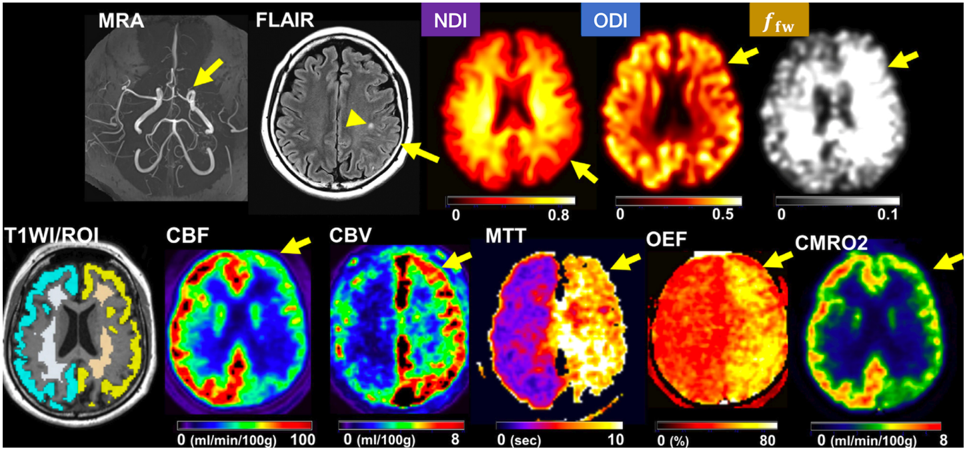
“In a longitudinal follow-up, ODI in the posterior limb of the internal capsule at the first hospital visit predicted upper extremity motor function at 5-week follow-up (Hodgson et al., 2019).”
§ NODDI in clinical research > 3.6. Ischemia
What the sources say
- Supportedcites Hodgson et al., 2019 source
The Conclusions report that baseline ODI asymmetry in the posterior limb of the internal capsule (PLIC) predicted upper-extremity motor outcomes approximately five weeks after stroke. The Abstract specifies that the baseline MRI was obtained 3–12 days after stroke and that the follow-up outcome was an upper-extremity Fugl-Meyer score. The measured predictor was ODI-based asymmetry between the two sides of the PLIC, rather than ODI alone. (LLM, conf=0.91)
plaincorrelational- Asserted: passes — The authors put it forward as true.
- Checkable: passes — It can be checked against evidence.
- Load-bearing: passes — The paper’s conclusions depend on it.
- Based: passes — The paper gives a reason why it holds.
- Supported
- Probably not a substantial claim. 52
- It may state two separate claims as one. 73
At least one cited source doesn’t support this claim or points to a different paper, and none confirmed it — see the verdicts below.
In the paper
“A very recent report (Guerreri et al., 2020) suggested that the fixed diffusivity assumption, but not the tortuosity model, is the primary cause of NODDI's incompatibility with b-tensor encoding (Lampinen et al., 2017).”
§ NODDI in clinical research > 2.2. Is NODDI specific?
What the sources say
- Not checked — no full text of the sourcecites Guerreri et al., 2020
- Disputedcites Lampinen et al., 2017 sourceExperimental — accuracy not yet measured
Section 2.3 describes the fixed neurite diffusivity and the tortuosity model as linked NODDI constraints, not competing explanations. Sections 4.3 and 5 attribute the LTE–STE inconsistency to invalid constraints connecting neurite density with tissue mean diffusivity. The paper therefore does not support excluding tortuosity as a cause. (LLM, conf=0.84)
Checked by a reasoning model — may be wrong.
hedgeddirect- Asserted: passes — The authors put it forward as true.
- Checkable: passes — It can be checked against evidence.
- Load-bearing: fails — The paper’s conclusions may not depend on it.
- Based: passes — The paper gives a reason why it holds.
Probably not a substantial claim. The paper’s conclusions may not depend on it. It may state two separate claims as one.
The sources with a verdict support this claim; the rest weren’t checked yet, have no full text we could read, or their verdicts aren’t rated yet.
In the paper
“There are two main approaches to extracting information from dMRI data: signal representations and biophysical models (Jelescu and Budde, 2017;Jespersen, 2018;Novikov et al., 2018a).”
§ NODDI in clinical research > 1. Introduction
What the sources say
- Supportedcites Jelescu and Budde, 2017 source
Section 1 (Models) explicitly identifies two complementary approaches to extracting information from the diffusion signal: signal representations and tissue models. Section 1.4 (Summary) calls these signal representations and biophysical models, while noting that hybrid models combine features of both. (LLM, conf=0.94)
- Not checked — no full text of the sourcecites Jespersen, 2018 source
- Not matchedcites Novikov et al., 2018a
Couldn’t be matched to a paper in Crossref, so it can’t be checked.
plain- Asserted: passes — The authors put it forward as true.
- Checkable: passes — It can be checked against evidence.
- Load-bearing: fails — The paper’s conclusions may not depend on it.
- Based: passes — The paper gives a reason why it holds.
Probably not a substantial claim. The paper’s conclusions may not depend on it.
- Supported
Every source the paper cites for this claim was checked and supports it.
In the paper
“Recent years have seen a marked proliferation of biophysical models with the explicit aim of clinically feasible data acquisition (single-diffusion encoding, b-values up to 2000-3000 s/mm 2 , diffusion time 20-100 ms) (Fieremans et al., 2011;Hansen et al., 2017;Kaden et al., 2016;Zhang et al., 2012).”
§ NODDI in clinical research > 1. Introduction
What the sources say
- Supportedcites Fieremans et al., 2011 source
The Introduction identifies DKI combined with a tissue model as a clinically feasible alternative to models requiring high b-values or long scans. Methods §2.2.2 reports acquisition at b-values up to 2000 s/mm² and a diffusion time of about 50 ms; Discussion §4.2 emphasizes the model’s shorter acquisition time and clinical usefulness. This paper supports the citation as an example of a biophysical model designed for clinically feasible acquisition, rather than as evidence of proliferation on its own. (LLM, conf=0.87)
- Supportedcites Hansen et al., 2017 source
The Discussion (page unavailable) describes a faster WMTI approach that reduces the number of images required and says it may be useful in clinical settings where scan time is constrained. The human-brain Methods (page unavailable) report single-diffusion encoding, b-values up to 3.0 ms/μm² (3000 s/mm²), and a diffusion time of approximately 50 ms. This paper therefore supports its role as an example of a biophysical approach designed for clinically feasible acquisition; it does not need to establish the broader trend of proliferation on its own. (LLM, conf=0.90)
- Supportedcites Kaden et al., 2016 source
This citation serves as an example of a biophysical model designed for clinically feasible acquisition, rather than as evidence for the number of models developed. The Abstract describes a multi-compartment model usable within clinically feasible scan times; Clinical translation specifies a roughly five-minute, two-shell protocol at b-values of 1000 and 2500 s/mm². Human data describes a Stejskal–Tanner acquisition with a 43.1 ms pulse separation, within the cited diffusion-time range. (LLM, conf=0.91)
plain- Asserted: passes — The authors put it forward as true.
- Checkable: passes — It can be checked against evidence.
- Load-bearing: fails — The paper’s conclusions may not depend on it.
- Based: passes — The paper gives a reason why it holds.
Probably not a substantial claim. The paper’s conclusions may not depend on it.
- Supported
The cited sources support only part of this claim — read each source’s verdict below.
In the paper
“In clinical research, diffusion tensor imaging (DTI) (Basser et al., 1994) has long been an important tool that has yielded many insights in a wide range of neurological and psychological disorders (for recent reviews see (Andica et al., 2019a;Goveas et al., 2015;Pasternak et al., 2018).”
§ NODDI in clinical research > 1. Introduction
What the sources say
- Not matchedcites Andica et al., 2019a
Couldn’t be matched to a paper in Crossref, so it can’t be checked.
- Not checked — no full text of the sourcecites Goveas et al., 2015 source
- Partly supportedcites Pasternak et al., 2018 sourceExperimental — accuracy not yet measured
The Introduction reports DTI findings in schizophrenia, bipolar disorder, and major depressive disorder, supporting its value in psychiatric research. It says the review is limited to those conditions, so this source does not establish the claim about a wide range of neurological disorders. (LLM, conf=0.84)
plain- Asserted: passes — The authors put it forward as true.
- Checkable: passes — It can be checked against evidence.
- Load-bearing: fails — The paper’s conclusions may not depend on it.
- Based: passes — The paper gives a reason why it holds.
Probably not a substantial claim. The paper’s conclusions may not depend on it.
- Not matched
The cited sources support only part of this claim — read each source’s verdict below.
In the paper
“Similar repeatability is also reported in the cervical spinal cord (By et al., 2017;Grussu et al., 2015;Ma et al., 2018), although a greater CoV for ODI and f fw has been observed in GM, reflecting the general challenges of dMRI in the spinal cord (e.g., small structure, magnetic field inhomogeneity, cerebrospinal fluid pulsation and physiological noise).”
§ NODDI in clinical research > 2.3. Is NODDI reliable?
What the sources say
- Not matchedcites By et al., 2017
Couldn’t be matched to a paper in Crossref, so it can’t be checked.
- Supportedcites Grussu et al., 2015 source
The Results (§3.2.2, page not available in our copy) report reproducibility in the cervical spinal cord and higher coefficients of variation in gray matter than white matter for both ODI (44% versus 7%) and the isotropic volume fraction, v_iso (140% versus 41%). The paper uses v_iso for the isotropic compartment, corresponding to the claim’s free-water fraction notation. (LLM, conf=0.90)
- Not matchedcites Ma et al., 2018
Couldn’t be matched to a paper in Crossref, so it can’t be checked.
plain- Asserted: passes — The authors put it forward as true.
- Checkable: passes — It can be checked against evidence.
- Load-bearing: unclear — It is unclear whether the paper’s conclusions depend on it.
- Based: passes — The paper gives a reason why it holds.
It may state two separate claims as one.
- Not matched
The cited sources support only part of this claim — read each source’s verdict below.
In the paper
“f fw is less stable than NDI and ODI, with a scan-rescan CoV of 10 %-40 % (Andica et al., 2019b;Chung et al., 2016;Granberg et al., 2017).”
§ NODDI in clinical research > 2.3. Is NODDI reliable?
What the sources say
- Not matchedcites Andica et al., 2019b
Couldn’t be matched to a paper in Crossref, so it can’t be checked.
- Partly supportedcites Chung et al., 2016 sourceExperimental — accuracy not yet measured
The Results (Within-Session Reproducibility; page unavailable) say that νiso, the free-water fraction, had the largest within-session CV, supporting its lower stability relative to NDI and ODI. The paper does not give a 10%–40% scan-rescan CV for νiso in the available text. The Discussion instead gives a 3.8%–40% range for between-subject NODDI CV and explicitly excludes νiso from that range. (LLM, conf=0.88)
- Not checked — no full text of the sourcecites Granberg et al., 2017 source
plain- Asserted: passes — The authors put it forward as true.
- Checkable: passes — It can be checked against evidence.
- Load-bearing: passes — The paper’s conclusions depend on it.
- Based: passes — The paper gives a reason why it holds.
It may state two separate claims as one.
- Not matched
Every source the paper cites for this claim was checked and supports it.
In the paper
“In the GM of patients with young-onset Alzheimer's disease, reductions of NDI and ODI were found in the temporal cortex and precuneus, and a smaller NDI in the cortex was associated with more severe cognitive impairment (Parker et al., 2018).”
§ NODDI in clinical research > 3.1. Alzheimer's disease
What the sources say
- Supportedcites Parker et al., 2018 source
The Results report lower NDI and ODI in the inferior and middle temporal gyri and precuneus of young-onset Alzheimer’s patients than in controls. The Discussion reports that lower NDI in those regions was associated with a lower MMSE cognition score. (LLM, conf=0.93)
plaincorrelational- Asserted: passes — The authors put it forward as true.
- Checkable: passes — It can be checked against evidence.
- Load-bearing: passes — The paper’s conclusions depend on it.
- Based: passes — The paper gives a reason why it holds.
It may state two separate claims as one.
- Supported
The cited sources support only part of this claim — read each source’s verdict below.
In the paper
“Several studies (Fukutomi et al., 2018;Genç et al., 2018) found optimizing d i, based on the fitting residual is helpful for re- vealing cortical cytoarchitecture with NODDI, though their method is still dependent on the assumption of equal diffusivities ( = d d i, e, ).”
§ NODDI in clinical research > 2.2. Is NODDI specific?
What the sources say
- Supportedcites Fukutomi et al., 2018 source
In Materials and Methods (NODDI and DTI calculation; page unavailable), the authors select an optimized diffusivity using model fit to cortical data. The Discussion (Cortical neurite properties resemble microscopic findings and cortical classifications; page unavailable) links the resulting NODDI measures to cortical cytoarchitecture, while the Discussion (Optimization and validity of NODDI in the gray matter; page unavailable) explicitly retains the assumption of equal intracellular and extracellular axial diffusivity. The paper describes fit quality using maximum likelihood rather than the term “fitting residual,” but the substantive attribution matches. (LLM, conf=0.88)
- Partly supportedcites Genç et al., 2018 sourceExperimental — accuracy not yet measured
The Methods section (“Analysis of imaging data in the S259 sample”; page unavailable) says the authors adjusted NODDI’s intrinsic free-diffusivity parameter to 1.1 × 10⁻³ mm²/s for gray matter to analyze cortical structure. It does not say they selected that value by minimizing fitting residuals or state the claimed assumption of equal intra- and extra-neurite diffusivities. (LLM, conf=0.85)
plaindirect- Asserted: passes — The authors put it forward as true.
- Checkable: passes — It can be checked against evidence.
- Load-bearing: unclear — It is unclear whether the paper’s conclusions depend on it.
- Based: passes — The paper gives a reason why it holds.
It may state two separate claims as one.
- Supported
Every source the paper cites for this claim was checked and supports it.
In the paper
“With NODDI, (Slattery et al., 2017) reported reduced NDI in the parieto-occipital WM in both ε4+ and ε4-patients with young-onset Alzheimer's disease relative to controls, with the reduction more widespread in ε4+ patients.”
§ NODDI in clinical research > 3.1. Alzheimer's disease
What the sources say
- Supportedcites Slattery et al., 2017 source
The Results section (“White-matter structural differences by APOE ε4 genotype”) states that NDI was reduced in parieto-occipital white-matter projections in both ε4− and ε4+ young-onset Alzheimer’s disease groups relative to controls, and that the reduction was more widespread in ε4+ patients. It also notes that direct comparisons between the patient groups did not reach the prescribed statistical threshold. (LLM, conf=0.95)
plain- Asserted: passes — The authors put it forward as true.
- Checkable: passes — It can be checked against evidence.
- Load-bearing: passes — The paper’s conclusions depend on it.
- Based: passes — The paper gives a reason why it holds.
It may state two separate claims as one.
- Supported
Every source the paper cites for this claim was checked and supports it.
In the paper
“Also, even within usual multi-shell acquisition (linear tensor encoding), the optimal value of d i, seems different between neonates and adults, as well as between white matter (WM) and gray matter (GM) (Guerrero et al., 2019).”
§ NODDI in clinical research > 2.2. Is NODDI specific?
What the sources say
- Supportedcites Guerrero et al., 2019 source
The Discussion reports that both age and tissue type affect the optimal intrinsic parallel diffusivity in the multi-shell diffusion MRI data studied. The Conclusion states that the optimum is near the default value in adult white matter, but lower in adult gray matter and in both white and gray matter of the newborn brain. The supplied passages do not explicitly use the term “linear tensor encoding,” but they support the attributed age- and tissue-dependent finding. (LLM, conf=0.91)
hedgedcorrelational- Asserted: passes — The authors put it forward as true.
- Checkable: passes — It can be checked against evidence.
- Load-bearing: passes — The paper’s conclusions depend on it.
- Based: passes — The paper gives a reason why it holds.
It may state two separate claims as one.
- Supported
Every source the paper cites for this claim was checked and supports it.
In the paper
“Though extended acquisitions have been proposed toward unconstrained estimation of the model parameters (Lampinen et al., 2020 et al., 2018b;Veraart et al., 2018), at present, the increased scan time hampers clinical application of these cutting-edge techniques.”
§ NODDI in clinical research > 2.2. Is NODDI specific?
What the sources say
- Supportedcites Lampinen et al., 2020 source
The citation is attached to the proposal of extended acquisitions for less-constrained parameter estimation. The Results (Sampling protocols and parameter precision; page unavailable) describe an optimized 10-shell protocol, and the Methods (In vivo acquisition and processing; page unavailable) report a 15-minute, multi-TE acquisition. The statement that scan time hampers clinical application follows the citation and is the citing authors’ framing, not a finding attributed to this paper. (LLM, conf=0.88)
- Supportedcites Veraart et al., 2018 source
The Methods describe varying both b-values and TE to estimate diffusion and relaxation parameters simultaneously, and the Results discuss parameter estimation without imposed constraints. The Discussion (Optimal design) says the densely sampled, one-hour protocol has limited value in a clinical setting. (LLM, conf=0.90)
plaindirect- Asserted: passes — The authors put it forward as true.
- Checkable: passes — It can be checked against evidence.
- Load-bearing: unclear — It is unclear whether the paper’s conclusions depend on it.
- Based: passes — The paper gives a reason why it holds.
It may state two separate claims as one.
- Supported
Every source the paper cites for this claim was checked and supports it.
In the paper
“(Slattery et al., 2017) also demonstrated improved sensitivity of NODDI over DTI, reporting parallel reductions of NDI and ODI in some WM regions that had no observable changes in FA.”
§ NODDI in clinical research > 3.1. Alzheimer's disease
What the sources say
- Supportedcites Slattery et al., 2017 source
The Results section (Fig. 3B and accompanying text) reports parallel NDI and ODI reductions in a right frontal white-matter region of patients with young-onset Alzheimer’s disease, despite no significant FA change. It explicitly describes NODDI metrics as more sensitive than FA in this setting because the opposing effects cancel in FA. (LLM, conf=0.94)
boosteddirect- Asserted: passes — The authors put it forward as true.
- Checkable: passes — It can be checked against evidence.
- Load-bearing: passes — The paper’s conclusions depend on it.
- Based: passes — The paper gives a reason why it holds.
It may state two separate claims as one.
- Supported
The cited sources support only part of this claim — read each source’s verdict below.
In the paper
“The validity of such constraints is a matter of debate, even in the normal brain, with several works (Lampinen et al., 2020(Lampinen et al., , 2017;;Novikov et al., 2018b) pointing out incompatibility of NODDI with extended data acquisitions.”
§ NODDI in clinical research > 2.2. Is NODDI specific?
What the sources say
- Supportedcites Lampinen et al., 2020 source
The Theory section identifies equal axial diffusivities and the tortuosity relation as constraints used by NODDI. The In vivo results report that estimates from the richer acquisition contradicted these commonly enforced relations and that the unconstrained model fit most regions of the healthy brain significantly better than models enforcing equal T2 values or tortuosity. Page numbers are unavailable in our copy. (LLM, conf=0.92)
- Supportedcites Lampinen et al., 2017 source
The Introduction says NODDI's model constraints had not been experimentally validated and proposes comparing LTE with STE data. The Discussion reports that the constraints appear invalid in the brain: STE-based neurite-density maps did not resemble LTE-based maps, and the gray-matter fit was relatively poor. This supports the attributed concern even in the healthy brain when the acquisition is extended to STE. (LLM, conf=0.94)
- Not matchedcites Novikov et al., 2018b
Couldn’t be matched to a paper in Crossref, so it can’t be checked.
plain- Asserted: passes — The authors put it forward as true.
- Checkable: passes — It can be checked against evidence.
- Load-bearing: unclear — It is unclear whether the paper’s conclusions depend on it.
- Based: passes — The paper gives a reason why it holds.
It may state two separate claims as one.
- Supported
The cited sources support only part of this claim — read each source’s verdict below.
In the paper
“When applied to clinical studies, the use of different constraints sometimes yields results that agree in their relative trends (Huber et al., 2019;Jelescu et al., 2015;Kamiya et al., 2017), but such agreement is not always guaranteed and is not proof of validity.”
§ NODDI in clinical research > 2.2. Is NODDI specific?
What the sources say
- Partly supportedcites Huber et al., 2019 sourceExperimental — accuracy not yet measured
The Results (Biological underpinnings of reading-diffusion correlations; page unavailable) report that measures from two models, NODDI and WMTI, both correlated with reading skill in children, supporting an example of agreement in relative trends. The paper does not establish that differing model constraints generally yield agreement across clinical studies. The caution after the citations is not clearly attributed to Huber et al. (LLM, conf=0.82)
- Supportedcites Jelescu et al., 2015 source
Section 4.1.2 reports relative agreement between WMTI and NODDI in age-related trends, but substantially different quantitative estimates and poorer agreement for some parameters. Sections 5.3 and 2.3 explain that the models’ assumptions can bias those estimates, so agreement in trends does not establish validity. (LLM, conf=0.90)
- Supportedcites Kamiya et al., 2017 source
The Introduction says NODDI and WMTI use different constraints and that the authors compared them for consistency. The Discussion reports consistent findings despite different estimated values, while cautioning that the models have intrinsic limitations and the results require careful interpretation. The paper provides an example of agreement in trends, not a guarantee of agreement or proof of validity. (LLM, conf=0.88)
plaincorrelational- Asserted: passes — The authors put it forward as true.
- Checkable: passes — It can be checked against evidence.
- Load-bearing: passes — The paper’s conclusions depend on it.
- Based: passes — The paper gives a reason why it holds.
It may state two separate claims as one.
- Partly supported
The cited sources support only part of this claim — read each source’s verdict below.
In the paper
“In a mouse model of tau pathology, NDI in WM and hippocampus was reduced, and NDI in GM was positively correlated with the level of hyperphosphorylated tau protein (Colgan et al., 2016).”
§ NODDI in clinical research > 3.1. Alzheimer's disease
What the sources say
- Partly supportedcites Colgan et al., 2016 sourceExperimental — accuracy not yet measured
The Results (Hippocampus and Corpus callosum; page unavailable) report lower NDI in the tau-model mice, supporting the reduction in hippocampus and white matter. The Results (Cortex and Hippocampus; page unavailable) report correlations between NDI and tau burden in grey matter, but do not establish the claimed positive direction; they report higher cortical NDI but lower hippocampal NDI in the model mice. (LLM, conf=0.86)
plaincorrelational- Asserted: passes — The authors put it forward as true.
- Checkable: passes — It can be checked against evidence.
- Load-bearing: unclear — It is unclear whether the paper’s conclusions depend on it.
- Based: passes — The paper gives a reason why it holds.
It may state two separate claims as one.
- Partly supported
Every source the paper cites for this claim was checked and supports it.
In the paper
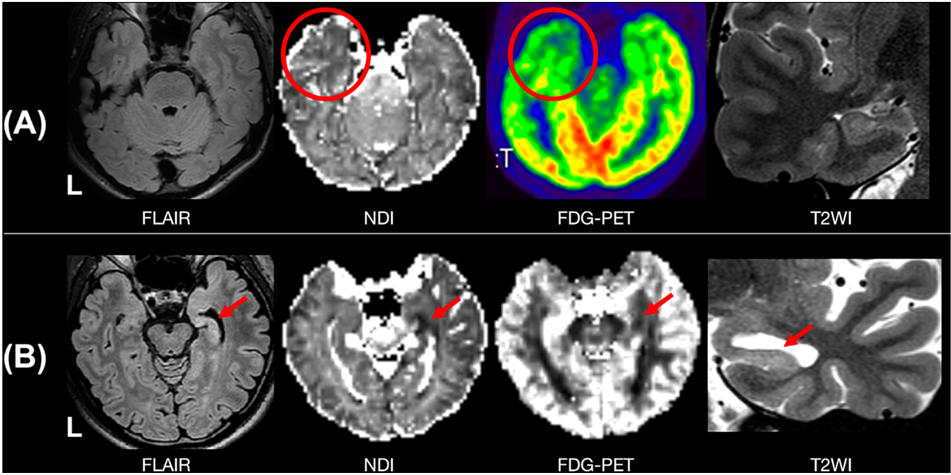
“In temporal lobe epilepsy (TLE), the most common epilepsy in adults, reduction of NDI was found in the temporal lobes, with more prominent abnormalities in the hemisphere ipsilateral to the epileptogenic focus (Sone et al., 2018;Winston et al., 2020).”
§ NODDI in clinical research > 3.5. Epilepsy
What the sources say
- Supportedcites Sone et al., 2018 source
The Introduction (page not provided) calls TLE the most common type of adult epilepsy. The Results and Conclusions (pages not provided) report reduced neurite density mainly in the ipsilateral temporal lobe in both left and right TLE, supporting the claimed hemispheric pattern. (LLM, conf=0.94)
- Supportedcites Winston et al., 2020 source
The Results (Intracortical grey matter; page unavailable) report reduced neurite density confined to ipsilateral mesial and basal temporal regions. The Results (Subcortical white matter; page unavailable) report bilateral neurite-density reductions, alongside stronger ipsilateral effects for a related diffusion measure. Together, these support reduced temporal-lobe neurite density with more prominent ipsilateral abnormalities, although the paper does not explicitly quantify an ipsilateral-versus-contralateral difference in neurite density. (LLM, conf=0.87)
plaincorrelational- Asserted: passes — The authors put it forward as true.
- Checkable: passes — It can be checked against evidence.
- Load-bearing: passes — The paper’s conclusions depend on it.
- Based: passes — The paper gives a reason why it holds.
It may state two separate claims as one.
- Supported
Every source the paper cites for this claim was checked and supports it.
In the paper
“(Winston et al., 2014) reported that NDI maps yielded a clearer depiction of FCD than other imaging approaches (i.e., T1-/T2-weighted images and DTI maps).”
§ NODDI in clinical research > 3.5. Epilepsy
What the sources say
- Supportedcites Winston et al., 2014 source
The Results state that reduced ICVF, the NODDI measure of neurite density, was more conspicuous than on conventional structural or diffusion images. The Discussion likewise says the abnormality was more readily identifiable than on other clinical or diffusion images, supporting the comparison with T1-/T2-weighted and DTI imaging. (LLM, conf=0.91)
boosted- Asserted: passes — The authors put it forward as true.
- Checkable: passes — It can be checked against evidence.
- Load-bearing: passes — The paper’s conclusions depend on it.
- Based: passes — The paper gives a reason why it holds.
Probably not a substantial claim.
- Supported
Every source the paper cites for this claim was checked and supports it.
In the paper
“In postmortem human spinal cord, (Grussu et al., 2017) observed decreased ODI in MS lesions and an excellent agreement between ODI and its histological counterpart.”
§ NODDI in clinical research > 3.3. Multiple sclerosis
What the sources say
- Supportedcites Grussu et al., 2017 source
The Results section reports decreased ODI in a thoracic MS lesion and a trend toward decreased ODI in lumbar lesions. Its statistical analysis reports a strong correlation between ODI and its histological counterpart, CV, in MS cases (r = 0.60; P = 0.001), supporting the described agreement. (LLM, conf=0.88)
plaincorrelational- Asserted: passes — The authors put it forward as true.
- Checkable: passes — It can be checked against evidence.
- Load-bearing: unclear — It is unclear whether the paper’s conclusions depend on it.
- Based: passes — The paper gives a reason why it holds.
It may state two separate claims as one.
- Supported
Every source the paper cites for this claim was checked and supports it.
In the paper
“The potential usefulness of NODDI for discriminating Parkinson's disease from the other Parkinsonian disorders has also been suggested (Mitchell et al., 2019), with NODDI showing greater abnormalities in progressive supranuclear palsy and multiple system atrophy than in Parkinson's disease.”
§ NODDI in clinical research > 3.2. Parkinson's disease
What the sources say
- Supportedcites Mitchell et al., 2019 source
The Differentiation of Parkinsonism section reports that NODDI distinguished PD from atypical Parkinsonism (the studied MSAp and PSP groups), with an AUC of 0.945. The Introduction describes more widespread pathological changes in MSAp and PSP than in PD, and the NODDI results identify abnormalities across multiple regions in those groups. The study examined the Parkinsonian variant of multiple system atrophy, rather than all variants. (LLM, conf=0.86)
hedgedcorrelational- Asserted: passes — The authors put it forward as true.
- Checkable: passes — It can be checked against evidence.
- Load-bearing: unclear — It is unclear whether the paper’s conclusions depend on it.
- Based: passes — The paper gives a reason why it holds.
It may state two separate claims as one.
- Supported
Every source the paper cites for this claim was checked and supports it.
In the paper
“They also reported that reduced NDI was seen in larger areas than was FA, suggesting a greater sensitivity of NODDI over DTI, and that reduced ODI within the precentral gyrus was correlated with disease duration, presumably representing reduced dendritic density and branching.”
§ NODDI in clinical research > 3.4. Amyotrophic lateral sclerosis
What the sources say
- Supportedcites Broad et al., 2019 source
The Discussion reports that, at the same statistical threshold, significantly reduced NDI covered larger areas than significantly reduced FA. It explicitly suggests that NDI may be more sensitive than FA for detecting ALS-related white-matter pathology. (LLM, conf=0.94)
hedgedcorrelational- Asserted: passes — The authors put it forward as true.
- Checkable: passes — It can be checked against evidence.
- Load-bearing: passes — The paper’s conclusions depend on it.
- Based: passes — The paper gives a reason why it holds.
It may state two separate claims as one.
- Supported
The cited sources support only part of this claim — read each source’s verdict below.
In the paper
“These studies generally agree that NDI in WM is reduced compared with healthy controls in MR-visible lesions, and to a lesser degree in normal-appearing WM, and that NDI reveals more prominent and widespread abnormalities than FA (Fig. 4).”
§ NODDI in clinical research > 3.3. Multiple sclerosis
What the sources say
- Not matchedcites Collorone et al., 2019
Couldn’t be matched to a paper in Crossref, so it can’t be checked.
- Partly supportedcites De Santis et al., 2019 sourceExperimental — accuracy not yet measured
The Effect size section reports reduced NODDI restricted fraction in MS lesions and normal-appearing white matter, while FA differences did not survive the post-hoc test. This supports the comparison with FA, but the claim is too broad across protocols: the NODDI difference in normal-appearing white matter was not significant at 7 T. The paper does not establish that the abnormalities were more widespread beyond the tissue regions it tested. (LLM, conf=0.87)
- Not checked — no full text of the sourcecites Granberg et al., 2017 source
hedgedcorrelational- Asserted: passes — The authors put it forward as true.
- Checkable: passes — It can be checked against evidence.
- Load-bearing: passes — The paper’s conclusions depend on it.
- Based: passes — The paper gives a reason why it holds.
It may state two separate claims as one.
- Not matched
Every source the paper cites for this claim was checked and supports it.
In the paper
“Tractography and network analysis both have their own limitations (Jeurissen et al., 2019;Sotiropoulos and Zalesky, 2019), which, in combination with the limitations of NODDI, means that caution is required when interpreting the data.”
§ NODDI in clinical research > 3.5. Epilepsy
What the sources say
- Supportedcites Jeurissen et al., 2019 source
Jeurissen's discussion accompanying Figure 14 says fiber-tracking connectomes can contain false positives, false negatives, and biased connection strengths, and advises proceeding with extreme caution. The citation supports the tractography limitation in the citing sentence; that sentence does not attribute the limitations of network analysis or NODDI specifically to Jeurissen. (LLM, conf=0.93)
- Supportedcites Sotiropoulos and Zalesky, 2019 source
The citation is attached to the statement that tractography and network analysis have limitations, not to the separate mention of NODDI. In “Mapping edges,” the paper describes tractography errors and urges caution; in “Comparing network properties between groups,” it says interpreting brain graphs is challenging and some network measures rest on unestablished assumptions. (LLM, conf=0.92)
plaindirect- Asserted: passes — The authors put it forward as true.
- Checkable: passes — It can be checked against evidence.
- Load-bearing: fails — The paper’s conclusions may not depend on it.
- Based: passes — The paper gives a reason why it holds.
Probably not a substantial claim. The paper’s conclusions may not depend on it.
- Supported
The cited sources support only part of this claim — read each source’s verdict below.
In the paper
“The tuberous sclerosis patients also exhibited smaller NDI compared with controls throughout the WM, although no correlation was observed with severity of mental retardation or epilepsy.”
§ NODDI in clinical research > 3.5. Epilepsy
What the sources say
- Partly supportedcites Taoka et al., 2020 sourceExperimental — accuracy not yet measured
The Results (Quantitative analysis; page unavailable) report reduced Ficv, a measure of neurite density, across widespread white-matter regions—not throughout all white matter. The Results (Correlations of clinical symptoms; page unavailable) found no statistically significant correlations with mental retardation or epilepsy, although the Discussion describes slight associations with mental-retardation severity. (LLM, conf=0.85)
plainn = 11- Asserted: passes — The authors put it forward as true.
- Checkable: passes — It can be checked against evidence.
- Load-bearing: unclear — It is unclear whether the paper’s conclusions depend on it.
- Based: passes — The paper gives a reason why it holds.
It may state two separate claims as one.
- Partly supported
Every source the paper cites for this claim was checked and supports it.
In the paper
“NDI in this region was not different from the contralateral side in the subacute phase, and was decreased in the chronic phase, presumably representing the course of Wallerian degeneration (Mastropietro et al., 2019).”
§ NODDI in clinical research > 3.6. Ischemia
What the sources say
- Supportedcites Mastropietro et al., 2019 source
The Discussion (page unavailable) reports no significant ipsilateral–contralateral difference in Fic, the paper’s intraneurite NODDI measure, in the subacute phase. The chronic-phase Results (page unavailable) report significantly lower ipsilateral Fic in the distal CST region (CP), and the Discussion describes the changes as compatible with Wallerian degeneration. (LLM, conf=0.92)
plain- Asserted: passes — The authors put it forward as true.
- Checkable: passes — It can be checked against evidence.
- Load-bearing: unclear — It is unclear whether the paper’s conclusions depend on it.
- Based: passes — The paper gives a reason why it holds.
It may state two separate claims as one.
- Supported
Every source the paper cites for this claim was checked and supports it.
In the paper
“Notably, (Sone et al., 2018) observed reduced NDI in patients with TLE in whom experienced radiologists did not find abnormalities on structural MRI, albeit to a lesser extent than in patients with MRI-positive TLE (Fig. 5).”
§ NODDI in clinical research > 3.5. Epilepsy
What the sources say
- Supportedcites Sone et al., 2018 source
The Participants section (page unavailable) says experienced neuroradiologists assessed the MRI scans and found no conventional-MRI abnormalities in the MRI-negative/PET-positive group. The Results and Discussion (page unavailable) report reduced neurite density in that group, with less severe abnormalities than in the MRI-positive TLE group with hippocampal sclerosis. (LLM, conf=0.93)
plaincorrelational- Asserted: passes — The authors put it forward as true.
- Checkable: passes — It can be checked against evidence.
- Load-bearing: passes — The paper’s conclusions depend on it.
- Based: passes — The paper gives a reason why it holds.
It may state two separate claims as one.
- Supported
The sources with a verdict support this claim; the rest weren’t checked yet, have no full text we could read, or their verdicts aren’t rated yet.
In the paper
“In addition, increased f fw in the substantia nigra, which is consistent with accumulated evidence (Burciu et al., 2017(Burciu et al., , 2016) ) from free water imaging (Pasternak et al., 2009), was observed by (Mitchell et al., 2019) but not by (Kamagata et al., 2016).”
§ NODDI in clinical research > 3.2. Parkinson's disease
What the sources say
- Supportedcites Mitchell et al., 2019 source
Section 3.4 (page not provided) reports elevated free water in the posterior substantia nigra in Parkinson’s disease, MSAp, and PSP compared with controls. This supports the finding attributed to Mitchell et al.; the separate claim about Kamagata et al. is not assessed against Mitchell’s paper. (LLM, conf=0.93)
- Not checked — no full text of the sourcecites Kamagata et al., 2016 source
plain- Asserted: passes — The authors put it forward as true.
- Checkable: passes — It can be checked against evidence.
- Load-bearing: unclear — It is unclear whether the paper’s conclusions depend on it.
- Based: passes — The paper gives a reason why it holds.
It may state two separate claims as one.
- Supported
Every source the paper cites for this claim was checked and supports it.
In the paper
“Interestingly, a study of the long-term effects of sports-related concussion reported increased NDI and decreased ODI in athletes at 9-120 months after their last concussion compared with controls”
§ NODDI in clinical research > 3.7. Traumatic brain injury
What the sources say
- Supportedcites Churchill et al., 2017 source
The Subject Demographics section reports that athletes were imaged 9 months to 10 years after their last concussion. The Discussion reports increased intracellular volume fraction (VIC), indicating greater neurite density, and decreased ODI in concussed athletes compared with controls. Page numbers are not available for these passages. (LLM, conf=0.92)
plaincorrelational- Asserted: passes — The authors put it forward as true.
- Checkable: passes — It can be checked against evidence.
- Load-bearing: unclear — It is unclear whether the paper’s conclusions depend on it.
- Based: passes — The paper gives a reason why it holds.
It may state two separate claims as one.
- Supported
The cited sources support only part of this claim — read each source’s verdict below.
In the paper
“In patients with moyamoya disease, a disease characterized by progressive occlusion of the circle of Willis, NODDI parameters in GM and WM were correlated with hemodynamic activities measured with 15 O-gas positron-emission tomography, as well as neurocognitive dysfunction”
§ NODDI in clinical research > 3.6. Ischemia
What the sources say
- Not checked — no full text of the sourcecites Hara et al., 2019 source
- Partly supportedcites Hara et al., 2018 sourceExperimental — accuracy not yet measured
The Conclusions (page unavailable) report a correlation between NODDI and neuropsychological performance in adult moyamoya disease, and describe white-matter and cortical NODDI differences. The Statistical Analysis section (page unavailable) describes correlations with cognitive scores, but our copy does not report a correlation between NODDI parameters and hemodynamic activity measured by 15O-gas PET. (LLM, conf=0.86)
plaincorrelational- Asserted: passes — The authors put it forward as true.
- Checkable: passes — It can be checked against evidence.
- Load-bearing: passes — The paper’s conclusions depend on it.
- Based: passes — The paper gives a reason why it holds.
It may state two separate claims as one.
Every source the paper cites for this claim was checked and supports it.
In the paper
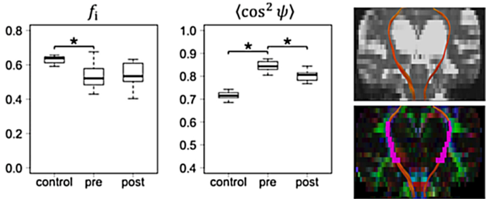
“After surgery, the orientation parameter showed partial normalization, whereas the reduced axonal water fraction remained unchanged (Kamiya et al., 2017) (Fig. 7).”
§ NODDI in clinical research > 3.9. Idiopathic normal pressure hydrocephalus
What the sources say
- Supportedcites Kamiya et al., 2017 source
The Results (Human data) report that the orientation parameter τ1 decreased significantly after surgery and that neither imaging model found a significant postoperative change in axonal water fraction (AWF). The Discussion describes the increased orientational coherence as tending to normalize while the decreased axon density remained unchanged. (LLM, conf=0.93)
plaindirect- Asserted: passes — The authors put it forward as true.
- Checkable: passes — It can be checked against evidence.
- Load-bearing: passes — The paper’s conclusions depend on it.
- Based: passes — The paper gives a reason why it holds.
It may state two separate claims as one.
- Supported
The cited sources support only part of this claim — read each source’s verdict below.
In the paper
“Furthermore, individuals with a history of TBI are at higher risk for dementia, neurodegenerative diseases, psychiatric illness, and even mortality, indicating long-term progression of sub-clinical pathology that manifests only in late adulthood (Smith et al., 2013;Wilson et al., 2017).”
§ NODDI in clinical research > 3.7. Traumatic brain injury
What the sources say
- Partly supportedcites Smith et al., 2013 sourceExperimental — accuracy not yet measured
The Introduction and “Single TBI” section support increased risk of later dementia and neurodegenerative disease, particularly after moderate to severe TBI. “Repetitive mild TBI” reports neuropsychiatric symptoms in selected cases and higher neurodegenerative mortality in former NFL players, but does not establish a general increased risk of psychiatric illness or mortality for everyone with a TBI history. The “Histological features” section also describes pathology appearing within hours of injury, so the claim that it manifests only in late adulthood is not supported. (LLM, conf=0.87)
- Partly supportedcites Wilson et al., 2017 sourceExperimental — accuracy not yet measured
The sections on neurodegenerative disease after single TBI and stroke and other neurological disorders after TBI report links with dementia, neurodegenerative disease, and neuropsychiatric illness; the Conclusions and future directions report higher mortality. But the paper does not establish that these outcomes all result from sub-clinical pathology manifesting only in late adulthood: it describes that mechanism as a possibility and also reports young-onset dementia and elevated mortality in younger people. No page numbers are available in our copy. (LLM, conf=0.86)
hedgedcorrelational- Asserted: passes — The authors put it forward as true.
- Checkable: passes — It can be checked against evidence.
- Load-bearing: unclear — It is unclear whether the paper’s conclusions depend on it.
- Based: passes — The paper gives a reason why it holds.
It may state two separate claims as one.
- Partly supported
Every source the paper cites for this claim was checked and supports it.
In the paper
“The degree of post-operative improvement varies greatly among individuals, and therefore quantitative metrics capable of predicting treatment response have been sought (Halperin et al., 2015).”
§ NODDI in clinical research > 3.9. Idiopathic normal pressure hydrocephalus
What the sources say
- Supportedcites Halperin et al., 2015 source
The Abstract reports differing outcomes among shunted patients, including marked or moderate improvement in 14 of 18 patients and minimal worsening in one. The Conclusion and Figure 2 discuss measured CSF flow, outflow resistance, and other tests assessed for their ability to predict shunt response. Together, these support the paraphrase. (LLM, conf=0.88)
plain- Asserted: passes — The authors put it forward as true.
- Checkable: passes — It can be checked against evidence.
- Load-bearing: passes — The paper’s conclusions depend on it.
- Based: passes — The paper gives a reason why it holds.
Probably not a substantial claim. It may state two separate claims as one.
- Supported
The cited sources support only part of this claim — read each source’s verdict below.
In the paper
“No significant differences were observed for ODI, f fw , myelin water fraction, or intra-or extra-neurite water fraction.”
§ NODDI in clinical research > 3.8. Neurofibromatosis type 1
What the sources say
- Partly supportedcites Billiet et al., 2014 sourceExperimental — accuracy not yet measured
The dMRI Results report no significant differences in ODI or isotropic fluid fraction (FISO), and the multi-exponential T2 Results report none in myelin water fraction or combined intra- and extracellular water fraction (IEWF). The comparison is specifically between unidentified bright objects and normal-appearing white matter in children with NF1. The paper does not report separate intra- or extra-neurite water fractions; calling its combined IEWF measure those fractions is not supported. (LLM, conf=0.88)
plain- Asserted: passes — The authors put it forward as true.
- Checkable: passes — It can be checked against evidence.
- Load-bearing: passes — The paper’s conclusions depend on it.
- Based: passes — The paper gives a reason why it holds.
It may state two separate claims as one.
- Partly supported
Every source the paper cites for this claim was checked and supports it.
In the paper
“With NODDI, axonal water fraction and orientation dispersion were both smaller within the CST of patients”
§ NODDI in clinical research > 3.9. Idiopathic normal pressure hydrocephalus
What the sources say
- Supportedcites Kamiya et al., 2017 source
The Results (Human data; page unavailable) report significantly lower NODDI axonal water fraction in the CST of iNPH patients than controls, alongside higher τ1, indicating greater orientational coherence. The Image processing section (page unavailable) defines higher τ1 as more parallel orientation, supporting the claim of lower orientation dispersion. (LLM, conf=0.92)
plaincorrelational- Asserted: passes — The authors put it forward as true.
- Checkable: passes — It can be checked against evidence.
- Load-bearing: passes — The paper’s conclusions depend on it.
- Based: passes — The paper gives a reason why it holds.
It may state two separate claims as one.
- Supported
The sources with a verdict support this claim; the rest weren’t checked yet, have no full text we could read, or their verdicts aren’t rated yet.
In the paper
“Studies have suggested that, depending on their anatomical location (e.g., thalamus), UBOs may be associated with cognitive deficits (Hyman et al., 2007;Moore et al., 1996).”
§ NODDI in clinical research > 3.8. Neurofibromatosis type 1
What the sources say
- Supportedcites Hyman et al., 2007 source
The Results state that T2 hyperintensities were not associated with cognitive dysfunction overall, but thalamic lesions were associated with cognitive impairment. The Location of T2H section reports lower cognitive scores in children with thalamic lesions, while lesions in several other locations showed no significant lowering. This supports the claim's location-dependent, hedged association. (LLM, conf=0.94)
- Not checked — no full text of the sourcecites Moore et al., 1996 source
hedgedcorrelational- Asserted: passes — The authors put it forward as true.
- Checkable: passes — It can be checked against evidence.
- Load-bearing: fails — The paper’s conclusions may not depend on it.
- Based: passes — The paper gives a reason why it holds.
Probably not a substantial claim. The paper’s conclusions may not depend on it.
- Supported
The cited sources that could be checked couldn’t confirm or dispute this claim.
In the paper
“the observed NDI increase has been interpreted as representing the inflammatory process.”
§ NODDI in clinical research > 3.14. Effects of drugs and substance abuse
What the sources say
- Could not verifycites Haroon et al., 2014 sourceExperimental — accuracy not yet measured
The Abstract and Discussion report increased glutamate measured as Glu/Cr during IFN-alpha treatment and discuss possible inflammatory mechanisms. Our copy does not report an NDI increase or interpret NDI as representing inflammation (searched: NDI, neurite density index). (LLM, conf=0.76)
- Not checked — no full text of the sourcecites Capuron et al., 2007 source
plaincorrelational- Asserted: passes — The authors put it forward as true.
- Checkable: passes — It can be checked against evidence.
- Load-bearing: fails — The paper’s conclusions may not depend on it.
- Based: passes — The paper gives a reason why it holds.
Probably not a substantial claim. The paper’s conclusions may not depend on it.
- Could not verify
Every source the paper cites for this claim was checked and supports it.
In the paper
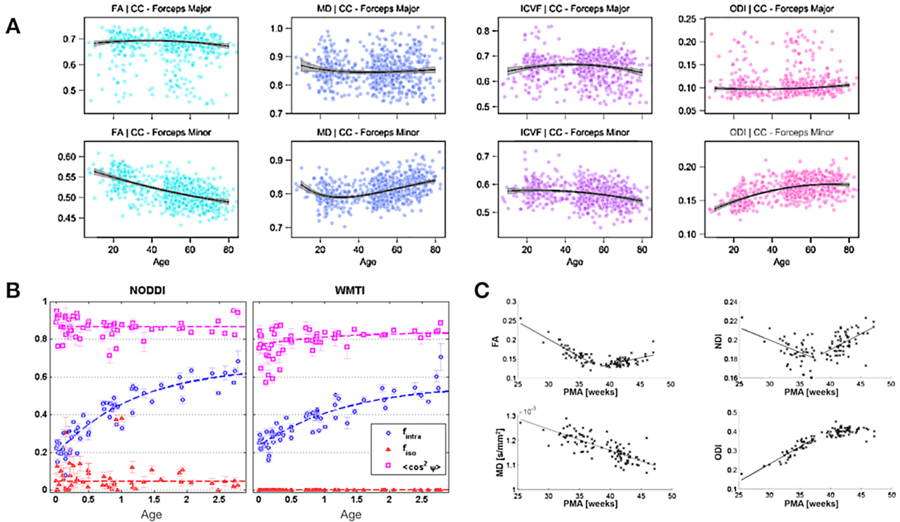
“In WM, NDI has a positive correlation with age, but the increase is non-linear and more rapid during early life (Dean et al., 2016;Jelescu et al., 2015;Lynch et al., 2020) (Fig. 9B).”
§ NODDI in clinical research > 4.2. Normal development and aging: perinatal to childhood
What the sources say
- Supportedcites Dean et al., 2016 source
The Methods identify νIC as the NODDI measure of neurite density. The Results (Fig. 4; page not provided) report that mean white-matter νIC increases logarithmically with age in the study’s infants and young children, supporting a nonlinear increase that is faster earlier in life. (LLM, conf=0.92)
- Supportedcites Jelescu et al., 2015 source
The Results (§4.1, page unavailable) report that the NODDI-derived intra-axonal fraction increased in all three white-matter regions during the first three years of life and that an exponential curve best described the increase. The Conclusion (§6, page unavailable) likewise describes a large nonlinear increase with age and notes that the trajectory levels off, supporting a faster increase early in the period studied. (LLM, conf=0.90)
- Supportedcites Lynch et al., 2020 source
The Discussion reports widespread age-related increases in white-matter tract NDI. It describes an exponential growth pattern, with rapid increases in infancy and young childhood followed by a plateau in adolescence. (LLM, conf=0.94)
plaincorrelational- Asserted: passes — The authors put it forward as true.
- Checkable: passes — It can be checked against evidence.
- Load-bearing: unclear — It is unclear whether the paper’s conclusions depend on it.
- Based: passes — The paper gives a reason why it holds.
It may state two separate claims as one.
- Supported
The cited sources support only part of this claim — read each source’s verdict below.
In the paper
“Although DTI has consistently shown reduced FA in the compressed spinal cord, the correlation of FA with symptoms and postoperative recovery remains controversial (Jones et al., 2013;Rajasekaran et al., 2017).”
§ NODDI in clinical research > 3.12. Spondylotic myelopathy
What the sources say
- Partly supportedcites Jones et al., 2013 sourceExperimental — accuracy not yet measured
The Correlation with Initial Clinical Assessment Scores section reports lower FA with poorer neurologic function in patients with cervical spondylotic myelopathy. The Relation to Surgical Outcome section reports an association between baseline FA and improvement on one postoperative measure, but not on the Nurick or mJOA scales; the Conclusions call the results preliminary. This supports uncertainty about postoperative prediction, but the paper does not establish that correlations with symptoms and recovery are broadly controversial or that reduced FA has been shown consistently across studies. (LLM, conf=0.85)
- Not checked — no full text of the sourcecites Rajasekaran et al., 2017 source
plaincorrelational- Asserted: passes — The authors put it forward as true.
- Checkable: passes — It can be checked against evidence.
- Load-bearing: passes — The paper’s conclusions depend on it.
- Based: passes — The paper gives a reason why it holds.
It may state two separate claims as one.
- Partly supported
Every source the paper cites for this claim was checked and supports it.
In the paper
“However, (Genç et al., 2018) have reported that higher intelligence in healthy young to middle-aged individuals was associated with lower cortical ODI”
§ NODDI in clinical research > 4.1. Normal development and aging: late childhood to old age
What the sources say
- Supportedcites Genç et al., 2018 source
The Results (Associations on a whole-brain level; page not provided) report a negative association between intelligence and cortical ODI in both samples. The same section describes participants aged 18–40 and 22–36, and the Methods describe the experimental sample as healthy. (LLM, conf=0.93)
plaincorrelational- Asserted: passes — The authors put it forward as true.
- Checkable: passes — It can be checked against evidence.
- Load-bearing: fails — The paper’s conclusions may not depend on it.
- Based: passes — The paper gives a reason why it holds.
Probably not a substantial claim. The paper’s conclusions may not depend on it.
- Supported
Every source the paper cites for this claim was checked and supports it.
In the paper
“Reduced ODI in the frontal cortices and increased ODI in the parietal cortices and the striatum have been reported from a study in young-adult binge drinkers (Morris et al., 2018).”
§ NODDI in clinical research > 3.14. Effects of drugs and substance abuse
What the sources say
- Supportedcites Morris et al., 2018 source
The Discussion reports reduced ODI in frontal cortical grey matter and increased ODI in parietal cortex in young-adult binge drinkers. It also reports higher ODI in the ventral striatum; the Results section confirms this comparison with healthy volunteers. (LLM, conf=0.91)
plaincorrelational- Asserted: passes — The authors put it forward as true.
- Checkable: passes — It can be checked against evidence.
- Load-bearing: passes — The paper’s conclusions depend on it.
- Based: passes — The paper gives a reason why it holds.
It may state two separate claims as one.
- Supported
Every source the paper cites for this claim was checked and supports it.
In the paper
“Another study found that lower NDI in WM was associated with poorer mathematics performance-but not with reading performance-across children born very preterm and full term (Collins et al., 2019).”
§ NODDI in clinical research > 4.3. Developmental abnormalities
What the sources say
- Supportedcites Collins et al., 2019 source
The Results (Associations between white matter microstructure and mathematics; page not available) report that higher neurite density was associated with better mathematics performance in the combined VPT and FT sample. The Results (Associations between white matter microstructure and word reading; page not available) report no association between any measured diffusion parameter and word reading performance in that sample. (LLM, conf=0.93)
plaincorrelational- Asserted: passes — The authors put it forward as true.
- Checkable: passes — It can be checked against evidence.
- Load-bearing: unclear — It is unclear whether the paper’s conclusions depend on it.
- Based: passes — The paper gives a reason why it holds.
It may state two separate claims as one.
- Supported
The cited sources support only part of this claim — read each source’s verdict below.
In the paper
“For example, in patients receiving interferon alpha treatment in whom an inflammatory cytokine response was confirmed by blood test, ODI remained unchanged, although NDI was increased (Dowell et al., 2019).”
§ NODDI in clinical research > 5.3. Specificity beyond NODDI
What the sources say
- Partly supportedcites Dowell et al., 2019 sourceExperimental — accuracy not yet measured
The Results sections on inflammatory cytokine response and acute NODDI effects report a blood-measured cytokine response and no significant change in ODI. However, they also report no significant increase in NDI after IFN-α; most of the listed NDI means were slightly lower at 4 hours. (LLM, conf=0.90)
plain- Asserted: passes — The authors put it forward as true.
- Checkable: passes — It can be checked against evidence.
- Load-bearing: passes — The paper’s conclusions depend on it.
- Based: passes — The paper gives a reason why it holds.
It may state two separate claims as one.
- Partly supported
Every source the paper cites for this claim was checked and supports it.
In the paper
“Compared with controls, infants with congenital heart disease exhibited smaller NDI and greater ODI in WM (Karmacharya et al., 2018), as well as smaller ODI in cortical GM (Kelly et al., 2019)”
§ NODDI in clinical research > 4.3. Developmental abnormalities
What the sources say
- Supportedcites Karmacharya et al., 2018 source
The Results section (‘White matter regional abnormalities in CHD’; page unavailable) reports lower NODDI intracellular volume fraction (Vic) in the bilateral SFOF and left PLIC, and higher ODI in the left corpus callosum, in CHD neonates compared with controls. These are region-specific white-matter findings. The cortical-gray-matter claim is attached to Kelly et al. (2019), not to this source. (LLM, conf=0.90)
- Supportedcites Kelly et al., 2019 source
The Results section ('Cortical ODI Is Reduced in Infants With CHD') reports significantly lower cortical ODI in infants with congenital heart disease than in controls. Kelly et al. is cited for the cortical gray matter finding, not the white matter findings attributed to Karmacharya et al. (LLM, conf=0.94)
plaincorrelational- Asserted: passes — The authors put it forward as true.
- Checkable: passes — It can be checked against evidence.
- Load-bearing: passes — The paper’s conclusions depend on it.
- Based: passes — The paper gives a reason why it holds.
It may state two separate claims as one.
- Supported
The cited sources support only part of this claim — read each source’s verdict below.
In the paper
“Both lower NDI and greater ODI were correlated with poorer neurodevelopmental outcomes (Kelly et al., 2016;Mürner-Lavanchy et al., 2018;Young et al., 2019).”
§ NODDI in clinical research > 4.3. Developmental abnormalities
What the sources say
- Supportedcites Kelly et al., 2016 source
The Discussion’s Conclusions state that higher axon dispersion (ODI) and lower axon density (NDI) in very preterm children are associated with some neurodevelopmental delays. The Neurodevelopmental outcomes section also links both measures to poorer motor outcomes. (LLM, conf=0.91)
- Supportedcites Mürner-Lavanchy et al., 2018 source
The Discussion reports that higher axon density was associated with better IQ and motor performance and fewer behavioural problems, while lower axon dispersion was associated with better motor performance and fewer behavioural problems in very-preterm children. It also reports higher axon density with better semantic performance in this study, although evidence for dispersion–language associations was weaker. Those findings support the broad claim about poorer neurodevelopmental outcomes; the motor and behavioural findings are reported from earlier work. (LLM, conf=0.88)
- Partly supportedcites Young et al., 2019 sourceExperimental — accuracy not yet measured
The Discussion reports that, among children born very preterm, lower NDI was associated with poorer intelligence and visuomotor skills, but intelligence was associated with NDI rather than ODI. Greater ODI was associated with lower intellectual scores in the full-term group; in that group, higher—not lower—NDI was also associated with lower scores. The claim combines associations observed in different groups as though both applied together. (LLM, conf=0.90)
plaincorrelational- Asserted: passes — The authors put it forward as true.
- Checkable: passes — It can be checked against evidence.
- Load-bearing: passes — The paper’s conclusions depend on it.
- Based: passes — The paper gives a reason why it holds.
It may state two separate claims as one.
- Supported
Every source the paper cites for this claim was checked and supports it.
In the paper
“Focusing on the fixed diffusivity assumption, (Guerrero et al., 2019) have suggested that the default value of 1.7 μm 2 /ms is likely suboptimal for neonates brain and GM, and that the age-dependence of NDI and ODI is affected by the choice of fixed diffusivity value.”
§ NODDI in clinical research > 4.2. Normal development and aging: perinatal to childhood
What the sources say
- Supportedcites Guerrero et al., 2019 source
The Results report that the optimal fixed diffusivity is below 1.7 μm²/ms in infant white and gray matter, and in gray matter across age groups. The Results and Discussion also show that changing this value alters age-group differences in neurite density and orientation-related NODDI parameters. The copy provides section labels but no page numbers. (LLM, conf=0.93)
hedgeddirect- Asserted: passes — The authors put it forward as true.
- Checkable: passes — It can be checked against evidence.
- Load-bearing: passes — The paper’s conclusions depend on it.
- Based: passes — The paper gives a reason why it holds.
Probably not a substantial claim. It may state two separate claims as one.
- Supported
The cited sources support only part of this claim — read each source’s verdict below.
In the paper
“Accumulating evidence suggests a major role of chronic neuroinflammation in the neurodegeneration that occurs in aging and in a broad range of diseases including Alzheimer's disease, Parkinson's disease, MS, ALS, stroke, TBI, and psychiatric diseases (Amor et al., 2010;Glass et al., 2010;Vikhreva et al., 2016).”
§ NODDI in clinical research > 5.3. Specificity beyond NODDI
What the sources say
- Partly supportedcites Amor et al., 2010 sourceExperimental — accuracy not yet measured
The Abstract and Conclusions describe chronic immune activation as a feature of many neurodegenerative diseases, and the paper discusses the listed neurological conditions, including ALS. The Introduction mentions an aging population but does not establish a role for chronic neuroinflammation in neurodegeneration caused by aging; the passages found also do not address psychiatric diseases. Page numbers are unavailable in our copy. (LLM, conf=0.88)
- Partly supportedcites Glass et al., 2010 sourceExperimental — accuracy not yet measured
The Introduction and Conclusion support a role for sustained neuroinflammation in the progression of Alzheimer’s, Parkinson’s, ALS, and MS, while noting that inflammation may amplify pathology rather than initiate disease. The Alzheimer’s Disease section identifies AD as age-related, but the cited passages do not establish the broader claim about neurodegeneration in aging, stroke, traumatic brain injury, or psychiatric diseases. Page numbers are unavailable in our copy. (LLM, conf=0.88)
- Not checked — no full text of the sourcecites Vikhreva et al., 2016 source
hedgeddirect- Asserted: passes — The authors put it forward as true.
- Checkable: passes — It can be checked against evidence.
- Load-bearing: fails — The paper’s conclusions may not depend on it.
- Based: passes — The paper gives a reason why it holds.
Probably not a substantial claim. The paper’s conclusions may not depend on it.
- Partly supported
The sources with a verdict support this claim; the rest weren’t checked yet, have no full text we could read, or their verdicts aren’t rated yet.
In the paper
“For example, T2s are likely different among compartments (Lampinen et al., 2020;Veraart et al., 2018) and are affected by pathologies like neuroinflammation (Stanisz et al., 2004), demyelination (Bartzokis, 2004;Lin et al., 2018), and intramyelinic edema (Harkins et al., 2013).”
§ NODDI in clinical research > 5.3. Specificity beyond NODDI
What the sources say
- Supportedcites Lampinen et al., 2020 source
The Lampinen et al. citation is attached to the claim that T2 values differ among compartments, not to the subsequent examples of pathologies, which have separate citations. The Results (In vivo results; page not provided) report different T2 values for the ‘stick’ and ‘zeppelin’ compartments in both healthy white matter and lesions. (LLM, conf=0.94)
- Supportedcites Veraart et al., 2018 source
Veraart et al. is cited for the first clause, that T2 values differ among compartments. The Discussion reports empirical evidence that intra- and extra-axonal T2 relaxation times differ, and the Conclusion reiterates this finding in the living human brain. The pathology examples have separate citations and are not attributed to Veraart et al. (LLM, conf=0.94)
- Not checked — no full text of the sourcecites Stanisz et al., 2004 source
hedgedconditional- Asserted: passes — The authors put it forward as true.
- Checkable: passes — It can be checked against evidence.
- Load-bearing: unclear — It is unclear whether the paper’s conclusions depend on it.
- Based: passes — The paper gives a reason why it holds.
It may state two separate claims as one.
- Supported
The cited sources support only part of this claim — read each source’s verdict below.
In the paper
“Although the negative correlation may look counterintuitive, it is in line with a number of studies reporting higher FA within this region in individuals with reading difficulties and the hypothesis that left lateralization of reading-related functions is diminished in struggling readers (Dougherty et al., 2007;Finn et al., 2014).”
§ NODDI in clinical research > 4.3. Developmental abnormalities
What the sources say
- Not checked — no full text of the sourcecites Dougherty et al., 2007 source
- Partly supportedcites Finn et al., 2014 sourceExperimental — accuracy not yet measured
Split into 2 atoms — 1 confirmed, 1 partially supported, 0 disputed, 0 misattributed, 0 unverifiable. Expand the claim to see per-atom verdicts.
hedgedcorrelational- Asserted: passes — The authors put it forward as true.
- Checkable: passes — It can be checked against evidence.
- Load-bearing: passes — The paper’s conclusions depend on it.
- Based: passes — The paper gives a reason why it holds.
It may state two separate claims as one.
Every source the paper cites for this claim was checked and supports it.
In the paper
“For translation into the clinic, an imaging biomarker needs to pass multiple steps in three parallel tracks: technical validation (precision, accuracy, and realizability), biological/clinical validation (performance in measuring relevant biological properties or predicting clinical outcomes), and cost-effectiveness (Connor et al., 2017).”
§ NODDI in clinical research > 5.2. Toward a clinical tool
What the sources say
- Supportedcites Connor et al., 2017 source
The imaging biomarker roadmap section describes parallel technical and biological/clinical validation tracks, with cost-effectiveness as a third track considered as validation evidence accumulates. It specifies precision, accuracy and availability for technical performance, and measurement of relevant biology or prediction of clinical outcomes for biological/clinical performance. The cost-effectiveness section says clinical translation requires good value for money. (LLM, conf=0.91)
plain- Asserted: passes — The authors put it forward as true.
- Checkable: passes — It can be checked against evidence.
- Load-bearing: fails — The paper’s conclusions may not depend on it.
- Based: passes — The paper gives a reason why it holds.
Probably not a substantial claim. The paper’s conclusions may not depend on it.
- Supported
Every source the paper cites for this claim was checked and supports it.
In the paper
“Later, (Batalle et al., 2019) reported that cortical development between 25 and 38 weeks is dominated by an increase of ODI, whereas between 38 and 47 weeks it is dominated by an increase of NDI”
§ NODDI in clinical research > 4.2. Normal development and aging: perinatal to childhood
What the sources say
- Supportedcites Batalle et al., 2019 source
The Discussion describes increases in ODI before 38 weeks PMA, followed by increased NDI with no change in ODI after 38 weeks. The Abstract gives the same 25–38 and 38–47 week pattern, while noting that later NDI increases were regionally confined. (LLM, conf=0.91)
plaindirect- Asserted: passes — The authors put it forward as true.
- Checkable: passes — It can be checked against evidence.
- Load-bearing: unclear — It is unclear whether the paper’s conclusions depend on it.
- Based: passes — The paper gives a reason why it holds.
It may state two separate claims as one.
- Supported
The sources with a verdict support this claim; the rest weren’t checked yet, have no full text we could read, or their verdicts aren’t rated yet.
In the paper
“Preliminary applications of NODDI and the g-ratio framework include studies of brain maturation during childhood (Dean et al., 2016;Geeraert et al., 2019), the effects of age and gender in young-to-late adulthood (Berman et al., 2018;Cercignani et al., 2017;Slater et al., 2019), and the effects of diseases like MS (Hagiwara et al., 2019;Stikov et al., 2015;Yu et al., 2019) and cervical spondylotic”
§ NODDI in clinical research > 5.4. Combination of multiple contrasts
What the sources say
- Supportedcites Dean et al., 2016 source
Dean et al. is cited for the childhood-maturation example, not the separately cited adult or disease studies. The Discussion reports a preliminary NODDI-based g-ratio study in children and a developmental trajectory across infancy and early childhood; page numbers are not provided in our copy. (LLM, conf=0.93)
- Not checked — no full text of the sourcecites Geeraert et al., 2019 source
- Supportedcites Berman et al., 2018 source
Berman et al. is an application of the g-ratio framework to age and sex: Methods §2.1 reports participants aged 7–85, and §2.5 describes testing sex differences across age ranges. The Conclusions state that the study tested g-ratio stability with age and between the sexes. The citing sentence identifies the subject of the study; it does not claim that the study found significant age or sex effects. (LLM, conf=0.92)
plaincorrelational- Asserted: passes — The authors put it forward as true.
- Checkable: passes — It can be checked against evidence.
- Load-bearing: unclear — It is unclear whether the paper’s conclusions depend on it.
- Based: passes — The paper gives a reason why it holds.
It may state two separate claims as one.
- Supported
The cited sources support only part of this claim — read each source’s verdict below.
In the paper
“A few studies have adopted this type of multi-parameter analysis with NODDI (Andica et al., 2020;Churchill et al., 2019Churchill et al., , 2017)), although most have been limited to combinations with other dMRI measures.”
§ NODDI in clinical research > 5.4. Combination of multiple contrasts
What the sources say
- Partly supportedcites Andica et al., 2020 sourceExperimental — accuracy not yet measured
The Methods (Linked independent component analysis) confirm that this study combined NODDI with DTI and VBM measures in a multi-parameter analysis. Because VBM measures white-matter volume, this study was not limited to other dMRI measures; the cited paper also does not establish that most such studies were so limited. (LLM, conf=0.85)
- Not checked — no full text of the sourcecites Churchill et al., 2019 source
- Supportedcites Churchill et al., 2017 source
The Magnetic Resonance Imaging section describes a protocol estimating both DTI and NODDI parameters. The Multivariate analysis: effects of concussion section says the study used N-way Partial Least Squares to examine covariation across multiple diffusion MRI measures and concussion history. This supports citing the paper as an example of multi-parameter NODDI analysis combined with another dMRI measure; the paper does not establish how common that approach is across other studies. (LLM, conf=0.91)
plain- Asserted: passes — The authors put it forward as true.
- Checkable: passes — It can be checked against evidence.
- Load-bearing: unclear — It is unclear whether the paper’s conclusions depend on it.
- Based: passes — The paper gives a reason why it holds.
It may state two separate claims as one.
- Partly supported
Every source the paper cites for this claim was checked and supports it.
In the paper
“Several groups have been even more ambitious and have investigated the use of MRI g-ratio as weights in connectomics studies (Kamagata et al., 2019;Mancini et al., 2018).”
§ NODDI in clinical research > 5.4. Combination of multiple contrasts
What the sources say
- Supportedcites Kamagata et al., 2019 source
The Introduction says the authors mapped connectomes based on the MR g-ratio in patients with multiple sclerosis. The Methods describe their g-ratio-weighted connectivity matrices, directly supporting the use of MRI g-ratio as connectome weights. (LLM, conf=0.94)
- Supportedcites Mancini et al., 2018 source
Section 2.4.2 (‘G-ratio weighted networks’) says the study modelled connectome edges with the g-ratio itself as their weight. This supports citing Mancini et al. as one group that investigated MRI g-ratio weights in connectomics; it does not need to establish what the other cited group did. (LLM, conf=0.94)
plain- Asserted: passes — The authors put it forward as true.
- Checkable: passes — It can be checked against evidence.
- Load-bearing: fails — The paper’s conclusions may not depend on it.
- Based: passes — The paper gives a reason why it holds.
Probably not a substantial claim. The paper’s conclusions may not depend on it.
- Supported
Every source the paper cites for this claim was checked and supports it.
In the paper
“One rapidly growing field is joint modeling of diffusion and relaxation (Gong et al., 2020;Lampinen et al., 2020;Veraart et al., 2018) (see also Hutter et al. in this special issue).”
§ NODDI in clinical research > 5.4. Combination of multiple contrasts
What the sources say
- Supportedcites Gong et al., 2020 source
The Introduction (page unavailable) describes combined modelling of diffusion and T2 relaxation and traces its development into more recent imaging methods. The Discussion (page unavailable) says an early study inspired many techniques and gives recent examples, supporting the broad characterization of a growing field. (LLM, conf=0.86)
- Supportedcites Lampinen et al., 2020 source
The Introduction (page unavailable) treats diffusion-relaxation experiments as an active research approach, describing their use to estimate compartment-specific T2 values and citing several recent studies. The paper itself develops a joint diffusion-relaxation model, supporting its citation as an example of this growing field. (LLM, conf=0.84)
- Supportedcites Veraart et al., 2018 source
The Introduction describes the paper’s own approach as combining diffusion and relaxation in a biophysical model. It also points to a vast literature on joint diffusion–relaxation methods and recent extensions to imaging, supporting the citing sentence’s broad characterization of an active, growing field. (LLM, conf=0.87)
plain- Asserted: passes — The authors put it forward as true.
- Checkable: passes — It can be checked against evidence.
- Load-bearing: fails — The paper’s conclusions may not depend on it.
- Based: passes — The paper gives a reason why it holds.
Probably not a substantial claim. The paper’s conclusions may not depend on it.
- Supported
The paper states this without a source or data behind it here, so there is nothing to check it against. The quote shows it is in the paper.
In the paper
“As with other advanced imaging techniques, most of the disease studies reported to date have been cross-sectional and have included a sample of limited size from a single center.”
§ NODDI in clinical research > 5.1. Summary of clinical studies
plain- Asserted: passes — The authors put it forward as true.
- Checkable: passes — It can be checked against evidence.
- Load-bearing: passes — The paper’s conclusions depend on it.
- Based: passes — The paper gives a reason why it holds.
It may state two separate claims as one.
The paper states this without a source or data behind it here, so there is nothing to check it against. The quote shows it is in the paper.
In the paper
“In contrast, biophysical models aim at specificity by parametrizing the dMRI signal as a function of biophysically meaningful parameters (e.g., axon density).”
§ NODDI in clinical research > 1. Introduction
plaindirect- Asserted: passes — The authors put it forward as true.
- Checkable: passes — It can be checked against evidence.
- Load-bearing: passes — The paper’s conclusions depend on it.
- Based: passes — The paper gives a reason why it holds.
Probably not a substantial claim.
The paper states this without a source or data behind it here, so there is nothing to check it against. The quote shows it is in the paper.
In the paper
“There are two main reasons for introducing a new imaging technique to the study of a disease: to improve sensitivity to target pathologies and to provide better explanations for observed abnormalities.”
§ NODDI in clinical research > 2. Rationale for using NODDI in clinical research
plain- Asserted: passes — The authors put it forward as true.
- Checkable: passes — It can be checked against evidence.
- Load-bearing: passes — The paper’s conclusions depend on it.
- Based: passes — The paper gives a reason why it holds.
Probably not a substantial claim. It may state two separate claims as one.
The paper states this without a source or data behind it here, so there is nothing to check it against. The quote shows it is in the paper.
In the paper
“As the models are often based on assumptions that are not yet proven even in the normal brain, users must be aware of the risk of being misled in their interpretations of the data.”
§ NODDI in clinical research > 2. Rationale for using NODDI in clinical research
plain- Asserted: passes — The authors put it forward as true.
- Checkable: passes — It can be checked against evidence.
- Load-bearing: passes — The paper’s conclusions depend on it.
- Based: fails — The paper may give no reason why it holds.
Probably not a substantial claim. The paper may give no reason why it holds.
The paper states this without a source or data behind it here, so there is nothing to check it against. The quote shows it is in the paper.
In the paper
“The validity of model assumptions is currently under debate.”
§ NODDI in clinical research > 2.2. Is NODDI specific?
plain- Asserted: passes — The authors put it forward as true.
- Checkable: passes — It can be checked against evidence.
- Load-bearing: fails — The paper’s conclusions may not depend on it.
- Based: passes — The paper gives a reason why it holds.
Probably not a substantial claim. The paper’s conclusions may not depend on it.
A conclusion the paper draws from its own results — it cites no other source for it, so there is none to check. The quote shows it is in the paper.
In the paper
“The signal representation approach aligns with the first reason, to improve sensitivity to target pathologies, with the caveat that this approach comes with no obvious biological interpretation.”
§ NODDI in clinical research > 2. Rationale for using NODDI in clinical research
plaincorrelational- Asserted: passes — The authors put it forward as true.
- Checkable: passes — It can be checked against evidence.
- Load-bearing: passes — The paper’s conclusions depend on it.
- Based: passes — The paper gives a reason why it holds.
It may state two separate claims as one.
In the paper
“neurite orientation dispersion and density imaging (NODDI) has been proposed as a way to relate the dMRI signal to tissue features via biophysically inspired modeling.”
§ NODDI in clinical research > Abstract
What the sources say
- Not checked — no full text of the sourcecites Zhang et al., 2012 source
plaincorrelational- Asserted: passes — The authors put it forward as true.
- Checkable: passes — It can be checked against evidence.
- Load-bearing: passes — The paper’s conclusions depend on it.
- Based: passes — The paper gives a reason why it holds.
Probably not a substantial claim.
In the paper
“With NODDI, reduced NDI and ODI have been observed in the substantia nigra and putamen of patients with Parkinson's disease compared with controls, and these reductions were predominant on the side corresponding to symptoms (contralateral) (Kamagata et al., 2016).”
§ NODDI in clinical research > 3.2. Parkinson's disease
What the sources say
- Not checked — no full text of the sourcecites Kamagata et al., 2016 source
plain- Asserted: passes — The authors put it forward as true.
- Checkable: passes — It can be checked against evidence.
- Load-bearing: passes — The paper’s conclusions depend on it.
- Based: passes — The paper gives a reason why it holds.
It may state two separate claims as one.
A conclusion the paper draws from its own results — it cites no other source for it, so there is none to check. The quote shows it is in the paper.
In the paper
“Despite the remaining ambiguity about model assumptions, research to investigate the clinical usefulness of NODDI can still be justified.”
§ NODDI in clinical research > 2.2. Is NODDI specific?
plain- Asserted: passes — The authors put it forward as true.
- Checkable: fails — It may be too vague to check against evidence.
- Load-bearing: passes — The paper’s conclusions depend on it.
- Based: passes — The paper gives a reason why it holds.
Probably not a substantial claim. It may be too vague to check against evidence.
A conclusion the paper draws from its own results — it cites no other source for it, so there is none to check. The quote shows it is in the paper.
In the paper
“NODDI may provide useful biomarkers if the effect of disease is far greater than the bias introduced by the constraints.”
§ NODDI in clinical research > 2.2. Is NODDI specific?
hedgedconditional- Asserted: passes — The authors put it forward as true.
- Checkable: fails — It may be too vague to check against evidence.
- Load-bearing: passes — The paper’s conclusions depend on it.
- Based: passes — The paper gives a reason why it holds.
Probably not a substantial claim. It may be too vague to check against evidence.
A conclusion the paper draws from its own results — it cites no other source for it, so there is none to check. The quote shows it is in the paper.
In the paper
“As the one true model has not been identified, results of NODDI, and any other model, are more or less phenomenological fit parameters that probably represent mixes of microstructural features rather than unambiguous quantifications of specific tissue properties.”
§ NODDI in clinical research > 2.2. Is NODDI specific?
hedged- Asserted: passes — The authors put it forward as true.
- Checkable: unclear — It is unclear whether it could be checked against evidence.
- Load-bearing: passes — The paper’s conclusions depend on it.
- Based: passes — The paper gives a reason why it holds.
It may state two separate claims as one.
The paper states this without a source or data behind it here, so there is nothing to check it against. The quote shows it is in the paper.
In the paper
“The debates on specificity and model validity have caused confusion among clinicians who are not familiar with the art of modeling and who wonder whether it is okay to use NODDI in their research.”
§ NODDI in clinical research > 2.2. Is NODDI specific?
plaindirect- Asserted: passes — The authors put it forward as true.
- Checkable: passes — It can be checked against evidence.
- Load-bearing: fails — The paper’s conclusions may not depend on it.
- Based: passes — The paper gives a reason why it holds.
Probably not a substantial claim. The paper’s conclusions may not depend on it.
The paper states this without a source or data behind it here, so there is nothing to check it against. The quote shows it is in the paper.
In the paper
“Important to note is that usual multi-shell dMRI data has limited information that allows estimation of only a handful of parameters.”
§ NODDI in clinical research > 2.2. Is NODDI specific?
plaindirect- Asserted: passes — The authors put it forward as true.
- Checkable: passes — It can be checked against evidence.
- Load-bearing: passes — The paper’s conclusions depend on it.
- Based: fails — The paper may give no reason why it holds.
Probably not a substantial claim. The paper may give no reason why it holds.
The paper states this without a source or data behind it here, so there is nothing to check it against. The quote shows it is in the paper.
In the paper
“With regard to the degree of freedom, NODDI has 5 free parameters (NDI, ODI, f fw , and polar and azimuthal angles of the principal direction of the bundle), which is one less than DTI.”
§ NODDI in clinical research > 2.2. Is NODDI specific?
plain- Asserted: passes — The authors put it forward as true.
- Checkable: passes — It can be checked against evidence.
- Load-bearing: fails — The paper’s conclusions may not depend on it.
- Based: fails — The paper may give no reason why it holds.
Probably not a substantial claim. The paper’s conclusions may not depend on it. The paper may give no reason why it holds. It may state two separate claims as one.
A conclusion the paper draws from its own results — it cites no other source for it, so there is none to check. The quote shows it is in the paper.
In the paper
“The range of pathologies may be too diverse to be adequately captured with a single model, and models need to be validated in the target disease, not only in the healthy state.”
§ NODDI in clinical research > 2.2. Is NODDI specific?
hedgedconditional- Asserted: passes — The authors put it forward as true.
- Checkable: fails — It may be too vague to check against evidence.
- Load-bearing: passes — The paper’s conclusions depend on it.
- Based: passes — The paper gives a reason why it holds.
Probably not a substantial claim. It may be too vague to check against evidence. It may state two separate claims as one.
The paper states this without a source or data behind it here, so there is nothing to check it against. The quote shows it is in the paper.
In the paper
“Remember, apparent diffusion coefficient, virtually the only dMRI metric that has gained a presence in clinical practice, is a mix of a multitude of microstructural effects.”
§ NODDI in clinical research > 2.2. Is NODDI specific?
plaindirect- Asserted: passes — The authors put it forward as true.
- Checkable: passes — It can be checked against evidence.
- Load-bearing: fails — The paper’s conclusions may not depend on it.
- Based: fails — The paper may give no reason why it holds.
Probably not a substantial claim. The paper’s conclusions may not depend on it. The paper may give no reason why it holds.
The paper states this without a source or data behind it here, so there is nothing to check it against. The quote shows it is in the paper.
In the paper
“Besides, the relationships between the model parameters and pathologies (e.g., atrophy and loss of axons, demyelination, microglial activation) are not one-to-one, and in reality different pathologies tend to coexist rather than occur in isolation.”
§ NODDI in clinical research > 2.2. Is NODDI specific?
plain- Asserted: passes — The authors put it forward as true.
- Checkable: passes — It can be checked against evidence.
- Load-bearing: passes — The paper’s conclusions depend on it.
- Based: fails — The paper may give no reason why it holds.
Probably not a substantial claim. The paper may give no reason why it holds. It may state two separate claims as one.
In the paper
“In a study of mild cognitive impairment, the mild cognitive impairment group had relatively greater ODI and smaller NDI than controls, although DTI was more sensitive to the group differences (Q.Wen et al., 2019b).”
§ NODDI in clinical research > 3.1. Alzheimer's disease
What the sources say
- Not matchedcites Q.Wen et al., 2019b
Couldn’t be matched to a paper in Crossref, so it can’t be checked.
plaincorrelational- Asserted: passes — The authors put it forward as true.
- Checkable: passes — It can be checked against evidence.
- Load-bearing: unclear — It is unclear whether the paper’s conclusions depend on it.
- Based: passes — The paper gives a reason why it holds.
It may state two separate claims as one.
- Not matched
In the paper
“Another study, which compared healthy controls, subjects with mild cognitive impairment, and patients with Alzheimer's disease, reported that NDI was the most sensitive to group differences, and that NDI, ODI, and f fw were all correlated with cognitive score (Fu et al., 2019).”
§ NODDI in clinical research > 3.1. Alzheimer's disease
What the sources say
- Not matchedcites Fu et al., 2019
Couldn’t be matched to a paper in Crossref, so it can’t be checked.
plaincorrelational- Asserted: passes — The authors put it forward as true.
- Checkable: passes — It can be checked against evidence.
- Load-bearing: unclear — It is unclear whether the paper’s conclusions depend on it.
- Based: passes — The paper gives a reason why it holds.
It may state two separate claims as one.
- Not matched
A conclusion the paper draws from its own results — it cites no other source for it, so there is none to check. The quote shows it is in the paper.
In the paper
“We also emphasize dependence on assumptions applies to all of the proposed biophysical models and does not necessarily undermine the value of NODDI.”
§ NODDI in clinical research > 2.2. Is NODDI specific?
plain- Asserted: passes — The authors put it forward as true.
- Checkable: passes — It can be checked against evidence.
- Load-bearing: fails — The paper’s conclusions may not depend on it.
- Based: passes — The paper gives a reason why it holds.
Probably not a substantial claim. The paper’s conclusions may not depend on it. It may state two separate claims as one.
In the paper
“The most widespread and successful clinical application of dMRI to date is the detection of acute ischemic infarction (Moseley et al., 1990).”
§ NODDI in clinical research > 3.6. Ischemia
What the sources say
- Not checked — no full text of the sourcecites Moseley et al., 1990 source
plain- Asserted: passes — The authors put it forward as true.
- Checkable: passes — It can be checked against evidence.
- Load-bearing: fails — The paper’s conclusions may not depend on it.
- Based: passes — The paper gives a reason why it holds.
Probably not a substantial claim. The paper’s conclusions may not depend on it.
In the paper
“In addition, this work found a weak negative correlation between NDI and dendritic markers, which is counter-intuitive to the name 'neurite density index'.”
§ NODDI in clinical research > 3.3. Multiple sclerosis
What the sources say
- Not checked — no full text of the sourcecites Crombe et al., 2018 source
plaincorrelational- Asserted: passes — The authors put it forward as true.
- Checkable: passes — It can be checked against evidence.
- Load-bearing: unclear — It is unclear whether the paper’s conclusions depend on it.
- Based: passes — The paper gives a reason why it holds.
It may state two separate claims as one.
In the paper
“Yet, there is an argument that those FCDs presented in (Winston et al., 2014) and (Rostampour et al., 2018) are readily detectable on conventional T1-/T2-weighted images (Chougar et al., 2018).”
§ NODDI in clinical research > 3.5. Epilepsy
What the sources say
- Not checked — no full text of the sourcecites Chougar et al., 2018 source
hedged- Asserted: fails — The authors may not put it forward as true.
- Checkable: passes — It can be checked against evidence.
- Load-bearing: fails — The paper’s conclusions may not depend on it.
- Based: passes — The paper gives a reason why it holds.
Probably not a substantial claim. The authors may not put it forward as true. The paper’s conclusions may not depend on it.
In the paper
“In addition, iNPH is primarily a disorder of cerebrospinal fluid dynamics that leads to cerebral dyshomeostasis, hypoperfusion, and hypometabolism (Bräutigam et al., 2019)”
§ NODDI in clinical research > 3.9. Idiopathic normal pressure hydrocephalus
What the sources say
- Not checked — no full text of the sourcecites Bräutigam et al., 2019 source
plaindirect- Asserted: passes — The authors put it forward as true.
- Checkable: passes — It can be checked against evidence.
- Load-bearing: passes — The paper’s conclusions depend on it.
- Based: passes — The paper gives a reason why it holds.
It may state two separate claims as one.
In the paper
“volume reduction and abnormal activation of the left superior temporal gyrus are reported to be associated with auditory hallucination in schizophrenia (Allen et al., 2007).”
§ NODDI in clinical research > 3.10. Schizophrenia
What the sources say
- Not checked — no full text of the sourcecites Allen et al., 2007 source
plaincorrelational- Asserted: passes — The authors put it forward as true.
- Checkable: passes — It can be checked against evidence.
- Load-bearing: fails — The paper’s conclusions may not depend on it.
- Based: passes — The paper gives a reason why it holds.
Probably not a substantial claim. The paper’s conclusions may not depend on it. It may state two separate claims as one.
In the paper
“A longitudinal study in athletes with concussion (Churchill et al., 2019) showed reduced NDI in WM in the early symptomatic phase of injury, and this decrease persisted at the time of return-to-play.”
§ NODDI in clinical research > 3.7. Traumatic brain injury
What the sources say
- Not checked — no full text of the sourcecites Churchill et al., 2019 source
plaincorrelational- Asserted: passes — The authors put it forward as true.
- Checkable: passes — It can be checked against evidence.
- Load-bearing: passes — The paper’s conclusions depend on it.
- Based: passes — The paper gives a reason why it holds.
It may state two separate claims as one.
In the paper
“In addition, increased ODI as well as decreased FA were also observed at both the early symptomatic phase and return-to-play.”
§ NODDI in clinical research > 3.7. Traumatic brain injury
What the sources say
- Not checked — no full text of the sourcecites Churchill et al., 2019 source
plaincorrelational- Asserted: passes — The authors put it forward as true.
- Checkable: passes — It can be checked against evidence.
- Load-bearing: passes — The paper’s conclusions depend on it.
- Based: passes — The paper gives a reason why it holds.
It may state two separate claims as one.
A conclusion the paper draws from its own results — it cites no other source for it, so there is none to check. The quote shows it is in the paper.
In the paper
“Overall, despite the issue of the validity of the model assumptions, especially in the acute phase, NODDI has shown the ability to track brain alterations caused by ischemia and it may be a potentially useful means of predicting chronic disabilities.”
§ NODDI in clinical research > 3.6. Ischemia
hedgedcorrelational- Asserted: passes — The authors put it forward as true.
- Checkable: passes — It can be checked against evidence.
- Load-bearing: passes — The paper’s conclusions depend on it.
- Based: passes — The paper gives a reason why it holds.
It may state two separate claims as one.
A claim is checked only against the cited paper’s full text, never its abstract, and none is available for its sources.
In the paper
“In schizophrenia, a severe mental illness characterized by positive (e.g., hallucinations and delusions) and negative (e.g., anhedonia and flat affect) symptoms, axon disruption with concurrent reduced myelin levels and oligodendrocyte abnormalities has been postulated as a key pathology based on both imaging and postmortem studies (Davis et al., 2003;Vikhreva et al., 2016).”
§ NODDI in clinical research > 3.10. Schizophrenia
What the sources say
hedgedcorrelational- Asserted: passes — The authors put it forward as true.
- Checkable: passes — It can be checked against evidence.
- Load-bearing: fails — The paper’s conclusions may not depend on it.
- Based: passes — The paper gives a reason why it holds.
Probably not a substantial claim. The paper’s conclusions may not depend on it.
A conclusion the paper draws from its own results — it cites no other source for it, so there is none to check. The quote shows it is in the paper.
In the paper
“Overall, the reported results and hypothetical interpretations of NODDI in TBI indicate the need to account for variabilities in time after injury, injury biomechanics, and individual pre-injury baseline.”
§ NODDI in clinical research > 3.7. Traumatic brain injury
hedged- Asserted: passes — The authors put it forward as true.
- Checkable: passes — It can be checked against evidence.
- Load-bearing: passes — The paper’s conclusions depend on it.
- Based: passes — The paper gives a reason why it holds.
Probably not a substantial claim.
In the paper
“Some damaged axons show recovery with remyelination, whereas others progress into the irreversible stage characterized by axonal fragmentation and disconnection.”
§ NODDI in clinical research > 3.7. Traumatic brain injury
What the sources say
- Not checked — no full text of the sourcecites Armstrong et al., 2016 source
plain- Asserted: passes — The authors put it forward as true.
- Checkable: passes — It can be checked against evidence.
- Load-bearing: unclear — It is unclear whether the paper’s conclusions depend on it.
- Based: passes — The paper gives a reason why it holds.
It may state two separate claims as one.
In the paper
“therefore, neurodegeneration is thought to be a consequence rather than a pathogenetic factor, and it remains uncertain as to what degree neurodegeneration explains the symptoms.”
§ NODDI in clinical research > 3.9. Idiopathic normal pressure hydrocephalus
What the sources say
- Not checked — no full text of the sourcecites Bräutigam et al., 2019 source
hedgeddirect- Asserted: passes — The authors put it forward as true.
- Checkable: passes — It can be checked against evidence.
- Load-bearing: fails — The paper’s conclusions may not depend on it.
- Based: passes — The paper gives a reason why it holds.
Probably not a substantial claim. The paper’s conclusions may not depend on it. It may state two separate claims as one.
In the paper
“In a longitudinal follow-up, NDI recovered to values comparable with the non-compressed level at 6 months after surgery, with concurrent recovery of neurological score (Iwama et al., 2020).”
§ NODDI in clinical research > 3.12. Spondylotic myelopathy
What the sources say
- Not checked — no full text of the sourcecites Iwama et al., 2020 source
plaincorrelational- Asserted: passes — The authors put it forward as true.
- Checkable: passes — It can be checked against evidence.
- Load-bearing: passes — The paper’s conclusions depend on it.
- Based: passes — The paper gives a reason why it holds.
It may state two separate claims as one.
None of the sources cited for this claim have been checked yet.
In the paper
“with gliomas and metastases tending to exhibit a higher extra-neurite fraction and a higher f fw , respectively (Fig. 8).”
§ NODDI in clinical research > 3.11. Brain tumors
What the sources say
- Not checked — no full text of the sourcecites Caverzasi et al., 2016 source
- Not matchedcites Kadota et al., 2018
Couldn’t be matched to a paper in Crossref, so it can’t be checked.
hedgedcorrelational- Asserted: passes — The authors put it forward as true.
- Checkable: passes — It can be checked against evidence.
- Load-bearing: passes — The paper’s conclusions depend on it.
- Based: passes — The paper gives a reason why it holds.
It may state two separate claims as one.
None of the sources cited for this claim have been checked yet.
In the paper
“NODDI has also revealed a regional variation in WM maturation, which is consistent with the known asynchrony of myelination and fiber development; maturation generally proceeds from posterior to anterior, and primary motor and sensory regions develop earlier than areas of higher order functions (Brody et al., 1987;Yakolev and Lecours, 1967).”
§ NODDI in clinical research > 4.2. Normal development and aging: perinatal to childhood
What the sources say
- Not checked — no full text of the sourcecites Brody et al., 1987 source
- Not matchedcites Yakolev and Lecours, 1967
Couldn’t be matched to a paper in Crossref, so it can’t be checked.
boostedcorrelational- Asserted: passes — The authors put it forward as true.
- Checkable: passes — It can be checked against evidence.
- Load-bearing: unclear — It is unclear whether the paper’s conclusions depend on it.
- Based: passes — The paper gives a reason why it holds.
It may state two separate claims as one.
A conclusion the paper draws from its own results — it cites no other source for it, so there is none to check. The quote shows it is in the paper.
In the paper
“Application of NODDI in clinical research has mostly reported promising results that dMRI biophysical models can be potentially useful for improving patient stratification and prediction of neurological functions.”
§ NODDI in clinical research > 5.1. Summary of clinical studies
hedgedconditional- Asserted: passes — The authors put it forward as true.
- Checkable: passes — It can be checked against evidence.
- Load-bearing: passes — The paper’s conclusions depend on it.
- Based: passes — The paper gives a reason why it holds.
It may state two separate claims as one.
In the paper
“In addition, the clinical value of NODDI needs to be evaluated in comparison with more accessible measures other than dMRI, with critical consideration given to cost effectiveness (Rao and Levin, 2012).”
§ NODDI in clinical research > 5.2. Toward a clinical tool
What the sources say
- Not checked — no full text of the sourcecites Rao and Levin, 2012 source
plain- Asserted: passes — The authors put it forward as true.
- Checkable: fails — It may be too vague to check against evidence.
- Load-bearing: fails — The paper’s conclusions may not depend on it.
- Based: passes — The paper gives a reason why it holds.
Probably not a substantial claim. It may be too vague to check against evidence. The paper’s conclusions may not depend on it.
The paper states this without a source or data behind it here, so there is nothing to check it against. The quote shows it is in the paper.
In the paper
“Although NODDI is a simplified model, it is already complex compared with the current clinical standard, apparent diffusion coefficient which is simply the average of diffusivities measured along three orthogonal axes.”
§ NODDI in clinical research > 5.2. Toward a clinical tool
plain- Asserted: passes — The authors put it forward as true.
- Checkable: passes — It can be checked against evidence.
- Load-bearing: passes — The paper’s conclusions depend on it.
- Based: passes — The paper gives a reason why it holds.
It may state two separate claims as one.
A conclusion the paper draws from its own results — it cites no other source for it, so there is none to check. The quote shows it is in the paper.
In the paper
“In the vast majority of studies, disease-related effects were in directions that are biologically plausible, although this does not assure specificity to the tissue pathology.”
§ NODDI in clinical research > 5.1. Summary of clinical studies
plaincorrelational- Asserted: passes — The authors put it forward as true.
- Checkable: passes — It can be checked against evidence.
- Load-bearing: unclear — It is unclear whether the paper’s conclusions depend on it.
- Based: passes — The paper gives a reason why it holds.
It may state two separate claims as one.
A conclusion the paper draws from its own results — it cites no other source for it, so there is none to check. The quote shows it is in the paper.
In the paper
“After all, even if the model was correct, assigning a certain cellular structure to a certain compartment is somewhat ambiguous.”
§ NODDI in clinical research > 5.1. Summary of clinical studies
plain- Asserted: passes — The authors put it forward as true.
- Checkable: fails — It may be too vague to check against evidence.
- Load-bearing: fails — The paper’s conclusions may not depend on it.
- Based: passes — The paper gives a reason why it holds.
Probably not a substantial claim. It may be too vague to check against evidence. The paper’s conclusions may not depend on it.
A conclusion the paper draws from its own results — it cites no other source for it, so there is none to check. The quote shows it is in the paper.
In the paper
“Because dMRI parameters are indirect measures of tissue features and the underlying microstructure can only be speculated, hard-thinking about possible confounding effects is always required to interpret model parameters.”
§ NODDI in clinical research > 5.1. Summary of clinical studies
boosted- Asserted: passes — The authors put it forward as true.
- Checkable: fails — It may be too vague to check against evidence.
- Load-bearing: fails — The paper’s conclusions may not depend on it.
- Based: passes — The paper gives a reason why it holds.
Probably not a substantial claim. It may be too vague to check against evidence. The paper’s conclusions may not depend on it. It may state two separate claims as one.
In the paper
“Recently, impaired recognition of facial emotion expression in persons with autism spectrum disorder was reported to be linked with reduced NDI and ODI in the corpus callosum and cortical regions associated with viewing of a human face (Yasuno et al., 2020).”
§ NODDI in clinical research > 4.3. Developmental abnormalities
What the sources say
- Not checked — no full text of the sourcecites Yasuno et al., 2020 source
plaincorrelational- Asserted: passes — The authors put it forward as true.
- Checkable: passes — It can be checked against evidence.
- Load-bearing: fails — The paper’s conclusions may not depend on it.
- Based: passes — The paper gives a reason why it holds.
Probably not a substantial claim. The paper’s conclusions may not depend on it.
A conclusion the paper draws from its own results — it cites no other source for it, so there is none to check. The quote shows it is in the paper.
In the paper
“It is important to note, however, that even if an imaging tool does not pass all the criteria to become part of clinical routine, the evidence accumulated during technical and biological/clinical validation can still show the usefulness of the tool in the basic research setting.”
§ NODDI in clinical research > 5.2. Toward a clinical tool
plain- Asserted: passes — The authors put it forward as true.
- Checkable: passes — It can be checked against evidence.
- Load-bearing: fails — The paper’s conclusions may not depend on it.
- Based: passes — The paper gives a reason why it holds.
Probably not a substantial claim. The paper’s conclusions may not depend on it.
A conclusion the paper draws from its own results — it cites no other source for it, so there is none to check. The quote shows it is in the paper.
In the paper
“Therefore, NODDI needs to be compared with the representations that suffice to explain the data, such as DKI.”
§ NODDI in clinical research > 5.2. Toward a clinical tool
plain- Asserted: passes — The authors put it forward as true.
- Checkable: fails — It may be too vague to check against evidence.
- Load-bearing: passes — The paper’s conclusions depend on it.
- Based: passes — The paper gives a reason why it holds.
Probably not a substantial claim. It may be too vague to check against evidence.
In the paper
“In GM, (Eaton-Rosen et al., 2015) compared two time-points in infants born preterm (soon after birth and at term-equivalent age) and observed an increase of ODI in the cortex and an increase of NDI in the thalamus during the two time-points.”
§ NODDI in clinical research > 4.2. Normal development and aging: perinatal to childhood
What the sources say
- Not checked — no full text of the sourcecites Eaton-Rosen et al., 2015 source
plaindirect- Asserted: passes — The authors put it forward as true.
- Checkable: passes — It can be checked against evidence.
- Load-bearing: unclear — It is unclear whether the paper’s conclusions depend on it.
- Based: passes — The paper gives a reason why it holds.
It may state two separate claims as one.
In the paper
“Recently, using an animal model and computer simulation, (Yi et al., 2019) showed that ODI may be sensitive to microglial density (due to increased occupancy in the extra-neurite space) and therefore could be a potential marker of neuroinflammation.”
§ NODDI in clinical research > 5.3. Specificity beyond NODDI
What the sources say
- Not matchedcites Yi et al., 2019
Couldn’t be matched to a paper in Crossref, so it can’t be checked.
hedgedconditional- Asserted: passes — The authors put it forward as true.
- Checkable: passes — It can be checked against evidence.
- Load-bearing: fails — The paper’s conclusions may not depend on it.
- Based: passes — The paper gives a reason why it holds.
Probably not a substantial claim. The paper’s conclusions may not depend on it. It may state two separate claims as one.
- Not matched
A conclusion the paper draws from its own results — it cites no other source for it, so there is none to check. The quote shows it is in the paper.
In the paper
“NODDI was originally developed for examining the adult brain and evidence is scarce on its applicability in infants and younger children.”
§ NODDI in clinical research > 4.2. Normal development and aging: perinatal to childhood
plain- Asserted: passes — The authors put it forward as true.
- Checkable: passes — It can be checked against evidence.
- Load-bearing: fails — The paper’s conclusions may not depend on it.
- Based: passes — The paper gives a reason why it holds.
Probably not a substantial claim. The paper’s conclusions may not depend on it. It may state two separate claims as one.
A conclusion the paper draws from its own results — it cites no other source for it, so there is none to check. The quote shows it is in the paper.
In the paper
“One possible explanation for the slow dissemination is that the diagnostic power of microstructure imaging does not yet have enough accumulated evidence to convince clinicians of its value.”
§ NODDI in clinical research > 5.2. Toward a clinical tool
hedgedconditional- Asserted: passes — The authors put it forward as true.
- Checkable: fails — It may be too vague to check against evidence.
- Load-bearing: fails — The paper’s conclusions may not depend on it.
- Based: fails — The paper may give no reason why it holds.
Probably not a substantial claim. It may be too vague to check against evidence. The paper’s conclusions may not depend on it. The paper may give no reason why it holds.
A conclusion the paper draws from its own results — it cites no other source for it, so there is none to check. The quote shows it is in the paper.
In the paper
“At present, we are not sure what biophysical phenomena have dominant effects on the dMRI signal, especially in disease states.”
§ NODDI in clinical research > 5.3. Specificity beyond NODDI
plain- Asserted: passes — The authors put it forward as true.
- Checkable: passes — It can be checked against evidence.
- Load-bearing: passes — The paper’s conclusions depend on it.
- Based: fails — The paper may give no reason why it holds.
Probably not a substantial claim. The paper may give no reason why it holds.
A claim is checked only against the cited paper’s full text, never its abstract, and none is available for its sources.
In the paper
“Difficulty in translation to actual clinical practice is not unique to dMRI; it is a universal issue for all kinds of biomarkers (Poste, 2011;Sung et al., 2003).”
§ NODDI in clinical research > 5.2. Toward a clinical tool
What the sources say
plain- Asserted: passes — The authors put it forward as true.
- Checkable: passes — It can be checked against evidence.
- Load-bearing: fails — The paper’s conclusions may not depend on it.
- Based: passes — The paper gives a reason why it holds.
Probably not a substantial claim. The paper’s conclusions may not depend on it.
In the paper
“For example, aging is associated with axonal degeneration characterized by accumulation of organelles and increase of neurofilaments in axoplasm, myelin splitting and degeneration, increase of cellular debris, and proliferation and activation of glial cells (Peters, 2003).”
§ NODDI in clinical research > 5.3. Specificity beyond NODDI
What the sources say
- Not checked — no full text of the sourcecites Peters, 2003 source
plaincorrelational- Asserted: passes — The authors put it forward as true.
- Checkable: passes — It can be checked against evidence.
- Load-bearing: fails — The paper’s conclusions may not depend on it.
- Based: passes — The paper gives a reason why it holds.
Probably not a substantial claim. The paper’s conclusions may not depend on it. It may state two separate claims as one.
A conclusion the paper draws from its own results — it cites no other source for it, so there is none to check. The quote shows it is in the paper.
In the paper
“As a first-generation biophysical model designed for use in clinical settings, NODDI has achieved great success, as demonstrated by studies reporting sensitivity to disease-related effects and biologically plausible interpretations of the dMRI data.”
§ NODDI in clinical research > 5.5. Concluding remarks
boostedcorrelational- Asserted: passes — The authors put it forward as true.
- Checkable: passes — It can be checked against evidence.
- Load-bearing: passes — The paper’s conclusions depend on it.
- Based: fails — The paper may give no reason why it holds.
Probably not a substantial claim. The paper may give no reason why it holds.
A conclusion the paper draws from its own results — it cites no other source for it, so there is none to check. The quote shows it is in the paper.
In the paper
“These processes are thought to result in increased hindrance of diffusion in both intra-and extra-axonal spaces.”
§ NODDI in clinical research > 5.3. Specificity beyond NODDI
hedgedconditional- Asserted: passes — The authors put it forward as true.
- Checkable: passes — It can be checked against evidence.
- Load-bearing: fails — The paper’s conclusions may not depend on it.
- Based: passes — The paper gives a reason why it holds.
Probably not a substantial claim. The paper’s conclusions may not depend on it.
A claim is checked only against the cited paper’s full text, never its abstract, and none is available for its sources.
In the paper
“Imaging sensitive to glial cells could be of large clinical importance in the future because glial cells are the targets of several emerging therapeutic strategies (Hirsch and Hunot, 2009;Wilbanks et al., 2019).”
§ NODDI in clinical research > 5.3. Specificity beyond NODDI
What the sources say
hedged- Asserted: passes — The authors put it forward as true.
- Checkable: fails — It may be too vague to check against evidence.
- Load-bearing: fails — The paper’s conclusions may not depend on it.
- Based: passes — The paper gives a reason why it holds.
Probably not a substantial claim. It may be too vague to check against evidence. The paper’s conclusions may not depend on it. It may state two separate claims as one.
A conclusion the paper draws from its own results — it cites no other source for it, so there is none to check. The quote shows it is in the paper.
In the paper
“It should be noted that intensive application of a tool in clinical studies is not enough for it to cross the translational gap, and proof of specificity, technical validation, and cost effectiveness are likely to become bottlenecks for the clinical application of NODDI.”
§ NODDI in clinical research > 5.2. Toward a clinical tool
hedgedconditional- Asserted: passes — The authors put it forward as true.
- Checkable: fails — It may be too vague to check against evidence.
- Load-bearing: passes — The paper’s conclusions depend on it.
- Based: fails — The paper may give no reason why it holds.
Probably not a substantial claim. It may be too vague to check against evidence. The paper may give no reason why it holds. It may state two separate claims as one.
A conclusion the paper draws from its own results — it cites no other source for it, so there is none to check. The quote shows it is in the paper.
In the paper
“Although substantial work remains to be done, we believe that NODDI represents a significant step toward application of microstructure imaging in realworld clinical practice.”
§ NODDI in clinical research > 5.5. Concluding remarks
plain- Asserted: passes — The authors put it forward as true.
- Checkable: fails — It may be too vague to check against evidence.
- Load-bearing: passes — The paper’s conclusions depend on it.
- Based: passes — The paper gives a reason why it holds.
Probably not a substantial claim. It may be too vague to check against evidence.
The authors state this as an assumption.
Diffusion within each NODDI compartment is well described by a Gaussian distribution.
“NODDI belongs to a family of models that assume diffusion within each compartment is well described by a Gaussian distribution (i.e., diffusion tensor ellipsoid).”
The authors state this as an assumption.
The intra-neurite compartment can be modeled as a collection of infinitely thin 'sticks' with negligible perpendicular diffusivity.
“The intra-neurite compartment represents axons, and possibly dendritic processes, that are often referred to together as neurites, and is modeled as a collection of infinitely thin 'sticks' (signal attenuation due to diffusion in the perpendicular direction is negligible, d 0 i, μm 2 /ms) (Kroenke et al., 2004).”
The authors state this as an assumption.
The free water compartment is represented by isotropic diffusion with diffusivity 3 μm²/ms.
“The free water compartment is represented by isotropic diffusion with the diffusivity = d 3 fw μm 2 /ms.”
The authors state this as an assumption.
The orientation distribution function is constrained to the Watson distribution.
“In NODDI, the orientation distribution function is constrained to the Watson distribution, an axially symmetric distribution characterized by a single parameter.”
The authors state this as an assumption.
The parallel diffusivity of intra- and extra-neurite compartments is fixed at 1.7 μm²/ms and equal (tortuosity model).
“In addition, for the sake of stable estimation, the following constraints are imposed: (i) = = d d 1.7 µm /ms i, e ) e, i e, (tortuosity model; (Szafer et al., 1995)).”
The paper relies on this without support.
Data acquisition with stronger diffusion weightings beyond the normal DTI regimen, with b-values up to 2000-3000 s/mm2, is feasible in clinical settings with modern scanners.
“However, with modern scanners, data acquisition with stronger diffusion weightings beyond the normal DTI regimen, with b-values up to 2000-3000 s/mm 2 , is now feasible in clinical settings and it is expected that these data will further improve our understanding of the brain and diseases.”
The paper relies on this without support.
Axonal injury is the primary neuropathology in TBI, and a proxy for axon density derived from dMRI is promising for detecting it.
“Although there is no established imaging tool capable of detecting the neuronal damage in TBI (Eierud et al., 2014), axonal injury is generally believed to be the primary neuropathology and so a proxy for axon density derived from dMRI is thought promising.”
The paper relies on this without support.
Pre-operative prediction of surgical outcome in cervical spondylotic myelopathy is difficult or almost impossible.
“In addition, pre-operative prediction of surgical outcome is difficult or almost impossible.”
Citations
Cites
Staging of brain pathology related to sporadic Parkinson’s disease
Braak, H., Tredici, K. D., Rüb, U., de Vos, R. A. I., Jansen Steur, E. N. H., & Braak, E. (2003) · Neurobiology of Aging · doi:10.1016/s0197-4580(02)00065-9 · Cited by 10,777 · cited 2×
“(Adapted and reproduced with permission from (Braak et al., 2003)).”
BackgroundEstimation of the Effective Self-Diffusion Tensor from the NMR Spin Echo
Basser, P. J., Mattiello, J., & Bihan, D. L. (1994) · Journal of Magnetic Resonance Series B · doi:10.1006/jmrb.1994.1037 · Cited by 3,656
Mechanisms underlying inflammation in neurodegeneration
Glass, C. K., Saijo, K., Winner, B., Marchetto, M. C., & Gage, F. H. (2010) · Cell · doi:10.1016/j.cell.2010.02.016 · Cited by 3,580
NODDI: Practical in vivo neurite orientation dispersion and density imaging of the human brain
Zhang, H., Schneider, T., Wheeler-Kingshott, C. A., & Alexander, D. C. (2012) · NeuroImage · doi:10.1016/j.neuroimage.2012.03.072 · Cited by 3,288 · cited 3×
“Recent years have seen a marked proliferation of biophysical models with the explicit aim of clinically feasible data acquisition (single-diffusion encoding, b-values up to 2000–3000 s/mm(2), diffusion time 20–100 ms) (Fieremans et al., 2011; Hansen et al., 2017; Kaden et al., 2016; Zhang et al., 2012).”
BackgroundJensen, J. H., Helpern, J. A., Ramani, A., Lu, H., & Kaczynski, K. (2005) · Magnetic Resonance in Medicine · doi:10.1002/mrm.20508 · Cited by 2,488 · cited 7×
“In this review, we discuss the rationale behind using NODDI in clinical research, explore and summarize the applications of NODDI in human studies, and discuss perspectives for future research. https://doi.org/10.1016/j.jneumeth.2020.108908 Received 16 March 2020; Received in revised form 8 August 2020; Accepted 9 Aug…”
MethodInfluentialRegional Development of the Brain in Early Life
(1968) · Archives of Disease in Childhood · doi:10.1136/adc.43.229.388 · Cited by 2,107 · cited 1×
“…in WM maturation, which is consistent with the known asynchrony of myelination and fiber development; maturation generally proceeds from posterior to anterior, and primary motor and sensory regions develop earlier than areas of higher order functions (Brody et al., 1987; Yakolev and Lecours, 1967).”
BackgroundMultimodal population brain imaging in the UK Biobank prospective epidemiological study
Miller, K. L., Alfaro-Almagro, F., Bangerter, N. K., Thomas, D. L., Yacoub, E., Xu, J., Bartsch, A. J., Jbabdi, S., Sotiropoulos, S. N., Andersson, J. L. R., et al. (2016) · Nature Neuroscience · doi:10.1038/nn.4393 · Cited by 2,020
Neuroinflammation in Parkinson’s disease: A target for neuroprotection?
Hirsch, E. C., & Hunot, S. (2009) · The Lancet Neurology · doi:10.1016/s1474-4422(09)70062-6 · Cited by 1,984
Cortical demyelination and diffuse white matter injury in multiple sclerosis
Kutzelnigg, A., Lucchinetti, C. F., Stadelmann, C., Brück, W., Rauschka, H., Bergmann, M., Schmidbauer, M., Parisi, J. E., & Lassmann, H. (2005) · Brain · doi:10.1093/brain/awh641 · Cited by 1,836 · cited 1×
“This is thought to be due, at least partly, to the limited sensitivity of conventional MRI to histologically confirmed pathology (Kutzelnigg et al., 2005; Weinstein et al., 2015).”
BackgroundBlümcke, I., Thom, M., Aronica, E., Armstrong, D. D., Vinters, H. V., Palmini, A., Jacques, T. S., AVANZINI, G., Barkovich, A. J., Battaglia, G. S., et al. (2010) · Epilepsia · doi:10.1111/j.1528-1167.2010.02777.x · Cited by 1,746 · cited 1×
“FCD is pathologically characterized by abnormal cortical lamination with/without (FCD type I/II) large bizarre neurons and balloon cells (Blümcke et al., 2011).”
Background
Cited by
Sorted by citations
Parlatini, V., Itahashi, T., Lee, Y., Liu, S., Nguyen, T. T., Aoki, Y. Y., Forkel, S. J., Catani, M., Rubia, K., Zhou, J. H., et al. (2023) · Molecular Psychiatry · doi:10.1038/s41380-023-02173-1 · Cited by 107
“Nevertheless, the association we observed between callosal FA and age, as well as fi ndings from previous structural MRI studies, should encourage the longitudinal investigation of differences in the developmental trajectories of the white and gray matter in ADHD.”
ResultDimitrova, R., Pietsch, M., Ciarrusta, J., Fitzgibbon, S. P., Williams, L. Z. J., Christiaens, D., Cordero‐Grande, L., Batallé, D., Makropoulos, A., Schuh, A., et al. (2021) · NeuroImage · doi:10.1016/j.neuroimage.2021.118488 · Cited by 97
Kraguljac, N. V., Guerreri, M., Strickland, M. J., & Zhang, H. G. (2022) · Biological Psychiatry Global Open Science · doi:10.1016/j.bpsgos.2021.12.012 · Cited by 76
“This interpretation of the voxelwise MRI signals confers the fundamental advantage over the standard DTI and the more recent diffusion kurtosis imaging (22).”
BackgroundMethodInfluentialWidespread white matter oedema in subacute COVID-19 patients with neurological symptoms
Rau, A., Schroeter, N., Blazhenets, G., Dreßing, A., Walter, L. I., Kellner, E., Bormann, T., Mast, H., Wagner, D., Urbach, H., et al. (2022) · Brain · doi:10.1093/brain/awac045 · Cited by 63
“Relying on maximum likelihood estimation, the neurite orientation dispersion and density imaging (NODDI) technique is themost established one.(12) However, the NODDI approach requires stabilization by hard a priori constraints and is hampered by computing times of several hours for one dataset.”
BackgroundMethodHosp, J. A., Reisert, M., Dreßing, A., Götz, V., Kellner, E., Mast, H., Arndt, S., Waller, C. F., Wagner, D., Rieg, S., et al. (2024) · Nature Communications · doi:10.1038/s41467-024-48651-0 · Cited by 60
Engels, N., Koops, E. A., Prokopiou, P. C., Egroo, M. V., Schneider, C., Riphagen, J. M., Singhal, T., & Jacobs, H. I. L. (2022) · Neuroscience & Biobehavioral Reviews · doi:10.1016/j.neubiorev.2022.104998 · Cited by 45
Kato, S., Hagiwara, A., Yokoyama, K., Andica, C., Tomizawa, Y., Hoshino, Y., Uchida, W., Nishimura, Y., Fujita, S., Kamagata, K., et al. (2022) · Journal of the Neurological Sciences · doi:10.1016/j.jns.2022.120205 · Cited by 39
“NODDI provides more reasonable and physically interpretable parameters, with recognized efficacy [24].”
Self-citationWright, A. M., Wu, Y., Feng, L., & Wen, Q. (2024) · NMR in Biomedicine · doi:10.1002/nbm.5162 · Cited by 36
Decoupling of functional and structural language networks in temporal lobe epilepsy
Trimmel, K., Vos, S. B., Caciagli, L., et al. (2021) · Epilepsia · doi:10.1111/epi.17098 · Cited by 35
Evaluation and Prediction of Post-stroke Cerebral Edema Based on Neuroimaging
Zhang, X., Huang, P., & Zhang, R. (2022) · Frontiers in Neurology · doi:10.3389/fneur.2021.763018 · Cited by 39
“Among these, NODDI provides quantification of the relative contribution of the three diffusion compartments (CSF-like, extra-neurite, and intraneurite) to the total diffusion signal in each voxel (65).”
BackgroundGimbel, B. A., Anthony, M. E., Ernst, A. M., Roediger, D. J., de Water, E., Eckerle, J. K., Boys, C. J., Radke, J. P., Mueller, B. A., Fuglestad, A. J., et al. (2022) · Journal of Neurodevelopmental Disorders · doi:10.1186/s11689-022-09470-w · Cited by 39
“, axons and dendrites) as well as the alignment (dispersion) of tissue fibers within each voxel [69, 70].”
BackgroundMethodInfluentialApplications of advanced diffusion MRI in early brain development: a comprehensive review
DiPiero, M. A., Rodrigues, P. G., Gromala, A., & Dean, D. (2022) · Brain Structure and Function · doi:10.1007/s00429-022-02605-8 · Cited by 34
Zhao, L., Zhao, W., Anttila, V., Artto, V., Belin, A. C., Bjornsdottir, A., Björnsdóttir, G., Boomsma, D. I., Børte, S., Chalmer, M. A., et al. (2023) · The Journal of Headache and Pain · doi:10.1186/s10194-023-01550-z · Cited by 31
“The OD is a parameter of NODDI that estimates the degree of neurite fiber dispersion [62].”
BackgroundAdvanced Diffusion MR Imaging for Multiple Sclerosis in the Brain and Spinal Cord
Hori, M., Maekawa, T., Kamiya, K., Hagiwara, A., Goto, M., Takemura, M. Y., Fujita, S., Andica, C., Kamagata, K., Cohen‐Adad, J., et al. (2022) · Magnetic Resonance in Medical Sciences · doi:10.2463/mrms.rev.2021-0091 · Cited by 31
Self-citationRadhakrishnan, H., Bennett, I. J., & Stark, C. E. L. (2022) · NeuroImage · doi:10.1016/j.neuroimage.2022.119063 · Cited by 29
“Longitudinal studies and studies monitoring interventions (Eaton-Rosen et al., 2015; Kamiya et al., 2020; Radhakrishnan et al., 2021) could greatly enhance our understanding of the benefits of these metrics.”
BackgroundKaltenhauser, S., Weber, C. F., Lin, H., Mozayan, A., Malhotra, A., Constable, R. T., Acosta, J., Falcone, G., Taylor, S. N., Ment, L., et al. (2023) · JAMA Network Open · doi:10.1001/jamanetworkopen.2023.14193 · Cited by 27
Pizarro-Galleguillos, B., Kunert, L., Brüggemann, N., & Prasuhn, J. (2023) · Antioxidants · doi:10.3390/antiox12071411 · Cited by 33
“In a comparative study of DKI and DDE, the reduction of DKI metrics reported in most PwPD studies was mainly driven by a decrease in microscopic anisotropy [95].”
ResultTraumatic brain injury: a comparison of diffusion and volumetric magnetic resonance imaging measures
Bourke, N., Lopez, M. Y., Jenkins, P. O., Simoni, S. D., Cole, J. H., Lally, P., Mallas, E., Zhang, H. G., & Sharp, D. J. (2021) · Brain Communications · doi:10.1093/braincomms/fcab006 · Cited by 28
“Recent work provides evidence that reductions in neurite density are related to a combination of reduced numbers of neuronal elements and demyelination of damaged axons, whereas increased ODI may be associated with axonal disorganization (Kamiya et al., 2020).”
BackgroundMapping brain endophenotypes associated with idiopathic pulmonary fibrosis genetic risk
Mohammadi‐Nejad, A., Allen, R. J., Kraven, L. M., Leavy, O. C., Jenkins, G. R., Wain, L. V., Auer, D. P., & Sotiropoulos, S. N. (2022) · EBioMedicine · doi:10.1016/j.ebiom.2022.104356 · Cited by 26
Schröter, N., Rijntjes, M., Urbach, H., Weiller, C., Treppner, M., Kellner, E., Jost, W. H., Sajonz, B., Reisert, M., Hosp, J. A., et al. (2022) · npj Parkinson s Disease · doi:10.1038/s41531-022-00401-z · Cited by 25
Würtemberger, U., Rau, A., Reisert, M., Kellner, E., Diebold, M., Erny, D., Reinacher, P. C., Hosp, J. A., Hohenhaus, M., Urbach, H., et al. (2022) · Cancers · doi:10.3390/cancers15010129 · Cited by 24
“Although NODDI is the most widely applied multicompartmental dMRI model to date [28], no significant differences in the extent of free water were found in contrast to DMI-derived V-CSF.”
ResultTaraku, B., Woods, R. P., Boucher, M., Espinoza, R. T., Jog, M., Al‐Sharif, N., Narr, K. L., & Zavaliangos‐Petropulu, A. (2023) · Human Brain Mapping · doi:10.1002/hbm.26217 · Cited by 23
“greater biophysical specificity with respect to isolating changes in neurite or axonal arrangement, dispersion, and density (Edwards et al., 2017; Fukutomi et al., 2019; Kamiya et al., 2020; Timmers et al., 2016), which has been shown to correspond with histologically derived neurite density measures (Sepehrband et al.”
BackgroundReliability on multiband diffusion NODDI models: A test retest study on children and adults
Lucignani, M., Breschi, L., Rossi‐Espagnet, M. C., Longo, D., Talamanca, L. F., Placidi, E., & Napolitano, A. (2021) · NeuroImage · doi:10.1016/j.neuroimage.2021.118234 · Cited by 23
“…recently gained increasing interest for applications in the clincal field, as they allowed to non-invasively investigate cognitive proesses ( Kamiya et al., 2020 ) and in-vivo cellular architecture of the deeloping human brain and to follow brain maturation ( Lynch et al., 020 ; Mah et al.,…”
BackgroundMethodIn vivo detection of damage in multiple sclerosis cortex and cortical lesions using NODDI
Preziosa, P., Pagani, E., Bonacchi, R., Cacciaguerra, L., Falini, A., Rocca, M., & Filippi, M. (2021) · Journal of Neurology Neurosurgery & Psychiatry · doi:10.1136/jnnp-2021-327803 · Cited by 18
Callow, D. D., Purcell, J. J., Won, J., & Smith, J. C. (2022) · Neuropsychologia · doi:10.1016/j.neuropsychologia.2022.108207 · Cited by 24
Neurite orientation dispersion and density imaging in cocaine use disorder
Rasgado‐Toledo, J., Shah, A., Ingalhalikar, M., & Garza‐Villarreal, E. A. (2021) · Progress in Neuro-Psychopharmacology and Biological Psychiatry · doi:10.1016/j.pnpbp.2021.110474 · Cited by 21
Gatto, R. G., Meade, G. F., Duffy, J. R., Clark, H. M., Utianski, R. L., Botha, H., Machulda, M. M., Josephs, K. A., & Whitwell, J. L. (2024) · Brain and Behavior · doi:10.1002/brb3.3346 · Cited by 19
“…orientation dispersion and density imaging (NODDI), have been proposed as an alternative and improved diffusion model in the interrogation of brain tissue in the context of different neurodegenerative diseases (Gatto et al., 2019; Kamagata et al., 2016; Kamiya et al., 2020; Zhang et al., 2012).”
BackgroundLi, Z., Mei, Y., Wang, W., Wang, L., Wu, S., Zhang, K., Qiu, D., Xiong, Z., Li, X., Yuan, Z., et al. (2024) · The Journal of Headache and Pain · doi:10.1186/s10194-024-01815-1 · Cited by 20
“NODDI enables the estimation of three critical components of neural tissue at each voxel: NDI, which quantifies the density of axons and dendrites; ODI, which estimates the orientation consistency of neurites; and ISOVF, which calculates the extent of CSF contamination [15, 21].”
BackgroundGatto, R. G., Weissmann, C., Amin, M., Angeles-López, Q. D., García‐Lara, L., Castellanos, L. C. S., Deyoung, D., Segovia, J., Mareci, T. H., Uchitel, O. D., et al. (2021) · Neurobiology of Aging · doi:10.1016/j.neurobiolaging.2021.02.006 · Cited by 21
“parameters data processing was performed using FSL (Jenkinson et al., 2012) to calculate fractional anisotropy (FA).”
MethodZeicu, C., Legouhy, A., Scott, C. A., Oliveira, J. F. A., Winston, G. P., Duncan, J. S., Vos, S. B., Thom, M., Lhatoo, S. D., Zhang, H. G., et al. (2023) · Epilepsia · doi:10.1111/epi.17804 · Cited by 20
“22 The application of NODDI in clinical research has been validated in other conditions, 40 showing lower ODI values in multiple sclerosis demyelinating spinal cord histologically 41 and in vivo.”
MethodHenriques, R. N., Henson, R. N., Cam-CAN, & Correia, M. M. (2023) · Imaging Neuroscience · doi:10.1162/imag_a_00051 · Cited by 22
Wearn, A. R., Tremblay, S. A., Tardif, C. L., Leppert, I. R., Gauthier, C. J., Baracchini, G., Hughes, C. S., Hewan, P., Tremblay‐Mercier, J., Rosa‐Neto, P., et al. (2024) · Nature Communications · doi:10.1038/s41467-024-48490-z · Cited by 27
“Complementing these MPM metrics, diffusion-weighted imaging estimates of white matter microstructure related to axonal damage, neuronal loss, and in fl ammation (key features of early Alzheimer ’ s pathology) 48 – 50 can now also be measured with improved sensitivity and speci fi city using the…”
Li, M., Chen, X., Xu, H., Huang, Z., Chen, N., Tu, Y., Gan, S., & Hu, J. (2021) · Journal of Neurology · doi:10.1007/s00415-021-10890-2 · Cited by 21
“In NODDI model, the microstructural environment is divided into three compartments according to different water diffusion modes: intra-neurite water, extra-neurite water, and free water, which allows to characterize alterations of microstructural features with higher tissue specificity [14, 15].”
BackgroundZhong, S., Lou, J., Ma, K., Shu, Z., Chen, L., Li, C., Ye, Q., Zhou, L. F., Shen, Y., Ye, X., et al. (2023) · Brain Imaging and Behavior · doi:10.1007/s11682-023-00805-2 · Cited by 22
“However, the biological interpretability of FA is poor, considering it is susceptible to multiple microscopic and macroscopic factors, such as axon diameter and density, fiber distribution direction, myelin integrity, and partial volume (Kamiya et al., 2020).”
Microstructure predicts non-motor outcomes following deep brain stimulation in Parkinson’s disease
Loehrer, P. A., Bopp, M. H. A., Dafsari, H. S., Seltenreich, S., Knake, S., Nimsky, C., Timmermann, L., Pedrosa, D. J., & Belke, M. (2024) · npj Parkinson s Disease · doi:10.1038/s41531-024-00717-y · Cited by 19
Multimodal Neuroimaging in Rett Syndrome With MECP2 Mutation
Kong, Y., Li, Q.-B., Zhao-hong, Y., Jiang, X., Zhang, G.-Q., Cheng, N., & Dang, N. (2022) · Frontiers in Neurology · doi:10.3389/fneur.2022.838206 · Cited by 21
“to the most potential combinations (99).”
Bai, J., He, M., Gao, E., Yang, G., Zhang, C., Yang, H., Dong, J., Ma, X., Gao, Y., Zhang, H., et al. (2024) · European Radiology · doi:10.1007/s00330-024-10686-8 · Cited by 18
Changes in Cortical Microstructure of the Human Brain Resulting from Long-Term Motor Learning
Lehmann, N., Aye, N., Kaufmann, J., Heinze, H., Düzel, E., Ziegler, G., & Taubert, M. (2023) · Journal of Neuroscience · doi:10.1523/jneurosci.0537-23.2023 · Cited by 20
“Recent advances in diffusion MRI do now offer the possibility to characterize key neuroplastic processes and their dynamics in unprecedented specificity, while possibly also offering higher sensitivity to detect neuroplastic changes and brain-behavior-correlations (Kamiya et al., 2020).”
InfluentialZhang, M., Ouyang, H., Liu, J., Jin, D., Wang, C., Zhang, X., Zhao, Q., Liu, X., Liu, Z., Lang, N., et al. (2021) · Journal of Magnetic Resonance Imaging · doi:10.1002/jmri.27894 · Cited by 18
“In contrast, NODDI utilizes a biophysical model that translates a DWI signal into biophysically meaningful metrics.(3,34) A study on the normal brain suggested that ODI greatly influences DTI FA and is more sensitive than the latter.”
BackgroundMethodResultRau, A., Jost, W. H., Demerath, T., Kellner, E., Reisert, M., & Urbach, H. (2022) · Cerebral Cortex · doi:10.1093/cercor/bhac041 · Cited by 16
Multi-Contrast Magnetic Resonance Imaging of Visual White Matter Pathways in Patients With Glaucoma
Ogawa, S., Takemura, H., Horiguchi, H., Miyazaki, A., Matsumoto, K., Masuda, Y., Yoshikawa, K., & Nakano, T. (2022) · Investigative Ophthalmology & Visual Science · doi:10.1167/iovs.63.2.29 · Cited by 17
“31 The other approach uses MRI data acquisition schemes other than the dMRI.”
Research Progress in Diffusion Spectrum Imaging
Sun, F., Huang, Y., Wang, J., Hong, W., & Zhao, Z. (2023) · Brain Sciences · doi:10.3390/brainsci13101497 · Cited by 20
“…such as multi-tensor diffusion imaging [8], diffusion kurtosis imaging (DKI) [9], neurite orientation dispersion and density imaging (NODDI) [10], the ball and stick model [11], the persistent angular structure MRI [12], and diffusion orientation transform [12]; the other is model-free…”
BackgroundOehr, L. E., Yang, J. Y., Chen, J., Maller, J. J., Seal, M. L., & Anderson, J. F. I. (2020) · Journal of Neurotrauma · doi:10.1089/neu.2020.7310 · Cited by 18
“17 One of the key reasons for this is that NODDI can estimate two distinct quantitative metrics—ICVF and ODI—which both contribute to the DTI metric FA.”
Legouhy, A., Allen, L. A., Vos, S. B., Oliveira, J. F. A., Kassinopoulos, M., Winston, G. P., Duncan, J. S., Ogren, J. A., Scott, C. A., Kumar, R., et al. (2023) · Epilepsy Research · doi:10.1016/j.eplepsyres.2023.107139 · Cited by 16
“As a biophysical model, NODDI has shown relevance in clinical studies by being sensitive to disease-related microstructure alterations and offering biologically plausible interpretations of DWI data [38].”
Ai, M., Liu, Y., Liu, D., Yan, C., Wang, X., & Chen, X. (2025) · Frontiers in Neurology · doi:10.3389/fneur.2025.1596632 · Cited by 16
“This technique can distinguish three microstructural tissue models: intracellular water, extracellular water, and cerebrospinal fluid (39).”
Okita, Y., Takano, K., Tateishi, S., Hayashi, M., Sakai, M., Kinoshita, M., Kishima, H., & Nakanishi, K. (2023) · Magnetic Resonance Imaging · doi:10.1016/j.mri.2023.03.001 · Cited by 15
Faiyaz, A., Doyley, M. M., Schifitto, G., & Uddin, M. N. (2023) · Frontiers in Neurology · doi:10.3389/fneur.2023.1168833 · Cited by 20
“Also, these approaches are computationally heavy (49, 59).”
BackgroundOu, Y., Ge, Y., Wu, B., Zhang, Y., Jiang, Y., Kuo, K., Yang, L., Tan, L., Feng, J., Cheng, W., et al. (2023) · Translational Psychiatry · doi:10.1038/s41398-023-02475-6 · Cited by 16
“NODDI provides OD, ICVF, and ISOVF maps that reflect the morphology of axons and dendrites and their branching complexity [52].”
MethodLam, H. W., Patodia, S., Zeicu, C., Lim, Y. M., Mrzyglod, A., Scott, C. A., Oliveira, J. F. A., de Tisi, J., Legouhy, A., Zhang, H. G., et al. (2024) · Epilepsia · doi:10.1111/epi.18033 · Cited by 15
“5,6 Recent studies of the amygdala in epilepsy have observed reduced NDI in keeping with microstructural reorganization.”
Callow, D. D., Spira, A. P., Zipunnikov, V., Pettigrew, C. A., Faria, A. V., Wanigatunga, S., Albert, M., Bakker, A., & Soldan, A. (2024) · Neurobiology of Aging · doi:10.1016/j.neurobiolaging.2024.11.011 · Cited by 14
Acute cycling exercise and hippocampal subfield function and microstructure in healthy older adults
Callow, D. D., Kommula, Y., Stark, C. E. L., & Smith, J. C. (2023) · Hippocampus · doi:10.1002/hipo.23571 · Cited by 16
“We then used the AMICO software (Daducci et al., 2015) and humans (Grussu et al., 2017; Kamiya et al., 2020; McCunn et al., 2019).”
MethodAcosta, J., Haider, S. P., Rivier, C. A., Leasure, A. C., Sheth, K. N., Falcone, G. J., & Payabvash, S. (2023) · Stroke and Vascular Neurology · doi:10.1136/svn-2022-001929 · Cited by 14
“Of note, a previous power calculation study in patients with cerebral small vessel disease indicated that difference detection for DTI parameters requires much smaller sample sizes than lacunar infarcts, due to the low frequency of new lacunar stroke.”
ResultReveley, C., Ye, F. Q., & Leopold, D. A. (2024) · Imaging Neuroscience · doi:10.1162/imag_a_00368 · Cited by 14
Gatto, R. G., Martin, P. R., Utianski, R. L., Duffy, J. R., Clark, H. M., Botha, H., Machulda, M. M., Josephs, K. A., & Whitwell, J. L. (2023) · Cortex · doi:10.1016/j.cortex.2023.08.019 · Cited by 15
Beydoun, M. A., Beydoun, H. A., Hu, Y., Li, Z., Georgescu, M. F., Hooten, N. N., Bouhrara, M., Weiss, J., Launer, L. J., Evans, M. K., et al. (2024) · Molecular Psychiatry · doi:10.1038/s41380-024-02678-3 · Cited by 13
“Indeed, studies have shown that NODDI derived outcomes are more sensitive and speci fi c to clinical outcomes and target pathologies as compared to DTI-indices [9, 10].”
Spindler, M., & Thiel, C. M. (2022) · GeroScience · doi:10.1007/s11357-022-00630-3 · Cited by 14
“We used data of a large representative sample aged 18 to 88 years, derived from the Cambridge Centre for Ageing and Neuroscience (CamCAN) repository [19, 20] and employed a multi-modal approach combining comprehensive structural (NODDI, [21, 22], DTI, MTR) and functional (resting-state functional connectivity (rs-FC))…”
MethodConcordance between focal brain temperature elevations and focal edema in temporal lobe epilepsy
Sharma, A. A., Nenert, R. E., Goodman, A. M., & Szaflarski, J. P. (2023) · Epilepsia · doi:10.1111/epi.17538 · Cited by 13
Huang, N., Qin, W., Lin, J., et al. (2023) · CNS Neuroscience & Therapeutics · doi:10.1111/cns.14270 · Cited by 12
“20 In patients with ALS, an NODDI study revealed NDI reductions in extensive regions, including the CST pathway, the corpus callosum, and the right precentral gyrus, together with ODI reductions in the right anterior internal capsule and precentral gyrus.”
BackgroundMethodResultDong, Q., Lin, J., Wu, Y., Cao, Y., Zhou, M., & Chen, H. (2023) · Neuroradiology · doi:10.1007/s00234-023-03201-1 · Cited by 12
“Fourth, it should be noted that although NODDI facilities specific microstructure imaging in WM, the challenges for this diffusion model design and validation remain [61].”
White Matter Alterations in Military Service Members With Remote Mild Traumatic Brain Injury
Kim, S. Y., Ollinger, J. M., Song, C., Raiciulescu, S., Seenivasan, S., Wolfgang, A. S., Kim, H., Werner, J. K., & Yeh, P. (2024) · JAMA Network Open · doi:10.1001/jamanetworkopen.2024.8121 · Cited by 14
Willis, H. E., Caron, B. A., Cavanaugh, M. R., Starling, L., Ajina, S., Pestilli, F., Tamietto, M., Huxlin, K. R., Watkins, K. E., & Bridge, H. (2024) · Brain Communications · doi:10.1093/braincomms/fcae323 · Cited by 12
“54 Increased NDI and reduced ODI are known to be related to increased axonal growth and myelination, 70,71 and therefore, these changes may underlie visual perceptual improvements from training.”
Nelson, B. K., Farah, L. N., Grier, A., Su, W., Chen, J., Sossi, V., Sekhon, M. S., Stoessl, A. J., Wellington, C. L., Honer, W. G., et al. (2024) · NeuroImage · doi:10.1016/j.neuroimage.2024.120859 · Cited by 16
“Further, more advanced, multi-shell diffusion imaging methodologies such as neurite orientation dispersion and density imaging may be more specific and sensitive than diffusion tensor imaging (Kamiya, et al., 2020) and should be considered in future studies.”
MethodAlotaibi, A., Alqarras, M., Podlasek, A., Almanaa, A., AlTokhis, A. I., Aldhebaib, A., Aldebasi, B., Almutairi, M. G., Tench, C. R., Almanaa, M. A., et al. (2025) · Medicina · doi:10.3390/medicina61030455 · Cited by 12
“…uses three scalar parameters, as follows: neurite density index (NDI), also known as intra-cellular volume fraction (ICVF); orientation dispersion index (ODI) (0 for perfectly aligned straight fibres and 1 for entirely isotropic); and free water fraction or isotropic volume fraction (IsoVF) [19].”
Tsuchida, A., Laurent, A., Crivello, F., Petit, L., Pepe, A., Beguedou, N., Debette, S., Tzourio, C., & Mazoyer, B. M. (2021) · Frontiers in Systems Neuroscience · doi:10.3389/fnsys.2021.692152 · Cited by 15
“Such ambiguity is evident in a number of speculative interpretations in the clinical applications of NODDI in the literature (Kamiya et al., 2020).”
BackgroundMicrostructural Tissue Changes in a Rat Model of Mild Traumatic Brain Injury
Chary, K., Narvaez, O., Salo, R., Molina, I. S. M., Tohka, J., Aggarwal, M., Gröhn, O., & Sierra, A. (2021) · Frontiers in Neuroscience · doi:10.3389/fnins.2021.746214 · Cited by 12
“The NODDI analysis provided information of the microstructural compartment contributions, which has shown promising results in clinical research (Kamiya et al., 2020).”
MethodHeller, C., Kimmig, A.-C. S., Kubicki, M. R., Derntl, B., & Kikinis, Z. (2022) · Frontiers in Neuroendocrinology · doi:10.1016/j.yfrne.2022.101031 · Cited by 14
Mueller, C., & Szaflarski, J. P. (2023) · NeuroImage Clinical · doi:10.1016/j.nicl.2023.103462 · Cited by 12
Muller, J., Wang, R., Milddleton, D., Alizadeh, M., Kang, K. C., Hryczyk, R., Zabrecky, G. P., Hriso, C., Navarreto, E., Wintering, N., et al. (2023) · Frontiers in Neuroscience · doi:10.3389/fnins.2023.1182509 · Cited by 11
Beydoun, M. A., Beydoun, H. A., Hu, Y., Li, Z., Wolf, C., Meirelles, O., Hooten, N. N., Launer, L. J., Evans, M. K., & Zonderman, A. B. (2023) · Brain Behavior and Immunity · doi:10.1016/j.bbi.2023.10.009 · Cited by 13
Schröter, N., Arnold, P. G., Hosp, J. A., Reisert, M., Rijntjes, M., Kellner, E., Jost, W. H., Weiller, C., Urbach, H., & Rau, A. (2024) · Clinical Neuroradiology · doi:10.1007/s00062-023-01377-w · Cited by 11
“For example, an elevated nigral mean diffusivity and reduced fractional anisotropy were observed compared to healthy subjects; however, the interpretability of DTI metrics is constrained as they are limited to information on the orientation and isotropy of diffusivity [15].”
BackgroundJochems, A. C. C., Maniega, S. M., Clancy, Ú., Arteaga, C., García, D. J., Chappell, F. M., Hewins, W., Locherty, R., Backhouse, E. V., Barclay, G., et al. (2024) · Journal of the American Heart Association · doi:10.1161/jaha.123.032259 · Cited by 11
“NODDI has been widely used as a marker of white matter integrity in aging 23 and neurological diseases (eg, multiple sclerosis and Alzheimer disease), 24 stroke, 25 and psychiatric disorders, 26 and it provides additional information to DTI.”
Plank, J. R., Gozdas, E., Dai, E., McGhee, C., Raman, M. M., & Green, T. (2024) · Human Brain Mapping · doi:10.1002/hbm.70087 · Cited by 11
Diffusion kurtosis imaging as a biomarker of breast cancer
Honda, M., Bihan, D. L., Kataoka, M., et al. (2022) · BJR|Open · doi:10.1259/bjro.20220038 · Cited by 11
Widespread Disruptions of White Matter in Familial Multiple Sclerosis: DTI and NODDI Study
Gharaylou, Z., Sahraian, M. A., Hadjighassem, M., Kohanpour, M., Doosti, R., Nahardani, S., & Moghadasi, A. N. (2021) · Frontiers in Neurology · doi:10.3389/fneur.2021.678245 · Cited by 11
“Axonal density (indexed by NDI) is a more specific estimate of density and a more sensitive quantitative indicator of axon pathology than FA (29).”
BackgroundTwo axes of white matter development
Luo, A. C., Meisler, S. L., Sydnor, V. J., Alexander‐Bloch, A. F., Bagautdinova, J., Barch, D. M., Bassett, D. S., Davatzikos, C. A., Franco, A. R., Goldsmith, J., et al. (2026) · Nature Communications · doi:10.1038/s41467-026-68714-8 · Cited by 11
“This model also estimates intracellular, extracellular, and isotropic volume fractions; we speci fi cally examined the intracellular volume fraction (ICVF) from NODDI, a marker of neurite density 97 .”
Cortical gray matter microstructural alterations in patients with type 2 diabetes mellitus
Huang, H., Ma, X., Yue, X., Kang, S., Rao, Y., Long, W., Liang, Y., Li, Y., Chen, Y., Lyu, W., et al. (2022) · Brain and Behavior · doi:10.1002/brb3.2746 · Cited by 9
“…corresponding metrics: (1) the intracellular volume fraction (ICVF), measuring the neuritic density; (2) the orientation dispersion index (ODI) reflecting the degree of neurite coherence; and (3) the isotropic volume fraction (ISOVF) representing the proportion of free water (Kamiya et al., 2020).”
BackgroundMethodEmotional Regulation and Adolescent Concussion: Overview and Role of Neuroimaging
Santos, J. P. L., Jia-Richards, M., Kontos, A., Collins, M., & Versace, A. (2023) · International Journal of Environmental Research and Public Health · doi:10.3390/ijerph20136274 · Cited by 13
“Specifically, by using different b values, it is possible to better account for the effect of noise in the diffusion imaging data [87,126,127].”
BackgroundCao, Y., Wu, Y., Dong, Q., Huang, N., Zou, Z., & Chen, H. (2024) · CNS Neuroscience & Therapeutics · doi:10.1111/cns.14616 · Cited by 10
“47,48 Among the thalamo-cortical tracts, bilateral thalamo-motor tracts had the greatest effect size in the intergroup NDI comparison, and NDI reductions were also found in the bilateral motor cortex.”
BackgroundExplicit Physics-Informed Deep Learning for Computer-Aided Diagnostic Tasks in Medical Imaging
Nemirovsky-Rotman, S., & Bercovich, E. (2024) · Machine Learning and Knowledge Extraction · doi:10.3390/make6010019 · Cited by 10
“The NODDI biophysical model has been widely used for the tissue microstructure characterization of white matter in the brain [38].”
MethodOquita, R., Cuello, V., Uppati, S., Mannuru, S., Salinas, D., Dobbs, M., & Potter–Baker, K. A. (2024) · Frontiers in Neurology · doi:10.3389/fneur.2024.1282685 · Cited by 13
Brain temperature and free water increases after mild COVID-19 infection
Sharma, A. A., Nenert, R. E., Goodman, A. M., & Szaflarski, J. P. (2024) · Scientific Reports · doi:10.1038/s41598-024-57561-6 · Cited by 10
Brett, B. L., Klein, A. P., Vazirnia, P., Omidfar, S. A., Guskiewicz, K. M., McCrea, M., & Meier, T. B. (2024) · Journal of Neurotrauma · doi:10.1089/neu.2023.0609 · Cited by 10
“59 Future preclinical and multimodal imaging human subject studies are required to further interrogate the underling pathology driving alterations in neurite orientation dispersion associated with years of football participation.”
Mak, E., Reid, R. I., Przybelski, S. A., Fought, A. J., Lesnick, T. G., Schwarz, C. G., Senjem, M. L., Raghavan, S., Vemuri, P., Jack, C. R., et al. (2025) · npj Parkinson s Disease · doi:10.1038/s41531-025-00944-x · Cited by 13
“…abnormalitiesinindividualswithintheDLBspectrumcorroborateand extendthegrowingliteraturedemonstratingrobustcorticalneurite abnormalitiesinotherneurodegenerativediseases,includingpatientswith young-onsetAD,andotherprimarytauopathies 31,36 – 39, 43, 44 .”
White Matter Characteristics of Damage Along Fiber Tracts in Patients with Type 2 Diabetes Mellitus
Huang, H., Ma, X., Yue, X., Kang, S., Li, Y., Rao, Y., Feng, Y., Wu, J., Long, W., Chen, Y., et al. (2022) · Clinical Neuroradiology · doi:10.1007/s00062-022-01213-7 · Cited by 11
“Nonetheless, the NODDI model has been implemented in various studies on neurodegeneration and psychiatric diseases [65], and the application of the NODDI model in T2DM still warrants further investigation.”
MethodBauer, C. E., Zachariou, V., Maillard, P., Caprihan, A., & Gold, B. T. (2022) · Frontiers in Aging Neuroscience · doi:10.3389/fnagi.2022.995425 · Cited by 10
“In particular, some multicompartment models such as NODDI can have limitations which are exacerbated in the presence of pathology (Lampinen et al., 2017; Kamiya et al., 2020).”
BackgroundYao, J., Tendler, B. C., Zhou, Z., Lei, H. C., Zhang, L., Bao, A., Zhong, J., Miller, K. L., & He, H. (2022) · Human Brain Mapping · doi:10.1002/hbm.26121 · Cited by 8
“The relationship between pdFA and NDI-NODDI, a metric reflecting the intra-neurite volume fraction of tissue microstructure (Fukutomi et al., 2018; Kamiya et al., 2020; Zhang et al., 2012), was also investigated.”
BackgroundGrand, Q. L., Tsuchida, A., Koch, A., Imtiaz, M. A., Aziz, N. A., Vigneron, C., Zago, L., Lathrop, M. G., Dubrac, A., Couffinhal, T., et al. (2024) · Molecular Psychiatry · doi:10.1038/s41380-024-02604-7 · Cited by 16
Gu, Y., Stauffer, E.-M., Bedford, S. A., Adhya, D., Allison, C. L., Bonnie Auyeung, B., Bamford, R., Bethlehem, R. A. I., Biron‐Shental, T., Burton, G. J., et al. (2025) · Molecular Psychiatry · doi:10.1038/s41380-025-02927-z · Cited by 11
Li, Z., Mei, Y., Wang, L., Fan, T., Peng, C., Zhang, K., Wu, S., Chen, T., Zhang, Z., Sui, B., et al. (2025) · The Journal of Headache and Pain · doi:10.1186/s10194-025-02059-3 · Cited by 11
“This makes it a promising technique for clinical applications [24, 25].”
Diffusion radiomics for subtyping and clustering in autism spectrum disorder: A preclinical study
Singh, A. P., Jain, V., & Yu, J. J. (2022) · Magnetic Resonance Imaging · doi:10.1016/j.mri.2022.12.003 · Cited by 9
Bartoňová, M., Bartoň, M., Říha, P., et al. (2021) · Scientific Reports · doi:10.1038/s41598-021-92804-w · Cited by 9
Free‐Water Imaging in Friedreich Ataxia Using Multi‐Compartment Models
Fernández, L., Corben, L. A., Bilal, H., Delatycki, M. B., Egan, G. F., & Harding, I. H. (2023) · Movement Disorders · doi:10.1002/mds.29648 · Cited by 8
“24 One advantage of btDTI relative to NODDI is that it can be applied to single-shell dMRI data commonly collected in research contexts and can also be easily translated to clinical use, whereas NODDI requires a more complex multi-shell dMRI acquisition sequence.”
BackgroundMethodResultInfluentialHe, L., Chen, M., Li, H., Shi, X., Qiu, Z., & Xu, X. (2024) · Frontiers in Oncology · doi:10.3389/fonc.2024.1401748 · Cited by 8
Pasquini, J., Firbank, M., Best, L. A., Foster, V., Stewart, C. B., Silani, V., Durcan, R., Roberts, G., Petrides, G. S., Ceravolo, R., et al. (2024) · Brain Communications · doi:10.1093/braincomms/fcaf023 · Cited by 9
“24 The NDI is a ratio between the intraneurite and intraneurite + extraneur-ite compartments, 30 and it is thought to represent the amount of neurites (dendrites and axons) in a voxel.”
Loehrer, P. A., Freigang, J., Bopp, M. H. A., Calvano, A., Dafsari, H. S., Wichmann, J., Seidel, A., Aberle, C., Knake, S., Nimsky, C., et al. (2025) · npj Parkinson s Disease · doi:10.1038/s41531-025-00930-3 · Cited by 8
Niu, Y., Camacho, M. C., Schilling, K. G., & Humphreys, K. L. (2025) · Brain Structure and Function · doi:10.1007/s00429-025-03007-2 · Cited by 11
“Taking a step back, even at a foundational level, such as the optimal number of compartments, consensus has not yet been reached (Kamiya et al. 2020 ).”
Granger, S. J., May, V., Hammack, S. E., Akman, E., Jobson, S. A., Olson, E. A., Pernia, C. D., Daskalakis, N. P., Ravichandran, C. T., Carlezon, W. A., et al. (2024) · European Journal of Psychotraumatology · doi:10.1080/20008066.2024.2335793 · Cited by 8
“PACAP was also associated with lower EC ODI, which indicates less occupancy of the extraneurite space (Kamiya et al., 2020).”
BackgroundAlghamdi, A. J. (2023) · Brain Sciences · doi:10.3390/brainsci13040622 · Cited by 8
“assumption behind the NODDI model is that water molecules in neuronal tissues follow one of three different pools: (I) a free water, which is modelled as isotropic diffusion (used to model CSF); (II) restricted water, which is modelled as sticks (used to model axons and dendrites); and (III) hindered water, which is m…”
BackgroundInfluentialKato, S., Kurokawa, R., Suzuki, F., Amemiya, S., Shinozaki, T., Takanezawa, D., Kohashi, R., & Abe, O. (2023) · Magnetic Resonance in Medical Sciences · doi:10.2463/mrms.mp.2022-0099 · Cited by 7
“14 Second, interpretation in regions with complex axonal and dendritic structures is not straightforward, and quantification of neurite density in regions of crossing and fanning is difficult with DTI.”
BackgroundStee, W., Legouhy, A., Guerreri, M., Villemonteix, T., Zhang, H. G., & Peigneux, P. (2023) · iScience · doi:10.1016/j.isci.2023.108426 · Cited by 9
“35,36 More specifically, NODDI enablesthe voxel-wise estimation of threemetrics:theneuritedensityindex (NDI),whichgaugesthe packingof neuritesincludingbothaxons anddendrites,theorientationdispersionindex(ODI),whichquantifiestheangularvariabilityoftheneurites,andthefree-waterfraction(FWF), which…”
Method
Metadata
- Authors
- Kamiya, K., Hori, M., & Aoki, S.
- Affiliations
- Toho University (JP)
- Juntendo University (JP)
- Corresponding author
- Kamiya, Kouhei
- Venue
- Journal of Neuroscience Methods
- Publisher
- Elsevier BV
- Published
- 2020-12
- Volume
- 346
- Pages
- 108908
- ISSN
- 0165-0270 (ISSN-L)
- OpenAlex
- W3049304068
- Semantic Scholar
- 4423ed0011e278c09c71720daeabdd56c94e251e
- Cited by
- 283
- References
- 281
- Citations by year
- 2026: 40 · 2025: 67 · 2024: 73 · 2023: 49 · 2022: 35 · 2021: 18 · 2020: 1
- FWCI
- 11.65
- Type
- journal article
- Language
- en
- Open access
- hybrid
- doi.org
- Licence
- Locations
- Journal of Neuroscience Methods (publishedVersion, cc-by-nc-nd)
- PubMed (publishedVersion)
- Funders
- Japan Agency for Medical Research and Development
- Japan Society for the Promotion of Science
- Topics
- Health Sciences › Medicine › Radiology, Nuclear Medicine and Imaging › Advanced Neuroimaging Techniques and Applications
- Health Sciences › Medicine › Radiology, Nuclear Medicine and Imaging › Advanced MRI Techniques and Applications
- Life Sciences › Neuroscience › Cognitive Neuroscience › Functional Brain Connectivity Studies
- Keywords
- NODDI, diffusion MRI, microstructure modeling, clinical application, diffusion tensor imaging, tissue microstructure, clinical translation
- MeSH terms
- Brain, Humans, Neurites, Diffusion Magnetic Resonance Imaging, Diffusion Tensor Imaging
About these checks
Registry, retraction, Cites and statistics results are computed, not judged, with one exception: a printed reference that no index lists is read once by a model before it counts as a citation error. Claims are extracted by a model and kept only when their quote appears verbatim in the text; each cited source is then checked, with a model’s help, for whether it says what the claim relies on. Those verdicts can be wrong — read the claim’s quote and the cited source before relying on one.
A language model drew the claims from the paper on 2026-10-13, under version 3 of the claim definition (model deepseek-v4.1-flash, prompt extract-v3).
A second model labelled each claim on 2026-10-13 (model jev-1.13-20260917, definition revision gold-guideline-v0.2).
Cited sources are checked with a language model’s help (gpt-6-sol).
Statistics and arithmetic are recomputed, not judged.
Confidence bands are shown only for fields calibrated on our annotated test set. None is calibrated yet, so no band is shown.
What counts as a claim ›How we measure confidence ›How we check this ›
Are you an author, or do you see a problem with this page? Request a review
