

Frontal and parietal participation in problem solving in the Tower of London: fMRI and computational modeling of planning and high-level perception
Open accessThe DOI matches its Crossref record; 50 of the 52 references it cites were found in a registry or an index.
Abstract
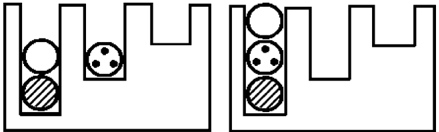
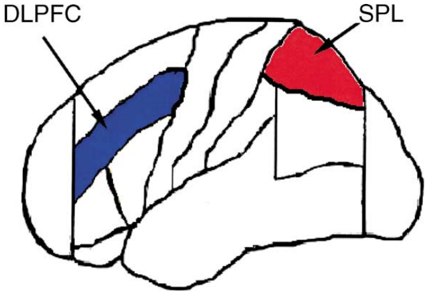
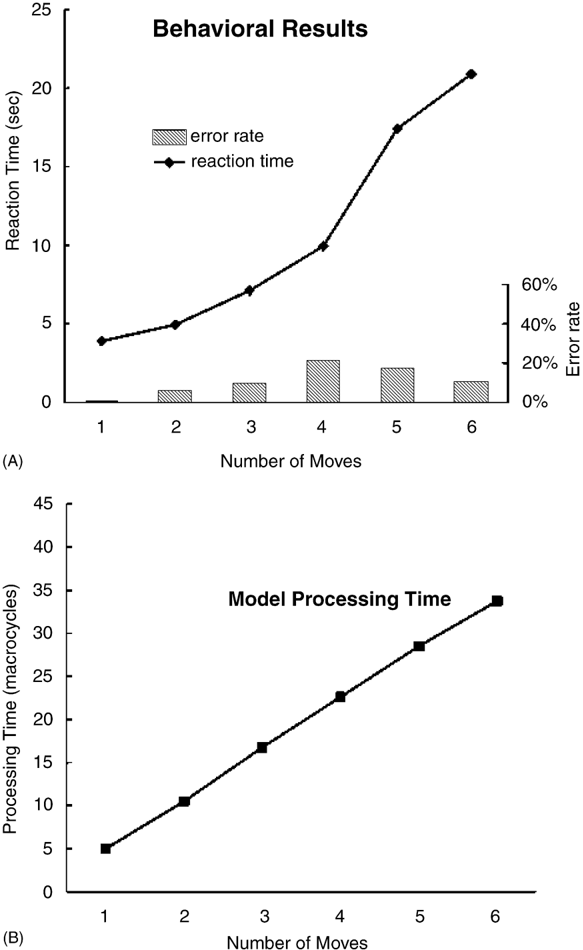
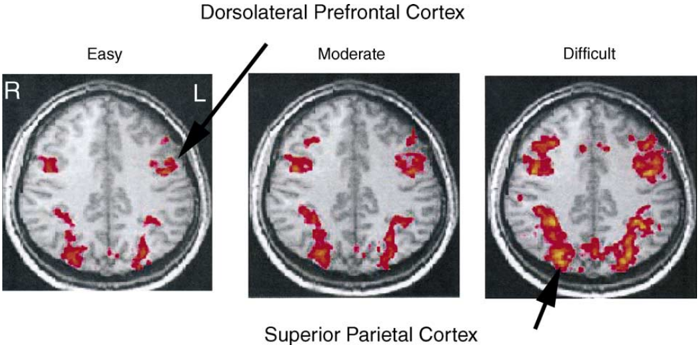
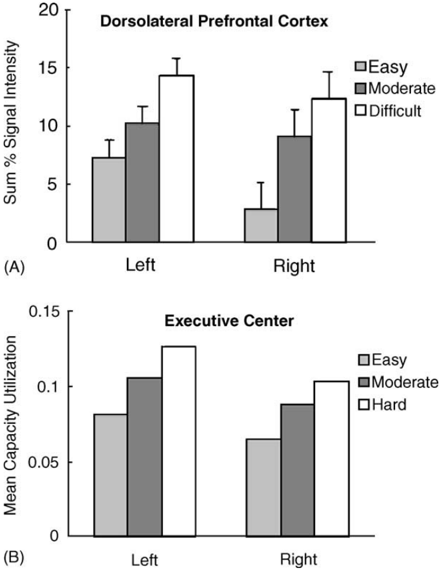
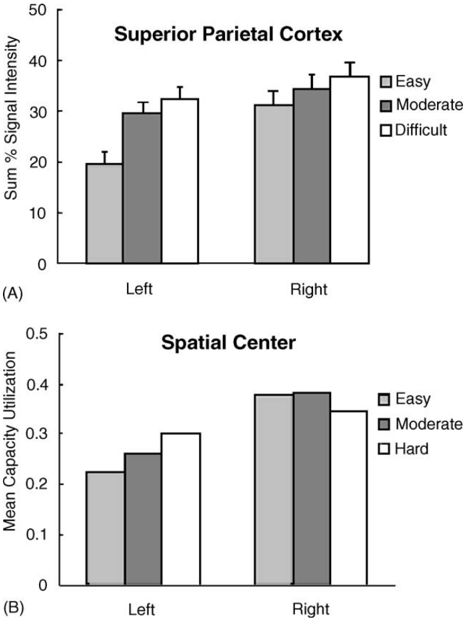
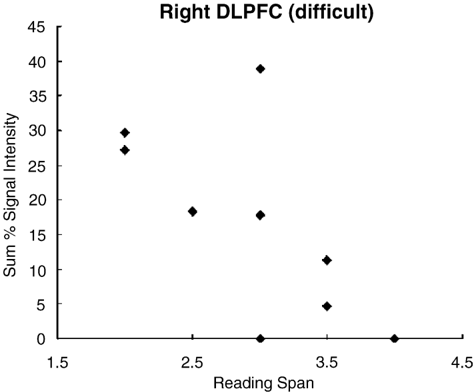
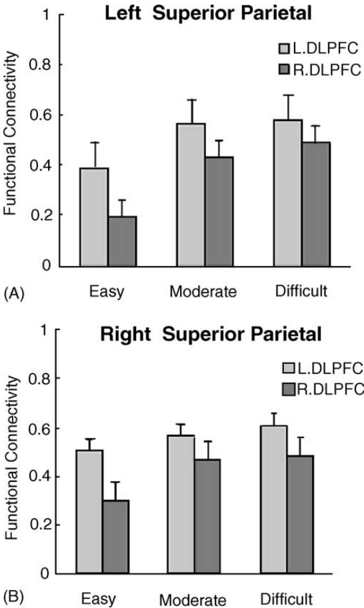
This study triangulates executive planning and visuo-spatial reasoning in the context of the Tower of London (TOL) task by using a variety of methodological approaches. These approaches include functional magnetic resonance imaging (fMRI), functional connectivity analysis, individual difference analysis, and computational modeling. A graded fMRI paradigm compared the brain activation during the solution of problems with varying path lengths: easy (1 and 2 moves), moderate (3 and 4 moves) and difficult (5 and 6 moves). There were three central findings regarding the prefrontal cortex: (1) while both the left and right prefrontal cortices were equally involved during the solution of moderate and difficult problems, the activation on the right was differentially attenuated during the solution of the easy problems; (2) the activation observed in the right prefrontal cortex was highly correlated with individual differences in working memory (measured independently by the reading span task); and (3) different patterns of functional connectivity were observed in the left and right prefrontal cortices. Results obtained from the superior parietal region also revealed left/right differences; only the left superior parietal region revealed an effect of difficulty. These fMRI results converged upon two hypotheses: (1) the right prefrontal area may be more involved in the generation of a plan, whereas the left prefrontal area may be more involved in plan execution; and (2) the right superior parietal region is more involved in attention processes while the left homologue is more of a visuo-spatial workspace. A 4CAPS computational model of the cognitive processes and brain activation in the TOL task integrated these hypothesized mechanisms, and provided a reasonably good fit to the observed behavioral and brain activation data. The multiple research approaches presented here converge on a deepening understanding of the combination of perceptual and conceptual processes in this type of visual problem solving.
Overview
The claims and statistics of this paper haven’t been checked yet.
Free: it reads the open-access text and checks the first 5 claims that cite a source we can check. Create a free account to check every claim.
Integrity signals
Registry
Cites
Statistics
Figures

Verification
Claims the paper makes
The claims and statistics of this paper haven’t been checked yet.
Free: it reads the open-access text and checks the first 5 claims that cite a source we can check. Create a free account to check every claim.
Claims other papers make about this one
Each is checked against this paper’s own text: does it say what the citing paper says it does?
The source backs part of the claim, not all of it — or backs it for a different population, condition or comparison.
In the citing paper
“Neuroimaging studies have shown that EF tasks similar to those used in our study activate a variety of areas within the prefrontal cortex [28,31,98] and in addition to this, activate areas with important connections to the prefrontal cortex, such as the caudate nucleus, the putamen, thalamic areas [30], cingulate and parietal cortex [29,99].”
From Neurocognitive functions in pathological gambling: a comparison with alcohol dependence, Tourette syndrome and normal controls (2006) · cites this paper as [99]
Experimental — accuracy not yet measured
Self-check
Percentages, sums and reported differences re-computed from the paper’s own numbers.
The self-check needs the paper’s full text.
Citations
Cites
Individual differences in working memory and reading
Daneman, M., & Carpenter, P. A. (1980) · Journal of Verbal Learning and Verbal Behavior · doi:10.1016/s0022-5371(80)90312-6 · Cited by 6,336 · cited 1×
“The Daneman and Carpenter (1980)reading span test was administered to 10 of 12 participants.”
MethodSelf-citation(1991) · Choice Reviews Online · doi:10.5860/choice.28-5376 · Cited by 4,207
A capacity theory of comprehension: individual differences in working memory
Just, M. A., & Carpenter, P. A. (1992) · Psychological Review · doi:10.1037/0033-295x.99.1.122 · Cited by 4,153 · cited 1×
“…of the prominent ones, including Soar (Newell, 1990), ACT-R (Anderson, 1993), EPIC (Meyer & Kieras, 1997) and 3CAPS (Goel, Pullara, & Grafman, 2001; Just & Carpenter, 1992), account for the error patterns and processing times in problem solving, reasoning, decision making, memory and learning,…”
Self-citationSpecific impairments of planning
Shallice, T. (1982) · Philosophical Transactions of the Royal Society of London. B, Biological Sciences · doi:10.1098/rstb.1982.0082 · Cited by 3,741 · cited 2×
“…and right prefrontal cortices were equally involved during the solution of moderate and difficult problems, the activation on the right was differentially attenuated during the solution of the easy problems; (2) the activation observed in the right prefrontal cortex was highly correlated with…”
ResultMacDonald, A. W., Cohen, J. D., Stenger, V. A., & Carter, C. S. (2000) · Science · doi:10.1126/science.288.5472.1835 · Cited by 3,666
Mesulam, M. (1998) · Brain · doi:10.1093/brain/121.6.1013 · Cited by 3,072
Large-scale neurocognitive networks and distributed processing for attention, language, and memory
Mesulam, M. (1990) · Annals of Neurology · doi:10.1002/ana.410280502 · Cited by 2,684
Functional and effective connectivity in neuroimaging: a synthesis
Friston, K. J. (1994) · Human Brain Mapping · doi:10.1002/hbm.460020107 · Cited by 2,452 · cited 1×
“The synchronization is taken as evidence of functional connectivity[or effective connectivity(Buchel, Coull, & Friston, 1999; Friston, 1994; Horwitz, Rumsey, & Donohue, 1998)].”
Time course EPI of human brain function during task activation
Bandettini, P. A., Wong, E. C., Hinks, R. S., Tikofsky, R. S., & Hyde, J. S. (1992) · Magnetic Resonance in Medicine · doi:10.1002/mrm.1910250220 · Cited by 1,935
(1993) · Medical Entomology and Zoology · Cited by 1,882
Planning and spatial working memory following frontal lobe lesions in man
Owen, A. M., Downes, J. J., Sahakian, B. J., Polkey, C. E., & Robbins, T. W. (1990) · Neuropsychologia · doi:10.1016/0028-3932(90)90137-d · Cited by 1,245 · cited 1×
“This is consistent with the success of patients with frontal lobe lesions on TOL problems requiring one or two moves (Owen et al., 1990).”
ResultThe functional equivalence of problem solving skills
Simon, H. A. (1975) · Cognitive Psychology · doi:10.1016/0010-0285(75)90012-2 · Cited by 742
The cognitive and neuroanatomical correlates of multitasking
Burgess, P. W., Veitch, E., de Lacy Costello, A., & Shallice, T. (2000) · Neuropsychologia · doi:10.1016/s0028-3932(99)00134-7 · Cited by 708 · cited 3×
“While previous neuropsychological studies have provided some hints for such a dissociation in processing ( Burgess et al., 2000; Feigenbaum et al., 1996; Miotto et al., 1996; Morris et al., 1997), the current study clearly articulates the hypothesis and provides further support for it.”
MethodResultHaier, R. J., Siegel, B. V., Nuechterlein, K. H., Hazlett, E., Wu, J. C., Paek, J., Browning, H. L., & Buchsbaum, M. S. (1988) · Intelligence · doi:10.1016/0160-2896(88)90016-5 · Cited by 695
Neural systems engaged by planning: A PET study of the Tower of London task
Baker, S. C., Rogers, R. D., Owen, A. M., Frith, C. D., Dolan, R. J., Frackowiak, R. S. J., & Robbins, T. W. (1996) · Neuropsychologia · doi:10.1016/0028-3932(95)00133-6 · Cited by 635
Functional connectivity of the angular gyrus in normal reading and dyslexia
Horwitz, B., Rumsey, J. M., & Donohue, B. C. (1998) · Proceedings of the National Academy of Sciences · doi:10.1073/pnas.95.15.8939 · Cited by 607
Distributed Neural Systems for the Generation of Visual Images
Ishai, A., Ungerleider, L. G., & Haxby, J. V. (2000) · Neuron · doi:10.1016/s0896-6273(00)00168-9 · Cited by 579
Integration of diverse information in working memory within the frontal lobe
Prabhakaran, V., Narayanan, K., Zhao, Z., & Gabrieli, J. D. E. (2000) · Nature Neuroscience · doi:10.1038/71156 · Cited by 539
Are the frontal lobes implicated in “planning” functions? Interpreting data from the Tower of Hanoi
Goel, V., & Grafman, J. (1995) · Neuropsychologia · doi:10.1016/0028-3932(95)90866-p · Cited by 510 · cited 1×
“In addition,Goel and Grafman (1995)have differentiated the process of planning (“charting a course from point A to B”) versus executing that plan.”
BackgroundThe Predictive Value of Changes in Effective Connectivity for Human Learning
Büchel, C., Coull, J. T., & Friston, K. J. (1999) · Science · doi:10.1126/science.283.5407.1538 · Cited by 447
The Role of Frontopolar Cortex in Subgoal Processing during Working Memory
Braver, T. S., & Bongiolatti, S. R. (2002) · NeuroImage · doi:10.1006/nimg.2001.1019 · Cited by 409 · cited 1×
“Also, a recent fMRI study of goal management (a key facet of planning) found more activation in right prefrontal cortex than in left prefrontal cortex (Braver & Bongiolatti, 2002).”
BackgroundHuman Cerebral Cortex: Localization, Parcellation, and Morphometry with Magnetic Resonance Imaging
Rademacher, J., Galaburda, A. M., Kennedy, D. N., Filipek, P. A., & Caviness, V. S. (1992) · Journal of Cognitive Neuroscience · doi:10.1162/jocn.1992.4.4.352 · Cited by 378
Mapping the network for planning: a correlational PET activation study with the Tower of London task
Dagher, A., Owen, A. M., Boecker, H., & Brooks, D. J. (1999) · Brain · doi:10.1093/brain/122.10.1973 · Cited by 345
Caviness, V. S., Meyer, J., Makris, N., & Kennedy, D. N. (1996) · Journal of Cognitive Neuroscience · doi:10.1162/jocn.1996.8.6.566 · Cited by 297
Graded Functional Activation in the Visuospatial System with the Amount of Task Demand
Carpenter, P. A., Just, M. A., Keller, T. A., Eddy, W., & Thulborn, K. (1999) · Journal of Cognitive Neuroscience · doi:10.1162/089892999563210 · Cited by 295
Self-citationThe cognitive neuroscience of mental imagery
Kosslyn, S. M., Behrmann, M., & Jeannerod, M. (1995) · Neuropsychologia · doi:10.1016/0028-3932(95)00067-d · Cited by 285
Neural correlates of planning ability: Frontal lobe activation during the tower of London test
Morris, R. G., Ahmed, S., Syed, G. M., & Toone, B. K. (1993) · Neuropsychologia · doi:10.1016/0028-3932(93)90104-8 · Cited by 266 · cited 1×
“Previous studies examining the Tower of London as well as the Tower of Hanoi (TOH) have examined the effect of planning time on the level of activation (Morris et al., 1993; Rowe, Owen, Johnsrude, & Passingham, 2001).”
BackgroundWorking memory and executive function: evidence from neuroimaging
Carpenter, P. (2000) · Current Opinion in Neurobiology · doi:10.1016/s0959-4388(00)00074-x · Cited by 264
Self-citationJust, M. A., Carpenter, P. A., & Miyake, A. (2003) · Theoretical Issues in Ergonomics Science · doi:10.1080/14639220210159735 · Cited by 246
Self-citationImaging subcortical auditory activity in humans
Guimarães, A. R., Melcher, J. R., Talavage, T. M., Baker, J. R., Ledden, P. J., Rosen, B. R., Kiang, N. Y.-S., Fullerton, B. C., & Weisskoff, R. M. (1998) · Human Brain Mapping · doi:10.1002/(sici)1097-0193(1998)6:1<33::aid-hbm3>3.0.co;2-m · Cited by 218
The Neural Bases of Strategy and Skill in Sentence–Picture Verification
Reichle, E. D., Carpenter, P. A., & Just, M. A. (2000) · Cognitive Psychology · doi:10.1006/cogp.2000.0733 · Cited by 209
Self-citationCoull, J. T., & Frith, C. D. (1998) · NeuroImage · doi:10.1006/nimg.1998.0354 · Cited by 197 · cited 1×
“It has been hypothesized that the right superior parietal region is involved in attention processing (Coull & Frith, 1998).”
BackgroundA hierarchical neuronal network for planning behavior
Dehaene, S., & Changeux, J.-P. (1997) · Proceedings of the National Academy of Sciences · doi:10.1073/pnas.94.24.13293 · Cited by 188
Planning and Problem solving Using the Five disc Tower of London Task
Ward, G., & Allport, A. (1997) · The Quarterly Journal of Experimental Psychology A · doi:10.1080/027249897392224 · Cited by 182 · cited 1×
“For example, empirical investigations of this task have employed operational definitions of perceptual and strategic problem solving (e.g.Ward & Allport, 1997).”
BackgroundAphasic Sentence Comprehension as a Resource Deficit: A Computational Approach
Haarmann, H. J., Just, M. A., & Carpenter, P. A. (1997) · Brain and Language · doi:10.1006/brln.1997.1814 · Cited by 180
Self-citationDiwadkar, V. A., Carpenter, P. A., & Just, M. A. (2000) · NeuroImage · doi:10.1006/nimg.2000.0586 · Cited by 164
Self-citationPons, F., & de Rosnay, M. (2000) · Swiss Journal of Psychology · doi:10.1024//1421-0185.59.3.215 · Cited by 157
Modeling strategy shifts in a problem-solving task
Simon, H. A., & Reed, S. K. (1976) · Cognitive Psychology · doi:10.1016/0010-0285(76)90005-0 · Cited by 155
Imaging the mental components of a planning task
Rowe, J. B., Owen, A. M., Johnsrude, I. S., & Passingham, R. E. (2001) · Neuropsychologia · doi:10.1016/s0028-3932(00)00109-3 · Cited by 151
Brain Activity Underlying Mental Imagery: Event-related Potentials During Mental Image Generation
Farah, M. J., Weisberg, L. L., Monheit, M., & Peronnet, F. (1989) · Journal of Cognitive Neuroscience · doi:10.1162/jocn.1989.1.4.302 · Cited by 116
Deficits in spatial working memory after unilateral temporal lobectomy in man
Feigenbaum, J., Polkey, C. E., & Morris, R. G. (1996) · Neuropsychologia · doi:10.1016/0028-3932(95)00107-7 · Cited by 107 · cited 3×
“While previous neuropsychological studies have provided some hints for such a dissociation in processing ( Burgess et al., 2000; Feigenbaum et al., 1996; Miotto et al., 1996; Morris et al., 1997), the current study clearly articulates the hypothesis and provides further support for it.”
BackgroundResultMeasuring Central Executive Functioning: What's in a Reading Span?
Whitney, P. J., Arnett, P. A., Driver, A. C., & Budd, D. (2001) · Brain and Cognition · doi:10.1006/brcg.2000.1243 · Cited by 99 · cited 2×
“However, because reading span does not measure a single processing ability (Whitney et al., 2001), it is not clear that the observed differences in brain activation are due solely to resource differences.”
BackgroundMethodA computational model of frontal lobe dysfunction: working memory and the Tower of Hanoi task
Goela, V., Pullara, S. D., & Grafman, J. H. (2001) · Cognitive Science · doi:10.1016/s0364-0213(01)00037-4 · Cited by 81
Xiong, J., Rao, S. L., Gao, J., Woldorff, M. G., & Fox, P. T. (1998) · Human Brain Mapping · doi:10.1002/(sici)1097-0193(1998)6:1<42::aid-hbm4>3.0.co;2-l · Cited by 78
Spatial Working Memory and Strategy Formation in Patients with Frontal Lobe Excisions
Miotto, E. C., Bullock, P. R., Polkey, C. E., & Morris, R. G. (1996) · Cortex · doi:10.1016/s0010-9452(96)80034-7 · Cited by 69 · cited 2×
“While previous neuropsychological studies have provided some hints for such a dissociation in processing (Burgess et al., 2000; Feigenbaum et al., 1996; Miotto et al., 1996; Morris et al., 1997), the current study clearly articulates the hypothesis and provides further support for it.”
BackgroundResultFunctional Imaging Analysis Software — Computational Olio
Eddy, W. F., Fitzgerald, M., Genovese, C., Mockus, A., & Noll, D. C. (1996) · COMPSTAT · doi:10.1007/978-3-642-46992-3_4 · Cited by 59
Statistical Issues in fMRI for Brain Imaging
Lazar, N. A., Eddy, W. F., Genovese, C. R., & Welling, J. (2001) · International Statistical Review · doi:10.1111/j.1751-5823.2001.tb00482.x · Cited by 48
Morris, R. G., Miotto, E. C., Feigenbaum, J. D., Bullock, P., & Polkey, C. E. (1997) · Cognitive Neuropsychology · doi:10.1080/026432997381330 · Cited by 34
Multi-Store versus Dynamic Models of Temporary Storage in Memory
(1999) · The MIT Press eBooks · doi:10.7551/mitpress/4877.003.0020 · Cited by 25
Xiong (1999) · doi:10.1002/(sici)1097-0193(1999)8:2/3
Self-citation
Research works printed but not linked: 4
- D'Esposito, M., Deter, J. A., Aguirre, G. K., Stallcup, M., Alsop, D. C., Tippet, L. J., & Farah, M. J. (1997). A functional MRI study of mental imagery generation. Neuropsychologia, 35, 715-730.
- Just, M. A., Carpenter, P. A., & Varma, S. (1999). Computational modeling of high-level cognition and brain function. Human Brain Mapping, 8, 128-136. · doi:10.1002/(sici)1097-0193(1999)8:2/3<128::aid-hbm10>3.0.co;2-g
- Rosenbloom, P. S., Laird, J. E., & Newell, A. (1993a). The Soarpapers: Research in integrated intelligence: Vol. 1. Cambridge, MA: MIT Press.
- Rosenbloom, P. S., Laird, J. E., & Newell, A. (1993b). The Soarpapers: Research in integrated intelligence: Vol. 2. Cambridge, MA: MIT Press.
Cited by
An Integrated Theory of the Mind.
Anderson, J. R., Bothell, D., Byrne, M. D., Douglass, S., Lebiere, C., & Qin, Y. (2004) · Psychological Review · doi:10.1037/0033-295x.111.4.1036 · Cited by 2,978
Functional connectome fingerprinting: Identifying individuals using patterns of brain connectivity
Finn, E. S., Shen, X., Scheinost, D., Rosenberg, M. D., Huang, J., Chun, M. M., Papademetris, X., & Constable, R. T. (2015) · Nature Neuroscience · doi:10.1038/nn.4135 · Cited by 2,747
Spreng, R. N., Stevens, W. D., Chamberlain, J. P., Gilmore, A. W., & Schacter, D. L. (2010) · NeuroImage · doi:10.1016/j.neuroimage.2010.06.016 · Cited by 1,256
“Consistent with previous observations, we also observed activity in the dorsal attention network while subjects engaged in visuospatial planning (Baker et al., 1996; Morris et al., 1993; Newman et al., 2003).”
InfluentialJust, M. A., Cherkassky, V. L., Keller, T. A., Kana, R. K., & Minshew, N. J. (2007) · Cerebral Cortex · doi:10.1093/cercor/bhl006 · Cited by 1,081
Self-citationEvaluative and generative modes of thought during the creative process
Ellamil, M., Dobson, C., Beeman, M., & Christoff, K. (2012) · NeuroImage · doi:10.1016/j.neuroimage.2011.08.008 · Cited by 611
“Although questions remain, the findings provide a valuable starting point for future studies that can provide an even more detailed account of how the brain supports creative thinking and the types of processes that facilitate it.”
Background
Metadata
- Authors
- Newman, S. D., Carpenter, P. A., Varma, S., & Just, M. A.
- Affiliations
- Carnegie Mellon University (US)
- Corresponding author
- Newman, Sharlene D
- Venue
- Neuropsychologia
- Publisher
- Elsevier BV
- Published
- 2003-01
- Volume
- 41
- Issue
- 12
- Pages
- 1668-1682
- ISSN
- 0028-3932 (ISSN-L)
- OpenAlex
- W2156102858
- Cited by
- 400
- References
- 52
- Citations by year
- 2026: 9 · 2025: 22 · 2024: 15 · 2023: 13 · 2022: 10 · 2021: 15 · 2020: 10 · 2019: 29 · 2018: 19 · 2017: 10 · 2016: 11 · 2015: 23 · 2014: 18 · 2013: 20 · 2012: 19
- FWCI
- 8.33
- Type
- journal article
- Language
- en
- Open access
- green
- figshare.com
- Licence
- cc-by
- www.elsevier.com/tdm/userlicense/1.0/ (tdm)
- Locations
- Neuropsychologia (publishedVersion)
- PubMed (publishedVersion)
- Figshare (submittedVersion, cc-by)
- KiltHub Repository (submittedVersion)
- KiltHub Repository
- Funders
- Carnegie Institution of Washington
- National Institutes of Health
- Office of Naval Research (N00014)
- National Institute of Mental Health (MH 00661, MH 00662)
- Topics
- Life Sciences › Neuroscience › Cognitive Neuroscience › Neural and Behavioral Psychology Studies
- Social Sciences › Psychology › Experimental and Cognitive Psychology › Cognitive Abilities and Testing
- Social Sciences › Psychology › Experimental and Cognitive Psychology › Cognitive Functions and Memory
- Keywords
- Tower of London task, executive planning, prefrontal cortex, right prefrontal cortex, left prefrontal cortex, superior parietal cortex, functional connectivity, problem difficulty, plan generation, plan execution, attention, computational cognitive modeling, visual problem solving
- MeSH terms
- Adolescent, Adult, Cognition, Female, Frontal Lobe, Goals, Humans, Magnetic Resonance Imaging, Male, Memory, Models, Psychological, Parietal Lobe, Problem Solving
About these checks
Registry, retraction, Cites and statistics results are computed, not judged, with one exception: a printed reference that no index lists is read once by a model before it counts as a citation error. Claims are extracted by a model and kept only when their quote appears verbatim in the text; each cited source is then checked, with a model’s help, for whether it says what the claim relies on. Those verdicts can be wrong — read the claim’s quote and the cited source before relying on one.
Statistics and arithmetic are recomputed, not judged.
Confidence bands are shown only for fields calibrated on our annotated test set. None is calibrated yet, so no band is shown.
What counts as a claim ›How we measure confidence ›How we check this ›
Are you an author, or do you see a problem with this page? Request a review
Data sources
Bibliographic data: Semantic Scholar, OpenAlex, Crossref.
Contains information from the Semantic Scholar Academic Graph Datasets, made available under the ODC Attribution License (ODC-BY 1.0).
Semantic Scholar’s data is described in: Kinney, R., et al. (2023). The Semantic Scholar Open Data Platform. arXiv:2301.10140.
