

Efficacy and safety of very early mobilisation within 24 h of stroke onset (AVERT): a randomised controlled trial
Open accessThe DOI matches its Crossref record; 28 of the 28 references it cites were found in a registry or an index; 2 of the 16 sources its claims cite were checked for support.
Abstract
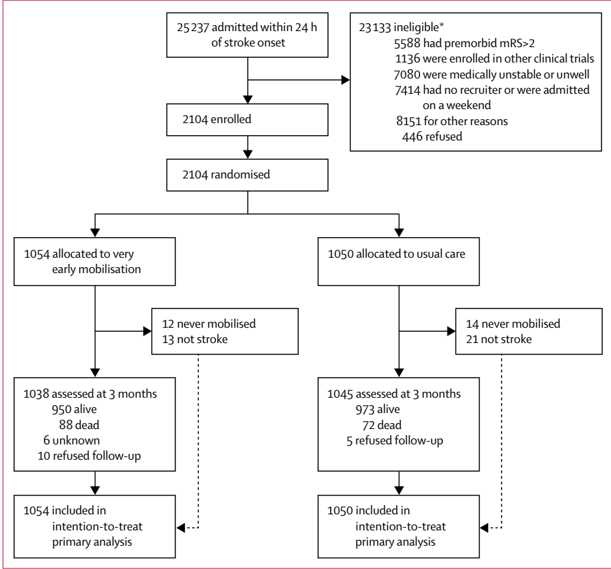
BACKGROUND: Early mobilisation after stroke is thought to contribute to the effects of stroke-unit care; however, the intervention is poorly defined and not underpinned by strong evidence. We aimed to compare the effectiveness of frequent, higher dose, very early mobilisation with usual care after stroke. METHODS: We did this parallel-group, single-blind, randomised controlled trial at 56 acute stroke units in five countries. Patients (aged ≥18 years) with ischaemic or haemorrhagic stroke, first or recurrent, who met physiological criteria were randomly assigned (1:1), via a web-based computer generated block randomisation procedure (block size of six), to receive usual stroke-unit care alone or very early mobilisation in addition to usual care. Treatment with recombinant tissue plasminogen activator was allowed. Randomisation was stratified by study site and stroke severity. Patients, outcome assessors, and investigators involved in trial and data management were masked to treatment allocation. The primary outcome was a favourable outcome 3 months after stroke, defined as a modified Rankin Scale score of 0-2. We did analysis on an intention-to-treat basis. The trial is registered with the Australian New Zealand Clinical Trials Registry, number ACTRN12606000185561. FINDINGS: Between July 18, 2006, and Oct 16, 2014, we randomly assigned 2104 patients to receive either very early mobilisation (n=1054) or usual care (n=1050); 2083 (99%) patients were included in the 3 month follow-up assessment. 965 (92%) patients were mobilised within 24 h in the very early mobilisation group compared with 623 (59%) patients in the usual care group. Fewer patients in the very early mobilisation group had a favourable outcome than those in the usual care group (n=480 [46%] vs n=525 [50%]; adjusted odds ratio [OR] 0·73, 95% CI 0·59-0·90; p=0·004). 88 (8%) patients died in the very early mobilisation group compared with 72 (7%) patients in the usual care group (OR 1·34, 95% CI 0·93-1·93, p=0·113). 201 (19%) patients in the very early mobilisation group and 208 (20%) of those in the usual care group had a non-fatal serious adverse event, with no reduction in immobility-related complications with very early mobilisation. INTERPRETATION: First mobilisation took place within 24 h for most patients in this trial. The higher dose, very early mobilisation protocol was associated with a reduction in the odds of a favourable outcome at 3 months. Early mobilisation after stroke is recommended in many clinical practice guidelines worldwide, and our findings should affect clinical practice by refining present guidelines; however, clinical recommendations should be informed by future analyses of dose-response associations. FUNDING: National Health and Medical Research Council, Singapore Health, Chest Heart and Stroke Scotland, Northern Ireland Chest Heart and Stroke, UK Stroke Association, National Institute of Health Research.
Overview
CoChat Summary
TL;DR
In AVERT, very early mobilisation (frequent, higher-dose out-of-bed activity within 24 h) reduced the odds of a favourable outcome at 3 months compared with usual care, with no significant difference in death or serious adverse events. The trial suggests an early, lower-dose usual-care activity regimen may be preferable to very early, frequent, higher-dose intervention.
Key findings
- 2104 patients were randomly assigned to very early mobilisation (n=1054) or usual care (n=1050); 2083 (99%) were included in the 3-month follow-up. 965 (92%) very early mobilisation patients were mobilised within 24 h versus 623 (59%) usual care patients; median time to first mobilisation was 18·5 h versus 22·4 h (median shift 4·8 h).
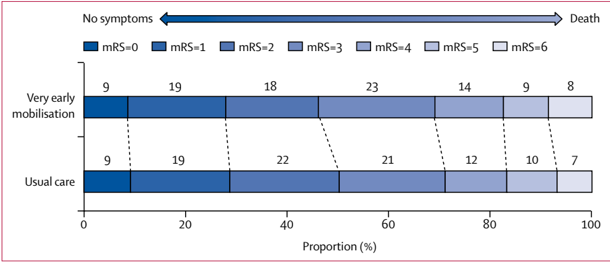
- The primary outcome, favourable modified Rankin Scale score 0–2 at 3 months, occurred in 480 (46%) very early mobilisation patients versus 525 (50%) usual care patients (adjusted OR 0·73, 95% CI 0·59–0·90; p=0·004). The ordinal modified Rankin Scale analysis was not significant (generalised OR 0·94, 95% CI 0·85–1·03; p=0·193).
- Death occurred in 88 (8%) very early mobilisation patients versus 72 (7%) usual care patients (OR 1·34, 95% CI 0·93–1·93; p=0·113). Non-fatal serious adverse events occurred in 201 (19%) versus 208 (20%) patients (IRR 0·88, 95% CI 0·72–1·07; p=0·194), with no reduction in immobility-related complications.
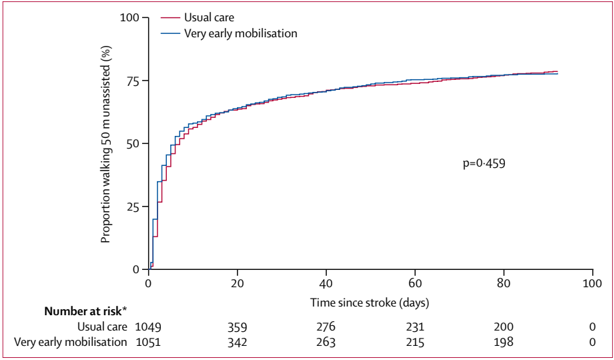
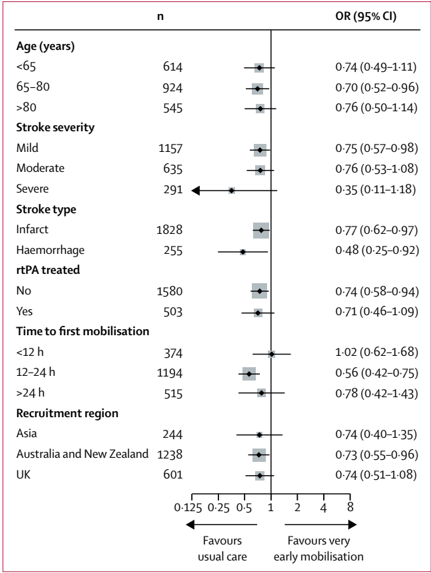
- There was no evidence of accelerated walking recovery: walking 50 m unassisted adjusted OR 0·83 (95% CI 0·64–1·07; p=0·143); time to walking unassisted HR 1·04 (95% CI 0·94–1·15; p=0·459). Prespecified subgroup analyses showed no significant interactions, though point estimates suggested reduced odds of favourable outcome in severe stroke and intracerebral haemorrhage subgroups with wide confidence intervals.
Methods
- Pragmatic, parallel-group, single-blind, multicentre, international randomised controlled trial at 56 acute stroke units in Australia, New Zealand, Malaysia, Singapore, and the UK. Eligible patients were aged ≥18 years with confirmed first or recurrent ischaemic or haemorrhagic stroke admitted to a stroke unit within 24 h of onset and meeting physiological criteria; exclusions included premorbid modified Rankin Scale score >2, early deterioration, and other serious medical instability.
- Patients were randomly assigned 1:1 via a secure, remote, web-based computer-generated block randomisation procedure (block size six), stratified by study site and baseline NIHSS stroke severity (mild 1–7, moderate 8–16, severe >16). The very early mobilisation intervention began within 24 h, focused on sitting, standing, and walking out-of-bed activity, and resulted in at least three additional out-of-bed sessions to usual care, with titrated dose for 14 days or until discharge.
- The primary outcome was favourable outcome at 3 months, defined as modified Rankin Scale score 0–2. Analysis was intention-to-treat; primary efficacy used binary logistic regression adjusted for baseline age and NIHSS. The trial was powered to detect an absolute risk reduction of poor outcome of 7·1% or greater, with a target sample of 2104 patients.
Limitations
- The paper states that large trials yield limited information about potential confounders such as physiological variables and about each staff–patient interaction, restricting but not preventing further detailed analyses.
- The pragmatic design did not prescribe usual care mobilisation practices, which changed significantly during the trial; usual care clinicians started mobilisation earlier each year, with roughly 60% of usual care patients starting out-of-bed therapy within 24 h. Whether this reflected contamination from the trial protocol, changing attitudes/guidelines, or both is uncertain.
- The study was not powered to detect subgroup differences; subgroup signals for severe stroke and intracerebral haemorrhage had wide confidence intervals and no significant interactions, so the paper advises caution. The text also notes the proportional hazards assumption was violated for the time-to-walking analysis, and missing data were handled under a missing-at-random assumption with sensitivity analyses.
Model-written summary. Check it against the paper before relying on it.
Integrity signals
Registry
Cites
Statistics
Figures
Verification
Claims the paper makes
2 Valid · 1 Not valid · 12 Not checked · 60 Own results and interpretations
A result the paper reports from its own data — it cites no other source for it, so there is none to check. The quote shows it is in the paper.
In the paper
“with no reduction in immobility-related complications with very early mobilisation.”
plainn = 2,104- Asserted: passes — The authors put it forward as true.
- Checkable: passes — It can be checked against evidence.
- Load-bearing: passes — The paper’s conclusions depend on it.
- Based: passes — The paper gives a reason why it holds.
A result the paper reports from its own data — it cites no other source for it, so there is none to check. The quote shows it is in the paper.
In the paper
“Frequency per person† | 6·5 (4·0-9·5) | 3 (2·0-4·5) | <0·0001 | 3 (3-3·5)”
plainstates a causen = 1,054 ·- Asserted: passes — The authors put it forward as true.
- Checkable: passes — It can be checked against evidence.
- Load-bearing: passes — The paper’s conclusions depend on it.
- Based: passes — The paper gives a reason why it holds.
A result the paper reports from its own data — it cites no other source for it, so there is none to check. The quote shows it is in the paper.
In the paper
“Total amount per person (min)§ | 201·5 (108-340) | 70 (32-130) | <0·0001 | 117 (107-128)”
plainstates a causen = 1,054 ·- Asserted: passes — The authors put it forward as true.
- Checkable: passes — It can be checked against evidence.
- Load-bearing: passes — The paper’s conclusions depend on it.
- Based: passes — The paper gives a reason why it holds.
A result the paper reports from its own data — it cites no other source for it, so there is none to check. The quote shows it is in the paper.
In the paper
“Time to first mobilisation (h) | 18·5 (12·8-22·3; n=1042*) | 22·4 (16·5-29·3; n=1036*) | <0·0001 | 4·8 (4·1-5·7)”
plainstates a causen = 1,042 ·- Asserted: passes — The authors put it forward as true.
- Checkable: passes — It can be checked against evidence.
- Load-bearing: passes — The paper’s conclusions depend on it.
- Based: passes — The paper gives a reason why it holds.
A result the paper reports from its own data — it cites no other source for it, so there is none to check. The quote shows it is in the paper.
In the paper
“Fewer patients in the very early mobilisation group had a favourable outcome than those in the usual care group (n=480 [46%] vs n=525 [50%]; adjusted odds ratio [OR] 0·73, 95% CI 0·59-0·90; p=0·004).”
- Also stated in: § Interpretation · plain
“Very early mobilisation was associated with a significant reduction in the odds of little or no disability at 3 months after stroke”
- Also stated in: § Statistical analysis · plain
“Favourable outcome‡ | 480 (46%) | 525 (50%) | 0·73 (0·59-0·90) | 0·004 | 0·85 (0·72-1·0) | 0·068”
plainstates an associationn = 480- Asserted: passes — The authors put it forward as true.
- Checkable: passes — It can be checked against evidence.
- Load-bearing: passes — The paper’s conclusions depend on it.
- Based: passes — The paper gives a reason why it holds.
- Also stated in: § Interpretation · plain
30 more claims
Create a free account to see all 75 claims and to verify the 1 reference still open.
- Probably not a substantial claim. 27
- It may state two separate claims as one. 22
Claims other papers make about this one
Each is checked against this paper’s own text: does it say what the citing paper says it does?
The cited source says what the claim attributes to it.
In the citing paper
“In the motor domain, the negative findings of the recent very large AVERT study on very early mobilisation in stroke [23] highlight the need to be cautious when making inferences from animal recovery data to human rehabilitation.”
From Aphasia Recovery: When, How and Who to Treat? (2018) · cites this paper as [23]
The cited source says what the claim attributes to it.
In the citing paper
“In our primary intention-to-treat analysis for A Very Early Rehabilitation Trial (AVERT), we reported that patients randomized to usual care had greater odds of a favorable outcome (modified Rankin Scale [mRS] score 0–2) at 3 months compared to those receiving the very early mobilization (VEM) protocol.1”
From Prespecified dose-response analysis for A Very Early Rehabilitation Trial (AVERT) (2016) · cites this paper as [1]
In the citing paper
“Our findings are in line with those of the A Very Early Rehabilitation Trial (AVERT) 7 whereby an increase in the intensity of ‘usual care’ services from pilot studies to the main study was reported and the Phase III trial was subsequently negative.”
From A randomized control trial of intensive aphasia therapy after acute stroke: The Very Early Rehabilitation for SpEech (VERSE) study (2021) · cites this paper as [7]
Self-check
Percentages, sums and reported differences re-computed from the paper’s own numbers.
Each contradiction between two passages listed here was confirmed by an independent check.
Rated minor: it would not touch a result — a value no result rests on, a p-value that stays on the same side of the significance level, or a conflict that is clerical, resolved elsewhere in the paper, or outside its own findings.
In the paper
§ Randomisation and masking
“mild (NIHSS 1-7), moderate (8-16), and severe (>16).”
§ Statistical analysis
“stroke severity (mild: NIHSS<7; moderate: 8-16; and severe: >16)”
Rated minor: it would not touch a result — a value no result rests on, a p-value that stays on the same side of the significance level, or a conflict that is clerical, resolved elsewhere in the paper, or outside its own findings.
In the paper
“| Diabetes mellitus | 239 (23%) | 228 (21%) |”
Reported 21 · recomputed 21.714286
Citations
Cites
Interobserver agreement for the assessment of handicap in stroke patients
van Swieten, J. C., Koudstaal, P. J., Visser, M. C., Schouten, H. J., & van Gijn, J. (1988) · Stroke · doi:10.1161/01.str.19.5.604 · Cited by 6,512
Plasticity during stroke recovery: from synapse to behaviour
Murphy, T. H., & Corbett, D. (2009) · Nature Reviews Neuroscience · doi:10.1038/nrn2735 · Cited by 1,938
Medical Complications After Stroke: A Multicenter Study
Langhorne, P., Stott, D. J., Robertson, L., MacDonald, J., Jones, L., McAlpine, C., Dick, F., Taylor, G. S., & Murray, G. (2000) · Stroke · doi:10.1161/01.str.31.6.1223 · Cited by 1,196
Strategy for intention to treat analysis in randomised trials with missing outcome data
White, I. R., Horton, N. J., Carpenter, J., statistics, R. I. M. A. S., & Pocock, S. J. (2011) · BMJ · doi:10.1136/bmj.d40 · Cited by 849
Bernhardt (2004) · doi:10.1161/01.str.0000120727.40792.40 · Cited by 593
Getting Neurorehabilitation Right: What Can Be Learned From Animal Models?
Krakauer, J. W., Carmichael, S. T., Corbett, D., & Wittenberg, G. F. (2012) · Neurorehabilitation and Neural Repair · doi:10.1177/1545968312440745 · Cited by 591
Bed rest: a potentially harmful treatment needing more careful evaluation
Allen, C., Glasziou, P., & Mar, C. D. (1999) · The Lancet · doi:10.1016/s0140-6736(98)10063-6 · Cited by 480
Treatment in a Combined Acute and Rehabilitation Stroke Unit: Which Aspects Are Most Important?
Indredavik, B., Bakke, F., Slørdahl, S. A., Rokseth, R., & Håheim, L. L. (1999) · Stroke · doi:10.1161/01.str.30.5.917 · Cited by 368
A Very Early Rehabilitation Trial for Stroke (AVERT): Phase II Safety and Feasibility
Bernhardt, J., Dewey, H., Thrift, A., Collier, J., & Donnan, G. (2008) · Stroke · doi:10.1161/strokeaha.107.492363 · Cited by 366
Cumming, T. B., Thrift, A. G., Collier, J. M., Churilov, L., Dewey, H. M., Donnan, G. A., & Bernhardt, J. (2011) · Stroke · doi:10.1161/strokeaha.110.594598 · Cited by 281
Cited by
Items 101–200 of 781
Belkin, A. A., Alasheev, A. M., Андреевич, Б. В., Belkina, Y. B., Belova, A. N., Belskii, D. V., Bodrova, R. А., Bryusov, G. P., Varako, N. A., Voznyuk, I. A., et al. (2022) · Annals of critical care · doi:10.21320/1818-474x-2022-2-7-40 · Cited by 77
Interventions for reducing sedentary behaviour in people with stroke
Saunders, D. H., Mead, G. E., Fitzsimons, C., Kelly, P., van Wijck, F., Verschuren, O., Backx, K., & English, C. (2021) · Cochrane Database of Systematic Reviews · doi:10.1002/14651858.cd012996.pub2 · Cited by 55
Wei, X., Sun, S., Zhang, M., & Zhao, Z. (2024) · BMC Neurology · doi:10.1186/s12883-024-03565-8 · Cited by 85
Fleming, L. M., Zhao, X., DeVore, A. D., Heidenreich, P. A., Yancy, C. W., Fonarow, G. C., Hernandez, A. F., & Kociol, R. D. (2018) · Circulation Heart Failure · doi:10.1161/circheartfailure.117.004634 · Cited by 51
Haas, R., Sarkies, M., Bowles, K., O'Brien, L., & Haines, T. P. (2016) · Osteoarthritis and Cartilage · doi:10.1016/j.joca.2016.05.005 · Cited by 48
Pin-Barre, C., Constans, A., Brisswalter, J., Pellegrino, C., & Laurin, J. (2017) · Stroke · doi:10.1161/strokeaha.117.017962 · Cited by 60
Early mobilization in neurocritical care patients
Kumar, M. A., Romero, F. G., & Dharaneeswaran, K. (2020) · Current Opinion in Critical Care · doi:10.1097/mcc.0000000000000709 · Cited by 67
Is the proportional recovery rule applicable to the lower limb after a first-ever ischemic stroke?
Veerbeek, J. M., Winters, C., van Wegen, E. E. H., & Kwakkel, G. (2018) · PLoS ONE · doi:10.1371/journal.pone.0189279 · Cited by 54
Urimubenshi, G., Langhorne, P., Cadilhac, D. A.-M., Kagwiza, J., & Wu, O. (2017) · European Stroke Journal · doi:10.1177/2396987317735426 · Cited by 51
Walters, R., Collier, J. M., Carvalho, L. B., Langhorne, P., Ali, N. A. M., Tan, D. M. L., Moodie, M., & Bernhardt, J. A. (2020) · BMJ Open · doi:10.1136/bmjopen-2019-035850 · Cited by 58
Leclerc, A. M., Riker, R. R., Brown, C. S., May, T., Nocella, K., Cote, J., Eldridge, A., Seder, D. B., & Gagnon, D. J. (2020) · Neurocritical Care · doi:10.1007/s12028-020-00986-4 · Cited by 51
Prevalence of Walking Limitation After Acute Stroke and Its Impact on Discharge to Home
Louie, D. R., Simpson, L. A., Mortenson, W. B., Field, T. S., Yao, J. K., & Eng, J. J. (2021) · Physical Therapy · doi:10.1093/ptj/pzab246 · Cited by 59
Poststroke Physical Activity Levels No Higher in Rehabilitation than in the Acute Hospital
Åstrand, A., Saxin, C., Sjöholm, A., Skarin, M., Linden, T. K. A., Stoker, A., Roshandel, S., Dedering, Å., Halvorsen, M., Bernhardt, J. A., et al. (2016) · Journal of Stroke and Cerebrovascular Diseases · doi:10.1016/j.jstrokecerebrovasdis.2015.12.046 · Cited by 55
Clinical Practice Guideline for Stroke Rehabilitation in Korea 2016
Kim, D. Y., Kim, Y., Lee, J., Chang, W. H., Kim, M.-W., Pyun, S., Yoo, W., Ohn, S. H., Park, K. D., Oh, B., et al. (2017) · Brain & Neurorehabilitation · doi:10.12786/bn.2017.10.e11 · Cited by 61
Nozoe, M., Kanai, M., Kubo, H., Kitamura, Y., Yamamoto, M., Furuichi, A., Takashima, S., Mase, K., & Shimada, S. (2016) · Journal of Stroke and Cerebrovascular Diseases · doi:10.1016/j.jstrokecerebrovasdis.2016.06.020 · Cited by 52
Brazilian Academy of Neurology practice guidelines for stroke rehabilitation: part I
Minelli, C., Bazán, R., Pedatella, M. T. A., Neves, L. D. O., Cacho, R. D. O., Magalhães, S. C. S. A., Luvizutto, G. J., Moro, C. H. C., Lange, M. C., Módolo, G. P., et al. (2022) · Arquivos de Neuro-Psiquiatria · doi:10.1590/0004-282x-anp-2021-0354 · Cited by 71
Gandolfi, M., (CICERONE), O. B. O. T. I. C. C. O. R. I. N., Valè, N., Posteraro, F., Morone, G., Dell’Orco, A., Botticelli, A., Dimitrova, E. K., Gervasoni, E., Goffredo, M., et al. (2021) · European Journal of Physical and Rehabilitation Medicine · doi:10.23736/s1973-9087.21.06922-7 · Cited by 54
Liu, M.-X., Luo, L., Fu, J., He, J.-Y., Chen, M.-Y., He, Z., & Jia, J. (2021) · Experimental Neurology · doi:10.1016/j.expneurol.2021.113952 · Cited by 50
Using Accelerometers to Measure Physical Activity in Older Patients Admitted to Hospital
Hartley, P., Keevil, V. L., Westgate, K. L., White, T., Brage, S., Romero‐Ortuño, R., & Deaton, C. (2018) · Current Gerontology and Geriatrics Research · doi:10.1155/2018/3280240 · Cited by 50
Cerebral Autoregulation in Ischemic Stroke: From Pathophysiology to Clinical Concepts
Nogueira, R. D. C., Beishon, L., Bor‐Seng‐Shu, E., Panerai, R. B., & Robinson, T. G. (2021) · Brain Sciences · doi:10.3390/brainsci11040511 · Cited by 52
Rehabilitation Practices in Patients With Moderate and Severe Traumatic Brain Injury
Kreitzer, N. P., Rath, K. A., Kurowski, B. G., Bakas, T., Hart, K., Lindsell, C. J., & Adeoye, O. M. (2019) · Journal of Head Trauma Rehabilitation · doi:10.1097/htr.0000000000000477 · Cited by 50
Kinoshita, S., Abo, M., Okamoto, T., & Miyamura, K. (2022) · Frontiers in Neurology · doi:10.3389/fneur.2021.711470 · Cited by 56
Recent advances in the role of excitation–inhibition balance in motor recovery post-stroke
Grigoras, I., & Stagg, C. J. (2021) · Faculty Reviews · doi:10.12703/r/10-58 · Cited by 50
Contamination in complex healthcare trials: the falls in care homes (FinCH) study experience
Robinson, K., Allen, F. A., Darby, J., Fox, C., Gordon, A. L., Horne, J. C., Leighton, P. A., Sims, E. J., & Logan, P. (2020) · BMC Medical Research Methodology · doi:10.1186/s12874-020-00925-z · Cited by 49
Balbi, M., Vanni, M. P., Silasi, G., Sekino, Y., Bolaños, L. A., LeDue, J. M., & Murphy, T. H. (2017) · Neurophotonics · doi:10.1117/1.nph.4.3.035001 · Cited by 51
Schaller, S. J., Scheffenbichler, F. T., Bose, S., Mazwi, N., Deng, H., Krebs, F., Seifert, C. L., Kasotakis, G., Grabitz, S. D., Latronico, N., et al. (2019) · Intensive Care Medicine · doi:10.1007/s00134-019-05528-x · Cited by 55
Luker, J. A., Craig, L., Bennett, L., Ellery, F., Langhorne, P., Wu, O., & Bernhardt, J. A. (2016) · BMC Medical Research Methodology · doi:10.1186/s12874-016-0156-9 · Cited by 52
Early mobilization in acute stroke phase: a systematic review
Miranda, J. M. D. A., Borges, V. M., Bazán, R., Luvizutto, G. J., & Shinosaki, J. S. M. (2021) · Topics in Stroke Rehabilitation · doi:10.1080/10749357.2021.2008595 · Cited by 65
Exacerbation of Brain Injury by Post-Stroke Exercise Is Contingent Upon Exercise Initiation Timing
Li, F., Geng, X., Khan, H., Pendy, J. T., Peng, C., Li, X., Rafols, J. A., & Ding, Y. (2017) · Frontiers in Cellular Neuroscience · doi:10.3389/fncel.2017.00311 · Cited by 46
Implementation in rehabilitation: a roadmap for practitioners and researchers
Morris, J. H., Bernhardsson, S., Bird, M., Connell, L., Lynch, E. A., Jarvis, K. A., Kayes, N. M., Miller, K., Mudge, S., & Fisher, R. J. (2019) · Disability and Rehabilitation · doi:10.1080/09638288.2019.1587013 · Cited by 56
Virtual Reality Assisted Motor Imagery for Early Post-Stroke Recovery: A Review
Choy, C. S., Cloherty, S. L., Pirogova, E., & Fang, Q. (2022) · IEEE Reviews in Biomedical Engineering · doi:10.1109/rbme.2022.3165062 · Cited by 51
Imura, T., Nagasawa, Y., Fukuyama, H., Imada, N., Oki, S., & Araki, O. (2017) · Disability and Rehabilitation · doi:10.1080/09638288.2017.1300337 · Cited by 49
Wiersma, A. M., Fouad, K., & Winship, I. R. (2017) · Journal of Neuroscience · doi:10.1523/jneurosci.0770-17.2017 · Cited by 48
The Stroke Unit Story: Where Have We Been and Where Are We Going?
Langhorne, P. (2021) · Cerebrovascular Diseases · doi:10.1159/000518934 · Cited by 49
Himi, N., Takahashi, H., Okabe, N., Nakamura, E., Shiromoto, T., Narita, K., Koga, T., & Miyamoto, O. (2016) · Journal of Stroke and Cerebrovascular Diseases · doi:10.1016/j.jstrokecerebrovasdis.2016.08.017 · Cited by 46
Kinoshita, S., Momosaki, R., Kakuda, W., Okamoto, T., & Abo, M. (2016) · Archives of Physical Medicine and Rehabilitation · doi:10.1016/j.apmr.2016.11.004 · Cited by 46
Venturelli, P. M., Arima, H., Lavados, P. M., Brunser, A. M., Peng, B., Cui, L., Song, L., Billot, L., Boaden, E., Hackett, M. L., et al. (2015) · Trials · doi:10.1186/s13063-015-0767-1 · Cited by 50
Bice, A. R., Xiao, Q., Kong, J., Yan, P., Rosenthal, Z. P., Kraft, A. W., Smith, K. P., Wieloch, T. W., Lee, J., Culver, J. P., et al. (2022) · eLife · doi:10.7554/elife.68852 · Cited by 37
Medical management of intracerebral haemorrhage
Schreuder, F. H. B. M., Sato, S., Klijn, C. J. M., & Anderson, C. S. (2016) · Journal of Neurology Neurosurgery & Psychiatry · doi:10.1136/jnnp-2016-314386 · Cited by 44
Momosaki, R., Yasunaga, H., Kakuda, W., Matsui, H., Fushimi, K., & Abo, M. (2016) · Cerebrovascular Diseases · doi:10.1159/000444720 · Cited by 48
Tan, E. C.-H., Gao, L., Collier, J. M., Ellery, F., Dewey, H. M., Bernhardt, J. A., & Moodie, M. (2022) · BMC Public Health · doi:10.1186/s12889-021-12400-5 · Cited by 45
Yokota, C., Yamamoto, Y., Kamada, M., Nakai, M., Nishimura, K., Ando, D., Sato, T., Koga, M., Ihara, M., Toyoda, Ḱ., et al. (2019) · Journal of the Neurological Sciences · doi:10.1016/j.jns.2019.07.012 · Cited by 45
Stroke Rehabilitation and Motor Recovery
O’Dell, M. W. (2023) · CONTINUUM Lifelong Learning in Neurology · doi:10.1212/con.0000000000001218 · Cited by 56
Norvang, O. P., Hokstad, A., Taraldsen, K., Tan, X., Lydersen, S., Indredavik, B., & Askim, T. (2018) · BMC Neurology · doi:10.1186/s12883-018-1134-0 · Cited by 46
Behavioral Mapping of Patient Activity to Explore the Built Environment During Rehabilitation
Blennerhassett, J. M., Borschmann, K., Lipson‐Smith, R., & Bernhardt, J. A. (2018) · HERD Health Environments Research & Design Journal · doi:10.1177/1937586718758444 · Cited by 42
Geng, H., Min, L., Tang, J. Y., Lv, Q., Li, R., & Wang, L. (2022) · International Journal of Molecular Sciences · doi:10.3390/ijms231810508 · Cited by 58
Kitago, T., & Ratan, R. R. (2017) · F1000Research · doi:10.12688/f1000research.11913.1 · Cited by 45
Wang, F., Zhang, S., Zhou, F., Zhao, M., & Zhao, H. (2021) · Disability and Rehabilitation · doi:10.1080/09638288.2021.1897168 · Cited by 53
McGlinchey, M. P., James, J., McKevitt, C., Douiri, A., McLachlan, S., & Sackley, C. M. (2018) · Systematic Reviews · doi:10.1186/s13643-018-0870-y · Cited by 44
Dalton, E. J., Churilov, L. P., Lannin, N. A., Corbett, D., Campbell, B. C. V., & Hayward, K. S. (2021) · Neurorehabilitation and neural repair · doi:10.1177/15459683211019362 · Cited by 26
Moyer, M. T., Young, B. C., Wilensky, E. M., Borst, J., Pino, W., Hart, M., LoBreglio, J., Zaleski, D., Leonor, I., Kung, D. K., et al. (2017) · Journal of Neuroscience Nursing · doi:10.1097/jnn.0000000000000258 · Cited by 42
Dementia is Associated With Poorer Quality of Care and Outcomes After Stroke: An Observational Study
Callisaya, M. L., Purvis, T., Lawler, K., Brodtmann, A., Cadilhac, D. A., & Kilkenny, M. F. (2021) · The Journals of Gerontology: Series A · doi:10.1093/gerona/glaa139 · Cited by 36
Stroke rehabilitation research needs to be different to make a difference
Stinear, C. M. (2016) · F1000Research · doi:10.12688/f1000research.8722.1 · Cited by 38
Xu, T., Yu, X., Ou, S., Liu, X., Yuan, J., & Chen, Y. (2017) · Scientific Reports · doi:10.1038/s41598-017-06871-z · Cited by 50
Sanchez‐Bezanilla, S., Åberg, N. D., Crock, P., Walker, F. R., Nilsson, M., Isgaard, J., & Ong, L. K. (2020) · International Journal of Molecular Sciences · doi:10.3390/ijms21020606 · Cited by 39
Yang, Y.-K., Lin, C.-Y., Chen, P., & Jhou, H. (2023) · Journal of Clinical Medicine · doi:10.3390/jcm12062267 · Cited by 42
Rehabilitation of visual perception in cortical blindness
Saionz, E. L., Busza, A., & Huxlin, K. R. (2022) · Handbook of clinical neurology · doi:10.1016/b978-0-12-819410-2.00030-8 · Cited by 49
Clinical Practice Guideline for Stroke Rehabilitation in Korea
Kim, Y., Han, T. R., Jung, H. Y., Chun, M. H., Lee, J., Kim, D. Y., Paik, N., Park, S.-W., Kim, M.-W., Pyun, S., et al. (2009) · Brain & Neurorehabilitation · doi:10.12786/bn.2009.2.1.1 · Cited by 37
Including Patients With Stroke in Cardiac Rehabilitation: BARRIERS AND FACILITATORS
Marzolini, S. (2020) · Journal of Cardiopulmonary Rehabilitation and Prevention · doi:10.1097/hcr.0000000000000540 · Cited by 37
Hartley, P., Keevil, V. L., Alushi, L., Charles, R. L., Conroy, E., Costello, P. M., Dixon, B., Dolinska-Grzybek, A. M., Vajda, D., & Romero‐Ortuño, R. (2017) · Journal of Geriatric Physical Therapy · doi:10.1519/jpt.0000000000000134 · Cited by 40
Early mobilization: Why, what for and how?
Rocha, Â. R. M., Martinez, B. P., da Silva, V. Z. M., & Forgiarini, L. A. (2017) · Medicina Intensiva (English Edition) · doi:10.1016/j.medine.2016.10.011 · Cited by 44
Bahouth, M. N., Power, M. C., Zink, E. K., Kozeniewski, K., Kumble, S., Deluzio, S., Urrutia, V., & Stevens, R. D. (2018) · Archives of Physical Medicine and Rehabilitation · doi:10.1016/j.apmr.2018.01.034 · Cited by 38
van Delft, L., Bor, P., Valkenet, K., Slooter, A. J. C., & Veenhof, C. (2020) · Physical Therapy · doi:10.1093/ptj/pzaa160 · Cited by 38
Optimal rehabilitation strategies for early postacute stroke recovery: An ongoing inquiry
Tong, Y., Ding, Y., Han, Z., Duan, H., & Geng, X. (2023) · Brain Circulation · doi:10.4103/bc.bc_33_23 · Cited by 39
Could upright posture be harmful in the early stages of stroke? – Author's reply
Bernhardt, J. A. (2015) · The Lancet · doi:10.1016/s0140-6736(15)00692-3 · Cited by 35
Early mobilisation post-stroke: a systematic review and meta-analysis of individual participant data
Rethnam, V., Langhorne, P., Churilov, L. P., Hayward, K. S., Hérisson, F., Poletto, S. R., Tong, Y., & Bernhardt, J. A. (2020) · Disability and Rehabilitation · doi:10.1080/09638288.2020.1789229 · Cited by 46
The German Validation Study of the Surgical Intensive Care Unit Optimal Mobility Score
Schaller, S. J., Stäuble, C. G., Suemasa, M., Heim, M. H., Moreno‐Duarte, I., Mensch, O., Bogdanski, R., Lewald, H., Eikermann, M., & Blobner, M. (2015) · Journal of Critical Care · doi:10.1016/j.jcrc.2015.12.020 · Cited by 35
Reynolds, H., Steinfort, S., Tillyard, J., Ellis, S. G., Hayes, A., Hanson, E. D., Wijeratne, T., & Skinner, E. H. (2021) · BMC Neurology · doi:10.1186/s12883-021-02052-8 · Cited by 35
Cerebral plasticity as the basis for upper limb recovery following brain damage
Lotze, M., Ladda, A. M., & Stephan, K. M. (2019) · Neuroscience & Biobehavioral Reviews · doi:10.1016/j.neubiorev.2019.01.027 · Cited by 35
Principles of rehabilitation of older people
Stott, D. J., & Quinn, T. J. (2016) · Medicine · doi:10.1016/j.mpmed.2016.10.002 · Cited by 36
dos Anjos, J. L. M., Neto, M. G., Tapparelli, Y. D. A., Tse, G., Biondi‐Zoccai, G., Bitar, Y. D. S. L., Roever, L., & Durães, A. R. (2022) · Journal of Neurology · doi:10.1007/s00415-022-11411-5 · Cited by 40
Limaye, N. S., Carvalho, L. B., & Kramer, S. F. (2021) · Archives of Physical Medicine and Rehabilitation · doi:10.1016/j.apmr.2021.04.010 · Cited by 43
Remote Ischemic Conditioning and Stroke Recovery
(2021) · doi:10.1177/15459683211011224 · Cited by 32
Early Progressive Mobilization of Patients with External Ventricular Drains: Safety and Feasibility
Yataco, R. A., Arnold, S. M., Brown, S. M., Freeman, W. D., Cononie, C., Heckman, M. G., Partridge, L. W., Stucky, C. M., Mellon, L. N., Birst, J., et al. (2018) · Neurocritical Care · doi:10.1007/s12028-018-0632-7 · Cited by 37
Effect of early intensive rehabilitation on the clinical outcomes of patients with acute stroke
Oyanagi, K., Kitai, T., Yoshimura, Y., Yokoi, Y., Ohara, N., Kohara, N., Sakai, N., Honda, A., Onishi, H., & IWATA, K. (2021) · Geriatrics and gerontology international/Geriatrics & gerontology international · doi:10.1111/ggi.14202 · Cited by 38
Interventions for reducing sedentary behaviour in people with stroke
Saunders, D. H., Mead, G. E., Fitzsimons, C. F., Kelly, P., van Wijck, F., Verschuren, O. W., & English, C. (2018) · Cochrane Database of Systematic Reviews · doi:10.1002/14651858.cd012996 · Cited by 34
Vahid-Ansari, F., & Albert, P. R. (2017) · Neurotherapeutics · doi:10.1007/s13311-017-0590-3 · Cited by 34
Critical care in acute ischemic stroke
McDermott, M., Jacobs, T. L., & Morgenstern, L. B. (2017) · Handbook of clinical neurology · doi:10.1016/b978-0-444-63600-3.00010-6 · Cited by 37
Lou, Y., Liu, Z., Ji, Y., Cheng, J., Zhao, C., & Li, L. (2024) · Frontiers in Neurology · doi:10.3389/fneur.2024.1423517 · Cited by 45
Early Mobilization for Critically Ill Patients
Yang, X., Zhang, T., Cao, L., Ye, L., & Song, W. (2023) · Respiratory Care · doi:10.4187/respcare.10481 · Cited by 48
Lee, K. (2019) · Brain Sciences · doi:10.3390/brainsci9110295 · Cited by 31
Lee, H., Yun, H. J., & Ding, Y. (2021) · Brain Circulation · doi:10.4103/bc.bc_35_21 · Cited by 31
Reuter, B., Venus, A., Heiler, P. M., Schad, L. R., Ebert, A., Hennerici, M. G., Grudzenski, S., & Fatar, M. (2016) · Frontiers in Aging Neuroscience · doi:10.3389/fnagi.2016.00170 · Cited by 33
Associations Between Time After Stroke and Exercise Training Outcomes: A Meta‐Regression Analysis
Marzolini, S., Wu, C., Hussein, R., Xiong, L. Y., Kangatharan, S., Peni, A., Cooper, C. R., Lau, K. S. K., Mahdoum, G. N., Pakosh, M. T., et al. (2021) · Journal of the American Heart Association · doi:10.1161/jaha.121.022588 · Cited by 33
Pinheiro, D. R. D. R., Cabeleira, M. E. P., da Campo, L. A., Corrêa, P. S., Blauth, A. H. E. G., & Cechetti, F. (2021) · Neurorehabilitation · doi:10.3233/nre-201585 · Cited by 38
Promoting recovery from ischemic stroke
Schmidt, A., & Minnerup, J. (2016) · Expert Review of Neurotherapeutics · doi:10.1586/14737175.2016.1134324 · Cited by 28
Hokstad, A., Indredavik, B., Bernhardt, J. A., Langhammer, B., Gunnes, M., Lundemo, C., Bovim, M. R., & Askim, T. (2016) · Journal of Rehabilitation Medicine · doi:10.2340/16501977-2051 · Cited by 34
Logan, A., Freeman, J. A., Kent, B., Pooler, J., Creanor, S., Vickery, J., Enki, D. G., Barton, A., & Marsden, J. F. (2018) · Pilot and Feasibility Studies · doi:10.1186/s40814-018-0254-z · Cited by 36
Revisiting dose and intensity of training: Opportunities to enhance recovery following stroke
Donnellan-Fernandez, K., Ioakim, A., & Hordacre, B. G. (2022) · Journal of Stroke and Cerebrovascular Diseases · doi:10.1016/j.jstrokecerebrovasdis.2022.106789 · Cited by 37
Pathophysiology of Intracerebral Hemorrhage: Recovery Trajectories
Lauren, M., Joundi, R. A., Katsanos, A. H., Selim, M. H., & Shoamanesh, A. (2024) · Stroke · doi:10.1161/strokeaha.124.046130 · Cited by 48
Curtis, K. A., Kourouche, S., Asha, S. E., Considine, J., Fry, M., Middleton, S., Mitchell, R. J., Munroe, B., Shaban, R. Z., D’Amato, A., et al. (2021) · PLoS ONE · doi:10.1371/journal.pone.0256027 · Cited by 27
Miranda, J. J., Moscoso‐Porras, M., Yan, L. L., Diez‐Canseco, F., Málaga, G., García, H. H., & Ovbiagele, B. (2017) · Journal of the Neurological Sciences · doi:10.1016/j.jns.2017.02.027 · Cited by 32
Stem Cell Therapy for Repair of the Injured Brain: Five Principles
Rust, R., & Tackenberg, C. (2022) · The Neuroscientist · doi:10.1177/10738584221110100 · Cited by 25
van Delft, L., Bor, P., Valkenet, K., & Veenhof, C. (2019) · JMIR Research Protocols · doi:10.2196/11341 · Cited by 26
Ding, R., & Zhang, H. (2021) · Annals of Palliative Medicine · doi:10.21037/apm-21-2997 · Cited by 34
Serrada, I., McDonnell, M. N., & Hillier, S. (2016) · Neurorehabilitation · doi:10.3233/nre-161374 · Cited by 30
Sayyah, M., Seydyousefi, M., Moghanlou, A. E., Metz, G. A. S., Shamsaei, N., Faghfoori, M. H., & Faghfoori, Z. (2022) · Metabolic Brain Disease · doi:10.1007/s11011-022-01003-7 · Cited by 30
Rehabilitation in Subacute and Chronic Stage After Stroke
Jung, H. Y. (2017) · Springer eBooks · doi:10.1007/978-981-10-1424-6_33 · Cited by 41
and Stroke Working Group of Baden-Wuerttemberg, Reuter, B., Gumbinger, C., Sauer, T., Wiethölter, H., Bruder, I., Diehm, C., Ringleb, P. A., Hacke, W., Hennerici, M. G., et al. (2016) · BMC Neurology · doi:10.1186/s12883-016-0744-7 · Cited by 34
Edwardson, M. A., Wang, X., Liu, B., Ding, L., Lane, C. J., Park, C., Nelsen, M. A., Jones, T. A., Wolf, S. L., Winstein, C. J., et al. (2017) · Neurorehabilitation and neural repair · doi:10.1177/1545968316688799 · Cited by 28
Metadata
- Venue
- The Lancet
- Publisher
- Elsevier BV
- Published
- 2015-07
- Volume
- 386
- Issue
- 9988
- Pages
- 46-55
- ISSN
- 0099-5355 (ISSN-L)
- 0140-6736
- OpenAlex
- W2096535216
- Semantic Scholar
- ab0a77142567bf8ff450d29579f23bdb9b7ed6e5
- Cited by
- 789
- References
- 26
- Citations by year
- 2026: 55 · 2025: 58 · 2024: 44 · 2023: 57 · 2022: 79 · 2021: 93 · 2020: 87 · 2019: 77 · 2018: 72 · 2017: 75 · 2016: 67 · 2015: 24
- FWCI
- 79.96
- Type
- journal article
- Language
- en
- Open access
- hybrid
- doi.org
- Licence
- cc-by-nc-nd
- www.elsevier.com/tdm/userlicense/1.0/ (tdm)
- creativecommons.org/licenses/by-nc-nd/4.0/ (vor)
- Locations
- The Lancet (publishedVersion, cc-by-nc-nd)
- PubMed (publishedVersion)
- ENLIGHTEN (Jurnal Bimbingan dan Konseling Islam) (acceptedVersion)
- Monash University Research Portal (Monash University) (submittedVersion, cc-by-nc-nd)
- Figshare (submittedVersion, cc-by)
- Minerva Access (University of Melbourne) (submittedVersion, cc-by-nc-nd)
- Funders
- National Health and Medical Research Council (NHMRC) of Australia (grant numbers 386201 and 1041401)
- Topics
- Health Sciences › Medicine › Rehabilitation › Stroke Rehabilitation and Recovery
- Health Sciences › Medicine › Clinical Neurology › Acute Ischemic Stroke Management
- Health Sciences › Health Professions › Speech and Hearing › Dysphagia Assessment and Management
- Keywords
- stroke, acute stroke, ischemic stroke, hemorrhagic stroke, stroke unit care, functional outcome, modified Rankin Scale, mortality, stroke rehabilitation, thrombolysis, tissue plasminogen activator, stroke severity
- MeSH terms
- Stroke Rehabilitation, Aged, Aged, 80 and over, Early Ambulation, Female, Follow-Up Studies, Humans, Male, Middle Aged, Severity of Illness Index, Time Factors, Single-Blind Method, Walking, Treatment Outcome, Recovery of Function, Stroke
About these checks
Registry, retraction, Cites and statistics results are computed, not judged, with one exception: a printed reference that no index lists is read once by a model before it counts as a citation error. Claims are extracted by a model and kept only when their quote appears verbatim in the text; each cited source is then checked, with a model’s help, for whether it says what the claim relies on. Those verdicts can be wrong — read the claim’s quote and the cited source before relying on one.
A language model drew the claims from the paper on 2026-10-11, under version 3 of the claim definition (model deepseek-v4.1-flash, prompt extract-v3).
A second model labelled each claim on 2026-10-11 (model jev-1.13-20260917, definition revision gold-guideline-v0.2).
Statistics and arithmetic are recomputed, not judged.
Confidence bands are shown only for fields calibrated on our annotated test set. None is calibrated yet, so no band is shown.
What counts as a claim ›How we measure confidence ›How we check this ›
Are you an author, or do you see a problem with this page? Request a review
Data sources
Bibliographic data: Semantic Scholar, OpenAlex, Crossref.
Contains information from the Semantic Scholar Academic Graph Datasets, made available under the ODC Attribution License (ODC-BY 1.0).
Semantic Scholar’s data is described in: Kinney, R., et al. (2023). The Semantic Scholar Open Data Platform. arXiv:2301.10140.
