

Efficacy and safety of very early mobilisation within 24 h of stroke onset (AVERT): a randomised controlled trial
Open accessThe DOI matches its Crossref record; 28 of the 28 references it cites were found in a registry or an index; 2 of the 16 sources its claims cite were checked for support.
Abstract
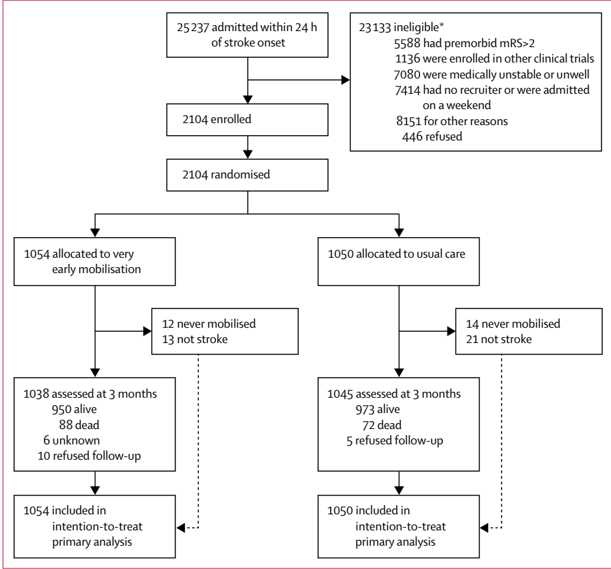
BACKGROUND: Early mobilisation after stroke is thought to contribute to the effects of stroke-unit care; however, the intervention is poorly defined and not underpinned by strong evidence. We aimed to compare the effectiveness of frequent, higher dose, very early mobilisation with usual care after stroke. METHODS: We did this parallel-group, single-blind, randomised controlled trial at 56 acute stroke units in five countries. Patients (aged ≥18 years) with ischaemic or haemorrhagic stroke, first or recurrent, who met physiological criteria were randomly assigned (1:1), via a web-based computer generated block randomisation procedure (block size of six), to receive usual stroke-unit care alone or very early mobilisation in addition to usual care. Treatment with recombinant tissue plasminogen activator was allowed. Randomisation was stratified by study site and stroke severity. Patients, outcome assessors, and investigators involved in trial and data management were masked to treatment allocation. The primary outcome was a favourable outcome 3 months after stroke, defined as a modified Rankin Scale score of 0-2. We did analysis on an intention-to-treat basis. The trial is registered with the Australian New Zealand Clinical Trials Registry, number ACTRN12606000185561. FINDINGS: Between July 18, 2006, and Oct 16, 2014, we randomly assigned 2104 patients to receive either very early mobilisation (n=1054) or usual care (n=1050); 2083 (99%) patients were included in the 3 month follow-up assessment. 965 (92%) patients were mobilised within 24 h in the very early mobilisation group compared with 623 (59%) patients in the usual care group. Fewer patients in the very early mobilisation group had a favourable outcome than those in the usual care group (n=480 [46%] vs n=525 [50%]; adjusted odds ratio [OR] 0·73, 95% CI 0·59-0·90; p=0·004). 88 (8%) patients died in the very early mobilisation group compared with 72 (7%) patients in the usual care group (OR 1·34, 95% CI 0·93-1·93, p=0·113). 201 (19%) patients in the very early mobilisation group and 208 (20%) of those in the usual care group had a non-fatal serious adverse event, with no reduction in immobility-related complications with very early mobilisation. INTERPRETATION: First mobilisation took place within 24 h for most patients in this trial. The higher dose, very early mobilisation protocol was associated with a reduction in the odds of a favourable outcome at 3 months. Early mobilisation after stroke is recommended in many clinical practice guidelines worldwide, and our findings should affect clinical practice by refining present guidelines; however, clinical recommendations should be informed by future analyses of dose-response associations. FUNDING: National Health and Medical Research Council, Singapore Health, Chest Heart and Stroke Scotland, Northern Ireland Chest Heart and Stroke, UK Stroke Association, National Institute of Health Research.
Overview
CoChat Summary
TL;DR
In AVERT, very early mobilisation (frequent, higher-dose out-of-bed activity within 24 h) reduced the odds of a favourable outcome at 3 months compared with usual care, with no significant difference in death or serious adverse events. The trial suggests an early, lower-dose usual-care activity regimen may be preferable to very early, frequent, higher-dose intervention.
Key findings
- 2104 patients were randomly assigned to very early mobilisation (n=1054) or usual care (n=1050); 2083 (99%) were included in the 3-month follow-up. 965 (92%) very early mobilisation patients were mobilised within 24 h versus 623 (59%) usual care patients; median time to first mobilisation was 18·5 h versus 22·4 h (median shift 4·8 h).
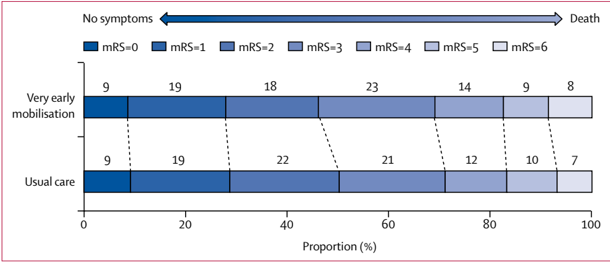
- The primary outcome, favourable modified Rankin Scale score 0–2 at 3 months, occurred in 480 (46%) very early mobilisation patients versus 525 (50%) usual care patients (adjusted OR 0·73, 95% CI 0·59–0·90; p=0·004). The ordinal modified Rankin Scale analysis was not significant (generalised OR 0·94, 95% CI 0·85–1·03; p=0·193).
- Death occurred in 88 (8%) very early mobilisation patients versus 72 (7%) usual care patients (OR 1·34, 95% CI 0·93–1·93; p=0·113). Non-fatal serious adverse events occurred in 201 (19%) versus 208 (20%) patients (IRR 0·88, 95% CI 0·72–1·07; p=0·194), with no reduction in immobility-related complications.
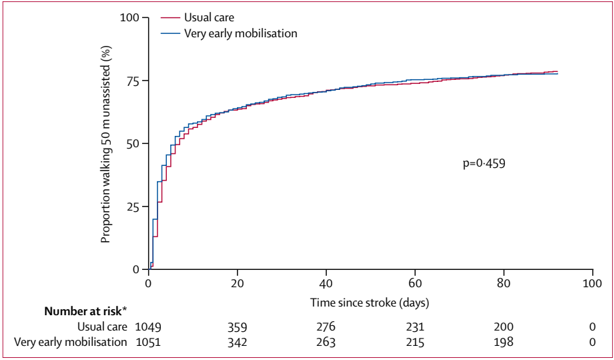
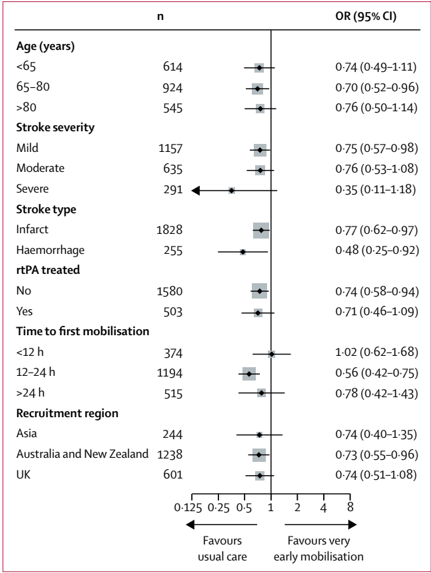
- There was no evidence of accelerated walking recovery: walking 50 m unassisted adjusted OR 0·83 (95% CI 0·64–1·07; p=0·143); time to walking unassisted HR 1·04 (95% CI 0·94–1·15; p=0·459). Prespecified subgroup analyses showed no significant interactions, though point estimates suggested reduced odds of favourable outcome in severe stroke and intracerebral haemorrhage subgroups with wide confidence intervals.
Methods
- Pragmatic, parallel-group, single-blind, multicentre, international randomised controlled trial at 56 acute stroke units in Australia, New Zealand, Malaysia, Singapore, and the UK. Eligible patients were aged ≥18 years with confirmed first or recurrent ischaemic or haemorrhagic stroke admitted to a stroke unit within 24 h of onset and meeting physiological criteria; exclusions included premorbid modified Rankin Scale score >2, early deterioration, and other serious medical instability.
- Patients were randomly assigned 1:1 via a secure, remote, web-based computer-generated block randomisation procedure (block size six), stratified by study site and baseline NIHSS stroke severity (mild 1–7, moderate 8–16, severe >16). The very early mobilisation intervention began within 24 h, focused on sitting, standing, and walking out-of-bed activity, and resulted in at least three additional out-of-bed sessions to usual care, with titrated dose for 14 days or until discharge.
- The primary outcome was favourable outcome at 3 months, defined as modified Rankin Scale score 0–2. Analysis was intention-to-treat; primary efficacy used binary logistic regression adjusted for baseline age and NIHSS. The trial was powered to detect an absolute risk reduction of poor outcome of 7·1% or greater, with a target sample of 2104 patients.
Limitations
- The paper states that large trials yield limited information about potential confounders such as physiological variables and about each staff–patient interaction, restricting but not preventing further detailed analyses.
- The pragmatic design did not prescribe usual care mobilisation practices, which changed significantly during the trial; usual care clinicians started mobilisation earlier each year, with roughly 60% of usual care patients starting out-of-bed therapy within 24 h. Whether this reflected contamination from the trial protocol, changing attitudes/guidelines, or both is uncertain.
- The study was not powered to detect subgroup differences; subgroup signals for severe stroke and intracerebral haemorrhage had wide confidence intervals and no significant interactions, so the paper advises caution. The text also notes the proportional hazards assumption was violated for the time-to-walking analysis, and missing data were handled under a missing-at-random assumption with sensitivity analyses.
Model-written summary. Check it against the paper before relying on it.
Integrity signals
Registry
Cites
Statistics
Figures
Verification
Claims the paper makes
2 Valid · 1 Not valid · 12 Not checked · 60 Own results and interpretations
A result the paper reports from its own data — it cites no other source for it, so there is none to check. The quote shows it is in the paper.
In the paper
“with no reduction in immobility-related complications with very early mobilisation.”
plainn = 2,104- Asserted: passes — The authors put it forward as true.
- Checkable: passes — It can be checked against evidence.
- Load-bearing: passes — The paper’s conclusions depend on it.
- Based: passes — The paper gives a reason why it holds.
A result the paper reports from its own data — it cites no other source for it, so there is none to check. The quote shows it is in the paper.
In the paper
“Frequency per person† | 6·5 (4·0-9·5) | 3 (2·0-4·5) | <0·0001 | 3 (3-3·5)”
plainstates a causen = 1,054 ·- Asserted: passes — The authors put it forward as true.
- Checkable: passes — It can be checked against evidence.
- Load-bearing: passes — The paper’s conclusions depend on it.
- Based: passes — The paper gives a reason why it holds.
A result the paper reports from its own data — it cites no other source for it, so there is none to check. The quote shows it is in the paper.
In the paper
“Total amount per person (min)§ | 201·5 (108-340) | 70 (32-130) | <0·0001 | 117 (107-128)”
plainstates a causen = 1,054 ·- Asserted: passes — The authors put it forward as true.
- Checkable: passes — It can be checked against evidence.
- Load-bearing: passes — The paper’s conclusions depend on it.
- Based: passes — The paper gives a reason why it holds.
A result the paper reports from its own data — it cites no other source for it, so there is none to check. The quote shows it is in the paper.
In the paper
“Time to first mobilisation (h) | 18·5 (12·8-22·3; n=1042*) | 22·4 (16·5-29·3; n=1036*) | <0·0001 | 4·8 (4·1-5·7)”
plainstates a causen = 1,042 ·- Asserted: passes — The authors put it forward as true.
- Checkable: passes — It can be checked against evidence.
- Load-bearing: passes — The paper’s conclusions depend on it.
- Based: passes — The paper gives a reason why it holds.
A result the paper reports from its own data — it cites no other source for it, so there is none to check. The quote shows it is in the paper.
In the paper
“Fewer patients in the very early mobilisation group had a favourable outcome than those in the usual care group (n=480 [46%] vs n=525 [50%]; adjusted odds ratio [OR] 0·73, 95% CI 0·59-0·90; p=0·004).”
- Also stated in: § Interpretation · plain
“Very early mobilisation was associated with a significant reduction in the odds of little or no disability at 3 months after stroke”
- Also stated in: § Statistical analysis · plain
“Favourable outcome‡ | 480 (46%) | 525 (50%) | 0·73 (0·59-0·90) | 0·004 | 0·85 (0·72-1·0) | 0·068”
plainstates an associationn = 480- Asserted: passes — The authors put it forward as true.
- Checkable: passes — It can be checked against evidence.
- Load-bearing: passes — The paper’s conclusions depend on it.
- Based: passes — The paper gives a reason why it holds.
- Also stated in: § Interpretation · plain
30 more claims
Create a free account to see all 75 claims and to verify the 1 reference still open.
- Probably not a substantial claim. 27
- It may state two separate claims as one. 22
Claims other papers make about this one
Each is checked against this paper’s own text: does it say what the citing paper says it does?
The cited source says what the claim attributes to it.
In the citing paper
“In the motor domain, the negative findings of the recent very large AVERT study on very early mobilisation in stroke [23] highlight the need to be cautious when making inferences from animal recovery data to human rehabilitation.”
From Aphasia Recovery: When, How and Who to Treat? (2018) · cites this paper as [23]
The cited source says what the claim attributes to it.
In the citing paper
“In our primary intention-to-treat analysis for A Very Early Rehabilitation Trial (AVERT), we reported that patients randomized to usual care had greater odds of a favorable outcome (modified Rankin Scale [mRS] score 0–2) at 3 months compared to those receiving the very early mobilization (VEM) protocol.1”
From Prespecified dose-response analysis for A Very Early Rehabilitation Trial (AVERT) (2016) · cites this paper as [1]
In the citing paper
“Our findings are in line with those of the A Very Early Rehabilitation Trial (AVERT) 7 whereby an increase in the intensity of ‘usual care’ services from pilot studies to the main study was reported and the Phase III trial was subsequently negative.”
From A randomized control trial of intensive aphasia therapy after acute stroke: The Very Early Rehabilitation for SpEech (VERSE) study (2021) · cites this paper as [7]
Self-check
Percentages, sums and reported differences re-computed from the paper’s own numbers.
Each contradiction between two passages listed here was confirmed by an independent check.
Rated minor: it would not touch a result — a value no result rests on, a p-value that stays on the same side of the significance level, or a conflict that is clerical, resolved elsewhere in the paper, or outside its own findings.
In the paper
§ Randomisation and masking
“mild (NIHSS 1-7), moderate (8-16), and severe (>16).”
§ Statistical analysis
“stroke severity (mild: NIHSS<7; moderate: 8-16; and severe: >16)”
Rated minor: it would not touch a result — a value no result rests on, a p-value that stays on the same side of the significance level, or a conflict that is clerical, resolved elsewhere in the paper, or outside its own findings.
In the paper
“| Diabetes mellitus | 239 (23%) | 228 (21%) |”
Reported 21 · recomputed 21.714286
Citations
Cites
Interobserver agreement for the assessment of handicap in stroke patients
van Swieten, J. C., Koudstaal, P. J., Visser, M. C., Schouten, H. J., & van Gijn, J. (1988) · Stroke · doi:10.1161/01.str.19.5.604 · Cited by 6,512
Plasticity during stroke recovery: from synapse to behaviour
Murphy, T. H., & Corbett, D. (2009) · Nature Reviews Neuroscience · doi:10.1038/nrn2735 · Cited by 1,938
Medical Complications After Stroke: A Multicenter Study
Langhorne, P., Stott, D. J., Robertson, L., MacDonald, J., Jones, L., McAlpine, C., Dick, F., Taylor, G. S., & Murray, G. (2000) · Stroke · doi:10.1161/01.str.31.6.1223 · Cited by 1,196
Strategy for intention to treat analysis in randomised trials with missing outcome data
White, I. R., Horton, N. J., Carpenter, J., statistics, R. I. M. A. S., & Pocock, S. J. (2011) · BMJ · doi:10.1136/bmj.d40 · Cited by 849
Bernhardt (2004) · doi:10.1161/01.str.0000120727.40792.40 · Cited by 593
Getting Neurorehabilitation Right: What Can Be Learned From Animal Models?
Krakauer, J. W., Carmichael, S. T., Corbett, D., & Wittenberg, G. F. (2012) · Neurorehabilitation and Neural Repair · doi:10.1177/1545968312440745 · Cited by 591
Bed rest: a potentially harmful treatment needing more careful evaluation
Allen, C., Glasziou, P., & Mar, C. D. (1999) · The Lancet · doi:10.1016/s0140-6736(98)10063-6 · Cited by 480
Treatment in a Combined Acute and Rehabilitation Stroke Unit: Which Aspects Are Most Important?
Indredavik, B., Bakke, F., Slørdahl, S. A., Rokseth, R., & Håheim, L. L. (1999) · Stroke · doi:10.1161/01.str.30.5.917 · Cited by 368
A Very Early Rehabilitation Trial for Stroke (AVERT): Phase II Safety and Feasibility
Bernhardt, J., Dewey, H., Thrift, A., Collier, J., & Donnan, G. (2008) · Stroke · doi:10.1161/strokeaha.107.492363 · Cited by 366
Cumming, T. B., Thrift, A. G., Collier, J. M., Churilov, L., Dewey, H. M., Donnan, G. A., & Bernhardt, J. (2011) · Stroke · doi:10.1161/strokeaha.110.594598 · Cited by 281
Cited by
Items 401–500 of 781
Factors Associated With Physical Therapy Engagement During the Period of Posttraumatic Amnesia
Spiteri, C., Williams, G. P., Kahn, M. B., Ponsford, J. L., & McKay, A. (2021) · Neurology Report · doi:10.1097/npt.0000000000000380 · Cited by 7
Delayed Treatment with Histone Deacetylase Inhibitors Promotes Stroke Recovery
Kannangara, T. S., & Vani, M. A. (2017) · Journal of Neuroscience · doi:10.1523/jneurosci.2615-17.2017 · Cited by 7
Medina‐Rincón, A., Pérez, L. M., Calafat, C. B., Barrios‐Franquesa, A. M., Barbosa, M. A., Doménech‐García, V., López, P. B., Buesa-Estéllez, A., & Farrés, M. G. (2025) · Clinical Rehabilitation · doi:10.1177/02692155241312067 · Cited by 7
Johns, H. T., Italiano, D., Campbell, B. C. V., & Churilov, L. P. (2022) · Statistics in Medicine · doi:10.1002/sim.9332 · Cited by 5
Tani, T., Imai, S., Inoue, N., Kanazawa, N., & Fushimi, K. (2022) · Journal of Stroke and Cerebrovascular Diseases · doi:10.1016/j.jstrokecerebrovasdis.2022.106872 · Cited by 6
Gallois, M., Davergne, T., Ledinot, P., Ravaud, P., & Régnaux, J.-P. (2017) · Archives of Physical Medicine and Rehabilitation · doi:10.1016/j.apmr.2017.03.030 · Cited by 11
Johns, H. T., Hearne, J., Bernhardt, J. A., & Churilov, L. P. (2020) · Statistical Methods in Medical Research · doi:10.1177/0962280220917174 · Cited by 7
Interventions to Improve Recovery after Stroke
Cramer, S. C. (2015) · Elsevier eBooks · doi:10.1016/b978-0-323-29544-4.00059-1 · Cited by 12
Acute Hospital Admission for Stroke Is Characterised by Inactivity
Sheedy, R., Kramer, S. F., Johnson, L. G., Shields, N., Churilov, L. P., Cadilhac, D. A.-M., & Bernhardt, J. A. (2020) · Stroke Research and Treatment · doi:10.1155/2020/5879295 · Cited by 7
Evolution of neurocritical care
(2020) · doi:10.1097/mcc.0000000000000712 · Cited by 6
BENEFÍCIOS E MÉTODOS DA MOBILIZAÇÃO PRECOCE EM UTI
de Castro, A. A. M., & Holstein, J. M. (2020) · Life Style · doi:10.19141/2237-3756.lifestyle.v6.n2.p7-22 · Cited by 11
Zheng, Y., Yan, C., Shi, H., Niu, Q., Liu, Q., Lu, S., Zhang, X., Cheng, Y., Teng, M., Wang, L., et al. (2021) · Physical Therapy · doi:10.1093/ptj/pzab038 · Cited by 9
Veldig tidlig mobilisering ved akutt hjerneslag
Fure, B., Holte, H. H., Hov, L., Vist, G. E., Kateraas, L. H., & Indredavik, B. (2018) · Tidsskrift for Den norske legeforening · doi:10.4045/tidsskr.17.0924 · Cited by 5
Okabe, N., Himi, N., Nakamura‐Maruyama, E., Hayashi, N., Sakamoto, I., Hasegawa, T., & Miyamoto, O. (2019) · Neurorehabilitation and neural repair · doi:10.1177/1545968319850132 · Cited by 6
Foudhaïli, A., Vitiello, D., & Chousterman, B. G. (2024) · Journal of Rehabilitation Medicine · doi:10.2340/jrm.v56.17734 · Cited by 6
Ambulatory Status Is Associated With Successful Discharge Home in Survivors of Critical Illness
Tran, D. H., Maheshwari, P., Nagaria, Z., Patel, H. Y., & Verceles, A. C. (2020) · Respiratory Care · doi:10.4187/respcare.07437 · Cited by 7
Virtual reality-guided therapy on a stroke unit: a feasibility study
Escolà, J. K., Demirdas, R., Schulze, M., Chae, W. H., Milles, L. S., Pommeranz, D., Oppong, M. D., Kleinschnitz, C., Köhrmann, M., & Frank, B. (2024) · Neurological Research and Practice · doi:10.1186/s42466-024-00357-w · Cited by 10
Stepping Up to Rethink the Future of Rehabilitation: IV STEP Considerations and Inspirations
Kimberley, T. J., Novak, I., Boyd, L. A., Fowler, E., & Larsen, D. S. (2017) · Pediatric Physical Therapy · doi:10.1097/pep.0000000000000435 · Cited by 6
(2016) · doi:10.12968/bjnn.2016.12.sup2.s6 · Cited by 6
Wang, Q., Wehbe, A., Wills, M. V., Li, F., Geng, X., & Ding, Y. (2022) · Neurological Research · doi:10.1080/01616412.2022.2146259 · Cited by 7
Plaitano, E. G., Scharf, R. A., Aboutaleb, P. E., Glennon, A. L., Melkumova, E., & Green, D. M. (2024) · BMC Neurology · doi:10.1186/s12883-024-03854-2 · Cited by 5
Nishimura, T., Matsugaki, R., & Matsuda, S. (2023) · Neurology International · doi:10.3390/neurolint15040094 · Cited by 5
Zhou, L., Xie, F., Zeng, Y., Xia, X., Wang, R., Cai, Y., Lei, Y., Xu, F., Li, X., & Chen, B. (2025) · Medizinische Klinik - Intensivmedizin und Notfallmedizin · doi:10.1007/s00063-024-01243-8 · Cited by 15
Tamakoshi, K., Maeda, M., Murohashi, N., & Saito, A. (2022) · Neuroreport · doi:10.1097/wnr.0000000000001782 · Cited by 5
Feasibility of an Enhanced Therapy Model of Care for Hospitalized Stroke Patients
Pruski, A., Lavezza, A., Ye, B., Langton‐Frost, N., Orient, S., Adeyemo, J., Zink, E. K., Daley, K. N., & Bahouth, M. N. (2023) · American Journal of Physical Medicine & Rehabilitation · doi:10.1097/phm.0000000000002140 · Cited by 5
The organization of stroke services
Langhorne, P., Pandian, J. D., & Felix, C. (2019) · Wiley eBooks · doi:10.1002/9781118492390.ch19 · Cited by 5
Physical therapy for a patient with neuromyelitis optica during the acute phase: A case report
Nishikawa, Y., Maeda, N., & Kimura, H. (2021) · SAGE Open Medical Case Reports · doi:10.1177/2050313x211013679 · Cited by 8
Kinetic changes of intestinal microbiota in the course of intestinal sensitization
Xiao, L., Yang, B., Liu, X., Luo, Y., Ji, Q., Wen, Z., Liu, Z., & Yang, P. (2016) · Oncotarget · doi:10.18632/oncotarget.12797 · Cited by 6
Impact assessment of the Centre for Research Excellence in Stroke Rehabilitation and Brain Recovery
Ramanathan, S. A., Lynch, E. A., Bernhardt, J. A., Nilsson, M., Cadilhac, D. A.-M., Carey, L. M., Middleton, S., Chamberlain, J., Walker, F. R., Reeves, P., et al. (2023) · Health Research Policy and Systems · doi:10.1186/s12961-023-00974-y · Cited by 5
Could upright posture be harmful in the early stages of stroke?
Barer, D. H., & Watkins, C. L. (2015) · The Lancet · doi:10.1016/s0140-6736(15)00691-1 · Cited by 5
Physiotherapy in the acute hospital phase of strokes: A bibliographic review
Ferreira, F. S., de França, N. B. M., Lima, R. A., Ferreira, J. R., & Sales, K. N. A. (2019) · Brazilian Journal of Health and Biomedical Sciences · doi:10.12957/bjhbs.2019.53476 · Cited by 5
Maia, T. F. L. D., Magalhães, P., Santos, D. T. S., Gomes, J. L. D. B., Schwingel, P. A., & Brito, A. D. F. (2024) · Neurocritical Care · doi:10.1007/s12028-023-01934-8 · Cited by 6
Yan, X., Xiao, L., Liao, M., Huang, J., He, Z., & Yan, T. (2022) · BMC Medical Research Methodology · doi:10.1186/s12874-022-01580-2 · Cited by 5
No Early Mobilization After Stroke: Lessons Learned from the AVERT Trial
Awad, A. J., Kellner, C. P., Mascitelli, J. R., Bederson, J. B., & Mocco, J. (2016) · World Neurosurgery · doi:10.1016/j.wneu.2016.01.043 · Cited by 7
Chu, Y. M., & Choi, K. (2020) · BMJ Health & Care Informatics · doi:10.1136/bmjhci-2020-100144 · Cited by 12
Molteni, F., Gaffuri, M., Guidotti, M., Checcarelli, N., Colombo, M. D. H. P., Lorenzon, C., Giovanzana, C., Specchia, A., & Cannaviello, G. (2019) · European Journal of Physical and Rehabilitation Medicine · doi:10.23736/s1973-9087.18.05361-3 · Cited by 8
Guclu‐Gunduz, A., Yazıcı, G., Özkul, Ç., Küçük, H., & Çağlayan, H. Z. B. (2019) · TURKISH JOURNAL OF MEDICAL SCIENCES · doi:10.3906/sag-1808-83 · Cited by 6
Curtis, K. A., Kourouche, S., Asha, S. E., et al. (2022) · Injury · doi:10.1016/j.injury.2022.04.024 · Cited by 5
Angerová, Y., Maršálek, P., Chmelová, I., Gueye, T., Barták, M., Uherek, Š., Bříza, J., & Rogalewicz, V. (2021) · Central European Journal of Public Health · doi:10.21101/cejph.a6111 · Cited by 5
Recovery and Rehabilitation after Stroke
Lau, G. K. K., Pendlebury, S. T., & Rothwell, P. M. (2018) · Cambridge University Press eBooks · doi:10.1017/9781316161609.024 · Cited by 5
Chen, D. H., & Bhaskar, S. M. M. (2025) · International Journal of Molecular Sciences · doi:10.3390/ijms26146733 · Cited by 8
Community-Based Rehabilitation After Brain Infarction in Japan: From the Acute Phase to Home
Maeshima, S., & Osawa, A. (2021) · Exon Publications eBooks · doi:10.36255/exonpublications.cerebralischemia.2021.rehabilitation · Cited by 6
Hernandez, S., Thomas, P., Udy, A. A., & Hodgson, C. L. (2018) · New Zealand Journal of Physiotherapy · doi:10.15619/nzjp/46.3.04 · Cited by 9
Mangset, M., Kitzmüller, G., Evju, A. S., Angel, S., Aadal, L., Martinsen, R., Bronken, B. A., Kvigne, K. J., Bragstad, L. K., Hjelle, E. G., et al. (2021) · Trials · doi:10.1186/s13063-021-05765-w · Cited by 5
Rethnam, V., Hayward, K. S., Johns, H. T., Carvalho, L. B., Churilov, L. P., & Bernhardt, J. A. (2023) · Frontiers in Stroke · doi:10.3389/fstro.2023.1293942 · Cited by 7
Early, Intense Rehabilitation Fails to Improve Outcome After Intra-Striatal Hemorrhage in Rats
Fedor, B. A., Kalisvaart, A. C. J., Ralhan, S., Kung, T. F. C., MacLaren, M., & Colbourne, F. (2022) · Neurorehabilitation and neural repair · doi:10.1177/15459683221137342 · Cited by 5
Hu, X., Liv, P., Lundström, E., Norström, F., Lindahl, O., Borg, K., & Sunnerhagen, K. S. (2023) · Trials · doi:10.1186/s13063-023-07673-7 · Cited by 4
Neues zur Neurorehabilitation: Motorik und Sprache
Liepert, J., & Breitenstein, C. (2016) · Der Nervenarzt · doi:10.1007/s00115-016-0239-1 · Cited by 6
Protein nutrition and exercise survival kit for critically ill
Weijs, P. J. M. (2017) · Current Opinion in Critical Care · doi:10.1097/mcc.0000000000000425 · Cited by 5
Hu, X., Liv, P., Lundström, E., Norström, F., Lindahl, O., Borg, K., & Sunnerhagen, K. S. (2023) · doi:10.21203/rs.3.rs-3256871/v1 · Cited by 4
Kakuda, W., Nakajima, M., Oki, K., Koyama, T., Oyama, N., Koga, M., Hayase, M., Ohta, T., Iguchi, Y., Fujimoto, S., et al. (2024) · Progress in Rehabilitation Medicine · doi:10.2490/prm.20240015 · Cited by 8
Factors associated with outcomes of inpatient stroke rehabilitation
Tarvonen-Schröder, S., Matomäki, J., & Laimi, K. (2017) · International Journal of Therapy and Rehabilitation · doi:10.12968/ijtr.2018.25.1.34 · Cited by 6
Differences in and Determinants of Prehospital Delay Times among Stroke Patients—1994 Versus 2012
Labberton, A. S., Faiz, K. W., Rønning, O. M., et al. (2018) · Journal of Stroke and Cerebrovascular Diseases · doi:10.1016/j.jstrokecerebrovasdis.2018.04.030 · Cited by 4
Bahouth, M. N., Deluzio, S., Pruski, A., & Zink, E. K. (2023) · Neurotherapeutics · doi:10.1007/s13311-023-01392-2 · Cited by 5
The Critical Period After Stroke Study (CPASS) Upper Extremity Treatment Protocol
Barth, J., Geed, S., Mitchell, A., Brady, K. P., Giannetti, M. L., Dromerick, A. W., & Edwards, D. F. (2023) · Archives of Rehabilitation Research and Clinical Translation · doi:10.1016/j.arrct.2023.100282 · Cited by 6
What are the next breakthroughs in the management of acute intracerebral hemorrhage?
Toyoda, Ḱ., Koga, M., & Sato, S. (2016) · International Journal of Stroke · doi:10.1177/1747493016631559 · Cited by 4
Early Mobilization in the ICU: Help or Hype?*
(2016) · doi:10.1097/ccm.0000000000001733 · Cited by 4
Li, X., & Kong, Y. (2025) · Archives of Physical Medicine and Rehabilitation · doi:10.1016/j.apmr.2025.10.021 · Cited by 5
Ni, X., Yuan, Z., Xie, R., Zhai, X., Cheng, X., & Pan, Y. (2025) · Neurological Sciences · doi:10.1007/s10072-025-08000-5 · Cited by 7
Getting the right prescription for rehabilitation after stroke
Ward, N., & Kitago, T. (2016) · Neurology · doi:10.1212/wnl.0000000000002653 · Cited by 4
Chernikova, L. A., Suponeva, N. A., Клочков, А. С., Khizhnikova, A. E., Lyukmanov, R. K., Gnedovskaya, E. V., Yankevich, D. S., & Пирадов, М. А. (2016) · Современные технологии в медицине · doi:10.17691/stm2016.8.4.27 · Cited by 4
Shi, Y., Liu, J., & Zhang, X. (2025) · Frontiers in Neurology · doi:10.3389/fneur.2025.1649246 · Cited by 4
Bainbridge, L., Briffa, K., Burton, E., Hill, K., & Fary, R. E. (2023) · Disability and Rehabilitation · doi:10.1080/09638288.2023.2245757 · Cited by 6
Richards, L. G., Ifejika, N. L., Stein, J., Bahouth, M. N., Saylor, M. A., Barrett, A. M., Chen, P., Deutsch, A. F., Dusenbury, W., Ellis, C., et al. (2026) · Stroke · doi:10.1161/str.0000000000000536 · Cited by 15
Editorial: Transitional and long-term continuous care & rehabilitation after stroke
Kim, W., Abo, M., Soekadar, S. R., & Pistarini, C. (2022) · Frontiers in Neurology · doi:10.3389/fneur.2022.965762 · Cited by 5
日本脳卒中学会 (2024) · Nosotchu · doi:10.3995/jstroke.11206 · Cited by 4
Recent Advances in Pulmonary Rehabilitation for Patients in the Intensive Care Unit (ICU)
Sato, R., Ebihara, S., & Kohzuki, M. (2017) · Pulmonary Research and Respiratory Medicine - Open Journal · doi:10.17140/prrmoj-se-2-107 · Cited by 4
Hu, X., Jonzén, K., Lindahl, O., Karlsson, M., Norström, F., Lundström, E., & Sunnerhagen, K. S. (2022) · JMIR Human Factors · doi:10.2196/38704 · Cited by 4
Descriptive analysis of post-stroke patients in a neurological physical therapy unit
Paniagua-Monrobel, M., Escobio-Prieto, I., Magni, E., Galán-Mercant, A., Lucena-Antón, D., Pinto, E. P., & Luque-Moreno, C. (2023) · Frontiers in Neurology · doi:10.3389/fneur.2023.1056415 · Cited by 4
Rehabilitation After Hemorrhagic Stroke: From Acute to Chronic Stage
Kim, Y. (2018) · Stroke revisited · doi:10.1007/978-981-10-1427-7_16 · Cited by 4
Neurosurgical Spreading Depolarization Monitoring: Why, How, and What to Do About It
Carlson, A. P. (2024) · Neurosurgery · doi:10.1227/neu.0000000000003278 · Cited by 3
General Concepts: Therapies for Rehabilitation and Recovery
Teasell, R. W., & Hussein, N. (2015) · Springer eBooks · doi:10.1007/978-3-319-17750-2_18 · Cited by 4
Rodrigues, P. S. M., Shimano, M. M., de Oliveira, E., Kawamura, F. M., Silveira, A. F., Luvizutto, G. J., & de Souza, L. A. P. S. (2023) · Disability and Rehabilitation Assistive Technology · doi:10.1080/17483107.2023.2166600 · Cited by 5
Schnitzler, A., Erbault, M., Solomiac, A., Sainte-Croix, D., Fouchard, A., May‐Michelangeli, L., & Grenier, C. (2018) · Annals of Physical and Rehabilitation Medicine · doi:10.1016/j.rehab.2018.07.001 · Cited by 5
Ajana, K., Everard, G. J., Sorrentino, G., Lejeune, T. M., & Edwards, M. (2023) · Research Square · doi:10.21203/rs.3.rs-3111608/v1 · Cited by 4
Sasa, N., Matsumoto, S., Kamata, G., Hoei, T., & Aoyagi, Y. (2022) · Progress in Rehabilitation Medicine · doi:10.2490/prm.20220059 · Cited by 7
Associação entre a gravidade do AVC, equilíbrio e mobilidade funcional em pacientes trombolisados
dos Santos, N. S. B., & dos Anjos, J. L. M. (2021) · Revista Neurociências · doi:10.34024/rnc.2021.v29.11868 · Cited by 74
Safety of Early Mobilization in Adult Neurocritical Patients: An Exploratory Review
Patiño, L. A., Estela-Zape, J. L., & Sanclemente-Cardoza, V. (2025) · Critical Care Research and Practice · doi:10.1155/ccrp/4660819 · Cited by 10
Hernández-Méndez, B., Martín-Silva, I., Tapias-Vilanova, M., Moreno-Gallo, Y., Sanjuán, E., Lorenzo-Tamayo, E., Ramos-González, M., Montufo-Rosal, M., & Zuriguel‐Pérez, E. (2021) · Neurorehabilitation · doi:10.3233/nre-210118 · Cited by 5
Acute Stroke Nursing Management
Alexandrov, A. W. (2019) · Wiley eBooks · doi:10.1002/9781119581161.ch4 · Cited by 3
Early physical rehabilitation vs standard care for intracerebral hemorrhage stroke
Cheng, X., Mao, S., Zhang, Y., Peng, X., Ma, R., Bao, Y.-C., Li, Q., Liu, M., Sun, D., Wan, B., et al. (2021) · Medicine · doi:10.1097/md.0000000000024219 · Cited by 3
RetractedNakajima, M., Oki, K., Omori, T., Koyama, T., Oyama, N., Koga, M., Hayase, M., Ohta, T., Matsumoto, K., Iguchi, Y., et al. (2023) · Journal of Stroke and Cerebrovascular Diseases · doi:10.1016/j.jstrokecerebrovasdis.2023.107550 · Cited by 5
Remote Ischemic Conditioning in Stroke Recovery
(2023) · doi:10.1016/j.pmr.2023.06.006 · Cited by 3
Yelnik, A. P. (2022) · Bulletin de l Académie Nationale de Médecine · doi:10.1016/j.banm.2022.02.016 · Cited by 13
Riberholt, C. G., Gluud, C. N., Jakobsen, J. C., Ovesen, C., Mehlsen, J., & Møller, K. (2021) · Contemporary Clinical Trials Communications · doi:10.1016/j.conctc.2021.100856 · Cited by 2
KITAJI, Y., Harashima, H., & MIYANO, S. (2020) · Physical Therapy Research · doi:10.1298/ptr.e10022 · Cited by 5
Bringing High-Dose Neurorestorative Behavioral Training Into the Acute Stroke Unit
Bahouth, M. N., Zink, E. K., Ahmad, O. M., Roy, P., Zeiler, S. R., Urrutia, V., & Krakauer, J. W. (2023) · American Journal of Physical Medicine & Rehabilitation · doi:10.1097/phm.0000000000002146 · Cited by 4
Zheng, P., Zhu, X., Cadilhac, D. A.-M., Luo, Y., & Liu, N. (2025) · Geriatric Nursing · doi:10.1016/j.gerinurse.2025.04.012 · Cited by 4
García-Rodríguez, N., Rodríguez, S., Tejada, P. I., Miranda-Artieda, Z. M., Ridao, N., Buxó, X., Pérez-Mesquida, M. E., Beseler, M. R., Salom, J. B., Pérez, L. M., et al. (2021) · Frontiers in Neurology · doi:10.3389/fneur.2021.767484 · Cited by 5
Danial, M., Chow, C. T., Lim, M. H., Ayop, N. A., Looi, I., & Ch’ng, A. S. H. (2025) · Journal of NeuroEngineering and Rehabilitation · doi:10.1186/s12984-025-01706-9 · Cited by 19
Budhdeo, S., Meek, T. H., Cosco, T. D., Turaga, S., Chari, A., & Sharma, N. (2019) · bioRxiv (Cold Spring Harbor Laboratory) · doi:10.1101/632604 · Cited by 3
Hayward, K. S., Donnan, G. A., Godecke, E., Balabanski, A. H., Barker, R. N., Bernhardt, J. A., Brauer, S., Brodtmann, A. G., Brogan, E., Brownsett, S. L. E., et al. (2025) · BMJ Neurology Open · doi:10.1136/bmjno-2025-001212 · Cited by 3
Metadata
- Venue
- The Lancet
- Publisher
- Elsevier BV
- Published
- 2015-07
- Volume
- 386
- Issue
- 9988
- Pages
- 46-55
- ISSN
- 0099-5355 (ISSN-L)
- 0140-6736
- OpenAlex
- W2096535216
- Semantic Scholar
- ab0a77142567bf8ff450d29579f23bdb9b7ed6e5
- Cited by
- 789
- References
- 26
- Citations by year
- 2026: 55 · 2025: 58 · 2024: 44 · 2023: 57 · 2022: 79 · 2021: 93 · 2020: 87 · 2019: 77 · 2018: 72 · 2017: 75 · 2016: 67 · 2015: 24
- FWCI
- 79.96
- Type
- journal article
- Language
- en
- Open access
- hybrid
- doi.org
- Licence
- cc-by-nc-nd
- www.elsevier.com/tdm/userlicense/1.0/ (tdm)
- creativecommons.org/licenses/by-nc-nd/4.0/ (vor)
- Locations
- The Lancet (publishedVersion, cc-by-nc-nd)
- PubMed (publishedVersion)
- ENLIGHTEN (Jurnal Bimbingan dan Konseling Islam) (acceptedVersion)
- Monash University Research Portal (Monash University) (submittedVersion, cc-by-nc-nd)
- Figshare (submittedVersion, cc-by)
- Minerva Access (University of Melbourne) (submittedVersion, cc-by-nc-nd)
- Funders
- National Health and Medical Research Council (NHMRC) of Australia (grant numbers 386201 and 1041401)
- Topics
- Health Sciences › Medicine › Rehabilitation › Stroke Rehabilitation and Recovery
- Health Sciences › Medicine › Clinical Neurology › Acute Ischemic Stroke Management
- Health Sciences › Health Professions › Speech and Hearing › Dysphagia Assessment and Management
- Keywords
- stroke, acute stroke, ischemic stroke, hemorrhagic stroke, stroke unit care, functional outcome, modified Rankin Scale, mortality, stroke rehabilitation, thrombolysis, tissue plasminogen activator, stroke severity
- MeSH terms
- Stroke Rehabilitation, Aged, Aged, 80 and over, Early Ambulation, Female, Follow-Up Studies, Humans, Male, Middle Aged, Severity of Illness Index, Time Factors, Single-Blind Method, Walking, Treatment Outcome, Recovery of Function, Stroke
About these checks
Registry, retraction, Cites and statistics results are computed, not judged, with one exception: a printed reference that no index lists is read once by a model before it counts as a citation error. Claims are extracted by a model and kept only when their quote appears verbatim in the text; each cited source is then checked, with a model’s help, for whether it says what the claim relies on. Those verdicts can be wrong — read the claim’s quote and the cited source before relying on one.
A language model drew the claims from the paper on 2026-10-11, under version 3 of the claim definition (model deepseek-v4.1-flash, prompt extract-v3).
A second model labelled each claim on 2026-10-11 (model jev-1.13-20260917, definition revision gold-guideline-v0.2).
Statistics and arithmetic are recomputed, not judged.
Confidence bands are shown only for fields calibrated on our annotated test set. None is calibrated yet, so no band is shown.
What counts as a claim ›How we measure confidence ›How we check this ›
Are you an author, or do you see a problem with this page? Request a review
Data sources
Bibliographic data: Semantic Scholar, OpenAlex, Crossref.
Contains information from the Semantic Scholar Academic Graph Datasets, made available under the ODC Attribution License (ODC-BY 1.0).
Semantic Scholar’s data is described in: Kinney, R., et al. (2023). The Semantic Scholar Open Data Platform. arXiv:2301.10140.
