

Efficacy and safety of very early mobilisation within 24 h of stroke onset (AVERT): a randomised controlled trial
Open accessThe DOI matches its Crossref record; 28 of the 28 references it cites were found in a registry or an index; 2 of the 16 sources its claims cite were checked for support.
Abstract
BACKGROUND: Early mobilisation after stroke is thought to contribute to the effects of stroke-unit care; however, the intervention is poorly defined and not underpinned by strong evidence. We aimed to compare the effectiveness of frequent, higher dose, very early mobilisation with usual care after stroke. METHODS: We did this parallel-group, single-blind, randomised controlled trial at 56 acute stroke units in five countries. Patients (aged ≥18 years) with ischaemic or haemorrhagic stroke, first or recurrent, who met physiological criteria were randomly assigned (1:1), via a web-based computer generated block randomisation procedure (block size of six), to receive usual stroke-unit care alone or very early mobilisation in addition to usual care. Treatment with recombinant tissue plasminogen activator was allowed. Randomisation was stratified by study site and stroke severity. Patients, outcome assessors, and investigators involved in trial and data management were masked to treatment allocation. The primary outcome was a favourable outcome 3 months after stroke, defined as a modified Rankin Scale score of 0-2. We did analysis on an intention-to-treat basis. The trial is registered with the Australian New Zealand Clinical Trials Registry, number ACTRN12606000185561. FINDINGS: Between July 18, 2006, and Oct 16, 2014, we randomly assigned 2104 patients to receive either very early mobilisation (n=1054) or usual care (n=1050); 2083 (99%) patients were included in the 3 month follow-up assessment. 965 (92%) patients were mobilised within 24 h in the very early mobilisation group compared with 623 (59%) patients in the usual care group. Fewer patients in the very early mobilisation group had a favourable outcome than those in the usual care group (n=480 [46%] vs n=525 [50%]; adjusted odds ratio [OR] 0·73, 95% CI 0·59-0·90; p=0·004). 88 (8%) patients died in the very early mobilisation group compared with 72 (7%) patients in the usual care group (OR 1·34, 95% CI 0·93-1·93, p=0·113). 201 (19%) patients in the very early mobilisation group and 208 (20%) of those in the usual care group had a non-fatal serious adverse event, with no reduction in immobility-related complications with very early mobilisation. INTERPRETATION: First mobilisation took place within 24 h for most patients in this trial. The higher dose, very early mobilisation protocol was associated with a reduction in the odds of a favourable outcome at 3 months. Early mobilisation after stroke is recommended in many clinical practice guidelines worldwide, and our findings should affect clinical practice by refining present guidelines; however, clinical recommendations should be informed by future analyses of dose-response associations. FUNDING: National Health and Medical Research Council, Singapore Health, Chest Heart and Stroke Scotland, Northern Ireland Chest Heart and Stroke, UK Stroke Association, National Institute of Health Research.
Overview
CoChat Summary
TL;DR
In AVERT, very early mobilisation (frequent, higher-dose out-of-bed activity within 24 h) reduced the odds of a favourable outcome at 3 months compared with usual care, with no significant difference in death or serious adverse events. The trial suggests an early, lower-dose usual-care activity regimen may be preferable to very early, frequent, higher-dose intervention.
Key findings
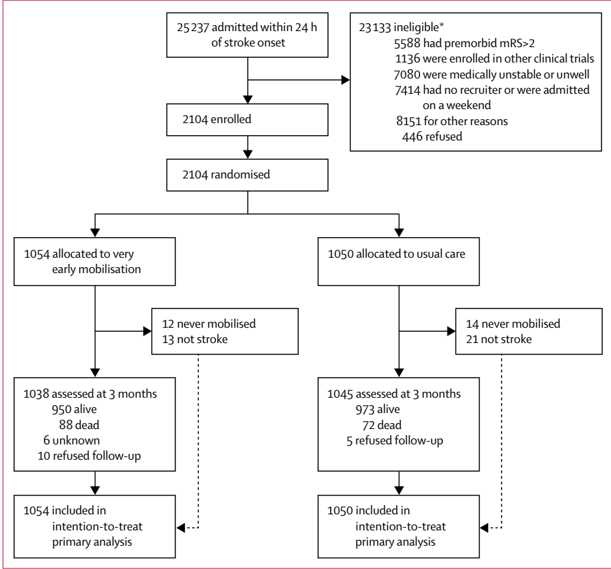
- 2104 patients were randomly assigned to very early mobilisation (n=1054) or usual care (n=1050); 2083 (99%) were included in the 3-month follow-up. 965 (92%) very early mobilisation patients were mobilised within 24 h versus 623 (59%) usual care patients; median time to first mobilisation was 18·5 h versus 22·4 h (median shift 4·8 h).
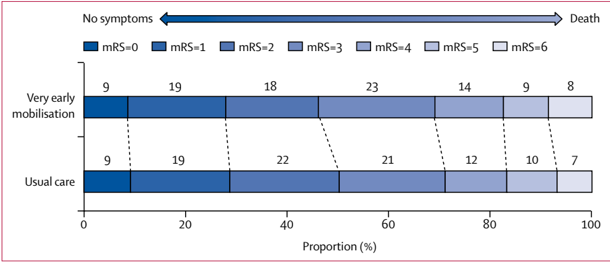
- The primary outcome, favourable modified Rankin Scale score 0–2 at 3 months, occurred in 480 (46%) very early mobilisation patients versus 525 (50%) usual care patients (adjusted OR 0·73, 95% CI 0·59–0·90; p=0·004). The ordinal modified Rankin Scale analysis was not significant (generalised OR 0·94, 95% CI 0·85–1·03; p=0·193).
- Death occurred in 88 (8%) very early mobilisation patients versus 72 (7%) usual care patients (OR 1·34, 95% CI 0·93–1·93; p=0·113). Non-fatal serious adverse events occurred in 201 (19%) versus 208 (20%) patients (IRR 0·88, 95% CI 0·72–1·07; p=0·194), with no reduction in immobility-related complications.
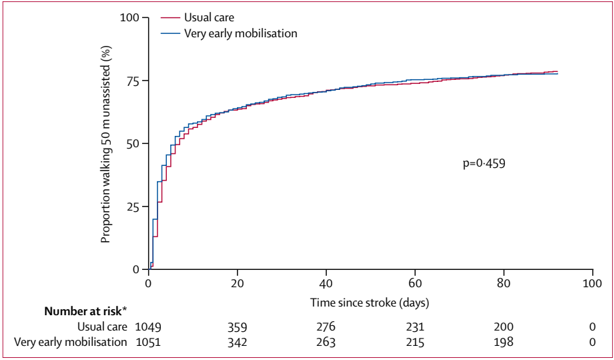
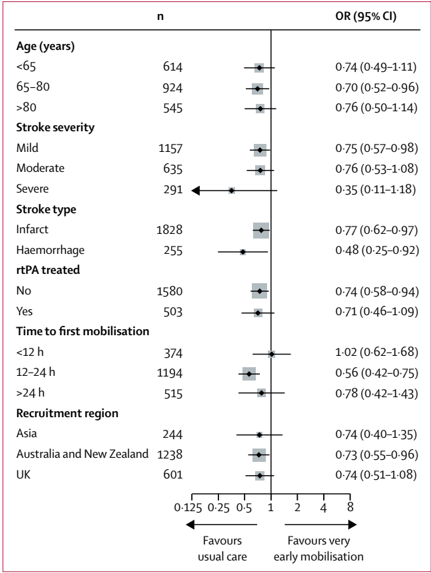
- There was no evidence of accelerated walking recovery: walking 50 m unassisted adjusted OR 0·83 (95% CI 0·64–1·07; p=0·143); time to walking unassisted HR 1·04 (95% CI 0·94–1·15; p=0·459). Prespecified subgroup analyses showed no significant interactions, though point estimates suggested reduced odds of favourable outcome in severe stroke and intracerebral haemorrhage subgroups with wide confidence intervals.
Methods
- Pragmatic, parallel-group, single-blind, multicentre, international randomised controlled trial at 56 acute stroke units in Australia, New Zealand, Malaysia, Singapore, and the UK. Eligible patients were aged ≥18 years with confirmed first or recurrent ischaemic or haemorrhagic stroke admitted to a stroke unit within 24 h of onset and meeting physiological criteria; exclusions included premorbid modified Rankin Scale score >2, early deterioration, and other serious medical instability.
- Patients were randomly assigned 1:1 via a secure, remote, web-based computer-generated block randomisation procedure (block size six), stratified by study site and baseline NIHSS stroke severity (mild 1–7, moderate 8–16, severe >16). The very early mobilisation intervention began within 24 h, focused on sitting, standing, and walking out-of-bed activity, and resulted in at least three additional out-of-bed sessions to usual care, with titrated dose for 14 days or until discharge.
- The primary outcome was favourable outcome at 3 months, defined as modified Rankin Scale score 0–2. Analysis was intention-to-treat; primary efficacy used binary logistic regression adjusted for baseline age and NIHSS. The trial was powered to detect an absolute risk reduction of poor outcome of 7·1% or greater, with a target sample of 2104 patients.
Limitations
- The paper states that large trials yield limited information about potential confounders such as physiological variables and about each staff–patient interaction, restricting but not preventing further detailed analyses.
- The pragmatic design did not prescribe usual care mobilisation practices, which changed significantly during the trial; usual care clinicians started mobilisation earlier each year, with roughly 60% of usual care patients starting out-of-bed therapy within 24 h. Whether this reflected contamination from the trial protocol, changing attitudes/guidelines, or both is uncertain.
- The study was not powered to detect subgroup differences; subgroup signals for severe stroke and intracerebral haemorrhage had wide confidence intervals and no significant interactions, so the paper advises caution. The text also notes the proportional hazards assumption was violated for the time-to-walking analysis, and missing data were handled under a missing-at-random assumption with sensitivity analyses.
Model-written summary. Check it against the paper before relying on it.
Integrity signals
Registry
Cites
Statistics
Figures
Verification
Claims the paper makes
2 Valid · 1 Not valid · 12 Not checked · 60 Own results and interpretations
A result the paper reports from its own data — it cites no other source for it, so there is none to check. The quote shows it is in the paper.
In the paper
“with no reduction in immobility-related complications with very early mobilisation.”
plainn = 2,104- Asserted: passes — The authors put it forward as true.
- Checkable: passes — It can be checked against evidence.
- Load-bearing: passes — The paper’s conclusions depend on it.
- Based: passes — The paper gives a reason why it holds.
A result the paper reports from its own data — it cites no other source for it, so there is none to check. The quote shows it is in the paper.
In the paper
“Frequency per person† | 6·5 (4·0-9·5) | 3 (2·0-4·5) | <0·0001 | 3 (3-3·5)”
plainstates a causen = 1,054 ·- Asserted: passes — The authors put it forward as true.
- Checkable: passes — It can be checked against evidence.
- Load-bearing: passes — The paper’s conclusions depend on it.
- Based: passes — The paper gives a reason why it holds.
A result the paper reports from its own data — it cites no other source for it, so there is none to check. The quote shows it is in the paper.
In the paper
“Total amount per person (min)§ | 201·5 (108-340) | 70 (32-130) | <0·0001 | 117 (107-128)”
plainstates a causen = 1,054 ·- Asserted: passes — The authors put it forward as true.
- Checkable: passes — It can be checked against evidence.
- Load-bearing: passes — The paper’s conclusions depend on it.
- Based: passes — The paper gives a reason why it holds.
A result the paper reports from its own data — it cites no other source for it, so there is none to check. The quote shows it is in the paper.
In the paper
“Time to first mobilisation (h) | 18·5 (12·8-22·3; n=1042*) | 22·4 (16·5-29·3; n=1036*) | <0·0001 | 4·8 (4·1-5·7)”
plainstates a causen = 1,042 ·- Asserted: passes — The authors put it forward as true.
- Checkable: passes — It can be checked against evidence.
- Load-bearing: passes — The paper’s conclusions depend on it.
- Based: passes — The paper gives a reason why it holds.
A result the paper reports from its own data — it cites no other source for it, so there is none to check. The quote shows it is in the paper.
In the paper
“Fewer patients in the very early mobilisation group had a favourable outcome than those in the usual care group (n=480 [46%] vs n=525 [50%]; adjusted odds ratio [OR] 0·73, 95% CI 0·59-0·90; p=0·004).”
- Also stated in: § Interpretation · plain
“Very early mobilisation was associated with a significant reduction in the odds of little or no disability at 3 months after stroke”
- Also stated in: § Statistical analysis · plain
“Favourable outcome‡ | 480 (46%) | 525 (50%) | 0·73 (0·59-0·90) | 0·004 | 0·85 (0·72-1·0) | 0·068”
plainstates an associationn = 480- Asserted: passes — The authors put it forward as true.
- Checkable: passes — It can be checked against evidence.
- Load-bearing: passes — The paper’s conclusions depend on it.
- Based: passes — The paper gives a reason why it holds.
- Also stated in: § Interpretation · plain
30 more claims
Create a free account to see all 75 claims and to verify the 1 reference still open.
- Probably not a substantial claim. 27
- It may state two separate claims as one. 22
Claims other papers make about this one
Each is checked against this paper’s own text: does it say what the citing paper says it does?
The cited source says what the claim attributes to it.
In the citing paper
“In the motor domain, the negative findings of the recent very large AVERT study on very early mobilisation in stroke [23] highlight the need to be cautious when making inferences from animal recovery data to human rehabilitation.”
From Aphasia Recovery: When, How and Who to Treat? (2018) · cites this paper as [23]
The cited source says what the claim attributes to it.
In the citing paper
“In our primary intention-to-treat analysis for A Very Early Rehabilitation Trial (AVERT), we reported that patients randomized to usual care had greater odds of a favorable outcome (modified Rankin Scale [mRS] score 0–2) at 3 months compared to those receiving the very early mobilization (VEM) protocol.1”
From Prespecified dose-response analysis for A Very Early Rehabilitation Trial (AVERT) (2016) · cites this paper as [1]
In the citing paper
“Our findings are in line with those of the A Very Early Rehabilitation Trial (AVERT) 7 whereby an increase in the intensity of ‘usual care’ services from pilot studies to the main study was reported and the Phase III trial was subsequently negative.”
From A randomized control trial of intensive aphasia therapy after acute stroke: The Very Early Rehabilitation for SpEech (VERSE) study (2021) · cites this paper as [7]
Self-check
Percentages, sums and reported differences re-computed from the paper’s own numbers.
Each contradiction between two passages listed here was confirmed by an independent check.
Rated minor: it would not touch a result — a value no result rests on, a p-value that stays on the same side of the significance level, or a conflict that is clerical, resolved elsewhere in the paper, or outside its own findings.
In the paper
§ Randomisation and masking
“mild (NIHSS 1-7), moderate (8-16), and severe (>16).”
§ Statistical analysis
“stroke severity (mild: NIHSS<7; moderate: 8-16; and severe: >16)”
Rated minor: it would not touch a result — a value no result rests on, a p-value that stays on the same side of the significance level, or a conflict that is clerical, resolved elsewhere in the paper, or outside its own findings.
In the paper
“| Diabetes mellitus | 239 (23%) | 228 (21%) |”
Reported 21 · recomputed 21.714286
Citations
Cites
Interobserver agreement for the assessment of handicap in stroke patients
van Swieten, J. C., Koudstaal, P. J., Visser, M. C., Schouten, H. J., & van Gijn, J. (1988) · Stroke · doi:10.1161/01.str.19.5.604 · Cited by 6,512
Plasticity during stroke recovery: from synapse to behaviour
Murphy, T. H., & Corbett, D. (2009) · Nature Reviews Neuroscience · doi:10.1038/nrn2735 · Cited by 1,938
Medical Complications After Stroke: A Multicenter Study
Langhorne, P., Stott, D. J., Robertson, L., MacDonald, J., Jones, L., McAlpine, C., Dick, F., Taylor, G. S., & Murray, G. (2000) · Stroke · doi:10.1161/01.str.31.6.1223 · Cited by 1,196
Strategy for intention to treat analysis in randomised trials with missing outcome data
White, I. R., Horton, N. J., Carpenter, J., statistics, R. I. M. A. S., & Pocock, S. J. (2011) · BMJ · doi:10.1136/bmj.d40 · Cited by 849
Bernhardt (2004) · doi:10.1161/01.str.0000120727.40792.40 · Cited by 593
Getting Neurorehabilitation Right: What Can Be Learned From Animal Models?
Krakauer, J. W., Carmichael, S. T., Corbett, D., & Wittenberg, G. F. (2012) · Neurorehabilitation and Neural Repair · doi:10.1177/1545968312440745 · Cited by 591
Bed rest: a potentially harmful treatment needing more careful evaluation
Allen, C., Glasziou, P., & Mar, C. D. (1999) · The Lancet · doi:10.1016/s0140-6736(98)10063-6 · Cited by 480
Treatment in a Combined Acute and Rehabilitation Stroke Unit: Which Aspects Are Most Important?
Indredavik, B., Bakke, F., Slørdahl, S. A., Rokseth, R., & Håheim, L. L. (1999) · Stroke · doi:10.1161/01.str.30.5.917 · Cited by 368
A Very Early Rehabilitation Trial for Stroke (AVERT): Phase II Safety and Feasibility
Bernhardt, J., Dewey, H., Thrift, A., Collier, J., & Donnan, G. (2008) · Stroke · doi:10.1161/strokeaha.107.492363 · Cited by 366
Cumming, T. B., Thrift, A. G., Collier, J. M., Churilov, L., Dewey, H. M., Donnan, G. A., & Bernhardt, J. (2011) · Stroke · doi:10.1161/strokeaha.110.594598 · Cited by 281
Cited by
Items 701–781 of 781
Reabilitação para idosos da Amazônia com AVC: superando as complicações e seus desafios associados.
Lacerda, J. D. P., & de Carvalho, F. P. B. (2020) · Brazilian Journal of Implantology and Health Sciences · doi:10.36557/2674-8169.2020v2n4p16-38 · Cited by 2
Araújo, M. A. D. S., Oliveira, T. D. A., Silva, R. S. E., Braga, A. C. G., & Faria, S. S. (2026) · Research Society and Development · doi:10.33448/rsd-v15i8.51524
Qureshi, A. I., Kaur, G., Carhuapoma, L., Lakhani, P., Lefton‐Greif, M. A., Mehr, D. R., Royse, L. A., Wang, N.-Y., Zahoor, K., & Hanley, D. F. (2026) · Neurological Research · doi:10.1080/01616412.2026.2693796
Special Systems of Care Considerations in Intracerebral Haemorrhage
Ganesh, A., & Hill, M. D. (2018) · Springer eBooks · doi:10.1007/978-3-319-77063-5_10 · Cited by 1
Hong, Y., Hu, W., Tang, J., & Xiong, F. (2026) · Frontiers in Neurology · doi:10.3389/fneur.2026.1837085
Neurological rehabilitation of patients after stroke: Guidelines of Austrian Stroke Society 2018
—, —. (2019) · Ukrainian Neurosurgical Journal · doi:10.25305/unj.165374 · Cited by 1
Troubles neurocognitifs vasculaires et post-AVC
Yelnik, A. P., & Quintaine, V. (2017) · De Boeck Supérieur eBooks · doi:10.3917/dbu.rouss.2017.01.0303
Hanaoka, S., Iwabuchi, K., Hirai, T., Seki, T., & Hayashi, H. (2024) · Stroke Research and Treatment · doi:10.1155/srat/2381790 · Cited by 2
Yu, T., Chen, Y., Lu, Y., Yu, F., Xiang, Y., Kou, X., Yang, H., lyu, D., Wu, M., Yin, X., et al. (2026) · Frontiers in Immunology · doi:10.3389/fimmu.2026.1807395
McNair, N. D., Bell, S. D., Hundt, E., Jones, S. E., & McNett, M. (2026) · Journal of Neuroscience Nursing · doi:10.1097/jnn.0000000000000859
Sun, L., Xue, L., Ye, T., & Zhang, X. (2026) · Frontiers in Neurology · doi:10.3389/fneur.2026.1920170
Pediatric Constraint-Induced Therapy: Checking under the Hood Before Jumping on the Bandwagon
Page, S. J., & Levine, P. (2024) · The Journal of Pediatrics · doi:10.1016/j.jpeds.2024.113998
Medical Therapy of Intracerebral and Intraventricular Hemorrhage
Berthaud, J. V., Morgenstern, L. B., & Zahuranec, D. B. (2021) · Elsevier eBooks · doi:10.1016/b978-0-323-69424-7.00059-4
Nutritional Support in the Neurointensive Care Unit
Khan, I. R., Bojedla, S., & Badjatia, N. (2017) · Springer eBooks · doi:10.1007/978-3-319-53171-7_5
Future Directions in Rehabilitation Medicine for Acute Stroke Patients
Kakuda, W. (2019) · リハビリテーション医学 : 日本リハビリテーション医学会誌 · doi:10.2490/jjrmc.56.492
脳卒中患者に対する発症後48 時間以内の起立と定義した早期離床導入の効果:―テント上病変ならびに保存的治療例を対象とした検討―
洋司, 山., 広希, 渡., 祐輔, 高., & 梅本, 安. (2020) · 理学療法学 · doi:10.15063/rigaku.11753 · Cited by 2
Evidenzbasierte Konzepte der motorischen Frührehabilitation
Thomas, S., Pohl, M., & Mehrholz, J. (2016) · Neurologie & Rehabilitation · doi:10.14624/nr150816.004
New Trend of Stroke Rehabilitation According to Japanese Guidelines for the Management of Stroke
Fujiwara, T. (2019) · リハビリテーション医学 : 日本リハビリテーション医学会誌 · doi:10.2490/jjrmc.56.54
Yamanaka, Y., Yonetsu, R., Kugo, M., Sawano, S., & Miyagaki, M. (2025) · リハビリテーション医学 : 日本リハビリテーション医学会誌 · doi:10.2490/jjrmc.24007
Deseoe, J., Rottenberger, Y., Pipping, T., Schwarz, A., Lehmann, A., Veerbeek, J. M., Wegener, S., Luft, A. R., Held, J. P. O., & Globas, C. (2026) · Frontiers in Neurology · doi:10.3389/fneur.2025.1709991
Acute Stroke Emergency Management
DeBoer, S. R., George, P., & Rivera‐Lara, L. (2020) · Springer eBooks · doi:10.1007/978-3-030-26710-0_35
Frisk, L. K., Fischer, J. B., Guisado‐Alonso, D., Gregori-Pla, C., Belmonte, I., Gomez, A. B. D. B., Roman, M. N., Weigel, U. M., Martí‐Fábregas, J., Delgado‐Mederos, R., et al. (2020) · Optics in the Life Sciences · doi:10.1364/translational.2020.tw1b.4
Wang, Q., Wills, M. V., Li, F., Geng, X., & Ding, Y. (2021) · SSRN Electronic Journal · doi:10.2139/ssrn.3995299
Ding, Y., Zhu, J., He, Y., Yang, X., Liang, W., Yang, K., Wu, X., Li, G., Zhao, J., Zhao, Z., et al. (2026) · Frontiers in Neurology · doi:10.3389/fneur.2026.1837086
Rehabilitación mediante movilización temprana en pacientes post accidente cerebrovascular
Jiménez, J. A. C., Caizahuano, V. E. C., Bermeo, E. A. R., et al. (2025) · Anatomía Digital · doi:10.33262/anatomiadigital.v8i3.3463
Evidence-based Motor Rehabilitation after Stroke
Kwakkel, G., & Veerbeek, J. M. (2020) · Cambridge University Press eBooks · doi:10.1017/9781316286234.024
Freivogel, S. (2019) · neuroreha · doi:10.1055/a-0825-8133
Gallois, M., Davergne, T., Ledinot, P., Ravaud, P., & Régnaux, J.-P. (2017) · Kinésithérapie la Revue · doi:10.1016/j.kine.2017.02.059
Broussy-Boudeau, S. (2019) · theses.fr (ABES) · doi:10.70675/d0b4e7cbz2af1z4b45z9dcfz221e54cd1ee4 · Cited by 3
Knowledge, attitude and perception of stroke : a population-based survey in Lebanon
Saade, S. (2022) · theses.fr (ABES) · doi:10.70675/198f9f9bzcee3z4ec9zb277ze26c8a5d0b55
Epigenetic mechanisms of (electro)acupuncture in acute neuroprotection and rehabilitation of stroke
Wang, J.-Y., Wu, T., Lin, L., Xu, Y.-M., & Lau, A. T. Y. (2026) · Neurochemistry International · doi:10.1016/j.neuint.2026.106187
General Stroke Management and Stroke Units
Tatlisumak, T., & Putaala, J. (2021) · Elsevier eBooks · doi:10.1016/b978-0-323-69424-7.00055-7
Rehabilitation des Schlaganfalls
Siebler, M. (2020) · Elsevier eBooks · doi:10.1016/b978-3-437-23431-6.00028-x
Törteli, A., Kozák, P., Uno, H., Hősi, R., Ruppert, Z., Gáspár, E., Bari, F., Török, Z., Farkas, E., Tóth, M. E., et al. (2026) · Neurotherapeutics · doi:10.1016/j.neurot.2026.e00933 · Cited by 1
Avitabile, A., Rusciano, D., Amato, R., Cannizzaro, L., & Gagliano, C. (2026) · Biology · doi:10.3390/biology15141176
Nozoe, M., Inoue, T., Yamamoto, M., Ikeji, R., Seike, H., & Ogawa, M. (2024) · Topics in Stroke Rehabilitation · doi:10.1080/10749357.2024.2392446
Riberholt, C. G., Gluud, C. N., Jakobsen, J. C., Ovesen, C., Mehlsen, J., & Møller, K. (2019) · Research Square · doi:10.21203/rs.2.468/v3
Constans, A. (2019) · theses.fr (ABES) · doi:10.70675/93486891z6065z449cz992az7390677dca22 · Cited by 1
Early mobilisation and rehabilitation in intensive care unit—ready for implementation?
Bernhardt, J. A. (2017) · Annals of Translational Medicine · doi:10.21037/atm.2017.01.48 · Cited by 1
Prevention of Stroke by Modification of Additional Vascular and Lifestyle Risk Factors
Towfighi, A., & Saver, J. L. (2020) · Cambridge University Press eBooks · doi:10.1017/9781316286234.018 · Cited by 1
Kugler, H. L., Brusco, N. K., & Taylor, N. F. (2024) · Physiotherapy Theory and Practice · doi:10.1080/09593985.2024.2406286 · Cited by 1
Akuter Schlaganfall – die ersten 14 Tage
Schwarz, A. (2021) · Elsevier eBooks · doi:10.1016/b978-3-437-45206-2.00001-4
Lê, V. Đ. (2025) · Tạp chí Tim Mạch Học Việt Nam · doi:10.58354/jvc.116.2025.942
Strømmen, A. M., & Christensen, T. (2016) · Journal of Neurology & Neurophysiology · doi:10.4172/2155-9562.1000350
de Aquino, A. P. M., dos Santos, F. M. K., de Castilho, B. C., Noveletto, F., da Silva, H. E., & Soares, A. V. (2023) · Seven Editora eBooks · doi:10.56238/colleinternhealthscienv1-098
Ganina, A., Yerzhigit, N., Lookin, O. N., Orassay, A., Shaimardanova, G., Chuvakova, E., Askarov, M. B., & Baigenzhin, A. K. (2026) · Brain Sciences · doi:10.3390/brainsci16080775
Jung, N., Mayet, W.-J., Mertens, P. R., Meyer, J., Müller, O.-A., Pfeifer, M., Schellinger, P. D., Weiss, N., & Wendtner, C.-M. (2020) · Elsevier eBooks · doi:10.1016/b978-3-437-06282-7.50019-x
Acute Treatment of Major Stroke: General Principles
Lau, G. K. K., Pendlebury, S. T., & Rothwell, P. M. (2018) · Cambridge University Press eBooks · doi:10.1017/9781316161609.021
Clarke, D. J., & Beaumont, P. (2017) · doi:10.1057/978-1-137-46552-8_6
Romanova, E. N., Parot'kin, D. O., Burzhunova, M. G., Климова, Ю. А., Mandrik, L., Мансур, Н., Trube, E. E., Gurievscaia, N., Musa, G., Montemurro, N., et al. (2025) · SN Comprehensive Clinical Medicine · doi:10.1007/s42399-025-02224-4
Impact of Pneumonia on Rehabilitation Outcomes: A Large Observational Study
Vu, G. V., Tran, T. L., Đào, V. P., Vu, X. T., Mai, L. H., Bui, T., Vu, T. M. T., Quang, Đ. Đ., Tran, T. T. H., & Do, D. V. (2025) · Archives of Rehabilitation Research and Clinical Translation · doi:10.1016/j.arrct.2025.100569 · Cited by 1
Three Pillars of Recovery After Aneurysmal Subarachnoid Hemorrhage: A Narrative Review
Ryan, D., Ikramuddin, S. S., Alexander, S. A., Buckley, C., & Feng, W. (2024) · Translational Stroke Research · doi:10.1007/s12975-024-01249-6 · Cited by 1
Borazan, İ., Top, A. A., Ferhatlar, M. E., Şentürk, M., Danış, F., Oymak, M. S., Karcıoğlu, Ö., Beşer, Z., Karabay, O., Kabakçı, A., et al. (2024) · Akademisyen Kitabevi eBooks · doi:10.37609/akya.3074
van Delft, L. (2021) · Utrecht University Repository (Utrecht University) · doi:10.33540/1011 · Cited by 1
Statistical Analysis PlanPreprint
Bernhardt, J., & Churilov, L. P. (2026) · medRxiv · doi:10.64898/2026.03.11.26348100
Watkins, C. L., & Cadilhac, D. A.-M. (2019) · Wiley eBooks · doi:10.1002/9781119581161.ch1
Gestione dell’infarto cerebrale acuto
Guillon, B., Bourcier, R., Toulgoat, F., de Gaalon, S., Gaultier-Lintia, A., & Sevin, M. (2016) · EMC - Neurologia · doi:10.1016/s1634-7072(16)80382-7
Gudym, M. S., Shchehlov, D. V., & Усович, Д. (2025) · Ukrainian Interventional Neuroradiology and Surgery · doi:10.26683/2786-4855-2025-2(52)-29-37
Gao, Y., Kang, J., Rao, T., Lu, J., Chen, X., Su, Q., Sun, Q., & Dai, Q. (2026) · Frontiers in Neurology · doi:10.3389/fneur.2026.1848746
Treatments to improve recovery after stroke
Markus, H. S. (2022) · International Journal of Stroke · doi:10.1177/17474930221136176
Julien Bogousslavsky, M. P., Bogousslavsky, J., Paciaroni, M., Hennerici, H., & Tatu, L. (2023) · MDPI eBooks · doi:10.3390/books978-3-0365-2313-2
Tajima, F., Kinoshita, T., Nakamura, T., Nishimura, Y., Uenishi, H., & Hashizaki, T. (2019) · リハビリテーション医学 : 日本リハビリテーション医学会誌 · doi:10.2490/jjrmc.56.565
Metadata
- Venue
- The Lancet
- Publisher
- Elsevier BV
- Published
- 2015-07
- Volume
- 386
- Issue
- 9988
- Pages
- 46-55
- ISSN
- 0099-5355 (ISSN-L)
- 0140-6736
- OpenAlex
- W2096535216
- Semantic Scholar
- ab0a77142567bf8ff450d29579f23bdb9b7ed6e5
- Cited by
- 789
- References
- 26
- Citations by year
- 2026: 55 · 2025: 58 · 2024: 44 · 2023: 57 · 2022: 79 · 2021: 93 · 2020: 87 · 2019: 77 · 2018: 72 · 2017: 75 · 2016: 67 · 2015: 24
- FWCI
- 79.96
- Type
- journal article
- Language
- en
- Open access
- hybrid
- doi.org
- Licence
- cc-by-nc-nd
- www.elsevier.com/tdm/userlicense/1.0/ (tdm)
- creativecommons.org/licenses/by-nc-nd/4.0/ (vor)
- Locations
- The Lancet (publishedVersion, cc-by-nc-nd)
- PubMed (publishedVersion)
- ENLIGHTEN (Jurnal Bimbingan dan Konseling Islam) (acceptedVersion)
- Monash University Research Portal (Monash University) (submittedVersion, cc-by-nc-nd)
- Figshare (submittedVersion, cc-by)
- Minerva Access (University of Melbourne) (submittedVersion, cc-by-nc-nd)
- Funders
- National Health and Medical Research Council (NHMRC) of Australia (grant numbers 386201 and 1041401)
- Topics
- Health Sciences › Medicine › Rehabilitation › Stroke Rehabilitation and Recovery
- Health Sciences › Medicine › Clinical Neurology › Acute Ischemic Stroke Management
- Health Sciences › Health Professions › Speech and Hearing › Dysphagia Assessment and Management
- Keywords
- stroke, acute stroke, ischemic stroke, hemorrhagic stroke, stroke unit care, functional outcome, modified Rankin Scale, mortality, stroke rehabilitation, thrombolysis, tissue plasminogen activator, stroke severity
- MeSH terms
- Stroke Rehabilitation, Aged, Aged, 80 and over, Early Ambulation, Female, Follow-Up Studies, Humans, Male, Middle Aged, Severity of Illness Index, Time Factors, Single-Blind Method, Walking, Treatment Outcome, Recovery of Function, Stroke
About these checks
Registry, retraction, Cites and statistics results are computed, not judged, with one exception: a printed reference that no index lists is read once by a model before it counts as a citation error. Claims are extracted by a model and kept only when their quote appears verbatim in the text; each cited source is then checked, with a model’s help, for whether it says what the claim relies on. Those verdicts can be wrong — read the claim’s quote and the cited source before relying on one.
A language model drew the claims from the paper on 2026-10-11, under version 3 of the claim definition (model deepseek-v4.1-flash, prompt extract-v3).
A second model labelled each claim on 2026-10-11 (model jev-1.13-20260917, definition revision gold-guideline-v0.2).
Statistics and arithmetic are recomputed, not judged.
Confidence bands are shown only for fields calibrated on our annotated test set. None is calibrated yet, so no band is shown.
What counts as a claim ›How we measure confidence ›How we check this ›
Are you an author, or do you see a problem with this page? Request a review
Data sources
Bibliographic data: Semantic Scholar, OpenAlex, Crossref.
Contains information from the Semantic Scholar Academic Graph Datasets, made available under the ODC Attribution License (ODC-BY 1.0).
Semantic Scholar’s data is described in: Kinney, R., et al. (2023). The Semantic Scholar Open Data Platform. arXiv:2301.10140.
