

Efficacy and safety of very early mobilisation within 24 h of stroke onset (AVERT): a randomised controlled trial
Open accessThe DOI matches its Crossref record; 28 of the 28 references it cites were found in a registry or an index; 2 of the 16 sources its claims cite were checked for support.
Abstract
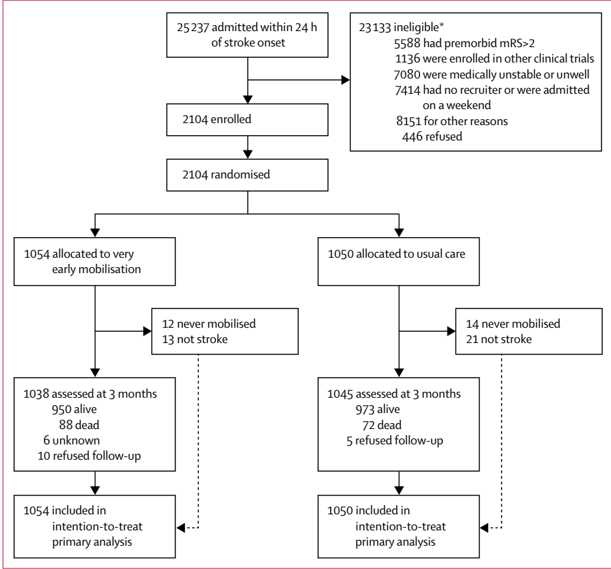
BACKGROUND: Early mobilisation after stroke is thought to contribute to the effects of stroke-unit care; however, the intervention is poorly defined and not underpinned by strong evidence. We aimed to compare the effectiveness of frequent, higher dose, very early mobilisation with usual care after stroke. METHODS: We did this parallel-group, single-blind, randomised controlled trial at 56 acute stroke units in five countries. Patients (aged ≥18 years) with ischaemic or haemorrhagic stroke, first or recurrent, who met physiological criteria were randomly assigned (1:1), via a web-based computer generated block randomisation procedure (block size of six), to receive usual stroke-unit care alone or very early mobilisation in addition to usual care. Treatment with recombinant tissue plasminogen activator was allowed. Randomisation was stratified by study site and stroke severity. Patients, outcome assessors, and investigators involved in trial and data management were masked to treatment allocation. The primary outcome was a favourable outcome 3 months after stroke, defined as a modified Rankin Scale score of 0-2. We did analysis on an intention-to-treat basis. The trial is registered with the Australian New Zealand Clinical Trials Registry, number ACTRN12606000185561. FINDINGS: Between July 18, 2006, and Oct 16, 2014, we randomly assigned 2104 patients to receive either very early mobilisation (n=1054) or usual care (n=1050); 2083 (99%) patients were included in the 3 month follow-up assessment. 965 (92%) patients were mobilised within 24 h in the very early mobilisation group compared with 623 (59%) patients in the usual care group. Fewer patients in the very early mobilisation group had a favourable outcome than those in the usual care group (n=480 [46%] vs n=525 [50%]; adjusted odds ratio [OR] 0·73, 95% CI 0·59-0·90; p=0·004). 88 (8%) patients died in the very early mobilisation group compared with 72 (7%) patients in the usual care group (OR 1·34, 95% CI 0·93-1·93, p=0·113). 201 (19%) patients in the very early mobilisation group and 208 (20%) of those in the usual care group had a non-fatal serious adverse event, with no reduction in immobility-related complications with very early mobilisation. INTERPRETATION: First mobilisation took place within 24 h for most patients in this trial. The higher dose, very early mobilisation protocol was associated with a reduction in the odds of a favourable outcome at 3 months. Early mobilisation after stroke is recommended in many clinical practice guidelines worldwide, and our findings should affect clinical practice by refining present guidelines; however, clinical recommendations should be informed by future analyses of dose-response associations. FUNDING: National Health and Medical Research Council, Singapore Health, Chest Heart and Stroke Scotland, Northern Ireland Chest Heart and Stroke, UK Stroke Association, National Institute of Health Research.
Overview
CoChat Summary
TL;DR
In AVERT, very early mobilisation (frequent, higher-dose out-of-bed activity within 24 h) reduced the odds of a favourable outcome at 3 months compared with usual care, with no significant difference in death or serious adverse events. The trial suggests an early, lower-dose usual-care activity regimen may be preferable to very early, frequent, higher-dose intervention.
Key findings
- 2104 patients were randomly assigned to very early mobilisation (n=1054) or usual care (n=1050); 2083 (99%) were included in the 3-month follow-up. 965 (92%) very early mobilisation patients were mobilised within 24 h versus 623 (59%) usual care patients; median time to first mobilisation was 18·5 h versus 22·4 h (median shift 4·8 h).
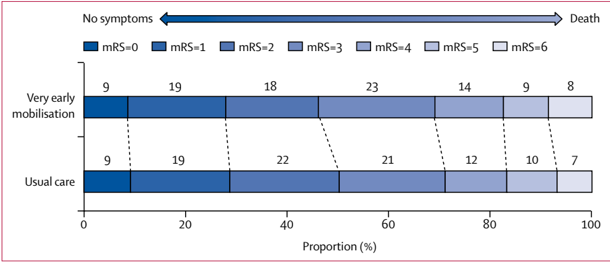
- The primary outcome, favourable modified Rankin Scale score 0–2 at 3 months, occurred in 480 (46%) very early mobilisation patients versus 525 (50%) usual care patients (adjusted OR 0·73, 95% CI 0·59–0·90; p=0·004). The ordinal modified Rankin Scale analysis was not significant (generalised OR 0·94, 95% CI 0·85–1·03; p=0·193).
- Death occurred in 88 (8%) very early mobilisation patients versus 72 (7%) usual care patients (OR 1·34, 95% CI 0·93–1·93; p=0·113). Non-fatal serious adverse events occurred in 201 (19%) versus 208 (20%) patients (IRR 0·88, 95% CI 0·72–1·07; p=0·194), with no reduction in immobility-related complications.
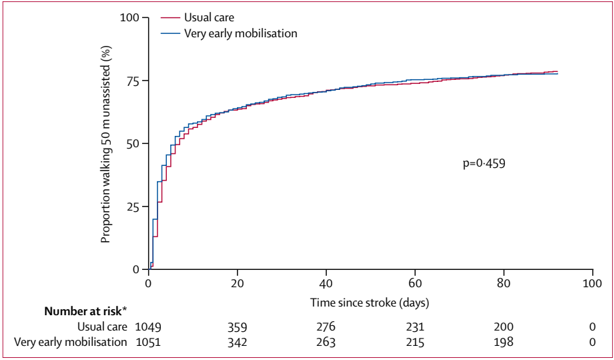
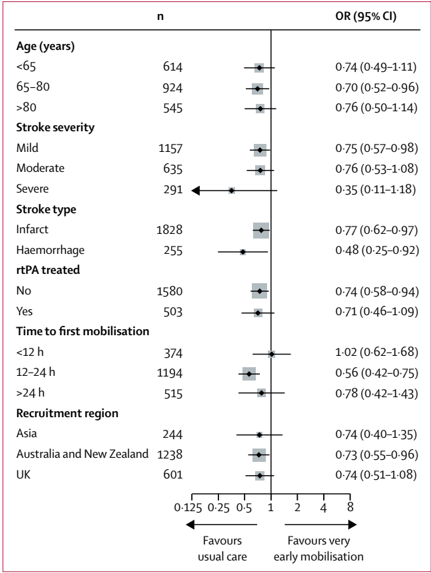
- There was no evidence of accelerated walking recovery: walking 50 m unassisted adjusted OR 0·83 (95% CI 0·64–1·07; p=0·143); time to walking unassisted HR 1·04 (95% CI 0·94–1·15; p=0·459). Prespecified subgroup analyses showed no significant interactions, though point estimates suggested reduced odds of favourable outcome in severe stroke and intracerebral haemorrhage subgroups with wide confidence intervals.
Methods
- Pragmatic, parallel-group, single-blind, multicentre, international randomised controlled trial at 56 acute stroke units in Australia, New Zealand, Malaysia, Singapore, and the UK. Eligible patients were aged ≥18 years with confirmed first or recurrent ischaemic or haemorrhagic stroke admitted to a stroke unit within 24 h of onset and meeting physiological criteria; exclusions included premorbid modified Rankin Scale score >2, early deterioration, and other serious medical instability.
- Patients were randomly assigned 1:1 via a secure, remote, web-based computer-generated block randomisation procedure (block size six), stratified by study site and baseline NIHSS stroke severity (mild 1–7, moderate 8–16, severe >16). The very early mobilisation intervention began within 24 h, focused on sitting, standing, and walking out-of-bed activity, and resulted in at least three additional out-of-bed sessions to usual care, with titrated dose for 14 days or until discharge.
- The primary outcome was favourable outcome at 3 months, defined as modified Rankin Scale score 0–2. Analysis was intention-to-treat; primary efficacy used binary logistic regression adjusted for baseline age and NIHSS. The trial was powered to detect an absolute risk reduction of poor outcome of 7·1% or greater, with a target sample of 2104 patients.
Limitations
- The paper states that large trials yield limited information about potential confounders such as physiological variables and about each staff–patient interaction, restricting but not preventing further detailed analyses.
- The pragmatic design did not prescribe usual care mobilisation practices, which changed significantly during the trial; usual care clinicians started mobilisation earlier each year, with roughly 60% of usual care patients starting out-of-bed therapy within 24 h. Whether this reflected contamination from the trial protocol, changing attitudes/guidelines, or both is uncertain.
- The study was not powered to detect subgroup differences; subgroup signals for severe stroke and intracerebral haemorrhage had wide confidence intervals and no significant interactions, so the paper advises caution. The text also notes the proportional hazards assumption was violated for the time-to-walking analysis, and missing data were handled under a missing-at-random assumption with sensitivity analyses.
Model-written summary. Check it against the paper before relying on it.
Integrity signals
Registry
Cites
Statistics
Figures
Verification
Claims the paper makes
2 Valid · 1 Not valid · 12 Not checked · 60 Own results and interpretations
A result the paper reports from its own data — it cites no other source for it, so there is none to check. The quote shows it is in the paper.
In the paper
“with no reduction in immobility-related complications with very early mobilisation.”
plainn = 2,104- Asserted: passes — The authors put it forward as true.
- Checkable: passes — It can be checked against evidence.
- Load-bearing: passes — The paper’s conclusions depend on it.
- Based: passes — The paper gives a reason why it holds.
A result the paper reports from its own data — it cites no other source for it, so there is none to check. The quote shows it is in the paper.
In the paper
“Frequency per person† | 6·5 (4·0-9·5) | 3 (2·0-4·5) | <0·0001 | 3 (3-3·5)”
plainstates a causen = 1,054 ·- Asserted: passes — The authors put it forward as true.
- Checkable: passes — It can be checked against evidence.
- Load-bearing: passes — The paper’s conclusions depend on it.
- Based: passes — The paper gives a reason why it holds.
A result the paper reports from its own data — it cites no other source for it, so there is none to check. The quote shows it is in the paper.
In the paper
“Total amount per person (min)§ | 201·5 (108-340) | 70 (32-130) | <0·0001 | 117 (107-128)”
plainstates a causen = 1,054 ·- Asserted: passes — The authors put it forward as true.
- Checkable: passes — It can be checked against evidence.
- Load-bearing: passes — The paper’s conclusions depend on it.
- Based: passes — The paper gives a reason why it holds.
A result the paper reports from its own data — it cites no other source for it, so there is none to check. The quote shows it is in the paper.
In the paper
“Time to first mobilisation (h) | 18·5 (12·8-22·3; n=1042*) | 22·4 (16·5-29·3; n=1036*) | <0·0001 | 4·8 (4·1-5·7)”
plainstates a causen = 1,042 ·- Asserted: passes — The authors put it forward as true.
- Checkable: passes — It can be checked against evidence.
- Load-bearing: passes — The paper’s conclusions depend on it.
- Based: passes — The paper gives a reason why it holds.
A result the paper reports from its own data — it cites no other source for it, so there is none to check. The quote shows it is in the paper.
In the paper
“Fewer patients in the very early mobilisation group had a favourable outcome than those in the usual care group (n=480 [46%] vs n=525 [50%]; adjusted odds ratio [OR] 0·73, 95% CI 0·59-0·90; p=0·004).”
- Also stated in: § Interpretation · plain
“Very early mobilisation was associated with a significant reduction in the odds of little or no disability at 3 months after stroke”
- Also stated in: § Statistical analysis · plain
“Favourable outcome‡ | 480 (46%) | 525 (50%) | 0·73 (0·59-0·90) | 0·004 | 0·85 (0·72-1·0) | 0·068”
plainstates an associationn = 480- Asserted: passes — The authors put it forward as true.
- Checkable: passes — It can be checked against evidence.
- Load-bearing: passes — The paper’s conclusions depend on it.
- Based: passes — The paper gives a reason why it holds.
- Also stated in: § Interpretation · plain
30 more claims
Create a free account to see all 75 claims and to verify the 1 reference still open.
- Probably not a substantial claim. 27
- It may state two separate claims as one. 22
Claims other papers make about this one
Each is checked against this paper’s own text: does it say what the citing paper says it does?
The cited source says what the claim attributes to it.
In the citing paper
“In the motor domain, the negative findings of the recent very large AVERT study on very early mobilisation in stroke [23] highlight the need to be cautious when making inferences from animal recovery data to human rehabilitation.”
From Aphasia Recovery: When, How and Who to Treat? (2018) · cites this paper as [23]
The cited source says what the claim attributes to it.
In the citing paper
“In our primary intention-to-treat analysis for A Very Early Rehabilitation Trial (AVERT), we reported that patients randomized to usual care had greater odds of a favorable outcome (modified Rankin Scale [mRS] score 0–2) at 3 months compared to those receiving the very early mobilization (VEM) protocol.1”
From Prespecified dose-response analysis for A Very Early Rehabilitation Trial (AVERT) (2016) · cites this paper as [1]
In the citing paper
“Our findings are in line with those of the A Very Early Rehabilitation Trial (AVERT) 7 whereby an increase in the intensity of ‘usual care’ services from pilot studies to the main study was reported and the Phase III trial was subsequently negative.”
From A randomized control trial of intensive aphasia therapy after acute stroke: The Very Early Rehabilitation for SpEech (VERSE) study (2021) · cites this paper as [7]
Self-check
Percentages, sums and reported differences re-computed from the paper’s own numbers.
Each contradiction between two passages listed here was confirmed by an independent check.
Rated minor: it would not touch a result — a value no result rests on, a p-value that stays on the same side of the significance level, or a conflict that is clerical, resolved elsewhere in the paper, or outside its own findings.
In the paper
§ Randomisation and masking
“mild (NIHSS 1-7), moderate (8-16), and severe (>16).”
§ Statistical analysis
“stroke severity (mild: NIHSS<7; moderate: 8-16; and severe: >16)”
Rated minor: it would not touch a result — a value no result rests on, a p-value that stays on the same side of the significance level, or a conflict that is clerical, resolved elsewhere in the paper, or outside its own findings.
In the paper
“| Diabetes mellitus | 239 (23%) | 228 (21%) |”
Reported 21 · recomputed 21.714286
Citations
Cites
Interobserver agreement for the assessment of handicap in stroke patients
van Swieten, J. C., Koudstaal, P. J., Visser, M. C., Schouten, H. J., & van Gijn, J. (1988) · Stroke · doi:10.1161/01.str.19.5.604 · Cited by 6,512
Plasticity during stroke recovery: from synapse to behaviour
Murphy, T. H., & Corbett, D. (2009) · Nature Reviews Neuroscience · doi:10.1038/nrn2735 · Cited by 1,938
Medical Complications After Stroke: A Multicenter Study
Langhorne, P., Stott, D. J., Robertson, L., MacDonald, J., Jones, L., McAlpine, C., Dick, F., Taylor, G. S., & Murray, G. (2000) · Stroke · doi:10.1161/01.str.31.6.1223 · Cited by 1,196
Strategy for intention to treat analysis in randomised trials with missing outcome data
White, I. R., Horton, N. J., Carpenter, J., statistics, R. I. M. A. S., & Pocock, S. J. (2011) · BMJ · doi:10.1136/bmj.d40 · Cited by 849
Bernhardt (2004) · doi:10.1161/01.str.0000120727.40792.40 · Cited by 593
Getting Neurorehabilitation Right: What Can Be Learned From Animal Models?
Krakauer, J. W., Carmichael, S. T., Corbett, D., & Wittenberg, G. F. (2012) · Neurorehabilitation and Neural Repair · doi:10.1177/1545968312440745 · Cited by 591
Bed rest: a potentially harmful treatment needing more careful evaluation
Allen, C., Glasziou, P., & Mar, C. D. (1999) · The Lancet · doi:10.1016/s0140-6736(98)10063-6 · Cited by 480
Treatment in a Combined Acute and Rehabilitation Stroke Unit: Which Aspects Are Most Important?
Indredavik, B., Bakke, F., Slørdahl, S. A., Rokseth, R., & Håheim, L. L. (1999) · Stroke · doi:10.1161/01.str.30.5.917 · Cited by 368
A Very Early Rehabilitation Trial for Stroke (AVERT): Phase II Safety and Feasibility
Bernhardt, J., Dewey, H., Thrift, A., Collier, J., & Donnan, G. (2008) · Stroke · doi:10.1161/strokeaha.107.492363 · Cited by 366
Cumming, T. B., Thrift, A. G., Collier, J. M., Churilov, L., Dewey, H. M., Donnan, G. A., & Bernhardt, J. (2011) · Stroke · doi:10.1161/strokeaha.110.594598 · Cited by 281
Cited by
Items 501–600 of 781
Kulesh, A. A. (2019) · Neurology neuropsychiatry Psychosomatics · doi:10.14412/2074-2711-2019-3-99-103 · Cited by 3
Physiotherapeutic Management of Critically Ill Neurological Patients
Aggarwal, R., & Dua, V. (2019) · Springer eBooks · doi:10.1007/978-981-13-3390-3_19 · Cited by 3
Stroke: two steps forward, one step sideward
Michel, P. (2015) · Current Opinion in Neurology · doi:10.1097/wco.0000000000000291 · Cited by 7
Kramer, S. F., Cumming, T. B., Johnson, L. G., Churilov, L. P., & Bernhardt, J. A. (2020) · Journal of Stroke and Cerebrovascular Diseases · doi:10.1016/j.jstrokecerebrovasdis.2020.105359 · Cited by 4
Adaptación lingüística y cultural del Oxford Cognitive Screen (OCS) en población española
García-Manzanares, M. D., Pérez, A. S., Alfaro, A., Gras, R. M. L., Sunyer-Catllà, M., & López-Roig, S. (2020) · Neurología · doi:10.1016/j.nrl.2019.11.004 · Cited by 4
Maffassanti-Reyes, M., González-Sierra, M., & Javier-Ormazábal, A. (2025) · Healthcare · doi:10.3390/healthcare14010078 · Cited by 7
(2017) · doi:10.1016/j.mpmed.2016.12.008 · Cited by 3
Early Mobilization Post Acute Stroke Thrombolysis and/or Thrombectomy Survey
Silver, B., Demers-Peel, M., Alexandrov, A. W., Selim, M. H., & Bernhardt, J. A. (2022) · The Neurohospitalist · doi:10.1177/19418744221138890 · Cited by 3
Development of motor learning implementation for ischemic stroke: finding expert consensus
Rahayu, U. B., Wibowo, S., & Setyopranoto, I. (2017) · Journal of the Medical Sciences (Berkala Ilmu Kedokteran) · doi:10.19106/jmedsci004904201706 · Cited by 3
Johns, H. T., Campbell, B. C. V., Bernhardt, J. A., & Churilov, L. P. (2022) · Statistical Methods in Medical Research · doi:10.1177/09622802221146306 · Cited by 5
Yazdani, M., Chitsaz, A., Zolaktaf, V., Saadatnia, M., Ghasemi, M., Nazari, F., Chitsaz, A., Suzuki, K., & Nobarı, H. (2022) · Brain Sciences · doi:10.3390/brainsci12070816 · Cited by 4
Chaves, M. A. L., Gittins, M., Bray, B., Vail, A., & Smith, C. J. (2022) · Frontiers in Neurology · doi:10.3389/fneur.2022.875893 · Cited by 4
Hammerbeck, U., Balancy, P., Gittins, M., & Parry‐Jones, A. (2025) · Journal of Stroke and Cerebrovascular Diseases · doi:10.1016/j.jstrokecerebrovasdis.2025.108266 · Cited by 4
Maso, I., Luvizutto, G. J., Miranda, J. M. D. A., do Nascimento, C. F., Miranda, L. A., Pinto, E. B., dos Santos, F. M. K., Souza, R. M., Moro, C. H. C., Bazán, R., et al. (2025) · Arquivos de Neuro-Psiquiatria · doi:10.1055/s-0045-1806924 · Cited by 6
Cerebral hemodynamic response to upright position in acute ischemic stroke
Carvalho, L. B., Kaffenberger, T., Chambers, B. R., Borschmann, K., Levi, C. R., Churilov, L. P., Thijs, V., & Bernhardt, J. A. (2024) · Frontiers in Neurology · doi:10.3389/fneur.2024.1392773 · Cited by 4
Pugliese, M., Wilson, K. R., Guerinet, J., Atkinson, K. M., Mallet, K. H., Shamloul, R. M., Zakutney, L., Corbett, D., & Dowlatshahi, D. D. (2017) · International Journal of Interactive Mobile Technologies (iJIM) · doi:10.3991/ijim.v11i1.6234 · Cited by 7
Pathansali, R. (2015) · Springer eBooks · doi:10.1007/978-3-319-17855-4_6 · Cited by 2
Savage, W., & Harel, N. Y. (2022) · Neurorehabilitation and neural repair · doi:10.1177/15459683221124112 · Cited by 3
Nakao, M., Banno, M., Kataoka, Y., & Taito, S. (2020) · Frontiers in Neurology · doi:10.3389/fneur.2020.00182 · Cited by 2
Kaffenberger, T., Bernhardt, J. A., Koehler, J. L., Ziegler, P., & Thijs, V. (2021) · Annals of Physical and Rehabilitation Medicine · doi:10.1016/j.rehab.2021.101540 · Cited by 6
Reducing the impact of stroke and improving public health
Hankey, G. J., & Gorelick, P. B. (2019) · Wiley eBooks · doi:10.1002/9781118492390.ch20 · Cited by 4
Controle postural e risco de quedas em pacientes com AVC agudo trombolisado
Corradini, S., do Nascimento, C. F., de Castro, I. P. R., dos Santos, D. F., & dos Anjos, J. L. M. (2021) · Revista Neurociências · doi:10.34024/rnc.2021.v29.12143 · Cited by 2
Die Schlaganfallrehabilitation der Zukunft voranbringen: Was sind die nächsten Schritte?
Kwakkel, G. (2019) · neuroreha · doi:10.1055/a-0829-5661 · Cited by 2
Mancuso, M., Iosa, M., Morone, G., Bartolo, D. D., Ciancarelli, I., & Cogniremo Study Group Cogniremo Study Group (2025) · Healthcare · doi:10.3390/healthcare13030316 · Cited by 4
Kugler, H. L., Brusco, N. K., Slade, S. C., et al. (2024) · Focus on Health Professional Education A Multi-Professional Journal · doi:10.11157/fohpe.v25i1.656 · Cited by 2
Smith, M., Scrivener, B. J., & Stinear, C. M. (2026) · Neurorehabilitation and neural repair · doi:10.1177/15459683261417638 · Cited by 3
Rehabilitation nach Schlaganfall
Dohle, C. (2021) · DMW - Deutsche Medizinische Wochenschrift · doi:10.1055/a-1221-7126 · Cited by 5
Rehabilitation and Recovery Processes
Williams, J., & Pryor, J. (2019) · Wiley eBooks · doi:10.1002/9781119581161.ch9 · Cited by 2
Lima, F. D. S., Carvalho, V. D. S., Souto, I. B., & Fontana, A. P. (2022) · Frontiers in Rehabilitation Sciences · doi:10.3389/fresc.2022.864907 · Cited by 3
Coelho, T. S., Bitencourt, A. C. S., Bazán, R., de Souza, L. A. P. S., & Luvizutto, G. J. (2021) · Journal of Bodywork and Movement Therapies · doi:10.1016/j.jbmt.2021.05.018 · Cited by 2
Finally, a time and place for electrophysiological testing in critically ill patients?
Fan, E., & Herridge, M. S. (2015) · Intensive Care Medicine · doi:10.1007/s00134-015-4083-8 · Cited by 2
Ghazali, S. E., Nordin, N. A. M., & Vasu, D. T. (2025) · PLoS ONE · doi:10.1371/journal.pone.0333386 · Cited by 4
Cultural and linguistic adaptation of the Oxford Cognitive Screen to the Spanish population
García-Manzanares, M. D., Pérez, A. S., Alfaro, A., Gras, R. M. L., Sunyer-Catllà, M., & López-Roig, S. (2021) · Neurología (English Edition) · doi:10.1016/j.nrleng.2019.11.005 · Cited by 2
Charlier, F., & Morgan, P. E. (2025) · Topics in Stroke Rehabilitation · doi:10.1080/10749357.2025.2532413 · Cited by 2
Koumo, M., Maki, Y., Goda, A., Uchida, K., Ogawa, S., Matsui, T., Hidemura, N., & Adachi, T. (2023) · Geriatrics · doi:10.3390/geriatrics8040080 · Cited by 3
Lee, K.-H., Jeong, E.-H., & Joa, K.-L. (2022) · American Journal of Physical Medicine & Rehabilitation · doi:10.1097/phm.0000000000001968 · Cited by 2
Mobilization for Persons With Acute Stroke: A Survey of Current Physical Therapy Clinical Practice
Anderson, H. D., & Biely, S. A. (2019) · Journal of Acute Care Physical Therapy · doi:10.1097/jat.0000000000000116 · Cited by 2
Mathews, N. G., Cuschieri, A., Darwazeh, M., Sisi, A. A., Krishnan, K., & Darwazeh, R. (2025) · Surgery Case Reports · doi:10.1016/j.sycrs.2025.100142 · Cited by 2
Multidisciplinary Collaboration
(2018) · doi:10.1007/978-3-319-76391-0_5 · Cited by 2
The A2F ICU Liberation Bundle in Neurocritical Care
Reznik, M. E., Steinberg, A., Shutter, L., & Girard, T. D. (2023) · Current Treatment Options in Neurology · doi:10.1007/s11940-023-00770-7 · Cited by 4
Neurorecovery after Critical COVID-19 Illness
Alabsi, H. S., Emerson, K., & Lin, D. J. (2023) · Seminars in Neurology · doi:10.1055/s-0043-1768714 · Cited by 2
Gururaj, S., Natarajan, M., Balasubramanian, C. K., & Solomon, J. M. (2021) · Neurorehabilitation · doi:10.3233/nre-210013 · Cited by 2
The hazards of chasing subgroups in neutral stroke trials
Bath, P. M., Howard, G., & Hacke, W. (2025) · Neurological Research and Practice · doi:10.1186/s42466-025-00369-0 · Cited by 3
Hoshino, T., Oguchi, K., Hoshino, A., & Hoshiyama, M. (2023) · International Journal of Therapy and Rehabilitation · doi:10.12968/ijtr.2021.0033 · Cited by 2
Intensive speech therapy after stroke
Markus, H. S. (2021) · International Journal of Stroke · doi:10.1177/17474930211027503 · Cited by 5
Verma, S. J., Gulati, P., Ratra, S., & Pandian, J. D. (2023) · Journal of Stroke Medicine · doi:10.1177/25166085221150411 · Cited by 3
Kamo, A., Nozoe, M., Kubo, H., & Shimada, S. (2022) · Journal of Stroke and Cerebrovascular Diseases · doi:10.1016/j.jstrokecerebrovasdis.2022.106493 · Cited by 2
Comparison of early and delayed rehabilitation outcomes in patients at the intensive care unit
Александрович, А. С., Serezhechkin, A. V., Владимирович, Б. М., & Klypa, T. V. (2020) · Russian Journal of Anesthesiology and Reanimatology · doi:10.17116/anaesthesiology202006151 · Cited by 3
A call to revolutionise acute stroke care and research
Sandercock, P. A. G. (2015) · The Lancet Neurology · doi:10.1016/s1474-4422(15)00088-5 · Cited by 2
Watanabe, S., Yamauchi, W., Shoka, K., Kawashima, A., Sawamura, S., Kanamori, K., Furukawa, T., Naito, Y., Takeshita, N., Utiyama, K., et al. (2025) · Journal of Clinical Medicine · doi:10.3390/jcm14196786 · Cited by 2
Palliative care approaches to acute stroke in the hospital setting
Greenway, M. R. F., & Robinson, M. T. (2023) · Handbook of clinical neurology · doi:10.1016/b978-0-12-824535-4.00010-0 · Cited by 4
Beretta, S., Carone, D., Cho, T., Viganò, M., Diamanti, S., Mariani, J., Pedrazzini, F., Bianchi, E., Pini, C., Bolbos, R. I., et al. (2025) · Experimental Neurology · doi:10.1016/j.expneurol.2025.115343 · Cited by 2
Nutritional support in the early stage of critical illness - focused on energy and protein intake
Kula, R., Kula, R., Charwátová, D., & Sušková, T. (2021) · Vnitřní lékařství · doi:10.36290/vnl.2021.016 · Cited by 2
Gadsden, T., Si, L., Atkins, E., Carcel, C., Wang, X., Jan, S., Woodward, M., & Downey, L. E. (2025) · The Medical Journal of Australia · doi:10.5694/mja2.52701 · Cited by 2
Naito, Y., Morishima, N., Oyama, H., & Iwai, K. (2022) · Journal of Stroke and Cerebrovascular Diseases · doi:10.1016/j.jstrokecerebrovasdis.2022.106592 · Cited by 4
Neurorehabilitation Practice for Stroke Patients
Mehrholz, J. (2019) · Cambridge University Press eBooks · doi:10.1017/9781108659574.026 · Cited by 3
The 6th Annual Acute Care Lecture Award: Survival Is Not Enough
Hakim, E. W. (2016) · Journal of Acute Care Physical Therapy · doi:10.1097/jat.0000000000000047 · Cited by 1
Louie, D. R. (2021) · cIRcle (University of British Columbia) · doi:10.14288/1.0396078 · Cited by 3
Motorische Neurorehabilitation
Rohrbach, N., & Hermsdörfer, J. (2023) · Springer eBooks · doi:10.1007/978-3-662-53410-6_67 · Cited by 1
Interventions to Improve Recovery After Stroke
Liew, S., Lin, D. J., & Cramer, S. C. (2021) · Elsevier eBooks · doi:10.1016/b978-0-323-69424-7.00061-2 · Cited by 1
Ebinger, M., Nave, A. H., Rackoll, T., & Flöel, A. (2019) · DGNeurologie · doi:10.1007/s42451-019-00143-y · Cited by 1
Wang, Q., Tong, Y., Ding, Y., Weiss, A., Fayyaz, A. I., & Geng, X. (2025) · Experimental Neurology · doi:10.1016/j.expneurol.2025.115568 · Cited by 2
Les études pilotes et les études de faisabilité en réadaptation : la prochaine décennie
Kho, M. E., & Thabane, L. (2020) · Physiotherapy Canada · doi:10.3138/ptc-72-3-gef2 · Cited by 1
Inoue, H., Kawano, T., Iwasaki, Y., Imada, I., Yamada, K., Tashima, K., Muta, D., Yamamoto, K., & Mukasa, A. (2023) · Surgical Neurology International · doi:10.25259/sni_1110_2022 · Cited by 1
Stroke and atrial fibrillation: better detection, effects on infarct evolution and outcome
Tu, H. T. H. (2018) · Minerva Access (University of Melbourne) · Cited by 1
Thromboprophylaxis and Seizure Management in Intracerebral Hemorrhage
Kargiotis, O., Tsivgoulis, G. K., & Suárez, J. I. (2018) · Springer eBooks · doi:10.1007/978-3-319-77063-5_5 · Cited by 1
Progressive Mobility Program in a Neuro-ICU: What Makes It Different?
Zink, E. K., & Geocadin, R. G. (2017) · Critical Care Medicine · doi:10.1097/ccm.0000000000002455 · Cited by 1
Kumar, S., Singh, A. K., & Dhiman, S. (2018) · doi:10.37591/rrjon.v8i1.261 · Cited by 1
Best Medical Management for Acute Ischemic Stroke
Shaban, A., & Leira, E. C. C. (2019) · Springer eBooks · doi:10.1007/978-3-030-17535-1_1 · Cited by 1
Neurorehabilitation for upper limb recovery after stroke: The use of non-invasive brain stimulation
van Lieshout, E. C. (2021) · Utrecht University Repository (Utrecht University) · doi:10.33540/420 · Cited by 2
Advances in the Management of Transient Ischaemic Attack and Stroke
Montalvo, M., Siket, M. S., Jayaraman, M. V., Yaghi, S. R., & Silver, B. (2016) · EMJ Neurology · doi:10.33590/emjneurol/10310035 · Cited by 3
İnme Sonrası Erken Mobilizasyon Hakkında Profesyonel Görüşlerin İncelenmesi
Salcı, Y., Balkan, A. F., Ceren, A. N., Karanfil, E., Çetin, B., CENGİZ, M. S., Uca, A. U., & Armutlu, K. (2019) · Dicle Medical Journal / Dicle Tip Dergisi · doi:10.5798/dicletip.540016 · Cited by 2
Design and Implementation of a Novel Rehabilitation Robot for Acute Stroke Patients
Berezny, N. (2019) · Carleton University's Institutional Repository (MacOdrum Library, Carleton University) · doi:10.22215/etd/2019-13725 · Cited by 3
Perspectives of inpatient neurological rehabilitation in elderly patients
MUREȘAN, D. A., Stănescu, I., Bulboacă, A. E., Fodor, D. M., & BULBOACĂ, A. I. (2019) · Balneo Research Journal · doi:10.12680/balneo.2019.287 · Cited by 1
Mobilização Precoce Pós Acidente Vascular Cerebral: Revisão Integrativa
dos Anjos, J. L. M., Oliveira, L. C., Lopes, L. R. R., & Durães, A. R. (2021) · Revista Neurociências · doi:10.34024/rnc.2021.v29.11225 · Cited by 4
Bedoucha, L., Gobron, C., Vallée, F., Gayat, É., Reiner, P., Sabben, C., Obadia, M., Boursin, P., Dubus, E., Jouvent, É., et al. (2025) · Brain and Behavior · doi:10.1002/brb3.70901
Turner, N., Pickering, D. M., & Jones, K. (2020) · Physiotherapy Theory and Practice · doi:10.1080/09593985.2020.1799462 · Cited by 2
The Effect of Early Mobilization on Functional Status of Stroke Patients: A Literature Review
Mustikaningrum, R. E., Handayani, F., Hastuti, Y. D., Latumanuwij, R., & Fieten, M. (2023) · Holistic Nursing and Health Science · doi:10.14710/hnhs.6.1.2023.43-57 · Cited by 2
Golestani, A., Eslami, Z., Gholamalipor, S., Milani, M., & Mirghani, S. J. (2026) · Journal of Science in Sport and Exercise · doi:10.1007/s42978-025-00359-3 · Cited by 1
Khamis, M., Almoosa, Z., Santos, M., Kamal, E. D., Yaghmor, S., Daniyal, M., & Mutair, A. S. A. (2025) · BMC Health Services Research · doi:10.1186/s12913-025-13272-w · Cited by 2
Yanase, L. R., Clark, D. K., Baraban, E., & Stuchiner, T. L. (2023) · Journal of Neuroscience Nursing · doi:10.1097/jnn.0000000000000731 · Cited by 2
la Cruz, S. P. (2025) · Medicina · doi:10.3390/medicina61071185 · Cited by 1
Wang, D., Li, L., Jiang, J., Zhang, Q., Liu, M., Liu, Y., Zhao, H., & Fang, Q. (2020) · European Journal of Clinical Pharmacology · doi:10.1007/s00228-020-02905-0 · Cited by 2
Head Positioning in Acute Stroke
Anderson, C. S., Robinson, T., & Watkins, C. L. (2017) · New England Journal of Medicine · doi:10.1056/nejmc1709517 · Cited by 1
Benayas, E., Madroñero-Mariscal, R., Martín, Y. P., Rodríguez-Alfaro, J. A., Mazarío, J., Espinosa, F. M., Garcia, R. A., Polo, J. L., González‐Mayorga, A., López‐Dolado, E., et al. (2026) · Biomaterials · doi:10.1016/j.biomaterials.2026.124164 · Cited by 1
Early Mobility—Multimodal Effects on Function
Lanphere, J. A. (2024) · Springer eBooks · doi:10.1007/978-3-031-42830-2_16 · Cited by 1
O’Grady, H. K., Ball, I. M., Berney, S. C., Burns, K. E. A., Cook, D. J., Fox‐Robichaud, A., Herridge, M. S., Karachi, T., Mathur, S., Reid, J. C., et al. (2024) · Canadian Journal of Anesthesia/Journal canadien d anesthésie · doi:10.1007/s12630-024-02838-7 · Cited by 2
Treinamento orientado à tarefa e fisioterapia convencional na recuperação motora no pós-AVC
Ribeiro, T. G., Paz, C. C. D. S. C., de Alencar, R. C., & Costa, Y. A. (2020) · Revista Neurociências · doi:10.34024/rnc.2020.v28.10571 · Cited by 1
MASHIKO, H., Kato, D., Kaneko, A., YOUNG, H., & IKEZAWA, R. (2026) · Physical Therapy Research · doi:10.1298/ptr.25-e10384
Metadata
- Venue
- The Lancet
- Publisher
- Elsevier BV
- Published
- 2015-07
- Volume
- 386
- Issue
- 9988
- Pages
- 46-55
- ISSN
- 0099-5355 (ISSN-L)
- 0140-6736
- OpenAlex
- W2096535216
- Semantic Scholar
- ab0a77142567bf8ff450d29579f23bdb9b7ed6e5
- Cited by
- 789
- References
- 26
- Citations by year
- 2026: 55 · 2025: 58 · 2024: 44 · 2023: 57 · 2022: 79 · 2021: 93 · 2020: 87 · 2019: 77 · 2018: 72 · 2017: 75 · 2016: 67 · 2015: 24
- FWCI
- 79.96
- Type
- journal article
- Language
- en
- Open access
- hybrid
- doi.org
- Licence
- cc-by-nc-nd
- www.elsevier.com/tdm/userlicense/1.0/ (tdm)
- creativecommons.org/licenses/by-nc-nd/4.0/ (vor)
- Locations
- The Lancet (publishedVersion, cc-by-nc-nd)
- PubMed (publishedVersion)
- ENLIGHTEN (Jurnal Bimbingan dan Konseling Islam) (acceptedVersion)
- Monash University Research Portal (Monash University) (submittedVersion, cc-by-nc-nd)
- Figshare (submittedVersion, cc-by)
- Minerva Access (University of Melbourne) (submittedVersion, cc-by-nc-nd)
- Funders
- National Health and Medical Research Council (NHMRC) of Australia (grant numbers 386201 and 1041401)
- Topics
- Health Sciences › Medicine › Rehabilitation › Stroke Rehabilitation and Recovery
- Health Sciences › Medicine › Clinical Neurology › Acute Ischemic Stroke Management
- Health Sciences › Health Professions › Speech and Hearing › Dysphagia Assessment and Management
- Keywords
- stroke, acute stroke, ischemic stroke, hemorrhagic stroke, stroke unit care, functional outcome, modified Rankin Scale, mortality, stroke rehabilitation, thrombolysis, tissue plasminogen activator, stroke severity
- MeSH terms
- Stroke Rehabilitation, Aged, Aged, 80 and over, Early Ambulation, Female, Follow-Up Studies, Humans, Male, Middle Aged, Severity of Illness Index, Time Factors, Single-Blind Method, Walking, Treatment Outcome, Recovery of Function, Stroke
About these checks
Registry, retraction, Cites and statistics results are computed, not judged, with one exception: a printed reference that no index lists is read once by a model before it counts as a citation error. Claims are extracted by a model and kept only when their quote appears verbatim in the text; each cited source is then checked, with a model’s help, for whether it says what the claim relies on. Those verdicts can be wrong — read the claim’s quote and the cited source before relying on one.
A language model drew the claims from the paper on 2026-10-11, under version 3 of the claim definition (model deepseek-v4.1-flash, prompt extract-v3).
A second model labelled each claim on 2026-10-11 (model jev-1.13-20260917, definition revision gold-guideline-v0.2).
Statistics and arithmetic are recomputed, not judged.
Confidence bands are shown only for fields calibrated on our annotated test set. None is calibrated yet, so no band is shown.
What counts as a claim ›How we measure confidence ›How we check this ›
Are you an author, or do you see a problem with this page? Request a review
Data sources
Bibliographic data: Semantic Scholar, OpenAlex, Crossref.
Contains information from the Semantic Scholar Academic Graph Datasets, made available under the ODC Attribution License (ODC-BY 1.0).
Semantic Scholar’s data is described in: Kinney, R., et al. (2023). The Semantic Scholar Open Data Platform. arXiv:2301.10140.
