

Parent-mediated social communication therapy for young children with autism (PACT): long-term follow-up of a randomised controlled trial
Open accessThe DOI matches its Crossref record; 31 of the 31 references it cites were found in a registry or an index.
Abstract
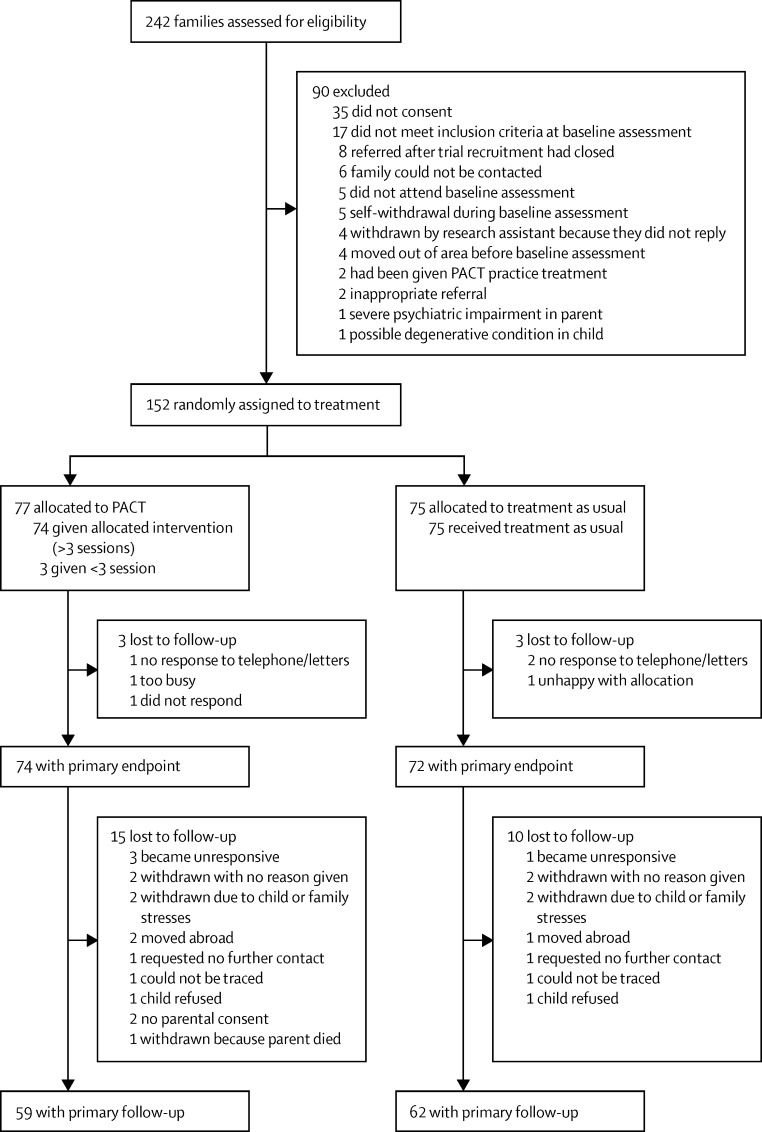
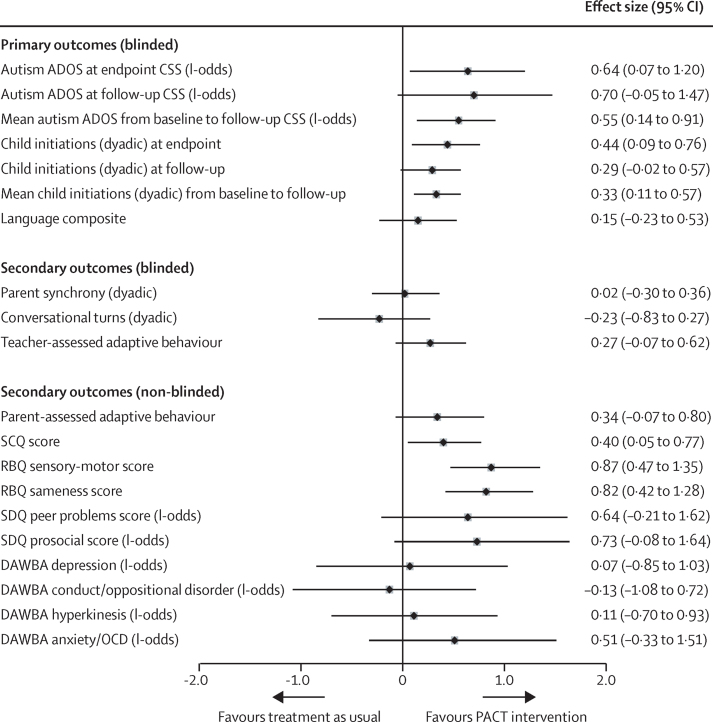
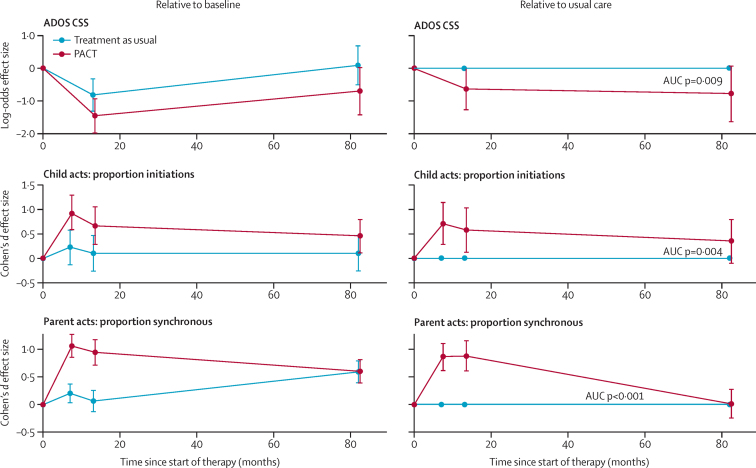
BACKGROUND: It is not known whether early intervention can improve long-term autism symptom outcomes. We aimed to follow-up the Preschool Autism Communication Trial (PACT), to investigate whether the PACT intervention had a long-term effect on autism symptoms and continued effects on parent and child social interaction. METHODS: PACT was a randomised controlled trial of a parent-mediated social communication intervention for children aged 2-4 years with core autism. Follow-up ascertainment was done at three specialised clinical services centres in the UK (London, Manchester, and Newcastle) at a median of 5·75 years (IQR 5·42-5·92) from the original trial endpoint. The main blinded outcomes were the comparative severity score (CSS) from the Autism Diagnostic Observation Schedule (ADOS), the Dyadic Communication Assessment Measure (DCMA) of the proportion of child initiatiations when interacting with the parent, and an expressive-receptive language composite. All analyses followed the intention-to-treat principle. PACT is registered with the ISRCTN registry, number ISRCTN58133827. FINDINGS: 121 (80%) of the 152 trial participants (59 [77%] of 77 assigned to PACT intervention vs 62 [83%] of 75 assigned to treatment as usual) were traced and consented to be assessed between July, 2013, and September, 2014. Mean age at follow-up was 10·5 years (SD 0·8). Group difference in favour of the PACT intervention based on ADOS CSS of log-odds effect size (ES) was 0·64 (95% CI 0·07 to 1·20) at treatment endpoint and ES 0·70 (95% CI -0·05 to 1·47) at follow-up, giving an overall reduction in symptom severity over the course of the whole trial and follow-up period (ES 0·55, 95% CI 0·14 to 0·91, p=0·004). Group difference in DCMA child initiations at follow-up showed a Cohen's d ES of 0·29 (95% CI -0.02 to 0.57) and was significant over the course of the study (ES 0·33, 95% CI 0·11 to 0·57, p=0·004). There were no group differences in the language composite at follow-up (ES 0·15, 95% CI -0·23 to 0·53). INTERPRETATION: The results are the first to show long-term symptom reduction after a randomised controlled trial of early intervention in autism spectrum disorder. They support the clinical value of the PACT intervention and have implications for developmental theory. FUNDING: Medical Research Council.
Overview
The claims and statistics of this paper haven’t been checked yet.
Free: it reads the open-access text and checks the first 5 claims that cite a source we can check. Create a free account to check every claim.
Integrity signals
Registry
Cites
Statistics
Figures
Verification
Claims the paper makes
The claims and statistics of this paper haven’t been checked yet.
Free: it reads the open-access text and checks the first 5 claims that cite a source we can check. Create a free account to check every claim.
Claims other papers make about this one
Each is checked against this paper’s own text: does it say what the citing paper says it does?
The source backs part of the claim, not all of it — or backs it for a different population, condition or comparison.
In the citing paper
“social skills training programs for which moderate evidence of benefit exists 186,187 .”
From Autism spectrum disorder (2020) · cites this paper as [186]
Experimental — accuracy not yet measured
Self-check
Percentages, sums and reported differences re-computed from the paper’s own numbers.
The self-check needs the paper’s full text.
Citations
Cites
1 retracted
Christensen, D. L., Baio, J., Braun, K. V. N., Bilder, D., Charles, J., Constantino, J. N., Daniels, J., Durkin, M. S., Fitzgerald, R. T., Kurzius-Spencer, M., et al. (2016) · MMWR. Surveillance Summaries · doi:10.15585/mmwr.ss6503a1 · Cited by 1,964
RetractedThe Strengths and Difficulties Questionnaire: A research note
Goodman, R. (1997) · Journal of Child Psychology and Psychiatry · doi:10.1111/j.1469-7610.1997.tb01545.x · Cited by 14,908
Lord, C., Rutter, M., & Le Couteur, A. (1994) · Journal of Autism and Developmental Disorders · doi:10.1007/bf02172145 · Cited by 9,065
Lord, C., Risi, S., Lambrecht, L., Cook, E. H., Leventhal, B. L., DiLavore, P. C., Pickles, A., & Rutter, M. (2000) · Journal of Autism and Developmental Disorders · doi:10.1023/a:1005592401947 · Cited by 7,520
Self-citationDawson, G., Rogers, S., Munson, J., Smith, M., Winter, J., Greenson, J., Donaldson, A., & Varley, J. (2010) · Pediatrics · doi:10.1542/peds.2009-0958 · Cited by 2,835
Baird, G., Simonoff, E., Pickles, A., Chandler, S., Loucas, T., Meldrum, D., & Charman, T. (2006) · The Lancet · doi:10.1016/s0140-6736(06)69041-7 · Cited by 2,104
Self-citationAutism Diagnostic Observation Schedule
Lord, C., Rutter, M., Goode, S., Heemsbergen, J., Jordan, H., Mawhood, L., & Schopler, E. (2016) · PsycTESTS Dataset · doi:10.1037/t54175-000 · Cited by 1,678
Standardizing ADOS Scores for a Measure of Severity in Autism Spectrum Disorders
Gotham, K., Pickles, A., & Lord, C. (2009) · Journal of Autism and Developmental Disorders · doi:10.1007/s10803-008-0674-3 · Cited by 1,605
Self-citationCosts of Autism Spectrum Disorders in the United Kingdom and the United States
Buescher, A. V. S., Cidav, Z., Knapp, M., & Mandell, D. S. (2014) · JAMA Pediatrics · doi:10.1001/jamapediatrics.2014.210 · Cited by 1,296
Long-term outcome for children with autism who received early intensive behavioral treatment.
McEachin, J. J., Smith, T. H., & Lövaas, O. I. (1993) · PubMed · Cited by 1,089
Research works printed but not linked: 3
- NICE Autism spectrum disorder in under 19s: support and management. Clinical guideline 170 2013 National Institute for Health and Care Excellence https://www.nice.org.uk/guidance/cg170 (accessed Jan 31, 2016). 34283415
- Semel E Wiig E Secord W Clinical evaluation of language fundamentals, 7th edn, Australian standardised edn (CELF-4 Australian) 2006 Pearson Sydney
- Brownell R Receptive and expressive one-word picture vocabulary tests, 4th edn (ROWPVT-4, EOWPVT-4) 2010 Pearson Education San Antonio
Cited by
Items 201–300 of 526
Stewart, S. L., Celebre, A., Iantosca, J. A. M., & Poss, J. W. (2021) · Frontiers in Psychiatry · doi:10.3389/fpsyt.2021.709491 · Cited by 18
Father–Child Interactions in Preschool Children with ASD: A Systematic Review
Perzolli, S., Bentenuto, A., Bertamini, G., de Falco, S., & Venuti, P. (2021) · Brain Sciences · doi:10.3390/brainsci11091202 · Cited by 24
“In fact, better caregiver–child mutual attunement is associated with long-term symptom reduction [31], and to a better generalization of the outcomes across different settings [32].”
BackgroundBrefort, E., Saint-Georges-Chaumet, Y., Cohen, D., & Saint‐Georges, C. (2022) · BMC Pediatrics · doi:10.1186/s12887-022-03431-x · Cited by 17
“Parent-mediated social communication therapy for young children with autism (PACT) is an approach aiming to optimize parental interactive behaviour to improve parent-child interaction and increase child communication through filmed parent-child play sessions [5].”
BackgroundInfluentialFreeman, N. C., & Paradis, P. (2022) · Autism · doi:10.1177/13623613221129830 · Cited by 24
“To date, only one study has focused specifically on the parental experience of obtaining a diagnosis in girls with autism (Rabbitte et al., 2017).”
BackgroundResultByrne, K., Sterrett, K., Holbrook, A., Kim, S. H., Grzadzinski, R., & Lord, C. (2022) · Journal of Autism and Developmental Disorders · doi:10.1007/s10803-022-05877-5 · Cited by 20
“Yet, these changes have been evident over long periods of time (i.e., years as opposed to months; Estes et al., 2015; Gotham et al., 2012; Pickles et al., 2016; Thurm et al., 2015).”
Lin, L., Lin, C.-H., Chuang, T., Cheong, L. S., & Chu, S. Y. (2023) · International Journal of Developmental Disabilities · doi:10.1080/20473869.2023.2202454 · Cited by 18
“The results of randomized controlled trials in which parents implemented social communication interventions showed that parent-child communication was significantly improved (Green et al. 2010, Rogers et al. 2012), and the intervention effect could be sustained (Pickles et al. 2016).”
Vivanti, G. (2024) · Current Psychiatry Reports · doi:10.1007/s11920-024-01552-x · Cited by 17
Wright, B., Mon-Williams, M. A., Kelly, B., Williams, S., Sims, D., Mushtaq, F., Sohal, K., Blackwell, J. E., & Wright, J. (2019) · BMJ Paediatrics Open · doi:10.1136/bmjpo-2019-000483 · Cited by 21
Edwards, N. M., Kaiser, E., & Stapel‐Wax, J. L. (2021) · Infants & Young Children · doi:10.1097/iyc.0000000000000201 · Cited by 18
“There is growing evidence that early intensive intervention for ASD, including Part C EI services, improves performance on measures of cognitive abilities and enhances language and behavior (Dawson et al., 2010; Pickles et al., 2016; Wetherby et al., 2014).”
BackgroundRethinking Autism Intervention Science: A Dynamic Perspective
Chen, Y., Duku, E., & Georgiades, S. (2022) · Frontiers in Psychiatry · doi:10.3389/fpsyt.2022.827406 · Cited by 22
Tinelli, M., Roddy, Á., Knapp, M. R. J., Arango, C., Méndez, M. A., Cusack, J., Murphy, D., Canitano, R., Oakley, B. F. M., & Quoidbach, V. (2023) · European Psychiatry · doi:10.1192/j.eurpsy.2023.2449 · Cited by 18
“At 6 years: parent–child interaction and child language and social communication rated by teachers [8]; predictors of mental health difficulties and well-being in caregivers [9]; family life experience [10]; and parental perceptions of their participation in the trial [11].”
BackgroundMethodInfluentialIngersoll, B. R., Frost, K. M., Straiton, D., Ramos, A. P., & Casagrande, K. A. (2024) · Autism Research · doi:10.1002/aur.3230 · Cited by 18
“However, findings from the PACT trial demonstrating child total effects 6 years post-treatment (Pickles et al., 2016), which were mediated via a similar process to the current study, is highly encouraging (Carruthers et al., 2024).”
Bones, S., Norris, K., & Quinn, M. G. (2019) · Clinical Psychologist · doi:10.1111/cp.12190 · Cited by 18
Alfieri, P., Scibelli, F., Casula, L., Piga, S., Napoli, E., Valeri, G., & Vicari, S. (2021) · Brain Sciences · doi:10.3390/brainsci12010008 · Cited by 14
Touzet, S., Occelli, P., Schroder, C. M., Manificat, S., Gicquel, L., Stanciu, R., Schaer, M., Orêve, M.-J., Speranza, M., Denis, A., et al. (2017) · BMJ Open · doi:10.1136/bmjopen-2016-014730 · Cited by 19
Westlake, F., Westlake, M. F., & Totsika, V. (2024) · Journal of Applied Research in Intellectual Disabilities · doi:10.1111/jar.13273 · Cited by 18
Davidoff, B. E. (2017) · ASHA Leader · doi:10.1044/leader.ftr2.22012017.48 · Cited by 17
the GPIS study group, Tanet, A., Hubert-Barthélémy, A., Clément, M.-N., Soumille, F., Crespin, G. C., Pellerin, H., Allaert, F., Cohen, D., & Saint‐Georges, C. (2020) · BMC Pediatrics · doi:10.1186/s12887-020-02156-z · Cited by 20
“For example, in the UK’s Preschool Autism Communication Trial studies, significant improvement was shown only at the 5-year follow-up [15, 51].”
BackgroundWright, B., Phillips, H., Allgar, V. L., Sweetman, J., Hodkinson, R., Hayward, E., Ralph‐Lewis, A., Teige, C., Bland, M., & Couteur, A. S. L. (2021) · Autism · doi:10.1177/13623613211029116 · Cited by 14
“Developing deaf children without ASD engage in many varied hand and finger movements as part of language exploration (Roos, 2013) and communicative non-linguistic verbal utterances (Lederberg & Everhart, 1998).”
BackgroundBettencourt, C., Garret‐Gloanec, N., Pellerin, H., Péré, M., Squillante, M., Roos-Weil, F., Ferrand, L., Pernel, A.-S., Apter, G., & Cohen, D. (2022) · PLoS ONE · doi:10.1371/journal.pone.0272693 · Cited by 14
“Care for children with ASD should also include parent-mediated interventions (e.g., The Preschool Autism Communication Trial— PACT [21]).”
Vyshedskiy, A., & Khokhlovich, E. (2023) · Journal of Developmental and Physical Disabilities · doi:10.1007/s10882-022-09887-0 · Cited by 13
“The difference in conversational turns in dyadic interactions was 28.3 ± 24.4 in the PACT group compared to 26.2 ± 19.4 in the TAU group.”
BackgroundMethodInfluentialMatthiesen, M., Khlaifia, A., Steininger, C. F. D., Dadabhoy, M., Mumtaz, U., & Arruda-Carvalho, M. (2023) · Molecular Brain · doi:10.1186/s13041-023-01028-8 · Cited by 14
Blewitt, C., O’Connor, A., May, T., Morris, H., Mousa, A., Bergmeier, H. J., Jackson, K., Barrett, H., & Skouteris, H. (2019) · Early Child Development and Care · doi:10.1080/03004430.2019.1704283 · Cited by 28
“Intervention studies suggest positive outcomes associated with caregiver-mediated programmes targeting the social skills of preschool-aged children experiencing or at risk of mental health and developmental challenges including ASD (McConachie & Diggle, 2007; Oono, Honey, & McConachie, 2013; Pickles et al., 2016), ADH…”
BackgroundLiu, G., Velott, D. L., Kong, L., Dick, A. W., Mandell, D. S., Stein, B. D., Murray, M. J., Ba, D. M., Cidav, Z., & LESLIE, D. L. (2021) · Journal of Autism and Developmental Disorders · doi:10.1007/s10803-021-05060-2 · Cited by 15
“An abundance of evidence supports the premise that participating in frequent intensive evidence-based behavioral treatment, beginning at a young age, improves children’s development (Estes et al., 2015; Landa, 2018; Pickles et al. 2016; Zwaigenbaum et al., 2015) and enhances their cognitive and adaptive functioning (L…”
BackgroundSustainability of an early detection program for autism spectrum disorder over the course of 8 years
Pijl, M., Buitelaar, J. K., de Korte, M. W. P., Rommelse, N. N. J., & Oosterling, I. J. (2017) · Autism · doi:10.1177/1362361317717977 · Cited by 22
The future of autism: Global & local achievements & challenges
Lord, C. (2020) · The Indian Journal of Medical Research · doi:10.4103/ijmr.ijmr_874_20 · Cited by 15
Brief Infant-Toddler Social and Emotional Assessment (BITSEA)
Giserman‐Kiss, I., & Carter, A. S. (2021) · Springer eBooks · doi:10.1007/978-3-319-91280-6_102182 · Cited by 13
Parent-Driven Early Intervention for Autism: A Clinical Approach for Low-Resource Contexts
Archana, M., Rambabu, B., & Adudhodla, M. (2026) · IGI Global eBooks · doi:10.4018/979-8-3373-2632-0.ch006 · Cited by 12
Perzolli, S., Bertamini, G., de Falco, S., Venuti, P., & Bentenuto, A. (2020) · Brain Sciences · doi:10.3390/brainsci10120904 · Cited by 17
“Further, parental involvement during intervention seemed to be extremely important in order to guarantee the adaptation to child’s difficulties and impairments, allowing the child to respond with enhanced communicative and social development [55], long-term symptom reduction [56], and to generalize these outcomes acro…”
BackgroundGreen, C. C., Bent, C. A., Smith, J., Chetcuti, L., Uljarević, M., Pye, K., Toscano, G., Hudry, K., & The Victorian ASELCC Team (2024) · Child & Youth Care Forum · doi:10.1007/s10566-024-09792-x · Cited by 17
“The related parent-mediated intervention for diagnosed autistic children, PACT, has consistently shown similar benefits for child developmental outcomes (Green et al., 2010; Jurek et al., 2021; Pickles et al., 2016).”
Greaves, N. (2024) · JCPP Advances · doi:10.1002/jcv2.12270 · Cited by 20
“…trained during play sessions to actively provide social responses to their child’s attempts at communication in ways that were on the child’s terms—showed significant improvements in the child’s behaviour and social communication/interaction over time (Green et al., 2010; Pickles et al., 2016).”
Myers, S. M., & Challman, T. D. (2018) · American Academy of PediatricsItasca, IL eBooks · doi:10.1542/9781610021357-19 · Cited by 14
Chow, J. C., Zhao, H., Sandbank, M. P., Bottema‐Beutel, K., & Woynaroski, T. G. (2022) · Journal of Clinical Child & Adolescent Psychology · doi:10.1080/15374416.2021.2007485 · Cited by 14
“For example, if we were to apply these benchmarks to the interpretation of effects observed in the longitudinal clinical trial of Preschool Autism Communication Therapy (PACT; Green et al., 2010; Pickles et al., 2016), we would find that the immediate intervention effect on the primary proximal, context-bound, direct…”
BackgroundMethodInfluentialNaithani, L., Sangwan, P., Roy, S. G., Menon, S., Azar, Z., Lakhera, S., Kumar, D., Abhilashi, M. K., Roy, R., Vajaratkar, V. P., et al. (2022) · Frontiers in Psychiatry · doi:10.3389/fpsyt.2022.903341 · Cited by 12
Self-citationRoy, R., Leadbitter, K., Shields, G., Taylor, C., Aldred, C. R., Juneja, M., Gulati, S., Vajaratkar, V. P., Davies, L. M., Emsley, R., et al. (2023) · Trials · doi:10.1186/s13063-023-07621-5 · Cited by 13
“5 years [6] showed treatment effect to reduce autism symptom severity, both at the primary endpoint (ES 0.”
BackgroundSelf-citationZhu, Z., Li, Y., Xu, M., Han, J., Li, Y., Liu, K., Shen, J., Qin, Y., & Zhang, H. (2019) · BMJ Open · doi:10.1136/bmjopen-2019-032949 · Cited by 12
Freitag, C. M., Jensen, K., Teufel, K., Luh, M., Todorova, A., Lalk, C., & Vllasaliu, L. (2020) · Zeitschrift für Kinder- und Jugendpsychiatrie und Psychotherapie · doi:10.1024/1422-4917/a000714 · Cited by 17
Pozo-Rodríguez, M., Cruz, S., Zubizarreta, S. C.-P., Carracedo, Á., Tubío-Fungueiriño, M., & Fernández‐Prieto, M. (2026) · Neuroscience & Biobehavioral Reviews · doi:10.1016/j.neubiorev.2026.106570 · Cited by 16
T-STAT for detecting autism spectrum disorder in toddlers aged 18–24 months
Wu, C., Chiang, C., Chu, C.-L., Iao, L., & Hou, Y. (2020) · Autism · doi:10.1177/1362361320972300 · Cited by 12
“Studies have shown that early intervention can significantly improve impairments and long-term outcomes for children with ASD (Dawson et al., 2010; Pickles et al., 2016; Rogers et al., 2019).”
BackgroundEnhancement of Social Communication Behaviors in Young Children With Autism Affects Maternal Stress
Laister, D., Vivanti, G., Marschik, P. B., Fellinger, J., & Holzinger, D. (2021) · Frontiers in Psychiatry · doi:10.3389/fpsyt.2021.797148 · Cited by 16
Day, F., Wyatt, L. A., Bhardwaj, A., Dubicka, B., Ewart, C., Gledhill, J. A., James, M., Lang, A. R., Marshall, T., Montgomery, A. A., et al. (2022) · BMJ Open · doi:10.1136/bmjopen-2021-053043 · Cited by 11
The Incredible Years® Group-Based Parenting Program for Young Children with Autism Spectrum Disorder
Webster-Stratton, C. H., Dababnah, S., & Olson, E. M. (2018) · Autism and child psychopathology series · doi:10.1007/978-3-319-90994-3_17 · Cited by 17
“Randomized controlled trials of a parent-implemented early intervention reported an improvement in parent-child communication (Green, Charman, & McConachie, 2010; Rogers et al., 2012), which was sustained in long-term follow-up (Pickles et al., 2016).”
BackgroundAutistic Disorder: A 20 Year Chronicle
Skinner, C. D., Pauly, R., Skinner, S. A., Schroer, R. J., Simensen, R. J., Taylor, H. A., Friez, M. J., DuPont, B. R., & Stevenson, R. E. (2020) · Journal of Autism and Developmental Disorders · doi:10.1007/s10803-020-04568-3 · Cited by 14
Wallace-Watkin, C., Whitehouse, A., & Waddington, H. L. (2020) · Journal of Autism and Developmental Disorders · doi:10.1007/s10803-020-04777-w · Cited by 13
Ji, Y., Xu, M., Liu, X., Dai, Y., Zhou, L., Li, F., & Zhang, L. (2022) · Frontiers in Psychiatry · doi:10.3389/fpsyt.2022.1072272 · Cited by 12
Differential reinforcement of low rate responding in social skills training
Gadaire, D. M., Marshall, G., & Brissett, E. (2017) · Learning and Motivation · doi:10.1016/j.lmot.2017.08.005 · Cited by 12
Crutel, V., Lambert, E., Pénélaud, P., Severo, C. A., Fuentes, J., Rosier, A., Hervas, A., Marret, S., Oliveira, G., Parellada, M., et al. (2021) · Journal of Autism and Developmental Disorders · doi:10.1007/s10803-020-04822-8 · Cited by 11
Zhang, B., Wu, H., Zhang, C., Wan, L., & Yang, G. (2024) · Neurology and Therapy · doi:10.1007/s40120-024-00665-y · Cited by 13
David, D. O., Baxter, P. E., Belpaeme, T., Billing, E., Cai, H., Cao, H.-L., Ciocan, A., Costescu, C. A., García, D. H., Esteban, P. G., et al. (2025) · Science Robotics · doi:10.1126/scirobotics.adl2266 · Cited by 11
Pacia, C., Gunning, C., McTiernan, A., & Holloway, J. (2022) · Journal of Autism and Developmental Disorders · doi:10.1007/s10803-022-05637-5 · Cited by 12
“Additionally, parents have demonstrated difficulties with using behavioral strategies outside the intervention setting and after intervention has ended (Moore & Symons, 2009, 2011; Pickles et al., 2016).”
BackgroundRacial and Ethnic Disparities in Autism Spectrum Disorder
Brasher, S. N., Stapel‐Wax, J. L., & Muirhead, L. (2022) · Nursing Clinics of North America · doi:10.1016/j.cnur.2022.04.014 · Cited by 11
Godoy, P. B. G., McWilliams, L., da Silveira, L. R., Revers, M. C., Pereira, F., Seda, L., Campoli, R. G., Liang, H., Divan, G., Leadbitter, K., et al. (2023) · Autism · doi:10.1177/13623613221144501 · Cited by 16
“The treatment effect on autistic symptoms was sustained for several years post-treatment (Pickles et al., 2016).”
BackgroundSelf-citationAlatar, W., Knott, F. J., & Loucas, T. (2023) · Review Journal of Autism and Developmental Disorders · doi:10.1007/s40489-023-00393-3 · Cited by 13
“Research has suggested that the changes in children communication and autism features during intervention could have become self-sustaining after the end of the intervention (Pickles et al., 2016).”
Systemic-attachment formulation for families of children with autism
Hudson, M., Dallos, R., & McKenzie, R. (2017) · Advances in Autism · doi:10.1108/aia-02-2017-0005 · Cited by 13
“Recent studies indicate that training parents to be able to attend and respond more effectively to subtle cues from their child with ASD, leads to improvement in their problems (Green et al. , 2015; Pickles et al. , 2016; Poslawsky et al. , 2015).”
BackgroundFeasibility of utilizing autism navigator® for primary care in South Africa
Chambers, N. J., de Vries, P. J., Delehanty, A. D., & Wetherby, A. M. (2018) · Autism Research · doi:10.1002/aur.2018 · Cited by 12
Zhang, L., Liu, Y., Zhou, Z., Wei, Y., Wang, J., Yang, J., Wu, Y., & Sun, Y. (2019) · Neurorehabilitation · doi:10.3233/nre-182502 · Cited by 12
Drmic, I., Brian, J. A., Roncadin, C., Shaver, C., Pase, M., Rugajs, N., Tofano, K., Dowds, E., Zwaigenbaum, L., Smith, I. M., et al. (2024) · Frontiers in Pediatrics · doi:10.3389/fped.2023.1295294 · Cited by 14
Tu, G., Jiang, N., Chen, W., Liu, L., Hu, M., & Liao, B. (2024) · Reviews in the Neurosciences · doi:10.1515/revneuro-2024-0058 · Cited by 14
Parsons, D. N., Vaz, S. M. A., Lee, H., Robinson, C., & Cordier, R. (2020) · Research in Developmental Disabilities · doi:10.1016/j.ridd.2020.103743 · Cited by 16
Mottron, L. (2020) · Handbook of clinical neurology · doi:10.1016/b978-0-444-64148-9.00010-7 · Cited by 12
Maksimović, S., Jeličić, L., Marisavljević, M., Fatić, S., Gavrilović, A., & Subotić, M. (2022) · Diagnostics · doi:10.3390/diagnostics12051110 · Cited by 9
Moore, D. M., Baggett, K. M., & Barger, B. D. (2020) · Psychosocial Intervention · doi:10.5093/pi2020a20 · Cited by 12
“…early intervention within the parent-child relationship in natural environments provides an important context for toddlers with autism to learn joint attention skills and improve other key social communication skills (Pickles et al., 2016; Siller & Sigman, 2008; Wetherby et al., 2018).”
Katuwal, G. J., Baum, S. A., & Michael, A. M. (2018) · bioRxiv (Cold Spring Harbor Laboratory) · doi:10.1101/471169 · Cited by 9
“Early intervention is effective in reducing the impact of impairments (Dawson et al., 2010) and may result in more positive long-term outcomes for the child (Rogers and Vismara, 2010; Pickles et al., 2016).”
BackgroundLee, J. Y. S., Whittingham, K., & Mitchell, A. E. (2024) · Review Journal of Autism and Developmental Disorders · doi:10.1007/s40489-024-00482-x · Cited by 11
Characterizing Parent–Child Interactions in Families of Autistic Children in Late Childhood
McCauley, J. B., & Solomon, M. (2022) · Social Sciences · doi:10.3390/socsci11030100 · Cited by 10
Aiello, S., Leonardi, E., Cerasa, A., Servidio, R. C., Famà, F. I., Carrozza, C., Campisi, A., Marino, F., Scifo, R., Baieli, S., et al. (2022) · Children · doi:10.3390/children9111710 · Cited by 13
Tagavi, D. M., Koegel, L. K., Koegel, R. L., & Vernon, T. W. (2020) · Journal of Positive Behavior Interventions · doi:10.1177/1098300720939969 · Cited by 12
“Previous research has demonstrated that with appropriate intervention, individuals with ASD can significantly improve their social communication skills, which can lead to advancements in other domains of life (Koegel & Ashbaugh, 2017; Pickles et al., 2016).”
Gaffrey, M. S., Markert, S., & Yu, C. (2020) · Development and Psychopathology · doi:10.1017/s0954579420000796 · Cited by 10
Guillon, Q., Baduel, S., Bejarano‐Martín, Á., Canal‐Bedia, R., Magán‐Maganto, M., Fernández-Álvarez, C. J., Cilleros, M. V. M., Gómez, M. C. S., Primo, P. G., Rose-Sweeney, M., et al. (2022) · Autism · doi:10.1177/13623613221080318 · Cited by 9
“…the central role of parents and promoting naturalistic learning to support very young children, have been developed with some benefits reported in social communication skills and child development (Kasari et al., 2006; Pickles et al., 2016; Rogers et al., 2019; Zwaigenbaum et al., 2015).”
BackgroundRae, J. P., & Ramey, M. (2020) · Springer eBooks · doi:10.1007/978-3-030-28799-3_3 · Cited by 8
Developmental Relationship-Based Interventions for Autistic Children
Cullinane, D., Binns, A. V., Feder, J. D., Graham, T., Mahoney, G. J., Naber, F. B. A., Robinson, R., Schertz, H. H., Solomon, R., Whitehouse, A., et al. (2024) · Topics in Early Childhood Special Education · doi:10.1177/02711214241303695 · Cited by 10
Moody, C. T., Schiltz, H. K., Ratto, A. B., Gulsrud, A. C., & Laugeson, E. A. (2022) · International review of research in developmental disabilities · doi:10.1016/bs.irrdd.2022.05.007 · Cited by 9
Hodge, M. A., Sutherland, R., Ong, N., Chan, E., Barnett, D., Bennett, B., Boulton, K., Francis, D. A., Guastella, A. J., Papanicolaou, A., et al. (2023) · International Journal of Speech-Language Pathology · doi:10.1080/17549507.2023.2270187 · Cited by 9
“…(ASD, hence-forth described as autism) is beneficial (Gibbs et al., 2019), cost effective (Horlin et al., 2014), and provides greater returns on investment when commenced in early childhood to influence longer-term outcomes (Estes et al., 2015; Pickles et al., 2016; Zuckerman et al., 2015).”
Seçer, İ., Ulaş, S., Tatlı, E., Çimen, F., Bülbül, B., & Tosunoğlu, B. (2025) · Frontiers in Psychology · doi:10.3389/fpsyg.2024.1408847 · Cited by 8
Understanding the Therapeutic Coaching Needs of Mothers of Children with Cerebral Palsy
Alabdulqader, E. A., Stockwell, K., Montague, K., Jackson, D., Monk, A. F., Pennington, L., McNaney, R., Lindsay, S., Wu, L., & Olivier, P. L. (2022) · Designing Interactive Systems Conference · doi:10.1145/3532106.3533576 · Cited by 8
“This technique has been proven useful for in-clinic visits, coaching parents of children with language delay in the Hanen Program®[45, 46] (a trademarked early SLT intervention that trains parents in practical strategies to support their child’s language development in the home environment), and for preschool autism c…”
MethodSkill Training for Parents with ASD Children in China
Zhang, Y., Xu, Q., Lu, P., & Xu, X. (2019) · Pediatric Medicine · doi:10.21037/pm.2019.08.02 · Cited by 8
Franz, L., Viljoen, M., Askew, S., Brown, M., Dawson, G., Martino, J. M. D., Sapiro, G., Sebolai, K., Seris, N., Shabalala, N., et al. (2024) · PLoS ONE · doi:10.1371/journal.pone.0291883 · Cited by 8
Embracing the Potential of Play for Children on the Autism Spectrum
Gerber, S. (2017) · Topics in Language Disorders · doi:10.1097/tld.0000000000000128 · Cited by 7
“For example, Pickles et al. (2016) concluded that their findings lend “support to the theoretical rationale behind a developmental approach in which targeting of pivotal precursor social communication skills can lead to improvements in developmental trajectories” (p. 2507).”
BackgroundDiagnostic et intervention précoce dans les TSA : des enjeux de société
Rogé, B. (2019) · Enfance · doi:10.3917/enf2.191.0005 · Cited by 12
Simonoff, E. A. (2018) · Journal of Child Psychology and Psychiatry · doi:10.1111/jcpp.12905 · Cited by 7
“In the PACT trial, the first to show positive long-term effects, statistical analysis included data from multiple timepoints to increase theprecisionof thefindings, without which long-term change would not have been identified (Pickles et al., 2016).”
BackgroundDavis, R., den Houting, J., Nordahl‐Hansen, A., & Fletcher‐Watson, S. (2022) · Wiley eBooks · doi:10.1002/9781119679028.ch39 · Cited by 9
Zavaleta-Ramírez, P., Rosetti, M., Albores‐Gallo, L., López, O. N., & González, P. P. (2023) · Clinical Child Psychology and Psychiatry · doi:10.1177/13591045231193817 · Cited by 6
“Health care leaders might be interested in promoting less expensive therapies such as Parent-Mediated Therapy (Pickles et al., 2016) or others that provide intervention techniques to parents for being delivered at home that have shown ef fi cacy for ASD symptoms (Wetherby et al., 2014).”
BackgroundGarikipati, A., Ciobanu, M., Singh, N. P., Barnes, G., Dinenno, F. A., Geisel, J., Mao, Q., & Das, R. (2024) · JMIR Pediatrics and Parenting · doi:10.2196/62878 · Cited by 7
Wong, P. C. M., Hirai, H. W., Wang, L., Qi, X., Poon, E. C. H., Chan, M. S. M., Yeung, G. T. Y., Lai, E. C. L., & To, C. K. S. (2024) · Journal of Communication Disorders · doi:10.1016/j.jcomdis.2024.106477 · Cited by 6
Feasibility of a videoconferencing-based parent-mediated intervention: a mixed-method pilot study
Geoffray, M., Bourgeois-Mollier, M., Maleysson-Baste, M., Gallifet, N., Dochez, S. L., Bonis, G., Jay, A., & Jurek, L. (2025) · Frontiers in Psychology · doi:10.3389/fpsyg.2024.1450455 · Cited by 7
La thérapie de Guidance Interactive
Serpa, S. R., Hervé, M.-J., Desvignes, C., Merminod, G., Velasquez, P., Vulliez‐Coady, L., Ouss, L., & Beauquier‐Maccotta, B. (2024) · Devenir · doi:10.3917/dev.243.0166 · Cited by 6
Strathearn, L., Momany, A. M., Kovács, E. H. C., Guiler, W., & Ladd‐Acosta, C. (2022) · Neurobiology of Learning and Memory · doi:10.1016/j.nlm.2023.107761 · Cited by 7
Theory of Change of Caregiver Coaching for an Early Parent-Mediated Autism Intervention
Frost, K. M., & Ingersoll, B. R. (2025) · Journal of Autism and Developmental Disorders · doi:10.1007/s10803-025-06767-2 · Cited by 7
“…are able to implement interventions with fidelity when observed by a research team (e.g., Hardan et al., 2015; Yoder et al., 2021), it is not clear how frequently caregivers use the techniques in their daily lives, and they may not maintain these practices long-term (Pickles et al., 2016).”
Cheng, Y., Shi, J., Cheng, X., Wei, Y., Wang, J., & Jiang, Z. (2025) · Asian Journal of Psychiatry · doi:10.1016/j.ajp.2025.104422 · Cited by 7
Davlantis, K. S., Estes, A. M., Dawson, G., & Rogers, S. J. (2019) · Autism · doi:10.1177/1362361318817303 · Cited by 7
“There is some evidence that facilitating responsive parenting may improve outcomes of children with ASD (e.g. Aldred et al., 2004; Baker et al., 2010; Pickles et al., 2016).”
BackgroundAldred, C. R., & Green, J. (2019) · Enfance · doi:10.3917/enf2.191.0119 · Cited by 10
Self-citationFull circle autism care includes family relationships and dynamics
Salazar, R. M. (2020) · Elsevier eBooks · doi:10.1016/b978-0-12-818466-0.00012-5 · Cited by 9
Autismus-Spektrum-Störungen: von der Früherfassung zu Intervention und Begleitung
Hofer, J., & Fellinger, J. (2021) · Monatsschrift Kinderheilkunde · doi:10.1007/s00112-020-01116-2 · Cited by 9
Tang, Y., Yang, Y., Chen, L., Liu, X., Deng, S., Dai, Y., Fan, Y., Li, F. R., & Cui, L. (2022) · Journal of Autism and Developmental Disorders · doi:10.1007/s10803-022-05487-1 · Cited by 7
Palmer, M. L., Leno, V. C., Hallett, V., Mueller, J., Breese, L., Pickles, A. R., Slonims, V., Scott, S., Charman, T., & Simonoff, E. A. (2023) · Journal of the American Academy of Child & Adolescent Psychiatry · doi:10.1016/j.jaac.2022.09.436 · Cited by 7
“These AUC effect estimates provide an overall mean effect for unequally spaced measures that summarize intervention effect over the whole period from baseline to follow-up.(9) In addition to looking specifically at intervention effects at the COVID-19 follow-up timepoint, we wanted to include a model that accounted fo…”
BackgroundSelf-citationMoshe, S., Oppenheim, D., Slonim, M., Hamburger, L., Maccabi, Y., & Yirmiya, N. (2023) · Autism · doi:10.1177/13623613231182513 · Cited by 10
“…parenting experience of young children with autism and can help provide support for parents, particularly because they are increasingly appreciated as crucial agents of change in early interventions with young children with autism (Pickles et al., 2016; Rogers et al., 2021; Siller & Morgan, 2018).”
BackgroundWorking Elements of Music Therapy for Children and Young People with Autism
Pater, M., de Graaf, P., & van Yperen, T. (2019) · Open Journal of Medical Psychology · doi:10.4236/ojmp.2019.84008 · Cited by 10
Autism Spectrum Disorder in the Primary Care Setting
Brasher, S. N., & Stapel‐Wax, J. L. (2020) · Advances in Family Practice Nursing · doi:10.1016/j.yfpn.2020.01.006 · Cited by 10
McKinney, A., Hotson, K. L., Rybicki, A. J., Weisblatt, E., Días, C., Foster, J., Villar, S. S., Murphy, S., & Belmonte, M. K. (2020) · Trials · doi:10.1186/s13063-019-3931-1 · Cited by 6
Zou, M., Sun, C., Wang, J., Kang, J. X., Xu, Z., Ma, Y., Chen, L., Xinxi, Z., Xia, W. T., & Wu, L. (2018) · Psychiatry Research · doi:10.1016/j.psychres.2017.12.084 · Cited by 7
“To date, although CSS have been widely used by Western research as a severity metric (de Bildt et al., 2011; Grzadzinski et al., 2016; Pickles et al., 2016; Wiggins et al., 2017), there was a paucity of studies focusing on the utility of CSS in Chinese sample populations.”
Method
Metadata
- Authors
- Pickles, A., Le Couteur, A., Leadbitter, K., Salomone, E., Cole-Fletcher, R., Tobin, H., Gammer, I., Lowry, J., Vamvakas, G., Byford, S., Aldred, C., Slonims, V., McConachie, H., Howlin, P., Parr, J. R., Charman, T., & Green, J.
- Affiliations
- King's College London (GB)
- University of Manchester (GB)
- Newcastle University (GB)
- Guy's and St Thomas' NHS Foundation Trust (GB)
- Manchester Academic Health Science Centre (GB)
- ORCID
- Venue
- The Lancet
- Publisher
- Elsevier BV
- Published
- 2016-11
- Volume
- 388
- Issue
- 10059
- Pages
- 2501-2509
- ISSN
- 0099-5355 (ISSN-L)
- 0140-6736
- PMC
- PMC5121131
- OpenAlex
- W2537346844
- Cited by
- 519
- References
- 30
- Citations by year
- 2026: 31 · 2025: 50 · 2024: 47 · 2023: 38 · 2022: 65 · 2021: 67 · 2020: 66 · 2019: 52 · 2018: 56 · 2017: 45 · 2016: 1
- FWCI
- 32.67
- Type
- journal article
- Language
- en
- Open access
- hybrid
- doi.org
- Licence
- cc-by
- www.elsevier.com/tdm/userlicense/1.0/ (tdm)
- creativecommons.org/licenses/by/4.0/ (vor)
- Locations
- The Lancet (publishedVersion, cc-by)
- PubMed Central (publishedVersion, cc-by)
- PubMed (publishedVersion)
- Research Portal (King's College London) (publishedVersion, cc-by)
- Research Explorer (The University of Manchester) (publishedVersion, other-oa)
- Sunderland Repository (University of Sunderland) (acceptedVersion)
- Institutional Research Information System University of Turin (University of Turin) (submittedVersion, other-oa)
- BOA (University of Milano-Bicocca) (submittedVersion)
- Griffith Research Online (submittedVersion, cc-by)
- Newcastle University ePrints (Newcastle Univesity) (cc-by)
- Funders
- Medical Research Council (MR/K005863/1)
- Topics
- Life Sciences › Neuroscience › Cognitive Neuroscience › Autism Spectrum Disorder Research
- Social Sciences › Psychology › Clinical Psychology › Family and Disability Support Research
- Health Sciences › Medicine › Psychiatry and Mental health › Child Nutrition and Feeding Issues
- Keywords
- parent-mediated intervention, social communication intervention, autism spectrum disorder, early intervention, young children, long-term follow-up, autism severity, usual care, intention-to-treat analysis
- MeSH terms
- Autism Spectrum Disorder, Autistic Disorder, Child, Communication, Follow-Up Studies, Humans, Parents
About these checks
Registry, retraction, Cites and statistics results are computed, not judged, with one exception: a printed reference that no index lists is read once by a model before it counts as a citation error. Claims are extracted by a model and kept only when their quote appears verbatim in the text; each cited source is then checked, with a model’s help, for whether it says what the claim relies on. Those verdicts can be wrong — read the claim’s quote and the cited source before relying on one.
Statistics and arithmetic are recomputed, not judged.
Confidence bands are shown only for fields calibrated on our annotated test set. None is calibrated yet, so no band is shown.
What counts as a claim ›How we measure confidence ›How we check this ›
Are you an author, or do you see a problem with this page? Request a review
Data sources
Bibliographic data: Semantic Scholar, OpenAlex, Crossref.
Contains information from the Semantic Scholar Academic Graph Datasets, made available under the ODC Attribution License (ODC-BY 1.0).
Semantic Scholar’s data is described in: Kinney, R., et al. (2023). The Semantic Scholar Open Data Platform. arXiv:2301.10140.
