

Parent-mediated social communication therapy for young children with autism (PACT): long-term follow-up of a randomised controlled trial
Open accessThe DOI matches its Crossref record; 31 of the 31 references it cites were found in a registry or an index.
Abstract
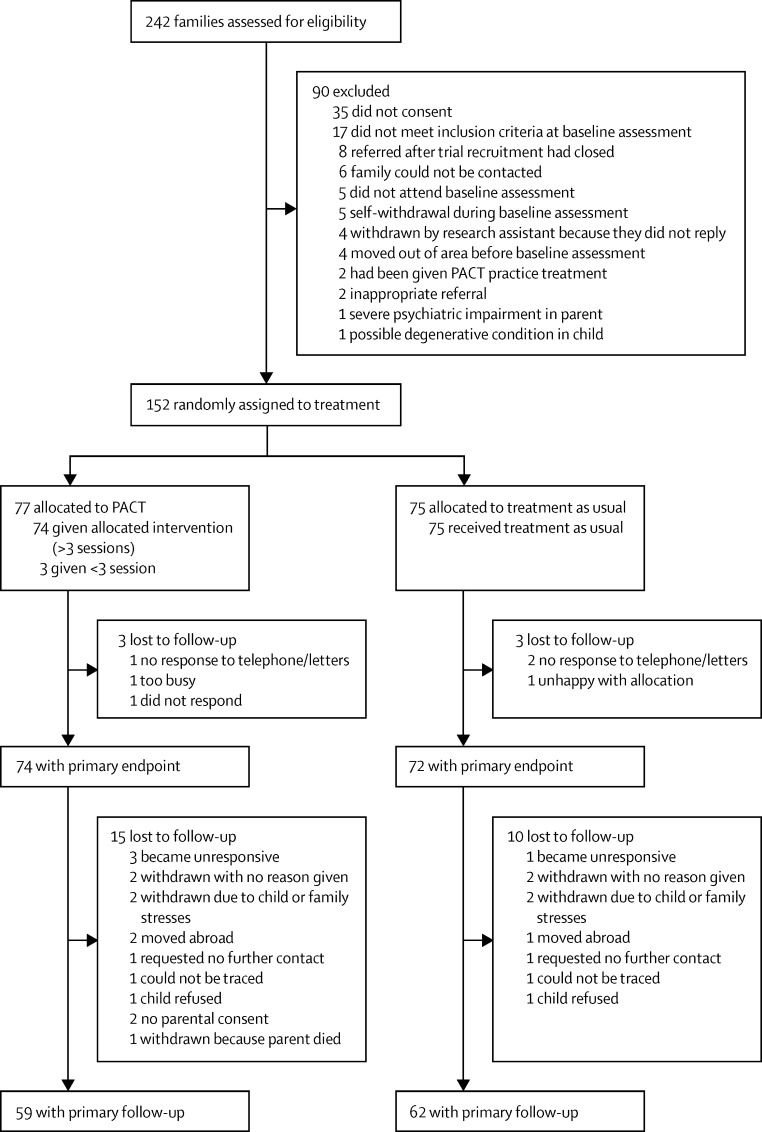
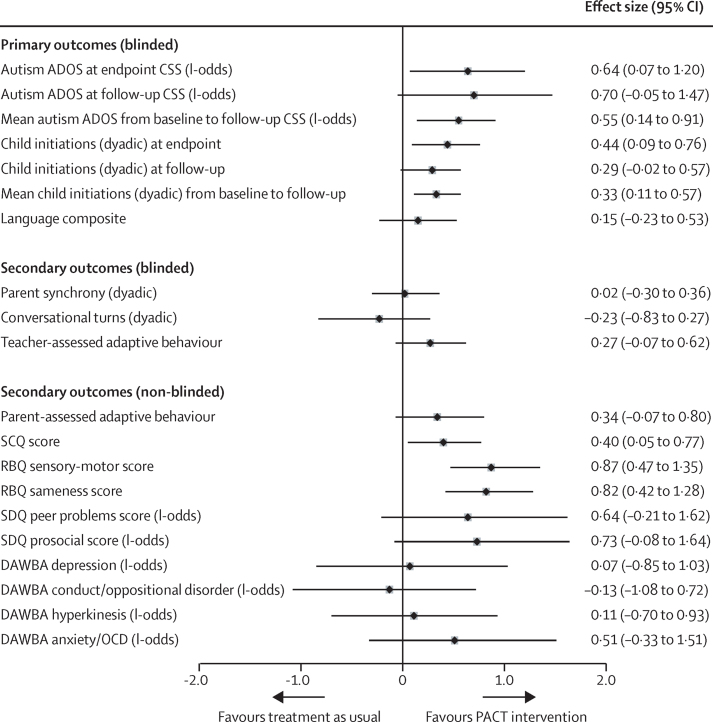
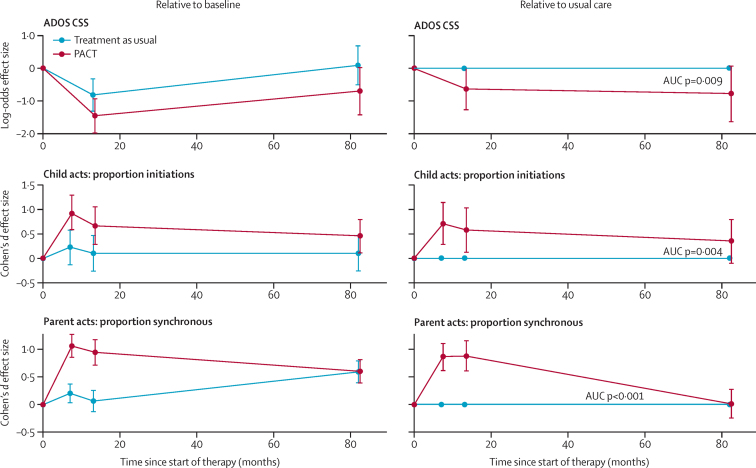
BACKGROUND: It is not known whether early intervention can improve long-term autism symptom outcomes. We aimed to follow-up the Preschool Autism Communication Trial (PACT), to investigate whether the PACT intervention had a long-term effect on autism symptoms and continued effects on parent and child social interaction. METHODS: PACT was a randomised controlled trial of a parent-mediated social communication intervention for children aged 2-4 years with core autism. Follow-up ascertainment was done at three specialised clinical services centres in the UK (London, Manchester, and Newcastle) at a median of 5·75 years (IQR 5·42-5·92) from the original trial endpoint. The main blinded outcomes were the comparative severity score (CSS) from the Autism Diagnostic Observation Schedule (ADOS), the Dyadic Communication Assessment Measure (DCMA) of the proportion of child initiatiations when interacting with the parent, and an expressive-receptive language composite. All analyses followed the intention-to-treat principle. PACT is registered with the ISRCTN registry, number ISRCTN58133827. FINDINGS: 121 (80%) of the 152 trial participants (59 [77%] of 77 assigned to PACT intervention vs 62 [83%] of 75 assigned to treatment as usual) were traced and consented to be assessed between July, 2013, and September, 2014. Mean age at follow-up was 10·5 years (SD 0·8). Group difference in favour of the PACT intervention based on ADOS CSS of log-odds effect size (ES) was 0·64 (95% CI 0·07 to 1·20) at treatment endpoint and ES 0·70 (95% CI -0·05 to 1·47) at follow-up, giving an overall reduction in symptom severity over the course of the whole trial and follow-up period (ES 0·55, 95% CI 0·14 to 0·91, p=0·004). Group difference in DCMA child initiations at follow-up showed a Cohen's d ES of 0·29 (95% CI -0.02 to 0.57) and was significant over the course of the study (ES 0·33, 95% CI 0·11 to 0·57, p=0·004). There were no group differences in the language composite at follow-up (ES 0·15, 95% CI -0·23 to 0·53). INTERPRETATION: The results are the first to show long-term symptom reduction after a randomised controlled trial of early intervention in autism spectrum disorder. They support the clinical value of the PACT intervention and have implications for developmental theory. FUNDING: Medical Research Council.
Overview
The claims and statistics of this paper haven’t been checked yet.
Free: it reads the open-access text and checks the first 5 claims that cite a source we can check. Create a free account to check every claim.
Integrity signals
Registry
Cites
Statistics
Figures
Verification
Claims the paper makes
The claims and statistics of this paper haven’t been checked yet.
Free: it reads the open-access text and checks the first 5 claims that cite a source we can check. Create a free account to check every claim.
Claims other papers make about this one
Each is checked against this paper’s own text: does it say what the citing paper says it does?
The source backs part of the claim, not all of it — or backs it for a different population, condition or comparison.
In the citing paper
“social skills training programs for which moderate evidence of benefit exists 186,187 .”
From Autism spectrum disorder (2020) · cites this paper as [186]
Experimental — accuracy not yet measured
Self-check
Percentages, sums and reported differences re-computed from the paper’s own numbers.
The self-check needs the paper’s full text.
Citations
Cites
1 retracted
Christensen, D. L., Baio, J., Braun, K. V. N., Bilder, D., Charles, J., Constantino, J. N., Daniels, J., Durkin, M. S., Fitzgerald, R. T., Kurzius-Spencer, M., et al. (2016) · MMWR. Surveillance Summaries · doi:10.15585/mmwr.ss6503a1 · Cited by 1,964
RetractedThe Strengths and Difficulties Questionnaire: A research note
Goodman, R. (1997) · Journal of Child Psychology and Psychiatry · doi:10.1111/j.1469-7610.1997.tb01545.x · Cited by 14,908
Lord, C., Rutter, M., & Le Couteur, A. (1994) · Journal of Autism and Developmental Disorders · doi:10.1007/bf02172145 · Cited by 9,065
Lord, C., Risi, S., Lambrecht, L., Cook, E. H., Leventhal, B. L., DiLavore, P. C., Pickles, A., & Rutter, M. (2000) · Journal of Autism and Developmental Disorders · doi:10.1023/a:1005592401947 · Cited by 7,520
Self-citationDawson, G., Rogers, S., Munson, J., Smith, M., Winter, J., Greenson, J., Donaldson, A., & Varley, J. (2010) · Pediatrics · doi:10.1542/peds.2009-0958 · Cited by 2,835
Baird, G., Simonoff, E., Pickles, A., Chandler, S., Loucas, T., Meldrum, D., & Charman, T. (2006) · The Lancet · doi:10.1016/s0140-6736(06)69041-7 · Cited by 2,104
Self-citationAutism Diagnostic Observation Schedule
Lord, C., Rutter, M., Goode, S., Heemsbergen, J., Jordan, H., Mawhood, L., & Schopler, E. (2016) · PsycTESTS Dataset · doi:10.1037/t54175-000 · Cited by 1,678
Standardizing ADOS Scores for a Measure of Severity in Autism Spectrum Disorders
Gotham, K., Pickles, A., & Lord, C. (2009) · Journal of Autism and Developmental Disorders · doi:10.1007/s10803-008-0674-3 · Cited by 1,605
Self-citationCosts of Autism Spectrum Disorders in the United Kingdom and the United States
Buescher, A. V. S., Cidav, Z., Knapp, M., & Mandell, D. S. (2014) · JAMA Pediatrics · doi:10.1001/jamapediatrics.2014.210 · Cited by 1,296
Long-term outcome for children with autism who received early intensive behavioral treatment.
McEachin, J. J., Smith, T. H., & Lövaas, O. I. (1993) · PubMed · Cited by 1,089
Research works printed but not linked: 3
- NICE Autism spectrum disorder in under 19s: support and management. Clinical guideline 170 2013 National Institute for Health and Care Excellence https://www.nice.org.uk/guidance/cg170 (accessed Jan 31, 2016). 34283415
- Semel E Wiig E Secord W Clinical evaluation of language fundamentals, 7th edn, Australian standardised edn (CELF-4 Australian) 2006 Pearson Sydney
- Brownell R Receptive and expressive one-word picture vocabulary tests, 4th edn (ROWPVT-4, EOWPVT-4) 2010 Pearson Education San Antonio
Cited by
Items 301–400 of 526
Boissel, L., Borgne, G. L., Baldini, L. F., Gosme, C., Gille, M. L., Desguerre, I., Golse, B., Nabbout, R., Borghini, A., & Ouss, L. (2020) · Epilepsy & Behavior · doi:10.1016/j.yebeh.2020.107401 · Cited by 9
Neural network applications in medicine
Özşahin, İ., & Ozsahin, D. U. (2020) · Elsevier eBooks · doi:10.1016/b978-0-12-818946-7.00007-x · Cited by 9
Swain, D. M., Han, J. E., Brown, H. R., Lord, C., Rogers, S. J., Estes, A. M., Kasari, C. L., Pickles, A. R., & Kim, S. H. (2025) · Autism · doi:10.1177/13623613251328463 · Cited by 7
“…long been recommended by experts and federal policy because it significantly enhances generalization and maintenance of skills attained (Individuals with Disabilities Education Act [IDEA], 2004; National Research Council, 2001; Pickles et al., 2016; Schreibman et al., 2015; Wetherby et al., 2014).”
Self-citationAlkinj, I., Sanches‐Ferreira, M., & Alves, S. (2025) · Revista Brasileira de Educação Especial · doi:10.1590/1980-54702025v31e0191 · Cited by 7
Gao, P., Zhou, C., Ruan, Z., Zhang, Z., & Fang, X. (2024) · Journal of Affective Disorders · doi:10.1016/j.jad.2024.03.078 · Cited by 5
Albright, J., Shinall, J. A., Tomczuk, L., Stewart, R. E., Mandell, D. S., Stahmer, A. C., Beidas, R. S., & Pellecchia, M. (2024) · Autism · doi:10.1177/13623613241272993 · Cited by 7
“…of their positive impact on a range of child and family outcomes, including children’s communication, play, behavior, and development, as well as caregiver’s sense of empowerment, self-efficacy, and stress (Estes et al., 2014; Kasari et al., 2014; Pickles et al., 2016; Wetherby et al., 2014).”
Carta, A., Casula, L., Manca, S., Puci, M. V., Puseddu, G., Fucà, E., Sotgiu, G., Vicari, S., Sotgiu, S., & Valeri, G. (2025) · Frontiers in Child and Adolescent Psychiatry · doi:10.3389/frcha.2025.1544344 · Cited by 5
Liu, G., Ou, P., Huang, L., Xie, N., Lin, J.-L., He, Y., & Hu, R. (2021) · Europe PMC (PubMed Central) · doi:10.7499/j.issn.1008-8830.2103178 · Cited by 5
Tsiplova, K., Ungar, W. J., Szatmári, P., Cost, K. T., Pullenayegum, E., Duku, E., Volden, J., Smith, I. M., Waddell, C., Zwaigenbaum, L., et al. (2022) · Research in Developmental Disabilities · doi:10.1016/j.ridd.2022.104392 · Cited by 6
Anderson, C. M., Hochheimer, S., Warren, Z. E., Butter, E. M., Hyman, S. L., Wang, H., Wallace, L., Levato, L., Martin, R., Stephenson, K. G., et al. (2024) · Autism Research · doi:10.1002/aur.3240 · Cited by 9
“In ensuing years, a number of studies have documented positive outcomes with lower dose CBIs (e.g., Pickles et al., 2016; Shire et al., 2020).”
Vyshedskiy, A., Pevzner, A., Mack, B., Shrayer, E., Zea, M., Bunner, S., Wong, N., Baskina, E., Sheikh, A., Tagliavia, A., et al. (2025) · Children · doi:10.3390/children12060793 · Cited by 13
Smith, J., Bent, C. A., Green, C. C., Woollacott, A., & Hudry, K. (2020) · Autism & Developmental Language Impairments · doi:10.1177/2396941519899684 · Cited by 6
“Further, synchronous parental behaviours have been shown to improve child communication outcomes (Green et al., 2010; Pickles et al., 2016) – a key area of difficulty for many children with this condition.”
BackgroundParents' perceptions of autism and their challenges in China
Fu, W., Xiao, Y., Cui, Y., & Xu, R. (2022) · Advances in Developmental and Educational Psychology · doi:10.25082/adep.2022.01.001 · Cited by 6
“tracked the long-term effects of parental mediation, showing that children in the parent-trained group had more communication with their parents and sustained improvements in ASD symptoms compared to children in the control group whose parents did not receive training (Pickles et al., 2016).”
ResultNarzisi, A., Alonso-Esteban, Y., Masi, G., & Alcantud-Marín, F. (2022) · Children · doi:10.3390/children9030430 · Cited by 5
“in 2010, replicated in 2016 [25], showed that the DCMA (Dyadic Communication Measure for Autism) could be used to study, from a punctiform perspective, the parental child interaction.”
BackgroundKlowan, A., Kadlec, M. B., & Johnston, S. (2023) · The Open Journal of Occupational Therapy · doi:10.15453/2168-6408.1958 · Cited by 10
LENDIO, J. G. C., TEVES, S. M. C., & CATALAN, D. S. (2023) · Cognizance Journal of Multidisciplinary Studies · doi:10.47760/cognizance.2023.v03i03.007 · Cited by 5
Early concerns in parents of infants at risk for autism
Tran, A. T., del Rosario, M., Nosco, E., Li, Y., Şentürk, D., McDonald, N. M., Wilson, R. B., Dapretto, M., & Jeste, S. (2021) · Developmental Medicine & Child Neurology · doi:10.1111/dmcn.14925 · Cited by 8
Machine Learning Based Autism Detection Using Brain Imaging
Katuwal, G. J. (2017) · RIT Scholar Works (Rochester Institute of Technology) · Cited by 10
Demand avoidance is not necessarily defiance – Authors' reply
Green, J., Absoud, M., Grahame, V., Malik, O., Simonoff, E. A., Couteur, A. S. L., & Baird, G. (2018) · The Lancet Child & Adolescent Health · doi:10.1016/s2352-4642(18)30221-9 · Cited by 11
Self-citationRae, J. P., & Ramey, M. (2020) · Clinical Linguistics & Phonetics · doi:10.1080/02699206.2020.1754920 · Cited by 5
Editorial: Targeting the Core Symptoms of Autism Spectrum Disorder With Mechanism-Based Medications
Vitiello, B. (2020) · Journal of the American Academy of Child & Adolescent Psychiatry · doi:10.1016/j.jaac.2020.11.006 · Cited by 5
Lai, M., Anagnostou, E. A., Wiznitzer, M., Allison, C. L., & Baron‐Cohen, S. (2018) · OSF Preprints (OSF Preprints) · doi:10.31219/osf.io/8z5rv · Cited by 7
Emotional Availability in Autism Intervention: A Mother–Father Comparative Analysis
Perzolli, S., Bertamini, G., Venuti, P., & Bentenuto, A. (2025) · Brain Sciences · doi:10.3390/brainsci15020133 · Cited by 5
“A substantial body of research showed that parental involvement during the intervention improves child outcomes in areas such as communication, social development [8], and symptom reduction [9] while fostering the generalization of skills across settings [10].”
Pusil, S. A., Laguna, A., Vilca, B. N. C., Zegarra-Valdivia, J. A., & Orlandi, S. (2025) · Journal of Autism and Developmental Disorders · doi:10.1007/s10803-025-06757-4 · Cited by 7
“Evidence strongly supports the benefits of these interventions, ranging from cognitive and language improvements to better social outcomes, underscoring their transformative impact on children, families, and society (Boyd et al., 2010; Okoye et al., 2023; Pickles et al., 2016).”
Arabic Language Autism Diagnostic Interview (ALADIN): A Validation Study
Nasir, A. K., Masri, A. T., Shaheen, S., Sayles, H. R., & Nasir, L. (2025) · Journal of Autism and Developmental Disorders · doi:10.1007/s10803-025-06797-w · Cited by 6
“Early diagnosis and intervention can reduce lifelong disability and dependence (Carruthers et al., 2020; Daniolou et al., 2022; Pickles et al., 2016; Sandbank et al., 2023).”
Freitag, C. M., Kirchner, M., Sauer, L. D., Kleber, S. K., Polzer, L., Raji, N., Lemler, C., Fröhlich, U., Jarczok, T. A., Geissler, J. M., et al. (2025) · Journal of Child Psychology and Psychiatry · doi:10.1111/jcpp.14162 · Cited by 5
“The majority of all children received supplementary psychosocial interventions and integrative care during their time in kindergarten, reflecting the typical standard of preschool care for ASD in Germany, where ASD-specific early intervention is relatively uncommon (Salomone et al., 2016).”
A bibliometric analysis of the current state of research on family interventions for ASD
Meng, X., Zhou, X. J., Luo, J., Li, J., Zhou, L., & Zhang, Y. (2025) · Frontiers in Psychiatry · doi:10.3389/fpsyt.2025.1435612 · Cited by 4
Lai, J., Luo, O. D., Klag, M., & Shikako‐Thomas, K. (2021) · Journal of Intellectual & Developmental Disability · doi:10.3109/13668250.2020.1865684 · Cited by 4
Pickles, A. R., Edwards, D., Horvath, L., & Emsley, R. (2023) · Journal of Child Psychology and Psychiatry · doi:10.1111/jcpp.13892 · Cited by 5
Self-citationBalabanovska, M., Leadbitter, K., Jurek, L., Mengarelli, F., Falissard, B., Ngan, N., Aldred, C. R., Green, J., & Geoffray, M. (2024) · Autism · doi:10.1177/13623613241262943 · Cited by 6
“…have demonstrated sustained effectiveness on masked outcome measures in a large ( N = 152) multi-site randomized controlled trial (RCT) in England (French & Kennedy, 2018; Pickles et al., 2016), and in two other multi-site RCTs in England and South Asia (J. Green et al., 2022; Rahman et al., 2016).”
Self-citationOppenheim, D., Mottes‐Peleg, M., Hamburger, L., Slonim, M., Maccabi, Y., & Yirmiya, N. (2024) · Journal of Child Psychology and Psychiatry · doi:10.1111/jcpp.14061 · Cited by 5
Beauquier‐Maccotta, B., Hervé, M.-J., Desvignes, C., Quirot, B., Ouss, L., & Rusconi-Serpa, S. (2020) · Neuropsychiatrie de l Enfance et de l Adolescence · doi:10.1016/j.neurenf.2020.03.002 · Cited by 5
Green, J., Leadbitter, K., Ellis, C., Taylor, L. J., Moore, H. L., Carruthers, S., James, K., Taylor, C., Balabanovska, M., Langhorne, S., et al. (2022) · Efficacy and Mechanism Evaluation · doi:10.3310/lbxi2342 · Cited by 5
Self-citationShort-term Outcome of Social Skills Group Therapy Intervention in School Aged Children With Autism
Gajre, M. P., Biswas, S., Aseri, H., & Pradhan, S. V. (2023) · Indian Pediatrics · doi:10.1007/s13312-023-3016-9 · Cited by 4
“Our data on serial improvement of pSRS-2 scores supported the conclusion of Olsson, et al. [16], who found the SSGT to be superior to standard care.”
ResultZhang, L., Ren, T., He, H., Huang, L., Huang, R., Xu, Y., Zhou, L., Tan, H., Chen, J., Wu, D., et al. (2023) · Psychological Medicine · doi:10.1017/s0033291723002908 · Cited by 4
Télésanté : les thérapies médiatisées par les parents
Arnaud, M., Baduel, S., Guillon, Q., & Rogé, B. (2019) · Enfance · doi:10.3917/enf2.191.0099 · Cited by 6
Understanding and Addressing Social Communication Difficulties in Children with Autism
Bottema‐Beutel, K. (2020) · Best practices in child and adolescent behavioral health care · doi:10.1007/978-3-030-41160-2_3 · Cited by 6
Parents of children with autism spectrum disorders: interventions with and for them
Rojas-Torres, L. P., Alonso-Esteban, Y., & Marín, F. A. (2023) · Elsevier eBooks · doi:10.1016/b978-0-12-824421-0.00012-6 · Cited by 5
Utility of the Language Use Inventory in Young Children at Elevated Likelihood of Autism
Blume, J., Miller, M., O’Neill, D. K., Mastergeorge, A. M., & Ozonoff, S. J. (2024) · Journal of Speech Language and Hearing Research · doi:10.1044/2023_jslhr-23-00442 · Cited by 5
Children with Developmental Disorders
Sofronoff, K., Whittingham, K., & Brown, F. L. (2018) · Springer eBooks · doi:10.1007/978-3-319-94598-9_14 · Cited by 4
Woods, R., & Waldock, K. E. (2020) · Springer eBooks · doi:10.1007/978-1-4614-6435-8_102297-2 · Cited by 5
Ajodan, E. L., Clark-Whitney, E., Silver, B., Silverman, M. R., Southerland, A., Barnes, E., Dikker, S., Lord, C., Rehg, J. M., Rozga, A., et al. (2019) · PsyArXiv (OSF Preprints) · doi:10.31234/osf.io/8c2dm · Cited by 4
“…interventions targeting parents’ ability to partake in joint engagement have demonstrated clear positive effects on the child’s social communication skills, as well as a reduction in autism symptom severity (Kasari, Gulsrud, Wong, Kwon, & Locke, 2010; Pickles et al., 2016; Shire et al., 2015).”
Brief Infant-Toddler Social and Emotional Assessment (BITSEA)
Giserman‐Kiss, I., & Carter, A. S. (2017) · Springer eBooks · doi:10.1007/978-1-4614-6435-8_102182-1 · Cited by 4
Waddington, H. L. (2018) · Open Access Victoria University of Wellington | Te Herenga Waka (Figshare) · doi:10.26686/wgtn.17068478 · Cited by 6
Wieckowski, A. T., de Marchena, A. B., Dickerson, A. F., Frick, E., Liz, G. P., Dubin, A. H., & Robins, D. L. (2025) · Autism · doi:10.1177/13623613251355257 · Cited by 4
Benedicto-Rodríguez, G., Hongn, A., Juan, C. G., Garrigós, J., Bonomini, M. P., Fernández, E., & Vicente, J. M. F. (2025) · International Journal of Neural Systems · doi:10.1142/s0129065725500662 · Cited by 4
Romeo, V. M. (2025) · Children · doi:10.3390/children12121703 · Cited by 4
“Evidence on SOR and thalamocortical dysmodulation in autism underscores why sensory context is a first-order determinant of relational availability and co-regulation [57,58].”
Parent-Reported Indicators of Depression in Non- and Minimally Speaking Adults With Autism
Wilkinson, E. H., Pai, K., Hastings, R. P., Jahoda, A. J., & Bal, V. H. (2026) · American Journal on Intellectual and Developmental Disabilities · doi:10.1080/19447515.2025.2578980 · Cited by 3
A dysfunctional hub model of voice–reward integration in autism
Abrams, D. A., Leipold, S., & Bowling, D. L. (2026) · Trends in Cognitive Sciences · doi:10.1016/j.tics.2025.12.006 · Cited by 3
Bruni, O., Mammarella, V., Breda, M., Gringras, P., Malow, B. A., Schaer, M., Schroder, C. M., & Weiss, S. K. (2026) · Sleep Medicine Reviews · doi:10.1016/j.smrv.2026.102286 · Cited by 3
de Oliveira, J. J. R., Moreira, I. A., & Britto, D. B. D. O. E. (2022) · Distúrbios da Comunicação · doi:10.23925/2176-2724.2022v34i1e53197 · Cited by 3
Ali, D. F., Ahmad, A. R., & Omar, M. B. (2022) · International Journal of Academic Research in Progressive Education and Development · doi:10.6007/ijarped/v11-i3/15002 · Cited by 5
“…second-highest cited research paper (151 citations) in this analysis investigated the effect of Parent-mediated social communication therapy for young children with autism (PACT) on parent-child social interaction and whether it is having a lasting impact (Pickles et al., 2016; Lyall et al., 2017).”
BackgroundInterventions in ASD: Psychosocial Interventions and Supports for ASD
Brian, J. A., Smith, I. M., & Stover, K. (2023) · Springer eBooks · doi:10.1007/978-3-031-20792-1_21 · Cited by 5
Xiao, S., & Li, J. (2023) · Advances in Psychological Science · doi:10.3724/sp.j.1042.2023.02350 · Cited by 3
Pfeiffer, D. L., Hess, C. R., & Landa, R. J. (2024) · Infants & Young Children · doi:10.1097/iyc.0000000000000260 · Cited by 4
“…high levels of fidelity and foster gains in infants’ social and communication development, particularly when parent coaching is implemented by a trained interventionist (e.g., Grzadzinkski et al., 2021; Hampton & Rodriguez, 2022; Landa, 2018; Pickles et al., 2016; Whitehouse et al., 2019, 2021).”
BackgroundConrad, C. E., Jørgensen, R., Amstrup, C., Gottschau, T. E., Thomsen, P. H., & Lauritsen, M. B. (2024) · Children · doi:10.3390/children11070838 · Cited by 6
“This empowerment of parents may be relevant for understanding the longer-term benefits previously evidenced in PACT [7,20].”
BackgroundResultInfluentialASD and Cultural Competence: An ASD Multicultural Treatment-Led Model
Henderson, M. J., & Majors, R. G. (2020) · Emerald Group Publishing Limited eBooks · doi:10.1108/978-1-83909-964-920201016 · Cited by 4
Deshpande, S., Kumari, N., Bhatia, T., Chakraborty, S., & Balsavar, A. (2020) · Indian Journal of Social Psychiatry · doi:10.4103/ijsp.ijsp_128_19 · Cited by 5
(Vroeg)Herkenning en screening
Pijl, M., & Servatius-Oosterling, I. J. (2021) · Bohn Stafleu van Loghum eBooks · doi:10.1007/978-90-368-2665-5_6 · Cited by 3
Being Born Autistic and the Forming of the Interpersonal World
Muratori, F., & Apicella, F. (2022) · Psychoanalytic Inquiry · doi:10.1080/07351690.2022.2007019 · Cited by 6
Zhang, C., Zhou, T., Yi, C., Liu, S., Ye, H., & Zhang, Y. (2022) · Research in Autism · doi:10.1016/j.rasd.2022.102048 · Cited by 3
Ouss, L., Beauquier‐Maccotta, B., Hervé, M.-J., Bompard, C., Desvignes, C., Velásquez, P., Serpa, S. R., & Quirot, B. (2023) · Annales Médico-psychologiques revue psychiatrique · doi:10.1016/j.amp.2022.11.017 · Cited by 4
Autism Spectrum Disorder Classification via Local and Global Feature Representation of Facial Image
Mahamood, M. N., Uddin, M. Z., Shahriar, M. A., Alnajjar, F., & Ahad, M. A. R. (2023) · Conference proceedings/Conference proceedings - IEEE International Conference on Systems, Man, and Cybernetics · doi:10.1109/smc53992.2023.10394092 · Cited by 8
“To improve cognitive, social, and language development outcomes, individuals with ASD must receive an early diagnosis and intervention [6].”
BackgroundDababnah, S., Zeleke, W. A., Chung, Y., Adjei, R. A., Dixon, P. J., Salomone, E., & WHO CST Team (2025) · Autism · doi:10.1177/13623613251351345 · Cited by 3
Self-citationIntervensi Orang Tua pada Anak dengan Autism Spectrum Disorder (ASD): Kajian Literatur Sistematis
Novianti, A., Ayuningtyas, A. L., & Kurniawati, F. (2021) · Jurnal Obsesi Jurnal Pendidikan Anak Usia Dini · doi:10.31004/obsesi.v6i2.1072 · Cited by 6
“…Focused Playtime Intervention (FPI) (Sadeghi et al., 2019; Siller et al., 2013), Preschool Autism Communication Trial (PACT) (Green et al., 2010; Pickles et al., 2016), Parent mediated intervention for Autism Spectrum Disorder in South Asia (PASS) (Rahman et al., 2016), Intervensi Playdate…”
BackgroundMethodInfluentialPrologue: The Interpersonal World of the Autistic Infant, Part 2: Modes of Treatment
Posner, D. S. (2023) · Psychoanalytic Inquiry · doi:10.1080/07351690.2023.2185060 · Cited by 3
“Similarly, empirical research (Pickles et al., 2016) is also welcoming parents back to the treatment fold, leveraging video-guided feedback approaches (Beebe & Steele, 2013) to help caregivers identify and amplify intentional bidirectional communications at the “local level” of everyday…”
BackgroundClinical outcomes of children with ASD – Preliminary findings from a 18 month follow up study
Manohar, H., & Kandasamy, P. (2021) · Asian Journal of Psychiatry · doi:10.1016/j.ajp.2021.102816 · Cited by 3
Delmas, C., Wang, X., Pelloux, A.-S., Caeymaex, L., Bouaziz, N., Aegerter, P., & Jung, C. (2025) · BMJ Open · doi:10.1136/bmjopen-2024-094729 · Cited by 2
“33 34 These techniques aim to reduce parental anxiety, rebuild parental self-efficacy often undermined by the child’s lack of responsiveness and promote positive parent–child interactions.”
Ziegler, S. M. T., Jeppesen, P., Christiansen, J. H., Conrad, C. E., Davidsen, K. A., Engkjær-Trautwein, G., Engstrøm, J., Fagerlund, B., Gøtzsche, M. V., Hastrup, L. H., et al. (2025) · Trials · doi:10.1186/s13063-025-09017-z · Cited by 5
“The ADOS-2 CSS score [40] was chosen as the primary outcome measure as it was previously used as the primary outcome measure in Green et al.’s initial 2010 PACT trial [28] at end-of-intervention and as a follow-up longitudinal effect measure 6 years later [33].”
Parent-Meditated Autism Intervention: Current Practice and Future Direction
Zeleke, W. A., & Torky, J. (2025) · IntechOpen eBooks · doi:10.5772/intechopen.1010294 · Cited by 3
Hansen, J. E., Schuengel, C., Willemen, A. M., Stuart, A., Væver, M. S., & Røhder, K. (2025) · Research in Developmental Disabilities · doi:10.1016/j.ridd.2025.105131 · Cited by 2
Gómez‐Andrés, D., Farrar, M. A., Molinero, M. A., Uzquiano, R. G., Brusa, C., Baranello, G., Quijano-Roy, S., Quijano-Roy, S., Baranello, G., Farrar, M. A., et al. (2025) · Neuromuscular Disorders · doi:10.1016/j.nmd.2025.106331 · Cited by 2
Interventions to Promote Communication in Minimally Verbal Autistic Children: A Systematic Review
Privitera, R., Piccolo, A., Domenico, C. D., Leonardi, G. C., Alito, A., Quartarone, A., Cucinotta, F., & Cara, M. D. (2026) · Medical Sciences · doi:10.3390/medsci14030388 · Cited by 2
“This aligns with broader developmental literature showing that language and social communication emerge through the interplay of environmental supports, cognitive capacities, and individual learning pathways [78].”
Dépister et prendre en charge les troubles du spectre de l’autisme en périnatalité
Savelon, S. V., Benoit, L., Khun-Franck, L., & Saint‐Georges, C. (2018) · Soins Psychiatrie · doi:10.1016/j.spsy.2018.09.006 · Cited by 2
Brehm, B., Schill, J. E., Rauh, R., Fleischhaker, C., & Biscaldi, M. (2021) · Frontiers in Psychology · doi:10.3389/fpsyg.2021.604851 · Cited by 4
Universitāte, L., Bezborodovs, N., Bite, I., Grope, I., Helmane, I., Kronberga, Z., Laganovska, E., Nīmante, D., Raščevska, M., Tomele, G., et al. (2024) · LU Akadēmiskais apgāds eBooks · doi:10.22364/psnsk.1.24 · Cited by 4
Gajre, M. P., Shah, M., Pradhan, S. V., & Aseri, H. (2024) · Cureus · doi:10.7759/cureus.53376 · Cited by 2
Le neurodéveloppement et la neuroprotection du jeune enfant
Marret, S., Chadie, A., Muller, J., & Chollat, C. (2024) · Gynécologie Obstétrique Fertilité & Sénologie · doi:10.1016/j.gofs.2024.03.003 · Cited by 5
Autism Severity and its Relationship to Disability
Waizbard‐Bartov, E., FEIN, D. A., Lord, C., & Amaral, D. G. (2024) · FOCUS The Journal of Lifelong Learning in Psychiatry · doi:10.1176/appi.focus.24022007 · Cited by 4
Peter, C., Antonietti, E., Antoniou, M., Bucaille, E., Osório, J. A., Manificat, S., Rodríguez‐Herreros, B., & Chabane, N. (2025) · Annals of the New York Academy of Sciences · doi:10.1111/nyas.15320 · Cited by 3
“15 PACT involves filming free play between the child and the parent followed by a video-feedback session with the therapist in which parents are encouraged to identify successful episodes of reciprocal interaction.”
Parker, V., & Childs, C. (2019) · Research and Practice in Intellectual and Developmental Disabilities · doi:10.1080/23297018.2019.1601590 · Cited by 2
Emoción y motivación en TEA y atención temprana
Pascual, R. G., Gómez, A. R., Mata, M. Á. G., Fernández, J. B., & Fuertes, A. M. D. C. (2019) · International Journal of Developmental and Educational Psychology Revista INFAD de psicología · doi:10.17060/ijodaep.2019.n1.v3.1446 · Cited by 8
“…Therapy) de Aldred y Green es la primera intervención que ha mostrado una reducción significativa en los síntomas de TEA mantenidos durante 6 años (Pickles et al., 2016), siendo la sincronía y la conexión emocional (entendida como la interacción diádica entre el adulto y el niño con una…”
BackgroundDépistage précoce, évaluation diagnostique et prises en charge éducatives précoces de l’autisme
Atzori, P., Beggiato, A., Colineaux, C., Humeau, É., & Vantalon, V. (2022) · Journal de Pédiatrie et de Puériculture · doi:10.1016/j.jpp.2021.12.008 · Cited by 7
(2022) · Developmental Medicine & Child Neurology · doi:10.1111/dmcn.15454 · Cited by 3
Hameed, Z., Fatima, & Rameen (2025) · ACADEMIA International Journal for Social Sciences · doi:10.63056/acad.004.03.0464 · Cited by 2
Dababnah, S., Ibrahim, A. T., Yusuf, A., Gaber, E., Elshafey, H., Kotb, H. M., Elsabbagh, M., Ramzy, S., Eskander, S., Theis, A., et al. (2025) · Research in Autism · doi:10.1016/j.reia.2025.202659 · Cited by 2
Reuniting Development and Infant Mental Health through the DIR Model
Wieder, S. (2020) · Elsevier eBooks · doi:10.1016/b978-0-12-818466-0.00013-7 · Cited by 2
Herbrecht, E., Lazari, O., Notter, M., Kievit, E., Schmeck, K., & Spiegel, R. (2020) · Frontiers in Psychiatry · doi:10.3389/fpsyt.2020.00687 · Cited by 3
Posner, D. S. (2021) · Psychoanalysis Self and Context · doi:10.1080/24720038.2020.1856110 · Cited by 2
The use of scripts by children with autism spectrum disorder: a puzzle and an opportunity
Gerber, S. (2021) · Elsevier eBooks · doi:10.1016/b978-0-323-85031-5.00025-6 · Cited by 2
Analiza interakcji dziecko–rodzic. Wprowadzenie dla studentów, klinicystów i badaczy
Niedźwiecka, A. (2021) · Wydawnictwo Liberi Libri eBooks · doi:10.47943/lib.9788363487539 · Cited by 2
Sappok, T., Sinzig, J., Lehmkuhl, G., & Diefenbacher, A. (2019) · Elsevier eBooks · doi:10.1016/b978-3-437-22485-0.00024-5 · Cited by 3
Rouhandeh, A. A., Honsberger, C., Shanok, N. A., Lozott, E. B., Levy, T., Kolevzon, A., Buxbaum, J. D., Sotelo, M., Foss‐Feig, J. H., & Siper, P. M. (2022) · Journal of Autism and Developmental Disorders · doi:10.1007/s10803-022-05587-y · Cited by 4
Empathy and a Personalised Approach in Autism
Woods, R., Waldock, K. E., Keates, N., & Morgan, H. (2019) · Journal of Autism and Developmental Disorders · doi:10.1007/s10803-019-04287-4 · Cited by 7
Perasso, G. F., Silton, N. R., & Angelis, J. D. (2020) · Advances in medical education, research, and ethics (AMERE) book series · doi:10.4018/978-1-7998-2940-9.ch009 · Cited by 3
Educational readiness for autism spectrum disorders: the integration of experience and development
Wieder, S. (2021) · Elsevier eBooks · doi:10.1016/b978-0-323-85031-5.00028-1 · Cited by 5
Can sharing education between home and school benefit the child with autism?
Lawrence, C. (2017) · Sheffield Hallam University · doi:10.7190/shu-thesis-00030 · Cited by 3
Big data approaches to investigating Child Mental Health disorder outcomes
Downs, J. M. (2018) · Research Portal (King's College London) · Cited by 2
Woods, R., & Waldock, K. E. (2021) · Springer eBooks · doi:10.1007/978-3-319-91280-6_102297 · Cited by 5
Woods, R., & Waldock, K. E. (2019) · Springer eBooks · doi:10.1007/978-1-4614-6435-8_102297-1 · Cited by 3
Metadata
- Authors
- Pickles, A., Le Couteur, A., Leadbitter, K., Salomone, E., Cole-Fletcher, R., Tobin, H., Gammer, I., Lowry, J., Vamvakas, G., Byford, S., Aldred, C., Slonims, V., McConachie, H., Howlin, P., Parr, J. R., Charman, T., & Green, J.
- Affiliations
- King's College London (GB)
- University of Manchester (GB)
- Newcastle University (GB)
- Guy's and St Thomas' NHS Foundation Trust (GB)
- Manchester Academic Health Science Centre (GB)
- ORCID
- Venue
- The Lancet
- Publisher
- Elsevier BV
- Published
- 2016-11
- Volume
- 388
- Issue
- 10059
- Pages
- 2501-2509
- ISSN
- 0099-5355 (ISSN-L)
- 0140-6736
- PMC
- PMC5121131
- OpenAlex
- W2537346844
- Cited by
- 519
- References
- 30
- Citations by year
- 2026: 31 · 2025: 50 · 2024: 47 · 2023: 38 · 2022: 65 · 2021: 67 · 2020: 66 · 2019: 52 · 2018: 56 · 2017: 45 · 2016: 1
- FWCI
- 32.67
- Type
- journal article
- Language
- en
- Open access
- hybrid
- doi.org
- Licence
- cc-by
- www.elsevier.com/tdm/userlicense/1.0/ (tdm)
- creativecommons.org/licenses/by/4.0/ (vor)
- Locations
- The Lancet (publishedVersion, cc-by)
- PubMed Central (publishedVersion, cc-by)
- PubMed (publishedVersion)
- Research Portal (King's College London) (publishedVersion, cc-by)
- Research Explorer (The University of Manchester) (publishedVersion, other-oa)
- Sunderland Repository (University of Sunderland) (acceptedVersion)
- Institutional Research Information System University of Turin (University of Turin) (submittedVersion, other-oa)
- BOA (University of Milano-Bicocca) (submittedVersion)
- Griffith Research Online (submittedVersion, cc-by)
- Newcastle University ePrints (Newcastle Univesity) (cc-by)
- Funders
- Medical Research Council (MR/K005863/1)
- Topics
- Life Sciences › Neuroscience › Cognitive Neuroscience › Autism Spectrum Disorder Research
- Social Sciences › Psychology › Clinical Psychology › Family and Disability Support Research
- Health Sciences › Medicine › Psychiatry and Mental health › Child Nutrition and Feeding Issues
- Keywords
- parent-mediated intervention, social communication intervention, autism spectrum disorder, early intervention, young children, long-term follow-up, autism severity, usual care, intention-to-treat analysis
- MeSH terms
- Autism Spectrum Disorder, Autistic Disorder, Child, Communication, Follow-Up Studies, Humans, Parents
About these checks
Registry, retraction, Cites and statistics results are computed, not judged, with one exception: a printed reference that no index lists is read once by a model before it counts as a citation error. Claims are extracted by a model and kept only when their quote appears verbatim in the text; each cited source is then checked, with a model’s help, for whether it says what the claim relies on. Those verdicts can be wrong — read the claim’s quote and the cited source before relying on one.
Statistics and arithmetic are recomputed, not judged.
Confidence bands are shown only for fields calibrated on our annotated test set. None is calibrated yet, so no band is shown.
What counts as a claim ›How we measure confidence ›How we check this ›
Are you an author, or do you see a problem with this page? Request a review
Data sources
Bibliographic data: Semantic Scholar, OpenAlex, Crossref.
Contains information from the Semantic Scholar Academic Graph Datasets, made available under the ODC Attribution License (ODC-BY 1.0).
Semantic Scholar’s data is described in: Kinney, R., et al. (2023). The Semantic Scholar Open Data Platform. arXiv:2301.10140.
