

Parent-mediated social communication therapy for young children with autism (PACT): long-term follow-up of a randomised controlled trial
Open accessThe DOI matches its Crossref record; 31 of the 31 references it cites were found in a registry or an index.
Abstract
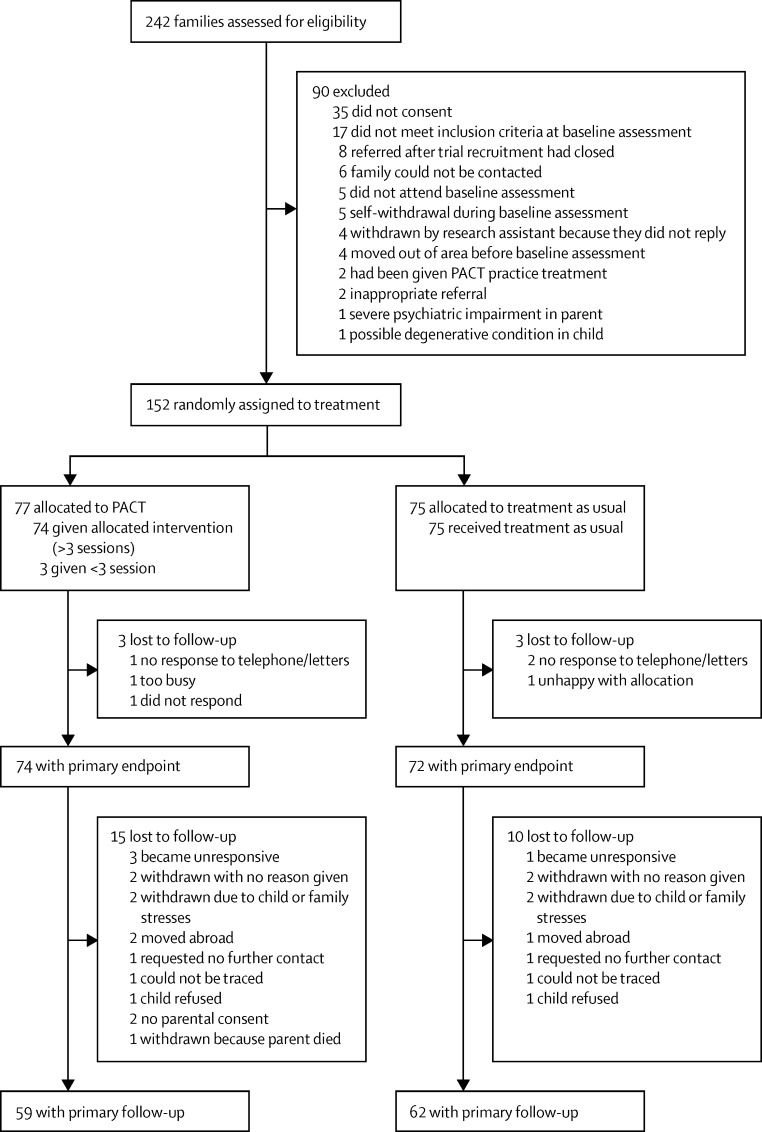
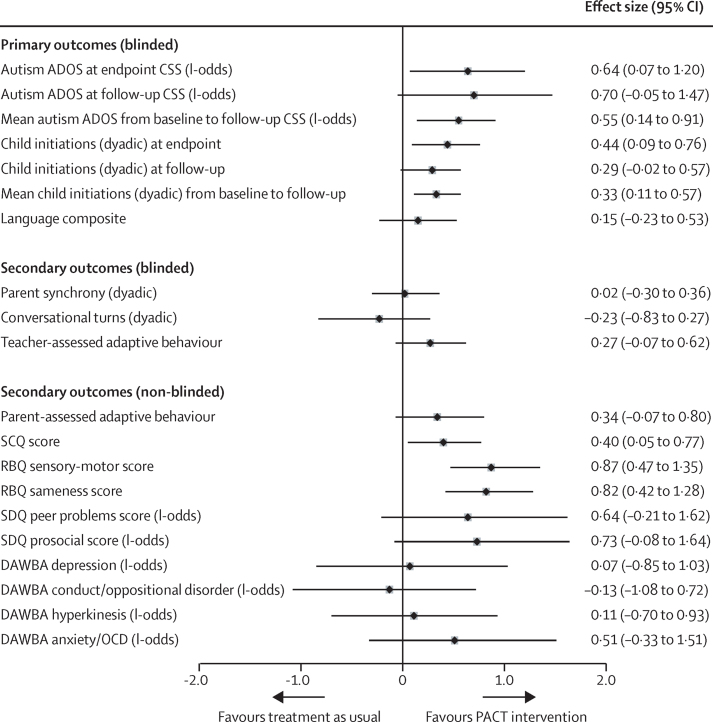
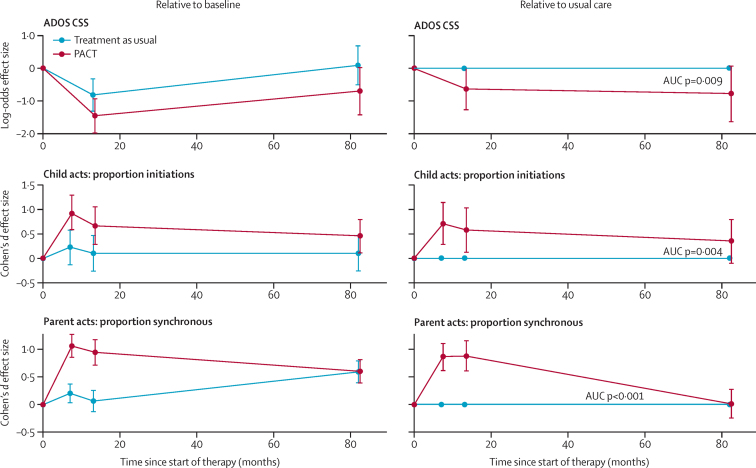
BACKGROUND: It is not known whether early intervention can improve long-term autism symptom outcomes. We aimed to follow-up the Preschool Autism Communication Trial (PACT), to investigate whether the PACT intervention had a long-term effect on autism symptoms and continued effects on parent and child social interaction. METHODS: PACT was a randomised controlled trial of a parent-mediated social communication intervention for children aged 2-4 years with core autism. Follow-up ascertainment was done at three specialised clinical services centres in the UK (London, Manchester, and Newcastle) at a median of 5·75 years (IQR 5·42-5·92) from the original trial endpoint. The main blinded outcomes were the comparative severity score (CSS) from the Autism Diagnostic Observation Schedule (ADOS), the Dyadic Communication Assessment Measure (DCMA) of the proportion of child initiatiations when interacting with the parent, and an expressive-receptive language composite. All analyses followed the intention-to-treat principle. PACT is registered with the ISRCTN registry, number ISRCTN58133827. FINDINGS: 121 (80%) of the 152 trial participants (59 [77%] of 77 assigned to PACT intervention vs 62 [83%] of 75 assigned to treatment as usual) were traced and consented to be assessed between July, 2013, and September, 2014. Mean age at follow-up was 10·5 years (SD 0·8). Group difference in favour of the PACT intervention based on ADOS CSS of log-odds effect size (ES) was 0·64 (95% CI 0·07 to 1·20) at treatment endpoint and ES 0·70 (95% CI -0·05 to 1·47) at follow-up, giving an overall reduction in symptom severity over the course of the whole trial and follow-up period (ES 0·55, 95% CI 0·14 to 0·91, p=0·004). Group difference in DCMA child initiations at follow-up showed a Cohen's d ES of 0·29 (95% CI -0.02 to 0.57) and was significant over the course of the study (ES 0·33, 95% CI 0·11 to 0·57, p=0·004). There were no group differences in the language composite at follow-up (ES 0·15, 95% CI -0·23 to 0·53). INTERPRETATION: The results are the first to show long-term symptom reduction after a randomised controlled trial of early intervention in autism spectrum disorder. They support the clinical value of the PACT intervention and have implications for developmental theory. FUNDING: Medical Research Council.
Overview
The claims and statistics of this paper haven’t been checked yet.
Free: it reads the open-access text and checks the first 5 claims that cite a source we can check. Create a free account to check every claim.
Integrity signals
Registry
Cites
Statistics
Figures
Verification
Claims the paper makes
The claims and statistics of this paper haven’t been checked yet.
Free: it reads the open-access text and checks the first 5 claims that cite a source we can check. Create a free account to check every claim.
Claims other papers make about this one
Each is checked against this paper’s own text: does it say what the citing paper says it does?
The source backs part of the claim, not all of it — or backs it for a different population, condition or comparison.
In the citing paper
“social skills training programs for which moderate evidence of benefit exists 186,187 .”
From Autism spectrum disorder (2020) · cites this paper as [186]
Experimental — accuracy not yet measured
Self-check
Percentages, sums and reported differences re-computed from the paper’s own numbers.
The self-check needs the paper’s full text.
Citations
Cites
1 retracted
Christensen, D. L., Baio, J., Braun, K. V. N., Bilder, D., Charles, J., Constantino, J. N., Daniels, J., Durkin, M. S., Fitzgerald, R. T., Kurzius-Spencer, M., et al. (2016) · MMWR. Surveillance Summaries · doi:10.15585/mmwr.ss6503a1 · Cited by 1,964
RetractedThe Strengths and Difficulties Questionnaire: A research note
Goodman, R. (1997) · Journal of Child Psychology and Psychiatry · doi:10.1111/j.1469-7610.1997.tb01545.x · Cited by 14,908
Lord, C., Rutter, M., & Le Couteur, A. (1994) · Journal of Autism and Developmental Disorders · doi:10.1007/bf02172145 · Cited by 9,065
Lord, C., Risi, S., Lambrecht, L., Cook, E. H., Leventhal, B. L., DiLavore, P. C., Pickles, A., & Rutter, M. (2000) · Journal of Autism and Developmental Disorders · doi:10.1023/a:1005592401947 · Cited by 7,520
Self-citationDawson, G., Rogers, S., Munson, J., Smith, M., Winter, J., Greenson, J., Donaldson, A., & Varley, J. (2010) · Pediatrics · doi:10.1542/peds.2009-0958 · Cited by 2,835
Baird, G., Simonoff, E., Pickles, A., Chandler, S., Loucas, T., Meldrum, D., & Charman, T. (2006) · The Lancet · doi:10.1016/s0140-6736(06)69041-7 · Cited by 2,104
Self-citationAutism Diagnostic Observation Schedule
Lord, C., Rutter, M., Goode, S., Heemsbergen, J., Jordan, H., Mawhood, L., & Schopler, E. (2016) · PsycTESTS Dataset · doi:10.1037/t54175-000 · Cited by 1,678
Standardizing ADOS Scores for a Measure of Severity in Autism Spectrum Disorders
Gotham, K., Pickles, A., & Lord, C. (2009) · Journal of Autism and Developmental Disorders · doi:10.1007/s10803-008-0674-3 · Cited by 1,605
Self-citationCosts of Autism Spectrum Disorders in the United Kingdom and the United States
Buescher, A. V. S., Cidav, Z., Knapp, M., & Mandell, D. S. (2014) · JAMA Pediatrics · doi:10.1001/jamapediatrics.2014.210 · Cited by 1,296
Long-term outcome for children with autism who received early intensive behavioral treatment.
McEachin, J. J., Smith, T. H., & Lövaas, O. I. (1993) · PubMed · Cited by 1,089
Research works printed but not linked: 3
- NICE Autism spectrum disorder in under 19s: support and management. Clinical guideline 170 2013 National Institute for Health and Care Excellence https://www.nice.org.uk/guidance/cg170 (accessed Jan 31, 2016). 34283415
- Semel E Wiig E Secord W Clinical evaluation of language fundamentals, 7th edn, Australian standardised edn (CELF-4 Australian) 2006 Pearson Sydney
- Brownell R Receptive and expressive one-word picture vocabulary tests, 4th edn (ROWPVT-4, EOWPVT-4) 2010 Pearson Education San Antonio
Cited by
Items 101–200 of 526
Bartolo, P. A., Kyriazopoulou, M., Björck‐Åkesson, E., & Giné, C. G. (2019) · International Journal of School & Educational Psychology · doi:10.1080/21683603.2019.1637311 · Cited by 54
“Outcomes are usually described in terms of the child’s achieved learning and development (see e.g., Pickles et al., 2016; Strain, 2017), both within the structure-process-outcome models (e.g. Pianta et al., 2009), as well as within the ecological systems model (Odom et al., 2004).”
BackgroundSensory Reactivity at 1 and 2 Years Old is Associated with ASD Severity During the Preschool Years
Grzadzinski, R., Donovan, K., Truong, K. N., Nowell, S. W., Lee, H. Y., Sideris, J. H., Turner‐Brown, L., Baranek, G. T., & Watson, L. R. (2020) · Journal of Autism and Developmental Disorders · doi:10.1007/s10803-020-04432-4 · Cited by 52
Parenting an Autistic Child: Experiences of Parents with Significant Autistic Traits
Marriott, E., Stacey, J., Hewitt, O. M., & Verkuijl, N. (2021) · Journal of Autism and Developmental Disorders · doi:10.1007/s10803-021-05182-7 · Cited by 52
Aperiodic electrophysiological activity in preterm infants is linked to subsequent autism risk
Shuffrey, L. C., Pini, N., Potter, M., Springer, P. E., Lucchini, M., Rayport, Y. K., Sania, A., Firestein, M. R., Brink, L. T., Isler, J. R., et al. (2022) · Developmental Psychobiology · doi:10.1002/dev.22271 · Cited by 47
Uljarević, M., Billingham, W., Cooper, M. N., Condron, P., & Hardan, A. Y. (2022) · Frontiers in Psychiatry · doi:10.3389/fpsyt.2021.766150 · Cited by 44
Autism as emergent and transactional
Green, J. (2022) · Frontiers in Psychiatry · doi:10.3389/fpsyt.2022.988755 · Cited by 50
“Increased child social engagement and communication initiation is also the origin of the sustained intervention effect on outcome symptoms from pre-school to mid-childhood (29, 32).”
BackgroundSelf-citationDebate: Neurodiversity, autism and healthcare
Green, J. (2023) · Child and Adolescent Mental Health · doi:10.1111/camh.12663 · Cited by 46
Self-citationTripathi, I., Estabillo, J. A., Moody, C. T., & Laugeson, E. A. (2021) · Journal of Autism and Developmental Disorders · doi:10.1007/s10803-021-05147-w · Cited by 54
Salomone, E., Settanni, M., McConachie, H., Suma, K., Ferrara, F., Foletti, G., Salandin, A., WHO CST Team, Brown, F. L., Pacione, L. R., et al. (2021) · Journal of Autism and Developmental Disorders · doi:10.1007/s10803-021-05297-x · Cited by 44
Self-citationFacial Image-Based Autism Detection: A Comparative Study of Deep Neural Network Classifiers
Farhat, T., Akram, S., AlSagri, H. S., Ali, Z., Ahmad, A., & Jaffar, A. (2023) · Computers, materials & continua/Computers, materials & continua (Print) · doi:10.32604/cmc.2023.045022 · Cited by 44
Beaudoin, A. J., Sébire, G., & Couture, M. M. (2019) · Research in Autism · doi:10.1016/j.rasd.2019.101416 · Cited by 56
Salomone, E., Ferrante, C., Salandin, A., Ferrara, F., Torchio, E., Foletti, G., Ghersi, S., CST Italy Team, WHO CST Team, Pacione, L., et al. (2022) · Autism · doi:10.1177/13623613211035228 · Cited by 39
“Nonetheless, training and implementation costs limit the provision of evidence-based early intervention in public health systems globally, as these typically require one-to-one time intensive delivery (Hardan et al., 2015; Kasari et al., 2010; Pickles et al., 2016).”
BackgroundSelf-citationWieckowski, A. T., Zuckerman, K. E., Broder‐Fingert, S., & Robins, D. L. (2022) · Autism Research · doi:10.1002/aur.2832 · Cited by 38
Paulais, M.-A. B., Mazetto, C. T. M., Thiébaut, É., Nassif, M. C., de Souza, M. T. C. C., Stefani, A., Blanc, R., Gattegno, M. P., Aïad, F., Sam, N., et al. (2019) · Frontiers in Psychiatry · doi:10.3389/fpsyt.2019.00508 · Cited by 51
Swanson, M. R. (2020) · Development and Psychopathology · doi:10.1017/s0954579420000838 · Cited by 57
“Children who participated in PACT had reduced autism symptoms at a long-term follow-up assessment over 6 years later, but the treatment and control groups no longer differed in responsive verbal behaviors (Pickles et al., 2016).”
BackgroundMontiel‐Nava, C., Tregnago, M., Marshall, J., Sohl, K., Curran, A. B., Mahurin, M. A., Warne-Griggs, M. D., WHO CST Team, & Dixon, P. (2022) · Frontiers in Psychiatry · doi:10.3389/fpsyt.2022.909947 · Cited by 46
“Besides effectively reducing challenging behaviors and restricted and repetitive behaviors in autistic children (14, 15), PMIs also increase their self-help skills (16).”
BackgroundWaddington, H. L., van der Meer, L. A. J., Sigafoos, J., & Whitehouse, A. (2019) · Autism · doi:10.1177/1362361319876495 · Cited by 43
“…of NDBIs by parents of children with ASD (Estes et al., 2014; Green et al., 2010; Kasari, Gulsrud, Wong, Kwon, & Locke, 2010; Kasari et al., 2014; Pickles et al., 2016; Rogers, Estes, et al., 2012; Rogers et al., 2019; Solomon, Van Egeren, Mahoney, Huber, & Zimmerman, 2014; Stadnick, Stahmer,…”
Gabellone, A., Marzulli, L., Matera, E., Petruzzelli, M. G., Margari, A., Giannico, O. V., & Margari, L. (2022) · Journal of Clinical Medicine · doi:10.3390/jcm11123294 · Cited by 39
“While telehealth is known to ensure the observation of parent–child interactions in their natural environment [71,72] and to protect ASD children from potentially stressful experiences (e.”
BackgroundSchwichtenberg, A. J., Kellerman, A. M., Young, G. S., Miller, M. R., & Ozonoff, S. J. (2018) · Autism · doi:10.1177/1362361318782220 · Cited by 42
“These parental difficulties create a potential barrier to care because parent-mediated interventions are now common practice when supporting children with or at risk for ASD (Green et al., 2013, 2015, 2017; Jones et al., 2017; Kasari et al., 2014b; Pickles et al., 2016; Rogers et al., 2014).”
BackgroundBradley, K., & Male, D. B. (2017) · Educational and Child Psychology · doi:10.53841/bpsecp.2017.34.2.80 · Cited by 61
Imm, P., White, T., & Durkin, M. S. (2019) · Autism · doi:10.1177/1362361319827510 · Cited by 35
“In most cases, the severity of associated functional limitations in ASD can be reduced through early identification and behavioral therapies (Pickles et al., 2016).”
BackgroundAn integrated early care pathway for autism
Green, J., Leadbitter, K., Ainsworth, J. D., & Bucci, S. (2022) · The Lancet Child & Adolescent Health · doi:10.1016/s2352-4642(22)00037-2 · Cited by 50
Self-citationWilliams, M. E., Hastings, R. P., & Hutchings, J. (2020) · Autism Research · doi:10.1002/aur.2265 · Cited by 47
“For example, Pickles et al. [2016] showed signi fi - cant reductions in ASD symptom severity 6 years after receiving parent-mediated social communication therapy.”
BackgroundGiserman‐Kiss, I., Feldman, M. S., Sheldrick, R. C., & Carter, A. S. (2017) · Journal of Autism and Developmental Disorders · doi:10.1007/s10803-017-3044-1 · Cited by 39
“The benefits of early intervention (EI) services for children diagnosed with autism spectrum disorder (ASD) (Pickles et al. 2016; Seida et al. 2009; Woods and Wetherby 2003)”
BackgroundCarruthers, S., Charman, T., Hawi, N. E., Kim, Y. A., Randle, R., Lord, C., & Pickles, A. R. (2020) · Autism Research · doi:10.1002/aur.2449 · Cited by 36
“However, follow-up work using the ADOS CSS, which spanned SA and RRBs, estimated effects as significant and of moderate size [Pickles et al., 2016].”
MethodResultInfluentialSelf-citationSupporting Parents of a Child with Autism Spectrum Disorder: The French Awakening
Sankey, C., Derguy, C., Clément, C., Ilg, J., & Cappe, É. (2018) · Journal of Autism and Developmental Disorders · doi:10.1007/s10803-018-3800-x · Cited by 39
Editorial Perspective: Delivering autism intervention through development
Green, J. (2019) · Journal of Child Psychology and Psychiatry · doi:10.1111/jcpp.13110 · Cited by 38
“One such social communication intervention has shown sustained impact to reduce symptom severity for 6 years after treatment end (Pickles et al., 2016), and others show mediumterm effects on language and parent–child social engagement (Kasari, Paparella, Freeman, & Jahromi, 2008).”
Self-citationCrutel, V., Lambert, E., Pénélaud, P., Severo, C. A., Fuentes, J., Rosier, A., Hervas, A., Marret, S., Oliveira, G., Parellada, M., et al. (2020) · Journal of Autism and Developmental Disorders · doi:10.1007/s10803-020-04709-8 · Cited by 37
Ingersoll, B. R., Straiton, D., & Caquias, N. R. (2019) · Behavior Therapy · doi:10.1016/j.beth.2019.09.004 · Cited by 48
Bejarano‐Martín, Á., Canal‐Bedia, R., Magán‐Maganto, M., Fernández-Álvarez, C. J., Jonsdottir, S. L., Sæmundsen, E., Vicente, A. M., Café, C., Rasga, C., Primo, P. G., et al. (2020) · Early Childhood Research Quarterly · doi:10.1016/j.ecresq.2020.01.004 · Cited by 40
Effects of Parental Involvement in Robot-Assisted Autism Therapy
Amirova, A., Rakhymbayeva, N., Zhanatkyzy, A., Telisheva, Z., & Sandygulova, A. (2022) · Journal of Autism and Developmental Disorders · doi:10.1007/s10803-022-05429-x · Cited by 38
On the Brainstem Origin of Autism
Delafield‐Butt, J. T., & Trevarthen, C. (2017) · CRC Press eBooks · doi:10.1201/9781315372518-11 · Cited by 46
“In a remarkable study, parents assisted to engage with sensitive attunement to the feelings and intentions of their child with autism significantly improved their child’s long-term socioemotional well-being and reduced symptom severity (Pickles et al 2016).”
Carruthers, S., Mleczko, N., Page, S., Ahuja, S., Ellis, C., Howlin, P., Leadbitter, K., Taylor, L. J., Slonims, V., & Charman, T. (2022) · Autism · doi:10.1177/13623613221125630 · Cited by 36
“In a follow-up study of PACT, improvements in child initiations were maintained, but parents, on average, were less synchronous during interactions with their children than at trial endpoint 6 years previously (Pickles et al., 2016).”
BackgroundSelf-citationPrevention in Autism Spectrum Disorder: A Lifelong Focused Approach
Francis, K., Karantanos, G., Al-Ozairi, A., & AlKhadhari, S. (2021) · Brain Sciences · doi:10.3390/brainsci11020151 · Cited by 39
“Indeed, after more than five years, the PACT group showed significantly lower ADOS CSS, with gains in both social communication and (interestingly) in repetitive behaviour symptoms [81].”
BackgroundResultMcDaniel, J., Brady, N. C., & Warren, S. F. (2021) · Journal of Autism and Developmental Disorders · doi:10.1007/s10803-021-05331-y · Cited by 38
Evaluating the Social Validity of the Early Start Denver Model: A Convergent Mixed Methods Study
Ogilvie, E., & McCrudden, M. T. (2017) · Journal of Autism and Developmental Disorders · doi:10.1007/s10803-017-3214-1 · Cited by 30
Ho, M.-H., & Lin, L. (2019) · Research in Autism · doi:10.1016/j.rasd.2019.101495 · Cited by 39
Ledbetter‐Cho, K., Lang, R. B., Watkins, L., O’Reilly, M. F., & Zamora, C. (2017) · Autism & Developmental Language Impairments · doi:10.1177/2396941517737536 · Cited by 33
“Given the importance of beginning intervention early in life (Pickles et al., 2016), the current systematic review aims to identify collateral effects demonstrated in early childhood intervention studies.”
BackgroundLongard, J., Brian, J. A., Zwaigenbaum, L., Duku, E., Moore, C. L., Smith, I. M., Garon, N., Szatmári, P., Vaillancourt, T., & Bryson, S. (2017) · Autism & Developmental Language Impairments · doi:10.1177/2396941517737418 · Cited by 37
Naturalistic Developmental Behavioral Interventions for Children with Autism
Vivanti, G., & Zhong, H. N. (2020) · Best Practices in Child and Adolescent Behavioral Health Care · doi:10.1007/978-3-030-41160-2_6 · Cited by 27
RETRACTED: A deep learning-based ensemble for autism spectrum disorder diagnosis using facial images
Farhat, T., Akram, S., Rashid, M., Jaffar, A., Bhatti, S. M., & Iqbal, M. A. (2025) · PLoS ONE · doi:10.1371/journal.pone.0321697 · Cited by 30
RetractedSaint‐Georges, C., Pagnier, M., Ghattassi, Z., Hubert-Barthélémy, A., Tanet, A., Clément, M.-N., Soumille, F., Crespin, G. C., Pellerin, H., & Cohen, D. (2020) · EClinicalMedicine · doi:10.1016/j.eclinm.2020.100537 · Cited by 38
“, parent-mediated communication-focused treatment-PACT) [7,8], educational interventions, specific therapies (e.”
Fletcher‐Watson, S., Larsen, K., Salomone, E., & Groups, M. O. T. C. E. W. (2017) · Autism · doi:10.1177/1362361317728436 · Cited by 33
“…cognitive and behavioural levels (Bolte et al., 2013; Dawson, 2010; Zwaigenbaum et al., 2007), rather than to test short- and long-term outcomes of early interventions, although the pattern is rapidly changing (Estes et al., 2015; Pickles et al., 2016; Rogers et al., 2014; Shire et al., 2016).”
BackgroundSelf-citationRedesign of the autism spectrum screening and diagnostic process for children aged 12 to 36 months
Lemay, J.-F., Yohemas, M., & Langenberger, S. (2018) · Paediatrics & Child Health · doi:10.1093/pch/pxx187 · Cited by 27
“In addition, data suggests that early intervention can improve the core deficits of ASD which positively impact family functioning (7,8).”
BackgroundHaine‐Schlagel, R., Rieth, S. R., Dickson, K. S., Brookman-Frazee, L. I., & Stahmer, A. C. (2020) · Journal of Community Psychology · doi:10.1002/jcop.22347 · Cited by 38
The Power of Symbolic Play in Emotional Development Through the DIR Lens
Wieder, S. (2017) · Topics in Language Disorders · doi:10.1097/tld.0000000000000126 · Cited by 40
“In another large RCT, Pickles et al. (2016) reported on a 6-year follow-up of PACT (Parents and Children Together), a parentmediated intervention with 152 children with autism.”
BackgroundTilmont, E., Saint-Georges-Chaumet, Y., Favrot, C., Tanet, A., Cohen, D., & Saint‐Georges, C. (2018) · BMC Pediatrics · doi:10.1186/s12887-018-1126-7 · Cited by 29
“published and highlight the importance of parental involvement in treating ASD [30–32], even for long-term outcomes [33].”
BackgroundTachibana, Y., Miyazaki, C., Mikami, M., Ota, E., Mori, R., Hwang, Y., Terasaka, A., Kobayashi, E., & Kamio, Y. (2018) · PLoS ONE · doi:10.1371/journal.pone.0196272 · Cited by 33
“programme for children with ASD showed significant effectiveness of the programme on improving autism severity [76], although the study did not demonstrate the short-term effectiveness of the programme for this outcome [37].”
BackgroundCarruthers, S., Pickles, A. R., Charman, T., McConachie, H., Couteur, A. S. L., Slonims, V., Howlin, P., Collum, R., Salomone, E., Tobin, H. R. S., et al. (2023) · Journal of Child Psychology and Psychiatry · doi:10.1111/jcpp.13798 · Cited by 35
“Full details of the trial and follow-up study design including a CONSORT diagram have been reported previously (Green et al., 2010; Pickles et al., 2016).”
BackgroundMethodResultInfluentialSelf-citationInfant neural sensitivity to eye gaze depends on early experience of gaze communication
Vernetti, A., Ganea, N., Tucker, L., Charman, T., Johnson, M. H., & Senju, A. (2018) · Developmental Cognitive Neuroscience · doi:10.1016/j.dcn.2018.05.007 · Cited by 24
“…from investigating whether early intervention for parenting behaviour targeting parent child social communication interaction (Green et al., 2017; Pickles et al., 2016), or a more targeted intervention for eye gaze processing (Murza et al., 2016) could rescue this neural marker for eye gaze…”
BackgroundSelf-citationThe process of co‐design for a new anxiety intervention for autistic children
Cullingham, T., Rennard, U., Creswell, C., Milton, D. E. M., Buckle, K. L., Godber, L., Gordon, K., Larkin, M., & Green, J. (2024) · JCPP Advances · doi:10.1002/jcv2.12255 · Cited by 30
“…is not only highly acceptable in meeting familyneeds(Leadbitteretal.,2020),butalsohasthebestevidencefor sustained long ‐ term developmental benefits for the child (Pickles et al., 2016), benefits themselves mediated by intervention changes within the parent ‐ child dyad (Carruthers et al., 2023).”
Self-citationLarge language models deconstruct the clinical intuition behind diagnosing autism
Stanley, J., Rabot, E., Reddy, S., Belilovsky, E., Mottron, L., & Bzdok, D. (2025) · Cell · doi:10.1016/j.cell.2025.02.025 · Cited by 35
Kitzerow, J., Hackbusch, M., Jensen, K., Kieser, M., Noterdaeme, M. A., Fröhlich, U., Taurines, R., Geissler, J. M., Wolff, N., Roessner, V., et al. (2020) · Trials · doi:10.1186/s13063-019-3881-7 · Cited by 27
Nedungadi, P., Shah, S. M., Stokes, M. A., Nair, V. K., Moorkoth, A., & Raman, R. (2024) · Frontiers in Psychiatry · doi:10.3389/fpsyt.2023.1294254 · Cited by 31
Wass, S. V., Greenwood, E., Esposito, G., Smith, C. G., Necef, I., & Phillips, E. (2024) · Journal of Child Psychology and Psychiatry · doi:10.1111/jcpp.13960 · Cited by 34
Autism and Pervasive Developmental Disorders
(2019) · Cambridge University Press eBooks · doi:10.1017/9781108297769 · Cited by 25
Ungar, W. J., Tsiplova, K., Millar, N., & Smith, I. M. (2018) · Clinical Practice in Pediatric Psychology · doi:10.1037/cpp0000226 · Cited by 33
“Because of a growing interest in parent-mediated therapy (Pickles et al., 2016; Stadnick, Stahmer, & Brookman-Frazee, 2015), each section contained a question on whether the intervention was administered fully or in part by a parent.”
Millar, L., McConnachie, A., Minnis, H., Wilson, P., Thompson, L. C., Anzulewicz, A., Sobota, K., Rowe, P. J., Gillberg, C., & Delafield‐Butt, J. T. (2019) · BMJ Open · doi:10.1136/bmjopen-2018-026226 · Cited by 29
“…is beginning to gain significant clinical and research interest 31 and although movement differences in autism have not yet entered into the diagnostic criteria, the Diagnostic and Statistical Manual of Mental Disorders (DSM–5) 32 now includes ‘awkward or clumsy gait’ as an associated symptom.”
BackgroundIngersoll, B. R., Frost, K. M., Straiton, D., Ramos, A. P., & Howard, M. (2023) · Journal of Autism and Developmental Disorders · doi:10.1007/s10803-023-06092-6 · Cited by 24
“…strategies with a high degree of fidelity, with their children experiencing concomitant gains in language and social communication development (Brian et al., 2017 ; Pickles et al., 2016 ), adap - tive skills (Scahill et al., 2016 ), and decreases in disruptive behavior (Bearss et al., 2015).”
Neurodiversity 2.0 - Harnessing cross-disciplinary disability insights
Srinivasan, H. (2025) · Research in Autism · doi:10.1016/j.reia.2025.202652 · Cited by 27
Salomone, E., Bulgarelli, D., Thommen, É., Rossini, E., & Molina, P. (2018) · European Journal of Special Needs Education · doi:10.1080/08856257.2018.1451292 · Cited by 28
“Despite promising effects of early intervention on reducing social communication deficits (Pickles et al. 2016), universally regarded as core symptoms of ASD (American Psychiatric Association 2013), such difficulties persist across the spectrum of cognitive functioning in real-life adaptive…”
Self-citationRabin, S. J., Laugeson, E. A., Mor‐Snir, I., & Golan, O. (2020) · Journal of Clinical Child & Adolescent Psychology · doi:10.1080/15374416.2020.1796681 · Cited by 29
“Different ways have been suggested to promote generalization, such as conducting the intervention within the educational system (Bauminger-Zviely et al., 2020), including peers as intervention mediators (Chang & Locke, 2016) or involving a parent as part of the intervention (Pickles et al., 2016).”
BackgroundRoemer, E. J., Kushner, E. H., & Iverson, J. M. (2021) · Journal of Autism and Developmental Disorders · doi:10.1007/s10803-021-05099-1 · Cited by 33
“However, interventions for toddlers with ASD have had mixed effects with regard to specific improvements in child language (e.g., Green et al., 2017; Pickles et al., 2016; Siller et al., 2013).”
BackgroundLong-Term Effects of Early Communication Interventions: A Systematic Review and Meta-Analysis
Pak, N. S., Chow, J. C., Dillehay, K. M., & Kaiser, A. P. (2023) · Journal of Speech Language and Hearing Research · doi:10.1044/2023_jslhr-22-00711 · Cited by 31
Pujol, C., Pellissier, L. P., Clément, C., Becker, J. A. J., & Merrer, J. L. (2018) · Translational Psychiatry · doi:10.1038/s41398-018-0247-y · Cited by 23
Analyzing Human-Robot Interaction Using Machine Vision for Autism screening
Moghadas, M., & Moradi, H. (2018) · RSI International Conference on Robotics and Mechatronics (ICRoM) · doi:10.1109/icrom.2018.8657569 · Cited by 25
“There are benefits of early intervention for children with autism [4].”
BackgroundExpanding Research on Contextual Factors in Autism Research: What Took Us So Long?
Seltzer, M. M., Bennett, T. A., DaWalt, L. S., Durkin, M. S., Forbes, G., Howlin, P., Lord, C., Zaidman‐Zait, A., Zwaigenbaum, L., Bal, V. H., et al. (2025) · Autism Research · doi:10.1002/aur.3312 · Cited by 26
“Contextual factors can be malleable, potentially improving the lives of autistic individuals (Dawson 2008; Pickles et al. 2016).”
Self-citationOppenheim, D., Koren‐Karie, N., Hamburger, L., Maccabi, Y., Slonim, M., & Yirmiya, N. (2023) · Journal of Child Psychology and Psychiatry · doi:10.1111/jcpp.13788 · Cited by 26
Kitzerow, J., Teufel, K., Jensen, K., Wilker, C., & Freitag, C. M. (2019) · Zeitschrift für Kinder- und Jugendpsychiatrie und Psychotherapie · doi:10.1024/1422-4917/a000661 · Cited by 28
Telepractice Delivery of an Autism Communication Intervention Program to Parent Groups
Garnett, R., Davidson, B. J., & Eadie, P. A. (2021) · Research in Autism · doi:10.1016/j.rasd.2021.101902 · Cited by 26
Chen, Y.-S., Zhang, S., Yue, C., Xiang, P., Li, J., Wei, Z., Xu, L., & Zeng, Y. (2022) · Experimental Neurology · doi:10.1016/j.expneurol.2022.114033 · Cited by 25
Bal, V. H., Hendren, R. L., Charman, T., Abbeduto, L., Kasari, C. L., Klinger, L. G., Ence, W. A., Glavin, T., Lyons, G. L., & Rosenberg, E. (2018) · Autism Research · doi:10.1002/aur.2034 · Cited by 22
Self-citationMeta-Analysis of RCTs of Technology-Assisted Parent-Mediated Interventions for Children with ASD
Pi, H. J., Kallapiran, K., Munivenkatappa, S., Kandasamy, P., Kirubakaran, R., Russell, P. S. S., & Eapen, V. (2021) · Journal of Autism and Developmental Disorders · doi:10.1007/s10803-021-05206-2 · Cited by 30
Austin, C. E., Curtin, P. C. P., Arora, M., Reichenberg, A., Curtin, A., Iwai‐Shimada, M., Wright, R. O., Wright, R. J., Remnélius, K. L., Isaksson, J., et al. (2022) · Journal of Clinical Medicine · doi:10.3390/jcm11237154 · Cited by 21
One-Year Language Outcomes in Toddlers With Language Delays: An RCT Follow-up
Hampton, L. H., Kaiser, A. P., & Roberts, M. Y. (2017) · PEDIATRICS · doi:10.1542/peds.2016-3646 · Cited by 21
Stability of Autism Spectrum Disorder in Young Children with Diverse Backgrounds
Giserman‐Kiss, I., & Carter, A. S. (2019) · Journal of Autism and Developmental Disorders · doi:10.1007/s10803-019-04138-2 · Cited by 23
“Further, recent research has described the effectiveness of parent-mediated intervention programs, including sustained symptom improvements (Pickles et al. 2016).”
BackgroundWu, C., Chu, C.-L., Stewart, L., Chiang, C., Hou, Y., & Liu, J.-H. (2020) · Journal of Autism and Developmental Disorders · doi:10.1007/s10803-019-04350-0 · Cited by 21
Colombi, C., Chericoni, N., Bargagna, S., Costanzo, V., Devescovi, R., Lecciso, F., Pierotti, C., Prosperi, M., & Contaldo, A. (2023) · Frontiers in Psychiatry · doi:10.3389/fpsyt.2023.1105253 · Cited by 27
The Influence of Maternal Pragmatics on the Language Skills of Children with Autism
Stern, Y. S., Maltman, N., & Roberts, M. Y. (2017) · Journal of Developmental & Behavioral Pediatrics · doi:10.1097/dbp.0000000000000445 · Cited by 20
Frost, K. M., Russell, K. M., & Ingersoll, B. R. (2021) · Autism · doi:10.1177/13623613211003747 · Cited by 23
“The techniques taught to parents in caregiver-mediated NDBIs are meant to elicit certain child social communication behaviors in the moment which have cascading developmental effects over time (Charman, 2003; Pickles et al., 2015, 2016; Wetherby et al., 2018).”
BackgroundPetruzzelli, M. G., Matera, E., Margari, L., Marzulli, L., Gabellone, A., Cotugno, C., Annecchini, F., & Cortese, S. (2025) · Expert Review of Neurotherapeutics · doi:10.1080/14737175.2025.2599856 · Cited by 23
Zeng, W., Magaña, S., Lopez, K., Xu, Y., & Marroquín, J. M. (2021) · Autism · doi:10.1177/13623613211033108 · Cited by 19
Klein, C. B., Swain, D. M., Vibert, B., Clark-Whitney, E., Lemelman, A. R., Giordano, J., Winter, J., & Kim, S. H. (2021) · Frontiers in Psychiatry · doi:10.3389/fpsyt.2021.763367 · Cited by 23
Graucher, T., Sinai-Gavrilov, Y., Mor, Y., Netzer, S., Cohen, E. Y., Levi, L., Avtalion, T. B., & Koller, J. (2022) · Journal of Autism and Developmental Disorders · doi:10.1007/s10803-022-05592-1 · Cited by 21
“, 2013), which encourages sustained effects following the intervention (Pickles et al., 2016).”
BackgroundLeadbitter, K., Smallman, R. P., James, K., Shields, G., Ellis, C., Langhorne, S., Harrison, L., Hackett, L., Dunkerley, A., Kroll, L., et al. (2022) · Trials · doi:10.1186/s13063-022-06524-1 · Cited by 20
“For example, current evidence supports the effectiveness of caregiver-mediated communication intervention strategies on dyadic caregiver-child interaction and on child autism impairments [14, 15].”
BackgroundSelf-citationSneed, L., & Samelson, D. (2022) · Journal of Social Behavioral and Health Sciences · doi:10.5590/jsbhs.2022.16.1.12 · Cited by 20
“There is broad empirical support for parent-mediated interventions for children and adolescents with ASD (Anan et al., 2008; Kuravackel et al., 2018; Pickles et al., 2016; Postorino et al., 2017; Rogers et al., 2019).”
BackgroundConti, E., Chericoni, N., Costanzo, V., Lasala, R., Mancini, A., Prosperi, M., Tancredi, R., Muratori, F., Calderoni, S., & Apicella, F. (2020) · Frontiers in Psychiatry · doi:10.3389/fpsyt.2020.565999 · Cited by 21
McClure, L. A., Lee, N. L., Sand, K., Vivanti, G., FEIN, D. A., Stahmer, A. C., & Robins, D. L. (2021) · Trials · doi:10.1186/s13063-021-05286-6 · Cited by 23
“Treatment effects for these interventions, as documented in several randomized controlled trials, include gains in cognitive, adaptive, and social communication functioning, both immediately after treatment [8–10] and several years after treatment cessation [11, 12].”
BackgroundBalint, Z. K., Raper, J., Michopoulos, V., Howell, L. H., Gunter, C., Bachevalier, J., & Sánchez, M. M. (2021) · PLoS ONE · doi:10.1371/journal.pone.0235946 · Cited by 20
Supporting Children with Autism and Their Families
Potvin, M., Prelock, P., & Savard, L. (2017) · Pediatric Clinics of North America · doi:10.1016/j.pcl.2017.08.020 · Cited by 22
Editorial: Trials and Tribulations in Early Autism Intervention Research
Charman, T. (2019) · Journal of the American Academy of Child & Adolescent Psychiatry · doi:10.1016/j.jaac.2019.03.004 · Cited by 17
Self-citationDevelopment and validation of a machine learning‐based tool to predict autism among children
Betts, K. S., Chai, K. E. K., Kisely, S. R., & Alati, R. (2023) · Autism Research · doi:10.1002/aur.2912 · Cited by 20
“, due to familial high risk) have been enrolled in pre-emptive intervention programs (French & Kennedy, 2018), with several studies showing clear benefits to early childhood social outcomes (Estes et al., 2015; Green et al., 2017; Pickles et al., 2016).”
BackgroundUsing Video Feedback Strategies in Parent-Mediated Early Autism Intervention
Aldred, C. R., Taylor, C., Wan, M. W., & Green, J. (2018) · Autism and child psychopathology series · doi:10.1007/978-3-319-90994-3_14 · Cited by 24
Self-citationAndersson, G. W., Miniscalco, C., & Gillberg, N. (2017) · Neuropsychiatric Disease and Treatment · doi:10.2147/ndt.s134165 · Cited by 25
Jurek, L., Occelli, P., Denis, A., Amestoy, A., Maffre, T., Dauchez, T., Orêve, M.-J., Baghdadli, A., Schroder, C. M., Jay, A., et al. (2021) · BMJ Open · doi:10.1136/bmjopen-2020-044669 · Cited by 20
Self-citationAging Well and Autism: A Narrative Review and Recommendations for Future Research
Klein, C. B., & Klinger, L. G. (2024) · Healthcare · doi:10.3390/healthcare12121207 · Cited by 23
“It is well established that access to appropriate services early in life improves developmental trajectories [8,9].”
BackgroundGunter, C., Harris, R. A., Kovacs‐Balint, Z., Raveendran, M., Michopoulos, V., Bachevalier, J., Raper, J., Sánchez, M. M., & Rogers, J. (2022) · Autism Research · doi:10.1002/aur.2675 · Cited by 18
“…is estimated at 1 in 59 children in the US (Maenner et al., Maenner et al., 2020) and that early diagnosis and intervention can change the trajectory of the disorder (Pickles et al., 2016; Wetherby et al., 2018), significant research is focused on identifying early markers for screening/diagnosis.”
BackgroundPsychological Factors in Autism Spectrum Disorders
Vivanti, G., Yerys, B. E., & Salomone, E. (2019) · Cambridge University Press eBooks · doi:10.1017/9781108297769.004 · Cited by 18
Self-citationSmith, J., Chetcuti, L., Kennedy, L. J., Varcin, K. J., Slonims, V., Bent, C. A., Green, J., Iacono, T. A., Pillar, S. V., Taylor, C., et al. (2022) · Autism Research · doi:10.1002/aur.2879 · Cited by 21
“…targeted supports, intervention trial designs offer strong potential for causal hypothesis testing, showing how caregiver behavior may be directionally linked to later child skills (such as Green et al., 2010; Pickles et al., 2016 have demonstrated for preschoolers with confirmed autism diagnoses).”
BackgroundSelf-citationParent-Mediated Music Interventions with Children with ASD: a Systematic Review
Ruiz, E. H. (2020) · Review Journal of Autism and Developmental Disorders · doi:10.1007/s40489-020-00219-6 · Cited by 20
Metadata
- Authors
- Pickles, A., Le Couteur, A., Leadbitter, K., Salomone, E., Cole-Fletcher, R., Tobin, H., Gammer, I., Lowry, J., Vamvakas, G., Byford, S., Aldred, C., Slonims, V., McConachie, H., Howlin, P., Parr, J. R., Charman, T., & Green, J.
- Affiliations
- King's College London (GB)
- University of Manchester (GB)
- Newcastle University (GB)
- Guy's and St Thomas' NHS Foundation Trust (GB)
- Manchester Academic Health Science Centre (GB)
- ORCID
- Venue
- The Lancet
- Publisher
- Elsevier BV
- Published
- 2016-11
- Volume
- 388
- Issue
- 10059
- Pages
- 2501-2509
- ISSN
- 0099-5355 (ISSN-L)
- 0140-6736
- PMC
- PMC5121131
- OpenAlex
- W2537346844
- Cited by
- 519
- References
- 30
- Citations by year
- 2026: 31 · 2025: 50 · 2024: 47 · 2023: 38 · 2022: 65 · 2021: 67 · 2020: 66 · 2019: 52 · 2018: 56 · 2017: 45 · 2016: 1
- FWCI
- 32.67
- Type
- journal article
- Language
- en
- Open access
- hybrid
- doi.org
- Licence
- cc-by
- www.elsevier.com/tdm/userlicense/1.0/ (tdm)
- creativecommons.org/licenses/by/4.0/ (vor)
- Locations
- The Lancet (publishedVersion, cc-by)
- PubMed Central (publishedVersion, cc-by)
- PubMed (publishedVersion)
- Research Portal (King's College London) (publishedVersion, cc-by)
- Research Explorer (The University of Manchester) (publishedVersion, other-oa)
- Sunderland Repository (University of Sunderland) (acceptedVersion)
- Institutional Research Information System University of Turin (University of Turin) (submittedVersion, other-oa)
- BOA (University of Milano-Bicocca) (submittedVersion)
- Griffith Research Online (submittedVersion, cc-by)
- Newcastle University ePrints (Newcastle Univesity) (cc-by)
- Funders
- Medical Research Council (MR/K005863/1)
- Topics
- Life Sciences › Neuroscience › Cognitive Neuroscience › Autism Spectrum Disorder Research
- Social Sciences › Psychology › Clinical Psychology › Family and Disability Support Research
- Health Sciences › Medicine › Psychiatry and Mental health › Child Nutrition and Feeding Issues
- Keywords
- parent-mediated intervention, social communication intervention, autism spectrum disorder, early intervention, young children, long-term follow-up, autism severity, usual care, intention-to-treat analysis
- MeSH terms
- Autism Spectrum Disorder, Autistic Disorder, Child, Communication, Follow-Up Studies, Humans, Parents
About these checks
Registry, retraction, Cites and statistics results are computed, not judged, with one exception: a printed reference that no index lists is read once by a model before it counts as a citation error. Claims are extracted by a model and kept only when their quote appears verbatim in the text; each cited source is then checked, with a model’s help, for whether it says what the claim relies on. Those verdicts can be wrong — read the claim’s quote and the cited source before relying on one.
Statistics and arithmetic are recomputed, not judged.
Confidence bands are shown only for fields calibrated on our annotated test set. None is calibrated yet, so no band is shown.
What counts as a claim ›How we measure confidence ›How we check this ›
Are you an author, or do you see a problem with this page? Request a review
Data sources
Bibliographic data: Semantic Scholar, OpenAlex, Crossref.
Contains information from the Semantic Scholar Academic Graph Datasets, made available under the ODC Attribution License (ODC-BY 1.0).
Semantic Scholar’s data is described in: Kinney, R., et al. (2023). The Semantic Scholar Open Data Platform. arXiv:2301.10140.
