

Physical distancing, face masks, and eye protection to prevent person-to-person transmission of SARS-CoV-2 and COVID-19: a systematic review and meta-analysis
Open accessThe DOI matches its Crossref record; 92 of the 104 references it cites were found in a registry or an index; 6 of the 17 sources its claims cite were checked for support.
Abstract
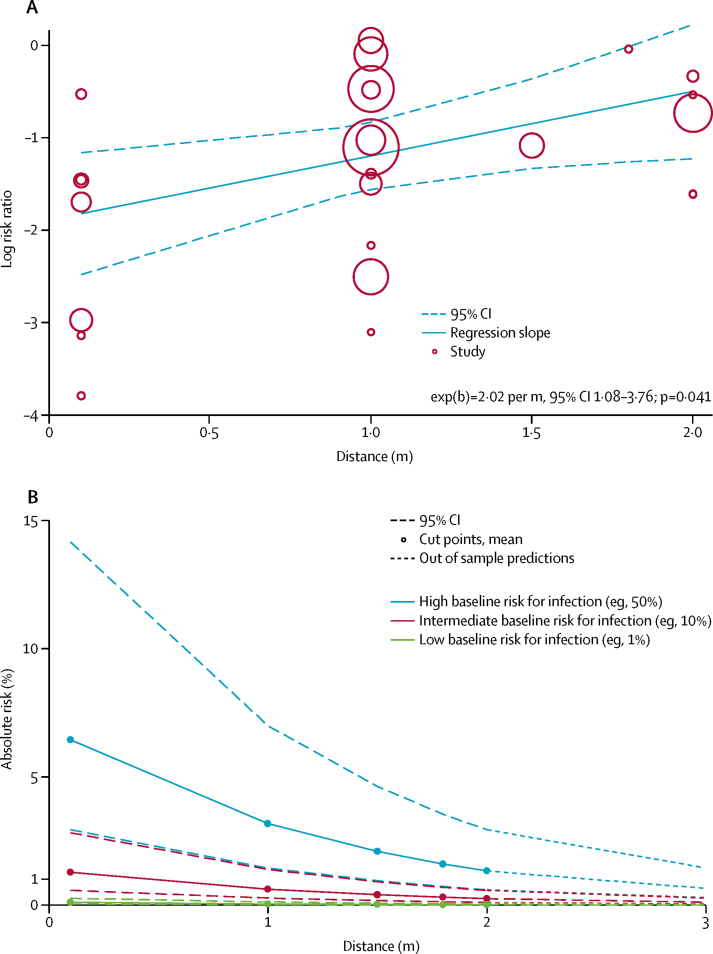
Background Severe acute respiratory syndrome coronavirus 2 (SARS-CoV-2) causes COVID-19 and is spread personto-person through close contact.We aimed to investigate the effects of physical distance, face masks, and eye protection on virus transmission in health-care and non-health-care (eg, community) settings. MethodsWe did a systematic review and meta-analysis to investigate the optimum distance for avoiding person-toperson virus transmission and to assess the use of face masks and eye protection to prevent transmission of viruses.We obtained data for SARS-CoV-2 and the betacoronaviruses that cause severe acute respiratory syndrome, and Middle East respiratory syndrome from 21 standard WHO-specific and COVID-19-specific sources.We searched these data sources from database inception to May 3, 2020, with no restriction by language, for comparative studies and for contextual factors of acceptability, feasibility, resource use, and equity.We screened records, extracted data, and assessed risk of bias in duplicate.We did frequentist and Bayesian meta-analyses and random-effects metaregressions.We rated the certainty of evidence according to Cochrane methods and the GRADE approach.This study is registered with PROSPERO, CRD42020177047.Findings Our search identified 172 observational studies across 16 countries and six continents, with no randomised controlled trials and 44 relevant comparative studies in health-care and non-health-care settings (n=25 697 patients).Transmission of viruses was lower with physical distancing of 1 m or more, compared with a distance of less than 1 m (n=10 736, pooled adjusted odds ratio [aOR] 0•18, 95% CI 0•09 to 0•38; risk difference [RD] -10•2%, 95% CI -11•5 to -7•5; moderate certainty); protection was increased as distance was lengthened (change in relative risk [RR] 2•02 per m; p interaction =0•041; moderate certainty).Face mask use could result in a large reduction in risk of infection (n=2647; aOR 0•15, 95% CI 0•07 to 0•34, RD -14•3%, -15•9 to -10•7; low certainty), with stronger associations with N95 or similar respirators compared with disposable surgical masks or similar (eg, reusable 12-16-layer cotton masks; p interaction =0•090; posterior probability >95%, low certainty).Eye protection also was associated with less infection (n=3713; aOR 0•22, 95% CI 0•12 to 0•39, RD -10•6%, 95% CI -12•5 to -7•7; low certainty).Unadjusted studies and subgroup and sensitivity analyses showed similar findings.Interpretation The findings of this systematic review and meta-analysis support physical distancing of 1 m or more and provide quantitative estimates for models and contact tracing to inform policy.Optimum use of face masks, respirators, and eye protection in public and health-care settings should be informed by these findings and contextual factors.Robust randomised trials are needed to better inform the evidence for these interventions, but this systematic appraisal of currently best available evidence might inform interim guidance.
Overview
CoChat Summary
TL;DR
This systematic review and meta-analysis of 172 observational studies found that physical distancing of at least 1 m, face masks, and eye protection were each associated with lower risk of SARS-CoV-2, SARS-CoV, or MERS-CoV infection. No randomised trials were identified, and certainty ranged from moderate for distancing to low for face masks and eye protection.
Key findings
- Among 44 comparative studies (n=25,697), physical distancing of ≥1 m versus <1 m was associated with lower infection risk (unadjusted n=10,736, RR 0·30, 95% CI 0·20–0·44; adjusted n=7782, aOR 0·18, 95% CI 0·09–0·38; RD −10·2%, 95% CI −11·5 to −7·5; moderate certainty), with protection increasing as distance lengthened (change in RR 2·02 per m; pinteraction=0·041).
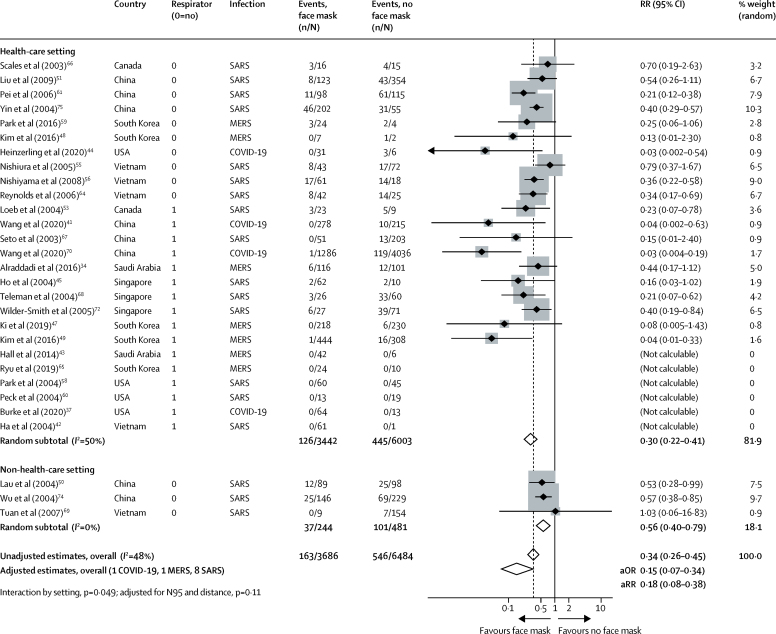
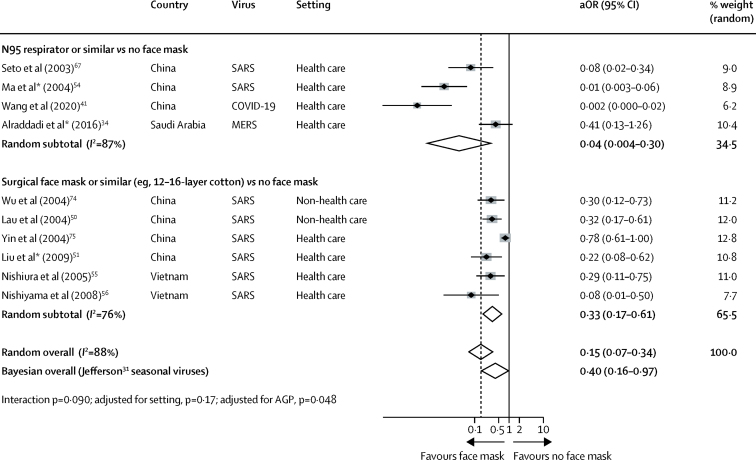
- Face mask use was associated with a large reduction in infection risk (adjusted n=2647, aOR 0·15, 95% CI 0·07–0·34; RD −14·3%, 95% CI −15·9 to −10·7; low certainty), with stronger associations for N95 or similar respirators than disposable surgical masks or similar (pinteraction=0·090; posterior probability >95%, low certainty).
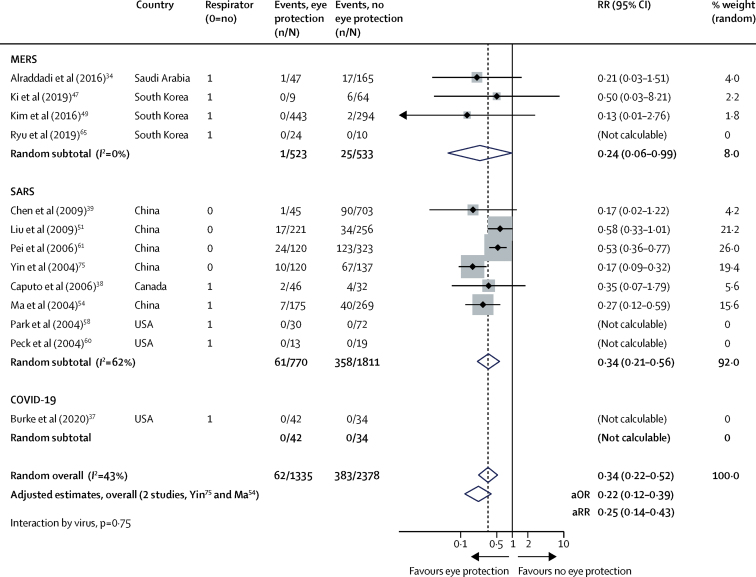
- Eye protection was associated with less infection (unadjusted n=3713, RR 0·34, 95% CI 0·22–0·52; adjusted n=701, aOR 0·22, 95% CI 0·12–0·39; RD −10·6%, 95% CI −12·5 to −7·7; low certainty).
- Across 24 contextual-factor studies, most stakeholders found these strategies acceptable, feasible, and reassuring, but reported discomfort, resource use and equity concerns, communication difficulty, and perceived reduced empathy.
Methods
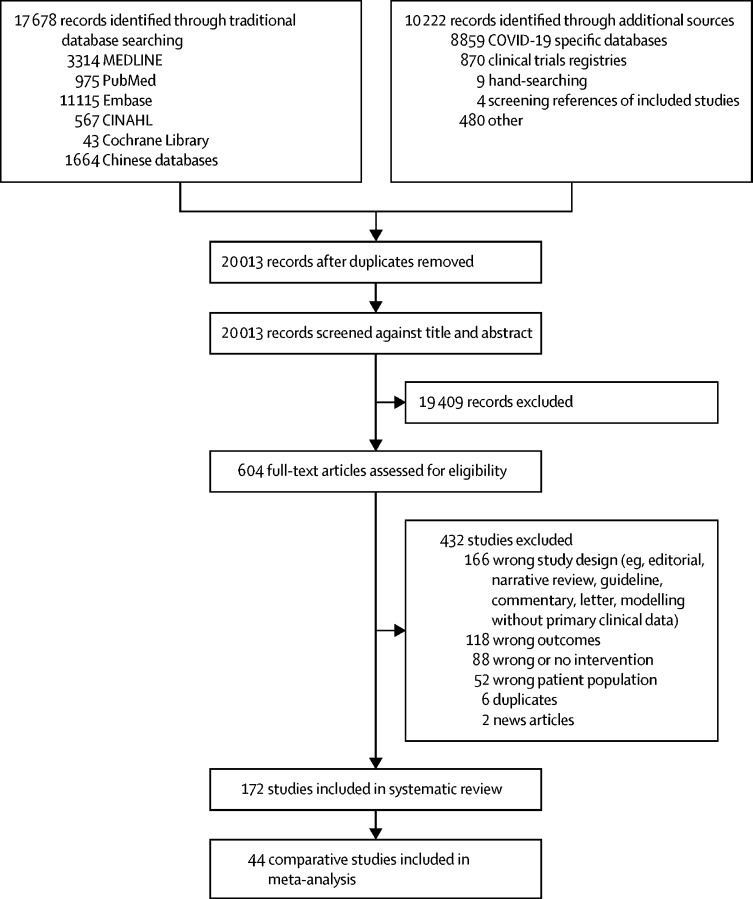
- Systematic review and meta-analysis searching 21 WHO-specific and COVID-19-specific sources from database inception to May 3, 2020, with no language restriction, for studies of confirmed or probable COVID-19, SARS, or MERS and close contacts.
- Duplicate screening, data extraction, and risk-of-bias assessment; frequentist and Bayesian meta-analyses and random-effects meta-regressions; certainty rated with Cochrane methods and GRADE; registered with PROSPERO, CRD42020177047.
- Outcomes included transmission and contextual factors; no randomised controlled trials were identified, so the meta-analysis included 44 comparative observational studies.
Limitations
- The paper states that all included studies were non-randomised, not always fully adjusted, and might suffer recall and measurement bias; many studies lacked precise distances, direct contact was equated to 0 m, and no eligible study quantitatively evaluated whether distances >2 m were more effective.
- The paper also states that few studies assessed non-health-care settings, most evidence came from SARS and MERS (n=6674 patients with COVID-19 of 25,697 total), duration of exposure was not specifically assessed, and reporting was inconsistent for aerosol-generating procedures and masks worn by infected patients.
- Evident from the text: observational designs preclude causal inference, and certainty was low for face masks and eye protection, with residual heterogeneity and imprecision noted.
Model-written summary. Check it against the paper before relying on it.
Integrity signals
Registry
Cites
Statistics
Figures
Verification
Claims the paper makes
3 Valid · 0 Not valid · 7 Not checked · 82 Own results and interpretations
The sources with a verdict support this claim; the rest weren’t checked yet, have no full text we could read, or their verdicts aren’t rated yet.
In the paper
“In 13 unadjusted studies and two adjusted studies,34, 37, 38, 39, 47, 49, 51, 54, 58, 60, 61, 65, 75 eye protection was associated with lower risk of infection (unadjusted n=3713, RR 0·34, 95% CI 0·22 to 0·52; AR 5·5% with eye protection vs 16·0% with no eye protection, RD −10·6%, 95% CI −12·5 to −7·7; adjusted n=701, aOR 0·22, 95% CI 0·12 to 0·39; low certainty; figure 6; table 2; appendix pp 16–”
§ Physical distancing, face masks, and eye protection to prevent person-to-person transmission of SARS-CoV-2 and COVID-19: a systematic review and meta-analysis > Results
What the sources say
- Supportedcites [34] Alraddadi BM Al-Salmi HS Jacobs-Slifka K Risk factors for Middle East respiratory syndrome coronavirus infection among healthcare personnel Emerg Infect Dis 22 2016 1915 1920 27767011 PMC5088034 source
Split into 2 atoms — 2 confirmed, 0 partially supported, 0 disputed, 0 misattributed, 0 unverifiable. Expand the claim to see per-atom verdicts.
- Not checked yetcites [37] Burke RM Balter S Barnes E Enhanced contact investigations for nine early travel-related cases of SARS-CoV-2 in the United States medRxiv 2020 published online May 3. 10.1101/2020.04.27.20081901 (preprint). PMC7467265 32877446
- Supportedcites [38] Caputo KM Byrick R Chapman MG Orser BJ Orser BA Intubation of SARS patients: infection and perspectives of healthcare workers Can J Anaesth 53 2006 122 129 16434750 source
Split into 2 atoms — 2 confirmed, 0 partially supported, 0 disputed, 0 misattributed, 0 unverifiable. Expand the claim to see per-atom verdicts.
plainstates an associationn = 3,713- Asserted: passes — The authors put it forward as true.
- Checkable: passes — It can be checked against evidence.
- Load-bearing: passes — The paper’s conclusions depend on it.
- Based: passes — The paper gives a reason why it holds.
- Supported
Every source the paper cites for this claim was checked and supports it.
In the paper
“This finding is inconsistent with conclusions of a review of four randomised trials,13 in which low certainty of evidence for no larger effect was suggested.”
§ Physical distancing, face masks, and eye protection to prevent person-to-person transmission of SARS-CoV-2 and COVID-19: a systematic review and meta-analysis > Discussion
What the sources say
- Supportedcites [13] Bartoszko JJ Farooqi MAM Alhazzani W Loeb M Medical masks vs N95 respirators for preventing COVID-19 in healthcare workers: a systematic review and meta-analysis of randomized trials Influenza Other Respir Viruses 2020 published online April 4. 10.1111/irv.12745 PMC7298295 32246890 source
The Abstract Conclusions (Bartoszko et al. 2020) state verbatim that 'Low certainty evidence suggests that medical masks and N95 respirators offer similar protection against viral respiratory infection including coronavirus in healthcare workers during non–aerosol–generating care' — i.e., no larger effect of one mask type, hedged at low certainty. The Abstract Data Synthesis and Results (Search results and study characteristics; Effect on outcomes) confirm the review/meta-analysis pooled exactly four RCTs (OR 1.06, 95% CI 0.90–1.25, I² = 0%, low certainty for laboratory-confirmed viral respiratory infection), and the Quality assessment section attributes the 'low' GRADE rating to that four-trial outcome. The citing sentence's paraphrase ('review of four randomised trials', 'low certainty of evidence for no larger effect') therefore matches what this source says. (LLM, conf=0.85)
plain- Asserted: passes — The authors put it forward as true.
- Checkable: passes — It can be checked against evidence.
- Load-bearing: unclear — It is unclear whether the paper’s conclusions depend on it.
- Based: passes — The paper gives a reason why it holds.
- Supported
A result the paper reports from its own data — it cites no other source for it, so there is none to check. The quote shows it is in the paper.
In the paper
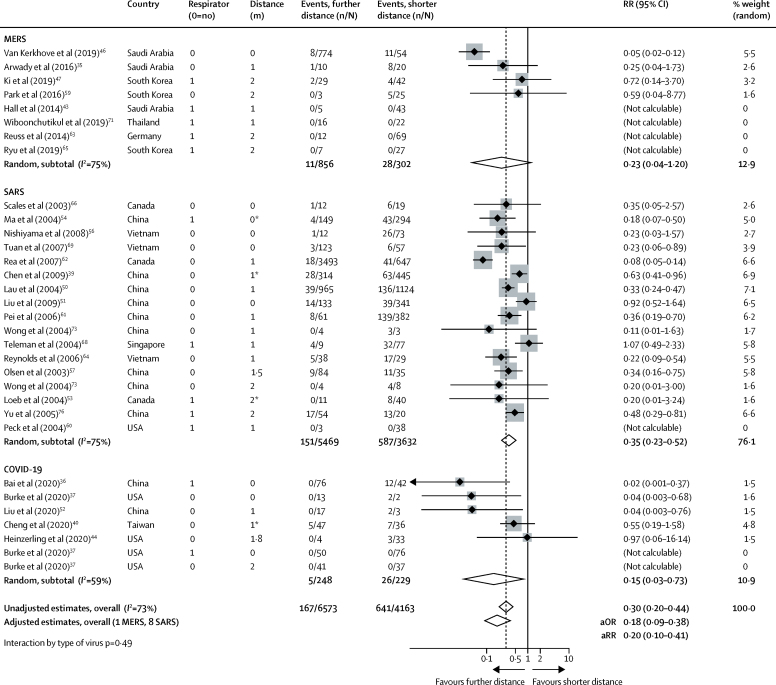
“Transmission of viruses was lower with physical distancing of 1 m or more, compared with a distance of less than 1 m (n=10 736, pooled adjusted odds ratio [aOR] 0·18, 95% CI 0·09 to 0·38; risk difference [RD] −10·2%, 95% CI −11·5 to −7·5; moderate certainty)”
- Also stated in: § Results · boosted
“a strong association was found of proximity of the exposed individual with the risk of infection (unadjusted n=10 736, RR 0·30, 95% CI 0·20 to 0·44; adjusted n=7782, aOR 0·18, 95% CI 0·09 to 0·38; absolute risk [AR] 12·8% with shorter distance vs 2·6% with further distance, risk difference [RD] −10·2%, 95% CI −11·5 to −7·5; moderate certainty; figure 2; table 2; appendix p 16).”
§ Physical distancing, face masks, and eye protection to prevent person-to-person transmission of SARS-CoV-2 and COVID-19: a systematic review and meta-analysis > Abstract > Findings
boostedstates a causen = 10- Asserted: passes — The authors put it forward as true.
- Checkable: passes — It can be checked against evidence.
- Load-bearing: passes — The paper’s conclusions depend on it.
- Based: passes — The paper gives a reason why it holds.
- Rests on an assumption not shown here.
- Also stated in: § Results · boosted
A result the paper reports from its own data — it cites no other source for it, so there is none to check. The quote shows it is in the paper.
In the paper
“When differential N95 or similar respirator use, which was more frequent in health-care settings than in non-health-care settings, was adjusted for the possibility that face masks were less effective in non-health-care settings, the subgroup effect was slightly less credible (pinteraction=0·11, adjusted for differential respirator use; figure 4).”
§ Physical distancing, face masks, and eye protection to prevent person-to-person transmission of SARS-CoV-2 and COVID-19: a systematic review and meta-analysis > Results
plain- Asserted: passes — The authors put it forward as true.
- Checkable: passes — It can be checked against evidence.
- Load-bearing: unclear — It is unclear whether the paper’s conclusions depend on it.
- Based: passes — The paper gives a reason why it holds.
A result the paper reports from its own data — it cites no other source for it, so there is none to check. The quote shows it is in the paper.
In the paper
“Our search did not identify any randomised trials of COVID-19, SARS, or MERS.”
- Also stated in: § Results · plain
“Studies were all observational in nature; no randomised trials were identified of any interventions that directly addressed the included study populations.”
§ Physical distancing, face masks, and eye protection to prevent person-to-person transmission of SARS-CoV-2 and COVID-19: a systematic review and meta-analysis > Methods > Data analysis
plain- Asserted: passes — The authors put it forward as true.
- Checkable: passes — It can be checked against evidence.
- Load-bearing: passes — The paper’s conclusions depend on it.
- Based: passes — The paper gives a reason why it holds.
- Also stated in: § Results · plain
30 more claims
Create a free account to see all 92 claims and to verify the 11 references still open.
- It may state two separate claims as one. 40
- The quote only partly states this claim. 1
- Probably not a substantial claim. 23
Claims other papers make about this one
Each is checked against this paper’s own text: does it say what the citing paper says it does?
The source backs part of the claim, not all of it — or backs it for a different population, condition or comparison.
In the citing paper
“The review by Chu 2020 did not consider RCTs of influenza transmission, but only the observational studies examining impact on SARS, MERS, or SARS‐CoV‐2.”
From Physical interventions to interrupt or reduce the spread of respiratory viruses (2023) · cites this paper as Chu 2020
Experimental — accuracy not yet measuredThe source backs part of the claim, not all of it — or backs it for a different population, condition or comparison.
In the citing paper
“For N95 masks versus no mask in HCWs, there was a large protective effective with an OR of 0.04 (95% CI 0.004 to 0.30); for surgical masks versus no masks, there was an OR of 0.33 (0.17 to 0.61) overall, but four of these studies were in healthcare settings.”
From Physical interventions to interrupt or reduce the spread of respiratory viruses (2023) · cites this paper as Chu 2020
Experimental — accuracy not yet measuredThe source backs part of the claim, not all of it — or backs it for a different population, condition or comparison.
In the citing paper
“Chu 2020 has been criticised for several reasons: use of an outdated 'Risk of bias' tool; inaccuracy of distance measures; and not adequately addressing multiple sources of bias, including recall and classification bias and in particular confounding.”
From Physical interventions to interrupt or reduce the spread of respiratory viruses (2023) · cites this paper as Chu 2020
Experimental — accuracy not yet measuredThe cited source says what the claim attributes to it.
In the citing paper
“Social distancing has been shown to be an important component of measures designed to reduce the spread and impact of COVID-19.”
From Facilitators and barriers to social distancing for young people during the COVID-19 pandemic (2022) · cites this paper as [5]
The cited source says what the claim attributes to it.
In the citing paper
“A systematic review of early efforts to control the spread of COVID-19 additionally estimated that physical distancing of over one meter was important in reducing transmission (pooled adjusted OR 0.18, 95% CI 0·09 to 0·38) [5].”
From Facilitators and barriers to social distancing for young people during the COVID-19 pandemic (2022) · cites this paper as [5]
1 more claim about this paper
Create a free account to see every claim other papers make about this one.
Self-check
Percentages, sums and reported differences re-computed from the paper’s own numbers.
Each contradiction between two passages listed here was confirmed by an independent check.
Rated minor: it would not touch a result — a value no result rests on, a p-value that stays on the same side of the significance level, or a conflict that is clerical, resolved elsewhere in the paper, or outside its own findings.
In the paper
§ Physical distancing, face masks, and eye protection to prevent person-to-person transmission of SARS-CoV-2 and COVID-19: a systematic review and meta-analysis > Abstract > Findings
“Transmission of viruses was lower with physical distancing of 1 m or more, compared with a distance of less than 1 m (n=10 736, pooled adjusted odds ratio [aOR] 0·18”
§ Physical distancing, face masks, and eye protection to prevent person-to-person transmission of SARS-CoV-2 and COVID-19: a systematic review and meta-analysis > Results
“unadjusted n=10 736, RR 0·30, 95% CI 0·20 to 0·44; adjusted n=7782, aOR 0·18, 95% CI 0·09 to 0·38”
Citations
Cites
Preferred Reporting Items for Systematic Reviews and Meta-Analyses: the PRISMA statement
Moher, D., Liberati, A., Tetzlaff, J., Altman, D. G., & for the PRISMA Group (2009) · BMJ · doi:10.1136/bmj.b2535 · Cited by 83,823
Preferred reporting items for systematic reviews and meta-analyses: the PRISMA Statement.
(2009) · PubMed Central · Cited by 44,859
RoB 2: a revised tool for assessing risk of bias in randomised trials
Sterne, J. A. C., Savović, J., Page, M. J., Elbers, R. G., Blencowe, N. S., Boutron, I., Cates, C. J., Cheng, H.-Y., Corbett, M. S., Eldridge, S. M., et al. (2019) · BMJ · doi:10.1136/bmj.l4898 · Cited by 34,787
Dermyshi, E., Wang, Y., Yan, C., Hong, W., Qiu, G., Gong, X., & Zhang, T. (2017) · Neonatology · doi:10.1159/000454668 · Cited by 24,451
GRADE: an emerging consensus on rating quality of evidence and strength of recommendations
Guyatt, G. H., Oxman, A. D., Vist, G. E., Kunz, R., Falck-Ytter, Y., Alonso-Coello, P., & Schünemann, H. J. (2008) · BMJ · doi:10.1136/bmj.39489.470347.ad · Cited by 23,305
Self-citationMeta-analysis of Observational Studies in Epidemiology<SUBTITLE>A Proposal for Reporting</SUBTITLE>
Stroup, D. F. (2000) · JAMA · doi:10.1001/jama.283.15.2008 · Cited by 20,623
Preferred Reporting Items for Systematic Reviews and Meta-Analyses: The PRISMA Statement
Moher, D., Liberati, A., Tetzlaff, J., & Altman, D. G. (2009) · Journal of Clinical Epidemiology · doi:10.1016/j.jclinepi.2009.06.005 · Cited by 19,575
(2014) · Medical Entomology and Zoology · Cited by 17,633
GRADE guidelines: 1. Introduction—GRADE evidence profiles and summary of findings tables
Guyatt, G., Oxman, A. D., Akl, E. A., Kunz, R., Vist, G., Brozek, J., Norris, S., Falck-Ytter, Y., Glasziou, P., & deBeer, H. (2011) · Journal of Clinical Epidemiology · doi:10.1016/j.jclinepi.2010.04.026 · Cited by 10,681
Self-citationCumpston, M., Li, T., Page, M. J., Chandler, J., Welch, V. A., Higgins, J. P., & Thomas, J. (2019) · Cochrane Database of Systematic Reviews · doi:10.1002/14651858.ed000142 · Cited by 7,218
Research works printed but not linked: 3
- Liu ZQ Ye Y Zhang H Guohong X Yang J Wang JL Analysis of the spatio-temporal characteristics and transmission path of COVID-19 cluster cases in Zhuhai Trop Geogr 2020 published online March 12. 10.13284/j.cnki.rddl.003228 · doi:10.13284/j.cnki.rddl.003228
- Park JY Kim BJ Chung KH Hwang YI Factors associated with transmission of Middle East respiratory syndrome among Korean healthcare workers: infection control via extended healthcare contact management in a secondary outbreak hospital Respirology 21 suppl 3 2016 89 (abstr APSR6-0642).
- Campbell A Chapter eight: it's not about the mask: SARS Commission final report, volume 3 http://www.archives.gov.on.ca/en/e_records/sars/report/v3-pdf/Vol3Chp8.pdf December, 2006
Cited by
Items 101–200 of 4,035
Clapp, P. W., Sickbert-Bennett, E. E., Samet, J. M., Berntsen, J., Zeman, K. L., Anderson, D. J., Weber, D. J., Bennett, W. D., & Program, U. C. F. D. C. A. P. E. (2021) · JAMA Internal Medicine · doi:10.1001/jamainternmed.2020.8168 · Cited by 167
Heterogeneity in transmissibility and shedding SARS-CoV-2 via droplets and aerosols
Chen, P., Bobrovitz, N., Premji, Z., Koopmans, M., Fisman, D. N., & Gu, F. (2021) · eLife · doi:10.7554/elife.65774 · Cited by 159
Li, L., Taeihagh, A., & Tan, S. Y. (2023) · Nature Communications · doi:10.1038/s41467-023-36267-9 · Cited by 166
Global Trends in Norovirus Genotype Distribution among Children with Acute Gastroenteritis
Cannon, J. L., Bonifacio, J., Bucardo, F., Buesa, J., Bruggink, L. D., Chan, M. C. W., Fumian, T. M., Giri, S., Gonzalez, M. D., Hewitt, J., et al. (2021) · Emerging infectious diseases · doi:10.3201/eid2705.204756 · Cited by 166
Sallam, M., Dababseh, D., Yaseen, A., Al-Haidar, A., Taim, D., Eid, H., Ababneh, N. A., Bakri, F. G., & Mahafzah, A. (2020) · PLOS ONE · doi:10.1371/journal.pone.0243264 · Cited by 180
“This is why frequent hand washing and social distancing are the ideal protective measures [14].”
BackgroundThe nature of cities and the Covid-19 pandemic
Lai, K. Y., Webster, C. J., Kumari, S., & Sarkar, C. (2020) · Current Opinion in Environmental Sustainability · doi:10.1016/j.cosust.2020.08.008 · Cited by 184
Physical distancing, face masks, and eye protection for prevention of COVID-19
MacIntyre, C. R., & Wang, Q. (2020) · The Lancet · doi:10.1016/s0140-6736(20)31183-1 · Cited by 169
The Impact of the COVID-19 Pandemic on Self-Reported Health
Peters, A., Rospleszcz, S., Greiser, K. H., Dallavalle, M., & Berger, K. (2020) · Deutsches Ärzteblatt international · doi:10.3238/arztebl.2020.0861 · Cited by 189
What Is an Aerosol-Generating Procedure?
Klompas, M., Baker, M. A., & Rhee, C. (2020) · JAMA Surgery · doi:10.1001/jamasurg.2020.6643 · Cited by 162
Aerosol Transmission of SARS-CoV-2: Physical Principles and Implications
Jarvis, M. C. (2020) · Frontiers in Public Health · doi:10.3389/fpubh.2020.590041 · Cited by 168
A compendium answering 150 questions on COVID‐19 and SARS‐CoV‐2
Riggioni, C., Comberiati, P., Giovannini, M., Agache, I. O., Akdiş, M., Alves‐Correia, M., Antó, J. M., Arcolacı, A., Azkur, A. K., Azkur, D., et al. (2020) · Allergy · doi:10.1111/all.14449 · Cited by 148
Wang, J., Huang, J., Feng, Z., Cao, S., & Haghighat, F. (2021) · Energy and Buildings · doi:10.1016/j.enbuild.2021.110883 · Cited by 160
Wright, L., Steptoe, A., & Fancourt, D. (2021) · The Lancet Regional Health - Europe · doi:10.1016/j.lanepe.2021.100061 · Cited by 136
Huang, B., Wang, J., Jixuan Cai, 蔡., Yao, S., Chan, P. K. S., Tam, T., Hong, Y., Ruktanonchai, C. W., Carioli, A., Floyd, J., et al. (2021) · Nature Human Behaviour · doi:10.1038/s41562-021-01063-2 · Cited by 158
Personal Protective Equipment for Healthcare Workers during the COVID-19 Pandemic
Park, S. H. (2020) · Infection and Chemotherapy · doi:10.3947/ic.2020.52.2.165 · Cited by 172
Modes of transmission of SARS-CoV-2 and evidence for preventive behavioral interventions
Zhou, L., Ayeh, S. K., Chidambaram, V., & Karakousis, P. C. (2021) · BMC Infectious Diseases · doi:10.1186/s12879-021-06222-4 · Cited by 175
Le, T. T., Curry, E. J., Vinikoor, T., Das, R., Liu, Y., Sheets, D., Tran, K. T. M., Hawxhurst, C. J., Stevens, J. F., Hancock, J., et al. (2022) · Advanced Functional Materials · doi:10.1002/adfm.202113040 · Cited by 146
Rahmandad, H., Lim, T. Y., & Sterman, J. D. (2021) · System Dynamics Review · doi:10.1002/sdr.1673 · Cited by 167
Peeples, L. (2020) · Nature · doi:10.1038/d41586-020-02801-8 · Cited by 153
Fluid Dynamics of Respiratory Infectious Diseases
Bourouiba, L. (2021) · Annual Review of Biomedical Engineering · doi:10.1146/annurev-bioeng-111820-025044 · Cited by 129
Tavares, F. F., & Betti, G. (2020) · World Development · doi:10.1016/j.worlddev.2020.105307 · Cited by 159
Fisher, K. A., Barile, J. P., Guerin, R. J., Esschert, K. L. V., Jeffers, A., Tian, L. H., Garcia‐Williams, A. G., Gurbaxani, B. M., Thompson, W., & Prue, C. E. (2020) · MMWR Morbidity and Mortality Weekly Report · doi:10.15585/mmwr.mm6928e3 · Cited by 124
Bioinspired superhydrophobic surfaces, inhibiting or promoting microbial contamination?
Chen, Y., Ao, J., Zhang, J., Gao, J., Hao, L., Jiang, R., Zhang, Z., Liu, Z., Zhao, J., & Ren, L. (2023) · Materials Today · doi:10.1016/j.mattod.2023.06.006 · Cited by 150
A SARS-CoV-2 Cluster in an Acute Care Hospital
Klompas, M., Baker, M. A., Rhee, C., Tucker, R., Fiumara, K., Griesbach, D., Bennett-Rizzo, C., Salmasian, H., Wang, R., Wheeler, N., et al. (2021) · Annals of Internal Medicine · doi:10.7326/m20-7567 · Cited by 129
Two Years into the COVID-19 Pandemic: Lessons Learned
da Silva, S. J. R., do Nascimento, J. C. F., Mendes, R. P. G., Guarines, K. M., da Silva, C. T. A., da Silva, P. G., de Magalhães, J. J. F., Vigar, J. R. J., Silva‐Júnior, A., Kohl, A., et al. (2022) · ACS Infectious Diseases · doi:10.1021/acsinfecdis.2c00204 · Cited by 174
Agent-Based Social Simulation of the Covid-19 Pandemic: A Systematic Review
Lorig, F., Johansson, E., & Davidsson, P. (2021) · Journal of Artificial Societies and Social Simulation · doi:10.18564/jasss.4601 · Cited by 181
Social stigma in the time of coronavirus disease 2019
Sotgiu, G., & Dobler, C. C. (2020) · European Respiratory Journal · doi:10.1183/13993003.02461-2020 · Cited by 161
Tuberculosis in times of COVID-19
Zimmer, A., Klinton, J. S., Omenka, C. O., Heitkamp, P., Nyirenda, C. N., Furin, J. J., & Pai, M. (2021) · Journal of Epidemiology & Community Health · doi:10.1136/jech-2021-217529 · Cited by 157
An upper bound on one-to-one exposure to infectious human respiratory particles
Bagheri, G., Thiede, B., Hejazi, B., Schlenczek, O., & Bodenschatz, E. (2021) · Proceedings of the National Academy of Sciences · doi:10.1073/pnas.2110117118 · Cited by 144
TFOS Lifestyle Report: Impact of environmental conditions on the ocular surface
Alves, M., Asbell, P. A., Doğru, M., Giannaccare, G., Grau, A. E., Gregory, D. G., Kim, D. H., Marini, M. C., Ngo, W., Nowińska, A., et al. (2023) · The Ocular Surface · doi:10.1016/j.jtos.2023.04.007 · Cited by 174
Shen, J., Kong, M., Dong, B., Birnkrant, M. J., & Zhang, J. “. (2021) · Building and Environment · doi:10.1016/j.buildenv.2021.107926 · Cited by 138
Ahorsu, D. K., Lin, C.-Y., & Pakpour, A. H. (2020) · Gerontology and Geriatric Medicine · doi:10.1177/2333721420966081 · Cited by 132
Mohapatra, R. K., Pintilie, L., Kandi, V., Sarangi, A. K., Das, D., Sahu, R., & Perekhoda, L. O. (2020) · Chemical Biology & Drug Design · doi:10.1111/cbdd.13761 · Cited by 148
Hou, Z., Song, S., Du, F., Shi, L., Zhang, D. “., Lin, L. K., & Yu, H. (2021) · JMIR Public Health and Surveillance · doi:10.2196/26372 · Cited by 130
Face masks, public policies and slowing the spread of COVID-19: Evidence from Canada
Karaivanov, A. K., Lu, S. E., Shigeoka, H., Chen, C., & Pamplona, S. (2021) · Journal of Health Economics · doi:10.1016/j.jhealeco.2021.102475 · Cited by 157
Self-citationChen, J., Guo, X., Pan, H., & Zhong, S. (2021) · Sustainable Cities and Society · doi:10.1016/j.scs.2021.102892 · Cited by 145
Review of the Breathability and Filtration Efficiency of Common Household Materials for Face Masks
Kwong, L. H., Wilson, R., Kumar, S., Crider, Y. S., Sanchez, Y. R., Rempel, D., & Pillarisetti, A. (2021) · ACS Nano · doi:10.1021/acsnano.0c10146 · Cited by 137
(Mis)communicating about COVID-19: Insights from Health and Crisis Communication
Noar, S. M., & Austin, L. (2020) · Health Communication · doi:10.1080/10410236.2020.1838093 · Cited by 143
A Rosetta Stone for Understanding Infectious Drops and Aerosols
Milton, D. K. (2020) · Journal of the Pediatric Infectious Diseases Society · doi:10.1093/jpids/piaa079 · Cited by 128
The risk of indoor sports and culture events for the transmission of COVID-19
Moritz, S., Gottschick, C., Horn, J., Popp, M., Langer, S., Klee, B., Purschke, O., Gekle, M., Ihling, A., Zimmermann, F. D. L., et al. (2021) · Nature Communications · doi:10.1038/s41467-021-25317-9 · Cited by 128
Wright, L., & Fancourt, D. E. (2021) · Preventive Medicine · doi:10.1016/j.ypmed.2021.106713 · Cited by 117
Fink, J. B., Ehrmann, S., Li, J., Dailey, P., McKiernan, P. J., Darquenne, C., Martin, A. R., Rothen‐Rutishauser, B., Kuehl, P. J., Häußermann, S., et al. (2020) · Journal of Aerosol Medicine and Pulmonary Drug Delivery · doi:10.1089/jamp.2020.1615 · Cited by 134
Effects of surgical face masks on cardiopulmonary parameters during steady state exercise
Lässing, J., Falz, R., Pökel, C., Fikenzer, S., Laufs, U., Schulze, A., Hölldobler, N., Rüdrich, P., & Busse, M. W. (2020) · Scientific Reports · doi:10.1038/s41598-020-78643-1 · Cited by 123
High energy efficiency ventilation to limit COVID-19 contagion in school environments
Schibuola, L., & Tambani, C. (2021) · Energy and Buildings · doi:10.1016/j.enbuild.2021.110882 · Cited by 129
Ehrhardt, J. P., Ekinci, A., Krehl, H., Meincke, M., Finci, I., Klein, J., Geisel, B., Wagner-Wiening, C., Eichner, M., & Brockmann, S. (2020) · Eurosurveillance · doi:10.2807/1560-7917.es.2020.25.36.2001587 · Cited by 121
Simulating COVID-19 in a university environment
Gressman, P. T., & Peck, J. (2020) · Mathematical Biosciences · doi:10.1016/j.mbs.2020.108436 · Cited by 127
Kinoshita, S., Cortright, K., Crawford, A., Mizuno, Y., Yoshida, K., Hilty, D., Guinart, D., Torous, J., Correll, C. U., Castle, D. J., et al. (2022) · Psychological Medicine · doi:10.1017/s0033291720004584 · Cited by 114
Tangcharoensathien, V., Bassett, M. T., Meng, Q., & Mills, A. (2021) · BMJ · doi:10.1136/bmj.n83 · Cited by 122
Belief in Science Influences Physical Distancing in Response to COVID-19 Lockdown PoliciesPreprint
Brzezinski, A., Kecht, V., Dijcke, D. V., & Wright, A. L. (2020) · SSRN Electronic Journal · doi:10.2139/ssrn.3587990 · Cited by 115
When and How Trust in Government Leads to Compliance with COVID-19 Precautionary Measures
Shanka, M. S., & Menebo, M. M. (2021) · Journal of Business Research · doi:10.1016/j.jbusres.2021.10.036 · Cited by 147
SDN–IoT empowered intelligent framework for industry 4.0 applications during COVID-19 pandemic
Rahman, A., Chakraborty, C., Anwar, A., Karim, M. R., Islam, M. J., Kundu, D., Rahman, Z., & Band, S. S. (2022) · Cluster Computing · doi:10.1007/s10586-021-03367-4 · Cited by 121
Michalowsky, B., Hoffmann, W. U., Bohlken, J., & Kostev, K. (2020) · Age and Ageing · doi:10.1093/ageing/afaa260 · Cited by 133
Global trends and predictors of face mask usage during the COVID-19 pandemic
Badillo‐Goicoechea, E., Chang, T., Kim, E., LaRocca, S., Morris, K. A., Deng, X., Chiu, S., Bradford, A., Garcia, A., Kern, C. A., et al. (2021) · BMC Public Health · doi:10.1186/s12889-021-12175-9 · Cited by 135
Vieira, A. G. D. S., Pinto, A. C. P. N., Garcia, B. M. S. P., Eid, R. A. C., Mól, C. G., & Nawa, R. K. (2022) · Journal of Physiotherapy · doi:10.1016/j.jphys.2022.03.011 · Cited by 119
“Morin L, Savale L, Pham T, Colle R, Figueiredo S, Harrois A, et al. Four-Month Clinical Status of a Cohort of Patients After Hospitalization for COVID-19.”
BackgroundInfluentialMask wearing in community settings reduces SARS-CoV-2 transmission
Leech, G., Smith, D., Monrad, J. T., Sandbrink, J. B., Snodin, B., Zinkov, R., Rader, B. M., Brownstein, J. S., Gal, Y., Bhatt, S., et al. (2022) · Proceedings of the National Academy of Sciences · doi:10.1073/pnas.2119266119 · Cited by 127
Is risk compensation threatening public health in the covid-19 pandemic?
Mantzari, E., Rubin, G. J., & Marteau, T. M. (2020) · BMJ · doi:10.1136/bmj.m2913 · Cited by 120
Morrison, C. B., Edwards, C. E., Shaffer, K. M., Araba, K. C., Wykoff, J. A., Williams, D. R., Asakura, T., Dang, H., Morton, L. C., Gilmore, R. C., et al. (2022) · Proceedings of the National Academy of Sciences · doi:10.1073/pnas.2119680119 · Cited by 110
Ball, H., & Wozniak, T. R. (2021) · Health Communication · doi:10.1080/10410236.2021.1920717 · Cited by 133
Development of a Fluorescence-Based, High-Throughput SARS-CoV-2 3CL pro Reporter Assay
Froggatt, H. M., Heaton, B. E., & Heaton, N. S. (2020) · Journal of Virology · doi:10.1128/jvi.01265-20 · Cited by 101
Vermund, S. H., & Pitzer, V. E. (2020) · Clinical Infectious Diseases · doi:10.1093/cid/ciaa855 · Cited by 106
Lifestyle factors in the prevention of COVID-19
Lange, K. W., & Nakamura, Y. (2020) · Global Health Journal · doi:10.1016/j.glohj.2020.11.002 · Cited by 143
Mousa, A., Winskill, P., Watson, O. J., Ratmann, O., Monod, M., Ajelli, M., Diallo, A., Dodd, P. J., Grijalva, C. G., Kiti, M. C., et al. (2021) · eLife · doi:10.7554/elife.70294 · Cited by 136
Vaccine response following anti-CD20 therapy: a systematic review and meta-analysis of 905 patients
Vijenthira, A., Gong, I. Y., Betschel, S., Cheung, M. C., & Hicks, L. K. (2021) · Blood Advances · doi:10.1182/bloodadvances.2021004629 · Cited by 123
COVID-19 and COPD: a narrative review of the basic science and clinical outcomes
Higham, A., Mathioudakis, A. G., Vestbo, J., & Singh, D. (2020) · European Respiratory Review · doi:10.1183/16000617.0199-2020 · Cited by 122
Is the SARS CoV-2 Omicron Variant Deadlier and More Transmissible Than Delta Variant?
Duong, B. V., Larpruenrudee, P., Fang, T., Hossain, S. I., Saha, S. C., Gu, Y., & Islam, M. S. (2022) · International Journal of Environmental Research and Public Health · doi:10.3390/ijerph19084586 · Cited by 121
Digital proximity tracing on empirical contact networks for pandemic control
(2021) · doi:10.1038/s41467-021-21809-w · Cited by 123
Shaw, K. A., Zello, G. A., Butcher, S. J., Ko, J. B., Bertrand, L., & Chilibeck, P. D. (2021) · Applied Physiology, Nutrition, and Metabolism · doi:10.1139/apnm-2021-0143 · Cited by 117
Guzek, D., Skolmowska, D., & Głąbska, D. (2020) · International Journal of Environmental Research and Public Health · doi:10.3390/ijerph17165770 · Cited by 117
Comparison of Face-Touching Behaviors Before and During the Coronavirus Disease 2019 Pandemic
Chen, Y., Qin, G., Chen, J., Xu, J., Feng, D.-Y., Wu, X., & Li, X. (2020) · JAMA Network Open · doi:10.1001/jamanetworkopen.2020.16924 · Cited by 110
Paul, E., & Fancourt, D. E. (2022) · The Lancet Regional Health - Europe · doi:10.1016/j.lanepe.2022.100317 · Cited by 116
Global Assessment of the Relationship between Government Response Measures and COVID-19 DeathsPreprint
Hale, T. N., Hale, A. J., Kira, B., Petherick, A., Phillips, T., Sridhar, D., Thompson, R. N., Webster, S., & Angrist, N. (2020) · medRxiv · doi:10.1101/2020.07.04.20145334 · Cited by 108
Medicinal Plants in COVID-19: Potential and Limitations
Lim, X. Y., Teh, B. P., & Tan, T. Y. C. (2021) · Frontiers in Pharmacology · doi:10.3389/fphar.2021.611408 · Cited by 121
How do hotels in developing countries manage the impact of COVID-19? The case of Lebanese hotels
Yacoub, L., & Elhajjar, S. (2021) · International Journal of Contemporary Hospitality Management · doi:10.1108/ijchm-08-2020-0814 · Cited by 135
Mounting evidence suggests coronavirus is airborne — but health advice has not caught up
Lewis, D. (2020) · Nature · doi:10.1038/d41586-020-02058-1 · Cited by 116
The Need for More and Better Testing for COVID-19
Manabe, Y. C., Sharfstein, J., & Armstrong, K. (2020) · JAMA · doi:10.1001/jama.2020.21694 · Cited by 97
Risk compensation and face mask mandates during the COVID-19 pandemic
Yan, Y., Bayham, J., Richter, A., & Fenichel, E. P. (2021) · Scientific Reports · doi:10.1038/s41598-021-82574-w · Cited by 107
Park, S., Michelow, I. C., & Choe, Y. J. (2021) · The Journal of Infectious Diseases · doi:10.1093/infdis/jiab231 · Cited by 110
Critical Thinking: A Model of Intelligence for Solving Real-World Problems
Halpern, D. F., & Dunn, D. S. (2021) · Journal of Intelligence · doi:10.3390/jintelligence9020022 · Cited by 199
Pemmada, R., Zhu, X., Dash, M., Zhou, Y., Ramakrishna, S., Peng, X., Thomas, V., Jain, S., & Nanda, H. S. (2020) · Materials · doi:10.3390/ma13184041 · Cited by 109
Association between COVID-19 outcomes and mask mandates, adherence, and attitudes
Adjodah, D., Dinakar, K., Chinazzi, M., Fraiberger, S. P., Pentland, A., Bates, S., Staller, K. D., Vespignani, A., & Bhatt, D. L. (2021) · PLoS ONE · doi:10.1371/journal.pone.0252315 · Cited by 118
Systemic diseases and the cornea
Shah, R., Amador, C., Tormanen, K., Ghiam, S., Saghizadeh, M., Arumugaswami, V., Kumar, A., Kramerov, A. A., & Ljubimov, A. V. (2021) · Experimental Eye Research · doi:10.1016/j.exer.2021.108455 · Cited by 114
Optimal control of the COVID-19 pandemic: controlled sanitary deconfinement in Portugal
Silva, C. J., Cruz, C., Torres, D. F. M., Muñuzuri, A. P., Carballosa, A., Area, I., Nieto, J. J., Fonseca-Pinto, R., Passadouro, R., dos Santos, E. S., et al. (2020) · Portuguese National Funding Agency for Science, Research and Technology (RCAAP Project by FCT) · Cited by 97
Ekpanyaskul, C., & Padungtod, C. (2021) · Safety and Health at Work · doi:10.1016/j.shaw.2021.01.010 · Cited by 125
Girum, T., Lentiro, K., Geremew, M., Migora, B., Shewamare, S., & Shimbre, M. S. (2021) · Archives of Public Health · doi:10.1186/s13690-021-00663-8 · Cited by 99
Anand, U., Cabreros, C., Mal, J., Ballesteros, F., Sillanpää, M. E. T., Tripathi, V. S., & Bontempi, E. (2021) · Environmental Research · doi:10.1016/j.envres.2021.111126 · Cited by 104
Shen, M., Zu, J., Fairley, C. K., Pagán, J. A., An, L., Du, Z., Guo, Y., Rong, L., Xiao, Y., Zhuang, G., et al. (2021) · Vaccine · doi:10.1016/j.vaccine.2021.02.056 · Cited by 101
Wright, L., Steptoe, A., & Fancourt, D. E. (2021) · Journal of Epidemiology & Community Health · doi:10.1136/jech-2021-216876 · Cited by 105
COVID‐19: Current knowledge in clinical features, immunological responses, and vaccine development
Singh, R., Kang, A., Luo, X., Jeyanathan, M., Gillgrass, A. E., Afkhami, S., & Xing, Z. (2021) · The FASEB Journal · doi:10.1096/fj.202002662r · Cited by 114
Impact of Early Pandemic Stage Mutations on Molecular Dynamics of SARS-CoV‑2 Mpro
Amamuddy, O. S., Verkhivker, G. M., & Bishop, Ö. T. (2020) · Journal of Chemical Information and Modeling · doi:10.1021/acs.jcim.0c00634 · Cited by 93
Conspiracy theories in the era of COVID‐19: A tale of two pandemics
Stein, R. A., Ometa, O., Shetty, S. P., Katz, A. A., Popitiu, M. I., & Brotherton, R. (2021) · International Journal of Clinical Practice · doi:10.1111/ijcp.13778 · Cited by 115
Derraik, J. G. B., Anderson, W. A., Connelly, E. A., & Anderson, Y. C. (2020) · International Journal of Environmental Research and Public Health · doi:10.3390/ijerph17176117 · Cited by 146
Contagion dynamics on higher-order networks
de Arruda, G. F., Aleta, A., & Moreno, Y. (2024) · Nature Reviews Physics · doi:10.1038/s42254-024-00733-0 · Cited by 154
The Importance of Understanding the Stages of COVID-19 in Treatment and Trials
Ferreira, A., Amstrong, A., Ngo, B., Mussini, C., Arkfeld, D. G., Griffin, D. O., Peng, D., Sawcer, D., Brennan-Rieder, D., Hanna, D. L., et al. (2021) · Aids Reviews · doi:10.24875/aidsrev.200001261 · Cited by 92
Ditekemena, J., Nkamba, D. M., Mavoko, H. M., Fodjo, J. N. S., Luhata, C., den Bergh, R. V., Kitoto, A. T., Damme, W. V., Muyembe, J. J., & Colebunders, R. (2021) · BMJ Open · doi:10.1136/bmjopen-2020-043356 · Cited by 93
Krolo, I., Blažeka, M., Merdžo, I., Vrtar, I., Sabol, I., & Vicković, I. P. (2021) · Medical Archives · doi:10.5455/medarh.2021.75.144-148 · Cited by 104
Downsides of face masks and possible mitigation strategies: a systematic review and meta-analysis
Bakhit, M., Krzyzaniak, N., Scott, A. M., Clark, J., Glasziou, P., & Del Mar, C. (2021) · BMJ Open · doi:10.1136/bmjopen-2020-044364 · Cited by 98
A conformable sensory face mask for decoding biological and environmental signals
Kim, J., Marcus, C., Ono, R., Sadat, D., Mirzazadeh, A., Jens, M., Fernandez, S. V., Zheng, S., Durak, T., & Dağdeviren, C. (2022) · Nature Electronics · doi:10.1038/s41928-022-00851-6 · Cited by 102
Biological fluid dynamics of airborne COVID-19 infection
Seminara, G., Carli, B., Forni, G., Fuzzi, S., Mazzino, A., & Rinaldo, A. (2020) · RENDICONTI LINCEI · doi:10.1007/s12210-020-00938-2 · Cited by 97
Metadata
- Authors
- Chu, D. K., Akl, E. A., Duda, S., Solo, K., Yaacoub, S., Schünemann, H. J., Chu, D. K., Akl, E. A., El-harakeh, A., Bognanni, A., Lotfi, T., Loeb, M., Hajizadeh, A., Bak, A., Izcovich, A., Cuello-Garcia, C. A., Chen, C., Harris, D. J., Borowiack, E., Chamseddine, F., Schünemann, F., Morgano, G. P., Muti Schünemann, G. E. U., Chen, G., Zhao, H., Neumann, I., Chan, J., Khabsa, J., Hneiny, L., Harrison, L., Smith, M., Rizk, N., Giorgi Rossi, P., AbiHanna, P., El-khoury, R., Stalteri, R., Baldeh, T., Piggott, T., Zhang, Y., Saad, Z., Khamis, A., Reinap, M., Duda, S., Solo, K., Yaacoub, S., & Schünemann, H. J.
- Affiliations
- McMaster University (CA)
- Samsung (China) (CN)
- Cochrane Canada (CA)
- ORCID
- Bognanni, Antonio
- Lotfi, Tamara
- Loeb, Mark
- Hajizadeh, Anisa
- Izcovich, Ariel
- Chen, Chen
- Harris, David J
- Borowiack, Ewa
- Chamseddine, Fatimah
- Morgano, Gian Paolo
- Chen, Guang
- Zhao, Hong
- Neumann, Ignacio
- Chan, Jeffrey
- Khabsa, Joanne
- Hneiny, Layal
- Harrison, Leila
- Smith, Maureen
- Rizk, Nesrine
- El-khoury, Rayane
- Baldeh, Tejan
- Piggott, Thomas
- Zhang, Yuan
- Khamis, Assem
- Reinap, Marge
- Venue
- The Lancet
- Publisher
- Elsevier BV
- Published
- 2020-06
- Volume
- 395
- Issue
- 10242
- Pages
- 1973-1987
- ISSN
- 0099-5355 (ISSN-L)
- 0140-6736
- PMC
- PMC7263814
- OpenAlex
- W3032742287
- Semantic Scholar
- 5af6b87d035e64d44ff43c277f06e1a2f21e23df
- Cited by
- 3,843
- References
- 104
- Citations by year
- 2026: 82 · 2025: 151 · 2024: 259 · 2023: 483 · 2022: 765 · 2021: 1366 · 2020: 729
- FWCI
- 117.07
- Type
- journal article
- Language
- en
- Open access
- hybrid
- doi.org
- Licence
- cc-by
- www.elsevier.com/tdm/userlicense/1.0/ (tdm)
- www.elsevier.com/legal/tdmrep-license (tdm)
- creativecommons.org/licenses/by/3.0/igo/ (vor)
- Locations
- The Lancet (publishedVersion, cc-by)
- PubMed Central (publishedVersion, cc-by)
- PubMed (publishedVersion)
- HAL (submittedVersion)
- Funders
- Canadian Allergy, Asthma and Immunology Foundation
- Lanzhou University
- Topics
- Health Sciences › Medicine › Pulmonary and Respiratory Medicine › Infection Control and Ventilation
- Physical Sciences › Mathematics › Modeling and Simulation › COVID-19 epidemiological studies
- Social Sciences › Sociology and Political Science › COVID-19 Prevention and Impact
- Keywords
- social distancing, face masks, eye protection, SARS-CoV-2, COVID-19 pandemic, human-to-human transmission, betacoronaviruses, SARS, MERS, respiratory virus transmission, N95 respirators, healthcare settings, community settings, infection control, droplet transmission, airborne transmission, acceptability
- MeSH terms
- Betacoronavirus, Physical Distancing, COVID-19, SARS-CoV-2, Communicable Disease Control, Eye Protective Devices, Humans, Masks, Pneumonia, Viral, Social Isolation, Coronavirus Infections, Pandemics
About these checks
Registry, retraction, Cites and statistics results are computed, not judged, with one exception: a printed reference that no index lists is read once by a model before it counts as a citation error. Claims are extracted by a model and kept only when their quote appears verbatim in the text; each cited source is then checked, with a model’s help, for whether it says what the claim relies on. Those verdicts can be wrong — read the claim’s quote and the cited source before relying on one.
The claim verdicts this report counts are experimental: their accuracy is not yet measured.
A language model drew the claims from the paper on 2026-10-06, under version 3 of the claim definition (model deepseek-v4.1-flash, prompt extract-v3).
A second model labelled each claim on 2026-10-06 (model jev-1.13-20260917, definition revision gold-guideline-v0.2).
Cited sources are checked with a language model’s help (gpt-6-sol and qwen3.8-omni-flash).
Statistics and arithmetic are recomputed, not judged.
Confidence bands are shown only for fields calibrated on our annotated test set. None is calibrated yet, so no band is shown.
What counts as a claim ›How we measure confidence ›How we check this ›
Are you an author, or do you see a problem with this page? Request a review
Data sources
Bibliographic data: Semantic Scholar, OpenAlex, Crossref.
Contains information from the Semantic Scholar Academic Graph Datasets, made available under the ODC Attribution License (ODC-BY 1.0).
Semantic Scholar’s data is described in: Kinney, R., et al. (2023). The Semantic Scholar Open Data Platform. arXiv:2301.10140.
