

Physical distancing, face masks, and eye protection to prevent person-to-person transmission of SARS-CoV-2 and COVID-19: a systematic review and meta-analysis
Open accessThe DOI matches its Crossref record; 92 of the 104 references it cites were found in a registry or an index; 6 of the 17 sources its claims cite were checked for support.
Abstract
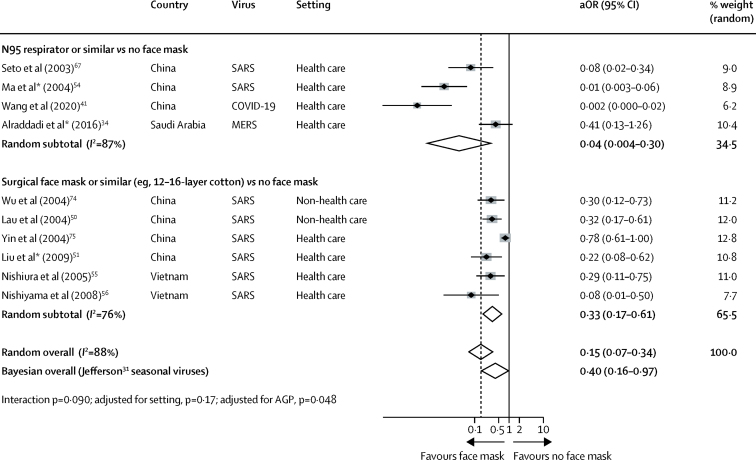
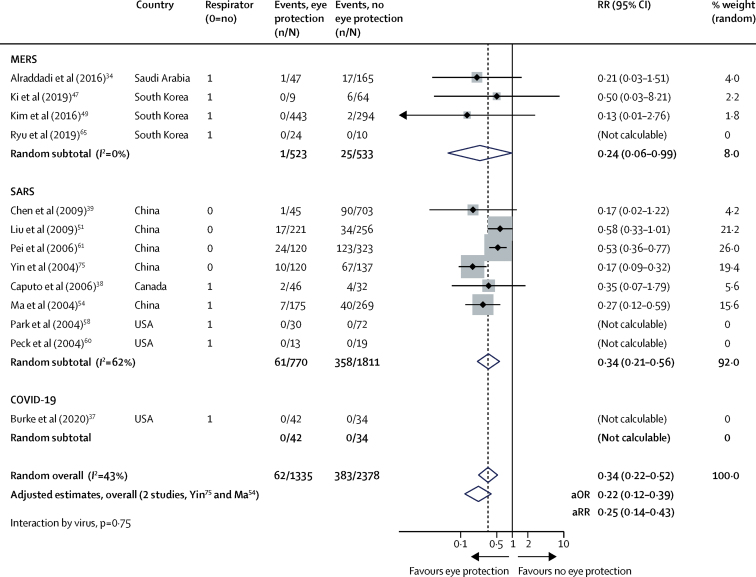
Background Severe acute respiratory syndrome coronavirus 2 (SARS-CoV-2) causes COVID-19 and is spread personto-person through close contact.We aimed to investigate the effects of physical distance, face masks, and eye protection on virus transmission in health-care and non-health-care (eg, community) settings. MethodsWe did a systematic review and meta-analysis to investigate the optimum distance for avoiding person-toperson virus transmission and to assess the use of face masks and eye protection to prevent transmission of viruses.We obtained data for SARS-CoV-2 and the betacoronaviruses that cause severe acute respiratory syndrome, and Middle East respiratory syndrome from 21 standard WHO-specific and COVID-19-specific sources.We searched these data sources from database inception to May 3, 2020, with no restriction by language, for comparative studies and for contextual factors of acceptability, feasibility, resource use, and equity.We screened records, extracted data, and assessed risk of bias in duplicate.We did frequentist and Bayesian meta-analyses and random-effects metaregressions.We rated the certainty of evidence according to Cochrane methods and the GRADE approach.This study is registered with PROSPERO, CRD42020177047.Findings Our search identified 172 observational studies across 16 countries and six continents, with no randomised controlled trials and 44 relevant comparative studies in health-care and non-health-care settings (n=25 697 patients).Transmission of viruses was lower with physical distancing of 1 m or more, compared with a distance of less than 1 m (n=10 736, pooled adjusted odds ratio [aOR] 0•18, 95% CI 0•09 to 0•38; risk difference [RD] -10•2%, 95% CI -11•5 to -7•5; moderate certainty); protection was increased as distance was lengthened (change in relative risk [RR] 2•02 per m; p interaction =0•041; moderate certainty).Face mask use could result in a large reduction in risk of infection (n=2647; aOR 0•15, 95% CI 0•07 to 0•34, RD -14•3%, -15•9 to -10•7; low certainty), with stronger associations with N95 or similar respirators compared with disposable surgical masks or similar (eg, reusable 12-16-layer cotton masks; p interaction =0•090; posterior probability >95%, low certainty).Eye protection also was associated with less infection (n=3713; aOR 0•22, 95% CI 0•12 to 0•39, RD -10•6%, 95% CI -12•5 to -7•7; low certainty).Unadjusted studies and subgroup and sensitivity analyses showed similar findings.Interpretation The findings of this systematic review and meta-analysis support physical distancing of 1 m or more and provide quantitative estimates for models and contact tracing to inform policy.Optimum use of face masks, respirators, and eye protection in public and health-care settings should be informed by these findings and contextual factors.Robust randomised trials are needed to better inform the evidence for these interventions, but this systematic appraisal of currently best available evidence might inform interim guidance.
Overview
CoChat Summary
TL;DR
This systematic review and meta-analysis of 172 observational studies found that physical distancing of at least 1 m, face masks, and eye protection were each associated with lower risk of SARS-CoV-2, SARS-CoV, or MERS-CoV infection. No randomised trials were identified, and certainty ranged from moderate for distancing to low for face masks and eye protection.
Key findings
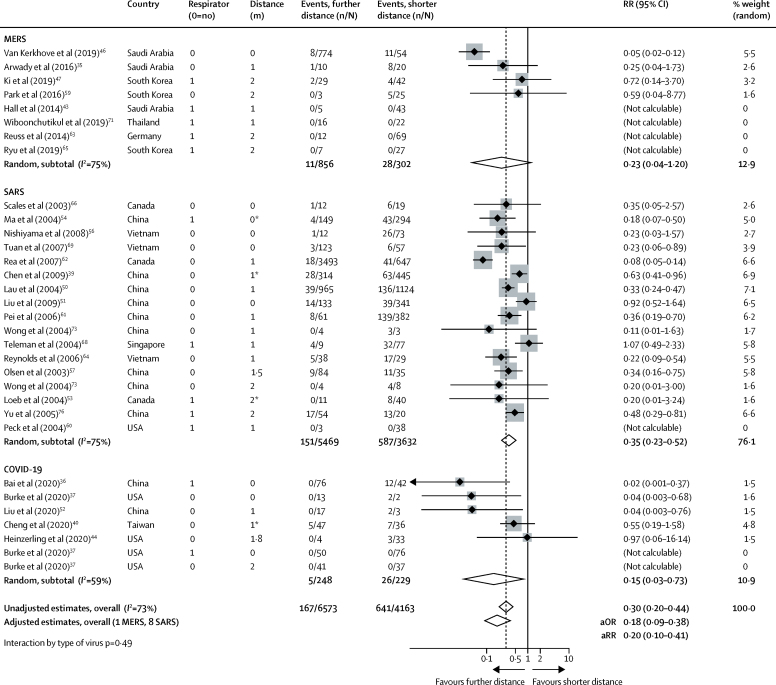
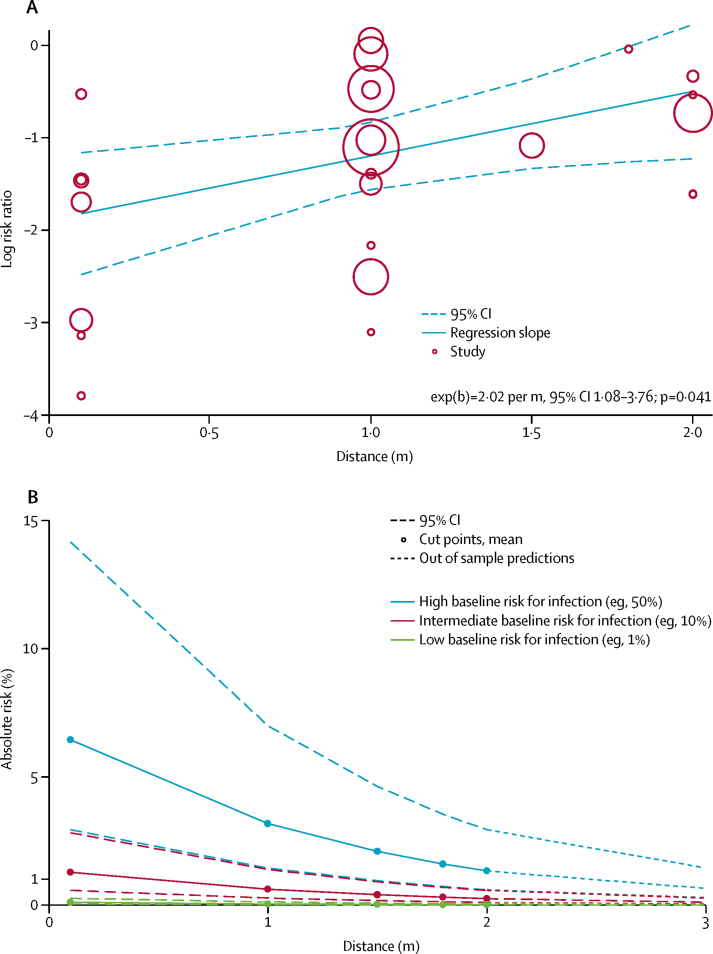
- Among 44 comparative studies (n=25,697), physical distancing of ≥1 m versus <1 m was associated with lower infection risk (unadjusted n=10,736, RR 0·30, 95% CI 0·20–0·44; adjusted n=7782, aOR 0·18, 95% CI 0·09–0·38; RD −10·2%, 95% CI −11·5 to −7·5; moderate certainty), with protection increasing as distance lengthened (change in RR 2·02 per m; pinteraction=0·041).
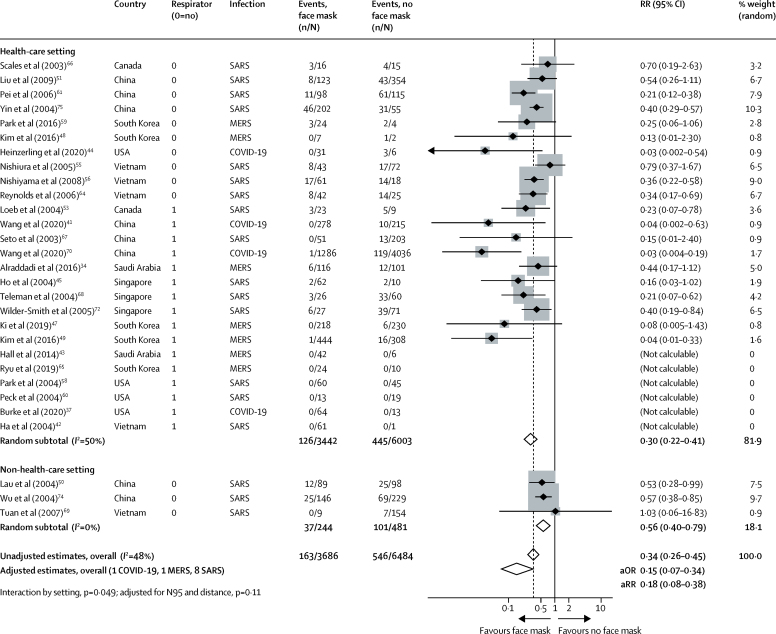
- Face mask use was associated with a large reduction in infection risk (adjusted n=2647, aOR 0·15, 95% CI 0·07–0·34; RD −14·3%, 95% CI −15·9 to −10·7; low certainty), with stronger associations for N95 or similar respirators than disposable surgical masks or similar (pinteraction=0·090; posterior probability >95%, low certainty).
- Eye protection was associated with less infection (unadjusted n=3713, RR 0·34, 95% CI 0·22–0·52; adjusted n=701, aOR 0·22, 95% CI 0·12–0·39; RD −10·6%, 95% CI −12·5 to −7·7; low certainty).
- Across 24 contextual-factor studies, most stakeholders found these strategies acceptable, feasible, and reassuring, but reported discomfort, resource use and equity concerns, communication difficulty, and perceived reduced empathy.
Methods
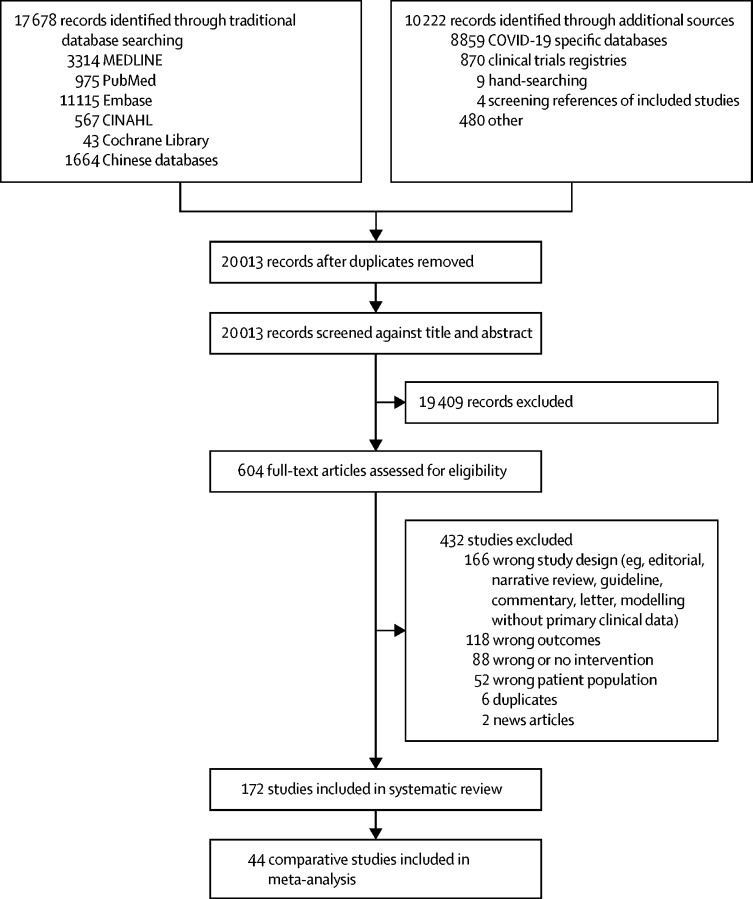
- Systematic review and meta-analysis searching 21 WHO-specific and COVID-19-specific sources from database inception to May 3, 2020, with no language restriction, for studies of confirmed or probable COVID-19, SARS, or MERS and close contacts.
- Duplicate screening, data extraction, and risk-of-bias assessment; frequentist and Bayesian meta-analyses and random-effects meta-regressions; certainty rated with Cochrane methods and GRADE; registered with PROSPERO, CRD42020177047.
- Outcomes included transmission and contextual factors; no randomised controlled trials were identified, so the meta-analysis included 44 comparative observational studies.
Limitations
- The paper states that all included studies were non-randomised, not always fully adjusted, and might suffer recall and measurement bias; many studies lacked precise distances, direct contact was equated to 0 m, and no eligible study quantitatively evaluated whether distances >2 m were more effective.
- The paper also states that few studies assessed non-health-care settings, most evidence came from SARS and MERS (n=6674 patients with COVID-19 of 25,697 total), duration of exposure was not specifically assessed, and reporting was inconsistent for aerosol-generating procedures and masks worn by infected patients.
- Evident from the text: observational designs preclude causal inference, and certainty was low for face masks and eye protection, with residual heterogeneity and imprecision noted.
Model-written summary. Check it against the paper before relying on it.
Integrity signals
Registry
Cites
Statistics
Figures
Verification
Claims the paper makes
3 Valid · 0 Not valid · 7 Not checked · 82 Own results and interpretations
The sources with a verdict support this claim; the rest weren’t checked yet, have no full text we could read, or their verdicts aren’t rated yet.
In the paper
“In 13 unadjusted studies and two adjusted studies,34, 37, 38, 39, 47, 49, 51, 54, 58, 60, 61, 65, 75 eye protection was associated with lower risk of infection (unadjusted n=3713, RR 0·34, 95% CI 0·22 to 0·52; AR 5·5% with eye protection vs 16·0% with no eye protection, RD −10·6%, 95% CI −12·5 to −7·7; adjusted n=701, aOR 0·22, 95% CI 0·12 to 0·39; low certainty; figure 6; table 2; appendix pp 16–”
§ Physical distancing, face masks, and eye protection to prevent person-to-person transmission of SARS-CoV-2 and COVID-19: a systematic review and meta-analysis > Results
What the sources say
- Supportedcites [34] Alraddadi BM Al-Salmi HS Jacobs-Slifka K Risk factors for Middle East respiratory syndrome coronavirus infection among healthcare personnel Emerg Infect Dis 22 2016 1915 1920 27767011 PMC5088034 source
Split into 2 atoms — 2 confirmed, 0 partially supported, 0 disputed, 0 misattributed, 0 unverifiable. Expand the claim to see per-atom verdicts.
- Not checked yetcites [37] Burke RM Balter S Barnes E Enhanced contact investigations for nine early travel-related cases of SARS-CoV-2 in the United States medRxiv 2020 published online May 3. 10.1101/2020.04.27.20081901 (preprint). PMC7467265 32877446
- Supportedcites [38] Caputo KM Byrick R Chapman MG Orser BJ Orser BA Intubation of SARS patients: infection and perspectives of healthcare workers Can J Anaesth 53 2006 122 129 16434750 source
Split into 2 atoms — 2 confirmed, 0 partially supported, 0 disputed, 0 misattributed, 0 unverifiable. Expand the claim to see per-atom verdicts.
plainstates an associationn = 3,713- Asserted: passes — The authors put it forward as true.
- Checkable: passes — It can be checked against evidence.
- Load-bearing: passes — The paper’s conclusions depend on it.
- Based: passes — The paper gives a reason why it holds.
- Supported
Every source the paper cites for this claim was checked and supports it.
In the paper
“This finding is inconsistent with conclusions of a review of four randomised trials,13 in which low certainty of evidence for no larger effect was suggested.”
§ Physical distancing, face masks, and eye protection to prevent person-to-person transmission of SARS-CoV-2 and COVID-19: a systematic review and meta-analysis > Discussion
What the sources say
- Supportedcites [13] Bartoszko JJ Farooqi MAM Alhazzani W Loeb M Medical masks vs N95 respirators for preventing COVID-19 in healthcare workers: a systematic review and meta-analysis of randomized trials Influenza Other Respir Viruses 2020 published online April 4. 10.1111/irv.12745 PMC7298295 32246890 source
The Abstract Conclusions (Bartoszko et al. 2020) state verbatim that 'Low certainty evidence suggests that medical masks and N95 respirators offer similar protection against viral respiratory infection including coronavirus in healthcare workers during non–aerosol–generating care' — i.e., no larger effect of one mask type, hedged at low certainty. The Abstract Data Synthesis and Results (Search results and study characteristics; Effect on outcomes) confirm the review/meta-analysis pooled exactly four RCTs (OR 1.06, 95% CI 0.90–1.25, I² = 0%, low certainty for laboratory-confirmed viral respiratory infection), and the Quality assessment section attributes the 'low' GRADE rating to that four-trial outcome. The citing sentence's paraphrase ('review of four randomised trials', 'low certainty of evidence for no larger effect') therefore matches what this source says. (LLM, conf=0.85)
plain- Asserted: passes — The authors put it forward as true.
- Checkable: passes — It can be checked against evidence.
- Load-bearing: unclear — It is unclear whether the paper’s conclusions depend on it.
- Based: passes — The paper gives a reason why it holds.
- Supported
A result the paper reports from its own data — it cites no other source for it, so there is none to check. The quote shows it is in the paper.
In the paper
“Transmission of viruses was lower with physical distancing of 1 m or more, compared with a distance of less than 1 m (n=10 736, pooled adjusted odds ratio [aOR] 0·18, 95% CI 0·09 to 0·38; risk difference [RD] −10·2%, 95% CI −11·5 to −7·5; moderate certainty)”
- Also stated in: § Results · boosted
“a strong association was found of proximity of the exposed individual with the risk of infection (unadjusted n=10 736, RR 0·30, 95% CI 0·20 to 0·44; adjusted n=7782, aOR 0·18, 95% CI 0·09 to 0·38; absolute risk [AR] 12·8% with shorter distance vs 2·6% with further distance, risk difference [RD] −10·2%, 95% CI −11·5 to −7·5; moderate certainty; figure 2; table 2; appendix p 16).”
§ Physical distancing, face masks, and eye protection to prevent person-to-person transmission of SARS-CoV-2 and COVID-19: a systematic review and meta-analysis > Abstract > Findings
boostedstates a causen = 10- Asserted: passes — The authors put it forward as true.
- Checkable: passes — It can be checked against evidence.
- Load-bearing: passes — The paper’s conclusions depend on it.
- Based: passes — The paper gives a reason why it holds.
- Rests on an assumption not shown here.
- Also stated in: § Results · boosted
A result the paper reports from its own data — it cites no other source for it, so there is none to check. The quote shows it is in the paper.
In the paper
“When differential N95 or similar respirator use, which was more frequent in health-care settings than in non-health-care settings, was adjusted for the possibility that face masks were less effective in non-health-care settings, the subgroup effect was slightly less credible (pinteraction=0·11, adjusted for differential respirator use; figure 4).”
§ Physical distancing, face masks, and eye protection to prevent person-to-person transmission of SARS-CoV-2 and COVID-19: a systematic review and meta-analysis > Results
plain- Asserted: passes — The authors put it forward as true.
- Checkable: passes — It can be checked against evidence.
- Load-bearing: unclear — It is unclear whether the paper’s conclusions depend on it.
- Based: passes — The paper gives a reason why it holds.
A result the paper reports from its own data — it cites no other source for it, so there is none to check. The quote shows it is in the paper.
In the paper
“Our search did not identify any randomised trials of COVID-19, SARS, or MERS.”
- Also stated in: § Results · plain
“Studies were all observational in nature; no randomised trials were identified of any interventions that directly addressed the included study populations.”
§ Physical distancing, face masks, and eye protection to prevent person-to-person transmission of SARS-CoV-2 and COVID-19: a systematic review and meta-analysis > Methods > Data analysis
plain- Asserted: passes — The authors put it forward as true.
- Checkable: passes — It can be checked against evidence.
- Load-bearing: passes — The paper’s conclusions depend on it.
- Based: passes — The paper gives a reason why it holds.
- Also stated in: § Results · plain
30 more claims
Create a free account to see all 92 claims and to verify the 11 references still open.
- It may state two separate claims as one. 40
- The quote only partly states this claim. 1
- Probably not a substantial claim. 23
Claims other papers make about this one
Each is checked against this paper’s own text: does it say what the citing paper says it does?
The source backs part of the claim, not all of it — or backs it for a different population, condition or comparison.
In the citing paper
“The review by Chu 2020 did not consider RCTs of influenza transmission, but only the observational studies examining impact on SARS, MERS, or SARS‐CoV‐2.”
From Physical interventions to interrupt or reduce the spread of respiratory viruses (2023) · cites this paper as Chu 2020
Experimental — accuracy not yet measuredThe source backs part of the claim, not all of it — or backs it for a different population, condition or comparison.
In the citing paper
“For N95 masks versus no mask in HCWs, there was a large protective effective with an OR of 0.04 (95% CI 0.004 to 0.30); for surgical masks versus no masks, there was an OR of 0.33 (0.17 to 0.61) overall, but four of these studies were in healthcare settings.”
From Physical interventions to interrupt or reduce the spread of respiratory viruses (2023) · cites this paper as Chu 2020
Experimental — accuracy not yet measuredThe source backs part of the claim, not all of it — or backs it for a different population, condition or comparison.
In the citing paper
“Chu 2020 has been criticised for several reasons: use of an outdated 'Risk of bias' tool; inaccuracy of distance measures; and not adequately addressing multiple sources of bias, including recall and classification bias and in particular confounding.”
From Physical interventions to interrupt or reduce the spread of respiratory viruses (2023) · cites this paper as Chu 2020
Experimental — accuracy not yet measuredThe cited source says what the claim attributes to it.
In the citing paper
“Social distancing has been shown to be an important component of measures designed to reduce the spread and impact of COVID-19.”
From Facilitators and barriers to social distancing for young people during the COVID-19 pandemic (2022) · cites this paper as [5]
The cited source says what the claim attributes to it.
In the citing paper
“A systematic review of early efforts to control the spread of COVID-19 additionally estimated that physical distancing of over one meter was important in reducing transmission (pooled adjusted OR 0.18, 95% CI 0·09 to 0·38) [5].”
From Facilitators and barriers to social distancing for young people during the COVID-19 pandemic (2022) · cites this paper as [5]
1 more claim about this paper
Create a free account to see every claim other papers make about this one.
Self-check
Percentages, sums and reported differences re-computed from the paper’s own numbers.
Each contradiction between two passages listed here was confirmed by an independent check.
Rated minor: it would not touch a result — a value no result rests on, a p-value that stays on the same side of the significance level, or a conflict that is clerical, resolved elsewhere in the paper, or outside its own findings.
In the paper
§ Physical distancing, face masks, and eye protection to prevent person-to-person transmission of SARS-CoV-2 and COVID-19: a systematic review and meta-analysis > Abstract > Findings
“Transmission of viruses was lower with physical distancing of 1 m or more, compared with a distance of less than 1 m (n=10 736, pooled adjusted odds ratio [aOR] 0·18”
§ Physical distancing, face masks, and eye protection to prevent person-to-person transmission of SARS-CoV-2 and COVID-19: a systematic review and meta-analysis > Results
“unadjusted n=10 736, RR 0·30, 95% CI 0·20 to 0·44; adjusted n=7782, aOR 0·18, 95% CI 0·09 to 0·38”
Citations
Cites
Preferred Reporting Items for Systematic Reviews and Meta-Analyses: the PRISMA statement
Moher, D., Liberati, A., Tetzlaff, J., Altman, D. G., & for the PRISMA Group (2009) · BMJ · doi:10.1136/bmj.b2535 · Cited by 83,823
Preferred reporting items for systematic reviews and meta-analyses: the PRISMA Statement.
(2009) · PubMed Central · Cited by 44,859
RoB 2: a revised tool for assessing risk of bias in randomised trials
Sterne, J. A. C., Savović, J., Page, M. J., Elbers, R. G., Blencowe, N. S., Boutron, I., Cates, C. J., Cheng, H.-Y., Corbett, M. S., Eldridge, S. M., et al. (2019) · BMJ · doi:10.1136/bmj.l4898 · Cited by 34,787
Dermyshi, E., Wang, Y., Yan, C., Hong, W., Qiu, G., Gong, X., & Zhang, T. (2017) · Neonatology · doi:10.1159/000454668 · Cited by 24,451
GRADE: an emerging consensus on rating quality of evidence and strength of recommendations
Guyatt, G. H., Oxman, A. D., Vist, G. E., Kunz, R., Falck-Ytter, Y., Alonso-Coello, P., & Schünemann, H. J. (2008) · BMJ · doi:10.1136/bmj.39489.470347.ad · Cited by 23,305
Self-citationMeta-analysis of Observational Studies in Epidemiology<SUBTITLE>A Proposal for Reporting</SUBTITLE>
Stroup, D. F. (2000) · JAMA · doi:10.1001/jama.283.15.2008 · Cited by 20,623
Preferred Reporting Items for Systematic Reviews and Meta-Analyses: The PRISMA Statement
Moher, D., Liberati, A., Tetzlaff, J., & Altman, D. G. (2009) · Journal of Clinical Epidemiology · doi:10.1016/j.jclinepi.2009.06.005 · Cited by 19,575
(2014) · Medical Entomology and Zoology · Cited by 17,633
GRADE guidelines: 1. Introduction—GRADE evidence profiles and summary of findings tables
Guyatt, G., Oxman, A. D., Akl, E. A., Kunz, R., Vist, G., Brozek, J., Norris, S., Falck-Ytter, Y., Glasziou, P., & deBeer, H. (2011) · Journal of Clinical Epidemiology · doi:10.1016/j.jclinepi.2010.04.026 · Cited by 10,681
Self-citationCumpston, M., Li, T., Page, M. J., Chandler, J., Welch, V. A., Higgins, J. P., & Thomas, J. (2019) · Cochrane Database of Systematic Reviews · doi:10.1002/14651858.ed000142 · Cited by 7,218
Research works printed but not linked: 3
- Liu ZQ Ye Y Zhang H Guohong X Yang J Wang JL Analysis of the spatio-temporal characteristics and transmission path of COVID-19 cluster cases in Zhuhai Trop Geogr 2020 published online March 12. 10.13284/j.cnki.rddl.003228 · doi:10.13284/j.cnki.rddl.003228
- Park JY Kim BJ Chung KH Hwang YI Factors associated with transmission of Middle East respiratory syndrome among Korean healthcare workers: infection control via extended healthcare contact management in a secondary outbreak hospital Respirology 21 suppl 3 2016 89 (abstr APSR6-0642).
- Campbell A Chapter eight: it's not about the mask: SARS Commission final report, volume 3 http://www.archives.gov.on.ca/en/e_records/sars/report/v3-pdf/Vol3Chp8.pdf December, 2006
Cited by
Items 301–400 of 4,035
Peripheral Oxygen Saturation in Older Persons Wearing Nonmedical Face Masks in Community Settings
Chan, N., Li, K., & Hirsh, J. (2020) · JAMA · doi:10.1001/jama.2020.21905 · Cited by 68
Effect of Wearing Face Masks on the Carbon Dioxide Concentration in the Breathing Zone
Geiss, O. (2021) · Aerosol and Air Quality Research · doi:10.4209/aaqr.2020.07.0403 · Cited by 68
Ng, T.-C. V., Cheng, H., Chang, H., Liu, C., Yang, C.-C., Jian, S.-W., Liu, D., Cohen, T., & Lin, H.-H. (2021) · JAMA Internal Medicine · doi:10.1001/jamainternmed.2021.1644 · Cited by 70
Chua, G. T., Wong, J. S. C., Lam, I. C. S., Ho, P. K., Chan, W. H., Yau, F. Y. S., Duque, J. S. R., Ho, A. C. C., Siu, K. K., Cheung, T. W. Y., et al. (2021) · JAMA Network Open · doi:10.1001/jamanetworkopen.2021.8824 · Cited by 77
Supporting parents as essential care partners in neonatal units during the SARS‐CoV‐2 pandemic
van Veenendaal, N. R., Deierl, A., Bacchini, F., O’Brien, K., & Franck, L. S. (2021) · Acta Paediatrica · doi:10.1111/apa.15857 · Cited by 72
Conspiracy theories and their societal effects during the COVID-19 pandemic
Pummerer, L., Böhm, R., Lilleholt, L., Winter, K., Zettler, I., & Sassenberg, K. (2020) · doi:10.31234/osf.io/y5grn · Cited by 67
Carbon, C., & Serrano, M. (2021) · i-Perception · doi:10.1177/20416695211038265 · Cited by 64
Kim, H., Hegde, S. M., LaFiura, C., Raghavan, M., Sun, N., Cheng, S. C., Rebholz, C. M., & Seidelmann, S. B. (2021) · BMJ Global Health · doi:10.1136/bmjgh-2020-004611 · Cited by 72
Luo, Y., Cheng, Y., & Sui, M. (2021) · International Journal of Environmental Research and Public Health · doi:10.3390/ijerph18042011 · Cited by 73
Can a combination of vaccination and face mask wearing contain the COVID‐19 pandemic?
Brüssow, H., & Zuber, S. (2021) · Microbial Biotechnology · doi:10.1111/1751-7915.13997 · Cited by 74
Zhang, X. S., & Duchaine, C. (2020) · Clinical Microbiology Reviews · doi:10.1128/cmr.00184-20 · Cited by 59
Lentz, R. J., Colt, H. G., Chen, H., Cordovilla, R., Popević, S., Tahura, S., Candoli, P., Tomassetti, S., Meachery, G. J., Cohen, B. P., et al. (2020) · Infection Control and Hospital Epidemiology · doi:10.1017/ice.2020.455 · Cited by 66
Hydrogen peroxide vapor decontamination of N95 respirators for reuse
Kenney, P. A., Chan, B. K., Kortright, K. E., Cintron, M., Russi, M. B., Epright, J., Lee, L. S., Balcezak, T. J., Havill, N. L., & Martinello, R. A. (2021) · Infection Control and Hospital Epidemiology · doi:10.1017/ice.2021.48 · Cited by 104
Abdullah, M., Ali, N., Dias, C., Campisi, T., & Javid, M. A. (2021) · Applied Sciences · doi:10.3390/app11083630 · Cited by 70
Srivastav, A. K., Tiwari, P. K., Srivastava, P. K., Ghosh, M., & Kang, Y. (2020) · Mathematical Biosciences & Engineering · doi:10.3934/mbe.2021010 · Cited by 72
Ding, Y., Fu, X., Liu, R., Hwang, J., Hong, W., & Jia, W. (2021) · International Journal of Environmental Research and Public Health · doi:10.3390/ijerph182010947 · Cited by 98
Abubakar, A. R., Sani, I. H., Godman, B., Kumar, S., Islam, S., Jahan, I., & Haque, M. (2020) · Infection and Drug Resistance · doi:10.2147/idr.s289037 · Cited by 69
Belief in Science Influences Physical Distancing in Response to COVID-19 Lockdown Policies
Brzezinski, A., Kecht, V., Dijcke, D. V., & Wright, A. L. (2020) · Nature Human Behaviour · doi:10.1038/s41562-021-01227-0 · Cited by 181
Physical distancing and the perception of interpersonal distance in the COVID-19 crisis
Welsch, R., Wessels, M., Bernhard, C., Thönes, S., & von Castell, C. (2021) · Scientific Reports · doi:10.1038/s41598-021-90714-5 · Cited by 69
Goniewicz, K., Khorram‐Manesh, A., Burkle, F. M., Hertelendy, A. J., & Goniewicz, M. (2023) · Global Transitions · doi:10.1016/j.glt.2023.10.003 · Cited by 88
Elnaem, M. H., Taufek, N. H. M., Rahman, N. S. A., Nazar, N. I. M., Zin, C. S., Nuffer, W. A., & Turner, C. J. (2021) · Vaccines · doi:10.3390/vaccines9101156 · Cited by 74
Mizukoshi, A., Nakama, C., Okumura, J., & Azuma, K. (2020) · Environment International · doi:10.1016/j.envint.2020.106338 · Cited by 63
Face mask integrated with flexible and wearable manganite oxide respiration sensor
Ye, L., Wu, F., Xu, R., Zhang, D., Lu, J., Wang, C., Dong, A., Xu, S., Xue, L., Fan, Z., et al. (2023) · Nano Energy · doi:10.1016/j.nanoen.2023.108460 · Cited by 70
Disposable over Reusable Face Masks: Public Safety or Environmental Disaster?
Prata, J. C., Silva, A. L. P., Duarte, A. C., & Rocha‐Santos, T. (2021) · Environments · doi:10.3390/environments8040031 · Cited by 72
Wang, B., Sun, Y., Duong, T. Q., Nguyen, L. D., & Hanzo, L. (2020) · IEEE Access · doi:10.1109/access.2020.3003750 · Cited by 68
Scott, N., Saul, A. J., Spelman, T. D., Stoove, M. A., Pedrana, A. E., Saeri, A. K., Grundy, E. A. C., Smith, L. D. G., TOOLE, M. J., MacIntyre, C. R., et al. (2021) · PLoS ONE · doi:10.1371/journal.pone.0253510 · Cited by 66
Challenges and Lessons Learned From COVID-19 Trials: Should We Be Doing Clinical Trials Differently?
Janiaud, P., Hemkens, L. G., & Ioannidis, J. P. A. (2021) · Canadian Journal of Cardiology · doi:10.1016/j.cjca.2021.05.009 · Cited by 76
Thomas, R. E., Thomas, B. C., Conly, J., & Lorenzetti, D. (2022) · Journal of Hospital Infection · doi:10.1016/j.jhin.2021.12.017 · Cited by 43
On-site airborne pathogen detection for infection risk mitigation
Qiu, G., Zhang, X., deMello, A. J., Yao, M., Cao, J., & Wang, J. (2023) · Chemical Society Reviews · doi:10.1039/d3cs00417a · Cited by 78
Wang, L., Han, J., Zhou, S.-X., Yu, L., Lu, Q., Zhang, X., Zhang, H., Ren, X., Zhang, C., Wang, Y., et al. (2021) · The Lancet Regional Health - Western Pacific · doi:10.1016/j.lanwpc.2021.100268 · Cited by 75
Kim, M. S., Seong, D., Li, H., Chung, S. K., Park, Y., Lee, M., Lee, S. W., Yon, D. K., Kim, J. H., Lee, K. H., et al. (2022) · Reviews in Medical Virology · doi:10.1002/rmv.2336 · Cited by 70
COVID‐19 environmental transmission and preventive public health measures
Vardoulakis, S., Sheel, M., Lal, A., & Gray, D. J. (2020) · Australian and New Zealand Journal of Public Health · doi:10.1111/1753-6405.13033 · Cited by 73
HIV and COVID-19 co-infection: A mathematical model and optimal control
Ringa, N., Diagne, M. L., Rwezaura, H., Omame, A., Tchoumi, S. Y., & Tchuenche, J. M. (2022) · Informatics in Medicine Unlocked · doi:10.1016/j.imu.2022.100978 · Cited by 71
Sources, analysis, and health implications of atmospheric microplastics
Ahmad, M., Chen, J., Khan, M. T., Yu, Q., Phairuang, W., Furuuchi, M., Ali, S. W., Nawab, A., & Panyametheekul, S. (2023) · Emerging contaminants · doi:10.1016/j.emcon.2023.100233 · Cited by 77
Numerical study on the effect of diner divider on the airborne transmission of diseases in canteens
Liu, Z., Li, R., Wu, Y. L., Ju, R., & Gao, N. (2021) · Energy and Buildings · doi:10.1016/j.enbuild.2021.111171 · Cited by 72
A Journey Like No Other: Anatomy 2020!
Smith, C. F., & Pawlina, W. (2021) · Anatomical Sciences Education · doi:10.1002/ase.2039 · Cited by 64
Ippolito, G., Vecchia, A. L., Umbrello, G., Pietro, G. M. D., Bono, P., Catenacci, S. S., Pinzani, R., Tagliabue, C., Bosis, S., Agostoni, C. V., et al. (2021) · Frontiers in Pediatrics · doi:10.3389/fped.2021.721005 · Cited by 63
Kosfeld, R., Mitze, T., Rode, J., & Wälde, K. (2021) · Journal of Regional Science · doi:10.1111/jors.12536 · Cited by 62
Putra, P. Y., Fithriyah, I., & Zahra, Z. (2023) · Psychiatry Investigation · doi:10.30773/pi.2021.0311 · Cited by 62
VILCHES, T. N., Nourbakhsh, S., Zhang, K., Juden-Kelly, L., Cipriano, L. E., Langley, J. M., Sah, P., Galvani, A. P., & Moghadas, S. M. (2021) · Preventive Medicine · doi:10.1016/j.ypmed.2021.106564 · Cited by 68
Bhattacharjee, S., Bahl, P., Chughtai, A. A., & MacIntyre, C. R. (2020) · BMJ Open Respiratory Research · doi:10.1136/bmjresp-2020-000698 · Cited by 70
The influence of mask use on the spread of COVID-19 during pandemic in New York City
Ma, X., Luo, X., Li, L., Li, Y., & Sun, G. (2022) · Results in Physics · doi:10.1016/j.rinp.2022.105224 · Cited by 63
A cross-country comparison of Covid-19 containment measures and their effects on the epidemic curves
Cascini, F., Failla, G., Gobbi, C., Pallini, E., Jin, H., Luxi, W., Villani, L., Quentin, W., Boccia, S., & Ricciardi, W. (2022) · BMC Public Health · doi:10.1186/s12889-022-14088-7 · Cited by 74
Ahluwalia, S. C., Edelen, M. O., Qureshi, N., & Etchegaray, J. M. (2021) · Risk Hazards & Crisis in Public Policy · doi:10.1002/rhc3.12219 · Cited by 84
Epidemiology and Clinical Presentation of COVID-19 in Older Adults
Abul, Y., Leeder, C., & Gravenstein, S. (2022) · Clinics in Geriatric Medicine · doi:10.1016/j.cger.2025.09.007 · Cited by 72
What is the risk of acquiring SARS-CoV-2 from the use of public toilets?
Dancer, S. J., Li, Y., Hart, A. J., Tang, J. W.-T., & Jones, D. L. (2021) · The Science of The Total Environment · doi:10.1016/j.scitotenv.2021.148341 · Cited by 65
Estimating COVID-19 under-reporting across 86 nations: implications for projections and controlPreprint
Rahmandad, H., Lim, T. Y., & Sterman, J. D. (2020) · medRxiv · doi:10.1101/2020.06.24.20139451 · Cited by 60
Sun, K. S., Lau, T. S. M., Yeoh, E., Chung, V. C., Leung, Y. S., Yam, C. H. K., & Hung, C. T. (2022) · BMJ Open · doi:10.1136/bmjopen-2021-053938 · Cited by 71
Social distancing compliance: A video observational analysis
Hoeben, E. M., Bernasco, W., Liebst, L. S., van Baak, C., & Lindegaard, M. R. (2021) · PLoS ONE · doi:10.1371/journal.pone.0248221 · Cited by 59
Maude, R. R., Jongdeepaisal, M., Skuntaniyom, S., Muntajit, T., Blacksell, S. D., Khuenpetch, W., Ngum, W. P., Taleangkaphan, K., Malathum, K., & Maude, R. J. (2021) · BMC Public Health · doi:10.1186/s12889-021-10768-y · Cited by 80
Control of airborne infectious disease in buildings: Evidence and research priorities
de Mesquita, P. J. B., Delp, W. W., Chan, W. R., Bahnfleth, W. P., & Singer, B. C. (2021) · Indoor Air · doi:10.1111/ina.12965 · Cited by 69
Liu, J., Shen, Q. X., & Wang, X. (2024) · Clinical Nutrition · doi:10.1016/j.clnu.2024.10.021 · Cited by 81
Martins‐Filho, P. R., Ferreira, L. C., Heimfarth, L., Araújo, A. A. D. S., & Quintans‐Júnior, L. J. (2021) · The Lancet Regional Health - Americas · doi:10.1016/j.lana.2021.100062 · Cited by 69
Yang, S., Cheng, Y., Liu, T., Huang, S., Yin, L., Pu, Y., & Liang, G. (2022) · Environmental Chemistry Letters · doi:10.1007/s10311-022-01462-5 · Cited by 68
Wong, C. K. H., Wong, J. Y. H., Tang, E. H. M., Au, C. H., Lau, K. T. K., & Wai, A. K. C. (2020) · Journal of Medical Internet Research · doi:10.2196/19904 · Cited by 56
Bokemper, S., Cucciniello, M., Rotesi, T., Pin, P., Malik, A. A., Willebrand, K. S., Paintsil, E. E., Omer, S. B., Huber, G. A., & Melegaro, A. (2021) · PLoS ONE · doi:10.1371/journal.pone.0258282 · Cited by 64
Zheng, C., Poon, E. T., Wan, K., Dai, Z., & Wong, S. H. (2022) · Sports Medicine · doi:10.1007/s40279-022-01746-4 · Cited by 64
Normalizing Community Mask-Wearing: A Cluster Randomized Trial in Bangladesh
Abaluck, J., Kwong, L. H., Styczynski, A., Haque, A., Kabir, M. A., Bates-Jefferys, E., Crawford, E., Benjamin‐Chung, J., Benhachmi, S., Raihan, S., et al. (2021) · National Bureau of Economic Research · doi:10.3386/w28734 · Cited by 69
Schünemann, H. J., Santesso, N., Vist, G. E., Cuello, C., Lotfi, T., Flottorp, S., Davoli, M., Mustafa, R., Meerpohl, J. J., Alonso-Coello, P., et al. (2020) · Journal of Clinical Epidemiology · doi:10.1016/j.jclinepi.2020.05.030 · Cited by 57
Self-citationSmiljanić, R., Keerstock, S., Meemann, K., & Ransom, S. M. (2021) · The Journal of the Acoustical Society of America · doi:10.1121/10.0005191 · Cited by 63
Zhu, Y., Li, W., Bin-bin, Y., Qian, R., Wu, F. Q., He, X., Zhu, Q., Liu, J., Ni, Y., Wang, J., et al. (2021) · BMC Pediatrics · doi:10.1186/s12887-021-02654-8 · Cited by 55
Daoust, J., Bélanger, É., Dassonneville, R. C., Lachapelle, É., Nadeau, R., Becher, M., Brouard, S., Foucault, M., Hönnige, C., & Stegmueller, D. (2021) · PLoS ONE · doi:10.1371/journal.pone.0249914 · Cited by 65
Loenenbach, A. D., Markus, I., Lehfeld, A.-S., der Heiden, M. A., Haas, W., Kiegele, M., Ponzi, A., Unger-Goldinger, B., Weidenauer, C., Schlosser, H., et al. (2021) · Eurosurveillance · doi:10.2807/1560-7917.es.2021.26.21.2100433 · Cited by 51
Quandt, S. A., LaMonto, N. J., Mora, D. C., Talton, J. W., Laurienti, P. J., & Arcury, T. A. (2021) · NEW SOLUTIONS A Journal of Environmental and Occupational Health Policy · doi:10.1177/1048291121992468 · Cited by 70
Obiała, J., Obiała, K., Mańczak, M., Owoc, J., & Olszewski, R. (2020) · Health Policy and Technology · doi:10.1016/j.hlpt.2020.10.007 · Cited by 57
COVID-19 Pandemic impact on Brazil's Public Dental System
Chisini, L. A., Costa, F. D. S., Sartori, L. R. M., Corrêa, M. B., D’Ávila, O. P., & Demarco, F. F. (2021) · Brazilian Oral Research · doi:10.1590/1807-3107bor-2021.vol35.0082 · Cited by 63
Governor Partisanship Explains the Adoption of Statewide Mask Mandates in Response to COVID-19
Adolph, C., Amano, K., Bang-Jensen, B., Fullman, N., Magistro, B., Reinke, G. E., & Wilkerson, J. (2021) · State Politics & Policy Quarterly · doi:10.1017/spq.2021.22 · Cited by 78
Modeling COVID-19 spread in small colleges
Bahl, R., Eikmeier, N., Fraser, A., Junge, M., Keesing, F., Nakahata, K., & Reeves, L. (2021) · PLoS ONE · doi:10.1371/journal.pone.0255654 · Cited by 60
Mitigating the Twin Threats of Climate-Driven Atlantic Hurricanes and COVID-19 Transmission
Shultz, J. M., Kossin, J. P., Hertelendy, A. J., Burkle, F. M., Fugate, C., Sherman, R., Bakalar, J. L., Berg, K., Maggioni, A., Espinel, Z., et al. (2020) · Disaster Medicine and Public Health Preparedness · doi:10.1017/dmp.2020.243 · Cited by 58
Rapid Scoping Review of Evidence of Outdoor Transmission of COVID-19Preprint
Weed, M., & Foad, A. (2020) · medRxiv · doi:10.1101/2020.09.04.20188417 · Cited by 56
Mass Spectrometry-Based Human Breath Analysis: Towards COVID-19 Diagnosis and Research
Yuan, Z., & Hu, B. (2021) · Journal of Analysis and Testing · doi:10.1007/s41664-021-00194-9 · Cited by 60
Abbott, R., Bethel, A., Rogers, M., Whear, R., Orr, N., Shaw, L., Stein, K., & Thompson Coon, J. (2022) · BMJ Evidence-Based Medicine · doi:10.1136/bmjebm-2021-111710 · Cited by 56
Heat warning and public and workers' health at the time of COVID-19 pandemic
Morabito, M., Messeri, A., Crisci, A., Pratali, L., Bonafede, M., & Marinaccio, A. (2020) · The Science of The Total Environment · doi:10.1016/j.scitotenv.2020.140347 · Cited by 60
Unmasking Partisanship: How Polarization Influences Public Responses to Collective RiskPreprint
Milosh, M., Painter, M., Dijcke, D. V., & Wright, A. L. (2020) · SSRN Electronic Journal · doi:10.2139/ssrn.3664779 · Cited by 54
IoT-to-the-Rescue: A Survey of IoT Solutions for COVID-19-Like Pandemics
Pathak, N., Deb, P. K., Mukherjee, A., & Misra, S. (2021) · IEEE Internet of Things Journal · doi:10.1109/jiot.2021.3082838 · Cited by 61
Tong, J., Zhang, J., Zhu, N., Pei, Y., Liu, W., Yu, W., Hu, C., & Sun, X. (2023) · Frontiers in Psychology · doi:10.3389/fpsyg.2022.1096857 · Cited by 76
Ng, V., Fazil, A., Waddell, L. A., Bancej, C. M., Turgeon, P., Otten, A., Atchessi, N., & Ogden, N. H. (2020) · Canadian Medical Association Journal · doi:10.1503/cmaj.200990 · Cited by 55
Efficacy and practice of facemask use in general population: a systematic review and meta-analysis
Li, H., Yuan, K., Sun, Y., Zheng, Y., Xu, Y., Su, S., Zhang, Y., Zhong, Y., Wang, Y., Tian, S.-S., et al. (2022) · Translational Psychiatry · doi:10.1038/s41398-022-01814-3 · Cited by 65
Self-citationMicrostructure analysis and image-based modelling of face masks for COVID-19 virus protection
Du, W., Iacoviello, F., Fernandez, T., Loureiro, R. C. V., Brett, D. J. L., & Shearing, P. R. (2021) · Communications Materials · doi:10.1038/s43246-021-00160-z · Cited by 59
The Unintended Consequences of COVID-19 Mitigation Measures on Mass Transit and Car Use
Labonté-LeMoyne, É., Chen, S. L., Coursaris, C. K., Sénécal, S., & Léger, P. (2020) · Sustainability · doi:10.3390/su12239892 · Cited by 63
Factors influencing the filtration performance of homemade face masks
Hao, W., Xu, G., & Wang, Y. (2021) · Journal of Occupational and Environmental Hygiene · doi:10.1080/15459624.2020.1868482 · Cited by 62
Tian, C., Lovrics, O., Vaisman, A., Chin, K. J., TOMLINSON, G. A., Lee, Y., Englesakis, M. F., Parotto, M., & Singh, M. (2021) · Infection Control and Hospital Epidemiology · doi:10.1017/ice.2021.18 · Cited by 66
Curtis, D. S., Rigolon, A., Schmalz, D. L., & Brown, B. B. (2021) · Environment and Behavior · doi:10.1177/00139165211031199 · Cited by 63
COVID-19 dynamics across the US: A deep learning study of human mobility and social behavior
Bhouri, M. A., Costabal, F. S., Wang, H., Linka, K., Peirlinck, M., Kuhl, E., & Perdikaris, P. G. (2020) · Computer Methods in Applied Mechanics and Engineering · doi:10.1016/j.cma.2021.113891 · Cited by 63
Alfelali, M., Haworth, E. A., Barasheed, O., Badahdah, A.-M., Bokhary, H., Tashani, M., Azeem, M. I., Kok, J., Taylor, J., Barnes, E. H., et al. (2020) · PLOS ONE · doi:10.1371/journal.pone.0240287 · Cited by 55
“Findings of systematic reviews have been conflicting [17, 18, 39, 41–45], the most recent showing protective effects of masks against respiratory viral infection including pandemic coronaviruses across different populations but with low certainty [39, 41].”
BackgroundResultProtection From COVID-19: The Efficacy of Face Masks
Hemmer, C. J., Hufert, F. T., Siewert, S., & Reisinger, E. C. (2021) · Deutsches Ärzteblatt international · doi:10.3238/arztebl.m2021.0119 · Cited by 64
How Spatial Epidemiology Helps Understand Infectious Human Disease Transmission
Lin, C., & Wen, T. (2022) · Tropical Medicine and Infectious Disease · doi:10.3390/tropicalmed7080164 · Cited by 77
Electrostatic interactions between the SARS-CoV-2 virus and a charged electret fibre
Javidpour, L., Božič, A., Naji, A., & Podgornik, R. (2021) · Soft Matter · doi:10.1039/d1sm00232e · Cited by 53
Strickland, J. C., Reed, D. D., Hursh, S. R., Schwartz, L. P., Foster, R. N. S., Gelino, B. W., LeComte, R. S., Oda, F. S., Salzer, A. R., Schneider, T. D., et al. (2022) · PLoS ONE · doi:10.1371/journal.pone.0258828 · Cited by 67
The challenges of COVID‐19 Delta variant: Prevention and vaccine development
He, X., He, C., Hong, W., Zhang, K., & Wei, X. (2021) · MedComm · doi:10.1002/mco2.95 · Cited by 55
Wibisono, Y., Fadila, C. R., Saiful, S., & Bilad, M. R. (2020) · Polymers · doi:10.3390/polym12112516 · Cited by 58
Metadata
- Authors
- Chu, D. K., Akl, E. A., Duda, S., Solo, K., Yaacoub, S., Schünemann, H. J., Chu, D. K., Akl, E. A., El-harakeh, A., Bognanni, A., Lotfi, T., Loeb, M., Hajizadeh, A., Bak, A., Izcovich, A., Cuello-Garcia, C. A., Chen, C., Harris, D. J., Borowiack, E., Chamseddine, F., Schünemann, F., Morgano, G. P., Muti Schünemann, G. E. U., Chen, G., Zhao, H., Neumann, I., Chan, J., Khabsa, J., Hneiny, L., Harrison, L., Smith, M., Rizk, N., Giorgi Rossi, P., AbiHanna, P., El-khoury, R., Stalteri, R., Baldeh, T., Piggott, T., Zhang, Y., Saad, Z., Khamis, A., Reinap, M., Duda, S., Solo, K., Yaacoub, S., & Schünemann, H. J.
- Affiliations
- McMaster University (CA)
- Samsung (China) (CN)
- Cochrane Canada (CA)
- ORCID
- Bognanni, Antonio
- Lotfi, Tamara
- Loeb, Mark
- Hajizadeh, Anisa
- Izcovich, Ariel
- Chen, Chen
- Harris, David J
- Borowiack, Ewa
- Chamseddine, Fatimah
- Morgano, Gian Paolo
- Chen, Guang
- Zhao, Hong
- Neumann, Ignacio
- Chan, Jeffrey
- Khabsa, Joanne
- Hneiny, Layal
- Harrison, Leila
- Smith, Maureen
- Rizk, Nesrine
- El-khoury, Rayane
- Baldeh, Tejan
- Piggott, Thomas
- Zhang, Yuan
- Khamis, Assem
- Reinap, Marge
- Venue
- The Lancet
- Publisher
- Elsevier BV
- Published
- 2020-06
- Volume
- 395
- Issue
- 10242
- Pages
- 1973-1987
- ISSN
- 0099-5355 (ISSN-L)
- 0140-6736
- PMC
- PMC7263814
- OpenAlex
- W3032742287
- Semantic Scholar
- 5af6b87d035e64d44ff43c277f06e1a2f21e23df
- Cited by
- 3,843
- References
- 104
- Citations by year
- 2026: 82 · 2025: 151 · 2024: 259 · 2023: 483 · 2022: 765 · 2021: 1366 · 2020: 729
- FWCI
- 117.07
- Type
- journal article
- Language
- en
- Open access
- hybrid
- doi.org
- Licence
- cc-by
- www.elsevier.com/tdm/userlicense/1.0/ (tdm)
- www.elsevier.com/legal/tdmrep-license (tdm)
- creativecommons.org/licenses/by/3.0/igo/ (vor)
- Locations
- The Lancet (publishedVersion, cc-by)
- PubMed Central (publishedVersion, cc-by)
- PubMed (publishedVersion)
- HAL (submittedVersion)
- Funders
- Canadian Allergy, Asthma and Immunology Foundation
- Lanzhou University
- Topics
- Health Sciences › Medicine › Pulmonary and Respiratory Medicine › Infection Control and Ventilation
- Physical Sciences › Mathematics › Modeling and Simulation › COVID-19 epidemiological studies
- Social Sciences › Sociology and Political Science › COVID-19 Prevention and Impact
- Keywords
- social distancing, face masks, eye protection, SARS-CoV-2, COVID-19 pandemic, human-to-human transmission, betacoronaviruses, SARS, MERS, respiratory virus transmission, N95 respirators, healthcare settings, community settings, infection control, droplet transmission, airborne transmission, acceptability
- MeSH terms
- Betacoronavirus, Physical Distancing, COVID-19, SARS-CoV-2, Communicable Disease Control, Eye Protective Devices, Humans, Masks, Pneumonia, Viral, Social Isolation, Coronavirus Infections, Pandemics
About these checks
Registry, retraction, Cites and statistics results are computed, not judged, with one exception: a printed reference that no index lists is read once by a model before it counts as a citation error. Claims are extracted by a model and kept only when their quote appears verbatim in the text; each cited source is then checked, with a model’s help, for whether it says what the claim relies on. Those verdicts can be wrong — read the claim’s quote and the cited source before relying on one.
The claim verdicts this report counts are experimental: their accuracy is not yet measured.
A language model drew the claims from the paper on 2026-10-06, under version 3 of the claim definition (model deepseek-v4.1-flash, prompt extract-v3).
A second model labelled each claim on 2026-10-06 (model jev-1.13-20260917, definition revision gold-guideline-v0.2).
Cited sources are checked with a language model’s help (gpt-6-sol and qwen3.8-omni-flash).
Statistics and arithmetic are recomputed, not judged.
Confidence bands are shown only for fields calibrated on our annotated test set. None is calibrated yet, so no band is shown.
What counts as a claim ›How we measure confidence ›How we check this ›
Are you an author, or do you see a problem with this page? Request a review
Data sources
Bibliographic data: Semantic Scholar, OpenAlex, Crossref.
Contains information from the Semantic Scholar Academic Graph Datasets, made available under the ODC Attribution License (ODC-BY 1.0).
Semantic Scholar’s data is described in: Kinney, R., et al. (2023). The Semantic Scholar Open Data Platform. arXiv:2301.10140.
