

Estimating global, regional, and national daily and cumulative infections with SARS-CoV-2 through Nov 14, 2021: a statistical analysis
Open accessThe DOI matches its Crossref record; 62 of the 65 references it cites were found in a registry or an index; 14 of the 63 sources its claims cite were checked for support.
Abstract
Background Timely, accurate, and comprehensive estimates of SARS-CoV-2 daily infection rates, cumulative infections, the proportion of the population that has been infected at least once, and the effective reproductive number (R effective ) are essential for understanding the determinants of past infection, current transmission patterns, and a population's susceptibility to future infection with the same variant. Although several studies have estimated cumulative SARS-CoV-2 infections in select locations at specific points in time, all of these analyses have relied on biased data inputs that were not adequately corrected for. In this study, we aimed to provide a novel approach to estimating past SARS-CoV-2 daily infections, cumulative infections, and the proportion of the population infected, for 190 countries and territories from the start of the pandemic to Nov 14, 2021. This approach combines data from reported cases, reported deaths, excess deaths attributable to COVID-19, hospitalisations, and seroprevalence surveys to produce more robust estimates that minimise constituent biases. Methods We produced a comprehensive set of global and location-specific estimates of daily and cumulative SARS-CoV-2 infections through Nov 14, 2021, using data largely from Johns Hopkins University (Baltimore, MD, USA) and national databases for reported cases, hospital admissions, and reported deaths, as well as seroprevalence surveys identified through previous reviews, SeroTracker, and governmental organisations. We corrected these data for known biases such as lags in reporting, accounted for under-reporting of deaths by use of a statistical model of the proportion of excess mortality attributable to SARS-CoV-2, and adjusted seroprevalence surveys for waning antibody sensitivity, vaccinations, and reinfection from SARS-CoV-2 escape variants. We then created an empirical database of infection–detection ratios (IDRs), infection–hospitalisation ratios (IHRs), and infection–fatality ratios (IFRs). To estimate a complete time series for each location, we developed statistical models to predict the IDR, IHR, and IFR by location and day, testing a set of predictors justified through published systematic reviews. Next, we combined three series of estimates of daily infections (cases divided by IDR, hospitalisations divided by IHR, and deaths divided by IFR), into a more robust estimate of daily infections. We then used daily infections to estimate cumulative infections and the cumulative proportion of the population with one or more infections, and we then calculated posterior estimates of cumulative IDR, IHR, and IFR using cumulative infections and the corrected data on reported cases, hospitalisations, and deaths. Finally, we converted daily infections into a historical time series of R effective by location and day based on assumptions of duration from infection to infectiousness and time an individual spent being infectious. For each of these quantities, we estimated a distribution based on an ensemble framework that captured uncertainty in data sources, model design, and parameter assumptions. Findings Global daily SARS-CoV-2 infections fluctuated between 3 million and 17 million new infections per day between April, 2020, and October, 2021, peaking in mid-April, 2021, primarily as a result of surges in India. Between the start of the pandemic and Nov 14, 2021, there were an estimated 3·80 billion (95% uncertainty interval 3·44–4·08) total SARS-CoV-2 infections and reinfections combined, and an estimated 3·39 billion (3·08–3·63) individuals, or 43·9% (39·9–46·9) of the global population, had been infected one or more times. 1·34 billion (1·20–1·49) of these infections occurred in south Asia, the highest among the seven super-regions, although the sub-Saharan Africa super-region had the highest infection rate (79·3 per 100 population [69·0–86·4]). The high-income super-region had the fewest infections (239 million [226–252]), and southeast Asia, east Asia, and Oceania had the lowest infection rate (13·0 per 100 population [8·4–17·7]). The cumulative proportion of the population ever infected varied greatly between countries and territories, with rates higher than 70% in 40 countries and lower than 20% in 39 countries. There was no discernible relationship between R effective and total immunity, and even at total immunity levels of 80%, we observed no indication of an abrupt drop in R effective , indicating that there is not a clear herd immunity threshold observed in the data. Interpretation COVID-19 has already had a staggering impact on the world up to the beginning of the omicron (B.1.1.529) wave, with over 40% of the global population infected at least once by Nov 14, 2021. The vast differences in cumulative proportion of the population infected across locations could help policy makers identify the transmission-prevention strategies that have been most effective, as well as the populations at greatest risk for future i
Overview
CoChat Summary
TL;DR
Barber et al. estimated global, regional, and national daily and cumulative SARS-CoV-2 infections through Nov 14, 2021 by triangulating reported cases, hospitalisations, deaths, excess mortality, and seroprevalence data. They estimated 3.80 billion infections/reinfections and 3.39 billion individuals infected at least once, or 43.9% of the global population, with no clear herd immunity threshold observed.
Key findings
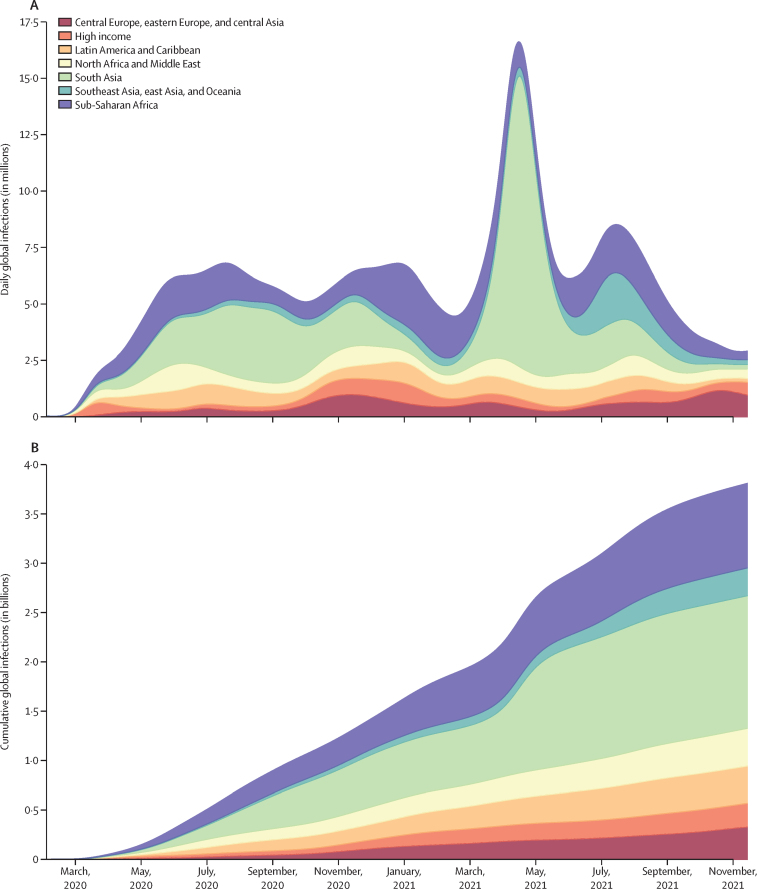
- Global daily infections fluctuated between 3 million and 17 million new infections per day from April, 2020, to October, 2021, peaking in mid-April, 2021, primarily due to surges in India.
- By Nov 14, 2021, there were an estimated 3.80 billion (95% UI 3.44–4.08) total SARS-CoV-2 infections and reinfections combined, and 3.39 billion (3.08–3.63) individuals, or 43.9% (39.9–46.9) of the global population, had been infected one or more times.
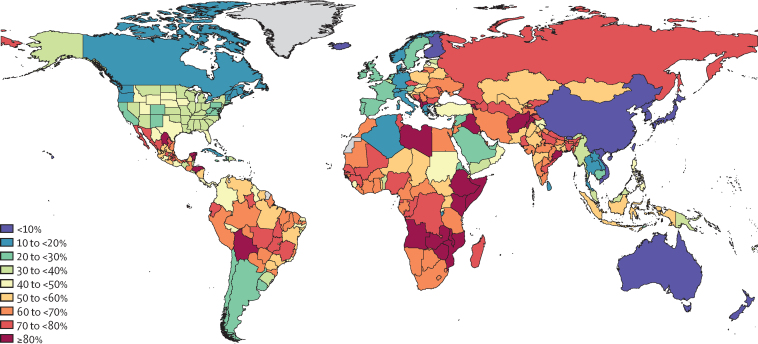
- South Asia had the most infections (1.34 billion [1.20–1.49]); sub-Saharan Africa had the highest infection rate (79.3 per 100 population [69.0–86.4]); the high-income super-region had the fewest infections (239 million [226–252]); southeast Asia, east Asia, and Oceania had the lowest infection rate (13.0 per 100 [8.4–17.7]). Over 70% of the population had been infected in 40 countries and under 20% in 39 countries.
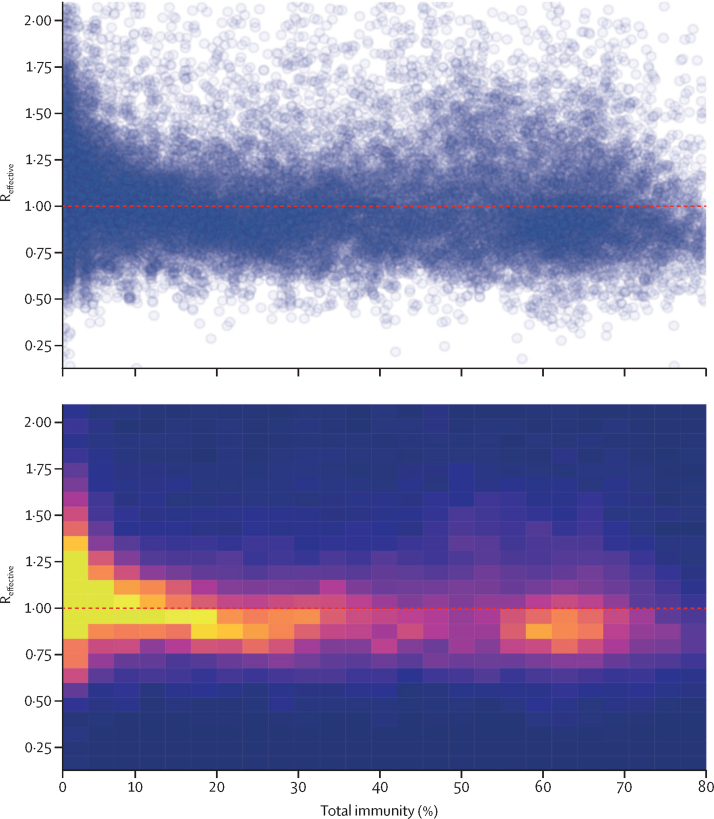
- There was no discernible relationship between Reffective and total immunity, and even at total immunity levels of 80%, no abrupt drop in Reffective was observed, indicating no clear herd immunity threshold in the data.
Methods
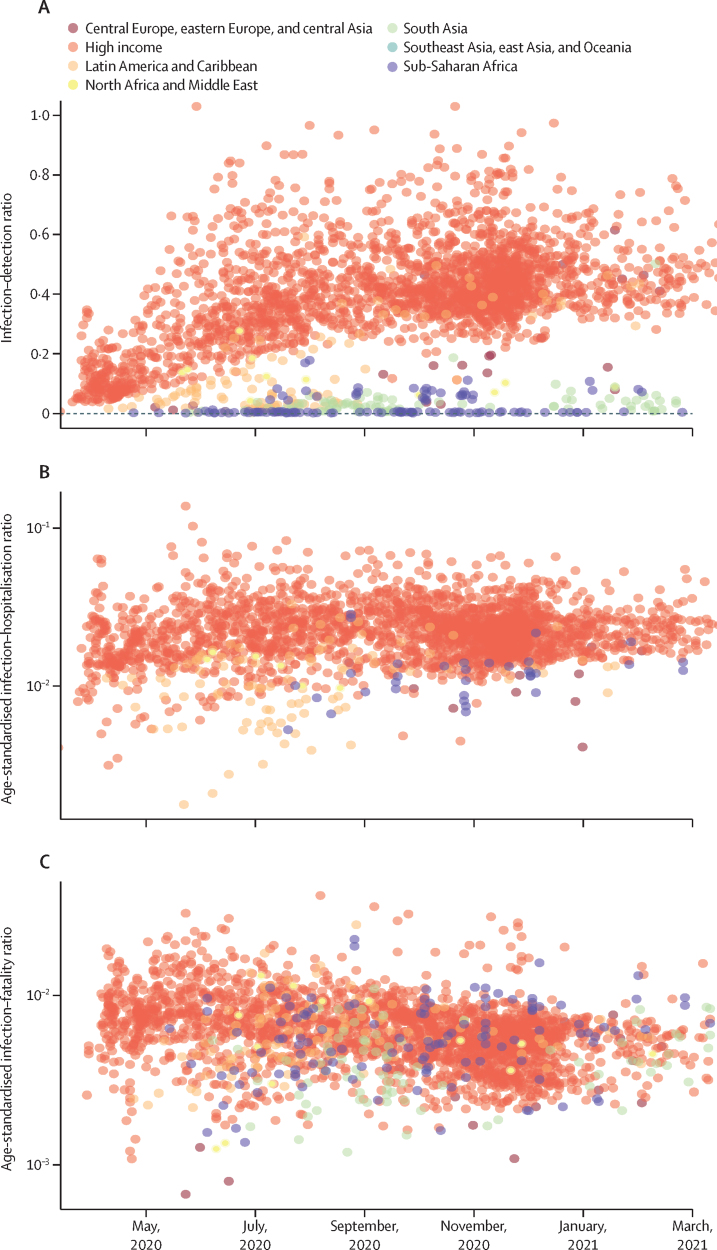
- The study used a seven-step ensemble framework: corrected reported cases, hospitalisations, and deaths for reporting lags and under-reporting; adjusted 2817 seroprevalence survey datapoints for vaccination, waning antibody sensitivity, and reinfection from escape variants; and created empirical databases of infection–detection ratios (IDRs), infection–hospitalisation ratios (IHRs), and infection–fatality ratios (IFRs).
- Bayesian cascading regression models predicted IDR, IHR, and IFR by location and day using covariates including testing, universal health-care coverage, HAQ Index, age structure, and comorbidities; three daily infection series (cases/IDR, hospitalisations/IHR, deaths/IFR) were combined into a robust daily infection estimate, then summed to cumulative infections and the cumulative proportion infected at least once, and converted to Reffective.
- Estimates covered 190 countries and territories, subnational locations in ten countries, 21 regions, seven super-regions, and globally through Nov 14, 2021, with a 100-iteration ensemble to capture uncertainty in data sources, model design, and parameter assumptions.
Limitations
- The paper states that some seroprevalence surveys may be biased and corrections were inconsistent; the testing-capacity covariate cannot decline, so declines in effective testing may be missed; vaccination adjustments sometimes produced decreasing seroprevalence estimates, leading to exclusion of those data; interval IDR/IHR/IFR measures limit identification of short-term fluctuations; hospital admissions data were sparse in low- and middle-income settings; total COVID-19 mortality estimates had wide uncertainty intervals; and the model allowed a maximum of two infections per individual.
- The paper also notes that its analysis ends before the omicron wave and that omicron’s transmissibility and immune escape mean the findings should not be extrapolated to later periods.
- Evident from the text: the estimates depend on many modelling assumptions and covariates, and the lack of a clear herd immunity threshold may reflect confounding by seasonality, physical distancing, mask use, and new variant spread rather than immunity alone.
Model-written summary. Check it against the paper before relying on it.
Integrity signals
Registry
Cites
Statistics
Figures
Verification
Claims the paper makes
7 Valid · 6 Not valid · 25 Not checked · 127 Own results and interpretations
At least one cited source doesn’t support this claim or points to a different paper, and none confirmed it — see the verdicts below.
In the paper
“This estimate did not take into account that some individuals could have been infected more than once with ancestral variants.31”
§ Estimating global, regional, and national daily and cumulative infections with SARS-CoV-2 through Nov 14, 2021: a statistical analysis > Methods > Seroprevalence survey adjustments
What the sources say
- Disputedcites [31] Hansen CH Michlmayr D Gubbels SM Mølbak K Ethelberg S Assessment of protection against reinfection with SARS-CoV-2 among 4 million PCR-tested individuals in Denmark in 2020: a population-level observational study Lancet 397 2021 1204 1212 33743221 PMC7969130 sourceExperimental — accuracy not yet measured
The Methods (Alternative cohort analysis; page unavailable) explicitly describe counting a new positive PCR test at least 90 days after an earlier positive test as a reinfection. The Results (page unavailable) report 138 reinfections and use them to estimate protection against repeat infection. Thus, the paper’s estimate did account for detected repeat infections, contrary to the claim. (LLM, conf=0.82)
Checked by a reasoning model — may be wrong.
plain- Asserted: passes — The authors put it forward as true.
- Checkable: passes — It can be checked against evidence.
- Load-bearing: unclear — It is unclear whether the paper’s conclusions depend on it.
- Based: passes — The paper gives a reason why it holds.
- Disputed
None of the sources cited for this claim have been checked yet.
In the paper
“Daily infections are also the crucial input into measuring the changing effective reproductive number (Reffective, the number of subsequent infections caused by a new infection).1, 2, 3”
§ Estimating global, regional, and national daily and cumulative infections with SARS-CoV-2 through Nov 14, 2021: a statistical analysis > Introduction
What the sources say
- Could not verifycites [1] Bjørnstad ON Shea K Krzywinski M Altman N Modeling infectious epidemics Nat Methods 17 2020 455 456 32313223 sourceExperimental — accuracy not yet measured
Our copy of Bjørnstad et al. (Nature Methods 17, 453–456, 2020) is a deterministic SIR primer: it defines only the basic reproduction number R0 = β/γ as 'the expected number of secondary cases caused by a single primary infected individual introduced into a population with no prior immunity' (Abstract/body passage, p. 453–454) and discusses estimating SIR parameters shortly after a new disease appears to predict trajectory and needed reductions in R0 (closing passage). No passage anywhere in our copy mentions an effective reproduction number (Re), a time-varying/changing reproduction number, or daily infection counts (incidence) as the input for measuring one — searches for 'effective reproduction number', 'daily new infections case incidence data estimate R over time', and paraphrases returned only semantic neighbours, no exact hits. The claim's substantive point therefore cannot be checked against this source; the closest content (the R0 definition) is a different quantity with a fully-susceptible-population qualifier, not the Re-measurement assertion. (LLM, conf=0.72)
- Could not verifycites [2] Bjørnstad ON Shea K Krzywinski M Altman N The SEIRS model for infectious disease dynamics Nat Methods 17 2020 557 558 32499633 sourceExperimental — accuracy not yet measured
Our copy of the SEIRS column (Bjørnstad et al., Nat Methods 17:557–558, 2020) defines only the basic reproduction number R0 — 'the number of secondary cases for each infection in a completely susceptible population' — and its formula R0 = [σ/(σ+μ)]·[β/(γ+μ+αI)], plus the endemic relation S = 1/R0 (intro and Points of significance sections; p. 557–558). No passage introduces the effective reproductive number (Re) or states that daily infections/incidence are the input used to measure its change over time; I searched 'effective reproductive number Re', 'daily incidence case counts estimating time-varying reproduction number', and 'Rt susceptible fraction R0 S/N' with no hit. The paper is not contrary to the claim, it simply does not address it, so the attribution cannot be checked against this source. (LLM, conf=0.68)
- Not checked yetcites [3] Cintrón-Arias A Castillo-Chávez C Bettencourt LMA Lloyd AL Banks HT The estimation of the effective reproductive number from disease outbreak data Math Biosci Eng 6 2009 261 282 19364152 source
plainstates a cause- Asserted: passes — The authors put it forward as true.
- Checkable: passes — It can be checked against evidence.
- Load-bearing: passes — The paper’s conclusions depend on it.
- Based: passes — The paper gives a reason why it holds.
- Could not verify
Every source the paper cites for this claim was checked and supports it.
In the paper
“Using the 718 seroprevalence surveys with age-specific detail, the COVID-19 Forecasting Team40 estimated the age pattern of the IFR.”
§ Estimating global, regional, and national daily and cumulative infections with SARS-CoV-2 through Nov 14, 2021: a statistical analysis > Methods > Empirical estimates of the IDR, IHR, and IFR
What the sources say
- Supportedcites [40] COVID-19 Forecasting Team Variation in the COVID-19 infection–fatality ratio by age, time, and geography during the pre-vaccine era: a systematic analysis Lancet 2022 published online Feb 24. 10.1016/S0140-6736(21)02867-1 PMC8871594 35219376 source
The Methods section, “Infection-fatality ratio by age,” reports 3012 age-specific observations from 718 seroprevalence surveys and says the team used a Bayesian meta-regression to estimate the non-linear age pattern of IFR. This directly supports the cited paraphrase. (LLM, conf=0.94)
hedged- Asserted: passes — The authors put it forward as true.
- Checkable: passes — It can be checked against evidence.
- Load-bearing: passes — The paper’s conclusions depend on it.
- Based: passes — The paper gives a reason why it holds.
- Supported
The cited sources support only part of this claim — read each source’s verdict below.
In the paper
“Because reinfection can be common in settings where escape variants such as beta (B.1.351), gamma (P.1), and delta (B.1.617.2) are present,28, 29, 30”
§ Estimating global, regional, and national daily and cumulative infections with SARS-CoV-2 through Nov 14, 2021: a statistical analysis > Methods > Seroprevalence survey adjustments
What the sources say
- Partly supportedcites [28] Sabino EC Buss LF Carvalho MPS Resurgence of COVID-19 in Manaus, Brazil, despite high seroprevalence Lancet 397 2021 452 455 33515491 PMC7906746 sourceExperimental — accuracy not yet measured
Our copy of Sabino et al. (2021) supports only part of what is attributed: the 'Third' paragraph (Resurgence of COVID-19 in Manaus, Brazil, despite high seroprevalence) says lineages 'might evade immunity generated in response to previous infection', names B.1.351 and P.1 among three divergent lineages, and reports a single P.1-associated reinfection case in Manaus plus two reinfection cases with P.2 E484K — i.e., isolated case reports, not evidence that reinfection 'can be common'. The concluding paragraph likewise only says the new lineages 'may drive a resurgence... if they are associated with antigenic escape' and calls for monitoring reinfections, and the 'Second' paragraph actually cites a UK study finding reinfection 'uncommon up to 6 months'. Delta (B.1.617.2) is not addressed anywhere in our copy (searched: delta/B.1.617.2, reinfection frequency), so the claim's generality across beta, gamma and delta overstates this source. (LLM, conf=0.72)
- Not checked yetcites [29] Jolly B Rophina M Shamnath A Genetic epidemiology of variants associated with immune escape from global SARS-CoV-2 genomes bioRxiv 2021 published online Dec 26. 10.1101/2020.12.24.424332 (preprint). source
- Not checked yetcites [30] Lee J-S Kim SY Kim TS Evidence of severe acute respiratory syndrome coronavirus 2 reinfection after recovery from mild coronavirus disease 2019 Clin Infect Dis 73 2021 e3002 e3008 33219681 PMC7890673 source
plainstates an association- Asserted: passes — The authors put it forward as true.
- Checkable: passes — It can be checked against evidence.
- Load-bearing: passes — The paper’s conclusions depend on it.
- Based: passes — The paper gives a reason why it holds.
- Partly supported
The cited sources support only part of this claim — read each source’s verdict below.
In the paper
“Other countries, such as Australia and New Zealand, have shown how early and effective lockdowns, combined with geographical isolation and travel restrictions, have kept transmission low throughout the study period.18, 55, 56”
§ Estimating global, regional, and national daily and cumulative infections with SARS-CoV-2 through Nov 14, 2021: a statistical analysis > Discussion
What the sources say
- Partly supportedcites [18] Kontis V Bennett JE Rashid T Magnitude, demographics and dynamics of the effect of the first wave of the COVID-19 pandemic on all-cause mortality in 21 industrialized countries Nat Med 26 2020 1919 1928 33057181 PMC7615092 sourceExperimental — accuracy not yet measured
The Discussion says New Zealand introduced movement restrictions or lockdowns early and kept cases low; it also places both New Zealand and Australia among countries without a detectable rise in all-cause mortality. It does not establish that geographical isolation and travel restrictions, combined with early lockdowns, kept transmission low in both countries throughout the study period. (LLM, conf=0.86)
- Partly supportedcites [55] Adekunle A Meehan M Rojas-Alvarez D Trauer J McBryde E Delaying the COVID-19 epidemic in Australia: evaluating the effectiveness of international travel bans Aust N Z J Public Health 44 2020 257 259 32697418 PMC7405030 sourceExperimental — accuracy not yet measured
The Results and Discussion report that Australia's China travel ban delayed widespread local transmission by about a month. The paper does not establish that lockdowns or geographical isolation kept transmission low in Australia and New Zealand throughout the study period; its Abstract instead says stronger domestic controls were needed in Australia. (LLM, conf=0.88)
- Partly supportedcites [56] Jefferies S French N Gilkison C COVID-19 in New Zealand and the impact of the national response: a descriptive epidemiological study Lancet Public Health 5 2020 e612 e623 33065023 PMC7553903 sourceExperimental — accuracy not yet measured
The Discussion reports that New Zealand’s early lockdown and border controls reduced transmission and helped maintain very low case numbers during the study period. It does not establish the same account for Australia; it instead names Australia among countries with slower lockdown implementation. The paper discusses New Zealand’s island-state border advantage, but does not separately measure the effect of geographical isolation. (LLM, conf=0.87)
boostedstates a cause- Asserted: passes — The authors put it forward as true.
- Checkable: passes — It can be checked against evidence.
- Load-bearing: unclear — It is unclear whether the paper’s conclusions depend on it.
- Based: passes — The paper gives a reason why it holds.
- Partly supported
97 more claims · 2 with their cited sources checked
Create a free account to see all 165 claims and to verify the 42 references still open.
- Probably not a substantial claim. 36
- It may state two separate claims as one. 36
Claims other papers make about this one
Each is checked against this paper’s own text: does it say what the citing paper says it does?
The source backs part of the claim, not all of it — or backs it for a different population, condition or comparison.
In the citing paper
“The emergence and spread of COVID-19 follows a similar pattern of regional heterogeneity that is common among many leading communicable causes of death, with higher rates of infection and increased fatalities occurring in lower-resource settings.6, 16, 17”
From Global burden of 288 causes of death and life expectancy decomposition in 204 countries and territories and 811 subnational locations, 1990–2021: a systematic analysis for the Global Burden of Disease Study 2021 (2024) · cites this paper as [16]
Experimental — accuracy not yet measuredThe source backs part of the claim, not all of it — or backs it for a different population, condition or comparison.
In the citing paper
“Locations with strained and under-resourced health systems faced overwhelming structural challenges in securing swift and sufficient supplies of vaccine, which compromised vaccine delivery to high-risk populations,29 and further affected progress in responding to the burden imposed by the pandemic in under-resourced locations in 2021.25”
From Global incidence, prevalence, years lived with disability (YLDs), disability-adjusted life-years (DALYs), and healthy life expectancy (HALE) for 371 diseases and injuries in 204 countries and territories and 811 subnational locations, 1990–2021: a systematic analysis for the Global Burden of Disease Study 2021 (2024) · cites this paper as [25]
Experimental — accuracy not yet measuredThe cited source says what the claim attributes to it.
In the citing paper
“First, data on COVID-19 outcomes (eg, cases, deaths, hospital admissions, and seroprevalence) were of highly variable quality and completeness, which required novel methods for standardisation.23, 25, 26”
From Global incidence, prevalence, years lived with disability (YLDs), disability-adjusted life-years (DALYs), and healthy life expectancy (HALE) for 371 diseases and injuries in 204 countries and territories and 811 subnational locations, 1990–2021: a systematic analysis for the Global Burden of Disease Study 2021 (2024) · cites this paper as [25]
In the citing paper
“older individuals with co-infection, particularly those who were undiagnosed with tuberculosis at the beginning of the pandemic, might have died from COVID-19.”
Self-check
Percentages, sums and reported differences re-computed from the paper’s own numbers.
Each contradiction between two passages listed here was confirmed by an independent check.
Rated minor: it would not touch a result — a value no result rests on, a p-value that stays on the same side of the significance level, or a conflict that is clerical, resolved elsewhere in the paper, or outside its own findings.
In the paper
§ Estimating global, regional, and national daily and cumulative infections with SARS-CoV-2 through Nov 14, 2021: a statistical analysis > Results
“5570 (4120–7780) | 14·1 (10·4–19·7) | 6·2% (1·7–16·1)”
§ Estimating global, regional, and national daily and cumulative infections with SARS-CoV-2 through Nov 14, 2021: a statistical analysis > Discussion
“Seventh, our model permitted a maximum of two infections per individual”
Citations
Cites
Vos, T., Lim, S. S., Abbafati, C., Abbas, K. M., Abbasi, M., Abbasifard, M., Abbasi-Kangevari, M., Abbastabar, H., Abd-Allah, F., Abdelalim, A., et al. (2020) · The Lancet · doi:10.1016/s0140-6736(20)30925-9 · Cited by 19,358 · cited 3×
“…of population infected varied widely within most countries for which subnational units were modelled in this analysis, varying by a factor of two across administrative units in Brazil, India, Italy, and Mexico; a factor of three in Germany and Spain; and over a factor of four in the USA (table).”
Self-citationAn interactive web-based dashboard to track COVID-19 in real time
Dong, E., Du, H., & Gardner, L. (2020) · The Lancet Infectious Diseases · doi:10.1016/s1473-3099(20)30120-1 · Cited by 10,048 · cited 2×
“Deaths were based on reported deaths data from Johns Hopkins University 23 and various national sources from locations where data inconsistencies were evident in the Johns Hopkins University datasets (more details in appendix 1, section 4.3, and appendix 2, section 2).”
InfluentialAntibody Responses to SARS-CoV-2 in Patients With Novel Coronavirus Disease 2019
Zhao, J., Yuan, Q., Wang, H., Liu, W., Liao, X., Su, Y., Wang, X., Yuan, J., Li, T., Li, J., et al. (2020) · Clinical Infectious Diseases · doi:10.1093/cid/ciaa344 · Cited by 2,607
Quantifying SARS-CoV-2 transmission suggests epidemic control with digital contact tracing
Ferretti, L., Wymant, C., Kendall, M., Zhao, L., Nurtay, A., Abeler-Dörner, L., Parker, M., Bonsall, D., & Fraser, C. (2020) · Science · doi:10.1126/science.abb6936 · Cited by 2,512 · cited 1×
“…by a combination of factors including policies enacted by governments to encourage mask use and reduce social interaction, 48–50 presence of escape variants, testing and contact tracing capacity, 51,52 previous exposure to other coronaviruses, 53 baseline patterns of social interaction, and more.”
The WHO Rapid Evidence Appraisal for COVID-19 Therapies (REACT) Working Group, Sterne, J. A. C., Murthy, S., Diaz, J. V., Slutsky, A. S., Villar, J., Angus, D. C., Annane, D., Azevedo, L. C. P., Berwanger, O., et al. (2020) · JAMA · doi:10.1001/jama.2020.17023 · Cited by 2,257
Wang, H., Paulson, K. R., Pease, S. A., Watson, S., Comfort, H., Zheng, P., Aravkin, A. Y., Bisignano, C., Barber, R. M., Alam, T., et al. (2022) · The Lancet · doi:10.1016/s0140-6736(21)02796-3 · Cited by 2,069
Self-citationGuidelines for accurate and transparent health estimates reporting: the GATHER statement
Stevens, G. A., Alkema, L., Black, R. E., Boerma, J. T., Collins, G. S., Ezzati, M., Grove, J. T., Hogan, D. R., Hogan, M. C., Horton, R., et al. (2016) · The Lancet · doi:10.1016/s0140-6736(16)30388-9 · Cited by 1,798
Self-citationGBD 2010: design, definitions, and metrics
Murray, C. J., Ezzati, M., Flaxman, A. D., Lim, S., Lozano, R., Michaud, C., Naghavi, M., Salomon, J. A., Shibuya, K., Vos, T., et al. (2012) · The Lancet · doi:10.1016/s0140-6736(12)61899-6 · Cited by 1,103
Self-citationEstimating the burden of SARS-CoV-2 in France
Salje, H., Tran Kiem, C., Lefrancq, N., Courtejoie, N., Bosetti, P., Paireau, J., Andronico, A., Hozé, N., Richet, J., Dubost, C.-L., et al. (2020) · Science · doi:10.1126/science.abc3517 · Cited by 1,038
Increased risk of SARS-CoV-2 reinfection associated with emergence of Omicron in South Africa
Pulliam, J. R. C., van Schalkwyk, C., Govender, N., Gottberg, A. V., Cohen, C., Groome, M. J., Dushoff, J., Mlisana, K., & Moultrie, H. (2021) · doi:10.1101/2021.11.11.21266068 · Cited by 1,037
Cited by
Items 101–200 of 303
Antibody response in elderly vaccinated four times with an mRNA anti-COVID-19 vaccine
Rouvinski, A., Friedman, A., Kirillov, S., Attal, J. H., Kumari, S., Fahoum, J., Wiener, R., Magen, S., Plotkin, Y., Chemtob, D., et al. (2023) · Scientific Reports · doi:10.1038/s41598-023-41399-5 · Cited by 9
Impacto de la COVID-19 en la salud mental de la población: estudio en atención primaria
Montserrat-Capdevila, J., Fornells-Barberà, I., Roso‐Llorach, A., Olivares-Sanzo, P., Gracia, A. R., & Ichart, J. X. (2023) · Atención Primaria · doi:10.1016/j.aprim.2023.102813 · Cited by 9
Uncovering the collateral impacts of COVID-19 on maternal mental health
Otu, A., & Yaya, S. (2022) · Reproductive Health · doi:10.1186/s12978-022-01427-5 · Cited by 9
Chakraborty, C., Bhattacharya, M., Chatterjee, S., Lee, S., Bhattacharya, P., Ohimain, E. I., Wen, Z., Das, A., Rai, A., Abdelhameed, A. S., et al. (2025) · Folia Microbiologica · doi:10.1007/s12223-025-01299-9 · Cited by 7
“They found infection fluctuations between 3 and 17 million (Collaborators 2022a).”
Madhi, S. A., Kwatra, G., Myers, J. E., Jassat, W., Dhar, N., Mukendi, C. K., Blumberg, L. H., Welch, R., Izu, A., & Mutevedzi, P. C. (2023) · Viruses · doi:10.3390/v15030597 · Cited by 7
Mindfulness and COVID-19-Related Stress: Staying Present During Uncertain Times
Polizzi, C. P., Sleight, F. G., Aksen, D. E., McDonald, C. W., & Lynn, S. J. (2023) · Mindfulness · doi:10.1007/s12671-023-02132-5 · Cited by 7
Chen, X., Peng, L., Huang, J., Yang, Y., Zhang, H., Wang, Z., Zhu, Z., Wang, J., Zhang, J., Chen, K., et al. (2023) · Bioorganic & Medicinal Chemistry Letters · doi:10.1016/j.bmcl.2023.129324 · Cited by 7
Reconstructing the COVID-19 incidence in India using airport screening data in Japan
Liu, S.-Q., Anzai, A., & Nishiura, H. (2024) · BMC Infectious Diseases · doi:10.1186/s12879-023-08882-w · Cited by 9
“This is not far from the IFR of 0.3% in the above-mentioned study [24] as of November 4, 2021.”
MethodResultInfluentialDavid, S. S. B., Mizrahi, B., Rahamim‐Cohen, D., Supino‐Rosin, L., Shahar, A., Alon, S. H., Sacerdote, A. F., Irony, A., Lazar, R., Kalkstein, N., et al. (2022) · Vaccine · doi:10.1016/j.vaccine.2022.05.051 · Cited by 7
Sun, P., Ramos, I., Coelho, C. H., Grifoni, A., Balinsky, C. A., Vangeti, S., Tarke, A., Bloom, N. I., Jani, V., Jakubski, S., et al. (2022) · iScience · doi:10.1016/j.isci.2022.105202 · Cited by 7
“…2021, approximately 80% of the US population had received vaccines designed based on the Wuhan-Hu-1 strain and approximately 30% of the global population had experienced infection with the Ancestral strain or other variants circulating prior to Omicron (Collaborators 2022; Kleynhans et al., 2022).”
COVID-19 Statistics in the Arab World by the End of October 2022: A Cross-Sectional Study
Alrasheedi, A. (2022) · Cureus · doi:10.7759/cureus.32670 · Cited by 7
Singh, I., & Joseph, P. (2022) · European Respiratory Journal · doi:10.1183/13993003.01739-2022 · Cited by 9
Wei, J., Liu, S., Bian, Y., Li, L., Qian, B., Shen, Z., Zhang, Y., Abuduaini, A., Dong, F., Zhang, X., et al. (2025) · Scientific Reports · doi:10.1038/s41598-024-75891-3 · Cited by 6
Shioda, K., Chen, Y., Collins, M. H., & Lopman, B. A. (2022) · The Journal of Infectious Diseases · doi:10.1093/infdis/jiac483 · Cited by 6
Mimura, W., Ishiguro, C., Terada-Hirashima, J., Matsunaga, N., Sato, S., Kawazoe, Y., Maeda, M., Murata, F., & Fukuda, H. (2023) · Journal of Epidemiology · doi:10.2188/jea.je20230106 · Cited by 6
Diagnostics for Public Health — Infectious Disease Surveillance and Control
Lipsitch, M., & Grad, Y. H. (2024) · NEJM Evidence · doi:10.1056/evidra2300271 · Cited by 6
Convergence of SARS-CoV-2 spike antibody levels to a population immune setpoint
Nilles, E. J., Roberts, K. W., Aubin, M. D. S., Mayfield, H. J., Restrepo, A. C., Garnier, S., Abdalla, G., Etienne, M. C., Duke, W., Dumas, D., et al. (2024) · EBioMedicine · doi:10.1016/j.ebiom.2024.105319 · Cited by 6
Tang, R. S. Y., Sattayalertyanyong, O., Kuo, Y., Park, K. H., Anastassiades, C. P., Ligresti, D., Hayashi, N., Hasan, A., Kim, T., Pausawasdi, N., et al. (2022) · Journal of Gastroenterology and Hepatology · doi:10.1111/jgh.16100 · Cited by 6
Zhang, C., Guo, T., Zhang, L., Gu, A., Ye, J., Lin, M., Chu, M., Zhu, F., & Zhu, L. (2023) · China CDC Weekly · doi:10.46234/ccdcw2023.074 · Cited by 6
What is wrong with Chinese COVID-19 statistics?
Nesteruk, I. G. (2023) · Epidemiology Biostatistics and Public Health · doi:10.54103/2282-0930/20637 · Cited by 6
Moura-Corrêa, M. J., Campos, A. S., Amaral, I. C. C., Cavalcante, A. L. M., Luques, I. N., Teixeira, L. R., & Mattos, R. D. C. O. D. C. (2023) · Saúde em Debate · doi:10.1590/0103-1104202313903 · Cited by 6
Distinct SARS-CoV-2 populational immune backgrounds tolerate divergent RBD evolutionary preferences
Ma, W., Fu, H., Jian, F., Cao, Y., & Li, M. (2024) · National Science Review · doi:10.1093/nsr/nwae196 · Cited by 7
“The estimated global daily number of infections was obtained from a previous study [38 ], and the accumulative infection rate of a specific variant was calculated by summing the product of daily variant proportion and the estimated daily infection rate.”
MethodImpact of cross-reactivity and herd immunity on SARS-CoV-2 pandemic severity
Owusu‐Boaitey, N., Böttcher, L., He, D., Erkhembayar, R., Yang, L., Kim, D.-H., Барчук, А. А., Gorski, D. H., & Howard, J. (2024) · Scandinavian Journal of Infectious Diseases · doi:10.1080/23744235.2024.2388222 · Cited by 7
“This pattern confirms that factors other than herd immunity ended outbreak waves in 2020 and early 2021 [13,18,23].”
InfluentialInfectious diseases in Poland in 2021
Rosińska, M., Czarkowski, M. P., & Sadkowska-Todys, M. (2024) · Przeglad Epidemiologiczny · doi:10.32394/pe.77.36 · Cited by 6
“Serological tests show that only about 1/4 of all infections could be diagnosed (19,20).”
BackgroundYamayoshi, S., Iwatsuki‐Horimoto, K., Okuda, M., Ujie, M., Yasuhara, A., Murakami, J., Duong, C., Hamabata, T., Ito, M., Chiba, S., et al. (2022) · Emerging infectious diseases · doi:10.3201/eid2811.221127 · Cited by 6
“Analyses of seroprevalence in several countries have revealed that the actual incidence of SARS-CoV-2 infection is much higher than the reported COVID-19 cases (3).”
BackgroundResultInfluentialRodríguez, J. P., Aleta, A., & Moreno, Y. (2023) · Frontiers in Public Health · doi:10.3389/fpubh.2023.1122230 · Cited by 7
It’s in the blood: a review of the hematological system in SARS-CoV-2-associated COVID-19
Harte, J. V., Coleman-Vaughan, C., Crowley, M. P., & Mykytiv, V. (2023) · Critical Reviews in Clinical Laboratory Sciences · doi:10.1080/10408363.2023.2232010 · Cited by 8
“However, the true burden of the COVID-19 pandemic is significantly under-represented by reported cases [4], with 3.8 billion total SARS-CoV-2 infections [5] and 14.9 million deaths [6,7] estimated between March 2020 and November 2021 alone.”
BackgroundInfluentialSidat, M., & Capitine, I. (2022) · Anais do Instituto de Higiene e Medicina Tropical · doi:10.25761/anaisihmt.432 · Cited by 6
Mathematical assessment of the role of human behavior changes on SARS-CoV-2 transmission dynamicsPreprint
Pant, B. P., Safdar, S., Santillana, M., & Gumel, A. B. (2024) · Research Square · doi:10.21203/rs.3.rs-3954838/v1 · Cited by 6
Ketaren, N. E., Mast, F. D., Fridy, P. C., Olivier, J. P., Sanyal, T., Sali, A., Chait, B. T., Rout, M. P., & Aitchison, J. D. (2024) · eLife · doi:10.7554/elife.89423.3 · Cited by 5
Estimation of excess cardiovascular deaths after COVID-19 in 2020
Furuse, Y. (2023) · Journal of Infection · doi:10.1016/j.jinf.2023.04.014 · Cited by 5
Finch, E., Nilles, E. J., Paulino, C. T., Skewes-Ramm, R., Lau, C. L., Lowe, R., & Kucharski, A. J. (2024) · The Lancet Regional Health - Americas · doi:10.1016/j.lana.2024.100860 · Cited by 5
A Deep Learning-Enhanced Compartmental Model and Its Application in Modeling Omicron in China
Deng, Q., & Wang, G. (2024) · Bioengineering · doi:10.3390/bioengineering11090906 · Cited by 5
“A set of posterior statistical models to estimate cumulative infections and the cumulative proportion of the population in various locations has been produced [2].”
BackgroundQuality of sleep after COVID-19 infection: a cross-sectional study in the Southern Italy
Sansone, V., Angelillo, S., Paduano, G., Pileggi, C., Nobile, C. G. A., & Giuseppe, G. D. (2024) · Frontiers in Psychiatry · doi:10.3389/fpsyt.2024.1428423 · Cited by 5
Identification of the first COVID-19 infections in the US using a retrospective analysis (REMEDID)
García‐García, D., Morales, E., de la Fuente‐Núñez, C., Vigo, I., Fonfría, E. S., & Bordehore, C. (2022) · Spatial and Spatio-temporal Epidemiology · doi:10.1016/j.sste.2022.100517 · Cited by 5
Toyama, M., Vargas, L., Ticliahuanca, S., & Quispe, A. M. (2022) · Gates Open Research · doi:10.12688/gatesopenres.13644.1 · Cited by 5
Meta-analysis of nationwide SARS-CoV-2 infection fatality rates in India
Zimmermann, L., & Mukherjee, B. (2022) · PLOS Global Public Health · doi:10.1371/journal.pgph.0000897 · Cited by 5
“This is due to the very large number of estimated cumulative infections in India (approximately 1 billion, through mid-November 2021 [7]).”
BackgroundStemler, J., Salmanton‐García, J., Weise, B., Többen, C., Joisten, C. S., Fleig, J., & Cornely, O. A. (2022) · Infection · doi:10.1007/s15010-022-01931-7 · Cited by 5
Zheng, D., Liu, P., Chen, H., Wang, X., & Li, J. (2023) · The European Journal of Psychiatry · doi:10.1016/j.ejpsy.2022.09.002 · Cited by 5
“As a global public health event, the coronavirus disease (COVID-19) pandemic has been affecting people’s daily lives and well-being for the last three years.(1,2) After most persons have been vaccinated or infected with COVID-19, the physiological problems related to the virus have steadily been reduced, mainly includ…”
BackgroundGarenne, M., & Stiegler, N. (2024) · PLoS ONE · doi:10.1371/journal.pone.0294870 · Cited by 5
SARS‐CoV‐2 does not infect pigs, but this has to be verified regularly
Opriessnig, T., & Huang, Y. (2022) · Xenotransplantation · doi:10.1111/xen.12772 · Cited by 5
Bivalent omicron (BA.1) booster vaccination against SARS-CoV-2
Vasin, A. V., & Stukova, M. (2023) · The Lancet Infectious Diseases · doi:10.1016/s1473-3099(23)00189-5 · Cited by 5
Prevalence and determinants of post-acute sequelae of COVID-19 in Liberia
Gwaikolo, C., Wapoe, Y., Badio, M., Glidden, D. V., Lindan, C., & Martin, J. N. (2023) · International Journal of Epidemiology · doi:10.1093/ije/dyad167 · Cited by 5
Reiner, R. C., Collins, J. K., anon Forecasting Team, & Murray, C. J. L. (2022) · SSRN Electronic Journal · doi:10.2139/ssrn.4126660 · Cited by 8
Self-citationMadhi, S. A., Kwatra, G., Myers, J. E., Jassat, W., Dhar, N., Mukendi, C. K., Blumberg, L. H., Welch, R., Izu, A., & Mutevedzi, P. C. (2022) · medRxiv · doi:10.1101/2022.07.13.22277575 · Cited by 5
Wei, C., Yin, W., Hu, T., Zhang, J., Dan, H., & Wu, B. (2024) · Frontiers in Pharmacology · doi:10.3389/fphar.2023.1323240 · Cited by 4
Development of Pneumonia Patient Classification Model Using Fair Federated Learning
Kim, D., Oh, K., Kang, S., & Lee, Y. (2024) · Lecture notes in computer science · doi:10.1007/978-3-031-53827-8_15 · Cited by 5
Ahmed, S. A. E., AbuKoura, R., Ahmed, A. E., Abdalla, O., Hassan, O. K., Hemeadan, A. T., Eldirdiri, A., Ismaeil, D., Zainalabdeen, I., Nurelhuda, N. M., et al. (2024) · BMC Public Health · doi:10.1186/s12889-024-18274-7 · Cited by 4
“Literature reports suggest that only 0.2% of coronavirus infections were identified in Sudan, echoing the significant underestimation of both the prevalence and incidence of COVID-19 across Sub-Saharan Africa [2].”
BackgroundInfluentialYang, J., Huo, X., Jiang, Q., Liao, Y., Zhang, C., Li, Y., Wang, Q., Niu, T., Li, C., Pi, N., et al. (2023) · Vaccine · doi:10.1016/j.vaccine.2023.03.033 · Cited by 4
Gupta, R., Sharma, K., Khedar, R. S., Sharma, S., Makkar, J. S., Natani, V., Bana, A., & Sharma, S. K. (2024) · BMJ Open · doi:10.1136/bmjopen-2023-078596 · Cited by 5
Franco, C. D., Cornejo, A., Rodríguez, M., García, A. H., Belisario, I., Mayora, S. J., García, A., Jaspe, R. C., Hidalgo, M., Parra-Giménez, N., et al. (2024) · Viruses · doi:10.3390/v16091480 · Cited by 4
Jirsa, V., Petkoski, S., Wang, H., Woodman, M., Fousek, J., Betsch, C., Felgendreff, L., BOHM, R. M., Lilleholt, L., Zettler, I., et al. (2022) · PLOS Digital Health · doi:10.1371/journal.pdig.0000098 · Cited by 6
Population-level differences in COVID-19 prevalence, severity, and clinical outcome
Dasgupta, I., Saini, S., Khan, M. A., & Chaudhary, K. (2023) · Elsevier eBooks · doi:10.1016/b978-0-443-18769-8.00008-8 · Cited by 6
Housing situations and local COVID-19 infection dynamics using small-area data
Freise, D., Schiele, V., & Schmitz, H. (2023) · Scientific Reports · doi:10.1038/s41598-023-40734-0 · Cited by 4
Gomaa, H. A. M., Shaker, M. E., Alzarea, S. I., Alsahli, T. G., Hendawy, O. M., Mohammed, Y. K., Younes, M. K., Rahman, F. E.-Z. S. A., Mohamed, F. A., Raoof, G. F. A., et al. (2023) · Tetrahedron · doi:10.1016/j.tet.2023.133628 · Cited by 4
SARS-CoV-2 Antibody Responses to AZD1222 Vaccination in West AfricaPreprint
Abdullahi, A., Oladele, D. A., Owusu, M., Kemp, S. A., James, A. B., Salako, A. O., Fink, D., Sylverken, A. A., Ige, F. A., Onwuamah, C. K., et al. (2022) · Research Square · doi:10.21203/rs.3.rs-1834968/v1 · Cited by 4
Conflicting COVID-19 excess mortality estimates – Authors' reply
Hay, S. I., & Murray, C. J. L. (2023) · The Lancet · doi:10.1016/s0140-6736(23)00227-1 · Cited by 4
Self-citationCase growth analysis to inform local response to COVID-19 epidemic in a diverse U.S community
Otto, M. C. D. O., Brito, F. A., Tark, J. Y., Bakota, E. V., Yamal, J., Marko, D., Sharma, S. V., Brown, M. R., Appana, S. N., Rector, A. M., et al. (2022) · Scientific Reports · doi:10.1038/s41598-022-20502-2 · Cited by 3
Wang, Y., Gong, G., & He, X. (2025) · Journal of Hazardous Materials · doi:10.1016/j.jhazmat.2025.139323 · Cited by 3
Genomic epidemiology of SARS-CoV-2 in large university hospital cohort: the UnCoVER-Brazil project
de Carvalho, F. S., Slack, S. D., Barbosa-Júnior, F., de Campos, M. R., Castro, G. S., Baroni, S., Bueno, L. M. T., Coeli, F. B., Yamamoto, A. Y., Silva, J. M., et al. (2023) · Epidemiology and Infection · doi:10.1017/s095026882300119x · Cited by 3
“Sociodemographic information and COVID-19 case details were extractedfromtheHCFMRP-USPCOVID-19surveillancereporting system,withsomeentriessupplementedwithinformationfrom electronicmedicalrecords.”
InfluentialZheng, D., Yang, L., Li, M., Qiu, Y., Gao, Y., & Li, J. (2023) · Psychology Research and Behavior Management · doi:10.2147/prbm.s427226 · Cited by 3
“Impact of the COVID-19 Pandemic on Mental Health In the three years since the outbreak, this panic and inconvenience caused by the novel coronavirus has been affecting people’s daily lives and mental health.(8,9) People’s psychological problems are increasing and attracting the attention of many researchers.”
Artificial Neural Network Prediction of COVID-19 Daily Infection Count
Jiang, N., Kolozsvary, C., & Li, Y. (2024) · Bulletin of Mathematical Biology · doi:10.1007/s11538-024-01275-3 · Cited by 4
“We remark that although there has been numerous papers addressing unreported COVID-19 infections (Barber et al. 2022; Hortaçsu et al. 2021; Chen et al. 2022; Albani et al. 2021), estimating true infection count using machine learning approaches (Tang and Cao 2023; Guo and He 2021; Vaid et al. 2020;…”
Humoral Immunity across the SARS-CoV-2 Spike after Sputnik V (Gam-COVID-Vac) Vaccination
Cornejo, A., Franco, C. D., Rodríguez, M., García, A. H., Belisario, I., Mayora, S. J., Garzaro, D. J., Zambrano, J. L., Jaspe, R. C., Hidalgo, M., et al. (2024) · Antibodies · doi:10.3390/antib13020041 · Cited by 4
“More than 770 million cases of COVID-19 and over 7 million deaths have been officially reported since then, although it is estimated that these numbers are considerably higher [1].”
BackgroundAgarwalla, A., Ahmed, W. K., Al-Marzouqi, A. H., Rizvi, T. A., Zaneldin, E. K., & Khan, M. A. (2024) · Buildings · doi:10.3390/buildings14061717 · Cited by 3
Zhang, S. H., Tan, S., Yang, B. T., Wu, Y., Yuan, G., Chen, F., & Liu, L. (2024) · Infection and Drug Resistance · doi:10.2147/idr.s481591 · Cited by 3
Ethnic equity in Aotearoa New Zealand's COVID-19 response: A descriptive epidemiological study
Jefferies, S., Gilkison, C., Duff, P., Grey, C., French, N. P., Carr, H., Priest, P. C., & Crengle, S. M. (2025) · Public Health · doi:10.1016/j.puhe.2025.105732 · Cited by 3
Xue, L., Qi, Y., & Zou, Y. (2025) · PeerJ · doi:10.7717/peerj.19466 · Cited by 3
Guest, P. C., Neyazi, A., Braun-Dullaeus, R. C., Müller, P., Schreiber, J., Haghikia, A., Vasilevska, V., & Steiner, J. (2023) · Advances in experimental medicine and biology · doi:10.1007/978-3-031-28012-2_5 · Cited by 3
Li, L., Sassen, S. D. T., Hunfeld, N., Smeets, T. J. L., Ewoldt, T. M. J., van den Berg, S. A. A., Koch, B. C. P., & Endeman, H. (2023) · Journal of Critical Care · doi:10.1016/j.jcrc.2023.154395 · Cited by 3
Czerwiński, M., Stępień, M., Juszczyk, G., Sadkowska-Todys, M., Zieliński, A., Rutkowski, J., & Rosińska, M. (2023) · Eurosurveillance · doi:10.2807/1560-7917.es.2023.28.35.2200745 · Cited by 4
Garchitorena, A., Rasoloharimanana, L. T., Rakotonanahary, R. J. L., Evans, M., Miller, A. C., Finnegan, K. E., Cordier, L., Cowley, G., Razafinjato, B., Randriamanambintsoa, M., et al. (2023) · International Journal of Epidemiology · doi:10.1093/ije/dyad135 · Cited by 3
de Aguirre, P. M., Carlos, S., Pina‐Sánchez, M., Mbikayi, S. M., Burgueño, E., Tendobi, C., Chiva, L. M., Holguín, Á., & Reina, G. (2024) · Journal of Medical Virology · doi:10.1002/jmv.29529 · Cited by 3
Discovery of Novel Spike Inhibitors against SARS-CoV-2 Infection
Tai, L.-T., Yeh, C.-Y., Chang, Y.-J., Liu, J., Hsu, K., Cheng, J., & Lu, C. (2024) · International Journal of Molecular Sciences · doi:10.3390/ijms25116105 · Cited by 5
Corrêa, R. D. O., de Arruda, J. A. A., Gomes, A. I. F., de Aguiar, E. G., Ferreira, E. F. E., de Magalhães, C. S., & Moreno, A. (2023) · PLoS ONE · doi:10.1371/journal.pone.0286853 · Cited by 3
Wong, S.-Y., Wellens, J., Helmus, D. S., Marlow, L., Brann, S., Pazos, V. M., Weinberg, A. D., Moran, H. R., McGregor, C., Vermeire, S., et al. (2023) · Inflammatory Bowel Diseases · doi:10.1093/ibd/izad097 · Cited by 3
Zhi, H., Qiu, Y., Jiang, H., Xiao, M., Han, L., Lei, S., & Niu, H. (2025) · Scientific Data · doi:10.1038/s41597-025-05268-2 · Cited by 4
“…differences between domain names across various categories, with both inter-group and intra-group comparisons sorted by frequency of occurrence. which applies a statistical test to evaluate the significance of the difference between the means of two distributions with different variances 49 .”
Liu, Y., Jiali, C., Li, P., Fu, H., Ning, N., & Chen, H. (2023) · Journal of Clinical Nursing · doi:10.1111/jocn.16647 · Cited by 2
Bergh, A., Gohar, F., Kidula, N., & Abdullah, M. (2023) · Frontiers in Health Services · doi:10.3389/frhs.2023.1230414 · Cited by 2
Yamamoto, M., Sakurai, K., Takatani, R., Hisada, A., & Mori, C. (2024) · Journal of Epidemiology · doi:10.2188/jea.je20240284 · Cited by 2
Assessing the extent of multisectoral collaboration in antimicrobial resistance interventions
Sekamatte, M., Musinguzi, S. P., Nyamor, C., Mutesi, C., & Ndibazza, J. (2025) · Discover Public Health · doi:10.1186/s12982-025-01291-1 · Cited by 2
Occurrence of SARS-CoV-2 reinfections at regular intervals in Ecuador
Guevara, R., Prado-Vivar, B., Márquez, S., Muñoz, E. B., Carvajal, M., Guadalupe, J. J., Becerra-Wong, M., Proaño, S., Bayas-Rea, R. D. L. Á., Coloma, J., et al. (2022) · Frontiers in Cellular and Infection Microbiology · doi:10.3389/fcimb.2022.951383 · Cited by 3
“Frontiers in Cellular and Infection Microbiology 06 SARS-CoV-2 (Barber et al., 2022) but remains susceptible to reinfections.”
BackgroundSong, W., Abudunaibi, B., Zhao, Z., Liu, W., Wang, X., & Chen, T. (2023) · Infectious Disease Modelling · doi:10.1016/j.idm.2023.07.011 · Cited by 2
Exploring Novel Vitamin K Derivatives with Anti-SARS-CoV-2 Activity
Homma, T., Okamoto, M., Koharazawa, R., Hayakawa, M., Fushimi, T., Tode, C., Hirota, Y., Osakabe, N., Baba, M., & Suhara, Y. (2023) · ACS Omega · doi:10.1021/acsomega.3c04175 · Cited by 2
Mapping regional funding for COVID-19 research in the Asia-Pacific region
Antonio, E. S., Pulik, N., Lee, J.-E., Soni, T., Hagen, H.-E., Ryu, C., & Norton, A. (2023) · BMJ Global Health · doi:10.1136/bmjgh-2023-013551 · Cited by 2
Zheng, Z., Wang, L., Wang, S., Fan, Q., Zhang, H., Luo, G., Gao, B., Yang, X., Zhao, B., Wang, X., et al. (2024) · BMJ Open · doi:10.1136/bmjopen-2023-077572 · Cited by 2
Evaluation of the exit screening policy among travelers arriving from Asian and pacific nations
Liu, S.-Q., Anzai, A., & Nishiura, H. (2024) · BMC Infectious Diseases · doi:10.1186/s12879-024-09327-8 · Cited by 2
Coskun, A. K., Aydın, A., Tosun, S., To, U., Rubman, S., Schilsky, M. L., & Zimbrean, P. C. (2024) · Frontiers in Psychology · doi:10.3389/fpsyg.2024.1326802 · Cited by 2
Owaraganise, A., Beesiga, B., Okiring, J., Roh, M. E., Kakande, E. R., Nangendo, J., Akatukwasa, C., Lee, J. J., Mwangwa, F., Kabami, J., et al. (2024) · PLOS Global Public Health · doi:10.1371/journal.pgph.0003270 · Cited by 2
The COVID ‐19 pandemic as a modifier of DGBI symptom severity: A systematic review and meta‐analysis
Kulin, D., Shah, A., Fairlie, T., Wong, R. K. M., Fang, X., Ghoshal, U. C., Kashyap, P., Mulak, A., Lee, Y. Y., Talley, N. J., et al. (2024) · Neurogastroenterology & Motility · doi:10.1111/nmo.14878 · Cited by 2
“69 There are data available that suggest that the severity of symptoms of patients with DGBI managed in a tertiary care setting during the COVID-19 pandemic was higher compared to the prepandemic lev - els.”
Katoh, S., Yasuda, I., Kitakawa, K., Hamaguchi, S., & Sando, E. (2024) · Tropical Medicine and Health · doi:10.1186/s41182-024-00635-y · Cited by 2
Coronaviruses: Pandemic SARS-CoV-2
Cowling, B. J., & Wong, S. (2024) · Springer eBooks · doi:10.1007/978-1-4939-9544-8_68-1 · Cited by 2
Optimizing vaccination campaign strategies considering societal characteristics
Lee, S., Zabinsky, Z. B., & Liu, S. (2025) · Health Care Management Science · doi:10.1007/s10729-025-09696-9 · Cited by 4
Yeh, J., Wang, Y.-F., Tzeng, Y., Chen, S., Pan, L. H., & Wang, S. (2025) · Headache The Journal of Head and Face Pain · doi:10.1111/head.14911 · Cited by 2
Mendes, L. F. B., Dal-Pizzol, H. R., Prestes, G. D. S., Girardi, C. S., Santos¹, L. F. D. S., Gelain, D. P., Westphal, G. A., Walz, R., Ritter, C., Dal‐Pizzol, F., et al. (2025) · Medicina Intensiva · doi:10.1016/j.medine.2025.502200 · Cited by 2
How to interpret the total number of SARS-CoV-2 infections
Shioda, K., & Lopman, B. A. (2022) · The Lancet · doi:10.1016/s0140-6736(22)00629-8 · Cited by 2
Bucenko, S. A., Sergoventsev, A. A., Kuznetsova, R. Y., Voevodin, E. E., Cherkashin, D. V., & Sobolev, A. D. (2023) · Bulletin of the Russian Military Medical Academy · doi:10.17816/brmma112377 · Cited by 2
Llorca, J., Gómez‐Acebo, I., Alonso-Molero, J., & Dierssen‐Sotos, T. (2023) · Frontiers in Public Health · doi:10.3389/fpubh.2023.1233043 · Cited by 2
Interventions reducing mortality in COVID-19 patients: a systematic review of randomized evidence
Maimeri, N., Marmiere, M., Losiggio, R., Nardelli, P., Redaelli, M. B., Fresilli, S., D’Amico, F., Zangrillo, A., Hajjar, L. A., & Landoni, G. (2023) · Minerva Medica · doi:10.23736/s0026-4806.23.08590-7 · Cited by 2
Pathology of the cardiovascular system in people returning to sports after COVID-19
Сергеевич, Ш. А., Бадтиева, В. А., Zholinsky, A. V., Парастаев, С. А., & Usmanov, D. M. (2024) · Sports medicine research and practice · doi:10.47529/2223-2524.2023.4.1 · Cited by 2
Incidence and Risk Factors of the COVID-19 Pandemic: An Epidemiological Approach
Arnedo-Pena, A., & Guillén‐Grima, F. (2023) · Epidemiologia · doi:10.3390/epidemiologia4020014 · Cited by 2
Metadata
- Authors
- Barber, R. M., Sorensen, R. J. D., Pigott, D. M., Bisignano, C., Carter, A., Amlag, J. O., Collins, J. K., Abbafati, C., Adolph, C., Allorant, A., Aravkin, A. Y., Bang-Jensen, B. L., Castro, E., Chakrabarti, S., Cogen, R. M., Combs, E., Comfort, H., Cooperrider, K., Dai, X., Daoud, F., Deen, A., Earl, L., Erickson, M., Ewald, S. B., Ferrari, A. J., Flaxman, A. D., Frostad, J. J., Fullman, N., Giles, J. R., Guo, G., He, J., Helak, M., Hulland, E. N., Huntley, B. M., Lazzar-Atwood, A., LeGrand, K. E., Lim, S. S., Lindstrom, A., Linebarger, E., Lozano, R., Magistro, B., Malta, D. C., Månsson, J., Mantilla Herrera, A. M., Mokdad, A. H., Monasta, L., Naghavi, M., Nomura, S., Odell, C. M., Olana, L. T., Ostroff, S. M., Pasovic, M., Pease, S. A., Reiner Jr, R. C., Reinke, G., Ribeiro, A. L. P., Santomauro, D. F., Sholokhov, A., Spurlock, E. E., Syailendrawati, R., Topor-Madry, R., Vo, A. T., Vos, T., Walcott, R., Walker, A., Wiens, K. E., Wiysonge, C. S., Worku, N. A., Zheng, P., Hay, S. I., Gakidou, E., & Murray, C. J. L.
- Corresponding author
- Barber, Ryan M
- ORCID
- Barber, Ryan M
- Sorensen, Reed J D
- Pigott, David M
- Carter, Austin
- Collins, James K
- Abbafati, Cristiana
- Adolph, Christopher
- Allorant, Adrien
- Aravkin, Aleksandr Y
- Bang-Jensen, Bree L
- Chakrabarti, Suman
- Dai, Xiaochen
- Daoud, Farah
- Ewald, Samuel B
- Ferrari, Alize J
- Flaxman, Abraham D
- Fullman, Nancy
- Guo, Gaorui
- He, Jiawei
- Hulland, Erin N
- LeGrand, Kate E
- Lim, Stephen S
- Lindstrom, Akiaja
- Lozano, Rafael
- Magistro, Beatrice
- Mokdad, Ali H
- Monasta, Lorenzo
- Naghavi, Mohsen
- Nomura, Shuhei
- Pasovic, Maja
- Pease, Spencer A
- Reinke, Grace
- Santomauro, Damian F
- Sholokhov, Aleksei
- Spurlock, Emma E
- Vo, Anh Truc
- Vos, Theo
- Walcott, Rebecca
- Wiens, Kirsten E
- Wiysonge, Charles Shey
- Hay, Simon I
- Gakidou, Emmanuela
- Murray, Christopher J L
- Venue
- The Lancet
- Publisher
- Elsevier BV
- Published
- 2022-06
- Volume
- 399
- Issue
- 10344
- Pages
- 2351-2380
- ISSN
- 0099-5355 (ISSN-L)
- 0140-6736
- PMC
- PMC8993157
- OpenAlex
- W4223443877
- Semantic Scholar
- 6e85baaa79fcc5d72aa4afd7107b35833323a529
- Cited by
- 298
- References
- 65
- Citations by year
- 2026: 21 · 2025: 26 · 2024: 80 · 2023: 105 · 2022: 66
- FWCI
- 41.46
- Type
- journal article
- Language
- en
- Open access
- hybrid
- doi.org
- Licence
- cc-by
- www.elsevier.com/tdm/userlicense/1.0/ (tdm)
- www.elsevier.com/legal/tdmrep-license (tdm)
- creativecommons.org/licenses/by/4.0/ (vor)
- Locations
- The Lancet (publishedVersion, cc-by)
- PubMed Central (publishedVersion, cc-by)
- PubMed (publishedVersion)
- ePrints Soton (University of Southampton) (acceptedVersion)
- LSHTM Research Online (London School of Hygiene and Tropical Medicine) (acceptedVersion)
- IRIS Research product catalog (Sapienza University of Rome) (submittedVersion, other-oa)
- Funders
- Queensland Government
- Queensland Health
- Conselho Nacional de Desenvolvimento Científico e Tecnológico (310679/2016-8, 465518/2014-1)
- National Health and Medical Research Council (APP1121516)
- Fundação de Amparo à Pesquisa do Estado de Minas Gerais (PPM-00428-17, RED-00081-16)
- South African Medical Research Council
- National Science Foundation (2031096)
- Ministry of Education, Culture, Sports, Science and Technology
- Coordenação de Aperfeiçoamento de Pessoal de Nível Superior (88887.507149/2020-00)
- New York State Department of Health
- Bill and Melinda Gates Foundation
- Topics
- Physical Sciences › Mathematics › Modeling and Simulation › COVID-19 epidemiological studies
- Health Sciences › Medicine › Infectious Diseases › SARS-CoV-2 and COVID-19 Research
- Health Sciences › Medicine › Epidemiology › Data-Driven Disease Surveillance
- Keywords
- SARS-CoV-2, COVID-19 pandemic, cumulative infections, infection fatality rate, excess mortality, seroprevalence, effective reproduction number, reinfection, escape variants, vaccination, global estimates, country-level estimates, time series forecasting, SARS-CoV-2 variants
- MeSH terms
- COVID-19, SARS-CoV-2, Humans, Seroepidemiologic Studies, Pandemics
About these checks
Registry, retraction, Cites and statistics results are computed, not judged, with one exception: a printed reference that no index lists is read once by a model before it counts as a citation error. Claims are extracted by a model and kept only when their quote appears verbatim in the text; each cited source is then checked, with a model’s help, for whether it says what the claim relies on. Those verdicts can be wrong — read the claim’s quote and the cited source before relying on one.
The claim verdicts this report counts are experimental: their accuracy is not yet measured.
A language model drew the claims from the paper on 2026-10-04, under version 3 of the claim definition (model deepseek-v4.1-flash, prompt extract-v3).
A second model labelled each claim on 2026-10-04 (model jev-1.13-20260917, definition revision gold-guideline-v0.2).
Cited sources are checked with a language model’s help (gpt-6-sol and qwen3.8-omni-flash).
Statistics and arithmetic are recomputed, not judged.
Confidence bands are shown only for fields calibrated on our annotated test set. None is calibrated yet, so no band is shown.
What counts as a claim ›How we measure confidence ›How we check this ›
Are you an author, or do you see a problem with this page? Request a review
Data sources
Bibliographic data: Semantic Scholar, OpenAlex, Crossref.
Contains information from the Semantic Scholar Academic Graph Datasets, made available under the ODC Attribution License (ODC-BY 1.0).
Semantic Scholar’s data is described in: Kinney, R., et al. (2023). The Semantic Scholar Open Data Platform. arXiv:2301.10140.
