

Contribution of vaccination to improved survival and health: modelling 50 years of the Expanded Programme on Immunization
Open accessThe DOI matches its Crossref record; 13 of the 14 references it cites were found in a registry or an index; 2 of the 14 sources its claims cite were checked for support.
Abstract
BACKGROUND: WHO, as requested by its member states, launched the Expanded Programme on Immunization (EPI) in 1974 to make life-saving vaccines available to all globally. To mark the 50-year anniversary of EPI, we sought to quantify the public health impact of vaccination globally since the programme's inception. METHODS: In this modelling study, we used a suite of mathematical and statistical models to estimate the global and regional public health impact of 50 years of vaccination against 14 pathogens in EPI. For the modelled pathogens, we considered coverage of all routine and supplementary vaccines delivered since 1974 and estimated the mortality and morbidity averted for each age cohort relative to a hypothetical scenario of no historical vaccination. We then used these modelled outcomes to estimate the contribution of vaccination to globally declining infant and child mortality rates over this period. FINDINGS: Since 1974, vaccination has averted 154 million deaths, including 146 million among children younger than 5 years of whom 101 million were infants younger than 1 year. For every death averted, 66 years of full health were gained on average, translating to 10·2 billion years of full health gained. We estimate that vaccination has accounted for 40% of the observed decline in global infant mortality, 52% in the African region. In 2024, a child younger than 10 years is 40% more likely to survive to their next birthday relative to a hypothetical scenario of no historical vaccination. Increased survival probability is observed even well into late adulthood. INTERPRETATION: Since 1974 substantial gains in childhood survival have occurred in every global region. We estimate that EPI has provided the single greatest contribution to improved infant survival over the past 50 years. In the context of strengthening primary health care, our results show that equitable universal access to immunisation remains crucial to sustain health gains and continue to save future lives from preventable infectious mortality. FUNDING: WHO.
Overview
CoChat Summary
TL;DR
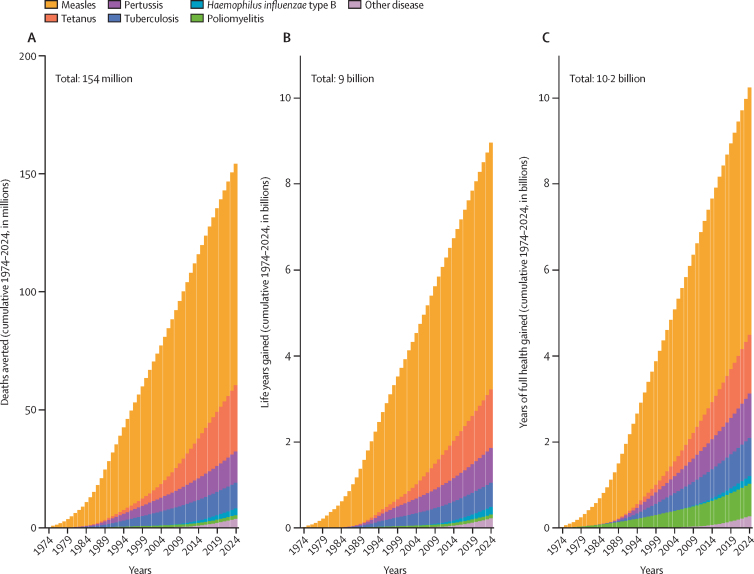
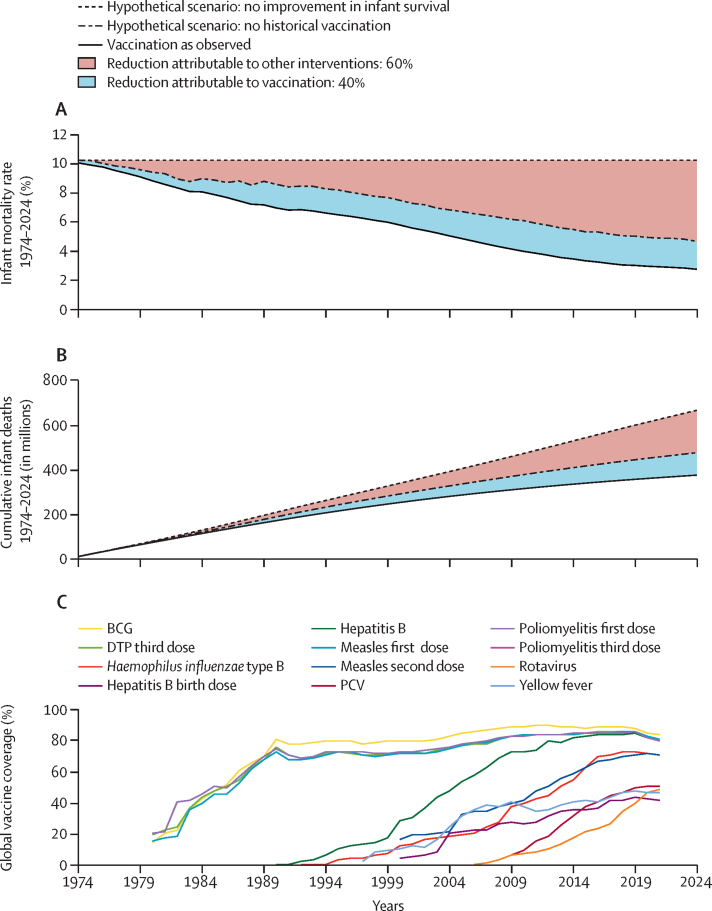
Modelling 50 years of the WHO Expanded Programme on Immunization estimates that vaccination against 14 pathogens averted 154 million deaths from 1974 to 2024, including 146 million in children younger than 5 years, and gained 10·2 billion years of full health. Vaccination accounted for 40% of the global decline in infant mortality, with measles vaccination the single greatest contributor.
Key findings
- Vaccination averted 154 million deaths, including 146 million in children younger than 5 years and 101 million in infants younger than 1 year; 9·0 billion life-years and 10·2 billion years of full health were gained. For each death averted, an average of 58 years of life and 66 years of full health were gained.
- Measles vaccination accounted for 93·7 million lives saved (60·8%) of the 154·0 million total. Poliomyelitis vaccination averted 1% of deaths but accounted for 0·8 billion (7·8%) of the 10·2 billion years of full health gained.
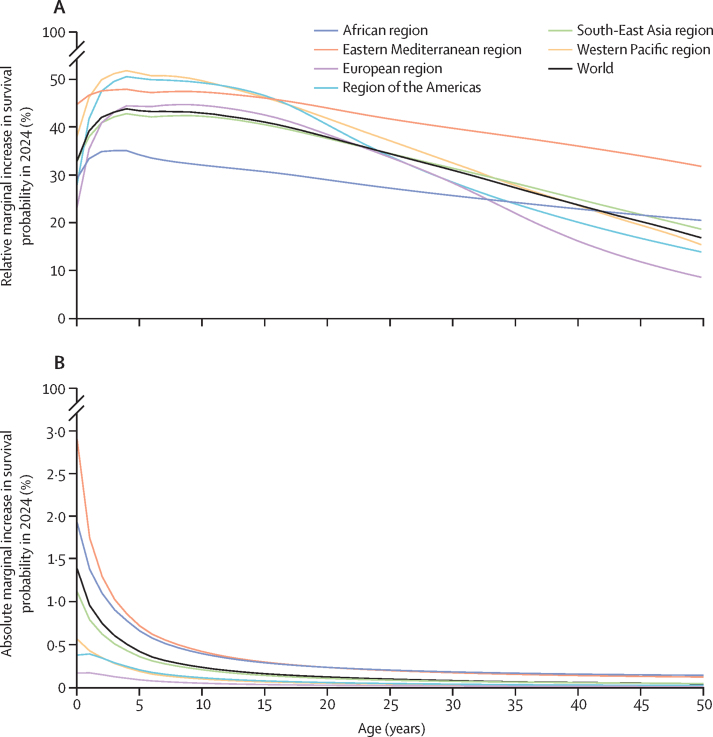
- Vaccination was estimated to be directly responsible for 40% of the global decline in infant mortality, varying from 21% in the Western Pacific region to 52% in the African region. In 2024, children aged 10 years were approximately 44% more likely to survive to their next birthday than with no historical vaccination; individuals aged 25 years were 35% more likely, and those aged 50 years were 16% more likely.
- Global coverage with a third dose of diphtheria–tetanus–pertussis vaccine increased from less than 5% in 1974 to 86% in 2019 before the COVID-19 pandemic, and was 84% at the time of the study.
Methods
- Modelling study estimating deaths averted, life-years gained, and years of full health gained from vaccination against 14 pathogens in 194 WHO member states between June 1, 1974, and May 31, 2024, through routine and supplementary immunisation activities, relative to a hypothetical scenario of no historical vaccination.
- The analysis synthesised results of 22 models using three modelling forms: dynamic transmission models for measles and poliomyelitis; extended Vaccine Impact Modelling Consortium transmission models for *H influenzae* type B, hepatitis B, Japanese encephalitis, invasive pneumococcal disease, rotavirus, and rubella; and upgraded static disease burden models for diphtheria, tetanus, pertussis, and tuberculosis. Age-specific coverage was drawn from WHO Immunization dashboard, WHO Supplementary Immunization Activities Database, WHO Polio Information System, and VIMC estimates; 24 vaccine activities were evaluated.
- Regression-based imputation and functional fitting with Markov chain Monte Carlo and Akaike Information Criterion model selection were used to extrapolate impact to countries and time periods without direct model estimates. Primary outcomes were deaths averted, years of life gained, years of full health gained, and the proportion of infant mortality reduction attributable to vaccination, with secondary evaluation by WHO region and World Bank income stratum.
Limitations
- The paper states that the calendar-year approach does not fully account for post-2024 lifetime vaccination impacts, implying a substantial underestimate for diseases such as hepatitis B; HPV was excluded because of incomparability of timeframe. The analysis also excludes vaccines against COVID-19, influenza, HPV, outbreak vaccines such as cholera or Ebola, vaccines targeting disease in adult life, and vaccines used largely in high-income settings such as varicella, herpes zoster, or mumps; the counterfactual assumed a smallpox-free world, so smallpox eradication benefits were not counted.
- The paper states that double counting is a limitation but estimates it would have only a small (0·01%) effect; findings are presented at global and regional resolution, limiting geographical conclusions; uncertainty propagation was not possible for all hierarchical models or inputs; and posterior credible intervals had arbitrarily predefined widths and should not be interpreted as bounds for final outcomes.
- The text makes evident further limitations: the authors describe the analysis as a minimum conservative estimate because it excludes possible heterologous or non-specific vaccine effects, downstream effects on non-communicable disease mortality, and broader economic or community development gains. The text also contains an internal numerical inconsistency, reporting 10·2 billion years of full health in the abstract and results but referring later to 10·8 billion healthy life-years gained.
Model-written summary. Check it against the paper before relying on it.
Integrity signals
Registry
Cites
Statistics
Figures
Verification
Claims the paper makes
2 Valid · 2 Not valid · 8 Not checked · 77 Own results and interpretations
The sources with a verdict support this claim; the rest weren’t checked yet, have no full text we could read, or their verdicts aren’t rated yet.
In the paper
“Measles vaccination has been the single greatest contributor and is likely to remain so.18, 23”
§ Contribution of vaccination to improved survival and health: modelling 50 years of the Expanded Programme on Immunization > Discussion
What the sources say
- Supportedcites [18] Toor J Echeverria-Londono S Li X Lives saved with vaccination for 10 pathogens across 12 countries in a pre-COVID-19 world eLife 10 2021 10 PMC8277373 34253291 source
The Results (Impact by year of vaccination; page not provided) identify measles as having the largest estimated impact on deaths averted among the ten pathogens over 2000–2030. The Discussion says that, under the default forecast through 2030, measles is predicted to produce the greatest reduction in deaths. The prediction is conditional on that forecast, not an indefinite projection. (LLM, conf=0.90)
- Not checked — no full text of the sourcecites [23] Carter A Msemburi W Sim SY Modeling the impact of vaccination for the Immunization Agenda 2030: deaths averted due to vaccination against 14 pathogens in 194 countries from 2021 to 2030 Vaccine 2023 published online Aug 1. 10.1016/j.vaccine.2023.07.033 37537094 source
hedgedstates a cause- Asserted: passes — The authors put it forward as true.
- Checkable: passes — It can be checked against evidence.
- Load-bearing: passes — The paper’s conclusions depend on it.
- Based: passes — The paper gives a reason why it holds.
- Supported
A result the paper reports from its own data — it cites no other source for it, so there is none to check. The quote shows it is in the paper.
In the paper
“Since 1974, vaccination has averted 154 million deaths,”
- Also stated in: § Findings · plain
“Since 1974, vaccination has averted 154 million deaths, including 146 million among children younger than 5 years of whom 101 million were infants younger than 1 year.”
§ Contribution of vaccination to improved survival and health: modelling 50 years of the Expanded Programme on Immunization > Abstract > Findings
plainstates a cause- Asserted: passes — The authors put it forward as true.
- Checkable: passes — It can be checked against evidence.
- Load-bearing: passes — The paper’s conclusions depend on it.
- Based: passes — The paper gives a reason why it holds.
- Rests on an assumption not shown here.
- Also stated in: § Findings · plain
A result the paper reports from its own data — it cites no other source for it, so there is none to check. The quote shows it is in the paper.
In the paper
“Since 1974, vaccination has averted 154 million deaths, including 146 million among children younger than 5 years of whom 101 million were infants younger than 1 year.”
§ Contribution of vaccination to improved survival and health: modelling 50 years of the Expanded Programme on Immunization > Abstract > Findings
plainstates a causen = 146- Asserted: passes — The authors put it forward as true.
- Checkable: passes — It can be checked against evidence.
- Load-bearing: passes — The paper’s conclusions depend on it.
- Based: passes — The paper gives a reason why it holds.
- Rests on an assumption not shown here.
A result the paper reports from its own data — it cites no other source for it, so there is none to check. The quote shows it is in the paper.
In the paper
“For every death averted, 66 years of full health were gained on average, translating to 10·2 billion years of full health gained.”
§ Contribution of vaccination to improved survival and health: modelling 50 years of the Expanded Programme on Immunization > Abstract > Findings
plainstates a cause- Asserted: passes — The authors put it forward as true.
- Checkable: passes — It can be checked against evidence.
- Load-bearing: passes — The paper’s conclusions depend on it.
- Based: passes — The paper gives a reason why it holds.
- Rests on an assumption not shown here.
A result the paper reports from its own data — it cites no other source for it, so there is none to check. The quote shows it is in the paper.
In the paper
“We estimate that vaccination has accounted for 40% of the observed decline in global infant mortality, 52% in the African region.”
§ Contribution of vaccination to improved survival and health: modelling 50 years of the Expanded Programme on Immunization > Abstract > Findings
hedgedstates a cause- Asserted: passes — The authors put it forward as true.
- Checkable: passes — It can be checked against evidence.
- Load-bearing: passes — The paper’s conclusions depend on it.
- Based: passes — The paper gives a reason why it holds.
- Rests on an assumption not shown here.
48 more claims
Create a free account to see all 89 claims and every source verdict.
- Probably not a substantial claim. 23
- It may state two separate claims as one. 20
Claims other papers make about this one
Each is checked against this paper’s own text: does it say what the citing paper says it does?
The cited source says what the claim attributes to it.
In the citing paper
“For example, the Expanded Programme on Immunization (EPI) marks its 50th anniversary in 2024 and a retrospective assessment of impact estimated that 40% of the post-1974 decline in infant mortality resulted from the EPI.81”
From Global health 2050: the path to halving premature death by mid-century (2024) · cites this paper as [81]
Self-check
Percentages, sums and reported differences re-computed from the paper’s own numbers.
Each contradiction between two passages listed here was confirmed by an independent check.
Rated minor: it would not touch a result — a value no result rests on, a p-value that stays on the same side of the significance level, or a conflict that is clerical, resolved elsewhere in the paper, or outside its own findings.
In the paper
§ Contribution of vaccination to improved survival and health: modelling 50 years of the Expanded Programme on Immunization > Results
“with 0·8 billion (7·8%) of the 10·2 billion years of full health gained attributable to poliomyelitis cases averted.”
§ Contribution of vaccination to improved survival and health: modelling 50 years of the Expanded Programme on Immunization > Discussion
“Vaccination against poliomyelitis has had a modest impact on mortality, averting 1% of deaths, but has led to substantial public health gains by reducing poliomyelitis-induced paralysis, accounting for 8% of the 10·8 billion healthy life-years gained.”
Rated minor: it would not touch a result — a value no result rests on, a p-value that stays on the same side of the significance level, or a conflict that is clerical, resolved elsewhere in the paper, or outside its own findings.
In the paper
§ Contribution of vaccination to improved survival and health: modelling 50 years of the Expanded Programme on Immunization > Discussion
“accounting for 8% of the 10·8 billion healthy life-years gained.”
§ Contribution of vaccination to improved survival and health: modelling 50 years of the Expanded Programme on Immunization > Discussion
“10·2 billion healthy years of life have been gained due to vaccination.”
Citations
Cites
Brisson, M., Kim, J. J., Canfell, K., Drolet, M., Gingras, G., Burger, E. A., Martin, D., Simms, K. T., Bénard, É., Boily, M.-C., et al. (2020) · The Lancet · doi:10.1016/s0140-6736(20)30068-4 · Cited by 1,138 · cited 1×
“18,23,32 This imperative is highly dependent on achieving post-COVID-19 pandemic recovery and restoration of the trajectory to Immunization Agenda 2030 targets; achieving and maintaining universally high coverage with measles-containing vaccines (a principle aim of the Big Catch-up initiative;…”
BackgroundSelf-citationImmunization agenda 2030: A global strategy to leave no one behind
(2024) · Vaccine · doi:10.1016/j.vaccine.2022.11.042 · Cited by 372 · cited 2×
“26,27 Measles outbreaks are a tracer for vaccine programme performance under the Immunization Agenda 2030 (panel).”
The broader economic impact of vaccination: reviewing and appraising the strength of evidence
Jit, M., Hutubessy, R., Png, M. E., Sundaram, N., Audimulam, J., Salim, S., & Yoong, J. (2015) · BMC Medicine · doi:10.1186/s12916-015-0446-9 · Cited by 153 · cited 1×
“30 We also did not include possible heterologous effects of vaccines on epitopically non-specific immune training or other potential mechanisms.”
BackgroundSelf-citationCarter, A., Msemburi, W., Sim, S. Y., Gaythorpe, K. A. M., Lambach, P., Lindstrand, A., & Hutubessy, R. (2024) · Vaccine · doi:10.1016/j.vaccine.2023.07.033 · Cited by 121 · cited 4×
“18 Finally, published static disease burden models for diphtheria, tetanus, pertussis, and tuberculosis were upgraded (appendix pp 23–31).”
BackgroundMethodInfluentialSelf-citationVerguet, S., Johri, M., Morris, S. K., Gauvreau, C. L., Jha, P., & Jit, M. (2014) · Vaccine · doi:10.1016/j.vaccine.2014.11.050 · Cited by 106 · cited 1×
“20,21 For poliomyelitis we ran novel simulations of an existing dynamic model.”
MethodSelf-citationLives saved with vaccination for 10 pathogens across 112 countries in a pre-COVID-19 world
Toor, J., Echeverria-Londono, S., Li, X., Abbas, K., Carter, E. D., Clapham, H. E., Clark, A., de Villiers, M. J., Eilertson, K., Ferrari, M., et al. (2021) · eLife · doi:10.7554/elife.67635 · Cited by 97 · cited 4×
“18 Finally, published static disease burden models for diphtheria, tetanus, pertussis, and tuberculosis were upgraded (appendix pp 23–31).”
BackgroundMethodInfluentialSelf-citationClark, R. A., Mukandavire, C., Portnoy, A., Weerasuriya, C. K., Deol, A., Scarponi, D., Iskauskas, A., Bakker, R., Quaife, M., Malhotra, S., et al. (2023) · The Lancet Global Health · doi:10.1016/s2214-109x(23)00045-1 · Cited by 63
Self-citationHow can the public health impact of vaccination be estimated?
Echeverría-Londoño, S., Li, X., Toor, J., de Villiers, M. J., Nayagam, S., Hallett, T. B., Abbas, K., Jit, M., Klepac, P., Jean, K., et al. (2021) · BMC Public Health · doi:10.1186/s12889-021-12040-9 · Cited by 36 · cited 2×
“18 Finally, published static disease burden models for diphtheria, tetanus, pertussis, and tuberculosis were upgraded (appendix pp 23–31).”
BackgroundSelf-citationPolio by the Numbers—A Global Perspective
Badizadegan, K., Kalkowska, D. A., & Thompson, K. M. (2022) · The Journal of Infectious Diseases · doi:10.1093/infdis/jiac130 · Cited by 35 · cited 1×
“22 Second, we extended a suite of VIMC transmission models for H influenzae type B, hepatitis B, Japanese encephalitis, invasive pneumococcal disease, rotavirus, and rubella, which estimated vaccine impact for 110 countries (fewer for meningitis A and yellow fever) from 2000 to 2024, by…”
MethodSelf-citationEilertson, K. E., Fricks, J., & Ferrari, M. J. (2019) · Statistics in Medicine · doi:10.1002/sim.8290 · Cited by 32 · cited 2×
“20,21 For poliomyelitis we ran novel simulations of an existing dynamic model.”
MethodSelf-citation
Research works printed but not linked: 2
- O'Brien K From the expanded to the essential programme on immunization: achievements of the last 50 years and inspirations for the next 50. IVB Director's Report to SAGE 2024 World Health Organization Geneva
- Institute of Medicine The Children's Vaccine Initiative: achieving the vision 1993 The National Academies Press Washington, DC 25144104
Cited by
Items 301–400 of 631
Measles, polio, tuberculosis: what’s causing spikes in infectious diseases?
Nuwer, R. (2025) · Nature · doi:10.1038/d41586-025-03334-8 · Cited by 1
Ghisi, F., Gotelli, M., Solina, V., & Tonelli, F. (2025) · Applied Sciences · doi:10.3390/app152111734 · Cited by 3
The World Health Organization Reviews Another Year of Global Health Progress and Some Setbacks
Binns, C. W., & Low, W. Y. (2024) · Asia Pacific Journal of Public Health · doi:10.1177/10105395241265205 · Cited by 1
Flagellin in the human gut microbiome is a diet-adjustable adjuvant for vaccinationPreprint
Huus, K. E., Tan, Y. H., Abo, H., Keller, R., Atay, E., Vu, D. L., Dauser, S., Prokipchuk, A., Tyakht, A., Youngblut, N. D., et al. (2025) · bioRxiv (Cold Spring Harbor Laboratory) · doi:10.1101/2025.02.21.639485 · Cited by 1
Pijpers, J., van Roon, A. M., Schipper, M., et al. (2025) · medRxiv · doi:10.1101/2025.04.24.25326341 · Cited by 1
Pandemic Treaty and More Progress at the 2025 World Health Assembly
Binns, C. W., & Low, W. Y. (2025) · Asia Pacific Journal of Public Health · doi:10.1177/10105395251360288 · Cited by 1
Papelian, S. (2025) · Research Square · doi:10.21203/rs.3.rs-7340665/v1 · Cited by 2
Vaccine hesitancy in war-torn Ukraine: A machine learning framework for resilient immunizationPreprint
Bukhari, M. H., Павлова, Ю., Lapii, F., & Haque, U. (2025) · Research Square · doi:10.21203/rs.3.rs-7406595/v1 · Cited by 2
Verma, A. K., Dhalaria, P., Kumar, P., Kapur, S., Priyadarshini, P., Singh, A. K., Singh, K., Tripathi, B., & Ray, A. (2026) · medRxiv · doi:10.64898/2026.02.05.26345714 · Cited by 1
Adeyanju, G. C., & Korn, L. (2026) · medRxiv · doi:10.64898/2026.03.12.26348244 · Cited by 1
Ventura, A. (2024) · Medico e Bambino · doi:10.53126/meb43281
Macnab, A. J. (2024) · Journal of Human Virology & Retrovirology · doi:10.15406/jhvrv.2024.11.00276
El impacto de la vacunación a cincuenta años de la implemetación del Programa Ampliado de Vacunación
Ituarte, F. A. (2024) · Acta Pediátrica de México · doi:10.18233/apm.v45i3.2921
Lee, J. (2024) · Osong Public Health and Research Perspectives · doi:10.24171/j.phrp.2024.0181
Erradicación del sarampión: todavía un largo y difícil camino
Llop, F. A. M., & Campins, M. (2024) · Vacunas · doi:10.1016/j.vacun.2024.07.001
The Dire Need for Surveillance of Vaccine Hesitancy in the United States
Higgins, D. M., & O’Leary, S. T. (2024) · American Journal of Public Health · doi:10.2105/ajph.2024.307806
Increasing immunization coverage, Solomon Islands, 2022
Angessa, R., Siliota, R., Anga, J., et al. (2024) · Bulletin of the World Health Organization · doi:10.2471/blt.24.291084
Measles eradication: Still a long and winding road
Llop, F. A. M., & Campins, M. (2024) · Vacunas (English Edition) · doi:10.1016/j.vacune.2024.10.002
Cheuyem, F. Z. L., Amani, A., Ajong, B. N., et al. (2024) · medRxiv · doi:10.1101/2024.11.07.24316922
Vaccine, vaccination & personal decision making
Panda, S. (2024) · The Indian Journal of Medical Research · doi:10.25259/ijmr_1734_2024
O’Brien, K. L. (2024) · The Indian Journal of Medical Research · doi:10.25259/ijmr_1608_2024
Self-citationVaccines for neglected tropical diseases: Learnings from COVID-19
Kant, L. (2024) · The Indian Journal of Medical Research · doi:10.25259/ijmr_1548_2024
Legal Underpinnings of the Great Vaccine Debate of 2025Preprint
Hodge, J. G. (2025) · SSRN Electronic Journal · doi:10.2139/ssrn.5084606
COVID-19 Vaccine Uptake and its Determinants in Cameroon: A Systematic Review and Meta-analysisPreprint
Cheuyem, F. Z. L., Amani, A., Achangwa, C., et al. (2025) · medRxiv · doi:10.1101/2025.01.12.25320427
Rasmussen, A. L., Hung, I. F., & Krammer, F. (2025) · Vaccine · doi:10.1016/j.vaccine.2024.126642
Rasmussen, S. A., Perrotta, K., Conover, E. A., Curran, C. P., & Običan, S. G. (2025) · Birth Defects Research · doi:10.1002/bdr2.2433 · Cited by 1
La vaccination, la plus grande avancée de la médecine
Fischer, A. (2025) · Bulletin de l Académie Nationale de Médecine · doi:10.1016/j.banm.2024.09.004
Delport, D., Muellenmeister, A. M., Greig, J. E., et al. (2025) · medRxiv · doi:10.1101/2025.02.04.25321698
Kim, S., Park, S. H., Choi, S., Lee, W., Choi, S., Han, S., Han, S., & Lee, D. (2025) · Human Vaccines & Immunotherapeutics · doi:10.1080/21645515.2025.2467554 · Cited by 2
A journey worth taking: global eradication of measles, rubella and congenital rubella syndrome
Andrus, J. K., & Dürrheim, D. N. (2025) · Expert Review of Vaccines · doi:10.1080/14760584.2025.2476535
“Measles vaccination delivered through the Expanded Programme on Immunization has resulted in a staggering gain of 5.7 billion years of full health over the past 50 years [13].”
Influential154 million lives and counting: 5 charts reveal the power of vaccines
Ledford, H. K. (2025) · Nature · doi:10.1038/d41586-025-00862-1
Incorporating vaccines into vaccination schedules around the world: A scoping review
Araújo, A. C. D. M., Oliveira, T. M., Souza, J. F. A., et al. (2025) · Vaccine · doi:10.1016/j.vaccine.2025.127132
Vaccines work… and do not cause autism
Pariente, N., & editors, O. B. O. T. P. B. S. (2025) · PLoS Biology · doi:10.1371/journal.pbio.3003143
“Immunization against measles accounts for 60% of the lives saved, and vaccination against 14 other diseases has reduced infant deaths by 40% globally, and over 50% in Africa [5].”
Marszalek, M., Firman, N., Wilk, M., et al. (2025) · BMJ Open · doi:10.1136/bmjopen-2024-097559
Fernanda, H.-B. M., Bernal‐Silva, S., Cristina, D.-J. G., et al. (2025) · SSRN Electronic Journal · doi:10.2139/ssrn.5258726
Akers, R. M., & Denbow, D. M. (2025) · Wiley eBooks · doi:10.1002/9781394304288.ch15
Ndjock, A. S. N., Souga, S. R., Ekow, E., Meli, M. J., Yossa, K. D. S., & Amer, S. A. (2025) · Cureus · doi:10.7759/cureus.85346
Vacunas, equidad y soberanía: ciencia desde Colombia para el mundo
Muñoz‐Durango, N., Hernandez-Ortiz, J. P., & Osorio, J. E. (2025) · Biomédica · doi:10.7705/biomedica.8030
High reelin expression can explain why the entorhinal cortex is a cradle for Alzheimer’s diseasePreprint
Kobro‐Flatmoen, A., Hussan, J. R., Hunter, P. J., & Omholt, S. W. (2025) · bioRxiv (Cold Spring Harbor Laboratory) · doi:10.1101/2025.06.04.655278
“Although vaccines rarely cause serious complications and have saved approximately 154 million lives in the last 50 years alone (Shattock et al., 2024), they, as part of their effect, cause an inflammatory response that is likely to include a neuroinflammatory component (Nath, 2023).”
Nloga, G. S., Amani, A., Nkongo, F. K., et al. (2025) · medRxiv · doi:10.1101/2025.06.07.25329191
Fafangel, M., Žibert, J., & Fošnarič, M. (2026) · Scientific Reports · doi:10.21203/rs.3.rs-6829583/v1
Vaccine Dosing Considerations in Product Labels and ACIP Recommendations: A Review
Saxena, K., Mevis, K., Toso, S., et al. (2025) · Vaccines · doi:10.3390/vaccines13070682
“Vaccines have improved health outcomes for millions of individuals, with a recent retrospective analysis finding childhood vaccines saved 154 million lives globally and accounted for 40% of the decline in worldwide infant mortality since 1974 [2].”
Miranda, J., Celis-Amórtegui, M., Rojas, M. C. A., Rosado, L. M., Grillo‐Ardila, C. F., Ardila, E. K. G., Ramírez-Mosquera, J. J., Montilla, L. A. L., & Ramírez-Mosquera, M. J. (2025) · Revista Colombiana de Obstetricia y Ginecología · doi:10.18597/rcog.4310
Grechukha, Y., Deineha, D., Chaikivska, Y., & Volokha, A. P. (2025) · Ukrainian Scientific Medical Youth Journal · doi:10.32345/usmyj.2(154).2025.198-208
Determinantes de la confianza y la aceptación de las vacunas en República Dominicana
Hidalgo, M. E. C., del Castillo, J. B., Mougin, N., et al. (2025) · Revista Panamericana de Salud Pública · doi:10.26633/rpsp.2025.69
Global immunisation monitoring in times of drastic cutbacks
Rau, C., Danovaro-Holliday, M. C., Sheel, M., et al. (2025) · The Lancet · doi:10.1016/s0140-6736(25)01120-1
Climate change, financial development, and health outcomes in sub Saharan Africa
Amoah, L., Ofori‐Sasu, D., Amoah, J., Anarfo, E. B., & Titus-Kwaku, J. (2026) · International Journal for Equity in Health · doi:10.1186/s12939-026-02894-z
“Shattock et al. [84] and Yakubu and Shehu [85], asserted that vaccination has led to a reduction in infant mortality.”
Campins, M. (2025) · Vacunas (English Edition) · doi:10.1016/j.vacune.2025.500462
Hirsch, G., Phares, S. E., Barlow, J., Aitken, M. L., Cziraky, M. J., Daniel, G. W., Good, C. B., & Kennedy, A. (2025) · Therapeutic Innovation & Regulatory Science · doi:10.1007/s43441-025-00847-2 · Cited by 2
Trust in government, science, and vaccine confidence in Southeast Asia: A latent profile analysis
Genova, P., Phung, C. F., Dickens, B. S. L., & Lim, J. M. (2025) · Vaccine · doi:10.1016/j.vaccine.2025.127536
Collateral damage from violent incidents: human costs of polio immunization
Badizadegan, K., & Thompson, K. M. (2025) · Bulletin of the World Health Organization · doi:10.2471/blt.25.293307
Self-citationBruce, A. A.-A., & Gallagher, K. E. (2025) · SSRN Electronic Journal · doi:10.2139/ssrn.5388882
Declining vaccination uptake rates need active advocacy by the whole healthcare workforce
Ghebrehewet, S. (2025) · Journal of Public Health · doi:10.1093/pubmed/fdaf101 · Cited by 1
O’Brian, M. R. (2024) · The Conversation · doi:10.64628/aai.ct6uuje7c
Boost your immune system with this centuries-old health hack: Vaccines
Bernard, A., & Higgins, D. (2024) · The Conversation · doi:10.64628/aai.dyedtpxy6
O’Brian, M. R. (2024) · The Conversation · doi:10.64628/aai.uc6tnqyg6
Tarazjani, A. D., Weibel, D. M., Aurelius, T., et al. (2025) · medRxiv · doi:10.1101/2025.08.25.25334384
Strengthening cGMP capabilities for microbiology and immunology clinical research in South America
Bueno, S. M., González, P. A., & Kalergis, A. M. (2025) · Trends in Microbiology · doi:10.1016/j.tim.2025.08.006
School Entry Vaccination Checks Allow Mapping of Under-Vaccinated Children in Zambia
Powell, M. P., Mufwambi, W., Hasan, A. Z., et al. (2025) · Vaccines · doi:10.3390/vaccines13090924
“Over the past five decades, immunization programmes have averted 154 million deaths, largely driven by measles vaccination [1].”
Georgousopoulou, V., Vlotinou, P., Serdari, A., et al. (2025) · Central European Journal of Nursing and Midwifery · doi:10.15452/cejnm.2025.16.0018
Thomas, K. A., Ismail, S., Chantler, T., et al. (2025) · medRxiv · doi:10.1101/2025.09.12.25335325
A Rapid Risk Assessment for Measles Outbreaks in North Carolina
DeWitt, M., Bellotti, B. R., Kortessis, N., Shetty, A. K., Green, J., Neelakanta, A., Bukhari, A., Ahmed, A., Bischoff, W. E., & Passaretti, C. L. (2026) · North Carolina Medical Journal · doi:10.18043/001c.162610
Cheliotis, K. S., Gonzalez‐Dias, P., German, E. L., Gonçalves, A. N. A., Mitsi, E., Nikolaou, E., Pojar, S., Miyaji, E. N., Tostes, R., Reiné, J., et al. (2025) · medRxiv · doi:10.1101/2025.09.12.25335625
Roberts, L. M., Arakkal, L., Wehrly, T. D., Fonseka, C. P., Laskova, P., Schwarz, B. H., Bohrnsen, E., Germain, R. N., Bosio, C. M., & Speranza, E. E. (2025) · The Journal of Immunology · doi:10.1093/jimmun/vkaf197
Rubin, E. J. (2025) · New England Journal of Medicine · doi:10.1056/nejme2513817
Seki, F., & Takeda, M. (2025) · Uirusu · doi:10.2222/jsv.75.13
Changing Family Demography in Ghana
Odame, M. L., Ofori, C. A. E., & Frempong-Ainguah, F. (2025) · Springer eBooks · doi:10.1007/978-3-032-00582-3_7
Fang, X., Holding, A. C., Audet, É. C., Thai, H., & Koestner, R. (2025) · Vaccine · doi:10.1016/j.vaccine.2025.127803
Essalim, S., Vallier, E., Wargny, A., Detoc, M., Gagneux‐Brunon, A., & Botelho-Nevers, É. (2025) · Research Square · doi:10.21203/rs.3.rs-7424852/v1
The European Vaccination Challenge: Stemming the Resurgence of Vaccine-Preventable Diseases
Somekh, E., Haddad, J., Bali, D., Giardino, I., Vural, M., Şevketoğlu, E., Pop, T. L., Pastore, M. N., & Pettoello‐Mantovani, M. (2025) · The Journal of Pediatrics · doi:10.1016/j.jpeds.2025.114844
Cheliotis, K. S., Gonzalez‐Dias, P., German, E. L., Gonçalves, A. N. A., Mitsi, E., Nakaya, H. I., Nikolaou, E., Pennington, S. H., Pojar, S., Reiné, J., et al. (2025) · Research Square · doi:10.21203/rs.3.rs-7566878/v1
Timing of the fourth dose of RTS,S/AS01 malaria vaccine in perennial settings: a modelling studyPreprint
Figueroa‐Downing, D., Kelly, S. L., Cavelan, A., et al. (2025) · medRxiv · doi:10.1101/2025.10.13.25337955
Expanding modeling boundaries to design more resilient vaccine supply networks
Guttieres, D., Riet, C. V., Vandaele, N. J., & Decouttere, C. J. (2025) · Health Care Management Science · doi:10.1007/s10729-025-09726-6
“It is the most cost-effective public health intervention, with value extending throughout a person’s lifetime and well beyond health ben - efits [ 1–3 ].”
Markers of Antiviral Response in SLE Patients After Vaccination Against SARS-CoV-2
Komorniczak, M., Lisowska, K. A., Bułło‐Piontecka, B., Dębska-Ślizień, A. M., & Wardowska, A. (2025) · International Journal of Molecular Sciences · doi:10.3390/ijms262010241 · Cited by 1
“Vaccination is one of the most transformative achievements in medicine, preventing millions of deaths each year and contributing to the eradication or near-elimination of several pathogens [1–4].”
Akman, C., Ozturk, G. A., & Karcıoglu, O. (2025) · IntechOpen eBooks · doi:10.5772/intechopen.1010943
Park, H., Carter, A., Choe, Y. J., Sempungu, J. K., Choi, M., Sohn, I. B., Han, J. H., & Lee, Y. H. (2025) · medRxiv · doi:10.1101/2025.10.28.25338937
Self-citationDevelopment of shelf stable formulation for adenovirus vectored vaccines and therapeutics
Iwashkiw, J. A., Ameen, A., Kazhdan, N., et al. (2026) · Scientific Reports · doi:10.1038/s41598-026-64584-8
Mapping Eight Decades of Vaccination Social Science: Bibliometric Analysis of Global Research Trends
Iwu, C. J., Nkereuwem, O., Iwu, C. D., Mazingisa, A. V., Jaca, A., Ndwandwe, D. E., & Wiysonge, C. S. (2025) · Vaccines · doi:10.3390/vaccines13111138
“Vaccination has long been recognized as one of the most cost-effective public health interventions, significantly reducing morbidity and mortality associated with infectious diseases [1,2].”
When Weather Disrupts the Vaccine Cold-Chain: Shipping Delays and Storage Risks in Illinois
Egbedimame, J., Ebonyi, J.-M. A., Opia, F. N., Ebonyi, M. O.-U., & Tettevi, J. (2025) · E-Health Telecommunication Systems and Networks · doi:10.4236/etsn.2025.144008
The Ethical Prerogative to Eradicate Measles and Rubella
Dürrheim, D. N. (2025) · IntechOpen eBooks · doi:10.5772/intechopen.1012053
Maintain vaccine mandates to save children’s lives
Epee-Bounya, A. (2025) · BMJ · doi:10.1136/bmj.r2386
Li, D., Wang, L., Li, H., & Guan, X. (2025) · Frontiers in Public Health · doi:10.3389/fpubh.2025.1669984
Vaccination igennem hele livet
Krause, T. G. (2025) · Ugeskrift for Læger · doi:10.61409/v10250847
Vaccine contraindications, scepticism and acceptance
Larsen, F. D., Harboe, Z. B., Kronborg, G., & Dalager‐Pedersen, M. (2025) · Ugeskrift for Læger · doi:10.61409/v03250197
La couverture vaccinale, un équilibre fragile
Naudon, A.-S. (2025) · Actualités Pharmaceutiques · doi:10.1016/j.actpha.2025.09.018
Shoulder Injury Related to Vaccine Administration: Implications in Primary Care
Pankiewicz, M. K., & Hardy, A. (2025) · The Journal for Nurse Practitioners · doi:10.1016/j.nurpra.2025.105596
Determinants of Multimorbidity in Community-dwelling Older Adults: A Decision-tree-based Analysis
Sengupta, P., & Bora, A. K. (2025) · Health and population. Perspectives and issues · doi:10.5005/hppi-11041-0020
Managing pain-and-distress during infant vaccination: An integrative literature reviewPreprint
Delport, C., Lubbe, W., Rabie, T., & Botha, J. (2025) · Research Square · doi:10.21203/rs.3.rs-6506614/v1 · Cited by 1
Zhang, Z., Li, J., Wang, W., et al. (2025) · Annals of Medicine · doi:10.1080/07853890.2025.2595723
“Moreover, expanded immunization programs may have reduced ICH risk related to infections, particularly in resource-limited countries [23].”
Zandam, H., & Abdurrahman, A. U. (2025) · Pan African Medical Journal · doi:10.11604/pamj.supp.2025.51.1.48970
Mwengee, W., Mujuni, D., Katsande, R., Higgins‐Steele, A., Omondi, A., Bawa, S. B., & Wanyoike, S. W. (2025) · Pan African Medical Journal · doi:10.11604/pamj.2025.52.141.49151 · Cited by 1
Leno, N. N., Camara, A. M., Solano, S., Ibrahima, B., Bangoura, A. K., Kambadouno, T. G., Cissé, G., & Délamou, A. (2025) · Open Journal of Preventive Medicine · doi:10.4236/ojpm.2025.1512015
Public spending on immunisation in Poland
Seweryn, M., Augustyńska, J., Kopel, J., et al. (2025) · Frontiers in Public Health · doi:10.3389/fpubh.2025.1682169
50 years of the Expanded Programme on Immunization
Sadki, R. (2024) · doi:10.59350/m7k5r-aj947
Asafo‐Agyei, S. B., Ameyaw, E., Nguah, S. B., Paintsil, V., & Ocran, A. A. (2025) · BMC Pediatrics · doi:10.1186/s12887-025-06365-2
“It is estimated that immunisation has contributed to approximately 40% of the observed reduction in global infant mortality and 52% of the decline within the African region [24].”
Zhang, X.-Y., Chen, S., & Tang, S. (2025) · Vaccine · doi:10.1016/j.vaccine.2025.128119 · Cited by 2
D’Souza, I., & Mishra, S. (2025) · SAGE Open · doi:10.1177/21582440251385988 · Cited by 1
Securing the future of immunisation: ESCMID’s vision
Ramasamy, M., Harboe, Z. B., Fitzpatrick, F., Friedland, J., Kantele, A., Kluytmans, J., Şahin, G. Ö., Paño, J. R., Skov, R., & Zinkernagel, A. S. (2025) · CMI Communications · doi:10.1016/j.cmicom.2025.105167
Oyeyemi, A. S., Nwafia, E., Eshikhena, G., Ibe, U., Akeboi, O., Idim, G., Ahmad, M., Ogenyi, A., Aadum, K., Mbagwu, G., et al. (2025) · Pan African Medical Journal · doi:10.11604/pamj.supp.2025.51.1.46815
Securing the future of immunisation: ESCMID's vision
Ramasamy, M., Harboe, Z. B., Fitzpatrick, F., Friedland, J. S., Kantele, A., Kluytmans, J. A. J. W., Paño, J. R., Skov, R. E., Şahin, G. Ö., & Zinkernagel, A. S. (2025) · Clinical Microbiology and Infection · doi:10.1016/j.cmi.2025.12.013
Metadata
- Authors
- Shattock, A. J., Johnson, H. C., Sim, S. Y., Carter, A., Lambach, P., Hutubessy, R. C. W., Thompson, K. M., Badizadegan, K., Lambert, B., Ferrari, M. J., Jit, M., Fu, H., Silal, S. P., Hounsell, R. A., White, R. G., Mosser, J. F., Gaythorpe, K. A. M., Trotter, C. L., Lindstrand, A., O'Brien, K. L., & Bar-Zeev, N.
- Affiliations
- Swiss Tropical and Public Health Institute (CH)
- University of Cambridge (GB)
- London School of Hygiene & Tropical Medicine (GB)
- University of Washington (US)
- Pennsylvania State University (US)
- University of Cape Town (ZA)
- ORCID
- Shattock, Andrew J
- Johnson, Helen C
- Sim, So Yoon
- Carter, Austin
- Lambach, Philipp
- Hutubessy, Raymond C W
- Thompson, Kimberly M
- Badizadegan, Kamran
- Lambert, Brian
- Ferrari, Matthew J
- Jit, Mark
- Fu, Han
- Silal, Sheetal P
- Hounsell, Rachel A
- White, Richard G
- Mosser, Jonathan F
- Gaythorpe, Katy A M
- Trotter, Caroline L
- Lindstrand, Ann
- Venue
- The Lancet
- Publisher
- Elsevier BV
- Published
- 2024-05
- Volume
- 403
- Issue
- 10441
- Pages
- 2307-2316
- ISSN
- 0099-5355 (ISSN-L)
- 0140-6736
- PMC
- PMC11140691
- OpenAlex
- W4396571207
- Cited by
- 655
- References
- 12
- Citations by year
- 2026: 324 · 2025: 268 · 2024: 63
- FWCI
- 295.47
- Type
- journal article
- Language
- en
- Open access
- hybrid
- doi.org
- Licence
- cc-by
- www.elsevier.com/tdm/userlicense/1.0/ (tdm)
- www.elsevier.com/legal/tdmrep-license (tdm)
- creativecommons.org/licenses/by/3.0/igo/ (vor)
- Locations
- The Lancet (publishedVersion, cc-by)
- PubMed Central (publishedVersion, cc-by)
- PubMed (publishedVersion)
- London School of Economics and Political Science Research Online (London School of Economics and Political Science) (acceptedVersion)
- London School of Economics and Political Science Theses Online (London School of Economics and Political Science) (acceptedVersion)
- LSHTM Research Online (London School of Hygiene and Tropical Medicine) (acceptedVersion)
- UWA Profiles and Research Repository (UWA) (submittedVersion, cc-by)
- Funders
- World Health Organization (201910)
- Bill and Melinda Gates Foundation (OPP1157270, INV-034218, INV-009125)
- Topics
- Social Sciences › Health › Vaccine Coverage and Hesitancy
- Health Sciences › Medicine › Pediatrics, Perinatology and Child Health › Global Maternal and Child Health
- Life Sciences › Immunology and Microbiology › Immunology › Immune responses and vaccinations
- Keywords
- Expanded Programme on Immunization, vaccine impact, mortality averted, child mortality decline, infant mortality, life-years gained, child survival, vaccination coverage, global health impact
- MeSH terms
- Adolescent, Adult, Child, Child, Preschool, Humans, Infant, Infant Mortality, Infant, Newborn, Middle Aged, Public Health, Vaccination, Global Health, Models, Statistical, Immunization Programs, Child Mortality, History, 20th Century, Young Adult
About these checks
Registry, retraction, Cites and statistics results are computed, not judged, with one exception: a printed reference that no index lists is read once by a model before it counts as a citation error. Claims are extracted by a model and kept only when their quote appears verbatim in the text; each cited source is then checked, with a model’s help, for whether it says what the claim relies on. Those verdicts can be wrong — read the claim’s quote and the cited source before relying on one.
The claim verdicts this report counts are experimental: their accuracy is not yet measured.
A language model drew the claims from the paper on 2026-09-28, under version 3 of the claim definition (model deepseek-v4.1-flash, prompt extract-v3).
A second model labelled each claim on 2026-09-28 (model jev-1.13-20260917, definition revision gold-guideline-v0.2).
Cited sources are checked with a language model’s help (gpt-6-sol).
Statistics and arithmetic are recomputed, not judged.
Confidence bands are shown only for fields calibrated on our annotated test set. None is calibrated yet, so no band is shown.
What counts as a claim ›How we measure confidence ›How we check this ›
Are you an author, or do you see a problem with this page? Request a review
Data sources
Bibliographic data: Semantic Scholar, OpenAlex, Crossref.
Contains information from the Semantic Scholar Academic Graph Datasets, made available under the ODC Attribution License (ODC-BY 1.0).
Semantic Scholar’s data is described in: Kinney, R., et al. (2023). The Semantic Scholar Open Data Platform. arXiv:2301.10140.
