

Contribution of vaccination to improved survival and health: modelling 50 years of the Expanded Programme on Immunization
Open accessThe DOI matches its Crossref record; 13 of the 14 references it cites were found in a registry or an index; 2 of the 14 sources its claims cite were checked for support.
Abstract
BACKGROUND: WHO, as requested by its member states, launched the Expanded Programme on Immunization (EPI) in 1974 to make life-saving vaccines available to all globally. To mark the 50-year anniversary of EPI, we sought to quantify the public health impact of vaccination globally since the programme's inception. METHODS: In this modelling study, we used a suite of mathematical and statistical models to estimate the global and regional public health impact of 50 years of vaccination against 14 pathogens in EPI. For the modelled pathogens, we considered coverage of all routine and supplementary vaccines delivered since 1974 and estimated the mortality and morbidity averted for each age cohort relative to a hypothetical scenario of no historical vaccination. We then used these modelled outcomes to estimate the contribution of vaccination to globally declining infant and child mortality rates over this period. FINDINGS: Since 1974, vaccination has averted 154 million deaths, including 146 million among children younger than 5 years of whom 101 million were infants younger than 1 year. For every death averted, 66 years of full health were gained on average, translating to 10·2 billion years of full health gained. We estimate that vaccination has accounted for 40% of the observed decline in global infant mortality, 52% in the African region. In 2024, a child younger than 10 years is 40% more likely to survive to their next birthday relative to a hypothetical scenario of no historical vaccination. Increased survival probability is observed even well into late adulthood. INTERPRETATION: Since 1974 substantial gains in childhood survival have occurred in every global region. We estimate that EPI has provided the single greatest contribution to improved infant survival over the past 50 years. In the context of strengthening primary health care, our results show that equitable universal access to immunisation remains crucial to sustain health gains and continue to save future lives from preventable infectious mortality. FUNDING: WHO.
Overview
CoChat Summary
TL;DR
Modelling 50 years of the WHO Expanded Programme on Immunization estimates that vaccination against 14 pathogens averted 154 million deaths from 1974 to 2024, including 146 million in children younger than 5 years, and gained 10·2 billion years of full health. Vaccination accounted for 40% of the global decline in infant mortality, with measles vaccination the single greatest contributor.
Key findings
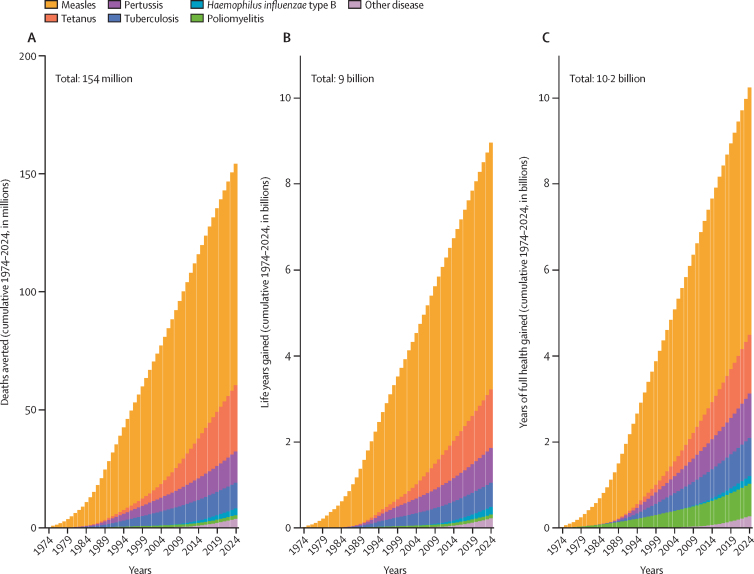
- Vaccination averted 154 million deaths, including 146 million in children younger than 5 years and 101 million in infants younger than 1 year; 9·0 billion life-years and 10·2 billion years of full health were gained. For each death averted, an average of 58 years of life and 66 years of full health were gained.
- Measles vaccination accounted for 93·7 million lives saved (60·8%) of the 154·0 million total. Poliomyelitis vaccination averted 1% of deaths but accounted for 0·8 billion (7·8%) of the 10·2 billion years of full health gained.
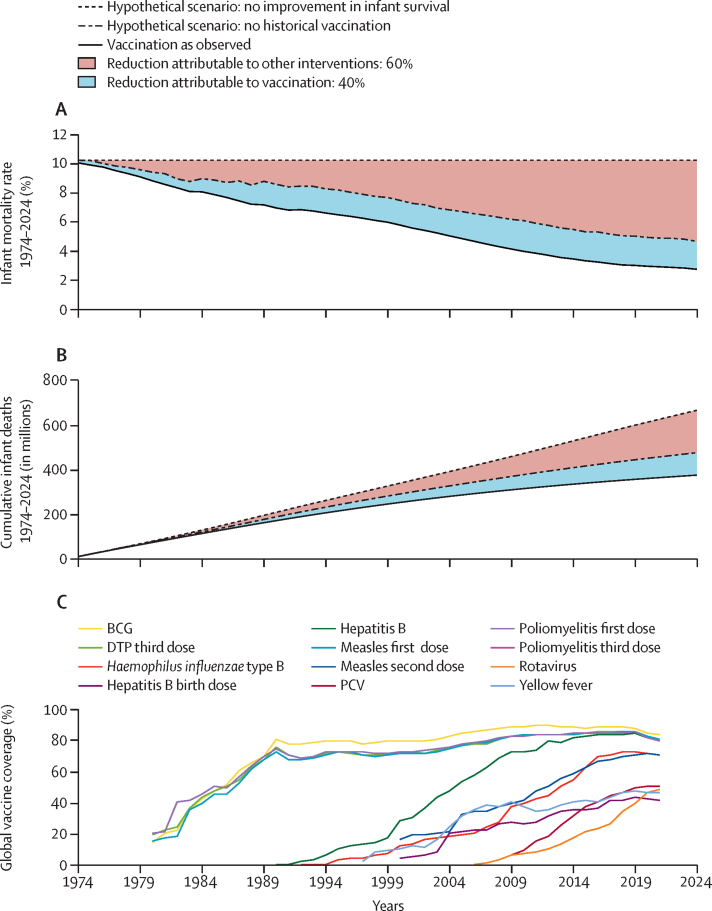
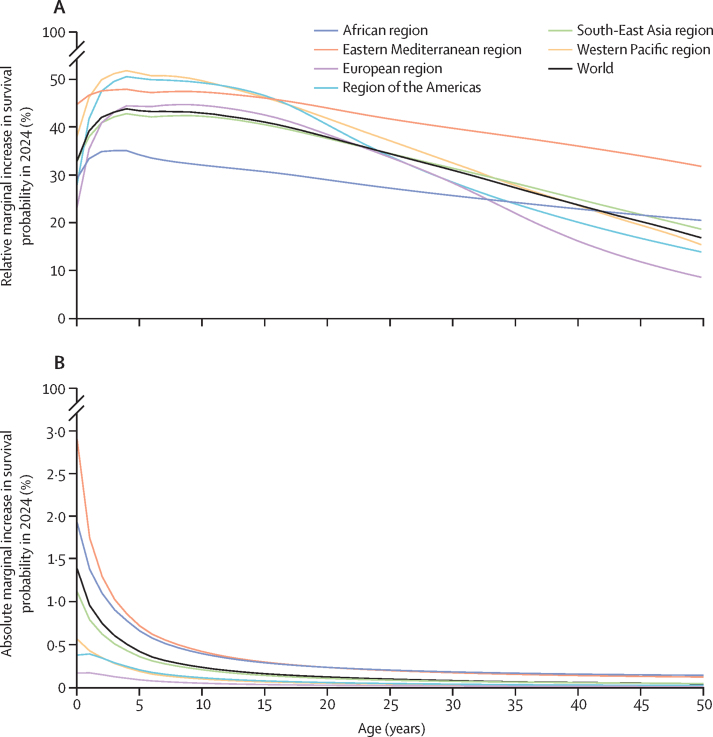
- Vaccination was estimated to be directly responsible for 40% of the global decline in infant mortality, varying from 21% in the Western Pacific region to 52% in the African region. In 2024, children aged 10 years were approximately 44% more likely to survive to their next birthday than with no historical vaccination; individuals aged 25 years were 35% more likely, and those aged 50 years were 16% more likely.
- Global coverage with a third dose of diphtheria–tetanus–pertussis vaccine increased from less than 5% in 1974 to 86% in 2019 before the COVID-19 pandemic, and was 84% at the time of the study.
Methods
- Modelling study estimating deaths averted, life-years gained, and years of full health gained from vaccination against 14 pathogens in 194 WHO member states between June 1, 1974, and May 31, 2024, through routine and supplementary immunisation activities, relative to a hypothetical scenario of no historical vaccination.
- The analysis synthesised results of 22 models using three modelling forms: dynamic transmission models for measles and poliomyelitis; extended Vaccine Impact Modelling Consortium transmission models for *H influenzae* type B, hepatitis B, Japanese encephalitis, invasive pneumococcal disease, rotavirus, and rubella; and upgraded static disease burden models for diphtheria, tetanus, pertussis, and tuberculosis. Age-specific coverage was drawn from WHO Immunization dashboard, WHO Supplementary Immunization Activities Database, WHO Polio Information System, and VIMC estimates; 24 vaccine activities were evaluated.
- Regression-based imputation and functional fitting with Markov chain Monte Carlo and Akaike Information Criterion model selection were used to extrapolate impact to countries and time periods without direct model estimates. Primary outcomes were deaths averted, years of life gained, years of full health gained, and the proportion of infant mortality reduction attributable to vaccination, with secondary evaluation by WHO region and World Bank income stratum.
Limitations
- The paper states that the calendar-year approach does not fully account for post-2024 lifetime vaccination impacts, implying a substantial underestimate for diseases such as hepatitis B; HPV was excluded because of incomparability of timeframe. The analysis also excludes vaccines against COVID-19, influenza, HPV, outbreak vaccines such as cholera or Ebola, vaccines targeting disease in adult life, and vaccines used largely in high-income settings such as varicella, herpes zoster, or mumps; the counterfactual assumed a smallpox-free world, so smallpox eradication benefits were not counted.
- The paper states that double counting is a limitation but estimates it would have only a small (0·01%) effect; findings are presented at global and regional resolution, limiting geographical conclusions; uncertainty propagation was not possible for all hierarchical models or inputs; and posterior credible intervals had arbitrarily predefined widths and should not be interpreted as bounds for final outcomes.
- The text makes evident further limitations: the authors describe the analysis as a minimum conservative estimate because it excludes possible heterologous or non-specific vaccine effects, downstream effects on non-communicable disease mortality, and broader economic or community development gains. The text also contains an internal numerical inconsistency, reporting 10·2 billion years of full health in the abstract and results but referring later to 10·8 billion healthy life-years gained.
Model-written summary. Check it against the paper before relying on it.
Integrity signals
Registry
Cites
Statistics
Figures
Verification
Claims the paper makes
2 Valid · 2 Not valid · 8 Not checked · 77 Own results and interpretations
The sources with a verdict support this claim; the rest weren’t checked yet, have no full text we could read, or their verdicts aren’t rated yet.
In the paper
“Measles vaccination has been the single greatest contributor and is likely to remain so.18, 23”
§ Contribution of vaccination to improved survival and health: modelling 50 years of the Expanded Programme on Immunization > Discussion
What the sources say
- Supportedcites [18] Toor J Echeverria-Londono S Li X Lives saved with vaccination for 10 pathogens across 12 countries in a pre-COVID-19 world eLife 10 2021 10 PMC8277373 34253291 source
The Results (Impact by year of vaccination; page not provided) identify measles as having the largest estimated impact on deaths averted among the ten pathogens over 2000–2030. The Discussion says that, under the default forecast through 2030, measles is predicted to produce the greatest reduction in deaths. The prediction is conditional on that forecast, not an indefinite projection. (LLM, conf=0.90)
- Not checked — no full text of the sourcecites [23] Carter A Msemburi W Sim SY Modeling the impact of vaccination for the Immunization Agenda 2030: deaths averted due to vaccination against 14 pathogens in 194 countries from 2021 to 2030 Vaccine 2023 published online Aug 1. 10.1016/j.vaccine.2023.07.033 37537094 source
hedgedstates a cause- Asserted: passes — The authors put it forward as true.
- Checkable: passes — It can be checked against evidence.
- Load-bearing: passes — The paper’s conclusions depend on it.
- Based: passes — The paper gives a reason why it holds.
- Supported
A result the paper reports from its own data — it cites no other source for it, so there is none to check. The quote shows it is in the paper.
In the paper
“Since 1974, vaccination has averted 154 million deaths,”
- Also stated in: § Findings · plain
“Since 1974, vaccination has averted 154 million deaths, including 146 million among children younger than 5 years of whom 101 million were infants younger than 1 year.”
§ Contribution of vaccination to improved survival and health: modelling 50 years of the Expanded Programme on Immunization > Abstract > Findings
plainstates a cause- Asserted: passes — The authors put it forward as true.
- Checkable: passes — It can be checked against evidence.
- Load-bearing: passes — The paper’s conclusions depend on it.
- Based: passes — The paper gives a reason why it holds.
- Rests on an assumption not shown here.
- Also stated in: § Findings · plain
A result the paper reports from its own data — it cites no other source for it, so there is none to check. The quote shows it is in the paper.
In the paper
“Since 1974, vaccination has averted 154 million deaths, including 146 million among children younger than 5 years of whom 101 million were infants younger than 1 year.”
§ Contribution of vaccination to improved survival and health: modelling 50 years of the Expanded Programme on Immunization > Abstract > Findings
plainstates a causen = 146- Asserted: passes — The authors put it forward as true.
- Checkable: passes — It can be checked against evidence.
- Load-bearing: passes — The paper’s conclusions depend on it.
- Based: passes — The paper gives a reason why it holds.
- Rests on an assumption not shown here.
A result the paper reports from its own data — it cites no other source for it, so there is none to check. The quote shows it is in the paper.
In the paper
“For every death averted, 66 years of full health were gained on average, translating to 10·2 billion years of full health gained.”
§ Contribution of vaccination to improved survival and health: modelling 50 years of the Expanded Programme on Immunization > Abstract > Findings
plainstates a cause- Asserted: passes — The authors put it forward as true.
- Checkable: passes — It can be checked against evidence.
- Load-bearing: passes — The paper’s conclusions depend on it.
- Based: passes — The paper gives a reason why it holds.
- Rests on an assumption not shown here.
A result the paper reports from its own data — it cites no other source for it, so there is none to check. The quote shows it is in the paper.
In the paper
“We estimate that vaccination has accounted for 40% of the observed decline in global infant mortality, 52% in the African region.”
§ Contribution of vaccination to improved survival and health: modelling 50 years of the Expanded Programme on Immunization > Abstract > Findings
hedgedstates a cause- Asserted: passes — The authors put it forward as true.
- Checkable: passes — It can be checked against evidence.
- Load-bearing: passes — The paper’s conclusions depend on it.
- Based: passes — The paper gives a reason why it holds.
- Rests on an assumption not shown here.
48 more claims
Create a free account to see all 89 claims and every source verdict.
- Probably not a substantial claim. 23
- It may state two separate claims as one. 20
Claims other papers make about this one
Each is checked against this paper’s own text: does it say what the citing paper says it does?
The cited source says what the claim attributes to it.
In the citing paper
“For example, the Expanded Programme on Immunization (EPI) marks its 50th anniversary in 2024 and a retrospective assessment of impact estimated that 40% of the post-1974 decline in infant mortality resulted from the EPI.81”
From Global health 2050: the path to halving premature death by mid-century (2024) · cites this paper as [81]
Self-check
Percentages, sums and reported differences re-computed from the paper’s own numbers.
Each contradiction between two passages listed here was confirmed by an independent check.
Rated minor: it would not touch a result — a value no result rests on, a p-value that stays on the same side of the significance level, or a conflict that is clerical, resolved elsewhere in the paper, or outside its own findings.
In the paper
§ Contribution of vaccination to improved survival and health: modelling 50 years of the Expanded Programme on Immunization > Results
“with 0·8 billion (7·8%) of the 10·2 billion years of full health gained attributable to poliomyelitis cases averted.”
§ Contribution of vaccination to improved survival and health: modelling 50 years of the Expanded Programme on Immunization > Discussion
“Vaccination against poliomyelitis has had a modest impact on mortality, averting 1% of deaths, but has led to substantial public health gains by reducing poliomyelitis-induced paralysis, accounting for 8% of the 10·8 billion healthy life-years gained.”
Rated minor: it would not touch a result — a value no result rests on, a p-value that stays on the same side of the significance level, or a conflict that is clerical, resolved elsewhere in the paper, or outside its own findings.
In the paper
§ Contribution of vaccination to improved survival and health: modelling 50 years of the Expanded Programme on Immunization > Discussion
“accounting for 8% of the 10·8 billion healthy life-years gained.”
§ Contribution of vaccination to improved survival and health: modelling 50 years of the Expanded Programme on Immunization > Discussion
“10·2 billion healthy years of life have been gained due to vaccination.”
Citations
Cites
Brisson, M., Kim, J. J., Canfell, K., Drolet, M., Gingras, G., Burger, E. A., Martin, D., Simms, K. T., Bénard, É., Boily, M.-C., et al. (2020) · The Lancet · doi:10.1016/s0140-6736(20)30068-4 · Cited by 1,138 · cited 1×
“18,23,32 This imperative is highly dependent on achieving post-COVID-19 pandemic recovery and restoration of the trajectory to Immunization Agenda 2030 targets; achieving and maintaining universally high coverage with measles-containing vaccines (a principle aim of the Big Catch-up initiative;…”
BackgroundSelf-citationImmunization agenda 2030: A global strategy to leave no one behind
(2024) · Vaccine · doi:10.1016/j.vaccine.2022.11.042 · Cited by 372 · cited 2×
“26,27 Measles outbreaks are a tracer for vaccine programme performance under the Immunization Agenda 2030 (panel).”
The broader economic impact of vaccination: reviewing and appraising the strength of evidence
Jit, M., Hutubessy, R., Png, M. E., Sundaram, N., Audimulam, J., Salim, S., & Yoong, J. (2015) · BMC Medicine · doi:10.1186/s12916-015-0446-9 · Cited by 153 · cited 1×
“30 We also did not include possible heterologous effects of vaccines on epitopically non-specific immune training or other potential mechanisms.”
BackgroundSelf-citationCarter, A., Msemburi, W., Sim, S. Y., Gaythorpe, K. A. M., Lambach, P., Lindstrand, A., & Hutubessy, R. (2024) · Vaccine · doi:10.1016/j.vaccine.2023.07.033 · Cited by 121 · cited 4×
“18 Finally, published static disease burden models for diphtheria, tetanus, pertussis, and tuberculosis were upgraded (appendix pp 23–31).”
BackgroundMethodInfluentialSelf-citationVerguet, S., Johri, M., Morris, S. K., Gauvreau, C. L., Jha, P., & Jit, M. (2014) · Vaccine · doi:10.1016/j.vaccine.2014.11.050 · Cited by 106 · cited 1×
“20,21 For poliomyelitis we ran novel simulations of an existing dynamic model.”
MethodSelf-citationLives saved with vaccination for 10 pathogens across 112 countries in a pre-COVID-19 world
Toor, J., Echeverria-Londono, S., Li, X., Abbas, K., Carter, E. D., Clapham, H. E., Clark, A., de Villiers, M. J., Eilertson, K., Ferrari, M., et al. (2021) · eLife · doi:10.7554/elife.67635 · Cited by 97 · cited 4×
“18 Finally, published static disease burden models for diphtheria, tetanus, pertussis, and tuberculosis were upgraded (appendix pp 23–31).”
BackgroundMethodInfluentialSelf-citationClark, R. A., Mukandavire, C., Portnoy, A., Weerasuriya, C. K., Deol, A., Scarponi, D., Iskauskas, A., Bakker, R., Quaife, M., Malhotra, S., et al. (2023) · The Lancet Global Health · doi:10.1016/s2214-109x(23)00045-1 · Cited by 63
Self-citationHow can the public health impact of vaccination be estimated?
Echeverría-Londoño, S., Li, X., Toor, J., de Villiers, M. J., Nayagam, S., Hallett, T. B., Abbas, K., Jit, M., Klepac, P., Jean, K., et al. (2021) · BMC Public Health · doi:10.1186/s12889-021-12040-9 · Cited by 36 · cited 2×
“18 Finally, published static disease burden models for diphtheria, tetanus, pertussis, and tuberculosis were upgraded (appendix pp 23–31).”
BackgroundSelf-citationPolio by the Numbers—A Global Perspective
Badizadegan, K., Kalkowska, D. A., & Thompson, K. M. (2022) · The Journal of Infectious Diseases · doi:10.1093/infdis/jiac130 · Cited by 35 · cited 1×
“22 Second, we extended a suite of VIMC transmission models for H influenzae type B, hepatitis B, Japanese encephalitis, invasive pneumococcal disease, rotavirus, and rubella, which estimated vaccine impact for 110 countries (fewer for meningitis A and yellow fever) from 2000 to 2024, by…”
MethodSelf-citationEilertson, K. E., Fricks, J., & Ferrari, M. J. (2019) · Statistics in Medicine · doi:10.1002/sim.8290 · Cited by 32 · cited 2×
“20,21 For poliomyelitis we ran novel simulations of an existing dynamic model.”
MethodSelf-citation
Research works printed but not linked: 2
- O'Brien K From the expanded to the essential programme on immunization: achievements of the last 50 years and inspirations for the next 50. IVB Director's Report to SAGE 2024 World Health Organization Geneva
- Institute of Medicine The Children's Vaccine Initiative: achieving the vision 1993 The National Academies Press Washington, DC 25144104
Cited by
Items 401–500 of 631
The Calculus of Confidence: Modelling Vaccine Hesitancy and Strategies for SupportPreprint
Gill, E. E., Winsor, G. L., Jia, B., Cook, J., Lotoski, L. C., Medeleanu, M., Ruggiero, E. D., Cameron, E. E., Langois, M.-A., Moraes, T. J., et al. (2025) · medRxiv · doi:10.64898/2025.12.21.25342784
Regional progress and persistent gaps: toward measles elimination in Asia and the Pacific
Ylade, M. C., Kennedy, R. B., & Crawford, N. W. (2025) · Vaccine X · doi:10.1016/j.jvacx.2025.100772
mRNA-based vaccines: Rational antigen design, delivery optimization, and immune modulation
Liu, S., Shi, H., Dai, D., Tian, T., Duan, X., Sun, J., Xu, W., Yin, X., Xie, Y., & Song, X. (2025) · Chinese Chemical Letters · doi:10.1016/j.cclet.2025.112312
Maness, S. B., Richman, A. R., Schwartz, A., & Sanchez, L. (2025) · Vaccines · doi:10.3390/vaccines14010021 · Cited by 2
Song, H., Zhang, Y., & Long, Q. (2025) · Vaccines · doi:10.3390/vaccines14010048
“Given that measles vaccination accounts for roughly 60% of all children’s lives saved through routine immunization [35], prioritizing improvements in measles coverage is of public health importance.”
Managing Vaccine Hesitancy Among Adults and Elderly People
Lopalco, P. L., Nuccetelli, F., & Gabellone, V. (2026) · Springer eBooks · doi:10.1007/978-3-032-09163-5_5
Shehu, A., Metiboba, L., Ohiaeri, N., et al. (2026) · doi:10.12688/verixiv.2605.1
Vaccine delay in routine childhood vaccines in the post-COVID-19 era in Jiangning, Nanjing, China
Guo, D., Dai, J., & Zhang, T. (2026) · Preventive Medicine Reports · doi:10.1016/j.pmedr.2025.103368
Dark Clouds Gather Over a Golden Age of Public Health
Binns, C. W., & Low, P. D. W. Y. (2026) · Asia Pacific Journal of Public Health · doi:10.1177/10105395251413378
Challenges to the Protection of the Child’s Right to Health
Žiobienė, E. (2025) · European Union and its neighbours in a globalized world · doi:10.1007/978-3-032-07092-0_20
Hobbs, M., Marek, L., Wiki, J., Paynter, J., Nghiem, N., Liu, B. O.-B. Z., & McIntyre, P. (2026) · Vaccine · doi:10.1016/j.vaccine.2025.128165
Sample Size Parameters for Vaccination Coverage Cluster Surveys—Insights from Pakistan
Rhoda, D. A., Soofi, S. B., Hussain, I., Clary, C. B., Yu, M., Khanyile, S., Brustrom, J. E., Robinson, B., Trimner, M. K., Umer, M., et al. (2025) · Journal of Survey Statistics and Methodology · doi:10.1093/jssam/smaf033
Nambiar, D., Hosseinpoor, A. R., Bergen, N., et al. (2026) · Vaccines · doi:10.3390/vaccines14010083
Self-citationMontoya, V. R., Alarcon, A. Y. S., Castillo, S. P., et al. (2026) · medRxiv · doi:10.64898/2025.12.31.25343235
Utazi, C. E., Megheib, M., Olowe, I., Chaudhuri, S., Tejedor‐Garavito, N., Mwinnyaa, G., Kawakatsu, Y., Boyda, D., Lorin, J., & Tatem, A. J. (2026) · medRxiv · doi:10.64898/2026.01.19.26344414 · Cited by 1
We Need to Continue to Care About Public Health
Michel, A. D. (2026) · The Journal of Perinatal & Neonatal Nursing · doi:10.1097/jpn.0000000000000967
Alem, K. J., Woya, A. A., Workie, D. L., et al. (2026) · Human Vaccines & Immunotherapeutics · doi:10.1080/21645515.2026.2613578
Adamu, A. A., Ndwandwe, D. E., Jalo, R. I., & Wiysonge, C. S. (2026) · Discover Public Health · doi:10.1186/s12982-026-01427-x · Cited by 1
“…past two decades, newer and more sophisticated vaccines have been added to the Expanded Program on Immunization (now referred to as the Essential Program on immunization), broadening the tools available to countries to protect children and adolescents against vaccine-preventable diseases (VPD) [1].”
Prosser, W., Akhlaghi, L. A., Sipaneque, S., & Rodrigues, T. (2026) · Vaccines · doi:10.3390/vaccines14020118 · Cited by 1
Harmonizing Case Validation for Vaccine Safety in Real-World Data: The VAC4EU Experience
Tarazjani, A. D., Weibel, D. M., Aurelius, T., et al. (2026) · Clinical Epidemiology · doi:10.2147/clep.s558974
Coulibaly, A., & Ridde, V. (2025) · Research Square · doi:10.21203/rs.3.rs-8454940/v1
Cheliotis, K. S., Gonzalez‐Dias, P., German, E. L., Gonçalves, A. N. A., Mitsi, E., Nikolaou, E., Pojar, S., Miyaji, E. N., Tostes, R., Reiné, J., et al. (2026) · Vaccine · doi:10.1016/j.vaccine.2026.128280 · Cited by 1
Cobertura vacinal infantil no Brasil e o impacto da pandemia de COVID-19: Uma revisão integrativa
Ferreira, L. D. P., Gianetti, D. M., Assis, B. H. D. S., et al. (2026) · Research Society and Development · doi:10.33448/rsd-v15i2.50571
Addressing the anti-vaccination threat to public health
Lee, A. C., & Taylor, M. (2026) · Public Health · doi:10.1016/j.puhe.2026.106160
Content and Factors Influencing Health Education in Immunisation Clinics in Nigeria
Ekhaguere, O. A., Ekpenyong, N., Mohammed, E., Bukar, F. L., Oyo-Ita, A., & Kaufman, J. (2026) · Tropical Medicine & International Health · doi:10.1111/tmi.70101 · Cited by 2
Economic evaluation of national immunization program vaccines in China: a systematic review
Sun, J., Jin, X., Li, H., Zhou, L., Cheng, L. J., Li, R., Shi, J., Cao, Y., Li, J., Cai, X., et al. (2026) · Health Economics Review · doi:10.1186/s13561-026-00745-9
ERS Congress 2025: highlights from the Respiratory Infections Assembly
Papadopoulou, E., Matthaiou, A. Μ., Stadler, S. V., Konstantynovych, T. V., Akkerman, O. W., Duarte, R., & Premuda, C. (2026) · ERJ Open Research · doi:10.1183/23120541.01701-2025
Zuckerman, M. K., Watkins, D., White, M., Chambers, M., Pilkinton, H., & Rounds, L. (2026) · Annals of Human Biology · doi:10.1080/03014460.2025.2577351
Vaccinationism in the modern era: The fight against the new “unorthodoxy”
Rees, A. R. (2026) · Elsevier eBooks · doi:10.1016/b978-0-443-43876-9.00014-4
Adverse events following vaccination in northern Iran
Mollamohammadi-Omran, S., Nikbakht, H., Sedighi, S., et al. (2026) · Discover Public Health · doi:10.1186/s12982-026-01539-4
“Since 1974, when the Expanded Programme on Immunization (EPI) was launched by the World Health Organization (WHO), vaccination has averted 154 million deaths, worldwide [2].”
Adamu, A. A., Rey, L., Bekele, A. T., Masresha, B., & Wiysonge, C. S. (2026) · BMJ Public Health · doi:10.1136/bmjph-2025-004484 · Cited by 1
Hudu, S. A., & Jimoh, A. A. (2026) · Clinical and Experimental Vaccine Research · doi:10.7774/cevr.2026.15.e11
“Vaccines against pathogens such as measles or polio have fundamentally altered disease landscapes, yet many regionally endemic pathogens still lack effective, scalable, or durable vaccine solutions [8].”
Special Issue: Novel Vaccines and Vaccine Technologies for Emerging Infections
Chen, W., Li, X., & Kamen, A. (2026) · Vaccines · doi:10.3390/vaccines14030206
Peeters, I., Dambre, C., Dupont, Y., et al. (2026) · Archives of Public Health · doi:10.1186/s13690-026-01864-9
“Since the introduction of vaccinations, the morbidity and mortality of different infectious diseases have been importantly reduced and worldwide at least 154 million lives have been saved over the past 50 years [1, 2].”
Making US public health a good idea again
Timpka, T., Gursky, E. A., & Nyce, J. M. (2026) · The Lancet Regional Health - Americas · doi:10.1016/j.lana.2026.101423
Lukusa, J., Koba, T., Mutombo, A. B., et al. (2026) · Research Square · doi:10.21203/rs.3.rs-8693656/v1
Amaral, T. D. S., Souza, S. O., de Matos, M. A. D., Meireles, G. O. A. B., de Paula, C. R., & de Matos, M. A. (2026) · Revista da Escola de Enfermagem da USP · doi:10.1590/1980-220x-reeusp-2025-0358es
Amaral, T. D. S., Souza, S. O., de Matos, M. A. D., Meireles, G. O. A. B., de Paula, C. R., & de Matos, M. A. (2026) · Revista da Escola de Enfermagem da USP · doi:10.1590/1980-220x-reeusp-2025-0358pt
Reed, T., Clarke, P., Arrieta, J. D. L. T., Razzaque, M. F., de Castro, A. G., Alexiev, R., Panainte, C., Khan, N. U., Grey, L., Matheson, M., et al. (2026) · medRxiv · doi:10.64898/2026.03.09.26347956
Timing of the fourth dose of RTS,S/AS01 malaria vaccine in perennial settings: a modelling study
Figueroa‐Downing, D., Kelly, S. L., Cavelan, A., Penny, M. A., & Malinga, J. (2026) · Malaria Journal · doi:10.1186/s12936-026-05848-6
“Since its launch in 1974, vaccination through the Expanded Programme on Immunization (EPI) has helped avert an estimated 146 million deaths in children under 5 years old due to vaccine-preventable diseases, accounting for around 52% of the decline in infant mortality across the African region [2].”
White, J., Wilson, B., Clark, K. K., King, C. L., Alderman, K. B., Kaufman, J., Mohamed, Y., Danchin, M. H., & Dürrheim, D. N. (2026) · Journal of Health Equity · doi:10.1080/29944694.2026.2631478
Bijukchhe, S. M., Marchevsky, N. G., Kibengo, F., et al. (2026) · The Lancet Infectious Diseases · doi:10.1016/s1473-3099(26)00053-8
Harmonizing sanitary inspections in vaccination services: Towards safer immunization practice
Nogueira, C. C. C., da Veiga, C. R. P., Veiga, C. P. D., da Silva, D. M., Guimarães, E. A. D. A., & de Miranda, W. D. (2026) · Health Policy and Technology · doi:10.1016/j.hlpt.2026.101201
Renzetti, M., & Losier, A. (2026) · Clinics in Chest Medicine · doi:10.1016/j.ccm.2025.12.019
Can vaccine-preventable disease resurgence be anticipated? Leading indicators and tipping points
Drake, J. M., Rohani, P., & Winter, A. K. (2026) · Future Microbiology · doi:10.1080/17460913.2026.2645506 · Cited by 1
Ooi, J. S. G., Hamis, N. Z., Tan, H. C., Yee, J. X., Chew, V. S. Y., Lim, J. M. E., Ong, E. Z., Chan, K. R., Rivino, L., Low, J. G. H., et al. (2026) · Vaccine · doi:10.1016/j.vaccine.2026.128510 · Cited by 1
Spatial and temporal trends of measles and measles vaccination status in Ethiopia, 2015–2024
Yitbarek, K., Sheel, M., Woldie, M. K., et al. (2026) · Vaccine · doi:10.1016/j.vaccine.2026.128524
Hooper, M., Joseph, J., Davis, D. L., Blackburn, J., Al-Ghareeb, A. Z., Hampton, K., Atchan, M., Knight-Agarwal, C. R., Frank, G. D., Northam, H. L., et al. (2026) · Vaccine · doi:10.1016/j.vaccine.2026.128528 · Cited by 1
van de Burgwal, L., Pronker, E. S., & Herz, J. (2026) · Vaccine · doi:10.1016/j.vaccine.2026.128525
Cao, G., Liu, J., & Liu, M. (2026) · PLoS ONE · doi:10.1371/journal.pone.0343745 · Cited by 2
“…actions of the global health community to combat the main causes of child mortality with high-impact interventions, such as immunizations, access to nutrition and micronutrients, skilled attendants around birth and postnatal care, and expanded access to safe water, sanitation, and hygiene [25–29].”
Vaccine stock management in Africa: challenges, innovations, and future directions
Mazingisa, A. V., Iwu, C. D., Wiysonge, C. S., et al. (2025) · Pan African Medical Journal · doi:10.11604/pamj.supp.2025.51.1.49111
COVID-19 Vaccine Framing and Acceptance Among Adults Who Are Vaccine Hesitant
Krishnamurthy, P., & Hu, Y. (2026) · JAMA Network Open · doi:10.1001/jamanetworkopen.2026.4114
Vacunación, política sanitaria y el desafío de recuperar coberturas en Argentina
Yedlin, P. (2026) · Revista del Hospital Italiano de Buenos Aires · doi:10.51987/rev.hosp.ital.b.aires.v46i1.1323
Barbieri, M. A., Cicala, G., Molonia, A., Alibrandi, A., Pallio, G., Fauci, E. L., Ingrassia, M., Irrera, N., & Benedetto, L. (2026) · Pharmaceutical Research · doi:10.1007/s11095-026-04072-w · Cited by 3
“…inception in 1974, WHO Expanded Programme on Immunization (EPI) has greatly reduced childhood mortality worldwide over the past five decades and now covers vaccines against 13 core vaccine-preventable diseases, as well as more than 17 additional diseases of regional or contextual importance [4].”
Quilty, B. J., & Dadari, I. (2026) · International Journal of Infectious Diseases · doi:10.1016/j.ijid.2026.108676
Recent Developments in United States Vaccine Policy
Bhatt, S., & Smith, K. (2026) · Delaware Journal of Public Health · doi:10.32481/djph.2026.03.16
ОЦІНКА ВПЛИВУ СОЦІАЛЬНИХ ТА ІНФОРМАЦІЙНИХ ЧИННИКІВ НА СТАВЛЕННЯ БАТЬКІВ ДО ВАКЦИНАЦІЇ ДІТЕЙ
ЛОТОЦЬКА, О. В., & ЧМІЛЬ, Л. В. (2026) · Вісник соціальної гігієни та організації охорони здоров я України · doi:10.11603/1681-2786.2026.1.16081
Cai, P., He, X., Xiao, K., Li, J. N., Liu, Y. J., Zhang, Y., Zhou, H., Tang, R., Xu, X., & Xu, J. (2026) · BMC Public Health · doi:10.1186/s12889-026-27239-x
“While implementation of diphtheria-tetanus-pertussis (DTP) immunisation has dramatically reduced global mortality [3, 4], resurgence has been observed over the past decade in both high-income and low-and middle-income settings [5–8].”
Terhune, T. D., Ghafourian, T., Eshraghi, R. S., Eshraghi, A. A., & Deth, R. C. (2026) · Molecular Neurobiology · doi:10.1007/s12035-026-05842-8
“While this approach has proved safe and effective for a large majority of individuals and has prevented millions of severe illnesses and deaths [1], both beneficial and adverse consequences of immune activation are not shared equally among different subpopulations.”
Zhu, C., Frivold, C., Jarrahian, C., et al. (2026) · doi:10.12688/verixiv.3064.1
Mekbib, M. S., Muchiri, J., Thuo, E., Gichuki, J., Limo, S., Ogolla, D., Inoti, D., & Kimani, D. (2026) · Journal of Interventional Epidemiology and Public Health · doi:10.37432/jieph-d-25-00269 · Cited by 2
Olson, N. L., Mitchell, P. G., Armon, C., et al. (2026) · Vaccine · doi:10.1016/j.vaccine.2026.128585
Pinheiro, P. Y. M., Vianna, R. A. D. O., Ferreira, L. D. C., de Matos, J. P. S., McBenedict, B., de Oliveira, S. A., & Martins, E. B. (2026) · Acta Tropica · doi:10.1016/j.actatropica.2026.108093
How to cut child mortality in half again: making primary healthcare work
Carai, S., & Jullien, S. (2026) · Journal of Global Health · doi:10.7189/jogh.16.03010
“Over the past three decades, substantial progress has been made in reducing global child mortality, in large part thanks to services delivered at the PHC level [7,8].”
Marcau, F., Peptan, C., Alecsoiu, O.-R., Cojoaca, M. E., Musetescu, A. M., Căruntu, G. A., Holt, A. G., Popescu, L. D., Sfinteș, C., & Gheorman, V. (2026) · Behavioral Sciences · doi:10.3390/bs16040595
Badarou, S., Attah, K. M., Gounon, K. H., Dali, A. S., Sire, X. R., & Dia, E. C. (2026) · medRxiv · doi:10.64898/2026.04.19.26350799
Kidie, D. M., Gessesse, A. D., Derse, T. K., Lidetu, T., Asgai, A. S., & Kelkay, J. M. (2026) · medRxiv · doi:10.64898/2026.04.18.26351159
Vaccination and transfusion safety at the time of expanding use of live attenuated vaccines
Tiberghien, P., Gallian, P., Taille, V. D. L., et al. (2026) · Vox Sanguinis · doi:10.1111/vox.70272
Sansone, V., Angelillo, S., Pelullo, C. P., et al. (2026) · Vaccines · doi:10.3390/vaccines14050368
“With more than 150 million deaths averted worldwide, it is estimated that immunization provided one of the greatest contributions to public health over the past 50 years [1,2].”
The immune response to childhood vaccines is seasonalPreprint
Guevara, L. A. B., Feghali, G., Krämer, S., & de Cellès, M. D. (2026) · Research Square · doi:10.64898/2026.04.23.26351620
Vaccination strategies for responding to public health emergencies of infectious diseases
Wang, Y., Cui, F., & Lu, Q. (2026) · Vaccine · doi:10.1016/j.vaccine.2026.128642 · Cited by 1
Lee, J. (2026) · Osong Public Health and Research Perspectives · doi:10.24171/j.phrp.2026.0357
Puzhankara, L., Kedlaya, M. N., Karuveettil, V., Suresh, R., Ramanarayanan, V., Nayak, N., & Peter, M. R. (2026) · Journal of International Society of Preventive and Community Dentistry · doi:10.4103/jispcd.jispcd_170_25
“[24,25] f ears regarDIng VaccIne aDmInIstratIOn Despite favorable views, participants expressed fears surrounding vaccination.”
Amin, M., Zhang, X., Green, M. A., Holford, D. L., Hemingway, C., Ismail, A., Essale, N., Doyle, V., Taegtmeyer, M., & Hungerford, D. (2026) · medRxiv · doi:10.64898/2026.05.01.26352232
Pajoohian, P. F., Pind, A. A. A., Estupiñan, J. L. M., Christensen, D., Pedersen, G. K., Olafsdottir, T. A., Jónsdóttir, I., & Bjarnarson, S. P. (2026) · Frontiers in Immunology · doi:10.3389/fimmu.2026.1792155
Impact of standing orders on vaccine uptake: A systematic review
Ellingson, M. K., Sudarsanam, V., Goddard, K., et al. (2026) · Vaccine · doi:10.1016/j.vaccine.2026.128664
“Vaccination is one of the most significant public health achievements of the last century, preventing millions of deaths each year [1].”
Proteomic Applications in Vaccine Development
Veenstra, T. D. (2026) · Advances in experimental medicine and biology · doi:10.1007/978-3-032-22340-1_10
Rey, R., L’Huillier, A. G., & Pittet, L. F. (2026) · European Journal of Pediatrics · doi:10.1007/s00431-026-07067-2 · Cited by 1
“It has successfully prevented 146 million deaths among children younger than 5 years [2].”
Bekele, A. T., Dadjo, C. H., Manga, P. E. M., et al. (2026) · BMJ Public Health · doi:10.1136/bmjph-2025-004798
Widdershoven, V., Reijs, R. P., Claessen, V. P. J., Pijls, K. E., Verhaegh-Haasnoot, A., ten Hoor, G. A., Ruiter, R. A. C., Bijker, E. M., & Hoebe, C. J. P. A. (2026) · Vaccine X · doi:10.1016/j.jvacx.2026.100833
Fishbein, D., Aung, H. T., Ong, R., Nyein, A., Kyaw, Z. L., Karenni, E., Jie, J., Maw, K., Khant, K., Poe, A., et al. (2026) · medRxiv · doi:10.64898/2026.05.15.26352743
Vaccine Demand: Theory and Evidence on Psychological and Social Drivers
Ferris, L. J., & Hornsey, M. J. (2026) · Springer eBooks · doi:10.1007/978-981-95-8349-2_9
Montoya, V. R., Alarcon, A. Y. S., Castillo, S. P., Raez, T. Z., & Quispe, A. M. (2026) · PLoS ONE · doi:10.1371/journal.pone.0340756 · Cited by 1
“After adjusting for income level, the association weakened, which is consistent with prior modeling studies that showed the contribution of vaccination to reduce child mortality, while also emphasizing that its impact operates within broader social and economic contexts [1,4,8].”
Malhotra, G., Bilguche, A., Eades, O., et al. (2026) · Vaccine · doi:10.1016/j.vaccine.2026.128735
Assembling a New Vaccine Ecosystem: Rethinking Responsibility and Vaccine Security After the Crisis
Shahare, M. (2026) · Springer eBooks · doi:10.1007/978-981-95-8349-2_7
Dhalaria, P., Kumar, P., Kapur, S., et al. (2026) · medRxiv · doi:10.64898/2026.05.14.26353222
Heterogeneous returns to antenatal care: Evidence from childhood immunization in Senegal
KOLANI, T. (2026) · Economics & Human Biology · doi:10.1016/j.ehb.2026.101608
Khan, A., & Tidman, M. M. (2026) · Cureus · doi:10.7759/cureus.109407
“Vaccines are vital catalysts for public health transformation and improvements in population well-being, helping to limit the spread of diseases such as measles, polio, and hepatitis, which may result in mortality and morbidity [9].”
Preserving the future of vaccine science in the USA
Simonich, C. A. L., Ewen, I. D., & Permar, S. R. (2026) · Nature Microbiology · doi:10.1038/s41564-026-02358-8
Medeleanu, M., Gill, E. E., Winsor, G. L., Azeez, R., Lotoski, L. C., Goguen, S., Humble, R. M., McNeil, D. A., Patrick, D. M., Bolotin, S., et al. (2026) · BMC Public Health · doi:10.1186/s12889-026-27115-8
“Prior to the pandemic, global immunization efforts had averted approximately 154 million deaths over the past half-century [41].”
Bahrulolum, H., Tabatabaei, S. N., Beyranvand, P., et al. (2026) · Springer eBooks · doi:10.1007/978-981-92-0038-2_2
Habib, M. A., Hughes, T., Huang, L., Deseda, C., Zavadska, D., Povey, M., Raja, R., Demoitié, M., Kondagunta, V. H., MMRVNS 20-001 study group, et al. (2026) · Human Vaccines & Immunotherapeutics · doi:10.1080/21645515.2026.2660525 · Cited by 1
“15 By 2025, nationwide immunization programs have been introduced in 191 countries for measles, 124 countries for mumps, and 178 countries for rubella, 48 while 45 countries worldwide have implemented varicella vaccination.”
Understanding Streptococcus Pneumoniae: Implications for vaccines, treatments, and future directions
Jana, S. K., Sharma, D., Sharma, S. R. K., & Sharma, S. R. K. (2026) · The Microbe · doi:10.1016/j.microb.2026.100745
Vaccination policies and the ethics of risking: A scoping review of the bioethics literature
Pahlman, K., & Silva, D. S. (2026) · Bioethics News · doi:10.1007/s40592-026-00289-y · Cited by 1
Cantwell, E., Hurley, F., Butler, M., & Flanagan, P. C. (2026) · HRB Open Research · doi:10.12688/hrbopenres.14374.1
Reconciling the Use of Human Fetal Tissue in Research
Sarnat, H. B., Graf, W. D., Scher, M. S., Pearl, P. L., & Flores‐Sarnat, L. (2026) · Annals of the Child Neurology Society · doi:10.1002/cns3.70075
“…from the lung tissue of a legally aborted fetus in Sweden in 1962, have been used to develop and test lifesaving antiviral vaccines, including those that protect against polio, measles, rubella, rabies, hepatitis A, varicella, shingles, and COVID‐19—all without containing fetal cells [4, 5].”
Chaudhary, N., Coleman, H., Paolone, E. V., Yu, J., Ledbetter, A., Lemnios, A. A., Walsh, A. A., Suh, H., Wang, A., Mansoor, M. M., et al. (2026) · bioRxiv (Cold Spring Harbor Laboratory) · doi:10.64898/2026.05.29.728600
Shehu, A., Metiboba, L., Ohiaeri, N., Ilesanmi, O., Akpan, D., Fashoto, B., Nwakaogor, G. U., Fawaz, A., Akhigbe, O., Odukoya, A., et al. (2026) · Gates Open Research · doi:10.12688/gatesopenres.16387.1
Magoola, J., Aksnes, B., Ampeire, I., Wibabara, Y., Sugerman, C. E., & Ward, K. (2026) · Vaccines · doi:10.3390/vaccines14060490 · Cited by 1
For every generation, vaccines must reach everyone: closing the access gap in WHO South-East Asia
Boehme, C. C. (2026) · The Lancet Regional Health - Southeast Asia · doi:10.1016/j.lansea.2026.100792
Metadata
- Authors
- Shattock, A. J., Johnson, H. C., Sim, S. Y., Carter, A., Lambach, P., Hutubessy, R. C. W., Thompson, K. M., Badizadegan, K., Lambert, B., Ferrari, M. J., Jit, M., Fu, H., Silal, S. P., Hounsell, R. A., White, R. G., Mosser, J. F., Gaythorpe, K. A. M., Trotter, C. L., Lindstrand, A., O'Brien, K. L., & Bar-Zeev, N.
- Affiliations
- Swiss Tropical and Public Health Institute (CH)
- University of Cambridge (GB)
- London School of Hygiene & Tropical Medicine (GB)
- University of Washington (US)
- Pennsylvania State University (US)
- University of Cape Town (ZA)
- ORCID
- Shattock, Andrew J
- Johnson, Helen C
- Sim, So Yoon
- Carter, Austin
- Lambach, Philipp
- Hutubessy, Raymond C W
- Thompson, Kimberly M
- Badizadegan, Kamran
- Lambert, Brian
- Ferrari, Matthew J
- Jit, Mark
- Fu, Han
- Silal, Sheetal P
- Hounsell, Rachel A
- White, Richard G
- Mosser, Jonathan F
- Gaythorpe, Katy A M
- Trotter, Caroline L
- Lindstrand, Ann
- Venue
- The Lancet
- Publisher
- Elsevier BV
- Published
- 2024-05
- Volume
- 403
- Issue
- 10441
- Pages
- 2307-2316
- ISSN
- 0099-5355 (ISSN-L)
- 0140-6736
- PMC
- PMC11140691
- OpenAlex
- W4396571207
- Cited by
- 655
- References
- 12
- Citations by year
- 2026: 324 · 2025: 268 · 2024: 63
- FWCI
- 295.47
- Type
- journal article
- Language
- en
- Open access
- hybrid
- doi.org
- Licence
- cc-by
- www.elsevier.com/tdm/userlicense/1.0/ (tdm)
- www.elsevier.com/legal/tdmrep-license (tdm)
- creativecommons.org/licenses/by/3.0/igo/ (vor)
- Locations
- The Lancet (publishedVersion, cc-by)
- PubMed Central (publishedVersion, cc-by)
- PubMed (publishedVersion)
- London School of Economics and Political Science Research Online (London School of Economics and Political Science) (acceptedVersion)
- London School of Economics and Political Science Theses Online (London School of Economics and Political Science) (acceptedVersion)
- LSHTM Research Online (London School of Hygiene and Tropical Medicine) (acceptedVersion)
- UWA Profiles and Research Repository (UWA) (submittedVersion, cc-by)
- Funders
- World Health Organization (201910)
- Bill and Melinda Gates Foundation (OPP1157270, INV-034218, INV-009125)
- Topics
- Social Sciences › Health › Vaccine Coverage and Hesitancy
- Health Sciences › Medicine › Pediatrics, Perinatology and Child Health › Global Maternal and Child Health
- Life Sciences › Immunology and Microbiology › Immunology › Immune responses and vaccinations
- Keywords
- Expanded Programme on Immunization, vaccine impact, mortality averted, child mortality decline, infant mortality, life-years gained, child survival, vaccination coverage, global health impact
- MeSH terms
- Adolescent, Adult, Child, Child, Preschool, Humans, Infant, Infant Mortality, Infant, Newborn, Middle Aged, Public Health, Vaccination, Global Health, Models, Statistical, Immunization Programs, Child Mortality, History, 20th Century, Young Adult
About these checks
Registry, retraction, Cites and statistics results are computed, not judged, with one exception: a printed reference that no index lists is read once by a model before it counts as a citation error. Claims are extracted by a model and kept only when their quote appears verbatim in the text; each cited source is then checked, with a model’s help, for whether it says what the claim relies on. Those verdicts can be wrong — read the claim’s quote and the cited source before relying on one.
The claim verdicts this report counts are experimental: their accuracy is not yet measured.
A language model drew the claims from the paper on 2026-09-28, under version 3 of the claim definition (model deepseek-v4.1-flash, prompt extract-v3).
A second model labelled each claim on 2026-09-28 (model jev-1.13-20260917, definition revision gold-guideline-v0.2).
Cited sources are checked with a language model’s help (gpt-6-sol).
Statistics and arithmetic are recomputed, not judged.
Confidence bands are shown only for fields calibrated on our annotated test set. None is calibrated yet, so no band is shown.
What counts as a claim ›How we measure confidence ›How we check this ›
Are you an author, or do you see a problem with this page? Request a review
Data sources
Bibliographic data: Semantic Scholar, OpenAlex, Crossref.
Contains information from the Semantic Scholar Academic Graph Datasets, made available under the ODC Attribution License (ODC-BY 1.0).
Semantic Scholar’s data is described in: Kinney, R., et al. (2023). The Semantic Scholar Open Data Platform. arXiv:2301.10140.
