

Contribution of vaccination to improved survival and health: modelling 50 years of the Expanded Programme on Immunization
Open accessThe DOI matches its Crossref record; 13 of the 14 references it cites were found in a registry or an index; 2 of the 14 sources its claims cite were checked for support.
Abstract
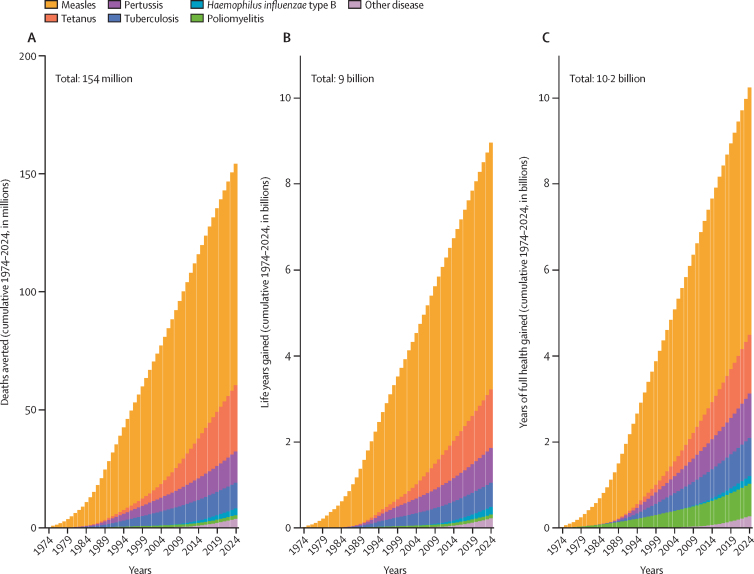
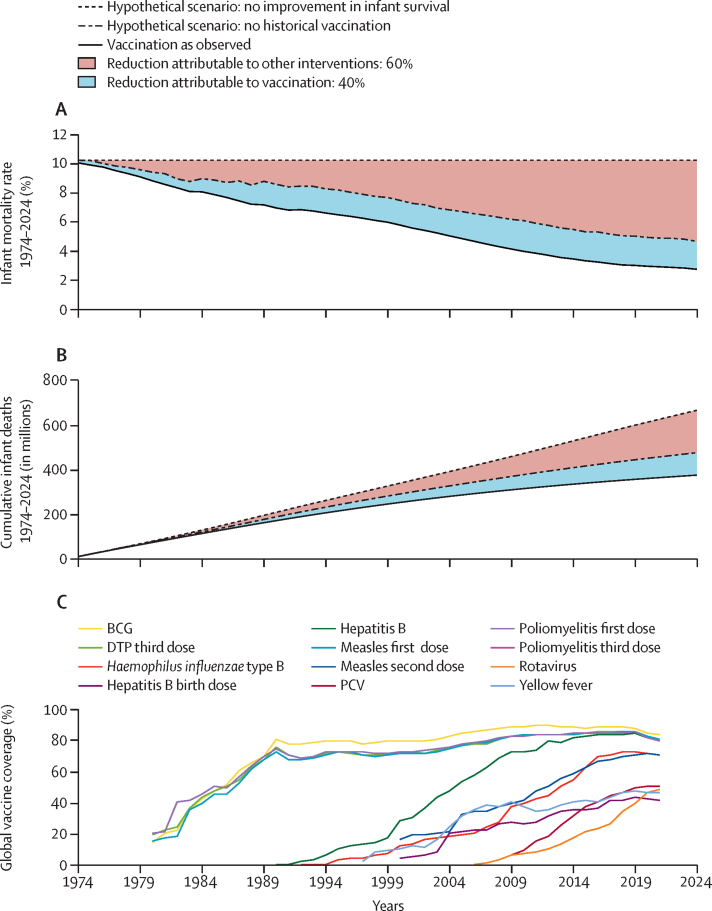
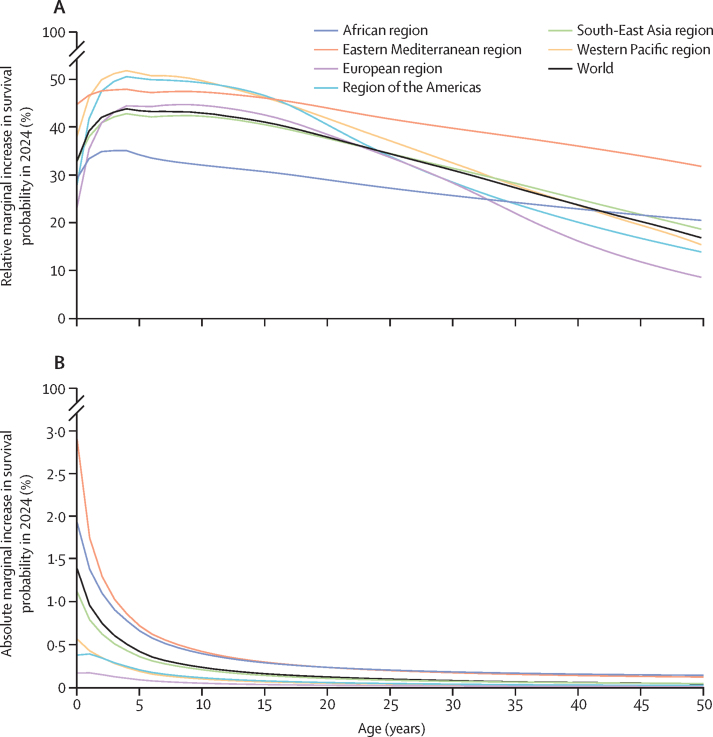
BACKGROUND: WHO, as requested by its member states, launched the Expanded Programme on Immunization (EPI) in 1974 to make life-saving vaccines available to all globally. To mark the 50-year anniversary of EPI, we sought to quantify the public health impact of vaccination globally since the programme's inception. METHODS: In this modelling study, we used a suite of mathematical and statistical models to estimate the global and regional public health impact of 50 years of vaccination against 14 pathogens in EPI. For the modelled pathogens, we considered coverage of all routine and supplementary vaccines delivered since 1974 and estimated the mortality and morbidity averted for each age cohort relative to a hypothetical scenario of no historical vaccination. We then used these modelled outcomes to estimate the contribution of vaccination to globally declining infant and child mortality rates over this period. FINDINGS: Since 1974, vaccination has averted 154 million deaths, including 146 million among children younger than 5 years of whom 101 million were infants younger than 1 year. For every death averted, 66 years of full health were gained on average, translating to 10·2 billion years of full health gained. We estimate that vaccination has accounted for 40% of the observed decline in global infant mortality, 52% in the African region. In 2024, a child younger than 10 years is 40% more likely to survive to their next birthday relative to a hypothetical scenario of no historical vaccination. Increased survival probability is observed even well into late adulthood. INTERPRETATION: Since 1974 substantial gains in childhood survival have occurred in every global region. We estimate that EPI has provided the single greatest contribution to improved infant survival over the past 50 years. In the context of strengthening primary health care, our results show that equitable universal access to immunisation remains crucial to sustain health gains and continue to save future lives from preventable infectious mortality. FUNDING: WHO.
Overview
CoChat Summary
TL;DR
Modelling 50 years of the WHO Expanded Programme on Immunization estimates that vaccination against 14 pathogens averted 154 million deaths from 1974 to 2024, including 146 million in children younger than 5 years, and gained 10·2 billion years of full health. Vaccination accounted for 40% of the global decline in infant mortality, with measles vaccination the single greatest contributor.
Key findings
- Vaccination averted 154 million deaths, including 146 million in children younger than 5 years and 101 million in infants younger than 1 year; 9·0 billion life-years and 10·2 billion years of full health were gained. For each death averted, an average of 58 years of life and 66 years of full health were gained.
- Measles vaccination accounted for 93·7 million lives saved (60·8%) of the 154·0 million total. Poliomyelitis vaccination averted 1% of deaths but accounted for 0·8 billion (7·8%) of the 10·2 billion years of full health gained.
- Vaccination was estimated to be directly responsible for 40% of the global decline in infant mortality, varying from 21% in the Western Pacific region to 52% in the African region. In 2024, children aged 10 years were approximately 44% more likely to survive to their next birthday than with no historical vaccination; individuals aged 25 years were 35% more likely, and those aged 50 years were 16% more likely.
- Global coverage with a third dose of diphtheria–tetanus–pertussis vaccine increased from less than 5% in 1974 to 86% in 2019 before the COVID-19 pandemic, and was 84% at the time of the study.
Methods
- Modelling study estimating deaths averted, life-years gained, and years of full health gained from vaccination against 14 pathogens in 194 WHO member states between June 1, 1974, and May 31, 2024, through routine and supplementary immunisation activities, relative to a hypothetical scenario of no historical vaccination.
- The analysis synthesised results of 22 models using three modelling forms: dynamic transmission models for measles and poliomyelitis; extended Vaccine Impact Modelling Consortium transmission models for *H influenzae* type B, hepatitis B, Japanese encephalitis, invasive pneumococcal disease, rotavirus, and rubella; and upgraded static disease burden models for diphtheria, tetanus, pertussis, and tuberculosis. Age-specific coverage was drawn from WHO Immunization dashboard, WHO Supplementary Immunization Activities Database, WHO Polio Information System, and VIMC estimates; 24 vaccine activities were evaluated.
- Regression-based imputation and functional fitting with Markov chain Monte Carlo and Akaike Information Criterion model selection were used to extrapolate impact to countries and time periods without direct model estimates. Primary outcomes were deaths averted, years of life gained, years of full health gained, and the proportion of infant mortality reduction attributable to vaccination, with secondary evaluation by WHO region and World Bank income stratum.
Limitations
- The paper states that the calendar-year approach does not fully account for post-2024 lifetime vaccination impacts, implying a substantial underestimate for diseases such as hepatitis B; HPV was excluded because of incomparability of timeframe. The analysis also excludes vaccines against COVID-19, influenza, HPV, outbreak vaccines such as cholera or Ebola, vaccines targeting disease in adult life, and vaccines used largely in high-income settings such as varicella, herpes zoster, or mumps; the counterfactual assumed a smallpox-free world, so smallpox eradication benefits were not counted.
- The paper states that double counting is a limitation but estimates it would have only a small (0·01%) effect; findings are presented at global and regional resolution, limiting geographical conclusions; uncertainty propagation was not possible for all hierarchical models or inputs; and posterior credible intervals had arbitrarily predefined widths and should not be interpreted as bounds for final outcomes.
- The text makes evident further limitations: the authors describe the analysis as a minimum conservative estimate because it excludes possible heterologous or non-specific vaccine effects, downstream effects on non-communicable disease mortality, and broader economic or community development gains. The text also contains an internal numerical inconsistency, reporting 10·2 billion years of full health in the abstract and results but referring later to 10·8 billion healthy life-years gained.
Model-written summary. Check it against the paper before relying on it.
Integrity signals
Registry
Cites
Statistics
Figures
Verification
Claims the paper makes
2 Valid · 2 Not valid · 8 Not checked · 77 Own results and interpretations
The sources with a verdict support this claim; the rest weren’t checked yet, have no full text we could read, or their verdicts aren’t rated yet.
In the paper
“Measles vaccination has been the single greatest contributor and is likely to remain so.18, 23”
§ Contribution of vaccination to improved survival and health: modelling 50 years of the Expanded Programme on Immunization > Discussion
What the sources say
- Supportedcites [18] Toor J Echeverria-Londono S Li X Lives saved with vaccination for 10 pathogens across 12 countries in a pre-COVID-19 world eLife 10 2021 10 PMC8277373 34253291 source
The Results (Impact by year of vaccination; page not provided) identify measles as having the largest estimated impact on deaths averted among the ten pathogens over 2000–2030. The Discussion says that, under the default forecast through 2030, measles is predicted to produce the greatest reduction in deaths. The prediction is conditional on that forecast, not an indefinite projection. (LLM, conf=0.90)
- Not checked — no full text of the sourcecites [23] Carter A Msemburi W Sim SY Modeling the impact of vaccination for the Immunization Agenda 2030: deaths averted due to vaccination against 14 pathogens in 194 countries from 2021 to 2030 Vaccine 2023 published online Aug 1. 10.1016/j.vaccine.2023.07.033 37537094 source
hedgedstates a cause- Asserted: passes — The authors put it forward as true.
- Checkable: passes — It can be checked against evidence.
- Load-bearing: passes — The paper’s conclusions depend on it.
- Based: passes — The paper gives a reason why it holds.
- Supported
A result the paper reports from its own data — it cites no other source for it, so there is none to check. The quote shows it is in the paper.
In the paper
“Since 1974, vaccination has averted 154 million deaths,”
- Also stated in: § Findings · plain
“Since 1974, vaccination has averted 154 million deaths, including 146 million among children younger than 5 years of whom 101 million were infants younger than 1 year.”
§ Contribution of vaccination to improved survival and health: modelling 50 years of the Expanded Programme on Immunization > Abstract > Findings
plainstates a cause- Asserted: passes — The authors put it forward as true.
- Checkable: passes — It can be checked against evidence.
- Load-bearing: passes — The paper’s conclusions depend on it.
- Based: passes — The paper gives a reason why it holds.
- Rests on an assumption not shown here.
- Also stated in: § Findings · plain
A result the paper reports from its own data — it cites no other source for it, so there is none to check. The quote shows it is in the paper.
In the paper
“Since 1974, vaccination has averted 154 million deaths, including 146 million among children younger than 5 years of whom 101 million were infants younger than 1 year.”
§ Contribution of vaccination to improved survival and health: modelling 50 years of the Expanded Programme on Immunization > Abstract > Findings
plainstates a causen = 146- Asserted: passes — The authors put it forward as true.
- Checkable: passes — It can be checked against evidence.
- Load-bearing: passes — The paper’s conclusions depend on it.
- Based: passes — The paper gives a reason why it holds.
- Rests on an assumption not shown here.
A result the paper reports from its own data — it cites no other source for it, so there is none to check. The quote shows it is in the paper.
In the paper
“For every death averted, 66 years of full health were gained on average, translating to 10·2 billion years of full health gained.”
§ Contribution of vaccination to improved survival and health: modelling 50 years of the Expanded Programme on Immunization > Abstract > Findings
plainstates a cause- Asserted: passes — The authors put it forward as true.
- Checkable: passes — It can be checked against evidence.
- Load-bearing: passes — The paper’s conclusions depend on it.
- Based: passes — The paper gives a reason why it holds.
- Rests on an assumption not shown here.
A result the paper reports from its own data — it cites no other source for it, so there is none to check. The quote shows it is in the paper.
In the paper
“We estimate that vaccination has accounted for 40% of the observed decline in global infant mortality, 52% in the African region.”
§ Contribution of vaccination to improved survival and health: modelling 50 years of the Expanded Programme on Immunization > Abstract > Findings
hedgedstates a cause- Asserted: passes — The authors put it forward as true.
- Checkable: passes — It can be checked against evidence.
- Load-bearing: passes — The paper’s conclusions depend on it.
- Based: passes — The paper gives a reason why it holds.
- Rests on an assumption not shown here.
48 more claims
Create a free account to see all 89 claims and every source verdict.
- Probably not a substantial claim. 23
- It may state two separate claims as one. 20
Claims other papers make about this one
Each is checked against this paper’s own text: does it say what the citing paper says it does?
The cited source says what the claim attributes to it.
In the citing paper
“For example, the Expanded Programme on Immunization (EPI) marks its 50th anniversary in 2024 and a retrospective assessment of impact estimated that 40% of the post-1974 decline in infant mortality resulted from the EPI.81”
From Global health 2050: the path to halving premature death by mid-century (2024) · cites this paper as [81]
Self-check
Percentages, sums and reported differences re-computed from the paper’s own numbers.
Each contradiction between two passages listed here was confirmed by an independent check.
Rated minor: it would not touch a result — a value no result rests on, a p-value that stays on the same side of the significance level, or a conflict that is clerical, resolved elsewhere in the paper, or outside its own findings.
In the paper
§ Contribution of vaccination to improved survival and health: modelling 50 years of the Expanded Programme on Immunization > Results
“with 0·8 billion (7·8%) of the 10·2 billion years of full health gained attributable to poliomyelitis cases averted.”
§ Contribution of vaccination to improved survival and health: modelling 50 years of the Expanded Programme on Immunization > Discussion
“Vaccination against poliomyelitis has had a modest impact on mortality, averting 1% of deaths, but has led to substantial public health gains by reducing poliomyelitis-induced paralysis, accounting for 8% of the 10·8 billion healthy life-years gained.”
Rated minor: it would not touch a result — a value no result rests on, a p-value that stays on the same side of the significance level, or a conflict that is clerical, resolved elsewhere in the paper, or outside its own findings.
In the paper
§ Contribution of vaccination to improved survival and health: modelling 50 years of the Expanded Programme on Immunization > Discussion
“accounting for 8% of the 10·8 billion healthy life-years gained.”
§ Contribution of vaccination to improved survival and health: modelling 50 years of the Expanded Programme on Immunization > Discussion
“10·2 billion healthy years of life have been gained due to vaccination.”
Citations
Cites
Brisson, M., Kim, J. J., Canfell, K., Drolet, M., Gingras, G., Burger, E. A., Martin, D., Simms, K. T., Bénard, É., Boily, M.-C., et al. (2020) · The Lancet · doi:10.1016/s0140-6736(20)30068-4 · Cited by 1,138 · cited 1×
“18,23,32 This imperative is highly dependent on achieving post-COVID-19 pandemic recovery and restoration of the trajectory to Immunization Agenda 2030 targets; achieving and maintaining universally high coverage with measles-containing vaccines (a principle aim of the Big Catch-up initiative;…”
BackgroundSelf-citationImmunization agenda 2030: A global strategy to leave no one behind
(2024) · Vaccine · doi:10.1016/j.vaccine.2022.11.042 · Cited by 372 · cited 2×
“26,27 Measles outbreaks are a tracer for vaccine programme performance under the Immunization Agenda 2030 (panel).”
The broader economic impact of vaccination: reviewing and appraising the strength of evidence
Jit, M., Hutubessy, R., Png, M. E., Sundaram, N., Audimulam, J., Salim, S., & Yoong, J. (2015) · BMC Medicine · doi:10.1186/s12916-015-0446-9 · Cited by 153 · cited 1×
“30 We also did not include possible heterologous effects of vaccines on epitopically non-specific immune training or other potential mechanisms.”
BackgroundSelf-citationCarter, A., Msemburi, W., Sim, S. Y., Gaythorpe, K. A. M., Lambach, P., Lindstrand, A., & Hutubessy, R. (2024) · Vaccine · doi:10.1016/j.vaccine.2023.07.033 · Cited by 121 · cited 4×
“18 Finally, published static disease burden models for diphtheria, tetanus, pertussis, and tuberculosis were upgraded (appendix pp 23–31).”
BackgroundMethodInfluentialSelf-citationVerguet, S., Johri, M., Morris, S. K., Gauvreau, C. L., Jha, P., & Jit, M. (2014) · Vaccine · doi:10.1016/j.vaccine.2014.11.050 · Cited by 106 · cited 1×
“20,21 For poliomyelitis we ran novel simulations of an existing dynamic model.”
MethodSelf-citationLives saved with vaccination for 10 pathogens across 112 countries in a pre-COVID-19 world
Toor, J., Echeverria-Londono, S., Li, X., Abbas, K., Carter, E. D., Clapham, H. E., Clark, A., de Villiers, M. J., Eilertson, K., Ferrari, M., et al. (2021) · eLife · doi:10.7554/elife.67635 · Cited by 97 · cited 4×
“18 Finally, published static disease burden models for diphtheria, tetanus, pertussis, and tuberculosis were upgraded (appendix pp 23–31).”
BackgroundMethodInfluentialSelf-citationClark, R. A., Mukandavire, C., Portnoy, A., Weerasuriya, C. K., Deol, A., Scarponi, D., Iskauskas, A., Bakker, R., Quaife, M., Malhotra, S., et al. (2023) · The Lancet Global Health · doi:10.1016/s2214-109x(23)00045-1 · Cited by 63
Self-citationHow can the public health impact of vaccination be estimated?
Echeverría-Londoño, S., Li, X., Toor, J., de Villiers, M. J., Nayagam, S., Hallett, T. B., Abbas, K., Jit, M., Klepac, P., Jean, K., et al. (2021) · BMC Public Health · doi:10.1186/s12889-021-12040-9 · Cited by 36 · cited 2×
“18 Finally, published static disease burden models for diphtheria, tetanus, pertussis, and tuberculosis were upgraded (appendix pp 23–31).”
BackgroundSelf-citationPolio by the Numbers—A Global Perspective
Badizadegan, K., Kalkowska, D. A., & Thompson, K. M. (2022) · The Journal of Infectious Diseases · doi:10.1093/infdis/jiac130 · Cited by 35 · cited 1×
“22 Second, we extended a suite of VIMC transmission models for H influenzae type B, hepatitis B, Japanese encephalitis, invasive pneumococcal disease, rotavirus, and rubella, which estimated vaccine impact for 110 countries (fewer for meningitis A and yellow fever) from 2000 to 2024, by…”
MethodSelf-citationEilertson, K. E., Fricks, J., & Ferrari, M. J. (2019) · Statistics in Medicine · doi:10.1002/sim.8290 · Cited by 32 · cited 2×
“20,21 For poliomyelitis we ran novel simulations of an existing dynamic model.”
MethodSelf-citation
Research works printed but not linked: 2
- O'Brien K From the expanded to the essential programme on immunization: achievements of the last 50 years and inspirations for the next 50. IVB Director's Report to SAGE 2024 World Health Organization Geneva
- Institute of Medicine The Children's Vaccine Initiative: achieving the vision 1993 The National Academies Press Washington, DC 25144104
Cited by
Items 501–600 of 631
All Lives Matter: A Story of Institutionalized Social Action in Global Health
Yuan, Y., & Goheer, N. (2026) · IGI Global eBooks · doi:10.4018/979-8-3373-3341-0.ch005
TABLET BASED VACCINES: A REVIEW OF RESEARCH AND DEVELOPMENT
Alieva, A. B., Aidarbekova, D. B., Almas, E. K., Serikbayov, O. N., Barakbayev, K. B., Chervyakova, O. V., & А.А., К. (2026) · Ġylym men densaulyķ saķtau. · doi:10.34689/sh.2026.28.2.023
A Protocol of National Mixed‐Methods Assessment of Childhood and Maternal Immunization
Nejadghaderi, S. A., Dehesh, P., Nakhaeizadeh, M., Rajabalipour, M., Tahrudi, F., Nasiri, N., Zahraei, S. M., Sharifi, H. P., & Haghdoost, A. A. (2026) · Health Science Reports · doi:10.1002/hsr2.72566
Alfaqeeh, M., Zakiyah, N., Postma, M. J., & Suwantika, A. A. (2026) · BMC Pregnancy and Childbirth · doi:10.1186/s12884-026-09373-x · Cited by 2
“Therefore, full immunization supports a cycle of improved health and growth in children [79].”
Zhao, X., Liu, Z. C., Wang, Y., Wang, Y., Zhang, W., Wang, X., Song, D., Zhao, Z., & Liu, X. (2026) · Infection · doi:10.1007/s15010-026-02863-2 · Cited by 1
Update to the Recommended Childhood and Adolescent Immunization Schedule
Smith, T. K. (2026) · Pediatric Annals · doi:10.3928/19382359-20260505-02
Grechukha, Y., Kuzin, I., Kurpita, V., et al. (2026) · The Lancet Primary Care · doi:10.1016/j.lanprc.2026.100173
Höglund-Braun, H., & Tinnemann, P. (2026) · Public Health Forum · doi:10.1515/pubhef-2026-0015
“Bevölkerungsmedizinische Interventionen, wie das Unterbrechen von Infektionsketten, sind hinsicht-lich der Gesamtmorbidität und -mortalität sehr wirksam [18, 19].”
Qadri, I., AlKhawaja, R. E., Mathew, R. S., et al. (2026) · Cureus · doi:10.7759/cureus.110925
“In 1974, the World Health Organization (WHO) launched the Expanded Programme on Immunization, a global initiative that established it as an essential part of childhood vaccines worldwide [4].”
Better Health for All in a Changing World: Sparks From the 14th ECTMIH
Albonico, M., Awa, N., Eggers, Y., et al. (2026) · Tropical Medicine & International Health · doi:10.1111/tmi.70172
“Between 2010 and 2018, measles vaccination alone averted 23 million deaths, and more than 20 life-threatening diseases are preventable through immunization [12].”
Alfaqeeh, M., Alfian, S. D., Suwantika, A. A., Abdulah, R., Maulana, S., Postma, M. J., & Zakiyah, N. (2026) · Critical Public Health · doi:10.1080/09581596.2026.2687171 · Cited by 1
Distinct Humoral Response Development to Measles Virus Across Vaccine Platforms
Chan, A. K. P., Brockhurst, J., Liu, L. J. S., Ghimire, S., Baumgarth, N., & Griffin, D. E. (2026) · The Journal of Infectious Diseases · doi:10.1093/infdis/jiag309
Hagos, A., Tariku, M. K., Mekuriya, G. E., Abuhay, H. W., Demoze, L., Abeje, G., Aweke, M. N., Getahun, H. A., Chanie, S. T., Yitageasu, G., et al. (2026) · BMJ Open · doi:10.1136/bmjopen-2025-109481 · Cited by 1
White, P. M., Alberti, H., Tang, E. Y. H., Rowlands, G., & Dubé, È. (2026) · Social Science & Medicine · doi:10.1016/j.socscimed.2026.119506 · Cited by 1
Anwari, P., Dbaibo, G. S., Alsuwaidi, A. R., et al. (2026) · New Microbes and New Infections · doi:10.1016/j.nmni.2026.101798
Sanogo, M., Tendo‐Bugondo, C., Abedi, M., Kasongo, D. K., Rusangiza, R. K., Brenzel, L., & Debellut, F. (2026) · Vaccine · doi:10.1016/j.vaccine.2026.128874
Narrative shielding and prebunking: a synergistic strategy against vaccine hesitancy in pediatrics
Ávila-Agüero, M. L., Brenes-Chacón, H., Falleiros-Arlant, L. H., del Castillo, J. B., Alfaro-Murillo, J. A., Debbag, R., & Burgos, F. J. (2026) · Expert Review of Vaccines · doi:10.1080/14760584.2026.2694390
Badypwyla, I., Raes, M., Kazadi, J. M. D., Kabengele, E. M., Nsakila, G. M., & Kabamba, A. M. (2026) · Human Vaccines & Immunotherapeutics · doi:10.1080/21645515.2026.2686484
Rossi, R., Kovarik, M., Davila, A. M., et al. (2026) · Journal of Epidemiology and Global Health · doi:10.1007/s44197-026-00600-4
Whole-genome sequencing reveals a previously unrecognized measles virus cluster in Burundi
Nzoyikorera, N., Nieuwenhuijse, D. F., Schuele, L., et al. (2026) · PLoS ONE · doi:10.1371/journal.pone.0351691
“Here, measles remains endemic in many countries and according to the WHO, a total of 424,433 cases were reported in Africa in 2023 with large outbreaks occurring in countries such as the Democratic Republic of Congo (DRC), Nigeria, and Ethiopia [11].”
Ionov, A. Y., Redko, A. N., Kryuchkova, I. V., et al. (2026) · Кубанский научный медицинский вестник · doi:10.25207/1608-6228-2026-33-3-85-99
Napier, M., de Aldecoa, A. L., Brassel, S., Tunnicliffe, E., Theakston, C., Moreno, Y., Mesa, F., Vietri, J., Mendes, D., Yang, J., et al. (2026) · Expert Review of Vaccines · doi:10.1080/14760584.2026.2695495 · Cited by 1
Middleton, B. F., Crooks, K., Taylor, K., Harwood, E., Clark, K. K., Kent, C., McCrory, K., Hefler, M., Kaufman, J., Dürrheim, D. N., et al. (2026) · The Medical Journal of Australia · doi:10.5694/mja2.70233 · Cited by 1
Current progress in developing mRNA-lipid nanoparticle vaccines against human bacterial pathogens
Pullinger, B., Harbison-Price, N., Sebina, I., Na, J., Belz, G. T., & Walker, M. J. (2026) · Clinical Microbiology Reviews · doi:10.1128/cmr.00138-26 · Cited by 2
“For every death averted, an average of 66 years of full health was gained, corresponding to 10.2 billion years of full health (2).”
InfluentialImagination and Idealism After the COVID-19 Pandemic
Farrelly, C. (2026) · Oxford University Press eBooks · doi:10.1093/9780197830062.003.0005
Farrelly, C. (2026) · Oxford University Press eBooks · doi:10.1093/9780197830062.003.0012
Equality and the Intersectionality of Biological Aging
Farrelly, C. (2026) · Oxford University Press eBooks · doi:10.1093/9780197830062.003.0007
The Good Life as a Constraint on Longevity Science
Farrelly, C. (2026) · Oxford University Press eBooks · doi:10.1093/9780197830062.003.0010
Walker, B. B. (2026) · doi:10.1093/9780197858950.003.0065
Philosophy and the “Framing” of Translational Science
Farrelly, C. (2026) · Oxford University Press eBooks · doi:10.1093/9780197830062.003.0002
Reconstructing childhood immunisation during conflict: a mixed-methods cohort evaluation in MyanmarPreprint
Fishbein, D., Aung, H. T., Ong, R., Nyein, A., Jie, J., Karenni, E., Maw, K., Khant, K., Poe, A., Win, M., et al. (2026) · Research Square · doi:10.21203/rs.3.rs-10121350/v1
Farrelly, C. (2026) · Oxford University Press eBooks · doi:10.1093/9780197830062.003.0003
“Fair Innings,” Women, and Longevity Science
Farrelly, C. (2026) · Oxford University Press eBooks · doi:10.1093/9780197830062.003.0008
Farrelly, C. (2026) · Oxford University Press eBooks · doi:10.1093/9780197830062.003.0009
Public Health Must Transcend Folkbiology
Farrelly, C. (2026) · Oxford University Press eBooks · doi:10.1093/9780197830062.003.0006
Farrelly, C. (2026) · Oxford University Press eBooks · doi:10.1093/9780197830062.003.0011
Introduction: The Tale of the Journey Through the Ocean of Longevity
Farrelly, C. (2026) · Oxford University Press eBooks · doi:10.1093/9780197830062.003.0001
The Frankensteinification of Translational Gerontology
Farrelly, C. (2026) · Oxford University Press eBooks · doi:10.1093/9780197830062.003.0004
Quantifying Vaccine-Specific Cardiovascular Risk Using Parametric Survival Analysis
Deif, M. A., Nour, M., Hafez, M. A., et al. (2026) · Lecture notes in networks and systems · doi:10.1007/978-3-032-23297-7_5
Childhood Vaccine Hesitancy Among Migrant Parents: A Concept Analysis
Flanagan, P. C., & Hurley, F. (2026) · The Journal for Nurse Practitioners · doi:10.1016/j.nurpra.2026.105912
Immunity gaps for several vaccine preventable diseases in Norway
Aase, A., Herstad, T. K., Greve‐Isdahl, M., & Tunheim, G. (2026) · Vaccine · doi:10.1016/j.vaccine.2026.128905
Improving the vaccine efficacy gap with microbial-derived therapies
Kim, J., de Bree, G., & Harris, V. (2026) · Cell Host & Microbe · doi:10.1016/j.chom.2026.06.009
Meyer, J. C., & Burnett, R. J. (2026) · SA pharmaceutical journal. · doi:10.36303/sapj.4701
Joe, W., Kumar, S., & Pahuja, I. (2026) · Springer eBooks · doi:10.1007/978-981-95-7868-9_5
Yuan, Q., Zhang, W., Huai, W. A. N. G., et al. (2026) · Human Vaccines & Immunotherapeutics · doi:10.1080/21645515.2026.2664995
An integrative review of adolescent voice on vaccination
Adams, C., Batchelor, L. L., Ellis, K., Humphrey, J., & Kubin, L. (2026) · Journal of Pediatric Nursing · doi:10.1016/j.pedn.2026.07.011 · Cited by 1
Cushnie, A., Rhoda, D. A., Clary, C. B., et al. (2026) · Revista Panamericana de Salud Pública · doi:10.26633/rpsp.2026.49
A Global Perspective of Childhood Vaccinations: Past, Present, and Future—From Smallpox to mRNA
Alfvén, T., Reza, T., & Sowe, A. (2026) · Acta Paediatrica · doi:10.1111/apa.70677 · Cited by 1
Helbing, A., Heise, J., Redlin, S., & Kriwy, P. (2026) · Journal of Community Health · doi:10.1007/s10900-026-01599-2
“While vaccines are among the most effective tools for preventing infectious diseases and are estimated to have prevented 154 million death since 1974 [ 5 ], public confidence in their safety, efficacy, and necessity varies considerably across populations and contexts [ 6 ].”
Re-emergence of vaccine-preventable diseases in the post-elimination era
Kumar, C. K., & Lo, N. C. (2026) · PLoS Medicine · doi:10.1371/journal.pmed.1005175
Dalexis, R. D., Beogo, I., Xu, Y., Muray, M., Kibret, T. C., & Cénat, J. M. (2026) · Vaccine · doi:10.1016/j.vaccine.2026.128931
Beyond elimination: reframing measles vaccination strategies
Monnais, L., Cobuccio, L. G., Crisinel, P. A., Filali, A., Petitet, P. H., MacDougall, H. A., Necochea, R. A., & Tousignant, N. (2026) · BMJ Global Health · doi:10.1136/bmjgh-2025-021240
Evaluation of the measles surveillance system in Chereponi District, Ghana, 2019-2024
Dzeha, R., & Amponsah, O. (2026) · Public Health in Practice · doi:10.1016/j.puhip.2026.100833
“In 2024, an estimated 11.0 million measles cases and 94,564 deaths occurred globally, highlighting persistent immunity gaps despite ongoing vaccination efforts [3].”
InfluentialGuo, S., Cao, C., Qin, S., Shang, L., Qiao, X., Su, D., & Pang, Y. (2026) · Clinical Therapeutics · doi:10.1016/j.clinthera.2026.06.011
Gardner, P. N., Ngulube, D., Chipoya, M., Mwangilwa, K., Azibadighi, W., Kalubula, P., Lamba, L., Simwaba, D., & Chilengi, R. (2026) · Research Square · doi:10.21203/rs.3.rs-10368493/v1
Machine Learning Applications in Vaccine Design
Parvathy, P. S., Kumar, V. A., Biswas, R., & Mohan, C. G. (2026) · Royal Society of Chemistry eBooks · doi:10.1039/9781837070206-00682
Childhood vaccination coverage and socioeconomic inequalities in the Northern region of Brazil
Costa, E. D. P., & Nascimento, L. F. C. (2026) · Revista Brasileira de Epidemiologia · doi:10.1590/1980-549720260027
“…large-scale vaccination strategies, such as the World Health Organization’s (WHO) Expanded Programme on Immunization, it is esti - mated that more than 154 million deaths have been avert - ed worldwide, including 146 million among children under five years of age and 101 million among infants 1-3 .”
Global Cooperation in Maternal and Child Health: A Historical Perspective
Ehiri, J. E., Yeo, S., Ehiri, L., et al. (2026) · Springer eBooks · doi:10.1007/978-1-0716-5428-6_1
Cobertura vacinal infantil e desigualdades socioeconômicas na região Norte do Brasil
Costa, E. D. P., & Nascimento, L. F. C. (2026) · Revista Brasileira de Epidemiologia · doi:10.1590/1980-549720260027.2
Childhood Diarrhea in a Global Context: Epidemiology, Determinants, and Evidence-Based Interventions
Ayoade, O. O., Yeo, S., & Ehiri, J. E. (2026) · Springer eBooks · doi:10.1007/978-1-0716-5432-3_2
Suo, Y., Zhang, R., Cao, H., Feng, Z., & Feng, D. (2026) · Global Health Research and Policy · doi:10.1016/j.ghrp.2026.07.001
Obi‐Jeff, C., Abdulganiyu, A. O., Okeke, C., et al. (2026) · Research Square · doi:10.21203/rs.3.rs-10449144/v1
Fitchett, E. J. A., Ndoye, A. M., Bailey, R. L., Barry, A., Dia, N., Dramé, N. D., Diallo, O. N., Dieng, I., Faye, J., Kabo, K., et al. (2026) · doi:10.12688/verixiv.3554.1
Kyesi, F., Michael, F. S., Kilonzo, S., et al. (2026) · Vaccine · doi:10.1016/j.vaccine.2026.128985
Nkodila, A. N., Okingo, R. L., Nsana, A.-R. B., Wembonyama, S. O., Likwela, J. L., N’siala, A. K., & Lukanu, P. N. (2026) · Vaccine · doi:10.1016/j.vaccine.2026.128995
Gender Difference in EPI (Expanded Program of Immunization) Awareness among Teacher Educators
Waqas, M., & Akram, M. (2026) · Qlantic journal of social sciences. · doi:10.55737/qjss.vii-iii.26556
ACP Supports Updated Adult Vaccination Schedules From AAFP and ACOG
Goldman, J. M., Mitchell, K. M., & HOPKINS, R. H. (2026) · Annals of Internal Medicine · doi:10.7326/annals-26-03113
Nussbaum, C., Sundmacher, L., & Schuettig, W. (2026) · BMC Medicine · doi:10.1186/s12916-026-05113-2
“Even so, differences by socioeconomic status persist despite national recommendations and strong evidence on the effectiveness of childhood vaccines [31, 78, 79].”
Munblit, D., Buonsenso, D., Olliaro, P., Semple, M. G., Greenhawt, M., Genuneit, J., Ashkenazi‐Hoffnung, L., Wilder‐Smith, A., Warner, J. O., Chang, A. Y., et al. (2026) · Clinical Infectious Diseases · doi:10.1093/cid/ciag403
What drives adult vaccine hesitancy? Content and face validation of a new measure for U. S. Adults
Subramaniam, D. S., Poirier, M. P., Ward, E., Teni, M. T., Meiklejohn, A. L., & Subramaniam, D. P. (2026) · Frontiers in Public Health · doi:10.3389/fpubh.2026.1819321
Xing, R., Wu, Y., Lin, Y., Hao, Y., Zhang, L., 呼满霞, Bai, Y., Zhang, J., & Gao, F. (2026) · Frontiers in Public Health · doi:10.3389/fpubh.2026.1835253
The greatest global public health threats in the post-COVID-19 pandemic era
Khubchandani, J., Batra, K., Wiblishauser, M. J., Webb, F. J., Yockey, R. A., Pai, A., Kotecki, J. E., Bhandari, R., England-Kennedy, E. S., Rijhwani, E., et al. (2026) · Journal of Medicine Surgery and Public Health · doi:10.1016/j.glmedi.2026.100245 · Cited by 3
Scala, A., Cristillo, S., Piano, M. G. D., Lorenzo, T. D., Maestro, A. R., Esposito, C., Mascolo, P., Avagliano, S., Girardi, F., Izzo, P., et al. (2026) · Frontiers in Public Health · doi:10.3389/fpubh.2026.1901337
Azumah, G. E., & Saani, A. T. (2026) · The Lancet Regional Health - Africa · doi:10.1016/j.lanafr.2026.100124
Akanbi, O. O., Emenuga, C. O., Uchejuru, U. O., Ekundayo, Z., Udochukwu, E., Beverla, E., & Olayinka, A. S. (2026) · Epidemiology and Health Data Insights · doi:10.63946/ehdi/19127
Greenslade, L. (2026) · The Lancet Global Health · doi:10.1016/j.langlo.2026.104064
Do vaccinated cases transmit measles? A systematic review and meta-analysis
Wright, J., Crowcroft, N. S., Perry, J. A., Poolsaar, H., Gastañaduy, P. A., Dürrheim, D. N., Moss, W. J., Hahné, S., Orenstein, W. A., Rota, P. A., et al. (2026) · Expert Review of Vaccines · doi:10.1080/14760584.2026.2708188
Schreiber, A. G., Hauswirth, F., Reger, L., Carneiro, S. P., Merkel, O. M., & Breunig, M. (2026) · Journal of Pharmaceutical Sciences · doi:10.64898/2026.08.13.741169
Fractured Guidance in Recent U.S. Vaccine Policy and Implications for Nurses
Poole, S. N., Rowe, G. C., Andress, L., Lavin, R. P., & Edwardson, N. (2026) · Journal of Obstetric, Gynecologic & Neonatal Nursing · doi:10.1016/j.jogn.2026.07.004
Neurologic complications of vaccine-preventable diseases in children
Belarde, J., Granovetter, M. C., & Nelson, A. (2026) · Current Opinion in Pediatrics · doi:10.1097/mop.0000000000001611
Ba, A. E., Ngabo, F., Wiysonge, C. S., et al. (2026) · Vaccine · doi:10.1016/j.vaccine.2026.129042
Frasca, G., Fortuna, D., Cintori, C., Ceccarelli, A., Gori, D., Diegoli, G., & Montalti, M. (2026) · Value in Health Regional Issues · doi:10.1016/j.vhri.2026.101684
Xing, R., Wu, Y., Liu, R., et al. (2026) · Frontiers in Public Health · doi:10.3389/fpubh.2026.1849007
Meeting Summary: Global Vaccine and Immunization Research Forum, 2025Preprint
Hwang, A., Earle, K. A., Sparrow, E. G., Dull, P. M., & Giersing, B. K. (2026) · doi:10.12688/verixiv.3649.1
Castro-Fuentes, M. N., & Mugruza-Vassallo, C. A. (2026) · Frontiers in Public Health · doi:10.3389/fpubh.2026.1779442
“Similarly, in England, Public Health England data showed a reduction in pertussis notifications during the first national lockdown compared to pre-pandemic averages (39).”
Pediatric and Adolescent Immunizations in the Current Era
Linn, A., Ibrahim, O., & Sharma, T. S. (2026) · Current Pediatrics Reports · doi:10.1007/s40124-026-00384-y
Tang, K., Agu, U., Sandalinas, F., Hasman, A., Imohe, A., & Dadari, I. (2026) · Vaccines · doi:10.3390/vaccines14090740
“…154 million deaths since the establishment of the Expanded Programme on Immunization (EPI), the majority among children under five years of age [3,4], and a core package of 22 evidence-backed maternal and child nutrition interventions has been estimated to reduce under-five mortality by…”
Does Migration Affect a Child’s Immunization Coverage? A Cross-Sectional Analytical Study of India
Kumar, P., Dhalaria, P., Kapur, S., Verma, A. K., Singh, A. K., Priyadarshini, P., Singh, K., Tripathi, B., & Ray, A. (2026) · Vaccines · doi:10.3390/vaccines14090744
“These childhood survival gains have occurred across all WHO regions [4].”
Dalton, M., Vaccher, S., Morgan, C., et al. (2026) · Vaccines · doi:10.3390/vaccines14090755
“Globally, deaths from vaccine-preventable diseases have declined substantially since the World Health Organisation (WHO) established the Expanded Programme on Immunisation in 1974 across all WHO regions [2].”
Sanftenberg, L., Weng, Y., Wang, H., Kosilek, R. P., & Gensichen, J. (2026) · BMC Public Health · doi:10.1186/s12889-026-29260-6
“It plays a crucial role in preventing and controlling infections and in safeguarding public health and safety [3].”
Vaccination considerations in autoimmune rheumatic diseases
Kapetanovic, M. C. (2026) · Nature Reviews Rheumatology · doi:10.1038/s41584-026-01427-w · Cited by 2
Financing Children’s Health Care in the United States
Money, N. M., & Giardino, A. P. (2026) · Pediatric Clinics of North America · doi:10.1016/j.pcl.2026.07.007
Iwu, C. J., Olu, O. O., Iwu, C. D., Nyasulu, P. S., & Wiysonge, C. S. (2026) · BMJ Public Health · doi:10.1136/bmjph-2025-004861
Dornbusch, H. J., Pana, Z. D., del Torso, S., et al. (2026) · The Lancet Regional Health - Europe · doi:10.1016/j.lanepe.2026.101851
Baram, M. (2026) · Springer eBooks · doi:10.1007/978-3-032-18934-9_41
Sezer, E., & Ülman, Y. I. (2026) · Frontiers in Public Health · doi:10.3389/fpubh.2026.1896557
Knowledge as a predictor of parental vaccine hesitancy during children's first year of life
Almeida, M. G., de Oliveira, B. F. A., Júnior, E. B. D. M., Rodrigues, A. R. D. A., Lugo, N. F., Borges, P. D. T. M., Neto, A. R. D. S., & de Araújo, T. M. E. (2026) · Vaccine · doi:10.1016/j.vaccine.2026.129127 · Cited by 1
Huang, C., Chi, R., Gong, Y., Yan, C., Broucker, G. D., Fang, H., Yin, X., Zhang, H., & Patenaude, B. (2026) · medRxiv · doi:10.64898/2026.09.03.26362103
Advances in Vaccines Against Infectious Diseases
De-Simone, S. G. (2026) · Vaccines · doi:10.3390/vaccines14090796
“A recent modeling analysis estimated that vaccination has averted approximately 154 million deaths since the establishment of the EPI, including 146 million deaths among children younger than five years, and has contributed substantially to the global reduction in infant mortality [1].”
Meningitis burden and vaccine impact in the WHO Western Pacific Region, 1990–2023
Byun, S., Hwang, Y., Son, Y., Choi, T., Kim, H. J., Smith, L., Woo, H. G., Nehs, C. J., Yon, D. K., & Kang, J. (2026) · Journal of Travel Medicine · doi:10.1093/jtm/taag083
Metadata
- Authors
- Shattock, A. J., Johnson, H. C., Sim, S. Y., Carter, A., Lambach, P., Hutubessy, R. C. W., Thompson, K. M., Badizadegan, K., Lambert, B., Ferrari, M. J., Jit, M., Fu, H., Silal, S. P., Hounsell, R. A., White, R. G., Mosser, J. F., Gaythorpe, K. A. M., Trotter, C. L., Lindstrand, A., O'Brien, K. L., & Bar-Zeev, N.
- Affiliations
- Swiss Tropical and Public Health Institute (CH)
- University of Cambridge (GB)
- London School of Hygiene & Tropical Medicine (GB)
- University of Washington (US)
- Pennsylvania State University (US)
- University of Cape Town (ZA)
- ORCID
- Shattock, Andrew J
- Johnson, Helen C
- Sim, So Yoon
- Carter, Austin
- Lambach, Philipp
- Hutubessy, Raymond C W
- Thompson, Kimberly M
- Badizadegan, Kamran
- Lambert, Brian
- Ferrari, Matthew J
- Jit, Mark
- Fu, Han
- Silal, Sheetal P
- Hounsell, Rachel A
- White, Richard G
- Mosser, Jonathan F
- Gaythorpe, Katy A M
- Trotter, Caroline L
- Lindstrand, Ann
- Venue
- The Lancet
- Publisher
- Elsevier BV
- Published
- 2024-05
- Volume
- 403
- Issue
- 10441
- Pages
- 2307-2316
- ISSN
- 0099-5355 (ISSN-L)
- 0140-6736
- PMC
- PMC11140691
- OpenAlex
- W4396571207
- Cited by
- 655
- References
- 12
- Citations by year
- 2026: 324 · 2025: 268 · 2024: 63
- FWCI
- 295.47
- Type
- journal article
- Language
- en
- Open access
- hybrid
- doi.org
- Licence
- cc-by
- www.elsevier.com/tdm/userlicense/1.0/ (tdm)
- www.elsevier.com/legal/tdmrep-license (tdm)
- creativecommons.org/licenses/by/3.0/igo/ (vor)
- Locations
- The Lancet (publishedVersion, cc-by)
- PubMed Central (publishedVersion, cc-by)
- PubMed (publishedVersion)
- London School of Economics and Political Science Research Online (London School of Economics and Political Science) (acceptedVersion)
- London School of Economics and Political Science Theses Online (London School of Economics and Political Science) (acceptedVersion)
- LSHTM Research Online (London School of Hygiene and Tropical Medicine) (acceptedVersion)
- UWA Profiles and Research Repository (UWA) (submittedVersion, cc-by)
- Funders
- World Health Organization (201910)
- Bill and Melinda Gates Foundation (OPP1157270, INV-034218, INV-009125)
- Topics
- Social Sciences › Health › Vaccine Coverage and Hesitancy
- Health Sciences › Medicine › Pediatrics, Perinatology and Child Health › Global Maternal and Child Health
- Life Sciences › Immunology and Microbiology › Immunology › Immune responses and vaccinations
- Keywords
- Expanded Programme on Immunization, vaccine impact, mortality averted, child mortality decline, infant mortality, life-years gained, child survival, vaccination coverage, global health impact
- MeSH terms
- Adolescent, Adult, Child, Child, Preschool, Humans, Infant, Infant Mortality, Infant, Newborn, Middle Aged, Public Health, Vaccination, Global Health, Models, Statistical, Immunization Programs, Child Mortality, History, 20th Century, Young Adult
About these checks
Registry, retraction, Cites and statistics results are computed, not judged, with one exception: a printed reference that no index lists is read once by a model before it counts as a citation error. Claims are extracted by a model and kept only when their quote appears verbatim in the text; each cited source is then checked, with a model’s help, for whether it says what the claim relies on. Those verdicts can be wrong — read the claim’s quote and the cited source before relying on one.
The claim verdicts this report counts are experimental: their accuracy is not yet measured.
A language model drew the claims from the paper on 2026-09-28, under version 3 of the claim definition (model deepseek-v4.1-flash, prompt extract-v3).
A second model labelled each claim on 2026-09-28 (model jev-1.13-20260917, definition revision gold-guideline-v0.2).
Cited sources are checked with a language model’s help (gpt-6-sol).
Statistics and arithmetic are recomputed, not judged.
Confidence bands are shown only for fields calibrated on our annotated test set. None is calibrated yet, so no band is shown.
What counts as a claim ›How we measure confidence ›How we check this ›
Are you an author, or do you see a problem with this page? Request a review
Data sources
Bibliographic data: Semantic Scholar, OpenAlex, Crossref.
Contains information from the Semantic Scholar Academic Graph Datasets, made available under the ODC Attribution License (ODC-BY 1.0).
Semantic Scholar’s data is described in: Kinney, R., et al. (2023). The Semantic Scholar Open Data Platform. arXiv:2301.10140.
