

The economics of small business finance: The roles of private equity and debt markets in the financial growth cycle
Open accessThe DOI matches its Crossref record; 217 of the 230 references it cites were found in a registry or an index, and 1 are not checked yet; 24 of the 170 sources its claims cite were checked for support.
Abstract
This article examines the economics of financing small business in private equity and debt markets. Firms are viewed through a financial growth cycle paradigm in which different capital structures are optimal at different points in the cycle. We show the sources of small business finance, and how capital structure varies with firm size and age. The interconnectedness of small firm finance is discussed along with the impact of the macroeconomic environment. We also analyze a number of research and policy issues, review the literature, and suggest topics for future research.
Verified 2026-11-25 · 1 reference not checked yet
Overview
CoChat Summary
TL;DR
This article reviews the economics of small business finance through a financial growth cycle paradigm, emphasizing informational opacity and the roles of private equity and debt markets. It documents US small business funding sources and contracts, and analyzes vulnerability to macroeconomic shocks, credit crunches, and bank consolidation.
Key findings
- US small business finance is split roughly evenly between equity (49.63%) and debt (50.37%); the largest sources are the principal owner, commercial banks, and trade creditors, together accounting for 70.10% of total funding. Commercial banks provide 18.75%, trade credit 15.78%, principal owner equity 31.33%, angel finance 3.59%, venture capital 1.85%, and credit card debt 0.14%.
- Financial institution debt is used by 54.23% of small businesses; 86.95% name a commercial bank as their primary financial institution. Average relationship length is 6.64 years overall and 9.01 years with the primary institution; 52.03% of financial institution debt is under lines of credit, 91.94% is secured, and 51.63% is guaranteed.
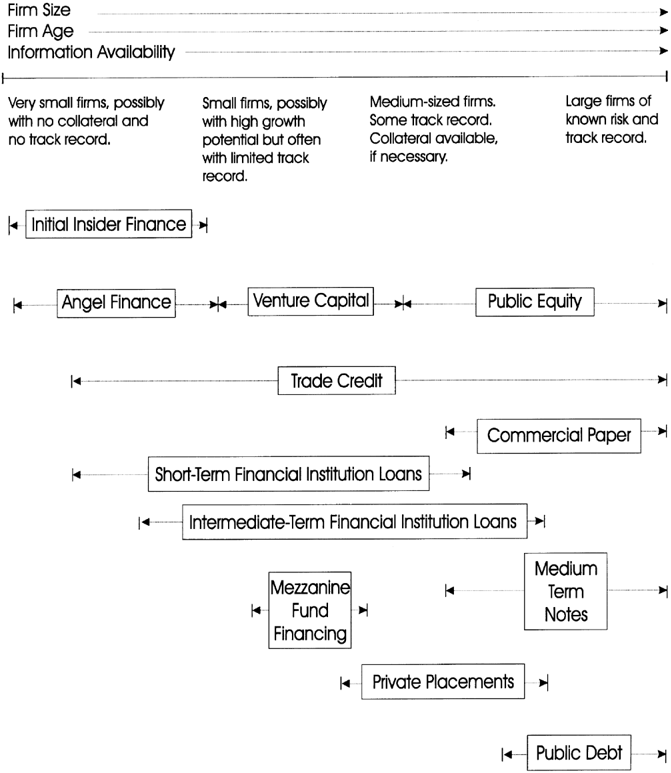
- The growth cycle paradigm predicts younger/more opaque firms rely on insider finance, trade credit, and angel finance, then venture capital and banks, and eventually public markets. However, 1993 NSSBF data show insider finance does not dominate external finance even for adolescents (upper bound 56.8% insider, roughly equal to external), and financial institution debt is important to very young firms, often based on personal guarantees or collateral.
- Macro vulnerability: the early-1990s credit crunch saw real C&I loans fall 23.2% ($596.7 billion to $458.2 billion) and estimated small business lending fall 38.5% ($143.7 billion to $88.4 billion). Banks with less than $100 million in assets held about 9% of portfolios in small business loans versus about 2% for banks over $10 billion; large banks charged about 100 basis points less and required collateral about 25% less often than small banks, other things equal.
Methods
- Design: review and synthesis organized around the financial growth cycle paradigm, covering theoretical and empirical literature on private equity and debt markets, contracts, and macroeconomic vulnerability.
- Data: primarily the 1993 National Survey of Small Business Finances (NSSBF) for US small business finance tables, plus other sources including NFIB, SCF, STBL, CALL, CRA, Venture Economics/VentureOne, and international data.
- Analysis: descriptive tabulations (Tables 1 and 2) and literature synthesis; the paper is a review rather than a new primary empirical study.
Limitations
- Paper-stated: Table 1 data are not completely accurate or consistent and should be considered rough estimates; angel finance estimates are imprecise (range $15 billion to $120 billion); 1993 data may not reflect current conditions; weighted averages mask considerable heterogeneity.
- Paper-stated: the growth cycle paradigm is not intended to fit all small businesses; firm size, age, and information availability are far from perfectly correlated, and the points at which different funding sources begin and end are not definitive.
- Evident from the text: informational opacity and the intertwining of personal and business finances make small business finance difficult to research, and data on owners’ finances are often unavailable; the paper relies heavily on existing literature and available data rather than new primary data collection.
Model-written summary. Check it against the paper before relying on it.
Integrity signals
Registry
Cites
Statistics
Figures
Verification
Claims the paper makes
22 Valid · 27 Not valid · 107 Not checked · 201 Own results and interpretations
Every source the paper cites for this claim was checked and supports it.
In the paper
“This use of personal assets to help with external ®nance also highlights another important aspect of small business ®nance ± the ®nancial intertwining of owners and their businesses (Ang, 1992).”
§ The economics of small business ®nance: The roles of private equity and debt markets in the ®nancial growth cycle > 2.3. The ®nancial growth cycle of small business
What the sources say
- Supportedcites Ang, 1992 matched to “On the Theory of Finance for Privately Held Firms” (1992) source
In “Integrating Personal and Business Accounts,” Ang says that personal guarantees or collateral make business risk inseparable from owners’ personal risk. “The Financing Decision” also identifies owners’ assets used for loan guarantees as contributions to the business. Together, these passages support the cited point that using personal assets to obtain external finance intertwines owners’ and businesses’ finances. (LLM, conf=0.94)
plainstates an association- Asserted: passes — The authors put it forward as true.
- Checkable: passes — It can be checked against evidence.
- Load-bearing: unclear — It is unclear whether the paper’s conclusions depend on it.
- Based: passes — The paper gives a reason why it holds.
- Supported
The cited sources support only part of this claim — read each source’s verdict below.
In the paper
“Costly state veri®cation (Townsend, 1979;Diamond, 1984) and adverse selection (Myers, 1984;Myers and Majluf, 1984;Nachman and Noe, 1994) arguments suggest the optimality of debt contracts after insider ®nance has been exhausted.”
§ The economics of small business ®nance: The roles of private equity and debt markets in the ®nancial growth cycle > 2.3. The ®nancial growth cycle of small business
What the sources say
- Partly supportedcites Townsend, 1979 matched to “Optimal contracts and competitive markets with costly state verification” (1979) sourceExperimental — accuracy not yet measured
Section 3 characterizes an optimal contract for a firm financing an investment project as a bond that defaults when returns fall below a threshold, supporting the costly-state-verification rationale for debt. The paper does not establish that debt becomes optimal only after insider finance has been exhausted. The adverse-selection citations in the sentence refer to other sources, not Townsend. (LLM, conf=0.85)
- Not checked — no full text of the sourcecites Diamond, 1984 matched to “Financial intermediation and delegated monitoring” (1984) source
- Not matchedcites Myers, 1984
More than one paper fits this citation.
hedgedstates a cause- Asserted: passes — The authors put it forward as true.
- Checkable: passes — It can be checked against evidence.
- Load-bearing: passes — The paper’s conclusions depend on it.
- Based: passes — The paper gives a reason why it holds.
- Partly supported
The cited sources support only part of this claim — read each source’s verdict below.
In the paper
“An agency problem arises in the relationship between the entrepreneur and the venture capitalist in which the entrepreneur may expend insucient eort, exhibit expense preference behavior, or lack sucient information or skill to make optimal production decisions.”
§ The economics of small business ®nance: The roles of private equity and debt markets in the ®nancial growth cycle > 3.2. The venture capital market
What the sources say
- Not checked — no full text of the sourcecites Cooper and Carleton, 1979 matched to “Dynamics of Borrower‐Lender Interaction: Partitioning Final Payoff in Venture Capital Finance” (1979) source
- Partly supportedcites Bergemann and Hege, 1998 matched to “Venture capital financing, moral hazard, and learning” (1998) sourceExperimental — accuracy not yet measured
Section 2.3, “Moral hazard and financing,” describes an entrepreneur who may reduce costly effort or divert investment funds to private ends, supporting the insufficient-effort and expense-preference parts of the claim. It does not identify a lack of the entrepreneur’s information or skill as a cause of poor production decisions; it instead says the entrepreneur and venture capitalists initially have the same assessment of the project. (LLM, conf=0.88)
hedgedstates a possible cause- Asserted: passes — The authors put it forward as true.
- Checkable: passes — It can be checked against evidence.
- Load-bearing: passes — The paper’s conclusions depend on it.
- Based: passes — The paper gives a reason why it holds.
Every source the paper cites for this claim was checked and supports it.
In the paper
“Since 1990, this share has about doubled to 30% (Fenn et al., 1997).”
§ The economics of small business ®nance: The roles of private equity and debt markets in the ®nancial growth cycle > 3. The role of private equity markets in small business ®nance
What the sources say
- Supportedcites Fenn et al., 1997 matched to “The Private Equity Market: An Overveiw” (1997) source
In “IPO Firms that Received Private Equity Backing,” the paper states that the share of IPOs with venture backing averaged 15% during the 1980s and doubled to 30% since 1990. This directly supports the cited claim. (LLM, conf=0.95)
plainstates an association- Asserted: passes — The authors put it forward as true.
- Checkable: passes — It can be checked against evidence.
- Load-bearing: unclear — It is unclear whether the paper’s conclusions depend on it.
- Based: passes — The paper gives a reason why it holds.
- Supported
The cited sources support only part of this claim — read each source’s verdict below.
In the paper
“During the 1980s, approximately 15% of all IPOs were backed by venture capital, well out of proportion to the fraction of all ®rms that received venture capital.”
§ The economics of small business ®nance: The roles of private equity and debt markets in the ®nancial growth cycle > 3. The role of private equity markets in small business ®nance
What the sources say
- Partly supportedcites Fenn et al., 1997 matched to “The Private Equity Market: An Overveiw” (1997) sourceExperimental — accuracy not yet measured
The section “IPO Firms that Received Private Equity Backing” states that venture-backed IPOs averaged 15% of IPOs during the 1980s. It does not give the fraction of all firms that received venture capital or make the claimed comparison with that fraction. (LLM, conf=0.84)
plainstates an association- Asserted: passes — The authors put it forward as true.
- Checkable: passes — It can be checked against evidence.
- Load-bearing: unclear — It is unclear whether the paper’s conclusions depend on it.
- Based: passes — The paper gives a reason why it holds.
- Partly supported
184 more claims · 6 with their cited sources checked
Create a free account to see all 357 claims and to verify the 12 references still open.
- Probably not a substantial claim. 94
- It may state two separate claims as one. 87
- Borderline: one of the tests for a substantial claim is unclear. 2
Claims other papers make about this one
Each is checked against this paper’s own text: does it say what the citing paper says it does?
The cited source says what the claim attributes to it.
In the citing paper
“SMEs are more dependent on external financing supplied by commercial banks (Berger and Udell 1998) because most of them are not qualified to raise money from the stock market.”
From Local Bank, Digital Financial Inclusion and SME Financing Constraints: Empirical Evidence from China (2022) · cites this paper as Berger and Udell 1998
Self-check
Percentages, sums and reported differences re-computed from the paper’s own numbers.
Rated minor: it would not touch a result — a value no result rests on, a p-value that stays on the same side of the significance level, or a conflict that is clerical, resolved elsewhere in the paper, or outside its own findings.
In the paper
“Non®nancial business/government debt provides 19.26% of small business funding (mostly trade credit)”
§ The economics of small business ®nance: The roles of private equity and debt markets in the ®nancial growth cycle > 4. The role of private debt markets in small business ®nance
Reported 19.26 · recomputed 18.01
Citations
Cites
Corporate financing and investment decisions when firms have information that investors do not have
Myers, S. C., & Majluf, N. S. (1984) · Journal of Financial Economics · doi:10.1016/0304-405x(84)90023-0 · Cited by 18,957
The Cost of Capital, Corporation Finance and the Theory of Investment
Miller, M. H. (1958) · American Economic Review · Cited by 14,574
Determinants of corporate borrowing
Myers, S. C. (1977) · Journal of Financial Economics · doi:10.1016/0304-405x(77)90015-0 · Cited by 13,169
Credit Rationing in Markets with Imperfect Information
Stiglitz, J. E., & Weiss, A. (1981) · Columbia University · doi:10.7916/d8v12ft1 · Cited by 12,769 · cited 1×
“…pledging outside collateral may help resolve adverse selection problems when the borrower has more information about the quality of the investment than the lender, and may help prevent credit rationing (Stiglitz and Weiss 1981, 1986, Bester 1985, Chan and Kanatas 1985, Besanko and Thakor 1987a,b).”
The cost of capital, corporation finance and the theory of investment
Terra, P. R. (2008) · Revista de Administração e Contabilidade da Unisinos · doi:10.4013/base.20082.07 · Cited by 8,615
Financial intermediation and delegated monitoring
Diamond, D. W. (1984) · The Review of Economic Studies · doi:10.2307/2297430 · Cited by 8,476 · cited 2×
“Costly state verification (Townsend 1979, Diamond 1984) and adverse selection (Myers 1984, Myers and Majluf 1984, Nachman and Noe 1994) arguments suggest the optimality of debt contracts after insider cFor example, there are generally accepted definitions of the stages of finance for the kind of…”
Corporate Financing and Investment Decisions When Firms Have InformationThat Investors Do Not Have
Myers, S., & Majluf, N. (1984) · doi:10.3386/w1396 · Cited by 6,745
The Benefits of Lending Relationships: Evidence from Small Business Data
PETERSEN, M. A., & RAJAN, R. G. (1994) · The Journal of Finance · doi:10.1111/j.1540-6261.1994.tb04418.x · Cited by 5,440 · cited 4×
“…whereas mortgages, equipment loans, motor vehicle loans, and other loans may more often be transactionsdriven .zs It was also found that dependence on trade credit decreased with the length of the banking relationship, supporting the value of relationship lending (Petersen and Rajan 1994, 1995).”
InfluentialInside the black box: the credit channel of monetary policy transmission
Bernanke, B. S., & Gertler, M. (1995) · Journal of Economic Perspectives · doi:10.1257/jep.9.4.27 · Cited by 4,211
Insiders and Outsiders: The Choice between Informed and Arm's‐Length Debt
RAJAN, R. G. (1992) · The Journal of Finance · doi:10.1111/j.1540-6261.1992.tb04662.x · Cited by 3,902 · cited 1×
“Some research suggests that these firms may try to reduce the control of their banks by issuing public debt, even though public debt may entail higher costs (Diamond 1991, 1993, Rajan 1992, Houston and James 1996).”
Research works printed but not linked: 11
- 66. Cook, L., 1997. Trade ®nance, bank ®nance, and capital market imperfections. Working paper. Harvard University, Cambridge, MA.
- 89. Freear, J., Sohl, J.E., Wetzel, W.E., Jr., 1994. The private investor market for venture capital. The Financier 1, 7±19.
- 112. Hancock, D., Wilcox, J.A., 1997. Bank capital, nonbank ®nance, and real estate activity. Journal of Housing Research 8, 75±105.
- 117. Hempel, G., Coleman, A., Simonson, D., 1986. Bank Management, Wiley, New York.
- 119. Ho, R., 1997. Credit-card use to ®nance small business is soaring, says survey of small ®rms. Wall Street Journal B2, Sept. 25.
- 153. Megginson, W.L., Weiss, K.A., 1991. Venture capitalist certi®cation in initial public oerings. Journal of Finance 46, 903±979.
- 162. Morsman Jr., E., 1986. Commercial loan structuring. Journal of Commercial Bank Lending 68, 2± 20.
- 187. Ravid, S.A., 1996. Debt maturity ± A survey. Financial Markets, Institutions and Instruments 5 (3), 1±68.
- 217. Wetzel Jr. W.E., 1994. Venture capital. In: Bygrave, W.D. (Ed.), Portable MBA in Entrepreneur- ship. Wiley, New York, pp. 172±194.
- 219. White, L.J., 1995. An analytical framework. In: Zahid, S.N. (Ed.), Financial Sector Development in Asia. Oxford University Press, New York, pp. 3±35.
- 222. McKean, R. (Ed.), Issues in Defense Economics. Columbia University Press, New York.
Cited by
Items 2,501–2,600 of 3,739
Credit card cash‐out as informal financing: Evidence from China
Ma, Y., Xue, Y., & Yang, J. (2019) · Australian Economic Papers · doi:10.1111/1467-8454.12153 · Cited by 2
Mahajan, D., & Sidhu, A. S. (2019) · SEDME (Small Enterprises Development Management & Extension Journal) A worldwide window on MSME Studies · doi:10.1177/0970846419852496 · Cited by 2
Bank soundness and bank lending to new firms during the global financial crisis
Naiki, E., & Ogane, Y. (2019) · Review of Financial Economics · doi:10.1002/rfe.1090 · Cited by 2
Regalado, J. O. G., Vinces, J. Z., & Sánchez-Giler, S. (2020) · Revista de Métodos Cuantitativos para la Economía y la Empresa · doi:10.46661/revmetodoscuanteconempresa.3866 · Cited by 4
Lean Principles Improving Entrepreneurial Ecosystem in Malaysian SMEs
Anuar, A., Sadek, D. M., Rahman, N. L. A., & Othman, N. (2020) · Cited by 2
Bocci, C., Caloffi, A., Mariani, M., & Sterlacchini, A. (2021) · Italian Economic Journal · doi:10.1007/s40797-021-00170-3 · Cited by 4
Alcance de los créditos a tasa subsidiada para mipymes Argentinas
Corzo, L. J., Guercio, M., & Vigier, H. P. (2021) · Revista Finanzas y Política Económica · doi:10.14718/revfinanzpolitecon.v13.n2.2021.2 · Cited by 3
FINANCIALS MENU AT EUROPEAN RESTAURANTS
Torluccio, G. (2012) · Archivio istituzionale della ricerca (Alma Mater Studiorum Università di Bologna) · doi:10.26215/tourismos.v7i2.304 · Cited by 6
Nawi, H. M., Zulkefle, W. N. S. A., & Siong, O. H. (2022) · International Journal of Academic Research in Business and Social Sciences · doi:10.6007/ijarbss/v12-i10/15117 · Cited by 2
“Smaller firms were generally found to be reluctant to disclose firms’ information to outsiders (Berger & Udell, 1998).”
BackgroundSME Financing: A Life Cycle Approach
Bhaird, C. M. A. (2009) · Contributions to management science · doi:10.1007/978-3-7908-2399-8_2 · Cited by 4
Working Capital Management in Start-ups - An Exploratory Research on Swedish Start-ups
Kunze, A., & Peri, P. (2015) · Lund University Publications Student Papers (Lund University) · Cited by 3
Innovators and Access to Finance in the UK’s Environmental SectorPreprint
Parris, S., & Demirel, P. (2012) · SSRN Electronic Journal · Cited by 2
Economie, F., & Meuleman, M. L. C. J. (2006) · RePEc: Research Papers in Economics · Cited by 2
Credit Decisions and Adverse Selection: An Empirical Study of Banking BehaviorPreprint
Statnik, J., de Bodt, E., & Lobez, F. (2000) · SSRN Electronic Journal · doi:10.2139/ssrn.244555 · Cited by 2
“However we can consider that the banks trusting a particular 9 Berger and Udell (1998) show that this complementarity is also temporal: the credit offered by the 17/36 debtor will accept more easily a long-term relation and hence deny themselves the possibility of frequent renegotiations that are…”
Wuebker, R. J., Ács, Z. J., & Florida, R. L. (2010) · SSRN Electronic Journal · Cited by 2
Credit Cards, Race and EntrepreneurshipPreprint
Chatterji, A., & Seamans, R. (2010) · SSRN Electronic Journal · doi:10.2139/ssrn.1696036 · Cited by 2
“While most prior work has examined new ventures supported by outside capital, 1 the vast majority of entrepreneurs are likely to use their own funds, raise money from their friends and family, or borrow money from commercial banks, government, and other sources (Berger and Udell, 1998).”
BackgroundFinancing of SMEs: Do They Match Their Assets and Liabilities?Preprint
Bartholdy, J., Mateus, C., & Olson, D. O. (2010) · SSRN Electronic Journal · doi:10.2139/ssrn.1907200 · Cited by 2
Switching costs in China's banking market
Yin, W. (2014) · ORCA Online Research @Cardiff (Cardiff University) · Cited by 3
The impact of financial Information on organizing and managing a small business
Nawaz, R. (2011) · Tuwhera (Auckland University of Technology) · Cited by 3
Debt Financing of High-growth StartupsPreprint
Fischer, T., & de Rassenfosse, G. (2011) · RePEc: Research Papers in Economics · Cited by 8
The Survival of New Firms: Do Bank Loans at Birth Matter?Preprint
Bastié, F., Cieply, S., & Cussy, P. (2011) · RePEc: Research Papers in Economics · Cited by 2
Financing and Managerial Support with (Some) Optimistic EntrepreneursPreprint
Vilanova, L. (2011) · SSRN Electronic Journal · doi:10.2139/ssrn.1833615 · Cited by 2
Sharma, P., & Gounder, N. (2011) · RePEc: Research Papers in Economics · Cited by 2
Is there a Market for Microlending in Industrialized CountriesPreprint
Kritikos, A. S., Kneiding, C., & Germelmann, C. C. (2006) · RePEc: Research Papers in Economics · Cited by 2
External finance, collateralizable assets and export market entryPreprint
Halldin, T. (2012) · RePEc: Research Papers in Economics · Cited by 2
Financing decisions and financial constraints: evidence from the UK and China
Kasseeah, H. (2008) · Nottingham ePrints (University of Nottingham) · Cited by 3
Schock, F., von Flotow, P., & Taübe, F. (2014) · SSRN Electronic Journal · doi:10.2139/ssrn.2387560 · Cited by 2
CORPORATE SOCIAL RESPONSIBILITY: DOMESTIC AND INTERNATIONAL PRIVATE EQUITY INSTITUTIONAL INVESTMENTPreprint
Johan, S., & Cumming, D. J. (2006) · RePEc: Research Papers in Economics · Cited by 5
Performance et risque des entreprises appartenant à des groupes de PMEPreprint
Hamelin, A. (2008) · RePEc: Research Papers in Economics · Cited by 2
Self-Financing of Traditional and R&D Investments: Evidence from Italian SMEsPreprint
Brighi, P., Patuelli, R., & Torluccio, G. (2012) · SSRN Electronic Journal · doi:10.2139/ssrn.2142373 · Cited by 2
“This result is consistent with the literature suggesting that, when R&D firms become large, they can more easily fund their investments with external funds (Berger and Udell 1998).”
InfluentialMetzger, G. (2010) · SSRN Electronic Journal · doi:10.2139/ssrn.1605214 · Cited by 3
Scott, R. H. (2009) · SSRN Electronic Journal · doi:10.2139/ssrn.1446780 · Cited by 2
Main Drivers of LBO in AsiaPreprint
Sannajust, A., & Khamlichi, A. E. (2014) · RePEc: Research Papers in Economics · Cited by 2
Determinants of Voluntary Disclosure of Sales by Small Private CompaniesPreprint
Ceustermans, S., & Breesch, D. (2013) · SSRN Electronic Journal · doi:10.2139/ssrn.2340403 · Cited by 2
Confidi, Piccole Imprese E Banche: Un'Analisi Empirica
Busetta, G., & Presbitero, A. (2008) · Munich Personal RePEc Archive (Ludwig Maximilian University of Munich) · Cited by 2
Relationship Lending and Conservative Accounting? Empirical Evidence from Private FirmsPreprint
Bigus, J., Schachner, L., & Stein, I. (2009) · SSRN Electronic Journal · doi:10.2139/ssrn.1474743 · Cited by 6
Factors Influencing Managers’ Decisions to Prepare a Business PlanPreprint
Dearman, D. T. (2012) · SSRN Electronic Journal · doi:10.2139/ssrn.2133100 · Cited by 2
Antonczyk, R. C., Breuer, W., & Salzmann, A. (2014) · SSRN Electronic Journal · doi:10.2139/ssrn.1700895 · Cited by 3
Funding Self-Employment: The Role of Consumer CreditPreprint
Kneiding, C., & Kritikos, A. S. (2012) · SSRN Electronic Journal · doi:10.2139/ssrn.1980661 · Cited by 3
“This lack of data is probably the main reason why small business finance is ‘one of the most under researched areas in finance’ (Berger and Udell, 1998).”
InfluentialLa structure financière des PME de la haute technologie
Fathi, E.-T., & Gailly, B. (2004) · Digital Access to Libraries · Cited by 11
Exporting and Firm-Level Credit Constraints-Evidence from GhanaPreprint
Ngo, M. A. (2015) · RePEc: Research Papers in Economics · Cited by 3
The Interaction between Financial and Human Resource Slack and its Effect on Venture Performance
Paeleman, I., & Vanacker, T. R. (2012) · Academy of Management Proceedings · doi:10.5465/ambpp.2012.169 · Cited by 2
Growth versus Margin and Castles in the Air: Evidence from Industry IPO WavesPreprint
Da, Z., Jagannathan, R., & Shen, J. (2012) · SSRN Electronic Journal · doi:10.2139/ssrn.2175396 · Cited by 2
Managerial Ownership Effects on Cash Holdings: The Case of Private Family FirmsPreprint
Niskanen, M., & Steijvers, T. (2011) · SSRN Electronic Journal · doi:10.2139/ssrn.1937512 · Cited by 3
Best Practice Guidance for Angel Groups - Deal Structure and NegotiationPreprint
Hudson, M., & Koss, A.-M. (2009) · SSRN Electronic Journal · doi:10.2139/ssrn.1291787 · Cited by 2
INVESTMENTS AND PROPERTY RIGHTS IN RUSSIA: EVIDENCE FROM SMALL FIRMS IN SAMARAPreprint
Hartarska, V., & Hartarska, V. M. (2001) · RePEc: Research Papers in Economics · doi:10.22004/ag.econ.20739 · Cited by 2
Endeudamiento a corto plazo en las pymes españolasPreprint
Solano, P. M., & García‐Teruel, P. J. (2004) · RePEc: Research Papers in Economics · Cited by 2
Unobserved Heterogeneity: Evidence and Implications for SMEs' Hedging BehaviorPreprint
Pennings, J. M. E., & Garcia, P. (2001) · RePEc: Research Papers in Economics · doi:10.22004/ag.econ.18955 · Cited by 3
“Avery and Bostic (1998); and Berger and Udell (1998) show that private equity, bank loans and personal commitments dominate the capital structure of SMEs.”
BackgroundManaging Corporate Investment and R&D Financing: Are They Really Different?Preprint
Brighi, P., Corigliano, R., & Torluccio, G. (2009) · SSRN Electronic Journal · doi:10.2139/ssrn.1476783 · Cited by 2
Cozarenco, A., & Szafarz, A. (2014) · SSRN Electronic Journal · doi:10.2139/ssrn.2387573 · Cited by 2
The Indirect Costs of Venture Capital in CanadaPreprint
Carpentier, C., & Suret, J. (2005) · RePEc: Research Papers in Economics · Cited by 2
Cross Border Venture Capital Investment: A Network of Emerging TrustPreprint
Hain, D. S., Johan, S., & Wang, D. (2014) · SSRN Electronic Journal · doi:10.2139/ssrn.2382327 · Cited by 2
The impact of the financial crisis on the working capital of SMEs: a panel data analysis
McGuinness, G. (2015) · Dublin City University Open Access Institutional Repository (Dublin City University) · Cited by 2
Center for Development Economics, WILLIAMS COLLEGE
Honohan, P. (2008) · Cited by 2
Regime Uncertainty and the Great Recession: A Market Process ApproachPreprint
Martin, A., & von Laer, W. (2015) · SSRN Electronic Journal · doi:10.2139/ssrn.2625580 · Cited by 2
Guda, D. O. (2013) · Cited by 2
(Un)Expected Housing Price Changes: Identifying the Drivers of Small Business FinancePreprint
Kapinos, P. S., Gurley‐Calvez, T., & Kapinos, K. A. (2016) · SSRN Electronic Journal · doi:10.2139/ssrn.2725265 · Cited by 2
Capital Structure in Blockholder-Dominated Firms: A Closer Look on Corporate Ownership and ControlPreprint
Morresi, O. (2009) · SSRN Electronic Journal · doi:10.2139/ssrn.1523826 · Cited by 2
“According to the financial growth cycle theory by Berger and Udell (1998), older firms are likely to be in a maturity stage, with stable cash flows and therefore to raise more debt.”
Banking Deregulation, Local Credit Supply, and Small Business GrowthPreprint
Krishnamurthy, P. (2012) · SSRN Electronic Journal · doi:10.2139/ssrn.2149904 · Cited by 2
Inorganic Growth Strategies in Private Equity: Empirical Evidence on Add-On AcquisitionsPreprint
Hammer, B., Knauer, A., Pfluecke, M., et al. (2013) · SSRN Electronic Journal · doi:10.2139/ssrn.2338115 · Cited by 2
Microcredit in Industrialized Countries: Unexpected Consequences of Regulatory Loan CeilingsPreprint
Cozarenco, A., & Szafarz, A. (2016) · RePEc: Research Papers in Economics · Cited by 3
Firm Growth, Capital Choice Preferences, and Impact on Performance: Evidence from the SME IndustryPreprint
Raju, D., & Annamalai, T. R. (2015) · SSRN Electronic Journal · doi:10.2139/ssrn.2647869 · Cited by 3
The Dynamics of Capital Structure in U.S. Start-Up BusinessesPreprint
Cotei, C., & Farhat, J. B. (2016) · SSRN Electronic Journal · doi:10.2139/ssrn.2782776 · Cited by 2
The "virtuous circle" of informal investment activity: evidence from the UK
Murray, G. C., & Cowling, M. (2012) · Figshare · Cited by 2
Boyd, J. H., Hakenes, H., & Heitz, A. R. (2016) · SSRN Electronic Journal · doi:10.2139/ssrn.2877788 · Cited by 2
Innovation, Credit Constraints and National Banking Systems: A comparison of developing nationsPreprint
Lorenz, E., & Pommet, S. (2018) · RePEc: Research Papers in Economics · Cited by 10
Bank risk management : How do bank employees deal with risk at the strategic and operational levels?
Rad, A. (2017) · Publications (Mid Sweden University) · Cited by 8
A New Measure of Managers' Intentional Income SmoothingPreprint
Black, D. E., Pierce, S. R., & Thomas, W. B. (2017) · SSRN Electronic Journal · doi:10.2139/ssrn.3026235 · Cited by 2
Capital Structure and Firm's Life Cycle: An Iberian Study
Valente, B. A. R. (2017) · Open Repository of the University of Porto (University of Porto) · doi:10.34626/vyf2-0012 · Cited by 2
Loan Officers’ Information Focus in SME Loan Assessment: A Case StudyPreprint
Rad, A., Öhman, P., & Yazdanfar, D. (2018) · SSRN Electronic Journal · doi:10.2139/ssrn.3250610 · Cited by 2
FINANCIAL STRATEGIES OF FAMILY BUSINESSES: A STUDY OF GHANAIAN OWNED SHOPS IN LONDON, UNITED KINGDOM
Boateng, B. O. (2020) · Queen Margaret University Publications Repository (Queen Margaret University) · Cited by 4
Moedl, M. (2018) · SSRN Electronic Journal · doi:10.2139/ssrn.3284559 · Cited by 2
Foreign Currency Borrowing by Small FirmsPreprint
Brown, M., Ongena, S. R. G., & Yesin, P. A. (2009) · SSRN Electronic Journal · doi:10.2139/ssrn.1338791 · Cited by 4
Collaborative R&D as a Strategy to Attenuate Financing ConstraintsPreprint
Czarnitzki, D., & Hottenrott, H. (2012) · SSRN Electronic Journal · doi:10.2139/ssrn.2118558 · Cited by 3
Relationship Lending and Firm InnovativenessPreprint
Giannetti, C. (2012) · SSRN Electronic Journal · doi:10.2139/ssrn.1332977 · Cited by 67
“Lacking the visibility of more established firms, young and small firms are likely to suffer even more for the financing of their investments because of asymmetric information problems (Berger and Udell (1998)).”
Financing of Entrepreneurial Firms in Canada: Some PatternsPreprint
Miglo, A. (2018) · SSRN Electronic Journal · doi:10.2139/ssrn.3294626 · Cited by 2
Kibona, D. (2021) · Qucosa (Saxon State and University Library Dresden) · doi:10.13140/rg.2.2.21645.56809 · Cited by 2
An exploratory analysis of patterns of movement in the financial structure of Australian small firms
Gibson, B. (2002) · EPubDev Repository · Cited by 2
Determinants of the capital structure of Dutch SMEs
Hul, E. F. V. '. (2014) · Cited by 2
Institutional Voids, Capital Markets and Temporary Migration: Evidence from Bangladesh
Bossavie, L. L. Y., Görlach, J., Özden, Ç., & Wang, H. (2022) · World Bank, Washington, DC eBooks · doi:10.1596/1813-9450-9930 · Cited by 2
Competition in Financial ServicesPreprint
Evans, C. M., Healey, D., Nehme, M., & Nicholls, R. (2015) · SSRN Electronic Journal · doi:10.2139/ssrn.2666851 · Cited by 2
Corporate Liquidity During the Covid-19 Crisis: The Trade Credit ChannelPreprint
Bureau, B., Duquerroy, A., & Vinas, F. (2021) · SSRN Electronic Journal · doi:10.2139/ssrn.3982197 · Cited by 7
Gender and race in entrepreneurial financePreprint
Ewens, M. (2022) · SocArXiv (OSF Preprints) · doi:10.31235/osf.io/djf8z · Cited by 2
Verifying the State of Financing Constraints: Evidence from US Business Credit ContractsPreprint
Meisenzahl, R. R. (2011) · SSRN Electronic Journal · doi:10.2139/ssrn.1959562 · Cited by 3
Basel Iii and SME Bank Finance in GermanyPreprint
Marek, P., & Stein, I. (2022) · SSRN Electronic Journal · doi:10.2139/ssrn.4261450 · Cited by 8
Monetary Policy and Local Industry StructurePreprint
Popov, A. A., & Steininger, L. (2023) · SSRN Electronic Journal · doi:10.2139/ssrn.4353227 · Cited by 2
'Let Us Put Our Moneys Together:' Minority-Owned Banks and Resilience to Crises
Berger, A. N., Fedlman, M., Langford, S. W., & Roman, R. A. (2022) · Working paper · doi:10.21799/frbp.wp.2023.13 · Cited by 7
Self-citationMasters of Disasters: The Heterogeneous Effects of a Crisis on Micro-Sized Firms
Brucal, A., & Grover, A. (2023) · World Bank, Washington, DC eBooks · doi:10.1596/1813-9450-10556 · Cited by 2
Capital Structure in New Ventures
Söderblom, A., & Samuelsson, M. J. (2023) · Springer eBooks · doi:10.1007/978-3-030-38738-9_127-1 · Cited by 2
Model of Corporate Sustainability Drivers through Business Lifecycle
Zumente, I. (2023) · doi:10.7250/9789934229930 · Cited by 3
Spillovers that Pay Dividends: The Indirect Impact of Federal Disaster Loans on Firm EntryPreprint
Erda, T. (2024) · SSRN Electronic Journal · doi:10.2139/ssrn.4875803 · Cited by 5
Internal Financing and External Financing
Qingma, D. (2025) · Springer eBooks · doi:10.1007/978-981-97-4036-9_938 · Cited by 2
Unternehmerische Finanzierungspolitik unter Berücksichtigung von Realoptionen
Dahlheim, C., & Wieland, A. K. (2001) · Springer eBooks · doi:10.1007/978-3-642-56603-5_5 · Cited by 2
Les choix de financement des Très Petites Entreprises
Bellettre, I. (2010) · theses.fr (ABES) · doi:10.70675/76150007z15c7z42ccz9f06z24593f44f346 · Cited by 18
“D plus, ces firmes sont fortement soumises aux problèmes d’asymétrie d’information (Berger & Udell, 1998) et de sélection adverse en raison de la place prépondérante de cet actionnaire-dir geant mais également d’un taux de mortalité important.”
BackgroundThe Impact of German guarantee banks on the access to finance for SMEs
Valentin, A. (2014) · Edinburgh Napier Research Repository (Edinburgh Napier University) · doi:10.17869/enu.176079 · Cited by 2
Unternehmensfinanzierung nach neuen Spielregeln: Instrumente — Märkte — Perspektiven
Stadler, W. (2002) · Gabler Verlag eBooks · doi:10.1007/978-3-322-82391-5_6 · Cited by 2
National Culture and Cross-Country Differences in Trade CreditPreprint
Mättö, M., & Niskanen, M. (2015) · SSRN Electronic Journal · doi:10.2139/ssrn.2546305 · Cited by 3
“Firm’s accessibility to financial markets depends on its age (Berger & Udell, 1998).”
BackgroundFinancing, Firm Size and Productive Efficiency : the Effect of Family Ownership
Barbera, F. (2013) · e-publications@bond (Bond University) · Cited by 5
Duggal, S., & Sassoon, D. (2015) · Lund University Publications Student Papers (Lund University) · Cited by 2
Metadata
- Authors
- N. Berger, A., & F. Udell, G.
- Venue
- Journal of Banking & Finance
- Publisher
- Elsevier BV
- Published
- 1998-08
- Volume
- 22
- Issue
- 6-8
- Pages
- 613-673
- ISSN
- 0378-4266 (ISSN-L)
- OpenAlex
- W2119780569
- Semantic Scholar
- dfc06f7f7eb83d2c0e2a1d67ecb95b520a406843
- Cited by
- 3,690
- References
- 230
- Citations by year
- 2026: 136 · 2025: 148 · 2024: 144 · 2023: 193 · 2022: 155 · 2021: 211 · 2020: 200 · 2019: 156 · 2018: 208 · 2017: 174 · 2016: 186 · 2015: 187 · 2014: 168 · 2013: 177 · 2012: 171
- FWCI
- 169.26
- Type
- journal article
- Language
- en
- Open access
- hybrid
- doi.org
- Licence
- cc-by-nc-nd
- www.elsevier.com/tdm/userlicense/1.0/ (tdm)
- www.elsevier.com/legal/tdmrep-license (tdm)
- creativecommons.org/licenses/by-nc-nd/4.0/ (vor, 125 d)
- Locations
- Journal of Banking & Finance (publishedVersion, cc-by-nc-nd)
- RePEc: Research Papers in Economics (submittedVersion)
- Funders
- York University
- Topics
- Social Sciences › Economics, Econometrics and Finance › Finance › Private Equity and Venture Capital
- Social Sciences › Economics, Econometrics and Finance › Finance › Corporate Finance and Governance
- Social Sciences › Economics, Econometrics and Finance › Finance › Banking stability, regulation, efficiency
- Keywords
- small business financing, private equity, debt markets, capital structure, firm size, firm age, macroeconomic conditions
About these checks
Registry, retraction, Cites and statistics results are computed, not judged, with one exception: a printed reference that no index lists is read once by a model before it counts as a citation error. Claims are extracted by a model and kept only when their quote appears verbatim in the text; each cited source is then checked, with a model’s help, for whether it says what the claim relies on. Those verdicts can be wrong — read the claim’s quote and the cited source before relying on one.
The claim verdicts this report counts are experimental: their accuracy is not yet measured.
A language model drew the claims from the paper on 2026-10-10, under version 3 of the claim definition (model deepseek-v4.1-flash, prompt extract-v3).
A second model labelled each claim on 2026-10-10 (model jev-1.13-20260917, definition revision gold-guideline-v0.2).
Cited sources are checked with a language model’s help (gpt-6-sol).
Statistics and arithmetic are recomputed, not judged.
Confidence bands are shown only for fields calibrated on our annotated test set. None is calibrated yet, so no band is shown.
What counts as a claim ›How we measure confidence ›How we check this ›
Are you an author, or do you see a problem with this page? Request a review
Data sources
Bibliographic data: Semantic Scholar, OpenAlex, Crossref.
Contains information from the Semantic Scholar Academic Graph Datasets, made available under the ODC Attribution License (ODC-BY 1.0).
Semantic Scholar’s data is described in: Kinney, R., et al. (2023). The Semantic Scholar Open Data Platform. arXiv:2301.10140.
