

The economics of small business finance: The roles of private equity and debt markets in the financial growth cycle
Open accessThe DOI matches its Crossref record; 217 of the 230 references it cites were found in a registry or an index, and 1 are not checked yet; 24 of the 170 sources its claims cite were checked for support.
Abstract
This article examines the economics of financing small business in private equity and debt markets. Firms are viewed through a financial growth cycle paradigm in which different capital structures are optimal at different points in the cycle. We show the sources of small business finance, and how capital structure varies with firm size and age. The interconnectedness of small firm finance is discussed along with the impact of the macroeconomic environment. We also analyze a number of research and policy issues, review the literature, and suggest topics for future research.
Verified 2026-11-25 · 1 reference not checked yet
Overview
CoChat Summary
TL;DR
This article reviews the economics of small business finance through a financial growth cycle paradigm, emphasizing informational opacity and the roles of private equity and debt markets. It documents US small business funding sources and contracts, and analyzes vulnerability to macroeconomic shocks, credit crunches, and bank consolidation.
Key findings
- US small business finance is split roughly evenly between equity (49.63%) and debt (50.37%); the largest sources are the principal owner, commercial banks, and trade creditors, together accounting for 70.10% of total funding. Commercial banks provide 18.75%, trade credit 15.78%, principal owner equity 31.33%, angel finance 3.59%, venture capital 1.85%, and credit card debt 0.14%.
- Financial institution debt is used by 54.23% of small businesses; 86.95% name a commercial bank as their primary financial institution. Average relationship length is 6.64 years overall and 9.01 years with the primary institution; 52.03% of financial institution debt is under lines of credit, 91.94% is secured, and 51.63% is guaranteed.
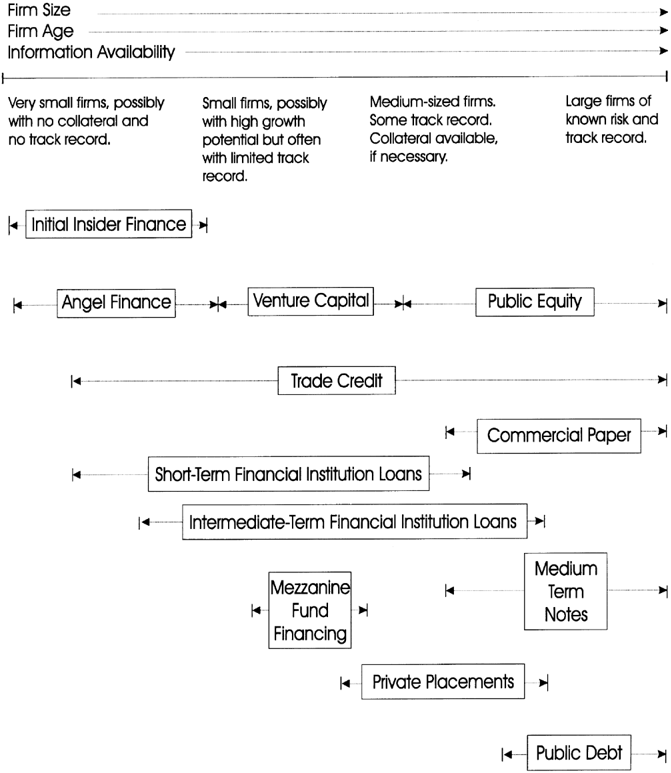
- The growth cycle paradigm predicts younger/more opaque firms rely on insider finance, trade credit, and angel finance, then venture capital and banks, and eventually public markets. However, 1993 NSSBF data show insider finance does not dominate external finance even for adolescents (upper bound 56.8% insider, roughly equal to external), and financial institution debt is important to very young firms, often based on personal guarantees or collateral.
- Macro vulnerability: the early-1990s credit crunch saw real C&I loans fall 23.2% ($596.7 billion to $458.2 billion) and estimated small business lending fall 38.5% ($143.7 billion to $88.4 billion). Banks with less than $100 million in assets held about 9% of portfolios in small business loans versus about 2% for banks over $10 billion; large banks charged about 100 basis points less and required collateral about 25% less often than small banks, other things equal.
Methods
- Design: review and synthesis organized around the financial growth cycle paradigm, covering theoretical and empirical literature on private equity and debt markets, contracts, and macroeconomic vulnerability.
- Data: primarily the 1993 National Survey of Small Business Finances (NSSBF) for US small business finance tables, plus other sources including NFIB, SCF, STBL, CALL, CRA, Venture Economics/VentureOne, and international data.
- Analysis: descriptive tabulations (Tables 1 and 2) and literature synthesis; the paper is a review rather than a new primary empirical study.
Limitations
- Paper-stated: Table 1 data are not completely accurate or consistent and should be considered rough estimates; angel finance estimates are imprecise (range $15 billion to $120 billion); 1993 data may not reflect current conditions; weighted averages mask considerable heterogeneity.
- Paper-stated: the growth cycle paradigm is not intended to fit all small businesses; firm size, age, and information availability are far from perfectly correlated, and the points at which different funding sources begin and end are not definitive.
- Evident from the text: informational opacity and the intertwining of personal and business finances make small business finance difficult to research, and data on owners’ finances are often unavailable; the paper relies heavily on existing literature and available data rather than new primary data collection.
Model-written summary. Check it against the paper before relying on it.
Integrity signals
Registry
Cites
Statistics
Figures
Verification
Claims the paper makes
22 Valid · 27 Not valid · 107 Not checked · 201 Own results and interpretations
Every source the paper cites for this claim was checked and supports it.
In the paper
“This use of personal assets to help with external ®nance also highlights another important aspect of small business ®nance ± the ®nancial intertwining of owners and their businesses (Ang, 1992).”
§ The economics of small business ®nance: The roles of private equity and debt markets in the ®nancial growth cycle > 2.3. The ®nancial growth cycle of small business
What the sources say
- Supportedcites Ang, 1992 matched to “On the Theory of Finance for Privately Held Firms” (1992) source
In “Integrating Personal and Business Accounts,” Ang says that personal guarantees or collateral make business risk inseparable from owners’ personal risk. “The Financing Decision” also identifies owners’ assets used for loan guarantees as contributions to the business. Together, these passages support the cited point that using personal assets to obtain external finance intertwines owners’ and businesses’ finances. (LLM, conf=0.94)
plainstates an association- Asserted: passes — The authors put it forward as true.
- Checkable: passes — It can be checked against evidence.
- Load-bearing: unclear — It is unclear whether the paper’s conclusions depend on it.
- Based: passes — The paper gives a reason why it holds.
- Supported
The cited sources support only part of this claim — read each source’s verdict below.
In the paper
“Costly state veri®cation (Townsend, 1979;Diamond, 1984) and adverse selection (Myers, 1984;Myers and Majluf, 1984;Nachman and Noe, 1994) arguments suggest the optimality of debt contracts after insider ®nance has been exhausted.”
§ The economics of small business ®nance: The roles of private equity and debt markets in the ®nancial growth cycle > 2.3. The ®nancial growth cycle of small business
What the sources say
- Partly supportedcites Townsend, 1979 matched to “Optimal contracts and competitive markets with costly state verification” (1979) sourceExperimental — accuracy not yet measured
Section 3 characterizes an optimal contract for a firm financing an investment project as a bond that defaults when returns fall below a threshold, supporting the costly-state-verification rationale for debt. The paper does not establish that debt becomes optimal only after insider finance has been exhausted. The adverse-selection citations in the sentence refer to other sources, not Townsend. (LLM, conf=0.85)
- Not checked — no full text of the sourcecites Diamond, 1984 matched to “Financial intermediation and delegated monitoring” (1984) source
- Not matchedcites Myers, 1984
More than one paper fits this citation.
hedgedstates a cause- Asserted: passes — The authors put it forward as true.
- Checkable: passes — It can be checked against evidence.
- Load-bearing: passes — The paper’s conclusions depend on it.
- Based: passes — The paper gives a reason why it holds.
- Partly supported
The cited sources support only part of this claim — read each source’s verdict below.
In the paper
“An agency problem arises in the relationship between the entrepreneur and the venture capitalist in which the entrepreneur may expend insucient eort, exhibit expense preference behavior, or lack sucient information or skill to make optimal production decisions.”
§ The economics of small business ®nance: The roles of private equity and debt markets in the ®nancial growth cycle > 3.2. The venture capital market
What the sources say
- Not checked — no full text of the sourcecites Cooper and Carleton, 1979 matched to “Dynamics of Borrower‐Lender Interaction: Partitioning Final Payoff in Venture Capital Finance” (1979) source
- Partly supportedcites Bergemann and Hege, 1998 matched to “Venture capital financing, moral hazard, and learning” (1998) sourceExperimental — accuracy not yet measured
Section 2.3, “Moral hazard and financing,” describes an entrepreneur who may reduce costly effort or divert investment funds to private ends, supporting the insufficient-effort and expense-preference parts of the claim. It does not identify a lack of the entrepreneur’s information or skill as a cause of poor production decisions; it instead says the entrepreneur and venture capitalists initially have the same assessment of the project. (LLM, conf=0.88)
hedgedstates a possible cause- Asserted: passes — The authors put it forward as true.
- Checkable: passes — It can be checked against evidence.
- Load-bearing: passes — The paper’s conclusions depend on it.
- Based: passes — The paper gives a reason why it holds.
Every source the paper cites for this claim was checked and supports it.
In the paper
“Since 1990, this share has about doubled to 30% (Fenn et al., 1997).”
§ The economics of small business ®nance: The roles of private equity and debt markets in the ®nancial growth cycle > 3. The role of private equity markets in small business ®nance
What the sources say
- Supportedcites Fenn et al., 1997 matched to “The Private Equity Market: An Overveiw” (1997) source
In “IPO Firms that Received Private Equity Backing,” the paper states that the share of IPOs with venture backing averaged 15% during the 1980s and doubled to 30% since 1990. This directly supports the cited claim. (LLM, conf=0.95)
plainstates an association- Asserted: passes — The authors put it forward as true.
- Checkable: passes — It can be checked against evidence.
- Load-bearing: unclear — It is unclear whether the paper’s conclusions depend on it.
- Based: passes — The paper gives a reason why it holds.
- Supported
The cited sources support only part of this claim — read each source’s verdict below.
In the paper
“During the 1980s, approximately 15% of all IPOs were backed by venture capital, well out of proportion to the fraction of all ®rms that received venture capital.”
§ The economics of small business ®nance: The roles of private equity and debt markets in the ®nancial growth cycle > 3. The role of private equity markets in small business ®nance
What the sources say
- Partly supportedcites Fenn et al., 1997 matched to “The Private Equity Market: An Overveiw” (1997) sourceExperimental — accuracy not yet measured
The section “IPO Firms that Received Private Equity Backing” states that venture-backed IPOs averaged 15% of IPOs during the 1980s. It does not give the fraction of all firms that received venture capital or make the claimed comparison with that fraction. (LLM, conf=0.84)
plainstates an association- Asserted: passes — The authors put it forward as true.
- Checkable: passes — It can be checked against evidence.
- Load-bearing: unclear — It is unclear whether the paper’s conclusions depend on it.
- Based: passes — The paper gives a reason why it holds.
- Partly supported
184 more claims · 6 with their cited sources checked
Create a free account to see all 357 claims and to verify the 12 references still open.
- Probably not a substantial claim. 94
- It may state two separate claims as one. 87
- Borderline: one of the tests for a substantial claim is unclear. 2
Claims other papers make about this one
Each is checked against this paper’s own text: does it say what the citing paper says it does?
The cited source says what the claim attributes to it.
In the citing paper
“SMEs are more dependent on external financing supplied by commercial banks (Berger and Udell 1998) because most of them are not qualified to raise money from the stock market.”
From Local Bank, Digital Financial Inclusion and SME Financing Constraints: Empirical Evidence from China (2022) · cites this paper as Berger and Udell 1998
Self-check
Percentages, sums and reported differences re-computed from the paper’s own numbers.
Rated minor: it would not touch a result — a value no result rests on, a p-value that stays on the same side of the significance level, or a conflict that is clerical, resolved elsewhere in the paper, or outside its own findings.
In the paper
“Non®nancial business/government debt provides 19.26% of small business funding (mostly trade credit)”
§ The economics of small business ®nance: The roles of private equity and debt markets in the ®nancial growth cycle > 4. The role of private debt markets in small business ®nance
Reported 19.26 · recomputed 18.01
Citations
Cites
Corporate financing and investment decisions when firms have information that investors do not have
Myers, S. C., & Majluf, N. S. (1984) · Journal of Financial Economics · doi:10.1016/0304-405x(84)90023-0 · Cited by 18,957
The Cost of Capital, Corporation Finance and the Theory of Investment
Miller, M. H. (1958) · American Economic Review · Cited by 14,574
Determinants of corporate borrowing
Myers, S. C. (1977) · Journal of Financial Economics · doi:10.1016/0304-405x(77)90015-0 · Cited by 13,169
Credit Rationing in Markets with Imperfect Information
Stiglitz, J. E., & Weiss, A. (1981) · Columbia University · doi:10.7916/d8v12ft1 · Cited by 12,769 · cited 1×
“…pledging outside collateral may help resolve adverse selection problems when the borrower has more information about the quality of the investment than the lender, and may help prevent credit rationing (Stiglitz and Weiss 1981, 1986, Bester 1985, Chan and Kanatas 1985, Besanko and Thakor 1987a,b).”
The cost of capital, corporation finance and the theory of investment
Terra, P. R. (2008) · Revista de Administração e Contabilidade da Unisinos · doi:10.4013/base.20082.07 · Cited by 8,615
Financial intermediation and delegated monitoring
Diamond, D. W. (1984) · The Review of Economic Studies · doi:10.2307/2297430 · Cited by 8,476 · cited 2×
“Costly state verification (Townsend 1979, Diamond 1984) and adverse selection (Myers 1984, Myers and Majluf 1984, Nachman and Noe 1994) arguments suggest the optimality of debt contracts after insider cFor example, there are generally accepted definitions of the stages of finance for the kind of…”
Corporate Financing and Investment Decisions When Firms Have InformationThat Investors Do Not Have
Myers, S., & Majluf, N. (1984) · doi:10.3386/w1396 · Cited by 6,745
The Benefits of Lending Relationships: Evidence from Small Business Data
PETERSEN, M. A., & RAJAN, R. G. (1994) · The Journal of Finance · doi:10.1111/j.1540-6261.1994.tb04418.x · Cited by 5,440 · cited 4×
“…whereas mortgages, equipment loans, motor vehicle loans, and other loans may more often be transactionsdriven .zs It was also found that dependence on trade credit decreased with the length of the banking relationship, supporting the value of relationship lending (Petersen and Rajan 1994, 1995).”
InfluentialInside the black box: the credit channel of monetary policy transmission
Bernanke, B. S., & Gertler, M. (1995) · Journal of Economic Perspectives · doi:10.1257/jep.9.4.27 · Cited by 4,211
Insiders and Outsiders: The Choice between Informed and Arm's‐Length Debt
RAJAN, R. G. (1992) · The Journal of Finance · doi:10.1111/j.1540-6261.1992.tb04662.x · Cited by 3,902 · cited 1×
“Some research suggests that these firms may try to reduce the control of their banks by issuing public debt, even though public debt may entail higher costs (Diamond 1991, 1993, Rajan 1992, Houston and James 1996).”
Research works printed but not linked: 11
- 66. Cook, L., 1997. Trade ®nance, bank ®nance, and capital market imperfections. Working paper. Harvard University, Cambridge, MA.
- 89. Freear, J., Sohl, J.E., Wetzel, W.E., Jr., 1994. The private investor market for venture capital. The Financier 1, 7±19.
- 112. Hancock, D., Wilcox, J.A., 1997. Bank capital, nonbank ®nance, and real estate activity. Journal of Housing Research 8, 75±105.
- 117. Hempel, G., Coleman, A., Simonson, D., 1986. Bank Management, Wiley, New York.
- 119. Ho, R., 1997. Credit-card use to ®nance small business is soaring, says survey of small ®rms. Wall Street Journal B2, Sept. 25.
- 153. Megginson, W.L., Weiss, K.A., 1991. Venture capitalist certi®cation in initial public oerings. Journal of Finance 46, 903±979.
- 162. Morsman Jr., E., 1986. Commercial loan structuring. Journal of Commercial Bank Lending 68, 2± 20.
- 187. Ravid, S.A., 1996. Debt maturity ± A survey. Financial Markets, Institutions and Instruments 5 (3), 1±68.
- 217. Wetzel Jr. W.E., 1994. Venture capital. In: Bygrave, W.D. (Ed.), Portable MBA in Entrepreneur- ship. Wiley, New York, pp. 172±194.
- 219. White, L.J., 1995. An analytical framework. In: Zahid, S.N. (Ed.), Financial Sector Development in Asia. Oxford University Press, New York, pp. 3±35.
- 222. McKean, R. (Ed.), Issues in Defense Economics. Columbia University Press, New York.
Cited by
Items 2,201–2,300 of 3,739
Attitude of Couples and Marrigeable Singles in Establishing Joint Fashion Business
Amubode, A. A., Rauf-Lawal, H. M., & Owodiong-Idemeko, B. M. (2016) · Journal of Management and Sustainability · doi:10.5539/jms.v6n1p192 · Cited by 3
“Under such circumstance, family members, guided by altruistic belief, may bring in personal equity (Peterson & Shulman, 1987) or family loans, therefore easing the firm from financial anemia (Berger & Udell, 1998; Romano, Tanewski, & Smyrnios, 2000).”
BackgroundAli, A. (2013) · IOSR Journal of Business and Management · doi:10.9790/487x-1268393 · Cited by 3
“[9].”
LA ADOPCION DE LAS TECNOLOGIAS DE LA INFORMACION EN LAS PEQUENAS Y MEDIANAS EMPRESAS
Castel, A. G., & Alesón, M. L. R. (2007) · Redalyc (Universidad Autónoma del Estado de México) · Cited by 3
Paredes, A. P., Flores, A. T., Ángeles, J. A. C. D. L., & Martínez, I. D. L. Á. M. (2016) · TEC Empresarial · doi:10.18845/te.v10i1.2531 · Cited by 16
Market-Based Regulatory Responses to Private Lending in China: Beyond a Law and Society Paradigm
Wei, S. (2017) · Asian Journal of Law and Society · doi:10.1017/als.2016.61 · Cited by 3
Does the financial system affects early stage venture capital investments
Schröder, C. A. (2017) · DOAJ (DOAJ: Directory of Open Access Journals) · Cited by 3
Strategic Planning and Forecasting
de Lautour, V. J. (2018) · Springer eBooks · doi:10.1007/978-3-319-92949-1_4 · Cited by 3
The bank capital channel and bank profits
Orzechowski, P. E. (2019) · Review of Financial Economics · doi:10.1002/rfe.1054 · Cited by 3
MUHASEBEDE FİRMA YAŞAM DÖNGÜSÜ KAVRAMI: LİTERATÜR İNCELEMESİ
Güleç, Ö. F. (2019) · Muhasebe Bilim Dünyası Dergisi · doi:10.31460/mbdd.566553 · Cited by 3
The Venture Capital Feedback Cycle: A Critical Review and Future Directions
Torres, J. P. (2020) · Entrepreneurship Research Journal · doi:10.1515/erj-2017-0205 · Cited by 5
Financial Policies of European Union Countries Regarding the Tourism Industry in COVID-19 Process
Şengel, Ü., & Erkan, M. K. (2021) · Journal of Business Research - Turk · doi:10.20491/isarder.2021.1124 · Cited by 6
“In fact, such firms are not considered appropriate in terms of bank financing, too (Berger and Udell, 1998).”
BackgroundGonzález-Ros, A. (2021) · Revista Mediterránea de Comunicación · doi:10.14198/medcom.19393 · Cited by 3
Adolfo Barajas, E., Beck, T., Belhaj, M., & Naceur, S. B. (2021) · Oxford University Press eBooks · doi:10.1093/oso/9780192846938.003.0004 · Cited by 8
Ospina, A. M. P., Holguín, J. H. O., & Vásquez, J. E. M. (2022) · Revista de Métodos Cuantitativos para la Economía y la Empresa · doi:10.46661/revmetodoscuanteconempresa.5581 · Cited by 12
Formal Versus Informal Finance: Evidence from Selected African Firms
Arisa, L. N. (2022) · Journal of Economics Finance and Management Studies · doi:10.47191/jefms/v5-i5-04 · Cited by 3
Enterprise Life Cycle and Earnings Management: A Study Based on Mediating Effect of Financing Demand
You, H., & Du, Y. (2019) · Hradec Economic Days ... · doi:10.36689/uhk/hed/2019-02-057 · Cited by 3
Audit Partner Industry Specialization and the Cost of Debt: Evidence from Thailand
Sanoran, K. (2022) · Journal of International Accounting Research · doi:10.2308/jiar-2021-059 · Cited by 3
Large lending and banks performance. Is there any relationship? Empirical evidence from US banks
Ανδριακόπουλος, Κ., & Kounetas, K. E. (2022) · Bulletin of Economic Research · doi:10.1111/boer.12377 · Cited by 5
Hussein, A., & Bakry, B. T. (2022) · Corporate Governance and Organizational Behavior Review · doi:10.22495/cgobrv6i4sip1 · Cited by 3
“This theory was proposed by Berger and Udell (1998).”
BackgroundXin, Y., Amin, M. S., Khan, H., Zheng, J., & Quddoos, M. U. (2023) · Sustainability · doi:10.3390/su15042945 · Cited by 9
Alexeeva-Alexeev, I. (2023) · Scientific Annals of Economics and Business · doi:10.47743/saeb-2023-0014 · Cited by 7
“…higher taxes are expected to favour corporate borrowing, i.e. the higher the tax rate on profit, the higher the use of debt (Modigliani & Miller, 1963; A. N. Berger & Udell, 1998; Graham et al. , 1998; Benito, 2003; Graham, 2003; Brounen et al. , 2006; De Mooij, 2011; Belkhir et al. , 2016).”
BackgroundAdaskou, M., & Bettioui, R. E. (2022) · Economics Management and Sustainability · doi:10.14254/jems.2022.7-2.4 · Cited by 3
Understanding the Firm Specific Risk Premium
Feldman, S., & Feldman, T. J. (2023) · Journal of Business Valuation and Economic Loss Analysis · doi:10.1515/jbvela-2023-0004 · Cited by 3
Rupasingha, A. (2023) · The Annals of Regional Science · doi:10.1007/s00168-023-01231-4 · Cited by 7
“Other papers also suggest that local banks may fill the credit gap caused by increasing functional distance (Berger and Udell 1998; Alessandrini et al. 2008, 2009b).”
Credit Access and the Firm–Government Connection: Is There Any Link?
Phan, T. T., Ta, L. N., Pham, T., & Pham, D. T. N. (2023) · Journal of Risk and Financial Management · doi:10.3390/jrfm16110482 · Cited by 3
International Trade Friction and Firm Disclosure Tone: Evidence from China
Xu, H., Wu, Y., & Zhang, M. (2023) · The International Journal of Accounting · doi:10.1142/s1094406024500057 · Cited by 4
Zhu, H., Chang, S., Chen, B., & Zhu, H. (2024) · Economic Analysis and Policy · doi:10.1016/j.eap.2024.02.009 · Cited by 6
CSR performance of dual-class firms in different life cycle stages
Zhang, H., Ye, H., Dong, L., & Wang, J. (2024) · Applied Economics · doi:10.1080/00036846.2024.2331426 · Cited by 5
“For instance, Berger and Udell (1998) conclude that the life cycle stage significantly shapes a firm’s financial structure, with early-stage firms prefer-ring private equity and loan markets, whereas mature-stage firms tend to favour public equity markets.”
The Usefulness of Financial Reporting Quality in the Access to Bank Debt for Private Firms
Selleslagh, T., & Ceustermans, S. (2024) · Accounting in Europe · doi:10.1080/17449480.2024.2332397 · Cited by 4
“Consequently, private fi rms exhibit a higher degree of information opaqueness (Berger & Udell, 1998; Moro & Fink, 2013).”
Zhang, K., Hu, Z., Shen, J., & Wang, Y. (2024) · PLoS ONE · doi:10.1371/journal.pone.0308160 · Cited by 4
SMEs’ Access to Finance, Growth, and Jobs
Mugano, G. (2024) · Springer eBooks · doi:10.1007/978-3-031-69103-4_6 · Cited by 10
Djabang, P., Shubita, M., & Konstantopoulou, A. (2025) · International journal of organizational analysis · doi:10.1108/ijoa-09-2024-4788 · Cited by 3
Subjective assessment by entrepreneurs and venture financing for startup enterprises
Zhong, W.-D., & Zhang, W. (2008) · International Conference on Management Science and Engineering (ICMSE) · doi:10.1109/icmse.2008.4669094 · Cited by 3
“For example, Wright and Robbie (1998) [19] argue that high levels of information asymmetry is likely the cause of venture investment institutions’ initial rejection of many enterprises which later became highly”
BackgroundThe Role of Islamic Finance in Economic Development
Almarzoqi, R. M. (2014) · Palgrave Macmillan UK eBooks · doi:10.1057/9781137372697_6 · Cited by 3
Fuentes, C. C. R., Maté‐Sánchez‐Val, M., & Hernández, F. A. L. (2020) · Studies of Applied Economics · doi:10.25115/eae.v34i3.3063 · Cited by 15
Partly risky, partly solid – Performance study of public innovation loans
Grimsby, G. (2018) · Research Policy · doi:10.1016/j.respol.2018.04.018 · Cited by 10
Building an optimal capital structure of start‑ups
Burżacka, M. (2017) · Gospodarka w praktyce i teorii/ Economy in Practice and Theory · doi:10.18778/1429-3730.48.01 · Cited by 3
Credit Guarantee and the Impact in Financial Structure of the Portuguese SMEs
Duarte, F., Rodrigues, L., & Madeira, M. J. (2018) · Chinese Business Review · doi:10.17265/1537-1506/2018.04.003 · Cited by 3
“The financial analysis of SMEs usually starts with the assumption that growth can be expected (Gregory et al., 2005; Berger & Udell, 1998), but restrictions imposed by the market (Stiglitz & Weiss, 1981) or credit restrictions (Storey, 1994), will condition this growth process.”
BackgroundDevelopment and Access to Finance of Small and Medium-Sized Enterprises in Mongolia
Doojav, G., Luvsannyam, D., Sukhbaatar, B., Sodnomdarjaa, B., Otgonbat, T., Batmunkh, K., Gantumur, M., & Enkh-Amgalan, E. (2020) · Advances in human resources management and organizational development book series · doi:10.4018/978-1-7998-1566-2.ch014 · Cited by 3
“In line with the literature (i.e., Berger and Udell 1998, Calindo and Schiantarelli 2003), SMEs in Mongolia have less access to external finance and to be more constrained in their operation and growth.”
ResultDeposit Money Bank Policy and Private Sector Funding: A Multi-Dimensional Study from Nigeria
Sulaiman, Z. A., & Ebike, M. M. (2020) · Australian Finance & Banking Review · doi:10.46281/afbr.v4i1.600 · Cited by 3
Corporate fixed investment and internal liquidity: Evidence from Greek listed companies
Kallandranis, C., Kalantonis, P., & Aljandali, A. (2020) · Corporate Governance and Sustainability Review · doi:10.22495/cgsrv4i2p7 · Cited by 3
Gewoonten en tijdsdruk leidend bij keuzes voor mkb-financieringen
Rauwerda, K., de Graaf, F. J., van Teeffelen, L., et al. (2021) · Maandblad Voor Accountancy en Bedrijfseconomie · doi:10.5117/mab.95.47817 · Cited by 3
“Daarnaast suggereert onze analyse dat de Pecking Order- en Growth Cycle-theorie niet bewust wordt gevolgd door financieel adviseurs.”
BackgroundInfluentialThe Role of Culture on SME Access to Credit: Implications for Developing Nations
Asare, E. K., Nketia, J., Beldona, S., & Wysong, S. (2021) · Journal of Accounting and Finance · doi:10.33423/jaf.v21i5.4734 · Cited by 6
Predicciones del financiamiento bancario en las PYMES de México
Rico, A. J., López, C. S. G., & González, D. D. C. C. (2022) · Newman Business Review · doi:10.22451/3002.nbr2022.vol8.1.10069 · Cited by 3
Efrat, K., Gilboa, S., & Wald, A. E. (2023) · Baltic Journal of Management · doi:10.1108/bjm-11-2022-0416 · Cited by 7
Bertoni, F., Colombo, M. G., D’Adda, D., & Grilli, L. (2009) · International studies in entrepreneurship · doi:10.1007/978-1-4419-0058-6_7 · Cited by 7
“In principle, the above mentioned adverse selection and moral hazard problems can be alleviated through the recourse to collateralized loans (Berger and Udell 1998).”
BackgroundSME's Business Environment : The Case of Croatia
Vidučić, L., Vidučić, V., Boras, D., et al. (2013) · Cited by 3
PREDICTORS OF NET TRADE CREDIT EXPOSURE: EVIDENCE FROM THE ITALIAN MARKET
Gibilaro, L., & Mattarocci, G. (2010) · RePEc: Research Papers in Economics · Cited by 3
Do Liquidity Constraints Matter for New Entrepreneurs?
Moore, K. B. (2004) · Finance and Economics Discussion Series · doi:10.17016/feds.2004.42 · Cited by 22
Business Support Within Business Incubators
Ratinho, T., Harms, R., & Groen, A. J. (2009) · University of Twente Research Information · doi:10.13016/m2h98zd69 · Cited by 3
Brophy, D. J., & Mourtada, W. (1999) · RePEc: Research Papers in Economics · Cited by 3
The role of banks in financing small and medium firmsPreprint
Bertocco, G. (2003) · RePEc: Research Papers in Economics · Cited by 3
An Analysis of Business Angels in Scotland And Poland
Danson, M., Helińska-Hughes, E., Stuart, P., Whittam, G., & Hughes, M. (2006) · Zagreb international review of economics and business/Zagreb international review of economics & business · Cited by 4
Can the Supply of Small Business Loans Be Increased
Wilkinson, J., & Christensson, J. (2011) · RePEc: Research Papers in Economics · Cited by 6
Milanesi, G. S., Alabi, E. E., & Pesce, G. (2015) · Research in Applied Economics · doi:10.5296/rae.v7i1.6578 · Cited by 3
“After contract: (1) Agency problems; some of their models: (a) agency costs in stock and debt (Jensen & Meckling, 1976); (b) agency costs in free cash flow (Jensen, 1986); (c) stakeholder coinvestment theory (Titman, 1984) and (2) firm lifecycle approach (Berger & Udell, 1998).”
BackgroundVeiklos diversifikacija įmonės gyvavimo ciklo kontekste
Kutut, I., Ginevičius, R., & Kutut, V. (2008) · Verslas teorija ir praktika · doi:10.3846/1648-0627.2008.9.169-179 · Cited by 3
Inside Finance Constraints on the Growth of Italian Small Medium Sized Enterprises
Donati, C., Cinquegrana, G., & Sarno, D. (2012) · Theoretical and Practical Research in Economic Fields · doi:10.2478/v10261-012-0005-2 · Cited by 3
The Impact of Banking Reforms on the Profitability of Nigerian Banking Industry
Echekoba, F. N., Egbunike, C. F., & Kasie, G. E. (2014) · IOSR Journal of Business and Management · doi:10.9790/487x-161036077 · Cited by 3
Hogan, T., & Hutson, E. (2006) · International Entrepreneurship and Management Journal · doi:10.1007/s11365-006-8686-y · Cited by 3
“The description of the mature phase comes from traditional financing stage models as outlined by Weston and Brigham (1970) and the time band is taken from Berger and Udell (1998).”
MethodThe costs of lead bank–distressed borrower relationships: evidence from commercial lending in Taiwan
Tang, T.-C. (2010) · Service Industries Journal · doi:10.1080/02642060802626790 · Cited by 3
“Berger and Udell (1998) further indicate that a majority of small-sized or information-sensitive borrowers identify the bank as their primary financial intermediary.”
BackgroundStructure du Capital des PME Françaises de Haute Technologie
Chevallier, C., & Miloudi, A. (2014) · Recherches en Sciences de Gestion · doi:10.3917/resg.101.0081 · Cited by 3
Sources of Predictability of European Stock Markets for High-technology Firms
Pierdzioch, C., & Schertler, A. (2006) · European Journal of Finance · doi:10.1080/13518470600762408 · Cited by 3
“For example, one could argue that, consistent with the empirical evidence reported by Bohl and Reitz (2004), feedback trading gained in importance when transaction costs were relatively unimportant, i.”
BackgroundResultHow Did Young Firms Fare During the Great Recession? Evidence from the Kauffman Firm Survey
Zarutskie, R. E., Yang, T., Zarutskie, R., & Yang, T. (2015) · Cited by 3
Venture capital and economic growth in the local markets
Kobeissi, N., & Wang, H. (2009) · International Journal of Public Sector Performance Management · doi:10.1504/ijpspm.2009.029122 · Cited by 3
Trade Credit Supply: Evidence from SME Firms in Canary Islands
Rodríguez, O. M. (2006) · Dialnet (Universidad de la Rioja) · Cited by 4
Serrasqueiro, Z. (2011) · International Journal of Entrepreneurship and Small Business · doi:10.1504/ijesb.2011.038533 · Cited by 4
“Greater age can be fundamental for the reduction of information asymmetry in the relationships between creditors and owners and/or managers of small firms (Ang, 1991; Berger and Udell, 1998).”
BackgroundIncreasing the Efficiency of State Institutional Aid to Small Innovative Enterprises
Vasin, S. M., & Gamidullaeva, L. A. (2015) · Review of European Studies · doi:10.5539/res.v7n11p77 · Cited by 5
“The economic literature has extensively discussed the problem about SMEs needs in comparison with large firms (see among others Avery et al., 1998; Berger & Udell, 1998; Gregory et al., 2005).”
BackgroundBanking system development, small businesses and minority lending in Nigeria
Ezeoha, A. E., & Amaeshi, K. (2010) · International Journal of Financial Services Management · doi:10.1504/ijfsm.2010.035681 · Cited by 7
Banks’ lending decisions after loan acquisitions: do banks favour pre-existing relationships?
Sohn, W., & Choi, H. (2009) · Applied Economics · doi:10.1080/00036840802600202 · Cited by 3
Koralun‐Bereźnicka, J. (2013) · Eurasian Journal of Economics and Finance · Cited by 4
Zare, R., Farzanfar, F., & Boroumand, M. (2013) · International Journal of Economy Management and Social Sciences · Cited by 3
The effect of house prices on business start-ups: A review and analysis using Swedish regional data
Berggren, B., Fili, A., & Wilhelmsson, M. H. (2017) · REGION · doi:10.18335/region.v4i1.95 · Cited by 7
Investors' perspective and needs in the process of developing a business plan
Stankov, B., Roganović, M., & Marjanski-Lazić, S. (2015) · Skola biznisa · doi:10.5937/skolbiz2-10347 · Cited by 2
“Berger & Udell (1998) naglašavaju da do informacione asimetrije najčešće dolazi između predstavnika poslovnih banaka i novih preduzeća kod kojih još uvek ne postoji merljivi učinak.”
BackgroundHacking AngelList: Third Party Signaling in Equity Crowdfunding
Klein, M. (2016) · Digital Archive @ GSU · doi:10.57709/8507712 · Cited by 9
The Social Function of Asset Classes in Microfinance
Hummels, H., & Milione, M. (2014) · Palgrave Macmillan UK eBooks · doi:10.1057/9781137399663_9 · Cited by 4
Present State and Perspectives of Entrepreneurial Financing in Bosnia and Herzegovina
Umihanić, B., Jukan, M. K., & Nuhanović, A. (2016) · Springer eBooks · doi:10.1007/978-3-319-28856-7_16 · Cited by 3
Traditional and R&D Investments: are They really Different?
Brighi, P., & Torluccio, G. (2010) · Palgrave Macmillan UK eBooks · doi:10.1057/9780230299153_5 · Cited by 4
Benkraiem, R., Bouattour, M., Miloudi, A., & Vigneron, L. (2016) · Applied Economics · doi:10.1080/00036846.2016.1237755 · Cited by 5
“Costs related to human capital and conflicts of interests are particularly important for small businesses because of a relatively high informational opacity and default risk (Ang 1992; Hubbard 1998; Berger and Udell 1998; Cassar 2004).”
BackgroundWu, C.-S., Hu, K.-H., & Chen, F.-H. (2016) · SpringerPlus · doi:10.1186/s40064-016-3562-x · Cited by 3
“For long-term stable development of technology and financial services, the demands of high-tech enterprise investment and financing, as well as the related issues of corporate credit risk, must be prudently considered.”
BackgroundValverde, S. C., & Fernández, F. R. (2016) · Palgrave Macmillan UK eBooks · doi:10.1057/978-1-137-52144-6_10 · Cited by 3
Caselli, S., & Giovannini, R. (2008) · Corporate Ownership and Control · doi:10.22495/cocv5i4p7 · Cited by 3
“…to the fore the role of financial players and sources of financing, specifying that as a firm progresses toward maturity, the more extensive its group of financial institutions will be, and the more diversified its system of financing sources (Berger and Udell, 1998; Rajan and Zingales, 1998).”
BackgroundWang, L. (2016) · International Conference on Logistics, Informatics and Service Sciences · doi:10.1109/liss.2016.7854343 · Cited by 3
“Berger and Udell build that the potential risks faced by the enterprises associated with the enterprise information asymmetry are believed to be the reasons for their financing constraints [8].”
BackgroundColombo, M. G., & Grilli, L. (2005) · Cited by 3
Li, Z., & Zheng, X. (2017) · RePEc: Research Papers in Economics · Cited by 3
The failure to obtain VC financing in the pre-start-up phase: Evidence from the Portuguese context
Bilau, J., & Couto, E. (2012) · South African Journal of Business Management · doi:10.4102/sajbm.v43i4.481 · Cited by 7
“Berger and Udell (1998) and Delmar and Shane (2003) referred to the importance of the business plan to obtain external finance.”
BackgroundPetty cash from parents: Provision of liquidity to spin-offs by trade credit channel
Yamada, K., & Honjo, Y. (2020) · Journal of Small Business Management · doi:10.1111/jsbm.12538 · Cited by 5
Film Finance: The Role of Private Investors in the European Film Market
Debande, O. (2018) · Media business and innovation · doi:10.1007/978-3-319-71716-6_4 · Cited by 8
Banking on Ambidexterity: A Longitudinal Study of Ambidexterity, Volatility and Performance
Sasson, A., & Minoja, M. (2010) · Edward Elgar Publishing eBooks · doi:10.4337/9781849807289.00018 · Cited by 6
Ershov, D. (2018) · Russian Journal of Entrepreneurship · doi:10.18334/rp.19.5.39052 · Cited by 7
Support for microenterprise as asset-building: Concepts, good practices, and measurement
Schreiner, M. J. (2004) · Open Scholarship Institutional Repository (Washington University in St. Louis) · doi:10.7936/k7q52p49 · Cited by 3
“Berger and Udell (1998) and Bates (1997) find that microenterprises are limited less by low debt than by low savings.”
BackgroundBoard Characteristics and Capital Structure of Malaysia Consumer Products Sector
Chin, K. Y., & Zakaria, Z. (2018) · International Journal of Banking and Finance · doi:10.32890/ijbf2017.13.1.4 · Cited by 3
Bank Financing for Small and Medium Enterprises in Nigeria: Mudharabah Vs Usury
Adekola, M. J. N., Lekan, O. K., & Braide, S. E. (2018) · RePEc: Research Papers in Economics · Cited by 3
The Importance of Short Term Financing Sources in Small Firms
Gibson, B. (2004) · RUNE (Research UNE) · Cited by 3
Introduction en bourse et croissance externe des PME françaises
Lefebvre, V., & Hamelin, A. (2021) · Revue d économie financière · doi:10.3917/ecofi.138.0317 · Cited by 4
Los efectos de las restricciones bancarias sobre el uso de financiamiento alternativo
Guercio, M. (2020) · Revista de Economía Mundial · doi:10.33776/rem.v0i57.4672 · Cited by 3
Equity financing for external growth in SMEs
Chalençon, L., & Marion, A. (2021) · Revue de l’Entrepreneuriat · doi:10.3917/entre.202.0089 · Cited by 3
Quantum of finance obtained by tech startups over the lifecycle: an analysis of its determinants
Singh, S., & Subrahmanya, M. H. B. (2021) · International Review of Applied Economics · doi:10.1080/02692171.2021.1945549 · Cited by 7
“This is met by formal external investors, usually VCs and PEs (Berger and Udell 1998; Bertoni, Colombo, and Grilli 2011; Čalopa, Horvat, and Lalic 2014; Davila, Foster, and Gupta 2003; Denis 2004; Gompers, Lerner, and Scharfstein 2008).”
BackgroundEquity Crowdfunding and Capital Formation for Early-Stage Firms
Schwienbacher, A. (2021) · Springer eBooks · doi:10.1007/978-3-030-65117-6_18 · Cited by 3
Sun, Y., Yang, J., Bao, Q., et al. (2021) · Economic Research-Ekonomska Istraživanja · doi:10.1080/1331677x.2021.2004189 · Cited by 3
“Recent accounting and finance empirical research has looked at the influence of the business life cycle on corporate investment, financing and dividend decisions (Berger & Udell, 1998).”
La liminalité de l’accélérateur comme catalyseur de l’écosystème entrepreneurial
Niamié, Y. O. (2021) · Gestion 2000 · doi:10.3917/g2000.383.0017 · Cited by 6
Metadata
- Authors
- N. Berger, A., & F. Udell, G.
- Venue
- Journal of Banking & Finance
- Publisher
- Elsevier BV
- Published
- 1998-08
- Volume
- 22
- Issue
- 6-8
- Pages
- 613-673
- ISSN
- 0378-4266 (ISSN-L)
- OpenAlex
- W2119780569
- Semantic Scholar
- dfc06f7f7eb83d2c0e2a1d67ecb95b520a406843
- Cited by
- 3,690
- References
- 230
- Citations by year
- 2026: 136 · 2025: 148 · 2024: 144 · 2023: 193 · 2022: 155 · 2021: 211 · 2020: 200 · 2019: 156 · 2018: 208 · 2017: 174 · 2016: 186 · 2015: 187 · 2014: 168 · 2013: 177 · 2012: 171
- FWCI
- 169.26
- Type
- journal article
- Language
- en
- Open access
- hybrid
- doi.org
- Licence
- cc-by-nc-nd
- www.elsevier.com/tdm/userlicense/1.0/ (tdm)
- www.elsevier.com/legal/tdmrep-license (tdm)
- creativecommons.org/licenses/by-nc-nd/4.0/ (vor, 125 d)
- Locations
- Journal of Banking & Finance (publishedVersion, cc-by-nc-nd)
- RePEc: Research Papers in Economics (submittedVersion)
- Funders
- York University
- Topics
- Social Sciences › Economics, Econometrics and Finance › Finance › Private Equity and Venture Capital
- Social Sciences › Economics, Econometrics and Finance › Finance › Corporate Finance and Governance
- Social Sciences › Economics, Econometrics and Finance › Finance › Banking stability, regulation, efficiency
- Keywords
- small business financing, private equity, debt markets, capital structure, firm size, firm age, macroeconomic conditions
About these checks
Registry, retraction, Cites and statistics results are computed, not judged, with one exception: a printed reference that no index lists is read once by a model before it counts as a citation error. Claims are extracted by a model and kept only when their quote appears verbatim in the text; each cited source is then checked, with a model’s help, for whether it says what the claim relies on. Those verdicts can be wrong — read the claim’s quote and the cited source before relying on one.
The claim verdicts this report counts are experimental: their accuracy is not yet measured.
A language model drew the claims from the paper on 2026-10-10, under version 3 of the claim definition (model deepseek-v4.1-flash, prompt extract-v3).
A second model labelled each claim on 2026-10-10 (model jev-1.13-20260917, definition revision gold-guideline-v0.2).
Cited sources are checked with a language model’s help (gpt-6-sol).
Statistics and arithmetic are recomputed, not judged.
Confidence bands are shown only for fields calibrated on our annotated test set. None is calibrated yet, so no band is shown.
What counts as a claim ›How we measure confidence ›How we check this ›
Are you an author, or do you see a problem with this page? Request a review
Data sources
Bibliographic data: Semantic Scholar, OpenAlex, Crossref.
Contains information from the Semantic Scholar Academic Graph Datasets, made available under the ODC Attribution License (ODC-BY 1.0).
Semantic Scholar’s data is described in: Kinney, R., et al. (2023). The Semantic Scholar Open Data Platform. arXiv:2301.10140.
