

The economics of small business finance: The roles of private equity and debt markets in the financial growth cycle
Open accessThe DOI matches its Crossref record; 217 of the 230 references it cites were found in a registry or an index, and 1 are not checked yet; 24 of the 170 sources its claims cite were checked for support.
Abstract
This article examines the economics of financing small business in private equity and debt markets. Firms are viewed through a financial growth cycle paradigm in which different capital structures are optimal at different points in the cycle. We show the sources of small business finance, and how capital structure varies with firm size and age. The interconnectedness of small firm finance is discussed along with the impact of the macroeconomic environment. We also analyze a number of research and policy issues, review the literature, and suggest topics for future research.
Verified 2026-11-25 · 1 reference not checked yet
Overview
CoChat Summary
TL;DR
This article reviews the economics of small business finance through a financial growth cycle paradigm, emphasizing informational opacity and the roles of private equity and debt markets. It documents US small business funding sources and contracts, and analyzes vulnerability to macroeconomic shocks, credit crunches, and bank consolidation.
Key findings
- US small business finance is split roughly evenly between equity (49.63%) and debt (50.37%); the largest sources are the principal owner, commercial banks, and trade creditors, together accounting for 70.10% of total funding. Commercial banks provide 18.75%, trade credit 15.78%, principal owner equity 31.33%, angel finance 3.59%, venture capital 1.85%, and credit card debt 0.14%.
- Financial institution debt is used by 54.23% of small businesses; 86.95% name a commercial bank as their primary financial institution. Average relationship length is 6.64 years overall and 9.01 years with the primary institution; 52.03% of financial institution debt is under lines of credit, 91.94% is secured, and 51.63% is guaranteed.
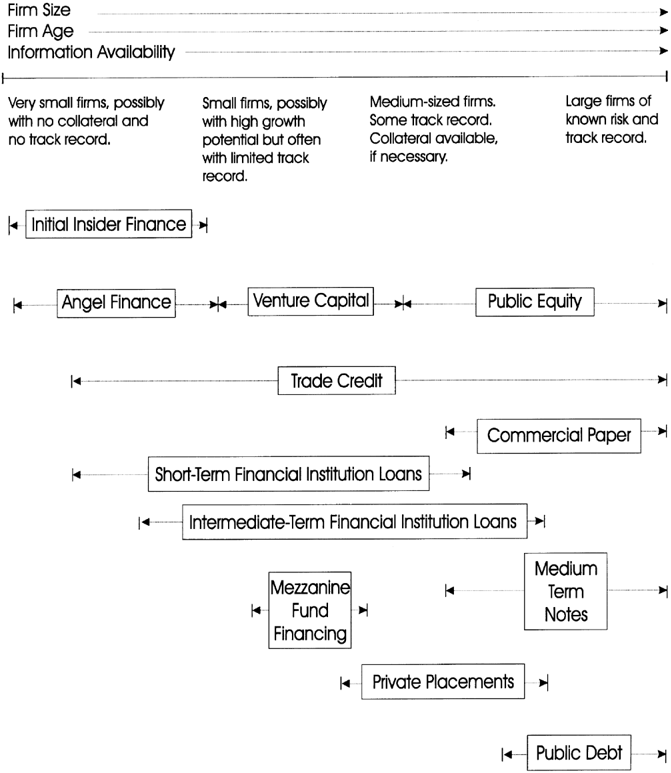
- The growth cycle paradigm predicts younger/more opaque firms rely on insider finance, trade credit, and angel finance, then venture capital and banks, and eventually public markets. However, 1993 NSSBF data show insider finance does not dominate external finance even for adolescents (upper bound 56.8% insider, roughly equal to external), and financial institution debt is important to very young firms, often based on personal guarantees or collateral.
- Macro vulnerability: the early-1990s credit crunch saw real C&I loans fall 23.2% ($596.7 billion to $458.2 billion) and estimated small business lending fall 38.5% ($143.7 billion to $88.4 billion). Banks with less than $100 million in assets held about 9% of portfolios in small business loans versus about 2% for banks over $10 billion; large banks charged about 100 basis points less and required collateral about 25% less often than small banks, other things equal.
Methods
- Design: review and synthesis organized around the financial growth cycle paradigm, covering theoretical and empirical literature on private equity and debt markets, contracts, and macroeconomic vulnerability.
- Data: primarily the 1993 National Survey of Small Business Finances (NSSBF) for US small business finance tables, plus other sources including NFIB, SCF, STBL, CALL, CRA, Venture Economics/VentureOne, and international data.
- Analysis: descriptive tabulations (Tables 1 and 2) and literature synthesis; the paper is a review rather than a new primary empirical study.
Limitations
- Paper-stated: Table 1 data are not completely accurate or consistent and should be considered rough estimates; angel finance estimates are imprecise (range $15 billion to $120 billion); 1993 data may not reflect current conditions; weighted averages mask considerable heterogeneity.
- Paper-stated: the growth cycle paradigm is not intended to fit all small businesses; firm size, age, and information availability are far from perfectly correlated, and the points at which different funding sources begin and end are not definitive.
- Evident from the text: informational opacity and the intertwining of personal and business finances make small business finance difficult to research, and data on owners’ finances are often unavailable; the paper relies heavily on existing literature and available data rather than new primary data collection.
Model-written summary. Check it against the paper before relying on it.
Integrity signals
Registry
Cites
Statistics
Figures
Verification
Claims the paper makes
22 Valid · 27 Not valid · 107 Not checked · 201 Own results and interpretations
Every source the paper cites for this claim was checked and supports it.
In the paper
“This use of personal assets to help with external ®nance also highlights another important aspect of small business ®nance ± the ®nancial intertwining of owners and their businesses (Ang, 1992).”
§ The economics of small business ®nance: The roles of private equity and debt markets in the ®nancial growth cycle > 2.3. The ®nancial growth cycle of small business
What the sources say
- Supportedcites Ang, 1992 matched to “On the Theory of Finance for Privately Held Firms” (1992) source
In “Integrating Personal and Business Accounts,” Ang says that personal guarantees or collateral make business risk inseparable from owners’ personal risk. “The Financing Decision” also identifies owners’ assets used for loan guarantees as contributions to the business. Together, these passages support the cited point that using personal assets to obtain external finance intertwines owners’ and businesses’ finances. (LLM, conf=0.94)
plainstates an association- Asserted: passes — The authors put it forward as true.
- Checkable: passes — It can be checked against evidence.
- Load-bearing: unclear — It is unclear whether the paper’s conclusions depend on it.
- Based: passes — The paper gives a reason why it holds.
- Supported
The cited sources support only part of this claim — read each source’s verdict below.
In the paper
“Costly state veri®cation (Townsend, 1979;Diamond, 1984) and adverse selection (Myers, 1984;Myers and Majluf, 1984;Nachman and Noe, 1994) arguments suggest the optimality of debt contracts after insider ®nance has been exhausted.”
§ The economics of small business ®nance: The roles of private equity and debt markets in the ®nancial growth cycle > 2.3. The ®nancial growth cycle of small business
What the sources say
- Partly supportedcites Townsend, 1979 matched to “Optimal contracts and competitive markets with costly state verification” (1979) sourceExperimental — accuracy not yet measured
Section 3 characterizes an optimal contract for a firm financing an investment project as a bond that defaults when returns fall below a threshold, supporting the costly-state-verification rationale for debt. The paper does not establish that debt becomes optimal only after insider finance has been exhausted. The adverse-selection citations in the sentence refer to other sources, not Townsend. (LLM, conf=0.85)
- Not checked — no full text of the sourcecites Diamond, 1984 matched to “Financial intermediation and delegated monitoring” (1984) source
- Not matchedcites Myers, 1984
More than one paper fits this citation.
hedgedstates a cause- Asserted: passes — The authors put it forward as true.
- Checkable: passes — It can be checked against evidence.
- Load-bearing: passes — The paper’s conclusions depend on it.
- Based: passes — The paper gives a reason why it holds.
- Partly supported
The cited sources support only part of this claim — read each source’s verdict below.
In the paper
“An agency problem arises in the relationship between the entrepreneur and the venture capitalist in which the entrepreneur may expend insucient eort, exhibit expense preference behavior, or lack sucient information or skill to make optimal production decisions.”
§ The economics of small business ®nance: The roles of private equity and debt markets in the ®nancial growth cycle > 3.2. The venture capital market
What the sources say
- Not checked — no full text of the sourcecites Cooper and Carleton, 1979 matched to “Dynamics of Borrower‐Lender Interaction: Partitioning Final Payoff in Venture Capital Finance” (1979) source
- Partly supportedcites Bergemann and Hege, 1998 matched to “Venture capital financing, moral hazard, and learning” (1998) sourceExperimental — accuracy not yet measured
Section 2.3, “Moral hazard and financing,” describes an entrepreneur who may reduce costly effort or divert investment funds to private ends, supporting the insufficient-effort and expense-preference parts of the claim. It does not identify a lack of the entrepreneur’s information or skill as a cause of poor production decisions; it instead says the entrepreneur and venture capitalists initially have the same assessment of the project. (LLM, conf=0.88)
hedgedstates a possible cause- Asserted: passes — The authors put it forward as true.
- Checkable: passes — It can be checked against evidence.
- Load-bearing: passes — The paper’s conclusions depend on it.
- Based: passes — The paper gives a reason why it holds.
Every source the paper cites for this claim was checked and supports it.
In the paper
“Since 1990, this share has about doubled to 30% (Fenn et al., 1997).”
§ The economics of small business ®nance: The roles of private equity and debt markets in the ®nancial growth cycle > 3. The role of private equity markets in small business ®nance
What the sources say
- Supportedcites Fenn et al., 1997 matched to “The Private Equity Market: An Overveiw” (1997) source
In “IPO Firms that Received Private Equity Backing,” the paper states that the share of IPOs with venture backing averaged 15% during the 1980s and doubled to 30% since 1990. This directly supports the cited claim. (LLM, conf=0.95)
plainstates an association- Asserted: passes — The authors put it forward as true.
- Checkable: passes — It can be checked against evidence.
- Load-bearing: unclear — It is unclear whether the paper’s conclusions depend on it.
- Based: passes — The paper gives a reason why it holds.
- Supported
The cited sources support only part of this claim — read each source’s verdict below.
In the paper
“During the 1980s, approximately 15% of all IPOs were backed by venture capital, well out of proportion to the fraction of all ®rms that received venture capital.”
§ The economics of small business ®nance: The roles of private equity and debt markets in the ®nancial growth cycle > 3. The role of private equity markets in small business ®nance
What the sources say
- Partly supportedcites Fenn et al., 1997 matched to “The Private Equity Market: An Overveiw” (1997) sourceExperimental — accuracy not yet measured
The section “IPO Firms that Received Private Equity Backing” states that venture-backed IPOs averaged 15% of IPOs during the 1980s. It does not give the fraction of all firms that received venture capital or make the claimed comparison with that fraction. (LLM, conf=0.84)
plainstates an association- Asserted: passes — The authors put it forward as true.
- Checkable: passes — It can be checked against evidence.
- Load-bearing: unclear — It is unclear whether the paper’s conclusions depend on it.
- Based: passes — The paper gives a reason why it holds.
- Partly supported
184 more claims · 6 with their cited sources checked
Create a free account to see all 357 claims and to verify the 12 references still open.
- Probably not a substantial claim. 94
- It may state two separate claims as one. 87
- Borderline: one of the tests for a substantial claim is unclear. 2
Claims other papers make about this one
Each is checked against this paper’s own text: does it say what the citing paper says it does?
The cited source says what the claim attributes to it.
In the citing paper
“SMEs are more dependent on external financing supplied by commercial banks (Berger and Udell 1998) because most of them are not qualified to raise money from the stock market.”
From Local Bank, Digital Financial Inclusion and SME Financing Constraints: Empirical Evidence from China (2022) · cites this paper as Berger and Udell 1998
Self-check
Percentages, sums and reported differences re-computed from the paper’s own numbers.
Rated minor: it would not touch a result — a value no result rests on, a p-value that stays on the same side of the significance level, or a conflict that is clerical, resolved elsewhere in the paper, or outside its own findings.
In the paper
“Non®nancial business/government debt provides 19.26% of small business funding (mostly trade credit)”
§ The economics of small business ®nance: The roles of private equity and debt markets in the ®nancial growth cycle > 4. The role of private debt markets in small business ®nance
Reported 19.26 · recomputed 18.01
Citations
Cites
Corporate financing and investment decisions when firms have information that investors do not have
Myers, S. C., & Majluf, N. S. (1984) · Journal of Financial Economics · doi:10.1016/0304-405x(84)90023-0 · Cited by 18,957
The Cost of Capital, Corporation Finance and the Theory of Investment
Miller, M. H. (1958) · American Economic Review · Cited by 14,574
Determinants of corporate borrowing
Myers, S. C. (1977) · Journal of Financial Economics · doi:10.1016/0304-405x(77)90015-0 · Cited by 13,169
Credit Rationing in Markets with Imperfect Information
Stiglitz, J. E., & Weiss, A. (1981) · Columbia University · doi:10.7916/d8v12ft1 · Cited by 12,769 · cited 1×
“…pledging outside collateral may help resolve adverse selection problems when the borrower has more information about the quality of the investment than the lender, and may help prevent credit rationing (Stiglitz and Weiss 1981, 1986, Bester 1985, Chan and Kanatas 1985, Besanko and Thakor 1987a,b).”
The cost of capital, corporation finance and the theory of investment
Terra, P. R. (2008) · Revista de Administração e Contabilidade da Unisinos · doi:10.4013/base.20082.07 · Cited by 8,615
Financial intermediation and delegated monitoring
Diamond, D. W. (1984) · The Review of Economic Studies · doi:10.2307/2297430 · Cited by 8,476 · cited 2×
“Costly state verification (Townsend 1979, Diamond 1984) and adverse selection (Myers 1984, Myers and Majluf 1984, Nachman and Noe 1994) arguments suggest the optimality of debt contracts after insider cFor example, there are generally accepted definitions of the stages of finance for the kind of…”
Corporate Financing and Investment Decisions When Firms Have InformationThat Investors Do Not Have
Myers, S., & Majluf, N. (1984) · doi:10.3386/w1396 · Cited by 6,745
The Benefits of Lending Relationships: Evidence from Small Business Data
PETERSEN, M. A., & RAJAN, R. G. (1994) · The Journal of Finance · doi:10.1111/j.1540-6261.1994.tb04418.x · Cited by 5,440 · cited 4×
“…whereas mortgages, equipment loans, motor vehicle loans, and other loans may more often be transactionsdriven .zs It was also found that dependence on trade credit decreased with the length of the banking relationship, supporting the value of relationship lending (Petersen and Rajan 1994, 1995).”
InfluentialInside the black box: the credit channel of monetary policy transmission
Bernanke, B. S., & Gertler, M. (1995) · Journal of Economic Perspectives · doi:10.1257/jep.9.4.27 · Cited by 4,211
Insiders and Outsiders: The Choice between Informed and Arm's‐Length Debt
RAJAN, R. G. (1992) · The Journal of Finance · doi:10.1111/j.1540-6261.1992.tb04662.x · Cited by 3,902 · cited 1×
“Some research suggests that these firms may try to reduce the control of their banks by issuing public debt, even though public debt may entail higher costs (Diamond 1991, 1993, Rajan 1992, Houston and James 1996).”
Research works printed but not linked: 11
- 66. Cook, L., 1997. Trade ®nance, bank ®nance, and capital market imperfections. Working paper. Harvard University, Cambridge, MA.
- 89. Freear, J., Sohl, J.E., Wetzel, W.E., Jr., 1994. The private investor market for venture capital. The Financier 1, 7±19.
- 112. Hancock, D., Wilcox, J.A., 1997. Bank capital, nonbank ®nance, and real estate activity. Journal of Housing Research 8, 75±105.
- 117. Hempel, G., Coleman, A., Simonson, D., 1986. Bank Management, Wiley, New York.
- 119. Ho, R., 1997. Credit-card use to ®nance small business is soaring, says survey of small ®rms. Wall Street Journal B2, Sept. 25.
- 153. Megginson, W.L., Weiss, K.A., 1991. Venture capitalist certi®cation in initial public oerings. Journal of Finance 46, 903±979.
- 162. Morsman Jr., E., 1986. Commercial loan structuring. Journal of Commercial Bank Lending 68, 2± 20.
- 187. Ravid, S.A., 1996. Debt maturity ± A survey. Financial Markets, Institutions and Instruments 5 (3), 1±68.
- 217. Wetzel Jr. W.E., 1994. Venture capital. In: Bygrave, W.D. (Ed.), Portable MBA in Entrepreneur- ship. Wiley, New York, pp. 172±194.
- 219. White, L.J., 1995. An analytical framework. In: Zahid, S.N. (Ed.), Financial Sector Development in Asia. Oxford University Press, New York, pp. 3±35.
- 222. McKean, R. (Ed.), Issues in Defense Economics. Columbia University Press, New York.
Cited by
Items 2,301–2,400 of 3,739
Adalessossi, B. D. U. K. (2015) · 美中经济评论:英文版 · doi:10.17265/1537-1514/2015.02.003 · Cited by 3
“Berger and Udell (1998) argued that new businesses are the most informationally opaque, on account of their lack of any track record of their business.”
BackgroundMalone, P., & Mazzarol, T. W. (2022) · Springer eBooks · doi:10.1007/978-981-19-2651-8_7 · Cited by 3
Senior-subordinated structure: buffer or signal in securitisation?
Filomeni, S., & Baltas, K. N. (2022) · European Journal of Finance · doi:10.1080/1351847x.2022.2052140 · Cited by 3
Funding Sources for Medical Entrepreneurship in the Digital Age (Middle East Perspective)
El-Chaarani, H., Raimi, L., & El-Abiad, Z. (2023) · Springer eBooks · doi:10.1007/978-981-19-6696-5_7 · Cited by 5
Which Loans are Relationship Loans? Evidence from the 1998 Survey of Small Business Finances
Mitchell, K., & Pearce, D. K. (2004) · The Journal of Entrepreneurial Finance · doi:10.57229/2373-1761.1068 · Cited by 3
“His main research interests are financial markets, financial institutions, and Federal Reserve policy. recurring credit needs (e.g., Berger and Udell (1998)).”
BackgroundDynamic model of the efficiency of small enterprises
Parkitna, A., & Gądek, M. (2023) · Journal of Entrepreneurship and Sustainability Issues · doi:10.9770/jesi.2023.11.1(19 · Cited by 4
The oak and the reed: Working capital management and the role of business group affiliation
Lefebvre, V., & Hamelin, A. (2022) · Finance · doi:10.3917/fina.432.0159 · Cited by 3
Bank Financing Constraints: The Effects of Start-Up Characteristics
Iruarrizaga, J. H., Mendialdua, A. B., & Santos, M. S. (2014) · Springer eBooks · doi:10.1007/978-3-319-08888-4_15 · Cited by 3
Does Money Make the Entrepreneurial World Go Round
Lima, F., & Venâncio, A. (2009) · Cited by 3
Does the value of venture capital vary over the investee life cycle? Evidence from Irish investees
Huyghebaert, N., & O’Donohoe, S. (2007) · Elsevier eBooks · doi:10.1016/b978-075068259-6.50024-5 · Cited by 3
La estructura de capital de las pequeñas y medianas empresas argentinas
Briozzo, A., & Vigier, H. P. (2009) · Estudios económicos · doi:10.52292/j.estudecon.2009.885 · Cited by 3
Breakthrough Innovations by Locally Embedded Start-Ups and SMEs in a Global Network
Breukel, A., & Zeegers, H. (2017) · Springer eBooks · doi:10.1007/978-3-319-43859-7_7 · Cited by 3
Innovation Systems, Policy and Management
Niosi, J. E. (2018) · Cited by 7
Xu, J., & Shi, Y. (2019) · International Conference on Economic Management and Model Engineering (ICEMME) · doi:10.1109/icemme49371.2019.00038 · Cited by 4
Building a Junior Stock Exchange: Lessons from China
Xu, W., Zhu, S., & Wu, Z. (2020) · European Business Organization Law Review · doi:10.1007/s40804-020-00181-0 · Cited by 3
“3 Berger and Udell (1998).”
Development of Bangladesh through SMEs Financing: A Case Study on IDLC Finance Limited
Islam, K. M. A. (2017) · Australian Finance & Banking Review · doi:10.46281/afbr.v1i1.1237 · Cited by 3
Neuberger, D. (2005) · SSRN Electronic Journal · doi:10.2139/ssrn.818384 · Cited by 5
Law, Innovation and Finance: A ReviewPreprint
Armour, J. H. (2002) · RePEc: Research Papers in Economics · Cited by 8
Dietrich, A. (2009) · SSRN Electronic Journal · doi:10.2139/ssrn.1333200 · Cited by 3
Determinants of capital structure of start-up firms in South Africa
Elomo, P. N. (2015) · University of the Witwatersrand, Johannesburg Institutional Repository on DSpace (University of the Witwatersrand, Johannesburg) · Cited by 6
Law or Finance: Evidence from Finland (Revised version 25.09.2002))Preprint
Hyytinen, A., Kuosa, I., & Takalo, T. (2001) · RePEc: Research Papers in Economics · Cited by 3
Does Relationship Lending Require Opaque (and Conservative) Financial ReportingPreprint
Bigus, J., & Hakenes, H. (2014) · SSRN Electronic Journal · doi:10.2139/ssrn.2414587 · Cited by 5
Creating Modern Venture Capital: Institutional Design and Performance in the Early YearsPreprint
Fohlin, C. (2013) · SSRN Electronic Journal · doi:10.2139/ssrn.2197840 · Cited by 4
Dimensions of Capital Structure of Companies:Evidence from Sub-Saharan Africa
Danso, A. (2014) · UPT. Syiah Kuala University Library (Syiah Kuala University) · Cited by 3
Modina, M., & Polese, F. (2009) · SSRN Electronic Journal · doi:10.2139/ssrn.1338745 · Cited by 3
ESTRADA, J. V. (2012) · RiuNet (Universitat Politècnica de València) · doi:10.4995/thesis/10251/18141 · Cited by 31
Jackson, W. E., & Thomson, J. B. (2008) · SSRN Electronic Journal · doi:10.2139/ssrn.1260440 · Cited by 3
Capital Structure Determinants in Growth Firms Accessing Venture FundingPreprint
Balboa, M., Martí, J., & Tanaka, Á. T. (2009) · SSRN Electronic Journal · doi:10.2139/ssrn.1344267 · Cited by 3
“However, since the 90s, more attention has been devoted to small and medium firms because of the interest of academics and political regulators in these firms (Berger and Udell, 1998) and because they are different in many respects, including financing, to large firms (Hutchinson et al.”
InfluentialInteraction between Trade Credit and Debt: Evidence from the Italian MarketPreprint
Gibilaro, L., & Mattarocci, G. (2010) · SSRN Electronic Journal · doi:10.2139/ssrn.1664443 · Cited by 3
R&D financing of start-up firms : How much does founders' human capital matter?
Honjo, Y., Kato, M., & Okamuro, H. (2010) · Institutional Repositories DataBase (IRDB) · Cited by 3
Small-business access to trade credit: some evidence of ethnic differencesPreprint
Aaronson, D. M., Huck, P. F., & Townsend, R. M. (2000) · RePEc: Research Papers in Economics · Cited by 4
Demand Side Analysis of Microlending Markets in GermanyPreprint
Kritikos, A. S., Kneiding, C., & Germelmann, C. C. (2009) · SSRN Electronic Journal · doi:10.2139/ssrn.1491048 · Cited by 3
The Determinants of SMEs Capital Structure: Overcoming Supply Constraints
Gennari, A. N. (2012) · Portuguese National Funding Agency for Science, Research and Technology (RCAAP Project by FCT) · Cited by 3
Corporate Finance and Corporate Financial Advisory for Family BusinessPreprint
Gatti, S. (2004) · SSRN Electronic Journal · doi:10.2139/ssrn.540822 · Cited by 3
“…from the sale of equity stakes by a physical person (the entrepreneur) are subject to a tax regime which is different from ordinary income taxes.3 1 Berger and Udell (1998) point out that during their life cyle, small family-owned firms are characterized by very different financial structures.”
BackgroundCapital structure and corporate governance : the role of hybrid financial instruments
Sasso, L. (2013) · London School of Economics and Political Science Theses Online (London School of Economics and Political Science) · Cited by 14
Culture and Capital Structure in Small and Medium Sized FirmsPreprint
Kearney, C., Bhaird, C. M. A., & Lucey, B. M. (2012) · SSRN Electronic Journal · doi:10.2139/ssrn.2185284 · Cited by 8
Venture Capital Investments in Europe and Firm Productivity: Independent versus Corporate InvestorsPreprint
Colombo, M. G., & Murtinu, S. (2014) · SSRN Electronic Journal · doi:10.2139/ssrn.2384816 · Cited by 6
Growth and Change in the New Economy: Opportunities and Challenges
Polski, M. M. (2002) · Springer eBooks · doi:10.1007/978-3-540-24826-2_15 · Cited by 3
The Relation between Country-Specific Factors and Working Capital: Is it About Rule of Law?Preprint
Mättö, M., & Niskanen, M. (2015) · SSRN Electronic Journal · doi:10.2139/ssrn.2546287 · Cited by 5
Start-Up Financing: Outside EquityPreprint
Hvide, H. K., & Mjøs, A. (2007) · SSRN Electronic Journal · doi:10.2139/ssrn.1023942 · Cited by 2
1999 Levy Institute Survey of Small Business: An Impending Cash Flow Squeeze?Preprint
Moudud, J. K. (1999) · RePEc: Research Papers in Economics · Cited by 5
Simeonova–Ganeva, R., Vladimirov, Z. D., Boeva, M., et al. (2011) · SSRN Electronic Journal · doi:10.2139/ssrn.2290717 · Cited by 3
Gabriel, K. (2015) · SSRN Electronic Journal · doi:10.2139/ssrn.2665041 · Cited by 3
Trade Credit in Europe: 'It is All Down to Culture'Preprint
Belghitar, Y., Mateus, C., & Moro, A. (2016) · SSRN Electronic Journal · doi:10.2139/ssrn.2809112 · Cited by 3
Bertoni, F., Grilli, L., & D’Adda, D. (2010) · Università Politecnica delle Marche (Università Politecnica delle Marche) · Cited by 3
Hong, B. P. (2017) · White Rose eTheses Online (University of Leeds, The University of Sheffield, University of York) · Cited by 3
The Role of Culture in Firm-Bank MatchingPreprint
Accetturo, A., Barboni, G., Cascarano, M., & García-Appendini, E. (2021) · SSRN Electronic Journal · doi:10.2139/ssrn.3882637 · Cited by 3
Product Market Competition and the Financing of New VenturesPreprint
de Bettignies, J., & Duchêne, A. (2014) · SSRN Electronic Journal · doi:10.2139/ssrn.2403211 · Cited by 3
The Decline of Secured DebtPreprint
Benmelech, E., Kumar, N., & Rajan, R. G. (2020) · SSRN Electronic Journal · doi:10.2139/ssrn.3512974 · Cited by 3
“It is hard to discern a clear trend over the period, though the share of bonds with NPCs rose in the early years between 1926 and 1946. We use Mergent to collect information on the prevalence of NPC in bonds issued in recent years. Non-missing information on NPC – whether a bond has NPC or not – is available for a sub…”
InfluentialBhue, G., & Tantri, P. L. (2019) · SSRN Electronic Journal · doi:10.2139/ssrn.2960598 · Cited by 3
Bank Capital Ratios and the Structure of Nonfinancial IndustriesPreprint
Lee, S. J., & Stebunovs, V. (2011) · SSRN Electronic Journal · doi:10.2139/ssrn.1970447 · Cited by 5
Armstrong, C. E., Craig, B. R., Jackson, W. E., et al. (2010) · SSRN Electronic Journal · doi:10.2139/ssrn.1723444 · Cited by 3
“Clearly, under these conditions, it is conceivable that the demand for credit may exceed the supply of credit in equilibrium (Berger & Udell, 1998; 9 Hyytinen, A., & Väänänen, L. 2006).”
BackgroundLoan Guarantee and Portfolio Greening: Evidence from European Credit RegistersPreprint
Buchetti, B., Lin, L. X., Miquel-Flores, I., Perdichizzi, S., & Reghezza, A. (2024) · SSRN Electronic Journal · doi:10.2139/ssrn.4731209 · Cited by 5
Greentech Innovation and Diffusion
Hoff, P. H. (2012) · Gabler Verlag eBooks · doi:10.1007/978-3-8349-3601-1 · Cited by 13
A Macroeconometric Assessment of Minsky's Financial Instability HypothesisPreprint
Greenwood‐Nimmo, M., & Tarassow, A. (2013) · SSRN Electronic Journal · doi:10.2139/ssrn.2320964 · Cited by 3
“tightening will be concentrated among informationally opaque firms with lower net worth (Berger and Udell, 1998).”
Kalapriya, K. (2024) · Asian Journal of Management Studies · doi:10.4038/ajms.v3i2.67 · Cited by 2
MANDATORY CREDIT ALLOCATION AND GOVERNMENT GUARANTEE IN THE PHILIPPINES
Dumlao, L. F. (2024) · Financial and credit activity problems of theory and practice · doi:10.55643/fcaptp.2.55.2024.4322 · Cited by 2
“They cited the works of Beck and Demirguc - Kunt (2006), Berger and Udell (1998), and Chittitaworn et al (2011) identifying credit access as one of the constraints of SMEs for higher productivity, growth, and development.”
BackgroundBeyond age: Decoding the investment DNA of generations Z and Y in Indonesia
Ovami, D. C., Lubis, H. Z., Setiana, E., et al. (2024) · Investment Management and Financial Innovations · doi:10.21511/imfi.21(3).2024.31 · Cited by 2
“This means that investment activities are activities carried out to avoid spending current money on purposeful activities to increase future profits (Berger & Udell, 1998).”
BackgroundZhu, L., Memili, E., & Fang, H. “. (2025) · Entrepreneurship Research Journal · doi:10.1515/erj-2024-0148 · Cited by 3
What sources of finance are firms least likely to use?
Cowling, M., & Yang, H. (2025) · Finance research letters · doi:10.1016/j.frl.2025.107385 · Cited by 4
Discouraged Borrowers and Sentimental Shocks
Anastasiou, D., Pasiouras, F., Ρίζος, Α., & Stratopoulou, A. (2025) · Journal of International Money and Finance · doi:10.1016/j.jimonfin.2025.103359 · Cited by 2
Nassim, I., Nassim, S., & Moussa, A. (2025) · International Journal of Financial Studies · doi:10.3390/ijfs13030164 · Cited by 15
“Most prior research has focused on large, often publicly listed corporations, leaving SMEs relatively understudied in theoretical frameworks (T. H. L. Beck et al., 2005; Colot & Croquet, 2007; Berger & Udell, 1998).”
A hazai kis- és középvállalkozások növekedési konfigurációi
Komlosi, E. S., & Szerb, L. (2025) · Közgazdasági Szemle · doi:10.18414/ksz.2025.9-10.842 · Cited by 2
Zhu, Z., & Song, W. (2025) · The North American Journal of Economics and Finance · doi:10.1016/j.najef.2025.102549 · Cited by 2
Bu, Y., Jin, N., & Li, H. (2025) · Pacific-Basin Finance Journal · doi:10.1016/j.pacfin.2025.103036 · Cited by 13
Beyond the bureau: Interoperable payment data for loan screening and monitoring
Rishabh, K. (2026) · Journal of Financial Intermediation · doi:10.1016/j.jfi.2026.101196 · Cited by 11
Gumber, A., Egli, F., & Steffen, B. (2026) · Environmental Innovation and Societal Transitions · doi:10.1016/j.eist.2026.101123 · Cited by 2
Nassim, I., Mahboubi, M. H., & Nassim, S. (2026) · Journal of risk and financial management · doi:10.3390/jrfm19040244 · Cited by 7
Fredriksson, A. (2012) · Medical Entomology and Zoology · Cited by 2
The impact of financing on the investments of SMEs: evidence from the recent financial crisis
Zubair, S. M. (2014) · University of Twente Research Information · Cited by 2
Kunyang, W., & Yan, Y. (2009) · International Conference on Information Management, Innovation Management and Industrial Engineering (ICIII) · doi:10.1109/iciii.2009.79 · Cited by 2
FİRMALARIN FİNANSMAN KARARLARI: DAVRANIŞSAL PERSPEKTİF
Tekin, B. (2016) · Akademik Araştırmalar ve Çalışmalar Dergisi (AKAD) · doi:10.20990/kilisiibfakademik.266032 · Cited by 6
Kurumsal Yaşam Eğrisi ve Muhasebe Performansı: Borsa İstanbul Örneği
Güleç, Ö. F., & Karacaer, S. (2018) · Muhasebe ve Finansman Dergisi · doi:10.25095/mufad.412716 · Cited by 2
Liu, L. (2018) · doi:10.2991/icem-17.2018.76 · Cited by 2
“Even though enterprise obtains “Angle Investment” luckily, the company’s later operation decision will be influenced, as investor will ask for the definite number of shares[2].”
BackgroundAnalyse des déterminants du recours au capital-risque par les entreprises camerounaises
Ngongang, D. (2018) · Revue internationale des sciences de l organisation · doi:10.3917/riso.004.0093 · Cited by 2
STUDY OF FACTORS AFFECTING THE ATTITUDE OF DEBT FINANCING DECISION
Satoto, S. H., Nilmawati, & Nurrohim, K. P. H. (2020) · Russian Journal of Agricultural and Socio-Economic Sciences · doi:10.18551/rjoas.2020-02.13 · Cited by 2
“This view is supported by Berger and Udell (1998), Harvey and Evans (1995), and Barton (1989), who find that issues relating to risk control and avoidance affect capital structure and financing decisions.”
BackgroundBehavioral agency research and theory: a review and research agenda
Massa, R. M., Partyka, R. B., & Lana, J. (2020) · Cadernos EBAPE BR · doi:10.1590/1679-395177017x · Cited by 2
Financing Behavior of Small and Medium Sized Enterprises of Khyber Pakhtunkhwa at Life Cycle Stages
Ali, S., Jabeen, M., Qazi, L. T., & Jabeen, A. (2020) · Journal of Applied Economics and Business Studies · doi:10.34260/jaebs.437 · Cited by 4
“Researchers like (Berger & Udell, 1998) have developed a financial growth life cycle model for SMEs which need to be tested for SMEs around the world.”
BackgroundDemand Side Analysis of Microlending Markets in Germany
Kritikos, A. S., Kneiding, C., & Germelmann, C. C. (2009) · Jahrbücher für Nationalökonomie und Statistik · doi:10.1515/jbnst-2009-0502 · Cited by 4
“There are three more options: First, Berger and Udell (1998) emphasize the importance of private loans for this segment.”
InfluentialSustainable Islamic SME Financing
Diallo, A. T., & Gündoğdu, A. Ş. (2021) · Palgrave studies in Islamic banking, finance, and economics · doi:10.1007/978-3-030-67094-8_4 · Cited by 2
Owusu‐Manu, D., Parn, E. A., Antwi‐Afari, M. F., et al. (2017) · Journal of Construction Project Management and Innovation · doi:10.36615/jcpmi.v7i1.127 · Cited by 2
“Previously, other authors have considered age of vendor firms as a proxy measure for reduction of asymmetric information between a firm and its financiers (Elliehausen and Wolken, 1990; Berger and Udell, 1998).”
BackgroundAnh, H. T. P., Hà, V. M., & Hồng, N. T. T. (2020) · TẠP CHÍ KHOA HỌC ĐẠI HỌC MỞ THÀNH PHỐ HỒ CHÍ MINH - KINH TẾ VÀ QUẢN TRỊ KINH DOANH · doi:10.46223/hcmcoujs.econ.vi.13.1.529.2018 · Cited by 4
Does the Capital Structure of New Ventures Differ as a Response to a Financial Crisis?
Guedes, M. J., Saraiva, T., & Felício, T. (2021) · Advances in finance, accounting, and economics book series · doi:10.4018/978-1-7998-6643-5.ch005 · Cited by 2
Saerens, F., & Ceustermans, S. (2021) · Sustainability · doi:10.3390/su13158137 · Cited by 2
“Although agency conflicts can be reduced via private channels [31,37,38], that does not mean that financial statements are not valuable in lending decisions.”
BackgroundBorrower income and loan rates in the credit market of Lima
Zegarra, L. F. (2021) · Economic History of Developing Regions · doi:10.1080/20780389.2021.1962705 · Cited by 2
“Lenders face operation costs for making a loan, in particular for searching, screening, and monitoring (Bhat and Tang 1998; Dietrich 2012).”
BackgroundFrom Market Fixing to Market Creating: A New Framework for Innovation Policy*
Mazzucato, M. (2018) · Cambridge University Press eBooks · doi:10.1017/9781108529525.005 · Cited by 7
Small Scale Enterprise Finance Sources and Constraints in Ethiopia, Case Study of Addis Ababa
(2016) · International Journal of Science and Research (IJSR) · doi:10.21275/v5i4.nov162911 · Cited by 2
Small and Medium Enterprises' Challenges of Accessing Microfinance in Nigeria
Woldie, A., & Ubrurhe, U. (2021) · IGI Global eBooks · doi:10.4018/978-1-7998-9155-0.ch071 · Cited by 2
Koch, L. P., Crossan, K., & Jaworski, P. M. (2022) · International Journal of Entrepreneurial Behaviour & Research · doi:10.1108/ijebr-04-2021-0247 · Cited by 5
Vandana (2023) · Proceedings of the National Academy of Sciences India Section A Physical Sciences · doi:10.1007/s40010-022-00806-8 · Cited by 2
“Nevertheless, according to Berger and Udell [10], approximately 16% of the total assets of small U.S. businesses are funded through trade credit.”
BackgroundInfluentialSustainability in Private Capital Investing: A Systematic Literature Review
Mirza, M., Dordi, T., Alguindigue, P., Johnson, R. G., & Weber, O. (2023) · Journal of Management and Sustainability · doi:10.5539/jms.v13n1p119 · Cited by 3
An agent-based model of supply chain financing: agents’ strategies, performance, and risk contagions
Yang, Y., Que, X., Qian, Q., & Fang, H. (2023) · Journal of Simulation · doi:10.1080/17477778.2023.2207747 · Cited by 4
“…enterprises (SMEs) often encounter difficulties in accessing financing given the many inherent features of SMEs, such as information asymmetry (Berger & Udell, 1998), a lack of trading history (R. Wang et al., 2019), a high risk of failure (Gupta & Gregoriou, 2018), and a low portion of…”
Gandégnon, M. C. F. (2023) · Revue internationale P M E Économie et gestion de la petite et moyenne entreprise · doi:10.7202/1098938ar · Cited by 4
A Three-Level Game-Theoretic Trade Credit Model in a Supply Channel
Ezimadu, S. O., & Ezimadu, P. E. (2023) · Journal of Advances in Mathematics and Computer Science · doi:10.9734/jamcs/2023/v38i71780 · Cited by 2
Business group affiliation in resource-scarce locations
Lefebvre, V. (2023) · Journal of Organization Design · doi:10.1007/s41469-023-00145-x · Cited by 2
“Small and young firms have limited access to finance, because informational opacity increases the risk that investors take when investing in or lending money to these firms (Stiglitz and Weiss 1981; Berger and Udell 1998; Cassar 2004).”
BackgroundBased On “Long Tail” Theory to Solve Finance Difficulties of SMEs with Internet Finance
Yang, M., & Wang, G. D. (2023) · Advances in Economics and Management Research · doi:10.56028/aemr.6.1.382.2023 · Cited by 2
“…made survey on all the commercial banks in American financial markets and made a conclusion that for banks developing electric financial services, they have wide sources of debts, their income gradually transforming from interest income into intermediate business income(Berger and Udell, 1998).”
BackgroundFollow the money: funding acquisition processes of nascent ventures
Herrmann, A. M., Polzin, F., Held, L., & Dimov, D. P. (2024) · Entrepreneurship and Regional Development · doi:10.1080/08985626.2023.2298997 · Cited by 4
“Because these sources are distinct in terms of the requirements they place on the founders and the nascent ventures (Linder, Lechner, and Pelzel 2019), scholars theorized on the funding choices, developing what has become known as pecking-order theory (POT) (e.g. Cosh, Cumming, and Hughes 2009; Frank and Goyal 2003; M…”
BackgroundResultInfluentialMugiati, M. (2024) · International Journal of Accounting & Finance in Asia Pasific · doi:10.32535/ijafap.v7i1.2880 · Cited by 2
DuPont analysis among European dentistry companies to measure the impact of the COVID-19 pandemic
Heryán, T., & Gajdová, K. (2024) · E+M Ekonomie a Management · doi:10.15240/tul/001/2024-1-010 · Cited by 3
The Impact of Credit and Liquidity Risk on Bank Performance
Abbas, M. R., & Ullah, B. (2023) · Bulletin of Business and Economics (BBE) · doi:10.61506/01.00104 · Cited by 2
Metadata
- Authors
- N. Berger, A., & F. Udell, G.
- Venue
- Journal of Banking & Finance
- Publisher
- Elsevier BV
- Published
- 1998-08
- Volume
- 22
- Issue
- 6-8
- Pages
- 613-673
- ISSN
- 0378-4266 (ISSN-L)
- OpenAlex
- W2119780569
- Semantic Scholar
- dfc06f7f7eb83d2c0e2a1d67ecb95b520a406843
- Cited by
- 3,690
- References
- 230
- Citations by year
- 2026: 136 · 2025: 148 · 2024: 144 · 2023: 193 · 2022: 155 · 2021: 211 · 2020: 200 · 2019: 156 · 2018: 208 · 2017: 174 · 2016: 186 · 2015: 187 · 2014: 168 · 2013: 177 · 2012: 171
- FWCI
- 169.26
- Type
- journal article
- Language
- en
- Open access
- hybrid
- doi.org
- Licence
- cc-by-nc-nd
- www.elsevier.com/tdm/userlicense/1.0/ (tdm)
- www.elsevier.com/legal/tdmrep-license (tdm)
- creativecommons.org/licenses/by-nc-nd/4.0/ (vor, 125 d)
- Locations
- Journal of Banking & Finance (publishedVersion, cc-by-nc-nd)
- RePEc: Research Papers in Economics (submittedVersion)
- Funders
- York University
- Topics
- Social Sciences › Economics, Econometrics and Finance › Finance › Private Equity and Venture Capital
- Social Sciences › Economics, Econometrics and Finance › Finance › Corporate Finance and Governance
- Social Sciences › Economics, Econometrics and Finance › Finance › Banking stability, regulation, efficiency
- Keywords
- small business financing, private equity, debt markets, capital structure, firm size, firm age, macroeconomic conditions
About these checks
Registry, retraction, Cites and statistics results are computed, not judged, with one exception: a printed reference that no index lists is read once by a model before it counts as a citation error. Claims are extracted by a model and kept only when their quote appears verbatim in the text; each cited source is then checked, with a model’s help, for whether it says what the claim relies on. Those verdicts can be wrong — read the claim’s quote and the cited source before relying on one.
The claim verdicts this report counts are experimental: their accuracy is not yet measured.
A language model drew the claims from the paper on 2026-10-10, under version 3 of the claim definition (model deepseek-v4.1-flash, prompt extract-v3).
A second model labelled each claim on 2026-10-10 (model jev-1.13-20260917, definition revision gold-guideline-v0.2).
Cited sources are checked with a language model’s help (gpt-6-sol).
Statistics and arithmetic are recomputed, not judged.
Confidence bands are shown only for fields calibrated on our annotated test set. None is calibrated yet, so no band is shown.
What counts as a claim ›How we measure confidence ›How we check this ›
Are you an author, or do you see a problem with this page? Request a review
Data sources
Bibliographic data: Semantic Scholar, OpenAlex, Crossref.
Contains information from the Semantic Scholar Academic Graph Datasets, made available under the ODC Attribution License (ODC-BY 1.0).
Semantic Scholar’s data is described in: Kinney, R., et al. (2023). The Semantic Scholar Open Data Platform. arXiv:2301.10140.
