

The economics of small business finance: The roles of private equity and debt markets in the financial growth cycle
Open accessThe DOI matches its Crossref record; 217 of the 230 references it cites were found in a registry or an index, and 1 are not checked yet; 24 of the 170 sources its claims cite were checked for support.
Abstract
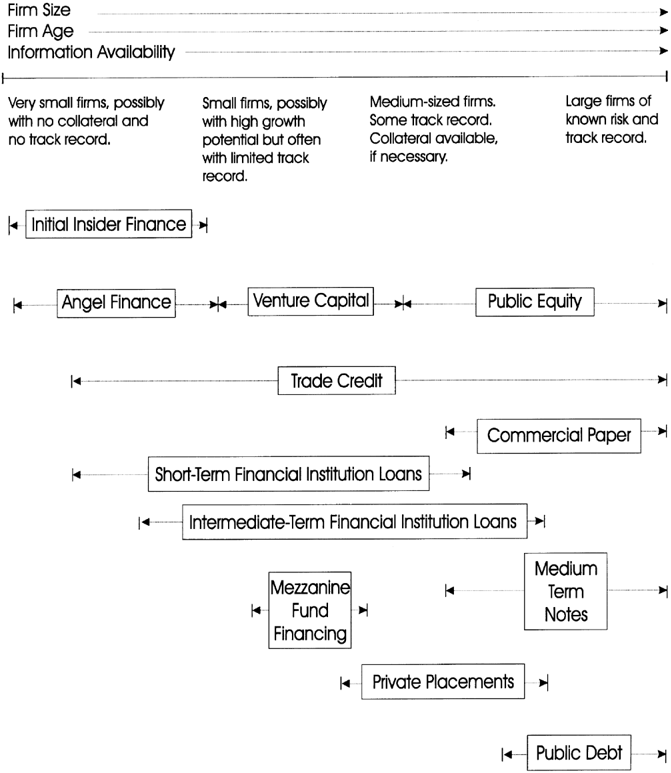
This article examines the economics of financing small business in private equity and debt markets. Firms are viewed through a financial growth cycle paradigm in which different capital structures are optimal at different points in the cycle. We show the sources of small business finance, and how capital structure varies with firm size and age. The interconnectedness of small firm finance is discussed along with the impact of the macroeconomic environment. We also analyze a number of research and policy issues, review the literature, and suggest topics for future research.
Verified 2026-11-25 · 1 reference not checked yet
Overview
CoChat Summary
TL;DR
This article reviews the economics of small business finance through a financial growth cycle paradigm, emphasizing informational opacity and the roles of private equity and debt markets. It documents US small business funding sources and contracts, and analyzes vulnerability to macroeconomic shocks, credit crunches, and bank consolidation.
Key findings
- US small business finance is split roughly evenly between equity (49.63%) and debt (50.37%); the largest sources are the principal owner, commercial banks, and trade creditors, together accounting for 70.10% of total funding. Commercial banks provide 18.75%, trade credit 15.78%, principal owner equity 31.33%, angel finance 3.59%, venture capital 1.85%, and credit card debt 0.14%.
- Financial institution debt is used by 54.23% of small businesses; 86.95% name a commercial bank as their primary financial institution. Average relationship length is 6.64 years overall and 9.01 years with the primary institution; 52.03% of financial institution debt is under lines of credit, 91.94% is secured, and 51.63% is guaranteed.
- The growth cycle paradigm predicts younger/more opaque firms rely on insider finance, trade credit, and angel finance, then venture capital and banks, and eventually public markets. However, 1993 NSSBF data show insider finance does not dominate external finance even for adolescents (upper bound 56.8% insider, roughly equal to external), and financial institution debt is important to very young firms, often based on personal guarantees or collateral.
- Macro vulnerability: the early-1990s credit crunch saw real C&I loans fall 23.2% ($596.7 billion to $458.2 billion) and estimated small business lending fall 38.5% ($143.7 billion to $88.4 billion). Banks with less than $100 million in assets held about 9% of portfolios in small business loans versus about 2% for banks over $10 billion; large banks charged about 100 basis points less and required collateral about 25% less often than small banks, other things equal.
Methods
- Design: review and synthesis organized around the financial growth cycle paradigm, covering theoretical and empirical literature on private equity and debt markets, contracts, and macroeconomic vulnerability.
- Data: primarily the 1993 National Survey of Small Business Finances (NSSBF) for US small business finance tables, plus other sources including NFIB, SCF, STBL, CALL, CRA, Venture Economics/VentureOne, and international data.
- Analysis: descriptive tabulations (Tables 1 and 2) and literature synthesis; the paper is a review rather than a new primary empirical study.
Limitations
- Paper-stated: Table 1 data are not completely accurate or consistent and should be considered rough estimates; angel finance estimates are imprecise (range $15 billion to $120 billion); 1993 data may not reflect current conditions; weighted averages mask considerable heterogeneity.
- Paper-stated: the growth cycle paradigm is not intended to fit all small businesses; firm size, age, and information availability are far from perfectly correlated, and the points at which different funding sources begin and end are not definitive.
- Evident from the text: informational opacity and the intertwining of personal and business finances make small business finance difficult to research, and data on owners’ finances are often unavailable; the paper relies heavily on existing literature and available data rather than new primary data collection.
Model-written summary. Check it against the paper before relying on it.
Integrity signals
Registry
Cites
Statistics
Figures
Verification
Claims the paper makes
22 Valid · 27 Not valid · 107 Not checked · 201 Own results and interpretations
Every source the paper cites for this claim was checked and supports it.
In the paper
“This use of personal assets to help with external ®nance also highlights another important aspect of small business ®nance ± the ®nancial intertwining of owners and their businesses (Ang, 1992).”
§ The economics of small business ®nance: The roles of private equity and debt markets in the ®nancial growth cycle > 2.3. The ®nancial growth cycle of small business
What the sources say
- Supportedcites Ang, 1992 matched to “On the Theory of Finance for Privately Held Firms” (1992) source
In “Integrating Personal and Business Accounts,” Ang says that personal guarantees or collateral make business risk inseparable from owners’ personal risk. “The Financing Decision” also identifies owners’ assets used for loan guarantees as contributions to the business. Together, these passages support the cited point that using personal assets to obtain external finance intertwines owners’ and businesses’ finances. (LLM, conf=0.94)
plainstates an association- Asserted: passes — The authors put it forward as true.
- Checkable: passes — It can be checked against evidence.
- Load-bearing: unclear — It is unclear whether the paper’s conclusions depend on it.
- Based: passes — The paper gives a reason why it holds.
- Supported
The cited sources support only part of this claim — read each source’s verdict below.
In the paper
“Costly state veri®cation (Townsend, 1979;Diamond, 1984) and adverse selection (Myers, 1984;Myers and Majluf, 1984;Nachman and Noe, 1994) arguments suggest the optimality of debt contracts after insider ®nance has been exhausted.”
§ The economics of small business ®nance: The roles of private equity and debt markets in the ®nancial growth cycle > 2.3. The ®nancial growth cycle of small business
What the sources say
- Partly supportedcites Townsend, 1979 matched to “Optimal contracts and competitive markets with costly state verification” (1979) sourceExperimental — accuracy not yet measured
Section 3 characterizes an optimal contract for a firm financing an investment project as a bond that defaults when returns fall below a threshold, supporting the costly-state-verification rationale for debt. The paper does not establish that debt becomes optimal only after insider finance has been exhausted. The adverse-selection citations in the sentence refer to other sources, not Townsend. (LLM, conf=0.85)
- Not checked — no full text of the sourcecites Diamond, 1984 matched to “Financial intermediation and delegated monitoring” (1984) source
- Not matchedcites Myers, 1984
More than one paper fits this citation.
hedgedstates a cause- Asserted: passes — The authors put it forward as true.
- Checkable: passes — It can be checked against evidence.
- Load-bearing: passes — The paper’s conclusions depend on it.
- Based: passes — The paper gives a reason why it holds.
- Partly supported
The cited sources support only part of this claim — read each source’s verdict below.
In the paper
“An agency problem arises in the relationship between the entrepreneur and the venture capitalist in which the entrepreneur may expend insucient eort, exhibit expense preference behavior, or lack sucient information or skill to make optimal production decisions.”
§ The economics of small business ®nance: The roles of private equity and debt markets in the ®nancial growth cycle > 3.2. The venture capital market
What the sources say
- Not checked — no full text of the sourcecites Cooper and Carleton, 1979 matched to “Dynamics of Borrower‐Lender Interaction: Partitioning Final Payoff in Venture Capital Finance” (1979) source
- Partly supportedcites Bergemann and Hege, 1998 matched to “Venture capital financing, moral hazard, and learning” (1998) sourceExperimental — accuracy not yet measured
Section 2.3, “Moral hazard and financing,” describes an entrepreneur who may reduce costly effort or divert investment funds to private ends, supporting the insufficient-effort and expense-preference parts of the claim. It does not identify a lack of the entrepreneur’s information or skill as a cause of poor production decisions; it instead says the entrepreneur and venture capitalists initially have the same assessment of the project. (LLM, conf=0.88)
hedgedstates a possible cause- Asserted: passes — The authors put it forward as true.
- Checkable: passes — It can be checked against evidence.
- Load-bearing: passes — The paper’s conclusions depend on it.
- Based: passes — The paper gives a reason why it holds.
Every source the paper cites for this claim was checked and supports it.
In the paper
“Since 1990, this share has about doubled to 30% (Fenn et al., 1997).”
§ The economics of small business ®nance: The roles of private equity and debt markets in the ®nancial growth cycle > 3. The role of private equity markets in small business ®nance
What the sources say
- Supportedcites Fenn et al., 1997 matched to “The Private Equity Market: An Overveiw” (1997) source
In “IPO Firms that Received Private Equity Backing,” the paper states that the share of IPOs with venture backing averaged 15% during the 1980s and doubled to 30% since 1990. This directly supports the cited claim. (LLM, conf=0.95)
plainstates an association- Asserted: passes — The authors put it forward as true.
- Checkable: passes — It can be checked against evidence.
- Load-bearing: unclear — It is unclear whether the paper’s conclusions depend on it.
- Based: passes — The paper gives a reason why it holds.
- Supported
The cited sources support only part of this claim — read each source’s verdict below.
In the paper
“During the 1980s, approximately 15% of all IPOs were backed by venture capital, well out of proportion to the fraction of all ®rms that received venture capital.”
§ The economics of small business ®nance: The roles of private equity and debt markets in the ®nancial growth cycle > 3. The role of private equity markets in small business ®nance
What the sources say
- Partly supportedcites Fenn et al., 1997 matched to “The Private Equity Market: An Overveiw” (1997) sourceExperimental — accuracy not yet measured
The section “IPO Firms that Received Private Equity Backing” states that venture-backed IPOs averaged 15% of IPOs during the 1980s. It does not give the fraction of all firms that received venture capital or make the claimed comparison with that fraction. (LLM, conf=0.84)
plainstates an association- Asserted: passes — The authors put it forward as true.
- Checkable: passes — It can be checked against evidence.
- Load-bearing: unclear — It is unclear whether the paper’s conclusions depend on it.
- Based: passes — The paper gives a reason why it holds.
- Partly supported
184 more claims · 6 with their cited sources checked
Create a free account to see all 357 claims and to verify the 12 references still open.
- Probably not a substantial claim. 94
- It may state two separate claims as one. 87
- Borderline: one of the tests for a substantial claim is unclear. 2
Claims other papers make about this one
Each is checked against this paper’s own text: does it say what the citing paper says it does?
The cited source says what the claim attributes to it.
In the citing paper
“SMEs are more dependent on external financing supplied by commercial banks (Berger and Udell 1998) because most of them are not qualified to raise money from the stock market.”
From Local Bank, Digital Financial Inclusion and SME Financing Constraints: Empirical Evidence from China (2022) · cites this paper as Berger and Udell 1998
Self-check
Percentages, sums and reported differences re-computed from the paper’s own numbers.
Rated minor: it would not touch a result — a value no result rests on, a p-value that stays on the same side of the significance level, or a conflict that is clerical, resolved elsewhere in the paper, or outside its own findings.
In the paper
“Non®nancial business/government debt provides 19.26% of small business funding (mostly trade credit)”
§ The economics of small business ®nance: The roles of private equity and debt markets in the ®nancial growth cycle > 4. The role of private debt markets in small business ®nance
Reported 19.26 · recomputed 18.01
Citations
Cites
Corporate financing and investment decisions when firms have information that investors do not have
Myers, S. C., & Majluf, N. S. (1984) · Journal of Financial Economics · doi:10.1016/0304-405x(84)90023-0 · Cited by 18,957
The Cost of Capital, Corporation Finance and the Theory of Investment
Miller, M. H. (1958) · American Economic Review · Cited by 14,574
Determinants of corporate borrowing
Myers, S. C. (1977) · Journal of Financial Economics · doi:10.1016/0304-405x(77)90015-0 · Cited by 13,169
Credit Rationing in Markets with Imperfect Information
Stiglitz, J. E., & Weiss, A. (1981) · Columbia University · doi:10.7916/d8v12ft1 · Cited by 12,769 · cited 1×
“…pledging outside collateral may help resolve adverse selection problems when the borrower has more information about the quality of the investment than the lender, and may help prevent credit rationing (Stiglitz and Weiss 1981, 1986, Bester 1985, Chan and Kanatas 1985, Besanko and Thakor 1987a,b).”
The cost of capital, corporation finance and the theory of investment
Terra, P. R. (2008) · Revista de Administração e Contabilidade da Unisinos · doi:10.4013/base.20082.07 · Cited by 8,615
Financial intermediation and delegated monitoring
Diamond, D. W. (1984) · The Review of Economic Studies · doi:10.2307/2297430 · Cited by 8,476 · cited 2×
“Costly state verification (Townsend 1979, Diamond 1984) and adverse selection (Myers 1984, Myers and Majluf 1984, Nachman and Noe 1994) arguments suggest the optimality of debt contracts after insider cFor example, there are generally accepted definitions of the stages of finance for the kind of…”
Corporate Financing and Investment Decisions When Firms Have InformationThat Investors Do Not Have
Myers, S., & Majluf, N. (1984) · doi:10.3386/w1396 · Cited by 6,745
The Benefits of Lending Relationships: Evidence from Small Business Data
PETERSEN, M. A., & RAJAN, R. G. (1994) · The Journal of Finance · doi:10.1111/j.1540-6261.1994.tb04418.x · Cited by 5,440 · cited 4×
“…whereas mortgages, equipment loans, motor vehicle loans, and other loans may more often be transactionsdriven .zs It was also found that dependence on trade credit decreased with the length of the banking relationship, supporting the value of relationship lending (Petersen and Rajan 1994, 1995).”
InfluentialInside the black box: the credit channel of monetary policy transmission
Bernanke, B. S., & Gertler, M. (1995) · Journal of Economic Perspectives · doi:10.1257/jep.9.4.27 · Cited by 4,211
Insiders and Outsiders: The Choice between Informed and Arm's‐Length Debt
RAJAN, R. G. (1992) · The Journal of Finance · doi:10.1111/j.1540-6261.1992.tb04662.x · Cited by 3,902 · cited 1×
“Some research suggests that these firms may try to reduce the control of their banks by issuing public debt, even though public debt may entail higher costs (Diamond 1991, 1993, Rajan 1992, Houston and James 1996).”
Research works printed but not linked: 11
- 66. Cook, L., 1997. Trade ®nance, bank ®nance, and capital market imperfections. Working paper. Harvard University, Cambridge, MA.
- 89. Freear, J., Sohl, J.E., Wetzel, W.E., Jr., 1994. The private investor market for venture capital. The Financier 1, 7±19.
- 112. Hancock, D., Wilcox, J.A., 1997. Bank capital, nonbank ®nance, and real estate activity. Journal of Housing Research 8, 75±105.
- 117. Hempel, G., Coleman, A., Simonson, D., 1986. Bank Management, Wiley, New York.
- 119. Ho, R., 1997. Credit-card use to ®nance small business is soaring, says survey of small ®rms. Wall Street Journal B2, Sept. 25.
- 153. Megginson, W.L., Weiss, K.A., 1991. Venture capitalist certi®cation in initial public oerings. Journal of Finance 46, 903±979.
- 162. Morsman Jr., E., 1986. Commercial loan structuring. Journal of Commercial Bank Lending 68, 2± 20.
- 187. Ravid, S.A., 1996. Debt maturity ± A survey. Financial Markets, Institutions and Instruments 5 (3), 1±68.
- 217. Wetzel Jr. W.E., 1994. Venture capital. In: Bygrave, W.D. (Ed.), Portable MBA in Entrepreneur- ship. Wiley, New York, pp. 172±194.
- 219. White, L.J., 1995. An analytical framework. In: Zahid, S.N. (Ed.), Financial Sector Development in Asia. Oxford University Press, New York, pp. 3±35.
- 222. McKean, R. (Ed.), Issues in Defense Economics. Columbia University Press, New York.
Cited by
Items 2,901–3,000 of 3,739
Pitching Power: Increasing Alternatives Through Signals in New Venture Funding
Krukowski, K. A. (2019) · SHAREOK (University of Oklahoma; Oklahoma State University; Central Oklahoma University) · Cited by 1
Statlig finansiering till småföretag? (Public Funding for Small Firms?)Preprint
Svensson, R. (2021) · SSRN Electronic Journal · doi:10.2139/ssrn.3677069 · Cited by 1
The Role of Information from International Bank Lending in Mutual Fund Equity InvestingPreprint
Allen, L., Chakraborty, S., Hazarika, S., & Banks, C.-H. (2015) · SSRN Electronic Journal · doi:10.2139/ssrn.2665690 · Cited by 1
“Diamond (1989) and Berger and Udell (1998) focus on the interaction between a small firm and a single relationship bank.”
A corpus study of move functions in collection letters
Hanel, S. D. (2007) · doi:10.31274/rtd-180813-15733 · Cited by 1
Ableitung des Forschungsmodells
(2009) · Gabler eBooks · doi:10.1007/978-3-8349-8128-8_4 · Cited by 1
Payout Policy in Taiwan: Cash Dividends, Repurchases, and Capital ReductionPreprint
Liu, J.-C., & Chiou, J.-J. (2012) · SSRN Electronic Journal · doi:10.2139/ssrn.2140337 · Cited by 1
Marble, H. (2011) · Wiley eBooks · doi:10.1002/9781118266250.ch18 · Cited by 1
Pajarinen, M. (2016) · Springer eBooks · doi:10.1007/978-1-4614-7883-6_253-1 · Cited by 1
Social capital and crowdfunding: A multilevel perspective
Cai, W. (2022) · Utrecht University Repository (Utrecht University) · doi:10.33540/1399 · Cited by 1
Recent trends in SME investment in Ireland: exploring the pandemic and barriers to growth
Cantillon, L., Gargan, E., Kren, J., et al. (2022) · doi:10.26504/sustat113 · Cited by 1
7th ERAZ Conference Proceedings (part of ERAZ conference collection)
(2021) · International Scientific Conference ERAZ. Knowledge Based Sustainable Development · doi:10.31410/eraz.2021 · Cited by 4
Emission Taxes and Capital Investments: The Role of Tax IncidencePreprint
Jacob, M., & Zerwer, K. (2022) · SSRN Electronic Journal · doi:10.2139/ssrn.4094069 · Cited by 1
Entrepreneurial Finance without Investor Protection: Evidence from IPOs in pre-World War I BelgiumPreprint
Deloof, M., & Paeleman, I. (2022) · SSRN Electronic Journal · doi:10.2139/ssrn.4199512 · Cited by 1
Capital Structure with Information about the Upside and the DownsidePreprint
Chaigneau, P. (2022) · SSRN Electronic Journal · doi:10.2139/ssrn.4307274 · Cited by 1
The Competitiveness of Alternative FinancePreprint
Allen, F., & Qian, M. (2023) · SSRN Electronic Journal · doi:10.2139/ssrn.4521519 · Cited by 1
Bigus, J., & Weicker, M. (2023) · SSRN Electronic Journal · doi:10.2139/ssrn.4509958 · Cited by 1
Entrepreneurial Firms and Bank Financing:Do Business Angels Play a Role?Preprint
Capizzi, V., Carta, N., Cavezzali, E., et al. (2023) · SSRN Electronic Journal · doi:10.2139/ssrn.4583068 · Cited by 1
Late Payments to Smes - a Factor that Affects Their Access to FinancePreprint
Kaya, O. (2023) · SSRN Electronic Journal · doi:10.2139/ssrn.4606894 · Cited by 1
The Financing Role of Private Equity: Global EvidencePreprint
Öztekin, Ö., & Çolak, G. (2023) · SSRN Electronic Journal · doi:10.2139/ssrn.4627275 · Cited by 1
Verification Costs and Liquidity Provision in Private-Firm AcquisitionsPreprint
Cadman, B. D., Jansen, M., & Noe, T. H. (2024) · SSRN Electronic Journal · doi:10.2139/ssrn.4680608 · Cited by 1
Amin, M., & Gomez, N. (2024) · SSRN Electronic Journal · doi:10.2139/ssrn.4750705 · Cited by 1
Greening the Economy: How Public-Guaranteed Loans Influence Firm-Level Resource AllocationPreprint
Buchetti, B., Miquel-Flores, I., Perdichizzi, S., & Reghezza, A. (2024) · SSRN Electronic Journal · doi:10.2139/ssrn.4759852 · Cited by 3
Kumar, A., & Raman, R. K. (2024) · Elsevier eBooks · doi:10.1016/b978-0-443-13701-3.00087-6 · Cited by 1
Momanyi, C. (2024) · Research Square · doi:10.21203/rs.3.rs-4330945/v1 · Cited by 1
Changwony, F. K., Kinyua, K. M., & Campbell, K. (2024) · SSRN Electronic Journal · doi:10.2139/ssrn.4885047 · Cited by 1
Berzani, Y., & Zlatokrilov, L. S. (2025) · SSRN Electronic Journal · doi:10.2139/ssrn.5241813 · Cited by 1
The Poor, the Rich, and the Credit Channel of Monetary PolicyPreprint
Delis, M. D., Ferrando, A., Mulier, K., & Ongena, S. (2025) · SSRN Electronic Journal · doi:10.2139/ssrn.5265613 · Cited by 2
Experience-Based Learning in SMEs: A Dual Perspective on Manufacturing Efficiency and ConsistencyPreprint
Mengfei, L. I., Zhang, W., Cheng, Y., Liu, M., & Wu, X. (2025) · SSRN Electronic Journal · doi:10.2139/ssrn.5273302 · Cited by 1
Monetary Policy Tightening and SME Bank-Credit Demand SubstitutionPreprint
Kapoor, S., Mahony, M., & Singh, A. P. (2025) · SSRN Electronic Journal · doi:10.2139/ssrn.5493819 · Cited by 4
Do Firm-Bank 'Odd Couples' Exacerbate Credit Rationing?
Ferri, G., & Murro, P. (2012) · Journal of Financial Intermediation · doi:10.1016/j.jfi.2014.09.002 · Cited by 87
Comeig, I., Bediou, B., Jaramillo-Gutiérrez, A., & Sander, D. (2010) · Gredos (University of Salamanca)
Ramlee, S., & Madeline, B. (2009) · Zeszyty Naukowe Uniwersytetu Szczecińskiego. Finanse, Rynki Finansowe, Ubezpieczenia
Zewnętrzne finansowanie przedsiębiorstw w warunkach integracji europejskiej
Dębniewska, M., & Sołoma, A. (2004)
System podatkowy jako determinanta struktury kapitału w małych i średnich przedsiębiorstwach
Łuczka, T., & Przepióra, P. (2014) · Zeszyty Naukowe Uniwersytetu Szczecińskiego. Ekonomiczne Problemy Usług
Cassia, L., & Minola, T. (2011) · Aisberg (University of Bergamo)
Joukkorahoituksen asema startup-yritysten rahoituksessa
Piispanen, P., & Liettyä, P. (2015)
Capitale informato: investimenti e R&S in Italia
Brighi, P., & Torluccio, G. (2008) · AMS Acta (University of Bologna) · doi:10.6092/unibo/amsacta/2593
Taktak, S., Azouzi, M. A., & Triki, M. W. (2013) · BUSINESS EXCELLENCE AND MANAGEMENT
Źródła finansowania małych i średnich przedsiębiorstw w Europie w warunkach kryzysu
Czemiel-Grzybowska, W. (2013) · Prace Naukowe Uniwersytetu Ekonomicznego we Wrocławiu
Competition among financial institutions and startup company exit
Ogane, Y. (2015) · International Journal of Business · Cited by 1
Financial Policy and Local Development in SMS' Italian FirmsPreprint
Rocca, T. L. (2007) · SSRN Electronic Journal · doi:10.2139/ssrn.965549
Two Essays on the Unintended Consequences of Sarbanes-Oxley on Small Banks and Small Businesses
Howell, E. C. (2013) · DigitalCommons - Kennesaw State University (Kennesaw State University)
A estrutura de financiamento das PMEs exportadoras do setor do calçado
Correia, S. I. R. (2014) · Portuguese National Funding Agency for Science, Research and Technology (RCAAP Project by FCT)
Tricaud, C. S. H. (2015) · Americanae (AECID Library)
Sivák, R., Čaplánová, A., & Hudson, J. (2013) · Eastern European Economics · doi:10.2753/eee0012-8775510203
“Berger and Udell (1998) reported that in the United States the majority of loans to small businesses are backed by collateral. But if the small firm, particularly a small new firm, has no collateral, or the legal system is inadequate to protect creditors’ rights, then problems may remain. Hutchinson and Xavier (2006)…”
BackgroundInfluentialThree Essays on Product Form ChoicePreprint
Frias, K. M. (2013) · SSRN Electronic Journal · doi:10.2139/ssrn.2205380
Henriques, J. P., & Brás, F. A. (2019) · Portuguese National Funding Agency for Science, Research and Technology (RCAAP Project by FCT) · doi:10.1234/ei.v0i5.2200
An exploration of small business mortality : a Lesotho perspective.
Qhobela, M. (2010) · ResearchSpace (University of KwaZulu-Natal)
Alexandre, H., & Smondel, A. (2010) · SSRN Electronic Journal · doi:10.2139/ssrn.1588871
“The credit decision, which is based on the financial statements, requires them to be reliable (Berger & Udell, 1998).”
BackgroundJackson, W. E., Craig, B. R., & Thompson, J. B. (2006) · Cited by 1
Is there tunneling in Small Business Groups? Evidence from French SMEs.Preprint
Hamelin-Schertzer, A. (2010) · RePEc: Research Papers in Economics
Entrepreneurial activity and aggregate employment performance : theory and OECD evidence
López-García, P. (2004) · London School of Economics and Political Science Theses Online (London School of Economics and Political Science)
Tarekegn, G. K. (2014) · Journal of Economics and Sustainable Development
Operation of Business Supporting Networks: Evidence from an EU Candidate CountryPreprint
Vensel, V. (2004) · RePEc: Research Papers in Economics
Does SBA Guaranteed Lending Improve Economic Performance in Low-Income Areas?Preprint
Jackson, W. E., Craig, B. R., & Thomson, J. B. (2008) · SSRN Electronic Journal · doi:10.2139/ssrn.1244666
Optimal Time Allocation for Process Improvement and Growth for EntrepreneursPreprint
Yoo, O. S., Roels, G., & Corbett, C. J. (2012) · SSRN Electronic Journal · doi:10.2139/ssrn.2285219
THE STATE OF SME's ECONOMIC AND SOCIAL RATIONALITY
Biolan, M., & Gavrilă, I. (2010) · RePEc: Research Papers in Economics
Domenichelli, O. (2012) · Piccola Impresa / Small Business · doi:10.14596/pisb.18 · Cited by 2
“The issue of the capital structure2 of firms still is a puzzling question for academicians all around the world who, after the Modigliani and Miller (1958) irrelevance proposition, have generated an extensive and varied literature which has tried and taken into account specific market imperfections, mainly taxes, bank…”
BackgroundMethodInfluentialIndustry structure and monetary policy effectiveness
Raabe, K. (2006) · Research Publications (Maastricht University) · doi:10.26481/dis.20061207kr
Vanacker, T. R., Manigart, S., & Meuleman, M. L. C. J. (2008) · Ghent University Academic Bibliography (Ghent University)
THE CAPITAL STRUCTURE OF YOUNG FIRMS AND THE WORKING EXPERIENCE OF NEW ENTREPRENEURSPreprint
Melnik, A., & Colombatto, E. (2008) · RePEc: Research Papers in Economics
The duration of bank relationships and the performance of Tunisian firms
Hakimi, A., & Hamdi, H. (2013) · Munich Personal RePEc Archive (Ludwig Maximilian University of Munich)
Professionalization and debt financing of new ventures : evidence from the United States
Sun, L. (2010) · University Library - University of Saskatchewan (University of Saskatchewan)
Fedele, M. (2015) · International Business Research · doi:10.5539/ibr.v8n5p146
“…the increasing problems of credit, by presenting itself as a valid alternative, especially for innovative startups which, not having adequate collateral or stable cash flows able to support the return on the capital borrowed, are severely limited in the access to credit (Berger & Udell, 1998).”
BackgroundBANK RELATIONSHIPS AND BORROWING COSTS
Bonfi, D., Dai, Q., & Franco, F. A. (2010) · Economic Bulletin and Financial Stability Report Articles
Access to Equity for New, Innovative Companies in the Province of ModenaPreprint
Gualandri, E., Canovi, L., & Venturelli, V. (2009) · SSRN Electronic Journal · doi:10.2139/ssrn.1529290
Financial development and economic growth in Kentucky counties
Conley, J. (2012) · UKnowledge (University of Kentucky) · Cited by 1
Directional Second Order Derivatives: Application To Edge And Corner Detection
Guillon, S., & Donias, M. (1998) · HAL (Le Centre pour la Communication Scientifique Directe) · doi:10.5281/zenodo.36880
Screening good borrowers: Evidence from the small business community
Comeig, I., González, E. B. D. B., & Fernández, M. O. (2010) · Gredos (University of Salamanca)
Franck, T., & Huyghebaert, N. (2006) · SSRN Electronic Journal · doi:10.2139/ssrn.909201
“, Berger and Udell, 1998; Huyghebaert and Van de Gucht, 2004). Large information asymmetries between firm-insiders and outsiders basically result from the lack of an operating history. Furthermore, entrepreneurs in firsttime business start-ups have not built up a reputation yet and, because they usually have a majorit…”
InfluentialCONSOLIDATION OF THE BANKING INDUSTRY, CUSTOMER RELATIONSHIPS AND SME FINANCING IN FRANCE
Dietsch, M., & Golitin, V. (2004) · Research in banking and finance · doi:10.1016/s1567-7915(04)04010-8
Opacity of young firms: Faith or fact?Preprint
Hyytinen, A., & Pajarinen, M. (2004) · RePEc: Research Papers in Economics · Cited by 1
Nasica, E., & Dufour, D. (2009) · Americanae (AECID Library)
Do local financial and legal systems affect SMEs capital structurePreprint
Agostino, M., Rocca, M. L., Rocca, T. L., et al. (2012) · RePEc: Research Papers in Economics
On the Relationship Between Patents and Venture Capital
Romain, A., & de la Potterie, B. V. P. (2006) · Palgrave Macmillan UK eBooks · doi:10.1057/9780230504745_11
“For instance, Black and Gilson (1998) provide evidence that an active stock market is crucial for the development of strong venture capital market because of the potential for VC exit through an initial public offering.”
BackgroundBertoni, F., & Tykvová, T. (2013) · RePEc: Research Papers in Economics
Theory and Empirical Evidence of Business Support NetworksPreprint
Kerem, K., & Vensel, V. (2005) · RePEc: Research Papers in Economics
Kredietrantsoenering en evoluties in de kredietverlening: een theoretische analyse
Steijvers, T., Voordeckers, W., Mercken, R., & Universitair, L. (2004) · Document Server@UHasselt (UHasselt) · Cited by 1
De waarde van relatiebankieren
HERMANS, E. (2009) · Document Server@UHasselt (UHasselt)
Business diplomacy in small-medium enterprises: How to handle?
Meijerink, W. (2014)
Small and Medium-Sized Firms, Financial Strategy and Institutions in Italy
Rocca, M. L., & Rocca, T. L. (2011) · Archive of Doctoral Theses and Digital Collections (University of Calabria) · doi:10.7433/s75.2008.06
Three essays on firm investment, trade credit, and exports
Fernández, M., & Manuel, J. (2014) · Institutional Repository of the University of Granada (University of Granada)
Bueno, S., & del Carmen, I. (2012) · Oskar-Bordeaux (Universite de Bordeaux)
Camargo, C. (2008) · LA Referencia (Red Federada de Repositorios Institucionales de Publicaciones Científicas)
Does the Regional Dimension Matter as Regards Finance and Entrepreneurship?
Bonnet, J., Cieply, S., & Dejardin, M. (2012) · Edward Elgar Publishing eBooks · doi:10.4337/9780857938947.00020
“Their informational disadvantage drives to informational asymmetries between creditors and debtors and produce situations of rationing in the credit market (Binks, et al., 1992, Berger and Udell, 1998).”
BackgroundThe Spatial Extent of Commercial Bank Deposit and Loan ContractsPreprint
Kilkenny, M., & Kilkenny, M. (2006) · RePEc: Research Papers in Economics · doi:10.22004/ag.econ.133084
Redovisning av uppskjuten skatt på fastigheter : En studie på fastighetsbolag inom K3-regelverket
Urby, V., & Enoksson, F. (2014) · DiVA (University of Gävle)
Financing of SMEs in Sweden and China engaged in foreign trade
Mai, L., & Yang, W. (2011) · DiVA (University of Gävle)
Portuguese Startups : benefits and consequences of a model of tax deferral
Abreu, P. F. P. P. (2012) · Portuguese National Funding Agency for Science, Research and Technology (RCAAP Project by FCT)
Zur Rolle von Venture Capital für das Wachstum junger Unternehmen
Engel, D. (2003) · Gabler Verlag eBooks · doi:10.1007/978-3-322-90342-6_15
Changing Bank Lending Behavior and Corporate Financing in Asia—Some Research IssuesPreprint
Fan, X., & Terada‐Hagiwara, A. (2024) · SSRN Electronic Journal · doi:10.2139/ssrn.4894235
Komponentavskrivning inom fastighetsbranschen : Hur kommer metoden tillämpas i praktiken och varför?
Kaulich, M., & Cámel, G. (2014) · DiVA (University of Gävle)
Essays in financial propagation and corporate inventory investment behavior
Yang, X. (2006) · Texas ScholarWorks (Texas Digital Library)
Earnings Management in Business Groups: Tax Incentives or Expropriation Concealment?Preprint
Beuselinck, C., & Deloof, M. (2006) · SSRN Electronic Journal · doi:10.2139/ssrn.919681
Sociedades de Capital de Risco em Moçambique
Ribas, C. (2007) · Cadernos de Estudos Africanos · doi:10.4000/cea.954
The Impact of the Enabling Bank on SME Satisfaction
Zineldin, M. (2007) · International Journal of Bank Marketing
Metadata
- Authors
- N. Berger, A., & F. Udell, G.
- Venue
- Journal of Banking & Finance
- Publisher
- Elsevier BV
- Published
- 1998-08
- Volume
- 22
- Issue
- 6-8
- Pages
- 613-673
- ISSN
- 0378-4266 (ISSN-L)
- OpenAlex
- W2119780569
- Semantic Scholar
- dfc06f7f7eb83d2c0e2a1d67ecb95b520a406843
- Cited by
- 3,690
- References
- 230
- Citations by year
- 2026: 136 · 2025: 148 · 2024: 144 · 2023: 193 · 2022: 155 · 2021: 211 · 2020: 200 · 2019: 156 · 2018: 208 · 2017: 174 · 2016: 186 · 2015: 187 · 2014: 168 · 2013: 177 · 2012: 171
- FWCI
- 169.26
- Type
- journal article
- Language
- en
- Open access
- hybrid
- doi.org
- Licence
- cc-by-nc-nd
- www.elsevier.com/tdm/userlicense/1.0/ (tdm)
- www.elsevier.com/legal/tdmrep-license (tdm)
- creativecommons.org/licenses/by-nc-nd/4.0/ (vor, 125 d)
- Locations
- Journal of Banking & Finance (publishedVersion, cc-by-nc-nd)
- RePEc: Research Papers in Economics (submittedVersion)
- Funders
- York University
- Topics
- Social Sciences › Economics, Econometrics and Finance › Finance › Private Equity and Venture Capital
- Social Sciences › Economics, Econometrics and Finance › Finance › Corporate Finance and Governance
- Social Sciences › Economics, Econometrics and Finance › Finance › Banking stability, regulation, efficiency
- Keywords
- small business financing, private equity, debt markets, capital structure, firm size, firm age, macroeconomic conditions
About these checks
Registry, retraction, Cites and statistics results are computed, not judged, with one exception: a printed reference that no index lists is read once by a model before it counts as a citation error. Claims are extracted by a model and kept only when their quote appears verbatim in the text; each cited source is then checked, with a model’s help, for whether it says what the claim relies on. Those verdicts can be wrong — read the claim’s quote and the cited source before relying on one.
The claim verdicts this report counts are experimental: their accuracy is not yet measured.
A language model drew the claims from the paper on 2026-10-10, under version 3 of the claim definition (model deepseek-v4.1-flash, prompt extract-v3).
A second model labelled each claim on 2026-10-10 (model jev-1.13-20260917, definition revision gold-guideline-v0.2).
Cited sources are checked with a language model’s help (gpt-6-sol).
Statistics and arithmetic are recomputed, not judged.
Confidence bands are shown only for fields calibrated on our annotated test set. None is calibrated yet, so no band is shown.
What counts as a claim ›How we measure confidence ›How we check this ›
Are you an author, or do you see a problem with this page? Request a review
Data sources
Bibliographic data: Semantic Scholar, OpenAlex, Crossref.
Contains information from the Semantic Scholar Academic Graph Datasets, made available under the ODC Attribution License (ODC-BY 1.0).
Semantic Scholar’s data is described in: Kinney, R., et al. (2023). The Semantic Scholar Open Data Platform. arXiv:2301.10140.
