

The economics of small business finance: The roles of private equity and debt markets in the financial growth cycle
Open accessThe DOI matches its Crossref record; 217 of the 230 references it cites were found in a registry or an index, and 1 are not checked yet; 24 of the 170 sources its claims cite were checked for support.
Abstract
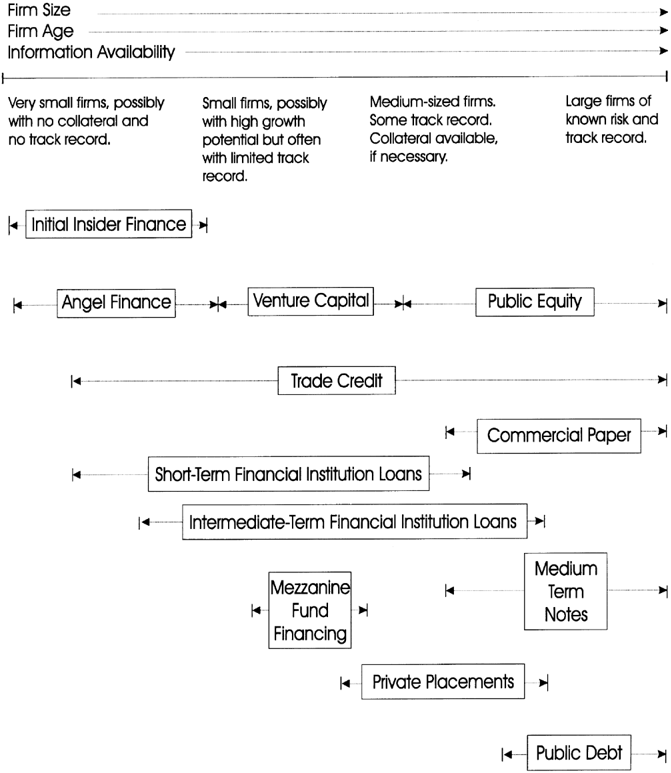
This article examines the economics of financing small business in private equity and debt markets. Firms are viewed through a financial growth cycle paradigm in which different capital structures are optimal at different points in the cycle. We show the sources of small business finance, and how capital structure varies with firm size and age. The interconnectedness of small firm finance is discussed along with the impact of the macroeconomic environment. We also analyze a number of research and policy issues, review the literature, and suggest topics for future research.
Verified 2026-11-25 · 1 reference not checked yet
Overview
CoChat Summary
TL;DR
This article reviews the economics of small business finance through a financial growth cycle paradigm, emphasizing informational opacity and the roles of private equity and debt markets. It documents US small business funding sources and contracts, and analyzes vulnerability to macroeconomic shocks, credit crunches, and bank consolidation.
Key findings
- US small business finance is split roughly evenly between equity (49.63%) and debt (50.37%); the largest sources are the principal owner, commercial banks, and trade creditors, together accounting for 70.10% of total funding. Commercial banks provide 18.75%, trade credit 15.78%, principal owner equity 31.33%, angel finance 3.59%, venture capital 1.85%, and credit card debt 0.14%.
- Financial institution debt is used by 54.23% of small businesses; 86.95% name a commercial bank as their primary financial institution. Average relationship length is 6.64 years overall and 9.01 years with the primary institution; 52.03% of financial institution debt is under lines of credit, 91.94% is secured, and 51.63% is guaranteed.
- The growth cycle paradigm predicts younger/more opaque firms rely on insider finance, trade credit, and angel finance, then venture capital and banks, and eventually public markets. However, 1993 NSSBF data show insider finance does not dominate external finance even for adolescents (upper bound 56.8% insider, roughly equal to external), and financial institution debt is important to very young firms, often based on personal guarantees or collateral.
- Macro vulnerability: the early-1990s credit crunch saw real C&I loans fall 23.2% ($596.7 billion to $458.2 billion) and estimated small business lending fall 38.5% ($143.7 billion to $88.4 billion). Banks with less than $100 million in assets held about 9% of portfolios in small business loans versus about 2% for banks over $10 billion; large banks charged about 100 basis points less and required collateral about 25% less often than small banks, other things equal.
Methods
- Design: review and synthesis organized around the financial growth cycle paradigm, covering theoretical and empirical literature on private equity and debt markets, contracts, and macroeconomic vulnerability.
- Data: primarily the 1993 National Survey of Small Business Finances (NSSBF) for US small business finance tables, plus other sources including NFIB, SCF, STBL, CALL, CRA, Venture Economics/VentureOne, and international data.
- Analysis: descriptive tabulations (Tables 1 and 2) and literature synthesis; the paper is a review rather than a new primary empirical study.
Limitations
- Paper-stated: Table 1 data are not completely accurate or consistent and should be considered rough estimates; angel finance estimates are imprecise (range $15 billion to $120 billion); 1993 data may not reflect current conditions; weighted averages mask considerable heterogeneity.
- Paper-stated: the growth cycle paradigm is not intended to fit all small businesses; firm size, age, and information availability are far from perfectly correlated, and the points at which different funding sources begin and end are not definitive.
- Evident from the text: informational opacity and the intertwining of personal and business finances make small business finance difficult to research, and data on owners’ finances are often unavailable; the paper relies heavily on existing literature and available data rather than new primary data collection.
Model-written summary. Check it against the paper before relying on it.
Integrity signals
Registry
Cites
Statistics
Figures
Verification
Claims the paper makes
22 Valid · 27 Not valid · 107 Not checked · 201 Own results and interpretations
Every source the paper cites for this claim was checked and supports it.
In the paper
“This use of personal assets to help with external ®nance also highlights another important aspect of small business ®nance ± the ®nancial intertwining of owners and their businesses (Ang, 1992).”
§ The economics of small business ®nance: The roles of private equity and debt markets in the ®nancial growth cycle > 2.3. The ®nancial growth cycle of small business
What the sources say
- Supportedcites Ang, 1992 matched to “On the Theory of Finance for Privately Held Firms” (1992) source
In “Integrating Personal and Business Accounts,” Ang says that personal guarantees or collateral make business risk inseparable from owners’ personal risk. “The Financing Decision” also identifies owners’ assets used for loan guarantees as contributions to the business. Together, these passages support the cited point that using personal assets to obtain external finance intertwines owners’ and businesses’ finances. (LLM, conf=0.94)
plainstates an association- Asserted: passes — The authors put it forward as true.
- Checkable: passes — It can be checked against evidence.
- Load-bearing: unclear — It is unclear whether the paper’s conclusions depend on it.
- Based: passes — The paper gives a reason why it holds.
- Supported
The cited sources support only part of this claim — read each source’s verdict below.
In the paper
“Costly state veri®cation (Townsend, 1979;Diamond, 1984) and adverse selection (Myers, 1984;Myers and Majluf, 1984;Nachman and Noe, 1994) arguments suggest the optimality of debt contracts after insider ®nance has been exhausted.”
§ The economics of small business ®nance: The roles of private equity and debt markets in the ®nancial growth cycle > 2.3. The ®nancial growth cycle of small business
What the sources say
- Partly supportedcites Townsend, 1979 matched to “Optimal contracts and competitive markets with costly state verification” (1979) sourceExperimental — accuracy not yet measured
Section 3 characterizes an optimal contract for a firm financing an investment project as a bond that defaults when returns fall below a threshold, supporting the costly-state-verification rationale for debt. The paper does not establish that debt becomes optimal only after insider finance has been exhausted. The adverse-selection citations in the sentence refer to other sources, not Townsend. (LLM, conf=0.85)
- Not checked — no full text of the sourcecites Diamond, 1984 matched to “Financial intermediation and delegated monitoring” (1984) source
- Not matchedcites Myers, 1984
More than one paper fits this citation.
hedgedstates a cause- Asserted: passes — The authors put it forward as true.
- Checkable: passes — It can be checked against evidence.
- Load-bearing: passes — The paper’s conclusions depend on it.
- Based: passes — The paper gives a reason why it holds.
- Partly supported
The cited sources support only part of this claim — read each source’s verdict below.
In the paper
“An agency problem arises in the relationship between the entrepreneur and the venture capitalist in which the entrepreneur may expend insucient eort, exhibit expense preference behavior, or lack sucient information or skill to make optimal production decisions.”
§ The economics of small business ®nance: The roles of private equity and debt markets in the ®nancial growth cycle > 3.2. The venture capital market
What the sources say
- Not checked — no full text of the sourcecites Cooper and Carleton, 1979 matched to “Dynamics of Borrower‐Lender Interaction: Partitioning Final Payoff in Venture Capital Finance” (1979) source
- Partly supportedcites Bergemann and Hege, 1998 matched to “Venture capital financing, moral hazard, and learning” (1998) sourceExperimental — accuracy not yet measured
Section 2.3, “Moral hazard and financing,” describes an entrepreneur who may reduce costly effort or divert investment funds to private ends, supporting the insufficient-effort and expense-preference parts of the claim. It does not identify a lack of the entrepreneur’s information or skill as a cause of poor production decisions; it instead says the entrepreneur and venture capitalists initially have the same assessment of the project. (LLM, conf=0.88)
hedgedstates a possible cause- Asserted: passes — The authors put it forward as true.
- Checkable: passes — It can be checked against evidence.
- Load-bearing: passes — The paper’s conclusions depend on it.
- Based: passes — The paper gives a reason why it holds.
Every source the paper cites for this claim was checked and supports it.
In the paper
“Since 1990, this share has about doubled to 30% (Fenn et al., 1997).”
§ The economics of small business ®nance: The roles of private equity and debt markets in the ®nancial growth cycle > 3. The role of private equity markets in small business ®nance
What the sources say
- Supportedcites Fenn et al., 1997 matched to “The Private Equity Market: An Overveiw” (1997) source
In “IPO Firms that Received Private Equity Backing,” the paper states that the share of IPOs with venture backing averaged 15% during the 1980s and doubled to 30% since 1990. This directly supports the cited claim. (LLM, conf=0.95)
plainstates an association- Asserted: passes — The authors put it forward as true.
- Checkable: passes — It can be checked against evidence.
- Load-bearing: unclear — It is unclear whether the paper’s conclusions depend on it.
- Based: passes — The paper gives a reason why it holds.
- Supported
The cited sources support only part of this claim — read each source’s verdict below.
In the paper
“During the 1980s, approximately 15% of all IPOs were backed by venture capital, well out of proportion to the fraction of all ®rms that received venture capital.”
§ The economics of small business ®nance: The roles of private equity and debt markets in the ®nancial growth cycle > 3. The role of private equity markets in small business ®nance
What the sources say
- Partly supportedcites Fenn et al., 1997 matched to “The Private Equity Market: An Overveiw” (1997) sourceExperimental — accuracy not yet measured
The section “IPO Firms that Received Private Equity Backing” states that venture-backed IPOs averaged 15% of IPOs during the 1980s. It does not give the fraction of all firms that received venture capital or make the claimed comparison with that fraction. (LLM, conf=0.84)
plainstates an association- Asserted: passes — The authors put it forward as true.
- Checkable: passes — It can be checked against evidence.
- Load-bearing: unclear — It is unclear whether the paper’s conclusions depend on it.
- Based: passes — The paper gives a reason why it holds.
- Partly supported
184 more claims · 6 with their cited sources checked
Create a free account to see all 357 claims and to verify the 12 references still open.
- Probably not a substantial claim. 94
- It may state two separate claims as one. 87
- Borderline: one of the tests for a substantial claim is unclear. 2
Claims other papers make about this one
Each is checked against this paper’s own text: does it say what the citing paper says it does?
The cited source says what the claim attributes to it.
In the citing paper
“SMEs are more dependent on external financing supplied by commercial banks (Berger and Udell 1998) because most of them are not qualified to raise money from the stock market.”
From Local Bank, Digital Financial Inclusion and SME Financing Constraints: Empirical Evidence from China (2022) · cites this paper as Berger and Udell 1998
Self-check
Percentages, sums and reported differences re-computed from the paper’s own numbers.
Rated minor: it would not touch a result — a value no result rests on, a p-value that stays on the same side of the significance level, or a conflict that is clerical, resolved elsewhere in the paper, or outside its own findings.
In the paper
“Non®nancial business/government debt provides 19.26% of small business funding (mostly trade credit)”
§ The economics of small business ®nance: The roles of private equity and debt markets in the ®nancial growth cycle > 4. The role of private debt markets in small business ®nance
Reported 19.26 · recomputed 18.01
Citations
Cites
Corporate financing and investment decisions when firms have information that investors do not have
Myers, S. C., & Majluf, N. S. (1984) · Journal of Financial Economics · doi:10.1016/0304-405x(84)90023-0 · Cited by 18,957
The Cost of Capital, Corporation Finance and the Theory of Investment
Miller, M. H. (1958) · American Economic Review · Cited by 14,574
Determinants of corporate borrowing
Myers, S. C. (1977) · Journal of Financial Economics · doi:10.1016/0304-405x(77)90015-0 · Cited by 13,169
Credit Rationing in Markets with Imperfect Information
Stiglitz, J. E., & Weiss, A. (1981) · Columbia University · doi:10.7916/d8v12ft1 · Cited by 12,769 · cited 1×
“…pledging outside collateral may help resolve adverse selection problems when the borrower has more information about the quality of the investment than the lender, and may help prevent credit rationing (Stiglitz and Weiss 1981, 1986, Bester 1985, Chan and Kanatas 1985, Besanko and Thakor 1987a,b).”
The cost of capital, corporation finance and the theory of investment
Terra, P. R. (2008) · Revista de Administração e Contabilidade da Unisinos · doi:10.4013/base.20082.07 · Cited by 8,615
Financial intermediation and delegated monitoring
Diamond, D. W. (1984) · The Review of Economic Studies · doi:10.2307/2297430 · Cited by 8,476 · cited 2×
“Costly state verification (Townsend 1979, Diamond 1984) and adverse selection (Myers 1984, Myers and Majluf 1984, Nachman and Noe 1994) arguments suggest the optimality of debt contracts after insider cFor example, there are generally accepted definitions of the stages of finance for the kind of…”
Corporate Financing and Investment Decisions When Firms Have InformationThat Investors Do Not Have
Myers, S., & Majluf, N. (1984) · doi:10.3386/w1396 · Cited by 6,745
The Benefits of Lending Relationships: Evidence from Small Business Data
PETERSEN, M. A., & RAJAN, R. G. (1994) · The Journal of Finance · doi:10.1111/j.1540-6261.1994.tb04418.x · Cited by 5,440 · cited 4×
“…whereas mortgages, equipment loans, motor vehicle loans, and other loans may more often be transactionsdriven .zs It was also found that dependence on trade credit decreased with the length of the banking relationship, supporting the value of relationship lending (Petersen and Rajan 1994, 1995).”
InfluentialInside the black box: the credit channel of monetary policy transmission
Bernanke, B. S., & Gertler, M. (1995) · Journal of Economic Perspectives · doi:10.1257/jep.9.4.27 · Cited by 4,211
Insiders and Outsiders: The Choice between Informed and Arm's‐Length Debt
RAJAN, R. G. (1992) · The Journal of Finance · doi:10.1111/j.1540-6261.1992.tb04662.x · Cited by 3,902 · cited 1×
“Some research suggests that these firms may try to reduce the control of their banks by issuing public debt, even though public debt may entail higher costs (Diamond 1991, 1993, Rajan 1992, Houston and James 1996).”
Research works printed but not linked: 11
- 66. Cook, L., 1997. Trade ®nance, bank ®nance, and capital market imperfections. Working paper. Harvard University, Cambridge, MA.
- 89. Freear, J., Sohl, J.E., Wetzel, W.E., Jr., 1994. The private investor market for venture capital. The Financier 1, 7±19.
- 112. Hancock, D., Wilcox, J.A., 1997. Bank capital, nonbank ®nance, and real estate activity. Journal of Housing Research 8, 75±105.
- 117. Hempel, G., Coleman, A., Simonson, D., 1986. Bank Management, Wiley, New York.
- 119. Ho, R., 1997. Credit-card use to ®nance small business is soaring, says survey of small ®rms. Wall Street Journal B2, Sept. 25.
- 153. Megginson, W.L., Weiss, K.A., 1991. Venture capitalist certi®cation in initial public oerings. Journal of Finance 46, 903±979.
- 162. Morsman Jr., E., 1986. Commercial loan structuring. Journal of Commercial Bank Lending 68, 2± 20.
- 187. Ravid, S.A., 1996. Debt maturity ± A survey. Financial Markets, Institutions and Instruments 5 (3), 1±68.
- 217. Wetzel Jr. W.E., 1994. Venture capital. In: Bygrave, W.D. (Ed.), Portable MBA in Entrepreneur- ship. Wiley, New York, pp. 172±194.
- 219. White, L.J., 1995. An analytical framework. In: Zahid, S.N. (Ed.), Financial Sector Development in Asia. Oxford University Press, New York, pp. 3±35.
- 222. McKean, R. (Ed.), Issues in Defense Economics. Columbia University Press, New York.
Cited by
Items 2,001–2,100 of 3,739
Microenterprise in the First and Third WorldsPreprint
Schreiner, M. J. (2001) · RePEc: Research Papers in Economics · Cited by 5
Information Availability, Information Quality and the Financial Structure of Belgian SMEsPreprint
Caneghem, T. V., & Campenhout, G. V. (2010) · SSRN Electronic Journal · doi:10.2139/ssrn.1541793 · Cited by 5
Surveying Technology-Based Small Firms: A Perspective From BelgiumPreprint
Romain, A., Bozkaya, A., & Pottelsberghe, B. V. (2003) · RePEc: Research Papers in Economics · Cited by 5
Does Local Financial Development Matter for Firm Lifecycle in India?
Ayyagari, M., Demirgüç‐Kunt, A., & Maksimovic, V. (2014) · The World Bank Open Knowledge Repository (World Bank) · doi:10.1596/1813-9450-7008 · Cited by 9
“…explanations for dividends (Fama and French (2001), Grullon et al. (2002), and DeAngelo, DeAngelo, and Stulz (2006), Denis and Osobov (2008)), financing (Berger and Udell, 1998), stock valuations (Pastor and Veronesi (2003)) and acquisitions (Maksimovic and Philips (2008), Arikan and Stulz (2013)).”
Krainer, R. E. (2013) · SSRN Electronic Journal · doi:10.2139/ssrn.2261361 · Cited by 5
The Influence of Corporate Governance on the Relation between Capital Structure and ValuePreprint
Rocca, M. L. (2005) · SSRN Electronic Journal · doi:10.2139/ssrn.835384 · Cited by 5
“the attempt to apply these theories to small firms ( Berger and Udell, 1998”
Berger, A. N., Klapper, L. F., Pería, M. S. M., & Zaidi, R. (2005) · Cited by 5
Self-citationVerheul, I., Grilo, I., & Thurik, R. (2006) · RePub (Erasmus University Rotterdam) · Cited by 16
The Impact of Growth Opportunities on the Investment-Cash Flow SensitivityPreprint
Schoubben, F., & Hulle, C. V. (2008) · SSRN Electronic Journal · doi:10.2139/ssrn.1101685 · Cited by 5
“financially sound. Simultaneously, following Berger and Udell (1998) , and consistent”
Financing Technology: An Assessment of Theory and PracticePreprint
Scandizzo, P. L. (2004) · SSRN Electronic Journal · doi:10.2139/ssrn.486823 · Cited by 5
Bank Relationships and Private Firms’ Financial Reporting OpacityPreprint
Hillebrand, C., & Bigus, J. (2015) · SSRN Electronic Journal · doi:10.2139/ssrn.2629206 · Cited by 5
Bank Financing as an Incentive for Earnings Management in Business Start-UpsPreprint
Huyghebaert, N., Bauwhede, H. V., & Willekens, M. (2007) · SSRN Electronic Journal · doi:10.2139/ssrn.967386 · Cited by 5
“Berger and Udell, 1998; Huyghebaert, 2006; Huyghebaert and Van de Gucht, 2007).”
The asymmetric burden of regulation: will local banks survive?Preprint
Alessandrini, P., Fratianni, M. U., Papi, L., & Zazzaro, A. (2016) · RePEc: Research Papers in Economics · Cited by 8
Relational Distance and Contracting - Family in Credit MarketsPreprint
Bubna, A. (2005) · SSRN Electronic Journal · doi:10.2139/ssrn.926363 · Cited by 4
Alternative Financing Instruments for SMEs and Entrepreneurs
Thompson, J. L., Boschmans, K., & Pissareva, L. (2018) · OECD SME and entrepreneurship papers · doi:10.1787/dbdda9b6-en · Cited by 5
Markups and Productivity under Heterogeneous Financial FrictionsPreprint
Altomonte, C., Favoino, D., & Sonno, T. (2018) · SSRN Electronic Journal · doi:10.2139/ssrn.3303329 · Cited by 9
Xie, Z., Wang, X., Xie, L., & Duan, K. (2020) · Journal of Business Research · doi:10.1016/j.jbusres.2020.12.025 · Cited by 6
RetractedU.S. Banking Deregulation, Small Businesses,and Interstate Insurance of Personal Income
Demyanyk, Y. S., Østergaard, C., & Sørensen, B. E. (2006) · BIBSYS Brage (BIBSYS (Norway)) · Cited by 5
Verifying the State of Financing Constraints: Evidence from US Business Credit ContractsPreprint
Meisenzahl, R. R. (2012) · SSRN Electronic Journal · doi:10.2139/ssrn.1730213 · Cited by 5
A Structural Form Default Prediction Model for SMEs, Evidence from the Dutch MarketPreprint
Rikkers, F., & Thibeault, A. E. (2009) · SSRN Electronic Journal · Cited by 5
Foundations and Trends at the Interface of Finance, Operations, and Risk ManagementPreprint
Babich, V., & Birge, J. R. (2020) · SSRN Electronic Journal · doi:10.2139/ssrn.3693440 · Cited by 7
A Theory of Banks' Industry Expertise, Market Power, and Credit RiskPreprint
Stomper, A. (2002) · SSRN Electronic Journal · doi:10.2139/ssrn.295568 · Cited by 7
Components Of Credit RationingPreprint
Beyhaghi, M., Firoozi, F., & Jalilvand, A. (2019) · SSRN Electronic Journal · doi:10.2139/ssrn.3478832 · Cited by 5
KNOWCON 2021. Knowledge on Economics and Management: Conference Proceedings
Olomouc, C. R. K. (., Slavíčková, P., & Stoklasa, J. C. 2. /. J. (2021) · doi:10.5507/ff.21.24460321 · Cited by 5
Know Your Worth: Angel Financing of Female Entrepreneurial VenturesPreprint
Poczter, S. L., & Shapsis, M. (2016) · SSRN Electronic Journal · doi:10.2139/ssrn.2782266 · Cited by 10
“External financing from investors is crucial for the survival and growth in the early stages of a company (Amit, Glosten, & Muller, 1990; Berger & Udell, 1998).”
Entrepreneurial WagesPreprint
Babina, T., Ma, W., Ouimet, P., & Zarutskie, R. E. (2018) · SSRN Electronic Journal · doi:10.2139/ssrn.3177153 · Cited by 7
Does the Country Effect Matter in the Capital Structure Decisions of European Firms?Preprint
Venanzi, D., Naccarato, A., & Abate, G. (2014) · SSRN Electronic Journal · doi:10.2139/ssrn.2616597 · Cited by 11
“Except for the pioneering study by Rajan-Zingales (1995), only in the last decade the international literature analyzed the role of countries as a determinant of firm leverage (Booth et al.”
Competition and entrepreneurship as engines of growth
Fazio, G. (2010) · UCL Discovery (University College London) · Cited by 5
Incidence of Bank Levy and Bank Market PowerPreprint
Capelle‐Blancard, G., & Havrylchyk, O. (2013) · SSRN Electronic Journal · doi:10.2139/ssrn.2378340 · Cited by 5
Mobilizing credit for clean energy: De-risking and public loan provision under learning spillovers
Waidelich, P., Krug, J., & Steffen, B. (2025) · Journal of Environmental Economics and Management · doi:10.1016/j.jeem.2025.103222 · Cited by 4
Berliner, D., Shneor, R., & Wald, A. E. (2025) · Electronic Markets · doi:10.1007/s12525-025-00856-x · Cited by 4
“Moreover, they are less likely to invest in a follow-on campaign, as they have already invested their ‘love money’ (Berger & Udell, 1998; Hornuf & Schmitt, 2016) in the first original campaign.”
Market segmentation, marketisation change speed and R&D investment of private firms
Hou, B., Yu, Y., Zhu, Y., et al. (2023) · Post-Communist Economies · doi:10.1080/14631377.2023.2236877 · Cited by 4
“Thirdly, information asymmetry and high levels of uncertainty are disadvantages for private firms in attracting investment and funding (Berger & Udell, 1998).”
BackgroundAnalysis of the capital structure of startups in light of the tradeoff and pecking Order theories
Colombo, G. D. C., Gomes, M. D. C., Eça, J. P. A., & do Valle, M. R. (2023) · REGEPE Entrepreneurship and Small Business Journal · doi:10.14211/regepe.esbj.e2338 · Cited by 20
Leverage and SMEs financial stability: the role of banking competition
Agostino, M., Errico, L., Rondinella, S., & Trivieri, F. (2024) · Journal of Economics and Finance · doi:10.1007/s12197-023-09654-7 · Cited by 10
“…allow or prevent firms’ access to bank loans has shown that bank competition would play a relevant role – though the theoretical predictions and the empirical evidence are mixed (Berger and Udell 1998; Bonaccorsi di Patti and Dell’Ariccia 2004; Sutaria and Hicks 2004; Rogers 2012; Backman 2015).”
Li, D., Wu, Z., & Wu, Q. (2024) · Sustainability · doi:10.3390/su16145847 · Cited by 9
The equity crowdfunding choice: A demand-side perspective
Löher, J. (2024) · Journal of Business Economics · doi:10.1007/s11573-024-01211-w · Cited by 6
“As the company grows, these uncertainties and thus, information asymmetries between ventures and different kinds of capital providers decrease, giving ventures more alternatives to finance their business (Berger and Udell 1998).”
Francisco, P. M. (2024) · Cogent Business & Management · doi:10.1080/23311975.2024.2429791 · Cited by 13
“While Modigliani and Miller (1963) argued that a firm’s value is independent of its capital structure, the financial growth cycle paradigm proposed by Berger and udell (1998) illustrates how MEs’ financial needs and resources evolve, initially depending on internal funds due to informational…”
Gill-de-Albornoz, B., Maffei, M., & Spagnuolo, F. (2025) · Research in International Business and Finance · doi:10.1016/j.ribaf.2025.102794 · Cited by 8
Anderloni, L., & Harasheh, M. (2025) · Review of Financial Economics · doi:10.1002/rfe.70004 · Cited by 4
Mishra, A. S., & Choudhury, S. (2025) · Journal of Human Behavior in the Social Environment · doi:10.1080/10911359.2025.2503439 · Cited by 13
SMEs employment growth under heterogeneous credit constraints
Vlassas, I., Giannakopoulos, N., & Kallandranis, C. (2025) · Journal of Small Business Management · doi:10.1080/00472778.2025.2501086 · Cited by 4
“…focuses on small and medium-sized enterprises (SMEs), which are particularly vulnerable to credit constraints due to heightened information asymmetries with lenders (Anastasiou et al., 2024; Beck & Demirguc-Kunt, 2006; Berger & Udell, 1998; Demoussis et al., 2017; Kallandranis et al., 2023).”
What Strategies should be Adopted for Small Level Business in the Prospective of Entrepreneurship
Ikram, M., Gohar, F. R., Atif, J., & Haq, M. Z. U. (2013) · Journals & Books Hosting (International Knowledge Sharing Platform) · Cited by 4
Koistinen, D. (2012) · Business History · doi:10.1080/00076791.2011.638490 · Cited by 4
“Doing so reduces the chances of risk-shifting or moral hazard occurring during the life of the loan (Berger & Udell, 1998, pp. 616, 640, 643–645).”
BackgroundHidayah, A. (2019) · DOAJ (DOAJ: Directory of Open Access Journals) · doi:10.21002/amj.v10i1.10627 · Cited by 4
“During the early phase, Berger and Udell (1998) explain that the characteristics of MSMEs include informational opacity, a lack of trading history (Cassar, 2004), and a high risk of failure (Huyghebaert & Van de Gucht, 2007).”
BackgroundBank connections and small business performance: Evidence from Canadian survey data
Gill, A. S., & Wilson, C. (2020) · International Journal of Finance & Economics · doi:10.1002/ijfe.2057 · Cited by 10
Gherghina, Ş. C., Vintilă, G., & Toader, D. A. (2020) · Emerald Group Publishing Limited eBooks · doi:10.1108/s1569-376720200000021013 · Cited by 4
The impact of geographical positioning on agri‐food businesses' failure considering nonlinearities
Maté‐Sánchez‐Val, M. (2020) · Agribusiness · doi:10.1002/agr.21686 · Cited by 4
Khan, S., Baig, N., Hussain, S., Usman, M., & Manzoor, H. (2021) · Cogent Business & Management · doi:10.1080/23311975.2021.1974291 · Cited by 6
“A firm’s industry determine and affect its borrowing demand, capability to offer collateral, and various other aspects related to its loan-acquiring ability (Berger & Udell, 1998; Ongena & Şendeniz-Yüncü, 2011; Petersen & Rajan, 1994; Saparito et al., 2013).”
BackgroundShould I sell part of my family firm? Exploring the drivers of a minority sale
Kurta, E., Kammerlander, N. H., & Khoury, C. (2022) · Journal of Family Business Management · doi:10.1108/jfbm-08-2022-0111 · Cited by 7
Spatial competition on rural bank efficiency: Evidence from Indonesia
Amanda, C. (2023) · Cogent Economics & Finance · doi:10.1080/23322039.2023.2190216 · Cited by 6
“Rural banks are central for many small businesses and have been decisive sources of credit for local people since it is hard for those people to get options for other external funding (Berger & Udell, 1998; Carbo-Valverde et al., 2009).”
BackgroundThe role of growth aspirations in SMME financing decisions
Rathogwa, B., & Msimango-Galawe, J. (2023) · Cogent Business & Management · doi:10.1080/23311975.2023.2196040 · Cited by 12
“The financial growth paradigm purports that entrepreneurs choose to use different sources of finance at different stages of the business lifecycle (Berger & Udell, 1998, 2006).”
BackgroundJuma, S., & Mathuva, D. M. (2023) · Journal of Co-operative Organization and Management · doi:10.1016/j.jcom.2023.100202 · Cited by 5
Ally, Z. (2024) · Business Strategy & Development · doi:10.1002/bsd2.70016 · Cited by 4
RetractedFoguesatto, C. R., Frare, A. B., Wegner, D., Mitręga, M., & Rodrigues, R. A. B. (2024) · The Journal of High Technology Management Research · doi:10.1016/j.hitech.2024.100518 · Cited by 9
Zhang, J., van Hugten, J., & Stam, W. (2024) · Small Business Economics · doi:10.1007/s11187-024-00973-5 · Cited by 7
“It follows that having substantial financial resources allows for larger ventures, while undercapitalized entrepreneurs may still create smaller-scale ventures (Berger & Udell, 1998; Cassar, 2004).”
SME rebalancing short-term and long-term debt ratios: the role of financial distress costs
Serrasqueiro, Z., Sardo, F., Neves, E., & Morais, F. (2024) · International Journal of Accounting and Information Management · doi:10.1108/ijaim-02-2023-0034 · Cited by 7
Returns on informal and formal finance for Indian informal firms: a pseudo panel data analysis
Posti, L., Kholiya, M., & Posti, A. K. (2025) · Empirica · doi:10.1007/s10663-025-09650-6 · Cited by 6
Traversing the multiple nested geographies of NUTs based entrepreneurial ecosystems
Cowling, M., Brown, R., & Yang, H. (2025) · The Journal of Technology Transfer · doi:10.1007/s10961-025-10207-9 · Cited by 5
“The lens we use is the loan market as access to loan funds is key for the survival and growth of smaller firms, and one in which they typically find the most challenging for a number of reasons including their size per se, and the relative informational opacity (Berger & Udell, 1998; Cassar, 2004).”
Chen, H., Basri, M. F., & Halim, H. A. (2025) · Sustainability · doi:10.3390/su17177693 · Cited by 4
Guarantees and Bank Loan Interest Rates in Italian Small-Sized Firms
Calcagnini, G., Farabullini, F., & Giombini, G. (2012) · Contributions to economics · doi:10.1007/978-3-7908-2852-8_12 · Cited by 4
Bassey, N. E., Arene, C. J., & Akpaeti, A. J. (2014) · RePEc: Research Papers in Economics · doi:10.22004/ag.econ.168588 · Cited by 6
Muñoz, D. M. C., & Camargo, J. A. C. (2015) · Revista Finanzas y Política Económica · doi:10.14718/revfinanzpolitecon.2015.7.1.2 · Cited by 23
An analysis of the effects of the severance payment reform on credit to Italian SMEs
Calcagno, R., Kräussl, R., & Monticone, C. (2011) · Journal of Financial Economic Policy · doi:10.1108/17576381111152227 · Cited by 5
“Berger and Udell (1998) observe that small, private businesses are “acutely informationally opaque” and argue that this is a major impediment for them to access the public capital markets.”
InfluentialNew regulations: challenge or opportunity for Turkish SMEs?
Bayraktar, S. (2015) · Qualitative Research in Financial Markets · doi:10.1108/qrfm-05-2014-0015 · Cited by 4
Does informal risk capital relax the financial constraints of high-tech entrepreneurial ventures?
Colombo, M. G., Croce, A., & Guerini, M. (2014) · Applied Economics Letters · doi:10.1080/13504851.2013.859368 · Cited by 4
“Using a sample of US small firms in 1993, Berger and Udell (1998) document that informal risk capital accounted for an estimated 16.45% of the total funding (i.e., equity and debt) provided to small firms, while institutional venture capital only accounted for 1.85%.”
BackgroundInfluentialBanken in der Krise kleiner und mittlerer Unternehmen – ein Forschungsüberblick
Mitter, C. (2012) · Zeitschrift für Klein- und Mittelunternehmen/Zeitschrift für KMU und Entrepreneurship · doi:10.3790/zfke.60.4.261 · Cited by 5
Sources of Capital and Debt Structure in Small Firms
Bathala, C. T., Bowlin, O. D., & Dukes, W. P. (2004) · The journal of entrepreneurial finance · doi:10.57229/2373-1761.1075 · Cited by 4
Dynamisme du capital-risque americain : l'IPO n'est plus la voie de sortie preferee
Lounes, M. (2010) · Vie & sciences de l entreprise · doi:10.3917/vse.185.0105 · Cited by 4
Modeling the time to an initial public offering: When does the fruit ripen?
Ahmad, Y. S., & Kashian, R. D. (2009) · Journal of Economics and Finance · doi:10.1007/s12197-008-9073-z · Cited by 6
“Berger and Udell (1998) also highlight the importance of equity for an IPO.”
BackgroundFinancing Small and Medium Manufacturing Firms in Malaysia
Rasiah, R. (2011) · Cited by 4
VC financing and patenting in new technology-based firms: an empirical study
Bertoni, F., Colombo, M. G., & D’Adda, D. (2009) · Università Politecnica delle Marche (Università Politecnica delle Marche) · Cited by 4
Do enterprise–bank relationships improve market quality? Evidence from Taiwan
Wang, M.-C., Ding, Y., & Chiang, H.-C. (2017) · The Quarterly Review of Economics and Finance · doi:10.1016/j.qref.2017.05.001 · Cited by 4
Bank Financing of SMEs in Five Sub-Saharan African Countries
Berg, G., & Fuchs, M. (2013) · Cited by 4
Long- and Short-run Relationship Between Firm Creation and the Ease and Cost of Doing Business
Canare, T. A., Francisco, J. P., & Morales, J. F. (2019) · International Journal of the Economics of Business · doi:10.1080/13571516.2018.1558636 · Cited by 4
“Access to finance problems is well documented in small businesses (Beck and Demirguc-Kunt 2006; Berger and Udell 1998) particularly in developing countries (Chittitaworn et al. 2011; Harvie, Narjoko, and Oum 2013).”
BackgroundInvestment-cash flow sensitivity in small and medium sized enterprises at expansion stage
Pellón, J. M., & Ferrer, M. A. (2012) · Cited by 5
Innovation and Investment Finance in Comparison
Zimmermann, V. (2019) · FGF studies in small business and entrepreneurship · doi:10.1007/978-3-030-17612-9_3 · Cited by 7
Allen, L., Chakraborty, S., Hazarika, S., et al. (2019) · Journal of International Business Studies · doi:10.1057/s41267-019-00273-1 · Cited by 4
“The first strand identifies private ‘‘soft’’ information production in the course of bank lending activity (Holmstrom & Tirole, 1997; Diamond, 1984; Berger & Udell, 1998; Stein, 2002) that may lead to the classic hold-up problem (Rajan, 1992).”
Credit Rationing and Mature French SMEs: A Disequilibrium Model
Adair, P., & Adaskou, M. (2020) · World Journal of Applied Economics · doi:10.22440/wjae.6.1.4 · Cited by 5
“…Créteil, Créteil, France. e-mail: adair@u-pec.fr. https://orcid.org/0000-0002-6474-2420 c Faculty of Law, Economics and Social Sciences, University Ibn Zohr, Agadir, Morocco. e-mail: m.adaskou@uiz.ac.ma https://orcid.org/0000-0003-4426-9346 of the major difficulties (Berger & Udell, 1998).”
El entorno emprendedor de las Mipymes: Un análisis de la región centro de Tamaulipas
Ayala, L. R., & Limón, M. L. S. (2020) · NovaRUA · doi:10.20983/novarua.2020.21.3 · Cited by 7
The analysis of OLC stages and the venture capital investors from Adizes life cycle theory
Verma, P., & Kumar, V. (2021) · International journal of organizational analysis · doi:10.1108/ijoa-01-2021-2592 · Cited by 4
Does firm size really affect the outcome of loan applications?
Mallik, G., Nguyen, D. N., & Chowdhury, A. (2022) · Economic Analysis and Policy · doi:10.1016/j.eap.2022.04.004 · Cited by 10
What drives corporate cash holdings in MSMEs?: Evidence from India
Saxena, V., & Sahoo, S. (2022) · Managerial Finance · doi:10.1108/mf-04-2022-0184 · Cited by 8
External audit and tax evasion: evidence from India
Shehata, N. F., Nathan, S., Farooq, O., & Dahawy, K. M. (2022) · Applied Economics · doi:10.1080/00036846.2022.2123103 · Cited by 4
“The risk aversion can lead capital providers to prefer firms that carry less risk, the result of which is to exclude privately held firms (Berger and Udell 1998; Cressy and Toivanen 2001).”
BackgroundA Game-Theoretic Credit Period and Promotion Model in a Supplier-Retailer Channel
Ezimadu, P. E., & Ezimadu, S. O. (2022) · Asian Research Journal of Mathematics · doi:10.9734/arjom/2022/v18i11609 · Cited by 6
“The importance of trade credit for small firms and starts-ups in the midst of scarce resources cannot be over emphasized [4,5].”
BackgroundTsuruta, D. (2023) · Accounting and Finance · doi:10.1111/acfi.13078 · Cited by 4
The role of auditors and banks in the tax aggressiveness of private firms
Mättö, M., Niskanen, M., & Ojala, H. (2023) · International Journal of Auditing · doi:10.1111/ijau.12309 · Cited by 11
Searching for role models: The case of Malferida the healthy cola with nothing to hide
Donaldson, C., & Villagrasa, J. (2023) · Industry and Higher Education · doi:10.1177/09504222231189715 · Cited by 5
Dohaiman, M. S. A. (2013) · Research Journal of Finance and Accounting · Cited by 6
Specific Financial Constraints of Innovative Companies: Theoretical Approach
Ettahri, Y., & Laachach, A. (2016) · Journal of Modern Accounting and Auditing · doi:10.17265/1548-6583/2016.11.002 · Cited by 5
“SPECIFIC FINANCIAL CONSTRAINTS OF INNOVATIVE COMPANIES 562 The firms may encounter specific financial constraints (Berger & Udell, 1998), when they are small, young companies or when they present important risk investment opportunities.”
BackgroundIntellectual Properties and Debt Finance for Startups
Shimizu, T. (2017) · Perspectives in law, business and innovation · doi:10.1007/978-981-10-5415-0_2 · Cited by 4
“3See Berger and Udell (1998), pp. 613–673.”
BackgroundInvestigating the Impact of Firm Characteristics on Capital Structure of Quoted and Unquoted SMEs
ELbekpashy, M. S., & Elgiziry, K. (2017) · Accounting and Finance Research · doi:10.5430/afr.v7n1p144 · Cited by 8
“In contrast, according to Gregory et al. (2005), it is not likely to have a single life cycle model for SMEs, as introduced by Berger and Udell (1998).”
BackgroundRecent Trends in Small Business Lending and the Community Reinvestment Act
Mach, T., & Dore, T. E. (2018) · FEDS Notes · doi:10.17016/2380-7172.2122 · Cited by 4
Occhino, P., & Maté‐Sánchez‐Val, M. (2018) · Spanish Journal of Agricultural Research · doi:10.5424/sjar/2018164-13387 · Cited by 4
Financial and Institutional Determinants of Cash Holdings in the Oil and Gas Industry
Gancherka, S., & Westerman, W. (2018) · Journal of Corporate Finance Research / Корпоративные Финансы · doi:10.17323/j.jcfr.2073-0438.12.3.2018.60-72 · Cited by 3
“Berger and Udell (1998) point out that creditors often expect riskier borrowers to provide security for their loans.”
BackgroundGyimah, A. G., & Agyeman, A. S. (2019) · International Journal of Financial Research · doi:10.5430/ijfr.v10n2p27 · Cited by 5
Financing the Next Generations of Innovation: New Dimensions in the Private Equity Model
Parpaleix, L.-A., Levillain, K., & Segrestin, B. (2019) · Journal of Innovation Economics & Management · doi:10.3917/jie.029.0007 · Cited by 10
Can banks monitor small business borrowers effectively using hard information?
Tsuruta, D. (2019) · Accounting and Finance · doi:10.1111/acfi.12544 · Cited by 5
Győri, Á., & Czakó, Á. (2019) · Szociológiai szemle · doi:10.51624/szocszemle.2019.1.4 · Cited by 13
THE DETERMINANTS OF CAPITAL STRUCTURE: A CASE STUDY
Loan, B. T. T., Thang, N. X., Mai, D. P., et al. (2020) · Journal of Security and Sustainability Issues · doi:10.9770/jssi.2020.9.m(1 · Cited by 4
Zhou, R., Cai, Z., & Shen, L. (2021) · doi:10.1145/3459012.3459035 · Cited by 4
“the change of information with the growth of enterprises, the constraint condition of enterprise-scale and capital demand as the basic elements to influence the enterprises’ choices of financing way [2].”
Background
Metadata
- Authors
- N. Berger, A., & F. Udell, G.
- Venue
- Journal of Banking & Finance
- Publisher
- Elsevier BV
- Published
- 1998-08
- Volume
- 22
- Issue
- 6-8
- Pages
- 613-673
- ISSN
- 0378-4266 (ISSN-L)
- OpenAlex
- W2119780569
- Semantic Scholar
- dfc06f7f7eb83d2c0e2a1d67ecb95b520a406843
- Cited by
- 3,690
- References
- 230
- Citations by year
- 2026: 136 · 2025: 148 · 2024: 144 · 2023: 193 · 2022: 155 · 2021: 211 · 2020: 200 · 2019: 156 · 2018: 208 · 2017: 174 · 2016: 186 · 2015: 187 · 2014: 168 · 2013: 177 · 2012: 171
- FWCI
- 169.26
- Type
- journal article
- Language
- en
- Open access
- hybrid
- doi.org
- Licence
- cc-by-nc-nd
- www.elsevier.com/tdm/userlicense/1.0/ (tdm)
- www.elsevier.com/legal/tdmrep-license (tdm)
- creativecommons.org/licenses/by-nc-nd/4.0/ (vor, 125 d)
- Locations
- Journal of Banking & Finance (publishedVersion, cc-by-nc-nd)
- RePEc: Research Papers in Economics (submittedVersion)
- Funders
- York University
- Topics
- Social Sciences › Economics, Econometrics and Finance › Finance › Private Equity and Venture Capital
- Social Sciences › Economics, Econometrics and Finance › Finance › Corporate Finance and Governance
- Social Sciences › Economics, Econometrics and Finance › Finance › Banking stability, regulation, efficiency
- Keywords
- small business financing, private equity, debt markets, capital structure, firm size, firm age, macroeconomic conditions
About these checks
Registry, retraction, Cites and statistics results are computed, not judged, with one exception: a printed reference that no index lists is read once by a model before it counts as a citation error. Claims are extracted by a model and kept only when their quote appears verbatim in the text; each cited source is then checked, with a model’s help, for whether it says what the claim relies on. Those verdicts can be wrong — read the claim’s quote and the cited source before relying on one.
The claim verdicts this report counts are experimental: their accuracy is not yet measured.
A language model drew the claims from the paper on 2026-10-10, under version 3 of the claim definition (model deepseek-v4.1-flash, prompt extract-v3).
A second model labelled each claim on 2026-10-10 (model jev-1.13-20260917, definition revision gold-guideline-v0.2).
Cited sources are checked with a language model’s help (gpt-6-sol).
Statistics and arithmetic are recomputed, not judged.
Confidence bands are shown only for fields calibrated on our annotated test set. None is calibrated yet, so no band is shown.
What counts as a claim ›How we measure confidence ›How we check this ›
Are you an author, or do you see a problem with this page? Request a review
Data sources
Bibliographic data: Semantic Scholar, OpenAlex, Crossref.
Contains information from the Semantic Scholar Academic Graph Datasets, made available under the ODC Attribution License (ODC-BY 1.0).
Semantic Scholar’s data is described in: Kinney, R., et al. (2023). The Semantic Scholar Open Data Platform. arXiv:2301.10140.
