

The economics of small business finance: The roles of private equity and debt markets in the financial growth cycle
Open accessThe DOI matches its Crossref record; 217 of the 230 references it cites were found in a registry or an index, and 1 are not checked yet; 24 of the 170 sources its claims cite were checked for support.
Abstract
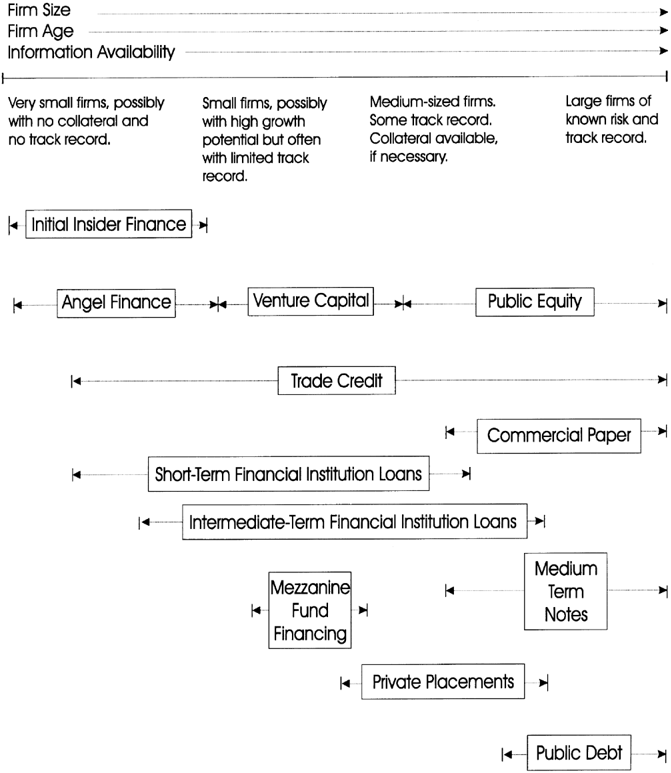
This article examines the economics of financing small business in private equity and debt markets. Firms are viewed through a financial growth cycle paradigm in which different capital structures are optimal at different points in the cycle. We show the sources of small business finance, and how capital structure varies with firm size and age. The interconnectedness of small firm finance is discussed along with the impact of the macroeconomic environment. We also analyze a number of research and policy issues, review the literature, and suggest topics for future research.
Verified 2026-11-25 · 1 reference not checked yet
Overview
CoChat Summary
TL;DR
This article reviews the economics of small business finance through a financial growth cycle paradigm, emphasizing informational opacity and the roles of private equity and debt markets. It documents US small business funding sources and contracts, and analyzes vulnerability to macroeconomic shocks, credit crunches, and bank consolidation.
Key findings
- US small business finance is split roughly evenly between equity (49.63%) and debt (50.37%); the largest sources are the principal owner, commercial banks, and trade creditors, together accounting for 70.10% of total funding. Commercial banks provide 18.75%, trade credit 15.78%, principal owner equity 31.33%, angel finance 3.59%, venture capital 1.85%, and credit card debt 0.14%.
- Financial institution debt is used by 54.23% of small businesses; 86.95% name a commercial bank as their primary financial institution. Average relationship length is 6.64 years overall and 9.01 years with the primary institution; 52.03% of financial institution debt is under lines of credit, 91.94% is secured, and 51.63% is guaranteed.
- The growth cycle paradigm predicts younger/more opaque firms rely on insider finance, trade credit, and angel finance, then venture capital and banks, and eventually public markets. However, 1993 NSSBF data show insider finance does not dominate external finance even for adolescents (upper bound 56.8% insider, roughly equal to external), and financial institution debt is important to very young firms, often based on personal guarantees or collateral.
- Macro vulnerability: the early-1990s credit crunch saw real C&I loans fall 23.2% ($596.7 billion to $458.2 billion) and estimated small business lending fall 38.5% ($143.7 billion to $88.4 billion). Banks with less than $100 million in assets held about 9% of portfolios in small business loans versus about 2% for banks over $10 billion; large banks charged about 100 basis points less and required collateral about 25% less often than small banks, other things equal.
Methods
- Design: review and synthesis organized around the financial growth cycle paradigm, covering theoretical and empirical literature on private equity and debt markets, contracts, and macroeconomic vulnerability.
- Data: primarily the 1993 National Survey of Small Business Finances (NSSBF) for US small business finance tables, plus other sources including NFIB, SCF, STBL, CALL, CRA, Venture Economics/VentureOne, and international data.
- Analysis: descriptive tabulations (Tables 1 and 2) and literature synthesis; the paper is a review rather than a new primary empirical study.
Limitations
- Paper-stated: Table 1 data are not completely accurate or consistent and should be considered rough estimates; angel finance estimates are imprecise (range $15 billion to $120 billion); 1993 data may not reflect current conditions; weighted averages mask considerable heterogeneity.
- Paper-stated: the growth cycle paradigm is not intended to fit all small businesses; firm size, age, and information availability are far from perfectly correlated, and the points at which different funding sources begin and end are not definitive.
- Evident from the text: informational opacity and the intertwining of personal and business finances make small business finance difficult to research, and data on owners’ finances are often unavailable; the paper relies heavily on existing literature and available data rather than new primary data collection.
Model-written summary. Check it against the paper before relying on it.
Integrity signals
Registry
Cites
Statistics
Figures
Verification
Claims the paper makes
22 Valid · 27 Not valid · 107 Not checked · 201 Own results and interpretations
Every source the paper cites for this claim was checked and supports it.
In the paper
“This use of personal assets to help with external ®nance also highlights another important aspect of small business ®nance ± the ®nancial intertwining of owners and their businesses (Ang, 1992).”
§ The economics of small business ®nance: The roles of private equity and debt markets in the ®nancial growth cycle > 2.3. The ®nancial growth cycle of small business
What the sources say
- Supportedcites Ang, 1992 matched to “On the Theory of Finance for Privately Held Firms” (1992) source
In “Integrating Personal and Business Accounts,” Ang says that personal guarantees or collateral make business risk inseparable from owners’ personal risk. “The Financing Decision” also identifies owners’ assets used for loan guarantees as contributions to the business. Together, these passages support the cited point that using personal assets to obtain external finance intertwines owners’ and businesses’ finances. (LLM, conf=0.94)
plainstates an association- Asserted: passes — The authors put it forward as true.
- Checkable: passes — It can be checked against evidence.
- Load-bearing: unclear — It is unclear whether the paper’s conclusions depend on it.
- Based: passes — The paper gives a reason why it holds.
- Supported
The cited sources support only part of this claim — read each source’s verdict below.
In the paper
“Costly state veri®cation (Townsend, 1979;Diamond, 1984) and adverse selection (Myers, 1984;Myers and Majluf, 1984;Nachman and Noe, 1994) arguments suggest the optimality of debt contracts after insider ®nance has been exhausted.”
§ The economics of small business ®nance: The roles of private equity and debt markets in the ®nancial growth cycle > 2.3. The ®nancial growth cycle of small business
What the sources say
- Partly supportedcites Townsend, 1979 matched to “Optimal contracts and competitive markets with costly state verification” (1979) sourceExperimental — accuracy not yet measured
Section 3 characterizes an optimal contract for a firm financing an investment project as a bond that defaults when returns fall below a threshold, supporting the costly-state-verification rationale for debt. The paper does not establish that debt becomes optimal only after insider finance has been exhausted. The adverse-selection citations in the sentence refer to other sources, not Townsend. (LLM, conf=0.85)
- Not checked — no full text of the sourcecites Diamond, 1984 matched to “Financial intermediation and delegated monitoring” (1984) source
- Not matchedcites Myers, 1984
More than one paper fits this citation.
hedgedstates a cause- Asserted: passes — The authors put it forward as true.
- Checkable: passes — It can be checked against evidence.
- Load-bearing: passes — The paper’s conclusions depend on it.
- Based: passes — The paper gives a reason why it holds.
- Partly supported
The cited sources support only part of this claim — read each source’s verdict below.
In the paper
“An agency problem arises in the relationship between the entrepreneur and the venture capitalist in which the entrepreneur may expend insucient eort, exhibit expense preference behavior, or lack sucient information or skill to make optimal production decisions.”
§ The economics of small business ®nance: The roles of private equity and debt markets in the ®nancial growth cycle > 3.2. The venture capital market
What the sources say
- Not checked — no full text of the sourcecites Cooper and Carleton, 1979 matched to “Dynamics of Borrower‐Lender Interaction: Partitioning Final Payoff in Venture Capital Finance” (1979) source
- Partly supportedcites Bergemann and Hege, 1998 matched to “Venture capital financing, moral hazard, and learning” (1998) sourceExperimental — accuracy not yet measured
Section 2.3, “Moral hazard and financing,” describes an entrepreneur who may reduce costly effort or divert investment funds to private ends, supporting the insufficient-effort and expense-preference parts of the claim. It does not identify a lack of the entrepreneur’s information or skill as a cause of poor production decisions; it instead says the entrepreneur and venture capitalists initially have the same assessment of the project. (LLM, conf=0.88)
hedgedstates a possible cause- Asserted: passes — The authors put it forward as true.
- Checkable: passes — It can be checked against evidence.
- Load-bearing: passes — The paper’s conclusions depend on it.
- Based: passes — The paper gives a reason why it holds.
Every source the paper cites for this claim was checked and supports it.
In the paper
“Since 1990, this share has about doubled to 30% (Fenn et al., 1997).”
§ The economics of small business ®nance: The roles of private equity and debt markets in the ®nancial growth cycle > 3. The role of private equity markets in small business ®nance
What the sources say
- Supportedcites Fenn et al., 1997 matched to “The Private Equity Market: An Overveiw” (1997) source
In “IPO Firms that Received Private Equity Backing,” the paper states that the share of IPOs with venture backing averaged 15% during the 1980s and doubled to 30% since 1990. This directly supports the cited claim. (LLM, conf=0.95)
plainstates an association- Asserted: passes — The authors put it forward as true.
- Checkable: passes — It can be checked against evidence.
- Load-bearing: unclear — It is unclear whether the paper’s conclusions depend on it.
- Based: passes — The paper gives a reason why it holds.
- Supported
The cited sources support only part of this claim — read each source’s verdict below.
In the paper
“During the 1980s, approximately 15% of all IPOs were backed by venture capital, well out of proportion to the fraction of all ®rms that received venture capital.”
§ The economics of small business ®nance: The roles of private equity and debt markets in the ®nancial growth cycle > 3. The role of private equity markets in small business ®nance
What the sources say
- Partly supportedcites Fenn et al., 1997 matched to “The Private Equity Market: An Overveiw” (1997) sourceExperimental — accuracy not yet measured
The section “IPO Firms that Received Private Equity Backing” states that venture-backed IPOs averaged 15% of IPOs during the 1980s. It does not give the fraction of all firms that received venture capital or make the claimed comparison with that fraction. (LLM, conf=0.84)
plainstates an association- Asserted: passes — The authors put it forward as true.
- Checkable: passes — It can be checked against evidence.
- Load-bearing: unclear — It is unclear whether the paper’s conclusions depend on it.
- Based: passes — The paper gives a reason why it holds.
- Partly supported
184 more claims · 6 with their cited sources checked
Create a free account to see all 357 claims and to verify the 12 references still open.
- Probably not a substantial claim. 94
- It may state two separate claims as one. 87
- Borderline: one of the tests for a substantial claim is unclear. 2
Claims other papers make about this one
Each is checked against this paper’s own text: does it say what the citing paper says it does?
The cited source says what the claim attributes to it.
In the citing paper
“SMEs are more dependent on external financing supplied by commercial banks (Berger and Udell 1998) because most of them are not qualified to raise money from the stock market.”
From Local Bank, Digital Financial Inclusion and SME Financing Constraints: Empirical Evidence from China (2022) · cites this paper as Berger and Udell 1998
Self-check
Percentages, sums and reported differences re-computed from the paper’s own numbers.
Rated minor: it would not touch a result — a value no result rests on, a p-value that stays on the same side of the significance level, or a conflict that is clerical, resolved elsewhere in the paper, or outside its own findings.
In the paper
“Non®nancial business/government debt provides 19.26% of small business funding (mostly trade credit)”
§ The economics of small business ®nance: The roles of private equity and debt markets in the ®nancial growth cycle > 4. The role of private debt markets in small business ®nance
Reported 19.26 · recomputed 18.01
Citations
Cites
Corporate financing and investment decisions when firms have information that investors do not have
Myers, S. C., & Majluf, N. S. (1984) · Journal of Financial Economics · doi:10.1016/0304-405x(84)90023-0 · Cited by 18,957
The Cost of Capital, Corporation Finance and the Theory of Investment
Miller, M. H. (1958) · American Economic Review · Cited by 14,574
Determinants of corporate borrowing
Myers, S. C. (1977) · Journal of Financial Economics · doi:10.1016/0304-405x(77)90015-0 · Cited by 13,169
Credit Rationing in Markets with Imperfect Information
Stiglitz, J. E., & Weiss, A. (1981) · Columbia University · doi:10.7916/d8v12ft1 · Cited by 12,769 · cited 1×
“…pledging outside collateral may help resolve adverse selection problems when the borrower has more information about the quality of the investment than the lender, and may help prevent credit rationing (Stiglitz and Weiss 1981, 1986, Bester 1985, Chan and Kanatas 1985, Besanko and Thakor 1987a,b).”
The cost of capital, corporation finance and the theory of investment
Terra, P. R. (2008) · Revista de Administração e Contabilidade da Unisinos · doi:10.4013/base.20082.07 · Cited by 8,615
Financial intermediation and delegated monitoring
Diamond, D. W. (1984) · The Review of Economic Studies · doi:10.2307/2297430 · Cited by 8,476 · cited 2×
“Costly state verification (Townsend 1979, Diamond 1984) and adverse selection (Myers 1984, Myers and Majluf 1984, Nachman and Noe 1994) arguments suggest the optimality of debt contracts after insider cFor example, there are generally accepted definitions of the stages of finance for the kind of…”
Corporate Financing and Investment Decisions When Firms Have InformationThat Investors Do Not Have
Myers, S., & Majluf, N. (1984) · doi:10.3386/w1396 · Cited by 6,745
The Benefits of Lending Relationships: Evidence from Small Business Data
PETERSEN, M. A., & RAJAN, R. G. (1994) · The Journal of Finance · doi:10.1111/j.1540-6261.1994.tb04418.x · Cited by 5,440 · cited 4×
“…whereas mortgages, equipment loans, motor vehicle loans, and other loans may more often be transactionsdriven .zs It was also found that dependence on trade credit decreased with the length of the banking relationship, supporting the value of relationship lending (Petersen and Rajan 1994, 1995).”
InfluentialInside the black box: the credit channel of monetary policy transmission
Bernanke, B. S., & Gertler, M. (1995) · Journal of Economic Perspectives · doi:10.1257/jep.9.4.27 · Cited by 4,211
Insiders and Outsiders: The Choice between Informed and Arm's‐Length Debt
RAJAN, R. G. (1992) · The Journal of Finance · doi:10.1111/j.1540-6261.1992.tb04662.x · Cited by 3,902 · cited 1×
“Some research suggests that these firms may try to reduce the control of their banks by issuing public debt, even though public debt may entail higher costs (Diamond 1991, 1993, Rajan 1992, Houston and James 1996).”
Research works printed but not linked: 11
- 66. Cook, L., 1997. Trade ®nance, bank ®nance, and capital market imperfections. Working paper. Harvard University, Cambridge, MA.
- 89. Freear, J., Sohl, J.E., Wetzel, W.E., Jr., 1994. The private investor market for venture capital. The Financier 1, 7±19.
- 112. Hancock, D., Wilcox, J.A., 1997. Bank capital, nonbank ®nance, and real estate activity. Journal of Housing Research 8, 75±105.
- 117. Hempel, G., Coleman, A., Simonson, D., 1986. Bank Management, Wiley, New York.
- 119. Ho, R., 1997. Credit-card use to ®nance small business is soaring, says survey of small ®rms. Wall Street Journal B2, Sept. 25.
- 153. Megginson, W.L., Weiss, K.A., 1991. Venture capitalist certi®cation in initial public oerings. Journal of Finance 46, 903±979.
- 162. Morsman Jr., E., 1986. Commercial loan structuring. Journal of Commercial Bank Lending 68, 2± 20.
- 187. Ravid, S.A., 1996. Debt maturity ± A survey. Financial Markets, Institutions and Instruments 5 (3), 1±68.
- 217. Wetzel Jr. W.E., 1994. Venture capital. In: Bygrave, W.D. (Ed.), Portable MBA in Entrepreneur- ship. Wiley, New York, pp. 172±194.
- 219. White, L.J., 1995. An analytical framework. In: Zahid, S.N. (Ed.), Financial Sector Development in Asia. Oxford University Press, New York, pp. 3±35.
- 222. McKean, R. (Ed.), Issues in Defense Economics. Columbia University Press, New York.
Cited by
Items 3,001–3,100 of 3,739
Sarno, D. (2015) · International Review of Applied Economics · doi:10.1080/02692171.2015.1054370
“…internal finance; the degree of substitution of the financial sources increases and the firm can count on the support of external finance to realize growth potentialities (Berger and Udell 1998).1 The second question regards access to finance sources and the availability of finance for firm growth.”
BackgroundKitching, J., Kašperová, E., & Collis, J. (2012) · Research Repository (Kingston University London)
Migayi, E. A. (2012) · University of Nairobi Research Archive (University of Nairobi) · Cited by 1
Peter, B. A., & Anyieni, A. G. (2015) · Journals & Books Hosting (International Knowledge Sharing Platform)
Zhou, X. (2011) · University Library - University of Saskatchewan (University of Saskatchewan)
Bátiz‐Lazo, B., & Noguchi, M. (2011) · SSRN Electronic Journal · doi:10.2139/ssrn.1955934
Local Financial Development and Corporate Financial Policy
Rocca, M. L., Rocca, T. L., & Cariola, A. (2009) · Physica-Verlag eBooks · doi:10.1007/978-3-7908-2112-3_4
Effects of venture capital and private equity on investment-cash flow sesitivity of Spanish firms
Ferrer, M. A. (2010) · LA Referencia (Red Federada de Repositorios Institucionales de Publicaciones Científicas) · Cited by 3
Comment optimiser la recherche de financement pour démarrer une PME technologique ?
Mandron, A. (2011) · Gestion · doi:10.3917/riges.362.0070
Cowling, M., Murray, G. C., & Bates, P. (2009) · International studies in entrepreneurship · doi:10.1007/978-1-4419-0249-8_12 · Cited by 2
“A related important argument is that smaller companies are constrained in their ability to raise capital versus equivalent larger companies ( Berger and Udell 1998 ) . This market failure argument is implicit (and often explicit) in any government intervention in capital markets ( Cowling and Mitchell 2003) . This is…”
BackgroundStrategische Sicherung des Fremdkapitalzugangs durch eine vertrauensvolle Bankbeziehung
Wickart, R., & Voléry, T. (2015) · Zeitschrift für Klein- und Mittelunternehmen/Zeitschrift für KMU und Entrepreneurship · doi:10.3790/zfke.63.2.99
How Financing Match Entrepreneurial Growth Cycle?: Evidence from Chinese Technological SMEs
Li, W., & Zhao, Y. (2010) · International Conference on Management and Service Science (MASS) · doi:10.1109/icmss.2010.5578293
“Berger &Udell (1998) [5] amended Weston &Brigham’s corporate financial growth cycle theory.”
BackgroundIndebtedness in Indian unlisted firms
Majumdar, R. (2014) · DECISION · doi:10.1007/s40622-014-0053-1
HKUST - Julong Financing Analysis
Wu, C. Y., Wang, N., & Wang, Q. (2011) · Advanced materials research · doi:10.4028/www.scientific.net/amr.403-408.5250
The Internationalization of Venture Capital: Challenges and Opportunities
Gstraunthaler, T., & Сагиева, Г. (2011) · Foresight-Russia · doi:10.17323/1995-459x.2011.4.66.76 · Cited by 1
Research on the beneficial interactions between small and medium-sized private firms and banks
Gao, J., & Chi, Z.-P. (2011) · International Conference on Electronics, Communications and Control · doi:10.1109/icecc.2011.6068144
“Petersen Rajan (1994) · (1998) “ ” Berger Udell 1995 (1) (2) (3) ( ) 1.”
Mutual Guarantee Systems of Small and Medium-Sized Enterprises in China
Yang, Y., Yan, H., & Yang, Z.-Y. (2010) · International Journal of Asian Business and Information Management · doi:10.4018/jabim.2010070101
Structure optimale du pool bancaire et accès au crédit : une revue de la littérature
Statnik, J. (2012) · Revue d économie financière · doi:10.3917/ecofi.106.0301
Microeconometric evidence of financing frictions and innovative activity
Tiwari, A. K. (2010) · Research Publications (Maastricht University) · doi:10.26481/dis.20101104at
Liang, D., & Xin-yu, Q. (2013) · International Conference on Management Science and Engineering (ICMSE) · doi:10.1109/icmse.2013.6586526
“firm size, demand for funds, and information asymmetry([7]).”
BackgroundO SIGNIFICADO E O SENTIDO DA VIDA HUMANA TÊM ALGUMA IMPORTÂNCIA NA GESTÃO DE PESSOAS?
Castillo, J. A. B. (2004) · Revista Eletrônica de Ciência Administrativa · doi:10.5329/recadm.20040302002 · Cited by 1
Investment in Young and Established Microenterprises in RussiaPreprint
Hartarska, V., & Hartarska, V. M. (2002) · RePEc: Research Papers in Economics · doi:10.22004/ag.econ.24857
Review of Forest Plantation Funding in South Africa
Motaung, T. (2015)
Leeuw, G. M. (2013) · University of the Witwatersrand, Johannesburg Institutional Repository on DSpace (University of the Witwatersrand, Johannesburg) · Cited by 1
Il finanziamento dell’impresa manifatturiera italiana: sfide e opportunità
Modina, M., & Quintiliani, A. (2014) · doi:10.7433/srecp.2014.26
Tying Lending and Underwriting: Scope Economies, Incentives, and ReputationPreprint
Laux, C., & Walz, U. (2006) · RePEc: Research Papers in Economics
GARANTÍAS DE CRÉDITO Y EFICIENCIA EN LA PYME ESPAÑOLA, 1996-2003Preprint
Tabuenca, A. G., & Espert, J. L. C. (2006) · RePEc: Research Papers in Economics
Murzacheva, E. (n.d.) · RePEc: Research Papers in Economics
Ullah, F. (2006) · High Technology Small Firms Conference and Doctoral Workshop (HTSF) · doi:10.3990/2.268616379 · Cited by 1
“Similarly Admati and Pfleiderer (1994), Aghion and Bolton (1992), Amit Glosten and Muller (1990), Bergemann and Hedge (1998), Cable and Shane (1997), Chan Seigel and Thakor (1990), Demsetz (1969), Dewatripont and Tirole (1994), Fama and Jensen (1983) and Jensen and Meckling (1976) all address the…”
BackgroundDebt concentration of European Firms
Giannetti, C. (2015) · Munich Personal RePEc Archive (Ludwig Maximilian University of Munich) · Cited by 1
Os determinantes da rendibilidade das KIBS
de Almeida, R. S. M. (2013)
Research on mutual guarantee system of SMEs based on self-organization theory
Yang, Y., Yan, H., & Yang, Z.-Y. (2010) · International Conference on Management Science and Engineering (ICMSE) · doi:10.1109/icmse.2010.5719953 · Cited by 1
“This is represented in Figure 2: ([15]).”
CONSERVATION AREA START-UPS: COMBINING THEORY AND PRACTICE
Wright, N. S., Caneen, J. M., Alexander, N., et al. (2010) · Journal of Developmental Entrepreneurship · doi:10.1142/s1084946710001464
Análisis del impacto de la crisis sobre el racionamiento de crédito de las Pyme en España
Zubeldia, A. M., Lertxundi, A. L., & Ibáñez, J. M. G. (2011) · Anales de estudios económicos y empresariales
Institutional environment, innovative entrepreneurial entry and venture capital financing
Fazio, G., & Mickiewicz, T. M. (2009) · Aston Publications Explorer (Aston University)
O financiamento e a performance das PME do Distrito de Castelo Branco
Raposo, F. J. (2013) · Portuguese National Funding Agency for Science, Research and Technology (RCAAP Project by FCT) · Cited by 1
Economic Reasons for the Nonhindrance of Creditors Per Se Rule? A Reply
Muro, S. A. (2007) · European Business Organization Law Review · doi:10.1017/s1566752907004016
Falke, F. R., & Schöne, M. D. (2014) · Lund University Publications Student Papers (Lund University) · Cited by 1
A importância do Spread e das garantias na concessão de crédito às pequenas e médias empresas
Fortunato, C. J. C. (2013) · Portuguese National Funding Agency for Science, Research and Technology (RCAAP Project by FCT)
Venture capital needs for sustainable development of clean technologies
Tunberg, M., Mark‐Herbert, C., & Neame, C. (2011) · International Journal of Sustainable Economy · doi:10.1504/ijse.2011.042795
Previsão de Falência de pequenas e médias empresas
Lopes, J. P. O. (2015) · Open Repository of the University of Porto (University of Porto) · doi:10.34626/f5c7-wh74
MODELING FINANCIAL ASSET DEMANDS OF SMALL AGRIBUSINESS FIRMS: A PORTFOLIO THEORY APPROACHPreprint
Holmes, M., & Park, T. A. (2001) · RePEc: Research Papers in Economics · doi:10.22004/ag.econ.20461
DIFFERENCES BETWEEN MALE AND FEMALE ENTREPRENEURS 'DOES GENDER MATTER?'Preprint
Verheul, I., & Thurik, R. (2000) · SSRN Electronic Journal · Cited by 1
Three essays on financing and investment decisions in small U.S. firms
Roncagli, F. B. (2012) · EngagedScholarship @ Cleveland State University (Cleveland State University)
REDOVISNINGENS ROLL I KREDITGIVNINGSPROCESSEN
Liu, R., & Tannerfors, H. (2014) · Borås Academic Digital Archive (University of Borås)
Holmes, M., & Park, T. A. (2000) · RePEc: Research Papers in Economics
Drysdale, D., & Gens, D. (2012) · International Business & Economics Research Journal (IBER) · doi:10.19030/iber.v11i12.7412
“While a few third party actors do exist that specialize in bringing together investors and small businesses in need of equity capital, these are relatively scarce and few businesses are funded in this manner (Berger & Udell, 1998).”
BackgroundExpansion And International Expansion Of Small-To Medium Sized Firms: The Role Of Finance
Smolarski, J. M., Kut, C., & Wilner, N. A. (2011) · International Business & Economics Research Journal (IBER) · doi:10.19030/iber.v4i2.3569
SMALL, MEDIUM, MICRO ENTERPRISES, AND FINANCIAL GROWTH CYCLE
Pakaryaningsih, E. (2011) · Journal of Economics Business and Accountancy Ventura · doi:10.14414/jebav.v14i3.51
“Berger and Udell (1998) provide empirical support for the strong dependence of SMMEs on internal capital resources.”
BackgroundEquity-Infused Microfinance: A Collaborative Success
Elena, J., Garcés, A., & Miller, G. R. (2010)
Mlambo, L., Aggarwal, R., Rajaram, S. S., Ponmani, R., Annapoorani, R., Rao, T. M., Rizwan, M. S., Shahid, M. N., Shafiq, H., Tabassum, S., et al. (2013) · International journal of research in commerce, economics and management · Cited by 1
Alma Mater Studiorum Università di Bologna Polo Scientifico Didattico di Rimini
Centralizzata, B., & Zagonari, F. (2014)
Conservative Banks vs. Aggressive Venture Capitalists
Makienko, R. (2011) · CBS Research Portal (Copenhagen Business School)
Influence of Information Availability on the Choice of Source of Entrepreneurial Finance
Njeru, A. W., Nyangaresi, W. M., & Waithaka, G. N. (2013)
DETERMINANTS OF CAPITAL STRUCTURE OF BANKS: EVIDENCE FROM
Africa, S.-S., & Anarfo, E. B. (2015)
Corporate Finance Syllabus and References
Banal‐Estañol, A. (2012)
Adin, M. M., Heirany, F., & Rashidi, F. (2013)
UNIVERSIDADE DA BEIRA INTERIOR DEPARTAMENTO DE GESTÃO E ECONOMIA UCP CIÊNCIAS SOCIAIS E HUMANAS
Alexandra, C., & Gonçalves, M. (2009)
Apollos, E. A., Alagba, O. S., & Oloruntoba, O. (2014) · International Journal of Empirical Finance
Txomin Iturralde JainagaAmaia Maseda GarcíaLeire San José Ruiz de Aguirre
Unibertsitatea, E. H. (2010)
Sector and Size: Determinants of Capital Structure
Jiménez, F., & Sánchez, P. (2007) · Dialnet (Universidad de la Rioja)
What influences the survival of Canadian biotechnology firms
Beaudry, C., & Levasseur, J. (2011) · PolyPublie (École Polytechnique de Montréal) · Cited by 1
Ebewo, P. (2014) · SSRN Electronic Journal · doi:10.2139/ssrn.2419060
Maliti, B., Mwewa, B. C., Ayen, Y. W., Demissie, W. M., Mishra, S., Mishra, A., Rawat, R., Mude, G., Pande, M., Vallabhaneni, M., et al. (2015) · International Journal of Research in Commerce and Management
AKBARI, A., & Mehrabian, F. (2015) · International Journal of Academic Research in Accounting Finance and Management Sciences · doi:10.6007/ijarafms/v5-i2/1642
“Foreign Investment: Dummy variable that if the company did not examine foreign investment equal 1 & zero otherwise be (Berger and Udell, 1998).”
BackgroundEntrepreneurship, innovation and competition
Heger, D. (2010) · Technische Universität Dortmund Eldorado (Technische Universität Dortmund) · doi:10.17877/de290r-962
“A classification of the various possibilities is given by Berger and Udell (1998). If the VC company is assigned extensive control rights over the firm, this prevents hold-up situations as described above. Hellmann (1998) models the allocation of control rights in VC contracts and states that this provides the VC comp…”
BackgroundInfluentialThe determinants of capital structure of private hospitals in Nairobi, Kenya
Etyang, D. G. (2012) · University of Nairobi Research Archive (University of Nairobi)
Credit rationing or overlending:Who is right ?Preprint
Bonnet, J., Cieply, S., & Dejardin, M. (2013) · RePEc: Research Papers in Economics
Almeida, S. G. T. (2009) · Portuguese National Funding Agency for Science, Research and Technology (RCAAP Project by FCT)
Busetta, G., & Presbitero, A. (2008) · Munich Personal RePEc Archive (Ludwig Maximilian University of Munich)
Escarameia, R. J. C. (2015) · Portuguese National Funding Agency for Science, Research and Technology (RCAAP Project by FCT) · doi:10.34626/5y8y-qh79
A dynamic approach to accounts receivable
García‐Teruel, P. J., & Solano, P. M. (2007) · Dialnet (Universidad de la Rioja)
Using Public Procurement For Policy Objectives : Opportunities and Pitfalls. An Empirical Analysis
Boulemia, A. (2015) · Cited by 1
Liu, J.-C., Lee, S.-C., & Liauh, Y.-H. (2015) · SSRN Electronic Journal
Hearn, B. A. (2010) · SSRN Electronic Journal · doi:10.2139/ssrn.1615744
Conflicts of Interest between Venture Capital Firms and Debtholders: Evidence from JapanPreprint
Suzuki, K. (2004) · SSRN Electronic Journal · doi:10.2139/ssrn.461480
Vidal, J. S., & Martín‐Ugedo, J. F. (2010) · SSRN Electronic Journal · doi:10.2139/ssrn.1615668
Financing constraints: a comparison between SMEs and large companies
Massetti, G. (2015)
Muli, A. (2013) · University of Nairobi Research Archive (University of Nairobi)
Relações Bancárias e Desempenho: Uma Abordagem Integrada no contexto das PME’s portuguesas
Pinto, A. P. S., Augusto, M., & Gama, P. M. (2011) · Portuguese National Funding Agency for Science, Research and Technology (RCAAP Project by FCT)
Aggregate Restructuring and the Credit MarketPreprint
Minetti, R. (2007) · SSRN Electronic Journal · doi:10.2139/ssrn.963608
“In several models, the distinct characteristic of a relationship lender is her informational advantage over a transactional lender (Berger and Udell, 1998).”
BackgroundBank Financing of Start-ups – Findings from a surveyPreprint
Bjuggren, P., & Laufer, M. E. (2014) · RePEc: Research Papers in Economics
Judgment Performance in Business PlanningPreprint
Dearman, D. T. (2014) · SSRN Electronic Journal · doi:10.2139/ssrn.2482869
The Happy Story Told by SME Capital StructurePreprint
Vos, E., & Bell, K. (2012) · SSRN Electronic Journal · doi:10.2139/ssrn.2124669
FACTEURS DE SURVIE ET DE CROISSANCE DES ENTREPRISES DE BIOTECHNOLOGIES AU CANADA
Levasseur, J. (2011) · PolyPublie (École Polytechnique de Montréal) · Cited by 1
Venture Capitalist's Role in Choosing Entrepreneurs: A Study of Indian Biotechnology Industry
Kathuria, V. K., & Tewari, V. (2008) · International studies in entrepreneurship · doi:10.1007/978-0-387-78695-7_9
Startups, financing and geography – findings from a survey
Bjuggren, P., & Laufer, M. E. (2018) · Edward Elgar Publishing eBooks · doi:10.4337/9781786439901.00014
“The second is a hypothesis inspired by Backman (2013) and Berggren and Silver (2010).”
BackgroundInfluentialDo Length, Trust Or Concentration Matter In Credit Renewal? The Case Of Smes In Romania
Bădulescu, D., & Simuț, R. (2012) · Research journal of economics, business and ICT · Cited by 1
Voluntary Disclosure of Sales and the Extent of Trade Credit in Small Young Private CompaniesPreprint
Ceustermans, S., & Breesch, D. (2015) · SSRN Electronic Journal · doi:10.2139/ssrn.2577746
Relations with Lenders and Enterprise Complexity in SMEsPreprint
Zara, C. (2008) · SSRN Electronic Journal · doi:10.2139/ssrn.1147010
Körperschaftsbesteuerung und Unternehmensverschuldung. Evidenz aus einem europäischen Firmenpanel
Stöckl, M., & Winner, H. (2012) · Econstor (Econstor)
Borrowing from Suppliers versus Borrowing from BanksPreprint
Liu, Z., & Zhao, X. (2015) · SSRN Electronic Journal · doi:10.2139/ssrn.2579874
Empirical Research of the Lack of Liquidity and the Use of Factoring by SME in Albania
Çela, S. (2015) · Anglisticum Journal · doi:10.0001/(aj).v4i6.135
Metadata
- Authors
- N. Berger, A., & F. Udell, G.
- Venue
- Journal of Banking & Finance
- Publisher
- Elsevier BV
- Published
- 1998-08
- Volume
- 22
- Issue
- 6-8
- Pages
- 613-673
- ISSN
- 0378-4266 (ISSN-L)
- OpenAlex
- W2119780569
- Semantic Scholar
- dfc06f7f7eb83d2c0e2a1d67ecb95b520a406843
- Cited by
- 3,690
- References
- 230
- Citations by year
- 2026: 136 · 2025: 148 · 2024: 144 · 2023: 193 · 2022: 155 · 2021: 211 · 2020: 200 · 2019: 156 · 2018: 208 · 2017: 174 · 2016: 186 · 2015: 187 · 2014: 168 · 2013: 177 · 2012: 171
- FWCI
- 169.26
- Type
- journal article
- Language
- en
- Open access
- hybrid
- doi.org
- Licence
- cc-by-nc-nd
- www.elsevier.com/tdm/userlicense/1.0/ (tdm)
- www.elsevier.com/legal/tdmrep-license (tdm)
- creativecommons.org/licenses/by-nc-nd/4.0/ (vor, 125 d)
- Locations
- Journal of Banking & Finance (publishedVersion, cc-by-nc-nd)
- RePEc: Research Papers in Economics (submittedVersion)
- Funders
- York University
- Topics
- Social Sciences › Economics, Econometrics and Finance › Finance › Private Equity and Venture Capital
- Social Sciences › Economics, Econometrics and Finance › Finance › Corporate Finance and Governance
- Social Sciences › Economics, Econometrics and Finance › Finance › Banking stability, regulation, efficiency
- Keywords
- small business financing, private equity, debt markets, capital structure, firm size, firm age, macroeconomic conditions
About these checks
Registry, retraction, Cites and statistics results are computed, not judged, with one exception: a printed reference that no index lists is read once by a model before it counts as a citation error. Claims are extracted by a model and kept only when their quote appears verbatim in the text; each cited source is then checked, with a model’s help, for whether it says what the claim relies on. Those verdicts can be wrong — read the claim’s quote and the cited source before relying on one.
The claim verdicts this report counts are experimental: their accuracy is not yet measured.
A language model drew the claims from the paper on 2026-10-10, under version 3 of the claim definition (model deepseek-v4.1-flash, prompt extract-v3).
A second model labelled each claim on 2026-10-10 (model jev-1.13-20260917, definition revision gold-guideline-v0.2).
Cited sources are checked with a language model’s help (gpt-6-sol).
Statistics and arithmetic are recomputed, not judged.
Confidence bands are shown only for fields calibrated on our annotated test set. None is calibrated yet, so no band is shown.
What counts as a claim ›How we measure confidence ›How we check this ›
Are you an author, or do you see a problem with this page? Request a review
Data sources
Bibliographic data: Semantic Scholar, OpenAlex, Crossref.
Contains information from the Semantic Scholar Academic Graph Datasets, made available under the ODC Attribution License (ODC-BY 1.0).
Semantic Scholar’s data is described in: Kinney, R., et al. (2023). The Semantic Scholar Open Data Platform. arXiv:2301.10140.
