

The economics of small business finance: The roles of private equity and debt markets in the financial growth cycle
Open accessThe DOI matches its Crossref record; 217 of the 230 references it cites were found in a registry or an index, and 1 are not checked yet; 24 of the 170 sources its claims cite were checked for support.
Abstract
This article examines the economics of financing small business in private equity and debt markets. Firms are viewed through a financial growth cycle paradigm in which different capital structures are optimal at different points in the cycle. We show the sources of small business finance, and how capital structure varies with firm size and age. The interconnectedness of small firm finance is discussed along with the impact of the macroeconomic environment. We also analyze a number of research and policy issues, review the literature, and suggest topics for future research.
Verified 2026-11-25 · 1 reference not checked yet
Overview
CoChat Summary
TL;DR
This article reviews the economics of small business finance through a financial growth cycle paradigm, emphasizing informational opacity and the roles of private equity and debt markets. It documents US small business funding sources and contracts, and analyzes vulnerability to macroeconomic shocks, credit crunches, and bank consolidation.
Key findings
- US small business finance is split roughly evenly between equity (49.63%) and debt (50.37%); the largest sources are the principal owner, commercial banks, and trade creditors, together accounting for 70.10% of total funding. Commercial banks provide 18.75%, trade credit 15.78%, principal owner equity 31.33%, angel finance 3.59%, venture capital 1.85%, and credit card debt 0.14%.
- Financial institution debt is used by 54.23% of small businesses; 86.95% name a commercial bank as their primary financial institution. Average relationship length is 6.64 years overall and 9.01 years with the primary institution; 52.03% of financial institution debt is under lines of credit, 91.94% is secured, and 51.63% is guaranteed.
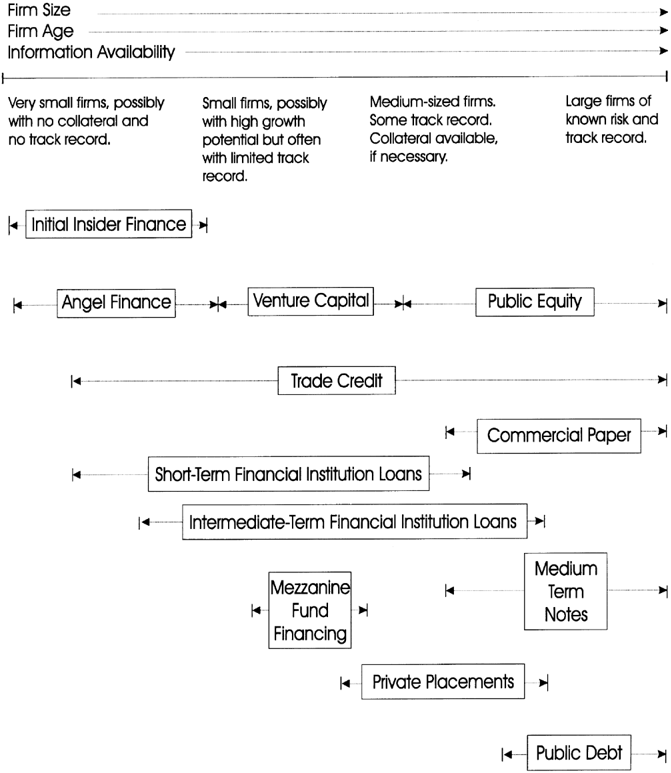
- The growth cycle paradigm predicts younger/more opaque firms rely on insider finance, trade credit, and angel finance, then venture capital and banks, and eventually public markets. However, 1993 NSSBF data show insider finance does not dominate external finance even for adolescents (upper bound 56.8% insider, roughly equal to external), and financial institution debt is important to very young firms, often based on personal guarantees or collateral.
- Macro vulnerability: the early-1990s credit crunch saw real C&I loans fall 23.2% ($596.7 billion to $458.2 billion) and estimated small business lending fall 38.5% ($143.7 billion to $88.4 billion). Banks with less than $100 million in assets held about 9% of portfolios in small business loans versus about 2% for banks over $10 billion; large banks charged about 100 basis points less and required collateral about 25% less often than small banks, other things equal.
Methods
- Design: review and synthesis organized around the financial growth cycle paradigm, covering theoretical and empirical literature on private equity and debt markets, contracts, and macroeconomic vulnerability.
- Data: primarily the 1993 National Survey of Small Business Finances (NSSBF) for US small business finance tables, plus other sources including NFIB, SCF, STBL, CALL, CRA, Venture Economics/VentureOne, and international data.
- Analysis: descriptive tabulations (Tables 1 and 2) and literature synthesis; the paper is a review rather than a new primary empirical study.
Limitations
- Paper-stated: Table 1 data are not completely accurate or consistent and should be considered rough estimates; angel finance estimates are imprecise (range $15 billion to $120 billion); 1993 data may not reflect current conditions; weighted averages mask considerable heterogeneity.
- Paper-stated: the growth cycle paradigm is not intended to fit all small businesses; firm size, age, and information availability are far from perfectly correlated, and the points at which different funding sources begin and end are not definitive.
- Evident from the text: informational opacity and the intertwining of personal and business finances make small business finance difficult to research, and data on owners’ finances are often unavailable; the paper relies heavily on existing literature and available data rather than new primary data collection.
Model-written summary. Check it against the paper before relying on it.
Integrity signals
Registry
Cites
Statistics
Figures
Verification
Claims the paper makes
22 Valid · 27 Not valid · 107 Not checked · 201 Own results and interpretations
Every source the paper cites for this claim was checked and supports it.
In the paper
“This use of personal assets to help with external ®nance also highlights another important aspect of small business ®nance ± the ®nancial intertwining of owners and their businesses (Ang, 1992).”
§ The economics of small business ®nance: The roles of private equity and debt markets in the ®nancial growth cycle > 2.3. The ®nancial growth cycle of small business
What the sources say
- Supportedcites Ang, 1992 matched to “On the Theory of Finance for Privately Held Firms” (1992) source
In “Integrating Personal and Business Accounts,” Ang says that personal guarantees or collateral make business risk inseparable from owners’ personal risk. “The Financing Decision” also identifies owners’ assets used for loan guarantees as contributions to the business. Together, these passages support the cited point that using personal assets to obtain external finance intertwines owners’ and businesses’ finances. (LLM, conf=0.94)
plainstates an association- Asserted: passes — The authors put it forward as true.
- Checkable: passes — It can be checked against evidence.
- Load-bearing: unclear — It is unclear whether the paper’s conclusions depend on it.
- Based: passes — The paper gives a reason why it holds.
- Supported
The cited sources support only part of this claim — read each source’s verdict below.
In the paper
“Costly state veri®cation (Townsend, 1979;Diamond, 1984) and adverse selection (Myers, 1984;Myers and Majluf, 1984;Nachman and Noe, 1994) arguments suggest the optimality of debt contracts after insider ®nance has been exhausted.”
§ The economics of small business ®nance: The roles of private equity and debt markets in the ®nancial growth cycle > 2.3. The ®nancial growth cycle of small business
What the sources say
- Partly supportedcites Townsend, 1979 matched to “Optimal contracts and competitive markets with costly state verification” (1979) sourceExperimental — accuracy not yet measured
Section 3 characterizes an optimal contract for a firm financing an investment project as a bond that defaults when returns fall below a threshold, supporting the costly-state-verification rationale for debt. The paper does not establish that debt becomes optimal only after insider finance has been exhausted. The adverse-selection citations in the sentence refer to other sources, not Townsend. (LLM, conf=0.85)
- Not checked — no full text of the sourcecites Diamond, 1984 matched to “Financial intermediation and delegated monitoring” (1984) source
- Not matchedcites Myers, 1984
More than one paper fits this citation.
hedgedstates a cause- Asserted: passes — The authors put it forward as true.
- Checkable: passes — It can be checked against evidence.
- Load-bearing: passes — The paper’s conclusions depend on it.
- Based: passes — The paper gives a reason why it holds.
- Partly supported
The cited sources support only part of this claim — read each source’s verdict below.
In the paper
“An agency problem arises in the relationship between the entrepreneur and the venture capitalist in which the entrepreneur may expend insucient eort, exhibit expense preference behavior, or lack sucient information or skill to make optimal production decisions.”
§ The economics of small business ®nance: The roles of private equity and debt markets in the ®nancial growth cycle > 3.2. The venture capital market
What the sources say
- Not checked — no full text of the sourcecites Cooper and Carleton, 1979 matched to “Dynamics of Borrower‐Lender Interaction: Partitioning Final Payoff in Venture Capital Finance” (1979) source
- Partly supportedcites Bergemann and Hege, 1998 matched to “Venture capital financing, moral hazard, and learning” (1998) sourceExperimental — accuracy not yet measured
Section 2.3, “Moral hazard and financing,” describes an entrepreneur who may reduce costly effort or divert investment funds to private ends, supporting the insufficient-effort and expense-preference parts of the claim. It does not identify a lack of the entrepreneur’s information or skill as a cause of poor production decisions; it instead says the entrepreneur and venture capitalists initially have the same assessment of the project. (LLM, conf=0.88)
hedgedstates a possible cause- Asserted: passes — The authors put it forward as true.
- Checkable: passes — It can be checked against evidence.
- Load-bearing: passes — The paper’s conclusions depend on it.
- Based: passes — The paper gives a reason why it holds.
Every source the paper cites for this claim was checked and supports it.
In the paper
“Since 1990, this share has about doubled to 30% (Fenn et al., 1997).”
§ The economics of small business ®nance: The roles of private equity and debt markets in the ®nancial growth cycle > 3. The role of private equity markets in small business ®nance
What the sources say
- Supportedcites Fenn et al., 1997 matched to “The Private Equity Market: An Overveiw” (1997) source
In “IPO Firms that Received Private Equity Backing,” the paper states that the share of IPOs with venture backing averaged 15% during the 1980s and doubled to 30% since 1990. This directly supports the cited claim. (LLM, conf=0.95)
plainstates an association- Asserted: passes — The authors put it forward as true.
- Checkable: passes — It can be checked against evidence.
- Load-bearing: unclear — It is unclear whether the paper’s conclusions depend on it.
- Based: passes — The paper gives a reason why it holds.
- Supported
The cited sources support only part of this claim — read each source’s verdict below.
In the paper
“During the 1980s, approximately 15% of all IPOs were backed by venture capital, well out of proportion to the fraction of all ®rms that received venture capital.”
§ The economics of small business ®nance: The roles of private equity and debt markets in the ®nancial growth cycle > 3. The role of private equity markets in small business ®nance
What the sources say
- Partly supportedcites Fenn et al., 1997 matched to “The Private Equity Market: An Overveiw” (1997) sourceExperimental — accuracy not yet measured
The section “IPO Firms that Received Private Equity Backing” states that venture-backed IPOs averaged 15% of IPOs during the 1980s. It does not give the fraction of all firms that received venture capital or make the claimed comparison with that fraction. (LLM, conf=0.84)
plainstates an association- Asserted: passes — The authors put it forward as true.
- Checkable: passes — It can be checked against evidence.
- Load-bearing: unclear — It is unclear whether the paper’s conclusions depend on it.
- Based: passes — The paper gives a reason why it holds.
- Partly supported
184 more claims · 6 with their cited sources checked
Create a free account to see all 357 claims and to verify the 12 references still open.
- Probably not a substantial claim. 94
- It may state two separate claims as one. 87
- Borderline: one of the tests for a substantial claim is unclear. 2
Claims other papers make about this one
Each is checked against this paper’s own text: does it say what the citing paper says it does?
The cited source says what the claim attributes to it.
In the citing paper
“SMEs are more dependent on external financing supplied by commercial banks (Berger and Udell 1998) because most of them are not qualified to raise money from the stock market.”
From Local Bank, Digital Financial Inclusion and SME Financing Constraints: Empirical Evidence from China (2022) · cites this paper as Berger and Udell 1998
Self-check
Percentages, sums and reported differences re-computed from the paper’s own numbers.
Rated minor: it would not touch a result — a value no result rests on, a p-value that stays on the same side of the significance level, or a conflict that is clerical, resolved elsewhere in the paper, or outside its own findings.
In the paper
“Non®nancial business/government debt provides 19.26% of small business funding (mostly trade credit)”
§ The economics of small business ®nance: The roles of private equity and debt markets in the ®nancial growth cycle > 4. The role of private debt markets in small business ®nance
Reported 19.26 · recomputed 18.01
Citations
Cites
Corporate financing and investment decisions when firms have information that investors do not have
Myers, S. C., & Majluf, N. S. (1984) · Journal of Financial Economics · doi:10.1016/0304-405x(84)90023-0 · Cited by 18,957
The Cost of Capital, Corporation Finance and the Theory of Investment
Miller, M. H. (1958) · American Economic Review · Cited by 14,574
Determinants of corporate borrowing
Myers, S. C. (1977) · Journal of Financial Economics · doi:10.1016/0304-405x(77)90015-0 · Cited by 13,169
Credit Rationing in Markets with Imperfect Information
Stiglitz, J. E., & Weiss, A. (1981) · Columbia University · doi:10.7916/d8v12ft1 · Cited by 12,769 · cited 1×
“…pledging outside collateral may help resolve adverse selection problems when the borrower has more information about the quality of the investment than the lender, and may help prevent credit rationing (Stiglitz and Weiss 1981, 1986, Bester 1985, Chan and Kanatas 1985, Besanko and Thakor 1987a,b).”
The cost of capital, corporation finance and the theory of investment
Terra, P. R. (2008) · Revista de Administração e Contabilidade da Unisinos · doi:10.4013/base.20082.07 · Cited by 8,615
Financial intermediation and delegated monitoring
Diamond, D. W. (1984) · The Review of Economic Studies · doi:10.2307/2297430 · Cited by 8,476 · cited 2×
“Costly state verification (Townsend 1979, Diamond 1984) and adverse selection (Myers 1984, Myers and Majluf 1984, Nachman and Noe 1994) arguments suggest the optimality of debt contracts after insider cFor example, there are generally accepted definitions of the stages of finance for the kind of…”
Corporate Financing and Investment Decisions When Firms Have InformationThat Investors Do Not Have
Myers, S., & Majluf, N. (1984) · doi:10.3386/w1396 · Cited by 6,745
The Benefits of Lending Relationships: Evidence from Small Business Data
PETERSEN, M. A., & RAJAN, R. G. (1994) · The Journal of Finance · doi:10.1111/j.1540-6261.1994.tb04418.x · Cited by 5,440 · cited 4×
“…whereas mortgages, equipment loans, motor vehicle loans, and other loans may more often be transactionsdriven .zs It was also found that dependence on trade credit decreased with the length of the banking relationship, supporting the value of relationship lending (Petersen and Rajan 1994, 1995).”
InfluentialInside the black box: the credit channel of monetary policy transmission
Bernanke, B. S., & Gertler, M. (1995) · Journal of Economic Perspectives · doi:10.1257/jep.9.4.27 · Cited by 4,211
Insiders and Outsiders: The Choice between Informed and Arm's‐Length Debt
RAJAN, R. G. (1992) · The Journal of Finance · doi:10.1111/j.1540-6261.1992.tb04662.x · Cited by 3,902 · cited 1×
“Some research suggests that these firms may try to reduce the control of their banks by issuing public debt, even though public debt may entail higher costs (Diamond 1991, 1993, Rajan 1992, Houston and James 1996).”
Research works printed but not linked: 11
- 66. Cook, L., 1997. Trade ®nance, bank ®nance, and capital market imperfections. Working paper. Harvard University, Cambridge, MA.
- 89. Freear, J., Sohl, J.E., Wetzel, W.E., Jr., 1994. The private investor market for venture capital. The Financier 1, 7±19.
- 112. Hancock, D., Wilcox, J.A., 1997. Bank capital, nonbank ®nance, and real estate activity. Journal of Housing Research 8, 75±105.
- 117. Hempel, G., Coleman, A., Simonson, D., 1986. Bank Management, Wiley, New York.
- 119. Ho, R., 1997. Credit-card use to ®nance small business is soaring, says survey of small ®rms. Wall Street Journal B2, Sept. 25.
- 153. Megginson, W.L., Weiss, K.A., 1991. Venture capitalist certi®cation in initial public oerings. Journal of Finance 46, 903±979.
- 162. Morsman Jr., E., 1986. Commercial loan structuring. Journal of Commercial Bank Lending 68, 2± 20.
- 187. Ravid, S.A., 1996. Debt maturity ± A survey. Financial Markets, Institutions and Instruments 5 (3), 1±68.
- 217. Wetzel Jr. W.E., 1994. Venture capital. In: Bygrave, W.D. (Ed.), Portable MBA in Entrepreneur- ship. Wiley, New York, pp. 172±194.
- 219. White, L.J., 1995. An analytical framework. In: Zahid, S.N. (Ed.), Financial Sector Development in Asia. Oxford University Press, New York, pp. 3±35.
- 222. McKean, R. (Ed.), Issues in Defense Economics. Columbia University Press, New York.
Cited by
Items 3,301–3,400 of 3,739
Yoshihara, K. (2014) · THE JOURNAL OF ISLAND STUDIES · doi:10.5995/jis.2014.13
Incubating financial development : private equity and the state
Puente, I. (2020) · DSpace@MIT (Massachusetts Institute of Technology)
Three essays on corporate finance
Hasan, M. M. (2015) · eSpace (Curtin University)
Mechanics of private equity and recent trends
Caselli, S., & Negri, G. (2021) · Elsevier eBooks · doi:10.1016/b978-0-323-85401-6.00009-6
اثر قرض دهی رابطه محور روی شرایط قرارداد وام
فرد, ر. ف., & رحمتی, م. (2019)
Credit Accessibility and Success of Women-Owned Enterprises in Kitui County, Kenya
Kitivui, J. K. (2020)
In Business Groups We TrustPreprint
Hamelin, A., Lefebvre, V., & Weill, L. (2023) · SSRN Electronic Journal · doi:10.2139/ssrn.4670144
Avramidis, P. K., Serfes, K., & Wu, K. (2021)
Boudreaux, C. J., Clarke, G. R. G., & Jha, A. (2021) · RePEc: Research Papers in Economics · doi:10.48550/arxiv.2104.12004
“…to the U.S. small business administration, about 20 percent of the small businesses in the U.S. do not get financing from banks and rely on credits from suppliers.4 Berger and Udell (1998) note that a typical small business has an almost equal amount of debt from banks as it has from suppliers.”
BackgroundDo Banks Lend Where They Borrow? Local Small-Business Lending in the U.S.Preprint
Cole, R. A., & Damm, J. (2020) · SSRN Electronic Journal · doi:10.2139/ssrn.3562347
Chong, B., & Im, H. J. (2020) · SSRN Electronic Journal · doi:10.2139/ssrn.3624042
SME investment determinants and financing constraints: A stochastic frontier approachPreprint
Martinez‐Cillero, M., Lawless, M., & O’Toole, C. M. (2021) · RePEc: Research Papers in Economics
Mustafa, M. (2021) · Springer eBooks · doi:10.1007/978-981-16-0921-3_1
Allen, L., Chakraborty, S., Hazarika, S., et al. (2019) · SSRN Electronic Journal · doi:10.2139/ssrn.3357149
The nature of crisis responses
Keller, E. (2021) · Oxford University Press eBooks · doi:10.1093/oso/9780198870746.003.0009
Social learning in response to the crisis
Keller, E. (2021) · Oxford University Press eBooks · doi:10.1093/oso/9780198870746.003.0006
Financial crises and the limits of reforms
Keller, E. (2021) · Oxford University Press eBooks · doi:10.1093/oso/9780198870746.003.0001
Consolidating the lessons learnt
Keller, E. (2021) · Oxford University Press eBooks · doi:10.1093/oso/9780198870746.003.0007
The Great Recession and international banking reforms
Keller, E. (2021) · Oxford University Press eBooks · doi:10.1093/oso/9780198870746.003.0004
The French and the German financial crisis
Keller, E. (2021) · Oxford University Press eBooks · doi:10.1093/oso/9780198870746.003.0005
Adjustments to financial globalization
Keller, E. (2021) · Oxford University Press eBooks · doi:10.1093/oso/9780198870746.003.0002
Studying the development of integrated financial sectors
Keller, E. (2021) · Oxford University Press eBooks · doi:10.1093/oso/9780198870746.003.0003
Li, J. (2020) · International Conference on Economic Management and Model Engineering (ICEMME) · doi:10.1109/icemme51517.2020.00038
Khalid, S., & Zaman, N. U. (2021) · Jinnah Business Review · doi:10.53369/gltd2825
Services Quality & Students Satisfaction Level
Hanif, M. I., Shahid, M., & Ahmed, S. (2021) · Jinnah Business Review · doi:10.53369/tdnp9849
Gender Based Financing Preferences of SMEs: Discouraged Borrowers
Singh, R. (2014) · uO Research (University of Ottawa) · doi:10.20381/ruor-3630 · Cited by 3
Value Creation by Private Equity Firms: A Resource-based View
Pang, K. (2021) · IRL - University of Missouri, St. Louis (University of Missouri–St. Louis)
Personal Taxes and Small Business LendingPreprint
Nordén, L., & Wang, W. (2021) · SSRN Electronic Journal · doi:10.2139/ssrn.3836142
Informe especial de estabilidad financiera: inclusión financiera - Primer semestre de 2021
Clavijo-Ramírez, F., Gualtero-Briceño, D., & Botero, Ó. D. (2021) · doi:10.32468/incl-fin.sem1-2021
Ansari, M. N., & Ahmed, S. F. (2021) · Jinnah Business Review · doi:10.53369/bpma2213
Trade Policy Uncertainty and Global Stock Returns: Evidence from the 2016 US Presidential ElectionPreprint
Thuy, N., Bui, D. G., Hasan, I., Lin, C., & Vaike, C. (2021) · SSRN Electronic Journal · doi:10.2139/ssrn.3860623
Politykowanie organizacyjne. Treść, proces, kontekst i efekty
Kulikowska-Pawlak, M. (2018) · Prace Naukowe / Uniwersytet Ekonomiczny w Katowicach · Cited by 2
Credit Risk Elements for Small and Medium-Sized Enterprises: The Case of Spain
Zubeldia, A. M., Sogorb, A. O., Zubiaurre, M. Z., & Blanco, A. (2021) · International Journal of Economics and Business Administration · doi:10.35808/ijeba/715
“It is at this point where one of the biggest problems of SMEs comes to the fore, access to external financing (Lehman and Neuberger, 2001), with bank financing being the source to which these companies turn predominantly (Berger and Udell, 1998; Selva and Giner, 1999; Montoriol, 2006).”
BackgroundO que torna uma campanha de crowdfunding de recompensa exitosa?
Felipe, I. J. D. S., & Souza, G. M. (2021) · Innovar · doi:10.15446/innovar.v31n81.95570
“A oferta de tal crédito ocorre, especialmente, através de instituições financeiras (Berger & Udell, 1998), nas quais a concessão do capital requerido pelo empreendedor depende de uma série de fatores, tais como taxa de juros elevada, garantias e um conjunto de informações financeiras, tornando o…”
BackgroundPaeleman, I., Zahra, S. A., & Lang, J. W. B. (2021) · RePEc: Research Papers in Economics · Cited by 1
Corporate Financing Strategies in Normal and Crisis Conditions: Evidence from Tehran Stock Exchange
Saman, R. N., Asghar, A. R. A., Karam, K., et al. (2020)
Miglo, A. (2018) · SSRN Electronic Journal · doi:10.2139/ssrn.3147650 · Cited by 2
Capital structure and firm growth: The case of Vietnamese listed firms
Hiep, H. (2021) · UWE Research Repository (UWE Bristol) · Cited by 2
The Impact of Relationship Lending on Bank Loan Process for Korean SMEs
Hwang, S.-Y., Lee, J.-J., & Kim, Y.-D. (2021) · Korean Journal of Financial Studies · doi:10.26845/kjfs.2021.10.50.5.521
“자금조달은 중소기업의 성장과 발전을 위해 필수적이다(Berger and Udell, 1998).”
The Potential for Biases in Resolving Loan Problems
Brody, R. G., Sokolowski, M., & White, R. (2021) · International Journal of Finance & Banking Studies (2147-4486) · doi:10.20525/ijfbs.v10i3.1312
“In doing so, this study also contributes to the literature on relationship lending that seeks to explain how bank-borrower relationships work, including how banks acquire borrower information and how lenders process borrower information (Berger and Udell, 1998; 2002).”
BackgroundXiang, D., Worthington, A. C., & Higgs, H. (2012) · SSRN Electronic Journal · doi:10.2139/ssrn.2131975
Ma, L. (2021) · International Conference on Smart Electronics and Communication (ICOSEC) · doi:10.1109/icosec51865.2021.9591830
“micro and tiny companies are widespread in all countries met the capital needs of personal consumption and corporate financing to a certain extent [1-6].”
BackgroundBuitrago, J. A., & Velez, J. L. (2021) · Revista Colombiana de Ciencias Administrativas · doi:10.52948/rcca.v3i2.434
Lefebvre, V. (2021) · Finance · doi:10.3917/fina.423.0057
Små tillväxtföretag och extern finansiering
Nielsen, J. L., Karlsson, P., & Christensen, P. J. (2007) · KTH Publication Database DiVA (KTH Royal Institute of Technology)
Capital structure adjustment process in firms accessing venture funding
Ramón, M. B., Martí, J., & Tanaka, Á. T. (2011) · Documentos de Trabajo FUNCAS
Brooksbank, D. J. (2006) · High Technology Small Firms Conference and Doctoral Workshop (HTSF) · doi:10.3990/2.268617586 · Cited by 1
Hedlund, A., & Gudmundsson, J. (2010) · KTH Publication Database DiVA (KTH Royal Institute of Technology)
Nejednakost spolova u pristupu bankarskim kreditima
Jukić, M., & Škokić, V. (2021) · Elektronički zbornik radova Veleučilišta u Šibeniku · doi:10.51650/ezrvs.15.3-4.1
The Dynamics of Privately Held Business Assets in the United StatesPreprint
Pernell, K., & Wodtke, G. T. (2022) · doi:10.31235/osf.io/xcde4
The Impact of Public Loan Guarantees on Banks’ Risk Taking and Firms’ Growth: Evidence from France
Gazaniol, A., & Lê, M. (2021) · Économie & prévision · doi:10.3917/ecop1.218.0072 · Cited by 6
A startupok állami finanszírozásának nemzetközi gyakorlata
Karsai, J. (2021) · Külgazdaság · doi:10.47630/kulg.2021.65.11-12.28
Private Equity, Financial Development, and Corporate Governance Reform
Puente, I. (2022) · Latin American Political Economy · doi:10.1007/978-3-030-88983-8_2
Bank, W. (2013) · World Bank, Washington, DC eBooks · doi:10.1596/978-0-8213-9985-9_bm
Edmans, A. (2020) · Cambridge University Press eBooks · doi:10.1017/9781108860093.022
(2007) · Deutscher Universitätsverlag eBooks · doi:10.1007/978-3-8350-9018-7_7
(2009) · Gabler eBooks · doi:10.1007/978-3-8349-8128-8_3
Theoretical Studies on the Problematic Issue of “Make or Buy”
(2016) · Innovation, technology, and education for growth · doi:10.1108/978-1-78635-742-720161002
(2016) · Innovation, technology, and education for growth · doi:10.1108/978-1-78635-742-720161009
Financing CyclesPreprint
Geelen, T., Hajda, J., Morellec, E., et al. (2022) · SSRN Electronic Journal · doi:10.2139/ssrn.4025812
Effect of Corporate Social Responsibility on Pricing of Small Business Loans: Evidence From Finland
Vieru, M., & Peltoniemi, J. (2021) · IGI Global eBooks · doi:10.4018/978-1-7998-9155-0.ch060
Niosi, J. E. (2018) · Cambridge University Press eBooks · doi:10.1017/9781108529525.001
Agglomeration of Invention in the Bay Area: Not Just ICT
Forman, C., Goldfarb, A., & Greenstein, S. M. (2018) · Cambridge University Press eBooks · doi:10.1017/9781108529525.015
Einleitung und Gegenstand der Arbeit
(2009) · Gabler eBooks · doi:10.1007/978-3-8349-8128-8_1
A BIBLIOMETRIC ANALYSIS OF PEER-REVIEWED LITERATURE ON DETERMINANTS OF SMALL BUSINESS GROWTH
LAZĂR, L., Ciocoiu, C. N., & MARCU, C. (2022) · Proccedings of the International Management Conference · doi:10.24818/imc/2021/05.06
Audretsch, D. B., Keilbach, M., & Lehmann, E. E. (2006) · Oxford University Press eBooks · doi:10.1093/acprof:oso/9780195183511.003.0001
Entrepreneurial Firms’ Financing Choice: Borrowing from Suppliers Versus Borrowing from Banks
Jiang, X., Liu, Z., Liang, H., Liu, C., & Cheng, Y. (2022) · Journal of Finance Issues · doi:10.2139/ssrn.4041268 · Cited by 1
Banking and Wealth Creation for Stakeholders in Cameroon: An Exploratory Study
Mbu, S. A., & Nso, M. A. (2022) · European Scientific Journal ESJ · doi:10.19044/esj.2022.v18n9p38 · Cited by 1
Does Headquarters Location Matter for Corporate Cash Holdings?Preprint
Wang, Y. Y., & Yi, L. (2022) · SSRN Electronic Journal · doi:10.2139/ssrn.4045255
Keller, E. (2021) · Oxford University Press eBooks · doi:10.1093/oso/9780198870746.003.0008
Collaboration, Innovation, and Funding as Survival Factors for Canadian Biotechnology SMEs
Beaudry, C., & Levasseur, J. (2019) · IGI Global eBooks · doi:10.4018/978-1-5225-8903-7.ch062
Local Financial Development and SMEs Capital Structure: An Empirical InvestigationPreprint
Agostino, M., Rocca, M. L., Rocca, T. L., et al. (2009) · SSRN Electronic Journal · doi:10.2139/ssrn.1343136
Are Financing Decisions of Family-Owned SMEs Different? Empirical Evidence Using Panel Data
Serrasqueiro, Z., Nunes, P. M., & da Silva, J. V. (2012) · Journal of Management & Organization · doi:10.5172/jmo.2012.1457
Structure financière et dépenses de R&D
Belin, J., Cavaco, S., & Guille, M. (2013) · Économie & prévision · doi:10.3917/ecop.197.0129
Legal Aspects and Regulation in Crowdfunding
Lerro, A. M. (2020) · IGI Global eBooks · doi:10.4018/978-1-7998-2448-0.ch019
Mutual Guarantee Systems of Small and Medium-Sized Enterprises in China
Yang, Y., Yan, H., & Yang, Z.-Y. (2012) · IGI Global eBooks · doi:10.4018/978-1-4666-0276-2.ch018
Debt Costs During Life Cycles of Listed Companies in the Tehran Stock Exchange
Hajiha, Z., & Bazaz, M. S. (2020) · Asia-Pacific Management Accounting Journal · doi:10.24191/apmaj.v15i1-06
Unternehmerische Finanzierungspolitik unter Berücksichtigung von Realoptionen
Wieland, A. K., & Dahlheim, C. (2003) · Springer eBooks · doi:10.1007/978-3-642-55457-5_5
Pajarinen, M. (2019) · Springer eBooks · doi:10.1007/978-1-4614-7753-2_253
Aleksejeva, I. (2013) · IEEE Lasers and Electro-Optics Society Annual Meeting (LEOS) · doi:10.22364/ncebd.2013.01 · Cited by 1
Audretsch, D. B., Keilbach, M., & Lehmann, E. E. (2006) · Oxford University Press eBooks · doi:10.1093/acprof:oso/9780195183511.003.0007
The Influence of Specific Criteria of Emerging Markets on SME Financing in MENA Markets
Snoussi, W., & Béjaoui, A. (2017) · Advances in finance, accounting, and economics book series · doi:10.4018/978-1-5225-2700-8.ch003
Niosi, J. E. (2018) · Cambridge University Press eBooks · doi:10.1017/9781108529525.018
Alcance de los créditos a tasa subsidiada para mipymes argentinas
Corzo, L. J., Guercio, M., & Vigier, H. P. (2021) · Revista Finanzas y Política Económica · doi:10.14718/revfinanzpolitecon.3631
Audretsch, D. B., Keilbach, M., & Lehmann, E. E. (2006) · Oxford University Press eBooks · doi:10.1093/acprof:oso/9780195183511.003.0008
(2020) · Elsevier eBooks · doi:10.1016/b978-0-12-814637-8.00027-5
(2013) · Elsevier eBooks · doi:10.1016/b978-0-12-409537-3.00036-0
Pajarinen, M. (2020) · Springer eBooks · doi:10.1007/978-1-4614-7883-6_253-2
(2018) · Elsevier eBooks · doi:10.1016/b978-0-12-812254-9.09986-1
Global Crisis and Financial Distress Likelihood of SMEs: Some Evidence From Panel Data Regression
Quintiliani, A. (2021) · IGI Global eBooks · doi:10.4018/978-1-7998-9155-0.ch054
El crédito comercial en el sector turístico: Ciclo económico y factores determinantes
Canto-Cuevas, F.-J., Palacín-Sánchez, M.-J., & di Pietro, F. (2016) · International Journal of World of Tourism · doi:10.12795/ijwt.2016.i06.04
Le rôle du discours des porteurs de projets dans la réussite des campagnes de crowdlending
Slimane, F. B., Chaney, D., Leboeuf, G., & Trabelsi, D. (2022) · Innovations · doi:10.3917/inno.pr2.0131 · Cited by 1
IMPACTS OF COVID-19 ON THE AZERBAIJAN ECONOMY
Dibirova, Y. D. Y. (2022) · PAHTEI-Procedings of Azerbaijan High Technical Educational Institutions · doi:10.36962/pahtei18072022-127
BENTONİT GİLLƏRİNİN TƏTBİQ SAHƏLƏRİNİN QİYMƏTLƏNDİRİLMƏSİ
Əfəndiyeva, M. H. Z., & Osmanlı, S. M. T. O. T. (2022) · PAHTEI-Procedings of Azerbaijan High Technical Educational Institutions · doi:10.36962/pahtei18072022-136
SME CREDIT RISK MODELLING IN SOUTH AFRICA: A CASE STUDY
Marimo, M., & Chimedza, C. (2022) · ACTA ECONOMICA · doi:10.7251/ace2236009m
“Lack of adequate funding is the main operating and growth constraint of SMEs (Berger & Udell, 1998).”
Background
Metadata
- Authors
- N. Berger, A., & F. Udell, G.
- Venue
- Journal of Banking & Finance
- Publisher
- Elsevier BV
- Published
- 1998-08
- Volume
- 22
- Issue
- 6-8
- Pages
- 613-673
- ISSN
- 0378-4266 (ISSN-L)
- OpenAlex
- W2119780569
- Semantic Scholar
- dfc06f7f7eb83d2c0e2a1d67ecb95b520a406843
- Cited by
- 3,690
- References
- 230
- Citations by year
- 2026: 136 · 2025: 148 · 2024: 144 · 2023: 193 · 2022: 155 · 2021: 211 · 2020: 200 · 2019: 156 · 2018: 208 · 2017: 174 · 2016: 186 · 2015: 187 · 2014: 168 · 2013: 177 · 2012: 171
- FWCI
- 169.26
- Type
- journal article
- Language
- en
- Open access
- hybrid
- doi.org
- Licence
- cc-by-nc-nd
- www.elsevier.com/tdm/userlicense/1.0/ (tdm)
- www.elsevier.com/legal/tdmrep-license (tdm)
- creativecommons.org/licenses/by-nc-nd/4.0/ (vor, 125 d)
- Locations
- Journal of Banking & Finance (publishedVersion, cc-by-nc-nd)
- RePEc: Research Papers in Economics (submittedVersion)
- Funders
- York University
- Topics
- Social Sciences › Economics, Econometrics and Finance › Finance › Private Equity and Venture Capital
- Social Sciences › Economics, Econometrics and Finance › Finance › Corporate Finance and Governance
- Social Sciences › Economics, Econometrics and Finance › Finance › Banking stability, regulation, efficiency
- Keywords
- small business financing, private equity, debt markets, capital structure, firm size, firm age, macroeconomic conditions
About these checks
Registry, retraction, Cites and statistics results are computed, not judged, with one exception: a printed reference that no index lists is read once by a model before it counts as a citation error. Claims are extracted by a model and kept only when their quote appears verbatim in the text; each cited source is then checked, with a model’s help, for whether it says what the claim relies on. Those verdicts can be wrong — read the claim’s quote and the cited source before relying on one.
The claim verdicts this report counts are experimental: their accuracy is not yet measured.
A language model drew the claims from the paper on 2026-10-10, under version 3 of the claim definition (model deepseek-v4.1-flash, prompt extract-v3).
A second model labelled each claim on 2026-10-10 (model jev-1.13-20260917, definition revision gold-guideline-v0.2).
Cited sources are checked with a language model’s help (gpt-6-sol).
Statistics and arithmetic are recomputed, not judged.
Confidence bands are shown only for fields calibrated on our annotated test set. None is calibrated yet, so no band is shown.
What counts as a claim ›How we measure confidence ›How we check this ›
Are you an author, or do you see a problem with this page? Request a review
Data sources
Bibliographic data: Semantic Scholar, OpenAlex, Crossref.
Contains information from the Semantic Scholar Academic Graph Datasets, made available under the ODC Attribution License (ODC-BY 1.0).
Semantic Scholar’s data is described in: Kinney, R., et al. (2023). The Semantic Scholar Open Data Platform. arXiv:2301.10140.
