

The economics of small business finance: The roles of private equity and debt markets in the financial growth cycle
Open accessThe DOI matches its Crossref record; 217 of the 230 references it cites were found in a registry or an index, and 1 are not checked yet; 24 of the 170 sources its claims cite were checked for support.
Abstract
This article examines the economics of financing small business in private equity and debt markets. Firms are viewed through a financial growth cycle paradigm in which different capital structures are optimal at different points in the cycle. We show the sources of small business finance, and how capital structure varies with firm size and age. The interconnectedness of small firm finance is discussed along with the impact of the macroeconomic environment. We also analyze a number of research and policy issues, review the literature, and suggest topics for future research.
Verified 2026-11-25 · 1 reference not checked yet
Overview
CoChat Summary
TL;DR
This article reviews the economics of small business finance through a financial growth cycle paradigm, emphasizing informational opacity and the roles of private equity and debt markets. It documents US small business funding sources and contracts, and analyzes vulnerability to macroeconomic shocks, credit crunches, and bank consolidation.
Key findings
- US small business finance is split roughly evenly between equity (49.63%) and debt (50.37%); the largest sources are the principal owner, commercial banks, and trade creditors, together accounting for 70.10% of total funding. Commercial banks provide 18.75%, trade credit 15.78%, principal owner equity 31.33%, angel finance 3.59%, venture capital 1.85%, and credit card debt 0.14%.
- Financial institution debt is used by 54.23% of small businesses; 86.95% name a commercial bank as their primary financial institution. Average relationship length is 6.64 years overall and 9.01 years with the primary institution; 52.03% of financial institution debt is under lines of credit, 91.94% is secured, and 51.63% is guaranteed.
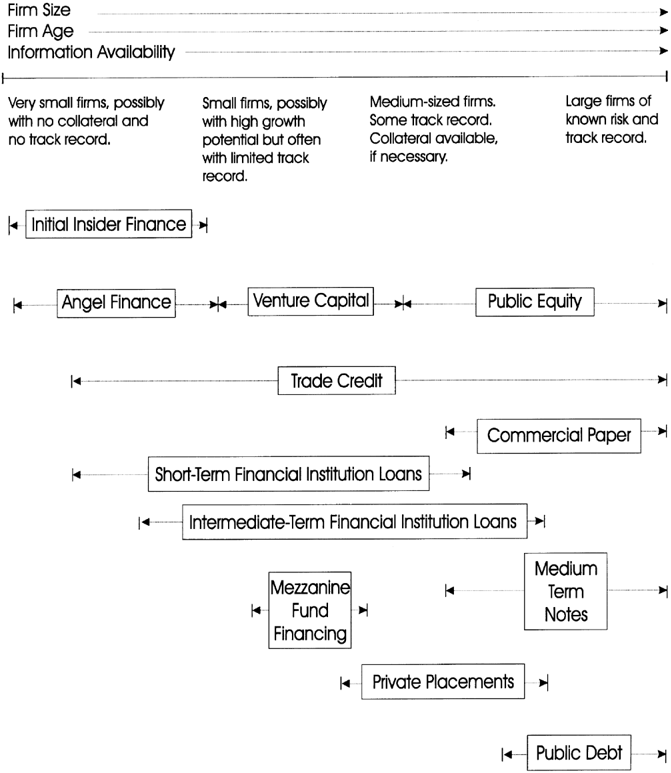
- The growth cycle paradigm predicts younger/more opaque firms rely on insider finance, trade credit, and angel finance, then venture capital and banks, and eventually public markets. However, 1993 NSSBF data show insider finance does not dominate external finance even for adolescents (upper bound 56.8% insider, roughly equal to external), and financial institution debt is important to very young firms, often based on personal guarantees or collateral.
- Macro vulnerability: the early-1990s credit crunch saw real C&I loans fall 23.2% ($596.7 billion to $458.2 billion) and estimated small business lending fall 38.5% ($143.7 billion to $88.4 billion). Banks with less than $100 million in assets held about 9% of portfolios in small business loans versus about 2% for banks over $10 billion; large banks charged about 100 basis points less and required collateral about 25% less often than small banks, other things equal.
Methods
- Design: review and synthesis organized around the financial growth cycle paradigm, covering theoretical and empirical literature on private equity and debt markets, contracts, and macroeconomic vulnerability.
- Data: primarily the 1993 National Survey of Small Business Finances (NSSBF) for US small business finance tables, plus other sources including NFIB, SCF, STBL, CALL, CRA, Venture Economics/VentureOne, and international data.
- Analysis: descriptive tabulations (Tables 1 and 2) and literature synthesis; the paper is a review rather than a new primary empirical study.
Limitations
- Paper-stated: Table 1 data are not completely accurate or consistent and should be considered rough estimates; angel finance estimates are imprecise (range $15 billion to $120 billion); 1993 data may not reflect current conditions; weighted averages mask considerable heterogeneity.
- Paper-stated: the growth cycle paradigm is not intended to fit all small businesses; firm size, age, and information availability are far from perfectly correlated, and the points at which different funding sources begin and end are not definitive.
- Evident from the text: informational opacity and the intertwining of personal and business finances make small business finance difficult to research, and data on owners’ finances are often unavailable; the paper relies heavily on existing literature and available data rather than new primary data collection.
Model-written summary. Check it against the paper before relying on it.
Integrity signals
Registry
Cites
Statistics
Figures
Verification
Claims the paper makes
22 Valid · 27 Not valid · 107 Not checked · 201 Own results and interpretations
Every source the paper cites for this claim was checked and supports it.
In the paper
“This use of personal assets to help with external ®nance also highlights another important aspect of small business ®nance ± the ®nancial intertwining of owners and their businesses (Ang, 1992).”
§ The economics of small business ®nance: The roles of private equity and debt markets in the ®nancial growth cycle > 2.3. The ®nancial growth cycle of small business
What the sources say
- Supportedcites Ang, 1992 matched to “On the Theory of Finance for Privately Held Firms” (1992) source
In “Integrating Personal and Business Accounts,” Ang says that personal guarantees or collateral make business risk inseparable from owners’ personal risk. “The Financing Decision” also identifies owners’ assets used for loan guarantees as contributions to the business. Together, these passages support the cited point that using personal assets to obtain external finance intertwines owners’ and businesses’ finances. (LLM, conf=0.94)
plainstates an association- Asserted: passes — The authors put it forward as true.
- Checkable: passes — It can be checked against evidence.
- Load-bearing: unclear — It is unclear whether the paper’s conclusions depend on it.
- Based: passes — The paper gives a reason why it holds.
- Supported
The cited sources support only part of this claim — read each source’s verdict below.
In the paper
“Costly state veri®cation (Townsend, 1979;Diamond, 1984) and adverse selection (Myers, 1984;Myers and Majluf, 1984;Nachman and Noe, 1994) arguments suggest the optimality of debt contracts after insider ®nance has been exhausted.”
§ The economics of small business ®nance: The roles of private equity and debt markets in the ®nancial growth cycle > 2.3. The ®nancial growth cycle of small business
What the sources say
- Partly supportedcites Townsend, 1979 matched to “Optimal contracts and competitive markets with costly state verification” (1979) sourceExperimental — accuracy not yet measured
Section 3 characterizes an optimal contract for a firm financing an investment project as a bond that defaults when returns fall below a threshold, supporting the costly-state-verification rationale for debt. The paper does not establish that debt becomes optimal only after insider finance has been exhausted. The adverse-selection citations in the sentence refer to other sources, not Townsend. (LLM, conf=0.85)
- Not checked — no full text of the sourcecites Diamond, 1984 matched to “Financial intermediation and delegated monitoring” (1984) source
- Not matchedcites Myers, 1984
More than one paper fits this citation.
hedgedstates a cause- Asserted: passes — The authors put it forward as true.
- Checkable: passes — It can be checked against evidence.
- Load-bearing: passes — The paper’s conclusions depend on it.
- Based: passes — The paper gives a reason why it holds.
- Partly supported
The cited sources support only part of this claim — read each source’s verdict below.
In the paper
“An agency problem arises in the relationship between the entrepreneur and the venture capitalist in which the entrepreneur may expend insucient eort, exhibit expense preference behavior, or lack sucient information or skill to make optimal production decisions.”
§ The economics of small business ®nance: The roles of private equity and debt markets in the ®nancial growth cycle > 3.2. The venture capital market
What the sources say
- Not checked — no full text of the sourcecites Cooper and Carleton, 1979 matched to “Dynamics of Borrower‐Lender Interaction: Partitioning Final Payoff in Venture Capital Finance” (1979) source
- Partly supportedcites Bergemann and Hege, 1998 matched to “Venture capital financing, moral hazard, and learning” (1998) sourceExperimental — accuracy not yet measured
Section 2.3, “Moral hazard and financing,” describes an entrepreneur who may reduce costly effort or divert investment funds to private ends, supporting the insufficient-effort and expense-preference parts of the claim. It does not identify a lack of the entrepreneur’s information or skill as a cause of poor production decisions; it instead says the entrepreneur and venture capitalists initially have the same assessment of the project. (LLM, conf=0.88)
hedgedstates a possible cause- Asserted: passes — The authors put it forward as true.
- Checkable: passes — It can be checked against evidence.
- Load-bearing: passes — The paper’s conclusions depend on it.
- Based: passes — The paper gives a reason why it holds.
Every source the paper cites for this claim was checked and supports it.
In the paper
“Since 1990, this share has about doubled to 30% (Fenn et al., 1997).”
§ The economics of small business ®nance: The roles of private equity and debt markets in the ®nancial growth cycle > 3. The role of private equity markets in small business ®nance
What the sources say
- Supportedcites Fenn et al., 1997 matched to “The Private Equity Market: An Overveiw” (1997) source
In “IPO Firms that Received Private Equity Backing,” the paper states that the share of IPOs with venture backing averaged 15% during the 1980s and doubled to 30% since 1990. This directly supports the cited claim. (LLM, conf=0.95)
plainstates an association- Asserted: passes — The authors put it forward as true.
- Checkable: passes — It can be checked against evidence.
- Load-bearing: unclear — It is unclear whether the paper’s conclusions depend on it.
- Based: passes — The paper gives a reason why it holds.
- Supported
The cited sources support only part of this claim — read each source’s verdict below.
In the paper
“During the 1980s, approximately 15% of all IPOs were backed by venture capital, well out of proportion to the fraction of all ®rms that received venture capital.”
§ The economics of small business ®nance: The roles of private equity and debt markets in the ®nancial growth cycle > 3. The role of private equity markets in small business ®nance
What the sources say
- Partly supportedcites Fenn et al., 1997 matched to “The Private Equity Market: An Overveiw” (1997) sourceExperimental — accuracy not yet measured
The section “IPO Firms that Received Private Equity Backing” states that venture-backed IPOs averaged 15% of IPOs during the 1980s. It does not give the fraction of all firms that received venture capital or make the claimed comparison with that fraction. (LLM, conf=0.84)
plainstates an association- Asserted: passes — The authors put it forward as true.
- Checkable: passes — It can be checked against evidence.
- Load-bearing: unclear — It is unclear whether the paper’s conclusions depend on it.
- Based: passes — The paper gives a reason why it holds.
- Partly supported
184 more claims · 6 with their cited sources checked
Create a free account to see all 357 claims and to verify the 12 references still open.
- Probably not a substantial claim. 94
- It may state two separate claims as one. 87
- Borderline: one of the tests for a substantial claim is unclear. 2
Claims other papers make about this one
Each is checked against this paper’s own text: does it say what the citing paper says it does?
The cited source says what the claim attributes to it.
In the citing paper
“SMEs are more dependent on external financing supplied by commercial banks (Berger and Udell 1998) because most of them are not qualified to raise money from the stock market.”
From Local Bank, Digital Financial Inclusion and SME Financing Constraints: Empirical Evidence from China (2022) · cites this paper as Berger and Udell 1998
Self-check
Percentages, sums and reported differences re-computed from the paper’s own numbers.
Rated minor: it would not touch a result — a value no result rests on, a p-value that stays on the same side of the significance level, or a conflict that is clerical, resolved elsewhere in the paper, or outside its own findings.
In the paper
“Non®nancial business/government debt provides 19.26% of small business funding (mostly trade credit)”
§ The economics of small business ®nance: The roles of private equity and debt markets in the ®nancial growth cycle > 4. The role of private debt markets in small business ®nance
Reported 19.26 · recomputed 18.01
Citations
Cites
Corporate financing and investment decisions when firms have information that investors do not have
Myers, S. C., & Majluf, N. S. (1984) · Journal of Financial Economics · doi:10.1016/0304-405x(84)90023-0 · Cited by 18,957
The Cost of Capital, Corporation Finance and the Theory of Investment
Miller, M. H. (1958) · American Economic Review · Cited by 14,574
Determinants of corporate borrowing
Myers, S. C. (1977) · Journal of Financial Economics · doi:10.1016/0304-405x(77)90015-0 · Cited by 13,169
Credit Rationing in Markets with Imperfect Information
Stiglitz, J. E., & Weiss, A. (1981) · Columbia University · doi:10.7916/d8v12ft1 · Cited by 12,769 · cited 1×
“…pledging outside collateral may help resolve adverse selection problems when the borrower has more information about the quality of the investment than the lender, and may help prevent credit rationing (Stiglitz and Weiss 1981, 1986, Bester 1985, Chan and Kanatas 1985, Besanko and Thakor 1987a,b).”
The cost of capital, corporation finance and the theory of investment
Terra, P. R. (2008) · Revista de Administração e Contabilidade da Unisinos · doi:10.4013/base.20082.07 · Cited by 8,615
Financial intermediation and delegated monitoring
Diamond, D. W. (1984) · The Review of Economic Studies · doi:10.2307/2297430 · Cited by 8,476 · cited 2×
“Costly state verification (Townsend 1979, Diamond 1984) and adverse selection (Myers 1984, Myers and Majluf 1984, Nachman and Noe 1994) arguments suggest the optimality of debt contracts after insider cFor example, there are generally accepted definitions of the stages of finance for the kind of…”
Corporate Financing and Investment Decisions When Firms Have InformationThat Investors Do Not Have
Myers, S., & Majluf, N. (1984) · doi:10.3386/w1396 · Cited by 6,745
The Benefits of Lending Relationships: Evidence from Small Business Data
PETERSEN, M. A., & RAJAN, R. G. (1994) · The Journal of Finance · doi:10.1111/j.1540-6261.1994.tb04418.x · Cited by 5,440 · cited 4×
“…whereas mortgages, equipment loans, motor vehicle loans, and other loans may more often be transactionsdriven .zs It was also found that dependence on trade credit decreased with the length of the banking relationship, supporting the value of relationship lending (Petersen and Rajan 1994, 1995).”
InfluentialInside the black box: the credit channel of monetary policy transmission
Bernanke, B. S., & Gertler, M. (1995) · Journal of Economic Perspectives · doi:10.1257/jep.9.4.27 · Cited by 4,211
Insiders and Outsiders: The Choice between Informed and Arm's‐Length Debt
RAJAN, R. G. (1992) · The Journal of Finance · doi:10.1111/j.1540-6261.1992.tb04662.x · Cited by 3,902 · cited 1×
“Some research suggests that these firms may try to reduce the control of their banks by issuing public debt, even though public debt may entail higher costs (Diamond 1991, 1993, Rajan 1992, Houston and James 1996).”
Research works printed but not linked: 11
- 66. Cook, L., 1997. Trade ®nance, bank ®nance, and capital market imperfections. Working paper. Harvard University, Cambridge, MA.
- 89. Freear, J., Sohl, J.E., Wetzel, W.E., Jr., 1994. The private investor market for venture capital. The Financier 1, 7±19.
- 112. Hancock, D., Wilcox, J.A., 1997. Bank capital, nonbank ®nance, and real estate activity. Journal of Housing Research 8, 75±105.
- 117. Hempel, G., Coleman, A., Simonson, D., 1986. Bank Management, Wiley, New York.
- 119. Ho, R., 1997. Credit-card use to ®nance small business is soaring, says survey of small ®rms. Wall Street Journal B2, Sept. 25.
- 153. Megginson, W.L., Weiss, K.A., 1991. Venture capitalist certi®cation in initial public oerings. Journal of Finance 46, 903±979.
- 162. Morsman Jr., E., 1986. Commercial loan structuring. Journal of Commercial Bank Lending 68, 2± 20.
- 187. Ravid, S.A., 1996. Debt maturity ± A survey. Financial Markets, Institutions and Instruments 5 (3), 1±68.
- 217. Wetzel Jr. W.E., 1994. Venture capital. In: Bygrave, W.D. (Ed.), Portable MBA in Entrepreneur- ship. Wiley, New York, pp. 172±194.
- 219. White, L.J., 1995. An analytical framework. In: Zahid, S.N. (Ed.), Financial Sector Development in Asia. Oxford University Press, New York, pp. 3±35.
- 222. McKean, R. (Ed.), Issues in Defense Economics. Columbia University Press, New York.
Cited by
Items 3,201–3,300 of 3,739
Carey, P. J., Cooper, B., Debernardi, W., Greco, T., Linke, M., Tanewski, G., & de Castro, V. B. (2015)
Financial Constraints on German Firms after the Crisis: Evidence from Threshold Panel Estimation
Tarassow, A. (2017) · Oxford Bulletin of Economics and Statistics · doi:10.1111/obes.12206
Sanchez-Barrios, L. J., & Núñez, L. G. (2017) · Advances in business strategy and competitive advantage book series · doi:10.4018/978-1-5225-2860-9.ch004
A Theoretical Perspective on Risk Management
Friberg, R. (2017) · Springer eBooks · doi:10.1007/978-3-319-59297-8_2
Venture Capital in Germany and the United Kingdom: A Focus on the Life Sciences Industry
Vincenti, A. J. F., & Delic, S. (2017) · Journal of Business and Policy Research · doi:10.21102/jbpr.2017.07.121.07
Companys indebtedness trend for the growth and survival
Elisa, G., & Mazzoleni, A. (2017) · AFRICAN JOURNAL OF BUSINESS MANAGEMENT · doi:10.5897/ajbm2017.8347
“Additionally, this growth perspectives have been differentiated depending on the phase of the company’s life cycle (Banca Intesa, 2000; Berger and Udell, 1988; Dessy and Vender, 1996; Dickinson, 2011; Fluck, 1999; Rija, 2006).”
BackgroundEssays on the Risks and Real Effects of Non-Bank Financial Institutions
Zeng, Y. (2016) · Digital Access to Scholarship at Harvard (DASH) (Harvard University)
Entrepreneurial Finance - Ein Überblick
Achleitner, A., & Braun, R. (2016)
Financial Education on Bank Lending and Economic Volatility in Taiwan
Chiang, S., & Cortes, B. S. (2017) · Eurasia Journal of Mathematics Science and Technology Education · doi:10.12973/ejmste/76969 · Cited by 1
“In other words, the financial and operating conditions of SMEs suffer from finance gaps (Avery et al., 1998; Berger and Udell, 1998) and the relationship between SME financing and banks is therefore noteworthy (Grunert and Norden, 2012; Berger and Udell, 2006).”
BackgroundStrategic Factors Influencing SMEs’ Participation In The Securities Exchange
Kamurasi, J. T. (2017)
Drivers of LBO Operating Performance: An Empirical Investigation in Asia
Sannajust, A., & Chevalier, A. (2017) · International series in management science/operations research/International series in operations research & management science · doi:10.1007/978-3-319-61320-8_3
Bank Networks and Buyout FinancingPreprint
Alperovych, Y., Divakaruni, A. K., Manigart, S., et al. (2017) · SSRN Electronic Journal · doi:10.2139/ssrn.2980709
Private Equity Transactions and Information Asymmetry
Osborne, S. (2017) · ANU Open Research (Australian National University) · doi:10.25911/5d70f1e0d80e3
Mazzoleni, A., Elisa, G., & Manzi, L. M. (2017) · AFRICAN JOURNAL OF BUSINESS MANAGEMENT · doi:10.5897/ajbm2017.8410
“For instance, Pettit and Singer (1985) and Berger and Udell (1998) stated that small companies are characterized by greater probability of default than large enterprises are because the small companies resort to debt less frequently than large companies do (Confindustria, 2007).”
Castro, P. (2015) · Buleria (Universidad de León) · doi:10.18002/10612/5966
IMPORTANCE OF THE ENTREPRENEUR IN BUSINESS ANGEL'S INVESTMENT PROCCESS. RESULTS OF THE STUDY
Morawczyński, R. (2017) · Zeszyty Naukowe Uniwersytetu Szczecińskiego. Finanse, Rynki Finansowe, Ubezpieczenia · doi:10.18276/frfu.2017.89/2-12
New Technology-Based Firms and Grants: Too Much of a Good Thing?
Pary, N., & Witmeur, O. (2018) · FGF studies in small business and entrepreneurship · doi:10.1007/978-3-319-73509-2_9
Islamic Micro Finance (Imf) For The Enterprises At Bottom Of The Pyramid (Bop) In India
Subhas, M. S. (2013) · i-manager’s Journal on Management · doi:10.26634/jmgt.8.2.2506
Financing for SMEs: The Role of Crises
Cardoso, C., & Sampaio, M. (2017) · Journal of Economics Business and Management · doi:10.18178/joebm.2017.5.12.538
Small-scale private equity: demand versus supply
Dwyer, B., Duncan, K., & Southam, C. (2020) · Accounting Research Journal · doi:10.1108/arj-05-2019-0096
How Do Higher Quality Entrepreneurs Choose Venture Capitalists?Preprint
Obrimah, O. A. (2005) · SSRN Electronic Journal · doi:10.2139/ssrn.641681
Accounting for What Counts in the Value Chain in a Way That Counts
de Lautour, V. J. (2018) · Springer eBooks · doi:10.1007/978-3-319-92949-1_1 · Cited by 1
Huang, Y. (2018) · International Conference on Education, Management, Information and Management Society (EMIM) · doi:10.2991/emim-18.2018.37
“Udell (1998)[4] believe that the financing needs and options of SMEs may change as the business grows in the financing growth cycle that SMEs may have.”
BackgroundGlobal Crisis and Financial Distress Likelihood of SMEs: Some Evidence From Panel Data Regression
Quintiliani, A. (2018) · Advances in finance, accounting, and economics book series · doi:10.4018/978-1-5225-3767-0.ch005
Financial sector development and trade credit : a case of BRICS countries
Мугова, Ш. (2018) · DUT Open Scholar (Durban University of Technology) · doi:10.51415/10321/3136
Coleman, S., Shetty, D., & Eppes, T. A. (2006) · International Congress on Applications of Lasers & Electro-Optics (ICALEO) · doi:10.2351/1.5060932
Moreira, R. J. C. (2018) · Open Repository of the University of Porto (University of Porto) · doi:10.34626/e9n8-hy76
Catching the Gazelle: Antecedents and Outcomes of High Growth Firms
Piazza, M. (2018) · EngagedScholarship @ Cleveland State University (Cleveland State University) · Cited by 1
Financial Sector Development, Economic Growth and Stability
Xue, W. (2018) · FIU - Digital Commons (Florida International University) · doi:10.25148/etd.fidc004085
“Earlier studies have found evidence suggesting firm size affects the firm’s access to credit, including Berger and Udell (1998), Schiffer and Weder (2001), Galindo and”
BackgroundInfluentialBank Characteristics and Bank Lending to New FirmsPreprint
Naiki, E., & Ogane, Y. (2018) · SSRN Electronic Journal · doi:10.2139/ssrn.3271636
Asimetría informativa y financiación de pymes: el papel de los préstamos participativos
Martí, J. (2018) · ICE Revista de Economía · doi:10.32796/ice.2018.904.6665 · Cited by 2
Research on Crowd-funding Financing Risk and Evasion Strategy of Small and Micro Enterprises
Liu, H., & Yu, Y. (2018) · International Conference on Economic and Business Management (FEBM) · doi:10.2991/febm-18.2018.98
“Udell, Bergrt [5] analyzed the financing of small and micro enterprises, and believed that the society lacks understanding of the economic status and future development of small and micro enterprises.”
BackgroundDoes business cycle matter in bank-firm relationships to overcome under-over-investment?
Hindrayani, A., Tandelilin, E., Husnan, S., et al. (2018) · Banks and Bank Systems · doi:10.21511/bbs.13(4).2018.14
Augusto, M., Murteira, J. M. R., & Pinto, A. P. S. (2018) · RePEc: Research Papers in Economics
Amona, T. D. (2019) · Figshare
The Influence of Specific Criteria of Emerging Markets on SME Financing in MENA Markets
Snoussi, W., & Béjaoui, A. (2017) · IGI Global eBooks · doi:10.4018/978-1-5225-3932-2.ch020 · Cited by 1
Devi, W. P. (2018) · Advances in human and social aspects of technology book series · doi:10.4018/978-1-5225-7027-1.ch009
The Political Economy of China’s Shadow Banking
Wei, S. (2019) · Cambridge University Press eBooks · doi:10.1017/9781108612821.016
Carpenter, C. W., Mencken, F. C., Tolbert, C. M., et al. (2018) · RePEc: Research Papers in Economics
Þráinsdóttir, A. R. (2016) · Skemman
Smith, L. (2018) · The University of Queensland · doi:10.14264/uql.2018.423
Working Capital Management during Financial Crisis: Evidence from JapanPreprint
Tsuruta, D. (2017) · RePEc: Research Papers in Economics
Maharana, N., & Chaudhury, S. K. (2018) · SMS Journal of Entrepreneurship & Innovation · doi:10.21844/smsjei.v4i02.14004
Financing growing firms and the importance of banking relationships
Dolan, S., Brouard, F., & Riding, A. (2011) · Regional Frontiers of Entrepreneurship Research: 8th International Australian Graduate School of Entrepreneurship (AGSE) Research Exchange, Swinburne University of Technology, Melbourne, Australia, 01-04 February 2011 · doi:10.25916/sut.26264060
Occhino, P. (2018) · Digital Repository (Polytechnic University of Cartagena) · doi:10.31428/10317/7718
“Following previous literature, we considered these strategic points: a) industrial parks, b) shopping centers, c) road nodes, d) airports, e) train stations, f) technological centers and g) city centers.”
BackgroundMethodInfluentialThe Attitude of IPO Decision in Emerging Markets: Evidence from EgyptPreprint
Wagdi, O. (2018) · SSRN Electronic Journal · doi:10.2139/ssrn.3386642
AZIZ, A. A., & Feudjo, J. R. (2019) · DOAJ (DOAJ: Directory of Open Access Journals) · doi:10.5281/zenodo.4835916
Strategic Alliances: Identifying Recent Emerging Sub-Fields of Research
Belussi, F., Orsi, L., & Ganzaroli, A. (2018) · Cambridge University Press eBooks · doi:10.1017/9781108529525.006
Bertoni, F., Colombo, M. G., D’Adda, D., & Grilli, L. (2009) · Università Politecnica delle Marche (Università Politecnica delle Marche)
Ondabu, I. T. (2019) · SSRN Electronic Journal · doi:10.2139/ssrn.3313520
Changes in Personal Bankruptcy Protection Laws: The Impact on Bank Lending to Small BusinessesPreprint
Damm, J., Suleymanov, M., & Cole, R. A. (2019) · SSRN Electronic Journal · doi:10.2139/ssrn.3247930 · Cited by 1
Financial Constraints, Innovation, and Productivity
Raymond, J. (2019) · The Atrium (University of Guelph) · Cited by 1
Kane, M. S. (2019) · INFLIBNET · Cited by 1
Serrasqueiro, Z. S., Sardo, F., & Fėlix, E. G. S. (2019) · The Journal of Entrepreneurial Finance · doi:10.57229/2373-1761.1356 · Cited by 2
“…asymmetry, thereby, relying more on internal cash flows to fund investment opportunities, since it is cost less in comparison to external finance (Berger and Udell, 1998, 2006; Dietrich, 2012; Sarno, 2008; Artola and Genre 2011; Canton et al. 2012; Ferrando and Mulier, 2013; Holton et al, 2014;…”
BackgroundInfluentialHernández, M. F. M., Lagarda, A. M., & Díaz, A. E. (2018) · Przedsiebiorczosc i Zarzadzanie
Análisis del financiamiento en microempresas de Puebla (México)
Paredes, A. P., Flores, A. T., Ángeles, J. A. C. D. L., et al. (2016) · Revista Geon (Gestión Organizaciones y Negocios) · doi:10.22579/23463910.71
Diamonds in the rough: The value of scouting for early-stage funding
Amaya, D., Brolley, M., & Smith, B. F. (2019) · The North American Journal of Economics and Finance · doi:10.1016/j.najef.2019.101131
Lending Model: Micro Credit Risk By Joint Liability
Sunardi, S., & Dwipasari, L. (2017) · Journals & Books Hosting (International Knowledge Sharing Platform)
Sundbo, D. (2012) · RUCforsk (Roskilde University)
Li, X. (2020) · Advances in intelligent systems and computing · doi:10.1007/978-981-15-2568-1_99
Entrepreneurial Access to Finance in the USPreprint
Love, I. (2020) · RePEc: Research Papers in Economics
Xu, J., & Shi, Y. (2019) · International Conference on Economic Management and Model Engineering (ICEMME) · doi:10.1109/icemme49371.2019.00043
Definitions, Literature Reviews, Research Gaps and Research Questions
Seibold, L. K. C. (2020) · Familienunternehmen und KMU · doi:10.1007/978-3-658-29396-3_2
Determination of Corporate Credit Ratings: Vietnamese Evidence
Le, T. A. T. (2019) · University of Hertfordshire Research Archive (University of Hertfordshire) · doi:10.18745/th.22526
“banking group and within commercial banks” themselves (Berger et al., 2005).”
BackgroundYeh, K. S., Chung, H., & Wang, Z.-C. (2001) · Journal of the Association for Information Systems
Effect of Corporate Social Responsibility on Pricing of Small Business Loans: Evidence From Finland
Vieru, M., & Peltoniemi, J. (2020) · Advances in business strategy and competitive advantage book series · doi:10.4018/978-1-7998-4637-6.ch009
Kim, D.-C., & Cheol-Gyu, L. (2020) · Journal of Digital Convergence · doi:10.14400/jdc.2020.18.7.135
“부자금융은 창업초기에 먼저 창업팀, 가족, 친구들에 의 해서 제공된다[15].”
The Italian Minibonds Experience in Triveneto
Carta, N., & Cruciani, C. (2020) · Palgrave Macmillan studies in banking and financial institutions · doi:10.1007/978-3-030-45752-5_10
Antecedents of Financial Instrument Choice by VC/PE Funds: Using the Theory of Adverse Selection
Tripathi, S. (2020) · The Journal of Structured Finance · doi:10.3905/jsf.2020.1.109 · Cited by 1
Contractual Obligation of Claims. A Factor Influencing Investors Choices of Capital
Obeng, G. (2020) · International Journal of Economic Behavior · doi:10.14276/2285-0430.2290
Financial Fragility and Corporate Bond Funding of SMEs: An Analysis of the Italian Case
Rossi, E., & Boccaletti, S. (2021) · IntechOpen eBooks · doi:10.5772/intechopen.93701
Ramanayake, S. S., & Lee, K. (2018) · Cambridge University Press eBooks · doi:10.1017/9781108529525.011
Introduction: Institution Systems, Policies and Management
Niosi, J. E. (2018) · Cambridge University Press eBooks · doi:10.1017/9781108529525.002 · Cited by 1
Ho, C. S. T., & Fili, A. (2020) · RePEc: Research Papers in Economics
Green, E. C. (2019) · Sheffield Hallam University · doi:10.7190/shu-thesis-00301
Nawi, H. M. (2020) · International Journal of Academic Research in Accounting Finance and Management Sciences · doi:10.6007/ijarafms/v10-i3/7736
“This is because loans from a bank are one of the most common sources of external funds for SMEs (Berger and Udell, 1998; Mat Nawi, 2015).”
BackgroundLegal Aspects in A Business Eligibility Study
Demingo, M., & Helder, Z. (2020) · Journal Dimensie Management and Public Sector · doi:10.48173/jdmps.v1i1.19
“The liability of the partnership form of the firm is not only limited to the capital deposited into the firm, but also includes all the private assets of allies (Berger & Udell 1998)”
BackgroundMathieson, D. J., & Schinasi, G. J. (2001) · International Monetary Fund eBooks · doi:10.5089/9781589060562.083.ch004
Mathieson, D. J., & Schinasi, G. J. (2001) · International Monetary Fund eBooks · doi:10.5089/9781589060562.083.ch006
GROWTH SUFFICIENCY OF THE INDUSTRIAL INVESTMENT FUND FOR LOCAL GOVERNMENT IN HENAN, CHINA
Li, Z., Tham, J., & Azam, S. M. F. (2020) · European Journal of Political Science Studies · doi:10.46827/ejpss.v4i1.962
Emission Levels and Greenhouse Gas Emissions Disclosure: Evidence From Private FirmsPreprint
Grahn, A. (2018) · SSRN Electronic Journal · doi:10.2139/ssrn.3230783
The Financing Dynamics of Newly Founded FirmsPreprint
Hirsch, J., & Walz, U. (2016) · SSRN Electronic Journal · doi:10.2139/ssrn.2865558
Evidence on Funding Decisions by Italian SMEs: A Self-Selection Model?
Brighi, P., & Torluccio, G. (2008) · AMS Acta (University of Bologna) · doi:10.6092/unibo/amsacta/2594
Capital structure in blockholder-dominated firms: a closer look on corporate ownership and control
Morresi, O. (2010) · Corporate Ownership and Control · doi:10.22495/cocv7i3p7 · Cited by 2
Why Do Firms Fail after Equity Crowdfunding Campaigns? Evidence from FrancePreprint
Bouaiss, K., Carine, G., & Zopounidis, C. (2018) · SSRN Electronic Journal · doi:10.2139/ssrn.3153175
Self-Financing of Traditional and R&D Investments: Evidence from Italian SMEs
Brighi, P., Patuelli, R., & Torluccio, G. (2012) · AMS Acta (University of Bologna) · doi:10.6092/unibo/amsacta/3998
Loan Availability and Investment – Can Innovative Companies Better Cope with Loan Denials?Preprint
Mueller, E., & Reize, F. (2010) · SSRN Electronic Journal · doi:10.2139/ssrn.1605209 · Cited by 2
Capital Structure Decisions of French Very Small BusinessesPreprint
Aktas, N., Bellettre, I., & Cousin, J.-G. (2010) · SSRN Electronic Journal · doi:10.2139/ssrn.1595087
Mueller, E. (2005) · MADOC (University of Mannheim)
The Marginal Value of Cash, Cash Flow Sensitivities, and Bank-Finance Shocks in Nonlisted FirmsPreprint
Østergaard, C., Sasson, A., & Sørensen, B. E. (2011) · SSRN Electronic Journal · doi:10.2139/ssrn.1735412
University-Industry Collaboration With a Focus on Venture Capital Investments
Şahin, S. (2021) · Advances in higher education and professional development book series · doi:10.4018/978-1-7998-3901-9.ch012
International Patterns of Ownership Structure Choices of Start-ups: Does the Quality of Law Matter?Preprint
Du, Q., & Vertinsky, I. B. (2005) · SSRN Electronic Journal · doi:10.2139/ssrn.844004
“Despite the important contribution of newly founded small and medium-sized enterprises (SMEs) to economic growth ( Berger and Udell 1998 ), to our knowledge, no study has considered the ownership structures at the founding stage of small and mediumsized firms that are not backed by private equity firms.”
InfluentialRecurrent funding in entrepreneurship
Segantini, M., & Dickes, L. (2020) · LA Referencia (Red Federada de Repositorios Institucionales de Publicaciones Científicas)
Avramidis, P. K., Pennacchi, G. G., Serfes, K., et al. (2021) · SSRN Electronic Journal · doi:10.2139/ssrn.3779297
Il ruolo della banca nel processo di innovazione del modello di business
Genovino, C., & Caprino, R. M. (2021) · ESPERIENZE D IMPRESA · doi:10.3280/ei2018-002005
Metadata
- Authors
- N. Berger, A., & F. Udell, G.
- Venue
- Journal of Banking & Finance
- Publisher
- Elsevier BV
- Published
- 1998-08
- Volume
- 22
- Issue
- 6-8
- Pages
- 613-673
- ISSN
- 0378-4266 (ISSN-L)
- OpenAlex
- W2119780569
- Semantic Scholar
- dfc06f7f7eb83d2c0e2a1d67ecb95b520a406843
- Cited by
- 3,690
- References
- 230
- Citations by year
- 2026: 136 · 2025: 148 · 2024: 144 · 2023: 193 · 2022: 155 · 2021: 211 · 2020: 200 · 2019: 156 · 2018: 208 · 2017: 174 · 2016: 186 · 2015: 187 · 2014: 168 · 2013: 177 · 2012: 171
- FWCI
- 169.26
- Type
- journal article
- Language
- en
- Open access
- hybrid
- doi.org
- Licence
- cc-by-nc-nd
- www.elsevier.com/tdm/userlicense/1.0/ (tdm)
- www.elsevier.com/legal/tdmrep-license (tdm)
- creativecommons.org/licenses/by-nc-nd/4.0/ (vor, 125 d)
- Locations
- Journal of Banking & Finance (publishedVersion, cc-by-nc-nd)
- RePEc: Research Papers in Economics (submittedVersion)
- Funders
- York University
- Topics
- Social Sciences › Economics, Econometrics and Finance › Finance › Private Equity and Venture Capital
- Social Sciences › Economics, Econometrics and Finance › Finance › Corporate Finance and Governance
- Social Sciences › Economics, Econometrics and Finance › Finance › Banking stability, regulation, efficiency
- Keywords
- small business financing, private equity, debt markets, capital structure, firm size, firm age, macroeconomic conditions
About these checks
Registry, retraction, Cites and statistics results are computed, not judged, with one exception: a printed reference that no index lists is read once by a model before it counts as a citation error. Claims are extracted by a model and kept only when their quote appears verbatim in the text; each cited source is then checked, with a model’s help, for whether it says what the claim relies on. Those verdicts can be wrong — read the claim’s quote and the cited source before relying on one.
The claim verdicts this report counts are experimental: their accuracy is not yet measured.
A language model drew the claims from the paper on 2026-10-10, under version 3 of the claim definition (model deepseek-v4.1-flash, prompt extract-v3).
A second model labelled each claim on 2026-10-10 (model jev-1.13-20260917, definition revision gold-guideline-v0.2).
Cited sources are checked with a language model’s help (gpt-6-sol).
Statistics and arithmetic are recomputed, not judged.
Confidence bands are shown only for fields calibrated on our annotated test set. None is calibrated yet, so no band is shown.
What counts as a claim ›How we measure confidence ›How we check this ›
Are you an author, or do you see a problem with this page? Request a review
Data sources
Bibliographic data: Semantic Scholar, OpenAlex, Crossref.
Contains information from the Semantic Scholar Academic Graph Datasets, made available under the ODC Attribution License (ODC-BY 1.0).
Semantic Scholar’s data is described in: Kinney, R., et al. (2023). The Semantic Scholar Open Data Platform. arXiv:2301.10140.
