

Is exercise an effective treatment for NASH? Knowns and unknowns
Open accessThe DOI matches its Crossref record; 46 of the 46 references it cites were found in a registry or an index.
Abstract
Non-alcoholic steatohepatitis has emerged as one of the most common causes of chronic liver disease in many regions of the world. Exercise and dietary changes constitute cornerstones of overall therapy aimed at achieving weight loss in hopes of ameliorating lipid-induced hepatocellular injury by mobilizing fat out of the liver. Indeed weight loss is known to be effective as evident in several controlled trials and, in the extreme, with bariatric surgery. However, less is known about exercise in the absence of weight loss especially in terms of altering hepatic fat metabolism. As with steatosis, adipose tissue function and other targets of insulin activity, skeletal muscle physiology is closely integrated with overall energy homeostasis and calorie disposal. Although much remains to be learned, increased physical conditioning appears to be closely linked to improved hepatic metabolism independent of changes in body weight. This is of practical importance to patients attempting lifestyle changes who may become unnecessarily discouraged if there is not evidence of associated weight loss as a result of increased activity. Moreover, the degree of physical conditioning represents an unmeasured and potentially confounding variable in most clinical trials of pharmacological intervention in NASH. Clinical investigation is needed to better understand the effects of exercise on liver fat metabolism and on how best to measure the degree of physical conditioning both as a baseline indicator of overall energy homeostasis and an end-point of treatment.
Overview
The claims and statistics of this paper haven’t been checked yet.
Free: it reads the open-access text and checks the first 5 claims that cite a source we can check. Create a free account to check every claim.
Integrity signals
Registry
Cites
Statistics
Figures
Verification
Claims the paper makes
The claims and statistics of this paper haven’t been checked yet.
Free: it reads the open-access text and checks the first 5 claims that cite a source we can check. Create a free account to check every claim.
Claims other papers make about this one
Each is checked against this paper’s own text: does it say what the citing paper says it does?
The cited source says what the claim attributes to it.
In the citing paper
“Caldwell and Lazo (74) contend that increased physical conditioning appears to be closely linked to improved hepatic metabolism independent of changes in body weight.”
From Lack of Exercise Is a Major Cause of Chronic Diseases (2012) · cites this paper as [74]
Self-check
Percentages, sums and reported differences re-computed from the paper’s own numbers.
The self-check needs the paper’s full text.
Citations
Cites
Transcriptional co-activator PGC-1α drives the formation of slow-twitch muscle fibres
Lin, J., Wu, H., Tarr, P. T., Zhang, C.-Y., Wu, Z., Boss, O., Michael, L. F., Puigserver, P., Isotani, E., Olson, E. N., et al. (2002) · Nature · doi:10.1038/nature00904 · Cited by 2,546
Wildman, R. P. (2008) · Archives of Internal Medicine · doi:10.1001/archinte.168.15.1617 · Cited by 1,618 · cited 1×
“Conversely, the recognition of metabolic risk among normal weight individuals and similarly the occurrence of NAFL among normal weight individuals might also reflect the presence of physical deconditioning in the absence of obesity.(12) The physically conditioned Sumo wrestler of Japan are sometimes cited as an exampl…”
BackgroundEffects of the amount and intensity of exercise on plasma lipoproteins
Kraus, W. E., Houmard, J. A., Duscha, B. D., Knetzger, K. J., Wharton, M. B., McCartney, J. S., Bales, C. W., Henes, S., Samsa, G. P., Otvos, J. D., et al. (2002) · New England Journal of Medicine · doi:10.1056/nejmoa020194 · Cited by 1,554 · cited 1×
“They showed that 8 months of high intensity-high frequency had greater beneficial effects on multiple parameters of lipoprotein metabolism compared to low intensity-low frequency exercise.(29) These results raise the difficult questions of how long, how often and how intense must the exercise be to offer benefit.”
BackgroundRoss, R., Dagnone, D., Jones, P. J. H., Smith, H., Paddags, A., Hudson, R., & Janssen, I. (2000) · Annals of Internal Medicine · doi:10.7326/0003-4819-133-2-200007180-00008 · Cited by 1,435 · cited 1×
“These findings are consistent with prior studies showing that visceral adiposity and steatosis correlate inversely with the degree of cardiorespiratory fitness.(26,27) In a recent report on the effects of different levels of exercise on abdominal visceral fat, Irving et al reported significant reduction of waist circu…”
ResultA lipidomic analysis of nonalcoholic fatty liver disease
Puri, P., Baillie, R. A., Wiest, M. M., Mirshahi, F., Choudhury, J., Cheung, O., Sargeant, C., Contos, M. J., & Sanyal, A. J. (2007) · Hepatology · doi:10.1002/hep.21763 · Cited by 1,338
Identification and characterization of metabolically benign obesity in humans
Stefan, N. (2008) · Archives of Internal Medicine · doi:10.1001/archinte.168.15.1609 · Cited by 1,049 · cited 1×
“Furthermore, in humans the recognition of a more benign form of obesity associated with both less hepatic fat and skeletal muscle fat suggests that different levels of activity and physical conditioning may be among the factors that strongly influence hepatic fat metabolism even among obese individuals.(11) Conversely…”
BackgroundPerseghin, G., Scifo, P., De Cobelli, F., Pagliato, E., Battezzati, A., Arcelloni, C., Vanzulli, A., Testolin, G., Pozza, G., Del Maschio, A., et al. (1999) · Diabetes · doi:10.2337/diabetes.48.8.1600 · Cited by 877 · cited 1×
“For example, it is known that intramyocellular triglyceride, measured by (1)H MRS, is a better predictor of insulin resistance in a high risk group (young relatives of type 2 diabetics) than are conventional parameters such as age, BMI, total body fat or the waist-hip ratio.(31) Moreover, older (age 51-62) compared to…”
BackgroundRole of Myokines in Exercise and Metabolism
Pedersen, B. K., Åkerström, T. C. A., Nielsen, A. R., & Fischer, C. P. (2007) · Journal of Applied Physiology · doi:10.1152/japplphysiol.00080.2007 · Cited by 841
Therapeutic effects of restricted diet and exercise in obese patients with fatty liver
Ueno, T., Sugawara, H., Sujaku, K., Hashimoto, O., Tsuji, R., Tamaki, S., Torimura, T., Inuzuka, S., Sata, M., & Tanikawa, K. (1997) · Journal of Hepatology · doi:10.1016/s0168-8278(97)80287-5 · Cited by 609
Increased Hepatic and Circulating Interleukin-6 Levels in Human Nonalcoholic Steatohepatitis
Wieckowska, A., Papouchado, B. G., Li, Z., Lopez, R., Zein, N. N., & Feldstein, A. E. (2008) · The American Journal of Gastroenterology · doi:10.1111/j.1572-0241.2007.01774.x · Cited by 597
Koves, T. R., Li, P., An, J., Akimoto, T., Slentz, D., Ilkayeva, O., Dohm, G. L., Yan, Z., Newgard, C. B., & Muoio, D. M. (2005) · Journal of Biological Chemistry · doi:10.1074/jbc.m507621200 · Cited by 464 · cited 1×
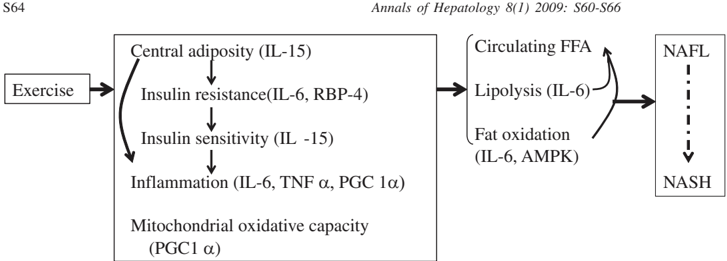
“Experimentally, the expression of PGC-1 α offers a link between activity levels and muscle oxidative capacity.(37) In addition, other mechanisms may be implicated in the therapeutic effects of exercise in fatty liver.”
BackgroundInterleukin-6 Is a Novel Factor Mediating Glucose Homeostasis During Skeletal Muscle Contraction
Febbraio, M. A., Hiscock, N., Sacchetti, M., Fischer, C. P., & Pedersen, B. K. (2004) · Diabetes · doi:10.2337/diabetes.53.7.1643 · Cited by 455
Nobili, V., Manco, M., Devito, R., Di Ciommo, V., Comparcola, D., Sartorelli, M. R., Piemonte, F., Marcellini, M., & Angulo, P. (2008) · Hepatology · doi:10.1002/hep.22336 · Cited by 415
Effect of Exercise Training Intensity on Abdominal Visceral Fat and Body Composition
IRVING, B. A., DAVIS, C. K., BROCK, D. W., WELTMAN, J. Y., SWIFT, D., BARRETT, E. J., GAESSER, G. A., & WELTMAN, A. (2008) · Medicine & Science in Sports & Exercise · doi:10.1249/mss.0b013e3181801d40 · Cited by 391 · cited 1×
“In a recent report on the effects of different levels of exercise on abdominal visceral fat, Irving et al reported significant reduction of waist circumference and visceral fat measured by L4-L5 level CT in middle-aged obese females undergoing 16 weeks of minimal versus light versus high intensity exercise in spite of…”
BackgroundHabitual Physical Activity Is Associated With Intrahepatic Fat Content in Humans
Perseghin, G., Lattuada, G., De Cobelli, F., Ragogna, F., Ntali, G., Esposito, A., Belloni, E., Canu, T., Terruzzi, I., Scifo, P., et al. (2007) · Diabetes Care · doi:10.2337/dc06-2032 · Cited by 320
Effect of changes on body weight and lifestyle in nonalcoholic fatty liver disease
Suzuki, A., Lindor, K., Saver, J. S., Lymp, J., Mendes, F., Muto, A., Okada, T., & Angulo, P. (2005) · Journal of Hepatology · doi:10.1016/j.jhep.2005.06.008 · Cited by 319
Role of leisure-time physical activity in nonalcoholic fatty liver disease: A population-based study
Zelber-Sagi, S., Nitzan-Kaluski, D., Goldsmith, R., Webb, M., Zvibel, I., Goldiner, I., Blendis, L., Halpern, Z., & Oren, R. (2008) · Hepatology · doi:10.1002/hep.22525 · Cited by 296
Oxidative capacity of human muscle fiber types: effects of age and training status
Proctor, D. N., Sinning, W. E., Walro, J. M., Sieck, G. C., & Lemon, P. W. (1995) · Journal of Applied Physiology · doi:10.1152/jappl.1995.78.6.2033 · Cited by 283 · cited 1×
“Moreover, older (age 51-62) compared to younger (age 2130) subjects have less type 2 (fast twitch) fibers and less capillary contacts in muscle biopsy samples of the vastus lateralis muscle.(32) However, from the same study, endurance trained older patients had increased capillary supply and similar oxidative capacity…”
BackgroundChurch, T. S., Kuk, J. L., Ross, R., Priest, E. L., Biltoff, E., & Blair, S. N. (2006) · Gastroenterology · doi:10.1053/j.gastro.2006.03.019 · Cited by 268 · cited 1×
“In another study, Church et al found an inverse association between fitness categories with the prevalence of NAFL independent of BMI, but not so for waist circumference.(17) The prevalence of NAFL in the lowest (MET < 10.”
BackgroundVisceral fat and liver fat are independent predictors of metabolic risk factors in men
Nguyen-Duy, T.-B., Nichaman, M. Z., Church, T. S., Blair, S. N., & Ross, R. (2003) · American Journal of Physiology-Endocrinology and Metabolism · doi:10.1152/ajpendo.00442.2002 · Cited by 261 · cited 1×
“These findings are consistent with prior studies showing that visceral adiposity and steatosis correlate inversely with the degree of cardiorespiratory fitness.(26,27) In a recent report on the effects of different levels of exercise on abdominal visceral fat, Irving et al reported significant reduction of waist circu…”
ResultBenefits of lifestyle modification in NAFLD
Harrison, S. A., & Day, C. P. (2007) · Gut · doi:10.1136/gut.2006.112094 · Cited by 240
Shojaee-Moradie, F., Baynes, K. C. R., Pentecost, C., Bell, J. D., Thomas, E. L., Jackson, N. C., Stolinski, M., Whyte, M., Lovell, D., Bowes, S. B., et al. (2007) · Diabetologia · doi:10.1007/s00125-006-0498-7 · Cited by 209 · cited 1×
“Similarly, Shojaee-Moradie et al showed that 6 weeks of exercise (20 min of physical activity, 3 times per week at 60-85% VO 2 max) significantly improved parameters of insulin metabolism including non-esterified fatty acid (NEFA) without a change in BMI, muscle or liver fat content by MR spectroscopy.(20) In another…”
BackgroundLavoie, J.-M., & Gauthier, M. (2006) · Cellular and Molecular Life Sciences · doi:10.1007/s00018-006-6600-y · Cited by 182
Dekker, M. J., Lee, S., Hudson, R., Kilpatrick, K., Graham, T. E., Ross, R., & Robinson, L. E. (2007) · Metabolism · doi:10.1016/j.metabol.2006.10.015 · Cited by 179
Exercise training increases intramyocellular lipid and oxidative capacity in older adults
Pruchnic, R., Katsiaras, A., He, J., Kelley, D. E., Winters, C., & Goodpaster, B. H. (2004) · American Journal of Physiology-Endocrinology and Metabolism · doi:10.1152/ajpendo.00459.2003 · Cited by 177 · cited 1×
“Does this relationship form an endorsement of the old adage ‘no pain, no gain’? In light of the association between muscle fat and insulin resistance noted above, it is somewhat paradoxical that 12 weeks of exercise training without significant weig t loss increased intramyocellular lipid (determined histologically fr…”
BackgroundLawlor, D. A., Sattar, N., Smith, G. D., & Ebrahim, S. (2005) · American Journal of Epidemiology · doi:10.1093/aje/kwi125 · Cited by 160
Health‐related fitness and physical activity in patients with nonalcoholic fatty liver disease†‡
Krasnoff, J. B., Painter, P. L., Wallace, J. P., Bass, N. M., & Merriman, R. B. (2008) · Hepatology · doi:10.1002/hep.22137 · Cited by 148 · cited 2×
“Moreover, Krasnoff et al showed a significant relationship between the severity of histological injury and diminished oxygen utilization at peak exercise (VO 2 peak) - an index of physical conditioning - among over-weight and obese patients with NAFL.18 Although a lower level of physical activity appears to correlate…”
BackgroundBlaak, E. E., Wagenmakers, A. J. M., Glatz, J. F. C., Wolffenbuttel, B. H. R., Kemerink, G. J., Langenberg, C. J. M., Heidendal, G. A. K., & Saris, W. H. M. (2000) · American Journal of Physiology-Endocrinology and Metabolism · doi:10.1152/ajpendo.2000.279.1.e146 · Cited by 140 · cited 1×
“In contrast to the pre-migratory goose with fatty liver, this condition is also associated with diminished free fatty acid utilization and decreased muscle fatty acid binding protein.(35) Skeletal muscle mitochondrial oxidative capacity and mitochondrial biogenesis appears to be influenced especially by PPAR-γ (peroxi…”
BackgroundRector, R. S., Thyfault, J. P., Laye, M. J., Morris, R. T., Borengasser, S. J., Uptergrove, G. M., Chakravarthy, M. V., Booth, F. W., & Ibdah, J. A. (2008) · The Journal of Physiology · doi:10.1113/jphysiol.2008.156745 · Cited by 110 · cited 1×
“However, emerging data from several groups including work from Rector et al indicate that the simple addition of an exercise wheel to an animal model of insulin resistance (Otsuka Long-Evans Tokushima rats) has profound effects on the development of fatty liver and multiple related parameters of hepatic fat metabolism…”
Effect of Endurance Exercise on Hepatic Lipid Content, Enzymes, and Adiposity in Men and Women
Devries, M. C., Samjoo, I. A., Hamadeh, M. J., & Tarnopolsky, M. A. (2008) · Obesity · doi:10.1038/oby.2008.358 · Cited by 100 · cited 1×
“Clinical trials (Table II): Devries et al studied hepatic lipid content by CT attenuation in 20 obese (BMI = 34 ± 2) and 21 lean (BMI = 24 ± 1) subjects undergoing 12 weeks of endurance exercise training consisting of up to three 60 minute bicycle sessions at 65-70% of peak aerobic capacity (VO 2 peak) without concomi…”
MethodFournier, E., Peresson, R., Guy, G. G., & Hermier, D. (1997) · Poultry Science · doi:10.1093/ps/76.4.599 · Cited by 97 · cited 5×
“One needs look no further than to some of the literature regarding hepatic physiology in one the world’s greatest marathon athletes, the migratory Palmipedes.1 The migratory palmipedes – fatty liver and exercise: While the Palmipedes (migratory geese and ducks) don’t develop histological NASH, seasonal or pre-migrator…”
BackgroundResultInfluentialHermier, D., Guy, G. G., Guillaumin, S., Davail, S., André, J., & Hoo-Paris, R. (2003) · Comparative Biochemistry and Physiology Part B Biochemistry and Molecular Biology · doi:10.1016/s1096-4959(03)00146-5 · Cited by 91 · cited 1×
“While the Palmipedes (migratory geese and ducks) don’t develop histological NASH, seasonal or pre-migratory steatosis is well-known for thousands of years and its accentuation through carbohydrate loading serves as basis for foie gras farming.(2,3) Similar seasonal variation in liver fat content has also been document…”
BackgroundHermier, D., Saadoun, A., SALICHON, M.-R., Sellier, N. N., Rousselot‐Paillet, D., & Chapman, M. J. (1991) · Lipids · doi:10.1007/bf02537194 · Cited by 84 · cited 1×
“Interestingly, the factors governing the variable transition to fat storage include changes in thyroid metabolism, altered lipoprotein metabolism and skeletal muscle energy utilization including changes in fatty acid binding protein expression which likely reflects muscle energy substrate utilization.(5,6) Thus, the a…”
BackgroundCotrim, H. P., Freitas, L. A., Alves, E., Almeida, A., May, D. S., & Caldwell, S. (2009) · European Journal of Gastroenterology & Hepatology · doi:10.1097/meg.0b013e328328f3ec · Cited by 79
Self-citationGenes and nonalcoholic fatty liver disease
de Alwis, N. M. W., & Day, C. P. (2008) · Current Diabetes Reports · doi:10.1007/s11892-008-0027-9 · Cited by 66
Jacobsen, E. B., Hamberg, O., Quistorff, B., & Ott, P. (2001) · Hepatology · doi:10.1053/jhep.2001.25451 · Cited by 63 · cited 1×
“Because the antecedent development of liver disease alters these relationships, such studies need to carefully take into account the basal health of the liver at the initiation of an intervention.(46) Clearly, while more exercise appears to be better, this field is one in need of active and well conceived investigatio…”
BackgroundMuscular mitochondrial dysfunction and type 2 diabetes mellitus
Schrauwen-Hinderling, V. B., Roden, M., Kooi, M. E., Hesselink, M. K., & Schrauwen, P. (2007) · Current Opinion in Clinical Nutrition and Metabolic Care · doi:10.1097/mco.0b013e3282f0eca9 · Cited by 57 · cited 1×
“com ESTE DOCUMENTO ES ELABORADO POR MEDIGRAPHIC or to both.(34) In contrast to the pre-migratory goose with fatty liver, this condition is also associated with diminished free fatty acid utilization and decreased muscle fatty acid binding protein.”
Pelsers, M. M. A. L., Butler, P. J., Bishop, C. M., & Glatz, J. F. C. (1999) · American Journal of Physiology-Regulatory, Integrative and Comparative Physiology · doi:10.1152/ajpregu.1999.276.3.r637 · Cited by 51 · cited 1×
“Interestingly, the factors governing the variable transition to fat storage include changes in thyroid metabolism, altered lipoprotein metabolism and skeletal muscle energy utilization including changes in fatty acid binding protein expression which likely reflects muscle energy substrate utilization.(5,6) Thus, the a…”
BackgroundCaldwell, S. H., Ikura, Y., Iezzoni, J. C., & Liu, Z. (2007) · Journal of Gastroenterology and Hepatology · doi:10.1111/j.1440-1746.2006.04639.x · Cited by 49 · cited 1×
“Thus, the accumulation of fat in the liver in this animal appears to represent an integrated and adaptive process preceding conditions of increased activity.(7) While fatty liver in humans is clearly influenced by other factors such as lipid composition and Artemisa medigraphic en línea”
BackgroundSelf-citationMcMillan, K. P., Kuk, J. L., Church, T. S., Blair, S. N., & Ross, R. (2007) · Applied Physiology, Nutrition, and Metabolism · doi:10.1139/h06-112 · Cited by 44
Changes in lipid composition of hepatocyte plasma membrane induced by overfeeding in duck
Molee, W., Bouillier-Oudot, M., Auvergne, A., & Babile, R. (2005) · Comparative Biochemistry and Physiology Part B Biochemistry and Molecular Biology · doi:10.1016/j.cbpc.2005.05.007 · Cited by 40 · cited 1×
“While the Palmipedes (migratory geese and ducks) don’t develop histological NASH, seasonal or pre-migratory steatosis is well-known for thousands of years and its accentuation through carbohydrate loading serves as basis for foie gras farming.(2,3) Similar seasonal variation in liver fat content has also been document…”
BackgroundSome factors related to obesity in the Japanese sumo wrestler
Nishizawa, T., AKAOKA, I., Nishida, Y., Kawaguchi, Y., Hayashi, E., & Yoshimura, T. (1976) · American Journal of Clinical Nutrition · doi:10.1093/ajcn/29.10.1167 · Cited by 30 · cited 1×
“reported to be increased in this group suggesting that any salutary benefits of rigorous exercise training without weight loss have significant limitations.(14) Exercise without weight loss in humans: Does exercise ameliorate fatty liver in humans in the absence of associated weight loss? This constitutes a simple but…”
BackgroundYamauchi, T., Abe, T., Midorikawa, T., & 近藤, 正. (2004) · Anthropological Science · doi:10.1537/ase.040210 · Cited by 16
Skeletal muscle: not simply an organ for locomotion and energy storage
Lancaster, G. I., & Febbraio, M. A. (2008) · The Journal of Physiology · doi:10.1113/jphysiol.2008.165753 · Cited by 15 · cited 1×
“exercise, and its role in tissue-tissue communication in health and disease.(38) The influence of exercise on this cytokine may form a key link between muscle activity, insulin sensitivity and liver fat content.”
BackgroundZomborszky, Z., & Húsvéth, F. (2000) · Comparative Biochemistry and Physiology Part A Molecular & Integrative Physiology · doi:10.1016/s1095-6433(00)00195-1 · Cited by 10 · cited 1×
“Similar seasonal variation in liver fat content has also been documented in a number of other non-hibernating animals.(4) However, variation exists in the degree of steatosis in different strains of ducks and geese.”
BackgroundAlcohol–Induced Myopathy: What Is the Role of Mitochondria?
Krähenbühl, S. (2001) · Hepatology · doi:10.1053/jhep.2001.26307 · Cited by 8 · cited 1×
“com effects of other variables on muscle and liver metabolism such as dietary lipid composition and ethanol consumption remain to be fully explored.(44,45) Because the antecedent development of liver disease alters these relationships, such studies need to carefully take into account the basal health of the liver at t…”
Background
Research works printed but not linked: 2
- Bonekamp S, Barone B, Clark JM, Stewarts K J. The effect of an exercise training intervention on hepatic steatosis. Hepatology 2008; 48 (S1): 806A.
- Lazo M, Solga SF, Horska A, Bonekamp S, Diehl AM, Brancati FL, Clark JM and Look Ahead Research Group. The effect of one year of intensive lifestyle intervention on hepatic steatosis. Hepatology 2008; 48(Suppl): 813A.
Cited by
Lack of Exercise Is a Major Cause of Chronic Diseases
Booth, F. W., Roberts, C. K., & Laye, M. J. (2012) · Comprehensive Physiology · doi:10.1002/cphy.c110025 · Cited by 2,575
Vigneri, P., Frasca, F., Sciacca, L., Pandini, G., & Vigneri, R. (2009) · Endocrine Related Cancer · doi:10.1677/erc-09-0087 · Cited by 1,009
“1998), and its increased activity further worsens insulin resistance and may result in NAFLD (Postic & Girard 2008), which is associated with an increased risk of hepatocarcinoma (Caldwell & Lazo 2009).”
Exercise and the Regulation of Hepatic Metabolism
Trefts, E., Williams, A. S., & Wasserman, D. H. (2015) · Progress in Molecular Biology and Translational Science · doi:10.1016/bs.pmbts.2015.07.010 · Cited by 189
Rector, R. S., Uptergrove, G. M., Morris, E. M., Borengasser, S. J., Laughlin, M. H., Booth, F. W., Thyfault, J. P., & Ibdah, J. A. (2011) · American Journal of Physiology-Gastrointestinal and Liver Physiology · doi:10.1152/ajpgi.00510.2010 · Cited by 151
“Caloric restriction and exercise are commonly recommended for prevention and amelioration of obesity and lifestyle-related diseases such as NAFLD (6).”
Role of Overweight and Obesity in Gastrointestinal Disease
Emerenziani, S., Pier Luca Guarino, M., Trillo Asensio, L., Altomare, A., Ribolsi, M., Balestrieri, P., & Cicala, M. (2019) · Nutrients · doi:10.3390/nu12010111 · Cited by 131
Metadata
- Authors
- Caldwell, S., & Lazo, M.
- Affiliations
- University of Virginia (US)
- Johns Hopkins University (US)
- Corresponding author
- Caldwell, Stephen
- Venue
- Annals of Hepatology
- Publisher
- Elsevier BV
- Published
- 2009
- Volume
- 8
- Pages
- S60-S66
- ISSN
- 1665-2681 (ISSN-L)
- OpenAlex
- W2268067733
- Semantic Scholar
- 9375c84d67adecdfbd7c74809313c5123cd921bd
- Cited by
- 42
- References
- 46
- Citations by year
- 2023: 1 · 2021: 1 · 2020: 1 · 2019: 2 · 2017: 3 · 2016: 4 · 2015: 4 · 2014: 4 · 2013: 2 · 2012: 4
- FWCI
- 4.48
- Type
- journal article
- Language
- en
- Open access
- hybrid
- doi.org
- Licence
- cc-by-nc-nd
- www.elsevier.com/tdm/userlicense/1.0/ (tdm)
- creativecommons.org/licenses/by-nc-nd/4.0/ (vor, 3827 d)
- Locations
- Annals of Hepatology (publishedVersion, cc-by-nc-nd)
- PubMed (publishedVersion)
- DOAJ (DOAJ: Directory of Open Access Journals) (submittedVersion, cc-by-sa)
- Topics
- Health Sciences › Medicine › Hepatology › Liver Disease Diagnosis and Treatment
- Health Sciences › Medicine › Pathology and Forensic Medicine › Alcohol Consumption and Health Effects
- Health Sciences › Medicine › Public Health, Environmental and Occupational Health › Physical Activity and Health
- Keywords
- nonalcoholic steatohepatitis, exercise therapy, physical conditioning, hepatic steatosis, weight loss, energy homeostasis, insulin sensitivity, adipose tissue, skeletal muscle, bariatric surgery, lifestyle intervention, treatment endpoints
- MeSH terms
- Exercise Therapy, Fatty Liver, Humans, Life Style, Weight Loss, Treatment Outcome
About these checks
Registry, retraction, Cites and statistics results are computed, not judged, with one exception: a printed reference that no index lists is read once by a model before it counts as a citation error. Claims are extracted by a model and kept only when their quote appears verbatim in the text; each cited source is then checked, with a model’s help, for whether it says what the claim relies on. Those verdicts can be wrong — read the claim’s quote and the cited source before relying on one.
Statistics and arithmetic are recomputed, not judged.
Confidence bands are shown only for fields calibrated on our annotated test set. None is calibrated yet, so no band is shown.
What counts as a claim ›How we measure confidence ›How we check this ›
Are you an author, or do you see a problem with this page? Request a review
Data sources
Bibliographic data: Semantic Scholar, OpenAlex, Crossref.
Contains information from the Semantic Scholar Academic Graph Datasets, made available under the ODC Attribution License (ODC-BY 1.0).
Semantic Scholar’s data is described in: Kinney, R., et al. (2023). The Semantic Scholar Open Data Platform. arXiv:2301.10140.
