

Effect of low-fat diet interventions versus other diet interventions on long-term weight change in adults: a systematic review and meta-analysis
Open accessThe DOI matches its Crossref record; 74 of the 75 references it cites were found in a registry or an index.
Abstract
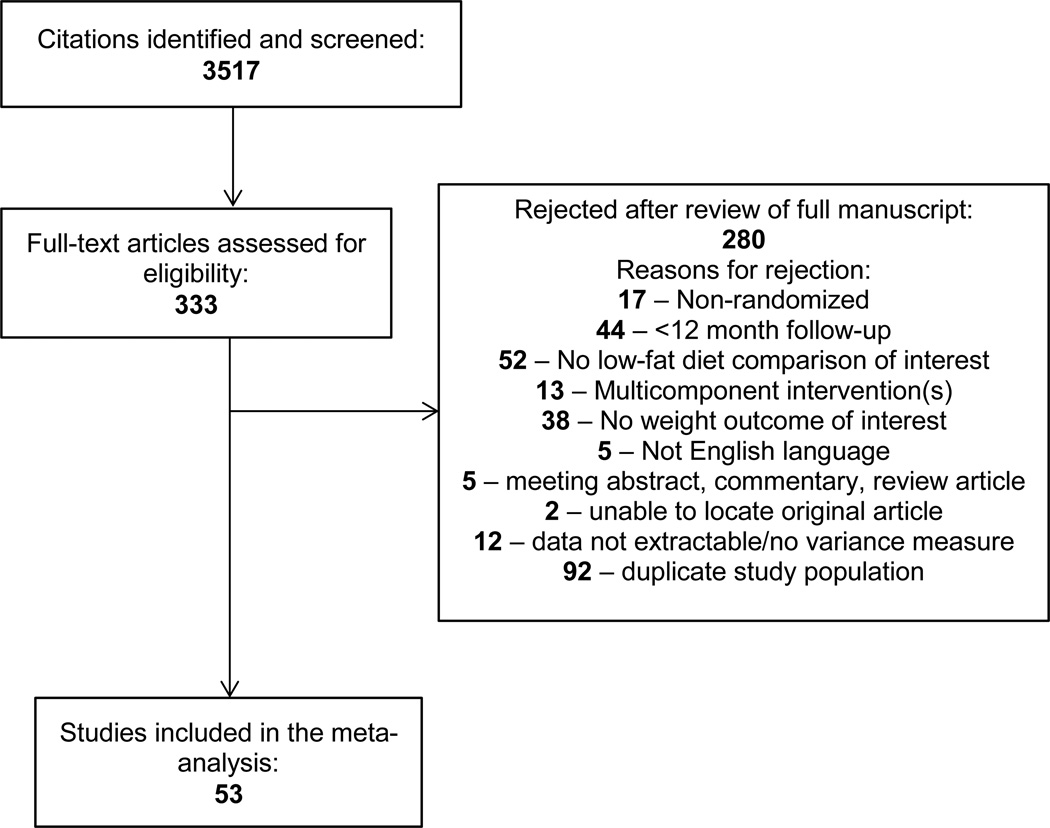
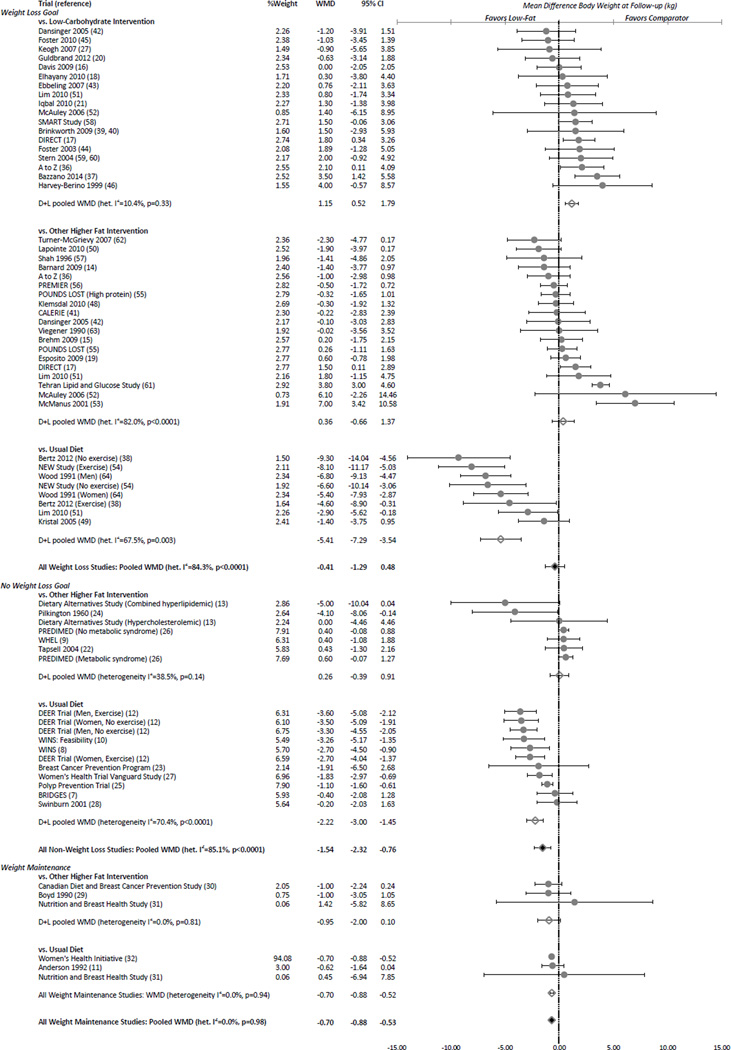
Background The effectiveness of low-fat diets for long-term weight loss has been debated for decades, with dozens of randomized trials (RCTs) and recent reviews giving mixed results. Methods We conducted a random effects meta-analysis of RCTs to estimate the long-term effect of low-fat vs. higher fat dietary interventions on weight loss. Our search included RCTs conducted in adult populations reporting weight change outcomes at ≥1 year, comparing low-fat with higher fat interventions, published through July 2014. The primary outcome measure was mean difference in weight change between interventions. Findings Fifty-three studies met inclusion criteria representing 68,128 participants. In the setting of weight loss trials, low-carbohydrate interventions led to significantly greater weight loss than low-fat interventions (n comparisons=18; weighted mean difference [WMD]=1.15 kg, 95% CI=0.52 to 1.79; I2=10%). Low-fat did not lead to differences in weight change compared with other moderate fat weight loss interventions (n=19; WMD=0.36, 95% CI=-0.66 to 1.37; I2=82%), and were superior only when compared with “usual diet” (n=8; WMD=-5.41, 95% CI=-7.29 to −3.54; I2=68%). Similarly, non-weight loss trials and weight maintenance trials, for which there were no low-carbohydrate comparisons, had similar effects for low-fat vs moderate fat interventions, and were superior compared with “usual diet”. Weight loss trials achieving a greater difference in fat intake at follow-up significantly favored the higher fat dietary interventions, as indicated by difference of ≥5% of calories from fat (n=18; WMD=1.04, 95% CI=0.06 to 2.03; I2=78%) or by difference in change serum triglycerides of ≥5 mg/dL (n=17; WMD=1.38, 95% CI=0.50 to 2.25; I2=62%). Interpretation These findings suggest that the long-term effect of low-fat diets on body weight depends on the intensity of intervention in the comparison group. When compared to dietary interventions of similar intensity, evidence from RCTs does not support low-fat diets over other dietary interventions.
Overview
The claims and statistics of this paper haven’t been checked yet.
Free: it reads the open-access text and checks the first 5 claims that cite a source we can check. Create a free account to check every claim.
Integrity signals
Registry
Cites
Statistics
Figures
Verification
Claims the paper makes
The claims and statistics of this paper haven’t been checked yet.
Free: it reads the open-access text and checks the first 5 claims that cite a source we can check. Create a free account to check every claim.
Claims other papers make about this one
Each is checked against this paper’s own text: does it say what the citing paper says it does?
The source backs part of the claim, not all of it — or backs it for a different population, condition or comparison.
In the citing paper
“Over the long term, high-fat diets result in more weight loss than high-carbohydrate diets (16, 101–104), contrary to expectation from considerations of energy density.”
From The carbohydrate-insulin model: A physiological perspective on the obesity pandemic (2021) · cites this paper as [16]
Experimental — accuracy not yet measuredThe source backs part of the claim, not all of it — or backs it for a different population, condition or comparison.
In the citing paper
“The greater long-term weight loss when consuming high-fat diets than when consuming low-fat diets (16, 101–104)”
From The carbohydrate-insulin model: A physiological perspective on the obesity pandemic (2021) · cites this paper as [16]
Experimental — accuracy not yet measuredThe cited source says what the claim attributes to it.
In the citing paper
“Meta-analyses of long-term weight loss have suggested that low-fat weight loss diets are slightly, if statistically, inferior to low-carbohydrate diets53, but the average differences between diets is too small to be clinically significant54.”
From Maintenance of Lost Weight and Long-Term Management of Obesity (2018) · cites this paper as [53]
The cited source says what the claim attributes to it.
In the citing paper
“The results of a meta-analysis did not support use of low-fat diets over other dietary interventions for long-term weight loss.”
From Optimal Diet Strategies for Weight Loss and Weight Loss Maintenance (2021) · cites this paper as [26]
The cited source says what the claim attributes to it.
In the citing paper
“low fat diets have not been shown to be superior for weight loss [10].”
From Effectiveness and Safety of a Novel Care Model for the Management of Type 2 Diabetes at 1 Year: An Open-Label, Non-Randomized, Controlled Study (2018) · cites this paper as [10]
3 more claims about this paper
Create a free account to see every claim other papers make about this one.
Self-check
Percentages, sums and reported differences re-computed from the paper’s own numbers.
The self-check needs the paper’s full text.
Citations
Cites
Measuring inconsistency in meta-analyses
Higgins, J. P. T., Thompson, S. G., Deeks, J. J., & Altman, D. G. (2003) · BMJ · doi:10.1136/bmj.327.7414.557 · Cited by 63,139
Bias in meta-analysis detected by a simple, graphical test
Egger, M., Smith, G. D., Schneider, M., & Minder, C. (1997) · BMJ · doi:10.1136/bmj.315.7109.629 · Cited by 56,722
Operating characteristics of a rank correlation test for publication bias
Begg, C. B., & Mazumdar, M. (1994) · Biometrics · doi:10.2307/2533446 · Cited by 16,955 · cited 1×
“Results were similar when restricted studies conducting to intention-to-treat analyses (Appendix pages 3–4) and when excluding smaller trials of 100 total participants, although few non-weight loss or weight maintenance trials remained eligible according to these criteria.”
ResultThe global obesity pandemic: shaped by global drivers and local environments
Swinburn, B. A., Sacks, G., Hall, K. D., McPherson, K., Finegood, D. T., Moodie, M. L., & Gortmaker, S. L. (2011) · The Lancet · doi:10.1016/s0140-6736(11)60813-1 · Cited by 4,888
(2008) · Cited by 3,790
Comparison of two methods to detect publication bias in meta-analysis.
Peters, J. L. (2006) · JAMA · doi:10.1001/jama.295.6.676 · Cited by 2,278 · cited 1×
“The fixed effect meta-analysis (Appendix pages 5–6), which gives less weight to smaller trials with greater variance, estimated 0.44 kg greater weight loss for the comparator vs. low-fat interventions among the weight loss trials.”
InfluentialWeight Loss with a Low-Carbohydrate, Mediterranean, or Low-Fat Diet
Shai, I., Schwarzfuchs, D., Henkin, Y., Shahar, D. R., Witkow, S., Greenberg, I., Golan, R., Fraser, D., Bolotin, A., Vardi, H., et al. (2008) · New England Journal of Medicine · doi:10.1056/nejmoa0708681 · Cited by 2,143
Comparison of Weight-Loss Diets with Different Compositions of Fat, Protein, and Carbohydrates
Sacks, F. M., Bray, G. A., Carey, V. J., Smith, S. R., Ryan, D. H., Anton, S. D., McManus, K., Champagne, C. M., Bishop, L. M., Laranjo, N., et al. (2009) · New England Journal of Medicine · doi:10.1056/nejmoa0804748 · Cited by 1,966
A Randomized Trial of a Low-Carbohydrate Diet for Obesity
Foster, G. D., Wyatt, H. R., Hill, J. O., McGuckin, B. G., Brill, C., Mohammed, B. S., Szapary, P. O., Rader, D. J., Edman, J. S., & Klein, S. (2003) · New England Journal of Medicine · doi:10.1056/nejmoa022207 · Cited by 1,794
Dansinger, M. L., Gleason, J. A., Griffith, J. L., Selker, H. P., & Schaefer, E. J. (2005) · JAMA · doi:10.1001/jama.293.1.43 · Cited by 1,726
Cited by
Food in the Anthropocene: the EAT–Lancet Commission on healthy diets from sustainable food systems
Willett, W., Rockström, J., Loken, B., Springmann, M., Lang, T., Vermeulen, S., Garnett, T., Tilman, D., DeClerck, F., Wood, A., et al. (2019) · The Lancet · doi:10.1016/s0140-6736(18)31788-4 · Cited by 10,880
Self-citation2021 ESC Guidelines on cardiovascular disease prevention in clinical practice
Visseren, F. L. J., Mach, F., Smulders, Y. M., Carballo, D., Koskinas, K. C., Bäck, M., Benetos, A., Biffi, A., Boavida, J.-M., Capodanno, D., et al. (2021) · European Heart Journal · doi:10.1093/eurheartj/ehab484 · Cited by 6,485
González-Muniesa, P., Mártinez-González, M.-A., Hu, F. B., Després, J.-P., Matsuzawa, Y., Loos, R. J. F., Moreno, L. A., Bray, G. A., & Martinez, J. A. (2017) · Nature Reviews Disease Primers · doi:10.1038/nrdp.2017.34 · Cited by 1,113
Self-citationThe Mediterranean diet and health: a comprehensive overview
Guasch‐Ferré, M., & Willett, W. C. (2021) · Journal of Internal Medicine · doi:10.1111/joim.13333 · Cited by 940
Self-citationMaintenance of Lost Weight and Long-Term Management of Obesity
Hall, K. D., & Kahan, S. (2018) · Medical Clinics of North America · doi:10.1016/j.mcna.2017.08.012 · Cited by 876
The science of obesity management: an endocrine society scientific statement
Bray, G. A., Heisel, W. E., Afshin, A., Jensen, M. D., Dietz, W. H., Long, M., Kushner, R. F., Daniels, S. R., Wadden, T. A., Tsai, A. G., et al. (2018) · Endocrine Reviews · doi:10.1210/er.2017-00253 · Cited by 812
Self-citationEnergy balance and obesity: what are the main drivers?
On behalf of the IARC working group on Energy Balance and Obesity, Romieu, I., Dossus, L., Barquera, S., Blottière, H. M., Franks, P. W., Gunter, M., Hwalla, N., Hursting, S. D., Leitzmann, M., et al. (2017) · Cancer Causes & Control · doi:10.1007/s10552-017-0869-z · Cited by 739
Self-citationObesity Pathogenesis: An Endocrine Society Scientific Statement
Schwartz, M. W., Seeley, R. J., Zeltser, L. M., Drewnowski, A., Ravussin, E., Redman, L. M., & Leibel, R. L. (2017) · Endocrine Reviews · doi:10.1210/er.2017-00111 · Cited by 727
Environmental/lifestyle factors in the pathogenesis and prevention of type 2 diabetes
Kolb, H., & Martin, S. (2017) · BMC Medicine · doi:10.1186/s12916-017-0901-x · Cited by 717
2018 Korean Society for the Study of Obesity Guideline for the Management of Obesity in Korea
Seo, M. H., Lee, W.-Y., Kim, S. S., Kang, J.-H., Kang, J.-H., Kim, K. K., Kim, B.-Y., Kim, Y.-H., Kim, W.-J., Kim, E. M., et al. (2019) · Journal of Obesity & Metabolic Syndrome · doi:10.7570/jomes.2019.28.1.40 · Cited by 676
2021 ESC Guidelines on cardiovascular disease prevention in clinical practice
Visseren, F. L. J., Mach, F., Smulders, Y. M., Carballo, D., Koskinas, K. C., Bäck, M., Benetos, A., Biffi, A., Boavida, J.-M., Capodanno, D., et al. (2022) · European Journal of Preventive Cardiology · doi:10.1093/eurjpc/zwab154 · Cited by 542
Japanese clinical practice guideline for diabetes 2019
Araki, E., Goto, A., Kondo, T., Noda, M., Noto, H., Origasa, H., Osawa, H., Taguchi, A., Tanizawa, Y., Tobe, K., et al. (2020) · Diabetology International · doi:10.1007/s13340-020-00439-5 · Cited by 545
“• Intake of dietary fibers [20, 21] and dietary magnesium [20, 22, 23] is associated with a reduced risk of type 2 diabetes.”
BackgroundInfluentialDietary Strategies for Metabolic Syndrome: A Comprehensive Review
Castro-Barquero, S., Ruiz-León, A. M., Sierra-Pérez, M., Estruch, R., & Casas, R. (2020) · Nutrients · doi:10.3390/nu12102983 · Cited by 482
Mozaffarian, D., Rosenberg, I., & Uauy, R. (2018) · BMJ · doi:10.1136/bmj.k2392 · Cited by 484
Ma, C., Avenell, A., Bolland, M., Hudson, J., Stewart, F., Robertson, C., Sharma, P., Fraser, C., & MacLennan, G. (2017) · BMJ · doi:10.1136/bmj.j4849 · Cited by 464
Dietary and nutritional approaches for prevention and management of type 2 diabetes
Forouhi, N. G., Misra, A., Mohan, V., Taylor, R., & Yancy, W. (2018) · BMJ · doi:10.1136/bmj.k2234 · Cited by 472
The Carbohydrate-Insulin Model of Obesity: Beyond “Calories In, Calories Out”
Ludwig, D. S., & Ebbeling, C. B. (2018) · JAMA Internal Medicine · doi:10.1001/jamainternmed.2018.2933 · Cited by 440
Self-citationUpdated Cardiovascular Prevention Guideline of the Brazilian Society of Cardiology - 2019
Précoma, D. B., Oliveira, G. M. M. D., Simão, A. F., Dutra, O. P., Coelho-Filho, O. R., Izar, M. C. D. O., Póvoa, R. M. D. S., Giuliano, I. D. C. B., Alencar Filho, A. C. D., Machado, C. A., et al. (2019) · Arquivos Brasileiros de Cardiologia · doi:10.5935/abc.20190204 · Cited by 434
Hallberg, S. J., McKenzie, A. L., Williams, P. T., Bhanpuri, N. H., Peters, A. L., Campbell, W. W., Hazbun, T. L., Volk, B. M., McCarter, J. P., Phinney, S. D., et al. (2018) · Diabetes Therapy · doi:10.1007/s13300-018-0373-9 · Cited by 406
Pérez-Martínez, P., Mikhailidis, D. P., Athyros, V. G., Bullo, M., Couture, P., Covas, M. I., de Koning, L., Delgado-Lista, J., Díaz-López, A., Drevon, C. A., et al. (2017) · Nutrition Reviews · doi:10.1093/nutrit/nux014 · Cited by 410
Japanese Clinical Practice Guideline for Diabetes 2019
Araki, E., Goto, A., Kondo, T., Noda, M., Noto, H., Origasa, H., Osawa, H., Taguchi, A., Tanizawa, Y., Tobe, K., et al. (2020) · Journal of Diabetes Investigation · doi:10.1111/jdi.13306 · Cited by 341
2020 Korean Society for the Study of Obesity Guidelines for the Management of Obesity in Korea
Kim, B.-Y., Kang, S. M., Kang, J.-H., Kang, S. Y., Kim, K. K., Kim, K.-B., Kim, B., Kim, S. J., Kim, Y.-H., Kim, J.-H., et al. (2021) · Journal of Obesity & Metabolic Syndrome · doi:10.7570/jomes21022 · Cited by 342
Rynders, C. A., Thomas, E. A., Zaman, A., Pan, Z., Catenacci, V. A., & Melanson, E. L. (2019) · Nutrients · doi:10.3390/nu11102442 · Cited by 339
Dietary carbohydrates: role of quality and quantity in chronic disease
Ludwig, D. S., Hu, F. B., Tappy, L., & Brand-Miller, J. (2018) · BMJ · doi:10.1136/bmj.k2340 · Cited by 330
Self-citationDietary fat and cardiometabolic health: evidence, controversies, and consensus for guidance
Forouhi, N. G., Krauss, R. M., Taubes, G., & Willett, W. (2018) · BMJ · doi:10.1136/bmj.k2139 · Cited by 314
Self-citationThe energy balance model of obesity: beyond calories in, calories out
Hall, K. D., Farooqi, I. S., Friedman, J. M., Klein, S., Loos, R. J., Mangelsdorf, D. J., O’Rahilly, S., Ravussin, E., Redman, L. M., Ryan, D. H., et al. (2022) · The American Journal of Clinical Nutrition · doi:10.1093/ajcn/nqac031 · Cited by 315
Self-citationCohort Profile: Design and methods of the PREDIMED-Plus randomized trial
Martínez-González, M. A., Buil-Cosiales, P., Corella, D., Bulló, M., Fitó, M., Vioque, J., Romaguera, D., Martínez, J. A., Wärnberg, J., López-Miranda, J., et al. (2019) · International Journal of Epidemiology · doi:10.1093/ije/dyy225 · Cited by 309
The carbohydrate-insulin model: A physiological perspective on the obesity pandemic
Ludwig, D. S., Aronne, L. J., Astrup, A., de Cabo, R., Cantley, L. C., Friedman, M. I., Heymsfield, S. B., Johnson, J. D., King, J. C., Krauss, R. M., et al. (2021) · The American Journal of Clinical Nutrition · doi:10.1093/ajcn/nqab270 · Cited by 292
Self-citationEbbeling, C. B., Feldman, H. A., Klein, G. L., Wong, J. M. W., Bielak, L., Steltz, S. K., Luoto, P. K., Wolfe, R. R., Wong, W. W., & Ludwig, D. S. (2018) · BMJ · doi:10.1136/bmj.k4583 · Cited by 274
Self-citationKoutoukidis, D. A., Astbury, N. M., Tudor, K. E., Morris, E., Henry, J. A., Noreik, M., Jebb, S. A., & Aveyard, P. (2019) · JAMA Internal Medicine · doi:10.1001/jamainternmed.2019.2248 · Cited by 270
Current treatments for obesity
Ruban, A., Stoenchev, K., Ashrafian, H., & Teare, J. (2019) · Clinical Medicine · doi:10.7861/clinmedicine.19-3-205 · Cited by 266
Dietary fat: From foe to friend?
Ludwig, D. S., Willett, W. C., Volek, J. S., & Neuhouser, M. L. (2018) · Science · doi:10.1126/science.aau2096 · Cited by 257
Self-citationVest, A. R., Chan, M., Deswal, A., Givertz, M. M., Lekavich, C., Lennie, T., Litwin, S. E., Parsly, L., Rodgers, J. E., Rich, M. W., et al. (2019) · Journal of Cardiac Failure · doi:10.1016/j.cardfail.2019.03.007 · Cited by 230
Did the Food Environment Cause the Obesity Epidemic?
Hall, K. D. (2018) · Obesity · doi:10.1002/oby.22073 · Cited by 220
“Furthermore, prescribing low-fat diets does not lead to greater weight loss when compared to other diets (8).”
BackgroundDiet strategies for promoting healthy aging and longevity: An epidemiological perspective
Hu, F. B. (2024) · Journal of Internal Medicine · doi:10.1111/joim.13728 · Cited by 216
Self-citationEstruch, R., Martínez-González, M. A., Corella, D., Salas-Salvadó, J., Fitó, M., Chiva-Blanch, G., Fiol, M., Gómez-Gracia, E., Arós, F., Lapetra, J., et al. (2016) · The Lancet Diabetes & Endocrinology · doi:10.1016/s2213-8587(16)30085-7 · Cited by 195
RetractedOptimal Diet Strategies for Weight Loss and Weight Loss Maintenance
Kim, J. Y. (2021) · Journal of Obesity & Metabolic Syndrome · doi:10.7570/jomes20065 · Cited by 193
Association of Low-Carbohydrate and Low-Fat Diets with Mortality Among US Adults
Shan, Z., Guo, Y., Hu, F. B., Liu, L., & Qi, Q. (2020) · JAMA Internal Medicine · doi:10.1001/jamainternmed.2019.6980 · Cited by 192
Self-citationChawla, S., Tessarolo Silva, F., Amaral Medeiros, S., Mekary, R., & Radenkovic, D. (2020) · Nutrients · doi:10.3390/nu12123774 · Cited by 185
Evidence that supports the prescription of low-carbohydrate high-fat diets: A narrative review
Noakes, T. D., & Windt, J. (2017) · British Journal of Sports Medicine · doi:10.1136/bjsports-2016-096491 · Cited by 178
The Complex Interactions Between Obesity, Metabolism and the Brain
Uranga, R. M., & Keller, J. N. (2019) · Frontiers in Neuroscience · doi:10.3389/fnins.2019.00513 · Cited by 164
Dietary fats and cardiometabolic disease: mechanisms and effects on risk factors and outcomes
Wu, J. H. Y., Micha, R., & Mozaffarian, D. (2019) · Nature Reviews Cardiology · doi:10.1038/s41569-019-0206-1 · Cited by 165
Dinu, M., Pagliai, G., Angelino, D., Rosi, A., Dall'Asta, M., Bresciani, L., Ferraris, C., Guglielmetti, M., Godos, J., Del Bo', C., et al. (2020) · Advances in Nutrition · doi:10.1093/advances/nmaa006 · Cited by 164
Smethers, A. D., & Rolls, B. J. (2018) · Medical Clinics of North America · doi:10.1016/j.mcna.2017.08.009 · Cited by 156
Smith, T. O., Aboelmagd, T., Hing, C. B., & MacGregor, A. J. (2016) · The Bone & Joint Journal · doi:10.1302/0301-620x.98b9.38024 · Cited by 164
Estruch, R., Martínez-González, M. A., Corella, D., Salas-Salvadó, J., Fitó, M., Chiva-Blanch, G., Fiol, M., Gómez-Gracia, E., Arós, F., Lapetra, J., et al. (2019) · The Lancet Diabetes & Endocrinology · doi:10.1016/s2213-8587(19)30074-9 · Cited by 147
RetractedKoliaki, C., Spinos, T., Spinou, Μ., Brinia, Μ.-E., Mitsopoulou, D., & Katsilambros, N. (2018) · Healthcare · doi:10.3390/healthcare6030073 · Cited by 146
“In another systematic review and meta-analysis comparing low-fat diets with other dietary interventions, it was found that the long-term effect of low-fat diets on body weight depends primarily on the intensity of diet intervention in the comparison group [55].”
BackgroundInfluentialLong-Term Weight Loss Strategies for Obesity
Kheniser, K., Saxon, D. R., & Kashyap, S. R. (2021) · The Journal of Clinical Endocrinology & Metabolism · doi:10.1210/clinem/dgab091 · Cited by 139
“Given that obesity has a complex etiology, long-term weight loss success is less commonly achieved with a diet-or exercise-only intervention (9,10).”
InfluentialThe PREDIMED trial, Mediterranean diet and health outcomes: How strong is the evidence?
Guasch‐Ferré, M., Salas‐Salvadó, J., Ros, E., Estruch, R., Corella, D., Fitó, M., Martínez‐González, M. Á., Arós, F., Gómez‐Gracia, E., Fiol, M., et al. (2017) · Nutrition Metabolism and Cardiovascular Diseases · doi:10.1016/j.numecd.2017.05.004 · Cited by 168
The Ketogenic Diet: Evidence for Optimism but High-Quality Research Needed
Ludwig, D. S. (2020) · The Journal of Nutrition · doi:10.1093/jn/nxz308 · Cited by 133
Self-citationDietary and policy priorities to reduce the global crises of obesity and diabetes
Mozaffarian, D. (2020) · Nature Food · doi:10.1038/s43016-019-0013-1 · Cited by 143
Competing paradigms of obesity pathogenesis: energy balance versus carbohydrate-insulin models
Ludwig, D. S., Apovian, C. M., Aronne, L. J., Astrup, A., Cantley, L. C., Ebbeling, C. B., Heymsfield, S. B., Johnson, J. D., King, J. C., Krauss, R. M., et al. (2022) · European Journal of Clinical Nutrition · doi:10.1038/s41430-022-01179-2 · Cited by 111
Self-citationDietary Fats and Chronic Noncommunicable Diseases
Billingsley, H., Carbone, S., & Lavie, C. J. (2018) · Nutrients · doi:10.3390/nu10101385 · Cited by 132
“A recent meta-analysis that included randomized controlled trials (RCTs) with over one year of follow up concluded that low-fat dietary trials did not result in greater weight loss when compared to higher fat interventions of similar intensity as measured by the time, individual attention, and program materials given…”
BackgroundEglseer, D., Traxler, M., Embacher, S., Reiter, L., Schoufour, J. D., Weijs, P. J. M., Voortman, T., Boirie, Y., Cruz-Jentoft, A., & Bauer, S. (2023) · Advances in Nutrition · doi:10.1016/j.advnut.2023.04.001 · Cited by 102
Ketogenic diets, physical activity and body composition: a review
Ashtary-Larky, D., Bagheri, R., Bavi, H., Baker, J. S., Moro, T., Mancin, L., & Paoli, A. (2022) · British Journal of Nutrition · doi:10.1017/s0007114521002609 · Cited by 100
Akhlaghi, M. (2020) · Nutrition Research Reviews · doi:10.1017/s0954422419000155 · Cited by 99
“Low-fat diets may have potential in weight control attempts(220); however, meta-analyses of controlled trials suggest that the effect of low-fat diets on weight depends on the diet of the control group(221).”
BackgroundMethodMacLeod, J., Franz, M. J., Handu, D., Gradwell, E., Brown, C., Evert, A. B., Reppert, A., & Robinson, M. (2017) · Journal of the Academy of Nutrition and Dietetics · doi:10.1016/j.jand.2017.03.023 · Cited by 125
The Many Faces of Obesity and Its Influence on Breast Cancer Risk
Agurs‐Collins, T., Ross, S. A., & Dunn, B. K. (2019) · Frontiers in Oncology · doi:10.3389/fonc.2019.00765 · Cited by 108
Best Practices in the Management of Overweight and Obesity
Tchang, B. G., Saunders, K. H., & Igel, L. I. (2021) · Medical Clinics of North America · doi:10.1016/j.mcna.2020.08.018 · Cited by 91
Lu, M., Wan, Y., Yang, B., Huggins, C. E., & Li, D. (2018) · British Journal of Nutrition · doi:10.1017/s0007114517002902 · Cited by 91
“These results are consistent with pooled data from RCT, which showed that low-fat diet have little effect on weight loss during long-term intervention of more than 12 months (58) compared with high-fat diet.”
ResultBelardo, D., Michos, E. D., Blankstein, R., Blumenthal, R. S., Ferdinand, K. C., Hall, K., Klatt, K., Natajaran, P., Ostfeld, R. J., Reddy, K., et al. (2022) · American Journal of Preventive Cardiology · doi:10.1016/j.ajpc.2022.100323 · Cited by 90
Self-citationKazemi, M., Kim, J. Y., Wan, C., Xiong, J. D., Michalak, J., Xavier, I. B., Ganga, K., Tay, C. T., Grieger, J. A., Parry, S. A., et al. (2022) · Human Reproduction Update · doi:10.1093/humupd/dmac023 · Cited by 89
The Role of Exercise, Diet, and Cytokines in Preventing Obesity and Improving Adipose Tissue
Atakan, M. M., Koşar, Ş. N., Güzel, Y., Tin, H. T., & Yan, X. (2021) · Nutrients · doi:10.3390/nu13051459 · Cited by 87
Stanhope, K. L., Goran, M. I., Bosy‐Westphal, A., King, J. C., Schmidt, L. A., Schwarz, J. ‐., Stice, E., Sylvetsky, A. C., Turnbaugh, P. J., Bray, G. A., et al. (2018) · Obesity Reviews · doi:10.1111/obr.12699 · Cited by 87
Genetic evidence that carbohydrate-stimulated insulin secretion leads to obesity
Astley, C. M., Todd, J. N., Salem, R. M., Vedantam, S., Ebbeling, C. B., Huang, P. L., Ludwig, D. S., Hirschhorn, J. N., & Florez, J. C. (2018) · Clinical Chemistry · doi:10.1373/clinchem.2017.280727 · Cited by 86
Self-citationSolmi, M., Köhler, C. A., Stubbs, B., Koyanagi, A., Bortolato, B., Monaco, F., Vancampfort, D., Machado, M. O., Maes, M., Tzoulaki, I., et al. (2018) · European Journal of Clinical Investigation · doi:10.1111/eci.12982 · Cited by 86
Nutrition transition in 2 lowland Bolivian subsistence populations
Kraft, T. S., Stieglitz, J., Trumble, B. C., Martin, M. A., Kaplan, H. S., & Gurven, M. (2018) · American Journal of Clinical Nutrition · doi:10.1093/ajcn/nqy250 · Cited by 91
The Origins of the Obesity Epidemic in the USA–Lessons for Today
Temple, N. (2022) · Nutrients · doi:10.3390/nu14204253 · Cited by 82
Mokkala, K., Houttu, N., Cansev, T., & Laitinen, K. (2019) · Clinical Nutrition · doi:10.1016/j.clnu.2019.05.003 · Cited by 89
Yannakoulia, M., & Scarmeas, N. (2024) · New England Journal of Medicine · doi:10.1056/nejmra2211889 · Cited by 89
Talenezhad, N., Mohammadi, M., Ramezani‐Jolfaie, N., Mozaffari–Khosravi, H., & Salehi‐Abargouei, A. (2020) · Clinical Nutrition ESPEN · doi:10.1016/j.clnesp.2020.03.008 · Cited by 97
Schwingshackl, L., Zähringer, J., Beyerbach, J., Werner, S. S., Heseker, H., Koletzko, B. V., & Meerpohl, J. J. (2021) · Annals of Nutrition and Metabolism · doi:10.1159/000515058 · Cited by 95
Guía ESC 2021 sobre la prevención de la enfermedad cardiovascular en la práctica clínica
Visseren, F. L. J., Mach, F., Smulders, Y. M., Carballo, D., Koskinas, K. C., Bäck, M., Bénétos, A., Biffi, A., Boavida, J. M., Capodanno, D., et al. (2022) · Revista Española de Cardiología · doi:10.1016/j.recesp.2021.10.016 · Cited by 125
Changes in Types of Dietary Fats Influence Long-term Weight Change in US Women and Men
Liu, X., Li, Y., Tobias, D. K., Wang, D. D., Manson, J. E., Willett, W. C., & Hu, F. B. (2018) · Journal of Nutrition · doi:10.1093/jn/nxy183 · Cited by 86
“15-kg greater weight loss compared with low-fat diets (10–30% of calories from fat) (8).”
BackgroundSelf-citationMaking progress on the global crisis of obesity and weight management
Lean, M. E. J., Astrup, A. V., & Roberts, S. B. (2018) · BMJ · doi:10.1136/bmj.k2538 · Cited by 85
Ashtary-Larky, D., Bagheri, R., Abbasnezhad, A., Tinsley, G. M., Alipour, M., & Wong, A. (2020) · British Journal of Nutrition · doi:10.1017/s000711452000224x · Cited by 72
“In individuals with overweight or obesity, FFM contributes approximately 20–30% to total WL (43; 44; 45; 46; 47; 48) .”
BackgroundEmbracing complexity: making sense of diet, nutrition, obesity and type 2 diabetes
Forouhi, N. G. (2023) · Diabetologia · doi:10.1007/s00125-023-05873-z · Cited by 98
Nutritional basis of type 2 diabetes remission
Taylor, R., Ramachandran, A., Yancy, W. S., & Forouhi, N. G. (2021) · BMJ · doi:10.1136/bmj.n1449 · Cited by 59
Beulen, Y. H., Martínez‐González, M. Á., van de Rest, O., Salas‐Salvadó, J., Sorlí, J. V., Gómez‐Gracia, E., Fiol, M., Estruch, R., Santos‐Lozano, J. M., Schröder, H., et al. (2018) · Nutrients · doi:10.3390/nu10122011 · Cited by 86
“Evidence from 53 randomized controlled trials summarized in a systematic review and meta-analysis did not support low-fat diets over other dietary interventions for long-term weight loss, when compared with dietary interventions of similar intensity [15].”
BackgroundDietary Management of Obesity: A Review of the Evidence
Hwalla, N., & Jaafar, Z. (2020) · Diagnostics · doi:10.3390/diagnostics11010024 · Cited by 66
Wan, Y., Tobias, D. K., Dennis, K. K., Guasch-Ferré, M., Sun, Q., Rimm, E. B., Hu, F. B., Ludwig, D. S., Devinsky, O., & Willett, W. C. (2023) · BMJ · doi:10.1136/bmj-2022-073939 · Cited by 64
Self-citationParra-Vargas, M., Rodriguez‐Echevarría, R., & Jiménez‐Chillarón, J. C. (2020) · Nutrients · doi:10.3390/nu12123860 · Cited by 67
“79) when the intensity of intervention was comparable [45].”
BackgroundCifuentes, L., Ghusn, W., Feris, F., Campos, A., Sacoto, D., la Rosa, A. D., MCRAE, A. N., Rieck, T., Mansfield, S., Ewoldt, J., et al. (2023) · EClinicalMedicine · doi:10.1016/j.eclinm.2023.101923 · Cited by 67
Dietary modifications for weight loss and weight loss maintenance
Yannakoulia, M., Poulimeneas, D., Mamalaki, E., & Anastasiou, C. A. (2019) · Metabolism · doi:10.1016/j.metabol.2019.01.001 · Cited by 60
Liu, L., Xie, B., Fan, M., Candas, D., Jiang, J. X., Wei, R., Wang, Y., Chen, H.-W., Hu, Y., & Li, J. J. (2019) · Developmental Cell · doi:10.1016/j.devcel.2019.11.012 · Cited by 64
“Although the exact definition of the physiology level of SFA consumption for humans will continue to debate and define, health benefits are evidenced by lowering fat intake (Tobias et al., 2015).”
BackgroundHeianza, Y., Ma, W., Huang, T., Wang, T., Zheng, Y., Smith, S. R., Bray, G. A., Sacks, F. M., & Qi, L. (2016) · Diabetes Care · doi:10.2337/dc16-1111 · Cited by 59
Weight Reduction with GLP-1 Agonists and Paths for Discontinuation While Maintaining Weight Loss
Reiss, A. B., Gulkarov, S., Lau, R., Klek, S. P., Srivastava, A., Renna, H. A., & De Leon, J. (2025) · Biomolecules · doi:10.3390/biom15030408 · Cited by 58
“The low-or very-low fat intake approach is recommended for inducing significant short-term weight loss, but its long-term efficacy is not superior to dietary interventions with higher fat content [48].”
Ciaffi, J., Mitselman, D., Mancarella, L., Brusi, V., Lisi, L., Ruscitti, P., Cipriani, P., Melicòni, R., Giacomelli, R., Borghi, C., et al. (2021) · Frontiers in Medicine · doi:10.3389/fmed.2021.792846 · Cited by 67
Weight loss diet studies: we need help not hype
Freedhoff, Y., & Hall, K. D. (2016) · The Lancet · doi:10.1016/s0140-6736(16)31338-1 · Cited by 56
Maekawa, R., Seino, Y., Ogata, H., Murase, M., Iida, A., Hosokawa, K., Joo, E., Harada, N., Tsunekawa, S., Hamada, Y., et al. (2017) · The Journal of Nutritional Biochemistry · doi:10.1016/j.jnutbio.2017.07.010 · Cited by 56
“[2] Tobias D, Chen M, Manson J, Ludwig D, Willett W, Hu F.”
BackgroundEffects of fermented feed supplementation on pig growth performance: A meta-analysis
Xu, B., Li, Z., Wang, C., Fu, J., Zhang, Y., Wang, Y., & Lu, Z. (2019) · Animal Feed Science and Technology · doi:10.1016/j.anifeedsci.2019.114315 · Cited by 63
Complex Relationships Between Food, Diet, and the Microbiome
Pace, L., & Crowe, S. E. (2016) · Gastroenterology Clinics of North America · doi:10.1016/j.gtc.2016.02.004 · Cited by 59
“However, the major pitfall of this diet is that the calories avoided by fat consumption are often replaced by consumption of refined sugars and processed foods.(13)”
BackgroundObesity and malnutrition in children and adults: A clinical review
Bradley, M., Melchor, J., Carr, R., & Karjoo, S. (2023) · Obesity Pillars · doi:10.1016/j.obpill.2023.100087 · Cited by 73
“Despite these varying results, comparing different diets for children and adults showed no significant difference in BMI and body composition from baseline and between the other diet groups [41,44,46].”
ResultIntermittent fasting versus continuous calorie restriction: which is better for weight loss?
Zhang, Q., Zhang, C., Wang, H., Ma, Z., Liu, D., Guan, X., Liu, Y., Fu, Y., Cui, M., & Dong, J. (2022) · Nutrients · doi:10.3390/nu14091781 · Cited by 53
Schwingshackl, L., Zähringer, J., Nitschke, K., Torbahn, G., Lohner, S., Kühn, T., Fontana, L., Veronese, N., Schmucker, C., & Meerpohl, J. J. (2021) · Critical Reviews in Food Science and Nutrition · doi:10.1080/10408398.2020.1757616 · Cited by 53
“In a previous meta-analysis (Tobias et al. 2015), meal replacement drink interventions were not considered, probably since meal replacement is not in the sense of a balanced diet, and are often investigated an separate meta-analyses (Astbury et al. 2019; Maston et al. 2019).”
BackgroundOh, R., Gilani, B., & Uppaluri, K. R. (2019) · StatPearls · Cited by 62
Vilar-Gomez, E., Athinarayanan, S. J., Adams, R. N., Hallberg, S. J., Bhanpuri, N. H., McKenzie, A. L., Campbell, W. W., McCarter, J. P., Phinney, S. D., Volek, J. S., et al. (2019) · BMJ Open · doi:10.1136/bmjopen-2018-023597 · Cited by 50
Fielding‐Singh, P., Patel, M. L., King, A. C., & Gardner, C. D. (2019) · Obesity · doi:10.1002/oby.22650 · Cited by 57
“Although a healthy diet is key to obesity treatment and prevention, weight-loss trials that incorporate dietary changes have mixed success, with variation in participants’ levels of treatment engagement, dietary adherence, and weight outcomes (4).”
BackgroundMachine Learning to Identify Metabolic Subtypes of Obesity: A Multi-Center Study
Lin, Z., Feng, W., Liu, Y., Ma, C., Arefan, D., Zhou, D., Cheng, X., Yu, J., Gao, L., Du, L., et al. (2021) · Frontiers in Endocrinology · doi:10.3389/fendo.2021.713592 · Cited by 52
Volek, J. S., Kackley, M. L., & Buga, A. (2024) · Current Nutrition Reports · doi:10.1007/s13668-024-00548-6 · Cited by 48
Metadata
- Authors
- Tobias, D. K., Chen, M., Manson, J. E., Ludwig, D. S., Willett, W., & Hu, F. B.
- Affiliations
- Brigham and Women's Hospital (US)
- Harvard University (US)
- Boston Children's Hospital (US)
- Corresponding author
- Tobias, Deirdre K
- Venue
- The Lancet Diabetes & Endocrinology
- Publisher
- Elsevier BV
- Published
- 2015-12
- Volume
- 3
- Issue
- 12
- Pages
- 968-979
- ISSN
- 2213-8587 (ISSN-L)
- PMC
- PMC4667723
- OpenAlex
- W1908915496
- Semantic Scholar
- 5d9d240cbe19f6989c884e2f86705aa3e811b288
- Cited by
- 373
- References
- 75
- Citations by year
- 2026: 15 · 2025: 23 · 2024: 25 · 2023: 39 · 2022: 43 · 2021: 36 · 2020: 49 · 2019: 43 · 2018: 36 · 2017: 34 · 2016: 25 · 2015: 4
- FWCI
- 4.03
- Type
- journal article
- Language
- en
- Open access
- green
- www.ncbi.nlm.nih.gov
- Licence
- cc-by-nc
- www.elsevier.com/tdm/userlicense/1.0/ (tdm)
- Locations
- The Lancet Diabetes & Endocrinology (publishedVersion)
- PubMed (publishedVersion)
- PubMed Central (acceptedVersion, cc-by-nc)
- Digital Access to Scholarship at Harvard (DASH) (Harvard University) (submittedVersion, cc-by)
- Funders
- National Institutes of Health (DK082730, HL34594, HL60712, CA176726, DK58845, DK46200, DK103720, and CA155626)
- American Diabetes Association (7-12-MN-34)
- Topics
- Health Sciences › Medicine › Physiology (medical) › Diet and metabolism studies
- Health Sciences › Medicine › Physiology (medical) › Dietary Effects on Health
- Health Sciences › Medicine › Public Health, Environmental and Occupational Health › Obesity, Physical Activity, Diet
- Keywords
- low-fat diet, weight loss, low-carbohydrate diet, long-term weight change, weight maintenance, dietary intervention, adults, obesity treatment, dietary lipid level, dietary fiber, dietary protein, hypocaloric diet, satiety
- MeSH terms
- Body Weight, Diet, Reducing, Female, Humans, Male, Weight Loss, Randomized Controlled Trials as Topic, Diet, Fat-Restricted, Diet, Carbohydrate-Restricted, Diet, High-Fat
About these checks
Registry, retraction, Cites and statistics results are computed, not judged, with one exception: a printed reference that no index lists is read once by a model before it counts as a citation error. Claims are extracted by a model and kept only when their quote appears verbatim in the text; each cited source is then checked, with a model’s help, for whether it says what the claim relies on. Those verdicts can be wrong — read the claim’s quote and the cited source before relying on one.
Statistics and arithmetic are recomputed, not judged.
Confidence bands are shown only for fields calibrated on our annotated test set. None is calibrated yet, so no band is shown.
What counts as a claim ›How we measure confidence ›How we check this ›
Are you an author, or do you see a problem with this page? Request a review
Data sources
Bibliographic data: Semantic Scholar, OpenAlex, Crossref.
Contains information from the Semantic Scholar Academic Graph Datasets, made available under the ODC Attribution License (ODC-BY 1.0).
Semantic Scholar’s data is described in: Kinney, R., et al. (2023). The Semantic Scholar Open Data Platform. arXiv:2301.10140.
