

Pharmacological and psychotherapeutic interventions for management of obsessive-compulsive disorder in adults: a systematic review and network meta-analysis
Open accessThe DOI matches its Crossref record; 88 of the 89 references it cites were found in a registry or an index.
Abstract
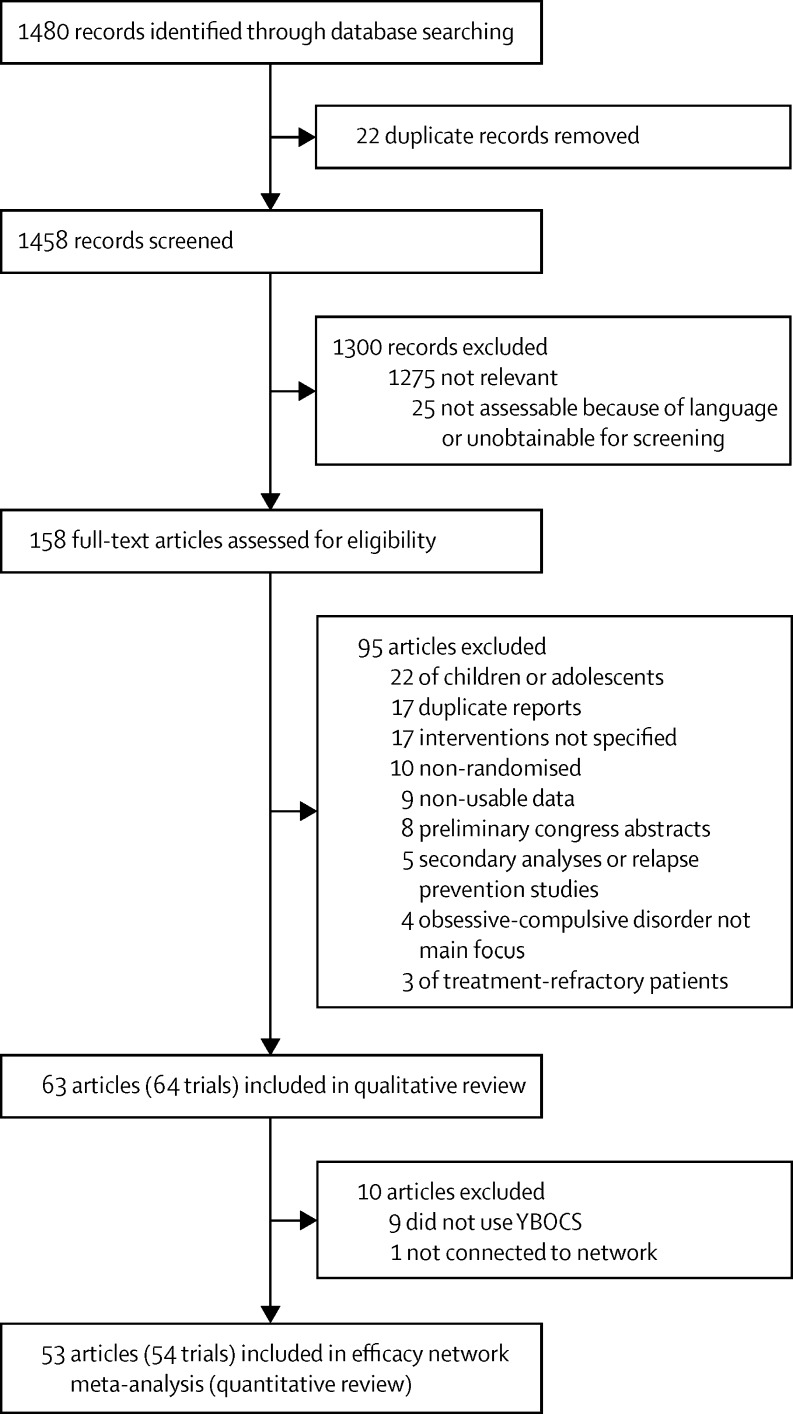
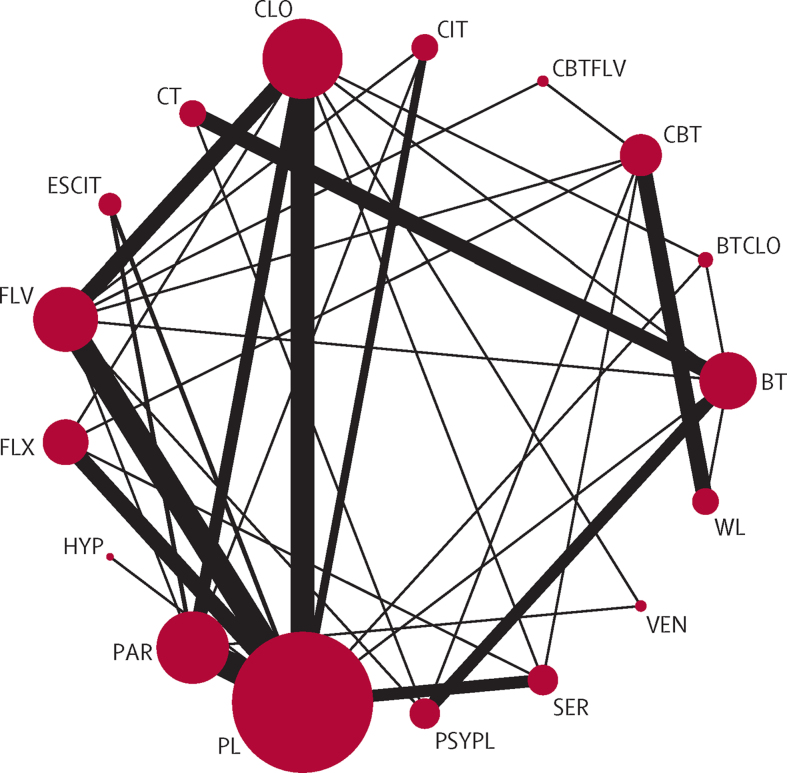
BACKGROUND: Several interventions are available for management of obsessive-compulsive disorder in adults, but few studies have compared their relative efficacy in a single analysis. We aimed to simultaneously compare all available treatments using both direct and indirect data. METHODS: In this systematic review and network meta-analysis, we searched the two controlled trials registers maintained by the Cochrane Collaboration Common Mental Disorders group for trials published up to Feb 16, 2016. We selected randomised controlled trials in which an active psychotherapeutic or pharmacological intervention had been used in adults with obsessive-compulsive disorder. We allowed all comorbidities except for schizophrenia or bipolar disorder. We excluded studies that focused exclusively on treatment-resistant patient populations defined within the same study. We extracted data from published reports. The primary outcome was symptom severity as measured by the Yale-Brown Obsessive Compulsive Scale. We report mean differences with 95% credible intervals compared with placebo. This study is registered with PROSPERO, number CRD42012002441. FINDINGS: We identified 1480 articles in our search and included 53 articles (54 trials; 6652 participants) in the network meta-analysis. Behavioural therapy (mean difference -14·48 [95% credible interval -18·61 to -10·23]; 11 trials and 287 patients), cognitive therapy (-13·36 [-18·40 to -8·21]; six trials and 172 patients), behavioural therapy and clomipramine (-12·97 [-19·18 to -6·74]; one trial and 31 patients), cognitive behavioural therapy and fluvoxamine (-7·50 [-13·89 to -1·17]; one trial and six patients), cognitive behavioural therapy (-5·37 [-9·10 to -1·63]; nine trials and 231 patients), clomipramine (-4·72 [-6·85 to -2·60]; 13 trials and 831 patients), and all SSRIs (class effect -3·49 [95% credible interval -5·12 to -1·81]; 37 trials and 3158 patients) had greater effects than did drug placebo. Clomipramine was not better than were SSRIs (-1·23 [-3·41 to 0·94]). Psychotherapeutic interventions had a greater effect than did medications, but a serious limitation was that most psychotherapeutic trials included patients who were taking stable doses of antidepressants (12 [80%] of the 15 psychotherapy trials explicitly allowed antidepressants). INTERPRETATION: A range of interventions is effective in the management of obsessive-compulsive disorder, but considerable uncertainty and limitations exist regarding their relative efficacy. Taking all the evidence into account, the combination of psychotherapeutic and psychopharmacological interventions is likely to be more effective than are psychotherapeutic interventions alone, at least in severe obsessive-compulsive disorder. FUNDING: National Institute for Health Research.
Overview
The claims and statistics of this paper haven’t been checked yet.
Free: it reads the open-access text and checks the first 5 claims that cite a source we can check. Create a free account to check every claim.
Integrity signals
Registry
Cites
Statistics
Figures
Verification
Claims the paper makes
The claims and statistics of this paper haven’t been checked yet.
Free: it reads the open-access text and checks the first 5 claims that cite a source we can check. Create a free account to check every claim.
Claims other papers make about this one
Each is checked against this paper’s own text: does it say what the citing paper says it does?
The source backs part of the claim, not all of it — or backs it for a different population, condition or comparison.
In the citing paper
“A meta-analysis of headtohead trials directly comparing clomipramine with SSRIs indicated equivalent efficacies [22].”
From Clinical Advances in Treatment Strategies for Obsessive-compulsive Disorder in Adults (2023) · cites this paper as [22]
Experimental — accuracy not yet measuredThe source backs part of the claim, not all of it — or backs it for a different population, condition or comparison.
In the citing paper
“Cognitive-behavioral therapy (CBT) with exposure and response prevention (ERP) as well as pharmacotherapy (i.e., selective serotonin reuptake inhibitors) are evidence-based treatments for OCD [19].”
From Metacognitive Training for Obsessive-Compulsive Disorder: A study protocol for a randomized controlled trial (2020) · cites this paper as [19]
Experimental — accuracy not yet measuredThe cited source says what the claim attributes to it.
In the citing paper
“Despite the limitation that most psychotherapeutic trials included patients were prescribed stable doses of SSRIs [22], meta-analyses of RCTs have consistently demonstrated that CBT/ERP therapy significantly improves OCD symptoms [43,44].”
From Clinical Advances in Treatment Strategies for Obsessive-compulsive Disorder in Adults (2023) · cites this paper as [22]
The cited source says what the claim attributes to it.
In the citing paper
“As there are no noticeable differences in the efficacy between specific SSRIs [22], the adverse effects of SSRIs could be one of the main considerations in the choice of a specific SSRI.”
From Clinical Advances in Treatment Strategies for Obsessive-compulsive Disorder in Adults (2023) · cites this paper as [22]
The check wasn’t confident either way, so it gives no verdict — never disputed.
In the citing paper
“Neurobiological models implicate dysfunction within fronto-striatal systems involved in cognitive control [47].”
From Neural correlates of response inhibition following cognitive behavioral therapy in obsessive–compulsive disorder: a randomized controlled EEG study (2026) · cites this paper as [47]
Experimental — accuracy not yet measured
2 more claims about this paper
Create a free account to see every claim other papers make about this one.
Self-check
Percentages, sums and reported differences re-computed from the paper’s own numbers.
The self-check needs the paper’s full text.
Citations
Cites
Cochrane Handbook for Systematic Reviews of Interventions: Cochrane Book Series
(2008) · doi:10.1002/9780470712184 · Cited by 25,048 · cited 3×
“14 We included studies with a high risk of bias in the main analysis but did sensitivity analyses to examine the eff ect of excluding them.”
InfluentialThe Yale-Brown Obsessive Compulsive Scale: I. Development, Use, and Reliability
Goodman, W. K. (1989) · Archives of General Psychiatry · doi:10.1001/archpsyc.1989.01810110048007 · Cited by 7,712 · cited 3×
“13 Our preferred measure was mean change from baseline score.”
InfluentialThe Yale-Brown Obsessive-Compulsive Scale: Measures of internal consistency
Kim, S. W., Dysken, M. W., Pheley, A. M., & Hoover, K. M. (1994) · Psychiatry Research · doi:10.1016/0165-1781(94)90039-6 · Cited by 2,359
Obsessional-compulsive problems: A cognitive-behavioural analysis
Salkovskis, P. M. (1985) · Behaviour Research and Therapy · doi:10.1016/0005-7967(85)90105-6 · Cited by 1,842
Self-citationSimultaneous comparison of multiple treatments: Combining direct and indirect evidence.
Caldwell, D. M., Ades, A. E., & Higgins, J. P. T. (2005) · BMJ · doi:10.1136/bmj.331.7521.897 · Cited by 1,600
Self-citationDias, S., Sutton, A. J., Ades, A. E., & Welton, N. J. (2013) · Medical Decision Making · doi:10.1177/0272989x12458724 · Cited by 1,207
Self-citationFoa, E. B., Liebowitz, M. R., Kozak, M. J., Davies, S., Campeas, R., Franklin, M. E., Huppert, J. D., Kjernisted, K., Rowan, V., Schmidt, A. B., et al. (2005) · American Journal of Psychiatry · doi:10.1176/appi.ajp.162.1.151 · Cited by 1,048
Dias, S., Welton, N. J., Sutton, A. J., Caldwell, D. M., Lu, G., & Ades, A. E. (2013) · Medical Decision Making · doi:10.1177/0272989x12455847 · Cited by 728
Self-citationCuijpers, P., Sijbrandij, M., Koole, S. L., Andersson, G., Beekman, A. T., & Reynolds, C. F. (2013) · World Psychiatry · doi:10.1002/wps.20038 · Cited by 540
Cuijpers, P., van Straten, A., Bohlmeijer, E., Hollon, S. D., & Andersson, G. (2010) · Psychological Medicine · doi:10.1017/s0033291709006114 · Cited by 533
Research works printed but not linked: 1
- Nakajima T Kudo Y Yamashita I Clinical usefulness of fluvoxamine maleate (SME3110), a selective serotonin reuptake inhibitor, in the treatment of obsessive compulsive disorder: a double blind, placebo controlled study J Clin Therapeut Med 12 1996 409 437
Cited by
Items 201–300 of 421
Xu, T., Gao, Y., Li, B., Jiang, J., Guo, H., Liu, X., Huang, H., Cheng, Y., Yu, H., Hu, J., et al. (2022) · Brain Sciences · doi:10.3390/brainsci12070933 · Cited by 7
van der Straten, A. L., Bruin, W. B., van de Mortel, L. A., ten Doesschate, F., Merkx, M. J. M., de Koning, P. P., Vulink, N. C. C., Figee, M., van den Heuvel, O. A., Denys, D. A. J. P., et al. (2024) · Depression and Anxiety · doi:10.1155/2024/6687657 · Cited by 13
Ruan, H., Wang, Y., Li, Z., Tong, G., & Wang, Z. (2022) · Brain Sciences · doi:10.3390/brainsci12070936 · Cited by 7
Cognitive-Behavioral Therapy for Obsessive-Compulsive Disorder: A Brief Review
Bragdon, L. B., Harvey, J. R., & Moldow, R. (2024) · Psychiatric Annals · doi:10.3928/00485713-20240227-01 · Cited by 7
Doolub, D., Vibert, N., Botta, F., Razmkon, A., Bouquet, C. A., Wassouf, I., Millet, B., Harika‐Germaneau, G., & Jaafari, N. (2024) · Journal of Psychiatric Research · doi:10.1016/j.jpsychires.2024.04.052 · Cited by 8
The Future of Obsessive-Compulsive Spectrum Disorders: A Research Perspective
Vats, T., Fineberg, N. A., & Hollander, E. (2021) · Current topics in behavioral neurosciences · doi:10.1007/7854_2020_208 · Cited by 8
Self-citationBloch, M. H., Artukoglu, B. B., Lennington, J. B., Szuhay, G., & Lombroso, P. J. (2020) · Elsevier eBooks · doi:10.1016/b978-0-12-813866-3.00039-4 · Cited by 7
Bai, Y., Yang, X., Zeng, Z., & Yang, H. (2018) · BMC Psychiatry · doi:10.1186/s12888-018-1655-5 · Cited by 7
Kühne, F., Brütt, A. L., Otterbeck, M. J., & Weck, F. (2019) · Health Expectations · doi:10.1111/hex.13005 · Cited by 7
Gamma oscillations predict paroxetine response of patients with Obsessive Compulsive Disorder
Arıkan, M. K., Günver, M. G., & İlhan, R. (2020) · Journal of Obsessive-Compulsive and Related Disorders · doi:10.1016/j.jocrd.2020.100620 · Cited by 7
Psychotherapeutische Verfahren
Voderholzer, U., Rubart, A., Kathmann, N., Staniloiu, A., Kordon, A., & Zurowski, B. (2024) · Springer eBooks · doi:10.1007/978-3-662-67878-7_4 · Cited by 7
Mogan, C., Mogan, J., Foroughi, E., Addison, K., Bryan, J., Felmingham, K. L., & Yap, K. (2025) · The Cognitive Behaviour Therapist · doi:10.1017/s1754470x2500008x · Cited by 6
Biological Mechanisms and Treatment of Obsessive–Compulsive Disorder
Pittenger, C. (2026) · Annual Review of Clinical Psychology · doi:10.1146/annurev-clinpsy-081423-020516 · Cited by 6
The efficacy of brief strategic therapy in treating obsessive-compulsive disorder: a case series.
Proietti, L., Aguglia, A., Amerio, A., Costanza, A., Fesce, F., Magnani, L., Serafini, G., & Amore, M. (2022) · Acta bio-medica dell'Ateneo parmense/Acta biomedica · doi:10.23750/abm.v93is1.13064 · Cited by 7
Murphy, C. E., Rhode, A., Kreyling, J., Appel, S. M., Heintz, J. R., Osborn, K., Lucas, K., Mohideen, R., Trusky, L., Smith, S. M., et al. (2023) · Frontiers in Human Neuroscience · doi:10.3389/fnhum.2023.1251194 · Cited by 7
Adequacy of treatment in outpatients with obsessive-compulsive disorder
Cohen, S. E., Storosum, B. W. C., Vulink, N. C. C., de Koning, P. P., Namavar, Y., Zantvoord, J. B., & Denys, D. A. J. P. (2024) · Comprehensive Psychiatry · doi:10.1016/j.comppsych.2024.152546 · Cited by 6
Moreau, A. L., Hansen, I. S., & Bogdan, R. (2025) · Frontiers in Psychiatry · doi:10.3389/fpsyt.2024.1432253 · Cited by 37
Holm, S. E. H., Hansen, B. K. A., Kvale, G., Eilertsen, T., Hagen, K., & Solem, S. (2019) · Journal of Obsessive-Compulsive and Related Disorders · doi:10.1016/j.jocrd.2019.100486 · Cited by 6
New Directions for Surgical Ablation Treatment of Obsessive Compulsive Disorder.
Etherington, L., Matthews, K., & Akram, H. (2021) · Current topics in behavioral neurosciences · doi:10.1007/7854_2020_207 · Cited by 3
Bertolín-Guiullén, J. M. (2023) · European journal of applied sciences · doi:10.14738/aivp.95.10994 · Cited by 14
Mowla, A., & Baniasadipour, H. (2022) · International Clinical Psychopharmacology · doi:10.1097/yic.0000000000000415 · Cited by 6
“Selective serotonin reuptake inhibitors (SSRIs), which are the treatment of choice for OCD, have shown to be effective in 40–60% of the patients (Cottraux et al., 2005; Beşiroğlu, 2016; Skapinakis et al., 2016).”
Taube-Schiff, M., Rector, N. A., Young, R., Larkin, P., & Richter, M. A. (2020) · Journal of Nervous & Mental Disease · doi:10.1097/nmd.0000000000001075 · Cited by 5
Ramsey, K. A., Browning, L. E., Chang, A. H., & Mcguire, J. F. (2024) · Journal of Obsessive-Compulsive and Related Disorders · doi:10.1016/j.jocrd.2024.100895 · Cited by 5
An effectiveness study of intensive outpatient treatment for OCD
Juel, E. K., Rogers, K., Hadlock, S., Myers, N. S., Friedman, J. B., Tadross, M. E., & Abramowitz, J. S. (2024) · Journal of Obsessive-Compulsive and Related Disorders · doi:10.1016/j.jocrd.2024.100931 · Cited by 5
Hohensee, N., Bischof, C., Dietel, F. A., Klein, N., Doebler, P., & Buhlmann, U. (2024) · Journal of Obsessive-Compulsive and Related Disorders · doi:10.1016/j.jocrd.2024.100934 · Cited by 5
Kishi, T., Sakuma, K., Hatano, M., Hamanaka, S., Nishii, Y., & Iwata, N. (2025) · Psychological Medicine · doi:10.1017/s0033291725101578 · Cited by 5
Loureiro, C. P., dos Santos‐Ribeiro, S., Moreira‐de‐Oliveira, M. E., Laurito, L. D., Hühne, V., Torres, B., Twohig, M. P., de Menezes, G. B., & Fontenelle, L. F. (2026) · Journal of Psychiatric Research · doi:10.1016/j.jpsychires.2026.01.035 · Cited by 5
Wheaton, M. G., Ward, H. E., & Pinto, A. (2022) · Journal of Cognitive Psychotherapy · doi:10.1891/jcp-2022-0023 · Cited by 5
Avances en el tratamiento farmacológico del trastorno obsesivo-compulsivo.
Vega‐Dienstmaier, J. M. (2017) · Revista de Neuro-Psiquiatría · doi:10.20453/rnp.v79i4.2978 · Cited by 7
de Mathis, M. A., Chacon, P., Boavista, R., de Oliveira, M. V. S., de Barros, P. M. F., Echevarria, M. A. N., Ferrão, Y. A., Vattimo, E. F. D. Q., Lopes, A. C., Torres, A. R., et al. (2023) · Brazilian Journal of Psychiatry · doi:10.47626/1516-4446-2023-3081 · Cited by 7
Swisher, V. S., Leman, T. Y., Piacentini, J. C., & Ricketts, E. J. (2023) · Current Developmental Disorders Reports · doi:10.1007/s40474-023-00284-6 · Cited by 5
Matsumoto, K., Hamatani, S., & Shimizu, E. (2024) · Internet Interventions · doi:10.1016/j.invent.2024.100725 · Cited by 6
“The efficacy of CBT, including the exposure and response prevention (ERP) module, in improving OCD severity forms the basis of the recommendations in the NICE guidelines (Skapinakis et al., 2016; Ferrando and Selai, 2021).”
Patel, S. R., Gershkovich, M., Hinds, M. T., Jankowski, S. E., Dixon, L. B., Myers, R. W., & Simpson, H. B. (2021) · Psychiatric Services · doi:10.1176/appi.ps.202100083 · Cited by 5
Intelligence quotient level and treatment of obsessive-compulsive disorders: Meta-analyses
Hu, L., Hao, Y., Liu, S., Kang, H., Li, Q., Zeng, Z., Abdelrahim, M. E. A., & Tan, Y. (2020) · Medical Hypotheses · doi:10.1016/j.mehy.2020.109995 · Cited by 6
Skapinakis, P., Caldwell, D. M., Hollingworth, W., Welton, N. J., Fineberg, N. A., Salkovskis, P. M., Churchill, R. C., & Lewis, G. (2016) · The Lancet Psychiatry · doi:10.1016/s2215-0366(16)30282-6 · Cited by 5
Self-citationAre current pharmacotherapeutic strategies effective in treating OCD?
Reddy, Y. C. J., & Arumugham, S. S. (2020) · Expert Opinion on Pharmacotherapy · doi:10.1080/14656566.2020.1735355 · Cited by 5
“This recommendation is based mostly on the data derived from patients who are already on medications [3].”
InfluentialGao, J. J., Jia, W., Li, P., zhao, H., Lin, L., Chen, M., Gao, R., Liu, X., Zhang, T., Zhao, W., et al. (2025) · Nature Mental Health · doi:10.1038/s44220-025-00410-w · Cited by 5
Gautam, V. K., Aich, T. K., Khan, A. H., Kar, S. K., Chaudhury, A., & Kushwaha, U. (2025) · CNS Spectrums · doi:10.1017/s1092852925100527 · Cited by 4
Veloso, P., & Pereira, F. (2025) · Cureus · doi:10.7759/cureus.94299 · Cited by 4
“OCD is among the most common mental disorders in developed countries and ranks as one of the top 10 causes of disability worldwide [3].”
Zhang, K., Trambaiolli, L. R., Zhao, Z., Taschereau‐Dumouchel, V., & Feusner, J. D. (2026) · Journal of Psychiatric Research · doi:10.1016/j.jpsychires.2026.03.013 · Cited by 4
“Although first-line treatments can lead to symptom improvement in up to 50% of OCD patients during the acute phase (Skapinakis et al., 2016; Stein et al., 2019), relapses are common following treatment discontinuation (Gonçalves et al., 2017), and even in some cases when continuing treatment…”
Desregulación Emocional Como Factor del Trastorno Obsesivo Compulsivo: Una Revisión Sistemática
Calle, F. P. M., & Ortiz, G. G. R. (2025) · Revista Multidisciplinaria Investigación Contemporánea · doi:10.58995/redlic.rmic.v3.n2.a106 · Cited by 4
Holm, S. E. H., Hansen, B. K. A., Kvale, G., Eilertsen, T., Grøtte, T., & Solem, S. (2018) · Cogent Psychology · doi:10.1080/23311908.2018.1461542 · Cited by 4
Comportamento suicida em estudantes universitários
Souza, S. D. S., & Marcolan, J. F. (2021) · Research Society and Development · doi:10.33448/rsd-v10i15.23424 · Cited by 4
Flygare, O., Wallert, J., Chen, L. L., de la Cruz, L. F., Lundström, L., Mataix‐Cols, D., Rück, C., & Andersson, E. (2022) · Behavior Therapy · doi:10.1016/j.beth.2022.06.009 · Cited by 4
Impact of gut microbiota on severity of obsessive-compulsive disorder (OCD) - a short review
Niewęgłowski, K., Wilczek, N. A., Rycharski, M., & Niewęgłowska, J. (2022) · Journal of Education Health and Sport · doi:10.12775/jehs.2022.12.08.028 · Cited by 4
Kohls, E., Baldofski, S., Scholl, J., Flygare, O., Lundström, L., Beyrich-Kolbus, U., Steinbrecher, M., Rück, C., & Rummel‐Kluge, C. (2025) · BMC Psychiatry · doi:10.1186/s12888-025-06519-7 · Cited by 4
The road to improvement in obsessive-compulsive disorder
Torres, A. R. (2016) · The Lancet Psychiatry · doi:10.1016/s2215-0366(16)30118-3 · Cited by 4
Obsesif Kompulsif Bozuklukta Bilişsel Yanlılık Değişimi
DERİN, S., & Yorulmaz, O. (2020) · Psikiyatride Guncel Yaklasimlar - Current Approaches in Psychiatry · doi:10.18863/pgy.620707 · Cited by 9
Bidirectional Behavioral Selection in Mice: A Novel Pre-clinical Approach to Examining Compulsivity
Mitra, S., & Bult‐Ito, A. (2021) · Frontiers in Psychiatry · doi:10.3389/fpsyt.2021.716619 · Cited by 8
Obsessive‐compulsive disorder: current management options
Harris, P. G., Drummond, L. M., & Fineberg, N. A. (2019) · Prescriber · doi:10.1002/psb.1793 · Cited by 5
Self-citationTownsend, A. N., Hertz, A. G., D’Souza, J. M., & Wiese, A. D. (2022) · Advances in Psychiatry and Behavioral Health · doi:10.1016/j.ypsc.2022.05.003 · Cited by 5
Miegel, F. S., Schröder, J., Schultz, J., Müller, J. C., & Jelinek, L. (2023) · International Journal of Psychology · doi:10.1002/ijop.12919 · Cited by 5
OBSESINIS-KOMPULSINIS SUTRIKIMAS: APIBRĖŽTIS, KLINIKINIAI BRUOŽAI, DIAGNOSTIKA IR GYDYMAS
Zajankauskas, V., & Musneckis, A. (2023) · Health Sciences · doi:10.35988/sm-hs.2023.106 · Cited by 3
Update Zwangsstörungen und verwandte Erkrankungen
Endres, D., Baldermann, J. C., Schiele, M. A., Jelinek, L., Domschke, K., & Voderholzer, U. (2025) · Der Nervenarzt · doi:10.1007/s00115-025-01845-3 · Cited by 4
Verstraete, E., Dreesen, E., Schruers, K. R. J., Desplenter, S., & Bervoets, C. (2025) · ALPHA PSYCHIATRY · doi:10.31083/ap41734 · Cited by 3
Leichsenring, F., Steinert, C., Biskup, J., Feix, L., Heim, N., Nimis, B., Kreische, R., Nöske, F., Ruckes, C., Weiß, H., et al. (2026) · Psychotherapy and Psychosomatics · doi:10.1159/000550421 · Cited by 3
Gender-specific perspectives in schizophrenia: Recent advances and future directions
Ansari, S. A., Khan, F. I., Alshanberi, A. M., Alam, M. Z., Saboor, M., & Ashraf, G. M. (2026) · Progress in Neuro-Psychopharmacology and Biological Psychiatry · doi:10.1016/j.pnpbp.2026.111617 · Cited by 4
From lobotomy to connectomics: a critical review of contemporary psychosurgery
González, V., Rumià, J., Brell, M., Roset, C., de Miguel, J., Arboleya, S., Aguirre, I., Alegre, D., Goliney, V. G., & Ibáñez, J. (2026) · Frontiers in Psychiatry · doi:10.3389/fpsyt.2026.1785333 · Cited by 3
“Surgical interventions produce the most signi fi cant average Y-BOCS reductions compared with other modalities, such as psychotherapy or medication (209).”
Chapter 12. Anxiety, Obsessive-Compulsive, and Trauma-Related Disorders
Conroy, M. L., Maruca-Sullivan, P. E., Lane, C. E., & Cook, J. M. (2022) · American Psychiatric Association Publishing eBooks · doi:10.1176/appi.books.9781615375196.ds12 · Cited by 3
Zisler, E. M., Meule, A., Koch, S., & Voderholzer, U. (2024) · Discover Mental Health · doi:10.1007/s44192-024-00073-6 · Cited by 3
Abdallah, S. B., Olfson, E., & Fernandez, T. V. (2024) · Elsevier eBooks · doi:10.1016/b978-0-443-19176-3.00011-x · Cited by 3
Leichsenring, F., Heim, N., & Steinert, C. (2025) · Journal of Anxiety Disorders · doi:10.1016/j.janxdis.2025.102980 · Cited by 3
Psychiatric Treatment and Management of Psychiatric Comorbidities of Movement Disorders
Walsh, K. H., Soe, K. C., & Sarawgi, S. (2017) · Seminars in Pediatric Neurology · doi:10.1016/j.spen.2017.12.002 · Cited by 3
Ismail, D. I., Gazia, M. A., Elekhtiar, S. A., & Elkalawy, S. (2020) · The Egyptian Journal of Histology · doi:10.21608/ejh.2020.22975.1239 · Cited by 4
“psychiatric disorders and women are twice as commonly affected as men[13], obsessive-compulsive disorder which is the fourth most common mental disorder[14], traumatic brain injury that is extensively followed by disorders of mood, attention, sleep and anxiety[15].”
BackgroundObsessive-Compulsive Disorder (OCD)
Ehret, M. J. (2017) · The American Pharmacists Association eBooks · doi:10.21019/pharmacotherapyfirst.ocd_overview · Cited by 3
Acevedo, N., Castle, D. J., Bosanac, P., & Rossell, S. L. (2023) · Brain Sciences · doi:10.3390/brainsci13101444 · Cited by 3
“cognitive models of OCD that postulate that dysfunctional beliefs related to the self (i.e., feared self, self-ambivalence) and the world (i.e., overestimation of threat, inflated responsibility) and impaired reasoning processes (i.e., inferential confusion) are meta-vulnerabilities to OCD [17–23].”
I molti volti della violenza di genere: discipline a confronto
Edited by: Serenella Civitelli, A. V., Viviani, A., & Civitelli, S. (2023) · doi:10.36253/979-12-215-0208-4 · Cited by 5
Metacognition in anxious-depression is state-dependent: an observational treatment studyPreprint
Fox, C. A., Lee, C. T., Hanlon, A. K., Seow, T. X. F., Lynch, K., Harty, S., Richards, D., Palacios, J. E., O’Keane, V., Stephan, K. E., et al. (2023) · eLife · doi:10.7554/elife.87193.1 · Cited by 4
Karadere, M. E., Burhan, H. Ş., Şafak, Y., Turgal, E., Özdel, K., & Türkçapar, M. H. (2024) · Current Psychology · doi:10.1007/s12144-024-06593-2 · Cited by 2
Spencer, S. D., Borgogna, N. C., Owen, T., Rast, C. E., Johnson, D. A., Cheng, J. S.-C., Castillo, A. A., Storch, E. A., Cervin, M., & Hollon, S. D. (2025) · Personalized Medicine in Psychiatry · doi:10.1016/j.pmip.2025.100154 · Cited by 3
Zheng, Y., Luo, X., Yang, B., Liu, S., Li, Q., He, W., Hu, Y., Zhou, Z., Ye, S., Che, X., et al. (2025) · Journal of Psychiatric Research · doi:10.1016/j.jpsychires.2025.09.029 · Cited by 2
Placebo effects in mental disorders
Wilhelm, M., Rief, W., & Salzmann, S. (2025) · Handbook of clinical neurology · doi:10.1016/b978-0-443-29884-4.00016-9 · Cited by 2
Rijn, E. M. D.-V., Mensinger, M. E., Dougherty, D. D., & Widge, A. S. (2026) · Elsevier eBooks · doi:10.1016/b978-0-323-99742-3.00015-1 · Cited by 2
Knebel, J., & Kennedy, M. L. H. (2024) · Human Psychopharmacology Clinical and Experimental · doi:10.1002/hup.2900 · Cited by 2
Wheaton, M. G. (2025) · CBT: science into practice · doi:10.1007/978-3-031-91439-3_14 · Cited by 2
Miller, E. W., Shoup, D. S., & Recktenwald, E. W. (2019) · Journal of Obsessive-Compulsive and Related Disorders · doi:10.1016/j.jocrd.2019.100456 · Cited by 2
van Steenwijk, M. V. G.-D. V., de Leeuw, A., van Megen, H. J. G. M., Selier, J., & Visser, H. A. D. (2021) · Frontiers in Psychiatry · doi:10.3389/fpsyt.2021.662069 · Cited by 3
Meehan, S., O’Connor, J., & Keogh, K. M. (2021) · International Journal of Applied Psychoanalytic Studies · doi:10.1002/aps.1732 · Cited by 2
Obsessive-Compulsive and Related Disorders
Kiselica, A. M., & Storch, E. A. (2018) · Cambridge University Press eBooks · doi:10.1017/9781108140416.013 · Cited by 2
Psychopharmacotherapy of Obsessive-Compulsive and Related Disorders
Hoffman, J., & Stein, D. J. (2022) · Springer eBooks · doi:10.1007/978-3-030-62059-2_433 · Cited by 2
Dehkordi, F. J., Farani, A. R., Gharraee, B., Shati, M., & Ashouri, A. (2023) · Journal of Education and Health Promotion · doi:10.4103/jehp.jehp_324_22 · Cited by 3
Network meta-analyses and treatment recommendations for obsessive-compulsive disorder
Ming, T. S. (2016) · The Lancet Psychiatry · doi:10.1016/s2215-0366(16)30281-4 · Cited by 2
An observational treatment study of metacognition in anxious-depression
Fox, C. A., Lee, C. T., Hanlon, A., Seow, T. X. F., Lynch, K., Harty, S., Richards, D., Palacios, J., O'Keane, V., Stephan, K. E., et al. (2023) · doi:10.31234/osf.io/uk7hr · Cited by 2
An observational treatment study of metacognition in anxious-depression
Fox, C. A., Lee, C. T., Hanlon, A. K., Seow, T. X., Lynch, K., Harty, S., Richards, D., Palacios, J., O'Keane, V., Stephan, K. E., et al. (2023) · eLife · doi:10.7554/elife.87193.3 · Cited by 1
Memantine as an augmentation therapy in obsessive–Compulsive disorder
Anjum, S., Gupta, P., Bhusri, L., & Singh, A. (2019) · Journal of Mental Health and Human Behaviour · doi:10.4103/jmhhb.jmhhb_20_19 · Cited by 1
Clinical utility of trifluoperazine in the treatment of obsessive-compulsive disorder: A case report
Chithra, N. K., Suhas, S., Sreeraj, V. S., & Venkatasubramanian, G. (2022) · Asian Journal of Psychiatry · doi:10.1016/j.ajp.2022.103051 · Cited by 1
Nataraj, M., Kumble, C. N., Ganjekar, S., & Desai, G. (2022) · Oxford University Press eBooks · doi:10.1093/med/9780198861478.003.0037 · Cited by 2
Brar, J., Sidana, A. K., Chauhan, N., Bajaj, M. K., & Jaswal, S. (2023) · Annals of Indian Psychiatry · doi:10.4103/aip.aip_110_22 · Cited by 1
Zwangsstörungen im Kindes- und Jugendalter
Walitza, S., & Wewetzer, C. (2023) · Springer eBooks · doi:10.1007/978-3-662-65267-1_27 · Cited by 1
Chapter 52. Treatment of Obsessive-Compulsive Disorder
Kayser, R. R., & Simpson, H. B. (2024) · American Psychiatric Association Publishing eBooks · doi:10.1176/appi.books.9781615375523.as52 · Cited by 1
Huang, X., Xiao, L., Wang, M., Wu, Y., Deng, H., & Wang, W. (2025) · Brain Sciences · doi:10.3390/brainsci15010043 · Cited by 1
Kawahito, M., Murayama, K., Tomiyama, H., Kato, K., Matsuo, A., Nishida, N., Matsukuma, K., & Nakao, T. (2025) · JBI Evidence Synthesis · doi:10.11124/jbies-24-00380 · Cited by 1
Staged Care for Adult Obsessive-Compulsive Disorder
Moreira‐de‐Oliveira, M. E., de Menezes, G. B., & Fontenelle, L. F. (2025) · Psychiatric Clinics of North America · doi:10.1016/j.psc.2025.06.005 · Cited by 2
Bellver-Peñalver, L., Arnáez, S., & García‐Soriano, G. (2025) · Exploration of Digital Health Technologies · doi:10.37349/edht.2025.101169 · Cited by 1
Hendges, N. V. Z., Batistuzzo, M. C., Costa, D. L. D. C., Bar‐Haim, Y., Abend, R., Morais, I., Salum, G. A., Miguel, E. C., Shavitt, R. G., & de Mathis, M. A. (2025) · Journal of Psychiatric Research · doi:10.1016/j.jpsychires.2025.12.013 · Cited by 2
Update Zwangsstörungen und verwandte Erkrankungen
Endres, D., Baldermann, J. C., Schiele, M. A., Jelinek, L., Domschke, K., & Voderholzer, U. (2025) · Die Psychotherapie · doi:10.1007/s00278-025-00812-2 · Cited by 1
Balachander, S., Bakam, A., Chakraborty, S., Shidore, M., Singh, N. A., Tholasappa, V., Vijayakumar, H. G., Sharma, L. P., Sharma, E., Reddy, Y. C. J., et al. (2025) · Expert Review of Neurotherapeutics · doi:10.1080/14737175.2025.2605084 · Cited by 1
Mukai, K., Hosoi, Y., Yamanishi, K., Sakurai, M., Ogino, S., Hayashida, K., & Matsunaga, H. (2026) · Psychiatry Research · doi:10.1016/j.psychres.2026.117127 · Cited by 1
The Bergen 4-day treatment for OCD in Iceland: 12-month follow-up
Davíðsdóttir, S. D., Ludvigsdottir, S. J., Kvale, G., Hansen, B. K. A., Hagen, K., Hjartarson, K. H., Skarphéðinsson, G., Gudmundsson, E. G., Guðmundsdóttir, H., & Öst, L. (2026) · The Cognitive Behaviour Therapist · doi:10.1017/s1754470x26100555 · Cited by 1
Shahtou, A., Omara, H. R., Qari, S. A., Alqahtani, R. S., Alnasyan, Z. S., Alotaibi, A. E., Ali, A. A., Alabdulrahim, J. M., Naser, S. A., Asad, N., et al. (2026) · Cureus · doi:10.7759/cureus.108358 · Cited by 1
“Previous meta-analyses have yielded conflicting hierarchical rankings due to significant inter-study heterogeneity, small sample sizes, and a notable scarcity of head-to-head randomized controlled trials (RCTs) [24,27].”
Metadata
- Authors
- Skapinakis, P., Caldwell, D. M., Hollingworth, W., Bryden, P., Fineberg, N. A., Salkovskis, P., Welton, N. J., Baxter, H., Kessler, D., Churchill, R., & Lewis, G.
- Affiliations
- University of Ioannina (GR)
- University of Bristol (GB)
- University of Hertfordshire (GB)
- University of Bath (GB)
- University of York (GB)
- University College London (GB)
- Corresponding author
- Skapinakis, Petros
- ORCID
- Venue
- The Lancet Psychiatry
- Publisher
- Elsevier BV
- Published
- 2016-08
- Volume
- 3
- Issue
- 8
- Pages
- 730-739
- ISSN
- 2215-0366 (ISSN-L)
- PMC
- PMC4967667
- OpenAlex
- W2423509797
- Semantic Scholar
- 6c8a328437615126f0b7c34e785375a47023e70b
- Cited by
- 407
- References
- 89
- Citations by year
- 2026: 35 · 2025: 51 · 2024: 46 · 2023: 50 · 2022: 44 · 2021: 45 · 2020: 43 · 2019: 37 · 2018: 29 · 2017: 16 · 2016: 10
- FWCI
- 4.54
- Type
- journal article
- Language
- en
- Open access
- hybrid
- doi.org
- Licence
- cc-by
- www.elsevier.com/tdm/userlicense/1.0/ (tdm)
- www.elsevier.com/legal/tdmrep-license (tdm)
- creativecommons.org/licenses/by/4.0/ (vor)
- Locations
- The Lancet Psychiatry (publishedVersion, cc-by)
- Europe PMC (PubMed Central) (publishedVersion, cc-by)
- PubMed Central (publishedVersion, cc-by)
- PubMed (publishedVersion)
- Explore Bristol Research (publishedVersion, cc-by)
- White Rose Research Online (University of Leeds, The University of Sheffield, University of York) (acceptedVersion)
- University of Hertfordshire Research Archive (University of Hertfordshire) (acceptedVersion)
- University of Hertfordshire Research Archive (University of Hertfordshire) (submittedVersion, cc-by)
- UCL Discovery (University College London) (submittedVersion)
- Bristol Research (University of Bristol) (submittedVersion, cc-by)
- Funders
- Health Technology Assessment Programme (10/104/41)
- Topics
- Social Sciences › Psychology › Clinical Psychology › Obsessive-Compulsive Spectrum Disorders
- Social Sciences › Psychology › Experimental and Cognitive Psychology › Anxiety, Depression, Psychometrics, Treatment, Cognitive Processes
- Social Sciences › Psychology › Clinical Psychology › Psychoanalysis and Psychopathology Research
- Keywords
- obsessive-compulsive disorder, pharmacotherapy, psychotherapy, clomipramine, selective serotonin reuptake inhibitors, fluvoxamine, cognitive behavioral therapy, behavior therapy, cognitive therapy, Yale-Brown Obsessive Compulsive Scale, symptom severity, treatment efficacy comparison, adults, comorbid depression, anxiety comorbidity, comorbid substance use disorders
- MeSH terms
- Adult, Humans, Obsessive-Compulsive Disorder, Psychotherapy, Psychotropic Drugs, Randomized Controlled Trials as Topic, Treatment Outcome
About these checks
Registry, retraction, Cites and statistics results are computed, not judged, with one exception: a printed reference that no index lists is read once by a model before it counts as a citation error. Claims are extracted by a model and kept only when their quote appears verbatim in the text; each cited source is then checked, with a model’s help, for whether it says what the claim relies on. Those verdicts can be wrong — read the claim’s quote and the cited source before relying on one.
Statistics and arithmetic are recomputed, not judged.
Confidence bands are shown only for fields calibrated on our annotated test set. None is calibrated yet, so no band is shown.
What counts as a claim ›How we measure confidence ›How we check this ›
Are you an author, or do you see a problem with this page? Request a review
Data sources
Bibliographic data: Semantic Scholar, OpenAlex, Crossref.
Contains information from the Semantic Scholar Academic Graph Datasets, made available under the ODC Attribution License (ODC-BY 1.0).
Semantic Scholar’s data is described in: Kinney, R., et al. (2023). The Semantic Scholar Open Data Platform. arXiv:2301.10140.
