

Pharmacological and psychotherapeutic interventions for management of obsessive-compulsive disorder in adults: a systematic review and network meta-analysis
Open accessThe DOI matches its Crossref record; 88 of the 89 references it cites were found in a registry or an index.
Abstract
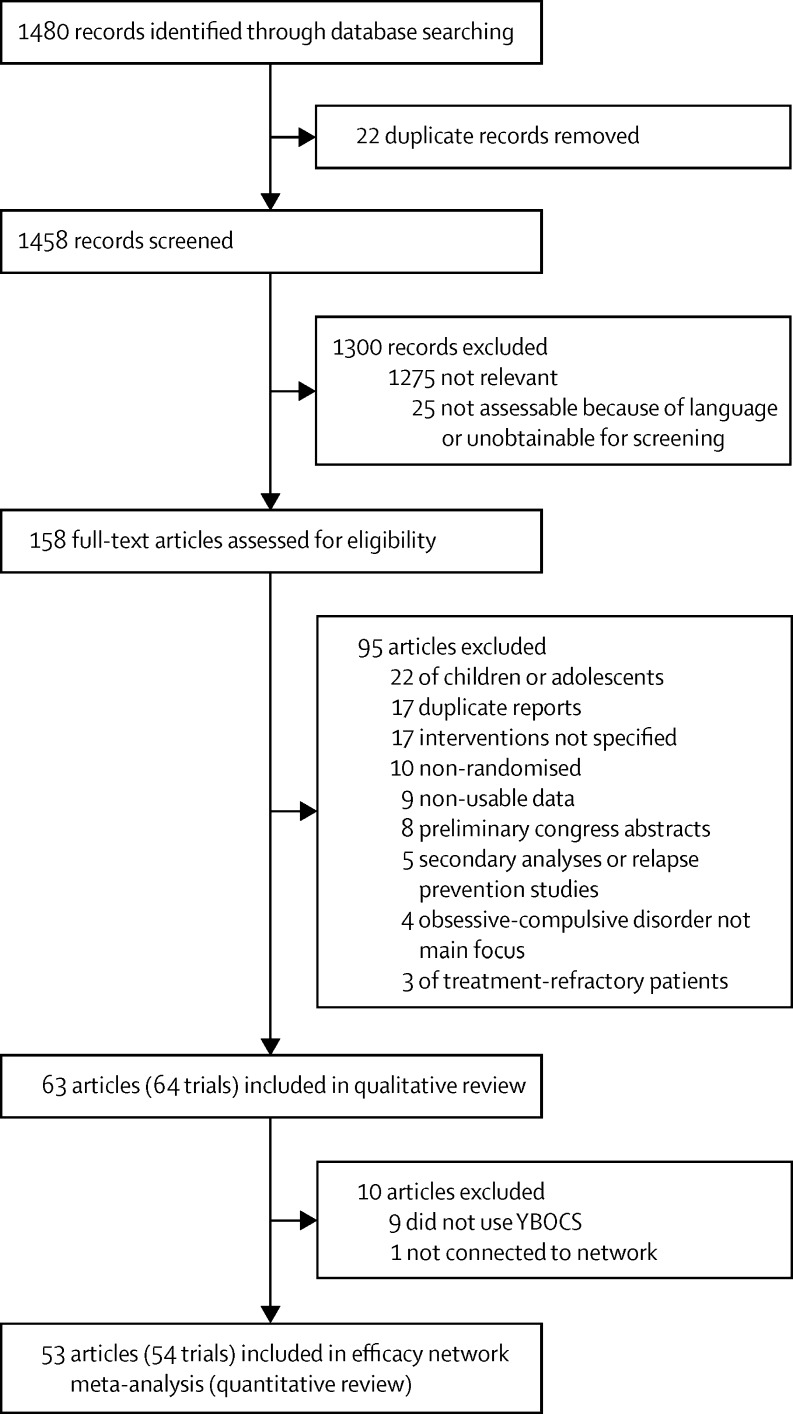
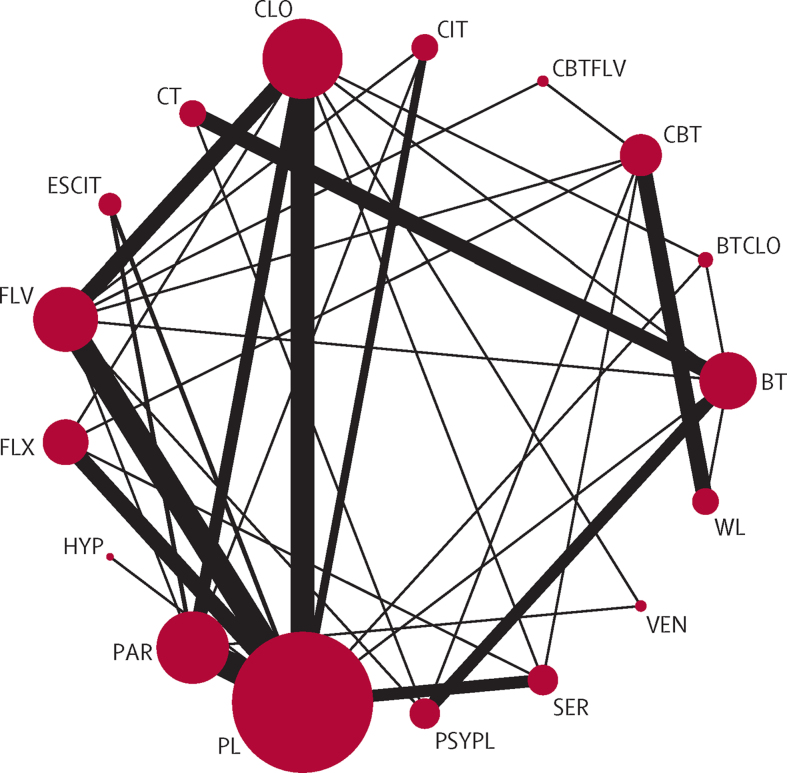
BACKGROUND: Several interventions are available for management of obsessive-compulsive disorder in adults, but few studies have compared their relative efficacy in a single analysis. We aimed to simultaneously compare all available treatments using both direct and indirect data. METHODS: In this systematic review and network meta-analysis, we searched the two controlled trials registers maintained by the Cochrane Collaboration Common Mental Disorders group for trials published up to Feb 16, 2016. We selected randomised controlled trials in which an active psychotherapeutic or pharmacological intervention had been used in adults with obsessive-compulsive disorder. We allowed all comorbidities except for schizophrenia or bipolar disorder. We excluded studies that focused exclusively on treatment-resistant patient populations defined within the same study. We extracted data from published reports. The primary outcome was symptom severity as measured by the Yale-Brown Obsessive Compulsive Scale. We report mean differences with 95% credible intervals compared with placebo. This study is registered with PROSPERO, number CRD42012002441. FINDINGS: We identified 1480 articles in our search and included 53 articles (54 trials; 6652 participants) in the network meta-analysis. Behavioural therapy (mean difference -14·48 [95% credible interval -18·61 to -10·23]; 11 trials and 287 patients), cognitive therapy (-13·36 [-18·40 to -8·21]; six trials and 172 patients), behavioural therapy and clomipramine (-12·97 [-19·18 to -6·74]; one trial and 31 patients), cognitive behavioural therapy and fluvoxamine (-7·50 [-13·89 to -1·17]; one trial and six patients), cognitive behavioural therapy (-5·37 [-9·10 to -1·63]; nine trials and 231 patients), clomipramine (-4·72 [-6·85 to -2·60]; 13 trials and 831 patients), and all SSRIs (class effect -3·49 [95% credible interval -5·12 to -1·81]; 37 trials and 3158 patients) had greater effects than did drug placebo. Clomipramine was not better than were SSRIs (-1·23 [-3·41 to 0·94]). Psychotherapeutic interventions had a greater effect than did medications, but a serious limitation was that most psychotherapeutic trials included patients who were taking stable doses of antidepressants (12 [80%] of the 15 psychotherapy trials explicitly allowed antidepressants). INTERPRETATION: A range of interventions is effective in the management of obsessive-compulsive disorder, but considerable uncertainty and limitations exist regarding their relative efficacy. Taking all the evidence into account, the combination of psychotherapeutic and psychopharmacological interventions is likely to be more effective than are psychotherapeutic interventions alone, at least in severe obsessive-compulsive disorder. FUNDING: National Institute for Health Research.
Overview
The claims and statistics of this paper haven’t been checked yet.
Free: it reads the open-access text and checks the first 5 claims that cite a source we can check. Create a free account to check every claim.
Integrity signals
Registry
Cites
Statistics
Figures
Verification
Claims the paper makes
The claims and statistics of this paper haven’t been checked yet.
Free: it reads the open-access text and checks the first 5 claims that cite a source we can check. Create a free account to check every claim.
Claims other papers make about this one
Each is checked against this paper’s own text: does it say what the citing paper says it does?
The source backs part of the claim, not all of it — or backs it for a different population, condition or comparison.
In the citing paper
“A meta-analysis of headtohead trials directly comparing clomipramine with SSRIs indicated equivalent efficacies [22].”
From Clinical Advances in Treatment Strategies for Obsessive-compulsive Disorder in Adults (2023) · cites this paper as [22]
Experimental — accuracy not yet measuredThe source backs part of the claim, not all of it — or backs it for a different population, condition or comparison.
In the citing paper
“Cognitive-behavioral therapy (CBT) with exposure and response prevention (ERP) as well as pharmacotherapy (i.e., selective serotonin reuptake inhibitors) are evidence-based treatments for OCD [19].”
From Metacognitive Training for Obsessive-Compulsive Disorder: A study protocol for a randomized controlled trial (2020) · cites this paper as [19]
Experimental — accuracy not yet measuredThe cited source says what the claim attributes to it.
In the citing paper
“Despite the limitation that most psychotherapeutic trials included patients were prescribed stable doses of SSRIs [22], meta-analyses of RCTs have consistently demonstrated that CBT/ERP therapy significantly improves OCD symptoms [43,44].”
From Clinical Advances in Treatment Strategies for Obsessive-compulsive Disorder in Adults (2023) · cites this paper as [22]
The cited source says what the claim attributes to it.
In the citing paper
“As there are no noticeable differences in the efficacy between specific SSRIs [22], the adverse effects of SSRIs could be one of the main considerations in the choice of a specific SSRI.”
From Clinical Advances in Treatment Strategies for Obsessive-compulsive Disorder in Adults (2023) · cites this paper as [22]
The check wasn’t confident either way, so it gives no verdict — never disputed.
In the citing paper
“Neurobiological models implicate dysfunction within fronto-striatal systems involved in cognitive control [47].”
From Neural correlates of response inhibition following cognitive behavioral therapy in obsessive–compulsive disorder: a randomized controlled EEG study (2026) · cites this paper as [47]
Experimental — accuracy not yet measured
2 more claims about this paper
Create a free account to see every claim other papers make about this one.
Self-check
Percentages, sums and reported differences re-computed from the paper’s own numbers.
The self-check needs the paper’s full text.
Citations
Cites
Cochrane Handbook for Systematic Reviews of Interventions: Cochrane Book Series
(2008) · doi:10.1002/9780470712184 · Cited by 25,048 · cited 3×
“14 We included studies with a high risk of bias in the main analysis but did sensitivity analyses to examine the eff ect of excluding them.”
InfluentialThe Yale-Brown Obsessive Compulsive Scale: I. Development, Use, and Reliability
Goodman, W. K. (1989) · Archives of General Psychiatry · doi:10.1001/archpsyc.1989.01810110048007 · Cited by 7,712 · cited 3×
“13 Our preferred measure was mean change from baseline score.”
InfluentialThe Yale-Brown Obsessive-Compulsive Scale: Measures of internal consistency
Kim, S. W., Dysken, M. W., Pheley, A. M., & Hoover, K. M. (1994) · Psychiatry Research · doi:10.1016/0165-1781(94)90039-6 · Cited by 2,359
Obsessional-compulsive problems: A cognitive-behavioural analysis
Salkovskis, P. M. (1985) · Behaviour Research and Therapy · doi:10.1016/0005-7967(85)90105-6 · Cited by 1,842
Self-citationSimultaneous comparison of multiple treatments: Combining direct and indirect evidence.
Caldwell, D. M., Ades, A. E., & Higgins, J. P. T. (2005) · BMJ · doi:10.1136/bmj.331.7521.897 · Cited by 1,600
Self-citationDias, S., Sutton, A. J., Ades, A. E., & Welton, N. J. (2013) · Medical Decision Making · doi:10.1177/0272989x12458724 · Cited by 1,207
Self-citationFoa, E. B., Liebowitz, M. R., Kozak, M. J., Davies, S., Campeas, R., Franklin, M. E., Huppert, J. D., Kjernisted, K., Rowan, V., Schmidt, A. B., et al. (2005) · American Journal of Psychiatry · doi:10.1176/appi.ajp.162.1.151 · Cited by 1,048
Dias, S., Welton, N. J., Sutton, A. J., Caldwell, D. M., Lu, G., & Ades, A. E. (2013) · Medical Decision Making · doi:10.1177/0272989x12455847 · Cited by 728
Self-citationCuijpers, P., Sijbrandij, M., Koole, S. L., Andersson, G., Beekman, A. T., & Reynolds, C. F. (2013) · World Psychiatry · doi:10.1002/wps.20038 · Cited by 540
Cuijpers, P., van Straten, A., Bohlmeijer, E., Hollon, S. D., & Andersson, G. (2010) · Psychological Medicine · doi:10.1017/s0033291709006114 · Cited by 533
Furukawa, T. A., Noma, H., Caldwell, D. M., Honyashiki, M., Shinohara, K., Imai, H., Chen, P., Hunot, V., & Churchill, R. (2014) · Acta Psychiatrica Scandinavica · doi:10.1111/acps.12275 · Cited by 521
Self-citationClomipramine Treatment of Obsessive-Compulsive Disorder: I. A Controlled Clinical Trial
Thorén, P. (1980) · Archives of General Psychiatry · doi:10.1001/archpsyc.1980.01780240079009 · Cited by 497
Tocolytic therapy for preterm delivery: systematic review and network meta-analysis
Haas, D. M., Caldwell, D. M., Kirkpatrick, P., McIntosh, J. J., & Welton, N. J. (2012) · BMJ · doi:10.1136/bmj.e6226 · Cited by 419 · cited 1×
“We used the random-eff ect models described by Dias and colleagues, 15 modifi ed to incorporate an additional class hierarchy, 16 such that all SSRIs were assumed to be similar, with a common class mean eff ect and between-SSRI variability about this class mean.”
Self-citationWhittal, M. L., Thordarson, D. S., & McLean, P. D. (2005) · Behaviour Research and Therapy · doi:10.1016/j.brat.2004.11.012 · Cited by 397
Efficacy of Fluvoxamine in Obsessive-Compulsive Disorder: A Double-blind Comparison With Placebo
Goodman, W. K. (1989) · Archives of General Psychiatry · doi:10.1001/archpsyc.1989.01810010038006 · Cited by 390
Clomipramine in the Treatment of Patients With Obsessive-Compulsive Disorder
(1991) · Archives of General Psychiatry · doi:10.1001/archpsyc.1991.01810320054008 · Cited by 388
The psychological treatment of obsessive-compulsive disorder
Abramowitz, J. S. (2006) · The Canadian Journal of Psychiatry · doi:10.1177/070674370605100702 · Cited by 371
Baskin, T. W., Tierney, S. C., Minami, T., & Wampold, B. E. (2003) · Journal of Consulting and Clinical Psychology · doi:10.1037/0022-006x.71.6.973 · Cited by 352
Cognitive therapy and exposure in vivo in the treatment of obsessive–compulsive disorder
Van Oppen, P., De Haan, E., Van Balkom, A. J. L. M., Spinhoven, P., Hoogduin, K., & Van Dyck, R. (1995) · Behaviour Research and Therapy · doi:10.1016/0005-7967(94)00052-l · Cited by 350
Soomro, G. M., Altman, D. G., Rajagopal, S., & Oakley Browne, M. (2008) · Cochrane Database of Systematic Reviews · doi:10.1002/14651858.cd001765.pub3 · Cited by 342
Evidence-based pharmacotherapy of obsessive-compulsive disorder
Fineberg, N. A., Brown, A., Reghunandanan, S., & Pampaloni, I. (2012) · The International Journal of Neuropsychopharmacology · doi:10.1017/s1461145711001829 · Cited by 336
Self-citationCognitive versus behavior therapy in the group treatment of obsessive–compulsive disorder
McLean, P. D., Whittal, M. L., Thordarson, D. S., Taylor, S., Söchting, I., Koch, W. J., Paterson, R., & Anderson, K. W. (2001) · Journal of Consulting and Clinical Psychology · doi:10.1037/0022-006x.69.2.205 · Cited by 332
Greist, J. H., Marks, I. M., Baer, L., Kobak, K. A., Wenzel, K. W., Hirsch, M. J., Mantle, J. M., & Clary, C. M. (2002) · The Journal of Clinical Psychiatry · doi:10.4088/jcp.v63n0209 · Cited by 321
Meta-analysis of the dose-response relationship of SSRI in obsessive–compulsive disorder
Bloch, M. H., McGuire, J., Landeros-Weisenberger, A., Leckman, J. F., & Pittenger, C. (2010) · Molecular Psychiatry · doi:10.1038/mp.2009.50 · Cited by 317
Simpson, H. B., Foa, E. B., Liebowitz, M. R., Ledley, D. R., Huppert, J. D., Cahill, S., Vermes, D., Schmidt, A. B., Hembree, E., Franklin, M., et al. (2008) · American Journal of Psychiatry · doi:10.1176/appi.ajp.2007.07091440 · Cited by 316 · cited 1×
“Some evidence exists from other trials that focused exclusively on treat-ment-refractory patients that addition of CBT for patients with SSRI-refractory obsessive-compulsive disorder is more effi cacious than is either psychological placebo 87 or risperidone.”
The descriptive epidemiology of obsessive–compulsive disorder
Fontenelle, L. F., Mendlowicz, M. V., & Versiani, M. (2006) · Progress in Neuro-Psychopharmacology and Biological Psychiatry · doi:10.1016/j.pnpbp.2005.11.001 · Cited by 310
Cottraux, J., Note, I., Yao, S. N., Lafont, S., Note, B., Mollard, E., Bouvard, M., Sauteraud, A., Bourgeois, M., & Dartigues, J.-F. (2001) · Psychotherapy and Psychosomatics · doi:10.1159/000056269 · Cited by 298
Efficacy of Drug Treatment in Obsessive–Compulsive Disorder: a Meta-Analytic Review
Piccinelli, M., Pini, S., Bellantuono, C., & Wilkinson, G. (1995) · British Journal of Psychiatry · doi:10.1192/bjp.166.4.424 · Cited by 282
Hohagen, F., Winkelmann, G., Rasche-Räuchle, H., Hand, I., König, A., Münchau, N., Hiss, H., Geiger-Kabisch, C., Käppler, C., Schramm, P., et al. (1998) · British Journal of Psychiatry · doi:10.1192/s0007125000297924 · Cited by 280
FALS-STEWART, W., MARKS, A. P., & SCHAFER, J. (1993) · The Journal of Nervous and Mental Disease · doi:10.1097/00005053-199303000-00007 · Cited by 279
Andersson, E., Enander, J., Andrén, P., Hedman, E., Ljótsson, B., Hursti, T., Bergström, J., Kaldo, V., Lindefors, N., Andersson, G., et al. (2012) · Psychological Medicine · doi:10.1017/s0033291712000244 · Cited by 274
Paroxetine versus Clomipramine in the Treatment of Obsessive–Compulsive Disorder
Zohar, J., Judge, R., & Ocd Paroxetine Study Investigators (1996) · British Journal of Psychiatry · doi:10.1192/bjp.169.4.468 · Cited by 272
Simpson, H. B., Foa, E. B., Liebowitz, M. R., Huppert, J. D., Cahill, S., Maher, M. J., McLean, C. P., Bender, J., Marcus, S. M., Williams, M. T., et al. (2013) · JAMA Psychiatry · doi:10.1001/jamapsychiatry.2013.1932 · Cited by 248
Controlled trial of exposure and response prevention in obsessive–compulsive disorder
Lindsay, M., Crino, R., & Andrews, G. (1997) · British Journal of Psychiatry · doi:10.1192/bjp.171.2.135 · Cited by 245
Cognitive-behavioral treatment of obsessive thoughts: a controlled study
Freeston, M. H., Ladouceur, R., Gagnon, F., Thibodeau, N., Rhéaume, J., Letarte, H., & Bujold, A. (1997) · Journal of Consulting and Clinical Psychology · doi:10.1037/0022-006x.65.3.405 · Cited by 234
Fluvoxamine treatment of obsessive-compulsive disorder
(1987) · American Journal of Psychiatry · doi:10.1176/ajp.144.12.1543 · Cited by 214
Multivariate Meta-Analysis of Controlled Drug Studies for Obsessive-Compulsive Disorder
Ackerman, D. L., & Greenland, S. (2002) · Journal of Clinical Psychopharmacology · doi:10.1097/00004714-200206000-00012 · Cited by 202
Watts, S. E., Turnell, A., Kladnitski, N., Newby, J. M., & Andrews, G. (2015) · Journal of Affective Disorders · doi:10.1016/j.jad.2014.12.025 · Cited by 188 · cited 1×
“18,84,85 We obtained similar fi ndings in the sensitivity analysis after exclusion of trials with high overall attrition to those from the main analysis after exclusion of waiting list controlled trials— ie, no diff erence between psychotherapies.”
Montgomery, S. A., Kasper, S., Stein, D. J., Hedegaard, K. B., & Lemming, O. M. (2001) · International Clinical Psychopharmacology · doi:10.1097/00004850-200103000-00002 · Cited by 187
Cognitive therapy with obsessive-compulsive disorder: A comparative evaluation
Emmelkamp, P. M. G., & Beens, H. (1991) · Behaviour Research and Therapy · doi:10.1016/0005-7967(91)90120-r · Cited by 175
Montgomery, S. (1993) · European Neuropsychopharmacology · doi:10.1016/0924-977x(93)90266-o · Cited by 172
Mortality Among Persons With Obsessive-Compulsive Disorder in Denmark
Meier, S. M., Mattheisen, M., Mors, O., Schendel, D. E., Mortensen, P. B., & Plessen, K. J. (2016) · JAMA Psychiatry · doi:10.1001/jamapsychiatry.2015.3105 · Cited by 172
(1990) · American Journal of Psychiatry · doi:10.1176/ajp.147.9.1209 · Cited by 164
Cognitive therapy vs. exposure in vivo in the treatment of obsessive–compulsives
Emmelkamp, P. M. G., Visser, S., & Hoekstra, R. J. (1988) · Cognitive Therapy and Research · doi:10.1007/bf01172784 · Cited by 160
Cognitive-behavioral group therapy in obsessive–compulsive disorder: a randomized clinical trial
Volpato Cordioli, A., Heldt, E., Braga Bochi, D., Margis, R., Basso de Sousa, M., Fonseca Tonello, J., Gus Manfro, G., & Kapczinski, F. (2003) · Psychotherapy and Psychosomatics · doi:10.1159/000070785 · Cited by 158
Hollander, E., Allen, A., Steiner, M., Wheadon, D. E., Oakes, R., Burnham, D. B., & Paroxetine OCD Study Group (2003) · The Journal of Clinical Psychiatry · doi:10.4088/jcp.v64n0919 · Cited by 156
Placebo-controlled trial of fluoxetine and phenelzine for obsessive- compulsive disorder
(1997) · American Journal of Psychiatry · doi:10.1176/ajp.154.9.1261 · Cited by 155
Psychological treatments versus treatment as usual for obsessive compulsive disorder (OCD)
Gava, I., Barbui, C., Aguglia, E., Carlino, D., Churchill, R., De Vanna, M., & McGuire, H. (2007) · Cochrane Database of Systematic Reviews · doi:10.1002/14651858.cd005333.pub2 · Cited by 151
Self-citationA Double Blind Comparison of Venlafaxine and Paroxetine in Obsessive-Compulsive Disorder
Denys, D., van der Wee, N., van Megen, H. J. G. M., & Westenberg, H. G. M. (2003) · Journal of Clinical Psychopharmacology · doi:10.1097/01.jcp.0000095342.32154.54 · Cited by 151
Double-blind comparative study of clomipramine and amitriptyline in obsessive neurosis
Ananth, J., Pecknold, J. C., Steen, N. V. D., & Engelsmann, F. F. (1981) · Progress in Neuro-Psychopharmacology · doi:10.1016/0364-7722(81)90077-1 · Cited by 150
Quality of life in obsessive compulsive disorder
Macy, A. S., Theo, J. N., Kaufmann, S. C. V., Ghazzaoui, R. B., Pawlowski, P. A., Fakhry, H. I., Cassmassi, B. J., & IsHak, W. W. (2013) · CNS Spectrums · doi:10.1017/s1092852912000697 · Cited by 150
Danger ideation reduction therapy (DIRT) for obsessive–compulsive washers. A controlled trial
Jones, M. K., & Menzies, R. G. (1998) · Behaviour Research and Therapy · doi:10.1016/s0005-7967(98)00057-6 · Cited by 137
Chouinard, G., Goodman, W. K., Greist, J. H., Jenike, M. A., Rasmussen, S., White, K., Hackett, E., Gaffney, M., & Bick, P. A. (1990) · PubMed · Cited by 136
Stein, D. J., Wreford Andersen, E., Tonnoir, B., & Fineberg, N. (2007) · Current Medical Research and Opinion · doi:10.1185/030079907x178838 · Cited by 134
Self-citationGreist, J. H., Jefferson, J. W., Kobak, K. A., Chouinard, G., DuBoff, E., Halaris, A., Kim, S. W., Koran, L., Liebowtiz, M. R., Lydiard, B., et al. (1995) · International Clinical Psychopharmacology · doi:10.1097/00004850-199506000-00001 · Cited by 133
Anderson, R. A., & Rees, C. S. (2007) · Behaviour Research and Therapy · doi:10.1016/j.brat.2006.01.016 · Cited by 132
Freeman, C. P. L., Trimble, M., Deakin, J. F. W., Stokes, T., & Ashford, J. J. (1994) · PubMed · Cited by 125
Clomipramine and imipramine in obsessive-compulsive disorder
Volavka, J., Neziroglu, F. A., & Yaryura-Tobias, J. A. (1985) · Psychiatry Research · doi:10.1016/0165-1781(85)90092-7 · Cited by 124 · cited 1×
“%] of all 18 psychotherapeutic trials and 12 [80”
Treatment of obsessions: a randomized controlled trial
Whittal, M. L., Woody, S. R., McLean, P. D., Rachman, S. J., & Robichaud, M. (2010) · Behaviour Research and Therapy · doi:10.1016/j.brat.2009.11.010 · Cited by 122
Taylor, D. M., Cornelius, V., Smith, L., & Young, A. H. (2014) · Acta Psychiatrica Scandinavica · doi:10.1111/acps.12343 · Cited by 122
Goodman, W. K., Kozak, M. J., Liebowitz, M., & White, K. L. (1996) · International Clinical Psychopharmacology · doi:10.1097/00004850-199603000-00003 · Cited by 120
(1985) · American Journal of Psychiatry · doi:10.1176/ajp.142.5.572 · Cited by 115
Sousa, M. B., Isolan, L. R., Oliveira, R. R., Manfro, G. G., & Cordioli, A. V. (2006) · The Journal of Clinical Psychiatry · doi:10.4088/jcp.v67n0717 · Cited by 110 · cited 1×
“26,71,74,75 Taking all of this evidence into account, our analysis does not support the view that the three types of psychotherapy have diff erent eff ects in obsessive-compulsive disorder.”
Fluvoxamine Versus Clomipramine for Obsessive-Compulsive Disorder: A Double-Blind Comparison
Koran, L. M., McElroy, S. L., Davidson, J. R. T., Rasmussen, S. A., Hollander, E., & Jenike, M. A. (1996) · Journal of Clinical Psychopharmacology · doi:10.1097/00004714-199604000-00004 · Cited by 106
Hollander, E., Koran, L. M., Goodman, W. K., Greist, J. H., Ninan, P. T., Yang, H., Li, D., & Barbato, L. M. (2003) · The Journal of Clinical Psychiatry · doi:10.4088/jcp.v64n0604 · Cited by 103
Nakatani, E., Nakagawa, A., Nakao, T., Yoshizato, C., Nabeyama, M., Kudo, A., Isomura, K., Kato, N., Yoshioka, K., & Kawamoto, M. (2005) · Psychotherapy and Psychosomatics · doi:10.1159/000086317 · Cited by 102
Cottraux, J. A., Mollard, E., Bouvard, M. A., & Marks, I. M. (1993) · Psychiatry Research · doi:10.1016/0165-1781(93)90030-k · Cited by 96
Albert, U., Aguglia, E., Maina, G., & Bogetto, F. (2002) · The Journal of Clinical Psychiatry · doi:10.4088/jcp.v63n1108 · Cited by 93
Bisserbe, J., Lane, R., Flament, M., & France-Belgian OCD Study Group (1997) · European Psychiatry · doi:10.1016/s0924-9338(97)89646-0 · Cited by 91 · cited 1×
“%] of 64) and those with psychotherapy arms only (18 [28”
St John??s wort versus placebo in obsessive???compulsive disorder: results from a double-blind study
Kobak, K. A., Taylor, L. V. H., Bystritsky, A., Kohlenberg, C. J., Greist, J. H., Tucker, P., Warner, G., Futterer, R., & Vapnik, T. (2005) · International Clinical Psychopharmacology · doi:10.1097/00004850-200511000-00003 · Cited by 88
Mundo, E., Bianchi, L., & Bellodi, L. (1997) · Journal of Clinical Psychopharmacology · doi:10.1097/00004714-199708000-00005 · Cited by 87
Belotto-Silva, C., Diniz, J. B., Malavazzi, D. M., Valério, C., Fossaluza, V., Borcato, S., Seixas, A. A., Morelli, D., Miguel, E. C., & Shavitt, R. G. (2012) · Journal of Anxiety Disorders · doi:10.1016/j.janxdis.2011.08.008 · Cited by 85 · cited 1×
“26,71,74,75 Taking all of this evidence into account, our analysis does not support the view that the three types of psychotherapy have diff erent eff ects in obsessive-compulsive disorder.”
Placebo-Controlled, Multicenter Study of Sertraline Treatment for Obsessive-Compulsive Disorder
Kronig, M. H., Apter, J., Asnis, G., Bystritsky, A., Curtis, G., Ferguson, J., Landbloom, R., Munjack, D., Riesenberg, R., Robinson, D., et al. (1999) · Journal of Clinical Psychopharmacology · doi:10.1097/00004714-199904000-00013 · Cited by 84
López-Ibor, J. J., Saíz, J., Cottraux, J. A., Note, I. D., Viñas, R., Bourgeois, M., Hernández, M., & Gómez-Pérez, J. C. (1996) · European Neuropsychopharmacology · doi:10.1016/0924-977x(95)00071-v · Cited by 83
Cognitive behaviour therapy and medication in the treatment of obsessive–compulsive disorder
O'Connor, K. P., Aardema, F., Robillard, S., Guay, S., Pélissier, M. ‐., Todorov, C., Borgeat, F., Leblanc, V., Grenier, S., & Doucet, P. (2006) · Acta Psychiatrica Scandinavica · doi:10.1111/j.1600-0447.2006.00767.x · Cited by 78 · cited 2×
“In most psycho-therapeutic trials, patients were not excluded if they were taking a stable dose of antidepressants for at least 3 months before inclusion (13 [72”
O'Connor, K., Todorov, C., Robillard, S., Borgeat, F., & Brault, M. (1999) · The Canadian Journal of Psychiatry · doi:10.1177/070674379904400108 · Cited by 75 · cited 1×
“26,71,74,75 Taking all of this evidence into account, our analysis does not support the view that the three types of psychotherapy have diff erent eff ects in obsessive-compulsive disorder.”
(1990) · American Journal of Psychiatry · doi:10.1176/ajp.147.7.923 · Cited by 73
Mundo, E., Rouillon, F., Figuera, M. L., & Stigler, M. (2001) · Human Psychopharmacology: Clinical and Experimental · doi:10.1002/hup.317 · Cited by 66
Bergeron, R., Ravindran, A. V., Chaput, Y., Goldner, E., Swinson, R., van Ameringen, M. A., Austin, C., & Hadrava, V. (2002) · Journal of Clinical Psychopharmacology · doi:10.1097/00004714-200204000-00007 · Cited by 62
Continuation treatment of OCD: double-blind and open-label experience with fluoxetine.
Tollefson, G. D., Birkett, M. A., Koran, L. M., & Genduso, L. A. (1994) · PubMed · Cited by 57
Milanfranchi, A., Ravagli, S., Lensi, P., Marazziti, D., & Cassano, G. B. (1997) · International Clinical Psychopharmacology · doi:10.1097/00004850-199705000-00002 · Cited by 52
Jaurrieta, N., Jimenez-Murcia, S., Menchón, J. M., Alonso, M. D. P., Segalas, C., ÁLvarez-Moya, E. M., Labad, J., Granero, R., & Vallejo, J. (2008) · Psychotherapy Research · doi:10.1080/10503300802192141 · Cited by 36
KAMIJIMA, K., MURASAKI, M., ASAI, M., HIGUCHI, T., NAKAJIMA, T., TAGA, C., & MATSUNAGA, H. (2004) · Psychiatry and Clinical Neurosciences · doi:10.1111/j.1440-1819.2004.01278.x · Cited by 35
(2010) · Cited by 35
Simpson, H. B., Foa, E. B., Liebowitz, M. R., Ledley, D. R., Huppert, J. D., Cahill, S., Vermes, D., Schmidt, A. B., Hembree, E., Franklin, M., et al. (2010) · Focus · doi:10.1176/foc.8.4.foc614 · Cited by 35
Belloch, A., Cabedo, E., & Carrió, C. (2008) · Behavioural and Cognitive Psychotherapy · doi:10.1017/s1352465808004451 · Cited by 34
Specificity of CBT for Depression: A Contribution from Multiple Treatments Meta-analyses
Honyashiki, M., Furukawa, T. A., Noma, H., Tanaka, S., Chen, P., Ichikawa, K., Ono, M., Churchill, R. C., Hunot, V., & Caldwell, D. M. (2014) · Cognitive Therapy and Research · doi:10.1007/s10608-014-9599-7 · Cited by 33
Self-citationSatiation therapy and exposure response prevention in the treatment of obsessive compulsive disorder
Khodarahimi, S. (2009) · Journal of Contemporary Psychotherapy · doi:10.1007/s10879-009-9110-z · Cited by 17 · cited 1×
“The behavioural therapy trial that used the waiting list as a control group 56 was clearly an outlier in terms of effi cacy, and excluding it from the analysis reduced the eff ects for both behavioural and cognitive therapy, but not signifi cantly.”
Research works printed but not linked: 1
- Nakajima T Kudo Y Yamashita I Clinical usefulness of fluvoxamine maleate (SME3110), a selective serotonin reuptake inhibitor, in the treatment of obsessive compulsive disorder: a double blind, placebo controlled study J Clin Therapeut Med 12 1996 409 437
Cited by
Stein, D. J., Costa, D. L. C., Lochner, C., Miguel, E. C., Reddy, Y. C. J., Shavitt, R. G., van den Heuvel, O. A., & Simpson, H. B. (2019) · Nature Reviews Disease Primers · doi:10.1038/s41572-019-0102-3 · Cited by 895
The Role of Common Factors in Psychotherapy Outcomes
Cuijpers, P., Reijnders, M., & Huibers, M. J. H. (2019) · Annual Review of Clinical Psychology · doi:10.1146/annurev-clinpsy-050718-095424 · Cited by 748
Obsessive-compulsive disorder: Puzzles and prospects
Robbins, T. W., Vaghi, M. M., & Banca, P. (2019) · Neuron · doi:10.1016/j.neuron.2019.01.046 · Cited by 510
Obsessive-Compulsive Disorder: Advances in Diagnosis and Treatment
Hirschtritt, M. E., Bloch, M. H., & Mathews, C. A. (2017) · JAMA · doi:10.1001/jama.2017.2200 · Cited by 493
Leichsenring, F., Steinert, C., Rabung, S., & Ioannidis, J. P. A. (2022) · World Psychiatry · doi:10.1002/wps.20941 · Cited by 485
Metadata
- Authors
- Skapinakis, P., Caldwell, D. M., Hollingworth, W., Bryden, P., Fineberg, N. A., Salkovskis, P., Welton, N. J., Baxter, H., Kessler, D., Churchill, R., & Lewis, G.
- Affiliations
- University of Ioannina (GR)
- University of Bristol (GB)
- University of Hertfordshire (GB)
- University of Bath (GB)
- University of York (GB)
- University College London (GB)
- Corresponding author
- Skapinakis, Petros
- ORCID
- Venue
- The Lancet Psychiatry
- Publisher
- Elsevier BV
- Published
- 2016-08
- Volume
- 3
- Issue
- 8
- Pages
- 730-739
- ISSN
- 2215-0366 (ISSN-L)
- PMC
- PMC4967667
- OpenAlex
- W2423509797
- Cited by
- 407
- References
- 89
- Citations by year
- 2026: 35 · 2025: 51 · 2024: 46 · 2023: 50 · 2022: 44 · 2021: 45 · 2020: 43 · 2019: 37 · 2018: 29 · 2017: 16 · 2016: 10
- FWCI
- 4.54
- Type
- journal article
- Language
- en
- Open access
- hybrid
- doi.org
- Licence
- cc-by
- www.elsevier.com/tdm/userlicense/1.0/ (tdm)
- www.elsevier.com/legal/tdmrep-license (tdm)
- creativecommons.org/licenses/by/4.0/ (vor)
- Locations
- The Lancet Psychiatry (publishedVersion, cc-by)
- Europe PMC (PubMed Central) (publishedVersion, cc-by)
- PubMed Central (publishedVersion, cc-by)
- PubMed (publishedVersion)
- Explore Bristol Research (publishedVersion, cc-by)
- White Rose Research Online (University of Leeds, The University of Sheffield, University of York) (acceptedVersion)
- University of Hertfordshire Research Archive (University of Hertfordshire) (acceptedVersion)
- University of Hertfordshire Research Archive (University of Hertfordshire) (submittedVersion, cc-by)
- UCL Discovery (University College London) (submittedVersion)
- Bristol Research (University of Bristol) (submittedVersion, cc-by)
- Funders
- Health Technology Assessment Programme (10/104/41)
- Topics
- Social Sciences › Psychology › Clinical Psychology › Obsessive-Compulsive Spectrum Disorders
- Social Sciences › Psychology › Experimental and Cognitive Psychology › Anxiety, Depression, Psychometrics, Treatment, Cognitive Processes
- Social Sciences › Psychology › Clinical Psychology › Psychoanalysis and Psychopathology Research
- Keywords
- obsessive-compulsive disorder, pharmacotherapy, psychotherapy, clomipramine, selective serotonin reuptake inhibitors, fluvoxamine, cognitive behavioral therapy, behavior therapy, cognitive therapy, Yale-Brown Obsessive Compulsive Scale, symptom severity, treatment efficacy comparison, adults, comorbid depression, anxiety comorbidity, comorbid substance use disorders
- MeSH terms
- Adult, Humans, Obsessive-Compulsive Disorder, Psychotherapy, Psychotropic Drugs, Randomized Controlled Trials as Topic, Treatment Outcome
About these checks
Registry, retraction, Cites and statistics results are computed, not judged, with one exception: a printed reference that no index lists is read once by a model before it counts as a citation error. Claims are extracted by a model and kept only when their quote appears verbatim in the text; each cited source is then checked, with a model’s help, for whether it says what the claim relies on. Those verdicts can be wrong — read the claim’s quote and the cited source before relying on one.
Statistics and arithmetic are recomputed, not judged.
Confidence bands are shown only for fields calibrated on our annotated test set. None is calibrated yet, so no band is shown.
What counts as a claim ›How we measure confidence ›How we check this ›
Are you an author, or do you see a problem with this page? Request a review
Data sources
Bibliographic data: Semantic Scholar, OpenAlex, Crossref.
Contains information from the Semantic Scholar Academic Graph Datasets, made available under the ODC Attribution License (ODC-BY 1.0).
Semantic Scholar’s data is described in: Kinney, R., et al. (2023). The Semantic Scholar Open Data Platform. arXiv:2301.10140.
