

Pharmacological and psychotherapeutic interventions for management of obsessive-compulsive disorder in adults: a systematic review and network meta-analysis
Open accessThe DOI matches its Crossref record; 88 of the 89 references it cites were found in a registry or an index.
Abstract
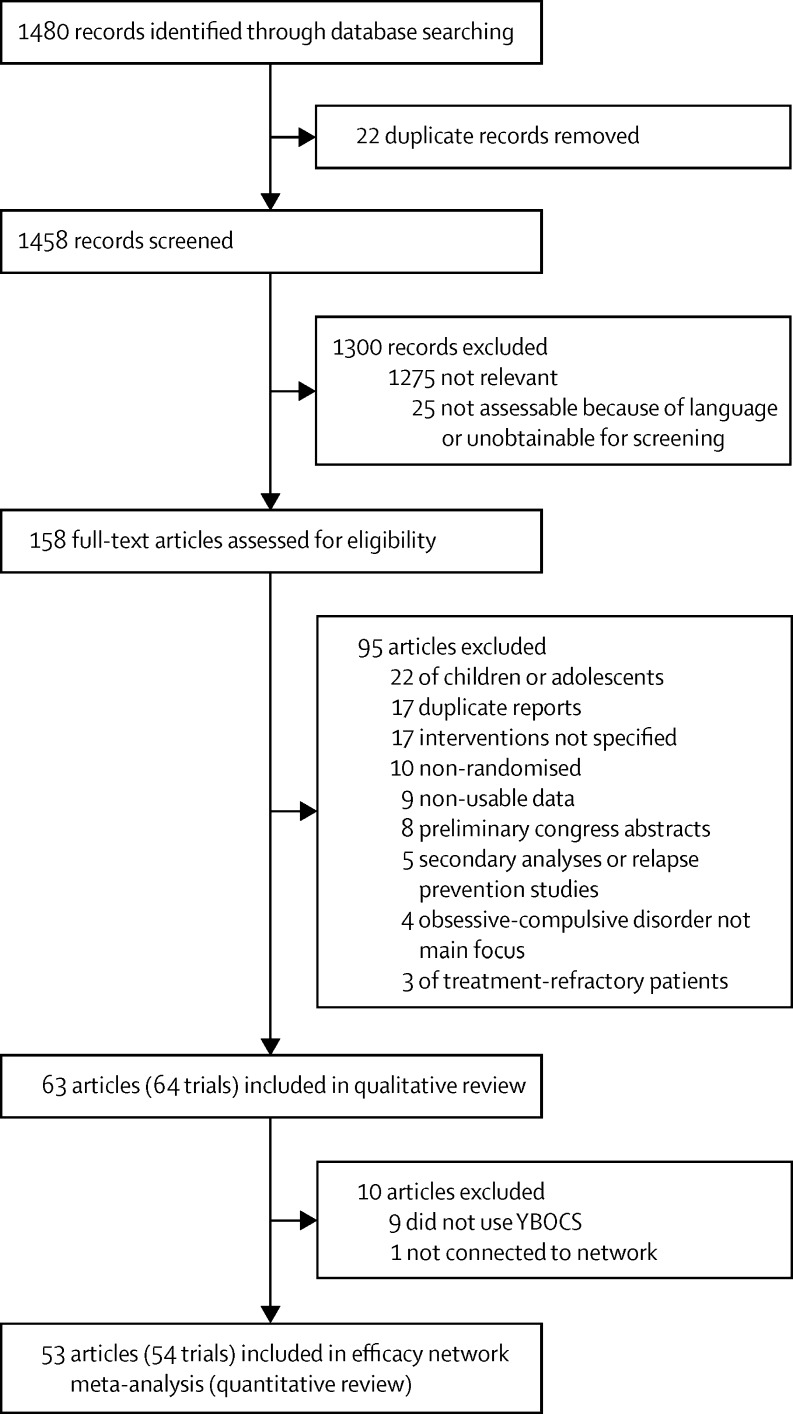
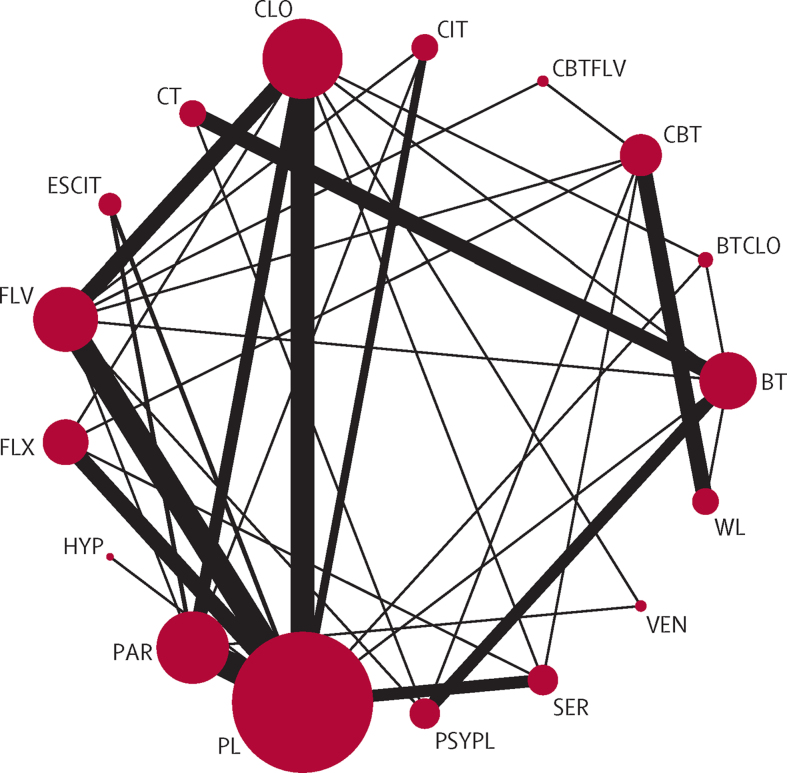
BACKGROUND: Several interventions are available for management of obsessive-compulsive disorder in adults, but few studies have compared their relative efficacy in a single analysis. We aimed to simultaneously compare all available treatments using both direct and indirect data. METHODS: In this systematic review and network meta-analysis, we searched the two controlled trials registers maintained by the Cochrane Collaboration Common Mental Disorders group for trials published up to Feb 16, 2016. We selected randomised controlled trials in which an active psychotherapeutic or pharmacological intervention had been used in adults with obsessive-compulsive disorder. We allowed all comorbidities except for schizophrenia or bipolar disorder. We excluded studies that focused exclusively on treatment-resistant patient populations defined within the same study. We extracted data from published reports. The primary outcome was symptom severity as measured by the Yale-Brown Obsessive Compulsive Scale. We report mean differences with 95% credible intervals compared with placebo. This study is registered with PROSPERO, number CRD42012002441. FINDINGS: We identified 1480 articles in our search and included 53 articles (54 trials; 6652 participants) in the network meta-analysis. Behavioural therapy (mean difference -14·48 [95% credible interval -18·61 to -10·23]; 11 trials and 287 patients), cognitive therapy (-13·36 [-18·40 to -8·21]; six trials and 172 patients), behavioural therapy and clomipramine (-12·97 [-19·18 to -6·74]; one trial and 31 patients), cognitive behavioural therapy and fluvoxamine (-7·50 [-13·89 to -1·17]; one trial and six patients), cognitive behavioural therapy (-5·37 [-9·10 to -1·63]; nine trials and 231 patients), clomipramine (-4·72 [-6·85 to -2·60]; 13 trials and 831 patients), and all SSRIs (class effect -3·49 [95% credible interval -5·12 to -1·81]; 37 trials and 3158 patients) had greater effects than did drug placebo. Clomipramine was not better than were SSRIs (-1·23 [-3·41 to 0·94]). Psychotherapeutic interventions had a greater effect than did medications, but a serious limitation was that most psychotherapeutic trials included patients who were taking stable doses of antidepressants (12 [80%] of the 15 psychotherapy trials explicitly allowed antidepressants). INTERPRETATION: A range of interventions is effective in the management of obsessive-compulsive disorder, but considerable uncertainty and limitations exist regarding their relative efficacy. Taking all the evidence into account, the combination of psychotherapeutic and psychopharmacological interventions is likely to be more effective than are psychotherapeutic interventions alone, at least in severe obsessive-compulsive disorder. FUNDING: National Institute for Health Research.
Overview
The claims and statistics of this paper haven’t been checked yet.
Free: it reads the open-access text and checks the first 5 claims that cite a source we can check. Create a free account to check every claim.
Integrity signals
Registry
Cites
Statistics
Figures
Verification
Claims the paper makes
The claims and statistics of this paper haven’t been checked yet.
Free: it reads the open-access text and checks the first 5 claims that cite a source we can check. Create a free account to check every claim.
Claims other papers make about this one
Each is checked against this paper’s own text: does it say what the citing paper says it does?
The source backs part of the claim, not all of it — or backs it for a different population, condition or comparison.
In the citing paper
“A meta-analysis of headtohead trials directly comparing clomipramine with SSRIs indicated equivalent efficacies [22].”
From Clinical Advances in Treatment Strategies for Obsessive-compulsive Disorder in Adults (2023) · cites this paper as [22]
Experimental — accuracy not yet measuredThe source backs part of the claim, not all of it — or backs it for a different population, condition or comparison.
In the citing paper
“Cognitive-behavioral therapy (CBT) with exposure and response prevention (ERP) as well as pharmacotherapy (i.e., selective serotonin reuptake inhibitors) are evidence-based treatments for OCD [19].”
From Metacognitive Training for Obsessive-Compulsive Disorder: A study protocol for a randomized controlled trial (2020) · cites this paper as [19]
Experimental — accuracy not yet measuredThe cited source says what the claim attributes to it.
In the citing paper
“Despite the limitation that most psychotherapeutic trials included patients were prescribed stable doses of SSRIs [22], meta-analyses of RCTs have consistently demonstrated that CBT/ERP therapy significantly improves OCD symptoms [43,44].”
From Clinical Advances in Treatment Strategies for Obsessive-compulsive Disorder in Adults (2023) · cites this paper as [22]
The cited source says what the claim attributes to it.
In the citing paper
“As there are no noticeable differences in the efficacy between specific SSRIs [22], the adverse effects of SSRIs could be one of the main considerations in the choice of a specific SSRI.”
From Clinical Advances in Treatment Strategies for Obsessive-compulsive Disorder in Adults (2023) · cites this paper as [22]
The check wasn’t confident either way, so it gives no verdict — never disputed.
In the citing paper
“Neurobiological models implicate dysfunction within fronto-striatal systems involved in cognitive control [47].”
From Neural correlates of response inhibition following cognitive behavioral therapy in obsessive–compulsive disorder: a randomized controlled EEG study (2026) · cites this paper as [47]
Experimental — accuracy not yet measured
2 more claims about this paper
Create a free account to see every claim other papers make about this one.
Self-check
Percentages, sums and reported differences re-computed from the paper’s own numbers.
The self-check needs the paper’s full text.
Citations
Cites
Cochrane Handbook for Systematic Reviews of Interventions: Cochrane Book Series
(2008) · doi:10.1002/9780470712184 · Cited by 25,048 · cited 3×
“14 We included studies with a high risk of bias in the main analysis but did sensitivity analyses to examine the eff ect of excluding them.”
InfluentialThe Yale-Brown Obsessive Compulsive Scale: I. Development, Use, and Reliability
Goodman, W. K. (1989) · Archives of General Psychiatry · doi:10.1001/archpsyc.1989.01810110048007 · Cited by 7,712 · cited 3×
“13 Our preferred measure was mean change from baseline score.”
InfluentialThe Yale-Brown Obsessive-Compulsive Scale: Measures of internal consistency
Kim, S. W., Dysken, M. W., Pheley, A. M., & Hoover, K. M. (1994) · Psychiatry Research · doi:10.1016/0165-1781(94)90039-6 · Cited by 2,359
Obsessional-compulsive problems: A cognitive-behavioural analysis
Salkovskis, P. M. (1985) · Behaviour Research and Therapy · doi:10.1016/0005-7967(85)90105-6 · Cited by 1,842
Self-citationSimultaneous comparison of multiple treatments: Combining direct and indirect evidence.
Caldwell, D. M., Ades, A. E., & Higgins, J. P. T. (2005) · BMJ · doi:10.1136/bmj.331.7521.897 · Cited by 1,600
Self-citationDias, S., Sutton, A. J., Ades, A. E., & Welton, N. J. (2013) · Medical Decision Making · doi:10.1177/0272989x12458724 · Cited by 1,207
Self-citationFoa, E. B., Liebowitz, M. R., Kozak, M. J., Davies, S., Campeas, R., Franklin, M. E., Huppert, J. D., Kjernisted, K., Rowan, V., Schmidt, A. B., et al. (2005) · American Journal of Psychiatry · doi:10.1176/appi.ajp.162.1.151 · Cited by 1,048
Dias, S., Welton, N. J., Sutton, A. J., Caldwell, D. M., Lu, G., & Ades, A. E. (2013) · Medical Decision Making · doi:10.1177/0272989x12455847 · Cited by 728
Self-citationCuijpers, P., Sijbrandij, M., Koole, S. L., Andersson, G., Beekman, A. T., & Reynolds, C. F. (2013) · World Psychiatry · doi:10.1002/wps.20038 · Cited by 540
Cuijpers, P., van Straten, A., Bohlmeijer, E., Hollon, S. D., & Andersson, G. (2010) · Psychological Medicine · doi:10.1017/s0033291709006114 · Cited by 533
Research works printed but not linked: 1
- Nakajima T Kudo Y Yamashita I Clinical usefulness of fluvoxamine maleate (SME3110), a selective serotonin reuptake inhibitor, in the treatment of obsessive compulsive disorder: a double blind, placebo controlled study J Clin Therapeut Med 12 1996 409 437
Cited by
Items 301–400 of 421
Mohammad, A., Ibrahim, M., Khan, A. M., Pervaiz, U., Aijaz, S., Nasrullah, M. H., & JAMİL, H. (2026) · European Journal of Clinical Pharmacology · doi:10.1007/s00228-026-04085-9 · Cited by 1
Öst, L., Andersson, E., Liberman, L. C., Fladvad, A., Havnen, A., Riise, E. N., Wahlund, T., & Wergeland, G. J. (2026) · Cognitive Behaviour Therapy · doi:10.1080/16506073.2026.2696809 · Cited by 2
Dowling, N. L., Blair‐West, S., Yap, K., Yardley, P., Cribb, L., Clement, S., Webster, K., Wise, S., Björgvinsson, Þ., Hansen, B. K. A., et al. (2026) · Australian & New Zealand Journal of Psychiatry · doi:10.1177/00048674261462748 · Cited by 1
The Bergen 4-day treatment for OCD: A systematic review
Hardman, T., Deacon, B., & Gates, J. (2026) · Journal of Obsessive-Compulsive and Related Disorders · doi:10.1016/j.jocrd.2026.101035 · Cited by 1
Assessing the effectiveness of pharmacotherapy for obsessive-compulsive disorder – Author's reply
Skapinakis, P. (2016) · The Lancet Psychiatry · doi:10.1016/s2215-0366(16)30325-x · Cited by 1
Self-citationSachdev, R. A., Ruparelia, R., Reid, J. E., Mpavenda, D., Cinosi, E., & Fineberg, N. A. (2018) · Cambridge University Press eBooks · doi:10.1017/9781108164313.016 · Cited by 2
Self-citationHerzog, P., & Jelinek, L. (2020) · Verhaltenstherapie · doi:10.1159/000511923 · Cited by 1
Raines, A. M., Koscinski, B., Mathes, B. M., Portero, A. K., Allan, N. P., & Schmidt, N. B. (2021) · British Journal of Clinical Psychology · doi:10.1111/bjc.12298 · Cited by 1
An Overview of Anxiety, Trauma-Related and Obsessive-Compulsive Disorders
Conroy, M. L., van Dyck, L. I., Lane, C. E., & Cook, J. M. (2021) · Current Geriatrics Reports · doi:10.1007/s13670-021-00361-x · Cited by 2
Koumantanou, L., Kasvikis, Y., Giaglis, G. D., Skapinakis, P., & Mavreas, V. G. (2021) · Psychopathology · doi:10.1159/000518906 · Cited by 1
Self-citationTundo, A., Salvati, L., Cieri, L., Balestrini, V., Spigno, D. D., Orazi, F., Iommi, M., & Necci, R. (2022) · International Journal of Psychiatry in Clinical Practice · doi:10.1080/13651501.2022.2054351 · Cited by 2
Medications for Anxiety Disorders
Narita, Z. C., Fujimoto, M., Winter, E., Nestadt, P. S., & Sawa, A. (2023) · Springer eBooks · doi:10.1007/978-3-030-42825-9_136-1 · Cited by 1
Imai, H., & Furukawa, T. A. (2024) · Psychiatry and Clinical Neurosciences Reports · doi:10.1002/pcn5.70009 · Cited by 1
Ishikawa, R. (2024) · Cureus · doi:10.7759/cureus.70584 · Cited by 2
“In addition, recent systematic reviews and meta-analyses suggest that for severe OCD, a combination of medication and psychological treatment, such as CBT, is recommended [38,40].”
Farhat, L. C., & Bloch, M. H. (2024) · Elsevier eBooks · doi:10.1016/b978-0-323-95702-1.00239-6 · Cited by 1
Expert opinion on challenges in the diagnosis and treatment of OCD in India
Porandla, K., Nagpal, R., & Garg, S. (2024) · International Journal of Research in Medical Sciences · doi:10.18203/2320-6012.ijrms20244166 · Cited by 1
Evidence‐Based Decision Making in Psychological Research: A Network Meta‐Analysis
Çimen, F., & Seçer, İ. (2025) · Journal of Evaluation in Clinical Practice · doi:10.1111/jep.14302 · Cited by 1
Imai, H., Luo, Y., Funada, S., Hashimoto, T., Matsuishi, K., Takamatsu, T., Yoshihara, Y., Hiraoka, Y., Mizui, Y., Hayasaka, Y., et al. (2025) · Psychiatry and Clinical Neurosciences Reports · doi:10.1002/pcn5.70065 · Cited by 1
Assessing the effectiveness of pharmacotherapy for obsessive-compulsive disorder
Johnson, J. C. S., Scott, J. G., & Jess, N. (2016) · The Lancet Psychiatry · doi:10.1016/s2215-0366(16)30324-8 · Cited by 1
Depression and Anxiety Disorders
(2021) · Wiley eBooks · doi:10.1002/9781119870203.mpg003 · Cited by 1
Klimkeit, E., Rinehart, N., May, T., Whelan, M., & Bradshaw, J. L. (2023) · Elsevier eBooks · doi:10.1016/b978-0-323-99967-0.00082-x · Cited by 1
Metacognition in anxious-depression is state-dependent: an observational treatment study
Fox, C. A., Lee, C. T., Hanlon, A. K., Seow, T. X., Lynch, K., Harty, S., Richards, D., Palacios, J., O’Keane, V., Stephan, K. E., et al. (2023) · doi:10.7554/elife.87193.2 · Cited by 1
Bation, R. (2018) · theses.fr (ABES) · doi:10.70675/3c89240bzc242z45f4z9247z73969c8af558 · Cited by 1
Çınaroğlu, M., Ülker, S. V., Yılmazer, E., & Sayar, G. H. (2026) · BMC Psychology · doi:10.1186/s40359-026-05201-1
Wassouf, I., Vibert, N., Dampuré, J., Doolub, D., Harika-Germaneau, G., Langbour, N., & Jaafari, N. (2026) · Depression and Anxiety · doi:10.1155/da/9694689
Medication May Be Equivalent to Psychotherapy in OCD
Roy‐Byrne, P. (2016) · Journal watch · doi:10.1056/nejm-jw.na41658
A Complex Case of Obsessive-Compulsive Disorder (OCD)
Drummond, L. M., & Roney, A. (2018) · Springer eBooks · doi:10.1007/978-3-319-70311-4_4
Les troubles obsessionnels-compulsifs
Pélissolo, A. (2019)
Wheaton, M. G. (2019) · Journal of Cognitive Psychotherapy · doi:10.1891/0889-8391.33.3.171
Omer, S., Murat, B., Dinçoğlan, F., Demiral, S., Bora, U., Gamsız, H., Özcan, F., Çolak, O., & Dırıcan, B. (2020) · Journal of Surgery and Surgical Research · doi:10.17352/2455-2968.000106
“Initial management of OCD may include exposure and response prevention, cognitive-bahavioural-therapy, and pharmacological agents such as selective serotonin reuptake inhibitors and tricyclic antidepressants [9-17].”
BackgroundMiller, E. W., Shoup, D. S., Recktenwald, M., & Recktenwald, E. W. (2020) · Journal of Affective Disorders Reports · doi:10.1016/j.jadr.2020.100016
Angst- und Zwangsstörungen im Alter
Bandelow, B., Pfeiffer, K., Lenouvel, E., Tagay, S., & Freyer, T. (2020) · Elsevier eBooks · doi:10.1016/b978-3-437-21155-3.00022-8
The Neural Substrates of Tics vs. Obsessive-compulsive Behaviours in Tourette Syndrome
Bhikram, T. (2020) · TSpace (University of Toronto)
Mind and brain: what is the connection? Clinical and philosophical aspects
Zobin, М. L. (2021) · Neurology Bulletin · doi:10.17816/nb55097
Marzuki, A. A. (2021) · Apollo (University of Cambridge) · doi:10.17863/cam.70408
Bai, S., Lan, B., Liu, D., Liang, R. P., Liu, G. Y., Wang, D. B., Yuan, S., Sun, W. J., & Li, G. Y. (2021) · Indian Journal of Pharmaceutical Sciences · doi:10.36468/pharmaceutical-sciences.spl.263
Psychopharmacotherapy of Obsessive-Compulsive and Related Disorders
Hoffman, J., & Stein, D. J. (2021) · Springer eBooks · doi:10.1007/978-3-319-56015-1_433-1 · Cited by 1
Stubbe, D. E. (2021) · FOCUS The Journal of Lifelong Learning in Psychiatry · doi:10.1176/appi.focus.20210018
Obsessive Compulsive Disorder: Neurobiology and Treatment
Hoffman, K. L. (2021) · Elsevier eBooks · doi:10.1016/b978-0-12-820472-6.00161-4
Early augmentation in the management of obsessive-compulsive disorder
Kar, S. K. (2022) · Asian Journal of Psychiatry · doi:10.1016/j.ajp.2022.103005
Kordon, A., Zurowski, B., Wahl, K., & Hohagen, F. (2019) · Elsevier eBooks · doi:10.1016/b978-3-437-22485-0.00013-0 · Cited by 1
Diagnosis and Treatment of Obsessive-Compulsive and Related Disorders
(2021) · FOCUS The Journal of Lifelong Learning in Psychiatry · doi:10.1176/appi.focus.19408
Stein, D. J. (2021) · Elsevier eBooks · doi:10.1016/b978-0-12-818697-8.00209-0
Clinical perspectives on the management of common psychiatric disorders in India
Reddy, M. S. S., Mohandas, E., Vaishnav, M., John, P., Kumar, S. S., Garg, U., Shah, B., & Das, J. (2022) · International Journal of Advances in Medicine · doi:10.18203/2349-3933.ijam20222113
INFLUENCE OF THE COVID-19 PANDEMIC ON OCD: A LITERATURE REVIEW
de Oliveira, P. H. N., da Gama-Pinheiro, R., da Silva, E. C. M., da Cruz, A. B., Pereira, L. D. L., Reis, D. R.-O., Medeiros, C. M. D. D., & Oliveira-Ferreira-da-Silva, D. (2022) · Brasília Médica · doi:10.5935/2236-5117.2022v59a243
Neurosurgery in Obsessive Compulsive Disorder: From targets to treatment to tracts and back again
van der Vlis, T. A. M. B. (2022) · Research Publications (Maastricht University) · doi:10.26481/dis.20221006tb
Treatment of Psychiatric Comorbidities in Tourette Syndrome
Cardona, F., & Rizzo, R. (2022) · Oxford University Press eBooks · doi:10.1093/med/9780197543214.003.0027
Zisler, E., Meule, A., Koch, S., & Voderholzer, U. (2023) · PsyArXiv (OSF Preprints) · doi:10.31234/osf.io/kr5hw
In-patient/residential treatment for obsessive-compulsive disorder
Nanjundaswamy, M. H., Sharma, L. P., & Arumugham, S. S. (2023) · Elsevier eBooks · doi:10.1016/b978-0-323-85726-0.00024-7
Rakitzi, S. (2023) · Springer eBooks · doi:10.1007/978-3-031-27837-2_10
The Relationship Between Obsessive-Compulsive Disorder and Aggression
Bertolucci, I., Cornejo, P. C., Angelo, N. L., Pugi, D., Iocca, F., & Pozza, A. (2023) · Springer eBooks · doi:10.1007/978-3-030-98711-4_166-1 · Cited by 1
VARGAS, A., Cortés-Jofré, M., & Ortiz-Muñoz, L. E. (2023) · OSF Preprints (OSF Preprints) · doi:10.31219/osf.io/4hwjq · Cited by 1
The Relationship Between Obsessive-Compulsive Disorder and Aggression
Bertolucci, I., Cornejo, P. C., Angelo, N. L., Pugi, D., Iocca, F., & Pozza, A. (2023) · Springer eBooks · doi:10.1007/978-3-031-31547-3_166
Investigation effectiveness of the integrated educational approach on obsessive-compulsive disorder
karimnejad, E., Ahmadinejad, B., Jalali, A., & Taqavi, A. (2023) · Journal of Public Health and Development · doi:10.55131/jphd/2023/210318
Belmaker, R. H., & Lichtenberg, P. (2023) · Springer eBooks · doi:10.1007/978-3-031-40371-2_14
Obsessive-Compulsive Disorder in Primary Care: Overview on Diagnosis and Management
Alsudairy, N. M., Alzhrani, S. A., Manea, T. M., Bardesi, M. H., Alsahawohi, A. S., Alamer, B. A. N., Almalki, M. A. S., Almutawah, A. A. A., Huraysi, H. M., Alsharif, M. F. Z., et al. (2023) · Journal Of Advanced Zoology · doi:10.17762/jaz.v44is-5.1161 · Cited by 1
Obsessive-Compulsive Related Disorders (OCRD) Across the Lifespan
Prochwicz, K., Löchner, C., & Grünblatt, E. (2023) · Frontiers research topics · doi:10.3389/978-2-8325-3751-0
Looi, J. C., Allison, S. C., Woon, L. S., & Bastiampillai, T. J. (2023) · Australasian Psychiatry · doi:10.1177/10398562231211129
Taurines, R., & Gerlach, M. (2023) · Springer eBooks · doi:10.1007/978-3-662-65267-1_5
Chang, W., Li, R., Noppen, B. L. V., & Frank, A. C. (2024) · Journal of Obsessive-Compulsive and Related Disorders · doi:10.1016/j.jocrd.2024.100876 · Cited by 1
Obsessive-Compulsive and Related Disorders
Drummond, L. M., Enara, A., Cirnigliaro, G., Burkauskas, J., & Fineberg, N. A. (2024) · Cambridge University Press eBooks · doi:10.1017/9781911623861.017
Self-citationSantin, M. D. N. (2023) · theses.fr (ABES) · doi:10.70675/d3b6a134z9d3cz4d33z87d3zb04e06790ca6 · Cited by 1
Kombination von Psychotherapie und Psychopharmaka
Voderholzer, U., Rubart, A., Kathmann, N., Staniloiu, A., Kordon, A., & Zurowski, B. (2024) · Springer eBooks · doi:10.1007/978-3-662-67878-7_7
Voderholzer, U., Rubart, A., Kathmann, N., Staniloiu, A., Kordon, A., & Zurowski, B. (2024) · Springer eBooks · doi:10.1007/978-3-662-67878-7_6
TRANSTORNO OBSESSIVO-COMPULSIVO: DIAGNÓSTICO, TRATAMENTO E CONSIDERAÇÕES CLÍNICAS
de Oliveira, T. C., Massardi, G. P. O., Vasconcelos, G. Q. L., de Giani, D. F. A., & Oliveira, E. C. (2024) · Revista Ibero-Americana de Humanidades, Ciências e Educação · doi:10.51891/rease.v10i9.15497
Medications for Anxiety Disorders
Narita, Z. C., Fujimoto, M., Winter, E., Nestadt, P. S., & Sawa, A. (2024) · Springer eBooks · doi:10.1007/978-3-030-51366-5_136
Comorbidity and Differential Diagnosis
Kelly, M. M., Mroz, P. J., & Dempsey, A. (2024) · CBT: science into practice · doi:10.1007/978-3-031-65339-1_2
Blacksell, I. A., Vismara, M. E. M., Lim, C. M., Dell’Osso, B. M., Pallanti, S., Hollander, E., Vendruscolo, M., D’Addario, C., Cooper, D., & D’Acquisto, F. (2024) · bioRxiv (Cold Spring Harbor Laboratory) · doi:10.1101/2024.12.16.628685
Effatpanah, M., Farhadian, M., Ghaleiha, A., Renner, F., & Moradveisi, L. (2025) · Research Square · doi:10.21203/rs.3.rs-3205058/v2
McKay, D. (2025) · Cambridge University Press eBooks · doi:10.1017/9781009086264.006
Panah, M. E., Farhadian, M., Ghaleiha, A., Renner, F., & Moradveisi, L. (2025) · International Journal of Cognitive Behavioral Therapy · doi:10.1007/s41811-025-00242-7 · Cited by 1
Grundlagen der Diagnostik und Therapie
(2024) · Elsevier eBooks · doi:10.1016/b978-3-437-22487-4.16001-0
Gene therapy for obsessive–compulsive disorder: Basic research and clinical prospects
Bamarinejad, F., Shokoohi, M., & Bamarinejad, A. (2025) · Personalized Medicine in Psychiatry · doi:10.1016/j.pmip.2025.100149
Ranjbaran, F., Hosseintehrani, M. A., Shahmoradi, Z., Nokani, M., & Sadeghi Sadeh, B. (2024) · Journal of Clinical Medicine · doi:10.32592/ajcm.31.3.136
da Costa, M. F. T., Lima, M. C. M., Bertazo, M. M., del Corsso, C., da Silva, J. C. P., Rigo, E. M., Ewald, T. A., de Sousa, M. B. V., Vieira, S. M., & Siqueira, M. L. (2025) · Caderno Pedagógico · doi:10.54033/cadpedv22n8-158
Internet psychoeducation and psychotherapy for obsessive-compulsive disorder - review
Pasztor, J., Praško, J., Vaněk, J., Višňovský, J., Zaťková, M., Šlepecký, M., Sollár, T., & Nesnídal, V. (2025) · Psychiatrie pro praxi · doi:10.36290/psy.2025.018
Exposure Therapy for Anxiety or Obsessive-Compulsive Disorders Adapted for Autism Spectrum Disorder
D’Souza, J. M., Townsend, A. N., Erps, K. H., Berry, L. N., Schneider, S. C., Guzick, A. G., & Storch, E. A. (2025) · Oxford University Press eBooks · doi:10.1093/oso/9780197635841.003.0020
The risk factors of obsessive-compulsive disorder: a cross-sectional study in Southwestern China
Chen, H., Feng, J., Wang, M., Han, H., Deng, Y., Qin, K., Liao, J., Chen, C., Qiu, J., & Zhang, H. (2025) · BMC Psychiatry · doi:10.1186/s12888-025-07281-6 · Cited by 1
Implementation of Acceptance and Commitment Therapy in Obsessive Compulsive Disorder
Sarıtaş, M., & Ata, E. E. (2025) · Psikiyatride Guncel Yaklasimlar - Current Approaches in Psychiatry · doi:10.18863/pgy.1573153
Bailey, A., Schreck, M. C., Nota, J. A., Kuckertz, J. M., & Falkenstein, M. J. (2025) · Cognitive Therapy and Research · doi:10.1007/s10608-025-10658-2
Wassouf, I., Vibert, N., Dampuré, J., Doolub, D., Harika‐Germaneau, G., Langbour, N., & Jaafari, N. (2025) · Progress in Neuro-Psychopharmacology and Biological Psychiatry · doi:10.1016/j.pnpbp.2025.111530
Bansal, H., Chakrabarti, S., & Grover, S. (2025) · World Journal of Psychiatry · doi:10.5498/wjp.v15.i11.110239
Mandal, S., Mukhopadhyay, K., Guin, A., Sorkhel, R., Mitra, P., Ojha, B., Verma, K., & Mukherjee, S. (2025) · BMC Psychiatry · doi:10.1186/s12888-025-07374-2
Maternal Obsessional-Compulsive Symptoms and Fetal Health Outcomes
Almond, A. (2025) · Carolina Digital Repository (University of North Carolina at Chapel Hill) · doi:10.17615/rg3c-q232
Stagg, B. (2025) · cIRcle (University of British Columbia) · doi:10.14288/1.0447150
Winkelmann, C., Koch, K., & München, T. U. (2024)
Napovedniki izida kognitivno-vedenjske terapije bolnikov z OKM
Juhart, U. (2023) · Repository of the University of Ljubljana (University of Ljubljana)
Lundström, L. (2023) · Open Archive (Karolinska Institutet)
Lane, O. (2023) · ORCA Online Research @Cardiff (Cardiff University) · Cited by 1
Elder-Vass, J. (2023) · UCL Discovery (University College London)
Neuromodulation to Augment Cognitive-behaviour Therapy for Obsessive-compulsive Disorder
Reddy, S., Kumar, A., Venkatasubramanian, G., & Arumugham, S. S. (2026) · Current Behavioral Neuroscience Reports · doi:10.1007/s40473-026-00322-8
Trouble obsessionnel compulsif au Maroc – Évaluation des pratiques thérapeutiques
Echater, S., Aknin, I., Benhaddouch, Y., & Ammouri, A. E. (2025) · Santé mentale au Québec · doi:10.7202/1123623ar
Beyond Symptom Reduction: Process and Outcome in Psychotherapy Across Diagnostic Categories
Korkut, B. (2026) · International Journal of Social Science Research and Review · doi:10.47814/ijssrr.v9i3.3311
The endocannabinoid system in obsessive-compulsive disorder: A scoping review
Idd, H., Cruz, G. A. D., Athansius, J., Verma, S., Feusner, J. D., & Kloiber, S. M. (2026) · Neuroscience & Biobehavioral Reviews · doi:10.1016/j.neubiorev.2026.106655
MALA PRAXIS, TÓPICO INVISIBILIZADO EN PSICOTERAPIA:
Zapata, A. C., & Jiménez, J. S. F. G. (2025) · Revista de Psicología de la Universidad Autónoma del Estado de México · doi:10.36677/rpsicologia.v14i43.26595
Accommodation familiale : Déterminants cliniques et psychopathologiques dans le TOC
de Connor, A. (2024) · theses.fr (ABES) · doi:10.70675/a27b7ae0ze458z43a5z884bzb573adc14943
Metadata
- Authors
- Skapinakis, P., Caldwell, D. M., Hollingworth, W., Bryden, P., Fineberg, N. A., Salkovskis, P., Welton, N. J., Baxter, H., Kessler, D., Churchill, R., & Lewis, G.
- Affiliations
- University of Ioannina (GR)
- University of Bristol (GB)
- University of Hertfordshire (GB)
- University of Bath (GB)
- University of York (GB)
- University College London (GB)
- Corresponding author
- Skapinakis, Petros
- ORCID
- Venue
- The Lancet Psychiatry
- Publisher
- Elsevier BV
- Published
- 2016-08
- Volume
- 3
- Issue
- 8
- Pages
- 730-739
- ISSN
- 2215-0366 (ISSN-L)
- PMC
- PMC4967667
- OpenAlex
- W2423509797
- Semantic Scholar
- 6c8a328437615126f0b7c34e785375a47023e70b
- Cited by
- 407
- References
- 89
- Citations by year
- 2026: 35 · 2025: 51 · 2024: 46 · 2023: 50 · 2022: 44 · 2021: 45 · 2020: 43 · 2019: 37 · 2018: 29 · 2017: 16 · 2016: 10
- FWCI
- 4.54
- Type
- journal article
- Language
- en
- Open access
- hybrid
- doi.org
- Licence
- cc-by
- www.elsevier.com/tdm/userlicense/1.0/ (tdm)
- www.elsevier.com/legal/tdmrep-license (tdm)
- creativecommons.org/licenses/by/4.0/ (vor)
- Locations
- The Lancet Psychiatry (publishedVersion, cc-by)
- Europe PMC (PubMed Central) (publishedVersion, cc-by)
- PubMed Central (publishedVersion, cc-by)
- PubMed (publishedVersion)
- Explore Bristol Research (publishedVersion, cc-by)
- White Rose Research Online (University of Leeds, The University of Sheffield, University of York) (acceptedVersion)
- University of Hertfordshire Research Archive (University of Hertfordshire) (acceptedVersion)
- University of Hertfordshire Research Archive (University of Hertfordshire) (submittedVersion, cc-by)
- UCL Discovery (University College London) (submittedVersion)
- Bristol Research (University of Bristol) (submittedVersion, cc-by)
- Funders
- Health Technology Assessment Programme (10/104/41)
- Topics
- Social Sciences › Psychology › Clinical Psychology › Obsessive-Compulsive Spectrum Disorders
- Social Sciences › Psychology › Experimental and Cognitive Psychology › Anxiety, Depression, Psychometrics, Treatment, Cognitive Processes
- Social Sciences › Psychology › Clinical Psychology › Psychoanalysis and Psychopathology Research
- Keywords
- obsessive-compulsive disorder, pharmacotherapy, psychotherapy, clomipramine, selective serotonin reuptake inhibitors, fluvoxamine, cognitive behavioral therapy, behavior therapy, cognitive therapy, Yale-Brown Obsessive Compulsive Scale, symptom severity, treatment efficacy comparison, adults, comorbid depression, anxiety comorbidity, comorbid substance use disorders
- MeSH terms
- Adult, Humans, Obsessive-Compulsive Disorder, Psychotherapy, Psychotropic Drugs, Randomized Controlled Trials as Topic, Treatment Outcome
About these checks
Registry, retraction, Cites and statistics results are computed, not judged, with one exception: a printed reference that no index lists is read once by a model before it counts as a citation error. Claims are extracted by a model and kept only when their quote appears verbatim in the text; each cited source is then checked, with a model’s help, for whether it says what the claim relies on. Those verdicts can be wrong — read the claim’s quote and the cited source before relying on one.
Statistics and arithmetic are recomputed, not judged.
Confidence bands are shown only for fields calibrated on our annotated test set. None is calibrated yet, so no band is shown.
What counts as a claim ›How we measure confidence ›How we check this ›
Are you an author, or do you see a problem with this page? Request a review
Data sources
Bibliographic data: Semantic Scholar, OpenAlex, Crossref.
Contains information from the Semantic Scholar Academic Graph Datasets, made available under the ODC Attribution License (ODC-BY 1.0).
Semantic Scholar’s data is described in: Kinney, R., et al. (2023). The Semantic Scholar Open Data Platform. arXiv:2301.10140.
