

Pharmacological and psychotherapeutic interventions for management of obsessive-compulsive disorder in adults: a systematic review and network meta-analysis
Open accessThe DOI matches its Crossref record; 88 of the 89 references it cites were found in a registry or an index.
Abstract
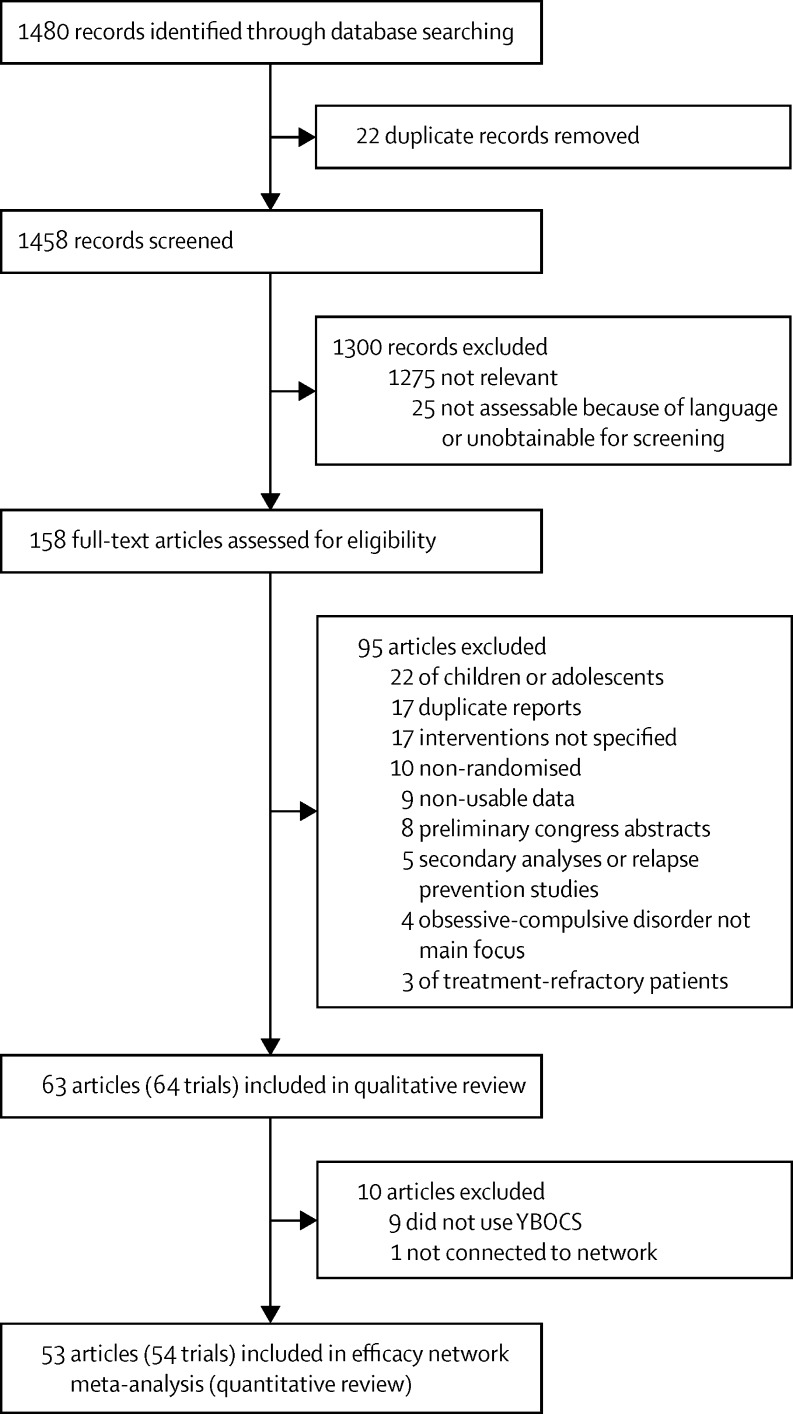
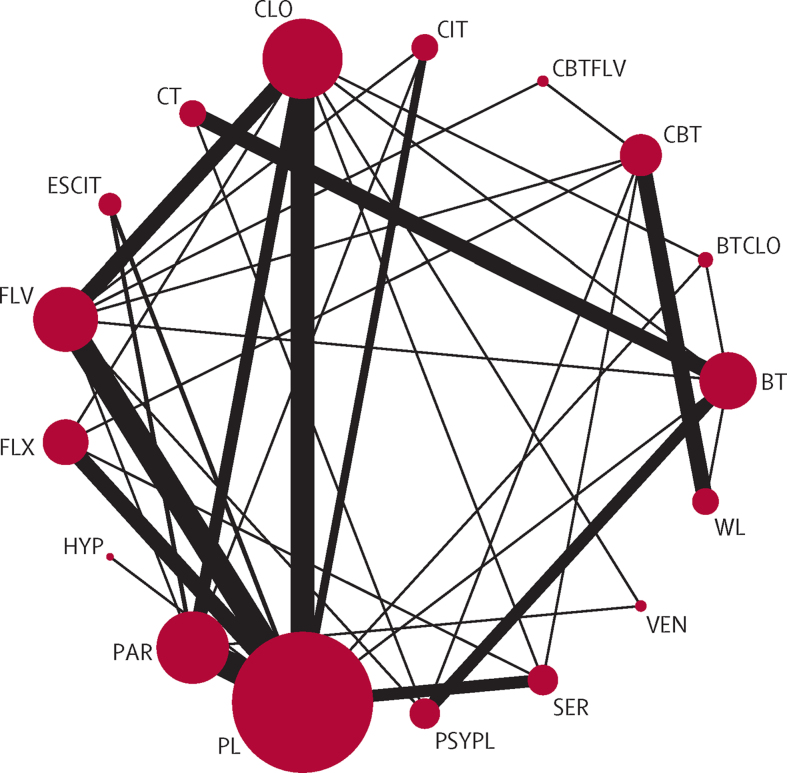
BACKGROUND: Several interventions are available for management of obsessive-compulsive disorder in adults, but few studies have compared their relative efficacy in a single analysis. We aimed to simultaneously compare all available treatments using both direct and indirect data. METHODS: In this systematic review and network meta-analysis, we searched the two controlled trials registers maintained by the Cochrane Collaboration Common Mental Disorders group for trials published up to Feb 16, 2016. We selected randomised controlled trials in which an active psychotherapeutic or pharmacological intervention had been used in adults with obsessive-compulsive disorder. We allowed all comorbidities except for schizophrenia or bipolar disorder. We excluded studies that focused exclusively on treatment-resistant patient populations defined within the same study. We extracted data from published reports. The primary outcome was symptom severity as measured by the Yale-Brown Obsessive Compulsive Scale. We report mean differences with 95% credible intervals compared with placebo. This study is registered with PROSPERO, number CRD42012002441. FINDINGS: We identified 1480 articles in our search and included 53 articles (54 trials; 6652 participants) in the network meta-analysis. Behavioural therapy (mean difference -14·48 [95% credible interval -18·61 to -10·23]; 11 trials and 287 patients), cognitive therapy (-13·36 [-18·40 to -8·21]; six trials and 172 patients), behavioural therapy and clomipramine (-12·97 [-19·18 to -6·74]; one trial and 31 patients), cognitive behavioural therapy and fluvoxamine (-7·50 [-13·89 to -1·17]; one trial and six patients), cognitive behavioural therapy (-5·37 [-9·10 to -1·63]; nine trials and 231 patients), clomipramine (-4·72 [-6·85 to -2·60]; 13 trials and 831 patients), and all SSRIs (class effect -3·49 [95% credible interval -5·12 to -1·81]; 37 trials and 3158 patients) had greater effects than did drug placebo. Clomipramine was not better than were SSRIs (-1·23 [-3·41 to 0·94]). Psychotherapeutic interventions had a greater effect than did medications, but a serious limitation was that most psychotherapeutic trials included patients who were taking stable doses of antidepressants (12 [80%] of the 15 psychotherapy trials explicitly allowed antidepressants). INTERPRETATION: A range of interventions is effective in the management of obsessive-compulsive disorder, but considerable uncertainty and limitations exist regarding their relative efficacy. Taking all the evidence into account, the combination of psychotherapeutic and psychopharmacological interventions is likely to be more effective than are psychotherapeutic interventions alone, at least in severe obsessive-compulsive disorder. FUNDING: National Institute for Health Research.
Overview
The claims and statistics of this paper haven’t been checked yet.
Free: it reads the open-access text and checks the first 5 claims that cite a source we can check. Create a free account to check every claim.
Integrity signals
Registry
Cites
Statistics
Figures
Verification
Claims the paper makes
The claims and statistics of this paper haven’t been checked yet.
Free: it reads the open-access text and checks the first 5 claims that cite a source we can check. Create a free account to check every claim.
Claims other papers make about this one
Each is checked against this paper’s own text: does it say what the citing paper says it does?
The source backs part of the claim, not all of it — or backs it for a different population, condition or comparison.
In the citing paper
“A meta-analysis of headtohead trials directly comparing clomipramine with SSRIs indicated equivalent efficacies [22].”
From Clinical Advances in Treatment Strategies for Obsessive-compulsive Disorder in Adults (2023) · cites this paper as [22]
Experimental — accuracy not yet measuredThe source backs part of the claim, not all of it — or backs it for a different population, condition or comparison.
In the citing paper
“Cognitive-behavioral therapy (CBT) with exposure and response prevention (ERP) as well as pharmacotherapy (i.e., selective serotonin reuptake inhibitors) are evidence-based treatments for OCD [19].”
From Metacognitive Training for Obsessive-Compulsive Disorder: A study protocol for a randomized controlled trial (2020) · cites this paper as [19]
Experimental — accuracy not yet measuredThe cited source says what the claim attributes to it.
In the citing paper
“Despite the limitation that most psychotherapeutic trials included patients were prescribed stable doses of SSRIs [22], meta-analyses of RCTs have consistently demonstrated that CBT/ERP therapy significantly improves OCD symptoms [43,44].”
From Clinical Advances in Treatment Strategies for Obsessive-compulsive Disorder in Adults (2023) · cites this paper as [22]
The cited source says what the claim attributes to it.
In the citing paper
“As there are no noticeable differences in the efficacy between specific SSRIs [22], the adverse effects of SSRIs could be one of the main considerations in the choice of a specific SSRI.”
From Clinical Advances in Treatment Strategies for Obsessive-compulsive Disorder in Adults (2023) · cites this paper as [22]
The check wasn’t confident either way, so it gives no verdict — never disputed.
In the citing paper
“Neurobiological models implicate dysfunction within fronto-striatal systems involved in cognitive control [47].”
From Neural correlates of response inhibition following cognitive behavioral therapy in obsessive–compulsive disorder: a randomized controlled EEG study (2026) · cites this paper as [47]
Experimental — accuracy not yet measured
2 more claims about this paper
Create a free account to see every claim other papers make about this one.
Self-check
Percentages, sums and reported differences re-computed from the paper’s own numbers.
The self-check needs the paper’s full text.
Citations
Cites
Cochrane Handbook for Systematic Reviews of Interventions: Cochrane Book Series
(2008) · doi:10.1002/9780470712184 · Cited by 25,048 · cited 3×
“14 We included studies with a high risk of bias in the main analysis but did sensitivity analyses to examine the eff ect of excluding them.”
InfluentialThe Yale-Brown Obsessive Compulsive Scale: I. Development, Use, and Reliability
Goodman, W. K. (1989) · Archives of General Psychiatry · doi:10.1001/archpsyc.1989.01810110048007 · Cited by 7,712 · cited 3×
“13 Our preferred measure was mean change from baseline score.”
InfluentialThe Yale-Brown Obsessive-Compulsive Scale: Measures of internal consistency
Kim, S. W., Dysken, M. W., Pheley, A. M., & Hoover, K. M. (1994) · Psychiatry Research · doi:10.1016/0165-1781(94)90039-6 · Cited by 2,359
Obsessional-compulsive problems: A cognitive-behavioural analysis
Salkovskis, P. M. (1985) · Behaviour Research and Therapy · doi:10.1016/0005-7967(85)90105-6 · Cited by 1,842
Self-citationSimultaneous comparison of multiple treatments: Combining direct and indirect evidence.
Caldwell, D. M., Ades, A. E., & Higgins, J. P. T. (2005) · BMJ · doi:10.1136/bmj.331.7521.897 · Cited by 1,600
Self-citationDias, S., Sutton, A. J., Ades, A. E., & Welton, N. J. (2013) · Medical Decision Making · doi:10.1177/0272989x12458724 · Cited by 1,207
Self-citationFoa, E. B., Liebowitz, M. R., Kozak, M. J., Davies, S., Campeas, R., Franklin, M. E., Huppert, J. D., Kjernisted, K., Rowan, V., Schmidt, A. B., et al. (2005) · American Journal of Psychiatry · doi:10.1176/appi.ajp.162.1.151 · Cited by 1,048
Dias, S., Welton, N. J., Sutton, A. J., Caldwell, D. M., Lu, G., & Ades, A. E. (2013) · Medical Decision Making · doi:10.1177/0272989x12455847 · Cited by 728
Self-citationCuijpers, P., Sijbrandij, M., Koole, S. L., Andersson, G., Beekman, A. T., & Reynolds, C. F. (2013) · World Psychiatry · doi:10.1002/wps.20038 · Cited by 540
Cuijpers, P., van Straten, A., Bohlmeijer, E., Hollon, S. D., & Andersson, G. (2010) · Psychological Medicine · doi:10.1017/s0033291709006114 · Cited by 533
Research works printed but not linked: 1
- Nakajima T Kudo Y Yamashita I Clinical usefulness of fluvoxamine maleate (SME3110), a selective serotonin reuptake inhibitor, in the treatment of obsessive compulsive disorder: a double blind, placebo controlled study J Clin Therapeut Med 12 1996 409 437
Cited by
Stein, D. J., Costa, D. L. C., Lochner, C., Miguel, E. C., Reddy, Y. C. J., Shavitt, R. G., van den Heuvel, O. A., & Simpson, H. B. (2019) · Nature Reviews Disease Primers · doi:10.1038/s41572-019-0102-3 · Cited by 895
The Role of Common Factors in Psychotherapy Outcomes
Cuijpers, P., Reijnders, M., & Huibers, M. J. H. (2019) · Annual Review of Clinical Psychology · doi:10.1146/annurev-clinpsy-050718-095424 · Cited by 748
Obsessive-compulsive disorder: Puzzles and prospects
Robbins, T. W., Vaghi, M. M., & Banca, P. (2019) · Neuron · doi:10.1016/j.neuron.2019.01.046 · Cited by 510
Obsessive-Compulsive Disorder: Advances in Diagnosis and Treatment
Hirschtritt, M. E., Bloch, M. H., & Mathews, C. A. (2017) · JAMA · doi:10.1001/jama.2017.2200 · Cited by 493
Leichsenring, F., Steinert, C., Rabung, S., & Ioannidis, J. P. A. (2022) · World Psychiatry · doi:10.1002/wps.20941 · Cited by 485
Reid, J. E., Laws, K. R., Drummond, L., Vismara, M., Grancini, B., Mpavaenda, D., & Fineberg, N. A. (2021) · Comprehensive Psychiatry · doi:10.1016/j.comppsych.2021.152223 · Cited by 266
“[16,17] was unable to find a clear advantage of one formof treatment over the other.”
BackgroundSelf-citationPsychopharmacological Treatment of Obsessive-Compulsive Disorder (OCD)
Del Casale, A., Sorice, S., Padovano, A., Simmaco, M., Ferracuti, S., Lamis, D. A., Rapinesi, C., Sani, G., Girardi, P., Kotzalidis, G. D., et al. (2019) · Current Neuropharmacology · doi:10.2174/1570159x16666180813155017 · Cited by 223
Zeng, C., Wei, J., Persson, M. S. M., Sarmanova, A., Doherty, M., Xie, D., Wang, Y., Li, X., Li, J., Long, H., et al. (2018) · British Journal of Sports Medicine · doi:10.1136/bjsports-2017-098043 · Cited by 223
Tyagi, H., Apergis-Schoute, A. M., Akram, H., Foltynie, T., Limousin, P., Drummond, L. M., Fineberg, N. A., Matthews, K., Jahanshahi, M., Robbins, T. W., et al. (2019) · Biological Psychiatry · doi:10.1016/j.biopsych.2019.01.017 · Cited by 227
“Effective treatments include cognitive behavioral therapy (CBT) and serotonin reuptake inhibitor medication (1), but there remains a severely impaired, treatment-refractory subgroup (2) for whom anterior cingulotomy or capsulotomy is an option (3).”
Self-citationAssociation of Antidepressant Use With Adverse Health Outcomes: A Systematic Umbrella Review
Dragioti, E., Solmi, M., Favaro, A., Fusar-Poli, P., Dazzan, P., Thompson, T., Stubbs, B., Firth, J., Fornaro, M., Tsartsalis, D., et al. (2019) · JAMA Psychiatry · doi:10.1001/jamapsychiatry.2019.2859 · Cited by 215
Castillo-Zacarías, C., Barocio, M. E., Hidalgo-Vázquez, E., Sosa-Hernández, J. E., Parra-Arroyo, L., López-Pacheco, I. Y., Barceló, D., Iqbal, H. N. M., & Parra-Saldívar, R. (2021) · Science of The Total Environment · doi:10.1016/j.scitotenv.2020.143722 · Cited by 184
Fineberg, N. A., Apergis-Schoute, A. M., Vaghi, M. M., Banca, P., Gillan, C. M., Voon, V., Chamberlain, S. R., Cinosi, E., Reid, J., Shahper, S., et al. (2018) · International Journal of Neuropsychopharmacology · doi:10.1093/ijnp/pyx088 · Cited by 183
“Moreover, SSRIs are at their most efficacious in OCD at dosages higher than is typically recommended for anxiety disorders (Fineberg et al., 2013c; Skapinakis et al., 2016).”
Self-citationFineberg, N. A., Van Ameringen, M., Drummond, L., Hollander, E., Stein, D. J., Geller, D., Walitza, S., Pallanti, S., Pellegrini, L., Zohar, J., et al. (2020) · Comprehensive Psychiatry · doi:10.1016/j.comppsych.2020.152174 · Cited by 176
“Review medication status as a priority: Based on the risks associated with exposure and response prevention (ERP) in the pandemic (see below), and uncertainty as to which of the two evidence-based treatments, pharmacotherapy or cognitive behaviour therapy (CBT), represents the most efficacious first line treatment mod…”
Self-citationFineberg, N. A., Hollander, E., Pallanti, S., Walitza, S., Grünblatt, E., Dell’Osso, B. M., Albert, U., Geller, D. A., Brakoulias, V., Janardhan Reddy, Y. C., et al. (2020) · International Clinical Psychopharmacology · doi:10.1097/yic.0000000000000314 · Cited by 161
Self-citationEarly intervention for obsessive compulsive disorder: An expert consensus statement
Fineberg, N. A., Dell'Osso, B., Albert, U., Maina, G., Geller, D., Carmi, L., Sireau, N., Walitza, S., Grassi, G., Pallanti, S., et al. (2019) · European Neuropsychopharmacology · doi:10.1016/j.euroneuro.2019.02.002 · Cited by 158
Self-citationClinical practice guidelines for Obsessive-Compulsive Disorder
Janardhan Reddy, Y., Sundar, A., Narayanaswamy, J., & Math, S. (2017) · Indian Journal of Psychiatry · doi:10.4103/0019-5545.196976 · Cited by 156
Skapinakis, P., Caldwell, D., Hollingworth, W., Bryden, P., Fineberg, N., Salkovskis, P., Welton, N., Baxter, H., Kessler, D., Churchill, R., et al. (2016) · Health Technology Assessment · doi:10.3310/hta20430 · Cited by 134
Self-citationGenetics of obsessive-compulsive disorder
Mahjani, B., Bey, K., Boberg, J., & Burton, C. L. (2021) · Psychological Medicine · doi:10.1017/s0033291721001744 · Cited by 185
“There is robust evidence that treatment with selective serotonin reuptake inhibitors and cognitive behavioral therapy, including exposure and response prevention therapy, provide relief from OCD symptoms (Skapinakis et al., 2016).”
Endres, D., Pollak, T. A., Bechter, K., Denzel, D., Pitsch, K., Nickel, K., Runge, K., Pankratz, B., Klatzmann, D., Tamouza, R., et al. (2022) · Translational Psychiatry · doi:10.1038/s41398-021-01700-4 · Cited by 155
Evolution of gamma knife capsulotomy for intractable obsessive-compulsive disorder
Miguel, E. C., Lopes, A. C., McLaughlin, N. C. R., Norén, G., Gentil, A. F., Hamani, C., Shavitt, R. G., Batistuzzo, M. C., Vattimo, E. F. Q., Canteras, M., et al. (2019) · Molecular Psychiatry · doi:10.1038/s41380-018-0054-0 · Cited by 131
“ERP and SRIs have been shown to be effective [11, 12], particularly in combination [13].”
Duration of untreated illness and response to SRI treatment in Obsessive-Compulsive Disorder
Albert, U., Barbaro, F., Bramante, S., Rosso, G., De Ronchi, D., & Maina, G. (2019) · European Psychiatry · doi:10.1016/j.eurpsy.2019.01.017 · Cited by 88
“Moderate-to-high doses for at least 12 weeks are required in order to elicit a response, with maintenance treatment indicated for at least 1 year after response [1,2].”
The optimal target for acute glycemic control in critically ill patients: A network meta-analysis.
Yatabe, T., Inoue, S., Sakaguchi, M., & Egi, M. (2017) · Intensive Care Medicine · doi:10.1007/s00134-016-4558-2 · Cited by 95
Ferrando, C., & Selai, C. (2021) · Journal of Obsessive-Compulsive and Related Disorders · doi:10.1016/j.jocrd.2021.100684 · Cited by 72
Bandelow, B., Allgulander, C., Baldwin, D. S., Costa, D. L. D. C., Denys, D., Dilbaz, N., Domschke, K., Hollander, E., Kasper, S., Möller, H.-J., et al. (2023) · The World Journal of Biological Psychiatry · doi:10.1080/15622975.2022.2086296 · Cited by 84
“A meta-analysis does not confirm this hypothesis (Skapinakis et al. 2016).”
BackgroundInfluentialSelf-citationBschor, T., Nagel, L., Unger, J., Schwarzer, G., & Baethge, C. (2024) · JAMA Psychiatry · doi:10.1001/jamapsychiatry.2024.0994 · Cited by 84
Prevalence and gender distribution of trichotillomania: A systematic review and meta-analysis
Thomson, H. A., Farhat, L. C., Olfson, E., Levine, J. L. S., & Bloch, M. H. (2022) · Journal of Psychiatric Research · doi:10.1016/j.jpsychires.2022.06.058 · Cited by 83
da Silva, R. D. M. F., Brunoni, A. R., Goerigk, S. A., Batistuzzo, M. C., Costa, D. L. D. C., Diniz, J. B., Padberg, F., D’Urso, G., Miguel, E. C., & Shavitt, R. G. (2021) · Neuropsychopharmacology · doi:10.1038/s41386-020-00928-w · Cited by 82
“First-line treatments include selective serotonin reuptake inhibitors (SSRIs) and cognitive behavioral therapy (CBT) [2].”
BackgroundInfluentialSwierkosz-Lenart, K., Santos, J. F. A. D., Elowe, J., Clair, A.-H., Bally, J. F., Riquier, F., Bloch, J., Draganski, B., Clerc, M.-T., Moyano, B. P., et al. (2023) · Frontiers in Psychiatry · doi:10.3389/fpsyt.2023.1065812 · Cited by 81
Patel, S. R., Wheaton, M. G., Andersson, E., Rück, C., Schmidt, A. B., La Lima, C. N., Galfavy, H., Pascucci, O., Myers, R. W., Dixon, L. B., et al. (2018) · Behavior Therapy · doi:10.1016/j.beth.2017.09.003 · Cited by 67
“Moreover, the effect size for reducingOCD symptomswas within the range reported in trials of face-to-face CBT for OCD (Skapinakis et al., 2016) and larger thanmost trialswith computer-based treatments that did not provide therapist support (Bachofen et al.”
Feliu‐Soler, A., Cebolla, A., McCracken, L. M., D’Amico, F., Knapp, M. R. J., López-Montoyo, A., García‐Campayo, J., Soler, J., Baños, R., Pérez‐Aranda, A., et al. (2017) · Behavior Therapy · doi:10.1016/j.beth.2017.07.001 · Cited by 77
Lee, D. J., Dallapiazza, R. F., De Vloo, P., Elias, G. J. B., Fomenko, A., Boutet, A., Giacobbe, P., & Lozano, A. M. (2019) · Brain Stimulation · doi:10.1016/j.brs.2018.11.012 · Cited by 64
Moritz, S., Külz, A., Voderholzer, U., Hillebrand, T., McKay, D., & Jelinek, L. (2019) · Cognitive Behaviour Therapy · doi:10.1080/16506073.2018.1494750 · Cited by 65
“…effect sizes for OCD in comparison to control conditions in adults (Abramowitz, Franklin, & Foa, 2002) and children (Öst, Riise, Wergeland, Hansen, & Kvale, 2016), and a recent meta-analysis demonstrates that BT showed the largest effects of all treatments investigated (Skapinakis et al., 2016).”
Self‐compassion and emotion regulation difficulties in obsessive–compulsive disorder
Eichholz, A., Schwartz, C., Meule, A., Heese, J., Neumüller, J., & Voderholzer, U. (2020) · Clinical Psychology & Psychotherapy · doi:10.1002/cpp.2451 · Cited by 65
“…linked to this concept, and many studies (e.g., McKay et al., 2015; Olatunji, Davis, Powers, & Smits, 2013; Öst, Havnen, Hansen, & Kvale, 2015; Skapinakis et al., 2016) have shown it to be Present address: Angelika Eichholz, Interdisciplinary Pain Center, University Hospital Erlangen,…”
Chen, T.-R., Huang, H.-C., Hsu, J.-H., Ouyang, W.-C., & Lin, K.-C. (2019) · Journal of Psychiatric Research · doi:10.1016/j.jpsychires.2019.08.014 · Cited by 54
Fordham, B., Sugavanam, T., Edwards, K., Hemming, K., Howick, J., Copsey, B. J., Lee, H., Kaidesoja, M., Kirtley, S., Hopewell, S., et al. (2021) · Health Technology Assessment · doi:10.3310/hta25090 · Cited by 69
Senova, S., Clair, A.-H., Palfi, S., Yelnik, J., Domenech, P., & Mallet, L. (2019) · Frontiers in Psychiatry · doi:10.3389/fpsyt.2019.00905 · Cited by 62
Storch, E. A., Sheu, J. C., Guzick, A. G., Schneider, S. C., Cepeda, S. L., Rombado, B. R., Gupta, R., Hoch, C. T., & Goodman, W. K. (2021) · Psychiatry Research · doi:10.1016/j.psychres.2020.113597 · Cited by 56
Pharmacotherapeutic Strategies and New Targets in OCD
Pittenger, C. (2021) · Current topics in behavioral neurosciences · doi:10.1007/7854_2020_204 · Cited by 59
Berden, F. A. C., Aaldering, B. R. R. Z., Groenewoud, H., IntHout, J., Kievit, W., & Drenth, J. P. H. (2016) · Clinical Gastroenterology and Hepatology · doi:10.1016/j.cgh.2016.10.034 · Cited by 54
Clear cell meningioma variant and clinical aggressiveness.
Pimentel, J., Fernandes, A., Pinto, A. E., Fonseca, I., Nunes, J. F. M., & Antunes, J. L. F. (1998) · PubMed · Cited by 55
Reddy, Y. C., Sudhir, P., Manjula, M., Arumugham, S., & Narayanaswamy, J. (2020) · Indian Journal of Psychiatry · doi:10.4103/psychiatry.indianjpsychiatry_773_19 · Cited by 48
COVID-19 and OCD: Potential impact of exposure and response prevention therapy
Sheu, J. C., McKay, D., & Storch, E. A. (2020) · Journal of Anxiety Disorders · doi:10.1016/j.janxdis.2020.102314 · Cited by 48
Thorsen, A. L., Kvale, G., Hansen, B. K. A., & van den Heuvel, O. A. (2018) · Current Treatment Options in Psychiatry · doi:10.1007/s40501-018-0142-4 · Cited by 57
Schneider, S. C., Knott, L., Cepeda, S. L., Hana, L. M., McIngvale, E., Goodman, W. K., & Storch, E. A. (2020) · Depression and Anxiety · doi:10.1002/da.23000 · Cited by 48
Wheaton, M. G., & Chen, S. R. (2021) · Cognitive Therapy and Research · doi:10.1007/s10608-020-10125-0 · Cited by 47
“We also reviewed the references from recent reviews of the OCD treatment literature (Öst et al. 2015; Leeuwerik et al. 2019; Skapinakis et al. 2016).”
Fineberg, N. A., Baldwin, D. S., Drummond, L. M., Wyatt, S., Hanson, J., Gopi, S., Kaur, S., Reid, J., Marwah, V., Sachdev, R. A., et al. (2018) · International Clinical Psychopharmacology · doi:10.1097/yic.0000000000000237 · Cited by 47
“There is additional uncertainty relating to the quality of life (QOL) gain and cost-effectiveness associated with the different treatment options (National Institute for Health and Care Excellence, 2006; Skapinakis et al., 2016b).”
Self-citationFarhat, L. C., Reid, M., Bloch, M. H., & Olfson, E. (2023) · Journal of Psychiatric Research · doi:10.1016/j.jpsychires.2023.03.034 · Cited by 53
van der Vlis, T. A. M. B., Ackermans, L., Mulders, A. E. P., Vrij, C. A., Schruers, K., Temel, Y., Duits, A., & Leentjens, A. F. G. (2021) · Neuromodulation: Technology at the Neural Interface · doi:10.1111/ner.13339 · Cited by 47
Treatments used for obsessive–compulsive disorder—An international perspective
Brakoulias, V., Starčević, V., Albert, U., Arumugham, S. S., Bailey, B. E., Belloch, A., Borda, T., Dell’Osso, L., Elias, J. A., Falkenstein, M. J., et al. (2019) · Human Psychopharmacology Clinical and Experimental · doi:10.1002/hup.2686 · Cited by 47
Self-citationNorman, L. J., Mannella, K. A., Yang, H., Angstadt, M., Abelson, J. L., Himle, J. A., Fitzgerald, K. D., & Taylor, S. F. (2021) · American Journal of Psychiatry · doi:10.1176/appi.ajp.2020.19080886 · Cited by 44
Optimizing first line treatments for adults with OCD
Nezgovorova, V., Reid, J. E., Fineberg, N. A., & Hollander, E. (2022) · Comprehensive Psychiatry · doi:10.1016/j.comppsych.2022.152305 · Cited by 52
Self-citationImmunomodulatory Role of CB2 Receptors in Emotional and Cognitive Disorders
Morcuende, Á., García‐Gutiérrez, M. S., Tambaro, S., Nieto, E. O., Manzanares, J., & Femenía, T. (2022) · Frontiers in Psychiatry · doi:10.3389/fpsyt.2022.866052 · Cited by 51
Investigational and Experimental Drugs to Treat Obsessive-Compulsive Disorder
Grassi, G., Cecchelli, C., Vignozzi, L., & Pacini, S. (2021) · Journal of Experimental Pharmacology · doi:10.2147/jep.s255375 · Cited by 44
Zhou, D., Zhou, X., Li, Y., Zhang, K.-F., Lv, Z., Chen, X., Wan, L.-Y., Wang, W., Wang, G.-M., Li, D., et al. (2018) · Progress in Neuro-Psychopharmacology and Biological Psychiatry · doi:10.1016/j.pnpbp.2018.12.009 · Cited by 48
Mallet, L., du Montcel, S. T., Clair, A.-H., Arbus, C., Bardinet, É., Baup, N., Chabardès, S., Chéreau, I., Czernecki, V., Fontaine, D., et al. (2019) · Brain stimulation · doi:10.1016/j.brs.2019.04.004 · Cited by 49
Bedford, S. A., Hunsche, M. C., & Kerns, C. M. (2020) · Current Psychiatry Reports · doi:10.1007/s11920-020-01176-x · Cited by 45
A simple mechanistic terminology of psychoactive drugs: a proposal
Seifert, R., & Schirmer, B. (2020) · Naunyn-Schmiedeberg s Archives of Pharmacology · doi:10.1007/s00210-020-01918-x · Cited by 44
“For example, antidepressants are often used for obsessive-compulsive disorder, anxiety disorder, and post-traumatic stress disorder (Skapinakis et al. 2016; Locher et al. 2017; Vries et al. 2018; Amerio et al. 2019; Slee et al. 2019; Stone 2019).”
The Psychopharmacology of Obsessive-Compulsive Disorder: A Preclinical Roadmap
Szechtman, H., Harvey, B. H., Woody, E. Z., & Hoffman, K. L. (2019) · Pharmacological Reviews · doi:10.1124/pr.119.017772 · Cited by 41
Moderators in psychotherapy meta-analysis
Spielmans, G. I., & Flückiger, C. (2018) · Psychotherapy Research · doi:10.1080/10503307.2017.1422214 · Cited by 40
Feusner, J. D., Farrell, N. R., Kreyling, J., McGrath, P. B., Rhode, A., Faneuff, T., Lonsway, S., Mohideen, R., Jurich, J. E., Trusky, L., et al. (2022) · Journal of Medical Internet Research · doi:10.2196/36431 · Cited by 40
Therapie der Zwangsstörungen: Empfehlungen der revidierten S3-Leitlinie Zwangsstörungen
Voderholzer, U., Favreau, M., Rubart, A., Staniloiu, A., Kordon, A., Zurowski, B., & Kathmann, N. (2022) · Der Nervenarzt · doi:10.1007/s00115-022-01336-9 · Cited by 44
Ketamine in the Treatment of Obsessive-Compulsive Disorder: A Systematic Review
Bandeira, I. D., Lins-Silva, D. H., Cavenaghi, V. B., Dorea-Bandeira, I., Faria-Guimarães, D., Barouh, J. L., Jesus-Nunes, A. P., Beanes, G., Souza, L. S., Leal, G. C., et al. (2022) · Harvard Review of Psychiatry · doi:10.1097/hrp.0000000000000330 · Cited by 39
Kvale, G., Hansen, B., Hagen, K., Abramowitz, J. S., Børtveit, T., Craske, M. G., Franklin, M. E., Haseth, S., Himle, J. A., Hystad, S., et al. (2020) · JAMA Network Open · doi:10.1001/jamanetworkopen.2020.13249 · Cited by 37
Javaherirenani, R., Mortazavi, S. S., Shalbafan, M., Ashouri, A., & Farani, A. R. (2022) · BMC Psychiatry · doi:10.1186/s12888-022-04402-3 · Cited by 44
Montero-Marin, J., Garcia-Campayo, J., López-Montoyo, A., Zabaleta-del-Olmo, E., & Cuijpers, P. (2018) · Psychological Medicine · doi:10.1017/s0033291717003099 · Cited by 37
“For instance, it has recently been said that a range of interventions is effective in the management of OCD, but considerable uncertainty exists regarding their relative efficacy (Skapinakis et al. 2016).”
Zhou, D.-D., Zhou, X.-X., Lv, Z., Chen, X.-R., Wang, W., Wang, G.-M., Liu, C., Li, D.-Q., & Kuang, L. (2019) · Journal of Psychiatric Research · doi:10.1016/j.jpsychires.2019.01.014 · Cited by 37
Soondrum, T., Wang, X., Gao, F., Liu, Q., Fan, J., & Zhu, X. (2022) · Brain Sciences · doi:10.3390/brainsci12050656 · Cited by 36
Solmi, M., Miola, A., Capone, F., Pallottino, S., Højlund, M., Firth, J., Siskind, D. J., Holt, R. I. G., Corbeil, O., Cortese, S., et al. (2024) · Expert Opinion on Drug Safety · doi:10.1080/14740338.2024.2396396 · Cited by 40
Antipsychotic augmentation in the treatment of obsessive-compulsive disorder
Jaisoorya, T. S., & Thamby, A. (2019) · Indian Journal of Psychiatry · doi:10.4103/psychiatry.indianjpsychiatry_519_18 · Cited by 39
Management and treatment of obsessive–compulsive disorder
Fineberg, N. A., Drummond, L. M., Reid, J. E., Cinosi, E., Carmi, L., & Mpavaenda, D. (2020) · doi:10.1093/med/9780198713005.003.0098 · Cited by 33
Self-citationBrakoulias, V., & Stockings, E. (2018) · Expert Opinion on Pharmacotherapy · doi:10.1080/14656566.2018.1540590 · Cited by 38
Ballı, T., Metin, B., Tülay, E. E., Tan, O., Sayar, G. H., Taş, C., Arıkan, M. K., & Tarhan, N. (2020) · Clinical Neurophysiology · doi:10.1016/j.clinph.2019.11.063 · Cited by 32
Pratt, M., Wieland, L. S., Ahmadzai, N., Butler, C., Wolfe, D. M., Pussagoda, K., Skidmore, B., Veroniki, A. A., Rios, P. D. L., Tricco, A. C., et al. (2020) · Systematic Reviews · doi:10.1186/s13643-020-01328-3 · Cited by 34
Skapinakis, P., Politis, S., Karampas, A., Petrikis, P., & Mavreas, V. G. (2019) · International Journal of Psychiatry in Clinical Practice · doi:10.1080/13651501.2019.1588327 · Cited by 32
“Interventions for the management of OCD have been recently reviewed and there is evidence of efficacy and cost-effectiveness for several pharmacological and psychotherapeutic treatments (Skapinakis et al., 2016a, 2016b).”
InfluentialSelf-citationObsessive–Compulsive Disorder in Autism Spectrum Disorder Across the Lifespan
Pazuniak, M., & Pekrul, S. R. (2020) · Child and Adolescent Psychiatric Clinics of North America · doi:10.1016/j.chc.2019.12.003 · Cited by 63
Deep brain stimulation for obsessive-compulsive disorder
Arya, S., Filkowski, M. M., Nanda, P., & Sheth, S. A. (2019) · Bulletin of the Menninger Clinic · doi:10.1521/bumc.2019.83.1.84 · Cited by 32
Fisher, P., Cherry, M. G., Stuart, T., Rigby, J., & Temple, J. (2020) · Journal of Affective Disorders · doi:10.1016/j.jad.2020.06.019 · Cited by 33
Mao, L., Hu, M., Luo, L., Wu, Y., Lu, Z., & Zou, J. (2022) · Frontiers in Psychiatry · doi:10.3389/fpsyt.2022.973838 · Cited by 29
“Exposure and response prevention (ERP) is the first-line psychotherapy for OCD, and research indicates ERP-based therapy has comparable efficacy to SSRIs (4).”
InfluentialCao, R., Yang, X., Luo, J., Wang, P., Meng, F., Xia, M., He, Y., Zhao, T., & Li, Z. (2021) · Progress in Neuro-Psychopharmacology and Biological Psychiatry · doi:10.1016/j.pnpbp.2020.110037 · Cited by 27
A narrative review of exercise and obsessive-compulsive disorder
Freedman, D., & Richter, M. A. (2021) · General Hospital Psychiatry · doi:10.1016/j.genhosppsych.2021.03.014 · Cited by 31
Suhas, S., Malo, P. K., Kumar, V., Issac, T. G., Chithra, N. K., Bhaskarapillai, B., Reddy, Y. C. J., & Rao, N. P. (2022) · The World Journal of Biological Psychiatry · doi:10.1080/15622975.2022.2082525 · Cited by 34
Zhang, C. C., Gong, H., Zhang, Y., Jin, H., Yong, Y., Li, B., Li, Y., Luo, X., Liu, W., Fang, F., et al. (2019) · Brazilian Journal of Psychiatry · doi:10.1590/1516-4446-2018-0126 · Cited by 34
Treatment of obsessive-compulsive disorders (OCD) and obsessive-compulsive-related disorders (OCRD)
Krzyszkowiak, W., Kuleta-Krzyszkowiak, M., & Krzanowska, E. (2019) · Psychiatria Polska · doi:10.12740/pp/105130 · Cited by 22
Meta-Review: Network Meta-Analyses in Child and Adolescent Psychiatry
Cortese, S., Tomlinson, A., & Cipriani, A. (2018) · Journal of the American Academy of Child & Adolescent Psychiatry · doi:10.1016/j.jaac.2018.07.891 · Cited by 28
Guzick, A. G., Hunt, P. J., Bijanki, K. R., Schneider, S. C., Sheth, S. A., Goodman, W. K., & Storch, E. A. (2019) · Expert Review of Neurotherapeutics · doi:10.1080/14737175.2020.1694409 · Cited by 31
“Cognitive-behavioral therapy with exposure and response prevention (CBT-ERP) has the strongest evidence-base in the psychosocial treatment of people with OCD [15], while the serotonin reuptake inhibitor (SRI) clomipramine as well as several selective SRIs have demonstrated efficacy in the treatment of OCD [16].”
Matsumoto, K., Hamatani, S., Makino, T., Takahashi, J., Suzuki, F., Ida, T., Hamamura, S., Takiguchi, S., Tomoda, A., Omori, I. M., et al. (2022) · Internet Interventions · doi:10.1016/j.invent.2022.100515 · Cited by 30
Wootton, B. M., Karin, E., Dear, B. F., Staples, L., Nielssen, O. B., Kayrouz, R., & Titov, N. (2021) · Journal of Anxiety Disorders · doi:10.1016/j.janxdis.2021.102444 · Cited by 28
Yan, S., Liu, H., Yu, Y., Han, N., & Du, W. (2022) · Frontiers in Psychiatry · doi:10.3389/fpsyt.2022.754165 · Cited by 29
Farnia, V., Gharehbaghi, H., Alikhani, M., Almasi, A., Golshani, S., Tatari, F., Davarinejad, O., Salemi, S., Bahmani, D. S., Holsboer‐Trachsler, E., et al. (2018) · Journal of Psychiatric Research · doi:10.1016/j.jpsychires.2018.07.008 · Cited by 28
Miegel, F. S., Jelinek, L., & Moritz, S. (2018) · Psychiatry Research · doi:10.1016/j.psychres.2018.12.070 · Cited by 28
Jelinek, L., Zielke, L., Hottenrott, B., Miegel, F., Cludius, B., Sure, A., & Demiralay, C. (2018) · Zeitschrift für Neuropsychologie · doi:10.1024/1016-264x/a000211 · Cited by 26
The Neuronal Glutamate Transporter EAAT3 in Obsessive-Compulsive Disorder
Escobar, A. P., Wendland, J. R., Chávez, A. E., & Moya, P. R. (2019) · Frontiers in Pharmacology · doi:10.3389/fphar.2019.01362 · Cited by 30
Zhang, W., Yang, W., Ruan, H., Gao, J. P., & Wang, Z. (2023) · Journal of Psychiatric Research · doi:10.1016/j.jpsychires.2023.10.025 · Cited by 27
Chang, K. W., Jung, H. H., & Chang, J. W. (2021) · Frontiers in Psychiatry · doi:10.3389/fpsyt.2021.640832 · Cited by 27
The Pharmacological Treatment of Obsessive-Compulsive Disorder
Pittenger, C. (2023) · Psychiatric Clinics of North America · doi:10.1016/j.psc.2022.11.005 · Cited by 28
Motivala, S. J., Arellano, M., Greco, R. L., Aitken, D., Hutcheson, N., Tadayonnejad, R., O’Neill, J., & Feusner, J. D. (2018) · International Journal of Psychiatry in Clinical Practice · doi:10.1080/13651501.2017.1351991 · Cited by 25
Higgins, G. A., Brown, M., John, J. S., MacMillan, C., Silenieks, L. B., & Thevarkunnel, S. (2020) · Neuropharmacology · doi:10.1016/j.neuropharm.2020.108064 · Cited by 25
Tao, Y., Li, H., Li, L., Zhang, H., Xu, H., Zhang, H., Zou, S., Deng, F., Huang, L., Wang, Y., et al. (2021) · Journal of Psychiatric Research · doi:10.1016/j.jpsychires.2022.01.057 · Cited by 27
Does cognitive-behavioral therapy affect goal-directed planning in obsessive-compulsive disorder?
Wheaton, M. G., Gillan, C. M., & Simpson, H. B. (2018) · Psychiatry Research · doi:10.1016/j.psychres.2018.12.079 · Cited by 27
Jalal, B., Chamberlain, S. R., Robbins, T. W., & Sahakian, B. J. (2022) · CNS Spectrums · doi:10.1017/s1092852920001947 · Cited by 24
“Although some clinics provide combined pharmacological (SSRI or clomipramine) and psychological treatment (CBT), there is no clear evidence to conclude that combined treatment is superior to either drugs or CBT alone.(67,68) However, SSRI monotherapy has been reported to be more cost-effective than either CBT alone or…”
Metadata
- Authors
- Skapinakis, P., Caldwell, D. M., Hollingworth, W., Bryden, P., Fineberg, N. A., Salkovskis, P., Welton, N. J., Baxter, H., Kessler, D., Churchill, R., & Lewis, G.
- Affiliations
- University of Ioannina (GR)
- University of Bristol (GB)
- University of Hertfordshire (GB)
- University of Bath (GB)
- University of York (GB)
- University College London (GB)
- Corresponding author
- Skapinakis, Petros
- ORCID
- Venue
- The Lancet Psychiatry
- Publisher
- Elsevier BV
- Published
- 2016-08
- Volume
- 3
- Issue
- 8
- Pages
- 730-739
- ISSN
- 2215-0366 (ISSN-L)
- PMC
- PMC4967667
- OpenAlex
- W2423509797
- Cited by
- 407
- References
- 89
- Citations by year
- 2026: 35 · 2025: 51 · 2024: 46 · 2023: 50 · 2022: 44 · 2021: 45 · 2020: 43 · 2019: 37 · 2018: 29 · 2017: 16 · 2016: 10
- FWCI
- 4.54
- Type
- journal article
- Language
- en
- Open access
- hybrid
- doi.org
- Licence
- cc-by
- www.elsevier.com/tdm/userlicense/1.0/ (tdm)
- www.elsevier.com/legal/tdmrep-license (tdm)
- creativecommons.org/licenses/by/4.0/ (vor)
- Locations
- The Lancet Psychiatry (publishedVersion, cc-by)
- Europe PMC (PubMed Central) (publishedVersion, cc-by)
- PubMed Central (publishedVersion, cc-by)
- PubMed (publishedVersion)
- Explore Bristol Research (publishedVersion, cc-by)
- White Rose Research Online (University of Leeds, The University of Sheffield, University of York) (acceptedVersion)
- University of Hertfordshire Research Archive (University of Hertfordshire) (acceptedVersion)
- University of Hertfordshire Research Archive (University of Hertfordshire) (submittedVersion, cc-by)
- UCL Discovery (University College London) (submittedVersion)
- Bristol Research (University of Bristol) (submittedVersion, cc-by)
- Funders
- Health Technology Assessment Programme (10/104/41)
- Topics
- Social Sciences › Psychology › Clinical Psychology › Obsessive-Compulsive Spectrum Disorders
- Social Sciences › Psychology › Experimental and Cognitive Psychology › Anxiety, Depression, Psychometrics, Treatment, Cognitive Processes
- Social Sciences › Psychology › Clinical Psychology › Psychoanalysis and Psychopathology Research
- Keywords
- obsessive-compulsive disorder, pharmacotherapy, psychotherapy, clomipramine, selective serotonin reuptake inhibitors, fluvoxamine, cognitive behavioral therapy, behavior therapy, cognitive therapy, Yale-Brown Obsessive Compulsive Scale, symptom severity, treatment efficacy comparison, adults, comorbid depression, anxiety comorbidity, comorbid substance use disorders
- MeSH terms
- Adult, Humans, Obsessive-Compulsive Disorder, Psychotherapy, Psychotropic Drugs, Randomized Controlled Trials as Topic, Treatment Outcome
About these checks
Registry, retraction, Cites and statistics results are computed, not judged, with one exception: a printed reference that no index lists is read once by a model before it counts as a citation error. Claims are extracted by a model and kept only when their quote appears verbatim in the text; each cited source is then checked, with a model’s help, for whether it says what the claim relies on. Those verdicts can be wrong — read the claim’s quote and the cited source before relying on one.
Statistics and arithmetic are recomputed, not judged.
Confidence bands are shown only for fields calibrated on our annotated test set. None is calibrated yet, so no band is shown.
What counts as a claim ›How we measure confidence ›How we check this ›
Are you an author, or do you see a problem with this page? Request a review
Data sources
Bibliographic data: Semantic Scholar, OpenAlex, Crossref.
Contains information from the Semantic Scholar Academic Graph Datasets, made available under the ODC Attribution License (ODC-BY 1.0).
Semantic Scholar’s data is described in: Kinney, R., et al. (2023). The Semantic Scholar Open Data Platform. arXiv:2301.10140.
