

Automated psychological therapy using immersive virtual reality for treatment of fear of heights: a single-blind, parallel-group, randomised controlled trial
Open accessThe DOI matches its Crossref record; 19 of the 19 references it cites were found in a registry or an index; 3 of the 15 sources its claims cite were checked for support.
Abstract
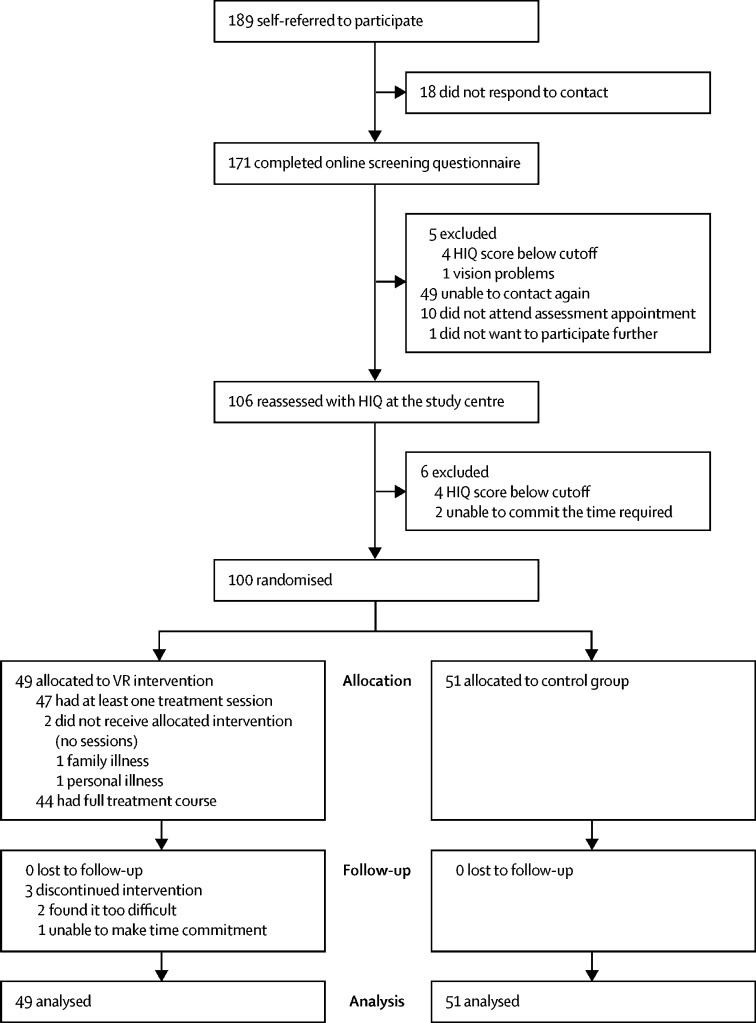
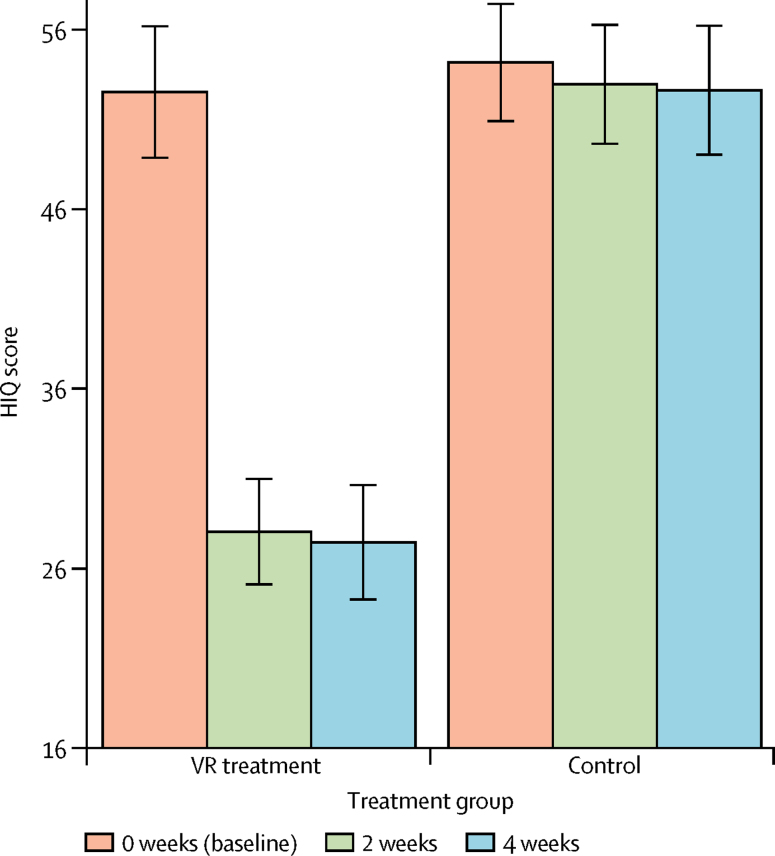
BACKGROUND: Engaging, interactive, and automated virtual reality (VR) treatments might help solve the unmet needs of individuals with mental health disorders. We tested the efficacy of an automated cognitive intervention for fear of heights guided by an avatar virtual coach (animated using motion and voice capture of an actor) in VR and delivered with the latest consumer equipment. METHODS: We did a randomised trial of automated VR versus usual care. We recruited adults aged older than 18 years with a fear of heights by radio advertisements in Oxfordshire, UK. We diagnosed fear of heights if participants scored more than 29 on the Heights Interpretation Questionnaire (HIQ). We randomly allocated participants by computer in a 1:1 ratio to either automated VR delivered in roughly six 30-min sessions administered about two to three times a week over a 2-week period (intervention group) or to usual care (control group). Randomisation was stratified by severity of fear of heights. The research team, who were unaware of the random allocation, administered three fear-of-height assessments, at baseline (0 weeks), at the end of treatment (2 weeks), and at follow-up (4 weeks). The primary outcome measure was HIQ score (range 16-80, with higher scores indicating greater severity). This trial is registered with the ISRCTN registry, number ISRCTN11898283. FINDINGS: Between Nov 25, 2017, and Feb 27, 2018, 100 individuals were enrolled and underwent randomisation, of whom 49 were assigned to the VR treatment group and 51 to the control group. All participants completed the 4-week follow-up. The mean total treatment time in VR was 124·43 min (SD 34·23). Compared with participants in the control group, the VR treatment reduced fear of heights at the end of treatment (mean change score -24·5 [SD 13·1] in the VR group vs -1·2 [7·3] in the control group; adjusted difference -24·0, 95% CI -27·7 to -20·3; Cohen's d=2·0; p<0·0001). The benefit was maintained at follow-up (mean change score -25·1 [SD 13·9] in the VR group vs -1·5 [7·8] in the control group; adjusted difference -24·3, 95% CI -27·9 to -20·6; Cohen's d=2·0; p<0·0001). The number needed to treat to at least halve the fear of heights was 1·3. No adverse events were reported. INTERPRETATION: Psychological therapy delivered automatically by a VR coach can produce large clinical benefits. Evidence-based VR treatments have the potential to greatly increase treatment provision for mental health disorders. FUNDING: Oxford VR, and the National Institute of Health Research Oxford Health Biomedical Research Centre.
Overview
CoChat Summary
## TL;DR
This single-blind, parallel-group randomized controlled trial found that an automated immersive VR intervention for fear of heights produced very large short-term and 4-week benefits versus usual care. The treatment was well tolerated, with no adverse events reported and very high uptake.
## Key findings
- 100 participants were randomized: 49 to VR and 51 to usual care; all participants completed 4-week follow-up.
- At the end of treatment (2 weeks), HIQ change was −24.5 in the VR group vs −1.2 in controls, with an adjusted between-group difference of −24.0 (95% CI −27.7 to −20.3; Cohen’s d=2.0; p<0.0001).
- At follow-up (4 weeks), HIQ change was −25.1 in the VR group vs −1.5 in controls, with an adjusted difference of −24.3 (95% CI −27.9 to −20.6; d=2.0; p<0.0001).
- 34/49 (69%) in the VR group fell below the trial’s HIQ entry criterion by follow-up, versus 0/51 controls; NNT 1.6. No adverse events were reported.
## Methods
- Single-blind, parallel-group, randomized, superiority trial comparing automated VR with usual care in adults older than 18 years recruited by radio advertisements in Oxfordshire, UK; fear of heights required HIQ >29.
- Participants were randomized 1:1, stratified by severity (moderate HIQ 30–55 or severe 56–80), to about six 30-minute VR sessions over 2 weeks or usual care.
- Primary outcome was HIQ; secondary outcomes included AQ, IAPT phobia scale–avoidance, and Simulator Sickness Questionnaire. Analyses used intention to treat and linear mixed-effects models with repeated measures at 2 and 4 weeks.
## Limitations
- The authors state they do not know how representative the participants are of the wider population with acrophobia.
- They state they did not test behaviour at real heights and did not test long-term outcomes beyond 4 weeks.
- They note the trial compared VR with usual care / no treatment, so they cannot pinpoint which elements caused the reduction; this is explicitly stated in the paper. An additional evident limitation is that the study was conducted in a single UK setting with self-referred participants.
Model-written summary. Check it against the paper before relying on it.
Integrity signals
Registry
Cites
Statistics
Figures
Verification
Claims the paper makes
2 Valid · 0 Not valid · 11 Not checked · 47 Own results and interpretations
A result the paper reports from its own data — it cites no other source for it, so there is none to check. The quote shows it is in the paper.
In the paper
“The mean reduction in the fear-of-heights score on the HIQ in the control group was 3·3% (SD 23·0).”
§ Automated psychological therapy using immersive virtual reality for treatment of fear of heights: a single-blind, parallel-group, randomised controlled trial > Results
plainn = 51- Asserted: passes — The authors put it forward as true.
- Checkable: passes — It can be checked against evidence.
- Load-bearing: passes — The paper’s conclusions depend on it.
- Based: passes — The paper gives a reason why it holds.
A result the paper reports from its own data — it cites no other source for it, so there is none to check. The quote shows it is in the paper.
In the paper
“We found no reports of automated VR being used to treat mental health problems.”
§ Automated psychological therapy using immersive virtual reality for treatment of fear of heights: a single-blind, parallel-group, randomised controlled trial > Introduction
plain- Asserted: passes — The authors put it forward as true.
- Checkable: passes — It can be checked against evidence.
- Load-bearing: passes — The paper’s conclusions depend on it.
- Based: passes — The paper gives a reason why it holds.
A result the paper reports from its own data — it cites no other source for it, so there is none to check. The quote shows it is in the paper.
In the paper
“Uptake of the VR treatment was very high. 47 (96%) of 49 people attended at least one VR session.”
§ Automated psychological therapy using immersive virtual reality for treatment of fear of heights: a single-blind, parallel-group, randomised controlled trial > Results
plainn = 49- Asserted: passes — The authors put it forward as true.
- Checkable: passes — It can be checked against evidence.
- Load-bearing: unclear — It is unclear whether the paper’s conclusions depend on it.
- Based: passes — The paper gives a reason why it holds.
A result the paper reports from its own data — it cites no other source for it, so there is none to check. The quote shows it is in the paper.
In the paper
“No adverse events were reported by any participant in either treatment group.”
§ Automated psychological therapy using immersive virtual reality for treatment of fear of heights: a single-blind, parallel-group, randomised controlled trial > Results
plain- Asserted: passes — The authors put it forward as true.
- Checkable: passes — It can be checked against evidence.
- Load-bearing: passes — The paper’s conclusions depend on it.
- Based: passes — The paper gives a reason why it holds.
A result the paper reports from its own data — it cites no other source for it, so there is none to check. The quote shows it is in the paper.
In the paper
“44 (90%) people had a full course of the VR intervention (ie, they completed all the treatment exercises), which comprised three (n=4), four (n=18), five (n=8), six (n=12), seven (n=1), or eight (n=1) treatment sessions.”
§ Automated psychological therapy using immersive virtual reality for treatment of fear of heights: a single-blind, parallel-group, randomised controlled trial > Results
plain- Asserted: passes — The authors put it forward as true.
- Checkable: passes — It can be checked against evidence.
- Load-bearing: unclear — It is unclear whether the paper’s conclusions depend on it.
- Based: passes — The paper gives a reason why it holds.
11 more claims
Create a free account to see all 60 claims and to verify the 12 references still open.
- It may state two separate claims as one. 31
- Probably not a substantial claim. 23
Claims other papers make about this one
Each is checked against this paper’s own text: does it say what the citing paper says it does?
The source backs part of the claim, not all of it — or backs it for a different population, condition or comparison.
In the citing paper
“The effect size of chatbots on acrophobia in this RCT [38] was substantially higher than the total effect size of therapist-assisted exposure treatment on phobias reported by a meta-analysis (2.0 versus 1.1) [46].”
From Effectiveness and safety of using chatbots to improve mental health: systematic review and meta-analysis (2020) · cites this paper as [38]
Experimental — accuracy not yet measuredThe source backs part of the claim, not all of it — or backs it for a different population, condition or comparison.
In the citing paper
“Compared with participants who received usual care, the chatbot significantly decreased the severity of acrophobia as measured by both tools at 2-week and 4-week follow-ups (P<.001) [38].”
From Effectiveness and safety of using chatbots to improve mental health: systematic review and meta-analysis (2020) · cites this paper as [38]
Experimental — accuracy not yet measuredThe source backs part of the claim, not all of it — or backs it for a different population, condition or comparison.
In the citing paper
“Generally, from studies that reported user experience outcomes (n=11), participants reported being satisfied with the conversational agent interventions offered [22,23,25,26,29,30,32].”
From Conversational agents in the treatment of mental health problems: mixed-method systematic review (2019) · cites this paper as [23]
Experimental — accuracy not yet measuredThe source backs part of the claim, not all of it — or backs it for a different population, condition or comparison.
In the citing paper
“This provides some support for the utility of conversational agents in treating mild-to-moderate psychological distress in adults [23,25,26,31,34].”
From Conversational agents in the treatment of mental health problems: mixed-method systematic review (2019) · cites this paper as [23]
Experimental — accuracy not yet measuredThe source backs part of the claim, not all of it — or backs it for a different population, condition or comparison.
In the citing paper
“Although all three studies reported large effect sizes in terms of symptom reduction”
From Experiences of gamified and automated virtual reality exposure therapy for spider phobia: qualitative study (2020) · cites this paper as [17]
Experimental — accuracy not yet measured
15 more claims about this paper
Create a free account to see every claim other papers make about this one.
Citations
Cites
Diagnostic and Statistical Manual of Mental Disorders
Williams, J. B. W., & First, M. (2013) · Encyclopedia of Social Work · doi:10.1093/acrefore/9780199975839.013.104 · Cited by 109,519
Simulator Sickness Questionnaire: An Enhanced Method for Quantifying Simulator Sickness
Kennedy, R. S., Lane, N. E., Berbaum, K. S., & Lilienthal, M. G. (1993) · The International Journal of Aviation Psychology · doi:10.1207/s15327108ijap0303_3 · Cited by 5,457
Virtual Reality in the Assessment, Understanding, and Treatment of Mental Health Disorders
Freeman, D., Reeve, S., Robinson, A., Ehlers, A., Clark, D., Spanlang, B., & Slater, M. (2017) · Psychological Medicine · doi:10.1017/s003329171700040x · Cited by 1,428
Self-citationVirtual reality exposure therapy for anxiety disorders: A meta-analysis
Powers, M. B., & Emmelkamp, P. M. G. (2008) · Journal of Anxiety Disorders · doi:10.1016/j.janxdis.2007.04.006 · Cited by 904
McHugh, R. K., Whitton, S. W., Peckham, A. D., Welge, J. A., & Otto, M. W. (2013) · The Journal of Clinical Psychiatry · doi:10.4088/jcp.12r07757 · Cited by 800
(2016) · City Research Online (City University London) · Cited by 747
Effectiveness of computer-generated (virtual reality) graded exposure in the treatment of acrophobia
(1995) · American Journal of Psychiatry · doi:10.1176/ajp.152.4.626 · Cited by 694
Mayo-Wilson, E., Dias, S., Mavranezouli, I., Kew, K., Clark, D. M., Ades, A. E., & Pilling, S. (2014) · The Lancet Psychiatry · doi:10.1016/s2215-0366(14)70329-3 · Cited by 680
Psychological approaches in the treatment of specific phobias: A meta-analysis
Wolitzky-Taylor, K. B., Horowitz, J. D., Powers, M. B., & Telch, M. J. (2008) · Clinical Psychology Review · doi:10.1016/j.cpr.2008.02.007 · Cited by 530
Virtual reality treatment versus exposure in vivo: a comparative evaluation in acrophobia
Emmelkamp, P. M. G., Krijn, M., Hulsbosch, A. M., de Vries, S., Schuemie, M. J., & van der Mast, C. A. P. G. (2002) · Behaviour Research and Therapy · doi:10.1016/s0005-7967(01)00023-7 · Cited by 475
Research works printed but not linked: 1
- Bouchard S St-Jacques J Renaud P Wiederhold B Side effects of immersions in virtual reality for people suffering from anxiety disorders J Cyber Ther Rehabil 2 2009 127 137
Cited by
Items 201–300 of 385
Confusing virtual reality with reality – An experimental study
Wiesing, M., Comadran, G., & Slater, M. (2025) · iScience · doi:10.1016/j.isci.2025.112655 · Cited by 10
“58 62 With extinction, a precipice would be presented multiple times but in conditions where the normal response is avoided through inhibitory control.”
Self-citationLightweight Mood Estimation Algorithm For Faces Under Partial Occlusion
Petrou, N., Christodoulou, G., Avgerinakis, K., & Kosmides, P. (2023) · International Conference on PErvasive Technologies Related to Assistive Environments (PETRA) · doi:10.1145/3594806.3596553 · Cited by 11
“These applications include surgical procedures [20], pain management [1, 26], physical [8] and cognitive rehabilitation [28], mental health [9], and other areas.”
BackgroundUsing iVR to deliver optimal psychotherapy experience—current perspectives on VRET for acrophobia
Varšová, K. K., & Juřík, V. (2024) · Frontiers in Psychology · doi:10.3389/fpsyg.2024.1491622 · Cited by 8
Immersive competence as a source of bias in virtual reality clinical assessment
Schaal, J., Leutritz, T., Lindner, M., Zamzow, A., Backhaus, J., Koenig, S., & Mühling, T. (2026) · npj Digital Medicine · doi:10.1038/s41746-026-02482-z · Cited by 7
“In immersive environments, users can engage in realistic and standardized simulations to practice or assess professional skills 1,3 , monitor cognitive and motor functions 4 – 6 , or receive psychological or rehabilitative interventions 7 – 11 .”
Williams, L. A., Tzelios, K., Masser, B., Thijsen, A., van Dongen, A., & Davison, T. E. (2024) · Scientific Reports · doi:10.1038/s41598-024-60578-6 · Cited by 8
“VR technology also has demonstrated utility in deploying psychological interventions, including those relating to vaccination 55–57 and phobias and other mental health disorders 58–60 .”
BackgroundMiranda, B., Moreira, P. M., Romero, L., & Rego, P. A. (2022) · Healthcare · doi:10.3390/healthcare10081497 · Cited by 9
“Patients can put on a headset and be immersed in multiple situations ranging in difficulty, which may cause them to experience different levels of psychological distress [6].”
BackgroundThe Metaverse and Mental Well-Being: Potential Benefits and Challenges intheCurrent Era
Govindankutty, S., & Gopalan, S. P. (2024) · Springer eBooks · doi:10.1007/978-3-031-60073-9_7 · Cited by 8
Virtuelle Realität bei Angsterkrankungen – vom experimentellen Tool zur klinischen Praxis
Zwanzger, P., Sich, M., & Diemer, J. (2021) · Fortschritte der Neurologie · Psychiatrie · doi:10.1055/a-1526-2210 · Cited by 6
“Ähnliche Untersuchungen mit automatisierten VR-Trainingsprogrammen wurden auch von anderen Autoren vorgelegt [22, 23]; insgesamt konzentriert sich dieser Ansatz (wieder) primär auf spezifische Phobien.”
BackgroundA Survey on the Effectiveness of Virtual Reality-based Therapy and Pain Management
Ibrahim, F. E., ElSayed, N., & Zayed, H. H. (2021) · International Journal of Advanced Computer Science and Applications · doi:10.14569/ijacsa.2021.0120769 · Cited by 9
“[24] conducted another study to investigate whether VR technology can be used to automate acrophobia.”
BackgroundReady Patient One: the role of therapeutic virtual reality in the future management of chronic pain
Tsigarides, J., Shenker, N., & MacGregor, A. J. (2021) · Rheumatology · doi:10.1093/rheumatology/keab594 · Cited by 7
Riva, G. (2021) · http://isrctn.com/ · doi:10.1186/isrctn63887521 · Cited by 6
Jans, N., Wouters, H., Kolijn, J., & Haeyen, S. (2025) · Frontiers in Virtual Reality · doi:10.3389/frvir.2025.1462775 · Cited by 5
Zhang, H., Li, X., Fu, X., Qiu, C., Zhang, J., & Carroll, J. M. (2024) · IEEE Transactions on Games · doi:10.1109/tg.2024.3403768 · Cited by 7
“It is worth noting that researchers have previously used VR games to cure and overcome fear of heights [15], [71], [72].”
Gherman, D. E., Krol, L. R., Klug, M., & Zander, T. O. (2025) · Biomedical Physics & Engineering Express · doi:10.1088/2057-1976/adb58b · Cited by 7
Artificial Intelligence and Psychotherapy
Bal, F. (2025) · Psikiyatride Guncel Yaklasimlar - Current Approaches in Psychiatry · doi:10.18863/pgy.1538432 · Cited by 7
Caravas, P., Kritikos, I., Alevizopoulos, G., & Koutsouris, D. (2021) · Lecture notes of the Institute for Computer Sciences, Social Informatics and Telecommunications Engineering · doi:10.1007/978-3-030-76066-3_13 · Cited by 5
Virtual Reality for Anxiety and Stress-Related Disorders: A SWOT Analysis
Fernández‐Álvarez, J., Colombo, D., Botella, C., García‐Palacios, A., & Riva, G. (2019) · Lecture notes of the Institute for Computer Sciences, Social Informatics and Telecommunications Engineering · doi:10.1007/978-3-030-25872-6_4 · Cited by 7
Khatri, H. (2024) · CHI Conference Extended Abstracts on Human Factors in Computing Systems (CHI EA) · doi:10.1145/3613905.3647963 · Cited by 5
“Half of the participants saw a decline of over 75% in their anxiety levels [22].”
Chang, Y., Arifin, H., Hung, T.-M., Lin, C.-L., Ye, J.-Y., Pien, L., Su, P.-Y., Chen, R., & Chou, K. (2026) · Journal of Global Health · doi:10.7189/jogh.16.04090 · Cited by 7
Lee, B. M., Kang, C. Y., Li, L., Rami, F. Z., & Chung, Y. (2023) · Virtual Reality · doi:10.1007/s10055-023-00857-1 · Cited by 7
“VR therapy has been increasingly used to treat psychological disorders, such as paranoia, social phobias, and acrophobia (Freeman et al. 2018, 2019; Gujjar et al. 2019; Kampmann et al. 2016).”
MethodStark, B. C. (2025) · Perspectives of the ASHA Special Interest Groups · doi:10.1044/2025_persp-25-00035 · Cited by 5
Virtual Reality Revolution: Strategies for treating mental and emotional disorders
Nava, E., & Jalote-Parmar, A. (2022) · Conference proceedings/Conference proceedings - IEEE International Conference on Systems, Man, and Cybernetics · doi:10.1109/smc53654.2022.9945483 · Cited by 5
“It designs and builds experiences using VR technology to aid research and test new therapeutic components of virtual exposure [16].”
BackgroundAcrophobia and consumer-based automated virtual reality cognitive behavior therapy
Donker, T., & Heinrichs, M. (2023) · Elsevier eBooks · doi:10.1016/b978-0-323-85726-0.00035-1 · Cited by 4
Impact of virtual reality technologies on the perception and interpretation of contemporary art
Wu, Z., & Oktrova, M. (2024) · Interdisciplinary Cultural and Humanities Review · doi:10.59214/cultural/2.2024.06 · Cited by 8
AI-based treatment of psychological conditions: the potential use, benefits and drawbacks
Baber, M., & Baker, B. (2025) · Exploration of Digital Health Technologies · doi:10.37349/edht.2025.101143 · Cited by 4
The Treatment and Development Prospect of VR Exposure Therapy for Mental Diseases
Yang, Y., & Wang, T. (2022) · International Conference on Electronic Communication and Artificial Intelligence (ICECAI) · doi:10.1109/iwecai55315.2022.00072 · Cited by 5
Bartlett, J. W., Fisher, E., Liikkanen, S., Turunen, J., Skog, M., & Eccleston, C. (2022) · Frontiers in Virtual Reality · doi:10.3389/frvir.2022.882980 · Cited by 4
Research on fear mental resilience training based on virtual reality and dynamic decision fusion
Yu, Y., He, B., Yu, G., & Zhong, F. (2023) · doi:10.1109/prmvia58252.2023.00045 · Cited by 5
“However, research on VRET mainly focuses on the rehabilitation of specific symptoms such as post-war PTSD [9], anxiety disorder [10], acrophobia [11], agoraphobia [12], etc.”
BackgroundPhobeeVR – Design and Development of a Virtual Reality Serious Game for People with Phobias
Ramalhoto, M., Martins, S., & Vairinhos, M. (2024) · SeGAH ... IEEE ... International Conference on Serious Games and Applications for Health/IEEE International Conference on Serious Games and Applications for Health · doi:10.1109/segah61285.2024.10639582 · Cited by 5
“Analyzing games or gamified experiences for specific phobias, certain approaches have been incorporating interactive and engaging elements, such as this example of an automated game for acrophobia, designed for home use with consumer equipment [17].”
BackgroundDesigning a Smart Virtual Environment for Autism Spectrum Disorder Detection
Mekbib, E., Huang, Y., Mei, C., & Li, Y. J. (2021) · IEEE SmartWorld, Ubiquitous Intelligence & Computing, Advanced & Trusted Computing, Scalable Computing & Communications, Cloud & Big Data Computing, Internet of People and Smart City Innovation (SmartWorld/SCALCOM/UIC/ATC/CBDCom/IOP/SCI) · doi:10.1109/swc50871.2021.00047 · Cited by 6
Urban Play: Make-Believe, Technology, and Space
Duarte, F., & Álvarez, R. (2021) · The MIT Press eBooks · doi:10.7551/mitpress/12418.001.0001 · Cited by 7
Commentary: Managing Virtual Hybrid Psychiatrist-Patient Relationships in a Digital World
Lundin, R. M., & Menkes, D. B. (2021) · Frontiers in Public Health · doi:10.3389/fpubh.2021.664778 · Cited by 4
Iarygina, O., Hornbæk, K., & Mottelson, A. (2025) · CHI Conference on Human Factors in Computing Systems · doi:10.1145/3706598.3713506 · Cited by 4
“Research leveraging body ownership illusions has demonstrated their potential to manipulate attitudes [5], encourage certain behaviours [69], and serve as medical interventions [26, 63].”
Yensathit, Y., Wongwan, N., Ariya, P., Intawong, K., & Puritat, K. (2025) · Library & Information Science Research · doi:10.1016/j.lisr.2025.101357 · Cited by 3
Cechnicki, A., Chrobak, A. A., Plencler, I., Stankiewicz, P., Kalisz, A., Błądziński, P., Kruk, D., Radoń, S., Szewczyk, B., Faron‐Górecka, A., et al. (2025) · Annals of General Psychiatry · doi:10.1186/s12991-025-00587-5 · Cited by 3
“Similarly, Freeman [30] reported that a brief VR cognitive therapy session significantly reduced anxious thoughts in social situations.”
Wallace, R., Lacey, C. J., & Sargisson, R. J. (2025) · Journal of Behavior Therapy and Experimental Psychiatry · doi:10.1016/j.jbtep.2025.102056 · Cited by 3
Gamified interventions for schizophrenia rehabilitation: A systematic scoping review
Yang, H., Chang, F., Zhu, D., Muroi, F., Liu, Z., Zhang, W., & Cai, J. (2025) · Clinical Psychology Review · doi:10.1016/j.cpr.2025.102651 · Cited by 4
Cheng, M. H. C., Chan, C. K. J., Yeung, Y. T. A., Wong, L. M. E., Cheung, W. H. P., Chu, K. K., Ho, S. Y. J., & Chan, C. K. J. (2025) · Clinical Simulation in Nursing · doi:10.1016/j.ecns.2025.101849 · Cited by 6
AI-driven proactive music therapy in the era of digital mental health
Li, F., Zhang, C., Liu, C., Jia, H., & Wang, Z. (2026) · Frontiers in Psychology · doi:10.3389/fpsyg.2026.1832950 · Cited by 3
Boussac, E., Berna, C., Dias, D. G., Horsch, A., & Desseauve, D. (2021) · JMIG · doi:10.53738/revmed.2021.17.755.1779 · Cited by 3
Physiological Responses to Affective Virtual Coach Design in a VR Fear of Heights Consultation
Wei, S., Ali, A. E., Cesar, P. S., Freeman, D. H., & Rovira, A. (2025) · CHI Conference Extended Abstracts on Human Factors in Computing Systems (CHI EA) · doi:10.1145/3706599.3719715 · Cited by 5
“Indoor VR: Participants engaged in an introductory session with a virtual coach, following a script adapted from a VR fear of heights clinical trial [11].”
Self-citationThe role of different sensory stimuli in an at height simulation
Shah, D., & Lawson, G. (2025) · Applied Ergonomics · doi:10.1016/j.apergo.2025.104559 · Cited by 4
Ratcliffe, J., & Tokarchuk, L. N. (2022) · Frontiers in Computer Science · doi:10.3389/fcomp.2022.952996 · Cited by 4
“, 2020), therapeutic applications (Freeman et al., 2018), pain remediation (Gromala et al.”
BackgroundFluctuations in proximity seeking and paranoia
Lawrence, K., Bucci, S., Berry, K., Carter, L., & Taylor, P. J. (2022) · British Journal of Clinical Psychology · doi:10.1111/bjc.12372 · Cited by 5
“We control for the confounding effects of negative affect, social comparison and gender (paranoia analyses only), which have been shown to be associated with experiences of paranoia (Freeman et al., 2018; Kramer et al., 2014).”
BackgroundWeng, A. K.-W., Chang, H., & Lai, K. (2023) · IEEE International Conference on Consumer Electronics - Berlin (ICCE-Berlin) · doi:10.1109/icce-berlin58801.2023.10375634 · Cited by 4
“These virtual characters can remind patients of the therapeutic context and convey psychoeducational information while adding a positive emotional element, which can alleviate symptoms of acrophobia and arachnophobia [48-50].”
BackgroundVR virtual reality technology and treatment progress
Lv, S., Zhang, Q., & Wang, L. (2020) · SID Symposium Digest of Technical Papers · doi:10.1002/sdtp.13745 · Cited by 3
“Analysis of the reasons for the insufficient application [4]of VRET At present, the application of VR technology in the treatment of phobias is rarely implemented in China, and it is still in the stage of academic exploration.”
BackgroundInteractive Characters for Virtual Reality Stories
Llobera, J., & Charbonnier, C. (2021) · ACM International Conference on Interactive Media Experiences · doi:10.1145/3452918.3465494 · Cited by 5
“This makes VR very useful for psychological therapies, such as treating fear of heights [4] or for post-traumatic stress disorder [17].”
BackgroundAn Online Therapeutic Intervention for Veterans Patients Suffering with Chronic Pain
Reilly, E. D., Volonte, M., & Bickmore, T. (2023) · IEEE Conference on Virtual Reality and 3D User Interfaces Abstracts and Workshops (VRW) · doi:10.1109/vrw58643.2023.00039 · Cited by 4
“Thus, ECAs are successfully implemented for treating anxiety disorders and depression [16], for unguided cognitive behavioral therapy [35], treatment of phobias [17], or mental well-being [18].”
BackgroundA Meta-Analysis of Virtual Reality Interventions for Reducing the Symptoms of Anxiety
Moyer, M., Lenz, A. S., Gonzales‐Wong, C. D., & Rodriguez, G. (2025) · Counseling Outcome Research and Evaluation · doi:10.1080/21501378.2024.2438952 · Cited by 4
A Gamified Virtual Reality Exposure Therapy for Individuals with Arachnophobia: A Pilot Study
Lopes, I. S., de Almeida, R. S., Gomes, P. V., & Marques, A. J. (2025) · Virtual Worlds · doi:10.3390/virtualworlds4020015 · Cited by 3
Mapping the Research Landscape of Virtual Coaches: What Is to Come?
Korn, F., Karger, E., & Ahlemann, F. (2025) · IEEE Access · doi:10.1109/access.2025.3581440 · Cited by 2
“Together with six other scholars, they published an article on the use of a VR enhanced coach for psychological therapy [94], which is the third most cited paper on VCs that we identified.”
Eating together apart: Designing immersive, multisensory commensality experiences in Virtual Reality
Alhasan, K., Alhasan, K., Velasco, C., Bertran, F. A., Ali, M., & Covaci, A. (2025) · International Academic Mindtrek Conference (Mindtrek) · doi:10.1145/3757980.3757999 · Cited by 2
“Immersive technologies have increasingly been explored as tools for behaviour change, from promoting physical activity [44], to supporting therapeutic interventions for phobias and pain management [23].”
Romeo, V. M. (2025) · Bioengineering · doi:10.3390/bioengineering12111257 · Cited by 2
“Current frameworks tend to focus on explicit behaviors, rational decision-making, and observable symptoms, often overlooking the deeper layers of subjective meaning, affect regulation, and transference dynamics that structure psychological life [4,5].”
Virtual Humans in Virtual Reality Mental Health Research: Systematic Review
Wei, S., Freeman, D. H., & Rovira, A. (2025) · JMIR XR and spatial computing. · doi:10.2196/75087 · Cited by 6
“Regarding phobias, Free-man et al [62] conducted a clinical trial for treating fear of heights.”
Self-citationDesign and Usability Evaluation of a Portable VR Serious Game for Adolescent Social Anxiety
Pattiasina, T. J., Rosyid, H. A., Handayani, A. N., Junaedi, H., Trianto, E. M., Sutjiadi, R., Sena, I. G. W., & Soedargo, D. S. O. (2026) · Journal of Information Technology Education Innovations in Practice · doi:10.28945/5713 · Cited by 2
“In anxiety - sensitive contexts, usability is not merely a matter of convenience but a prerequisite for engagement, as interaction difficulties or ambiguity may amplify avoidance tendencies (Freeman et al., 2018).”
Gao, T., & Zhou, H. (2026) · The Design Journal · doi:10.1080/14606925.2026.2635166 · Cited by 2
Colgan, G. A., Ng, K. K. L., Siskind, D. J., Trott, M., & Arnautovska, U. (2026) · BJPsych Open · doi:10.1192/bjo.2026.12012 · Cited by 2
Increasing access to psychological treatments for mental illness
Hayward, M. (2018) · The Lancet Psychiatry · doi:10.1016/s2215-0366(18)30262-1 · Cited by 2
Head-Movement Analysis of 360° Affective Experience
Goel, M., Srivastava, P., Agrawal, M., Singhal, R., Chand, R., & Baijesh, A. R. (2021) · International Conference on Virtual Reality · doi:10.1109/icvr51878.2021.9483847 · Cited by 4
“Studying emotion, and related psychological processes and psychological disorders are one of such psychological investigations that have become a central focus of VR psychological research [17], [25], [26], [28].”
BackgroundGega, L., & Wright, B. (2021) · Cambridge University Press eBooks · doi:10.1017/9781108355605.004 · Cited by 3
La realidad virtual para la acrofobia: Evaluación de la usabilidad de una VRBox comercial
Aguayo, L. V. (2023) · REVISTA ESPAÑOLA DE COMUNICACIÓN EN SALUD · doi:10.20318/recs.2023.7329 · Cited by 2
Depiction of conversational agents as health professionals: a scoping review
MacNeill, A. L., MacNeill, L., Yi, S., Goudreau, A., Luke, A., & Doucet, S. A. (2024) · JBI Evidence Synthesis · doi:10.11124/jbies-23-00029 · Cited by 3
Virtual Hand Illusion Induced by Suction Pressure Stimulation to the Face
Kameoka, T., Hachisu, T., & Kajimoto, H. (2024) · Lecture notes in computer science · doi:10.1007/978-3-031-70058-3_10 · Cited by 4
Playful User-Generated Treatment: Expert Perspectives on Opportunities and Design Challenges
Volkmar, G., Alexandrovsky, D., Smeddinck, J. D., Herrlich, M., & Malaka, R. (2020) · Annual Symposium on Computer-Human Interaction in Play · doi:10.1145/3383668.3419893 · Cited by 3
“Challenges: What concerns need to be considered when employing PUT in VRET?”
BackgroundInfluentialFetter, B., & Zilahy, G. (2020) · Köz-gazdaság · doi:10.14267/retp2020.04.11 · Cited by 4
Virtual embodiment for enhancing sense of presence in virtual reality
Cho, Y. (2022) · International Conference on Kansei Engineering and Emotion Research (KEER) · doi:10.5821/conference-9788419184849.70 · Cited by 2
Girardi, A., Higham, L., Fatima, S., Webb, E. L., Snyman, P., Wallang, P. M., & Breen, K. C. (2024) · Mental Health and Digital Technologies · doi:10.1108/mhdt-01-2024-0004 · Cited by 2
Bould, H., Kennedy, M., Penton‐Voak, I. S., Thomas, L. M., Bird, J., & Biddle, L. (2024) · JMIR XR and spatial computing. · doi:10.2196/47382 · Cited by 4
“VR shows promise in treating mental illnesses, with studies demonstrating efficacy in treating phobias, including fear of heights [10] and spiders [11]; anxiety disorders [12]; and avoidance and distress in people with psychosis [13].”
BackgroundElsey, J. W. B., Metselaar, V. N., Geiser, E., Knoop, D. F., Gangadien, S. M., Schrijver, N. A., van den Nieuwenhof, L. M., Spiekman, V. M., Jakschik, M. J., Enkelaar, C. M., et al. (2024) · The Journal of General Psychology · doi:10.1080/00221309.2024.2405876 · Cited by 3
“And that makes us feel anxious” (Freeman et al., 2018, p. 627).”
Terapide Sanal Gerçeklik Uygulamalarının Etkililiği: Bir Meta-Analiz Çalışması
YILDIRIM, N. H., & Çolak, T. S. (2024) · Ayna Klinik Psikoloji Dergisi · doi:10.31682/ayna.1208024 · Cited by 2
Dalko, K., Elsuson, H. A., Hofstetter, S., Stoevesandt, D., Paulicke, D., & Helm, J. (2025) · Virtual Reality · doi:10.1007/s10055-025-01113-4 · Cited by 2
The medical metaverse in China: Current applications and future prospects
Xing, Q., Fu, Y., Song, P., & He, J. (2025) · BioScience Trends · doi:10.5582/bst.2025.01209 · Cited by 2
Chouinard, P. A., & Stewart, R. M. (2020) · Experimental Brain Research · doi:10.1007/s00221-020-05869-w · Cited by 3
“The prediction was based on the therapeutic value of embodied exposure to fearful situations (Freeman et al. 2018).”
BackgroundHawes, D., & Arya, A. (2020) · IEEE International Conference on Artificial Intelligence and Virtual Reality (AIVR) · doi:10.1109/aivr50618.2020.00065 · Cited by 2
“The VRET solution showed considerable improvement over the control group, which was sustained in subsequent follow-ups [10].”
BackgroundMethodHLOBA, O., Антонова-Рафі, Ю. В., Żukow, W., HARNYK, T., & Sinyov, V. (2023) · Physical rehabilitation and recreational health technologies · doi:10.15391/prrht.2023-8(2).04 · Cited by 2
Development of a second‐screen system for sharing virtual reality information
Nakano, B., Matsumoto, T., Hoshikawa, N., Ito, T., & Shiraki, A. (2023) · Software Practice and Experience · doi:10.1002/spe.3299 · Cited by 2
“…there have been reports of research on surgical and medical training using medical simulators, 19–21 including research on the treatment of fear of heights 22 and exercise experience and rehabilitation for a disabled person, 23 and nursing experiences and nursing learning for nursing students.”
BackgroundVirtual Reality Exposure Therapy as a Novel Approach to Acrophobia Treatment
Hidayat, K. R., Aminuddin, A., Ahmad, A. N., Puri, F. M., Norhikmah, & Fatkhurohman, A. (2024) · IEEE International Conference on Electrical Engineering, Computer and Information Technology (ICEECIT) · doi:10.1109/iceecit63698.2024.10860224 · Cited by 2
A Research on Spatial Perception Focused on Olfactory Stimulant
Gopal, S., & Cho, Y. (2020) · Advances in intelligent systems and computing · doi:10.1007/978-981-15-7801-4_4 · Cited by 2
Depression Detection Using Virtual Reality: A Literature Review
Zhang, C., Luo, H., & Li, Y. (2021) · Hawaii International Conference on System Sciences (HICSS) · doi:10.24251/hicss.2021.487 · Cited by 2
“Previous studies have discussed that VR provides a fully immersive experience [13, 14, 15, 16, 17] and can meet the high requirement on variable controls in psychology and neuroscience research [18].”
BackgroundChung, O. S., Robinson, T., Johnson, A. M., Dowling, N. L., Ng, C. H., Yücel, M., & Segrave, R. A. (2022) · Frontiers in Psychiatry · doi:10.3389/fpsyt.2022.893637 · Cited by 2
Ghatnekar, P., & Esfahani, M. S. (2022) · doi:10.2196/preprints.43370 · Cited by 2
Stone, D. I. G., Potter, M. P., Trueba, A. F., Boger, K. D., & Vahia, I. V. (2021) · American Journal of Geriatric Psychiatry · doi:10.1016/j.jagp.2021.10.012 · Cited by 1
Martins, S., Vairinhos, M., Soares, S. C., Félix, A. L. S., Araújo, C. A., & Diniz, F. (2025) · Lecture notes in computer science · doi:10.1007/978-3-031-97763-3_16 · Cited by 1
XUE, H., & LIN, X. (2025) · Journal of Mechanics in Medicine and Biology · doi:10.1142/s0219519426400087 · Cited by 1
ReBAT: Regression-Based Anxiety Recognition during Be-havioural Avoidance Tasks
Grensing, F., Schmücker, V., Hildebrand, A. S., Klucken, T., & Maleshkova, M. (2025) · BIO Web of Conferences · doi:10.1051/bioconf/202519501002 · Cited by 1
Shankhwar, N., Ünal, A., & Singh, S. (2026) · Elsevier eBooks · doi:10.1016/b978-0-443-26466-5.00012-x · Cited by 2
An elephant in the room amplifies discomfort when the virtual reality space matches physical reality
Wiesing, M., Clocchiatti, A., Ryan, B., Montserrat, R., Soccini, A. M., & Slater, M. (2026) · iScience · doi:10.1016/j.isci.2026.115951 · Cited by 2
“…tool for clinical psychology, one of the most studied applications since the 1990s, for example, early research as described in, 14,15 or more recent studies, 16,17 and reviews in. 18,19 In MR or AR, we do perceive the physical world, whether via video or directly through transparent displays.”
Self-citationThe Study of the Intervention Effects of Virtual Contact on Negative Emotions
王, 馨. (2024) · Advances in Psychology · doi:10.12677/ap.2024.146416 · Cited by 1
The Evolution and Potential of Emotional Healing Design: A Systematic Review With Thematic Analysis
Gao, T., & Zhou, H. (2025) · Sociology Compass · doi:10.1111/soc4.70082 · Cited by 4
Hemsen, B., Wittenborn, A., Holsteg, S., Karger, A., Freitag, S., Mildner, P., Piesk, J., Storch, D., Krajewski, J., & Roelen, S. D. (2021) · Mensch und Computer (MuC) · doi:10.1145/3473856.3474016 · Cited by 1
“In einem VRProgramm zur Behandlung von Höhenangst [23] begeben sich Patienten beispielsweise innerhalb der VR-Umgebung auf verschiedene Stockwerke eines Hochhauses.”
BackgroundSarnin, E. F., Sharip, S., Idris, I. B., & Hashim, S. M. (2022) · Medicine & health · doi:10.17576/mh.2022.1702.17 · Cited by 3
“Virtual reality also allows for content that would be impossible to create in real life, as well as automated therapies that require fewer therapist resources (Geraets et al. 2021).”
BackgroundÖZEROL, Z., & Andiç, S. (2023) · Psikiyatride Guncel Yaklasimlar - Current Approaches in Psychiatry · doi:10.18863/pgy.1215149 · Cited by 3
Immersive Virtual Reality Serious Games for Schizophrenia Negative Symptomatology
Miranda, B., Rego, P. A., Romero, L., & Moreira, P. M. (2023) · SeGAH ... IEEE ... International Conference on Serious Games and Applications for Health/IEEE International Conference on Serious Games and Applications for Health · doi:10.1109/segah57547.2023.10253777 · Cited by 1
“Therefore, VR treatments still need to be thoroughly tested and validated through clinical trials and other scientific studies to ensure their safety, effectiveness, and suitability for use in a clinical setting [8].”
BackgroundWoo, O. K. L., Te, H. Y., & Craig, S. L. (2023) · IEEE International Symposium on Mixed and Augmented Reality Adjunct (ISMAR-Adjunct) · doi:10.1109/ismar-adjunct60411.2023.00075 · Cited by 1
“Research showed that the VR-based treatment of various mental disorders yielded similar or even superior treatment effect when compared with psychological interventions [16, 19, 47, 63].”
Li, H., Li, Z., & Wang, L. (2024) · SID Symposium Digest of Technical Papers · doi:10.1002/sdtp.17202 · Cited by 1
“It was found that after treatment and at 1 month follow-up, experimenta Compared with the control group, there was some improvement in phobia symptoms [12] .”
BackgroundRovira, A., Lambe, S., Beckwith, H., Ahmed, M., Hudson, F., Haynes, P., Yu, C.-J., Williams, K., Saidel, S., Iredale, E., et al. (2024) · Scientific Reports · doi:10.1038/s41598-024-70113-2 · Cited by 1
“Second, it is now possible to automate delivery of therapy within VR 5 .”
BackgroundSelf-citationVirtual Reality (VR) and Augmented Reality (AR) in Rehabilitation
Yıldız, A. (2024) · doi:10.69860/nobel.9786053359418.11 · Cited by 1
Treatment of Generalized Anxiety Disorder with Virtual Reality. Systematic Review
Andoni, M., & Vaida, S. R. (2024) · Educatia 21 · doi:10.24193/ed21.2024.29.08 · Cited by 1
Recent Virtual Reality Advances In Psychotherapy: A Highly Selective Review
Hadri, S. A., & Bouramoul, A. (2020) · International Journal of Informatics and Applied Mathematics · Cited by 3
Evidence-Based Virtual Reality Use for Mental Health Conditions
Bajaj, J., & Sahu, A. (2021) · Advances in medical technologies and clinical practice book series · doi:10.4018/978-1-7998-8371-5.ch011 · Cited by 1
Metadata
- Authors
- Freeman, D., Haselton, P., Freeman, J., Spanlang, B., Kishore, S., Albery, E., Denne, M., Brown, P., Slater, M., & Nickless, A.
- Affiliations
- Oxford Health NHS Foundation Trust (GB)
- University of Oxford (GB)
- Universitat de Barcelona (ES)
- Corresponding author
- Freeman, Daniel
- ORCID
- Venue
- The Lancet Psychiatry
- Publisher
- Elsevier BV
- Published
- 2018-08
- Volume
- 5
- Issue
- 8
- Pages
- 625-632
- ISSN
- 2215-0366 (ISSN-L)
- PMC
- PMC6063994
- OpenAlex
- W2841928325
- Cited by
- 377
- References
- 19
- Citations by year
- 2026: 30 · 2025: 60 · 2024: 42 · 2023: 48 · 2022: 51 · 2021: 59 · 2020: 46 · 2019: 37 · 2018: 4
- FWCI
- 36.59
- Type
- journal article
- Language
- en
- Open access
- hybrid
- doi.org
- Licence
- cc-by
- www.elsevier.com/tdm/userlicense/1.0/ (tdm)
- creativecommons.org/licenses/by/4.0/ (vor)
- Locations
- The Lancet Psychiatry (publishedVersion, cc-by)
- Europe PMC (PubMed Central) (publishedVersion, other-oa)
- PubMed Central (publishedVersion, cc-by)
- PubMed (publishedVersion)
- Explore Bristol Research (publishedVersion, cc-by)
- Bristol Research (University of Bristol) (submittedVersion, cc-by)
- Funders
- National Institute for Health and Care Research (RP-2014-05-003)
- University of Oxford
- National Institutes of Health
- Topics
- Physical Sciences › Computer Science › Human-Computer Interaction › Virtual Reality Applications and Impacts
- Social Sciences › Psychology › Applied Psychology › Digital Mental Health Interventions
- Social Sciences › Psychology › Experimental and Cognitive Psychology › Anxiety, Depression, Psychometrics, Treatment, Cognitive Processes
- Keywords
- fear of heights, acrophobia, virtual reality exposure therapy, immersive virtual reality, treatment efficacy, maintenance of treatment effects, usual care comparison, mental health treatment gap
- MeSH terms
- Adult, Female, United Kingdom, Humans, Male, Middle Aged, Phobic Disorders, Surveys and Questionnaires, Single-Blind Method, Treatment Outcome, Virtual Reality Exposure Therapy
About these checks
Registry, retraction, Cites and statistics results are computed, not judged, with one exception: a printed reference that no index lists is read once by a model before it counts as a citation error. Claims are extracted by a model and kept only when their quote appears verbatim in the text; each cited source is then checked, with a model’s help, for whether it says what the claim relies on. Those verdicts can be wrong — read the claim’s quote and the cited source before relying on one.
The claim verdicts this report counts are experimental: their accuracy is not yet measured.
A language model drew the claims from the paper on 2026-10-11, under version 3 of the claim definition (model deepseek-v4.1-flash, prompt extract-v3).
A second model labelled each claim on 2026-10-11 (model jev-1.13-20260917, definition revision gold-guideline-v0.2).
Statistics and arithmetic are recomputed, not judged.
Confidence bands are shown only for fields calibrated on our annotated test set. None is calibrated yet, so no band is shown.
What counts as a claim ›How we measure confidence ›How we check this ›
Are you an author, or do you see a problem with this page? Request a review
Data sources
Bibliographic data: Semantic Scholar, OpenAlex, Crossref.
Contains information from the Semantic Scholar Academic Graph Datasets, made available under the ODC Attribution License (ODC-BY 1.0).
Semantic Scholar’s data is described in: Kinney, R., et al. (2023). The Semantic Scholar Open Data Platform. arXiv:2301.10140.
