

Automated psychological therapy using immersive virtual reality for treatment of fear of heights: a single-blind, parallel-group, randomised controlled trial
Open accessThe DOI matches its Crossref record; 19 of the 19 references it cites were found in a registry or an index; 3 of the 15 sources its claims cite were checked for support.
Abstract
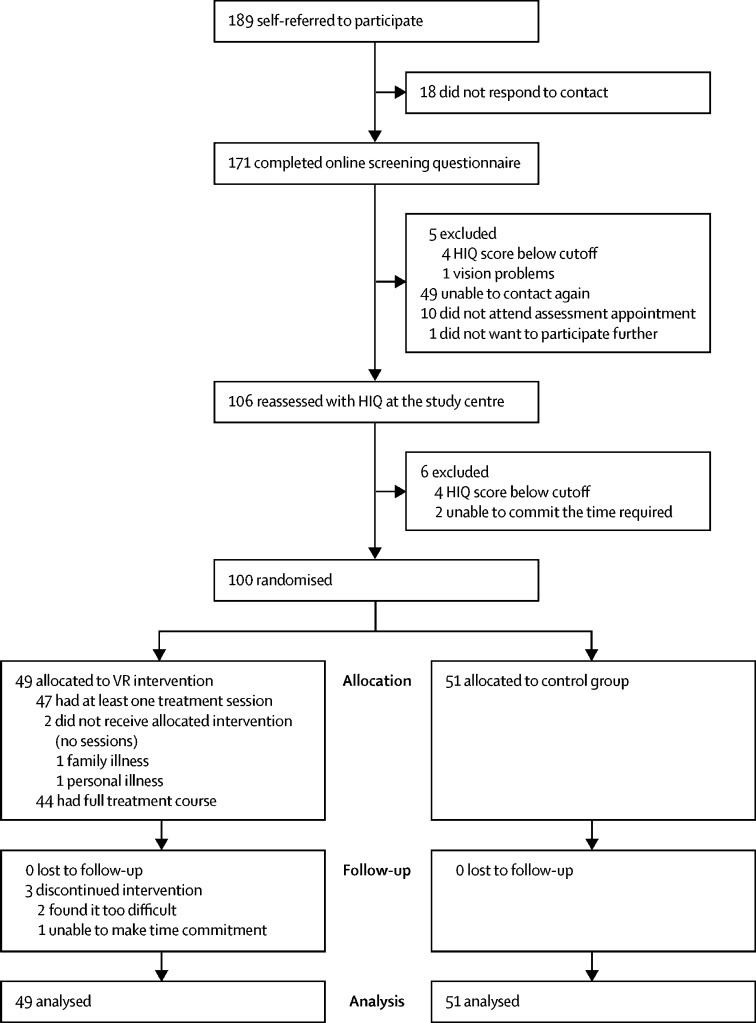
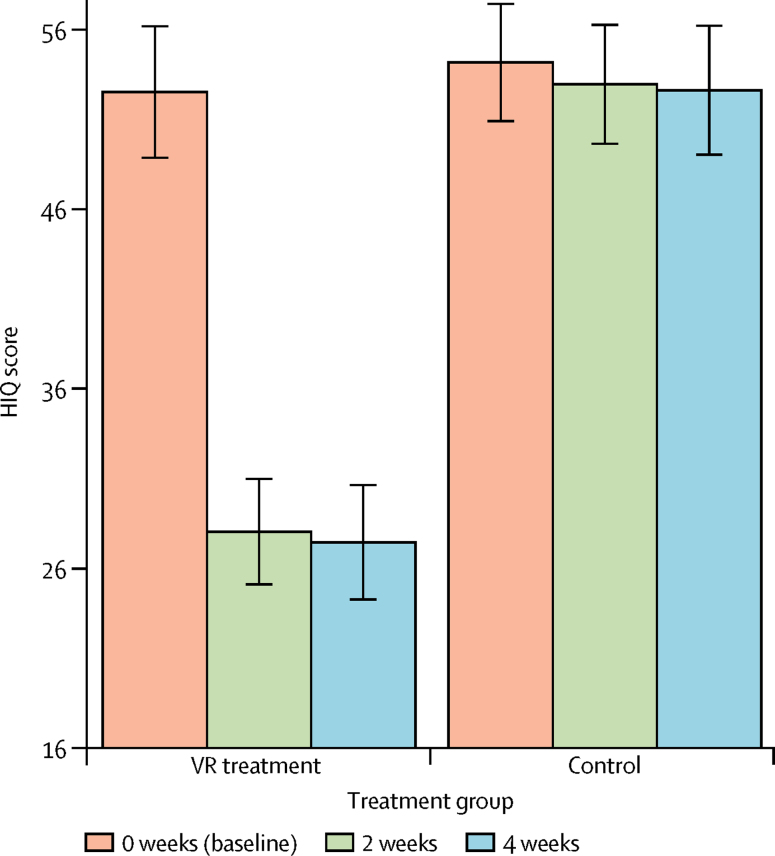
BACKGROUND: Engaging, interactive, and automated virtual reality (VR) treatments might help solve the unmet needs of individuals with mental health disorders. We tested the efficacy of an automated cognitive intervention for fear of heights guided by an avatar virtual coach (animated using motion and voice capture of an actor) in VR and delivered with the latest consumer equipment. METHODS: We did a randomised trial of automated VR versus usual care. We recruited adults aged older than 18 years with a fear of heights by radio advertisements in Oxfordshire, UK. We diagnosed fear of heights if participants scored more than 29 on the Heights Interpretation Questionnaire (HIQ). We randomly allocated participants by computer in a 1:1 ratio to either automated VR delivered in roughly six 30-min sessions administered about two to three times a week over a 2-week period (intervention group) or to usual care (control group). Randomisation was stratified by severity of fear of heights. The research team, who were unaware of the random allocation, administered three fear-of-height assessments, at baseline (0 weeks), at the end of treatment (2 weeks), and at follow-up (4 weeks). The primary outcome measure was HIQ score (range 16-80, with higher scores indicating greater severity). This trial is registered with the ISRCTN registry, number ISRCTN11898283. FINDINGS: Between Nov 25, 2017, and Feb 27, 2018, 100 individuals were enrolled and underwent randomisation, of whom 49 were assigned to the VR treatment group and 51 to the control group. All participants completed the 4-week follow-up. The mean total treatment time in VR was 124·43 min (SD 34·23). Compared with participants in the control group, the VR treatment reduced fear of heights at the end of treatment (mean change score -24·5 [SD 13·1] in the VR group vs -1·2 [7·3] in the control group; adjusted difference -24·0, 95% CI -27·7 to -20·3; Cohen's d=2·0; p<0·0001). The benefit was maintained at follow-up (mean change score -25·1 [SD 13·9] in the VR group vs -1·5 [7·8] in the control group; adjusted difference -24·3, 95% CI -27·9 to -20·6; Cohen's d=2·0; p<0·0001). The number needed to treat to at least halve the fear of heights was 1·3. No adverse events were reported. INTERPRETATION: Psychological therapy delivered automatically by a VR coach can produce large clinical benefits. Evidence-based VR treatments have the potential to greatly increase treatment provision for mental health disorders. FUNDING: Oxford VR, and the National Institute of Health Research Oxford Health Biomedical Research Centre.
Overview
CoChat Summary
## TL;DR
This single-blind, parallel-group randomized controlled trial found that an automated immersive VR intervention for fear of heights produced very large short-term and 4-week benefits versus usual care. The treatment was well tolerated, with no adverse events reported and very high uptake.
## Key findings
- 100 participants were randomized: 49 to VR and 51 to usual care; all participants completed 4-week follow-up.
- At the end of treatment (2 weeks), HIQ change was −24.5 in the VR group vs −1.2 in controls, with an adjusted between-group difference of −24.0 (95% CI −27.7 to −20.3; Cohen’s d=2.0; p<0.0001).
- At follow-up (4 weeks), HIQ change was −25.1 in the VR group vs −1.5 in controls, with an adjusted difference of −24.3 (95% CI −27.9 to −20.6; d=2.0; p<0.0001).
- 34/49 (69%) in the VR group fell below the trial’s HIQ entry criterion by follow-up, versus 0/51 controls; NNT 1.6. No adverse events were reported.
## Methods
- Single-blind, parallel-group, randomized, superiority trial comparing automated VR with usual care in adults older than 18 years recruited by radio advertisements in Oxfordshire, UK; fear of heights required HIQ >29.
- Participants were randomized 1:1, stratified by severity (moderate HIQ 30–55 or severe 56–80), to about six 30-minute VR sessions over 2 weeks or usual care.
- Primary outcome was HIQ; secondary outcomes included AQ, IAPT phobia scale–avoidance, and Simulator Sickness Questionnaire. Analyses used intention to treat and linear mixed-effects models with repeated measures at 2 and 4 weeks.
## Limitations
- The authors state they do not know how representative the participants are of the wider population with acrophobia.
- They state they did not test behaviour at real heights and did not test long-term outcomes beyond 4 weeks.
- They note the trial compared VR with usual care / no treatment, so they cannot pinpoint which elements caused the reduction; this is explicitly stated in the paper. An additional evident limitation is that the study was conducted in a single UK setting with self-referred participants.
Model-written summary. Check it against the paper before relying on it.
Integrity signals
Registry
Cites
Statistics
Figures
Verification
Claims the paper makes
2 Valid · 0 Not valid · 11 Not checked · 47 Own results and interpretations
A result the paper reports from its own data — it cites no other source for it, so there is none to check. The quote shows it is in the paper.
In the paper
“The mean reduction in the fear-of-heights score on the HIQ in the control group was 3·3% (SD 23·0).”
§ Automated psychological therapy using immersive virtual reality for treatment of fear of heights: a single-blind, parallel-group, randomised controlled trial > Results
plainn = 51- Asserted: passes — The authors put it forward as true.
- Checkable: passes — It can be checked against evidence.
- Load-bearing: passes — The paper’s conclusions depend on it.
- Based: passes — The paper gives a reason why it holds.
A result the paper reports from its own data — it cites no other source for it, so there is none to check. The quote shows it is in the paper.
In the paper
“We found no reports of automated VR being used to treat mental health problems.”
§ Automated psychological therapy using immersive virtual reality for treatment of fear of heights: a single-blind, parallel-group, randomised controlled trial > Introduction
plain- Asserted: passes — The authors put it forward as true.
- Checkable: passes — It can be checked against evidence.
- Load-bearing: passes — The paper’s conclusions depend on it.
- Based: passes — The paper gives a reason why it holds.
A result the paper reports from its own data — it cites no other source for it, so there is none to check. The quote shows it is in the paper.
In the paper
“Uptake of the VR treatment was very high. 47 (96%) of 49 people attended at least one VR session.”
§ Automated psychological therapy using immersive virtual reality for treatment of fear of heights: a single-blind, parallel-group, randomised controlled trial > Results
plainn = 49- Asserted: passes — The authors put it forward as true.
- Checkable: passes — It can be checked against evidence.
- Load-bearing: unclear — It is unclear whether the paper’s conclusions depend on it.
- Based: passes — The paper gives a reason why it holds.
A result the paper reports from its own data — it cites no other source for it, so there is none to check. The quote shows it is in the paper.
In the paper
“No adverse events were reported by any participant in either treatment group.”
§ Automated psychological therapy using immersive virtual reality for treatment of fear of heights: a single-blind, parallel-group, randomised controlled trial > Results
plain- Asserted: passes — The authors put it forward as true.
- Checkable: passes — It can be checked against evidence.
- Load-bearing: passes — The paper’s conclusions depend on it.
- Based: passes — The paper gives a reason why it holds.
A result the paper reports from its own data — it cites no other source for it, so there is none to check. The quote shows it is in the paper.
In the paper
“44 (90%) people had a full course of the VR intervention (ie, they completed all the treatment exercises), which comprised three (n=4), four (n=18), five (n=8), six (n=12), seven (n=1), or eight (n=1) treatment sessions.”
§ Automated psychological therapy using immersive virtual reality for treatment of fear of heights: a single-blind, parallel-group, randomised controlled trial > Results
plain- Asserted: passes — The authors put it forward as true.
- Checkable: passes — It can be checked against evidence.
- Load-bearing: unclear — It is unclear whether the paper’s conclusions depend on it.
- Based: passes — The paper gives a reason why it holds.
11 more claims
Create a free account to see all 60 claims and to verify the 12 references still open.
- It may state two separate claims as one. 31
- Probably not a substantial claim. 23
Claims other papers make about this one
Each is checked against this paper’s own text: does it say what the citing paper says it does?
The source backs part of the claim, not all of it — or backs it for a different population, condition or comparison.
In the citing paper
“The effect size of chatbots on acrophobia in this RCT [38] was substantially higher than the total effect size of therapist-assisted exposure treatment on phobias reported by a meta-analysis (2.0 versus 1.1) [46].”
From Effectiveness and safety of using chatbots to improve mental health: systematic review and meta-analysis (2020) · cites this paper as [38]
Experimental — accuracy not yet measuredThe source backs part of the claim, not all of it — or backs it for a different population, condition or comparison.
In the citing paper
“Compared with participants who received usual care, the chatbot significantly decreased the severity of acrophobia as measured by both tools at 2-week and 4-week follow-ups (P<.001) [38].”
From Effectiveness and safety of using chatbots to improve mental health: systematic review and meta-analysis (2020) · cites this paper as [38]
Experimental — accuracy not yet measuredThe source backs part of the claim, not all of it — or backs it for a different population, condition or comparison.
In the citing paper
“Generally, from studies that reported user experience outcomes (n=11), participants reported being satisfied with the conversational agent interventions offered [22,23,25,26,29,30,32].”
From Conversational agents in the treatment of mental health problems: mixed-method systematic review (2019) · cites this paper as [23]
Experimental — accuracy not yet measuredThe source backs part of the claim, not all of it — or backs it for a different population, condition or comparison.
In the citing paper
“This provides some support for the utility of conversational agents in treating mild-to-moderate psychological distress in adults [23,25,26,31,34].”
From Conversational agents in the treatment of mental health problems: mixed-method systematic review (2019) · cites this paper as [23]
Experimental — accuracy not yet measuredThe source backs part of the claim, not all of it — or backs it for a different population, condition or comparison.
In the citing paper
“Although all three studies reported large effect sizes in terms of symptom reduction”
From Experiences of gamified and automated virtual reality exposure therapy for spider phobia: qualitative study (2020) · cites this paper as [17]
Experimental — accuracy not yet measured
15 more claims about this paper
Create a free account to see every claim other papers make about this one.
Citations
Cites
Diagnostic and Statistical Manual of Mental Disorders
Williams, J. B. W., & First, M. (2013) · Encyclopedia of Social Work · doi:10.1093/acrefore/9780199975839.013.104 · Cited by 109,519
Simulator Sickness Questionnaire: An Enhanced Method for Quantifying Simulator Sickness
Kennedy, R. S., Lane, N. E., Berbaum, K. S., & Lilienthal, M. G. (1993) · The International Journal of Aviation Psychology · doi:10.1207/s15327108ijap0303_3 · Cited by 5,457
Virtual Reality in the Assessment, Understanding, and Treatment of Mental Health Disorders
Freeman, D., Reeve, S., Robinson, A., Ehlers, A., Clark, D., Spanlang, B., & Slater, M. (2017) · Psychological Medicine · doi:10.1017/s003329171700040x · Cited by 1,428
Self-citationVirtual reality exposure therapy for anxiety disorders: A meta-analysis
Powers, M. B., & Emmelkamp, P. M. G. (2008) · Journal of Anxiety Disorders · doi:10.1016/j.janxdis.2007.04.006 · Cited by 904
McHugh, R. K., Whitton, S. W., Peckham, A. D., Welge, J. A., & Otto, M. W. (2013) · The Journal of Clinical Psychiatry · doi:10.4088/jcp.12r07757 · Cited by 800
(2016) · City Research Online (City University London) · Cited by 747
Effectiveness of computer-generated (virtual reality) graded exposure in the treatment of acrophobia
(1995) · American Journal of Psychiatry · doi:10.1176/ajp.152.4.626 · Cited by 694
Mayo-Wilson, E., Dias, S., Mavranezouli, I., Kew, K., Clark, D. M., Ades, A. E., & Pilling, S. (2014) · The Lancet Psychiatry · doi:10.1016/s2215-0366(14)70329-3 · Cited by 680
Psychological approaches in the treatment of specific phobias: A meta-analysis
Wolitzky-Taylor, K. B., Horowitz, J. D., Powers, M. B., & Telch, M. J. (2008) · Clinical Psychology Review · doi:10.1016/j.cpr.2008.02.007 · Cited by 530
Virtual reality treatment versus exposure in vivo: a comparative evaluation in acrophobia
Emmelkamp, P. M. G., Krijn, M., Hulsbosch, A. M., de Vries, S., Schuemie, M. J., & van der Mast, C. A. P. G. (2002) · Behaviour Research and Therapy · doi:10.1016/s0005-7967(01)00023-7 · Cited by 475
Research works printed but not linked: 1
- Bouchard S St-Jacques J Renaud P Wiederhold B Side effects of immersions in virtual reality for people suffering from anxiety disorders J Cyber Ther Rehabil 2 2009 127 137
Cited by
Items 101–200 of 385
QuickVR: A standard library for virtual embodiment in unity
Oliva, R., Beacco, A., Navarro, X., & Slater, M. (2022) · Frontiers in Virtual Reality · doi:10.3389/frvir.2022.937191 · Cited by 35
Self-citationKashif, M., Ahmad, A., Bandpei, M. A. M., Farooq, M., Iram, H., & Fatima, R. (2022) · Medicine · doi:10.1097/md.0000000000029212 · Cited by 40
Bonfert, M., Muender, T., McMahan, R. P., Steinicke, F., Bowman, D. A., Malaka, R., & Döring, T. (2024) · International Journal of Human-Computer Interaction · doi:10.1080/10447318.2024.2400377 · Cited by 33
“…abilities (e.g., vocational education like public speaking (Poeschl, 2017)), entertainment (e.g., traveling the world (Sarkady et al., 2021), therapy (e.g., fear of heights (Freeman et al., 2018), or use cases that would be expensive or impossible without VR (e.g., visiting Mars (Holt, 2023).”
Zeka, F., Clemmensen, L., Valmaggia, L., Veling, W., Hjorthøj, C. R., & Glenthøj, L. B. (2024) · Acta Psychiatrica Scandinavica · doi:10.1111/acps.13777 · Cited by 37
Takac, M., Collett, J., Conduit, R., & Foe, A. D. (2021) · Clinical Psychology & Psychotherapy · doi:10.1002/cpp.2624 · Cited by 31
Tao, K., Huang, Y., Shen, Y., & Sun, L. (2022) · IEEE Transactions on Neural Systems and Rehabilitation Engineering · doi:10.1109/tnsre.2022.3192571 · Cited by 31
Wei, S., Freeman, D. H., & Rovira, A. (2023) · Scientific Reports · doi:10.1038/s41598-023-38499-7 · Cited by 32
“Therefore, participants were randomised to one of four virtual coach conditions: (1) neutral face (2) neutral face and affirmative nods (3) warm facial expressions and (4) warm facial expressions and affirmative nods.”
BackgroundInfluentialSelf-citationPsychological therapy using virtual reality for treatment of driving phobia: a systematic review
Elphinston, R. A., Vaezipour, A., Fowler, J. A., Russell, T. G., & Sterling, M. (2023) · Disability and Rehabilitation · doi:10.1080/09638288.2022.2069293 · Cited by 27
Analgesic efficacy of virtual reality for acute pain in amniocentesis: A randomized controlled trial
Melcer, Y., Maymon, R., Gal-Kochav, M., Pekar‐Zlotin, M., Levinsohn‐Tavor, O., Meizner, I., & Svirsky, R. (2021) · European Journal of Obstetrics & Gynecology and Reproductive Biology · doi:10.1016/j.ejogrb.2021.04.024 · Cited by 30
The Symbiosis of Virtual Reality Exposure Therapy and Telemental Health: A Review
Ong, T., Wilczewski, H., Soni, H., Nisbet, Q., Paige, S. R., Barrera, J. F., Welch, B. M., & Bunnell, B. E. (2022) · Frontiers in Virtual Reality · doi:10.3389/frvir.2022.848066 · Cited by 28
“Telemedicine has proven to reduce wait times, travel burdens, and the overall stress of patient health care experiences (Lehoux et al., 2000; Gajarawala and Pelkowski, 2021).”
BackgroundKritikos, I., Zoitaki, C., Tzannetos, G., Mehmeti, A., Douloudi, M., Nikolaou, G., Alevizopoulos, G., & Koutsouris, D. (2020) · Sensors · doi:10.3390/s20051244 · Cited by 33
Chen, J., Xie, Z., & Or, C. K. (2021) · Health and Technology · doi:10.1007/s12553-021-00561-7 · Cited by 31
“One additional study [67] was identified by manually search.”
BackgroundSeinfeld, S., & Montesano, A. (2025) · Journal of Clinical Psychology · doi:10.1002/jclp.23813 · Cited by 25
Participatory design to create a VR therapy for psychosis
Knight, I., West, J., Matthews, E., Kabir, T., Lambe, S., Waite, F., & Freeman, D. H. (2021) · Design for Health · doi:10.1080/24735132.2021.1885889 · Cited by 30
“A new generation in treatment development is the automation of VR therapy, which aims to reduce reliance on a stretched psychological workforce and enable greater scaling up of provision (Freeman et al. 2018; Freeman, Lister, et al. 2019).”
BackgroundMethodSelf-citationBaker, C., & Fairclough, S. H. (2021) · Elsevier eBooks · doi:10.1016/b978-0-12-821413-8.00014-2 · Cited by 34
Presence and simulator sickness predict the usability of a virtual reality attention task
Voinescu, A., Petrini, K., & Fraser, D. S. (2023) · Virtual Reality · doi:10.1007/s10055-023-00782-3 · Cited by 33
“For example, VR has potential in treating phobias and to manage anxiety and pain (Freeman et al. 2018; Freeman et al. 2017; Georgescu et al. 2020; Digital Health 2020).”
BackgroundAzimisefat, P., de Jongh, A., de Jongh, A., Kanske, P., & Jamshidi, F. (2022) · Frontiers in Psychology · doi:10.3389/fpsyg.2022.919148 · Cited by 28
“Although exposure therapy is widely used, it can be costly and time-consuming for therapists who wish to incorporate phobic stimuli in their treatment (Freeman et al., 2018; Heinig et al., 2021).”
BackgroundPelazas-Hernández, J. A., Varillas‐Delgado, D., González-Casado, T., Quevedo, I. C., Alonso-Bermejo, A., Ronchas-Martínez, M., & García, I. C. (2023) · Journal of Clinical Medicine · doi:10.3390/jcm12113645 · Cited by 34
My Virtual Self: The Role of Movement in Children's Sense of Embodiment
Dewe, H., Gottwald, J. M., Bird, L., Brenton, H., Gillies, M. F. P., & Cowie, D. A. (2021) · IEEE Transactions on Visualization and Computer Graphics · doi:10.1109/tvcg.2021.3073906 · Cited by 24
“of the self, allowing the user to change social attitudes and perceptions [13]–[15], or engage in psychological therapy [50], [60].”
BackgroundVR-based Student Priming to Reduce Anxiety and Increase Cognitive Bandwidth
Hawes, D., & Arya, A. (2021) · IEEE Conference on Virtual Reality and 3D User Interfaces (VR) · doi:10.1109/vr50410.2021.00046 · Cited by 29
“Studies have demonstrated that the animated avatar virtual coaches yield better results than the other chosen methods of treatment by the control group [23].”
BackgroundWang, X., Kou, X., Meng, X., & Yu, J. (2022) · Frontiers in Psychiatry · doi:10.3389/fpsyt.2022.952828 · Cited by 27
Wei, D., Hua, X., Zheng, M., Wu, J., & Xu, J. (2022) · BMC Neurology · doi:10.1186/s12883-022-02836-6 · Cited by 23
“The SSQ scale contains 16 items, for example, sweating, nausea, dizziness, burping, headache, blurred vision, and feeling dizzy [33].”
BackgroundExtended Reality for Mental Health Evaluation: Scoping Review
Omisore, O. M., Odenigbo, I. P., Orji, J., Beltran, A. I. H., Meier, S. M., Baghaei, N., & Orji, R. (2024) · JMIR Serious Games · doi:10.2196/38413 · Cited by 32
Facing Your Fear in Immersive Virtual Reality: Avoidance Behavior in Specific Phobia
Binder, F. P., Pöhlchen, D., Zwanzger, P., & Spoormaker, V. I. (2022) · Frontiers in Behavioral Neuroscience · doi:10.3389/fnbeh.2022.827673 · Cited by 30
“No costly trained therapists are needed making it easier to scale up and offer therapy to more people (Freeman et al., 2018).”
BackgroundDonker, T., Fehribach, J. R., van Klaveren, C., Cornelisz, I., Toffolo, M. B. J., van Straten, A., & van Gelder, J. (2022) · Psychological Medicine · doi:10.1017/s0033291722003531 · Cited by 31
“The development of consumer VR platforms has led to the emergence of automated VR treatment, with encouraging results (Bentz et al., 2021; Freeman et al., 2018; Miloff et al., 2019).”
Bouchard, S., & Rizzo, A. (2019) · Virtual reality technologies for health and clinical applications · doi:10.1007/978-1-4939-9482-3_1 · Cited by 29
Morris, M. E. (2020) · Dialogues in Clinical Neuroscience · doi:10.31887/dcns.2020.22.2/mmorris · Cited by 26
Cloud Based Virtual Reality Exposure Therapy Service for Public Speaking Anxiety
Šalkevičius, J., Miškinytė, A., & Navickas, L. (2019) · Information · doi:10.3390/info10020062 · Cited by 26
“Automated VRET sessions for acrophobia were conducted by Freeman et al. [13].”
MethodMetaverse: Implications for Business, Politics, and SocietyPreprint
Schmitt, M. (2022) · SSRN Electronic Journal · doi:10.2139/ssrn.4168458 · Cited by 27
Fusaro, M., Lisi, M. P., Era, V., Porciello, G., Candidi, M., Aglioti, S. M., & Boukarras, S. (2025) · Topoi · doi:10.1007/s11245-025-10216-1 · Cited by 31
“…limitations, virtual reality exposure-based cognitive behavioral therapy (VRE-CBT) has emerged as a compelling alternative, offering distinct advantages over conventional methods (Eshuis et al. 2021; Freeman et al. 2018; Lind-ner et al. 2021, see for a recent meta-analysis van Loenen et al. 2022).”
Is Consciousness First in Virtual Reality?
Slater, M., & Sanchez-Vives, M. V. (2022) · Frontiers in Psychology · doi:10.3389/fpsyg.2022.787523 · Cited by 27
“The scenario used for a fear of heights therapy described in Freeman et al. (2018) included a whale swimming in the air between buildings.”
MethodSelf-citationDie Entwicklung virtueller Realität als Expositionsverfahren
Diemer, J., & Zwanzger, P. (2019) · Der Nervenarzt · doi:10.1007/s00115-019-0678-6 · Cited by 29
Are you afraid of heights and suitable for working at height?
Wang, H., Wang, Q., & Hu, F. (2019) · Biomedical Signal Processing and Control · doi:10.1016/j.bspc.2019.03.011 · Cited by 20
Chou, P., Tseng, P., Wu, Y., Chang, J. P., Tu, Y., Stubbs, B., Carvalho, A. F., Lin, P.-Y., Chen, Y.-W., & Su, K. (2020) · Journal of Affective Disorders · doi:10.1016/j.jad.2020.12.172 · Cited by 21
Miller, I., Peake, E., Strauss, G., Vierra, E., Koepsell, X., Shalchi, B., Padmanabhan, A., & Lake, J. (2023) · JMIR Formative Research · doi:10.2196/43260 · Cited by 19
“VR treatments have also been effectively delivered at home and may reduce the burden on clinician time, particularly in areas where mental health resources are limited or in high demand [45,46].”
BackgroundYu, J., Wu, J., Liu, B., Zheng, K., & Ren, Z. (2023) · Ageing Research Reviews · doi:10.1016/j.arr.2023.102179 · Cited by 20
Dilgul, M., Martinez, J., Laxhman, N., Priebe, S., & Bird, V. (2020) · Consortium Psychiatricum · doi:10.17650/2712-7672-2020-1-1-30-46 · Cited by 24
“One study [27] used automated, repeated behavioural experiments for the treatment of a fear of heights.”
MethodRibba, B., Peck, R., Hutchinson, L. G., Bousnina, I., & Motti, D. (2023) · Clinical Pharmacology & Therapeutics · doi:10.1002/cpt.2989 · Cited by 21
Alfadil, M. (2024) · Sensors · doi:10.3390/s24227185 · Cited by 24
Schillings, C., Meißner, E., Erb, B., Schultchen, D., Bendig, E., & Pollatos, O. (2023) · Frontiers in Digital Health · doi:10.3389/fdgth.2023.1046202 · Cited by 23
“In particular, the improved outcomes comprised depression (57–59), psychological distress (60), anxiety (58), fear of heights (61), and positive affect (58, 60).”
BackgroundPerspective: The Promise of Virtual Reality as an Immersive Therapeutic
Maddox, T., Sparks, C. Y., Oldstone, L., Chibbaro, M., Sackman, J., Judge, E., Maddox, R., Bonakdar, R. A., & Darnall, B. D. (2024) · Journal of Medical Extended Reality · doi:10.1089/jmxr.2023.0003 · Cited by 20
Multi-modal physiological signals based fear of heights analysis in virtual reality scenes
Zheng, R., Wang, T., Cao, J., Vidal, P., & Wang, D. (2021) · Biomedical Signal Processing and Control · doi:10.1016/j.bspc.2021.102988 · Cited by 18
Itaguchi, Y. (2021) · Frontiers in Virtual Reality · doi:10.3389/frvir.2021.712378 · Cited by 19
“An increasing number of studies use consumer immersive virtual reality (VR) devices to investigate human perception, cognition, and action (e.g., Keizer et al., 2016; Osumi et al., 2017; Freeman et al., 2018; Sawada et al., 2020).”
BackgroundA Psychometric Analysis of Fear of COVID-19 Scale in India
Lathabhavan, R. (2021) · International Journal of Mental Health and Addiction · doi:10.1007/s11469-021-00657-1 · Cited by 17
“As the level and characteristics of fear vary among people and situations, a comprehensive understanding will help practitioners provide appropriate interventions (Freeman et al., 2018; Geller et al., 2016).”
BackgroundGao, C., Li, X., Peng, J., & Liu, M. (2022) · Mathematical Problems in Engineering · doi:10.1155/2022/4900890 · Cited by 18
“Positive psychology is a supplement to the development of contemporary psychology, which makes psychology more comprehensive, reasonable, and balanced [21].”
BackgroundTsamitros (2022) · doi:10.1007/s00115-022-01378-z · Cited by 16
“(Aus [17], Creative Commons Attribution License (CC BY) – https://creativecommons.”
Asadiof, F., Gharehtapeh, Z. H., Naeim, M., Mirzai, F., & Mohammadi, Y. (2025) · Annals of Medicine and Surgery · doi:10.1097/ms9.0000000000003035 · Cited by 24
“This immersive aspect provides a platform for participants to practice and internalize therapeutic strategies in scenarios that closely mimic real-life challenges, thus bridging the gap between therapy and daily life [ 20 , 21 ] .”
Kazimoglu, C., & Bacon, L. (2020) · IEEE Access · doi:10.1109/access.2020.3001751 · Cited by 17
“reality exposure therapy (VRET) is an approach perceived as an alternative to standard vivo procedures in psychology [27], [28].”
BackgroundWang, Q., Wang, H., Hu, F., Hua, C., & Wang, D. (2021) · Journal of Neural Engineering · doi:10.1088/1741-2552/abcdbd · Cited by 18
Žilinský, T., & Halamová, J. (2023) · International Journal of Environmental Research and Public Health · doi:10.3390/ijerph20032592 · Cited by 22
“, [9]), post-traumatic stress disorder (e.”
Ma, J., Li, H., Zhao, M., & Williams, J. W. (2025) · International Journal of Clinical and Health Psychology · doi:10.1016/j.ijchp.2025.100636 · Cited by 19
“Virtual Reality (VR) has been shown to enhance students ’ mental health (Freeman et al., 2018) and has the potential to be used to deliver nature-related interventions for university students living in urban areas where access to natural environments might be low.”
Effectiveness of the VR Cognitive Training for Symptom Relief in Patients with ADHD
Oh, S. H., Park, J. W., & Cho, S. (2022) · Journal of Web Engineering · doi:10.13052/jwe1540-9589.21310 · Cited by 21
Mancone, S., Diotaiuti, P., Valente, G., Corrado, S., Bellizzi, F., Vilarino, G. T., & Andrade, A. (2023) · Behavioral Sciences · doi:10.3390/bs13070550 · Cited by 14
Obremski, D., & Wienrich, C. (2024) · Journal of Computer and Communications · doi:10.4236/jcc.2024.124010 · Cited by 15
“The authors investigated if an automated VRET controlled by a virtual avatar can reduce patients’ fear of height [38].”
BackgroundA novel fusion strategy for locomotion activity recognition based on multimodal signals
Hu, F., Wang, H., Feng, N., Zhou, B., Wei, C., Lu, Y., Qi, Y., Jia, X., Tang, H., & Gouda, M. A. (2021) · Biomedical Signal Processing and Control · doi:10.1016/j.bspc.2021.102524 · Cited by 14
Lindner, P., Dafgård, P., Miloff, A., Andersson, G., Reuterskiöld, L., Hamilton, W., & Carlbring, P. (2021) · Frontiers in Psychiatry · doi:10.3389/fpsyt.2021.645273 · Cited by 18
Acrophobia Quantified by EEG Based on CNN Incorporating Granger Causality
Hu, F., Wang, H., Wang, Q., Feng, N., Chen, J., & Zhang, T. (2020) · International Journal of Neural Systems · doi:10.1142/s0129065720500690 · Cited by 14
Healing Through Stories: Co-designing Digital Mental Health with Asian Americans
Bautista, J., Wong, N., Reddy, M. C., & Schueller, S. M. (2025) · CHI Conference on Human Factors in Computing Systems · doi:10.1145/3706598.3714142 · Cited by 16
“DMHTs can include web and mobile applications [3], social media and online forums [16, 60], virtual reality [22, 53], robots [83, 86], and ubiquitous designs that integrate into everyday life, such as mobile devices [18].”
Lee, J., Kim, C. G., & Lee, K. C. (2022) · Frontiers in Psychology · doi:10.3389/fpsyg.2022.705442 · Cited by 15
Damme, S. V., Tack, J., Wallendael, G. V., Turck, F. D., & Vega, M. T. (2023) · International Conference on Quality of Multimedia Experience (QoMEX) · doi:10.1109/qomex58391.2023.10178453 · Cited by 19
Kritikos, I., Poulopoulou, S., Zoitaki, C., Douloudi, M., & Koutsouris, D. (2019) · Lecture notes of the Institute for Computer Sciences, Social Informatics and Telecommunications Engineering · doi:10.1007/978-3-030-25872-6_18 · Cited by 14
eTher – An Assistive Virtual Agent for Acrophobia Therapy in Virtual Reality
Balan, O. C., Cristea, Ș., Moise, G., Petrescu, L., Ivașcu, S., Moldoveanu, A. D. B., Moldoveanu, F., & Leordeanu, M. (2020) · Lecture notes in computer science · doi:10.1007/978-3-030-59990-4_2 · Cited by 14
Virtual Reality Self-help Treatment for Aviophobia: Protocol for a Randomized Controlled Trial
Fehribach, J. R., Toffolo, M. B. J., Cornelisz, I., van Klaveren, C., van Straten, A., van Gelder, J., & Donker, T. (2021) · JMIR Research Protocols · doi:10.2196/22008 · Cited by 16
“The evidence on the potential of automated or unguided self-help VRET for phobias also shows that there is a need to further investigate VRET [16,17].”
Bond, J., Robotham, D., Kenny, A., Pinfold, V., Kabir, T., Andleeb, H., Larkin, M., Martin, J. L., Brown, S., Bergin, A., et al. (2021) · JMIR Research Protocols · doi:10.2196/31742 · Cited by 13
“VR has been used as an effective treatment for anxiety [4,5] and, more recently, as a treatment for patients with psychosis [6-8].”
BackgroundSelf-citationA Survey of Conversational Agents and Their Applications for Self-Management of Chronic Conditions
Park, M. S., Upama, P. B., Anik, A. A., Ahamed, S. I., Luo, J., Tian, S., Rabbani, M., & Oh, H. (2023) · IEEE Annual International Computer Software and Applications Conference (COMPSAC) · doi:10.1109/compsac57700.2023.00162 · Cited by 18
“To illustrate, the studies that tested the engagement of patients using highly variable metrics for engagement from 30-minute sessions over 2 weeks [114], a single session [98], [136], daily sessions for 2 weeks [72], [94], to unlimited access for 30 days [115].”
BackgroundBanakou, D., Johnston, T., Beacco, A., Şenel, G., & Slater, M. (2024) · JMIR Formative Research · doi:10.2196/52212 · Cited by 13
“For example, Freeman et al [31] used a simple form of cognitive behavioral ET with VR, where over 5 sessions, patients with fear of heights learned to overcome their fear.”
MethodSelf-citationMartins, S., & Vairinhos, M. (2023) · Virtual Worlds · doi:10.3390/virtualworlds2040018 · Cited by 13
“In response to this challenge, researchers have explored the incorporation of game elements (gamification) to frame the presentation of phobic stimuli within VR environments (VREs) [9–12].”
BackgroundDraschkow, D., Anderson, N., David, E. J., Gauge, N., Kingstone, A. F., Kumle, L., Laurent, X., Nobre, A. C., Shiels, S., & Võ, M. L. ‐. (2023) · Policy Insights from the Behavioral and Brain Sciences · doi:10.1177/23727322231196305 · Cited by 16
Heart Rate Prediction from Head Movement during Virtual Reality Treatment for Social Anxiety
Noori, F. M., Kahlon, S., Lindner, P., Nordgreen, T., Torresen, J., & Riegler, M. (2019) · 2019 International Conference on Content-Based Multimedia Indexing (CBMI) · doi:10.1109/cbmi.2019.8877454 · Cited by 11
“In [7], the authors conducted automated VRET sessions for acrophobia.”
BackgroundMcInerney, J., Brown, P., Bird, J. C., Nickless, A., Brown, G. P., & Freeman, D. H. (2021) · Behaviour Research and Therapy · doi:10.1016/j.brat.2021.103928 · Cited by 32
Self-citationUnity3D-based app for 360VR subjective quality assessment with customizable questionnaires
Cortés, C., Pérez, P., & Garcia, N. N. (2019) · International Conference on Consumer Electronics · doi:10.1109/icce-berlin47944.2019.8966170 · Cited by 11
“Moreover, 360 video opens a new paradigm on video quality measurement, requiring application-related questionnaires [1] [2].”
BackgroundProject Westdrive: Unity City With Self-Driving Cars and Pedestrians for Virtual Reality Studies
Nezami, F. N., Wächter, M. A., Pipa, G., & König, P. (2020) · Frontiers in ICT · doi:10.3389/fict.2020.00001 · Cited by 15
Han, D., Kim, D., Kim, K., & Cho, I. (2023) · Proceedings - International Symposium on Mixed and Augmented Reality, ISMAR · doi:10.1109/ismar59233.2023.00103 · Cited by 14
“As VR devices are getting lighter and cheaper, immersive virtual simulations have been tried to treat mental illnesses in the field of clinical domains, such as PTSD [1, 13, 44], anxiety disorder [43], phobia [20] and fear of heights [19,52].”
BackgroundKim, H., & Choi, Y. (2025) · Frontiers in Psychiatry · doi:10.3389/fpsyt.2025.1554394 · Cited by 11
Majidi, E., & Manshaee, G. (2021) · Iranian Journal of Psychiatry and Behavioral Sciences · doi:10.5812/ijpbs.115684 · Cited by 12
de With, L. A., Thammasan, N., & Poel, M. (2022) · Frontiers in Computer Science · doi:10.3389/fcomp.2021.652550 · Cited by 12
Zhang, H., Li, X., Sun, Y., Fu, X., Qiu, C., & Carroll, J. M. (2024) · IEEE Conference on Virtual Reality and 3D User Interfaces (VR) · doi:10.1109/vr58804.2024.00054 · Cited by 14
“The study of how to induce, enhance [37], diminish, calm [30], and overcome [21] fear in virtual environments can help people better deal with fearful feelings in the virtual world.”
BackgroundLive Beyond Fear: A Virtual Reality Serious Game Platform to Overcome Phobias
Sharmili, S. S., & Kanagaraj, R. (2020) · International Conference on Devices, Circuits and Systems (ICDCS) · doi:10.1109/icdcs48716.2020.243592 · Cited by 11
Mahmoudi-Nejad, A., Guzdial, M., & Boulanger, P. (2021) · Proceedings of the AAAI Conference on Artificial Intelligence and Interactive Digital Entertainment · doi:10.1609/aiide.v17i1.18904 · Cited by 14
Varšová, K. K., Szitás, D., Janoušek, O., Jurkovičová, L., Kateřina, B., & Juřík, V. (2024) · Virtual Reality · doi:10.1007/s10055-024-01037-5 · Cited by 11
“(Freeman et al. 2018; Miloff et al. 2019; Lindner et al. 2020).”
Francová, A., Jablonská, M., Lhotská, L., Husák, J., & Fajnerová, I. (2025) · Journal of Behavior Therapy and Experimental Psychiatry · doi:10.1016/j.jbtep.2025.102035 · Cited by 12
Conversational agents on smartphones and the web
Bickmore, T., & O’Leary, T. K. (2022) · Elsevier eBooks · doi:10.1016/b978-0-323-90045-4.00010-1 · Cited by 12
Yadav, M., Pandey, A., Gaur, N., & Nghiem, X. (2024) · Advances in medical technologies and clinical practice book series · doi:10.4018/979-8-3693-1515-6.ch014 · Cited by 9
Virtual Reality Applications for the Treatment of Anxiety and Mental Disorders
Safikhani, S., Pirker, J., & Wriessnegger, S. C. (2021) · International Conference of the Immersive Learning Research Network (iLRN) · doi:10.23919/ilrn52045.2021.9459356 · Cited by 9
A Review of Virtual Therapists in Anxiety and Phobias Alleviating Applications
Mitruț, O., Moldoveanu, A. D. B., Petrescu, L., Petrescu, C., & Moldoveanu, F. (2021) · Lecture notes in computer science · doi:10.1007/978-3-030-77599-5_6 · Cited by 11
Dalko, K., Elsuson, H. A., Kalter, I., Zilezinski, M., Hofstetter, S., Stoevesandt, D., Paulicke, D., & Jahn, P. (2024) · JMIR Serious Games · doi:10.2196/52309 · Cited by 10
“Approaches to integrate immersive VR applications already exist in various areas of rehabilitation as well as in psychotherapy, for example, to alleviate respiratory symptoms [18,19] and reduce anxiety and stress [20].”
BackgroundBlending digital therapeutics within the healthcare system
Keller, O. C., Budney, A. J., Struble, C. A., & Teepe, G. W. (2022) · Elsevier eBooks · doi:10.1016/b978-0-323-90045-4.00016-2 · Cited by 14
Kim, H., Hartleb, T., Bello, K., Aqlan, F., Zhao, R., & Yang, H. Y. (2023) · Journal of Computing and Information Science in Engineering · doi:10.1115/1.4063089 · Cited by 12
Bergin, A., Allison, A. M., & Hazell, C. M. (2023) · JMIR Mental Health · doi:10.2196/48537 · Cited by 12
“More automated VRTs have been designed considering the pressure to deliver psychological therapies in mental health services and the lack of resources to meet this need [10,11].”
BackgroundMethodFreeman, D. H., Freeman, J., Rovira, A., Miguel, A. L., Ward, R., Bousfield, M., Riffiod, L., Leal, J., Kabir, T., Yu, L., et al. (2023) · BMJ Open · doi:10.1136/bmjopen-2023-076559 · Cited by 8
Self-citationRaphanel, M., Shaughness, G., Seiple, W., & Arleo, A. (2018) · Journal of Aging Science · doi:10.4172/2329-8847.1000194 · Cited by 10
It's so Real: Psychophysiological Reaction towards Virtual Reality Exposure
Ramdhani, N., Akpewila, F., Faizah, M., & Resibisma, B. (2019) · International Conference on Science and Technology (ICST) · doi:10.1109/icst47872.2019.9166212 · Cited by 10
“It was consistent with other studies [28], which has revealed that gender does not influence the changes resulted from intervention using reality virtual on acrophobia patients.”
ResultThe Era of Immersive Health Technology
Bremner, R., Gibbs, A., & Mitchell, A. R. J. (2020) · EMJ Innovation · doi:10.33590/emjinnov/19-00132 · Cited by 8
Teknolojik Bir Yaklaşım: Sanal Gerçeklik Maruz Bırakma Terapisi
Vardarlı, B. (2021) · Ege Eğitim Dergisi · doi:10.12984/egeefd.807422 · Cited by 16
Cheng, X., Bao, B., Cui, W., Liu, S., Zhong, J., Cai, L., & Yang, H. (2023) · Sensors · doi:10.3390/s23125482 · Cited by 7
“…axes, and calculated three-axis combined acceleration and angular velocity. before and after the experiment to label the subjects, those with HIQ scores greater than 29 were classi fi ed as the acrophobia group and those with scores less than 29 were classi fi ed as the non-acrophobia group [28].”
Rizzo, A., Mozgai, S., Sigaras, A., Rubin, J. E., & Jotwani, R. (2025) · Journal of Medical Extended Reality · doi:10.1177/29941520251369450 · Cited by 16
Alimour, S. A., & Alrabeei, M. (2025) · Frontiers in Digital Health · doi:10.3389/fdgth.2025.1693287 · Cited by 9
Bergsnev, K., & Laws, A. L. S. (2022) · Frontiers in Virtual Reality · doi:10.3389/frvir.2022.834004 · Cited by 8
Mauricio, F., Alvítez-Temoche, D., del Aguila, E., Mayta‐Tovalino, F., Silva, H., & Espinoza‐Carhuancho, F. (2024) · The Journal of Contemporary Dental Practice · doi:10.5005/jp-journals-10024-3675 · Cited by 7
“17,18 Advances in technology have made dental VR systems more portable and efficient, providing greater responsiveness in less time.”
Rosebrock, L. E., Freeman, J., Rovira, A., Miguel, A. L., Ward, R., Bousfield, M., Riffiod, L., Kamvar, R., Kabir, T., Waite, F., et al. (2024) · JMIR Serious Games · doi:10.2196/51512 · Cited by 9
“An automated VR therapy developed by our team was shown to significantly reduce fear of heights over the course of 2 weeks [9].”
MethodSelf-citation
Metadata
- Authors
- Freeman, D., Haselton, P., Freeman, J., Spanlang, B., Kishore, S., Albery, E., Denne, M., Brown, P., Slater, M., & Nickless, A.
- Affiliations
- Oxford Health NHS Foundation Trust (GB)
- University of Oxford (GB)
- Universitat de Barcelona (ES)
- Corresponding author
- Freeman, Daniel
- ORCID
- Venue
- The Lancet Psychiatry
- Publisher
- Elsevier BV
- Published
- 2018-08
- Volume
- 5
- Issue
- 8
- Pages
- 625-632
- ISSN
- 2215-0366 (ISSN-L)
- PMC
- PMC6063994
- OpenAlex
- W2841928325
- Cited by
- 377
- References
- 19
- Citations by year
- 2026: 30 · 2025: 60 · 2024: 42 · 2023: 48 · 2022: 51 · 2021: 59 · 2020: 46 · 2019: 37 · 2018: 4
- FWCI
- 36.59
- Type
- journal article
- Language
- en
- Open access
- hybrid
- doi.org
- Licence
- cc-by
- www.elsevier.com/tdm/userlicense/1.0/ (tdm)
- creativecommons.org/licenses/by/4.0/ (vor)
- Locations
- The Lancet Psychiatry (publishedVersion, cc-by)
- Europe PMC (PubMed Central) (publishedVersion, other-oa)
- PubMed Central (publishedVersion, cc-by)
- PubMed (publishedVersion)
- Explore Bristol Research (publishedVersion, cc-by)
- Bristol Research (University of Bristol) (submittedVersion, cc-by)
- Funders
- National Institute for Health and Care Research (RP-2014-05-003)
- University of Oxford
- National Institutes of Health
- Topics
- Physical Sciences › Computer Science › Human-Computer Interaction › Virtual Reality Applications and Impacts
- Social Sciences › Psychology › Applied Psychology › Digital Mental Health Interventions
- Social Sciences › Psychology › Experimental and Cognitive Psychology › Anxiety, Depression, Psychometrics, Treatment, Cognitive Processes
- Keywords
- fear of heights, acrophobia, virtual reality exposure therapy, immersive virtual reality, treatment efficacy, maintenance of treatment effects, usual care comparison, mental health treatment gap
- MeSH terms
- Adult, Female, United Kingdom, Humans, Male, Middle Aged, Phobic Disorders, Surveys and Questionnaires, Single-Blind Method, Treatment Outcome, Virtual Reality Exposure Therapy
About these checks
Registry, retraction, Cites and statistics results are computed, not judged, with one exception: a printed reference that no index lists is read once by a model before it counts as a citation error. Claims are extracted by a model and kept only when their quote appears verbatim in the text; each cited source is then checked, with a model’s help, for whether it says what the claim relies on. Those verdicts can be wrong — read the claim’s quote and the cited source before relying on one.
The claim verdicts this report counts are experimental: their accuracy is not yet measured.
A language model drew the claims from the paper on 2026-10-11, under version 3 of the claim definition (model deepseek-v4.1-flash, prompt extract-v3).
A second model labelled each claim on 2026-10-11 (model jev-1.13-20260917, definition revision gold-guideline-v0.2).
Statistics and arithmetic are recomputed, not judged.
Confidence bands are shown only for fields calibrated on our annotated test set. None is calibrated yet, so no band is shown.
What counts as a claim ›How we measure confidence ›How we check this ›
Are you an author, or do you see a problem with this page? Request a review
Data sources
Bibliographic data: Semantic Scholar, OpenAlex, Crossref.
Contains information from the Semantic Scholar Academic Graph Datasets, made available under the ODC Attribution License (ODC-BY 1.0).
Semantic Scholar’s data is described in: Kinney, R., et al. (2023). The Semantic Scholar Open Data Platform. arXiv:2301.10140.
