

Automated psychological therapy using immersive virtual reality for treatment of fear of heights: a single-blind, parallel-group, randomised controlled trial
Open accessThe DOI matches its Crossref record; 19 of the 19 references it cites were found in a registry or an index; 3 of the 15 sources its claims cite were checked for support.
Abstract
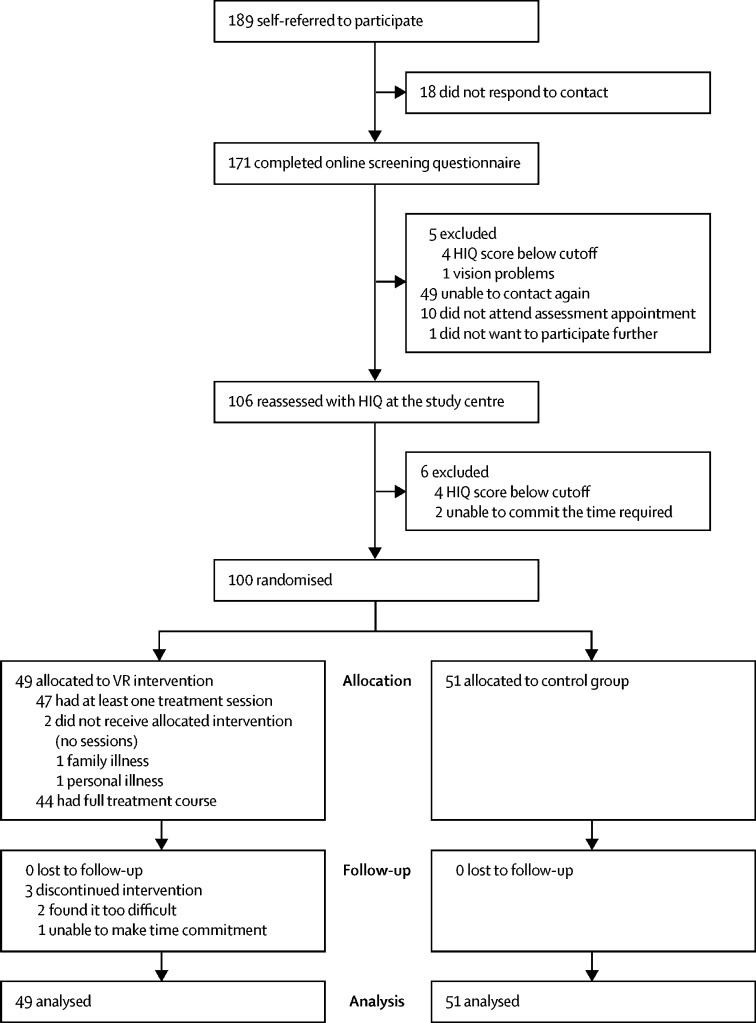
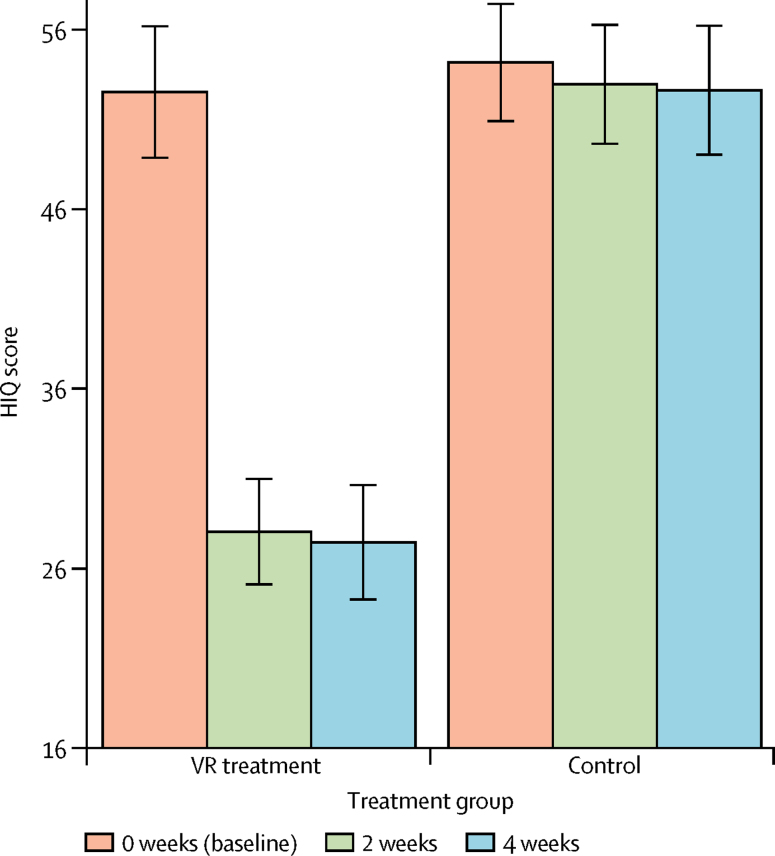
BACKGROUND: Engaging, interactive, and automated virtual reality (VR) treatments might help solve the unmet needs of individuals with mental health disorders. We tested the efficacy of an automated cognitive intervention for fear of heights guided by an avatar virtual coach (animated using motion and voice capture of an actor) in VR and delivered with the latest consumer equipment. METHODS: We did a randomised trial of automated VR versus usual care. We recruited adults aged older than 18 years with a fear of heights by radio advertisements in Oxfordshire, UK. We diagnosed fear of heights if participants scored more than 29 on the Heights Interpretation Questionnaire (HIQ). We randomly allocated participants by computer in a 1:1 ratio to either automated VR delivered in roughly six 30-min sessions administered about two to three times a week over a 2-week period (intervention group) or to usual care (control group). Randomisation was stratified by severity of fear of heights. The research team, who were unaware of the random allocation, administered three fear-of-height assessments, at baseline (0 weeks), at the end of treatment (2 weeks), and at follow-up (4 weeks). The primary outcome measure was HIQ score (range 16-80, with higher scores indicating greater severity). This trial is registered with the ISRCTN registry, number ISRCTN11898283. FINDINGS: Between Nov 25, 2017, and Feb 27, 2018, 100 individuals were enrolled and underwent randomisation, of whom 49 were assigned to the VR treatment group and 51 to the control group. All participants completed the 4-week follow-up. The mean total treatment time in VR was 124·43 min (SD 34·23). Compared with participants in the control group, the VR treatment reduced fear of heights at the end of treatment (mean change score -24·5 [SD 13·1] in the VR group vs -1·2 [7·3] in the control group; adjusted difference -24·0, 95% CI -27·7 to -20·3; Cohen's d=2·0; p<0·0001). The benefit was maintained at follow-up (mean change score -25·1 [SD 13·9] in the VR group vs -1·5 [7·8] in the control group; adjusted difference -24·3, 95% CI -27·9 to -20·6; Cohen's d=2·0; p<0·0001). The number needed to treat to at least halve the fear of heights was 1·3. No adverse events were reported. INTERPRETATION: Psychological therapy delivered automatically by a VR coach can produce large clinical benefits. Evidence-based VR treatments have the potential to greatly increase treatment provision for mental health disorders. FUNDING: Oxford VR, and the National Institute of Health Research Oxford Health Biomedical Research Centre.
Overview
CoChat Summary
## TL;DR
This single-blind, parallel-group randomized controlled trial found that an automated immersive VR intervention for fear of heights produced very large short-term and 4-week benefits versus usual care. The treatment was well tolerated, with no adverse events reported and very high uptake.
## Key findings
- 100 participants were randomized: 49 to VR and 51 to usual care; all participants completed 4-week follow-up.
- At the end of treatment (2 weeks), HIQ change was −24.5 in the VR group vs −1.2 in controls, with an adjusted between-group difference of −24.0 (95% CI −27.7 to −20.3; Cohen’s d=2.0; p<0.0001).
- At follow-up (4 weeks), HIQ change was −25.1 in the VR group vs −1.5 in controls, with an adjusted difference of −24.3 (95% CI −27.9 to −20.6; d=2.0; p<0.0001).
- 34/49 (69%) in the VR group fell below the trial’s HIQ entry criterion by follow-up, versus 0/51 controls; NNT 1.6. No adverse events were reported.
## Methods
- Single-blind, parallel-group, randomized, superiority trial comparing automated VR with usual care in adults older than 18 years recruited by radio advertisements in Oxfordshire, UK; fear of heights required HIQ >29.
- Participants were randomized 1:1, stratified by severity (moderate HIQ 30–55 or severe 56–80), to about six 30-minute VR sessions over 2 weeks or usual care.
- Primary outcome was HIQ; secondary outcomes included AQ, IAPT phobia scale–avoidance, and Simulator Sickness Questionnaire. Analyses used intention to treat and linear mixed-effects models with repeated measures at 2 and 4 weeks.
## Limitations
- The authors state they do not know how representative the participants are of the wider population with acrophobia.
- They state they did not test behaviour at real heights and did not test long-term outcomes beyond 4 weeks.
- They note the trial compared VR with usual care / no treatment, so they cannot pinpoint which elements caused the reduction; this is explicitly stated in the paper. An additional evident limitation is that the study was conducted in a single UK setting with self-referred participants.
Model-written summary. Check it against the paper before relying on it.
Integrity signals
Registry
Cites
Statistics
Figures
Verification
Claims the paper makes
2 Valid · 0 Not valid · 11 Not checked · 47 Own results and interpretations
A result the paper reports from its own data — it cites no other source for it, so there is none to check. The quote shows it is in the paper.
In the paper
“The mean reduction in the fear-of-heights score on the HIQ in the control group was 3·3% (SD 23·0).”
§ Automated psychological therapy using immersive virtual reality for treatment of fear of heights: a single-blind, parallel-group, randomised controlled trial > Results
plainn = 51- Asserted: passes — The authors put it forward as true.
- Checkable: passes — It can be checked against evidence.
- Load-bearing: passes — The paper’s conclusions depend on it.
- Based: passes — The paper gives a reason why it holds.
A result the paper reports from its own data — it cites no other source for it, so there is none to check. The quote shows it is in the paper.
In the paper
“We found no reports of automated VR being used to treat mental health problems.”
§ Automated psychological therapy using immersive virtual reality for treatment of fear of heights: a single-blind, parallel-group, randomised controlled trial > Introduction
plain- Asserted: passes — The authors put it forward as true.
- Checkable: passes — It can be checked against evidence.
- Load-bearing: passes — The paper’s conclusions depend on it.
- Based: passes — The paper gives a reason why it holds.
A result the paper reports from its own data — it cites no other source for it, so there is none to check. The quote shows it is in the paper.
In the paper
“Uptake of the VR treatment was very high. 47 (96%) of 49 people attended at least one VR session.”
§ Automated psychological therapy using immersive virtual reality for treatment of fear of heights: a single-blind, parallel-group, randomised controlled trial > Results
plainn = 49- Asserted: passes — The authors put it forward as true.
- Checkable: passes — It can be checked against evidence.
- Load-bearing: unclear — It is unclear whether the paper’s conclusions depend on it.
- Based: passes — The paper gives a reason why it holds.
A result the paper reports from its own data — it cites no other source for it, so there is none to check. The quote shows it is in the paper.
In the paper
“No adverse events were reported by any participant in either treatment group.”
§ Automated psychological therapy using immersive virtual reality for treatment of fear of heights: a single-blind, parallel-group, randomised controlled trial > Results
plain- Asserted: passes — The authors put it forward as true.
- Checkable: passes — It can be checked against evidence.
- Load-bearing: passes — The paper’s conclusions depend on it.
- Based: passes — The paper gives a reason why it holds.
A result the paper reports from its own data — it cites no other source for it, so there is none to check. The quote shows it is in the paper.
In the paper
“44 (90%) people had a full course of the VR intervention (ie, they completed all the treatment exercises), which comprised three (n=4), four (n=18), five (n=8), six (n=12), seven (n=1), or eight (n=1) treatment sessions.”
§ Automated psychological therapy using immersive virtual reality for treatment of fear of heights: a single-blind, parallel-group, randomised controlled trial > Results
plain- Asserted: passes — The authors put it forward as true.
- Checkable: passes — It can be checked against evidence.
- Load-bearing: unclear — It is unclear whether the paper’s conclusions depend on it.
- Based: passes — The paper gives a reason why it holds.
11 more claims
Create a free account to see all 60 claims and to verify the 12 references still open.
- It may state two separate claims as one. 31
- Probably not a substantial claim. 23
Claims other papers make about this one
Each is checked against this paper’s own text: does it say what the citing paper says it does?
The source backs part of the claim, not all of it — or backs it for a different population, condition or comparison.
In the citing paper
“The effect size of chatbots on acrophobia in this RCT [38] was substantially higher than the total effect size of therapist-assisted exposure treatment on phobias reported by a meta-analysis (2.0 versus 1.1) [46].”
From Effectiveness and safety of using chatbots to improve mental health: systematic review and meta-analysis (2020) · cites this paper as [38]
Experimental — accuracy not yet measuredThe source backs part of the claim, not all of it — or backs it for a different population, condition or comparison.
In the citing paper
“Compared with participants who received usual care, the chatbot significantly decreased the severity of acrophobia as measured by both tools at 2-week and 4-week follow-ups (P<.001) [38].”
From Effectiveness and safety of using chatbots to improve mental health: systematic review and meta-analysis (2020) · cites this paper as [38]
Experimental — accuracy not yet measuredThe source backs part of the claim, not all of it — or backs it for a different population, condition or comparison.
In the citing paper
“Generally, from studies that reported user experience outcomes (n=11), participants reported being satisfied with the conversational agent interventions offered [22,23,25,26,29,30,32].”
From Conversational agents in the treatment of mental health problems: mixed-method systematic review (2019) · cites this paper as [23]
Experimental — accuracy not yet measuredThe source backs part of the claim, not all of it — or backs it for a different population, condition or comparison.
In the citing paper
“This provides some support for the utility of conversational agents in treating mild-to-moderate psychological distress in adults [23,25,26,31,34].”
From Conversational agents in the treatment of mental health problems: mixed-method systematic review (2019) · cites this paper as [23]
Experimental — accuracy not yet measuredThe source backs part of the claim, not all of it — or backs it for a different population, condition or comparison.
In the citing paper
“Although all three studies reported large effect sizes in terms of symptom reduction”
From Experiences of gamified and automated virtual reality exposure therapy for spider phobia: qualitative study (2020) · cites this paper as [17]
Experimental — accuracy not yet measured
15 more claims about this paper
Create a free account to see every claim other papers make about this one.
Citations
Cites
Diagnostic and Statistical Manual of Mental Disorders
Williams, J. B. W., & First, M. (2013) · Encyclopedia of Social Work · doi:10.1093/acrefore/9780199975839.013.104 · Cited by 109,519
Simulator Sickness Questionnaire: An Enhanced Method for Quantifying Simulator Sickness
Kennedy, R. S., Lane, N. E., Berbaum, K. S., & Lilienthal, M. G. (1993) · The International Journal of Aviation Psychology · doi:10.1207/s15327108ijap0303_3 · Cited by 5,457
Virtual Reality in the Assessment, Understanding, and Treatment of Mental Health Disorders
Freeman, D., Reeve, S., Robinson, A., Ehlers, A., Clark, D., Spanlang, B., & Slater, M. (2017) · Psychological Medicine · doi:10.1017/s003329171700040x · Cited by 1,428
Self-citationVirtual reality exposure therapy for anxiety disorders: A meta-analysis
Powers, M. B., & Emmelkamp, P. M. G. (2008) · Journal of Anxiety Disorders · doi:10.1016/j.janxdis.2007.04.006 · Cited by 904
McHugh, R. K., Whitton, S. W., Peckham, A. D., Welge, J. A., & Otto, M. W. (2013) · The Journal of Clinical Psychiatry · doi:10.4088/jcp.12r07757 · Cited by 800
(2016) · City Research Online (City University London) · Cited by 747
Effectiveness of computer-generated (virtual reality) graded exposure in the treatment of acrophobia
(1995) · American Journal of Psychiatry · doi:10.1176/ajp.152.4.626 · Cited by 694
Mayo-Wilson, E., Dias, S., Mavranezouli, I., Kew, K., Clark, D. M., Ades, A. E., & Pilling, S. (2014) · The Lancet Psychiatry · doi:10.1016/s2215-0366(14)70329-3 · Cited by 680
Psychological approaches in the treatment of specific phobias: A meta-analysis
Wolitzky-Taylor, K. B., Horowitz, J. D., Powers, M. B., & Telch, M. J. (2008) · Clinical Psychology Review · doi:10.1016/j.cpr.2008.02.007 · Cited by 530
Virtual reality treatment versus exposure in vivo: a comparative evaluation in acrophobia
Emmelkamp, P. M. G., Krijn, M., Hulsbosch, A. M., de Vries, S., Schuemie, M. J., & van der Mast, C. A. P. G. (2002) · Behaviour Research and Therapy · doi:10.1016/s0005-7967(01)00023-7 · Cited by 475
Research works printed but not linked: 1
- Bouchard S St-Jacques J Renaud P Wiederhold B Side effects of immersions in virtual reality for people suffering from anxiety disorders J Cyber Ther Rehabil 2 2009 127 137
Cited by
Items 301–385 of 385
Cognitive Behavioral Therapy for Anxiety Disorders
Todd, G., & Branch, R. (2021) · Cambridge University Press eBooks · doi:10.1017/9781108355605.003 · Cited by 1
Proceedings of the 2020 ISNR Annual Conference: Poster Presentations
International Society of Neurofeedback and Research (2020) · NeuroRegulation · doi:10.15540/nr.7.4.173 · Cited by 1
Influence of multimodal integration on spatial perception
Kim, S., Gopal, S., & Cho, Y. (2022) · International Conference on Kansei Engineering and Emotion Research (KEER) · doi:10.5821/conference-9788419184849.40 · Cited by 1
“VR was used as a medium for visual stimuli in this experiment as it has been reported to be an effective tool for studying the emotional response to spatial conditions and has been widely applied in the psychiatric treatment of space-related phobia (ex: claustrophobia, acrophobia) [4, 5, 6].”
Hawes, D. (2022) · Carleton University's Institutional Repository (MacOdrum Library, Carleton University) · doi:10.22215/etd/2022-15050 · Cited by 2
Putman, S. (2021) · ThinkIR: The University of Louisville's Institutional Repository (University of Louisville) · doi:10.18297/etd/3728 · Cited by 1
Maneuvrier, A. (2020) · theses.fr (ABES) · doi:10.70675/3fbb4dbfzc553z459dzba8fz7ee7a2f5ec28 · Cited by 7
Automated Virtual Reality Therapy for Heights Phobia
Roy‐Byrne, P. (2018) · Journal watch · doi:10.1056/nejm-jw.na47162
ENCODS : A novel initiative to inspire young neuroscientists
Manrique‐Castano, D., van Casteren, A., Bouazza‐Arostegui, B., MacDonald, D. I., & Pfeiffer, P. E. (2019) · European Journal of Neuroscience · doi:10.1111/ejn.14428 · Cited by 3
Deepening extinction in a virtual reality treatment for fear of heights
McInerney, J. (2019)
STORYTELLING IN VR: HELPING CHILDREN WITH FEAR OF THE DARK
FAUSTINO, A. K. S., & Vairinhos, M. (2021) · INTED proceedings · doi:10.21125/inted.2021.1621
Bell, I. (2019) · Minerva Access (University of Melbourne)
Domestic Trend Analysis of Virtual Reality Therapy for the Treatment Anxiety Disorders
Cheong, M. J., Kim, J., Lyu, Y.-S., & Kang, H.-W. (2020) · Journal of Oriental Neuropsychiatry · Cited by 1
Alce, G., Hanserup, F., & Palm, K. (2022) · Lecture notes in computer science · doi:10.1007/978-3-031-15546-8_2
Martinengo, L., Jabir, A. I., Goh, W. W. T., Lo, N. Y. W., Ho, M. R., Kowatsch, T., Atun, R. A., Michie, S., & Car, L. T. (2022) · doi:10.2196/preprints.39243
МОДЕЛІ ПСИХОЛОГІЧНОГО КОНСУЛЬТУВАННЯ ТА ПСИХОТЕРАПІЇ СІМ’Ї
Mushkevych, M. (2022) · Psychological Prospects Journal · doi:10.29038/2227-1376-2022-40-mush
Features of VR Rehabilitation in Patients with Parkinson's Disease
Saleh, S. K. N., Seleznyova, S. V., Kozynskyi, O. V., Mamedalieva, S. A.-K., & Harpreet, S. H. (2023) · Ukraïnsʹkij žurnal medicini bìologìï ta sportu · doi:10.26693/jmbs08.01.041
An Examination of Memory Performance in a Fearful Virtual Reality Gaming Context
Lo, L. Y., & Ip, C. L. (2023) · Simulation & Gaming · doi:10.1177/10468781231166249
“VR technology has been widely used in helping people with phobias and other psychological disorders (e.g., Freeman et al., 2018; Lucifora et al., 2022).”
MethodÖzgül Fobilerin Bilişsel Davranışçı Terapilerinde Sanal Gerçeklik Uygulamaları
KILIÇASLAN, Y. (2023) · Journal of Social Research and Behavioral Sciences · doi:10.52096/jsrbs.9.18.34 · Cited by 2
“Katılımcılara, on katlı bir ofis kompleksinin avlusunda, bir ağaçtan kedileri kurtarma veya ilgili katın kenarından top fırlatma şeklinde görevler verilen bu çalışmada, SGMK grubunun akrofobi şiddetinde kontrol grubuna göre anlamlı düzeyde azalma sağlandığı gözlenmiştir [55].”
Hardware Psychodiagnosis of Resilience Indicators Mental Health
Boltivets, S. I. (2023) · Mental Health & Human Resilience International Journal · doi:10.23880/mhrij-16000222
Design for expanding interaction and cognitive enhancement in virtual reality
Cho, Y. (2023) · International Association of Societies of Design Research Congress (IASDR) · doi:10.21606/iasdr.2023.866
Link, M., Gerth, S., Belikova-Gerth, V., & Jesse, J. (2023) · Springer eBooks · doi:10.1007/978-3-658-42060-4_9
Bawa, Z., McCartney, D., Bedoya‐Pérez, M. A., Lau, N. S., Fox, R., MacDougall, H. G., & McGregor, I. S. (2024) · BMJ Open · doi:10.1136/bmjopen-2023-082927 · Cited by 1
“The 5 min ‘Walk the Plank’ task has been modified from previous VR studies requiring participants to walk along a narrow virtual plank above a precipitous drop, inducing physiological markers of acute anxiety 40–42 (ie, ‘situational anxiety’).”
Background22‐2: Virtual Reality Technology in The Field of Mental Decompression Research
Yang, Z., Hu, Y., & Wang, L. (2024) · SID Symposium Digest of Technical Papers · doi:10.1002/sdtp.17033
Marchioro, D. M., Fonseca, A. A., Benatti, F., & Zuin, M. (2024) · Palgrave Studies in Cyberpsychology. · doi:10.1007/978-3-031-68196-7_1
Kook, H. J., Kang, D.-H., Park, Y., Kim, N.-K., Kang, H.-W., & Jung, I. C. (2024) · Healthcare · doi:10.3390/healthcare12232407
“In the short term, VR therapy has been demonstrated to rapidly alleviate symptoms, with significant improvements achieved within just a few ses‑ sions for conditions such as anxiety with specific phobia [51].”
Transforming Healthcare: Exploring the Potential of Futuristic Healthcare Delivery System
Garg, V., Malhotra, C., Kumar, H., Bhardwaj, A., Bansal, R., & Saini, S. (2025) · Springer eBooks · doi:10.1007/978-981-97-0244-2_2
Computer Vision-Driven Assistive AR/VR/MR for Enhanced Geriatric Support
Nagpal, N., Singh, S., & Srivastava, M. (2025) · Advances in computational intelligence and robotics book series · doi:10.4018/979-8-3693-8272-1.ch008
Fox, S., Fisk, A., & Blustein, D. H. (2025) · PsyArXiv (OSF Preprints) · doi:10.31234/osf.io/mafrs_v1
Mustufa, G., Mandha, M., Malik, S. S., Kumar, M., Das, S., Chandan, N., Panda, M., Pandya, D. S., Kumar, G., & Mallick, A. (2025) · American Journal of Psychiatric Rehabilitation · doi:10.69980/ajpr.v28i1.320
Transition ability to safe states reduces fear responses to height
Fujino, M., & Haruno, M. (2025) · Proceedings of the National Academy of Sciences · doi:10.1073/pnas.2416920122
Metaverse Technologies, Security, and Applications for Healthcare
Jindal, S., Chaudhary, S., Sharma, S., Rani, M., & Bajaj, S. (2025) · Wiley eBooks · doi:10.1002/9781394305292.ch13
AI Integrated Spatial Experience for Mindfulness
Kathirvel.P (2025) · Journal of Information Systems Engineering & Management · doi:10.52783/jisem.v10i50s.10598
“[13] Psychologists , Life Coaches or Counsellors can design respective 3D worlds for their clients who are undergoing therapy for lifestyle issues such as Stress, OCD, Anxiety, Phobia… etc.[11, 12] .”
Chan, O., Mu, M., Debus, A., Dohan, M., Nicholls, D., Wallang, P. M., & Breen, K. C. (2025) · Mental Health and Digital Technologies · doi:10.1108/mhdt-02-2025-0014 · Cited by 1
The use of digital health technologies in mental health (literary review)
Morozova, S. A., Artemyeva, M. S., & Skuridin, I. V. (2025) · Vestnik nevrologii psihiatrii i nejrohirurgii (Bulletin of Neurology Psychiatry and Neurosurgery) · doi:10.33920/med-01-2505-10
Realidad inmersiva en la salud mental para el tratamiento de trastornos de ansiedad.
Pinargote-Garcia, Y., & Zambrano-Solórzano, T. (2025) · Revista Científica Multidisciplinar G-nerando · doi:10.60100/rcmg.v6i1.694
VR-Based Exposure Therapy for Acrophobia: Effects of Visual Realism and Interactivity
Pan, G., & Leong, W. Y. (2025) · INTI JOURNAL. · doi:10.61453/intij.202517
Measuring Acrophobia in Military Personnel: Design and Assessment of a Novel Device
Shamsoddini, A., & Sadeghiyan, E. (2025) · Journal of Archives in Military Medicine · doi:10.5812/jamm-163346
Measuring implicit bias in height-fearful participants with the Approach-Avoidance Task
Piovesan, K., Rinck, M., & Zlomuzica, A. (2025) · European Archives of Psychiatry and Clinical Neuroscience · doi:10.1007/s00406-025-02096-8
“Reliability (Cronbach’s alpha) of the AQ is generally adequate to excellent across different samples [19, 22, 71].”
Pathak, V. N., Anjalee, K. M., & Judge, J. (2025) · Advances in computational intelligence and robotics book series · doi:10.4018/979-8-3373-0467-0.ch005
Enhancing Healthcare with 3D Technologies: Motion Capture and Animation in the MoCASA Library
Lanfranco, E., Carrozzino, M. A., Santaguida, E., & Bergamasco, M. (2025) · Lecture notes in computer science · doi:10.1007/978-3-031-97778-7_12
Augmented Reality in the Treatment of Stress and Anxiety Disorders: A Literature Synthesis
Vona, F., Kuhlencord, M., Fox, J., Kojić, T., Shiban, Y., & Voigt‐Antons, J. (2025) · ACM International Conference on Intelligent Virtual Agents (IVA) · doi:10.1145/3742886.3756697
“Technical advances such as individualized or automated AR/VR therapy are also reported [3, 27, 52].”
An Optimized Immersive Virtual Reality System for Exposure Therapy in Treating Amaxophobia
Figuerola-Escoto, R. P., Cotero, A. G. G., Alva, R., Bernal, L. S., Coronel, G. E. O., Avalos, J.-G., & Sánchez, G. (2025) · Applied Sciences · doi:10.3390/app152111740
Ng, P. H. F., Cheng, A., Tai, K. S. K., FUNG, K. T. C., TO, H. H. F., CHAN, I. W. D., YAN, I. O. W., & LO, S. H. Y. (2023) · Asian Journal of the Scholarship of Teaching and Learning · doi:10.24112/ajsotl.133175 · Cited by 4
“Acrophobia (Freeman, 2018) Immersive VR is highly effective for reduction of fear of heights.”
BackgroundGamifying Life, Learning, Health, and Consumer Behaviors
Thomason, J. (2025) · International series on computer entertainment and media technology · doi:10.1007/978-3-032-08527-6_6
Polo, K. G. L., Mancheno, J. M. O., & Palacios, M. E. R. (2025) · Religación · doi:10.46652/rgn.v11i49.1591
Digital clinicians in spaceflight and off-Earth habitation
Clark, K. B. (2025) · Elsevier eBooks · doi:10.1016/b978-0-443-32904-3.00029-7
Halenta, D. (2025) · SSRN Electronic Journal · doi:10.2139/ssrn.5501439
Breaking the boundaried and optimizing healthcare in the metaverse through federated learning
Bhattacharya, N., & Bansal, D. (2025) · Elsevier eBooks · doi:10.1016/b978-0-443-33789-5.00021-2
VR-Based Simulation in Medical Education. Empathy: The Next Phase on the Journey to Health Equity
Roswell, R. O., Adelman, P., & Naidich, J. J. (2025) · Comprehensive healthcare simulation · doi:10.1007/978-3-032-03947-7_22
Zhou, Z. (2025) · doi:10.1145/3787364.3787366
“For example, Freeman et al. [11], [19] demonstrated that individuals treated for acrophobia and psychosis using automated VR therapy experienced reduced symptoms in real-world contexts, including public spaces and interpersonal interactions.”
Triggering anger using a virtual reality social scene
Lambe, S., Miguel, A. L., Bousfield, M., Hudson, F., Ahmed, M., Slaoui, G., Haynes, P., Rovira, A., Fazel, S., & Freeman, D. H. (2026) · Scientific Reports · doi:10.1038/s41598-026-36653-5 · Cited by 2
Self-citationBreen, C. J., Osmani, F., Sajadi, S. R., Mohtasham, S., Khosravi, M., & Zare-Bidaki, M. (2026) · Cambridge Prisms Global Mental Health · doi:10.1017/gmh.2026.10160
“This 4-week (1 month) follow-up period was selected as it was considered appropriate according to evidence from the previous literature (Freeman et al., 2018).”
Hiura, J., Ishida, Y., Sawahashi, R., Nishihama, R., & Nakamura, T. (2026) · IEEE/SICE International Symposium on System Integration (SII) · doi:10.1109/sii64115.2026.11404654
Modelling the induction of social stress in immersive virtual reality simulations
Kessassi, C. (2025) · theses.fr (ABES) · doi:10.70675/e27b6034zdab3z4ef9zab77zc9b1843e113c
Artificial Intelligence–Supported Psychodrama
Uşaklı, H. (2026) · Global Research in Higher Education · doi:10.22158/grhe.v9n2p37
Kot, J., Zjawiony, J., Leja, W., Błaszczak, M., Zulfiqar, Z., Latalska, K., Szczupaj, M., Pastuszak, A., Borkowski, K., & Rudnicki, J. (2026) · Quality in Sport · doi:10.12775/qs.2026.54.70515
Virtual Embodiment in virtual mirrors and presence: effects on adolescent self-esteem
Kapah, R., & Freedman, S. (2026) · Frontiers in Virtual Reality · doi:10.3389/frvir.2026.1772574
Varšová, K. K., Chmelík, J., Bílý, V., Janoušek, O., Bartošová, K., & Juřík, V. (2026) · Scientific Reports · doi:10.1038/s41598-026-58274-8
“Participants were included if they scored above the predefined threshold of 55 points 41,45 .”
An Introduction to Virtual and Augmented Reality: Designing Impactful Experiences
Gillies, M. F. P., & Pan, X. (2026) · Chapman & Hall/CRC eBooks · doi:10.1201/9781003592310
Colman, M. D., Millar, J. F. A., Patil, B., Finnegan, D. J., Kristoffersen, M., & Fraser, D. S. (2026) · JMIR XR and spatial computing. · doi:10.2196/92410
“The first example was Oxford VR’s acrophobia treatment app, which uses gamification and an automated therapist agent to treat fear of heights [40].”
Xiao, X., & Tang, W. (2026) · Lecture notes in computer science · doi:10.1007/978-3-032-29653-5_33
SOCIOVR: REALIDADE VIRTUAL COMO AUXILIADORA NO TRATAMENTO DA FOBIA E ANSIEDADE SOCIAL
Ribeiro, G. S., de OLIVEIRA-PEREIRA, W., & Siscoutto, R. A. (2026) · Colloquium Exactarum · doi:10.5747/ce.2026.v18.e446
Freeman, D. H., Freeman, J., Farmer, E., Turner, H. S., Ward, R., Miguel, A. L., Bousfield, M., Myrick, J., Rovira, A., McShane, H., et al. (2026) · EClinicalMedicine · doi:10.1016/j.eclinm.2026.104038
Self-citationTranquiliza 360: An Immersive VR–AI Ecosystem for Cognitive, Emotional, and Motor Rehabilitation
Cifuentes, M. V., & D’Amato, J. P. (2026) · Lecture notes in networks and systems · doi:10.1007/978-3-032-32029-2_4
Embodied Interfaces: Human Experience in Virtual and Mediated Worlds
(2026) · Frontiers research topics · doi:10.3389/978-2-8325-8362-3
Sabbar, M. B., Ushaw, G., & Davison, R. (2026) · Multimodal Technologies and Interaction · doi:10.3390/mti10080078
“The observed levels of perceived usability are consistent with previous studies reporting high user acceptance and positive engagement with interactive mental health interventions, including VR-based applications [5,11].”
Ziyue, Y., & Long, Q. (2026) · IEEE Internet of Things Magazine · doi:10.1109/miot.2026.3704633
“Automation of psychological therapy using immersive VR for the treatment of phobias of heights: a randomized controlled study with a single-blind design was created by Freeman et al. [14].”
Virtual Reality Exposure Therapy
Rossi, C., & Frisone, F. (2026) · Springer eBooks · doi:10.1007/978-3-031-52643-5_166-1
Fang, J., & Liang, Y. (2026) · Multimodal Technologies and Interaction · doi:10.3390/mti10080083
“Recent reviews further show that game design choices systematically shape presence and engagement, reinforcing the view that atmosphere operates as a multi-factor experiential system rather than as the isolated effect of any single sensory cue [4,13].”
Virtual Reality–Based Digital Therapeutic Systems in Clinical Health Psychology: A Scoping Review
Baron, A. M. G., Garcia, A. L. S., Roa, P. G. J., Salac, A. J. T., & Choy, A. H. C. (2026) · International Conference on e-Education, e-Business, e-Management and e-Learning · doi:10.1109/ic4e69618.2026.11631557
“Across therapeutic domains, Presence [5, 6, 7, 20], embodiment [16, 17], and multisensory feedback [2, 11, 29] consistently emerge as the core interaction mechanisms underlying therapeutic effectiveness.”
InfluentialMartins, S., Vairinhos, M., Soares, S. C., Félix, A. L. S., Araújo, C. A., & Diniz, F. (2026) · Lecture notes in computer science · doi:10.1007/978-3-032-33500-5_31
Carrasco, K., Escarzaga, A. M., Gonzalez, M., Rosenfelder, A., Beltrán, N., Ford, C., Miguel, K., Scott, L. C. A., & Carrasco, A. E. (2026) · PLoS ONE · doi:10.1371/journal.pone.0356395
Why Speech Motor Blocks Emerge in a Communicative Context: An Active Inference Model of StutteringPreprint
Demirel, B., Parr, T., Saleh, Y., Jackson, E. S., Denison, T., & Manohar, S. (2026) · bioRxiv (Cold Spring Harbor Laboratory) · doi:10.64898/2026.08.17.745328
“Training under communicative demand, of the kind a controlled social context can provide such as virtual reality exposure therapies (Freeman et al., 2018), is worth testing.”
Popescu, E. (2026) · Research Square · doi:10.21203/rs.3.rs-10966714/v1
Bassi, B. (2026) · Chapman & Hall/CRC eBooks · doi:10.1201/b23370
Alves, I., Conceição, N., & Esteves, A. (2026) · International Journal of Human-Computer Interaction · doi:10.1080/10447318.2026.2728236
Candela-Leal, M. O., Calderón-Gurubel, J. E., Ortiz, A., Elizondo-García, J., Vélez-Saboyá, C. S., Lozoya-Santos, J. D. J., Rodríguez-Sánchez, I., Cebral-Loureda, M., & Ramírez-Moreno, M. A. (2026) · Frontiers in Systems Neuroscience · doi:10.3389/fnsys.2026.1908489
Ifdil, I., Zulvi, N. A. W., & Zatrahadi, M. F. (2026) · SCHOULID Indonesian Journal of School Counseling · doi:10.23916/086864011
“No adverse events were reported in several trials (Freeman et al., 2018; M. Lee et al., 2025; Paul et al., 2022, 2024), and simulator sickness was mild (Thaysen-Petersen et al., 2024).”
InfluentialCriteria, Fit, and Compromise: How People Navigate Therapist-Seeking in Switzerland
Haussener, F. L., Al-Hazwani, I., Huang, E. M., & Ahmed, N. (2026) · Nordic Conference on Human-Computer Interaction · doi:10.1145/3821402.3830093
Psychological prevention of unsafe behavior: experience in using virtual reality technologies
Ukolova, A. A., & Buzanov, K. E. (2026) · Èkstremalʹnaâ psihologiâ i bezopasnostʹ ličnosti. · doi:10.17759/epps.2026030304
Future Prospects of Avatar Therapy Scenarios
Şahinbaş, R., & Gökbay, İ. Z. (2026) · Turkish Journal of Mathematics and Computer Science · doi:10.47000/tjmcs.1781975
Exploring perceived distance in virtual reality during ladder climbing: a pilot study
Liu, T., & Jeong, H. (2026) · Frontiers in Virtual Reality · doi:10.3389/frvir.2026.1785136
Janota, B., Dreier, H., & Janota, K. (2026) · Nervenheilkunde · doi:10.1055/a-2948-4569
Metadata
- Authors
- Freeman, D., Haselton, P., Freeman, J., Spanlang, B., Kishore, S., Albery, E., Denne, M., Brown, P., Slater, M., & Nickless, A.
- Affiliations
- Oxford Health NHS Foundation Trust (GB)
- University of Oxford (GB)
- Universitat de Barcelona (ES)
- Corresponding author
- Freeman, Daniel
- ORCID
- Venue
- The Lancet Psychiatry
- Publisher
- Elsevier BV
- Published
- 2018-08
- Volume
- 5
- Issue
- 8
- Pages
- 625-632
- ISSN
- 2215-0366 (ISSN-L)
- PMC
- PMC6063994
- OpenAlex
- W2841928325
- Cited by
- 377
- References
- 19
- Citations by year
- 2026: 30 · 2025: 60 · 2024: 42 · 2023: 48 · 2022: 51 · 2021: 59 · 2020: 46 · 2019: 37 · 2018: 4
- FWCI
- 36.59
- Type
- journal article
- Language
- en
- Open access
- hybrid
- doi.org
- Licence
- cc-by
- www.elsevier.com/tdm/userlicense/1.0/ (tdm)
- creativecommons.org/licenses/by/4.0/ (vor)
- Locations
- The Lancet Psychiatry (publishedVersion, cc-by)
- Europe PMC (PubMed Central) (publishedVersion, other-oa)
- PubMed Central (publishedVersion, cc-by)
- PubMed (publishedVersion)
- Explore Bristol Research (publishedVersion, cc-by)
- Bristol Research (University of Bristol) (submittedVersion, cc-by)
- Funders
- National Institute for Health and Care Research (RP-2014-05-003)
- University of Oxford
- National Institutes of Health
- Topics
- Physical Sciences › Computer Science › Human-Computer Interaction › Virtual Reality Applications and Impacts
- Social Sciences › Psychology › Applied Psychology › Digital Mental Health Interventions
- Social Sciences › Psychology › Experimental and Cognitive Psychology › Anxiety, Depression, Psychometrics, Treatment, Cognitive Processes
- Keywords
- fear of heights, acrophobia, virtual reality exposure therapy, immersive virtual reality, treatment efficacy, maintenance of treatment effects, usual care comparison, mental health treatment gap
- MeSH terms
- Adult, Female, United Kingdom, Humans, Male, Middle Aged, Phobic Disorders, Surveys and Questionnaires, Single-Blind Method, Treatment Outcome, Virtual Reality Exposure Therapy
About these checks
Registry, retraction, Cites and statistics results are computed, not judged, with one exception: a printed reference that no index lists is read once by a model before it counts as a citation error. Claims are extracted by a model and kept only when their quote appears verbatim in the text; each cited source is then checked, with a model’s help, for whether it says what the claim relies on. Those verdicts can be wrong — read the claim’s quote and the cited source before relying on one.
The claim verdicts this report counts are experimental: their accuracy is not yet measured.
A language model drew the claims from the paper on 2026-10-11, under version 3 of the claim definition (model deepseek-v4.1-flash, prompt extract-v3).
A second model labelled each claim on 2026-10-11 (model jev-1.13-20260917, definition revision gold-guideline-v0.2).
Statistics and arithmetic are recomputed, not judged.
Confidence bands are shown only for fields calibrated on our annotated test set. None is calibrated yet, so no band is shown.
What counts as a claim ›How we measure confidence ›How we check this ›
Are you an author, or do you see a problem with this page? Request a review
Data sources
Bibliographic data: Semantic Scholar, OpenAlex, Crossref.
Contains information from the Semantic Scholar Academic Graph Datasets, made available under the ODC Attribution License (ODC-BY 1.0).
Semantic Scholar’s data is described in: Kinney, R., et al. (2023). The Semantic Scholar Open Data Platform. arXiv:2301.10140.
