

The contribution of cannabis use to variation in the incidence of psychotic disorder across Europe (EU-GEI): a multicentre case-control study
Open accessThe DOI matches its Crossref record; 32 of the 32 references it cites were found in a registry or an index.
Abstract
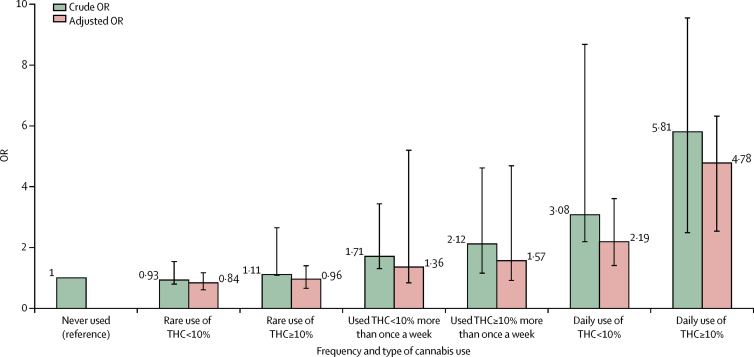
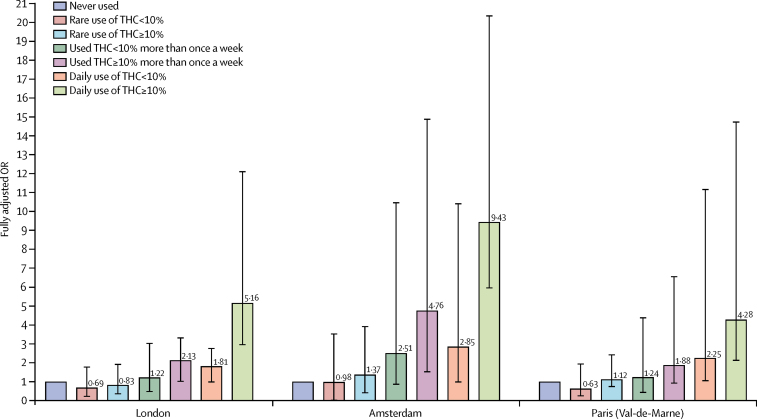
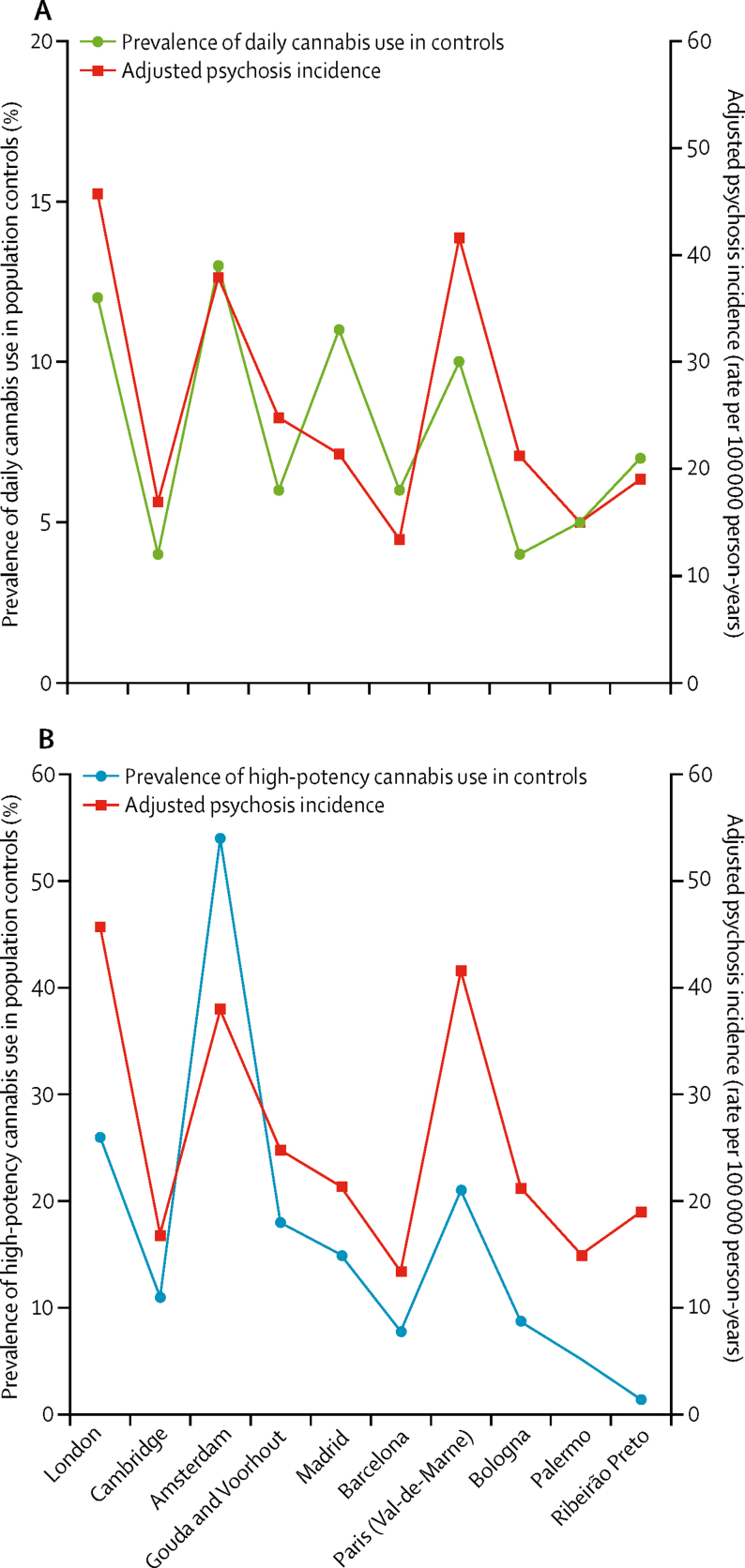
BACKGROUND: Cannabis use is associated with increased risk of later psychotic disorder but whether it affects incidence of the disorder remains unclear. We aimed to identify patterns of cannabis use with the strongest effect on odds of psychotic disorder across Europe and explore whether differences in such patterns contribute to variations in the incidence rates of psychotic disorder. METHODS: -tetrahydrocannabinol (THC) in the different types of cannabis available across the sites, we divided the types of cannabis used by participants into two categories: low potency (THC <10%) and high potency (THC ≥10%). Assuming causality, we calculated the population attributable fractions (PAFs) for the patterns of cannabis use associated with the highest odds of psychosis and the correlation between such patterns and the incidence rates for psychotic disorder across the study sites. FINDINGS: Between May 1, 2010, and April 1, 2015, we obtained data from 901 patients with first-episode psychosis across 11 sites and 1237 population controls from those same sites. Daily cannabis use was associated with increased odds of psychotic disorder compared with never users (adjusted odds ratio [OR] 3·2, 95% CI 2·2-4·1), increasing to nearly five-times increased odds for daily use of high-potency types of cannabis (4·8, 2·5-6·3). The PAFs calculated indicated that if high-potency cannabis were no longer available, 12·2% (95% CI 3·0-16·1) of cases of first-episode psychosis could be prevented across the 11 sites, rising to 30·3% (15·2-40·0) in London and 50·3% (27·4-66·0) in Amsterdam. The adjusted incident rates for psychotic disorder were positively correlated with the prevalence in controls across the 11 sites of use of high-potency cannabis (r = 0·7; p=0·0286) and daily use (r = 0·8; p=0·0109). INTERPRETATION: Differences in frequency of daily cannabis use and in use of high-potency cannabis contributed to the striking variation in the incidence of psychotic disorder across the 11 studied sites. Given the increasing availability of high-potency cannabis, this has important implications for public health. FUNDING SOURCE: Medical Research Council, the European Community's Seventh Framework Program grant, São Paulo Research Foundation, National Institute for Health Research (NIHR) Biomedical Research Centre (BRC) at South London and Maudsley NHS Foundation Trust and King's College London and the NIHR BRC at University College London, Wellcome Trust.
Overview
The claims and statistics of this paper haven’t been checked yet.
Free: it reads the open-access text and checks the first 5 claims that cite a source we can check. Create a free account to check every claim.
Integrity signals
Registry
Cites
Statistics
Figures
Verification
Claims the paper makes
The claims and statistics of this paper haven’t been checked yet.
Free: it reads the open-access text and checks the first 5 claims that cite a source we can check. Create a free account to check every claim.
Claims other papers make about this one
Each is checked against this paper’s own text: does it say what the citing paper says it does?
The source backs part of the claim, not all of it — or backs it for a different population, condition or comparison.
In the citing paper
“Use less than once a week was not associated with a psychotic disorder risk (other than acute psychoses which can emerge even with first time consumption of high THC doses).”
From Cannabis, cannabinoids and health: a review of evidence on risks and medical benefits (2025) · cites this paper as [50]
Experimental — accuracy not yet measuredThe cited source says what the claim attributes to it.
In the citing paper
“The prevalence of daily cannabis use and high potency cannabis use was positively associated with the incidence of treated psychosis across study sites in Europe and Brazil.”
From Cannabis, cannabinoids and health: a review of evidence on risks and medical benefits (2025) · cites this paper as [50]
The cited source says what the claim attributes to it.
In the citing paper
“A multinational study in Europe and Brazil [50] found that daily use of high potency cannabis increased the risk of psychosis fivefold compared to non-users while daily use of low potency cannabis doubled the risk.”
From Cannabis, cannabinoids and health: a review of evidence on risks and medical benefits (2025) · cites this paper as [50]
Self-check
Percentages, sums and reported differences re-computed from the paper’s own numbers.
The self-check needs the paper’s full text.
Citations
Cites
Marshall, M., Lewis, S., Lockwood, A., Drake, R., Jones, P., & Croudace, T. (2005) · Archives of General Psychiatry · doi:10.1001/archpsyc.62.9.975 · Cited by 1,593
Self-citationMcGuffin, P. (1991) · Archives of General Psychiatry · doi:10.1001/archpsyc.1991.01810320088015 · Cited by 1,483
McGrath, J., Saha, S., Welham, J., El Saadi, O., MacCauley, C., & Chant, D. (2004) · BMC Medicine · doi:10.1186/1741-7015-2-13 · Cited by 1,072
Meta-analysis of the Association Between the Level of Cannabis Use and Risk of Psychosis
Marconi, A., Di Forti, M., Lewis, C. M., Murray, R. M., & Vassos, E. (2016) · Schizophrenia Bulletin · doi:10.1093/schbul/sbw003 · Cited by 899
Self-citationDi Forti, M., Marconi, A., Carra, E., Fraietta, S., Trotta, A., Bonomo, M., Bianconi, F., Gardner-Sood, P., O'Connor, J., Russo, M., et al. (2015) · The Lancet Psychiatry · doi:10.1016/s2215-0366(14)00117-5 · Cited by 588
Self-citationHigh-potency cannabis and the risk of psychosis
Di Forti, M., Morgan, C., Dazzan, P., Pariante, C., Mondelli, V., Marques, T. R., Handley, R., Luzi, S., Russo, M., Paparelli, A., et al. (2009) · British Journal of Psychiatry · doi:10.1192/bjp.bp.109.064220 · Cited by 567
Self-citationAssociation Between Cannabis and Psychosis: Epidemiologic Evidence
Gage, S. H., Hickman, M., & Zammit, S. (2016) · Biological Psychiatry · doi:10.1016/j.biopsych.2015.08.001 · Cited by 379
Evaluating the public health impacts of legalizing recreational cannabis use in the United States
Hall, W., & Lynskey, M. (2016) · Addiction · doi:10.1111/add.13428 · Cited by 357
Self-citationTreated Incidence of Psychotic Disorders in the Multinational EU-GEI Study
Jongsma, H. E., Gayer-Anderson, C., Lasalvia, A., Quattrone, D., Mulè, A., Szöke, A., Selten, J.-P., Turner, C., Arango, C., Tarricone, I., et al. (2018) · JAMA Psychiatry · doi:10.1001/jamapsychiatry.2017.3554 · Cited by 335
Self-citationMurray, R. M., Quigley, H., Quattrone, D., Englund, A., & Di Forti, M. (2016) · World Psychiatry · doi:10.1002/wps.20341 · Cited by 315
Self-citation
Cited by
Items 401–500 of 1,000
Attitudes and beliefs of medical students on cannabis in Hong Kong
Chung, A. K.-K., Tse, C. Y., & Law, J. K. C. (2022) · Complementary Therapies in Medicine · doi:10.1016/j.ctim.2022.102870 · Cited by 8
Gouse, B. M., Boliver, E. E., Oblath, R., Camacho, L., & Brown, H. E. (2023) · Psychiatry Research · doi:10.1016/j.psychres.2023.115151 · Cited by 8
Does a history of cannabis use influence onset and course of schizophrenia?
Allebeck, P., Gunnarsson, T., Lundin, A., Löfving, S., Dal, H., & Zammit, S. (2023) · Acta Psychiatrica Scandinavica · doi:10.1111/acps.13562 · Cited by 8
“The use of high potency cannabis has been increasing in recent years and seems to be associated with higher risk of psychosis.(2,32) Adolescents in the end of the 1960's were exposed to cannabis of lower potency, so the associations found in this study might be lower than what would be found today.”
BackgroundDonisthorpe, H. S. J. K. (1942) · Annals and Magazine of Natural History · doi:10.1080/03745481.1942.9755466 · Cited by 8
McPhail, A., Whelan, J., Peter, S. C., Li, Q., Winters, K. C., & Meyers, A. W. (2020) · Addictive Behaviors · doi:10.1016/j.addbeh.2020.106531 · Cited by 8
Vaping Cannabis Oil: A Case of Catatonia Associated With Use of High-Potency Cannabis
Manning, T., Bartow, C., McNaughton, M., Reynolds, E., & Chen, Z. (2020) · Psychosomatics · doi:10.1016/j.psym.2020.06.012 · Cited by 8
Schwitzer, T., Schwan, R., Albuisson, É., Bugin, C., Zech, G., Angioï-Duprez, K., Bernardin, F., & Laprévote, V. (2021) · Journal of Psychiatric Research · doi:10.1016/j.jpsychires.2021.02.033 · Cited by 8
Insights Into the Pathophysiology of Endocannabinoid Signaling in Schizophrenia
Volk, D. W., & Lewis, D. A. (2019) · JAMA Psychiatry · doi:10.1001/jamapsychiatry.2019.0844 · Cited by 8
From heavy cannabis use to psychosis: is it time to take action?
Johnson‐Ferguson, L., & Forti, M. D. (2021) · Irish Journal of Psychological Medicine · doi:10.1017/ipm.2021.33 · Cited by 8
“Harm reduction measures for non-medicinal cannabis use have been published, notably in Canada (Fischer et al., 2011), encouraging, for example, people to opt for lower-potency cannabis forms and to reduce the frequency of consumption.”
BackgroundAndreu-Bernabeu, Á., González‐Peñas, J., Perdiguero, A. M., Bernardo, M., Mezquida, G., Amoretti, S., Bobes, J., Sáiz, P. A., García‐Portilla, M. P., Sanjuán, J., et al. (2025) · The British Journal of Psychiatry · doi:10.1192/bjp.2025.100 · Cited by 7
“8 Our study reveals that an extended state of loneliness lasting more than 6 months, particularly during adolescence, is associated with an increase in SSD odds comparable to those of established risk factors such as cannabis use 31 or sexual abuse.”
InfluentialSelf-citationThe rising tide of drug-induced psychosis
Murray, R. M., Paparelli, A., Forti, M. D., & Morrison, P. (2025) · Neuropsychiatrie · doi:10.1007/s40211-025-00541-7 · Cited by 7
“Di Forti et al. [8] found that the incidence rate of psychosis in 11 areas across 5 countries in Europe was positively correlated with the prevalence of daily cannabis use in the general population in each site; 30% of new cases of psychosis in London and 50% in Amsterdam were secondary to cannabis…”
Self-citationAymerich, C., Prisco, M. D., Melillo, A., Pedruzo, B., Catalan, A., Oliver, D., Diederen, K. M. J., MacCabe, J. H., Twumasi, R., UHER, R., et al. (2026) · World Psychiatry · doi:10.1002/wps.70093 · Cited by 7
“In this context, the rising potency of cannabis products 124 represents a major public health concern, as daily consumption of these compounds likely increases psychosis risk even further 125 .”
Self-citationWeiss, D. M., Bernier, E., Robbins, D. R., Elacqua, K. M., Johnson, K. A., Powers, K., Mesholam‐Gately, R. I., & Woodberry, K. A. (2022) · Frontiers in Psychiatry · doi:10.3389/fpsyt.2022.874246 · Cited by 7
Sokratous, S., Kaikoushi, K., Alexandrou, G., Rousou, E., & Karanikola, M. N. K. (2023) · Frontiers in Psychiatry · doi:10.3389/fpsyt.2023.1196915 · Cited by 7
The Role of Cannabis in the Development of Psychosis
Ertuğrul, A., & Türkoğlu, Ö. (2023) · Turkish Journal of Psychiatry · doi:10.5080/u27122 · Cited by 7
Black, J. C., Monte, A. A., Dasgupta, N., Jewell, J. S., Rockhill, K. M., Olson, R. A., & Dart, R. C. (2024) · Nature Mental Health · doi:10.1038/s44220-024-00233-1 · Cited by 7
“A corollary example has been observed where early use of high-potency cannabis is associated with a higher rate of progression to psychotic disorders 29,30 .”
Dourron, H. M., Bradley, M., Simonsson, O., Copes, H., Grossman, D., Shallcross, R. A., & Hendricks, P. S. (2025) · Psychedelic Medicine · doi:10.1089/psymed.2024.0036 · Cited by 7
O’Mahony, B. W., Lanigan, S., Lally, N., O’Malley, A., Smyth, B. P., McDonald, C., & Hallahan, B. P. (2025) · BJPsych Bulletin · doi:10.1192/bjb.2025.85 · Cited by 7
The impact of childhood trauma and cannabis use on paranoia: a structural equation model approach
Trotta, G., Spinazzola, E., Degen, H., Li, Z., Austin-Zimmerman, I., Leung, B. M., Lang, Y., Rodríguez, V., Aas, M., Sideli, L., et al. (2025) · Psychological Medicine · doi:10.1017/s0033291725101190 · Cited by 7
“Cannabis use was measured using the modified Cannabis Experiences Questionnaire – (CEQ mv ) (Di Forti et al., 2019) further updated for this study.”
Self-citationMarco, C. A., Detherage, J. P., LaFountain, A., Hanna, M. E., Anderson, J., Rhee, R., Ziegman, J. M., & Mann, D. (2020) · Journal of the American College of Emergency Physicians Open · doi:10.1002/emp2.12025 · Cited by 7
Cannabis use the week before admission to psychiatric in-patient service as a marker of severity
Madero, S., Oliveras, C., Pons-Cabrera, M. T., Sagué, M., López‐Pelayo, H., Gual, A., & Balcells‐Oliveró, M. (2020) · Journal of Psychiatric Research · doi:10.1016/j.jpsychires.2020.05.028 · Cited by 7
Loureiro, C. M., Zuelli, F. M. D. G. C., Fachim, H., Shuhama, R., de Oliveira, A. M., Menezes, P. R., Dalton, C., Louzada‐Júnior, P., Belangero, S. I., Coeli‐Lacchini, F. B., et al. (2023) · Brazilian Journal of Psychiatry · doi:10.47626/1516-4446-2022-2882 · Cited by 7
“5 Environmental factors, including cannabis use and childhood trauma, are also associated with first-episode psychosis and schizophrenia, 6,7 and growing evidence supports gene-environment interactions in additive models including both cannabis use and childhood trauma.”
BackgroundSelf-citationLlorca-Bofí, V., Mur, M., Font, M., Palacios‐Garrán, R., Sellart-Altisent, M., Agua-Martínez, E. D., Bioque, M., & Arteaga-Henríquez, G. (2024) · Brain Behavior & Immunity - Health · doi:10.1016/j.bbih.2024.100898 · Cited by 7
“…with not only a worsening in psychotic symptoms and/or with an increased risk of psychotic relapse (Kuepper et al., 2011; Haney and Evins, 2016; Bioque et al., 2022) but also, with an increased risk of developing a psychotic disorder in the future (Moore et al., 2007; Di Forti et al., 2019).”
Bond, B. W., Duric, B., Spinazzola, E., Trotta, G., Chesney, E., Li, Z., Quattrone, D., Tripoli, G., Gayer-Anderson, C. E., Rodríguez, V., et al. (2025) · The Canadian Journal of Psychiatry · doi:10.1177/07067437241290187 · Cited by 7
Self-citationOnline patient-provider cannabis consultations
Gali, K., Narode, R., Young‐Wolff, K. C., Rubinstein, M. L., Rutledge, G. W., & Prochaska, J. J. (2020) · Preventive Medicine · doi:10.1016/j.ypmed.2020.105987 · Cited by 7
Ristanovic, I., Damme, K. S. F., DeVylder, J., Schiffman, J. E., & Mittal, V. A. (2021) · Early Intervention in Psychiatry · doi:10.1111/eip.13153 · Cited by 7
“…for clinical high-risk (CHR) syndrome for psychosis is higher compared with the general population (Carney, Yung, et al., 2017) and is a prominent risk factor associated with exacerbation of attenuated psychotic symptoms (Corcoran et al., 2008; Di Forti et al., 2019; Valmaggia et al., 2014).”
BackgroundCannabis Use Among Patients With Psychotic Disorders
Hirschtritt, M. E., Young‐Wolff, K. C., Mathalon, D. H., & Satre, D. D. (2021) · The Permanente Journal · doi:10.7812/tpp/20.179 · Cited by 7
“Results from a recent multisite study among patients with FEP suggest that removing high-potency cannabis (tetrahydrocannabinol [THC] ≥ 10%) could prevent approximately 12% of patients with FEB and up to 50% at a single site.(18) Furthermore, among patients with FEP enrolled in coordinated specialty care, those with p…”
BackgroundCannabis and Intentional Self-injury: a Narrative Review
Denissoff, A., Levola, J. M., Niemelä, S., & Mustonen, A. (2022) · Current Addiction Reports · doi:10.1007/s40429-022-00453-4 · Cited by 7
Premorbid characteristics of patients with DSM-IV psychotic disorders
Widing, L. H., Simonsen, C., Flaaten, C. B., Haatveit, B. C., Vik, R. K., Wold, K. F., Åsbø, G., Ueland, T., & Melle, I. S. (2022) · Comprehensive Psychiatry · doi:10.1016/j.comppsych.2022.152310 · Cited by 7
Should the supply of cannabis be legalised now?
Meacher, M., Nutt, D. J., Liebling, J. P., Murray, R. M., & Gridley, A. (2019) · BMJ · doi:10.1136/bmj.l4468 · Cited by 7
Self-citationThe therapeutic use of cannabis and cannabinoids
Silva, J. P., & Carvalho, F. D. (2022) · Revista Española de Drogodependencias · doi:10.54108/10032 · Cited by 6
Measuring cannabis quantities in online surveys: A rapid review and proposals for ways forward
Manthey, J., Pons-Cabrera, M. T., Rosenkranz, M., & López‐Pelayo, H. (2023) · International Journal of Methods in Psychiatric Research · doi:10.1002/mpr.1971 · Cited by 6
Segura, À. G., Mané, A., Prohens, L., Rodríguez, N., Mezquida, G., Cuesta, M. J., Vieta, E., Amoretti, S., Lobo, A., González-Pinto, A. M., et al. (2023) · Psychiatry Research · doi:10.1016/j.psychres.2023.115249 · Cited by 6
Self-citationSubstances led to Psychosis: A Systematic Review
Karimi, I., & Pooyanmehr, N. (2024) · The Open Psychology Journal · doi:10.2174/0118743501297735240510161825 · Cited by 6
El‐Hammadi, M. M., Martín‐Navarro, L., Berrocoso, E., Álvarez‐Fuentes, J., Crespo‐Facorro, B., Suárez‐Pereira, I., Vázquez-Bourgón, J., & Martín‐Banderas, L. (2025) · Journal of Biomedical Materials Research Part A · doi:10.1002/jbm.a.37916 · Cited by 6
Murri, M. B., Catania, S., Centra, S., Folesani, F., Muscettola, A., Zerbinati, L., Toffanin, T., Ferrara, M., Ossola, P., Rossi, R., et al. (2025) · Neuroscience & Biobehavioral Reviews · doi:10.1016/j.neubiorev.2025.106269 · Cited by 6
Spinazzola, E., Degen, H., Austin-Zimmerman, I., Trotta, G., Chesney, E., Li, Z., Alameda, L., Leung, B. M., Lang, Y., Quattrone, A., et al. (2025) · BMJ Mental Health · doi:10.1136/bmjment-2025-301810 · Cited by 6
“14 19 This design helps to identify people for targeted interventions and offers valuable clinical insights.”
Self-citationTosato, S., Ristic, B., Zanini, A., Schimmenti, S., Maselli, F. M. C., & Vassos, E. (2025) · Epidemiology and Psychiatric Sciences · doi:10.1017/s204579602510022x · Cited by 6
Self-citationPanchalingam, T., Cooper, M., Shang, C., & Shi, Y. (2023) · Experimental and Clinical Psychopharmacology · doi:10.1037/pha0000618 · Cited by 6
Early onset marijuana use and suicidal ideation among African American college students
Floyd, L. J. (2023) · Journal of Ethnicity in Substance Abuse · doi:10.1080/15332640.2023.2239741 · Cited by 6
“One plausible pathway by which marijuana is associated with suicidal behavior involves an indirect link via depression and psychosis (Agrawal et al., 2017; Di Forti et al., 2019; Han et al., 2017).”
Cannabis and psychopathology: 2024 Snapshot of a meandering journey
Mahintamani, T., Mukherjee, D., & Basu, D. (2025) · Indian Journal of Psychiatry · doi:10.4103/indianjpsychiatry.indianjpsychiatry_968_24 · Cited by 6
Barakji, J. A., Korang, S. K., Feinberg, J. B., Maagaard, M., Gluud, C. N., Mathiesen, O., & Jakobsen, J. C. (2019) · BMJ Open · doi:10.1136/bmjopen-2019-031574 · Cited by 6
Cognitive functioning and cannabis use in first-episode psychosis
Karpov, B., Lindgren, M., Kieseppä, T., Wegelius, A., & Suvisaari, J. (2021) · Nordic Journal of Psychiatry · doi:10.1080/08039488.2021.2018038 · Cited by 6
Role of cyclin-dependent kinase 5 in psychosis and the modulatory effects of cannabinoids
Barrera-Conde, M., Veza-Estévez, E., Gomis‐González, M., García-Quintana, J., Trabsa, A., Martínez-Sadurní, L., Pujades, M., Pérez, V., de la Torre, R., Bergé, D., et al. (2022) · Neurobiology of Disease · doi:10.1016/j.nbd.2022.105942 · Cited by 6
“In addition, the association between cannabis and the risk of suffering a psychotic condition, such as schizophrenia, has been extensively described(7,8).”
BackgroundDeterrence effect of penalties upon adolescent cannabis use
Smyth, B. P., Davey, A., & Keenan, E. (2023) · Irish Journal of Psychological Medicine · doi:10.1017/ipm.2023.5 · Cited by 6
The Concept of Resistance to Substance Use and a Research Approach: The Resist! Project
Vanyukov, M. M., MAES, H. H. M., Iacono, W. G., Kirisci, L., Samek, D. R., Silberg, J. L., Zimmerman, E. B., & Prom‐Wormley, E. C. (2023) · Twin Research and Human Genetics · doi:10.1017/thg.2023.8 · Cited by 6
“Over 20% of new cases of psychosis could be attributed to daily cannabis use (Di Forti et al., 2019).”
Spinazzola, E., Quattrone, D., Rodríguez, V., Trotta, G., Alameda, L., Tripoli, G., Gayer-Anderson, C. E., Freeman, T. P., Johnson, E. C., Jongsma, H. E., et al. (2023) · Psychological Medicine · doi:10.1017/s0033291723001071 · Cited by 6
“Consistently with Di Forti et al. (2019), we used the combined measure of frequency and type of cannabis used derived from the following variables: (1) Frequency of use: never or occasional = 0, more than once a week = 1, daily = 2; (2) low potency cannabis with less than 10% of THC = 0, high…”
BackgroundMethodInfluentialSelf-citationKapler, S., Adery, L. H., Hoftman, G. D., Amir, C., Grigoryan, V., Cooper, Z. D., & Bearden, C. E. (2023) · Psychological Medicine · doi:10.1017/s0033291723002994 · Cited by 6
“However, recent work indicates elevated rates of first-episode psychosis in regions with predominantly high-potency cannabis (Di Forti et al., 2015, 2019).”
InfluentialL’Heureux, S., Huot‐Lavoie, M., Bergeron, A. B., Bergeron, C., Blouin, B.-P., & Roy, M. (2024) · The Canadian Journal of Psychiatry · doi:10.1177/07067437241232901 · Cited by 6
The Current Evidence for Marijuana as Medical Treatment
Buck, J. S., Bloomer, A. K., Wally, M. K., Seymour, R. B., & Hsu, J. R. (2020) · Journal of Bone and Joint Surgery · doi:10.2106/jbjs.20.00269 · Cited by 6
Peri, L. M. D., Traber, R., Bolla, E., & Vita, A. (2021) · Psychiatry Research · doi:10.1016/j.psychres.2021.113731 · Cited by 6
Cannabis, cannabinoids, and cannabis-based medicines: future research directions for analgesia
Badiola, I. J., Doshi, A., & Narouze, S. (2022) · Regional Anesthesia & Pain Medicine · doi:10.1136/rapm-2021-103109 · Cited by 6
Zeise, M. L. (2020) · Springer eBooks · doi:10.1007/978-3-030-47645-8_5 · Cited by 6
High-potency cannabis and incident psychosis: correcting the causal assumption
Sommer, I. E., & van den Brink, W. (2019) · The Lancet Psychiatry · doi:10.1016/s2215-0366(19)30130-0 · Cited by 6
Freeman, T. P., Beeching, E., Craft, S., Forti, M. D., Frison, G., Lindholst, C., Oomen, P. E., Potter, D., Rigter, S., Thomsen, K. R., et al. (2024) · European Archives of Psychiatry and Clinical Neuroscience · doi:10.1007/s00406-024-01816-w · Cited by 5
“Rising THC concentrations in cannabis may increase the risk of health harms [8] including cannabis use disorder [9, 10] and psychotic disorder [11, 12].”
Self-citationCannabis use in youth is associated with chronic inflammation
Power, E., Mongan, D., Healy, C., Susai, S. R., Föcking, M., Zammit, S., Cannon, M. D., & Cotter, D. (2024) · Psychological Medicine · doi:10.1017/s0033291724002848 · Cited by 5
“…between cannabis exposure; psychotic disorder; and potential roles of frequent cannabis use in oxidative stress, and potential role in chronic diseases in multiple systems (Di Forti et al., 2019; Eugen-Olsen et al., 2010; Haupt et al., 2019; Petersen et al., 2020; Rasmussen et al., 2021).”
Cannabinoid hyperemesis syndrome in pregnancy: a case series and review
Hanley, S., Imcha, M., & Mohamad, M. M. (2024) · Obstetric Medicine · doi:10.1177/1753495x241307415 · Cited by 5
“88 mood disorders, 89 personality disorders 90 and anxiety conditions 91 with concomitant cannabis use.”
Chung, A. K. K., & Tse, C. Y. (2025) · Frontiers in Psychiatry · doi:10.3389/fpsyt.2024.1495119 · Cited by 5
Zhou, C., Lavender, I., Gordon, R., McCartney, D., Kevin, R. C., Bedoya‐Pérez, M. A., & McGregor, I. S. (2025) · Scientific Reports · doi:10.1038/s41598-024-84897-w · Cited by 5
“Given that use of high-potency cannabis can cause unpleasant and undesirable short-term effects and sometimes is associated with adverse mental health outcomes 65–67 , low THC concentrations are arguably a positive attribute.”
Mulligan, L. D., Varese, F., Harris, K., & Haddock, G. (2025) · Psychological Medicine · doi:10.1017/s0033291725000236 · Cited by 7
“The remaining four studies utilized either validated measures comprising the Drug Use Scale (DUS; Drake et al., 1996), the Cannabis Use Disorder Identification Test – Revised (CUDIT-R; Adamson et al., 2010), and Cannabis Experience Questionnaire (CEQ EU-GEI ; Di Forti et al., 2019) or clinician-rated items pertaining…”
Johnson‐Ferguson, L., Loher, M., Bechtiger, L., Janousch, C., Baumgartner, M. R., Binz, T. M., Ribeaud, D., Eisner, M., Quednow, B. B., & Shanahan, L. (2025) · Psychological Medicine · doi:10.1017/s003329172510144x · Cited by 5
Waddington, J. L., Nkire, N., Kinsella, A., Russell, V., & Clarke, M. (2025) · Psychiatry Research Communications · doi:10.1016/j.psycom.2025.100232 · Cited by 5
Simard, B. J., Padon, A. A., Silver, L. D., Timberlake, D. S., & Young‐Wolff, K. C. (2025) · Journal of Adolescent Health · doi:10.1016/j.jadohealth.2025.09.003 · Cited by 5
Hall, W., Mekonen, T., Lees, R., Hoch, E., Burke, C., Gridley, A., Hurd, Y. L., Wilson, J., Leung, J., & Freeman, T. P. (2026) · The Lancet Psychiatry · doi:10.1016/s2215-0366(26)00086-6 · Cited by 5
Self-citationWilkinson, I., Mahmood, T., Yasmin, S. F., Tomlinson, A., Nazari, J., Alhaj, H., el Din, S. N., Neill, J., Pandit, C., Ashraf, S., et al. (2022) · Psychological Medicine · doi:10.1017/s0033291721005250 · Cited by 3
Fekih‐Romdhane, F., Hakiri, A., Stambouli, M., Cherif, W., Away, R., Amri, A., Cheour, M., & Hallit, S. R. (2023) · BMC Psychiatry · doi:10.1186/s12888-023-04942-2 · Cited by 5
“, the concentration of THC in cannabis) [104] levels, which can be determinant for the risk of psychosis development [104–109].”
BackgroundMental Disorders Associated with the Abuse of Synthetic Cannabinoids (Spices)
Bokhan, N. A., Селиванов, Г. Ю., Salnikov, A. A., & Blonsky, K. A. (2021) · Psikhiatriya · doi:10.30629/2618-6667-2021-19-2-6-16 · Cited by 5
Znoj, H., Genrich, G., Zeller, C. J., & Koroma, D. (2021) · Journal of Public Health Research · doi:10.4081/jphr.2021.2575 · Cited by 5
Archie, S., Palaniyappan, L. K., Olagunju, A. T., Johnson, N., Kozloff, N., Sadeh, E., Bardell, A., Baines, A., Anderson, K. K., Ayonrinde, O., et al. (2022) · JMIR Research Protocols · doi:10.2196/36758 · Cited by 5
Cortese, S., Besag, F., Clark, B., Hollis, C. P., Kilgariff, J., Moreno, C., Nicholls, D., Wilkinson, P. O., Woodbury‐Smith, M., & Sharma, A. (2022) · Journal of Psychopharmacology · doi:10.1177/02698811221140005 · Cited by 5
“Cannabis, particularly high-potency cannabis, is a common precipitant or contributor to psychosis in young people (Di Forti et al., 2019).”
Lee, J. O., Lee, W. J., Kritikos, A. F., Jin, H., Leventhal, A. M., Pedersen, E. R., Cho, J., Davis, J. P., Kapteyn, A., Wilson, J. P., et al. (2023) · American Journal of Preventive Medicine · doi:10.1016/j.amepre.2023.01.035 · Cited by 5
Raddo, M.-E. D., Milenkovic, M., Sivasubramanian, M., Hasbi, A., Bergman, J., Withey, S. L., Madras, B. K., & George, S. R. (2023) · Current Research in Neurobiology · doi:10.1016/j.crneur.2023.100107 · Cited by 5
“CBD has been reported to reverse or attenuate specific effects of THC (Boggs et al., 2018; Freeman et al., 2019), including our discovery that co-administration of CBD with THC to adult monkeys attenuated the THC-induced upregulation of the D1-D2 receptor heteromer in striatum (Hasbi et al., 2020a).”
BackgroundJantorno, G. M., Xavier, C. H., Magalhães, M. E. P., de Castro, M. B., McManus, C., & de Melo, C. B. (2024) · Frontiers in Veterinary Science · doi:10.3389/fvets.2024.1380415 · Cited by 6
Ostinelli, E. G., Cavallotti, S., Fanti, V., Demartini, B., Gambini, O., & D’Agostino, A. (2019) · Early Intervention in Psychiatry · doi:10.1111/eip.12899 · Cited by 5
Ayuso, A. T. A. (2020) · REVISTA ESPAÑOLA DE COMUNICACIÓN EN SALUD · doi:10.20318/recs.2020.4889 · Cited by 5
Cannabis et troubles psychotiques
Dervaux, A. (2020) · La Presse Médicale Formation · doi:10.1016/j.lpmfor.2020.09.016 · Cited by 5
Smith, J. M., Smith, J., Mader, J., Guestier, G., Conn, L., & Maddigan, J. (2021) · The Journal of Behavioral Health Services & Research · doi:10.1007/s11414-021-09763-3 · Cited by 5
Sharma, P., Riehm, K. E., Young, A. S., Reynolds, M., Tarter, R. E., Horner, M. S., & Hammond, C. J. (2021) · Substance Use & Misuse · doi:10.1080/10826084.2021.1964086 · Cited by 5
Acute effects of Δ9-tetrahydrocannabinol and cannabidiol on auditory mismatch negativity
Greenwood, L., Broyd, S. J., van Hell, H. H., Todd, J., Jones, A. L., Murray, R. M., Croft, R. J., Michie, P. T., & Solowij, N. (2021) · Psychopharmacology · doi:10.1007/s00213-021-05997-3 · Cited by 5
Self-citationBellnier, T. J., Brown, G. W., Ortega, T. R., Janda, M., & Miskowitz, K. (2021) · Journal of the American Pharmacists Association · doi:10.1016/j.japh.2021.11.023 · Cited by 5
Sulley, S., Ndanga, M., & Saka, A. K. (2022) · Cureus · doi:10.7759/cureus.28361 · Cited by 5
“Several studies have found the potency of cannabis used could also be related to the development of psychosis in comparison to those with no history of cannabis use [28-30].”
BackgroundWhiteley, L., Olsen, E. M., Haubrick, K. K., Kang, C., Vaughan, I., & Brown, L. K. (2022) · Journal of Dual Diagnosis · doi:10.1080/15504263.2022.2126058 · Cited by 5
Testing a hypothesis arising from the epidemiology of schizophrenia in New Zealand
Mellsop, G. W., Tapsell, R., & Menkes, D. B. (2019) · General Psychiatry · doi:10.1136/gpsych-2019-100048 · Cited by 5
Prenatal cannabis exposure and childhood outcomes: Results from the ABCD Study®
Paul, S. E. (2020) · Open Scholarship Institutional Repository (Washington University in St. Louis) · doi:10.7936/rkfk-7549 · Cited by 5
High-potency cannabis and incident psychosis: correcting the causal assumption
Gillespie, N. A., Pasman, J. A., Treur, J. L., Derks, E. M., Verweij, K. J. H., & Vink, J. M. (2019) · The Lancet Psychiatry · doi:10.1016/s2215-0366(19)30174-9 · Cited by 5
Hoch, E., Hall, W., & Feingold, D. (2025) · European Archives of Psychiatry and Clinical Neuroscience · doi:10.1007/s00406-025-01972-7 · Cited by 5
“It is well established that regular cannabis use, especially that beginning at adolescence, can increase the risks of developing cannabis use disorders [1, 2] and mental illnesses such as psychotic disorders [3].”
Zamberletti, E., Manenti, C., Prini, P., Gabaglio, M., Grimaldi, A., Pulze, L., Grassi, R., & Rubino, T. (2025) · Pharmacological Research · doi:10.1016/j.phrs.2025.107758 · Cited by 4
Ricci, V., Sarni, A., Barresi, M., Remondino, L., Martinotti, G., & Maina, G. (2025) · Asian Journal of Psychiatry · doi:10.1016/j.ajp.2025.104624 · Cited by 6
Rajput, J., Narahari, S., Arif, T., Iftikhar, R., Arpan, T., Tariq, A., Duleh, H. M. A., & Cherukuri, S. (2025) · Cureus · doi:10.7759/cureus.92793 · Cited by 4
Chiappini, S., Mosca, A., Miuli, A., d'Andrea, G., Cavallotto, C., Semeraro, F., Piro, T., Vicinelli, M. C., Tucci, R., Conidi, C., et al. (2025) · Psychopathology · doi:10.1159/000547322 · Cited by 4
Ricci, V., Chiappini, S., Martinotti, G., & Maina, G. (2026) · Schizophrenia Research · doi:10.1016/j.schres.2026.02.022 · Cited by 4
RetractedRicci, V. (2025) · Clinical Neuropsychopharmacology and Addiction · doi:10.53941/cna.2025.100004 · Cited by 4
Larsen, J. L., Johansen, K. S., Nordgaard, J., & Mehlsen, M. Y. (2022) · Advances in Dual Diagnosis · doi:10.1108/add-11-2021-0013 · Cited by 4
Yang, L., Tibbo, P. G., Stewart, S. H., Simon, P., Bullerwell, M., & Wang, J. (2024) · Journal of Psychiatric Research · doi:10.1016/j.jpsychires.2024.03.018 · Cited by 4
Gripe, I., Ramstedt, M., Karlsson, P., & Thor, S. (2024) · European Journal of Public Health · doi:10.1093/eurpub/ckae108 · Cited by 4
“A high concentration of THC is associated with increased risk of psychotic disorder [12], mental health problems [13], and addiction [13, 14].”
BackgroundSeason of birth and schizotypy in a sample of undergraduate students
Szöke, A., Richard, J., Ladea, M., Ferchiou, A., Ouaknine, E., Briciu, V. A., Pîrlog, M. C., Bran, M., Pignon, B., & Schürhoff, F. (2024) · Social Psychiatry and Psychiatric Epidemiology · doi:10.1007/s00127-024-02719-w · Cited by 4
“…e.g. age of subjects (mean and range), latitude and climate of birth place etc. Finally, important confounders (including substance abuse data, unreliable style of responding, urbanicity of place of birth [26–28]) were not always measured or used in modeling the link between SoB and schizotypy.”
Self-citationLiang, X., Avram, M.-M., Gibbs-Dean, T., Chesney, E., Oliver, D., Wang, S., Obreshkova, S., Spencer, T., Englund, A., & Diederen, K. M. J. (2024) · Frontiers in Psychiatry · doi:10.3389/fpsyt.2024.1309868 · Cited by 4
Feltmann, K., Hauspie, B., Dirkx, N., Elgán, T. H., Beck, O., Havere, T. V., & Gripenberg, J. (2024) · Toxics · doi:10.3390/toxics12090635 · Cited by 4
Neuroethics and Treatment Without Consent
Kennedy, H. G., & Davoren, M. (2025) · Cambridge University Press eBooks · doi:10.1017/9781009587747.029 · Cited by 4
The interaction between attachment, trauma and cannabis in creating vulnerability for psychosis
Carley, S., & Adams, G. C. (2023) · Psychosis · doi:10.1080/17522439.2023.2177326 · Cited by 4
“It was estimated (assuming causality) that 20% of the new cases of psychosis could have been prevented in the absence of daily cannabis use, confirming a dose–response association between cannabis use and the occurrence and severity of psychosis (Forti et al., 2019).”
Background
Metadata
- Authors
- Di Forti, M., Quattrone, D., Freeman, T. P., Tripoli, G., Gayer-Anderson, C., Quigley, H., Rodriguez, V., Jongsma, H. E., Ferraro, L., La Cascia, C., La Barbera, D., Tarricone, I., Berardi, D., Szöke, A., Arango, C., Tortelli, A., Velthorst, E., Bernardo, M., Del-Ben, C. M., Menezes, P. R., Selten, J.-P., Jones, P. B., Kirkbride, J. B., Rutten, B. P., de Haan, L., Sham, P. C., van Os, J., Lewis, C. M., Lynskey, M., Morgan, C., Murray, R. M., Amoretti, S., Arrojo, M., Baudin, G., Beards, S., Bernardo, M., Bobes, J., Bonetto, C., Cabrera, B., Carracedo, A., Charpeaud, T., Costas, J., Cristofalo, D., Cuadrado, P., Díaz-Caneja, C. M., Ferchiou, A., Franke, N., Frijda, F., García Bernardo, E., Garcia-Portilla, P., González, E., Hubbard, K., Jamain, S., Jiménez-López, E., Leboyer, M., López Montoya, G., Lorente-Rovira, E., Marcelino Loureiro, C., Marrazzo, G., Martínez, C., Matteis, M., Messchaart, E., Moltó, M. D., Nacher, J., Olmeda, M. S., Parellada, M., González Peñas, J., Pignon, B., Rapado, M., Richard, J.-R., Rodríguez Solano, J. J., Roldán Díaz, L., Ruggeri, M., Sáiz, P. A., Sánchez, E., Sanjuán, J., Sartorio, C., Schürhoff, F., Seminerio, F., Shuhama, R., Sideli, L., Stilo, S. A., Termorshuizen, F., Tosato, S., Tronche, A.-M., van Dam, D., & van der Ven, E.
- Affiliations
- King's College London (GB)
- University of Bath (GB)
- University of Cambridge (GB)
- University of Palermo (IT)
- University of Bologna (IT)
- Hospital General Universitario Gregorio Marañón (ES)
- Amsterdam UMC Location University of Amsterdam (NL)
- Universidade de São Paulo (BR)
- University College London (GB)
- Maastricht University Medical Centre (NL)
- ORCID
- Quattrone, Diego
- Freeman, Tom P
- Tripoli, Giada
- Gayer-Anderson, Charlotte
- Quigley, Harriet
- Jongsma, Hannah E
- Ferraro, Laura
- Tarricone, Ilaria
- Berardi, Domenico
- Arango, Celso
- Tortelli, Andrea
- Velthorst, Eva
- Menezes, Paulo Rossi
- Selten, Jean-Paul
- Jones, Peter B
- Kirkbride, James B
- Rutten, Bart PF
- Sham, Pak C
- Lewis, Cathryn M
- Lynskey, Michael
- Morgan, Craig
- Murray, Robin M
- Arrojo, Manuel
- Baudin, Grégoire
- Beards, Stephanie
- Bobes, Julio
- Bonetto, Chiara
- Cabrera, Bibiana
- Charpeaud, Thomas
- Costas, Javier
- Cuadrado, Pedro
- Hubbard, Kathryn
- Jamain, Stéphane
- Leboyer, Marion
- Lorente-Rovira, Esther
- Marrazzo, Giovanna
- Matteis, Mario
- Parellada, Mara
- Pignon, Baptiste
- Richard, Jean-Romain
- Ruggeri, Mirella
- Sáiz, Pilar A.
- Sanjuán, Julio
- Sartorio, Crocettarachele
- Schürhoff, Franck
- Shuhama, Rosana
- Sideli, Lucia
- Termorshuizen, Fabian
- Tosato, Sarah
- Tronche, Anne-Marie
- Venue
- The Lancet Psychiatry
- Publisher
- Elsevier BV
- Published
- 2019-05
- Volume
- 6
- Issue
- 5
- Pages
- 427-436
- ISSN
- 2215-0366 (ISSN-L)
- PMC
- PMC7646282
- OpenAlex
- W2922855419
- Cited by
- 875
- References
- 32
- Citations by year
- 2026: 92 · 2025: 92 · 2024: 105 · 2023: 126 · 2022: 144 · 2021: 122 · 2020: 121 · 2019: 72
- FWCI
- 71.07
- Type
- journal article
- Language
- en
- Open access
- hybrid
- doi.org
- Licence
- cc-by
- www.elsevier.com/tdm/userlicense/1.0/ (tdm)
- www.elsevier.com/legal/tdmrep-license (tdm)
- creativecommons.org/licenses/by/4.0/ (vor)
- Locations
- The Lancet Psychiatry (publishedVersion, cc-by)
- PubMed Central (publishedVersion, cc-by)
- PubMed (publishedVersion)
- Research Publications (Maastricht University) (publishedVersion, cc-by)
- Nova Science Publishers (Nova Science Publishers, Inc.) (submittedVersion, other-oa)
- Minerva Access (University of Melbourne) (submittedVersion, cc-by)
- Repository of Digital Objects for Teaching Research and Culture (University of Valencia) (submittedVersion, cc-by-nc)
- Data Archiving and Networked Services (DANS) (submittedVersion, other-oa)
- Archivio istituzionale della ricerca (Alma Mater Studiorum Università di Bologna) (submittedVersion, cc-by)
- Utrecht University Repository (Utrecht University) (submittedVersion, other-oa)
- UCL Discovery (University College London) (submittedVersion)
- UNICA IRIS Institutional Research Information System (University of Cagliari) (submittedVersion)
- Research Portal (King's College London) (submittedVersion, cc-by)
- Pure Amsterdam UMC (submittedVersion, other-oa)
- Apollo (University of Cambridge) (submittedVersion, cc-by)
- Research Publications (Maastricht University) (submittedVersion, other-oa)
- Utrecht University Repository (Utrecht University) (submittedVersion, cc-by)
- Apollo (cc-by)
- Funders
- Wellcome Trust (101272/Z/12/Z)
- Seventh Framework Programme (HEALTH-F2-2009-241909)
- Medical Research Council
- National Institute for Health and Care Research
- King's College London
- South London and Maudsley NHS Foundation Trust
- Fundação de Amparo à Pesquisa do Estado de São Paulo (2012/0417-0)
- Topics
- Health Sciences › Medicine › Pharmacology (medical) › Cannabis and Cannabinoid Research
- Health Sciences › Medicine › Psychiatry and Mental health › Schizophrenia research and treatment
- Life Sciences › Pharmacology, Toxicology and Pharmaceutics › Toxicology › Forensic Toxicology and Drug Analysis
- Keywords
- cannabis use, psychosis, first-episode psychosis, incidence, high-potency cannabis, tetrahydrocannabinol, daily cannabis use, population attributable fraction, cannabis availability, psychosis prevention, Europe, London, Amsterdam
- MeSH terms
- Adult, Brazil, Marijuana Abuse, Europe, Female, Humans, Male, Middle Aged, Psychotic Disorders, Incidence, Odds Ratio, Case-Control Studies, Young Adult
About these checks
Registry, retraction, Cites and statistics results are computed, not judged, with one exception: a printed reference that no index lists is read once by a model before it counts as a citation error. Claims are extracted by a model and kept only when their quote appears verbatim in the text; each cited source is then checked, with a model’s help, for whether it says what the claim relies on. Those verdicts can be wrong — read the claim’s quote and the cited source before relying on one.
Statistics and arithmetic are recomputed, not judged.
Confidence bands are shown only for fields calibrated on our annotated test set. None is calibrated yet, so no band is shown.
What counts as a claim ›How we measure confidence ›How we check this ›
Are you an author, or do you see a problem with this page? Request a review
Data sources
Bibliographic data: Semantic Scholar, OpenAlex, Crossref.
Contains information from the Semantic Scholar Academic Graph Datasets, made available under the ODC Attribution License (ODC-BY 1.0).
Semantic Scholar’s data is described in: Kinney, R., et al. (2023). The Semantic Scholar Open Data Platform. arXiv:2301.10140.
