

The contribution of cannabis use to variation in the incidence of psychotic disorder across Europe (EU-GEI): a multicentre case-control study
Open accessThe DOI matches its Crossref record; 32 of the 32 references it cites were found in a registry or an index.
Abstract
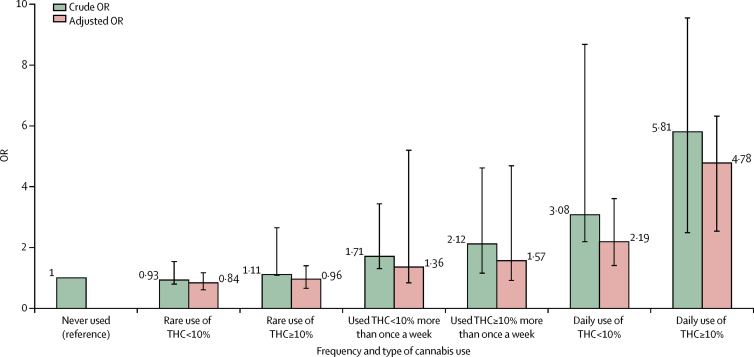
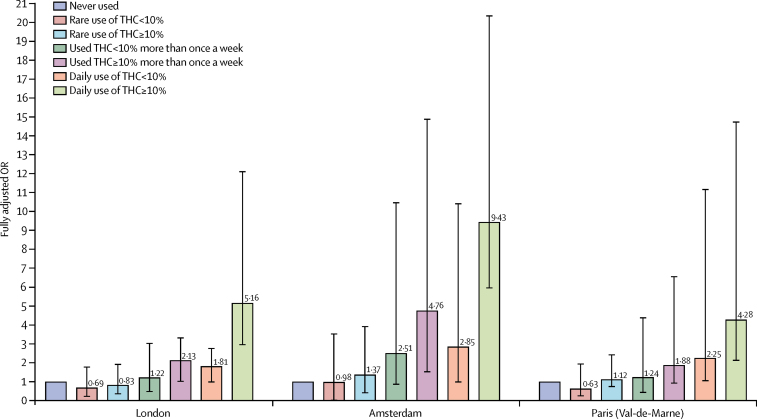
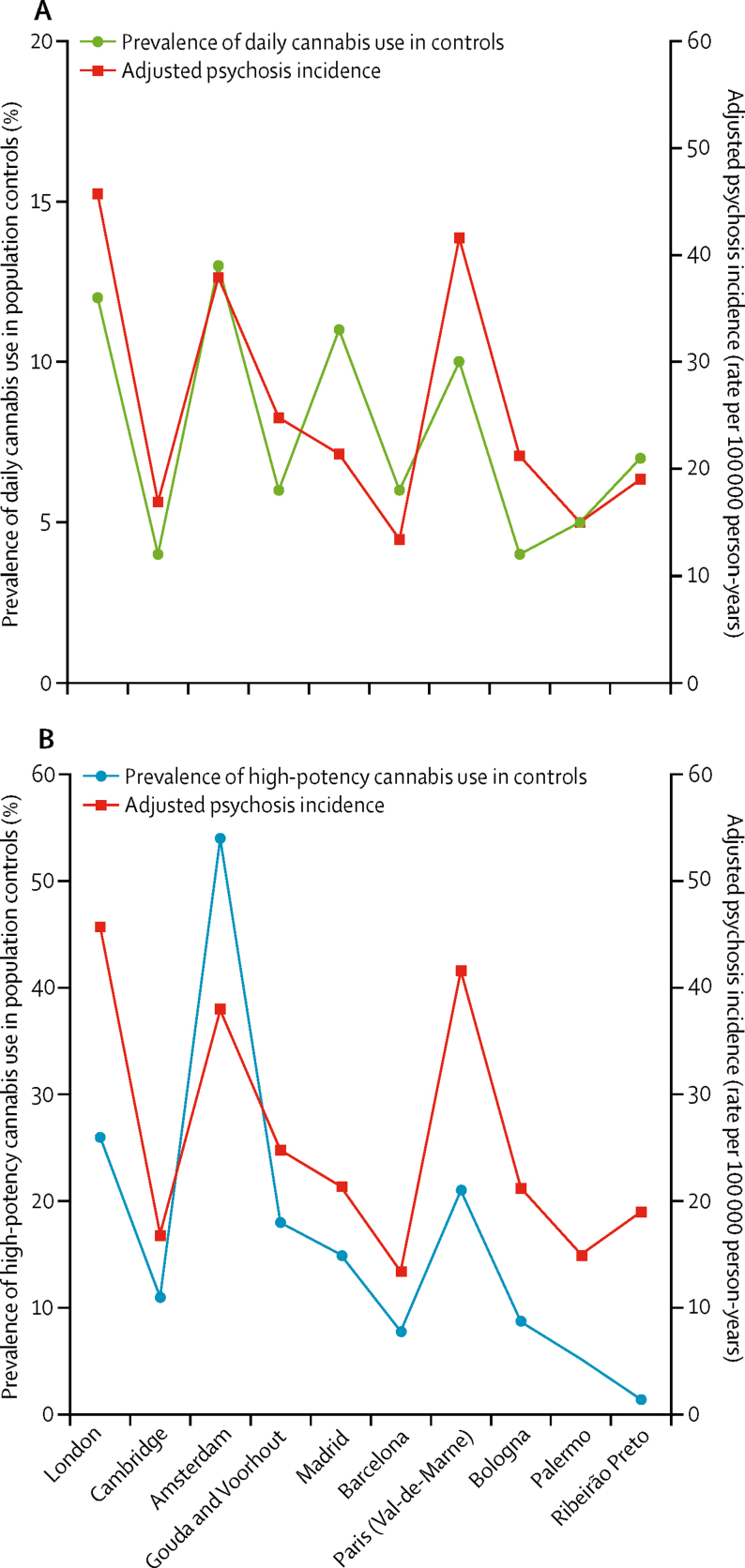
BACKGROUND: Cannabis use is associated with increased risk of later psychotic disorder but whether it affects incidence of the disorder remains unclear. We aimed to identify patterns of cannabis use with the strongest effect on odds of psychotic disorder across Europe and explore whether differences in such patterns contribute to variations in the incidence rates of psychotic disorder. METHODS: -tetrahydrocannabinol (THC) in the different types of cannabis available across the sites, we divided the types of cannabis used by participants into two categories: low potency (THC <10%) and high potency (THC ≥10%). Assuming causality, we calculated the population attributable fractions (PAFs) for the patterns of cannabis use associated with the highest odds of psychosis and the correlation between such patterns and the incidence rates for psychotic disorder across the study sites. FINDINGS: Between May 1, 2010, and April 1, 2015, we obtained data from 901 patients with first-episode psychosis across 11 sites and 1237 population controls from those same sites. Daily cannabis use was associated with increased odds of psychotic disorder compared with never users (adjusted odds ratio [OR] 3·2, 95% CI 2·2-4·1), increasing to nearly five-times increased odds for daily use of high-potency types of cannabis (4·8, 2·5-6·3). The PAFs calculated indicated that if high-potency cannabis were no longer available, 12·2% (95% CI 3·0-16·1) of cases of first-episode psychosis could be prevented across the 11 sites, rising to 30·3% (15·2-40·0) in London and 50·3% (27·4-66·0) in Amsterdam. The adjusted incident rates for psychotic disorder were positively correlated with the prevalence in controls across the 11 sites of use of high-potency cannabis (r = 0·7; p=0·0286) and daily use (r = 0·8; p=0·0109). INTERPRETATION: Differences in frequency of daily cannabis use and in use of high-potency cannabis contributed to the striking variation in the incidence of psychotic disorder across the 11 studied sites. Given the increasing availability of high-potency cannabis, this has important implications for public health. FUNDING SOURCE: Medical Research Council, the European Community's Seventh Framework Program grant, São Paulo Research Foundation, National Institute for Health Research (NIHR) Biomedical Research Centre (BRC) at South London and Maudsley NHS Foundation Trust and King's College London and the NIHR BRC at University College London, Wellcome Trust.
Overview
The claims and statistics of this paper haven’t been checked yet.
Free: it reads the open-access text and checks the first 5 claims that cite a source we can check. Create a free account to check every claim.
Integrity signals
Registry
Cites
Statistics
Figures
Verification
Claims the paper makes
The claims and statistics of this paper haven’t been checked yet.
Free: it reads the open-access text and checks the first 5 claims that cite a source we can check. Create a free account to check every claim.
Claims other papers make about this one
Each is checked against this paper’s own text: does it say what the citing paper says it does?
The source backs part of the claim, not all of it — or backs it for a different population, condition or comparison.
In the citing paper
“Use less than once a week was not associated with a psychotic disorder risk (other than acute psychoses which can emerge even with first time consumption of high THC doses).”
From Cannabis, cannabinoids and health: a review of evidence on risks and medical benefits (2025) · cites this paper as [50]
Experimental — accuracy not yet measuredThe cited source says what the claim attributes to it.
In the citing paper
“The prevalence of daily cannabis use and high potency cannabis use was positively associated with the incidence of treated psychosis across study sites in Europe and Brazil.”
From Cannabis, cannabinoids and health: a review of evidence on risks and medical benefits (2025) · cites this paper as [50]
The cited source says what the claim attributes to it.
In the citing paper
“A multinational study in Europe and Brazil [50] found that daily use of high potency cannabis increased the risk of psychosis fivefold compared to non-users while daily use of low potency cannabis doubled the risk.”
From Cannabis, cannabinoids and health: a review of evidence on risks and medical benefits (2025) · cites this paper as [50]
Self-check
Percentages, sums and reported differences re-computed from the paper’s own numbers.
The self-check needs the paper’s full text.
Citations
Cites
Marshall, M., Lewis, S., Lockwood, A., Drake, R., Jones, P., & Croudace, T. (2005) · Archives of General Psychiatry · doi:10.1001/archpsyc.62.9.975 · Cited by 1,593
Self-citationMcGuffin, P. (1991) · Archives of General Psychiatry · doi:10.1001/archpsyc.1991.01810320088015 · Cited by 1,483
McGrath, J., Saha, S., Welham, J., El Saadi, O., MacCauley, C., & Chant, D. (2004) · BMC Medicine · doi:10.1186/1741-7015-2-13 · Cited by 1,072
Meta-analysis of the Association Between the Level of Cannabis Use and Risk of Psychosis
Marconi, A., Di Forti, M., Lewis, C. M., Murray, R. M., & Vassos, E. (2016) · Schizophrenia Bulletin · doi:10.1093/schbul/sbw003 · Cited by 899
Self-citationDi Forti, M., Marconi, A., Carra, E., Fraietta, S., Trotta, A., Bonomo, M., Bianconi, F., Gardner-Sood, P., O'Connor, J., Russo, M., et al. (2015) · The Lancet Psychiatry · doi:10.1016/s2215-0366(14)00117-5 · Cited by 588
Self-citationHigh-potency cannabis and the risk of psychosis
Di Forti, M., Morgan, C., Dazzan, P., Pariante, C., Mondelli, V., Marques, T. R., Handley, R., Luzi, S., Russo, M., Paparelli, A., et al. (2009) · British Journal of Psychiatry · doi:10.1192/bjp.bp.109.064220 · Cited by 567
Self-citationAssociation Between Cannabis and Psychosis: Epidemiologic Evidence
Gage, S. H., Hickman, M., & Zammit, S. (2016) · Biological Psychiatry · doi:10.1016/j.biopsych.2015.08.001 · Cited by 379
Evaluating the public health impacts of legalizing recreational cannabis use in the United States
Hall, W., & Lynskey, M. (2016) · Addiction · doi:10.1111/add.13428 · Cited by 357
Self-citationTreated Incidence of Psychotic Disorders in the Multinational EU-GEI Study
Jongsma, H. E., Gayer-Anderson, C., Lasalvia, A., Quattrone, D., Mulè, A., Szöke, A., Selten, J.-P., Turner, C., Arango, C., Tarricone, I., et al. (2018) · JAMA Psychiatry · doi:10.1001/jamapsychiatry.2017.3554 · Cited by 335
Self-citationMurray, R. M., Quigley, H., Quattrone, D., Englund, A., & Di Forti, M. (2016) · World Psychiatry · doi:10.1002/wps.20341 · Cited by 315
Self-citation
Cited by
Items 601–700 of 1,000
Evidence of Health Effects Associated with Marijuana Use: A Comprehensive Public Health Review
Holdman, R. (2023) · IntechOpen eBooks · doi:10.5772/intechopen.106250 · Cited by 2
Galhenage, J., & Rodrigo, A. (2022) · Psychiatry Research Case Reports · doi:10.1016/j.psycr.2022.100089 · Cited by 2
Kleine, R., & Hanewinkel, R. (2023) · SUCHT - Zeitschrift für Wissenschaft und Praxis / Journal of Addiction Research and Practice · doi:10.1024/0939-5911/a000818 · Cited by 2
aktaş, S., & Kırlı, U. (2023) · Turkish Journal of Psychiatry · doi:10.5080/u27345 · Cited by 2
Leclerc, L., Fakra, É., Pignon, B., Benyamina, A., Gaillard, R., & Rolland, B. (2024) · L Encéphale · doi:10.1016/j.encep.2023.11.008 · Cited by 2
Self-citationCauses and Outcome of Psychosis
Casetta, C., Kępińska, A. P., Stilo, S. A., & Murray, R. M. (2024) · Cambridge University Press eBooks · doi:10.1017/9781911623861.011 · Cited by 2
Self-citationCannabis Use and Emotions in Romantic Relationships
Ashwal-Malka, A., Braw, Y., & Feingold, D. (2024) · Current Addiction Reports · doi:10.1007/s40429-024-00566-y · Cited by 3
“Specifically, pre-clinical and clinical studies emphasized the negative effect of administrating high Delta-9-Tetrahydrocannabinol (THC) concentration on cognition and behavior [7, 77].”
Billion, Z., & Hein, M. (2024) · L Encéphale · doi:10.1016/j.encep.2024.05.003 · Cited by 2
Freibott, C. E., Jayasinghe, T., Reagan, E. G., Perez, D. C., Berrigan, A., Kline, E. R., Brown, H. E., & Yule, A. M. (2025) · Journal of Dual Diagnosis · doi:10.1080/15504263.2025.2474950 · Cited by 2
“Another study of a program that used principles of assertive community treatment to reach homeless youth experiencing first episode psychosis and SUDs in Canada found that general functioning and mental illness severity improved with engagement in the program, and the majority reached housing stability after 6 months…”
InfluentialDealing with Early-Onset Schizophrenia and the Role of Lurasidone: An Expert Opinion
Filippis, S. D., Serafini, G., Vicari, S., Vita, A., Vitiello, B., & Masi, G. (2025) · Current Neuropharmacology · doi:10.2174/011570159x385722250701114931 · Cited by 2
Sageot, M., Achterhof, R., Hiekkaranta, A. P., Lecei, A., Vansteeland, K., Myin‐Germeys, I., & van Winkel, R. (2025) · Journal of Child Psychology and Psychiatry · doi:10.1111/jcpp.70042 · Cited by 2
A Century of Cannabis Research in Canada
Brewster, J. M. (2019) · The Canadian Journal of Addiction · doi:10.1097/cxa.0000000000000066 · Cited by 2
Talavera, J. O., Roy-García, I. A., Palacios‐Cruz, L., Rivas-Ruíz, R., Hoyo, I., & Pérez‐Rodríguez, M. (2020) · Gaceta Médica de México · doi:10.24875/gmm.m19000304 · Cited by 2
Tobacco cash behind cannabis research in Oxford
Gornall, J. (2020) · BMJ · doi:10.1136/bmj.m1044 · Cited by 2
Assessing the public health effects of cannabis use: can legalization improve the evidence base?
Hickman, M., Hines, L. A., & Gage, S. (2020) · World Psychiatry · doi:10.1002/wps.20744 · Cited by 2
Acute Emergency Department Presentations Related to Cannabis
Randall, K., Roberts, B., & Cienki, J. J. (2020) · Springer eBooks · doi:10.1007/978-3-030-45968-0_6 · Cited by 2
Pain and Psychotic-like Experiences in Young People Using Cannabis
Wilson, J., Constable, T., Mason, K., Ferris, L. J., Quinn, C. A., Hides, L. M., Leung, J., & Carlyle, M. (2022) · International Electronic Conference on Environmental Research and Public Health (ECERPH) · doi:10.3390/ecerph-3-09056 · Cited by 2
“Cannabis use during adolescence has been found to increase the risk of developing psychotic disorders [2], and a strong dose-response relationship has been found between cannabis use and psychotic-like experiences (PLEs) in young people [3,4].”
BackgroundSchmerzmedikamente bei Nierenpatienten
Steffen, P. R. P., & Keller, F. (2021) · DMW - Deutsche Medizinische Wochenschrift · doi:10.1055/a-1388-9889 · Cited by 2
“hochpotentes THC kann psychiatrische Symptome verstärken und das Risiko zur Entwicklung von Psychosen massiv steigern [16].”
BackgroundA Brief Screen to Detect Cannabis Use Disorder Among Incarcerated Youth
Delaney, D., Balestrieri, S. G., Bassett, S. S., & Stein, L. A. R. (2020) · Journal of Child & Adolescent Substance Abuse · doi:10.1080/1067828x.2021.1943587 · Cited by 2
“…functioning, memory; Medina et al., 2007), increased risk for mental health issues (i.e., psychosis and schizophrenia; Colins et al., 2009; Di Forti et al., 2019; Moore et al., 2007), and poorer educational and employment outcomes (Arria et al., 2013; Hara et al., 2013; Hyggen, 2012; Lynskey…”
BackgroundSchizophrenie, schizoaffektive und wahnhafte Störungen
Eusterschulte, B. (2020) · Elsevier eBooks · doi:10.1016/b978-3-437-21273-4.00018-5 · Cited by 2
Psychosocial contributors to cyclic vomiting syndrome
Tarbell, S. E. (2022) · Elsevier eBooks · doi:10.1016/b978-0-12-821597-5.00009-5 · Cited by 2
Cannabis Use and Psychosis – Modern Views on the Problem. Narrative Synthesis
Kolgashkin, A. J., Надеждин, А. В., Tetenova, E. J., Vdovin, A. S., Yusupov, A. A., Sobornikova, E. A., Alekseyuk, V. V., Andryushin, D. A., Barsukova, A. A., Deresh, S. V., et al. (2021) · Medicina · doi:10.29234/2308-9113-2021-9-4-76-100 · Cited by 2
Menores y consumo de cannabis: un análisis por género y edad
Boubeta, A. R. (2022) · Revista Española de Drogodependencias · doi:10.54108/10028 · Cited by 2
Recaídas de pacientes no primeiro episódio psicótico e fatores relacionados: estudo prospectivo
da Silva, A. H. S. (2019) · Digital Library of Theses and Dissertations (Universidade de São Paulo) · doi:10.11606/d.22.2019.tde-22102019-195851 · Cited by 2
Inteligencia emocional como factor protector del consumo de drogas en la adolescencia
González-Yubero, S. (2020) · UCrea (University of Cantabria) · Cited by 2
Editorial: Robust Sensitivities
Lesko, C. R., Cole, S. R., & Schisterman, E. F. (2021) · American Journal of Epidemiology · doi:10.1093/aje/kwab071 · Cited by 2
Ajuste socio-emocional en adolescentes
García, S., & Ángeles, M. D. L. (2020) · RIUR (Universidad de La Rioja) · Cited by 2
Wadsworth, E. (2021) · UWSpace (University of Waterloo) · Cited by 2
Ramalho, F. N. Z. (2023) · Digital Library of Theses and Dissertations (Universidade de São Paulo) · doi:10.11606/d.17.2023.tde-10042023-161129 · Cited by 2
Cannabis use in adolescence : studies of trends, correlates and adverse mental health consequences
Gripe, I. (2023) · Open Archive (Karolinska Institutet) · Cited by 3
Coronado‐Montoya, S. (2024) · Papyrus : Institutional Repository (Université de Montréal) · doi:10.71781/30119 · Cited by 2
Barresi, M., Martinotti, G., Maina, G., & Ricci, V. (2026) · International Journal of Mental Health and Addiction · doi:10.1007/s11469-025-01550-x · Cited by 1
“A landmark study by Di Forti et al. (2019) demonstrated that differences in frequency of daily cannabis use and use of high-potency cannabis contribute significantly to variation in the incidence of psychotic disorders across Europe, with substantial public health implications.”
A Nationwide Study of Inpatient Case Rate Incidence of Cannabis-Related Diagnoses in Switzerland
Pfeifer, P., Auer, R., Baggio, S., & Moggi, F. (2022) · International Journal of Public Health · doi:10.3389/ijph.2022.1605554 · Cited by 1
Establishing a System of Care for Severe and Refractory Dual Disorder in the State of Hawai'i.
Busch, G., & Seo, J. Y. (2022) · PubMed · Cited by 1
Shuhama, R., Rocha, V. H. S., Loureiro, C. M., Zuelli, F. M. D. G. C., Santos, J. L. F., Menezes, P. R., & Del‐Ben, C. M. (2021) · Asian Journal of Psychiatry · doi:10.1016/j.ajp.2021.102823 · Cited by 1
Self-citationKollias, K., Xenaki, L., Stefanatou, P., Vlachos, I., Dimitrakopoulos, S., Selaković, M., Ralli, I., Ntigrintaki, A.-A., & Stefanis, N. C. (2022) · Psychiatriki · doi:10.22365/jpsych.2022.082 · Cited by 1
Watling, C. Z., Hammond, D. G., Turner, S., Nickel, N. C., Woodgate, R. L., & Balneaves, L. G. (2024) · International Journal of Mental Health and Addiction · doi:10.1007/s11469-024-01246-8 · Cited by 1
“With higher potency being associated with greater risk of mental illness (Volkow et al., 2016), psychosis (Di Forti et al., 2019) Fig.”
Seltzberg, H., Ehrie, J., & Goldwaser, E. L. (2024) · Current Behavioral Neuroscience Reports · doi:10.1007/s40473-024-00274-x · Cited by 1
“To quantify this effect, one study examined a sample of 901 patients with first-episode psychosis and 1237 population controls across 11 sites in Europe and South America [29].”
Schizophrenia and Other Primary Psychoses: Clinical Features
Liddle, P. F. (2024) · Cambridge University Press eBooks · doi:10.1017/9781911623861.010 · Cited by 1
Treves, N., Yakirevich-Amir, N., Ahmad, W. A., Bonne, O. B., Davidson, E. M., Keeling, K., Hall, B., Dautrich, T., & Matok, I. (2024) · European Archives of Psychiatry and Clinical Neuroscience · doi:10.1007/s00406-024-01812-0 · Cited by 1
“Di-Forti et al. reported that daily exposure to cannabis was associated with higher rates of psychotic disorders compared with those who reportedly never used cannabis (OR = 3.2, 95%CI 2.2–4.1) [12].”
InfluentialJhalli, A., Sidana, A. K., & Arora, P. (2024) · Journal of Mental Health and Human Behaviour · doi:10.4103/jmhhb.jmhhb_162_24 · Cited by 1
Weißbuch Schizophrenie: Bestandsaufnahme und Zukunftsperspektiven
Häussler, B., Sussmann, S., Wolff, L. L., Weber, V., & KG, M. M. W. V. M. &. C. (2024) · Medizinisch Wissenschaftliche Verlagsgesellschaft eBooks · doi:10.32745/9783954669226 · Cited by 1
Penney, S. R., Jones, R. M., Wilkie, T., Gerritsen, C. J., Chatterjee, S., Chaimowitz, G. A., & Simpson, A. I. F. (2024) · International Journal of Drug Policy · doi:10.1016/j.drugpo.2024.104622 · Cited by 1
Reading and Understanding Health Research: A Critical Approach
Weaver, R. R., & Jia, Q. (2025) · Routledge eBooks · doi:10.4324/9781003595663 · Cited by 1
Silveira, C. M., Castaldelli-Maia, J. M., Siu, E. R., Viana, M. C., Wang, Y., & Andrade, L. H. (2025) · Brazilian Journal of Psychiatry · doi:10.47626/1516-4446-2024-3833 · Cited by 1
Environmental Risk Factors of Psychosis: A Review
Jagieła, B., Bolek, M., Fidyk, M., Kędzia, A., Musialska, D., & Minkiewicz, M. (2025) · Quality in Sport · doi:10.12775/qs.2025.41.60262 · Cited by 1
Recreational Marijuana Laws and Workplace Absence
Brown, M. (2026) · Health Economics · doi:10.1002/hec.70142 · Cited by 1
Palmer, A., Adamson, S. J., Schroder, R., & Wood, L. (2025) · Community Mental Health Journal · doi:10.1007/s10597-025-01494-5 · Cited by 1
Content Analysis of Cannabis Discourses on Twitter/X in the U.S.
Xie, Z., Zhou, R., Yun, Q., Wu, J., Wang, Z., Yu, M., Wilson, K. M., & Li, D. (2025) · AJPM Focus · doi:10.1016/j.focus.2025.100408 · Cited by 1
Adewuya, A. O., Oladipo, O. E., Emsley, R. A., & Asmal, L. (2025) · Schizophrenia Research · doi:10.1016/j.schres.2025.09.030 · Cited by 1
Substance use disorders and unauthorized drug use in an Australian forensic mental health hospital
Hoang, S., Ogloff, J. R. P., & Hew, A. (2025) · Advances in Dual Diagnosis · doi:10.1108/add-08-2025-0040 · Cited by 1
Medicinal cannabinoid use and the risk of developing psychoses and suicidality
Silva, J. P., & Carvalho, F. D. (2025) · Current Opinion in Toxicology · doi:10.1016/j.cotox.2025.100551 · Cited by 1
Ma, Y., West, B. T., & McCabe, S. E. (2025) · Drug and Alcohol Dependence · doi:10.1016/j.drugalcdep.2025.112974 · Cited by 1
“Potential adverse consequences associated with daily cannabis use include development of cannabis use disorder (CUD), cannabis-related psychosis or psychiatric disorders, and impaired driving, among others (Di Forti et al., 2019; Lapham et al., 2023; Sultan et al., 2023).”
Ricci, V., Chiappini, S., Martinotti, G., & Maina, G. (2025) · Healthcare · doi:10.3390/healthcare13243210 · Cited by 1
“Emerging evidence suggests that different classes of psychoactive substances may require distinct therapeutic approaches, challenging the traditional one-size-fits-all paradigm in antipsychotic treat-ment [24].”
Attentional bias in people with moderate-to-severe cannabis use disorder
Quinones‐Valera, M., Chan, G., Fraser, M. I., Jones, A., Freeman, T. P., Hindocha, C., Thomson, H. M., McTavish, E., Sehl, H., Clemente, A., et al. (2025) · Comprehensive Psychiatry · doi:10.1016/j.comppsych.2025.152658 · Cited by 1
Self-citationRicci, V., Berardis, D. D., Martinotti, G., & Maina, G. (2026) · Frontiers in Psychiatry · doi:10.3389/fpsyt.2025.1733254 · Cited by 1
Maestri, T. J., Anderson, D., & Echeverri, M. (2026) · Therapeutic Advances in Psychopharmacology · doi:10.1177/20451253251394296 · Cited by 1
“16–19 Future studies could target antipsychotic prescribing patterns in individuals who use THC versus those who do not.”
Exploring the roots of schizophrenia: Current research and future directions (Review)
Lv, S., & Luo, C. (2026) · Experimental and Therapeutic Medicine · doi:10.3892/etm.2026.13078 · Cited by 1
Challenges in establishing a link between THC exposure and cannabis use disorder
Manthey, J., Schranz, A., & Wardell, J. D. (2026) · Addiction · doi:10.1111/add.70364 · Cited by 1
Cannabis Use Disorders in China from 1990 to 2040: Incidence Trends and Future Projections
Hua, Z. (2026) · Substance Use & Misuse · doi:10.1080/10826084.2026.2634983 · Cited by 1
“CUDs can result in a range of adverse health effects, including cognitive impairments (Meier et al., 2012), physical complications (Monte et al., 2019), emotional dysfunction (Volkow et al., 2014), and psychiatric disorders (Di Forti et al., 2019).”
Socio-Cultural Predictors of First-Episode Psychosis and Symptom Severity
Mohammad, A., Khan, I., & Ayub, S. (2026) · Journal of College of Physicians And Surgeons Pakistan · doi:10.29271/jcpsp.2026.03.346 · Cited by 1
Armanino-Irigaray, M., Catalán, A., Aymerich, C., Pedruzo, B., Argüelles, I., Ramírez, A., Armyra, E., Gonzalez-Torres, M. A., & de Pablo, G. S. (2026) · Child and Adolescent Psychiatry and Mental Health · doi:10.1186/s13034-026-01060-1 · Cited by 1
“While the association between cannabis and psychosis has been robustly demonstrated [21], the potential role of hallucinogenic substances remains comparatively under-studied, particularly in younger populations.”
Ricci, V., Martinotti, G., & Maina, G. (2026) · Addictive Behaviors · doi:10.1016/j.addbeh.2026.108699 · Cited by 1
Zuelli, F. M. D. G. C., Duran, F. L. S., Damasceno, E. Z., Shuhama, R., Loureiro, C. M., dos Santos, A. C., Menezes, P. R., Louzada-Júnior, P., Busatto, G. F., & Del‐Ben, C. M. (2026) · Brain Behavior and Immunity · doi:10.1016/j.bbi.2026.106573 · Cited by 1
Self-citationKim, S., Saad, B., & Kelada, A. (2026) · Addictive Behaviors · doi:10.1016/j.addbeh.2026.108724 · Cited by 1
Wadsworth, E., Hines, L. A., Hammond, D. G., & Freeman, T. P. (2026) · Harm Reduction Journal · doi:10.1186/s12954-026-01456-4 · Cited by 1
Self-citationStructural Neuroimaging in Substance-Induced Psychosis
Atmaca, M., & Tabara, M. F. (2026) · Current Psychiatry Reports · doi:10.1007/s11920-026-01678-0 · Cited by 1
“An important consideration in substance-induced psychosis is the dose–response rela - tionship in cannabis use, as the risk of psychosis has been shown to increase significantly with higher levels of tetra - hydrocannabinol (THC) [ 7, 8 ].”
Annual Incidence of First Episode of Psychosis Presenting to a Community Mental Health Center
Pakou, I., Karampas, A., Gkopis, V., Petrikis, P., & Hyphantis, T. N. (2026) · Primary and Hospital Care · doi:10.3390/phc25010003 · Cited by 1
“…services, such as emergency or addiction services, rather than to CMHCs. Cannabis use, in particular, has been consistently associated with increased risk for psychosis and is commonly reported in FEP cohorts, highlighting the need for careful assessment in early intervention settings [20].”
Ferrara, P., Scaltrito, F., Pastore, M., Giardino, I., Cannito, S., Cammisa, I., Serra, G., Corsello, G., & Zona, M. (2026) · Global Pediatrics · doi:10.1016/j.gpeds.2026.100339 · Cited by 1
Ricci, V., Sarni, A., Fraccalini, T., & Maina, G. (2026) · Journal of Mental Health · doi:10.1080/09638237.2026.2672339 · Cited by 1
Śniadach, J., Szymkowiak, S., Osip, P., Orlof, W., & Waszkiewicz, N. (2026) · Frontiers in Psychiatry · doi:10.3389/fpsyt.2026.1778831 · Cited by 1
Hyatt, A. S., Flores, M. W., Overhage, L., Bien-Aimé, D. D. R., Evins, A. E., Öngür, D., & Cook, B. L. (2026) · Nature Mental Health · doi:10.1038/s44220-026-00673-x · Cited by 1
“High-potency cannabis use has much stronger associations with relapse and poorer psychosis outcomes than low-potency exposure 39–41 , highlighting harm reduction opportunities in the legal market.”
Sex-specific vulnerabilities in cannabis-induced psychosis: A scoping review
Ricci, V., Berardis, D. D., Martinotti, G., & Maina, G. (2026) · Asian Journal of Psychiatry · doi:10.1016/j.ajp.2026.105086 · Cited by 1
Pulido, L., Jandrisevits, M. D., Valenti, S. M., Manak, C. K., & Sandage, S. J. (2026) · Cureus · doi:10.7759/cureus.112367 · Cited by 1
“A European study of 901 patients with first-episode psychosis found that daily cannabis use was associated with increased odds of psychotic disorder compared with never-users (OR: 3.2; 95% CI: 2.2-4.1) and especially with high-potency cannabis (OR: 4.8; 95% CI: 2.5-6.3) [9 ].”
InfluentialCannabis, psychosis, and violence: case reports and comprehensive evidence review
Finn, K. P., Murray, R. M., Stuyt, E. B., & Randall, K. (2026) · Frontiers in Psychiatry · doi:10.3389/fpsyt.2026.1824748 · Cited by 1
“Daily users of high-potency cannabis exceeding 10% THC have approximately 5 times higher risk of psychotic disorder compared with never-users, with a clear dose-response relationship between potency and psychiatric outcomes (29).”
Self-citationWillert, A., von Hardenberg, L., Holzner, L., Kallenbach, M., Reichert, E., Bechdolf, A., & Leopold, K. (2026) · Early Intervention in Psychiatry · doi:10.1111/eip.70240 · Cited by 1
Wadsworth, E., Hammond, D. G., & Freeman, T. P. (2026) · Psychological Medicine · doi:10.1017/s0033291726105327 · Cited by 1
Self-citationAn etiological approach to psychosis: potential benefits for treatment, research and prevention
Murray, R. M., Oliver, D., Dima, A., & Alameda, L. (2026) · World Psychiatry · doi:10.1002/wps.70079 · Cited by 1
“Epidemiological studies have consistently shown a relation ship between cannabis use and the development of psychosis, with increased risks ranging from 1.5 to 9 51,52 .”
InfluentialSelf-citationCannabis for Medical Use: A Recent Overview
Dietmaier, O., & Laux, G. (2025) · Psychopharmakotherapie · doi:10.52778/ppt20250023 · Cited by 1
Daily Cannabis use Adversely Affects Mental Health
Rosenberg, K. E. (2019) · AJN American Journal of Nursing · doi:10.1097/01.naj.0000569460.86862.a4 · Cited by 1
Drugs—without the hot air: minimising the harms of legal and illegal drugs
Wong, C. (2019) · Practical Neurology · doi:10.1136/practneurol-2019-002288 · Cited by 1
Medical cannabis: A new frontier for pharmacists
Nichols, J. (2019) · Pharmacy Today · doi:10.1016/j.ptdy.2019.09.022 · Cited by 1
Бохан, Н. А., Селиванов, Г. Ю., Лаврова, У. А. Л., & Сальников, А. А. С. (2019) · Сибирский вестник психиатрии и наркологии · doi:10.26617/1810-3111-2019-4(105)-34-44 · Cited by 1
Looking at Marijuana Through the Lens of Public Health
Brooks, E. A., & Sørheim, S. E. (2020) · Springer eBooks · doi:10.1007/978-3-030-45968-0_18 · Cited by 1
Cannabinoid and Marijuana Neurobiology
Madras, B. K. (2020) · Springer eBooks · doi:10.1007/978-3-030-45968-0_2 · Cited by 2
Pearlson, G. D. (2020) · Elsevier eBooks · doi:10.1016/b978-0-12-818174-4.00002-1 · Cited by 1
Considerations for the Intersection of Sedation and Marijuana
McGeeney, B. E., & Lynn, R. R. (2021) · Springer eBooks · doi:10.1007/978-3-030-58406-1_44 · Cited by 1
Online survey into developing a model for a legal cannabis market in the United Kingdom
James, E., Robertshaw, T. L., Pascoe, M. J., Chapman, F., Westwell, A. D., Hoskins, M. D., Barrow, J., Sessa, B., Doblin, R., Rosky, R., et al. (2021) · Drug Science Policy and Law · doi:10.1177/20503245211034931 · Cited by 1
“…87% supported pharmacies aiding cannabis users by providing integrated mental health services to help monitor and reduce the likelihood of the emergence of cannabis-related mental health conditions such as psychosis (Bruins et al., 2016; Buckner et al, 2016; Di Forti et al., 2019; Gage, 2019).”
BackgroundLeiker, M. W. (2021) · Digital Commons (Liberty University) · Cited by 1
Cannabinoids: The Case for Legal Regulation That Permits Recreational Adult Use
Gregory, T. T., O’Malley, K. Y., Medina-Kirchner, C., Grifell, M., & Hart, C. L. (2022) · Springer eBooks · doi:10.1007/978-3-030-84834-7_13 · Cited by 1
Kuhn, J., Leopold, K., Janetzky, W., & Wietfeld, R. (2022) · Nervenheilkunde · doi:10.1055/a-1651-9979 · Cited by 1
Moving Beyond the War on Drugs? The Rhetoric and Reality of Harm Minimisation in Australia
Meadows, E., Kizimchuk, Z., O’Reilly, J., Bartkowiak-Théron, I., & Varney, S. (2022) · Springer eBooks · doi:10.1007/978-3-030-83913-0_12 · Cited by 1
Pogarell, O. M., Koller, G., & Adorjan, K. (2020) · PSYCH up2date · doi:10.1055/a-1103-6956 · Cited by 1
Pogarell, O. M., Koller, G., & Adorjan, K. (2022) · Suchttherapie · doi:10.1055/a-1912-0382 · Cited by 1
Legalizing Harmful Drugs: Government Participation and Optimal policies
Arnabal, L. R. (2022) · The B E Journal of Economic Analysis & Policy · doi:10.1515/bejeap-2021-0309 · Cited by 1
Kollias, K., Stefanatou, P., Xenaki, L., Vlachos, I. P., Ermiliou, V., Theleritis, C. G., Kosteletos, I., & Stefanis, N. C. (2022) · Psychiatriki · doi:10.22365/jpsych.2022.102 · Cited by 1
Cannabis Use in Transplantation
Sotelo, J. L., & Bilbul, M. (2022) · Springer eBooks · doi:10.1007/978-3-031-15052-4_21 · Cited by 1
El uso terapéutico del cannabis y los cannabinoides
Silva, J. P., & Carvalho, F. D. (2022) · Revista Española de Drogodependencias · doi:10.54108/10031 · Cited by 1
Cannabinoid-induced psychotic disorder: A descriptive study
Mohanty, N. G., Nayak, M. R., & Mahanta, D. (2022) · Odisha Journal of Psychiatry · doi:10.4103/ojp.ojp_9_22 · Cited by 1
Oh, H. Y., Du, J., Karcher, N. R., van der Ven, E., DeVylder, J., Smith, L., & Koyanagi, A. (2023) · Social Psychiatry and Psychiatric Epidemiology · doi:10.1007/s00127-023-02483-3 · Cited by 1
“In terms of cannabis use, consistent evidence shows that cannabis use is also linked to psychosis [17–24], where psychotic illness is more common in people who use cannabis compared to those who do not use cannabis, that cannabis use and risk of developing psychotic illness have a dose-dependent…”
Background
Metadata
- Authors
- Di Forti, M., Quattrone, D., Freeman, T. P., Tripoli, G., Gayer-Anderson, C., Quigley, H., Rodriguez, V., Jongsma, H. E., Ferraro, L., La Cascia, C., La Barbera, D., Tarricone, I., Berardi, D., Szöke, A., Arango, C., Tortelli, A., Velthorst, E., Bernardo, M., Del-Ben, C. M., Menezes, P. R., Selten, J.-P., Jones, P. B., Kirkbride, J. B., Rutten, B. P., de Haan, L., Sham, P. C., van Os, J., Lewis, C. M., Lynskey, M., Morgan, C., Murray, R. M., Amoretti, S., Arrojo, M., Baudin, G., Beards, S., Bernardo, M., Bobes, J., Bonetto, C., Cabrera, B., Carracedo, A., Charpeaud, T., Costas, J., Cristofalo, D., Cuadrado, P., Díaz-Caneja, C. M., Ferchiou, A., Franke, N., Frijda, F., García Bernardo, E., Garcia-Portilla, P., González, E., Hubbard, K., Jamain, S., Jiménez-López, E., Leboyer, M., López Montoya, G., Lorente-Rovira, E., Marcelino Loureiro, C., Marrazzo, G., Martínez, C., Matteis, M., Messchaart, E., Moltó, M. D., Nacher, J., Olmeda, M. S., Parellada, M., González Peñas, J., Pignon, B., Rapado, M., Richard, J.-R., Rodríguez Solano, J. J., Roldán Díaz, L., Ruggeri, M., Sáiz, P. A., Sánchez, E., Sanjuán, J., Sartorio, C., Schürhoff, F., Seminerio, F., Shuhama, R., Sideli, L., Stilo, S. A., Termorshuizen, F., Tosato, S., Tronche, A.-M., van Dam, D., & van der Ven, E.
- Affiliations
- King's College London (GB)
- University of Bath (GB)
- University of Cambridge (GB)
- University of Palermo (IT)
- University of Bologna (IT)
- Hospital General Universitario Gregorio Marañón (ES)
- Amsterdam UMC Location University of Amsterdam (NL)
- Universidade de São Paulo (BR)
- University College London (GB)
- Maastricht University Medical Centre (NL)
- ORCID
- Quattrone, Diego
- Freeman, Tom P
- Tripoli, Giada
- Gayer-Anderson, Charlotte
- Quigley, Harriet
- Jongsma, Hannah E
- Ferraro, Laura
- Tarricone, Ilaria
- Berardi, Domenico
- Arango, Celso
- Tortelli, Andrea
- Velthorst, Eva
- Menezes, Paulo Rossi
- Selten, Jean-Paul
- Jones, Peter B
- Kirkbride, James B
- Rutten, Bart PF
- Sham, Pak C
- Lewis, Cathryn M
- Lynskey, Michael
- Morgan, Craig
- Murray, Robin M
- Arrojo, Manuel
- Baudin, Grégoire
- Beards, Stephanie
- Bobes, Julio
- Bonetto, Chiara
- Cabrera, Bibiana
- Charpeaud, Thomas
- Costas, Javier
- Cuadrado, Pedro
- Hubbard, Kathryn
- Jamain, Stéphane
- Leboyer, Marion
- Lorente-Rovira, Esther
- Marrazzo, Giovanna
- Matteis, Mario
- Parellada, Mara
- Pignon, Baptiste
- Richard, Jean-Romain
- Ruggeri, Mirella
- Sáiz, Pilar A.
- Sanjuán, Julio
- Sartorio, Crocettarachele
- Schürhoff, Franck
- Shuhama, Rosana
- Sideli, Lucia
- Termorshuizen, Fabian
- Tosato, Sarah
- Tronche, Anne-Marie
- Venue
- The Lancet Psychiatry
- Publisher
- Elsevier BV
- Published
- 2019-05
- Volume
- 6
- Issue
- 5
- Pages
- 427-436
- ISSN
- 2215-0366 (ISSN-L)
- PMC
- PMC7646282
- OpenAlex
- W2922855419
- Cited by
- 875
- References
- 32
- Citations by year
- 2026: 92 · 2025: 92 · 2024: 105 · 2023: 126 · 2022: 144 · 2021: 122 · 2020: 121 · 2019: 72
- FWCI
- 71.07
- Type
- journal article
- Language
- en
- Open access
- hybrid
- doi.org
- Licence
- cc-by
- www.elsevier.com/tdm/userlicense/1.0/ (tdm)
- www.elsevier.com/legal/tdmrep-license (tdm)
- creativecommons.org/licenses/by/4.0/ (vor)
- Locations
- The Lancet Psychiatry (publishedVersion, cc-by)
- PubMed Central (publishedVersion, cc-by)
- PubMed (publishedVersion)
- Research Publications (Maastricht University) (publishedVersion, cc-by)
- Nova Science Publishers (Nova Science Publishers, Inc.) (submittedVersion, other-oa)
- Minerva Access (University of Melbourne) (submittedVersion, cc-by)
- Repository of Digital Objects for Teaching Research and Culture (University of Valencia) (submittedVersion, cc-by-nc)
- Data Archiving and Networked Services (DANS) (submittedVersion, other-oa)
- Archivio istituzionale della ricerca (Alma Mater Studiorum Università di Bologna) (submittedVersion, cc-by)
- Utrecht University Repository (Utrecht University) (submittedVersion, other-oa)
- UCL Discovery (University College London) (submittedVersion)
- UNICA IRIS Institutional Research Information System (University of Cagliari) (submittedVersion)
- Research Portal (King's College London) (submittedVersion, cc-by)
- Pure Amsterdam UMC (submittedVersion, other-oa)
- Apollo (University of Cambridge) (submittedVersion, cc-by)
- Research Publications (Maastricht University) (submittedVersion, other-oa)
- Utrecht University Repository (Utrecht University) (submittedVersion, cc-by)
- Apollo (cc-by)
- Funders
- Wellcome Trust (101272/Z/12/Z)
- Seventh Framework Programme (HEALTH-F2-2009-241909)
- Medical Research Council
- National Institute for Health and Care Research
- King's College London
- South London and Maudsley NHS Foundation Trust
- Fundação de Amparo à Pesquisa do Estado de São Paulo (2012/0417-0)
- Topics
- Health Sciences › Medicine › Pharmacology (medical) › Cannabis and Cannabinoid Research
- Health Sciences › Medicine › Psychiatry and Mental health › Schizophrenia research and treatment
- Life Sciences › Pharmacology, Toxicology and Pharmaceutics › Toxicology › Forensic Toxicology and Drug Analysis
- Keywords
- cannabis use, psychosis, first-episode psychosis, incidence, high-potency cannabis, tetrahydrocannabinol, daily cannabis use, population attributable fraction, cannabis availability, psychosis prevention, Europe, London, Amsterdam
- MeSH terms
- Adult, Brazil, Marijuana Abuse, Europe, Female, Humans, Male, Middle Aged, Psychotic Disorders, Incidence, Odds Ratio, Case-Control Studies, Young Adult
About these checks
Registry, retraction, Cites and statistics results are computed, not judged, with one exception: a printed reference that no index lists is read once by a model before it counts as a citation error. Claims are extracted by a model and kept only when their quote appears verbatim in the text; each cited source is then checked, with a model’s help, for whether it says what the claim relies on. Those verdicts can be wrong — read the claim’s quote and the cited source before relying on one.
Statistics and arithmetic are recomputed, not judged.
Confidence bands are shown only for fields calibrated on our annotated test set. None is calibrated yet, so no band is shown.
What counts as a claim ›How we measure confidence ›How we check this ›
Are you an author, or do you see a problem with this page? Request a review
Data sources
Bibliographic data: Semantic Scholar, OpenAlex, Crossref.
Contains information from the Semantic Scholar Academic Graph Datasets, made available under the ODC Attribution License (ODC-BY 1.0).
Semantic Scholar’s data is described in: Kinney, R., et al. (2023). The Semantic Scholar Open Data Platform. arXiv:2301.10140.
