

The contribution of cannabis use to variation in the incidence of psychotic disorder across Europe (EU-GEI): a multicentre case-control study
Open accessThe DOI matches its Crossref record; 32 of the 32 references it cites were found in a registry or an index.
Abstract
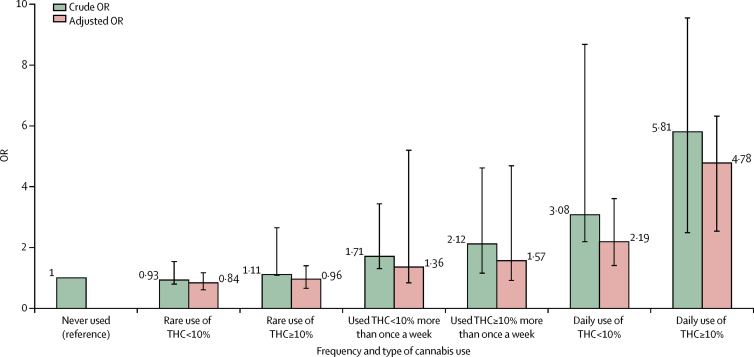
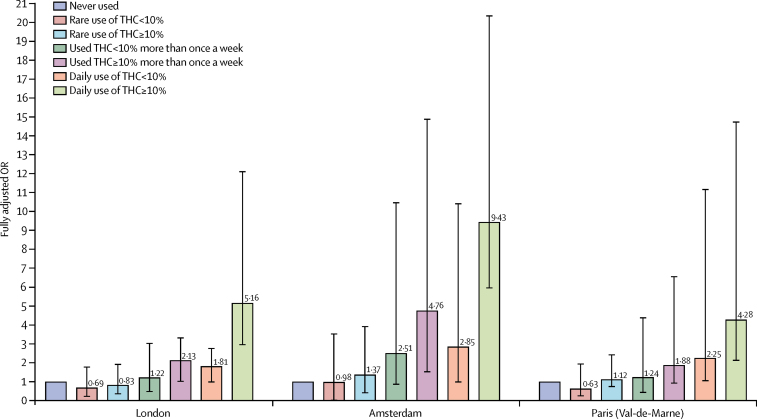
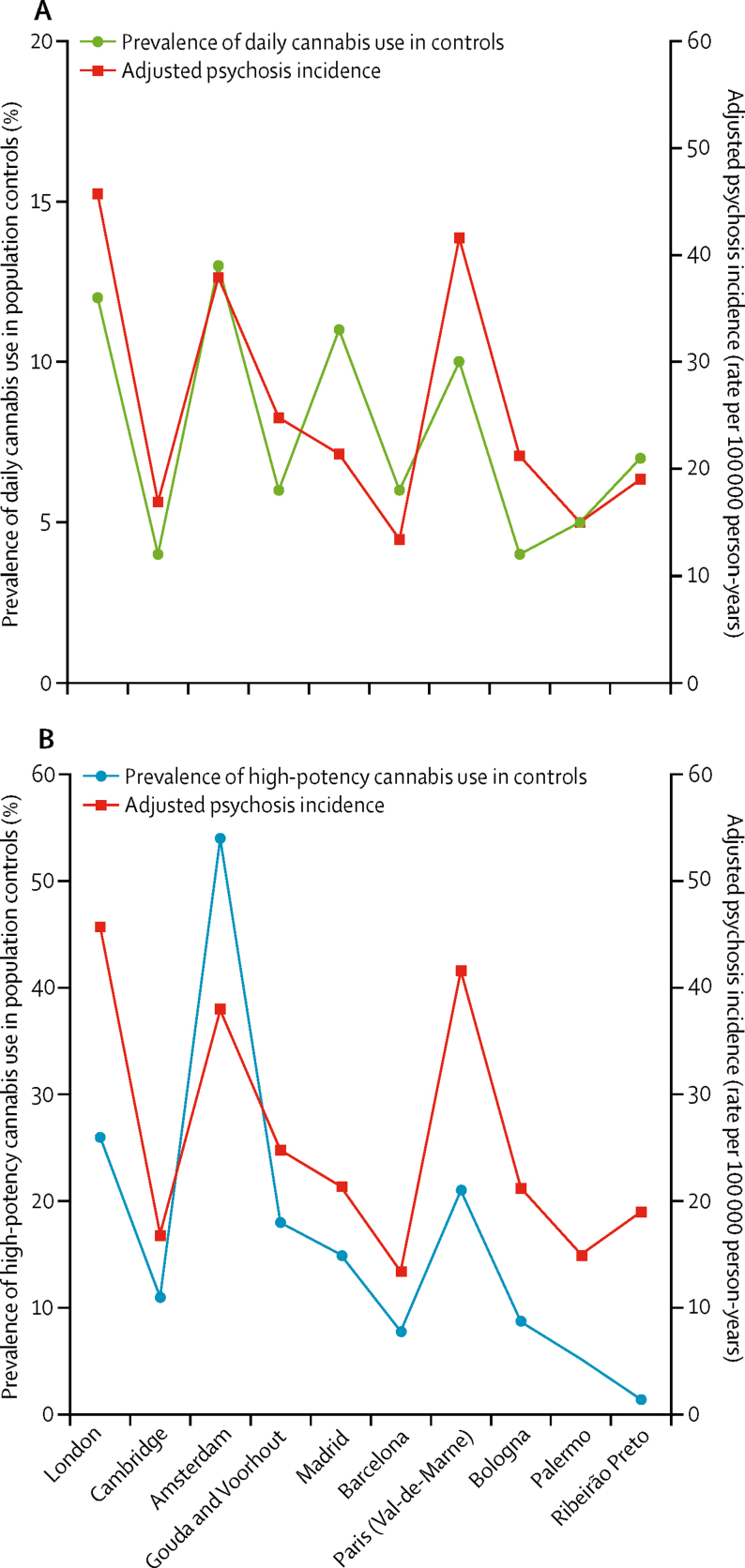
BACKGROUND: Cannabis use is associated with increased risk of later psychotic disorder but whether it affects incidence of the disorder remains unclear. We aimed to identify patterns of cannabis use with the strongest effect on odds of psychotic disorder across Europe and explore whether differences in such patterns contribute to variations in the incidence rates of psychotic disorder. METHODS: -tetrahydrocannabinol (THC) in the different types of cannabis available across the sites, we divided the types of cannabis used by participants into two categories: low potency (THC <10%) and high potency (THC ≥10%). Assuming causality, we calculated the population attributable fractions (PAFs) for the patterns of cannabis use associated with the highest odds of psychosis and the correlation between such patterns and the incidence rates for psychotic disorder across the study sites. FINDINGS: Between May 1, 2010, and April 1, 2015, we obtained data from 901 patients with first-episode psychosis across 11 sites and 1237 population controls from those same sites. Daily cannabis use was associated with increased odds of psychotic disorder compared with never users (adjusted odds ratio [OR] 3·2, 95% CI 2·2-4·1), increasing to nearly five-times increased odds for daily use of high-potency types of cannabis (4·8, 2·5-6·3). The PAFs calculated indicated that if high-potency cannabis were no longer available, 12·2% (95% CI 3·0-16·1) of cases of first-episode psychosis could be prevented across the 11 sites, rising to 30·3% (15·2-40·0) in London and 50·3% (27·4-66·0) in Amsterdam. The adjusted incident rates for psychotic disorder were positively correlated with the prevalence in controls across the 11 sites of use of high-potency cannabis (r = 0·7; p=0·0286) and daily use (r = 0·8; p=0·0109). INTERPRETATION: Differences in frequency of daily cannabis use and in use of high-potency cannabis contributed to the striking variation in the incidence of psychotic disorder across the 11 studied sites. Given the increasing availability of high-potency cannabis, this has important implications for public health. FUNDING SOURCE: Medical Research Council, the European Community's Seventh Framework Program grant, São Paulo Research Foundation, National Institute for Health Research (NIHR) Biomedical Research Centre (BRC) at South London and Maudsley NHS Foundation Trust and King's College London and the NIHR BRC at University College London, Wellcome Trust.
Overview
The claims and statistics of this paper haven’t been checked yet.
Free: it reads the open-access text and checks the first 5 claims that cite a source we can check. Create a free account to check every claim.
Integrity signals
Registry
Cites
Statistics
Figures
Verification
Claims the paper makes
The claims and statistics of this paper haven’t been checked yet.
Free: it reads the open-access text and checks the first 5 claims that cite a source we can check. Create a free account to check every claim.
Claims other papers make about this one
Each is checked against this paper’s own text: does it say what the citing paper says it does?
The source backs part of the claim, not all of it — or backs it for a different population, condition or comparison.
In the citing paper
“Use less than once a week was not associated with a psychotic disorder risk (other than acute psychoses which can emerge even with first time consumption of high THC doses).”
From Cannabis, cannabinoids and health: a review of evidence on risks and medical benefits (2025) · cites this paper as [50]
Experimental — accuracy not yet measuredThe cited source says what the claim attributes to it.
In the citing paper
“The prevalence of daily cannabis use and high potency cannabis use was positively associated with the incidence of treated psychosis across study sites in Europe and Brazil.”
From Cannabis, cannabinoids and health: a review of evidence on risks and medical benefits (2025) · cites this paper as [50]
The cited source says what the claim attributes to it.
In the citing paper
“A multinational study in Europe and Brazil [50] found that daily use of high potency cannabis increased the risk of psychosis fivefold compared to non-users while daily use of low potency cannabis doubled the risk.”
From Cannabis, cannabinoids and health: a review of evidence on risks and medical benefits (2025) · cites this paper as [50]
Self-check
Percentages, sums and reported differences re-computed from the paper’s own numbers.
The self-check needs the paper’s full text.
Citations
Cites
Marshall, M., Lewis, S., Lockwood, A., Drake, R., Jones, P., & Croudace, T. (2005) · Archives of General Psychiatry · doi:10.1001/archpsyc.62.9.975 · Cited by 1,593
Self-citationMcGuffin, P. (1991) · Archives of General Psychiatry · doi:10.1001/archpsyc.1991.01810320088015 · Cited by 1,483
McGrath, J., Saha, S., Welham, J., El Saadi, O., MacCauley, C., & Chant, D. (2004) · BMC Medicine · doi:10.1186/1741-7015-2-13 · Cited by 1,072
Meta-analysis of the Association Between the Level of Cannabis Use and Risk of Psychosis
Marconi, A., Di Forti, M., Lewis, C. M., Murray, R. M., & Vassos, E. (2016) · Schizophrenia Bulletin · doi:10.1093/schbul/sbw003 · Cited by 899
Self-citationDi Forti, M., Marconi, A., Carra, E., Fraietta, S., Trotta, A., Bonomo, M., Bianconi, F., Gardner-Sood, P., O'Connor, J., Russo, M., et al. (2015) · The Lancet Psychiatry · doi:10.1016/s2215-0366(14)00117-5 · Cited by 588
Self-citationHigh-potency cannabis and the risk of psychosis
Di Forti, M., Morgan, C., Dazzan, P., Pariante, C., Mondelli, V., Marques, T. R., Handley, R., Luzi, S., Russo, M., Paparelli, A., et al. (2009) · British Journal of Psychiatry · doi:10.1192/bjp.bp.109.064220 · Cited by 567
Self-citationAssociation Between Cannabis and Psychosis: Epidemiologic Evidence
Gage, S. H., Hickman, M., & Zammit, S. (2016) · Biological Psychiatry · doi:10.1016/j.biopsych.2015.08.001 · Cited by 379
Evaluating the public health impacts of legalizing recreational cannabis use in the United States
Hall, W., & Lynskey, M. (2016) · Addiction · doi:10.1111/add.13428 · Cited by 357
Self-citationTreated Incidence of Psychotic Disorders in the Multinational EU-GEI Study
Jongsma, H. E., Gayer-Anderson, C., Lasalvia, A., Quattrone, D., Mulè, A., Szöke, A., Selten, J.-P., Turner, C., Arango, C., Tarricone, I., et al. (2018) · JAMA Psychiatry · doi:10.1001/jamapsychiatry.2017.3554 · Cited by 335
Self-citationMurray, R. M., Quigley, H., Quattrone, D., Englund, A., & Di Forti, M. (2016) · World Psychiatry · doi:10.1002/wps.20341 · Cited by 315
Self-citation
Cited by
Items 101–200 of 1,000
Illicit Drug Use and Associated Problems in the Nightlife Scene: A Potential Setting for Prevention
Feltmann, K., Elgán, T. H., Strandberg, A. K., Kvillemo, P., Jayaram‐Lindström, N., Grabski, M., Waldron, J., Freeman, T. P., Curran, V. H., & Gripenberg, J. (2021) · International Journal of Environmental Research and Public Health · doi:10.3390/ijerph18094789 · Cited by 46
Self-citationRodríguez, V., Alameda, L., Quattrone, D., Tripoli, G., Gayer-Anderson, C. E., Spinazzola, E., Trotta, G., Jongsma, H. E., Stilo, S. A., Cascia, C. L., et al. (2022) · Psychological Medicine · doi:10.1017/s0033291721005456 · Cited by 45
“…and further information about the methodology of the study is available on the EU-GEI website (http://www.eu-gei.eu/) and can be found in previous publications (Di Forti et al., 2019; Gayer-Anderson et al., 2020; Jongsma, Gayer-Anderson, Lasalvia, Quattrone, & Mulè, 2018; Quattrone et al., 2018).”
MethodSelf-citationAge-dependent association of cannabis use with risk of psychotic disorder
McDonald, A. J., Kurdyak, P. A., Rehm, J. T., Roerecke, M., & Bondy, S. J. (2024) · Psychological Medicine · doi:10.1017/s0033291724000990 · Cited by 45
“…population-attributable risk fraction of cannabis use disorder in schizophrenia has increased over time due to increasing potency (Hjorthøj et al., 2021), and that high-potency cannabis contributes significantly to variation in the incidence of psychotic disorders in Europe (Di Forti et al., 2019).”
BackgroundGonçalves‐Pinho, M., Bragança, M., & Freitas, A. (2020) · International Journal of Methods in Psychiatric Research · doi:10.1002/mpr.1813 · Cited by 33
“Cannabis properties also play a role with the incidence of a first psychotic event being linked to the dosage of the cannabis used by the patient (Andreasson, Allebeck, Engstrom, & Rydberg, 1987; Di Forti et al., 2019; Roncero et al., 2018; Zammit, Allebeck, Andreasson, Lundberg, & Lewis, 2002).”
BackgroundTripoli, G., Quattrone, D., Ferraro, L., Gayer-Anderson, C. E., Cascia, C. L., Barbera, D. L., Sartorio, C., Seminerio, F., Rodríguez, V., Tarricone, I., et al. (2022) · Schizophrenia Bulletin · doi:10.1093/schbul/sbac022 · Cited by 45
Self-citationKöck, P., Meyer, M., Elsner, J., Dürsteler, K. M., Vogel, M., & Walter, M. (2022) · Frontiers in Psychiatry · doi:10.3389/fpsyt.2022.827658 · Cited by 43
Evaluation of State Cannabis Laws and Rates of Self-harm and Assault
Matthay, E. C., Kiang, M. V., Elser, H. C., Schmidt, L. A., & Humphreys, K. N. (2021) · JAMA Network Open · doi:10.1001/jamanetworkopen.2021.1955 · Cited by 43
González–Ortega, I., Echeburúa, E., Alberich, S., Bernardo, M., Vieta, E., de Pablo, G. S., & González-Pinto, A. M. (2022) · International Journal of Environmental Research and Public Health · doi:10.3390/ijerph19127325 · Cited by 42
Self-citationWang, G. S., Buttorff, C., Wilks, A., Schwam, D., Tung, G. J., & Pacula, R. L. (2022) · International Journal of Drug Policy · doi:10.1016/j.drugpo.2022.103685 · Cited by 42
Jeste, D. V., Malaspina, D., Bagot, K. S., Barch, D. M., Cole, S. W., Dickerson, F., Dilmore, A. H., Ford, C. L., Karcher, N. R., Luby, J. L., et al. (2023) · Schizophrenia Bulletin · doi:10.1093/schbul/sbad031 · Cited by 43
A systematic review of cannabidiol trials in neurodevelopmental disorders
Parrella, N.-F., Hill, A. T., Enticott, P. G., Barhoun, P., Bower, I. S., & Ford, T. C. (2023) · Pharmacology Biochemistry and Behavior · doi:10.1016/j.pbb.2023.173607 · Cited by 44
Callaghan, R. C., Sanches, M., Murray, R. M., Konefal, S., Maloney-Hall, B., & Kish, S. J. (2022) · The Canadian Journal of Psychiatry · doi:10.1177/07067437211070650 · Cited by 41
Self-citationJohnstad, P. G. (2024) · Frontiers in Public Health · doi:10.3389/fpubh.2023.1268339 · Cited by 41
The emergency department care of the cannabis and synthetic cannabinoid patient: a narrative review
Takakuwa, K. M., & Schears, R. M. (2021) · International Journal of Emergency Medicine · doi:10.1186/s12245-021-00330-3 · Cited by 41
Narayan, A. J., Downey, L. A., Manning, B., & Hayley, A. C. (2022) · Neuroscience & Biobehavioral Reviews · doi:10.1016/j.neubiorev.2022.104941 · Cited by 44
A Cannabinoid Hypothesis of Schizophrenia: Pathways to Psychosis.
Little, R., & D’Mello, D. A. (2022) · PubMed Central · Cited by 40
Urbanicity and psychotic disorders: Facts and hypotheses
Pignon, B., Szöke, A., Ku, B. S., Melchior, M., & Schürhoff, F. (2023) · Dialogues in Clinical Neuroscience · doi:10.1080/19585969.2023.2272824 · Cited by 40
“Analysing the European Network of National Schizophrenia Networks Studying Gene-Environment Interactions (EU-GEI) study data, Quattrone et al. (2019) have shown that among subjects with a first episode of psychosis (FEP), there is a positive association between urbanicity (as measured by population…”
Self-citationMedical cannabis for children: Evidence and recommendations
Kelly, L. E., Rieder, M. J., & Finkelstein, Y. (2024) · Paediatrics & Child Health · doi:10.1093/pch/pxad078 · Cited by 41
Sabé, M., Zhao, N., & Kaiser, S. (2020) · Neuroscience & Biobehavioral Reviews · doi:10.1016/j.neubiorev.2020.07.007 · Cited by 40
“However, chronic substance abuse has been suggested to impair dopaminergic neurotransmission and could have deleterious effects on negative symptoms (Diana, 2011).”
BackgroundAdverse Impact of Cannabis on Human Health
Chandy, M., Nishiga, M., Wei, T.-T., Hamburg, N. M., Nadeau, K. C., & Wu, J. C. (2023) · Annual Review of Medicine · doi:10.1146/annurev-med-052422-020627 · Cited by 41
Ricci, V., Martinotti, G., Ceci, F., Chiappini, S., Carlo, F. D., Burkauskas, J., Susini, O., Luciani, D., Quattrone, D., Berardis, D. D., et al. (2021) · International Journal of Environmental Research and Public Health · doi:10.3390/ijerph182312632 · Cited by 39
Self-citationAnnual incidence of substance-induced psychoses in Scandinavia from 2000 to 2016
Rognli, E. B., Taipale, H. T., Hjorthøj, C. R., Mittendorfer‐Rutz, E., Bramness, J. G., Heiberg, I. H., & Niemelä, S. (2022) · Psychological Medicine · doi:10.1017/s003329172200229x · Cited by 39
“The increase in cannabis-induced psychosis could also be explained by increasingly more potent cannabis products in this period (Chandra et al., 2019), as higher potency is strongly associated with psychosis (Di Forti et al., 2015; Di Forti et al., 2019).”
Shah, K., Farwa, U. E., Vanaparti, A., Patel, S., Kanumuri, M., Vashishth, O., Hossain, N., Dahiya, R., Banala, M., Enamorado, F. R. P., et al. (2024) · Journal of Family Medicine and Primary Care · doi:10.4103/jfmpc.jfmpc_824_23 · Cited by 37
Heidt, J., & Wheeldon, J. (2021) · Critical Criminology · doi:10.1007/s10612-020-09548-8 · Cited by 37
Pignon, B., Lajnef, M., Kirkbride, J. B., Peyre, H., Ferchiou, A., Richard, J., Baudin, G., Tosato, S., Jongsma, H. E., de Haan, L., et al. (2021) · Schizophrenia Bulletin · doi:10.1093/schbul/sbab060 · Cited by 37
Self-citationLivne, O., Shmulewitz, D., Sarvet, A. L., Wall, M. M., & Hasin, D. S. (2021) · American Journal of Psychiatry · doi:10.1176/appi.ajp.2021.21010073 · Cited by 37
Hasin, D. S., Borodovsky, J. T., Shmulewitz, D., Walsh, C. A., Struble, C. A., Livne, O., Habib, M. I., Fink, D. S., Aharonovich, E., & Budney, A. J. (2023) · Addictive Behaviors · doi:10.1016/j.addbeh.2023.107617 · Cited by 37
Wainberg, M. L., Alpert, J. E., Benton, T. D., Clarke, D. E., Drexler, K. P. G., Fung, K. P.-L., Gogtay, N., Malaspina, D., O’Keefe, V. M., Oquendo, M. A., et al. (2026) · American Journal of Psychiatry · doi:10.1176/appi.ajp.20250875 · Cited by 38
A Review of Cases of Marijuana and Violence
Miller, N. S., Ipeku, R., & Oberbarnscheidt, T. (2020) · International Journal of Environmental Research and Public Health · doi:10.3390/ijerph17051578 · Cited by 36
“These kinds of behaviors suggest that he was suffering from psychosis and paranoia since he was in the delusion that his acts would contribute to the Japanese society and the world [18,19].”
BackgroundAdverse effects of heavy cannabis use: Even plants can harm the brain
Sideli, L., Trotta, G., Spinazzola, E., La Cascia, C., & Di Forti, M. (2021) · Pain · doi:10.1097/j.pain.0000000000001963 · Cited by 36
“0109) among the controls representative of the local populations.(30) These findings suggest that where daily cannabis use and use of high-potency cannabis is prevalent in the general”
BackgroundInfluentialSelf-citationPrevention of psychosis: moving on from the at-risk mental state to universal primary prevention
Murray, R. M., David, A. S., & Ajnakina, O. (2021) · Psychological Medicine · doi:10.1017/s003329172000313x · Cited by 35
“Di Forti et al. (2019) found that the incidence rate of psychosis in 11 areas across five countries in Europe was positively correlated highly (r = 0.8) with the prevalence of daily cannabis use in the general population in each site.”
InfluentialSelf-citationParkman, H. P., Sharkey, E. P., Nguyen, L. A. B., Yates, K. P., Abell, T. L., Hasler, W. L., Snape, W. J., Clarke, J. O., Schey, R., Koch, K. L., et al. (2019) · Digestive Diseases and Sciences · doi:10.1007/s10620-019-05963-2 · Cited by 36
Exploring causal mechanisms of psychosis risk
Oliver, D., Chesney, E., Cullen, A. E., Davies, C., Englund, A., Gifford, G., Kerins, S., Lalousis, P. A., Logeswaran, Y., Merritt, K., et al. (2024) · Neuroscience & Biobehavioral Reviews · doi:10.1016/j.neubiorev.2024.105699 · Cited by 36
Setién‐Suero, E., Neergaard, K. D., de la Foz, V. O., Suárez‐Pinilla, P., Martínez‐García, O., Crespo‐Facorro, B., & Ayesa‐Arriola, R. (2019) · Acta Psychiatrica Scandinavica · doi:10.1111/acps.13081 · Cited by 35
“The type of cannabis used by patients was unknown, while the classification of user status was made regardless of the intensity of use and the potency of the drug used (4).”
Backgroundal'Absi, M., & Allen, A. M. (2021) · Frontiers in Psychology · doi:10.3389/fpsyg.2021.687106 · Cited by 34
“…for anxiety and depression (Rubino et al., 2008; Hyman and Sinha, 2009; Delforterie et al., 2015; Blanco et al., 2016; Borges et al., 2016; Danielsson et al., 2016; Feingold et al., 2016; Di Forti et al., 2019; Gobbi et al., 2019; Hosseini and Oremus, 2019; Scherma et al., 2020; Xue et al., 2021).”
Power, E., Sabherwal, S., Healy, C., O’ Neill, A., Cotter, D., & Cannon, M. (2021) · Psychological Medicine · doi:10.1017/s0033291720005036 · Cited by 34
Dos(e)Age: Role of Dose and Age in the Long-Term Effect of Cannabinoids on Cognition
Zamberletti, E., & Rubino, T. (2022) · Molecules · doi:10.3390/molecules27041411 · Cited by 34
“Daily cannabis use has been associated with a greater risk of developing psychotic disorders, and the likelihood of such disorders is greater among those people who use cannabis with a THC content ≥10% on a daily basis [2].”
BackgroundAlbaugh, M. D., Owens, M. M., Juliano, A., Ottino‐González, J., Cupertino, R. B., Cao, Z., Mackey, S., Lepage, C., Rioux, P., Evans, A. C., et al. (2023) · Molecular Psychiatry · doi:10.1038/s41380-023-02148-2 · Cited by 34
Vignault, C., Massé, A., Gouron, D., Quintin, J., Asli, K. D., & Semaan, W. (2021) · The Canadian Journal of Psychiatry · doi:10.1177/0706743720984684 · Cited by 33
“The literature also suggests that greater use of cannabis in the general population is directly linked to a higher incidence of psychotic disorders.(8) The Association des médecins psychiatres du Québec (Québec Association of Psychiatrists) expressed concern that legalization could decrease the perception of the dange…”
BackgroundVelayudhan, L., McGoohan, K. L., & Bhattacharyya, S. (2021) · JAMA Network Open · doi:10.1001/jamanetworkopen.2020.35913 · Cited by 33
Russian Federation medical student knowledge, attitudes and beliefs toward medical cannabis
Гриценко, В. В., Konstantinov, V. V., Reznik, A., & Isralowitz, R. (2019) · Complementary Therapies in Medicine · doi:10.1016/j.ctim.2019.102274 · Cited by 33
Gunasekera, B., Davies, C., Martín‐Santos, R., & Bhattacharyya, S. (2020) · Biological Psychiatry Cognitive Neuroscience and Neuroimaging · doi:10.1016/j.bpsc.2020.10.007 · Cited by 38
Hirjak, D., Schmitgen, M. M., Werler, F., Wittemann, M., Kubera, K. M., Wolf, N. D., Sambataro, F., Calhoun, V. D., Reith, W., & Wolf, R. C. (2021) · Addiction Biology · doi:10.1111/adb.13113 · Cited by 33
“, schizophrenia and other psychotic disorders).(6,7) One of the main hypotheses for psychotic disorders implicates different types of cannabis and a dysregulation (aberrant endogenous sig-”
BackgroundO’Connor, E., Thomas, R., Senger, C. A., Perdue, L., Robalino, S., & Patnode, C. (2020) · JAMA · doi:10.1001/jama.2020.1432 · Cited by 32
Can cannabis kill? Characteristics of deaths following cannabis use in England (1998–2020)
Rock, K. L., Englund, A., Morley, S., Rice, K., & Copeland, C. S. (2022) · Journal of Psychopharmacology · doi:10.1177/02698811221115760 · Cited by 32
“Strong evidence for a relationship between amount and frequency of THC use with onset and severity of psychosis has been reported (Di Forti et al., 2019; Moore et al., 2007; Murray et al., 2016).”
BackgroundHigh-Potency Cannabis Use and Health: A Systematic Review of Observational and Experimental Studies
Lake, S., Murray, C. H., Henry, B. A., Strong, L., White, K., Kilmer, B., & Cooper, Z. D. (2025) · American Journal of Psychiatry · doi:10.1176/appi.ajp.20240269 · Cited by 33
Aas, M., Alameda, L., Forti, M. D., Quattrone, D., Dazzan, P., Trotta, A., Ferraro, L., Rodríguez, V., Vassos, E., Sham, P. C., et al. (2021) · Psychological Medicine · doi:10.1017/s0033291721003664 · Cited by 32
“The current study was based on participants from work package 2 of the EU-GEI study ‘Incidence and first-episode’ (see Di Forti et al. 2019; Mallett, Leff, Bhugra, Pang, & Zhao, 2002 for more details).”
BackgroundMethodSelf-citationShum, C., Polit, L. D., Annuario, E., Warre-Cornish, K. M., Taylor, S. E., Taylor, R. D., Andreae, L. C., Buckley, N. J., Price, J., Bhattacharyya, S., et al. (2020) · Molecular and Cellular Neuroscience · doi:10.1016/j.mcn.2019.103463 · Cited by 33
The Cannabinoid CB1 Receptor in Schizophrenia
Borgan, F., Kokkinou, M., & Howes, O. D. (2020) · Biological Psychiatry Cognitive Neuroscience and Neuroimaging · doi:10.1016/j.bpsc.2020.06.018 · Cited by 32
Epigenome‐wide analysis uncovers a blood‐based DNA methylation biomarker of lifetime cannabis use
Markunas, C. A., Hancock, D. B., Xu, Z., Quach, B. C., Fang, F., Sandler, D. P., Johnson, E. O., & Taylor, J. A. (2021) · American Journal of Medical Genetics Part B: Neuropsychiatric Genetics · doi:10.1002/ajmg.b.32813 · Cited by 31
Towards a public health approach to psychotic disorders
Anderson, K. K. (2019) · The Lancet Public Health · doi:10.1016/s2468-2667(19)30054-4 · Cited by 31
Altered Corticolimbic Control of the Nucleus Accumbens by Long-term Δ9-Tetrahydrocannabinol Exposure
Hwang, E.-K., & Lupica, C. R. (2019) · Biological Psychiatry · doi:10.1016/j.biopsych.2019.07.024 · Cited by 31
Does religiosity matter? University student attitudes and beliefs toward medical cannabis
Edelstein, O. E., Wacht, O., Grinstein‐Cohen, O., Reznik, A., Pruginin, I., & Isralowitz, R. (2020) · Complementary Therapies in Medicine · doi:10.1016/j.ctim.2020.102407 · Cited by 31
Lessons learned in several states eight years after states legalized marijuana
Sabet, K. A. (2020) · Current Opinion in Psychology · doi:10.1016/j.copsyc.2020.07.018 · Cited by 31
A new 3-hit mouse model of schizophrenia built on genetic, early and late factors
Bouët, V., Percelay, S., Leroux, E., Diarra, B., Léger, M., Delcroix, N., Andrieux, A., Dollfus, S., Fréret, T., & Boulouard, M. (2020) · Schizophrenia Research · doi:10.1016/j.schres.2020.11.043 · Cited by 31
Kozak, K., Lowe, D. J. E., Sanches, M., Sorkhou, M., Boileau, I., Kiang, M., Blumberger, D. M., Remington, G. J., Ma, C., Castle, D. J., et al. (2022) · Schizophrenia · doi:10.1038/s41537-022-00210-6 · Cited by 32
Gender Differences in Dual Diagnoses Associated with Cannabis Use: A Review
Arenas, L. P., Díaz, I., & Arenas, M. C. (2022) · Brain Sciences · doi:10.3390/brainsci12030388 · Cited by 32
“This study also highlights the positive relationship between the use of cannabis with higher than 10% THC levels and the development of certain types of psychosis [71].”
BackgroundQuattrone, D., Reininghaus, U., Richards, A. L., Tripoli, G., Ferraro, L., Quattrone, A., Marino, P., Rodríguez, V., Spinazzola, E., Gayer-Anderson, C. E., et al. (2021) · Translational Psychiatry · doi:10.1038/s41398-021-01526-0 · Cited by 31
Self-citationPetrilli, K., Hines, L. A., Adams, S. H., Morgan, C. J. A., Curran, H. V., & Freeman, T. P. (2023) · Addictive Behaviors · doi:10.1016/j.addbeh.2023.107740 · Cited by 30
Self-citationBonnet, U., Specka, M., Soyka, M., Alberti, T., Bender, S., Grigoleit, T., Hermle, L., Hilger, J., Hillemacher, T., Kuhlmann, T., et al. (2020) · Frontiers in Psychiatry · doi:10.3389/fpsyt.2020.592199 · Cited by 29
Athanassiou, M., Dumais, A., Gnanhoue, G., Abdel-Baki, A., Jutras-Aswad, D., & Potvin, S. (2021) · Expert Review of Neurotherapeutics · doi:10.1080/14737175.2021.1942845 · Cited by 29
“consensus on cannabis use, particularly for vulnerable populations such as psychosis patients who are at increased risk of adverse health and behavioral outcomes [36,120].”
BackgroundKöck, P., Badek, A., Meyer, M., Klaassen, A.-L., Walter, M., & Kindler, J. (2024) · Child and Adolescent Psychiatry and Mental Health · doi:10.1186/s13034-024-00846-5 · Cited by 30
THC and CBD blood and brain concentrations following daily administration to adolescent primates
Withey, S. L., Bergman, J., Huestis, M. A., George, S. R., & Madras, B. K. (2020) · Drug and Alcohol Dependence · doi:10.1016/j.drugalcdep.2020.108129 · Cited by 30
Collaborative Care in the Identification and Management of Psychosis in Adolescents and Young Adults
Hua, L.-W. L. (2021) · Pediatrics · doi:10.1542/peds.2021-051486 · Cited by 22
Why doctors have a moral imperative to prescribe and support medical cannabis—an essay by David Nutt
Nutt, D. J. (2022) · BMJ · doi:10.1136/bmj.n3114 · Cited by 29
Cannabis and psychosis: triangulating the evidence
Gage, S. H. (2019) · The Lancet Psychiatry · doi:10.1016/s2215-0366(19)30086-0 · Cited by 29
Management of Multiple Sclerosis Symptoms and Comorbidities
Tobin, W. O. (2019) · CONTINUUM Lifelong Learning in Neurology · doi:10.1212/con.0000000000000732 · Cited by 30
Rotenberg, M., Tuck, A. C., Anderson, K. K., & McKenzie, K. J. (2021) · The Canadian Journal of Psychiatry · doi:10.1177/07067437211011852 · Cited by 28
Bertulies‐Esposito, B., Iyer, S. N., & Abdel‐Baki, A. (2022) · The Canadian Journal of Psychiatry · doi:10.1177/07067437211065726 · Cited by 28
“8 Median (range) 40 (2-150) 40 (15-150) 38 (2-80)”
BackgroundRup, J., Freeman, T. P., Perlman, C. M., & Hammond, D. G. (2022) · Substance Use & Misuse · doi:10.1080/10826084.2022.2034872 · Cited by 30
“There is extensive evidence linking chronic cannabis use to an increased risk of developing psychotic disorders and schizophrenia (Di Forti et al., 2019; Gage et al., 2016; Marconi et al., 2016; Wilkinson et al., 2014).”
BackgroundSelf-citationLessons Learned From Parsing Genetic Risk for Schizophrenia Into Biological Pathways
Pergola, G., Penzel, N., Sportelli, L., & Bertolino, A. (2022) · Biological Psychiatry · doi:10.1016/j.biopsych.2022.10.009 · Cited by 28
“Considering that several environmental risk factors, such as bullying, childhood trauma (108) or cannabis (109), and their interactions and correlations with”
Tassone, F., Ciano, P. D., Liu, Y., & Rueda, S. (2023) · Frontiers in Psychiatry · doi:10.3389/fpsyt.2023.1111330 · Cited by 28
Medicinal cannabis for psychiatry-related conditions: an overview of current Australian prescribing
Cairns, E. A., Benson, M. J., Bedoya‐Pérez, M. A., Macphail, S. L., Mohan, A., Cohen, R., Sachdev, P. S., & McGregor, I. S. (2023) · Frontiers in Pharmacology · doi:10.3389/fphar.2023.1142680 · Cited by 29
Fischer, B., Hall, W., Fidalgo, T. M., Hoch, E., Foll, B. L., Medina‐Mora, M. E., Reimer, J., Tibbo, P. G., & Jutras‐Aswad, D. (2023) · Journal of Dual Diagnosis · doi:10.1080/15504263.2023.2226588 · Cited by 28
Delphin, N., Aust, C. E., Griffiths, L. R., & Fernandez, F. (2024) · Genes · doi:10.3390/genes15030272 · Cited by 28
Bassalov, H., Yakirevich-Amir, N., Reuveni, I., Monk, C. E., Florentin, S., Bonne, O. B., & Matok, I. (2024) · American Journal of Obstetrics and Gynecology · doi:10.1016/j.ajog.2024.06.014 · Cited by 29
Moran, L. V., Tsang, E. S., Öngür, D., Hsu, J., & Choi, M. Y. (2022) · Psychiatry Research · doi:10.1016/j.psychres.2022.114387 · Cited by 27
Low income and schizophrenia risk: A narrative review
Schneider, M., Müller, C. P., & Knies, A. K. (2022) · Behavioural Brain Research · doi:10.1016/j.bbr.2022.114047 · Cited by 27
Stress, Environment and Early Psychosis
Xenaki, L., Dimitrakopoulos, S., Selaković, M., & Stefanis, N. C. (2023) · Current Neuropharmacology · doi:10.2174/1570159x21666230817153631 · Cited by 27
Ferraro, L., Cascia, C. L., Quattrone, D., Sideli, L., Matranga, D., Capuccio, V., Tripoli, G., Gayer-Anderson, C. E., Morgan, C., Sami, M. B., et al. (2019) · Schizophrenia Bulletin · doi:10.1093/schbul/sbz077 · Cited by 28
Self-citationRains, L. S., Marston, L., Hinton, M., Marwaha, S., Craig, T., Fowler, D. G., King, M., Omar, R., McCrone, P., Spencer, J., et al. (2019) · BMC Medicine · doi:10.1186/s12916-019-1395-5 · Cited by 27
Beyond monoamines: II. Novel applications for PET imaging in psychiatric disorders
Royse, S. K., Lopresti, B. J., Mathis, C. A., Tollefson, S., & Narendran, R. (2022) · Journal of Neurochemistry · doi:10.1111/jnc.15657 · Cited by 26
Chiappini, S., Sampogna, G., Ventriglio, A., Menculini, G., Ricci, V., Pettorruso, M., Volpe, U., & Martinotti, G. (2025) · Frontiers in Psychiatry · doi:10.3389/fpsyt.2025.1613251 · Cited by 26
Consumer perceptions of legal cannabis products in Canada, 2019–2021: a repeat cross-sectional study
Wadsworth, E., Fataar, F., Goodman, S. E., Smith, D. M., Renard, J., Gabrys, R. L., Jesseman, R., & Hammond, D. G. (2022) · BMC Public Health · doi:10.1186/s12889-022-14492-z · Cited by 26
Marqués-Feixa, L., Moya-Higueras, J., Romero, S., Santamarina-Pérez, P., Martín-González, N. S., Mas, A., Rapado‐Castro, M., Blasco-Fontecilla, H., Zorrilla, E. P., Forner-Puntonet, M., et al. (2023) · Journal of Affective Disorders · doi:10.1016/j.jad.2023.03.088 · Cited by 26
Cannabis and Mental Health: A Review
Kansagara, D. L., Terry, G. E., Ayers, C. K., & D'Souza, D. (2026) · JAMA Internal Medicine · doi:10.1001/jamainternmed.2025.8215 · Cited by 25
Substance-Related and Addictive Disorders
(2022) · American Psychiatric Association Publishing eBooks · doi:10.1176/appi.books.9780890425787.x16_substance_related_disorders · Cited by 26
Ferraro, L., Quattrone, D., Barbera, D. L., Cascia, C. L., Morgan, C., Kirkbride, J. B., Cardno, A. G., Sham, P. C., Tripoli, G., Sideli, L., et al. (2022) · Schizophrenia Bulletin · doi:10.1093/schbul/sbac100 · Cited by 26
“24 49 Instead, cognitive function was mainly related to variations in IQ_PRS.”
InfluentialSelf-citationMurri, M. B., Ferrara, M., Imbesi, M., Leuci, E., Marchi, M., Musella, V., Natali, A., Neri, A., Ragni, S., Saponaro, A., et al. (2023) · Early Intervention in Psychiatry · doi:10.1111/eip.13437 · Cited by 25
“The RER-FEP is one of the few large-scale public healthcare initiatives in Italy to address this condition in a coordinated way.”
BackgroundInfluentialSelf-citationRoss, J. A., & Levy, S. (2023) · Clinical Therapeutics · doi:10.1016/j.clinthera.2023.03.009 · Cited by 25
O’Mahony, B., O’Malley, A., Kerrigan, O., & McDonald, C. (2024) · Irish Journal of Psychological Medicine · doi:10.1017/ipm.2024.3 · Cited by 26
“A subsequent multi-center case – control study indicated that this relationship is likely mediated by THC, with higher levels of THC strongly correlated ( r = 0.8) with high rates of psychosis (Di Forti et al. 2019).”
InfluentialLash, T. L., Ahern, T. P., Collin, L. J., Fox, M. P., & MacLehose, R. F. (2021) · American Journal of Epidemiology · doi:10.1093/aje/kwab072 · Cited by 24
Morean, M. E., Davis, D. R., Kong, G., Bold, K. W., Camenga, D. R., Suttiratana, S. C., Lee, J., Rajeshkumar, L., & Krishnan‐Sarin, S. (2021) · Drug and Alcohol Dependence · doi:10.1016/j.drugalcdep.2021.109104 · Cited by 24
Early Intervention Services for Schizophrenia: Looking Back and Looking Ahead
Srihari, V. H., & Keshavan, M. S. (2022) · Schizophrenia Bulletin · doi:10.1093/schbul/sbac024 · Cited by 24
Lemvigh, C., Brouwer, R., Hilker, R. W., Anhøj, S. J., Baandrup, L., Pantelis, C., Glenthøj, B., & Fagerlund, B. (2021) · Psychological Medicine · doi:10.1017/s0033291721002749 · Cited by 16
“In line with this, a recent study comparing incidence rates of psychotic disorders across Europe estimated that 12% of all first-episode psychosis cases could have been prevented if high-potency cannabis was made unavailable (Di Forti et al., 2019).”
ResultThe Relationship Between Cannabis, Cognition, and Schizophrenia: It’s Complicated
Kayır, H., Ruffolo, J., McCunn, P., & Khokhar, J. Y. (2022) · Current topics in behavioral neurosciences · doi:10.1007/7854_2022_396 · Cited by 24
Cannabis use patterns and association with hyperemesis: A comprehensive review
Hasler, W. L., Alshaarawy, O., & Venkatesan, T. (2024) · Neurogastroenterology & Motility · doi:10.1111/nmo.14895 · Cited by 23
Kansagara, D. L., Hill, K. P., Yost, J., Humphrey, L. L., Shaw, B., Obley, A. J., Haeme, R., Akl, E. A., Qaseem, A., Humphrey, L. L., et al. (2025) · Annals of Internal Medicine · doi:10.7326/annals-24-03319 · Cited by 24
Parksepp, M., Haring, L., Kilk, K., Koch, K., Uppin, K., Kangro, R., Zilmer, M., & Vasar, E. (2022) · Biomedicines · doi:10.3390/biomedicines10020243 · Cited by 23
“The second, the cannabinoid theory, emphasizes the importance of an endogenous and exogenous perspective in the development of the disorder, according to which, the dysregulation of the endocannabinoid system (ECS) may contribute to the pathophysiology of SSD, and the risk associated with cannabis abuse could facilita…”
BackgroundPurcell, J. M., Passley, T. M., & Leheste, J. R. (2022) · The Lancet Regional Health - Americas · doi:10.1016/j.lana.2022.100325 · Cited by 24
Metadata
- Authors
- Di Forti, M., Quattrone, D., Freeman, T. P., Tripoli, G., Gayer-Anderson, C., Quigley, H., Rodriguez, V., Jongsma, H. E., Ferraro, L., La Cascia, C., La Barbera, D., Tarricone, I., Berardi, D., Szöke, A., Arango, C., Tortelli, A., Velthorst, E., Bernardo, M., Del-Ben, C. M., Menezes, P. R., Selten, J.-P., Jones, P. B., Kirkbride, J. B., Rutten, B. P., de Haan, L., Sham, P. C., van Os, J., Lewis, C. M., Lynskey, M., Morgan, C., Murray, R. M., Amoretti, S., Arrojo, M., Baudin, G., Beards, S., Bernardo, M., Bobes, J., Bonetto, C., Cabrera, B., Carracedo, A., Charpeaud, T., Costas, J., Cristofalo, D., Cuadrado, P., Díaz-Caneja, C. M., Ferchiou, A., Franke, N., Frijda, F., García Bernardo, E., Garcia-Portilla, P., González, E., Hubbard, K., Jamain, S., Jiménez-López, E., Leboyer, M., López Montoya, G., Lorente-Rovira, E., Marcelino Loureiro, C., Marrazzo, G., Martínez, C., Matteis, M., Messchaart, E., Moltó, M. D., Nacher, J., Olmeda, M. S., Parellada, M., González Peñas, J., Pignon, B., Rapado, M., Richard, J.-R., Rodríguez Solano, J. J., Roldán Díaz, L., Ruggeri, M., Sáiz, P. A., Sánchez, E., Sanjuán, J., Sartorio, C., Schürhoff, F., Seminerio, F., Shuhama, R., Sideli, L., Stilo, S. A., Termorshuizen, F., Tosato, S., Tronche, A.-M., van Dam, D., & van der Ven, E.
- Affiliations
- King's College London (GB)
- University of Bath (GB)
- University of Cambridge (GB)
- University of Palermo (IT)
- University of Bologna (IT)
- Hospital General Universitario Gregorio Marañón (ES)
- Amsterdam UMC Location University of Amsterdam (NL)
- Universidade de São Paulo (BR)
- University College London (GB)
- Maastricht University Medical Centre (NL)
- ORCID
- Quattrone, Diego
- Freeman, Tom P
- Tripoli, Giada
- Gayer-Anderson, Charlotte
- Quigley, Harriet
- Jongsma, Hannah E
- Ferraro, Laura
- Tarricone, Ilaria
- Berardi, Domenico
- Arango, Celso
- Tortelli, Andrea
- Velthorst, Eva
- Menezes, Paulo Rossi
- Selten, Jean-Paul
- Jones, Peter B
- Kirkbride, James B
- Rutten, Bart PF
- Sham, Pak C
- Lewis, Cathryn M
- Lynskey, Michael
- Morgan, Craig
- Murray, Robin M
- Arrojo, Manuel
- Baudin, Grégoire
- Beards, Stephanie
- Bobes, Julio
- Bonetto, Chiara
- Cabrera, Bibiana
- Charpeaud, Thomas
- Costas, Javier
- Cuadrado, Pedro
- Hubbard, Kathryn
- Jamain, Stéphane
- Leboyer, Marion
- Lorente-Rovira, Esther
- Marrazzo, Giovanna
- Matteis, Mario
- Parellada, Mara
- Pignon, Baptiste
- Richard, Jean-Romain
- Ruggeri, Mirella
- Sáiz, Pilar A.
- Sanjuán, Julio
- Sartorio, Crocettarachele
- Schürhoff, Franck
- Shuhama, Rosana
- Sideli, Lucia
- Termorshuizen, Fabian
- Tosato, Sarah
- Tronche, Anne-Marie
- Venue
- The Lancet Psychiatry
- Publisher
- Elsevier BV
- Published
- 2019-05
- Volume
- 6
- Issue
- 5
- Pages
- 427-436
- ISSN
- 2215-0366 (ISSN-L)
- PMC
- PMC7646282
- OpenAlex
- W2922855419
- Cited by
- 875
- References
- 32
- Citations by year
- 2026: 92 · 2025: 92 · 2024: 105 · 2023: 126 · 2022: 144 · 2021: 122 · 2020: 121 · 2019: 72
- FWCI
- 71.07
- Type
- journal article
- Language
- en
- Open access
- hybrid
- doi.org
- Licence
- cc-by
- www.elsevier.com/tdm/userlicense/1.0/ (tdm)
- www.elsevier.com/legal/tdmrep-license (tdm)
- creativecommons.org/licenses/by/4.0/ (vor)
- Locations
- The Lancet Psychiatry (publishedVersion, cc-by)
- PubMed Central (publishedVersion, cc-by)
- PubMed (publishedVersion)
- Research Publications (Maastricht University) (publishedVersion, cc-by)
- Nova Science Publishers (Nova Science Publishers, Inc.) (submittedVersion, other-oa)
- Minerva Access (University of Melbourne) (submittedVersion, cc-by)
- Repository of Digital Objects for Teaching Research and Culture (University of Valencia) (submittedVersion, cc-by-nc)
- Data Archiving and Networked Services (DANS) (submittedVersion, other-oa)
- Archivio istituzionale della ricerca (Alma Mater Studiorum Università di Bologna) (submittedVersion, cc-by)
- Utrecht University Repository (Utrecht University) (submittedVersion, other-oa)
- UCL Discovery (University College London) (submittedVersion)
- UNICA IRIS Institutional Research Information System (University of Cagliari) (submittedVersion)
- Research Portal (King's College London) (submittedVersion, cc-by)
- Pure Amsterdam UMC (submittedVersion, other-oa)
- Apollo (University of Cambridge) (submittedVersion, cc-by)
- Research Publications (Maastricht University) (submittedVersion, other-oa)
- Utrecht University Repository (Utrecht University) (submittedVersion, cc-by)
- Apollo (cc-by)
- Funders
- Wellcome Trust (101272/Z/12/Z)
- Seventh Framework Programme (HEALTH-F2-2009-241909)
- Medical Research Council
- National Institute for Health and Care Research
- King's College London
- South London and Maudsley NHS Foundation Trust
- Fundação de Amparo à Pesquisa do Estado de São Paulo (2012/0417-0)
- Topics
- Health Sciences › Medicine › Pharmacology (medical) › Cannabis and Cannabinoid Research
- Health Sciences › Medicine › Psychiatry and Mental health › Schizophrenia research and treatment
- Life Sciences › Pharmacology, Toxicology and Pharmaceutics › Toxicology › Forensic Toxicology and Drug Analysis
- Keywords
- cannabis use, psychosis, first-episode psychosis, incidence, high-potency cannabis, tetrahydrocannabinol, daily cannabis use, population attributable fraction, cannabis availability, psychosis prevention, Europe, London, Amsterdam
- MeSH terms
- Adult, Brazil, Marijuana Abuse, Europe, Female, Humans, Male, Middle Aged, Psychotic Disorders, Incidence, Odds Ratio, Case-Control Studies, Young Adult
About these checks
Registry, retraction, Cites and statistics results are computed, not judged, with one exception: a printed reference that no index lists is read once by a model before it counts as a citation error. Claims are extracted by a model and kept only when their quote appears verbatim in the text; each cited source is then checked, with a model’s help, for whether it says what the claim relies on. Those verdicts can be wrong — read the claim’s quote and the cited source before relying on one.
Statistics and arithmetic are recomputed, not judged.
Confidence bands are shown only for fields calibrated on our annotated test set. None is calibrated yet, so no band is shown.
What counts as a claim ›How we measure confidence ›How we check this ›
Are you an author, or do you see a problem with this page? Request a review
Data sources
Bibliographic data: Semantic Scholar, OpenAlex, Crossref.
Contains information from the Semantic Scholar Academic Graph Datasets, made available under the ODC Attribution License (ODC-BY 1.0).
Semantic Scholar’s data is described in: Kinney, R., et al. (2023). The Semantic Scholar Open Data Platform. arXiv:2301.10140.
