

School-based interventions to prevent anxiety and depression in children and young people: a systematic review and network meta-analysis
Open accessThe DOI matches its Crossref record; 46 of the 46 references it cites were found in a registry or an index.
Abstract
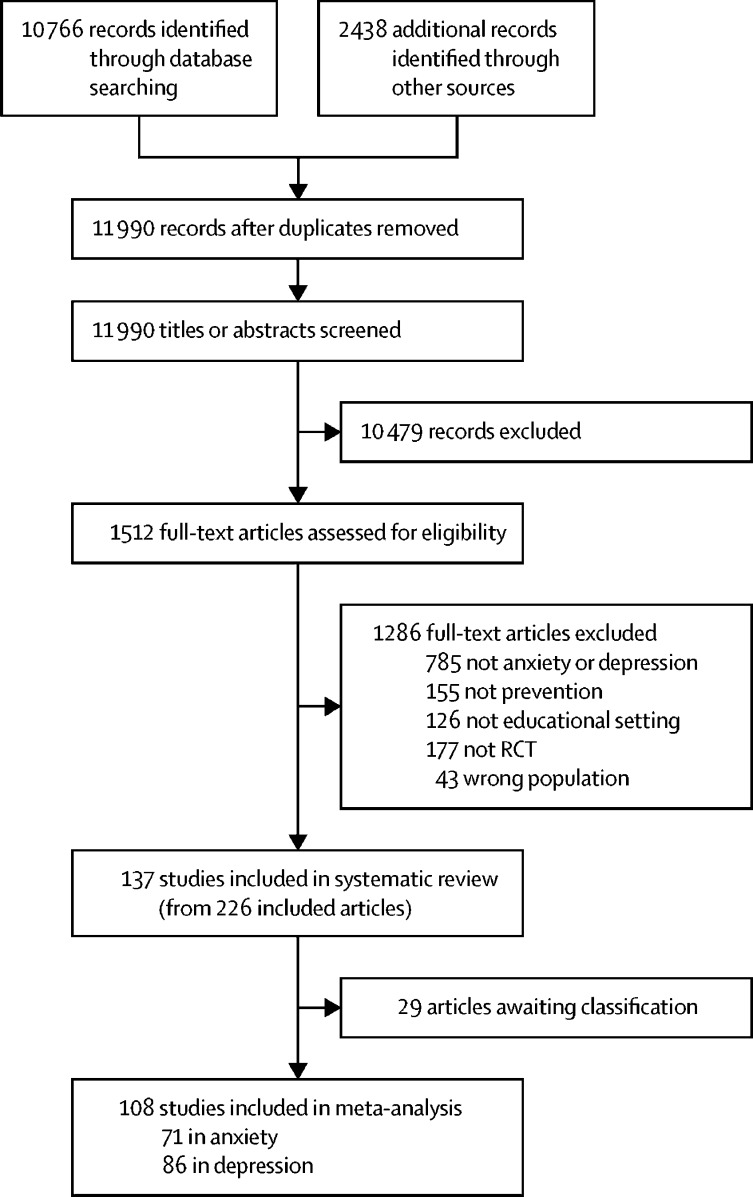
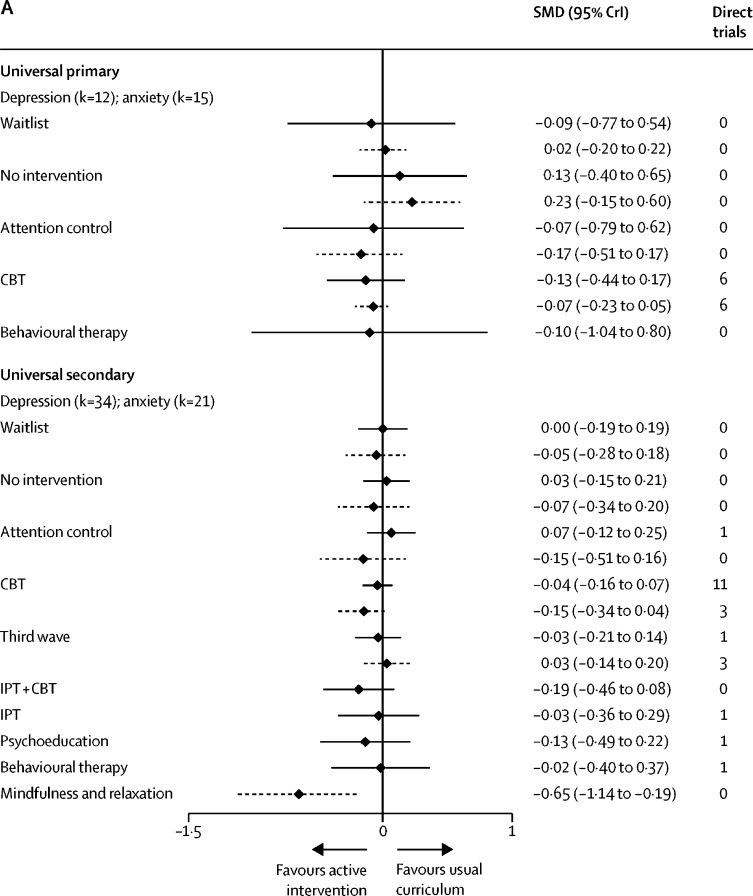
BACKGROUND: Rates of anxiety and depression are increasing among children and young people. Recent policies have focused on primary prevention of mental disorders in children and young people, with schools at the forefront of implementation. There is limited information for the comparative effectiveness of the multiple interventions available. METHODS: We did a systematic review and network meta-analysis, searching MEDLINE, Embase, PsycINFO, and Cochrane Central Register of Controlled trials for published and unpublished, passive and active-controlled randomised and quasi-randomised trials. We included educational setting-based, universal, or targeted interventions in which the primary aim was the prevention of anxiety and depression in children and young people aged 4-18 years. Primary outcomes were post-intervention self-report anxiety and depression, wellbeing, suicidal ideation, or self-harm. We assessed risk of bias following the Cochrane Handbook for Systematic Reviews of Interventions. We estimated standardised mean differences (SMD) using random effects network meta-analysis in a Bayesian framework. The study is registered with PROPSERO, number CRD42016048184. FINDINGS: 1512 full-text articles were independently screened for inclusion by two reviewers, from which 137 studies of 56 620 participants were included. 20 studies were assessed as being at low risk of bias for both random sequence generation and allocation concealment. There was weak evidence to suggest that cognitive behavioural interventions might reduce anxiety in primary and secondary settings. In universal secondary settings, mindfulness and relaxation-based interventions showed a reduction in anxiety symptoms relative to usual curriculum (SMD -0·65, 95% credible interval -1·14 to -0·19). There was a lack of evidence to support any one type of intervention being effective to prevent depression in universal or targeted primary or secondary settings. Comparison-adjusted funnel plots suggest the presence of small-study effects for the universal secondary anxiety analysis. Network meta-analysis was not feasible for wellbeing or suicidal ideation or self-harm outcomes, and results are reported narratively. INTERPRETATION: Considering unclear risk of bias and probable small study effects for anxiety, we conclude there is little evidence that educational setting-based interventions focused solely on the prevention of depression or anxiety are effective. Future research could consider multilevel, systems-based interventions as an alternative to the downstream interventions considered here. FUNDING: UK National Institute for Health Research.
Overview
The claims and statistics of this paper haven’t been checked yet.
Free: it reads the open-access text and checks the first 5 claims that cite a source we can check. Create a free account to check every claim.
Integrity signals
Registry
Cites
Statistics
Figures
Verification
Claims the paper makes
The claims and statistics of this paper haven’t been checked yet.
Free: it reads the open-access text and checks the first 5 claims that cite a source we can check. Create a free account to check every claim.
Claims other papers make about this one
Each is checked against this paper’s own text: does it say what the citing paper says it does?
The source backs part of the claim, not all of it — or backs it for a different population, condition or comparison.
In the citing paper
“In child and adolescent population, MBIs have been related to symptom reduction, increased wellbeing [1,10,14,15,31,32,33,34,35,36]”
From Systematic Review of Mindfulness-Based Interventions in Child-Adolescent Population: A Developmental Perspective (2022) · cites this paper as [1]
Experimental — accuracy not yet measuredThe source backs part of the claim, not all of it — or backs it for a different population, condition or comparison.
In the citing paper
“Psychological interventions may improve affective symptoms 155 , while psychotherapy/ psychoeducation may improve some anxiety symptoms 115 (but not as school-based education intervention 156 )”
From Preventive psychiatry: a blueprint for improving the mental health of young people (2021) · cites this paper as [156]
Experimental — accuracy not yet measuredThe source backs part of the claim, not all of it — or backs it for a different population, condition or comparison.
In the citing paper
“other evidence-based syntheses have disconfirmed initial promising findings relating to the indicated/selective/universal prevention of anxiety and depression 113,115,156 or reduction of substance abuse in young people 154”
From Preventive psychiatry: a blueprint for improving the mental health of young people (2021) · cites this paper as [156]
Experimental — accuracy not yet measuredThe source backs part of the claim, not all of it — or backs it for a different population, condition or comparison.
In the citing paper
“The lack of evidence to favour several preventive interventions 113,115,154,156 may indicate that a one-size-fits-all approach is not effective and may obfuscate the efficacy for specific subgroups of individuals.”
From Preventive psychiatry: a blueprint for improving the mental health of young people (2021) · cites this paper as [156]
Experimental — accuracy not yet measuredThe source backs part of the claim, not all of it — or backs it for a different population, condition or comparison.
In the citing paper
“but not as school-based interventions 156 ***”
From Preventive psychiatry: a blueprint for improving the mental health of young people (2021) · cites this paper as [156]
Experimental — accuracy not yet measured
9 more claims about this paper
Create a free account to see every claim other papers make about this one.
Self-check
Percentages, sums and reported differences re-computed from the paper’s own numbers.
The self-check needs the paper’s full text.
Citations
Cites
Cochrane Handbook for Systematic Reviews of Interventions: Cochrane Book Series
(2008) · doi:10.1002/9780470712184 · Cited by 25,048
Hoffmann, T. C., Glasziou, P. P., Boutron, I., Milne, R., Perera, R., Moher, D., Altman, D. G., Barbour, V., Macdonald, H., Johnston, M., et al. (2014) · BMJ · doi:10.1136/bmj.g1687 · Cited by 10,548
Hutton, B., Salanti, G., Caldwell, D. M., Chaimani, A., Schmid, C. H., Cameron, C., Ioannidis, J. P. A., Straus, S., Thorlund, K., Jansen, J. P., et al. (2015) · Annals of Internal Medicine · doi:10.7326/m14-2385 · Cited by 8,269
Self-citationCochrane Handbook for Systematic Reviews of Interventions
Higgins, J. P. T., Green, S., & Ben Van Den, A. (2020) · International Coaching Psychology Review · doi:10.53841/bpsicpr.2020.15.2.123 · Cited by 5,670
The Lancet Commission on global mental health and sustainable development
Patel, V., Saxena, S., Lund, C., Thornicroft, G., Baingana, F., Bolton, P., Chisholm, D., Collins, P. Y., Cooper, J. L., Eaton, J., et al. (2018) · The Lancet · doi:10.1016/s0140-6736(18)31612-x · Cited by 3,692
Graphical tools for network meta-analysis in STATA
Chaimani, A., Higgins, J. P. T., Mavridis, D., Spyridonos, P., & Salanti, G. (2013) · PLoS ONE · doi:10.1371/journal.pone.0076654 · Cited by 2,473
Global burden of disease in young people aged 10–24 years: a systematic analysis
Gore, F. M., Bloem, P. J., Patton, G. C., Ferguson, J., Joseph, V., Coffey, C., Sawyer, S. M., & Mathers, C. D. (2011) · The Lancet · doi:10.1016/s0140-6736(11)60512-6 · Cited by 2,301
(2009) · Cited by 2,013
Simultaneous comparison of multiple treatments: Combining direct and indirect evidence.
Caldwell, D. M., Ades, A. E., & Higgins, J. P. T. (2005) · BMJ · doi:10.1136/bmj.331.7521.897 · Cited by 1,600
Self-citationThe Interpretation of Random-Effects Meta-Analysis in Decision Models
Ades, A. E., Lu, G., & Higgins, J. P. T. (2005) · Medical Decision Making · doi:10.1177/0272989x05282643 · Cited by 859
Cited by
Items 101–200 of 336
Boson, K., Anderberg, M., Hagborg, J. M., Wennberg, P., & Dahlberg, M. (2022) · Substance Abuse Treatment Prevention and Policy · doi:10.1186/s13011-022-00482-2 · Cited by 14
Torralba-Suarez, C., & Lima, A. O. D. L. (2024) · Actas Españolas de Psiquiatría · doi:10.62641/aep.v52i4.1631 · Cited by 14
Oka, T., Ishikawa, S., Saito, A., Maruo, K., Stickley, A., Watanabe, N., Sasamori, H., Shioiri, T., & Kamio, Y. (2021) · Child and Adolescent Psychiatry and Mental Health · doi:10.1186/s13034-021-00398-y · Cited by 12
“In addition, a network meta-analysis evaluating 137 randomized controlled trials (RCT) to reduce anxiety and depression in 4–18 year olds concluded that there was insufficient evidence of their effectiveness [7].”
BackgroundBauer, A., Best, S., Malley, J., Christiansen, H., Goodyear, M. J., Zechmeister‐Koss, I., & Paul, J. L. (2021) · Frontiers in Psychiatry · doi:10.3389/fpsyt.2021.741225 · Cited by 17
Hikmat, R., Yosep, I., Mardhiyah, A., Kurniawan, K., & Syabana, M. N. (2025) · Discover Mental Health · doi:10.1007/s44192-025-00336-w · Cited by 24
“For example, some reviews combine child and adolescent populations across a wide age range, from 4 to 18 years [18], or generally focus on child mental health [19, 20], thereby obscuring developmental differences and the specific needs of secondary school students.”
Brown, F. L., Lee, C., Servili, C., Willhoite, A., van Ommeren, M., Hijazi, Z., Kieselbach, B. S., & Skeen, S. (2024) · Cambridge Prisms Global Mental Health · doi:10.1017/gmh.2024.57 · Cited by 17
Ching, B. C. F., Foster, A., Schlief, M., Lewis, G., & Rajyaguru, P. (2024) · Research Involvement and Engagement · doi:10.1186/s40900-024-00636-5 · Cited by 16
“However, a network meta-analysis of school-based interventions found little evidence of any intervention’s effectiveness in preventing depression, and only for anxiety when compared to usual curriculum [20].”
BackgroundMiller, E., & Thabrew, H. (2024) · Digital Health · doi:10.1177/20552076241302204 · Cited by 21
RetractedDieu, S. Z. Y., Low, M. K., & Mishu, M. P. (2025) · PLoS ONE · doi:10.1371/journal.pone.0316825 · Cited by 23
“Other examples of psychological interventions are behavioural therapy (BT), third wave therapies and interpersonal therapies [41].”
InfluentialKidger, J., Evans, R., Bell, S. L., Fisher, H., Turner, N. L., Hollingworth, W., Harding, S., Powell, J., Brockman, R., Copeland, L., et al. (2021) · Public Health Research · doi:10.3310/phr09120 · Cited by 22
Self-citationThe prevalence of depression in Iranian children: A systematic review and meta-analysis
Mahmudi, L., Karimi, P., Arghavan, F. S., Shokri, M., Badfar, G., Kazemi, F., & Azami, M. (2021) · Asian Journal of Psychiatry · doi:10.1016/j.ajp.2021.102579 · Cited by 14
Cumulative risk exposure and emotional symptoms among early adolescent girls
Demkowicz, O., Panayiotou, M., & Humphrey, N. (2021) · BMC Women s Health · doi:10.1186/s12905-021-01527-7 · Cited by 11
What got in the way? Caregiver-reported challenges to home practice of assigned intervention skills
Kim, J. J., Gonzales, N. A., Thamrin, H., Mauricio, A. M., Kuckertz, M., & Camacho‐Thompson, D. E. (2021) · Implementation Research and Practice · doi:10.1177/26334895211055994 · Cited by 12
“Prevention scientists have identified numerous evidencedbased interventions (EBIs) that prevent adolescent mental and behavioral health problems (Caldwell et al., 2019; Skeen et al., 2019).”
BackgroundFernández‐Castilla, B., & Noortgate, W. V. D. (2022) · Behavior Research Methods · doi:10.3758/s13428-022-01905-5 · Cited by 12
Yani, D. I., Chua, J. Y. X., Wong, J. C. M., Pikkarainen, M. A., & Shorey, S. (2024) · International Journal of Mental Health Nursing · doi:10.1111/inm.13494 · Cited by 29
A creative ecological approach to supporting young people with mental health challenges in schools
Harris, A., & Jones, S. H. (2023) · International Journal of Qualitative Studies in Education · doi:10.1080/09518398.2023.2233938 · Cited by 14
“…part-nering with organisations that foreground both creativity and mental health services and activities. normalising these services and organisations within a school, a focus on mental wellness replaces a deficit-framed focus on mental ill-health (Baik et al., 2019; Caldwell et al., 2019).”
BackgroundSalam, R. A., Khan, M. H., Meerza, S. S. A., Das, J. K., Lewis-Watts, L., & Bhutta, Z. A. (2024) · Nature Medicine · doi:10.1038/s41591-023-02737-2 · Cited by 14
Zhang, Q., Jia, L., Cui, J., Wang, Q., Ye, J., Shi, H., Wang, Y., & Chan, R. C. K. (2022) · PsyCh Journal · doi:10.1002/pchj.531 · Cited by 11
Zhai, S., Li, T., Zhang, D., Qu, Y., Xie, Y., Wu, X., Zou, L., Yang, Y., Tao, F., & Tao, S. (2023) · Frontiers in Immunology · doi:10.3389/fimmu.2022.1036739 · Cited by 10
“The incidence of depressive symptoms in children and adolescents is increasing sharply and the first onset of depression is often in adolescence or early adulthood (17).”
BackgroundThe cost-effectiveness of school-based interventions for chronic diseases: a systematic review
Lin, G., Werner, K., Alqunaiebet, A., Hamza, M. M., Alkanhal, N., Alsukait, R. F., Alruwaily, A., Rakić, S., Çetinkaya, V., Herbst, C. H., et al. (2024) · Cost Effectiveness and Resource Allocation · doi:10.1186/s12962-024-00511-w · Cited by 12
“The interventions have targeted a number of different mental health disorders such as depression and anxiety [45– 47], developmental disorders [48, 49], bullying [50] and abuse [51], as well as other social/behavioral problems and mediators of poor mental health.”
BackgroundMousset, E. S.-P., Lane, J., Therriault, D., & Roberge, P. (2024) · Social and Emotional Learning Research Practice and Policy · doi:10.1016/j.sel.2024.100040 · Cited by 16
Changqing, S., Hu, B., Zhang, P., Wu, T., Wang, L., Xue, W., Fu, Y., Wang, N., Yao, Z., Wang, Y., et al. (2024) · Journal of Affective Disorders · doi:10.1016/j.jad.2024.11.030 · Cited by 14
Carneiro, B. D., Pozza, D. H., Costa‐Pereira, J. T., & Tavares, I. (2025) · Pediatric Reports · doi:10.3390/pediatric17030059 · Cited by 15
“While some meta-analyses have reported significant positive effects of mind-fulness on anxiety, depression, and stress resilience [27,28], others have raised questions about the true efficacy of mindfulness when compared to other widely used interventions, such as Cognitive Behavioral Therapy…”
InfluentialMoore, G. F. (2025) · Journal of Child Psychology and Psychiatry · doi:10.1111/jcpp.70061 · Cited by 22
Rith‐Najarian, L., Triplett, N. S., Weisz, J. R., & McLaughlin, K. A. (2021) · Development and Psychopathology · doi:10.1017/s0954579420002059 · Cited by 10
“Meta-analyses were included if more than half of the reviewers (n = 6) voted for their inclusion, resulting in a final sample of seven meta-analyses (Caldwell et al., 2019; Filene, Kaminski, Valle, & Cachat, 2013; Leijten et al., 2019; Sanchez et al., 2018; Schleider & Weisz, 2017; Singla et al., 2020; van der Put, As…”
BackgroundGrummitt, L. R., Bailey, S., Birrell, L., Kelly, E. V., Gardner, L. A., Champion, K. E., Chapman, C., Andrews, J. L., Halladay, J. E., Teesson, M., et al. (2023) · Mental Health & Prevention · doi:10.1016/j.mhp.2023.200277 · Cited by 9
Yu, Y., Zhang, G., Han, T., & Huang, H. (2020) · Medicine · doi:10.1097/md.0000000000019142 · Cited by 10
“If significant heterogeneity is found, subgroup analysis will be envisaged based on treatment time, age, race, sex, and quality of study to investigate possible sources of heterogeneity.([19])”
BackgroundLearning and happiness during Covid-19 school closure in urban Malaysia
Asadullah, M. N., & Tham, E. (2023) · International Journal of Educational Development · doi:10.1016/j.ijedudev.2023.102822 · Cited by 14
Evidence Synthesis for Complex Interventions Using Meta-Regression Models
Konnyu, K. J., Grimshaw, J., Trikalinos, T. A., Ivers, N. M., Moher, D., & Dahabreh, I. J. (2023) · American Journal of Epidemiology · doi:10.1093/aje/kwad184 · Cited by 10
“…on prediction of posttreatment average outcomes with complex interventions differs from the stated goals of other methodological (15, 16) and applied (17–23) works that aim to estimate causal effects for each component of a complex intervention by modeling the between-arm differences in each trial.”
BackgroundLan, L., Liu, W., Liu, C., Wang, H., Wang, M., Abbey, C., Singh, M. K., Rozelle, S., She, X., & Tong, L. (2024) · Journal of Adolescent Health · doi:10.1016/j.jadohealth.2024.05.024 · Cited by 8
Neighborhood-Level Social Determinants of Health and Adolescent Mental Health
Oyegoke, S., Hughes, P. M., & Gigli, K. H. (2024) · Academic Pediatrics · doi:10.1016/j.acap.2024.08.008 · Cited by 9
Luttinen, J., Watroba, A., Niemelä, M., Miettunen, J., & Ruotsalainen, H. (2025) · Journal of Affective Disorders · doi:10.1016/j.jad.2025.02.002 · Cited by 13
Interventions for selective prevention of emotional problems in adolescents: a systematic review
Vivas-Fernández, M., López, L. J. G., & David, J.-V. (2024) · Revista de Psicología Clínica con Niños y Adolescentes · doi:10.21134/rpcna.2024.11.2.1 · Cited by 14
“Adjusting the methodology and providing precise details is essential to avoid biases (Caldwell et al., 2019).”
MethodThe Perniciousness and Promise of School-Based Mental Health Service Delivery for Youth
Kearney, C. A. (2024) · Research on Child and Adolescent Psychopathology · doi:10.1007/s10802-024-01253-2 · Cited by 13
“…demonstrate minimal to medium effects for ameliorating mental health problems, with outcomes better for targeted and multiple session interventions, externalizing behavior problems, and contingency management procedures (Caldwell et al., 2019; Laurens et al., 2022; Sanchez et al., 2018 ).”
Klim, P., LEVITT, A. J., Cheung, A., Loureiro, R., Fefergrad, M., Schaffer, A., Niederkrotenthaler, T., Sinyor, M., & Zaheer, J. (2022) · BMC Public Health · doi:10.1186/s12889-022-14058-z · Cited by 11
“Universal interventions can improve mental health literacy [14–16], identify persons at risk for suicide [17–20] and anxiety and mood disorders [1, 21, 22].”
BackgroundResultInfluentialTehrani, H. D., Yamini, S., & Vazsonyi, A. T. (2023) · Journal of Experimental Criminology · doi:10.1007/s11292-023-09562-0 · Cited by 15
“…child behavior) and the same treatment–control contrast (Leijten et al., 2021; Lundahl et al., 2006; Piquero et al., 2009), and consistent with the procedure used in the previous NMA (Caldwell et al., 2019), the present study applied a prespecified hierarchy to select the most appropriate outcome.”
In Sync: Inclusive school communities supporting students with anxiety
Carter, S., Andersen, C., & Abawi, L.-A. (2023) · Heliyon · doi:10.1016/j.heliyon.2023.e16447 · Cited by 15
Zhang, H., & Wang, D. (2022) · Journal of Child Psychology and Psychiatry · doi:10.1111/jcpp.13660 · Cited by 13
Tier 2 Mental Health Interventions in Primary and Secondary Schools: A Scoping Review
Townes, P., Weiss, S., Devoe, D. J. A., Ferris, S., Adams, O., Dimitropoulos, G., & Arnold, P. D. (2022) · School Mental Health · doi:10.1007/s12310-022-09554-x · Cited by 9
Systematic review and meta-analysis of the prevention of internalizing disorders in early childhood
Bolton, B., Rooney, R. M., Hughes, A., Hopkins, A., & Mancini, V. O. (2023) · Frontiers in Psychology · doi:10.3389/fpsyg.2023.1061825 · Cited by 12
Crosland, P., Ho, N., Nguyen, K., Tran, K., Hosseini, S. H., Vacher, C., Skinner, A., van Rosmalen, J., Rosenberg, S. P., Iorfino, F., et al. (2025) · Nature Mental Health · doi:10.1038/s44220-025-00459-7 · Cited by 9
Mainstream and special schools’ use of well‐being programmes: A regional survey
Nisar, A., Hastings, R. P., Watkins, R. C., & Williams, S. (2023) · British Educational Research Journal · doi:10.1002/berj.3903 · Cited by 11
“For example, a systematic review and meta-analysis by Caldwell et al. (2019) found little to no evidence for the effectiveness of school-based interventions for the prevention of anxiety and depression.”
Lockhart, G., Jones, C. J., & Sopp, V. (2021) · The Cognitive Behaviour Therapist · doi:10.1017/s1754470x21000301 · Cited by 7
Omkarappa, D. B., Rentala, S., & Nattala, P. (2022) · World Journal of Clinical Cases · doi:10.12998/wjcc.v10.i16.5306 · Cited by 11
Lou, X., Ng, T. K., & Siu, O. L. (2023) · The Journal of Positive Psychology · doi:10.1080/17439760.2023.2179934 · Cited by 9
“However, similar findings had been repeatedly documented in previous meta-analyses targeting the mental health or SWB outcomes of school-based interventions (Caldwell et al., 2019; Goldberg et al., 2019; Taylor et al., 2017).”
BackgroundResultThe Mediating Role of Basic Psychological Needs and Meaning in Life in Adolescent Suicidal Ideation
Li, J., Liao, J., Chen, S., & Guo, C. (2024) · Behavioral Sciences · doi:10.3390/bs15010014 · Cited by 8
“…quality of the parent–child relationship, diminish the individual’s sense of control, increase dependency, foster negative self-schemas, and lead to difficulties in emotional regulation (Bilsen, 2018; Caldwell et al., 2019; Elbogen et al., 2021), thereby resulting in various internalizing problems.”
Alemdar, H., & Karaca, A. (2025) · Journal of Pediatric Nursing · doi:10.1016/j.pedn.2024.12.020 · Cited by 12
Caldwell, D. M., Palmer, J. C., Webster, K. E., Davies, S. R., Hughes, H., Rona, J., Churchill, R. C., Hetrick, S. E., & Welton, N. J. (2025) · Prevention Science · doi:10.1007/s11121-025-01786-y · Cited by 5
“…and “attention” controlled studies published over the last five years (Werner-Seidler et al., 2021), this nested methodological study involved a rapid update of our original review (Caldwell et al., 2019) to include additional studies directly relevant to estimating control group moderator effects.”
Self-citationSandberg, E., Stenman, E., Palmer, K., Duberg, A., Sundquist, J., & Sundquist, K. (2024) · School Mental Health · doi:10.1007/s12310-023-09620-y · Cited by 15
“None of the interventions showed evidence of reducing symptoms of depression, and the overall evidence was considered weak due to possible bias and small-study effects (Caldwell et al., 2019).”
Depression: implications for learning and education
Nørby, S. (2024) · Emotional and Behavioural Difficulties · doi:10.1080/13632752.2024.2434982 · Cited by 6
“…but only to modest degrees, that effects may not endure over time and that interventions primarily work when they are targeted at at-risk individuals rather than universally applied (Feiss et al. 2019; Werner-Seidler et al. 2017, 2021; Zhang, Wang, and Neitzel 2023; but see; Caldwell et al. 2019).”
Chang, W. H., Foster, G. R., Kelly, D. A., & Lai, A. G. (2022) · BJPsych Open · doi:10.1192/bjo.2022.550 · Cited by 7
School-Based Interventions for Students with Anxiety
Ginsburg, G. S., & Smith, I. C. (2023) · Issues in clinical child psychology · doi:10.1007/978-3-031-20006-9_3 · Cited by 10
Predictors of school-based cognitive behavior therapy outcome for youth with anxiety
Wergeland, G. J., Haaland, V. Ø., Fjermestad, K. W., Öst, L., Gjestad, R., Bjaastad, J. F., Hoffart, A., Husabø, E. B., Raknes, S., & Haugland, B. S. M. (2023) · Behaviour Research and Therapy · doi:10.1016/j.brat.2023.104400 · Cited by 8
Welch, M. G., Ludwig, R. J., Hane, A. A., Austin, J., Markowitz, E. S., Jaffe, M. E., & Myers, M. M. (2023) · Frontiers in Child and Adolescent Psychiatry · doi:10.3389/frcha.2023.1232515 · Cited by 11
Health Dissemination and Implementation Within Schools
Lee, R. M., Eisman, A. B., & Gortmaker, S. L. (2023) · Oxford University Press eBooks · doi:10.1093/oso/9780197660690.003.0022 · Cited by 7
Mihalopoulos, C., Lee, Y. Y., Engel, L., Le, L. K., Tan, E. J., & Chatterton, M. L. (2021) · Australian Economic Review · doi:10.1111/1467-8462.12412 · Cited by 7
How can we optimise learning from trials in child and adolescent mental health?
Axford, N., Berry, V., Lloyd, J., & Wyatt, K. M. (2022) · Evidence-Based Mental Health · doi:10.1136/ebmental-2022-300500 · Cited by 8
Scoping review: Potential harm from school-based group mental health interventionsPreprint
Holst, C. G., Davis, R. S., Andrews, J. L., & Foulkes, L. (2024) · doi:10.31234/osf.io/we6bz · Cited by 6
Shao, S., Zhang, Y., Yang, M., Li, C., Zhao, R., Liu, Z., Wu, M., Liu, Y., Zhu, Z., & Cui, L. (2024) · Journal of School Psychology · doi:10.1016/j.jsp.2024.101357 · Cited by 6
Nakagami, Y., Uwatoko, T., Shimamoto, T., Sakata, M., Toyomoto, R., Yoshida, K., Luo, Y., Shiraishi, N., Tajika, A., Sahker, E., et al. (2024) · JMIR Mental Health · doi:10.2196/56691 · Cited by 10
“Several psychological interventions have shown promise for preventing depression [5] and cognitive behavioral therapy (CBT)–based strategies make up the bulk of the evidence [6,7].”
Universal, School‐Based Mental Health Literacy Programs for Middle School Students: A Scoping Review
Zachik, C. P., Collica, S. C., White, J., Espinoza, C. S., Swartz, K., & Cataldi, M. L. (2024) · Journal of School Health · doi:10.1111/josh.13538 · Cited by 12
Montagne, A., Rousseau, C., & Gómez-Carrillo, A. (2025) · The Lancet Regional Health - Americas · doi:10.1016/j.lana.2025.101310 · Cited by 7
“63,64 Calls for alternatives are growing, though consensus on their form and content remains elusive.”
Bartuska, A. D., Blanchard, L., Duan, J., Youn, S. J., Dean, K. E., LeBlanc, N. J., Zepeda, E. D., & Marques, L. M. (2024) · School Mental Health · doi:10.1007/s12310-024-09659-5 · Cited by 6
Savenkova, V., Zorkina, Y., Ochneva, A., Zeltser, A., Ryabinina, D. A., Tsurina, A. M., Golubeva, E., Goncharova, A. S., Алексеенко, И. В., Kostyuk, G. P., et al. (2024) · Consortium Psychiatricum · doi:10.17816/cp15487 · Cited by 8
“While most research indicates that the risk of anxiety and depressive disorders tends to increase with age [29], recent evidence suggests that these disorders are increasingly affecting younger populations [30, 31].”
Birrell, L., Grummitt, L. R., Christensen, H. M., & Teesson, M. (2025) · Research Directions Depression · doi:10.1017/dep.2025.1 · Cited by 6
“Only a small number of large-scale school-based trials have been undertaken in low-and middle-income countries (LMIC).”
InfluentialCapacidad predictiva del rechazo escolar sobre la alta ansiedad social en adolescentes chilenos
Giménez-Miralles, M., Martín, N. L. S., & Gonzálvez, C. (2022) · European Journal of Education and Psychology · doi:10.32457/ejep.v15i2.1967 · Cited by 8
Donaldson, C., Morgan, K., Ouerghi, S., Lewis, J. J., & Moore, G. F. (2025) · Child Indicators Research · doi:10.1007/s12187-024-10213-7 · Cited by 8
“…; O’Reilly et al., 2018) and may focus on a range of different outcomes including depression, anxiety, mental and emotional wellbeing, as well as behavioural outcomes (Caldwell et al., 2019; Clarke et al., 2021; Mackenzie & Williams, 2018 ; Mendes de Oliveira et al., 2022 ; Zhang et al., 2023).”
Hetrick, S. E., & Sharma, V. (2025) · Child and Adolescent Mental Health · doi:10.1111/camh.12754 · Cited by 7
Self-citationKumar, R., Sahu, M., Beniwal, K., Bahurupi, Y. A., & Das, A. (2025) · Medical Journal Armed Forces India · doi:10.1016/j.mjafi.2024.12.002 · Cited by 8
Cipriano, C., Ahmad, E., McCarthy, M. F., Ha, C., & Ross, A. (2025) · Social and Emotional Learning Research Practice and Policy · doi:10.1016/j.sel.2025.100088 · Cited by 10
Sarroeira, S., Pereira, B., de Carvalho, G. S., & Rodríguez-Fernández, J. E. (2022) · Retos · doi:10.47197/retos.v45i0.90898 · Cited by 9
Morgado, T. M. M., Loureiro, L. M. D. J., & Botelho, M. A. ́. (2021) · Issues in Mental Health Nursing · doi:10.1080/01612840.2021.1999541 · Cited by 9
“…2016; Perry et al., 2014; Seedaket et al., 2020; Skre et al., 2013) and/or to prevent anxiety in a universal, selective or indicated way (Ahlen et al., 2015; Caldwell et al., 2019; Johnstone et al., 2018; Stockings et al., 2016; Vassilopoulos et al., 2013; Werner-Seidler et al., 2017).”
BackgroundInfluentialAbbott, P., D’Ambruoso, L., Yared, M., McNamee, P., Hailu, T., & Nzabalirwa, W. (2023) · medRxiv · doi:10.1101/2023.05.10.23289769 · Cited by 9
Myopia and daylight—A combination of factors
Hobday, R. A., Aarts, M. M., Cajochen, C., Maierová, L., Münch, M. Y., Osterhaus, W., Stefani, O., & Wulff, K. (2025) · Frontiers in Medicine · doi:10.3389/fmed.2025.1481209 · Cited by 7
Public engagement to refine a whole-school intervention to promote adolescent mental health
Bonell, C. P., Hope, S., Sundaram, N., Lloyd-Houldey, O., Michalopoulou, S., Scott, S., Nicholls, D., & Viner, R. (2024) · Public Health Research · doi:10.3310/jwgt4863 · Cited by 7
“8 , 9 Multiple reviews support a role for school programmes in addressing young people’s mental health and disruptive behaviours, 10–13 with evidence across anxiety and depression, 11 body image and disordered eating, 14 and self-harm, and supportive capacities such as self-regulation.”
Phan, M. L., Renshaw, T. L., Rodríguez, M. M. D., McClain, M. B., Moo, E. L., Humphries, A., & Parker, B. (2025) · Contemporary School Psychology · doi:10.1007/s40688-025-00540-z · Cited by 16
The Association Between Social Outsiderhood and School Absence is Mediated by Internalizing Symptoms
Alanko, K., Söderberg, P., Lagerström, M., Laakso, M., & Junttila, N. (2025) · School Mental Health · doi:10.1007/s12310-025-09793-8 · Cited by 14
“The association between social outsiderhood and attendance issues align with models of school engagement that emphasize the importance of belongingness and peer acceptance (Allen et al., 2018; Caldwell et al., 2019).”
Sourander, A., Ishikawa, S., Stahlberg, T. H., Kishida, K., Mori, Y., Matsubara, K., Zhang, X., Hida, N., Korpilahti-Leino, T., Ristkari, T., et al. (2024) · Frontiers in Psychiatry · doi:10.3389/fpsyt.2023.1334282 · Cited by 13
Halladay, J. E., Sunderland, M., Newton, N. C., Lynch, S. J., Chapman, C., Stapinski, L. A., Andrews, J. L., Birrell, L., Teesson, M., & Slade, T. N. (2024) · Psychological Medicine · doi:10.1017/s0033291724002897 · Cited by 7
“Thecombined Climate SU and MH programs (CSC) were the second condition to prevent co-occurrence, though these”
Wilcock, R., Monro, A., Smith, A. W., & O’Keeffe, H. (2025) · Educational Review · doi:10.1080/00131911.2025.2459900 · Cited by 7
Klim, P., Zaheer, R., LEVITT, A. J., Cheung, A., Schaffer, A., Fefergrad, M., Niederkrotenthaler, T., & Sinyor, M. (2023) · Journal of Affective Disorders Reports · doi:10.1016/j.jadr.2023.100471 · Cited by 6
Lampropoulou, A., Georgakakou‐Koutsonikou, N., Hatzichristou, C., & Ρούσσος, Π. (2023) · Education Sciences · doi:10.3390/educsci13070644 · Cited by 15
“While school-based interventions are effective in promoting well-being and targeting specific difficulties [68,69], the adaptation of interventions to the specific needs of school communities during the pandemic requires careful consideration.”
BackgroundXu, W., Tang, J., & Chen, J. (2021) · Evidence-based Complementary and Alternative Medicine · doi:10.1155/2021/2568195 · Cited by 4
RetractedFrom East to West: Regional Disparities in Depressive and Anxious Symptoms Among Chinese Adolescents
Yang, R., Yang, X., Wan, J.-L., Wang, L., Hu, D., Chen, J., & Zhou, S. (2025) · Psychology Research and Behavior Management · doi:10.2147/prbm.s527697 · Cited by 3
MINDFULNESS-BASED APPROACHES IN NURSING: A COMPREHENSIVE SYSTEMATIC REVIEW
Iikura, A., Tamura, H., Miyamoto, S., & Sugawara, D. (2025) · Nurse and Holistic Care · doi:10.33086/nhc.v5i1.5615 · Cited by 4
Stapley, E., Hayes, D., March, A., Mansfield, R., Burrell, K., Ashworth, E., Moltrecht, B., Stallard, P. N., Thompson, A., & Deighton, J. (2025) · Contemporary School Psychology · doi:10.1007/s40688-025-00567-2 · Cited by 4
“Recent reviews of the efficacy of school-based mindfulness and relaxation interventions have identified tentative evidence for a positive impact on CYP anxiety or stress levels, whilst also highlighting limitations in study quality (e.g., Caldwell et al., 2019; Fulambarkar et al., 2023).”
Singh, R. K., Khanal, P., Tol, W. A., Jefferies, P., Jordans, M. J. D., & Lund, C. (2025) · Child and Adolescent Psychiatry and Mental Health · doi:10.1186/s13034-025-00964-8 · Cited by 6
“…resilience as a mechanism in larger, fully powered prevention trials for adolescents. intervention as ‘stand-alone’ or ‘in combination’, in reducing depressive and anxiety symptoms [42–46] in adolescents, there is limited understanding of the mechanisms through which these interventions work [47].”
Targeting Internalizing Symptoms in Children: What is the Impact on School Functioning?
Pedersen, M. L., Holen, S., Sund, A. M., Adolfsen, F., Løvaas, M. E. S., Martinsen, K. D., Neumer, S., Patras, J., Rasmussen, L. P., & Lydersen, S. (2022) · Scandinavian Journal of Educational Research · doi:10.1080/00313831.2022.2042849 · Cited by 8
“…a lack of evidence to support any one type of intervention as being effective in preventing depression in universal or targeted settings; in addition, to reduce anxiety symptoms, universal settings that included mindfulness and relaxation techniques achieved better results (Caldwell et al., 2019).”
ResultLesinskienė, S., Karalienė, V., Pociūtė, K., & Šambaras, R. (2024) · Journal of Clinical Medicine · doi:10.3390/jcm13072032 · Cited by 3
Viner, R., Michalopoulou, S., Hudson, L. D., Hope, S., Lloyd-Houldey, O., Sundaram, N., Scott, S., Nicholls, D., & Bonell, C. P. (2025) · Public Health Research · doi:10.3310/ffhr7745 · Cited by 6
Brown, C. G. (2020) · Oxford University Press eBooks · doi:10.1093/oxfordhb/9780198808640.013.40 · Cited by 3
Liu, P., Wang, G., Peng, H., Zhang, L., Li, X., Zeng, Q., Li, Q., & Zhou, J. (2021) · Frontiers in Oncology · doi:10.3389/fonc.2021.621917 · Cited by 3
How to compare multiple intervention effects: Educational research using network meta-analysis
Ha, C. (2022) · International Journal of Research & Method in Education · doi:10.1080/1743727x.2022.2035352 · Cited by 3
Beukema, L., Hofstra, J., Reijneveld, S. A., de Winter, A. F., & Korevaar, E. L. (2022) · International Journal of Environmental Research and Public Health · doi:10.3390/ijerph19116754 · Cited by 7
Kaluževičiūtė, G., Jessiman, P., Burn, A., Ford, T. J., Kidger, J., Leonard, N. E., Limmer, M., & Spencer, L. P. (2021) · Journal of Concurrent Disorders · doi:10.54127/rnuo8607 · Cited by 4
Self-citationZhao, T., Tang, C., Huang, Y., Wang, H., & Guo, M. (2023) · PLoS ONE · doi:10.1371/journal.pone.0287445 · Cited by 4
“For scales not included in this table, we will follow the following rules: (1) prefer clinician-reported scales rather than self-reports; (2) prioritize scales specifically targeted to measure depression symptoms over scales with a broader scope; (3) prefer the most commonly reported scale across studies [49].”
MethodKira, Y., Matsumoto, M., Kambara, K., & Ogata, A. (2023) · International Journal of School & Educational Psychology · doi:10.1080/21683603.2023.2243858 · Cited by 7
Stress and Resilience in the Workplace
Erskine, J., & Georgiou, G. J. (2023) · Springer eBooks · doi:10.1007/978-3-031-27349-0_22 · Cited by 4
Intersectionality, interdisciplinarity and mental health in education
Koh, A., Harris, A., Goh, D. P. S., & Jones, S. H. (2024) · International Journal of Qualitative Studies in Education · doi:10.1080/09518398.2023.2286240 · Cited by 5
Scholz, D., Taylor, A. M., Callaghan, P., & Strelan, P. (2024) · Australian Psychologist · doi:10.1080/00050067.2024.2315028 · Cited by 7
“A number of universal, school-based programs designed to specifically target anxiety, stress and depression in young people have been shown to be effective in the short term, but there is limited evidence to suggest these effects are long lasting (Caldwell et al., 2019; Feiss et al., 2019).”
Background
Metadata
- Authors
- Caldwell, D. M., Davies, S. R., Hetrick, S. E., Palmer, J. C., Caro, P., López-López, J. A., Gunnell, D., Kidger, J., Thomas, J., French, C., Stockings, E., Campbell, R., & Welton, N. J.
- Affiliations
- University of Bristol (GB)
- University of Auckland (NZ)
- University Hospitals Bristol NHS Foundation Trust (GB)
- University College London (GB)
- UNSW Sydney (AU)
- Corresponding author
- Caldwell, Deborah M
- ORCID
- Venue
- The Lancet Psychiatry
- Publisher
- Elsevier BV
- Published
- 2019-12
- Volume
- 6
- Issue
- 12
- Pages
- 1011-1020
- ISSN
- 2215-0366 (ISSN-L)
- PMC
- PMC7029281
- OpenAlex
- W2988840012
- Cited by
- 336
- References
- 46
- Citations by year
- 2026: 35 · 2025: 65 · 2024: 62 · 2023: 69 · 2022: 44 · 2021: 47 · 2020: 12 · 2019: 2
- FWCI
- 5.94
- Type
- journal article
- Language
- en
- Update notices
- erratum (2020-09-01)
- Open access
- hybrid
- doi.org
- Licence
- cc-by
- www.elsevier.com/tdm/userlicense/1.0/ (tdm)
- www.elsevier.com/legal/tdmrep-license (tdm)
- creativecommons.org/licenses/by/4.0/ (vor)
- Locations
- The Lancet Psychiatry (publishedVersion, cc-by)
- Europe PMC (PubMed Central) (publishedVersion, cc-by)
- PubMed Central (publishedVersion, cc-by)
- PubMed (publishedVersion)
- Bristol Research (University of Bristol) (publishedVersion, cc-by)
- UCL Discovery (University College London) (submittedVersion)
- ResearchSpace (University of Auckland) (submittedVersion, cc-by)
- Funders
- Auckland Medical Research Foundation
- Department of Health, Australian Government
- National Institute for Health Research (PHR [15/49/08)
- National Health and Medical Research Council (567062)
- School for Public Health Research
- Medical Research Council
- University of Bristol
- NIHR Biomedical Research Centre, Royal Marsden NHS Foundation Trust/Institute of Cancer Research
- Department of Health & Social Care (1104600)
- Public Health Research Programme
- Topics
- Health Sciences › Medicine › Public Health, Environmental and Occupational Health › School Health and Nursing Education
- Social Sciences › Psychology › Clinical Psychology › Child and Adolescent Psychosocial and Emotional Development
- Health Sciences › Medicine › Psychiatry and Mental health › Mental Health Treatment and Access
- Keywords
- school-based intervention, anxiety prevention, depression prevention, children and young people, primary prevention, cognitive-behavioural intervention, universal interventions, targeted interventions, suicidal ideation, self-harm, well-being, comparative effectiveness
- MeSH terms
- Adolescent, Anxiety, Child, Child, Preschool, Depression, Humans, School Health Services, Cognitive Behavioral Therapy, Suicidal Ideation
About these checks
Registry, retraction, Cites and statistics results are computed, not judged, with one exception: a printed reference that no index lists is read once by a model before it counts as a citation error. Claims are extracted by a model and kept only when their quote appears verbatim in the text; each cited source is then checked, with a model’s help, for whether it says what the claim relies on. Those verdicts can be wrong — read the claim’s quote and the cited source before relying on one.
Statistics and arithmetic are recomputed, not judged.
Confidence bands are shown only for fields calibrated on our annotated test set. None is calibrated yet, so no band is shown.
What counts as a claim ›How we measure confidence ›How we check this ›
Are you an author, or do you see a problem with this page? Request a review
Data sources
Bibliographic data: Semantic Scholar, OpenAlex, Crossref.
Contains information from the Semantic Scholar Academic Graph Datasets, made available under the ODC Attribution License (ODC-BY 1.0).
Semantic Scholar’s data is described in: Kinney, R., et al. (2023). The Semantic Scholar Open Data Platform. arXiv:2301.10140.
