

School-based interventions to prevent anxiety and depression in children and young people: a systematic review and network meta-analysis
Open accessThe DOI matches its Crossref record; 46 of the 46 references it cites were found in a registry or an index.
Abstract
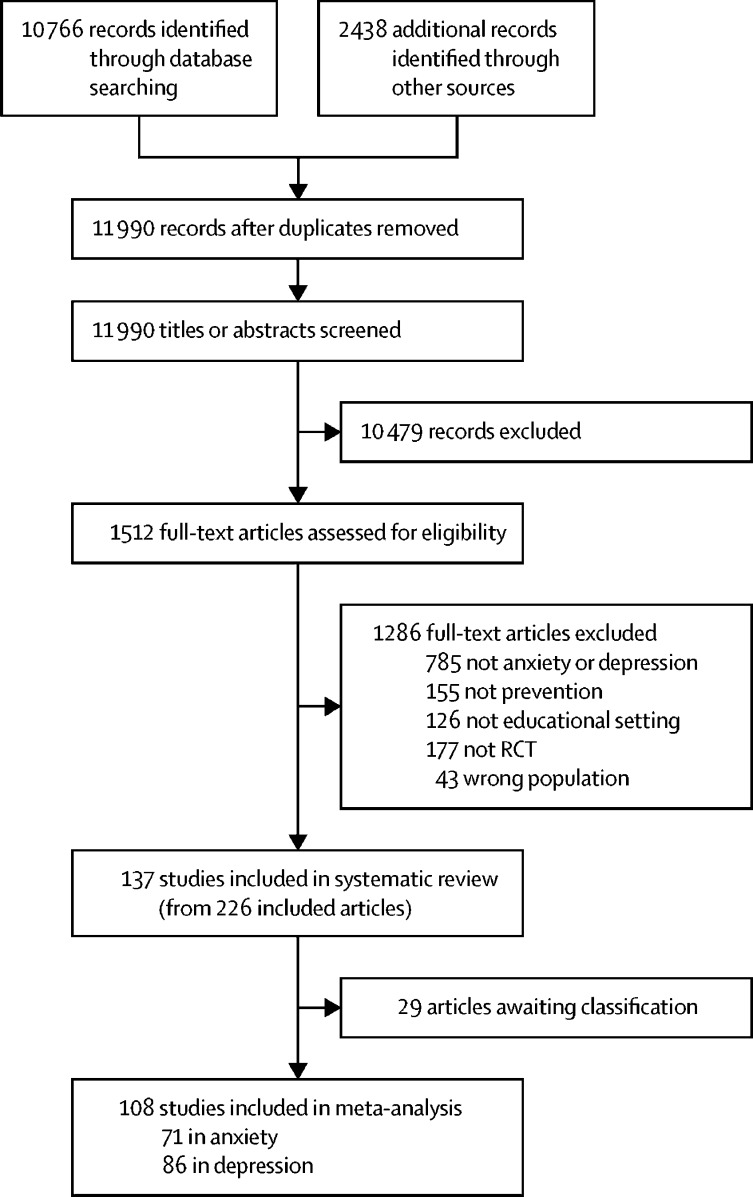
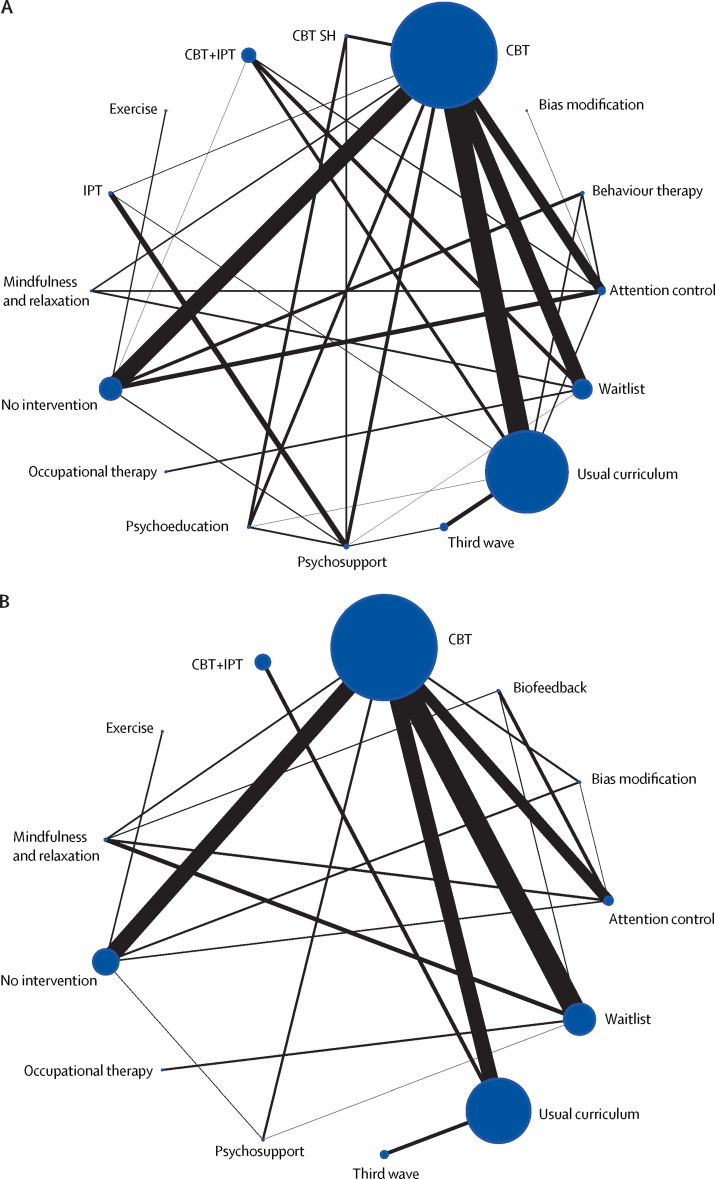
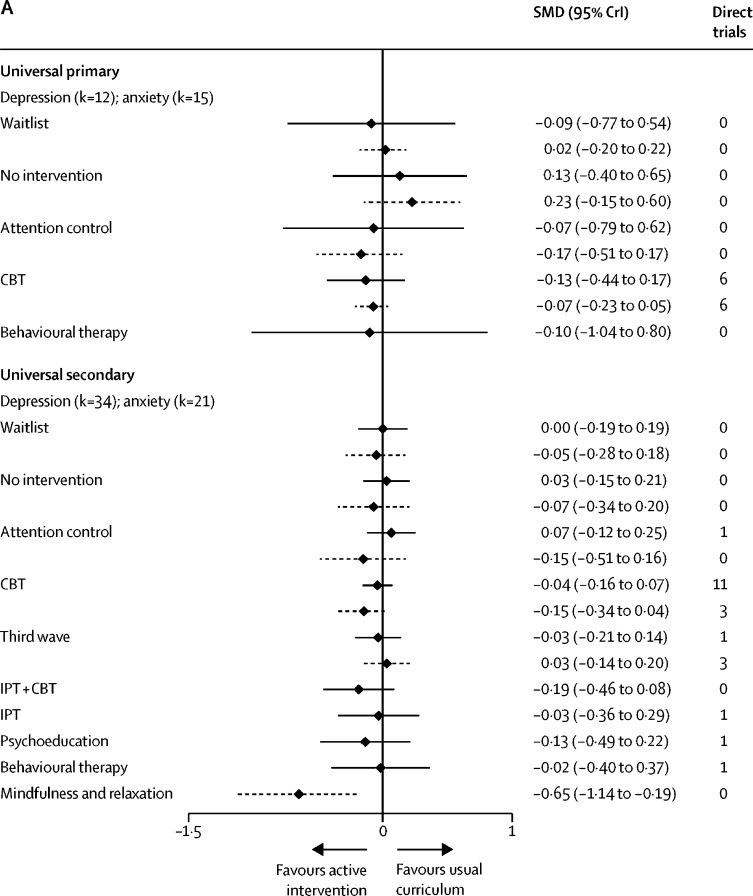
BACKGROUND: Rates of anxiety and depression are increasing among children and young people. Recent policies have focused on primary prevention of mental disorders in children and young people, with schools at the forefront of implementation. There is limited information for the comparative effectiveness of the multiple interventions available. METHODS: We did a systematic review and network meta-analysis, searching MEDLINE, Embase, PsycINFO, and Cochrane Central Register of Controlled trials for published and unpublished, passive and active-controlled randomised and quasi-randomised trials. We included educational setting-based, universal, or targeted interventions in which the primary aim was the prevention of anxiety and depression in children and young people aged 4-18 years. Primary outcomes were post-intervention self-report anxiety and depression, wellbeing, suicidal ideation, or self-harm. We assessed risk of bias following the Cochrane Handbook for Systematic Reviews of Interventions. We estimated standardised mean differences (SMD) using random effects network meta-analysis in a Bayesian framework. The study is registered with PROPSERO, number CRD42016048184. FINDINGS: 1512 full-text articles were independently screened for inclusion by two reviewers, from which 137 studies of 56 620 participants were included. 20 studies were assessed as being at low risk of bias for both random sequence generation and allocation concealment. There was weak evidence to suggest that cognitive behavioural interventions might reduce anxiety in primary and secondary settings. In universal secondary settings, mindfulness and relaxation-based interventions showed a reduction in anxiety symptoms relative to usual curriculum (SMD -0·65, 95% credible interval -1·14 to -0·19). There was a lack of evidence to support any one type of intervention being effective to prevent depression in universal or targeted primary or secondary settings. Comparison-adjusted funnel plots suggest the presence of small-study effects for the universal secondary anxiety analysis. Network meta-analysis was not feasible for wellbeing or suicidal ideation or self-harm outcomes, and results are reported narratively. INTERPRETATION: Considering unclear risk of bias and probable small study effects for anxiety, we conclude there is little evidence that educational setting-based interventions focused solely on the prevention of depression or anxiety are effective. Future research could consider multilevel, systems-based interventions as an alternative to the downstream interventions considered here. FUNDING: UK National Institute for Health Research.
Overview
The claims and statistics of this paper haven’t been checked yet.
Free: it reads the open-access text and checks the first 5 claims that cite a source we can check. Create a free account to check every claim.
Integrity signals
Registry
Cites
Statistics
Figures
Verification
Claims the paper makes
The claims and statistics of this paper haven’t been checked yet.
Free: it reads the open-access text and checks the first 5 claims that cite a source we can check. Create a free account to check every claim.
Claims other papers make about this one
Each is checked against this paper’s own text: does it say what the citing paper says it does?
The source backs part of the claim, not all of it — or backs it for a different population, condition or comparison.
In the citing paper
“In child and adolescent population, MBIs have been related to symptom reduction, increased wellbeing [1,10,14,15,31,32,33,34,35,36]”
From Systematic Review of Mindfulness-Based Interventions in Child-Adolescent Population: A Developmental Perspective (2022) · cites this paper as [1]
Experimental — accuracy not yet measuredThe source backs part of the claim, not all of it — or backs it for a different population, condition or comparison.
In the citing paper
“Psychological interventions may improve affective symptoms 155 , while psychotherapy/ psychoeducation may improve some anxiety symptoms 115 (but not as school-based education intervention 156 )”
From Preventive psychiatry: a blueprint for improving the mental health of young people (2021) · cites this paper as [156]
Experimental — accuracy not yet measuredThe source backs part of the claim, not all of it — or backs it for a different population, condition or comparison.
In the citing paper
“other evidence-based syntheses have disconfirmed initial promising findings relating to the indicated/selective/universal prevention of anxiety and depression 113,115,156 or reduction of substance abuse in young people 154”
From Preventive psychiatry: a blueprint for improving the mental health of young people (2021) · cites this paper as [156]
Experimental — accuracy not yet measuredThe source backs part of the claim, not all of it — or backs it for a different population, condition or comparison.
In the citing paper
“The lack of evidence to favour several preventive interventions 113,115,154,156 may indicate that a one-size-fits-all approach is not effective and may obfuscate the efficacy for specific subgroups of individuals.”
From Preventive psychiatry: a blueprint for improving the mental health of young people (2021) · cites this paper as [156]
Experimental — accuracy not yet measuredThe source backs part of the claim, not all of it — or backs it for a different population, condition or comparison.
In the citing paper
“but not as school-based interventions 156 ***”
From Preventive psychiatry: a blueprint for improving the mental health of young people (2021) · cites this paper as [156]
Experimental — accuracy not yet measured
6 more claims about this paper
Create a free account to see every claim other papers make about this one.
Self-check
Percentages, sums and reported differences re-computed from the paper’s own numbers.
The self-check needs the paper’s full text.
Citations
Cites
Cochrane Handbook for Systematic Reviews of Interventions: Cochrane Book Series
(2008) · doi:10.1002/9780470712184 · Cited by 25,048
Hoffmann, T. C., Glasziou, P. P., Boutron, I., Milne, R., Perera, R., Moher, D., Altman, D. G., Barbour, V., Macdonald, H., Johnston, M., et al. (2014) · BMJ · doi:10.1136/bmj.g1687 · Cited by 10,548
Hutton, B., Salanti, G., Caldwell, D. M., Chaimani, A., Schmid, C. H., Cameron, C., Ioannidis, J. P. A., Straus, S., Thorlund, K., Jansen, J. P., et al. (2015) · Annals of Internal Medicine · doi:10.7326/m14-2385 · Cited by 8,269
Self-citationCochrane Handbook for Systematic Reviews of Interventions
Higgins, J. P. T., Green, S., & Ben Van Den, A. (2020) · International Coaching Psychology Review · doi:10.53841/bpsicpr.2020.15.2.123 · Cited by 5,670
The Lancet Commission on global mental health and sustainable development
Patel, V., Saxena, S., Lund, C., Thornicroft, G., Baingana, F., Bolton, P., Chisholm, D., Collins, P. Y., Cooper, J. L., Eaton, J., et al. (2018) · The Lancet · doi:10.1016/s0140-6736(18)31612-x · Cited by 3,692
Graphical tools for network meta-analysis in STATA
Chaimani, A., Higgins, J. P. T., Mavridis, D., Spyridonos, P., & Salanti, G. (2013) · PLoS ONE · doi:10.1371/journal.pone.0076654 · Cited by 2,473
Global burden of disease in young people aged 10–24 years: a systematic analysis
Gore, F. M., Bloem, P. J., Patton, G. C., Ferguson, J., Joseph, V., Coffey, C., Sawyer, S. M., & Mathers, C. D. (2011) · The Lancet · doi:10.1016/s0140-6736(11)60512-6 · Cited by 2,301
(2009) · Cited by 2,013
Simultaneous comparison of multiple treatments: Combining direct and indirect evidence.
Caldwell, D. M., Ades, A. E., & Higgins, J. P. T. (2005) · BMJ · doi:10.1136/bmj.331.7521.897 · Cited by 1,600
Self-citationThe Interpretation of Random-Effects Meta-Analysis in Decision Models
Ades, A. E., Lu, G., & Higgins, J. P. T. (2005) · Medical Decision Making · doi:10.1177/0272989x05282643 · Cited by 859
Are child and adolescent mental health problems increasing in the 21st century? A systematic review
Bor, W., Dean, A. J., Najman, J., & Hayatbakhsh, R. (2014) · Australian & New Zealand Journal of Psychiatry · doi:10.1177/0004867414533834 · Cited by 853
Annual Research Review: Secular trends in child and adolescent mental health
Collishaw, S. (2015) · Journal of Child Psychology and Psychiatry · doi:10.1111/jcpp.12372 · Cited by 788
Werner-Seidler, A., Perry, Y., Calear, A. L., Newby, J. M., & Christensen, H. (2017) · Clinical Psychology Review · doi:10.1016/j.cpr.2016.10.005 · Cited by 773
Cipriani, A., Zhou, X., Del Giovane, C., Hetrick, S. E., Qin, B., Whittington, C., Coghill, D., Zhang, Y., Hazell, P., Leucht, S., et al. (2016) · The Lancet · doi:10.1016/s0140-6736(16)30385-3 · Cited by 734
Self-citationLangford, R., Bonell, C., Jones, H., Pouliou, T., Murphy, S., Waters, E., Komro, K., Gibbs, L., Magnus, D., & Campbell, R. (2015) · BMC Public Health · doi:10.1186/s12889-015-1360-y · Cited by 578
Self-citationBarth, J., Munder, T., Gerger, H., Nüesch, E., Trelle, S., Znoj, H., Jüni, P., & Cuijpers, P. (2013) · PLoS Medicine · doi:10.1371/journal.pmed.1001454 · Cited by 569
Andrews, G., Issakidis, C., Sanderson, K., Corry, J., & Lapsley, H. (2004) · British Journal of Psychiatry · doi:10.1192/bjp.184.6.526 · Cited by 560
The prognosis of common mental disorders in adolescents: a 14-year prospective cohort study
Patton, G. C., Coffey, C., Romaniuk, H., Mackinnon, A., Carlin, J. B., Degenhardt, L., Olsson, C. A., & Moran, P. (2014) · The Lancet · doi:10.1016/s0140-6736(13)62116-9 · Cited by 527
Furukawa, T. A., Noma, H., Caldwell, D. M., Honyashiki, M., Shinohara, K., Imai, H., Chen, P., Hunot, V., & Churchill, R. (2014) · Acta Psychiatrica Scandinavica · doi:10.1111/acps.12275 · Cited by 521
Self-citationGoldberg, J. M., Sklad, M., Elfrink, T. R., Schreurs, K. M. G., Bohlmeijer, E. T., & Clarke, A. M. (2019) · European Journal of Psychology of Education · doi:10.1007/s10212-018-0406-9 · Cited by 364
Welton, N. J., Caldwell, D. M., Adamopoulos, E., & Vedhara, K. (2009) · American Journal of Epidemiology · doi:10.1093/aje/kwp014 · Cited by 362
Self-citationLocher, C., Koechlin, H., Zion, S. R., Werner, C., Pine, D. S., Kirsch, I., Kessler, R. C., & Kossowsky, J. (2017) · JAMA Psychiatry · doi:10.1001/jamapsychiatry.2017.2432 · Cited by 360
Stockings, E. A., Degenhardt, L., Dobbins, T., Lee, Y. Y., Erskine, H. E., Whiteford, H. A., & Patton, G. (2016) · Psychological Medicine · doi:10.1017/s0033291715001725 · Cited by 345
Self-citationKeshavarz, N., Nutbeam, D., Rowling, L., & Khavarpour, F. (2010) · Social Science & Medicine · doi:10.1016/j.socscimed.2010.01.034 · Cited by 335
The Effect of the School Environment on the Emotional Health of Adolescents: A Systematic Review
Kidger, J., Araya, R., Donovan, J., & Gunnell, D. (2012) · Pediatrics · doi:10.1542/peds.2011-2248 · Cited by 323
Self-citationSharma, T., Guski, L. S., Freund, N., & Gøtzsche, P. C. (2016) · BMJ · doi:10.1136/bmj.i65 · Cited by 319
Hetrick, S. E., Cox, G. R., Witt, K. G., Bir, J. J., & Merry, S. N. (2016) · Cochrane Database of Systematic Reviews · doi:10.1002/14651858.cd003380.pub4 · Cited by 290
Self-citationPompoli, A., Furukawa, T. A., Efthimiou, O., Imai, H., Tajika, A., & Salanti, G. (2018) · Psychological Medicine · doi:10.1017/s0033291717003919 · Cited by 249
Patalay, P., & Fitzsimons, E. (2016) · Journal of the American Academy of Child & Adolescent Psychiatry · doi:10.1016/j.jaac.2016.05.019 · Cited by 180
Rith-Najarian, L. R., Boustani, M. M., & Chorpita, B. F. (2019) · Journal of Affective Disorders · doi:10.1016/j.jad.2019.06.035 · Cited by 176
López-López, J. A., Davies, S. R., Caldwell, D. M., Churchill, R., Peters, T. J., Tallon, D., Dawson, S., Wu, Q., Li, J., Taylor, A., et al. (2019) · Psychological Medicine · doi:10.1017/s003329171900120x · Cited by 161
Self-citationA Meta-Analysis of Universal School-Based Prevention Programs for Anxiety and Depression in Children
Johnstone, K. M., Kemps, E., & Chen, J. (2018) · Clinical Child and Family Psychology Review · doi:10.1007/s10567-018-0266-5 · Cited by 125
'Third wave' cognitive and behavioural therapies versus other psychological therapies for depression
Hunot, V., Moore, T. H., Caldwell, D. M., Furukawa, T. A., Davies, P., Jones, H., Honyashiki, M., Chen, P., Lewis, G., & Churchill, R. (2013) · Cochrane Database of Systematic Reviews · doi:10.1002/14651858.cd008704.pub2 · Cited by 124
Self-citationHow to prove that your therapy is effective, even when it is not: a guideline
Cuijpers, P., & Cristea, I. A. (2016) · Epidemiology and Psychiatric Sciences · doi:10.1017/s2045796015000864 · Cited by 122
Rasing, S. P. A., Creemers, D. H. M., Janssens, J. M. A. M., & Scholte, R. H. J. (2017) · Frontiers in Psychology · doi:10.3389/fpsyg.2017.01066 · Cited by 88
Provision of mental healthcare for children and adolescents: a worldwide view
Rocha, T. B.-M., Graeff-Martins, A. S., Kieling, C., & Rohde, L. A. (2015) · Current Opinion in Psychiatry · doi:10.1097/yco.0000000000000169 · Cited by 84
Ormel, J., Cuijpers, P., Jorm, A. F., & Schoevers, R. (2019) · World Psychiatry · doi:10.1002/wps.20580 · Cited by 77
Approaches for synthesising complex mental health interventions in meta-analysis
Caldwell, D. M., & Welton, N. J. (2016) · Evidence Based Mental Health · doi:10.1136/eb-2015-102275 · Cited by 75
Self-citationNode-making process in network meta-analysis of nonpharmacological treatment are poorly reported
James, A., Yavchitz, A., Ravaud, P., & Boutron, I. (2017) · Journal of Clinical Epidemiology · doi:10.1016/j.jclinepi.2017.11.018 · Cited by 58
A Comparison of National Guidelines for Network Meta-Analysis
Laws, A., Kendall, R., & Hawkins, N. (2014) · Value in Health · doi:10.1016/j.jval.2014.06.001 · Cited by 53
Haworth, C. M. A., Carter, K., Eley, T. C., & Plomin, R. (2017) · Developmental Science · doi:10.1111/desc.12376 · Cited by 51
Johnstone, J., Rooney, R. M., Hassan, S., & Kane, R. T. (2014) · Frontiers in Psychology · doi:10.3389/fpsyg.2014.00364 · Cited by 37
Achana, F. A., Hubbard, S., Sutton, A. J., Kendrick, D., & Cooper, N. J. (2014) · Journal of Clinical Epidemiology · doi:10.1016/j.jclinepi.2013.09.018 · Cited by 29
Bailey, A. P. (2014) · Journal of Depression & Anxiety · doi:10.4172/2167-1044.1000172 · Cited by 18
International approaches to school-based mental health: Intent of the Special Issue
McLaughlin, C. L. (2017) · School Psychology International · doi:10.1177/0143034317714839 · Cited by 8
Latest thinking on antidepressants in children and young people
Dubicka, B., & Wilkinson, P. O. (2018) · Archives of Disease in Childhood · doi:10.1136/archdischild-2017-314075 · Cited by 7
Cited by
Thapar, A., Eyre, O., Patel, V., & Brent, D. (2022) · The Lancet · doi:10.1016/s0140-6736(22)01012-1 · Cited by 869
“A recent systematic review of all school-based universal interventions focused solely on preventing depression concluded little evidence that any are effective 98 including in low and middle income countries 99 and recommended multi-level, systems-based interventions in the future.”
Penninx, B. W., Pine, D. S., Holmes, E. A., & Reif, A. (2021) · The Lancet · doi:10.1016/s0140-6736(21)00359-7 · Cited by 740
The Lancet Psychiatry Commission on youth mental health
McGorry, P. D., Mei, C., Dalal, N., Alvarez-Jimenez, M., Blakemore, S.-J., Browne, V., Dooley, B., Hickie, I. B., Jones, P. B., McDaid, D., et al. (2024) · The Lancet Psychiatry · doi:10.1016/s2215-0366(24)00163-9 · Cited by 663
Preventive psychiatry: a blueprint for improving the mental health of young people
Fusar‐Poli, P., Correll, C. U., Arango, C., Berk, M., Patel, V., & Ioannidis, J. P. A. (2021) · World Psychiatry · doi:10.1002/wps.20869 · Cited by 497
Wang, Y., Kala, M. P., & Jafar, T. H. (2020) · PLOS ONE · doi:10.1371/journal.pone.0244630 · Cited by 382
Metadata
- Authors
- Caldwell, D. M., Davies, S. R., Hetrick, S. E., Palmer, J. C., Caro, P., López-López, J. A., Gunnell, D., Kidger, J., Thomas, J., French, C., Stockings, E., Campbell, R., & Welton, N. J.
- Affiliations
- University of Bristol (GB)
- University of Auckland (NZ)
- University Hospitals Bristol NHS Foundation Trust (GB)
- University College London (GB)
- UNSW Sydney (AU)
- Corresponding author
- Caldwell, Deborah M
- ORCID
- Venue
- The Lancet Psychiatry
- Publisher
- Elsevier BV
- Published
- 2019-12
- Volume
- 6
- Issue
- 12
- Pages
- 1011-1020
- ISSN
- 2215-0366 (ISSN-L)
- PMC
- PMC7029281
- OpenAlex
- W2988840012
- Cited by
- 336
- References
- 46
- Citations by year
- 2026: 35 · 2025: 65 · 2024: 62 · 2023: 69 · 2022: 44 · 2021: 47 · 2020: 12 · 2019: 2
- FWCI
- 5.94
- Type
- journal article
- Language
- en
- Update notices
- erratum (2020-09-01)
- Open access
- hybrid
- doi.org
- Licence
- cc-by
- www.elsevier.com/tdm/userlicense/1.0/ (tdm)
- www.elsevier.com/legal/tdmrep-license (tdm)
- creativecommons.org/licenses/by/4.0/ (vor)
- Locations
- The Lancet Psychiatry (publishedVersion, cc-by)
- Europe PMC (PubMed Central) (publishedVersion, cc-by)
- PubMed Central (publishedVersion, cc-by)
- PubMed (publishedVersion)
- Bristol Research (University of Bristol) (publishedVersion, cc-by)
- UCL Discovery (University College London) (submittedVersion)
- ResearchSpace (University of Auckland) (submittedVersion, cc-by)
- Funders
- Auckland Medical Research Foundation
- Department of Health, Australian Government
- National Institute for Health Research (PHR [15/49/08)
- National Health and Medical Research Council (567062)
- School for Public Health Research
- Medical Research Council
- University of Bristol
- NIHR Biomedical Research Centre, Royal Marsden NHS Foundation Trust/Institute of Cancer Research
- Department of Health & Social Care (1104600)
- Public Health Research Programme
- Topics
- Health Sciences › Medicine › Public Health, Environmental and Occupational Health › School Health and Nursing Education
- Social Sciences › Psychology › Clinical Psychology › Child and Adolescent Psychosocial and Emotional Development
- Health Sciences › Medicine › Psychiatry and Mental health › Mental Health Treatment and Access
- Keywords
- school-based intervention, anxiety prevention, depression prevention, children and young people, primary prevention, cognitive-behavioural intervention, universal interventions, targeted interventions, suicidal ideation, self-harm, well-being, comparative effectiveness
- MeSH terms
- Adolescent, Anxiety, Child, Child, Preschool, Depression, Humans, School Health Services, Cognitive Behavioral Therapy, Suicidal Ideation
About these checks
Registry, retraction, Cites and statistics results are computed, not judged, with one exception: a printed reference that no index lists is read once by a model before it counts as a citation error. Claims are extracted by a model and kept only when their quote appears verbatim in the text; each cited source is then checked, with a model’s help, for whether it says what the claim relies on. Those verdicts can be wrong — read the claim’s quote and the cited source before relying on one.
Statistics and arithmetic are recomputed, not judged.
Confidence bands are shown only for fields calibrated on our annotated test set. None is calibrated yet, so no band is shown.
What counts as a claim ›How we measure confidence ›How we check this ›
Are you an author, or do you see a problem with this page? Request a review
Data sources
Bibliographic data: Semantic Scholar, OpenAlex, Crossref.
Contains information from the Semantic Scholar Academic Graph Datasets, made available under the ODC Attribution License (ODC-BY 1.0).
Semantic Scholar’s data is described in: Kinney, R., et al. (2023). The Semantic Scholar Open Data Platform. arXiv:2301.10140.
