

School-based interventions to prevent anxiety and depression in children and young people: a systematic review and network meta-analysis
Open accessThe DOI matches its Crossref record; 46 of the 46 references it cites were found in a registry or an index.
Abstract
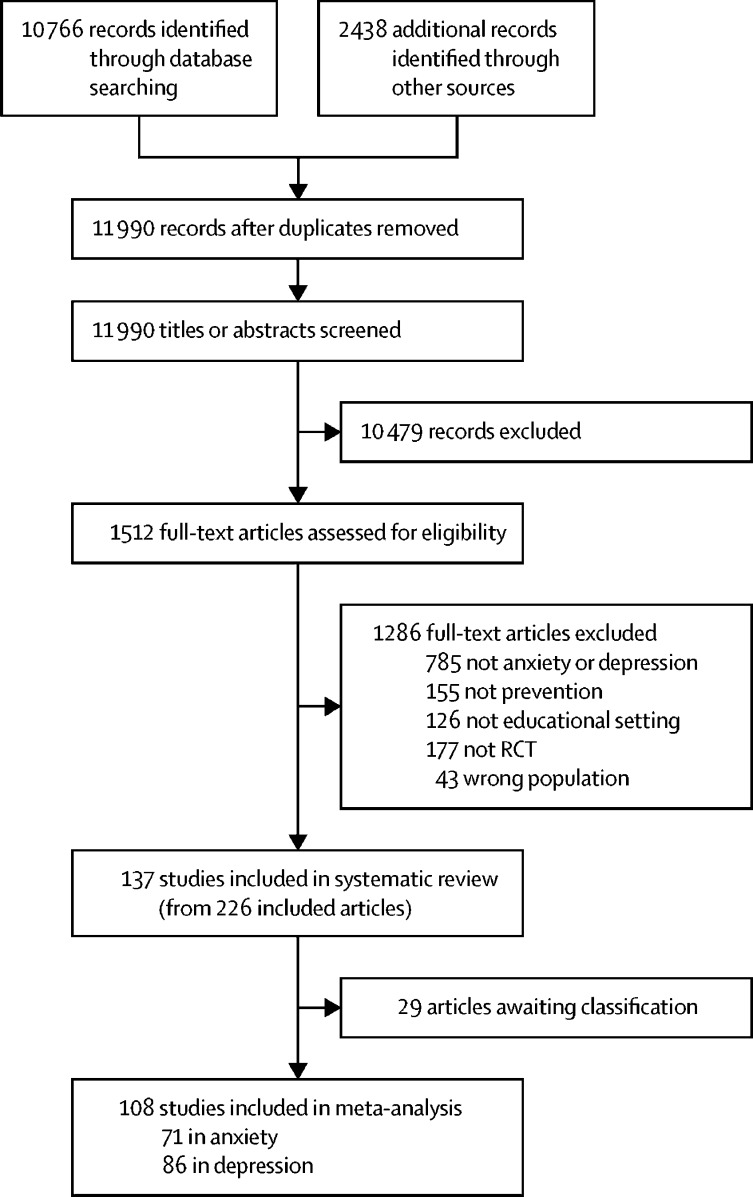
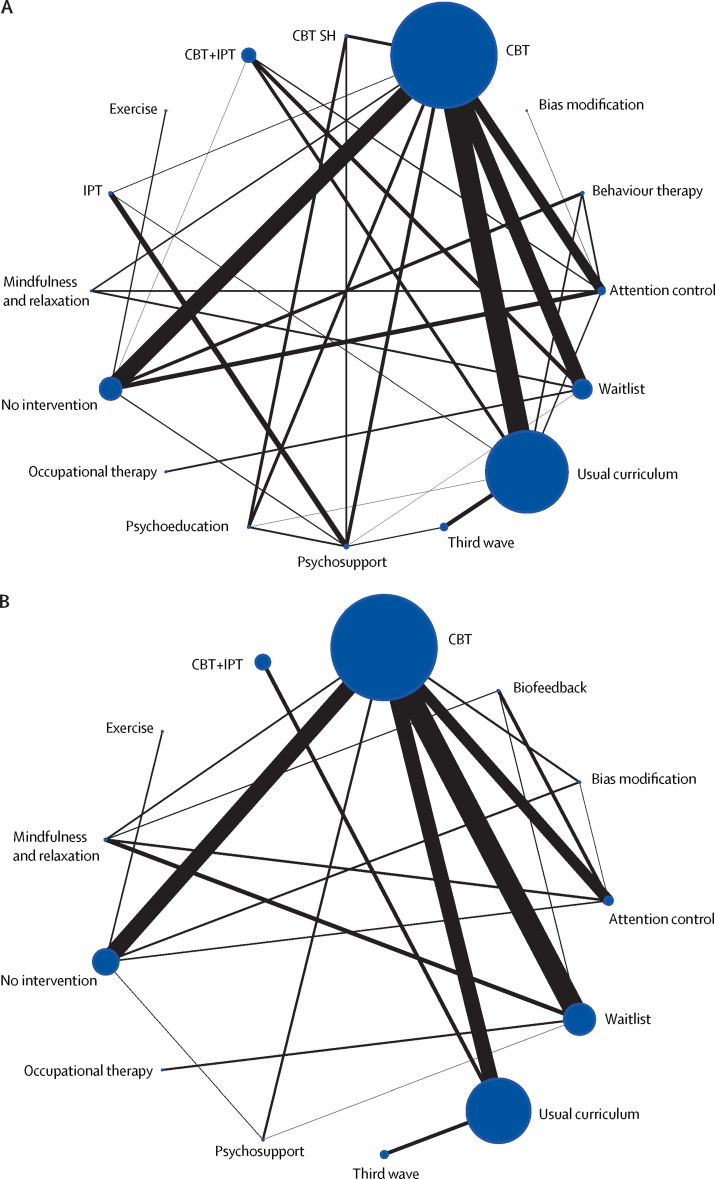
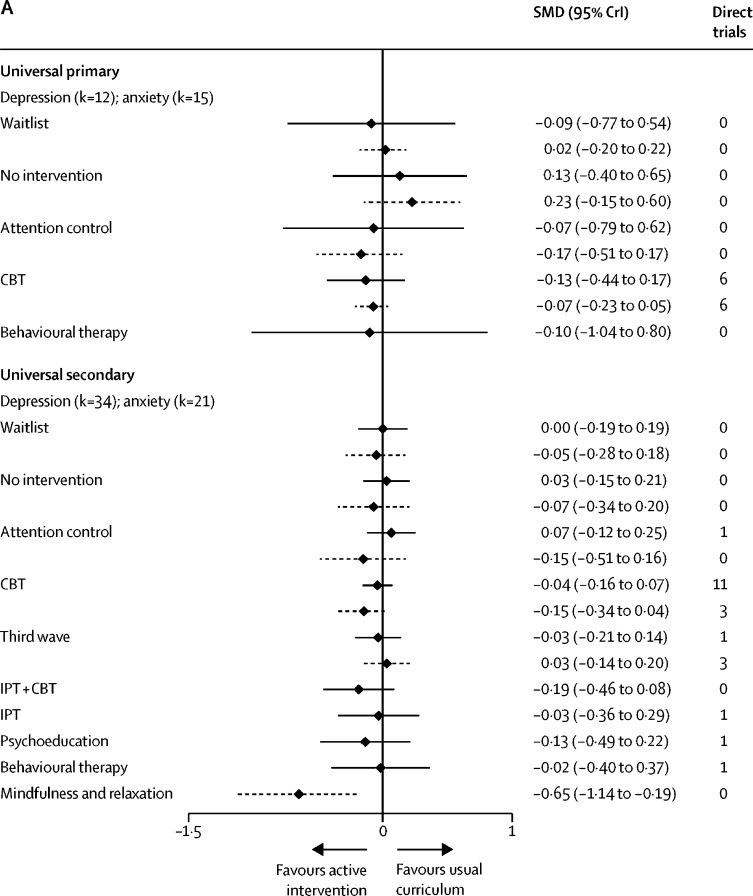
BACKGROUND: Rates of anxiety and depression are increasing among children and young people. Recent policies have focused on primary prevention of mental disorders in children and young people, with schools at the forefront of implementation. There is limited information for the comparative effectiveness of the multiple interventions available. METHODS: We did a systematic review and network meta-analysis, searching MEDLINE, Embase, PsycINFO, and Cochrane Central Register of Controlled trials for published and unpublished, passive and active-controlled randomised and quasi-randomised trials. We included educational setting-based, universal, or targeted interventions in which the primary aim was the prevention of anxiety and depression in children and young people aged 4-18 years. Primary outcomes were post-intervention self-report anxiety and depression, wellbeing, suicidal ideation, or self-harm. We assessed risk of bias following the Cochrane Handbook for Systematic Reviews of Interventions. We estimated standardised mean differences (SMD) using random effects network meta-analysis in a Bayesian framework. The study is registered with PROPSERO, number CRD42016048184. FINDINGS: 1512 full-text articles were independently screened for inclusion by two reviewers, from which 137 studies of 56 620 participants were included. 20 studies were assessed as being at low risk of bias for both random sequence generation and allocation concealment. There was weak evidence to suggest that cognitive behavioural interventions might reduce anxiety in primary and secondary settings. In universal secondary settings, mindfulness and relaxation-based interventions showed a reduction in anxiety symptoms relative to usual curriculum (SMD -0·65, 95% credible interval -1·14 to -0·19). There was a lack of evidence to support any one type of intervention being effective to prevent depression in universal or targeted primary or secondary settings. Comparison-adjusted funnel plots suggest the presence of small-study effects for the universal secondary anxiety analysis. Network meta-analysis was not feasible for wellbeing or suicidal ideation or self-harm outcomes, and results are reported narratively. INTERPRETATION: Considering unclear risk of bias and probable small study effects for anxiety, we conclude there is little evidence that educational setting-based interventions focused solely on the prevention of depression or anxiety are effective. Future research could consider multilevel, systems-based interventions as an alternative to the downstream interventions considered here. FUNDING: UK National Institute for Health Research.
Overview
The claims and statistics of this paper haven’t been checked yet.
Free: it reads the open-access text and checks the first 5 claims that cite a source we can check. Create a free account to check every claim.
Integrity signals
Registry
Cites
Statistics
Figures
Verification
Claims the paper makes
The claims and statistics of this paper haven’t been checked yet.
Free: it reads the open-access text and checks the first 5 claims that cite a source we can check. Create a free account to check every claim.
Claims other papers make about this one
Each is checked against this paper’s own text: does it say what the citing paper says it does?
The source backs part of the claim, not all of it — or backs it for a different population, condition or comparison.
In the citing paper
“In child and adolescent population, MBIs have been related to symptom reduction, increased wellbeing [1,10,14,15,31,32,33,34,35,36]”
From Systematic Review of Mindfulness-Based Interventions in Child-Adolescent Population: A Developmental Perspective (2022) · cites this paper as [1]
Experimental — accuracy not yet measuredThe source backs part of the claim, not all of it — or backs it for a different population, condition or comparison.
In the citing paper
“Psychological interventions may improve affective symptoms 155 , while psychotherapy/ psychoeducation may improve some anxiety symptoms 115 (but not as school-based education intervention 156 )”
From Preventive psychiatry: a blueprint for improving the mental health of young people (2021) · cites this paper as [156]
Experimental — accuracy not yet measuredThe source backs part of the claim, not all of it — or backs it for a different population, condition or comparison.
In the citing paper
“other evidence-based syntheses have disconfirmed initial promising findings relating to the indicated/selective/universal prevention of anxiety and depression 113,115,156 or reduction of substance abuse in young people 154”
From Preventive psychiatry: a blueprint for improving the mental health of young people (2021) · cites this paper as [156]
Experimental — accuracy not yet measuredThe source backs part of the claim, not all of it — or backs it for a different population, condition or comparison.
In the citing paper
“The lack of evidence to favour several preventive interventions 113,115,154,156 may indicate that a one-size-fits-all approach is not effective and may obfuscate the efficacy for specific subgroups of individuals.”
From Preventive psychiatry: a blueprint for improving the mental health of young people (2021) · cites this paper as [156]
Experimental — accuracy not yet measuredThe source backs part of the claim, not all of it — or backs it for a different population, condition or comparison.
In the citing paper
“but not as school-based interventions 156 ***”
From Preventive psychiatry: a blueprint for improving the mental health of young people (2021) · cites this paper as [156]
Experimental — accuracy not yet measured
9 more claims about this paper
Create a free account to see every claim other papers make about this one.
Self-check
Percentages, sums and reported differences re-computed from the paper’s own numbers.
The self-check needs the paper’s full text.
Citations
Cites
Cochrane Handbook for Systematic Reviews of Interventions: Cochrane Book Series
(2008) · doi:10.1002/9780470712184 · Cited by 25,048
Hoffmann, T. C., Glasziou, P. P., Boutron, I., Milne, R., Perera, R., Moher, D., Altman, D. G., Barbour, V., Macdonald, H., Johnston, M., et al. (2014) · BMJ · doi:10.1136/bmj.g1687 · Cited by 10,548
Hutton, B., Salanti, G., Caldwell, D. M., Chaimani, A., Schmid, C. H., Cameron, C., Ioannidis, J. P. A., Straus, S., Thorlund, K., Jansen, J. P., et al. (2015) · Annals of Internal Medicine · doi:10.7326/m14-2385 · Cited by 8,269
Self-citationCochrane Handbook for Systematic Reviews of Interventions
Higgins, J. P. T., Green, S., & Ben Van Den, A. (2020) · International Coaching Psychology Review · doi:10.53841/bpsicpr.2020.15.2.123 · Cited by 5,670
The Lancet Commission on global mental health and sustainable development
Patel, V., Saxena, S., Lund, C., Thornicroft, G., Baingana, F., Bolton, P., Chisholm, D., Collins, P. Y., Cooper, J. L., Eaton, J., et al. (2018) · The Lancet · doi:10.1016/s0140-6736(18)31612-x · Cited by 3,692
Graphical tools for network meta-analysis in STATA
Chaimani, A., Higgins, J. P. T., Mavridis, D., Spyridonos, P., & Salanti, G. (2013) · PLoS ONE · doi:10.1371/journal.pone.0076654 · Cited by 2,473
Global burden of disease in young people aged 10–24 years: a systematic analysis
Gore, F. M., Bloem, P. J., Patton, G. C., Ferguson, J., Joseph, V., Coffey, C., Sawyer, S. M., & Mathers, C. D. (2011) · The Lancet · doi:10.1016/s0140-6736(11)60512-6 · Cited by 2,301
(2009) · Cited by 2,013
Simultaneous comparison of multiple treatments: Combining direct and indirect evidence.
Caldwell, D. M., Ades, A. E., & Higgins, J. P. T. (2005) · BMJ · doi:10.1136/bmj.331.7521.897 · Cited by 1,600
Self-citationThe Interpretation of Random-Effects Meta-Analysis in Decision Models
Ades, A. E., Lu, G., & Higgins, J. P. T. (2005) · Medical Decision Making · doi:10.1177/0272989x05282643 · Cited by 859
Cited by
Thapar, A., Eyre, O., Patel, V., & Brent, D. (2022) · The Lancet · doi:10.1016/s0140-6736(22)01012-1 · Cited by 869
“A recent systematic review of all school-based universal interventions focused solely on preventing depression concluded little evidence that any are effective 98 including in low and middle income countries 99 and recommended multi-level, systems-based interventions in the future.”
Penninx, B. W., Pine, D. S., Holmes, E. A., & Reif, A. (2021) · The Lancet · doi:10.1016/s0140-6736(21)00359-7 · Cited by 740
The Lancet Psychiatry Commission on youth mental health
McGorry, P. D., Mei, C., Dalal, N., Alvarez-Jimenez, M., Blakemore, S.-J., Browne, V., Dooley, B., Hickie, I. B., Jones, P. B., McDaid, D., et al. (2024) · The Lancet Psychiatry · doi:10.1016/s2215-0366(24)00163-9 · Cited by 663
Preventive psychiatry: a blueprint for improving the mental health of young people
Fusar‐Poli, P., Correll, C. U., Arango, C., Berk, M., Patel, V., & Ioannidis, J. P. A. (2021) · World Psychiatry · doi:10.1002/wps.20869 · Cited by 497
Wang, Y., Kala, M. P., & Jafar, T. H. (2020) · PLOS ONE · doi:10.1371/journal.pone.0244630 · Cited by 382
Eirich, R., McArthur, B. A., Anhorn, C., McGuinness, C., Christakis, D. A., & Madigan, S. (2022) · JAMA Psychiatry · doi:10.1001/jamapsychiatry.2022.0155 · Cited by 293
Werner-Seidler, A., Spanos, S., Calear, A. L., Perry, Y., Torok, M., O'Dea, B., Christensen, H., & Newby, J. M. (2021) · Clinical Psychology Review · doi:10.1016/j.cpr.2021.102079 · Cited by 293
Bell, S. L., Audrey, S., Gunnell, D., Cooper, A., & Campbell, R. (2019) · International Journal of Behavioral Nutrition and Physical Activity · doi:10.1186/s12966-019-0901-7 · Cited by 262
Self-citationClimate Change and Children’s Mental Health: A Developmental Perspective
Vergunst, F., & Berry, H. L. (2022) · Clinical Psychological Science · doi:10.1177/21677026211040787 · Cited by 197
“Priority Research Areas mood disorders in children and youth yield small or weak effects (Caldwell et al., 2019; Moreno-Peral et al., 2019) and further development and refinement of current approaches is necessary.”
BackgroundWickersham, A., Sugg, H. V. R., Epstein, S., Stewart, R., Ford, T., & Downs, J. (2021) · Journal of the American Academy of Child & Adolescent Psychiatry · doi:10.1016/j.jaac.2020.10.008 · Cited by 194
The youth mental health crisis: analysis and solutions
McGorry, P., Gunasiri, H., Mei, C., Rice, S., & Gao, C. X. (2025) · Frontiers in Psychiatry · doi:10.3389/fpsyt.2024.1517533 · Cited by 175
Raniti, M., Rakesh, D., Patton, G. C., & Sawyer, S. M. (2022) · BMC Public Health · doi:10.1186/s12889-022-14364-6 · Cited by 184
“Yet overall these interventions have small effects that are not sustained over time, without evidence of reducing the incidence of depressive and anxiety disorders and with limited scalability [3].”
BackgroundAdverse childhood experiences and lifelong health
Bhutta, Z. A., Bhavnani, S., Betancourt, T. S., Tomlinson, M., & Patel, V. (2023) · Nature Medicine · doi:10.1038/s41591-023-02426-0 · Cited by 182
Bergin, A. D., Vallejos, E. P., Davies, E. B., Daley, D., Ford, T., Harold, G., Hetrick, S., Kidner, M., Long, Y., Merry, S., et al. (2020) · npj Digital Medicine · doi:10.1038/s41746-020-00339-7 · Cited by 157
Self-citationCybulski, L., Ashcroft, D. M., Carr, M. J., Garg, S., Chew-Graham, C. A., Kapur, N., & Webb, R. T. (2021) · BMC Psychiatry · doi:10.1186/s12888-021-03235-w · Cited by 170
“meta-analyses of school-based interventions is mixed [42, 43], and more high quality evidence is needed to better understand which interventions are effective for whom and in what settings, and which factors are associated with their successful implementation.”
BackgroundPhan, M. L., Renshaw, T. L., Caramanico, J., Greeson, J. M., Mackenzie, E., Atkinson‐Diaz, Z., Doppelt, N., Tai, H., Mandell, D. S., & Nuske, H. J. (2022) · Mindfulness · doi:10.1007/s12671-022-01885-9 · Cited by 251
Zhang, Q., Wang, J., & Neitzel, A. (2023) · Journal of Youth and Adolescence · doi:10.1007/s10964-022-01684-4 · Cited by 153
“The overall findings disagree with a previous systematic review and meta-analysis that found a lack of evidence of the effectiveness of school-based interventions focusing on depression or anxiety (Caldwell et al., 2019).”
BackgroundResultInfluentialAnxiety disorders, climate change, and the challenges ahead: Introduction to the special issue
Taylor, S. (2020) · Journal of Anxiety Disorders · doi:10.1016/j.janxdis.2020.102313 · Cited by 129
Supporting every school to become a foundation for healthy lives
Jourdan, D., Gray, N. J., Barry, M. M., Caffe, S., Cornu, C., Diagne, F., Hage, F. E., Farmer, M. Y., Slade, S., Marmot, M. G., et al. (2021) · The Lancet Child & Adolescent Health · doi:10.1016/s2352-4642(20)30316-3 · Cited by 171
Uher, R., Pavlová, B., Raduà, J., Provenzani, U., Najafi, S., Fortea, L., Ortuño, M., Nazarova, A., Perroud, N. A., Palaniyappan, L. K., et al. (2023) · World Psychiatry · doi:10.1002/wps.21147 · Cited by 157
Richter, A., Sjunnestrand, M., Strandh, M. R., & Hasson, H. (2022) · International Journal of Environmental Research and Public Health · doi:10.3390/ijerph19063489 · Cited by 198
“[30], focusing on SBMHS at secondary schools for youths with depression and anxiety, found limited evidence for their effectiveness.”
BackgroundVergunst, F., Commisso, M., Geoffroy, M., Temcheff, C. E., Poirier, M., Park, J., Vitaro, F., Tremblay, R. E., Côté, S. M., & Massimilliano, O. (2023) · JAMA Network Open · doi:10.1001/jamanetworkopen.2022.49568 · Cited by 149
Do no harm: can school mental health interventions cause iatrogenic harm?
Foulkes, L., & Stringaris, A. (2023) · BJPsych Bulletin · doi:10.1192/bjb.2023.9 · Cited by 106
Hamdani, S. U., Huma, Z., Zafar, S. W., Suleman, N., Baneen, U.-U., Waqas, A., & Rahman, A. (2022) · International Journal of Mental Health Systems · doi:10.1186/s13033-022-00541-y · Cited by 129
“A recent systematic review and network meta-analysis of school-based interventions to prevent anxiety and depression in children and adolescents [41] showed that compared with usual treatment, mindfulness and relaxation-based universal interventions were effective to reduce symptoms of anxiety in young people; however…”
BackgroundGee, B., Wilson, J., Clarke, T., Farthing, S., Carroll, B., Jackson, C., King, K., Murdoch, J., Fonagy, P., & Notley, C. (2021) · Child and Adolescent Mental Health · doi:10.1111/camh.12381 · Cited by 78
“A recent network meta-analysis found little evidence that school-based interventions for the prevention of anxiety and depression are effective (Caldwell et al., 2019).”
Zheng, Y., Wang, W., Zhong, Y., Wu, F., Zhu, Z., Tham, Y.-C., Lamoureux, E., Xiao, L., Zhu, E., Liu, H., et al. (2021) · Journal of Medical Internet Research · doi:10.2196/24316 · Cited by 73
“Previous studies have shown that interventions of this length can be effective [36-38], and such brief periods of engagement may be particularly applicable to unpredictable, short-term school closures [39], which may become more common in the future with additional waves of the COVID-19 pandemic.”
BackgroundAndrews, J. L., Birrell, L., Chapman, C., Teesson, M., Newton, N., Allsop, S., McBride, N., Hides, L., Andrews, G., Olsen, N., et al. (2023) · Psychological Medicine · doi:10.1017/s0033291722002033 · Cited by 70
School culture and student mental health: a qualitative study in UK secondary schools
Jessiman, P., Kidger, J., Spencer, L. P., Geijer‐Simpson, E., Kaluževičiūtė, G., Burn, A., Leonard, N., & Limmer, M. (2022) · BMC Public Health · doi:10.1186/s12889-022-13034-x · Cited by 135
“The limited impact of discreet mental health interventions may be because they do not address aspects of the school context or system that are determinants of poor mental health, or prevent the intervention becoming embedded [8].”
BackgroundSelf-citationStress Management Methods in Children and Adolescents: Past, Present, and Future
Zisopoulou, T., & Varvogli, L. (2023) · Hormone Research in Paediatrics · doi:10.1159/000526946 · Cited by 59
Ma, L., Zhang, Y., Huang, C. X., & Cui, Z. (2020) · Journal of Affective Disorders · doi:10.1016/j.jad.2020.03.051 · Cited by 67
Salazar de Pablo, G., De Micheli, A., Solmi, M., Oliver, D., Catalan, A., Verdino, V., Di Maggio, L., Bonoldi, I., Radua, J., Baccaredda Boy, O., et al. (2021) · Harvard Review of Psychiatry · doi:10.1097/hrp.0000000000000294 · Cited by 51
Porter, B., Oyanadel, C., Sáez-Delgado, F., Andaur, A., & Peñate, W. (2022) · European Journal of Investigation in Health, Psychology and Education · doi:10.3390/ejihpe12080085 · Cited by 45
“Common mental disorders are a relevant cause of morbidity in youth [1].”
BackgroundInfluentialGuzman‐Holst, C., Zaneva, M., Chessell, C., Creswell, C., & Bowes, L. (2022) · Journal of Child Psychology and Psychiatry · doi:10.1111/jcpp.13620 · Cited by 44
Foulkes, L., Andrews, J. L., Reardon, T. C., & Stringaris, A. K. (2024) · Nature Mental Health · doi:10.1038/s44220-024-00208-2 · Cited by 58
“…an effect size of g = 0.17 (95% confidence interval (CI): 0.13–0.21) for universal depression interventions and an effect size of g = 0.16 (95% CI: 0.12–0.21) for universal anxiety interventions 9 ; although note that some meta-analyses have found null effects or moderate positive effects 12,13 .”
InfluentialPickerell, L., Pennington, K., Cartledge, C., Miller, K. A., & Curtis, F. (2023) · Mindfulness · doi:10.1007/s12671-023-02131-6 · Cited by 88
Morgado, T. M. M., Loureiro, L. M. D. J., Botelho, M. A. ́., Marques, M. I., Riera, J. R. M., & Melo, P. M. D. A. (2021) · International Journal of Environmental Research and Public Health · doi:10.3390/ijerph18158022 · Cited by 70
Klim-Conforti, P., Zaheer, R., Levitt, A. J., Cheung, A. H., Schachar, R., Schaffer, A., Goldstein, B. I., Fefergrad, M., Niederkrotenthaler, T., & Sinyor, M. (2021) · Journal of Affective Disorders · doi:10.1016/j.jad.2021.02.028 · Cited by 41
Troy, D. M., Anderson, J., Jessiman, P., Albers, P. N., Williams, J. G., Sheard, S., Geijer‐Simpson, E., Spencer, L. P., Kaner, E., Limmer, M., et al. (2022) · BMC Public Health · doi:10.1186/s12889-022-12894-7 · Cited by 74
Self-citationUniversal depression prevention: An umbrella review of meta-analyses
Hoare, E., Collins, S., Marx, W., Callaly, E., Moxham-Smith, R., Cuijpers, P., Holte, A., Nierenberg, A. A., Reavley, N., Christensen, H., et al. (2021) · Journal of Psychiatric Research · doi:10.1016/j.jpsychires.2021.10.006 · Cited by 41
Interventions for Young Children’s Mental Health: A Review of Reviews
Hudson, J. L., Minihan, S., Chen, W., Carl, T., Fu, M., Tully, L. A., Kangas, M., Rosewell, L., McDermott, E. A., Wang, Y., et al. (2023) · Clinical Child and Family Psychology Review · doi:10.1007/s10567-023-00443-6 · Cited by 62
Saboor, S., Medina, A., & Marciano, L. (2024) · JMIR Mental Health · doi:10.2196/56045 · Cited by 68
Prevention versus intervention in school mental health
Fazel, M. S., & Kohrt, B. A. (2019) · The Lancet Psychiatry · doi:10.1016/s2215-0366(19)30440-7 · Cited by 47
Hayes, D., Deniz, E., Nisbet, K., Thompson, A., March, A., Mason, C., Santos, J., Mansfield, R., Ashworth, E., Moltrect, B., et al. (2025) · Frontiers in Child and Adolescent Psychiatry · doi:10.3389/frcha.2025.1526840 · Cited by 61
Knight, L., & Samuel, V. (2022) · Journal of Contextual Behavioral Science · doi:10.1016/j.jcbs.2022.06.006 · Cited by 37
“Reviews exploring the effectiveness of universal interventions have generally found small effects of the interventions on outcomes including anxiety, depression and externalising problems, suggesting limited effectiveness (Caldwell et al., 2019; Dray et al., 2017; Mackenzie & Williams, 2018).”
BackgroundInfluentialCooper, M., Stafford, M. R., Saxon, D. H., Beecham, J. K., Bonin, E., Barkham, M., Bower, P., Cromarty, K., Duncan, C., Pearce, P., et al. (2021) · The Lancet Child & Adolescent Health · doi:10.1016/s2352-4642(20)30363-1 · Cited by 60
Barker, R., Hartwell, G., Egan, M., & Lock, K. (2023) · British Educational Research Journal · doi:10.1002/berj.3853 · Cited by 67
“Yet the literature outlining effective in-school strategies for tackling student MH remains inconclusive (Barry et al., 2017; Caldwell et al., 2019; Durlak et al., 2011).”
BackgroundKidger, J., Turner, N. L., Hollingworth, W., Evans, R., Bell, S. L., Brockman, R., Copeland, L., Fisher, H., Harding, S., Powell, J., et al. (2021) · PLoS Medicine · doi:10.1371/journal.pmed.1003847 · Cited by 55
“Most school mental health intervention studies have focused on classroom based psychological or educational approaches, with mixed evidence of effectiveness [8].”
BackgroundSelf-citationTinner, L., Palmer, J. C., Lloyd, E. C., Caldwell, D. M., MacArthur, G. J., Dias, K., Langford, R. M., Redmore, J., Wittkop, L., Watkins, S., et al. (2022) · BMC Public Health · doi:10.1186/s12889-022-13072-5 · Cited by 64
Self-citationCohen, K. A., Ito, S., Ahuvia, I. L., Yang, Y., Zhang, Y., Renshaw, T. L., Larson, M. F., Cook, C. R., Hill, S., Liao, J., et al. (2024) · Clinical Child and Family Psychology Review · doi:10.1007/s10567-024-00487-2 · Cited by 67
Scoping review: potential harm from school‐based group mental health interventions
Holst, C. G., Davis, R. S., Andrews, J. L., & Foulkes, L. (2025) · Child and Adolescent Mental Health · doi:10.1111/camh.12760 · Cited by 55
“Speci fi cally, it is common to fi nd null effects (Caldwell et al., 2019): for 50% of our included studies, there are no positive effects reported at all.”
McGovern, R., Balogun-Katung, A., Artis, B., Bareham, B. K., Spencer, L. P., Alderson, H., Brown, E., Brown, J., Lingam, R., McArdle, P., et al. (2024) · Journal of Prevention · doi:10.1007/s10935-024-00785-z · Cited by 51
“…who were identified to be experiencing subclinical internalising problems (anxiety and/or depression) (Baourda et al., 2022; Bertha & Balazs, 2013; Caldwell et al., 2019; Gee et al., 2020; Hetrick et al., 2015; Hugh-Jones et al., 2021; Merry & Spence, 2007; Merry et al., 2011; Rasing et al.,…”
BackgroundHayes, D., Mansfield, R., Mason, C., Santos, J., Moore, A., Boehnke, J. R., Ashworth, E., Moltrecht, B., Humphrey, N., Stallard, P. N., et al. (2023) · European Child & Adolescent Psychiatry · doi:10.1007/s00787-022-02135-y · Cited by 43
“Whilst targeted interventions for specific difficulties often yield greater effect sizes than universal programmes [17], they may be more resource intensive by requiring screening and identification of the target population [18] and can also increase both self-stigma and stigma from others due to…”
BackgroundGunawardena, H., Voukelatos, A., Nair, S. V., Cross, S. P. M., & Hickie, I. B. (2023) · International Journal of Environmental Research and Public Health · doi:10.3390/ijerph20156508 · Cited by 42
“This outcome is consistent with other systematic reviews that reported low outcome measures showing largely small effects for universal school-based preventative interventions [32,44,50].”
ResultBaka, E., Tan, Y.-R., Wong, B. L. H., Xing, Z., & Yap, P. (2025) · Oxford Open Digital Health · doi:10.1093/oodh/oqaf005 · Cited by 31
How Personality Matters for Education Research
Jach, H. K., Bardach, L., & Murayama, K. (2023) · Educational Psychology Review · doi:10.1007/s10648-023-09807-4 · Cited by 50
“A wealth of intervention programs aim to reduce anxiety and depression in students (Caldwell et al., 2019).”
BackgroundBirrell, L., Debenham, J., Furneaux-Bate, A., Prior, K., Spallek, S., Thornton, L. K., Chapman, C., & Newton, N. C. (2023) · Journal of Medical Internet Research · doi:10.2196/45216 · Cited by 28
“Targeted programs commonly show larger effects than universal programs for depression symptoms [32,33]; however, most of these programs involve multiple classroom sessions, often facilitated by external providers, and require significant training and resources [31,32].”
Davies, C. A., Cordier, R., Graham, P., Littlefair, D., Speyer, R., & Melo, D. (2025) · Education Sciences · doi:10.3390/educsci15050582 · Cited by 50
Huang, J., Huebner, E. S., & Tian, L. (2021) · Journal of Interpersonal Violence · doi:10.1177/08862605211028004 · Cited by 32
“Moreover, rates of children’s depression are high and are continuing to increase, even with underestimation considered (Caldwell et al., 2019, for a review).”
BackgroundHankin, B. L., & Griffith, J. M. (2023) · Clinical Child and Family Psychology Review · doi:10.1007/s10567-023-00437-4 · Cited by 38
“Several school-based cognitive behavioral or inter-personal preventions show no meaningful effect on depression risk, on average (Caldwell et al., 2019; Cuijpers et al., 2021b), indicating that some universal prevention efforts are ineffective for reducing risk among unselected youth.”
BackgroundInterventions for Health and Well-Being in School-Aged Children and Adolescents: A Way Forward
Vaivada, T., Sharma, N., Das, J. K., Salam, R. A., Lassi, Z. S., & Bhutta, Z. A. (2022) · Pediatrics · doi:10.1542/peds.2021-053852m · Cited by 26
Zbukvic, I., McKay, S., Cooke, S., Anderson, R., Pilkington, V., McGillivray, L., Bailey, A. P., Purcell, R., & Tye, M. (2023) · Adolescent Research Review · doi:10.1007/s40894-023-00211-1 · Cited by 40
“The original search (February 2019) retrieved 145 reviews, of which six were included (Bastounis, 2016; Caldwell et al., 2019; Dray, 2017; Ferreira-Vorkapic, 2015; Sancassiani, 2015; Werner-Seidler, 2017).”
InfluentialWu, Y., Zheng, H., Liu, Z., Wang, S., Chen, X., Yu, H., Yong, L., & Hu, S. (2021) · International Journal of Environmental Research and Public Health · doi:10.3390/ijerph18041991 · Cited by 26
“It is not just the elderly [7–9] who are in their dying years, many adolescents [10,11] who have been in school for a long time and young people [12] who work every day are also troubled by depression and anxiety.”
BackgroundMental Health and Positive Development Prevention Interventions: Overview of Systematic Reviews
Harrison, L., Sharma, N., Irfan, O., Zaman, M., Vaivada, T., & Bhutta, Z. A. (2022) · PEDIATRICS · doi:10.1542/peds.2021-053852g · Cited by 32
Steare, T., Lewis, G., Lange, K., & Lewis, G. (2024) · The Lancet Child & Adolescent Health · doi:10.1016/s2352-4642(24)00051-8 · Cited by 26
The Importance of Including Psychophysiological Methods in Psychotherapy
Lehrer, P. M. (2024) · Applied Psychophysiology and Biofeedback · doi:10.1007/s10484-024-09667-w · Cited by 25
Allen, K., Meléndez‐Torres, G. J., Ford, T. J., Bonell, C. P., Finning, K., Fredlund, M., Gainsbury, A., & Berry, V. (2022) · PLoS ONE · doi:10.1371/journal.pone.0270894 · Cited by 33
Help-seeking processes related to targeted school-based mental health services: systematic review
McPhail, L., Thornicroft, G., & Gronholm, P. C. (2024) · BMC Public Health · doi:10.1186/s12889-024-18714-4 · Cited by 49
“Previous reviews have largely focused on synthesising universal and/or targeted school-based mental health services to establish their effectiveness in preventing or treating adolescent mental health [30–34].”
BackgroundSoneson, E., Burn, A., Anderson, J., Humphrey, A., Jones, P. B., Fazel, M. S., Ford, T. J., & Howarth, E. (2022) · Journal of School Psychology · doi:10.1016/j.jsp.2022.01.008 · Cited by 26
Research priorities for mental health in schools in the wake of COVID-19
Barker, R., Hartwell, G., Bonell, C. P., Egan, M., Lock, K., & Viner, R. (2021) · Journal of Epidemiology & Community Health · doi:10.1136/jech-2021-217902 · Cited by 26
Zhang, Y., Chen, S., Wu, H., & Guo, C. (2021) · Mindfulness · doi:10.1007/s12671-021-01775-6 · Cited by 32
“Consistent with previous findings (Caldwell et al., 2019; Dunning et al., 2019; Zhou et al., 2020), MBIs had significant effects on reducing stress, anxiety, and depression among children and adolescents when compared to control groups.”
BackgroundResultLi, G., Sit, H. F., Chen, W. L., Wu, K., Sou, E. K. L., Wong, M., Chen, Z., Burchert, S., Hong, I. W., Sit, H. Y., et al. (2024) · Translational Psychiatry · doi:10.1038/s41398-024-02812-3 · Cited by 28
“…and promote the mental well-being of young people, school-based educational interventions that focused solely on the prevention of mental disorders usually have limited effectiveness in preventing and treating depression for university students as indicated in a previous systematic review [6].”
BackgroundMorgado, T. M. M., Lopes, V., Carvalho, D., & Santos, E. J. F. (2022) · Nursing Reports · doi:10.3390/nursrep12010022 · Cited by 34
“Some authors have assessed the effectiveness of psychoeducational interventions in increasing anxiety mental health literacy [26,32,33] and reducing anxiety levels in adolescents [34,35].”
BackgroundTran, T. D., Nguyen, H. T., Shochet, I. M., Nguyen, N. T., La, N., Wurfl, A. M., Orr, J. A., Nguyen, H. T. M., Stocker, R., & Fisher, J. (2023) · Cambridge Prisms Global Mental Health · doi:10.1017/gmh.2023.66 · Cited by 23
Juhász, Á., Sebestyén, N., Árva, D., Barta, V., Pártos, K., Vokó, Z., & Rákosy, Z. (2024) · Journal of School Psychology · doi:10.1016/j.jsp.2024.101352 · Cited by 38
Wang, X., Wang, Y., Zhang, X., Yang, W., & Yang, J. (2023) · China CDC Weekly · doi:10.46234/ccdcw2023.136 · Cited by 27
Williams, I. R., Vaisey, A., Patton, G. C., & Sanci, L. A. (2020) · Current Opinion in Psychiatry · doi:10.1097/yco.0000000000000619 · Cited by 28
Scholz, D., Taylor, A. M., & Strelan, P. (2022) · Adolescent Research Review · doi:10.1007/s40894-022-00193-6 · Cited by 31
“This included five relevant studies identified by manually screening the reference lists of recent systematic reviews (Blank et al., 2010; Caldwell et al., 2019; Cilar et al., 2020; Dray et al., 2017; Feiss et al., 2019; Mackenzie & Williams, 2018; Tejada-Gallardo et al., 2020) and a further three…”
MethodThe Effectiveness of Anxiety Interventions for Young Children: A Meta-Analytic Review
Fisak, B. J., Penna, A., Mian, N. D., Lamoli, L., Margaris, A. M., & Cruz, S. A. M. F. D. (2023) · Journal of Child and Family Studies · doi:10.1007/s10826-023-02596-y · Cited by 24
Costantini, I., López-López, J. A., Caldwell, D. M., Campbell, A., Hadjipanayi, V., Cantrell, S. J., Thomas, T., Badmann, N., Paul, E., James, D. M., et al. (2023) · BMJ Mental Health · doi:10.1136/bmjment-2023-300811 · Cited by 23
“47 48 Hypothesised potential mechanisms could include parents’ withdrawal from other self-help or community support in usual care and reduced self-efficacy (in line with our secondary outcome findings).”
ResultSelf-citationZhang, P., Yang, F., Huang, N., Yan, W., Zhang, B., Zhang, C., Peng, K., & Guo, J. (2023) · JAMA Network Open · doi:10.1001/jamanetworkopen.2023.24025 · Cited by 19
Zhong, Z., Liu, J., Luo, Y., Wu, M., Qiu, F., Zhao, H., Liu, Y., Wang, Y., Long, H., Zhao, L., et al. (2024) · Drug Design Development and Therapy · doi:10.2147/dddt.s479055 · Cited by 18
“Knockdown of Shh significantly decreased the expression of Gli1 and Gli2 in the vDG compared to the JuA treatment ( p < 0.05 for both; Figure 10E–G).”
ResultInfluentialSyeda, M. M., & Andrews, J. J. W. (2021) · Journal of Child and Family Studies · doi:10.1007/s10826-021-01924-4 · Cited by 21
Blackburn, R. M., Ajetunmobi, O., Grath-Lone, L. M., Hardelid, P., Shafran, R., Gilbert, R. E., & Wijlaars, L. P. M. M. (2021) · BJPsych Open · doi:10.1192/bjo.2021.1058 · Cited by 19
Saarinen, A., Hintsanen, M., Vahlberg, T., Hankonen, N., & Volanen, S. (2022) · Journal of Adolescence · doi:10.1002/jad.12011 · Cited by 17
Lima, R. A., de Barros, M. V. G., Bezerra, J., dos Santos, S. J., Monducci, E., Rodríguez‐Ayllón, M., & Soares, F. C. (2021) · Scandinavian Journal of Medicine and Science in Sports · doi:10.1111/sms.14115 · Cited by 24
Editorial: The need for more effective school‐based youth mental health interventions
Dekkers, T. J., & Luman, M. (2023) · Child and Adolescent Mental Health · doi:10.1111/camh.12688 · Cited by 17
Sælid, G. A., Czajkowski, N. O., Aarø, L. E., Andersen, J. R., Idsøe, T., Helleseter, M. A. D., & Holte, A. (2022) · BMC Psychology · doi:10.1186/s40359-022-00721-y · Cited by 27
Beyer, F. R., Kenny, R. P. W., Johnson, E. E., Caldwell, D. M., Garnett, C. V., Rice, S. J. C., Simpson, J., Angus, C., Craig, D., Hickman, M., et al. (2022) · Addiction · doi:10.1111/add.15999 · Cited by 18
“Therefore, as well as exploring the difference in effectiveness between practitioner and digitally delivered interventions using NMA, we explored potential differences based on what was provided as ‘treatment as usual’ for control groups [16].”
MethodSelf-citationAt-Home use of App-Based Mindfulness for Children: A Randomized Active-Controlled Trial
Treves, I. N., Olson, H. A., Ozernov‐Palchik, O., Li, C. E., Wang, K. L., Arechiga, X. M., Goldberg, S. B., & Gabrieli, J. D. E. (2023) · Mindfulness · doi:10.1007/s12671-023-02231-3 · Cited by 23
“…Audiobook-scaffolded, 37 for HighPracticeMindful, 35 for LowPracticeMindful, and 18 mindfulness individuals were missing data for days practiced (Caldwell et al., 2019; Carsley et al., 2018; Porter et al., 2022), improved attention (Bauer et al., 2020), and behavioral regulation (Kaunhoven &…”
BackgroundStaines, L., Healy, C., Corcoran, P. E., Keeley, H., Coughlan, H., McMahon, E. M., Cotter, P., Cotter, D., Kelleher, I., Wasserman, C., et al. (2023) · BMC Public Health · doi:10.1186/s12889-023-15107-x · Cited by 18
“School based prevention interventions efficacy has been questioned, a recent systematic review of schoolbased prevention studies concluded that there was little evidence of their effectiveness for reducing symptoms of anxiety and depression [71].”
BackgroundGuo, X., Mueller, M. A. E., Armitage, J. M., Bonell, C. P., Ford, T. J., John, A. M., Lewis, G., Murphy, S., Ploubidis, G. B., Rice, F. J., et al. (2026) · The Lancet Child & Adolescent Health · doi:10.1016/s2352-4642(25)00342-6 · Cited by 34
“3,4 An alternative approach is to modify the school environment—whole-school interventions focus on school climate, culture, and values, not just individual students.”
Kambara, K., & Kira, Y. (2021) · Mental Health & Prevention · doi:10.1016/j.mhp.2021.200206 · Cited by 18
Complementary and Integrative Treatments for Attention-Deficit/Hyperactivity Disorder in Youth
Russell, D., & Arnold, L. E. (2023) · Child and Adolescent Psychiatric Clinics of North America · doi:10.1016/j.chc.2022.08.005 · Cited by 15
Franquez, R. T., Moura, M. D. G., McClung, D. C. F., Barberato-Filho, S., Lopes, L. C., Silva, M. T., Fiol, F. D. S. D., & Bergamaschi, C. D. C. (2023) · Diabetes Research and Clinical Practice · doi:10.1016/j.diabres.2023.110854 · Cited by 16
Fleming, T. M., Crengle, S. M., Peiris-John, R. J., Ball, J., Fortune, S. A., Yao, E. S., Latimer, C. L., Veukiso-Ulugia, A., & Clark, T. C. (2024) · Mental Health & Prevention · doi:10.1016/j.mhp.2024.200340 · Cited by 24
Teaching Parents to Be Responsive: A Network Meta-analysis
Sokolovic, N., Rodrigues, M., Tricco, A. C., Dobrina, R., & Jenkins, J. M. (2021) · PEDIATRICS · doi:10.1542/peds.2020-033563 · Cited by 21
Cadman, T., Hughes, A., Wright, C., López-López, J. A., Morris, T., Rice, F. J., Smith, G. D., & Howe, L. D. (2021) · Journal of Affective Disorders · doi:10.1016/j.jad.2021.08.043 · Cited by 21
“Whilst there is limited evidence for the effectiveness of individual interventions to improve children ’ s emotional well-being, (Caldwell et al., 2019; Richardson et al., 2015) trials using whole-school approaches in the US, UK and India have all shown promising results (Battistich et al., 1997;…”
BackgroundSelf-citationWolitzky-Taylor, K. B., Wen, A., Freimer, N. B., & Craske, M. G. (2025) · Neuropsychopharmacology · doi:10.1038/s41386-025-02174-4 · Cited by 26
Fanxing, K., Gao, Y., Herold, F., Hossain, M. M., Yeung, A., Ng, J. L., Kramer, A. F., & Zou, L. (2023) · Complementary Therapies in Clinical Practice · doi:10.1016/j.ctcp.2023.101806 · Cited by 20
Participatory Action Research on School Culture and Student Mental Health: A Study Protocol
Kaluževičiūtė, G., Jessiman, P., Burn, A., Ford, T. J., Geijer‐Simpson, E., Kidger, J., Limmer, M., Ramsay, S. E., & Spencer, L. P. (2021) · International Journal of Qualitative Methods · doi:10.1177/16094069211047753 · Cited by 26
“Studies of discreet interventions delivered into schools to improve mental health have been found to have a small or no effect (Caldwell et al., 2019).”
BackgroundSelf-citation
Metadata
- Authors
- Caldwell, D. M., Davies, S. R., Hetrick, S. E., Palmer, J. C., Caro, P., López-López, J. A., Gunnell, D., Kidger, J., Thomas, J., French, C., Stockings, E., Campbell, R., & Welton, N. J.
- Affiliations
- University of Bristol (GB)
- University of Auckland (NZ)
- University Hospitals Bristol NHS Foundation Trust (GB)
- University College London (GB)
- UNSW Sydney (AU)
- Corresponding author
- Caldwell, Deborah M
- ORCID
- Venue
- The Lancet Psychiatry
- Publisher
- Elsevier BV
- Published
- 2019-12
- Volume
- 6
- Issue
- 12
- Pages
- 1011-1020
- ISSN
- 2215-0366 (ISSN-L)
- PMC
- PMC7029281
- OpenAlex
- W2988840012
- Cited by
- 336
- References
- 46
- Citations by year
- 2026: 35 · 2025: 65 · 2024: 62 · 2023: 69 · 2022: 44 · 2021: 47 · 2020: 12 · 2019: 2
- FWCI
- 5.94
- Type
- journal article
- Language
- en
- Update notices
- erratum (2020-09-01)
- Open access
- hybrid
- doi.org
- Licence
- cc-by
- www.elsevier.com/tdm/userlicense/1.0/ (tdm)
- www.elsevier.com/legal/tdmrep-license (tdm)
- creativecommons.org/licenses/by/4.0/ (vor)
- Locations
- The Lancet Psychiatry (publishedVersion, cc-by)
- Europe PMC (PubMed Central) (publishedVersion, cc-by)
- PubMed Central (publishedVersion, cc-by)
- PubMed (publishedVersion)
- Bristol Research (University of Bristol) (publishedVersion, cc-by)
- UCL Discovery (University College London) (submittedVersion)
- ResearchSpace (University of Auckland) (submittedVersion, cc-by)
- Funders
- Auckland Medical Research Foundation
- Department of Health, Australian Government
- National Institute for Health Research (PHR [15/49/08)
- National Health and Medical Research Council (567062)
- School for Public Health Research
- Medical Research Council
- University of Bristol
- NIHR Biomedical Research Centre, Royal Marsden NHS Foundation Trust/Institute of Cancer Research
- Department of Health & Social Care (1104600)
- Public Health Research Programme
- Topics
- Health Sciences › Medicine › Public Health, Environmental and Occupational Health › School Health and Nursing Education
- Social Sciences › Psychology › Clinical Psychology › Child and Adolescent Psychosocial and Emotional Development
- Health Sciences › Medicine › Psychiatry and Mental health › Mental Health Treatment and Access
- Keywords
- school-based intervention, anxiety prevention, depression prevention, children and young people, primary prevention, cognitive-behavioural intervention, universal interventions, targeted interventions, suicidal ideation, self-harm, well-being, comparative effectiveness
- MeSH terms
- Adolescent, Anxiety, Child, Child, Preschool, Depression, Humans, School Health Services, Cognitive Behavioral Therapy, Suicidal Ideation
About these checks
Registry, retraction, Cites and statistics results are computed, not judged, with one exception: a printed reference that no index lists is read once by a model before it counts as a citation error. Claims are extracted by a model and kept only when their quote appears verbatim in the text; each cited source is then checked, with a model’s help, for whether it says what the claim relies on. Those verdicts can be wrong — read the claim’s quote and the cited source before relying on one.
Statistics and arithmetic are recomputed, not judged.
Confidence bands are shown only for fields calibrated on our annotated test set. None is calibrated yet, so no band is shown.
What counts as a claim ›How we measure confidence ›How we check this ›
Are you an author, or do you see a problem with this page? Request a review
Data sources
Bibliographic data: Semantic Scholar, OpenAlex, Crossref.
Contains information from the Semantic Scholar Academic Graph Datasets, made available under the ODC Attribution License (ODC-BY 1.0).
Semantic Scholar’s data is described in: Kinney, R., et al. (2023). The Semantic Scholar Open Data Platform. arXiv:2301.10140.
