

School-based interventions to prevent anxiety and depression in children and young people: a systematic review and network meta-analysis
Open accessThe DOI matches its Crossref record; 46 of the 46 references it cites were found in a registry or an index.
Abstract
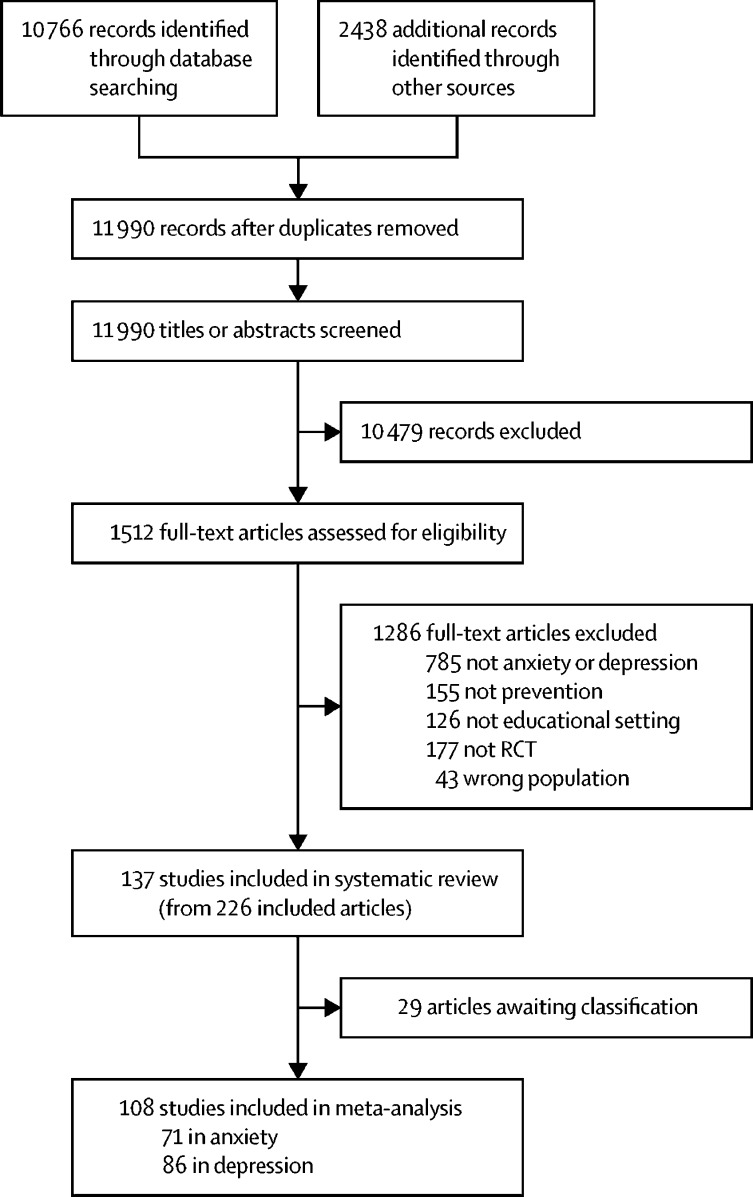
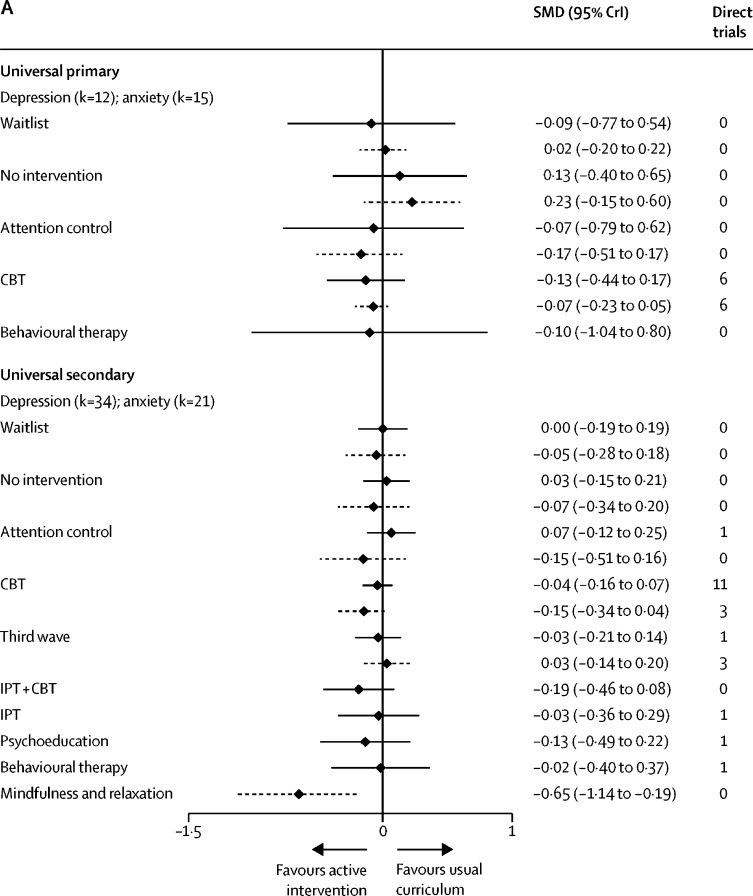
BACKGROUND: Rates of anxiety and depression are increasing among children and young people. Recent policies have focused on primary prevention of mental disorders in children and young people, with schools at the forefront of implementation. There is limited information for the comparative effectiveness of the multiple interventions available. METHODS: We did a systematic review and network meta-analysis, searching MEDLINE, Embase, PsycINFO, and Cochrane Central Register of Controlled trials for published and unpublished, passive and active-controlled randomised and quasi-randomised trials. We included educational setting-based, universal, or targeted interventions in which the primary aim was the prevention of anxiety and depression in children and young people aged 4-18 years. Primary outcomes were post-intervention self-report anxiety and depression, wellbeing, suicidal ideation, or self-harm. We assessed risk of bias following the Cochrane Handbook for Systematic Reviews of Interventions. We estimated standardised mean differences (SMD) using random effects network meta-analysis in a Bayesian framework. The study is registered with PROPSERO, number CRD42016048184. FINDINGS: 1512 full-text articles were independently screened for inclusion by two reviewers, from which 137 studies of 56 620 participants were included. 20 studies were assessed as being at low risk of bias for both random sequence generation and allocation concealment. There was weak evidence to suggest that cognitive behavioural interventions might reduce anxiety in primary and secondary settings. In universal secondary settings, mindfulness and relaxation-based interventions showed a reduction in anxiety symptoms relative to usual curriculum (SMD -0·65, 95% credible interval -1·14 to -0·19). There was a lack of evidence to support any one type of intervention being effective to prevent depression in universal or targeted primary or secondary settings. Comparison-adjusted funnel plots suggest the presence of small-study effects for the universal secondary anxiety analysis. Network meta-analysis was not feasible for wellbeing or suicidal ideation or self-harm outcomes, and results are reported narratively. INTERPRETATION: Considering unclear risk of bias and probable small study effects for anxiety, we conclude there is little evidence that educational setting-based interventions focused solely on the prevention of depression or anxiety are effective. Future research could consider multilevel, systems-based interventions as an alternative to the downstream interventions considered here. FUNDING: UK National Institute for Health Research.
Overview
The claims and statistics of this paper haven’t been checked yet.
Free: it reads the open-access text and checks the first 5 claims that cite a source we can check. Create a free account to check every claim.
Integrity signals
Registry
Cites
Statistics
Figures
Verification
Claims the paper makes
The claims and statistics of this paper haven’t been checked yet.
Free: it reads the open-access text and checks the first 5 claims that cite a source we can check. Create a free account to check every claim.
Claims other papers make about this one
Each is checked against this paper’s own text: does it say what the citing paper says it does?
The source backs part of the claim, not all of it — or backs it for a different population, condition or comparison.
In the citing paper
“In child and adolescent population, MBIs have been related to symptom reduction, increased wellbeing [1,10,14,15,31,32,33,34,35,36]”
From Systematic Review of Mindfulness-Based Interventions in Child-Adolescent Population: A Developmental Perspective (2022) · cites this paper as [1]
Experimental — accuracy not yet measuredThe source backs part of the claim, not all of it — or backs it for a different population, condition or comparison.
In the citing paper
“Psychological interventions may improve affective symptoms 155 , while psychotherapy/ psychoeducation may improve some anxiety symptoms 115 (but not as school-based education intervention 156 )”
From Preventive psychiatry: a blueprint for improving the mental health of young people (2021) · cites this paper as [156]
Experimental — accuracy not yet measuredThe source backs part of the claim, not all of it — or backs it for a different population, condition or comparison.
In the citing paper
“other evidence-based syntheses have disconfirmed initial promising findings relating to the indicated/selective/universal prevention of anxiety and depression 113,115,156 or reduction of substance abuse in young people 154”
From Preventive psychiatry: a blueprint for improving the mental health of young people (2021) · cites this paper as [156]
Experimental — accuracy not yet measuredThe source backs part of the claim, not all of it — or backs it for a different population, condition or comparison.
In the citing paper
“The lack of evidence to favour several preventive interventions 113,115,154,156 may indicate that a one-size-fits-all approach is not effective and may obfuscate the efficacy for specific subgroups of individuals.”
From Preventive psychiatry: a blueprint for improving the mental health of young people (2021) · cites this paper as [156]
Experimental — accuracy not yet measuredThe source backs part of the claim, not all of it — or backs it for a different population, condition or comparison.
In the citing paper
“but not as school-based interventions 156 ***”
From Preventive psychiatry: a blueprint for improving the mental health of young people (2021) · cites this paper as [156]
Experimental — accuracy not yet measured
9 more claims about this paper
Create a free account to see every claim other papers make about this one.
Self-check
Percentages, sums and reported differences re-computed from the paper’s own numbers.
The self-check needs the paper’s full text.
Citations
Cites
Cochrane Handbook for Systematic Reviews of Interventions: Cochrane Book Series
(2008) · doi:10.1002/9780470712184 · Cited by 25,048
Hoffmann, T. C., Glasziou, P. P., Boutron, I., Milne, R., Perera, R., Moher, D., Altman, D. G., Barbour, V., Macdonald, H., Johnston, M., et al. (2014) · BMJ · doi:10.1136/bmj.g1687 · Cited by 10,548
Hutton, B., Salanti, G., Caldwell, D. M., Chaimani, A., Schmid, C. H., Cameron, C., Ioannidis, J. P. A., Straus, S., Thorlund, K., Jansen, J. P., et al. (2015) · Annals of Internal Medicine · doi:10.7326/m14-2385 · Cited by 8,269
Self-citationCochrane Handbook for Systematic Reviews of Interventions
Higgins, J. P. T., Green, S., & Ben Van Den, A. (2020) · International Coaching Psychology Review · doi:10.53841/bpsicpr.2020.15.2.123 · Cited by 5,670
The Lancet Commission on global mental health and sustainable development
Patel, V., Saxena, S., Lund, C., Thornicroft, G., Baingana, F., Bolton, P., Chisholm, D., Collins, P. Y., Cooper, J. L., Eaton, J., et al. (2018) · The Lancet · doi:10.1016/s0140-6736(18)31612-x · Cited by 3,692
Graphical tools for network meta-analysis in STATA
Chaimani, A., Higgins, J. P. T., Mavridis, D., Spyridonos, P., & Salanti, G. (2013) · PLoS ONE · doi:10.1371/journal.pone.0076654 · Cited by 2,473
Global burden of disease in young people aged 10–24 years: a systematic analysis
Gore, F. M., Bloem, P. J., Patton, G. C., Ferguson, J., Joseph, V., Coffey, C., Sawyer, S. M., & Mathers, C. D. (2011) · The Lancet · doi:10.1016/s0140-6736(11)60512-6 · Cited by 2,301
(2009) · Cited by 2,013
Simultaneous comparison of multiple treatments: Combining direct and indirect evidence.
Caldwell, D. M., Ades, A. E., & Higgins, J. P. T. (2005) · BMJ · doi:10.1136/bmj.331.7521.897 · Cited by 1,600
Self-citationThe Interpretation of Random-Effects Meta-Analysis in Decision Models
Ades, A. E., Lu, G., & Higgins, J. P. T. (2005) · Medical Decision Making · doi:10.1177/0272989x05282643 · Cited by 859
Cited by
Items 301–336 of 336
McPhail, L., Thornicroft, G., & Gronholm, P. C. (2024) · Figshare · doi:10.6084/m9.figshare.25744285
Cybulski, L., Ashcroft, D. M., Carr, M., Garg, S., Chew-Graham, C. A., Kapur, N., & Webb, R. T. (2021) · Figshare · doi:10.6084/m9.figshare.14532680
Cybulski, L., Ashcroft, D. M., Carr, M., Garg, S., Chew-Graham, C. A., Kapur, N., & Webb, R. T. (2021) · Figshare · doi:10.6084/m9.figshare.14532686
Cybulski, L., Ashcroft, D. M., Carr, M., Garg, S., Chew-Graham, C. A., Kapur, N., & Webb, R. T. (2021) · Figshare · doi:10.6084/m9.figshare.14532671
Lin, G., Werner, K., Alqunaiebet, A., Hamza, M. M., Alkanhal, N., Alsukait, R. F., Alruwaily, A., Rakić, S., Çetinkaya, V., Herbst, C. H., et al. (2024) · Figshare · doi:10.6084/m9.figshare.26705109
Lin, G., Werner, K., Alqunaiebet, A., Hamza, M. M., Alkanhal, N., Alsukait, R. F., Alruwaily, A., Rakić, S., Çetinkaya, V., Herbst, C. H., et al. (2024) · Figshare · doi:10.6084/m9.figshare.26705112
Cybulski, L., Ashcroft, D. M., Carr, M., Garg, S., Chew-Graham, C. A., Kapur, N., & Webb, R. T. (2021) · Figshare · doi:10.6084/m9.figshare.14532677
Hankin, B. L., Jones, J. D., Davis, M., Schwartz, K. T. G., Gallop, R., & Young, J. F. (2025) · Journal of Affective Disorders · doi:10.1016/j.jad.2025.120939 · Cited by 1
Sarroeira, S., Pereira, B., Veiga, G., de Oliveira, W. A., & Rodríguez-Fernández, J. E. (2026) · Healthcare · doi:10.3390/healthcare14010110
Lu, C., Zhou, Y. C., Chen, X., Tan, P., Zhang, Y., Li, Z., Wu, Y., Chen, P., & Li, W.-H. (2026) · BMC Psychology · doi:10.1186/s40359-025-03905-4 · Cited by 2
Braën-Boucher, C., & Roberge, M.-C. (2026) · doi:10.64490/rouu6008
Lloyd-Houldey, O., Sundaram, N., Michalopoulou, S., Sturgess, J., Legood, R., Carlile, O., Allen, E., Scott, S., Nicholls, D., Hope, S., et al. (2025) · Public Health Research · doi:10.3310/pfhr4141 · Cited by 2
Maggio, C., Scuderi, V. E., Boccadamo, M., & Platania, S. (2026) · European Journal of Investigation in Health Psychology and Education · doi:10.3390/ejihpe16030039 · Cited by 2
“Among the core dimensions of burnout, emotional exhaustion is closely tied to fatigue, defined as a state of intense tiredness or sleepiness resulting from insufficient sleep, prolonged mental or physical effort, or sustained exposure to stress (Basi´nska et al., 2014; Caldwell et al., 2019).”
Cui, Y., Wu, W., Liu, Z., Shen, J. J., Ban, X., Li, R., Hu, J., Zhou, F., Zhang, J., Lou, X., et al. (2026) · Psychiatry Research · doi:10.1016/j.psychres.2026.117082 · Cited by 1
Schrijvers, K., Willems, B., Buyl, A., Deforche, B. I., & Dierckens, M. (2026) · School Mental Health · doi:10.1007/s12310-026-09861-7 · Cited by 1
“Therefore, as studies have shown short-lived effects from stand-alone programs (Caldwell et al., 2019; Feiss et al., 2019; Werner-Seidler et al., 2021), mental health policies in schools should still be considered valuable.”
Warner, S., Waller, D., & Bachraz, V. (2026) · International Journal of Adolescence and Youth · doi:10.1080/02673843.2026.2658162
Mechanisms for scale-up: Case example of a school-based mental health approach in the Netherlands
Jenniskens, K., Creemers, D. H. M., van Nassau, F., Popma, A., van Pelt, D., Mérelle, S. Y. M., Spijker, J., & Rasing, S. P. A. (2026) · Mental Health & Prevention · doi:10.1016/j.mhp.2026.200508
Schlechter, P., Neufeld, S., Stewart, L. C., Wilkinson, P. O., & Olino, T. M. (2026) · European Child & Adolescent Psychiatry · doi:10.1007/s00787-026-03065-9
“The elucidation of pathoplastic effects and sex-specific associations between changes in pubertal status, chronological age, and depressive symptoms in adolescents may ultimately offer clinical insights and guide appropriate support strategies, in school settings or at home [53].”
Johnson, E. A., Holt, N., Zignego, J., Scott, B., & Alexander-Ruff, J. H. (2026) · Nurse Researcher · doi:10.7748/nr.2026.e2009
Oranye, N. O., Dibaba, A., Nwankwo, I. U., Webb, L. A., Lee, T., Alexander, M., Kagulire, J., Landu-Adams, V., Nnedum, O. A. U., Abdalla, E., et al. (2026) · BMJ Open · doi:10.1136/bmjopen-2025-113697
“Generally, existing systematic review evidence is disproportionately concentrated on school-based mental health interventions, 64–67 revealing a substantial gap in the evaluation of community-based approaches and a complete absence of direct comparisons between school and community settings in…”
Meléndez‐Torres, G. J., Muraleetharan, V., Lewis, G., Ponsford, R., Meiksin, R., Lohan, M., Sundaram, N., Young, H., Campbell, R., & Bonell, C. P. (2026) · Frontiers in Public Health · doi:10.3389/fpubh.2026.1860546
Self-citationZhou, M., Zhu, Y., Xu, Z., Zhang, Y., Liu, J., & Liu, R. (2026) · School Mental Health · doi:10.1007/s12310-026-09896-w
Mental health illness in children and adolescents: Integrated mental health model of care
Zhu, S., Zeng, I., Kessler, R., Foster, M., Andajani, S., & Holroyd, E. (2026) · Journal of Pediatric Nursing · doi:10.1016/j.pedn.2026.06.007
Coping Skills to Address Internalizing Symptoms in Children and Adolescents
Cavallo, C., Reilly, M., Rogers, J., & Terjesen, M. D. (2026) · Elsevier eBooks · doi:10.1016/b978-0-443-29009-1.00148-7
Whelan, L., Kinderman, P., & Urbina‐Garcia, A. (2026) · Irish Educational Studies · doi:10.1080/03323315.2026.2702410
Chiappini, S., Ricci, V., Carlo, F. D., Mosca, A., Paolo, M. D., Cavallotto, C., Semeraro, F. M., Fraccalini, T., Longo, A., Pettorruso, M., et al. (2026) · International Journal of Social Psychiatry · doi:10.1177/00207640261470091
Jayanthi, M., Krowka, S. K., Schumacher, R. F., Morgan, S. B., Newman-Gonchar, R., Schweer‐Collins, M. L., & Gersten, R. M. (2026) · Review of Educational Research · doi:10.3102/00346543261462183
Community health research in the new German center for child and adolescent health
Kölch, M., Schmidt, S., van den Berg, N., Tomczyk, S., Heckmann, M., Bertsche, A., Seidler, A. L., Bergelt, C., Loss, J., Minden, K., et al. (2026) · Das Gesundheitswesen · doi:10.1055/a-2945-6211
School-based digital mental health interventions: A scoping review
Santosh-Thomas, S., Aggarwal, A., Chandler, T., Dremann, S., Phillips, S., Lopez, E., Weist, M. D., & Daly, B. P. (2026) · Journal of Child and Adolescent Mental Health · doi:10.2989/17280583.2026.2721998
La importancia de la salud mental y la educación emocional en contextos escolares
Caguana-Guamán, B. A., León-Sefla, A. T., Morales-Guamán, D. M., & Benites, R. M. (2026) · Sanitas. Revista arbitrada de ciencias de la salud. · doi:10.62574/ztth8x35
A narrative review of school-based preventive interventions on mental disorders and addictions
Aguilar-Moya, R., Ibáñez-Martínez, R., & Melero-Fuentes, D. (2026) · Discover Mental Health · doi:10.1007/s44192-026-00532-2
“…that they are the most prevalent disorders in the child and youth population [115], and those that have been most researched in the school setting [11, 18, 38], which would justify the predominance observed in our study of the presence of these disorders over others found, such as compulsive…”
Haidabieke, A., Allen, J. L., & Chen, B.-B. (2026) · European Child & Adolescent Psychiatry · doi:10.1007/s00787-026-03199-w
Stewart, T. M., McCluskey, G., Johnson, H., Fry, D., McAra, L., & Booth, J. N. (2026) · PLoS ONE · doi:10.1371/journal.pone.0359563
“…or adapted therapeutic-based interventions such as Cognitive Behavioural Therapy (CBT), Mindfulness Interventions (MI), Interpersonal Psychotherapy (IPT), Acceptance and Commitment Therapy (ACT), Dialectical Behaviour Therapy (DBT), and psychoeducational approaches as well as many others [42,43].”
Yin, S., Tian, T., & Auslander, W. (2026) · Frontiers in Psychology · doi:10.3389/fpsyg.2026.1809434
“Similar heterogeneity has been noted as a consistent challenge in other LMIC-focused prevention and intervention literature (Caldwell et al., 2019; Yin et al., 2025).”
Preventive strategies for mental disorders in children and adolescents
Golovina, A. G., & Shmakova, O. P. (2026) · S S Korsakov Journal of Neurology and Psychiatry · doi:10.17116/jnevro202612609264
Metadata
- Authors
- Caldwell, D. M., Davies, S. R., Hetrick, S. E., Palmer, J. C., Caro, P., López-López, J. A., Gunnell, D., Kidger, J., Thomas, J., French, C., Stockings, E., Campbell, R., & Welton, N. J.
- Affiliations
- University of Bristol (GB)
- University of Auckland (NZ)
- University Hospitals Bristol NHS Foundation Trust (GB)
- University College London (GB)
- UNSW Sydney (AU)
- Corresponding author
- Caldwell, Deborah M
- ORCID
- Venue
- The Lancet Psychiatry
- Publisher
- Elsevier BV
- Published
- 2019-12
- Volume
- 6
- Issue
- 12
- Pages
- 1011-1020
- ISSN
- 2215-0366 (ISSN-L)
- PMC
- PMC7029281
- OpenAlex
- W2988840012
- Cited by
- 336
- References
- 46
- Citations by year
- 2026: 35 · 2025: 65 · 2024: 62 · 2023: 69 · 2022: 44 · 2021: 47 · 2020: 12 · 2019: 2
- FWCI
- 5.94
- Type
- journal article
- Language
- en
- Update notices
- erratum (2020-09-01)
- Open access
- hybrid
- doi.org
- Licence
- cc-by
- www.elsevier.com/tdm/userlicense/1.0/ (tdm)
- www.elsevier.com/legal/tdmrep-license (tdm)
- creativecommons.org/licenses/by/4.0/ (vor)
- Locations
- The Lancet Psychiatry (publishedVersion, cc-by)
- Europe PMC (PubMed Central) (publishedVersion, cc-by)
- PubMed Central (publishedVersion, cc-by)
- PubMed (publishedVersion)
- Bristol Research (University of Bristol) (publishedVersion, cc-by)
- UCL Discovery (University College London) (submittedVersion)
- ResearchSpace (University of Auckland) (submittedVersion, cc-by)
- Funders
- Auckland Medical Research Foundation
- Department of Health, Australian Government
- National Institute for Health Research (PHR [15/49/08)
- National Health and Medical Research Council (567062)
- School for Public Health Research
- Medical Research Council
- University of Bristol
- NIHR Biomedical Research Centre, Royal Marsden NHS Foundation Trust/Institute of Cancer Research
- Department of Health & Social Care (1104600)
- Public Health Research Programme
- Topics
- Health Sciences › Medicine › Public Health, Environmental and Occupational Health › School Health and Nursing Education
- Social Sciences › Psychology › Clinical Psychology › Child and Adolescent Psychosocial and Emotional Development
- Health Sciences › Medicine › Psychiatry and Mental health › Mental Health Treatment and Access
- Keywords
- school-based intervention, anxiety prevention, depression prevention, children and young people, primary prevention, cognitive-behavioural intervention, universal interventions, targeted interventions, suicidal ideation, self-harm, well-being, comparative effectiveness
- MeSH terms
- Adolescent, Anxiety, Child, Child, Preschool, Depression, Humans, School Health Services, Cognitive Behavioral Therapy, Suicidal Ideation
About these checks
Registry, retraction, Cites and statistics results are computed, not judged, with one exception: a printed reference that no index lists is read once by a model before it counts as a citation error. Claims are extracted by a model and kept only when their quote appears verbatim in the text; each cited source is then checked, with a model’s help, for whether it says what the claim relies on. Those verdicts can be wrong — read the claim’s quote and the cited source before relying on one.
Statistics and arithmetic are recomputed, not judged.
Confidence bands are shown only for fields calibrated on our annotated test set. None is calibrated yet, so no band is shown.
What counts as a claim ›How we measure confidence ›How we check this ›
Are you an author, or do you see a problem with this page? Request a review
Data sources
Bibliographic data: Semantic Scholar, OpenAlex, Crossref.
Contains information from the Semantic Scholar Academic Graph Datasets, made available under the ODC Attribution License (ODC-BY 1.0).
Semantic Scholar’s data is described in: Kinney, R., et al. (2023). The Semantic Scholar Open Data Platform. arXiv:2301.10140.
