

The DOI matches its Crossref record; 84 of the 84 references it cites were found in a registry or an index; 2 of the 39 sources its claims cite were checked for support.
Risk factors for self-harm in prison: a systematic review and meta-analysis
Open accessAbstract
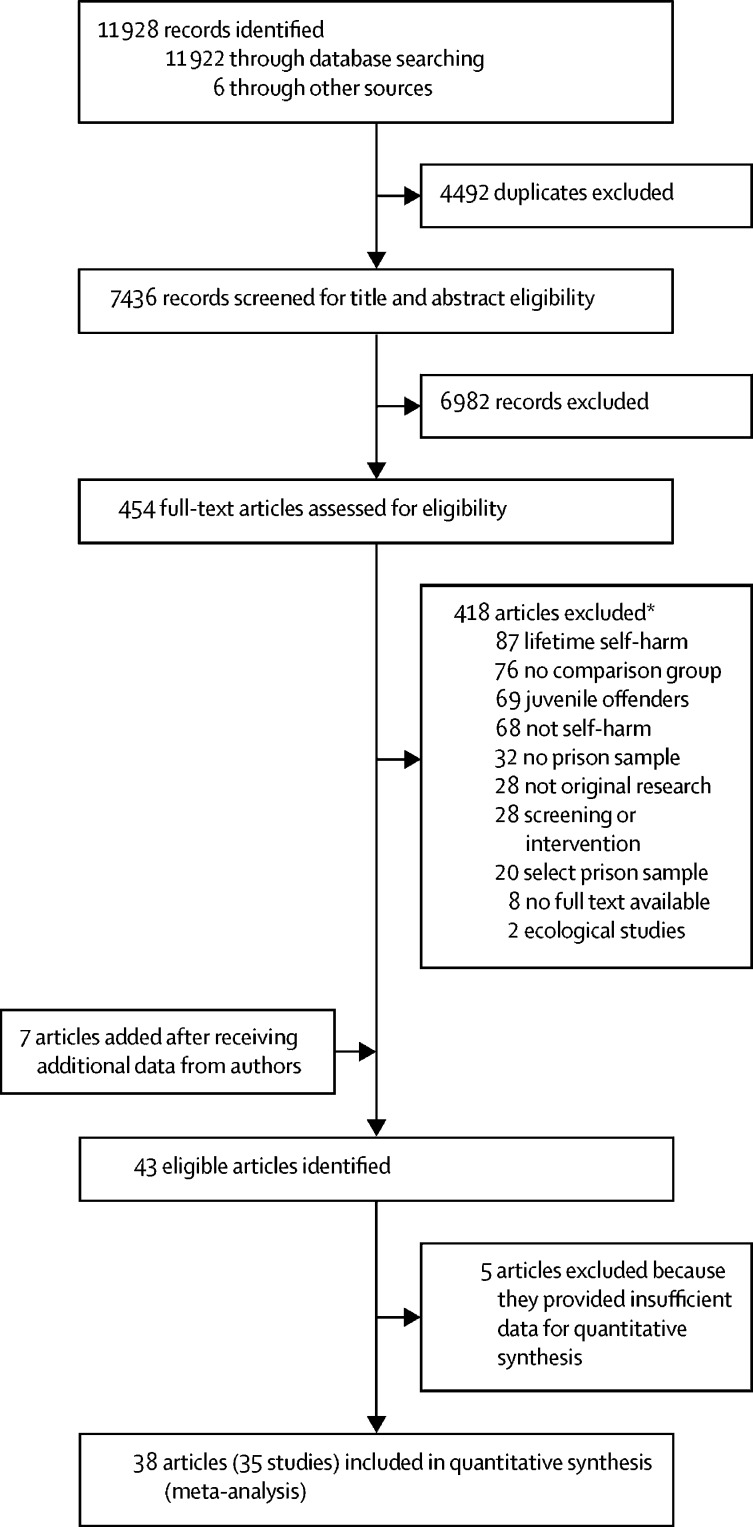
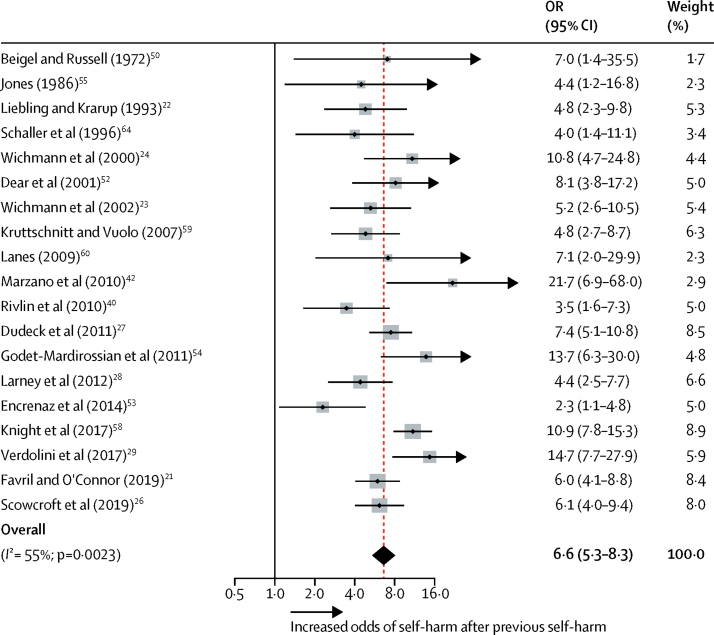
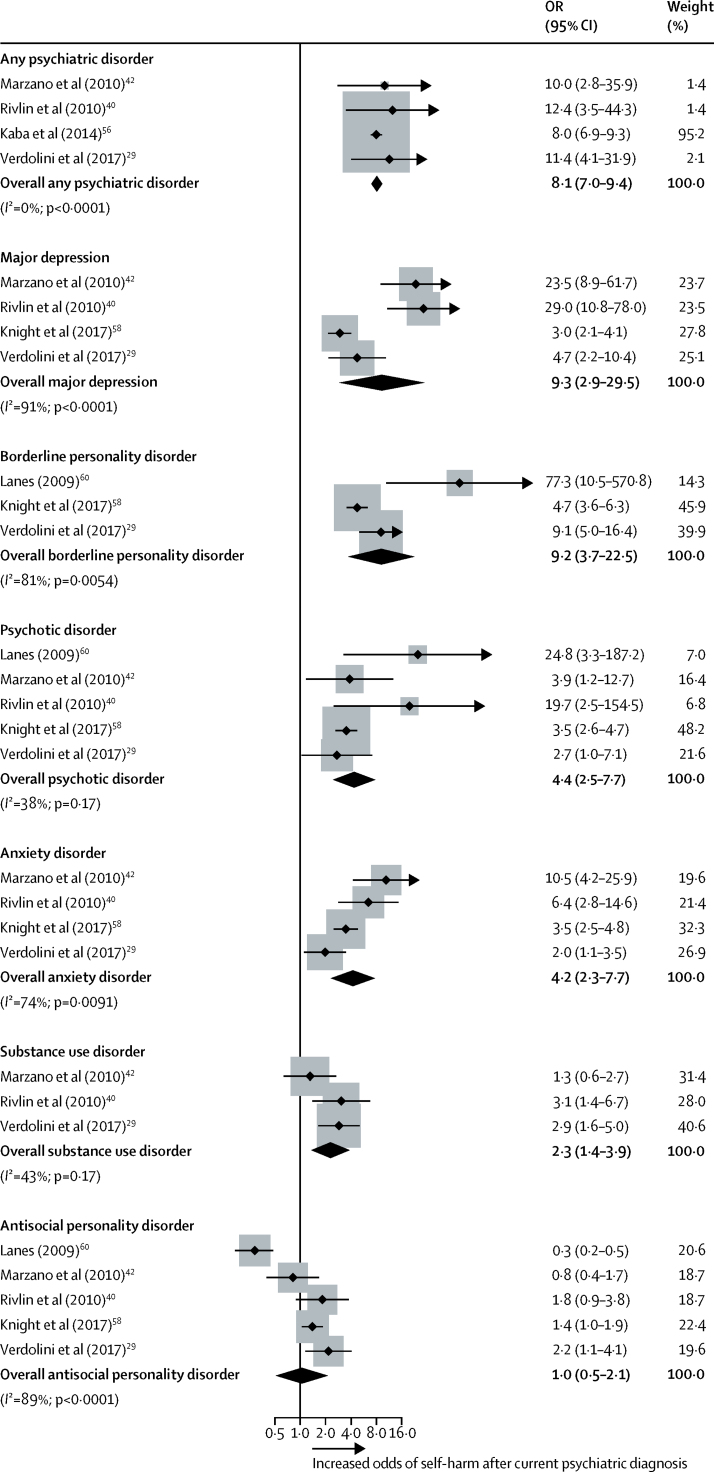
Background Self-harm is a leading cause of morbidity in prisoners. Although a wide range of risk factors for self-harm in prisoners has been identified, the strength and consistency of effect sizes is uncertain. We aimed to synthesise evidence and assess the risk factors associated with self-harm inside prison. Methods In this systematic review and meta-analysis, we searched four electronic databases (PubMed, Embase, Web of Science, and PsycINFO) for observational studies on risk factors for self-harm in prisoners published from database inception to Oct 31, 2019, supplemented through correspondence with authors of studies. We included primary studies involving adults sampled from general prison populations who self-harmed in prison and a comparison group without self-harm in prison. We excluded studies with qualitative or ecological designs, those that reported on lifetime measures of self-harm or on selected samples of prisoners, and those with a comparison group that was not appropriate or not based on general prison populations. Data were extracted from the articles and requested from study authors. Our primary outcome was the risk of self-harm for risk factors in prisoners. We pooled effect sizes as odds ratios (OR) using random effects models for each risk factor examined in at least three distinct samples. We assessed study quality on the basis of the Newcastle-Ottawa Scale and examined between-study heterogeneity. The study protocol was registered with PROSPERO, CRD42018087915. Findings We identified 35 independent studies from 20 countries comprising a total of 663 735 prisoners, of whom 24 978 (3·8%) had self-harmed in prison. Across the 40 risk factors examined, the strongest associations with self-harm in prison were found for suicide-related antecedents, including current or recent suicidal ideation (OR 13·8, 95% CI 8·6–22·1; I 2 =49%), lifetime history of suicidal ideation (8·9, 6·1–13·0; I 2 =56%), and previous self-harm (6·6, 5·3–8·3; I 2 =55%). Any current psychiatric diagnosis was also strongly associated with self-harm (8·1, 7·0–9·4; I 2 =0%), particularly major depression (9·3, 2·9–29·5; I 2 =91%) and borderline personality disorder (9·2, 3·7–22·5; I 2 =81%). Prison-specific environmental risk factors for self-harm included solitary confinement (5·6, 2·7–11·6; I 2 =98%), disciplinary infractions (3·5, 1·2–9·7; I 2 =99%), and experiencing sexual or physical victimisation while in prison (3·2, 2·1–4·8; I 2 =44%). Sociodemographic (OR range 1·5–2·5) and criminological (1·8–2·3) factors were only modestly associated with self-harm in prison. We did not find clear evidence of publication bias. Interpretation The wide range of risk factors across clinical and custody-related domains underscores the need for a comprehensive, prison-wide approach towards preventing self-harm in prison. This approach should incorporate both population and targeted strategies, with multiagency collaboration between the services for mental health, social care, and criminal justice having a key role. Funding Wellcome Trust.
Overview
AI snapshot
Written from the paper’s full text.
TL;DR
This systematic review and meta-analysis of 35 studies including 663,735 prisoners found that the strongest risk factors for self-harm in prison were suicide-related antecedents and psychiatric morbidity, with prison-specific environmental factors also strongly associated. The authors conclude that prevention requires a comprehensive, prison-wide approach with multiagency collaboration.
Key findings
- Across 40 risk factors, the strongest associations were current or recent suicidal ideation (OR 13·8, 95% CI 8·6–22·1; I²=49%), lifetime history of suicidal ideation (8·9, 6·1–13·0; I²=56%), and previous self-harm (6·6, 5·3–8·3; I²=55%).
- Any current psychiatric diagnosis was strongly associated with self-harm (8·1, 7·0–9·4; I²=0%), particularly major depression (9·3, 2·9–29·5; I²=91%) and borderline personality disorder (9·2, 3·7–22·5; I²=81%).
- Prison-specific environmental risk factors included solitary confinement (5·6, 2·7–11·6; I²=98%), disciplinary infractions (3·5, 1·2–9·7; I²=99%), and sexual or physical victimisation while in prison (3·2, 2·1–4·8; I²=44%). Sociodemographic (OR range 1·5–2·5) and criminological (1·8–2·3) factors were only modestly associated.
- The authors did not find clear evidence of publication bias; sensitivity analyses excluding low-quality studies did not materially change risk factor estimates.
Methods
- Systematic review and meta-analysis following PRISMA, registered with PROSPERO (CRD42018087915). Searched PubMed, Embase, Web of Science, and PsycINFO from database inception to Oct 31, 2019, with no language restrictions, supplemented by hand-searching and author correspondence.
- Included 35 independent studies from 20 countries comprising 663,735 prisoners, of whom 24,978 (3·8%) had self-harmed in prison. Median sample size was 785 (IQR 142–2119); 9·6% of the pooled sample were women.
- Pooled odds ratios using random-effects models for risk factors examined in at least three distinct samples; heterogeneity assessed with I²; study quality assessed with the Newcastle-Ottawa Scale; meta-regression examined sample size and outcome definition; publication bias assessed via funnel plots and Egger’s test.
Limitations
- Paper-stated limitations include lack of adjustment for confounding and non-independence of risk factors; possible reverse causality; no consideration of chronicity or frequency of self-harm; reliance on retrospective self-report in most cross-sectional studies, which may inflate estimates; high heterogeneity among some estimates; inability to investigate institutional variables such as prison size, mental health care availability, and overcrowding; no studies from low-income and middle-income countries; and limited sex-stratified analysis because 13 studies combined sexes.
- Evident from the text: most included studies were case-control (k=17) or cross-sectional (k=12), with only six cohorts and only two prospective studies; the three largest retrospective studies accounted for 609,366 (91·8%) of the pooled sample, and several key pooled estimates had very high heterogeneity (e.g., solitary confinement I²=98%, disciplinary infractions I²=99%).
Model-written summary. Check it against the paper before relying on it.
Integrity signals
Registry
Cites
Statistics
Figures
Verification
Claims the paper makes
66 Own result · 23 Not checked yet · 19 Own method · 9 Own interpretation · 1 Supported so far
The sources with a verdict support this claim; the rest weren’t checked yet, have no full text we could read, or their verdicts aren’t rated yet.
In the paper
“Given that previous self-harm is among the strongest predictors of future self-harm68, 69, 70 and suicide,9, 10”
§ Risk factors for self-harm in prison: a systematic review and meta-analysis > Discussion
What the sources say
- Supportedcites [68] Fox, 2015, Meta-analysis of risk factors for nonsuicidal self-injury, Clin Psychol Rev source
The citation is attached to the future-self-harm part of the sentence, not the separately cited suicide part. The Discussion identifies NSSI history as one of the strongest risk factors for future NSSI, supporting that attribution. (LLM, conf=0.91)
- Supportedcites [69] Ribeiro, 2016, Self-injurious thoughts and behaviors as risk factors for future suicide ideation, attempts, and death: a meta-analysis of longitudinal studies, Psychol Med source
Citations 9 and 10 attach to the claim about future suicide, rather than the separately cited claim about future self-harm. The Discussion reports that a history of suicide attempts was among the strongest predictors of suicide death, supporting the claim for previous self-harm in the form of suicide attempts. The passage has no page number in our copy. (LLM, conf=0.90)
- Not checked yetcites [70] Franklin, 2017, Risk factors for suicidal thoughts and behaviors: a meta-analysis of 50 years of research, Psychol Bull source
boostedcorrelational- Asserted: passes — The authors put it forward as true.
- Checkable: passes — It can be checked against evidence.
- Load-bearing: passes — The paper’s conclusions depend on it.
- Based: passes — The paper gives a reason why it holds.
- Supported
A result the paper reports from its own data — it cites no other source for it, so there is none to check. The quote shows it is in the paper.
In the paper
“We identified 35 independent studies from 20 countries comprising a total of 663 735 prisoners”
- Also stated in: § Results · plain
“We included 35 studies reported in 38 articles in the meta-analysis (appendix pp 4–5), comprising a total of 663 735 prisoners”
§ Risk factors for self-harm in prison: a systematic review and meta-analysis > Abstract > Findings
plain- Asserted: passes — The authors put it forward as true.
- Checkable: passes — It can be checked against evidence.
- Load-bearing: passes — The paper’s conclusions depend on it.
- Based: passes — The paper gives a reason why it holds.
- Also stated in: § Results · plain
A result the paper reports from its own data — it cites no other source for it, so there is none to check. The quote shows it is in the paper.
In the paper
“particularly major depression (9·3, 2·9–29·5; I2=91%)”
- Also stated in: § Results · plain
“Major depression | 4 | 3908 | 9·3 (2·9–29·5) | 3·8 | <0·0001 | 91%”
§ Risk factors for self-harm in prison: a systematic review and meta-analysis > Abstract > Findings
plaincorrelational- Asserted: passes — The authors put it forward as true.
- Checkable: passes — It can be checked against evidence.
- Load-bearing: passes — The paper’s conclusions depend on it.
- Based: passes — The paper gives a reason why it holds.
- Also stated in: § Results · plain
A result the paper reports from its own data — it cites no other source for it, so there is none to check. The quote shows it is in the paper.
In the paper
“solitary confinement (5·6, 2·7–11·6; I2=98%)”
- Also stated in: § Results · plain
“Solitary confinement | 11 | 410 314 | 5·6 (2·7–11·6) | 4·6 | <0·0001 | 98%”
§ Risk factors for self-harm in prison: a systematic review and meta-analysis > Abstract > Findings
plaincorrelational- Asserted: passes — The authors put it forward as true.
- Checkable: passes — It can be checked against evidence.
- Load-bearing: passes — The paper’s conclusions depend on it.
- Based: passes — The paper gives a reason why it holds.
- Also stated in: § Results · plain
A result the paper reports from its own data — it cites no other source for it, so there is none to check. The quote shows it is in the paper.
In the paper
“current or recent suicidal ideation (OR 13·8, 95% CI 8·6–22·1; I2=49%)”
- Also stated in: § Results · plain
“Current or recent | 6 | 7256 | 13·8 (8·6–22·1) | 10·9 | <0·0001 | 49%”
§ Risk factors for self-harm in prison: a systematic review and meta-analysis > Abstract > Findings
plaincorrelational- Asserted: passes — The authors put it forward as true.
- Checkable: passes — It can be checked against evidence.
- Load-bearing: passes — The paper’s conclusions depend on it.
- Based: passes — The paper gives a reason why it holds.
- Also stated in: § Results · plain
A result the paper reports from its own data — it cites no other source for it, so there is none to check. The quote shows it is in the paper.
In the paper
“of whom 24 978 (3·8%) had self-harmed in prison”
- Also stated in: § Results · plain
“Of all 663 735 prisoners included, 24 978 (3·8%) had self-harmed in prison.”
§ Risk factors for self-harm in prison: a systematic review and meta-analysis > Abstract > Findings
plain- Asserted: passes — The authors put it forward as true.
- Checkable: passes — It can be checked against evidence.
- Load-bearing: unclear — It is unclear whether the paper’s conclusions depend on it.
- Based: passes — The paper gives a reason why it holds.
- Also stated in: § Results · plain
A result the paper reports from its own data — it cites no other source for it, so there is none to check. The quote shows it is in the paper.
In the paper
“disciplinary infractions (3·5, 1·2–9·7; I2=99%)”
- Also stated in: § Results · plain
“Disciplinary infractions | 13 | 302 203 | 3·5 (1·2–9·7) | 2·3 | 0·019 | 99%”
§ Risk factors for self-harm in prison: a systematic review and meta-analysis > Abstract > Findings
plaincorrelational- Asserted: passes — The authors put it forward as true.
- Checkable: passes — It can be checked against evidence.
- Load-bearing: passes — The paper’s conclusions depend on it.
- Based: passes — The paper gives a reason why it holds.
- Also stated in: § Results · plain
A result the paper reports from its own data — it cites no other source for it, so there is none to check. The quote shows it is in the paper.
In the paper
“lifetime history of suicidal ideation (8·9, 6·1–13·0; I2=56%)”
- Also stated in: § Results · plain
“Lifetime history | 5 | 3779 | 8·9 (6·1–13·0) | 11·3 | <0·0001 | 56%”
§ Risk factors for self-harm in prison: a systematic review and meta-analysis > Abstract > Findings
plaincorrelational- Asserted: passes — The authors put it forward as true.
- Checkable: passes — It can be checked against evidence.
- Load-bearing: passes — The paper’s conclusions depend on it.
- Based: passes — The paper gives a reason why it holds.
- Also stated in: § Results · plain
A result the paper reports from its own data — it cites no other source for it, so there is none to check. The quote shows it is in the paper.
In the paper
“experiencing sexual or physical victimisation while in prison (3·2, 2·1–4·8; I2=44%)”
- Also stated in: § Results · plain
“Sexual or physical victimisation | 7 | 9198 | 3·2 (2·1–4·8) | 5·7 | <0·0001 | 44%”
§ Risk factors for self-harm in prison: a systematic review and meta-analysis > Abstract > Findings
plaincorrelational- Asserted: passes — The authors put it forward as true.
- Checkable: passes — It can be checked against evidence.
- Load-bearing: passes — The paper’s conclusions depend on it.
- Based: passes — The paper gives a reason why it holds.
- Also stated in: § Results · plain
A result the paper reports from its own data — it cites no other source for it, so there is none to check. The quote shows it is in the paper.
In the paper
“borderline personality disorder (9·2, 3·7–22·5; I2=81%)”
- Also stated in: § Results · plain
“Borderline personality disorder | 3 | 3932 | 9·2 (3·7–22·5) | 4·8 | <0·0001 | 81%”
§ Risk factors for self-harm in prison: a systematic review and meta-analysis > Abstract > Findings
plaincorrelational- Asserted: passes — The authors put it forward as true.
- Checkable: passes — It can be checked against evidence.
- Load-bearing: passes — The paper’s conclusions depend on it.
- Based: passes — The paper gives a reason why it holds.
- Also stated in: § Results · plain
- It may state two separate claims as one. 21
- The quote only partly states this claim. 4
- Probably not a substantial claim. 18
A result the paper reports from its own data — it cites no other source for it, so there is none to check. The quote shows it is in the paper.
In the paper
“Overall, we found strong effects for modifiable clinical and custodial variables, moderate effects for historical variables, and smaller effects for sociodemographic and criminological variables.”
§ Risk factors for self-harm in prison: a systematic review and meta-analysis > Discussion
plaincorrelational- Asserted: passes — The authors put it forward as true.
- Checkable: passes — It can be checked against evidence.
- Load-bearing: passes — The paper’s conclusions depend on it.
- Based: passes — The paper gives a reason why it holds.
It may state two separate claims as one.
A result the paper reports from its own data — it cites no other source for it, so there is none to check. The quote shows it is in the paper.
In the paper
“Emotional | 4 | 3453 | 3·0 (1·9–4·9) | 4·5 | <0·0001 | 71%”
§ Risk factors for self-harm in prison: a systematic review and meta-analysis > Results
plaincorrelational- Asserted: passes — The authors put it forward as true.
- Checkable: passes — It can be checked against evidence.
- Load-bearing: passes — The paper’s conclusions depend on it.
- Based: passes — The paper gives a reason why it holds.
The quote only partly states this claim.
A result the paper reports from its own data — it cites no other source for it, so there is none to check. The quote shows it is in the paper.
In the paper
“Outcome definition was a moderator only for the relationship between major depression and self-harm (B=–2·1; p=0·031), with a stronger effect observed for major depression in studies examining suicide attempt compared with non-suicidal self-injury.”
§ Risk factors for self-harm in prison: a systematic review and meta-analysis > Results
plaincorrelational- Asserted: passes — The authors put it forward as true.
- Checkable: passes — It can be checked against evidence.
- Load-bearing: unclear — It is unclear whether the paper’s conclusions depend on it.
- Based: passes — The paper gives a reason why it holds.
It may state two separate claims as one.
A result the paper reports from its own data — it cites no other source for it, so there is none to check. The quote shows it is in the paper.
In the paper
“Physical | 3 | 1183 | 3·2 (1·4–7·0) | 2·9 | 0·0044 | 75%”
§ Risk factors for self-harm in prison: a systematic review and meta-analysis > Results
plaincorrelational- Asserted: passes — The authors put it forward as true.
- Checkable: passes — It can be checked against evidence.
- Load-bearing: passes — The paper’s conclusions depend on it.
- Based: passes — The paper gives a reason why it holds.
The quote only partly states this claim.
A result the paper reports from its own data — it cites no other source for it, so there is none to check. The quote shows it is in the paper.
In the paper
“Similarly, Egger's test was not significant for violent offending (p=0·68), single marital status (p=0·14), and previous self-harm (p=0·53).”
§ Risk factors for self-harm in prison: a systematic review and meta-analysis > Results
plain- Asserted: passes — The authors put it forward as true.
- Checkable: passes — It can be checked against evidence.
- Load-bearing: passes — The paper’s conclusions depend on it.
- Based: passes — The paper gives a reason why it holds.
It may state two separate claims as one.
A result the paper reports from its own data — it cites no other source for it, so there is none to check. The quote shows it is in the paper.
In the paper
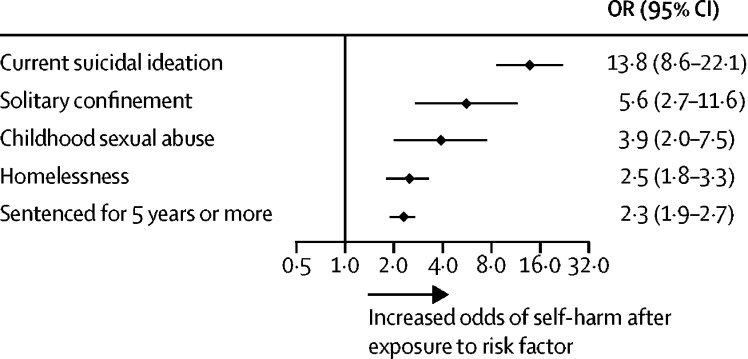
“The leading risk factors from each of the five domains were homelessness, being sentenced for 5 years or more, current suicidal ideation, solitary confinement, and childhood sexual abuse (figure 4).”
§ Risk factors for self-harm in prison: a systematic review and meta-analysis > Results
plaincorrelational- Asserted: passes — The authors put it forward as true.
- Checkable: passes — It can be checked against evidence.
- Load-bearing: passes — The paper’s conclusions depend on it.
- Based: passes — The paper gives a reason why it holds.
It may state two separate claims as one.
A result the paper reports from its own data — it cites no other source for it, so there is none to check. The quote shows it is in the paper.
In the paper
“Any abuse | 6 | 9481 | 2·1 (1·8–2·5) | 8·9 | <0·0001 | 0%”
§ Risk factors for self-harm in prison: a systematic review and meta-analysis > Results
plaincorrelational- Asserted: passes — The authors put it forward as true.
- Checkable: passes — It can be checked against evidence.
- Load-bearing: passes — The paper’s conclusions depend on it.
- Based: passes — The paper gives a reason why it holds.
The quote only partly states this claim.
A result the paper reports from its own data — it cites no other source for it, so there is none to check. The quote shows it is in the paper.
In the paper
“Screening of funnel plots (appendix pp 13–15) suggests that there was no clear publication bias for violent offending (k=24), single marital status (k=20), and previous self-harm (k=19).”
§ Risk factors for self-harm in prison: a systematic review and meta-analysis > Results
hedged- Asserted: passes — The authors put it forward as true.
- Checkable: passes — It can be checked against evidence.
- Load-bearing: unclear — It is unclear whether the paper’s conclusions depend on it.
- Based: passes — The paper gives a reason why it holds.
It may state two separate claims as one.
A result the paper reports from its own data — it cites no other source for it, so there is none to check. The quote shows it is in the paper.
In the paper
“Sexual | 4 | 1325 | 3·9 (2·0–7·5) | 4·0 | <0·0001 | 57%”
§ Risk factors for self-harm in prison: a systematic review and meta-analysis > Results
plaincorrelational- Asserted: passes — The authors put it forward as true.
- Checkable: passes — It can be checked against evidence.
- Load-bearing: passes — The paper’s conclusions depend on it.
- Based: passes — The paper gives a reason why it holds.
The quote only partly states this claim.
A result the paper reports from its own data — it cites no other source for it, so there is none to check. The quote shows it is in the paper.
In the paper
“we found no clear associations between self-harm and single cell occupancy or remand status.”
§ Risk factors for self-harm in prison: a systematic review and meta-analysis > Discussion
plain- Asserted: passes — The authors put it forward as true.
- Checkable: passes — It can be checked against evidence.
- Load-bearing: passes — The paper’s conclusions depend on it.
- Based: passes — The paper gives a reason why it holds.
It may state two separate claims as one.
A result the paper reports from its own data — it cites no other source for it, so there is none to check. The quote shows it is in the paper.
In the paper
“In addition, we found that environmental factors specific to prison, including solitary confinement, disciplinary infractions, victimisation during imprisonment, and poor social support, were clearly associated with self-harm.”
§ Risk factors for self-harm in prison: a systematic review and meta-analysis > Discussion
boostedcorrelational- Asserted: passes — The authors put it forward as true.
- Checkable: passes — It can be checked against evidence.
- Load-bearing: passes — The paper’s conclusions depend on it.
- Based: passes — The paper gives a reason why it holds.
It may state two separate claims as one.
A result the paper reports from its own data — it cites no other source for it, so there is none to check. The quote shows it is in the paper.
In the paper
“There was an increased risk of self-harm in female prisoners, although this was not statistically significant.”
§ Risk factors for self-harm in prison: a systematic review and meta-analysis > Discussion
plaincorrelational- Asserted: passes — The authors put it forward as true.
- Checkable: passes — It can be checked against evidence.
- Load-bearing: unclear — It is unclear whether the paper’s conclusions depend on it.
- Based: passes — The paper gives a reason why it holds.
It may state two separate claims as one.
None of the sources cited for this claim have been checked yet.
In the paper
“The presence of potential publication bias was assessed by examination of asymmetry in funnel plots48 and by applying Egger's test49 for the top three risk factors that had the most information.”
§ Risk factors for self-harm in prison: a systematic review and meta-analysis > Methods > Data analysis
What the sources say
plain- Asserted: passes — The authors put it forward as true.
- Checkable: passes — It can be checked against evidence.
- Load-bearing: fails — The paper’s conclusions may not depend on it.
- Based: passes — The paper gives a reason why it holds.
Probably not a substantial claim. The paper’s conclusions may not depend on it.
What the paper did — it cites no source for this, so there is none to check. The quote shows it is in the paper.
In the paper
“Overall, 18 (51%) of the 35 studies included were judged to be of high quality and four (11%) were categorised as being of low methodological quality (appendix pp 4–5).”
§ Risk factors for self-harm in prison: a systematic review and meta-analysis > Results
plain- Asserted: passes — The authors put it forward as true.
- Checkable: passes — It can be checked against evidence.
- Load-bearing: unclear — It is unclear whether the paper’s conclusions depend on it.
- Based: passes — The paper gives a reason why it holds.
It may state two separate claims as one.
In the paper
“We did a systematic review and meta-analysis following the Preferred Reporting Items for Systematic Reviews and Meta-analyses guidelines19 (known as PRISMA; appendix pp 1–3)”
§ Risk factors for self-harm in prison: a systematic review and meta-analysis > Methods > Search strategy and selection criteria
What the sources say
- Not checked yetcites [19] Moher, 2009, Preferred Reporting Items for Systematic reviews and Meta-analyses: the PRISMA statement, PLoS Med source
plain- Asserted: passes — The authors put it forward as true.
- Checkable: passes — It can be checked against evidence.
- Load-bearing: fails — The paper’s conclusions may not depend on it.
- Based: passes — The paper gives a reason why it holds.
Probably not a substantial claim. The paper’s conclusions may not depend on it.
What the paper did — it cites no source for this, so there is none to check. The quote shows it is in the paper.
In the paper
“the median score for the cross-sectional studies was 6 (5–6)”
§ Risk factors for self-harm in prison: a systematic review and meta-analysis > Results
plain- Asserted: passes — The authors put it forward as true.
- Checkable: passes — It can be checked against evidence.
- Load-bearing: fails — The paper’s conclusions may not depend on it.
- Based: passes — The paper gives a reason why it holds.
Probably not a substantial claim. The paper’s conclusions may not depend on it.
What the paper did — it cites no source for this, so there is none to check. The quote shows it is in the paper.
In the paper
“For all analyses, we generated random effects models that accounted for the anticipated high heterogeneity between studies resulting from differences in samples, measures, and design.”
§ Risk factors for self-harm in prison: a systematic review and meta-analysis > Methods > Data analysis
plain- Asserted: passes — The authors put it forward as true.
- Checkable: passes — It can be checked against evidence.
- Load-bearing: passes — The paper’s conclusions depend on it.
- Based: passes — The paper gives a reason why it holds.
Probably not a substantial claim.
In the paper
“the annual prevalence of self-harm in prison has been estimated to be 5–6% in men and 20–24% in women,5”
§ Risk factors for self-harm in prison: a systematic review and meta-analysis > Introduction
What the sources say
- Not checked yetcites [5] Hawton, 2014, Self-harm in prisons in England and Wales: an epidemiological study of prevalence, risk factors, clustering, and subsequent suicide, Lancet source
hedged- Asserted: passes — The authors put it forward as true.
- Checkable: passes — It can be checked against evidence.
- Load-bearing: fails — The paper’s conclusions may not depend on it.
- Based: passes — The paper gives a reason why it holds.
Probably not a substantial claim. The paper’s conclusions may not depend on it.
What the paper did — it cites no source for this, so there is none to check. The quote shows it is in the paper.
In the paper
“Data were independently extracted by two researchers (LF and Isabel Yoon).”
§ Risk factors for self-harm in prison: a systematic review and meta-analysis > Methods > Data analysis
plain- Asserted: passes — The authors put it forward as true.
- Checkable: passes — It can be checked against evidence.
- Load-bearing: fails — The paper’s conclusions may not depend on it.
- Based: passes — The paper gives a reason why it holds.
Probably not a substantial claim. The paper’s conclusions may not depend on it.
What the paper did — it cites no source for this, so there is none to check. The quote shows it is in the paper.
In the paper
“The funder of the study had no role in study design, data collection, data analysis, data interpretation, or writing of the report.”
§ Risk factors for self-harm in prison: a systematic review and meta-analysis > Methods > Role of the funding source
plain- Asserted: passes — The authors put it forward as true.
- Checkable: passes — It can be checked against evidence.
- Load-bearing: fails — The paper’s conclusions may not depend on it.
- Based: passes — The paper gives a reason why it holds.
Probably not a substantial claim. The paper’s conclusions may not depend on it. It may state two separate claims as one.
What the paper did — it cites no source for this, so there is none to check. The quote shows it is in the paper.
In the paper
“The study protocol was registered with PROSPERO, CRD42018087915.”
- Also stated in: § Search strategy and selection criteria · plain
“The research protocol was registered on PROSPERO (CRD42018087915) before the systematic review was done.”
§ Risk factors for self-harm in prison: a systematic review and meta-analysis > Abstract > Methods
plain- Asserted: passes — The authors put it forward as true.
- Checkable: passes — It can be checked against evidence.
- Load-bearing: fails — The paper’s conclusions may not depend on it.
- Based: passes — The paper gives a reason why it holds.
Probably not a substantial claim. The paper’s conclusions may not depend on it.
- Also stated in: § Search strategy and selection criteria · plain
In the paper
“LF assessed all studies for risk of bias using the Newcastle-Ottawa Scale for cohort and case-control studies, with 9 points indicating high quality and low risk of bias.35”
§ Risk factors for self-harm in prison: a systematic review and meta-analysis > Methods > Data analysis
What the sources say
- Not checked yetcites [35] Wells
plain- Asserted: passes — The authors put it forward as true.
- Checkable: passes — It can be checked against evidence.
- Load-bearing: fails — The paper’s conclusions may not depend on it.
- Based: passes — The paper gives a reason why it holds.
Probably not a substantial claim. The paper’s conclusions may not depend on it.
A result the paper reports from its own data — it cites no other source for it, so there is none to check. The quote shows it is in the paper.
In the paper
“We found one meta-analysis published in 2020 that examined the association between childhood maltreatment and suicide attempt in a population who has been in contact with the criminal justice system, but this meta-analysis included non-prisoners, juvenile offenders, and outcomes in the community.”
§ Risk factors for self-harm in prison: a systematic review and meta-analysis > Introduction
plaincorrelational- Asserted: passes — The authors put it forward as true.
- Checkable: passes — It can be checked against evidence.
- Load-bearing: passes — The paper’s conclusions depend on it.
- Based: passes — The paper gives a reason why it holds.
It may state two separate claims as one.
None of the sources cited for this claim have been checked yet.
In the paper
“This recommendation is supported by evidence on the clustering of self-harm5 and suicide78 in custody, which suggests that interventions after suicidal behaviour should extend beyond the individual prisoner to others in the same wing or prison who could be at risk.”
§ Risk factors for self-harm in prison: a systematic review and meta-analysis > Discussion
What the sources say
- Not checked yetcites [5] Hawton, 2014, Self-harm in prisons in England and Wales: an epidemiological study of prevalence, risk factors, clustering, and subsequent suicide, Lancet source
- Not checked yetcites [78] McKenzie, 2007, Contribution of imitative suicide to the suicide rate in prisons, Suicide Life Threat Behav source
hedgedcorrelational- Asserted: passes — The authors put it forward as true.
- Checkable: passes — It can be checked against evidence.
- Load-bearing: passes — The paper’s conclusions depend on it.
- Based: passes — The paper gives a reason why it holds.
Probably not a substantial claim.
What the paper did — it cites no source for this, so there is none to check. The quote shows it is in the paper.
In the paper
“some variables associated with self-harm showed high heterogeneity among risk estimates, so the pooled estimates should be interpreted with caution, and ranges should be also considered.”
§ Risk factors for self-harm in prison: a systematic review and meta-analysis > Discussion
plaincorrelational- Asserted: passes — The authors put it forward as true.
- Checkable: passes — It can be checked against evidence.
- Load-bearing: passes — The paper’s conclusions depend on it.
- Based: passes — The paper gives a reason why it holds.
It may state two separate claims as one.
What the paper did — it cites no source for this, so there is none to check. The quote shows it is in the paper.
In the paper
“the strength of our risk estimates is likely to be overestimated because we did not account for confounding, and risk factors are unlikely to be independent of each other (eg, psychiatric comorbidity).”
§ Risk factors for self-harm in prison: a systematic review and meta-analysis > Discussion
hedgeddirect- Asserted: passes — The authors put it forward as true.
- Checkable: passes — It can be checked against evidence.
- Load-bearing: passes — The paper’s conclusions depend on it.
- Based: passes — The paper gives a reason why it holds.
It may state two separate claims as one.
- Rests on an assumption: Risk factors for self-harm are unlikely to be independent of each other.
What the paper did — it cites no source for this, so there is none to check. The quote shows it is in the paper.
In the paper
“adding bibliographical indexes for criminal justice and global health might have identified additional work.”
§ Risk factors for self-harm in prison: a systematic review and meta-analysis > Discussion
hedgedconditional- Asserted: passes — The authors put it forward as true.
- Checkable: fails — It may be too vague to check against evidence.
- Load-bearing: fails — The paper’s conclusions may not depend on it.
- Based: passes — The paper gives a reason why it holds.
Probably not a substantial claim. It may be too vague to check against evidence. The paper’s conclusions may not depend on it.
In the paper
“Female prisoners are more likely to experience additional stressors around separation from family and children, higher rates of background abusive histories, and bereavement43 that might require interventions to be further tailored.”
§ Risk factors for self-harm in prison: a systematic review and meta-analysis > Discussion
What the sources say
- Not checked yetcites [43] Marzano, 2011, Psychosocial influences on prisoner suicide: a case-control study of near-lethal self-harm in women prisoners, Soc Sci Med source
plaincorrelational- Asserted: passes — The authors put it forward as true.
- Checkable: passes — It can be checked against evidence.
- Load-bearing: unclear — It is unclear whether the paper’s conclusions depend on it.
- Based: passes — The paper gives a reason why it holds.
It may state two separate claims as one.
A conclusion the paper draws from its own results — it cites no other source for it, so there is none to check. The quote shows it is in the paper.
In the paper
“Heterogeneity might be due to national differences in prison regimes and sentencing policies, and diversity in the ethnic compositions of prison populations worldwide.”
§ Risk factors for self-harm in prison: a systematic review and meta-analysis > Discussion
hedgedconditional- Asserted: passes — The authors put it forward as true.
- Checkable: fails — It may be too vague to check against evidence.
- Load-bearing: fails — The paper’s conclusions may not depend on it.
- Based: fails — The paper may give no reason why it holds.
Probably not a substantial claim. It may be too vague to check against evidence. The paper’s conclusions may not depend on it. The paper may give no reason why it holds. It may state two separate claims as one.
In the paper
“most of the included cross-sectional studies relied on retrospective self-report of self-harm, which might underestimate the prevalence of self-harm in custody.79”
§ Risk factors for self-harm in prison: a systematic review and meta-analysis > Discussion
What the sources say
- Not checked yetcites [79] Borschmann, 2017, Accuracy and predictive value of incarcerated adults' accounts of their self-harm histories: findings from an Australian prospective data linkage study, CMAJ Open source
hedgedconditional- Asserted: passes — The authors put it forward as true.
- Checkable: passes — It can be checked against evidence.
- Load-bearing: unclear — It is unclear whether the paper’s conclusions depend on it.
- Based: passes — The paper gives a reason why it holds.
It may state two separate claims as one.
None of the sources cited for this claim have been checked yet.
In the paper
“This non-significance contrasts with findings in the general population,74 in which female sex as a risk factor for self-harm is stronger, and one high-quality population study of UK prisoners5 that reported that the odds of self-harm was four times higher in women than in men.”
§ Risk factors for self-harm in prison: a systematic review and meta-analysis > Discussion
What the sources say
- Not checked yetcites [74] Fox, 2018, Examining the role of sex in self-injurious thoughts and behaviors, Clin Psychol Rev source
- Not checked yetcites [5] Hawton, 2014, Self-harm in prisons in England and Wales: an epidemiological study of prevalence, risk factors, clustering, and subsequent suicide, Lancet source
plain- Asserted: passes — The authors put it forward as true.
- Checkable: passes — It can be checked against evidence.
- Load-bearing: passes — The paper’s conclusions depend on it.
- Based: passes — The paper gives a reason why it holds.
It may state two separate claims as one.
What the paper did — it cites no source for this, so there is none to check. The quote shows it is in the paper.
In the paper
“We are not aware of any studies that have assessed prison size or the availability of mental health care.”
§ Risk factors for self-harm in prison: a systematic review and meta-analysis > Discussion
hedged- Asserted: passes — The authors put it forward as true.
- Checkable: passes — It can be checked against evidence.
- Load-bearing: fails — The paper’s conclusions may not depend on it.
- Based: passes — The paper gives a reason why it holds.
Probably not a substantial claim. The paper’s conclusions may not depend on it.
In the paper
“Antisocial personality disorder, despite being strongly associated with self-harm in the community,73”
§ Risk factors for self-harm in prison: a systematic review and meta-analysis > Discussion
What the sources say
- Not checked yetcites [73] Olfson, 2017, National trends in suicide attempts among adults in the United States, JAMA Psychiatry source
boostedcorrelational- Asserted: passes — The authors put it forward as true.
- Checkable: passes — It can be checked against evidence.
- Load-bearing: passes — The paper’s conclusions depend on it.
- Based: passes — The paper gives a reason why it holds.
Probably not a substantial claim.
What the paper did — it cites no source for this, so there is none to check. The quote shows it is in the paper.
In the paper
“reported associations could be due to reverse causality (eg, solitary confinement as a consequence of self-harm) and prospective studies are necessary to explore whether these risk factors predict self-harm during the course of imprisonment.”
§ Risk factors for self-harm in prison: a systematic review and meta-analysis > Discussion
hedgedcorrelational- Asserted: passes — The authors put it forward as true.
- Checkable: passes — It can be checked against evidence.
- Load-bearing: passes — The paper’s conclusions depend on it.
- Based: passes — The paper gives a reason why it holds.
Probably not a substantial claim. It may state two separate claims as one.
None of the sources cited for this claim have been checked yet.
In the paper
“Ecological studies looking at such variables have identified a positive association between overcrowding and self-harm.80, 81”
§ Risk factors for self-harm in prison: a systematic review and meta-analysis > Discussion
What the sources say
plaincorrelational- Asserted: passes — The authors put it forward as true.
- Checkable: passes — It can be checked against evidence.
- Load-bearing: fails — The paper’s conclusions may not depend on it.
- Based: passes — The paper gives a reason why it holds.
Probably not a substantial claim. The paper’s conclusions may not depend on it.
None of the sources cited for this claim have been checked yet.
In the paper
“Because prisoners are generally a population at high risk of self-harm, the identification of those at elevated risk of self-harm is a complex task,16 and will probably require high-quality methods and external validation.82”
§ Risk factors for self-harm in prison: a systematic review and meta-analysis > Discussion
What the sources say
- Not checked yetcites [16] Lohner, 2007, Risk factors for self-injurious behaviour in custody: problems of definition and prediction, Int J Prison Health source
- Not checked yetcites [82] Ryland, 2020, Predicting self-harm in prisoners: risk factors and a prognostic model in a cohort of 542 prison entrants, Eur Psychiatry source
hedgedconditional- Asserted: passes — The authors put it forward as true.
- Checkable: fails — It may be too vague to check against evidence.
- Load-bearing: fails — The paper’s conclusions may not depend on it.
- Based: passes — The paper gives a reason why it holds.
Probably not a substantial claim. It may be too vague to check against evidence. The paper’s conclusions may not depend on it. It may state two separate claims as one.
What the paper did — it cites no source for this, so there is none to check. The quote shows it is in the paper.
In the paper
“Strengths of this investigation include a quantitative synthesis, large population numbers, and the inclusion of previously unavailable data.”
§ Risk factors for self-harm in prison: a systematic review and meta-analysis > Discussion
plain- Asserted: passes — The authors put it forward as true.
- Checkable: passes — It can be checked against evidence.
- Load-bearing: fails — The paper’s conclusions may not depend on it.
- Based: passes — The paper gives a reason why it holds.
Probably not a substantial claim. The paper’s conclusions may not depend on it. It may state two separate claims as one.
A conclusion the paper draws from its own results — it cites no other source for it, so there is none to check. The quote shows it is in the paper.
In the paper
“the leading risk factors from each domain suggest that prisoners might import a vulnerability for self-harm into prison (characterised by social disadvantage, trauma, violence, and poor health) that might interact with custody-specific stressors (eg, isolation, victimisation, and long sentences) and thereby increase the likelihood of self-harming in prison.”
§ Risk factors for self-harm in prison: a systematic review and meta-analysis > Discussion
hedgedconditional- Asserted: passes — The authors put it forward as true.
- Checkable: passes — It can be checked against evidence.
- Load-bearing: passes — The paper’s conclusions depend on it.
- Based: passes — The paper gives a reason why it holds.
It may state two separate claims as one.
The paper relies on this without support.
Risk factors for self-harm are unlikely to be independent of each other.
“risk factors are unlikely to be independent of each other (eg, psychiatric comorbidity).”
Claims other papers make about this one
Each is checked against this paper’s own text: does it say what the citing paper says it does?
In the citing paper
“To ensure accuracy and reliability of obtained estimates, meta-analysis was performed only for risk factors that were examined in at least three independent samples.14”
From Risk factors for suicide in adults: systematic review and meta-analysis of psychological autopsy studies (2022) · cites this paper as [14]
Self-check
Percentages, sums and reported differences re-computed from the paper’s own numbers.
Each contradiction between two passages listed here was confirmed by an independent check.
Rated minor: it would not touch a result — a value no result rests on, a p-value that stays on the same side of the significance level, or a conflict that is clerical, resolved elsewhere in the paper, or outside its own findings.
In the paper
§ Risk factors for self-harm in prison: a systematic review and meta-analysis > Results
“Being sentenced for more than 5 years (2·3, 1·9–2·7)”
§ Risk factors for self-harm in prison: a systematic review and meta-analysis > Results
“being sentenced for 5 years or more”
Citations
Cites
Preferred Reporting Items for Systematic Reviews and Meta-Analyses: the PRISMA statement
Moher, D., Liberati, A., Tetzlaff, J., Altman, D. G., & for the PRISMA Group (2009) · BMJ · doi:10.1136/bmj.b2535 · Cited by 83,823
Preferred Reporting Items for Systematic Reviews and Meta-Analyses: The PRISMA Statement
Moher, D., Liberati, A., Tetzlaff, J., Altman, D. G., & The PRISMA Group (2009) · PLoS Medicine · doi:10.1371/journal.pmed.1000097 · Cited by 64,042
Bias in meta-analysis detected by a simple, graphical test
Egger, M., Smith, G. D., Schneider, M., & Minder, C. (1997) · BMJ · doi:10.1136/bmj.315.7109.629 · Cited by 56,722
Preferred reporting items for systematic reviews and meta-analyses: the PRISMA Statement.
(2009) · PubMed Central · Cited by 44,859
Cochrane Handbook for Systematic Reviews of Interventions: Cochrane Book Series
(2008) · doi:10.1002/9780470712184 · Cited by 25,048
(2014) · Medical Entomology and Zoology · Cited by 17,633
Duval, S., & Tweedie, R. (2000) · Biometrics · doi:10.1111/j.0006-341x.2000.00455.x · Cited by 14,099
Cochrane Handbook for Systematic Reviews of Interventions
Tarsilla, M. (2010) · Journal of MultiDisciplinary Evaluation · doi:10.56645/jmde.v6i14.284 · Cited by 5,232
Risk factors for suicidal thoughts and behaviors: A meta-analysis of 50 years of research
Franklin, J. C., Ribeiro, J. D., Fox, K. R., Bentley, K. H., Kleiman, E. M., Huang, X., Musacchio, K. M., Jaroszewski, A. C., Chang, B. P., & Nock, M. K. (2017) · Psychological Bulletin · doi:10.1037/bul0000084 · Cited by 3,784
Ribeiro, J. D., Franklin, J. C., Fox, K. R., Bentley, K. H., Kleiman, E. M., Chang, B. P., & Nock, M. K. (2016) · Psychological Medicine · doi:10.1017/s0033291715001804 · Cited by 1,346
Cited by
Sorted by citations
Favril, L., Yu, R., Uyar, A., Sharpe, M., & Fazel, S. (2022) · Evidence Based Mental Health · doi:10.1136/ebmental-2022-300549 · Cited by 336
Self-citationPrevalence and Correlates of Suicide and Nonsuicidal Self-injury in Children
Liu, R. T., Walsh, R. F. L., Sheehan, A. E., Cheek, S. M., & Sanzari, C. M. (2022) · JAMA Psychiatry · doi:10.1001/jamapsychiatry.2022.1256 · Cited by 296
Mental and physical health morbidity among people in prisons: an umbrella review
Favril, L., Rich, J. D., Hard, J., & Fazel, S. (2024) · The Lancet Public Health · doi:10.1016/s2468-2667(24)00023-9 · Cited by 191
Self-citationThe Lancet Commission on self-harm
Moran, P., Chandler, A., Dudgeon, P., Kirtley, O. J., Knipe, D. W., Pirkis, J., Sinyor, M., Allister, R., Ansloos, J. P., Ball, M. A., et al. (2024) · The Lancet · doi:10.1016/s0140-6736(24)01121-8 · Cited by 143
Self-citationPrevalence and risk factors for suicide attempts in prison
Favril, L., Shaw, J. J., & Fazel, S. (2022) · Clinical Psychology Review · doi:10.1016/j.cpr.2022.102190 · Cited by 72
Self-citationLocked up While Locked Down: Prisoners’ Experiences of the COVID-19 Pandemic
Suhomlinova, O., Ayres, T. C., Tonkin, M. J., O’Reilly, M., Wertans, E., & O’Shea, S. C. (2022) · The British Journal of Criminology · doi:10.1093/bjc/azab060 · Cited by 65
Liu, H., Li, T. W., Liang, L., & Hou, W. K. (2021) · Clinical Psychology Review · doi:10.1016/j.cpr.2021.102069 · Cited by 70
Risk factors for neck pain in college students: a systematic review and meta-analysis
Gao, Y., Chen, Z., Chen, S., Wang, S., & Lin, J. (2023) · BMC Public Health · doi:10.1186/s12889-023-16212-7 · Cited by 73
Caravaca-Sánchez, F., Aizpurúa, E., & Wolff, N. (2022) · Trauma Violence & Abuse · doi:10.1177/15248380221130358 · Cited by 43
Iorfino, F., Ho, N., Carpenter, J. S., Cross, S. P. M., Davenport, T. A., Hermens, D. F., Yee, H. F., Nichles, A., Zmicerevska, N., Guastella, A. J., et al. (2020) · PLoS ONE · doi:10.1371/journal.pone.0243467 · Cited by 44
Favril, L. (2021) · Psychologica Belgica · doi:10.5334/pb.1072 · Cited by 43
Self-citationClinical Characteristics and Self-Harm in Forensic Psychiatric Patients
Laporte, N., Ozolins, A., Westling, S., Westrin, Å., & Wallinius, M. (2021) · Frontiers in Psychiatry · doi:10.3389/fpsyt.2021.698372 · Cited by 48
Janca, E. K., Keen, C., Willoughby, M., Borschmann, R., Sutherland, G. A., Kwon, S., & Kinner, S. A. (2022) · Social Psychiatry and Psychiatric Epidemiology · doi:10.1007/s00127-022-02390-z · Cited by 35
Drug use before and during imprisonment: Drivers of continuation
Favril, L. (2023) · International Journal of Drug Policy · doi:10.1016/j.drugpo.2023.104027 · Cited by 39
Self-citationFactors associated with the transition from suicidal ideation to suicide attempt in prison
Favril, L., O’Connor, R. C., Hawton, K. E., & Laenen, F. V. (2020) · European Psychiatry · doi:10.1192/j.eurpsy.2020.101 · Cited by 37
Self-citationPsychiatric morbidity among women in Norwegian prisons, 2010–2019: a register-based study
Svendsen, V. G., Stavseth, M. R., Skarðhamar, T., & Bukten, A. (2023) · BMC Psychiatry · doi:10.1186/s12888-023-04886-7 · Cited by 32
Carter, A., Butler, A., Willoughby, M., Janca, E. K., Kinner, S. A., Southalan, L., Fazel, S., & Borschmann, R. (2022) · EClinicalMedicine · doi:10.1016/j.eclinm.2021.101266 · Cited by 37
Self-citationStijelja, S., & Mishara, B. L. (2022) · EClinicalMedicine · doi:10.1016/j.eclinm.2022.101560 · Cited by 34
Chow, R. T. S., Yu, R., Geddes, J. R., & Fazel, S. (2024) · The British Journal of Psychiatry · doi:10.1192/bjp.2024.226 · Cited by 33
Self-citationAustin, A., Favril, L., Craft, S., Thliveri, P., & Freeman, T. P. (2023) · International Journal of Drug Policy · doi:10.1016/j.drugpo.2023.104248 · Cited by 26
Self-citationRevisiting and Unpacking the Mental Illness and Solitary Confinement Relationship
Siennick, S. E., Picon, M., Brown, J. M., & Mears, D. P. (2021) · Justice Quarterly · doi:10.1080/07418825.2020.1871501 · Cited by 26
Addressing Shortages of Mental Health Professionals in U.S. Jails and Prisons
Morris, N. P., & Edwards, M. L. (2022) · Journal of Correctional Health Care · doi:10.1089/jchc.21.08.0072 · Cited by 26
Chia, A. Y. Y., Hartanto, A., Wan, T. S., Min, S. T. S., Sim, L., & Kasturiratna, K. T. A. S. (2025) · Psychiatry Research Communications · doi:10.1016/j.psycom.2025.100202 · Cited by 27
Perry, A., Waterman, M. G., Dale, V., Moore, K., & House, A. O. (2021) · EClinicalMedicine · doi:10.1016/j.eclinm.2020.100702 · Cited by 24
Hewson, T., Gutridge, K., Bernard, Z., Kay, K., & Robinson, L. (2022) · BJPsych Open · doi:10.1192/bjo.2022.70 · Cited by 23
Using the stress–vulnerability model to better understand suicide in prison populations
Scott, R. J., Aboud, A., & Smith, T. (2022) · Psychiatry Psychology and Law · doi:10.1080/13218719.2021.2013340 · Cited by 20
Guillot, C. R., Kelly, M. E., Phillips, N. B., Su, M.-Y., Douglas, M. E., Poe, D. J., Berman, M. E., & Liang, T. (2023) · Journal of Psychiatric Research · doi:10.1016/j.jpsychires.2023.05.060 · Cited by 19
Santamaría-García, H., Baez, S., Aponte-Canencio, D. M., Pasciarello, G. O., Donnelly-Kehoe, P. A., Maggiotti, G., Matallana, D., Hesse, E., Neely, A., Zapata, J. G., et al. (2021) · Patterns · doi:10.1016/j.patter.2020.100176 · Cited by 18
Koposov, R. A., Stickley, A., & Ruchkin, V. V. (2021) · Frontiers in Psychiatry · doi:10.3389/fpsyt.2021.652004 · Cited by 23
Dahlenburg, S. C., Bartsch, D. R., & Gilson, K. J. (2024) · International Journal of Law and Psychiatry · doi:10.1016/j.ijlp.2024.102032 · Cited by 17
Mental health, substance abuse, prison victimization and suicide attempts amongst incarcerated women
Caravaca-Sánchez, F., Barry, T. J., Aizpurúa, E., & Ricarte, J. J. (2021) · European Journal of Criminology · doi:10.1177/14773708211028471 · Cited by 23
Sriwiyanti, S., Saefudin, W., & Aminah, S. (2021) · Journal of Islamic Law · doi:10.24260/jil.v2i2.335 · Cited by 17
Considering the impact of COVID-19 on suicide risk among individuals in prison and during reentry
Mitchell, S. M., Rosa, N. L. L., Cary, J., & Sparks, S. (2021) · Journal of Criminal Psychology · doi:10.1108/jcp-10-2020-0044 · Cited by 17
Stoliker, B. E., & Abderhalden, F. P. (2021) · Archives of Suicide Research · doi:10.1080/13811118.2021.1982095 · Cited by 17
Lu, H., Barrett, A., Pierce, A. C., Zheng, J., Wang, Y., Chiang, C., & Rakovski, C. S. (2023) · Journal of Psychiatric Research · doi:10.1016/j.jpsychires.2023.01.032 · Cited by 15
Sleep quality, antepartum depression and self-harm thoughts in pregnant Chinese women
Zhong, W., Zhao, A., Lan, H., Ren, Z., Mao, S., Zhang, J., Li, P., Szeto, I. M., Wang, P., & Zhang, Y. (2023) · Journal of Affective Disorders · doi:10.1016/j.jad.2023.01.127 · Cited by 15
Experiences of COVID-19 isolation in Northern Ireland prisons: a qualitative study
Gray, R., Rooney, B., & Connolly, C. M. (2021) · International Journal of Prisoner Health · doi:10.1108/ijph-09-2020-0076 · Cited by 14
Jha, S., Chan, G., & Orji, R. (2023) · Human Behavior and Emerging Technologies · doi:10.1155/2023/3923097 · Cited by 23
Re-examining the dual harm profile: an assessment using US prison population-level data
Slade, K., Smith, H. P., Potter, A., & Baguley, T. S. (2022) · Psychology Crime and Law · doi:10.1080/1068316x.2022.2127716 · Cited by 13
Kappes, J. R., Huber, D., Kirchebner, J., Sonnweber, M., Günther, M. P., & Lau, S. (2021) · International Journal of Offender Therapy and Comparative Criminology · doi:10.1177/0306624x211062139 · Cited by 13
Self-injury and the embodiment of solitary confinement among adult men in Louisiana prisons
Cloud, D. H., Williams, B. A., Haardöerfer, R., Hosbey, J., & Cooper, H. L. F. (2023) · SSM - Population Health · doi:10.1016/j.ssmph.2023.101354 · Cited by 14
Individual and environmental contributors to psychological distress during imprisonment
Favril, L., & van Ginneken, E. F. J. C. (2023) · European Journal of Criminology · doi:10.1177/14773708231201726 · Cited by 14
Self-citationKaggwa, M. M., Chaimowitz, G. A., Erb, B., Prat, S. S., Davids, A., Moulden, H. M., Robbins, A., Bradford, J., Mамак, М., & Olagunju, A. T. (2023) · BMC Psychiatry · doi:10.1186/s12888-023-05394-4 · Cited by 12
Franke, I., Urwyler, T., & Prüter-Schwarte, C. (2022) · Frontiers in Psychiatry · doi:10.3389/fpsyt.2022.909096 · Cited by 20
Gullotta, M., Greenberg, D. M., Albalawi, O., Adily, A., Kariminia, A., Knight, L. G., Ellis, A., & Butler, T. G. (2021) · Health & Justice · doi:10.1186/s40352-021-00146-6 · Cited by 12
Painful lives: Understanding self-harm amongst care-experienced women in prison
Fitzpatrick, C., Hunter, K., Shaw, J., & Staines, J. (2022) · Criminology & Criminal Justice · doi:10.1177/17488958211067914 · Cited by 11
Browne, C. C., Chemjong, P., Korobanova, D., Jang, S., Yee, N., Marr, C., Rae, N., Ma, T., Spencer, S., & Dean, K. (2022) · International Journal of Prisoner Health · doi:10.1108/ijph-12-2021-0115 · Cited by 10
Prisoners on prisons: Experiences of peer-delivered suicide prevention work
Buck, G., Tomczak, P., Harriott, P., Page, R., Bradley, K., Nash, M., & Wainwright, L. (2023) · Incarceration · doi:10.1177/26326663231172023 · Cited by 10
Gender Discrimination in Prison: The Perception of Women Inmates and Prison Professionals
Quiroga-Carrillo, A., Otero, M. J. F., & Moledo, M. D. M. L. (2024) · Societies · doi:10.3390/soc14010005 · Cited by 17
Crole-Rees, C., Tomlin, J., Kalebic, N., Argent, S. E., Berrington, C., Chaplin, E., Davies, J., Hoskins, M., James, L., Jarrett, M., et al. (2024) · Psychology Crime and Law · doi:10.1080/1068316x.2024.2394807 · Cited by 12
Drubina, B., Kökönyei, G., & Reinhardt, M. (2021) · BMC Psychiatry · doi:10.1186/s12888-021-03408-7 · Cited by 10
McTernan, N., Griffin, E., Cully, G., Kelly, E., Hume, S., & Corcoran, P. E. (2023) · International Journal of Prisoner Health · doi:10.1108/ijph-02-2023-0012 · Cited by 13
Arora, A., Bojko, L., Kumar, S., Lillington, J., Panesar, S. S., & Petrungaro, B. (2023) · International Journal of Medical Informatics · doi:10.1016/j.ijmedinf.2023.105164 · Cited by 10
de Vogel, V., & Verstegen, N. (2021) · Journal of Forensic Practice · doi:10.1108/jfp-12-2020-0053 · Cited by 9
Gu, H., Xia, T., & Wang, L. (2021) · Current Psychology · doi:10.1007/s12144-021-02213-5 · Cited by 9
Fovet, T., Pignon, B., Wathelet, M., Benradia, I., Roelandt, J.-L., Jardri, R., Thomas, P., D’Hondt, F., & Amad, A. (2022) · Social Psychiatry and Psychiatric Epidemiology · doi:10.1007/s00127-022-02339-2 · Cited by 10
The depth of imprisonment and the dilution of self
Taxhjelm, F. R., & Crewe, B. (2025) · Punishment & Society · doi:10.1177/14624745251363610 · Cited by 8
Ricarte, J. J., Caravaca-Sánchez, F., Barry, T. J., & Aizpurúa, E. (2022) · Journal of Forensic and Legal Medicine · doi:10.1016/j.jflm.2022.102357 · Cited by 9
Golshani, S., Ghanbari, S., Firoozabadi, A., Shakeri, J., Hookari, S., Rahami, B., Bahmani, D. S., & Brand, S. (2020) · Neuropsychiatric Disease and Treatment · doi:10.2147/ndt.s266016 · Cited by 9
The effects of COVID-19 on self-harm in a high-secure psychiatry hospital
Challinor, A., Naylor, K., & Verstreken, P. (2021) · Journal of Forensic Practice · doi:10.1108/jfp-04-2021-0019 · Cited by 9
Psychiatry in Prisons and Corrections
Fovet, T., Mundt, A. P., & Fazel, S. (2023) · Springer eBooks · doi:10.1007/978-3-030-42825-9_103-1 · Cited by 8
Self-citationSlade, K., Justice, L. V., Martijn, F. M., Borschmann, R., & Baguley, T. S. (2024) · Health & Justice · doi:10.1186/s40352-024-00263-y · Cited by 7
Oral Findings in Male Prisoners: A Systematic Review
Korkosz, R., Trzcionka, A., Hildebrandt, T., Kiełbratowski, M., Kuśka-Kiełbratowska, A., Rahnama, M., & Tanasiewicz, M. (2024) · Journal of Clinical Medicine · doi:10.3390/jcm13061736 · Cited by 11
Srivastava, A., Prost, S. G., & Williams, S. M. (2022) · Current Psychology · doi:10.1007/s12144-022-03777-6 · Cited by 9
Damavandian, A., Golshani, F., Saffarinia, M., & Baghdasarians, A. (2022) · The Journal Of Psychological Science · doi:10.52547/jps.21.112.797 · Cited by 18
The Shadow of Childhood Harm Behind Prison Walls
Wolff, N. (2022) · doi:10.1093/oso/9780197653135.001.0001 · Cited by 7
Walker, T., Wainwright, V., Dunlop, B. J., Forrester, A., Senior, J., & Shaw, J. J. (2022) · Journal of Forensic Psychiatry and Psychology · doi:10.1080/14789949.2022.2149418 · Cited by 6
Self-harm in prisons: what do we know and how can we move forwards?
Perry, A. (2020) · The Lancet Psychiatry · doi:10.1016/s2215-0366(20)30298-4 · Cited by 6
Geng, F., Tu, L., Zhan, N., Zhang, Y., & Wang, J. (2021) · European Journal of Psychotraumatology · doi:10.1080/20008198.2021.1906022 · Cited by 6
Management of ADHD in Prisoners—Evidence Gaps and Reasons for Caution
Tully, J. (2022) · Frontiers in Psychiatry · doi:10.3389/fpsyt.2022.771525 · Cited by 10
Kastos, D., Dousis, E., Zartaloudi, A., Pavlatou, N., Kalogianni, A., Toulia, G., Tsoulou, V., & Polikandrioti, M. (2022) · Clinics and Practice · doi:10.3390/clinpract13010001 · Cited by 8
Erlangsen, A., Qin, P., Madsen, T., Hawton, K. E., Osler, M., Hjorthøj, C. R., Benros, M. E., Ethelberg, S., Mølbak, K., Laursen, T. M., et al. (2023) · The British Journal of Psychiatry · doi:10.1192/bjp.2022.194 · Cited by 6
Self-citationAlcántara-Jiménez, M., Torres-Parra, I., Guillén‐Riquelme, A., & Quevedo-Blasco, R. (2023) · Anuario de Psicología Jurídica · doi:10.5093/apj2022a13 · Cited by 12
Sariaslan, A., Larsson, H., Hawton, K. E., Pitkänen, J., Lichtenstein, P., Martikainen, P., & Fazel, S. (2023) · BMJ Mental Health · doi:10.1136/bmjment-2023-300758 · Cited by 6
Self-citationPató, I. H., Kresznerits, S., Szekeres, T., Zinner-Gérecz, Á., & Perczel-Forintos, D. (2024) · Frontiers in Psychiatry · doi:10.3389/fpsyt.2024.1448711 · Cited by 8
Overcrowding in prisons: Health and legal implications
Nudd, E., Aon, M., Kambanella, K., & Brasholt, M. (2024) · Torture Journal · doi:10.7146/torture.v34i3.147571 · Cited by 5
Marr, C., Browne, C. C., Ngui, D., Zeki, R., Woods, E., & Dean, K. (2025) · Australian & New Zealand Journal of Psychiatry · doi:10.1177/00048674251336031 · Cited by 5
Clemente-Faustino, J. A. R., & de Guzman, A. B. (2022) · International Journal of Offender Therapy and Comparative Criminology · doi:10.1177/0306624x221124833 · Cited by 5
Validation of a Multi-Dimensional Social Support Measure for Individuals Who Are Incarcerated
Curley, E. J., Killian, M., Renn, T., Veeh, C. A., & Pettus‐Davis, C. (2024) · Research on Social Work Practice · doi:10.1177/10497315241229681 · Cited by 5
Kołodziej, K., Kurowska, A., & Majda, A. (2021) · International Journal of Prisoner Health · doi:10.1108/ijph-12-2020-0103 · Cited by 8
Rong, F., Kang, C., Peng, C., Wang, M., Cheng, J., Ding, H., & Yu, Y. (2022) · Current Psychology · doi:10.1007/s12144-022-03647-1 · Cited by 5
Situation Analysis of Suicide and Self-Harm in the WHO Eastern Mediterranean Region
Erlangsen, A., Khan, M. M., Su, W., Alateeq, K., Charfi, F., Madsen, T., Qin, P., Morthorst, B. R., Thomsen, M., Malik, A., et al. (2023) · Archives of Suicide Research · doi:10.1080/13811118.2023.2262532 · Cited by 5
Automutilação e seus fatores determinantes: Uma revisão integrativa
Lima, D. D. S., Oliveira, E. N., França, S. D. S., Sobrinho, N. V., Santos, L. A., & Prado, F. A. (2021) · Research Society and Development · doi:10.33448/rsd-v10i9.18155 · Cited by 5
Fisk, I., & Hamilton-Giachritsis, C. E. (2024) · Ecopsychology · doi:10.1089/eco.2023.0034 · Cited by 4
Self‐Harm and Suicidal Behavior Among Prisoners in South Asia: A Narrative Review
Arafat, S. M. Y., & Kar, S. K. (2025) · Health Science Reports · doi:10.1002/hsr2.70695 · Cited by 4
Das spezifische Ansprechbarkeitsprinzip in der Behandlung delinquenter Personen
Stück, E., & Brünner, F. (2022) · Forensische Psychiatrie Psychologie Kriminologie · doi:10.1007/s11757-022-00731-x · Cited by 4
Online media reporting of prisoner's suicide in India during 2011 to 2021
Kar, S. K., Menon, V., Bascarane, S., Sharma, G., Ransing, R. S., Pattnaik, J. I., Mukherjee, S., Padhy, S. K., & Agarwal, V. (2022) · Ethics Medicine and Public Health · doi:10.1016/j.jemep.2022.100788 · Cited by 4
Self-harm in immigration detention: political, not (just) medical
Aitchison, G., & Essex, R. (2022) · Journal of Medical Ethics · doi:10.1136/jme-2022-108366 · Cited by 5
Understanding Filipino Jail Detainees’ Self-Harming Behavior: A Grounded Theory Explortion
Clemente-Faustino, J. A. R., & de Guzman, A. B. (2023) · The Prison Journal · doi:10.1177/00328855231173277 · Cited by 4
Suicide, suicide attempts and self-harm in Moroccan prisons
Aon, M., Levinsen, A. K. G., Abtal, T., Regragui, M., Ngwa, C. H., Leth-Sørensen, D. B., Bouharras, M., Azzouzi, M., Benjelloun, A., Riffai, N., et al. (2023) · International Journal of Prison Health · doi:10.1108/ijoph-12-2022-0078 · Cited by 4
Self-harm among inmates of the Berlin prison system
Blees, A., Jakobowitz, S., Hofer, J., Konrad, N., Krebs, J., & Opitz‐Welke, A. (2024) · Frontiers in Psychiatry · doi:10.3389/fpsyt.2024.1362188 · Cited by 5
Liu, H., Mok, Y. C., Lau, K. L., & Hou, W. K. (2022) · International Journal of Clinical and Health Psychology · doi:10.1016/j.ijchp.2022.100352 · Cited by 4
Capuzzi, E., Caldiroli, A., Auxilia, A. M., Capellazzi, M., Tagliabue, I., Manzoni, A., Cova, F., Brita, C. D., Surace, T., Bilardo, S., et al. (2024) · Journal of Forensic Psychiatry and Psychology · doi:10.1080/14789949.2024.2302433 · Cited by 4
Prediction of Suicide Risk Using Machine Learning and Big Data
Roza, T. H., Salgado, T. A., Machado, C. D. S., Watts, D., Bebber, J. C., de Freitas, T. R. O., Rabelo‐da‐Ponte, F. D., Kapczinski, F. P., & Passos, I. C. (2023) · Springer eBooks · doi:10.1007/978-3-031-10698-9_11 · Cited by 5
Suicide and self‐harm in prisons: The challenge of service evaluation and prevention
Challinor, A., Rafferty, J., Thomas, N., Pilling, S., Bhandari, S., Ibrahim, S. A., & Kapur, N. (2024) · Criminal Behaviour and Mental Health · doi:10.1002/cbm.2358 · Cited by 4
Forsyth, J., Shaw, J. J., & Shepherd, A. (2025) · Frontiers in Public Health · doi:10.3389/fpubh.2025.1656223 · Cited by 7
Karachaliou, E., Douzenis, P., Chatzinikolaou, F. G., Pantazis, N., Martinaki, S., Bali, P., Tasios, K., & Douzenis, A. (2024) · Healthcare · doi:10.3390/healthcare12101044 · Cited by 3
Comparison of two suicide screening instruments for identifying high-risk individuals in prison
Hausam, J., Calvano, D., & Opitz‐Welke, A. (2024) · Frontiers in Psychiatry · doi:10.3389/fpsyt.2024.1362928 · Cited by 3
Wang, R., Deng, J., Ou, Y., Lu, L., Ye, Y., Chen, Z., & Lu, P. (2024) · Journal of Forensic Psychiatry and Psychology · doi:10.1080/14789949.2024.2400941 · Cited by 3
Dual harm among patients in the Ontario forensic mental health system
Kaggwa, M. M., Erb, B., Prat, S. S., Davids, A., Bradford, J., Chaimowitz, G. A., & Olagunju, A. T. (2024) · PLoS ONE · doi:10.1371/journal.pone.0316364 · Cited by 3
Metadata
- Authors
- Favril, L., Yu, R., Hawton, K., & Fazel, S.
- Affiliations
- Ghent University (BE)
- Warneford Hospital (GB)
- Corresponding author
- Fazel, Seena
- Venue
- The Lancet Psychiatry
- Publisher
- Elsevier BV
- Published
- 2020-08
- Volume
- 7
- Issue
- 8
- Pages
- 682-691
- ISSN
- 2215-0366 (ISSN-L)
- PMC
- PMC7606912
- OpenAlex
- W3044322306
- Semantic Scholar
- 8f73675fc1f3a997e3dbd54a79efabc5521b0308
- Cited by
- 254
- References
- 84
- Citations by year
- 2026: 22 · 2025: 45 · 2024: 63 · 2023: 38 · 2022: 53 · 2021: 28 · 2020: 5
- FWCI
- 2.46
- Type
- journal article
- Language
- en
- Open access
- hybrid
- doi.org
- Licence
- Locations
- The Lancet Psychiatry (publishedVersion, cc-by)
- PubMed Central (publishedVersion, cc-by)
- PubMed (publishedVersion)
- Ghent University Academic Bibliography (Ghent University) (submittedVersion, cc-by)
- Funders
- Universität Ulm
- Università degli Studi di Milano-Bicocca
- University of Ottawa
- Nottingham Trent University
- St George's University Hospitals NHS Foundation Trust
- Universitat de Barcelona
- University of Queensland
- Topics
- Social Sciences › Psychology › Clinical Psychology › Suicide and Self-Harm Studies
- Social Sciences › Sociology and Political Science › Criminal Justice and Corrections Analysis
- Social Sciences › Sociology and Political Science › Homicide, Infanticide, and Child Abuse
- Keywords
- self-harm, prisoners, risk factors, suicidal ideation, mental illness, major depressive disorder, borderline personality disorder, substance use disorders, self-harm history, suicide prevention programs, suicide prevention funding
- MeSH terms
- Mental Disorders, Borderline Personality Disorder, Criminal Law, Major Depressive Disorder, Evaluation Studies as Topic, Female, Humans, Male, Mental Health, Prisoners, Risk Factors, Suicide, Attempted, Case-Control Studies, Self-Injurious Behavior, Crime Victims, Suicidal Ideation, Observational Studies as Topic
About these checks
Registry, retraction, Cites and statistics results are computed, not judged, with one exception: a printed reference that no index lists is read once by a model before it counts as a citation error. Claims are extracted by a model and kept only when their quote appears verbatim in the text; each cited source is then checked, with a model’s help, for whether it says what the claim relies on. Those verdicts can be wrong — read the claim’s quote and the cited source before relying on one.
A language model drew the claims from the paper on 2026-10-09, under version 3 of the claim definition (model deepseek-v4.1-flash, prompt extract-v3).
A second model labelled each claim on 2026-10-09 (model jev-1.13-20260917, definition revision gold-guideline-v0.2).
Cited sources are checked with a language model’s help (gpt-6-sol).
Statistics and arithmetic are recomputed, not judged.
Confidence bands are shown only for fields calibrated on our annotated test set. None is calibrated yet, so no band is shown.
What counts as a claim ›How we measure confidence ›How we check this ›
Are you an author, or do you see a problem with this page? Request a review
