

The effect of multiple adverse childhood experiences on health: a systematic review and meta-analysis.
Open accessThe DOI matches its Crossref record; 66 of the 70 references it cites were found in a registry or an index; 23 of the 40 sources its claims cite were checked for support.
Abstract
BACKGROUND: A growing body of research identifies the harmful effects that adverse childhood experiences (ACEs; occurring during childhood or adolescence; eg, child maltreatment or exposure to domestic violence) have on health throughout life. Studies have quantified such effects for individual ACEs. However, ACEs frequently co-occur and no synthesis of findings from studies measuring the effect of multiple ACE types has been done. METHODS: In this systematic review and meta-analysis, we searched five electronic databases for cross-sectional, case-control, or cohort studies published up to May 6, 2016, reporting risks of health outcomes, consisting of substance use, sexual health, mental health, weight and physical exercise, violence, and physical health status and conditions, associated with multiple ACEs. We selected articles that presented risk estimates for individuals with at least four ACEs compared with those with none for outcomes with sufficient data for meta-analysis (at least four populations). Included studies also focused on adults aged at least 18 years with a sample size of at least 100. We excluded studies based on high-risk or clinical populations. We extracted data from published reports. We calculated pooled odds ratios (ORs) using a random-effects model. FINDINGS: of >75%) between estimates for almost half of the outcomes. INTERPRETATION: To have multiple ACEs is a major risk factor for many health conditions. The outcomes most strongly associated with multiple ACEs represent ACE risks for the next generation (eg, violence, mental illness, and substance use). To sustain improvements in public health requires a shift in focus to include prevention of ACEs, resilience building, and ACE-informed service provision. The Sustainable Development Goals provide a global platform to reduce ACEs and their life-course effect on health. FUNDING: Public Health Wales.
Overview
CoChat Summary
TL;DR
This systematic review and meta-analysis of 37 studies and 253,719 participants found that adults with at least four adverse childhood experiences (ACEs) had increased odds of all 23 health outcomes compared with those with no ACEs. The strongest associations were for problematic drug use and interpersonal and self-directed violence, while physical inactivity, overweight or obesity, and diabetes showed weaker associations.
Key findings
- Across 37 included studies providing risk estimates for 23 outcomes, 57% of 252,467 participants reported at least one ACE and 13% of 244,979 reported at least four.
- Pooled odds ratios (ORs) were weak or modest for physical inactivity (1·25, 95% CI 1·03–1·52), overweight or obesity (1·39, 1·13–1·71), and diabetes (1·52, 1·23–1·89); moderate for smoking (2·82, 2·38–3·34), heavy alcohol use (2·20, 1·74–2·78), poor self-rated health (2·24, 1·97–2·54), cancer (2·31, 1·82–2·95), cardiovascular disease (2·07, 1·66–2·59), and respiratory disease (3·05, 2·47–3·77).
- Stronger associations included multiple sexual partners (3·64, 3·02–4·40), anxiety (3·70, 2·62–5·22), early sexual initiation (3·72, 2·88–4·80), teenage pregnancy (4·20, 2·98–5·92), low life satisfaction (4·36, 3·72–5·10), depression (4·40, 3·54–5·46), illicit drug use (5·62, 4·46–7·07), problematic alcohol use (5·84, 3·99–8·56), and sexually transmitted infections (5·92, 3·21–10·92).
- The strongest pooled ORs were for violence victimisation (7·51, 5·60–10·08), violence perpetration (8·10, 5·87–11·18), problematic drug use (10·22, 7·62–13·71), and suicide attempt (30·14, 14·73–61·67); considerable heterogeneity (I² >75%) was identified for almost half of outcomes.
Methods
- Systematic review and meta-analysis searching five electronic databases for cross-sectional, case-control, or cohort studies published up to May 6, 2016, reporting health outcomes associated with multiple ACEs; included studies focused predominantly on adults aged at least 18 years, had sample sizes of at least 100, used a cumulative measure of at least four ACEs spanning direct and indirect types, and reported risk estimates for at least four ACEs versus none.
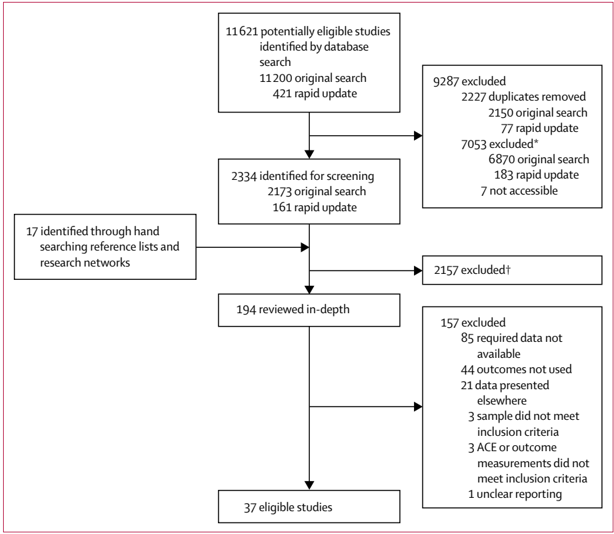
- From 11,621 references, 37 studies were included, providing risk estimates for 23 outcomes and 253,719 participants; most studies were from high-income countries, with nine samples from middle-income countries and none from low-income countries; 26 articles used cross-sectional data and 11 used cohort data, and all used retrospective, self-reported ACEs.
- Pooled ORs with 95% CIs were calculated using a random-effects model in StatsDirect; heterogeneity was assessed with I², publication bias with Begg-Mazumdar and Egger tests and funnel plots where at least ten samples were available, and sensitivity analyses and meta-regression were done in Stata.
Limitations
- The paper states that all included studies used retrospective ACE reports, which could be affected by recall or reporting bias; the number and types of ACEs varied, and summing ACEs does not account for different combinations or for variation in age at or length of exposure; confounding factors varied and some studies included no adjustments; genetic and environmental risks were largely unmeasured.
- The paper states that focusing on community settings likely excluded those with the most complex health problems (eg, homeless populations) and those who had already had ACE-related premature mortality; outcome measurement varied, rarer outcomes were less well covered by population surveys, and the study could only measure associations rather than establish causality.
- Evident from the text: most included samples came from high-income countries, with nine middle-income samples and none from low-income countries; heterogeneity was high for many outcomes; and visual funnel-plot assessment suggested possible missing small studies for smoking and early sexual initiation, although statistical tests for smoking were nonsignificant.
Model-written summary. Check it against the paper before relying on it.
Integrity signals
Registry
Cites
Statistics
Figures
Verification
Claims the paper makes
18 Valid · 0 Not valid · 4 Not checked · 126 Own results and interpretations
The sources with a verdict support this claim; the rest weren’t checked yet, have no full text we could read, or their verdicts aren’t rated yet.
In the paper
“However, five of the seven samples comprised students aged 18-25; 13 pooling of the remaining two samples 8,18 resulted in an OR of 12·53 (6·71-23·37; appendix).”
What the sources say
- Not checked — no full text of the sourcecites [8] 8 Ramiro LS, Madrid BJ, Brown DW. Adverse childhood experiences (ACE) and health-risk behaviors among adults in a developing country setting. Child Abuse Negl 2010; 34: 842-55. source
- Supportedcites [18] 18 Dube SR, Felitti VJ, Dong M, Giles WH, Anda RF. The impact of adverse childhood experiences on health problems: evidence from four birth cohorts dating back to 1900. Prev Med 2003; 37: 268-77 . source
The citation follows “the remaining two samples,” identifying studies used in the citing authors’ pooling rather than attributing the pooled estimate to either study. The cited paper’s Abstract describes a study of 17,337 adult HMO members that examined suicide attempts; its Methods identify the population as adult Kaiser Health Plan members. The OR of 12.53 is presented as the citing authors’ pooled result, not a result attributed to this source. (LLM, conf=0.85)
plainstates an associationn = 2- Asserted: passes — The authors put it forward as true.
- Checkable: passes — It can be checked against evidence.
- Load-bearing: unclear — It is unclear whether the paper’s conclusions depend on it.
- Based: passes — The paper gives a reason why it holds.
Every source the paper cites for this claim was checked and supports it.
In the paper
“However, five of the seven samples comprised students aged 18-25; 13 pooling of the remaining two samples 8,18 resulted in an OR of 12·53 (6·71-23·37; appendix).”
What the sources say
- Supportedcites [13] 13 Bellis MA, Hughes K, Leckenby N, et al. Adverse childhood experiences and associations with health-harming behaviours in young adults: surveys in eight eastern European countries. Bull World Health Organ 2014; 92: 641-55. source
The Attempted suicide section says respondents in seven of the eight countries were asked about suicide attempts. The Methods describe classroom surveys of students and state that the multi-study analyses were limited to respondents aged 18–25, supporting this paper's inclusion among the student samples described in the citing sentence. (LLM, conf=0.90)
plainn = 5- Asserted: passes — The authors put it forward as true.
- Checkable: passes — It can be checked against evidence.
- Load-bearing: unclear — It is unclear whether the paper’s conclusions depend on it.
- Based: passes — The paper gives a reason why it holds.
- Supported
The sources with a verdict support this claim; the rest weren’t checked yet, have no full text we could read, or their verdicts aren’t rated yet.
In the paper
“Supported by international work to standardise measurement of ACEs and their effects on health, these findings have since been replicated in studies from low-income and middle-income 7,8 and high-income 2,9 countries.”
What the sources say
- Not checked — no full text of the sourcecites [7] 7 Almuneef M, Qayad M, Aleissa M, Albuhairan F. Adverse childhood experiences, chronic diseases, and risky health behaviors in Saudi Arabian adults: a pilot study. Child Abuse Negl 2014; 38: 1787-93. source
- Not checked — no full text of the sourcecites [8] 8 Ramiro LS, Madrid BJ, Brown DW. Adverse childhood experiences (ACE) and health-risk behaviors among adults in a developing country setting. Child Abuse Negl 2010; 34: 842-55. source
- Supportedcites [2] 2 Bellis MA, Hughes K, Leckenby N, Hardcastle KA, Perkins C, Lowey H. Measuring mortality and the burden of adult disease associated with adverse childhood experiences in England: a national survey. J Public Health 2015; 37: 445-54. source
The citation to this paper supports the high-income-country part of the sentence: its English national survey found a strong association between ACEs and adult morbidity and premature mortality. The low- and middle-income-country studies are attributed to other citations. The decisive passage is in “What this study adds”; no page number is supplied in our copy. (LLM, conf=0.90)
- Supportedcites [9] 9 Bellis MA, Hughes K, Leckenby N, Perkins C, Lowey H. National household survey of adverse childhood experiences and their relationship with resilience to health-harming behaviors in England. BMC Med 2014; 12: 72. source
Citation 9 is attached to the high-income-country portion of the sentence. The Methods describe a national household survey in England, and the Results report that adverse childhood experiences were associated with multiple health-harming behaviors after adjustment for deprivation and other demographics. The indexed copy does not provide page numbers. (LLM, conf=0.91)
plainstates an association- Asserted: passes — The authors put it forward as true.
- Checkable: passes — It can be checked against evidence.
- Load-bearing: unclear — It is unclear whether the paper’s conclusions depend on it.
- Based: passes — The paper gives a reason why it holds.
The cited sources support only part of this claim — read each source’s verdict below.
In the paper
“For teenage pregnancy, four studies 9,33-35 had measured unintended teenage pregnancy and these studies reported higher estimates than did those measuring any teenage pregnancy 8,14,21 (appendix).”
What the sources say
- Supportedcites [9] 9 Bellis MA, Hughes K, Leckenby N, Perkins C, Lowey H. National household survey of adverse childhood experiences and their relationship with resilience to health-harming behaviors in England. BMC Med 2014; 12: 72. source
The paper is one of the studies identified in the citing sentence as measuring unintended teenage pregnancy. Its Results report an adjusted odds ratio of 5.86 for that outcome among respondents with four or more ACEs versus none. The comparison with studies measuring any teenage pregnancy is the citing authors’ cross-study synthesis, not a comparison attributed to this individual paper. (LLM, conf=0.88)
- Not checked — no full text of the sourcecites [33] 33 Bellis MA, Lowey H, Leckenby N, Hughes K, Harrison D. Adverse childhood experiences: retrospective study to determine their impact on adult health behaviours and health outcomes in a UK population. J Public Health 2014; 36: 81-91. source
- Partly supportedcites [34] 34 Bellis MA, Ashton K, Hughes K, Ford K, Bishop J, Paranjothy S. Adverse childhood experiences and their impact on health-harming behaviours in the Welsh adult population. Cardiff: Public Health Wales, 2015. sourceExperimental — accuracy not yet measured
The section ‘ACEs and their association with unintended teenage pregnancy’ reports an estimate for unintended teenage pregnancy, so this paper supports its identification as a study measuring that outcome. It does not compare its estimate with studies measuring any teenage pregnancy or establish that four studies reported higher estimates. (LLM, conf=0.83)
- Not matchedcites [35] 35 Ford K, Butler N, Hughes K, Quigg Z, Bellis MA. Adverse childhood experiences (ACEs) in Hertfordshire, Luton and Northamptonshire. Liverpool: Liverpool John Moores University, 2016.
Its entry has no title and year that we can search by.
- Not checked — no full text of the sourcecites [8] 8 Ramiro LS, Madrid BJ, Brown DW. Adverse childhood experiences (ACE) and health-risk behaviors among adults in a developing country setting. Child Abuse Negl 2010; 34: 842-55. source
- Not checked yetcites [14] 14 Anda RF, Chapman DP, Felitti VJ, et al. Adverse childhood experiences and risk of paternity in teen pregnancy. Obstet Gynecol 2002; 100: 37-45. source
Checked before — its earlier verdict is held back until a new check runs.
- Not checked — no full text of the sourcecites [21] 21 Hillis SD, Anda RF, Dube SR, Felitti VJ, Marchbanks PA, Marks JS. The association between adverse childhood experiences and adolescent pregnancy, long-term psychosocial consequences, and fetal death. Pediatrics 2004; 113: 320-27 . source
plainstates an association- Asserted: passes — The authors put it forward as true.
- Checkable: passes — It can be checked against evidence.
- Load-bearing: unclear — It is unclear whether the paper’s conclusions depend on it.
- Based: passes — The paper gives a reason why it holds.
- Supported
Every source the paper cites for this claim was checked and supports it.
In the paper
“However, our criteria also meant that studies were excluded because of alternative data analysis methods (eg, analysis of the World Mental Health Surveys 51 ).”
What the sources say
- Supportedcites [51] 51 Kessler RC, McLaughlin KA, Green JG, et al. Childhood adversities and adult psychopathology in the WHO World Mental Health Surveys. Br J Psychiatry 2010; 97: 378-85. source
The Analysis methods section identifies this paper as an analysis of the World Mental Health Surveys and describes its discrete-time survival analysis using person-years. The statement that the citing review excluded it under its own criteria is the citing authors’ decision, not a claim the source needs to make. (LLM, conf=0.88)
plainstates a cause- Asserted: passes — The authors put it forward as true.
- Checkable: passes — It can be checked against evidence.
- Load-bearing: unclear — It is unclear whether the paper’s conclusions depend on it.
- Based: passes — The paper gives a reason why it holds.
- Supported
53 more claims · 2 with their cited sources checked
Create a free account to see all 148 claims and to verify the 1 reference still open.
- It may state two separate claims as one. 44
- Probably not a substantial claim. 27
- The quote only partly states this claim. 31
Claims other papers make about this one
Each is checked against this paper’s own text: does it say what the citing paper says it does?
The source backs part of the claim, not all of it — or backs it for a different population, condition or comparison.
In the citing paper
“Early adverse life experiences, negative affectivity, neuroticism, depression, and anxiety have been identified as psycho logical predisposing conditions for persistent physical symptoms”
From Persistent physical symptoms: definition, genesis, and management (2024) · cites this paper as [64]
Experimental — accuracy not yet measuredThe source backs part of the claim, not all of it — or backs it for a different population, condition or comparison.
In the citing paper
“The impact of childhood abuse, neglect, and violence exposure on adult physical and emotional health and behaviors is significant and well documented”
From Intergenerational effects of childhood maltreatment: A systematic review of the parenting practices of adult survivors of childhood abuse, neglect, and violence. (2020) · cites this paper as Hughes et al., 2017
Experimental — accuracy not yet measuredThe source backs part of the claim, not all of it — or backs it for a different population, condition or comparison.
In the citing paper
“Early institutional rearing is associated with adverse biological and health outcomes in later life, including accelerated cellular aging as measured by telomere length.”
From Telomere trajectories from early adolescence to adulthood following early institutionalization: Protective effects of foster care in the Bucharest Early Intervention Project (2026) · cites this paper as Hughes et al., 2017
Experimental — accuracy not yet measuredThe source backs part of the claim, not all of it — or backs it for a different population, condition or comparison.
In the citing paper
“Individuals exposed to early life adversity are at increased risk of developing a broad spectrum of age-related illnesses at a young age, resulting in shorter health span, referring to the period of life free from chronic disease (Chandan et al., 2020; Hughes et al., 2017).”
From Telomere trajectories from early adolescence to adulthood following early institutionalization: Protective effects of foster care in the Bucharest Early Intervention Project (2026) · cites this paper as Hughes et al., 2017
Experimental — accuracy not yet measuredThe source backs part of the claim, not all of it — or backs it for a different population, condition or comparison.
In the citing paper
“This aligns with findings that ACEs are linked not only with SUD onset, but also with broader emotional and interpersonal dysregulation [4, 6].”
From The link of adverse childhood experiences and attachment to maladaptive personality traits in adults diagnosed with substance use disorder (2025) · cites this paper as [4]
Experimental — accuracy not yet measured
7 more claims about this paper
Create a free account to see every claim other papers make about this one.
Self-check
Percentages, sums and reported differences re-computed from the paper’s own numbers.
Each contradiction between two passages listed here was confirmed by an independent check.
Rated minor: it would not touch a result — a value no result rests on, a p-value that stays on the same side of the significance level, or a conflict that is clerical, resolved elsewhere in the paper, or outside its own findings.
In the paper
§ Summary
“respiratory disease (ORs of two to three)”
§ Discussion
“| Respiratory disease | 3·05 (2·47-3·77)”
Citations
Cites
Felitti, V. J., Anda, R. F., Nordenberg, D., Williamson, D. F., Spitz, A. M., Edwards, V., Koss, M. P., & Marks, J. S. (1998) · American Journal of Preventive Medicine · doi:10.1016/s0749-3797(98)00017-8 · Cited by 18,943
Global status report on noncommunicable diseases 2010.
Alwan, A. (2011) · Cited by 8,494
Forouzanfar, M. H., Afshin, A., Alexander, L. T., Anderson, H. R., Bhutta, Z. A., Biryukov, S., Brauer, M., Burnett, R., Cercy, K., Charlson, F. J., et al. (2016) · The Lancet · doi:10.1016/s0140-6736(16)31679-8 · Cited by 7,698
Wang, H., Naghavi, M., Allen, C., Barber, R. M., Bhutta, Z. A., Carter, A., Casey, D. C., Charlson, F. J., Chen, A. Z., Coates, M. M., et al. (2016) · The Lancet · doi:10.1016/s0140-6736(16)31012-1 · Cited by 6,596
Anda, R. F., Felitti, V. J., Bremner, J. D., Walker, J. D., Whitfield, C., Perry, B. D., Dube, S. R., & Giles, W. H. (2006) · European archives of psychiatry and clinical neuroscience · doi:10.1007/s00406-005-0624-4 · Cited by 4,292
Norman, R. E., Byambaa, M., De, R., Butchart, A., Scott, J., & Vos, T. (2012) · PLoS Medicine · doi:10.1371/journal.pmed.1001349 · Cited by 3,387
Self-citationValidity of adult retrospective reports of adverse childhood experiences: review of the evidence
Hardt, J., & Rutter, M. (2004) · Journal of Child Psychology and Psychiatry · doi:10.1111/j.1469-7610.2004.00218.x · Cited by 2,827
Childhood adversities and adult psychopathology in the WHO World Mental Health Surveys
Kessler, R. C., McLaughlin, K. A., Green, J. G., Gruber, M. J., Sampson, N. A., Zaslavsky, A. M., Aguilar-Gaxiola, S., Alhamzawi, A. O., Alonso, J., Angermeyer, M., et al. (2010) · British Journal of Psychiatry · doi:10.1192/bjp.bp.110.080499 · Cited by 2,640
Impact of child sexual abuse: A review of the research.
Browne, A., & Finkelhor, D. (1986) · Psychological Bulletin · doi:10.1037/0033-2909.99.1.66 · Cited by 2,590
Adverse childhood experiences, allostasis, allostatic load and age-related disease
Danese, A., & McEwen, B. S. (2012) · Physiology & Behavior · doi:10.1016/j.physbeh.2011.08.019 · Cited by 2,140
Cited by
Items 901–1,000 of 5,221
Early adversity as the prototype gene × environment interaction in mental disorders?
Martins, J., Yusupov, N., Binder, E. B., Brückl, T. M., & Czamara, D. (2022) · Pharmacology Biochemistry and Behavior · doi:10.1016/j.pbb.2022.173371 · Cited by 22
Wolff, N., Sánchez, F. C., & Aizpurúa, E. (2019) · Children and Youth Services Review · doi:10.1016/j.childyouth.2019.104732 · Cited by 23
Contemporary Developments and Perspectives in International Health Security - Volume 1
Stawicki, S. P., Firstenberg, M. S., Galwankar, S. C., Izurieta, R., & Papadimos, T. (2020) · IntechOpen eBooks · doi:10.5772/intechopen.84766 · Cited by 28
Loheide‐Niesmann, L., Riem, M. M. E., & Cima, M. (2022) · European Child & Adolescent Psychiatry · doi:10.1007/s00787-022-02117-0 · Cited by 30
“Nevertheless, our findings in combination with previous meta-analyses indicate that child maltreatment not only negatively impacts the health and wellbeing of survivors themselves [2, 3, 93], but that its detrimental impact can extend to the next generation.”
Supporting student learning and development through trauma-informed campuses
Schroeder, K., Šinko, L., Ibrahim, J. K., & Sarwer, D. B. (2023) · Journal of American College Health · doi:10.1080/07448481.2023.2187647 · Cited by 36
“3,27 The transition to higher education may create stressors that aggravate past trauma or trigger trauma-related symptoms.”
Wang, W., & Zhang, H. (2023) · Trauma Violence & Abuse · doi:10.1177/15248380231207887 · Cited by 25
“Violence against children not only causes them long-term suffering, including mental health problems, physical dysfunction, disability, and mortality (Hughes et al., 2017; Mehta et al., 2023; O’Sullivan et al., 2018) but also imposes heavy burdens on economies and societies (Fang et al., 2015).”
BackgroundIncidence Trajectories of Psychiatric Disorders After Assault, Injury, and Bereavement
Chen, Y., Shen, Q., Lichtenstein, P., Gradus, J. L., Arnberg, F. K., Larsson, H., D'Onofrio, B. M., Fang, F., Song, H., & Valdimarsdóttir, U. A. (2024) · JAMA Psychiatry · doi:10.1001/jamapsychiatry.2023.5156 · Cited by 28
Lam, N., Fairweather, S. J., Lewer, D., Prescott, M., Undugoda, P., Dickerson, J., Gilbody, S. M., & Wadman, R. (2024) · PLOS mental health. · doi:10.1371/journal.pmen.0000165 · Cited by 45
Progress in preventing child maltreatment in Europe
Sethi, D., Parekh, N., Yon, Y., & Mikkelsen, B. (2018) · The Lancet Child & Adolescent Health · doi:10.1016/s2352-4642(18)30280-3 · Cited by 21
Self-citationPeritraumatic Neural Processing and Intrusive Memories: The Role of Lifetime Adversity
Rattel, J. A., Miedl, S. F., Franke, L. K., Grünberger, L. M., Blechert, J., Kronbichler, M., Spoormaker, V. I., & Wilhelm, F. H. (2019) · Biological Psychiatry Cognitive Neuroscience and Neuroimaging · doi:10.1016/j.bpsc.2018.12.010 · Cited by 23
Berg, L., Rostila, M., Arat, A., & Hjern, A. (2019) · Humanities and Social Sciences Communications · doi:10.1057/s41599-019-0285-y · Cited by 32
Latent factors of adverse childhood experiences and adult-onset asthma
Ospina, M. B., Serrano-Lomelin, J. A., Amjad, S., Hicks, A., & Giesbrecht, G. F. (2020) · Journal of Developmental Origins of Health and Disease · doi:10.1017/s2040174419000886 · Cited by 26
Hovdestad, W., Shields, M. E., Shaw, A. K., & Tonmyr, L. (2020) · BMC Cancer · doi:10.1186/s12885-019-6481-8 · Cited by 29
Childhood adversities and mental health outcomes: Does the perception or age of the event matter?
Negriff, S. L. (2020) · Development and Psychopathology · doi:10.1017/s0954579420000048 · Cited by 27
“, sexual abuse, physical abuse, emotional abuse, or neglect) occur quite frequently and are increasingly being recognized as detrimental to both physical and mental health (Bright, Knapp, Hinojosa, Alford, & Bonner, 2016; Hughes et al., 2017; Kalmakis & Chandler, 2015; Merrick et al., 2017).”
BackgroundOzieh, M. N., Garacci, E., Campbell, J. A., Walker, R. J., & Egede, L. E. (2020) · American Journal of Preventive Medicine · doi:10.1016/j.amepre.2020.04.005 · Cited by 28
“Although evidence suggests that prevalence as well as risk of kidney disease are higher among those who experience ACEs,(13,26) no study has examined the influence of coexisting ACEs and CKD on mortality risk in individuals with kidney disease.(15) Therefore, the aim of this study is to examine the influence of coexis…”
BackgroundInfluentialWard, M. D., Turner, N., Briggs, R., O’Halloran, A. M., & Kenny, R. A. (2020) · Journal of Affective Disorders · doi:10.1016/j.jad.2020.08.089 · Cited by 26
Validation and Adaptation of the Slovak Version of the Childhood Trauma Questionnaire (CTQ)
Petrikova, M., Kascakova, N., Furstova, J., Hasto, J., & Tavel, P. (2021) · International Journal of Environmental Research and Public Health · doi:10.3390/ijerph18052440 · Cited by 22
“Childhood trauma experiences pose a higher possibility for the later development of alcoholism, depression, and eating disorders; a higher occurrence of dangerous sexual behavior, HIV and AIDS; an increased risk of heart diseases, cancer, other chronic diseases [7], later overweight, physical inactivity, and smoking;…”
BackgroundCairney, D. G., Kazmi, A., Delahunty, L., Marryat, L., & Wood, R. (2021) · PLoS ONE · doi:10.1371/journal.pone.0247299 · Cited by 29
Soneson, E., Burn, A., Anderson, J., Humphrey, A., Jones, P. B., Fazel, M. S., Ford, T. J., & Howarth, E. (2022) · Journal of School Psychology · doi:10.1016/j.jsp.2022.01.008 · Cited by 26
Iob, E., Ajnakina, O., & Steptoe, A. (2021) · Psychological Medicine · doi:10.1017/s0033291721003007 · Cited by 26
“…childhood experiences (ACEs), such as abuse, neglect, and family problems, are linked to an increased risk of developing depression (Hughes et al., 2017), as well as with greater severity of depressive symptoms and worse response to antidepressant treatment (Nanni, Uher, & Danese,…”
BackgroundAccumbofrontal tract integrity is related to early life adversity and feedback learning
Kennedy, B. V., Hanson, J. L., Buser, N. J., van den Bos, W., Rudolph, K. D., Davidson, R. J., & Pollak, S. D. (2021) · Neuropsychopharmacology · doi:10.1038/s41386-021-01129-9 · Cited by 24
Smith, B. T., Brumage, M. R., Zullig, K. J., Claydon, E. A., Smith, M. L., & Kristjánsson, Á. L. (2021) · Preventive Medicine Reports · doi:10.1016/j.pmedr.2021.101571 · Cited by 26
“Such experiences increase risks for many negative physical and mental health outcomes throughout the lifespan including, but not limited to, the five leading causes of death in the US (Jia and Lubetkin, 2020; Hughes et al., 2017; Merrick et al., 2019; Nurius et al., 2019).”
BackgroundSocioeconomic status effects on health vary between rural and urban Turkana
Lea, A. J., Waigwa, C., Muhoya, B., Lotukoi, F., Peng, J., Henry, L. P., Abhyankar, V., Kamau, J., Martins, D. J., Gurven, M., et al. (2021) · Evolution Medicine and Public Health · doi:10.1093/emph/eoab039 · Cited by 22
Wijayaratna, S., Lee, A., Park, H. Y., Jo, E., Wu, F., Bagg, W., & Cundy, T. (2021) · BMJ Open Diabetes Research & Care · doi:10.1136/bmjdrc-2021-002485 · Cited by 20
Dollberg, D. G., & Hanetz‐Gamliel, K. (2022) · Frontiers in Psychiatry · doi:10.3389/fpsyt.2022.837423 · Cited by 27
Area-level deprivation and adverse childhood experiences among high school students in Maryland
Kurani, S. S., Webb, L., Cadet, K., Ma, M., Gibson, M., Jallah, N., Park, J. N., & Johnson, R. M. (2022) · BMC Public Health · doi:10.1186/s12889-022-13205-w · Cited by 28
Life experience pathways to college student emotional and mental health: A structural equation model
Hanson, C. L., Magnusson, B. M., Crandall, A., Barnes, M., McFarland, E., & Smith, M. (2022) · Journal of American College Health · doi:10.1080/07448481.2022.2058328 · Cited by 27
AlHemyari, A. H., Al-Zamil, N. A., Shaikh, A. Y., Al‐Eidi, D. A., Al‐Dahlan, H. W., & Al‐Shamekh, S. S. (2022) · Brain and Behavior · doi:10.1002/brb3.2668 · Cited by 26
“Similar findings were found in England, where there was a strong association between all markers of low mental well-being and ACE score (Hughes et al., 2017).”
Skiendzielewski, K., Forke, C. M., Sarwer, D. B., Noll, J. G., Wheeler, D. C., Henry, K., & Schroeder, K. (2024) · Psychological Trauma Theory Research Practice and Policy · doi:10.1037/tra0001320 · Cited by 32
Measuring types and timing of childhood maltreatment: The psychometric properties of the KERF-40+
Seitz, K. I., Gerhardt, S., von Schroeder, C., Panizza, A., Thekkumthala, D., Bertsch, K., Herpertz, S. C., Schmahl, C. G., & Schalinski, I. (2022) · PLoS ONE · doi:10.1371/journal.pone.0273931 · Cited by 26
“Specifically, childhood maltreatment has been identified as a risk factor for cancer, cardiovascular, respiratory and sexually transmitted diseases as well as various mental disorders [2, 4, 5].”
BackgroundIlomäki, M., Lindblom, J., Salmela, V. R., Flykt, M. S., Vänskä, M., Salmi, J., Tolonen, T., Alho, K., Punamäki, R., & Wikman, P. A. (2022) · Frontiers in Behavioral Neuroscience · doi:10.3389/fnbeh.2022.958580 · Cited by 27
Early Life Stress Detection Using Physiological Signals and Machine Learning Pipelines
Shahbazi, Z., & Byun, Y.-C. (2023) · Biology · doi:10.3390/biology12010091 · Cited by 26
Adverse childhood experiences and delinquency: Does age of assessment matter?
Leban, L., & Delacruz, D. J. (2023) · Journal of Criminal Justice · doi:10.1016/j.jcrimjus.2023.102033 · Cited by 26
Craig, F., Servidio, R. C., Calomino, M. L., Candreva, F., Nardi, L., Palermo, A., Polito, A., Spina, M. F., Tenuta, F., & Costabile, A. (2023) · International Journal of Environmental Research and Public Health · doi:10.3390/ijerph20105906 · Cited by 31
“A minority (5–10%) of the general population score 4 or more, where the general long-term health consequences become most pronounced [34].”
BackgroundFoiselle, M., Lajnef, M., Hamdani, N., Boukouaci, W., Wu, C., Naamoune, S., Chami, L., Mezoued, E., Richard, J., Bouassida, J., et al. (2023) · Brain Behavior and Immunity · doi:10.1016/j.bbi.2023.05.015 · Cited by 23
“Adults exposed to adverse childhood experiences exhibit a high rate of somatic comorbidities including cardiovascular, metabolic disorders and cancers, all contributing to increased risk of premature death (Hughes et al., 2017).”
BackgroundCharite, J. L., Khan, M. B., Dudovitz, R., Nuckols, T. K., Sastry, N., Huang, C. X., Lei, Y. Y., & Schickedanz, A. B. (2023) · SSM - Population Health · doi:10.1016/j.ssmph.2023.101558 · Cited by 37
“A greater number of ACEs confers greater risk for a wide range of negative health behaviors and conditions; combinations of different types of ACEs can also have differential risk profiles depending on the type of health outcomes assessed (Bar-boza, 2018; Hughes et al., 2017).”
BackgroundLuo, S., Feng, X., Lin, L., Li, J., Chen, W., & Guo, V. Y. (2024) · Public Health · doi:10.1016/j.puhe.2024.01.006 · Cited by 24
Multi-omics in stress and health research: study designs that will drive the field forward
Mengelkoch, S., Gassen, J., Lev‐Ari, S., Alley, J. C., Rose, S. M. S., Snyder, M. P., & Slavich, G. M. (2024) · Stress · doi:10.1080/10253890.2024.2321610 · Cited by 28
“…research suggests that exposure to stressors during the perinatal period through adolescence can increase a person’s risk for myriad physical and mental health problems later in life, even when their situation improves (cohen et al., 2010; Hughes et al., 2017; Krushas & Schwartz, 2022).”
BackgroundToxic Stress and Vulnerable Mothers: A Multilevel Framework of Stressors and Strengths
Condon, E. M., & Sadler, L. S. (2018) · Western Journal of Nursing Research · doi:10.1177/0193945918788676 · Cited by 27
“For example, adverse childhood experiences, such as abuse and neglect, are associated with adult diseases such as obesity, diabetes, and cancer, and persistent childhood stressors such as poverty are associated with altered brain structure and impaired development (Hertzman & Boyce, 2010; Hughes et al., 2017; Shonkoff…”
Kapfhammer, H. (2018) · Psychiatria Danubina · doi:10.24869/psyd.2018.254 · Cited by 24
Kraav, S., Tolmunen, T., Kärkkäinen, O. K., Ruusunen, A. A., Viinamäki, H. T., Mäntyselkä, P. T., Koivumaa-Honkanen, H. T., Valkonen‐Korhonen, M., Honkalampi, K. M., Herzig, K., et al. (2018) · Psychiatry Research · doi:10.1016/j.psychres.2018.12.108 · Cited by 23
Campbell, J. A., Mosley-Johnson, E., Garacci, E., Walker, R. J., & Egede, L. E. (2019) · Journal of Affective Disorders · doi:10.1016/j.jad.2019.02.016 · Cited by 24
Wallander, J. L., Berry, S., Carr, P. A., Peterson, E. R., Waldie, K. E., Marks, E. J., D’Souza, S., & Morton, S. (2019) · Research on Child and Adolescent Psychopathology · doi:10.1007/s10802-019-00521-w · Cited by 25
Meinck, F., Orkin, F. M., & Cluver, L. D. (2019) · Journal of the International AIDS Society · doi:10.1002/jia2.25262 · Cited by 21
“92 for exposure to four or more ACEs and sexually transmitted diseases in adulthood [4].”
BackgroundKidman, R. C., & Kohler, H. (2019) · AIDS · doi:10.1097/qad.0000000000002352 · Cited by 25
“Evidence now links ACEs to early sexual debut, risky sexual behavior, and sexually transmitted infections (STI) [3–5].”
BackgroundDorji, N., Dunne, M. P., & Deb, S. (2020) · Public Health · doi:10.1016/j.puhe.2020.02.013 · Cited by 24
Self-citationKoponen, A. M., Nissinen, N., Gissler, M., Autti‐Rämö, I., Sarkola, T., & Kahila, H. K. (2020) · SSM - Population Health · doi:10.1016/j.ssmph.2020.100625 · Cited by 29
“Numerous studies carried out among the general population have also revealed the relationship between socioeconomic inequalities, multiple ACEs and high levels of mental health problems (Hughes et al., 2017; Paananen et al., 2013; Reiss, 2013; Ristikari et al., 2018).”
BackgroundBidirectional Relations between Adverse Childhood Experiences and Children’s Behavioral Problems
Zhang, L., & Mersky, J. P. (2020) · Child and Adolescent Social Work Journal · doi:10.1007/s10560-020-00720-1 · Cited by 26
Huq, T., Alexander, E. C., Manikam, L., Jokinen, T., Patil, P., Benjumea, D., Das, I., & Davidson, L. L. (2020) · Child Psychiatry & Human Development · doi:10.1007/s10578-020-01112-3 · Cited by 28
Andersson, S., Annerbäck, E., Söndergaard, H. P., Hallqvist, J., & Kristiansson, P. (2021) · PLoS ONE · doi:10.1371/journal.pone.0244696 · Cited by 32
“The limit of�4 ACE categories was chosen according to the comprehensive study by Hughes [4].”
BackgroundMethodResultInfluentialJackson, D. B., Posick, C., Vaughn, M. G., & Testa, A. M. (2021) · European Child & Adolescent Psychiatry · doi:10.1007/s00787-020-01687-1 · Cited by 27
“Highlighting the robust association between ACEs and adverse health outcomes, a recent meta-analysis that included 253,719 individuals across 37 studies linked ACEs with 23 negative health and socio-behavioral outcomes including cancer, heart disease, mental illness, substance abuse, and internal and external violent…”
BackgroundChild labor and psychosocial wellbeing: Findings from India
Feeny, S., Posso, A., Skali, A., Jyotishi, A., Nath, S., & Viswanathan, P. K. (2021) · Health Economics · doi:10.1002/hec.4224 · Cited by 28
“These impacts include lower levels of education through poorer school attendance and attainment (ILO, 2015) and worse physical health, sometimes through exposure to physical harm and injury (Ahmed & Ray, 2014; Hughes et al., 2017; Parker, 1997).”
BackgroundShenk, C. E., Felt, J. M., Ram, N., O’Donnell, K. J., Sliwinski, M. J., Pokhvisneva, I., Benson, L., Meaney, M. J., Putnam, F. W., & Noll, J. G. (2021) · Psychoneuroendocrinology · doi:10.1016/j.psyneuen.2021.105606 · Cited by 28
Thurston, C., Murray, A. L., Franchino-Olsen, H., Silima, M., Hemady, C. L., & Meinck, F. (2026) · Trauma, Violence, & Abuse · doi:10.1177/15248380251358223 · Cited by 25
“In their systematic review and meta-analysis, Hughes et al. (2017) demonstrated the significant, deleterious effects of multiple ACEs (four or more) on lifelong health.”
Krasnova, A., Tom, S. E., Valeri, L., Crane, P. K., & Bennett, D. A. (2023) · American Journal of Epidemiology · doi:10.1093/aje/kwad033 · Cited by 23
Rahapsari, S., & Levita, L. (2024) · Trauma Violence & Abuse · doi:10.1177/15248380241286812 · Cited by 38
“Furthermore, individuals with ACEs are at an increased risk of developing physical health issues, such as obesity, diabetes, heavy alcohol use, cancer, and heart disease (Hughes et al., 2017).”
Whose trauma is it anyway? Creating more equitable mental healthcare in a system that harms
Downs, J. L. (2024) · BJPsych Bulletin · doi:10.1192/bjb.2024.103 · Cited by 25
Chia, A. Y. Y., Hartanto, A., Wan, T.-S., Teo, S. S. K., Sim, L., & Kasturiratna, K. T. A. S. (2025) · Psychiatry Research Communications · doi:10.1016/j.psycom.2025.100202 · Cited by 23
Roettger, M. E., & Dennison, S. M. (2018) · American Behavioral Scientist · doi:10.1177/0002764218796995 · Cited by 23
“and imprisonment, set the stage for transition into a life of disadvantage and marginalization (Hughes et al., 2017; Turney & Lanuza, 2017; Wildeman & Wang, 2017).”
BackgroundInfluentialPuy, J. D., Radford, L., Fort, V. L., & Romain-Glassey, N. (2019) · Journal of Family Violence · doi:10.1007/s10896-019-00047-1 · Cited by 29
“The threats that these risk factors represent for children’s health are documented largely in the Anglophone literature (Bellis et al. 2014; Hughes et al. 2017) and prevention practices (Public Health Wales 2015) but such knowledge is not common yet among Swiss professionals.”
BackgroundACEs, Cultural Considerations and ‘Common Sense’ in Aotearoa New Zealand
Joy, E., & Beddoe, L. (2019) · Social Policy and Society · doi:10.1017/s1474746419000046 · Cited by 25
“, 2010), and despite a growing body of research showing some global generalisability for the ACEs checklist (Stoltenborgh et al., 2015; Hughes et al., 2017), we would add our voices to the calls from others in this themed section that the ACEs checklist often fails to consider wider societal pressures.”
BackgroundAdshead, C. D., Norman, A., & Holloway, M. (2019) · Disability and Rehabilitation · doi:10.1080/09638288.2019.1700565 · Cited by 26
“Another recent review [44] provides evidence that people who had experienced four or more categories of childhood exposure to adverse childhood experiences, had a four to twelve-fold increased health risk to alcoholism, drug use, and depression and BRAIN INJURY, SUBSTANCE USE AND HOMELESSNESS 2419”
BackgroundPiotrowski, C. C. (2020) · Elsevier eBooks · doi:10.1016/b978-0-12-816065-7.00015-x · Cited by 41
The Family Cycle: Breaking the Intergenerational Transmission of Trauma through Mentalizing
Stob, V., Slade, A., Adnopoz, J. A., & WOOLSTON, J. L. (2020) · Journal of Infant Child and Adolescent Psychotherapy · doi:10.1080/15289168.2020.1786762 · Cited by 33
Trauma-Informed Care in Primary Health Settings—Which Is Even More Needed in Times of COVID-19
Tomaz, T., & Castro-Vale, I. (2020) · Healthcare · doi:10.3390/healthcare8030340 · Cited by 32
“A meta-analysis of 37 studies calculated the risk estimates for 23 outcomes for a total of 253,719 participants, with the objective to understand the relationship between exposure to at least four ACEs and the occurrence of health problems in adulthood, in comparison to those who were not exposed to ACEs [20].”
BackgroundMethodInfluentialSumnall, H. R., Hamilton, I., Atkinson, A. M., Montgomery, C., & Gage, S. H. (2020) · Drugs Education Prevention and Policy · doi:10.1080/09687637.2020.1820450 · Cited by 26
“…of the association of traumatic and adverse childhood experiences (ACEs) with the aetiology of substance use, with multiple ACE exposures being associated with increased likelihood of development of substance use disorders ( (Dube et al., 2003; Hughes et al., 2017, 2019; Shin et al., 2018).”
BackgroundIntroducing ACEs (Adverse Childhood Experiences) and Resilience to First-Year Medical Students
Onigu-Otite, E., & Idicula, S. A. (2020) · MedEdPORTAL · doi:10.15766/mep_2374-8265.10964 · Cited by 27
Martín-Higarza, Y., Gómez, Y. F., Méndez, M. L., & Ezama, E. (2020) · International Journal of Environmental Research and Public Health · doi:10.3390/ijerph17228507 · Cited by 27
Adverse Childhood Experiences: The Protective and Therapeutic Potential of Nature
Touloumakos, A. Κ., & Barrable, A. (2020) · Frontiers in Psychology · doi:10.3389/fpsyg.2020.597935 · Cited by 36
Seker, S., Habersaat, S., Boonmann, C., Palix, J., Jenkel, N., Fischer, S., Fegert, J. M., Kölch, M. G., Schmeck, K., & Schmid, M. (2020) · Children and Youth Services Review · doi:10.1016/j.childyouth.2020.105825 · Cited by 31
Trinidad, J. E. (2020) · Children and Youth Services Review · doi:10.1016/j.childyouth.2020.105844 · Cited by 27
Baams, L., ten Have, M., de Graaf, R., & de Jonge, P. (2021) · Journal of Psychiatric Research · doi:10.1016/j.jpsychires.2021.02.046 · Cited by 26
Boch, S. J., & Ford, J. L. (2021) · Nursing Research · doi:10.1097/nnr.0000000000000522 · Cited by 26
Andrade, J. L., Hong, Y., Lee, A. M., Miller, D. R., Williams, C. E., Thompson, L. A., Bright, M. A., & Cardel, M. I. (2021) · The Journal of Pediatrics · doi:10.1016/j.jpeds.2021.06.024 · Cited by 22
Macarenco, M.-M., Opariuc‐Dan, C., & Nedelcea, C. (2021) · Child Abuse & Neglect · doi:10.1016/j.chiabu.2021.105322 · Cited by 27
Ringwald, K. G., Pfarr, J., Stein, F., Brosch, K., Meller, T., Thomas‐Odenthal, F., Meinert, S., Waltemate, L., Breuer, F., Winter, A., et al. (2022) · Human Brain Mapping · doi:10.1002/hbm.25869 · Cited by 26
“ACEs and SLEs in adulthood are both important risk factors for poor general health outcomes (Cohen et al., 2019; Hughes et al., 2017).”
BackgroundResilience to social defeat stress in adolescent male mice
Reguilón, M. D., Ballestín, R., Miñarro, J., & Rodríguez‐Arias, M. (2022) · Progress in Neuro-Psychopharmacology and Biological Psychiatry · doi:10.1016/j.pnpbp.2022.110591 · Cited by 22
“But the strongest association is found with problematic drug use and interpersonal and self-directed violence (Hughes et al., 2017).”
BackgroundBiological Aging in Maltreated Children Followed up into Middle Adulthood
Graf, G. H.-J., Li, X., Kwon, D., Belsky, D. W., & Widom, C. S. (2022) · Psychoneuroendocrinology · doi:10.1016/j.psyneuen.2022.105848 · Cited by 28
Oberg, G., & Bryce, I. (2022) · The Australian journal of teacher education · doi:10.14221/ajte.2022v47n2.6 · Cited by 23
“(1998) described ACEs as both experiences which impact children directly (such as abuse and/or neglect), as well as those which children experience more indirectly (witnessing familial violence, having family members in the home with mental illness or substance abuse problems, having parents who are jailed, and family…”
BackgroundAdverse childhood experiences, stress, and resilience among early childhood teachers
Rancher, C. E., & Moreland, A. D. (2022) · Early Childhood Research Quarterly · doi:10.1016/j.ecresq.2022.08.007 · Cited by 35
Bertele, S., Heitland, I., Fraccarollo, D., Stapel, B., Bauersachs, J. K., Westhoff‐Bleck, M., & Kahl, K. G. (2022) · Frontiers in Psychiatry · doi:10.3389/fpsyt.2022.1002143 · Cited by 26
Trauma-Informed Nature Therapy: A Case Study
Fisher, C. (2023) · Ecopsychology · doi:10.1089/eco.2022.0064 · Cited by 25
“The risk for negative physical and mental health outcomes increases with multiple adverse experiences (Hughes et al., 2017).”
Beyond medicalized approaches to violence and trauma: Empowering social work practice
Ross, N., Brown, C. G., & Johnstone, M. (2023) · Journal of Social Work · doi:10.1177/14680173221144557 · Cited by 39
“…likely to drink problematically, about four times more likely to experience anxiety and depression, about eight times more likely to be a victim and/or perpetrator of violence, and thirty times more likely to attempt suicide than those who had no adverse childhood experiences (Hughes et al., 2017).”
BackgroundChen, D., Lin, L., Li, C., Chen, W., Zhang, Y., Ren, Y., & Guo, V. Y. (2023) · Child and Adolescent Psychiatry and Mental Health · doi:10.1186/s13034-023-00570-6 · Cited by 24
Wang, L., Zou, H., Liu, J., & Hong, J. (2023) · Child Psychiatry & Human Development · doi:10.1007/s10578-023-01508-x · Cited by 27
“When confronted with multiple concurrent or sequential adverse experiences, the ability to adapt is exceeded [57], especially in adolescents with depression.”
Cohodes, E. M., McCauley, S., Pierre, J. C., Hodges, H. R., Haberman, J. T., Santiuste, I., Rogers, M. K., Wang, J., Mandell, J. D., & Gee, D. G. (2023) · Developmental Psychobiology · doi:10.1002/dev.22372 · Cited by 21
“The ACE study spawned many additional studies examining associations between ACE scores and numerous outcomes across the lifespan (see Hughes et al., 2017 for a review).”
BackgroundMa, J., Yang, B., Wang, S., Yao, Y., Wu, C., Li, M., & Dong, G. (2023) · Current Opinion in Psychiatry · doi:10.1097/yco.0000000000000910 · Cited by 26
“Finally, the scales were self-rated, and there may be some bias in the recall of traumatic childhood experiences.”
BackgroundNewton, L., Keane, C. A., & Byrne, M. K. (2023) · Children and Youth Services Review · doi:10.1016/j.childyouth.2023.107368 · Cited by 32
A Scoping Review of Positive Childhood Experiences: Measurement and Evidence
Raghunathan, R. S., Sosnowski, D. W., Musci, R. J., & Johnson, S. B. (2024) · Adversity and Resilience Science · doi:10.1007/s42844-023-00125-w · Cited by 31
“Researchers have established consistent, robust links between exposure to childhood adversity and numerous physical and mental health outcomes throughout the life course (Grummitt et al., 2021; Hughes et al., 2017; Kalmakis & Chandler, 2015).”
Young children’s development after forced displacement: a systematic review
Bernhardt, K., Beherec, S. L., Uppendahl, J. R., Fleischmann, M., Klosinski, M., Rivera, L. M., Samaras, G., Kenney, M., Müller, R., Nehring, I., et al. (2024) · Child and Adolescent Psychiatry and Mental Health · doi:10.1186/s13034-024-00711-5 · Cited by 37
“The first years in life especially are a critical time period characterized by rapid physiological, cognitive and emotional changes [3, 4].”
BackgroundLansing, A. E., Plante, W. Y., Beck, A. N., & Ellenberg, M. D. (2018) · Journal of Child & Adolescent Trauma · doi:10.1007/s40653-018-0209-9 · Cited by 27
“, depression) morbidity and mortality (Hughes et al. 2017), higher risk of reoffending among delinquents (Baglivio et al.”
BackgroundShaffer, H. J., Tom, M. A., Wiley, R. C., Wong, M. F.-Y., Chan, E. M. L., Cheng, G. L. F., Lo, C. K. M., Eric, K. Y., Wong, R. H. Y., & Lee, M. (2018) · International Journal of Mental Health and Addiction · doi:10.1007/s11469-018-9952-2 · Cited by 22
“Previous findings show that trauma is related to addiction (Corrigan et al. 2013; Felitti et al. 1998; Hughes et al. 2017; Ilie et al. 2014; Miller et al. 2013).”
Inter- and transgenerational inheritance of behavioral phenotypes
Jawaid, A., & Mansuy, I. M. (2019) · Current Opinion in Behavioral Sciences · doi:10.1016/j.cobeha.2018.12.004 · Cited by 23
Alvarez, C., Perrin, N., Fernández, M. L., Rodriguez, R., & Glass, N. E. (2019) · Child Abuse & Neglect · doi:10.1016/j.chiabu.2019.05.004 · Cited by 23
Anderson, S. R., Witting, A. B., Tambling, R. R., Ketring, S. A., & Johnson, L. N. (2019) · Journal of Marital and Family Therapy · doi:10.1111/jmft.12394 · Cited by 26
Lee, L. O., Aldwin, C. M., Kubzansky, L. D., Mroczek, D. K., & Spiro, A. (2019) · Psychology and Aging · doi:10.1037/pag0000394 · Cited by 22
“…domain, early adversities – most commonly represented by a composite index of severe stressors such as abuse, parental mental illness, and household criminality (Felitti et al., 1998) – are related to higher risks of adult diseases and health-compromising behaviors (Hughes et al., 2017).”
BackgroundNair, N., Daruwalla, N., Osrin, D., Rath, S., Gagrai, S., Sahu, R., Pradhan, H., De, M., Ambavkar, G., Das, N., et al. (2020) · BMC International Health and Human Rights · doi:10.1186/s12914-020-00224-0 · Cited by 31
Campbell, L. A., Lovas, D. A., Withers, E., & Peacock, K. (2020) · Research Involvement and Engagement · doi:10.1186/s40900-020-00204-7 · Cited by 27
Byrd, A. L., Tung, I., Manuck, S. D., Vine, V., Horner, M. S., Hipwell, A. E., & Stepp, S. D. (2020) · Development and Psychopathology · doi:10.1017/s0954579420000462 · Cited by 24
“…any of the threat experiences (0 = none; 1 = 1 year; 2 = 2 years; 3 = 3+years) in line with research suggesting that risk for psychopathology substantially increases as threat exposure becomes more chronic (Anda et al., 2006; Hughes et al., 2017; Manly et al., 2001; Mersky et al., 2013).”
Morris, D. J., Webb, E. L., Parmar, E., Trundle, G., & McLean, A. (2020) · Advances in Mental Health and Intellectual Disabilities · doi:10.1108/amhid-01-2020-0003 · Cited by 23
Metadata
- Authors
- Hughes, K., Bellis, M. A., Hardcastle, K. A., Sethi, D., Butchart, A., Mikton, C., Jones, L., & Dunne, M. P.
- Affiliations
- Bangor University (GB)
- Public Health Wales (GB)
- World Health Organization Regional Office for Europe (DK)
- World Health Organization (CH)
- University of the West of England (GB)
- Liverpool John Moores University (GB)
- Queensland University of Technology (AU)
- Corresponding author
- Bellis, Mark A
- Venue
- The Lancet Public Health
- Publisher
- Elsevier BV
- Published
- 2017-08
- Volume
- 2
- Issue
- 8
- Pages
- e356-e366
- ISSN
- 2468-2667 (ISSN-L)
- OpenAlex
- W2740726397
- Semantic Scholar
- cdd633b48c3e902b5a7a012711d868cf5745c677
- Cited by
- 5,255
- References
- 70
- Citations by year
- 2026: 750 · 2025: 849 · 2024: 817 · 2023: 711 · 2022: 698 · 2021: 626 · 2020: 464 · 2019: 232 · 2018: 97 · 2017: 7
- FWCI
- 33.48
- Type
- journal article
- Language
- en
- Open access
- gold
- doi.org
- Licence
- cc-by-nc-nd
- www.elsevier.com/tdm/userlicense/1.0/ (tdm)
- creativecommons.org/licenses/by-nc-nd/4.0/ (vor)
- Locations
- The Lancet Public Health (publishedVersion, cc-by-nc-nd)
- PubMed (publishedVersion)
- Liverpool John Moores University (acceptedVersion)
- QUT ePrints (Queensland University of Technology) (submittedVersion, cc-by-nc-nd)
- UWE Research Repository (UWE Bristol) (submittedVersion, cc-by-nc-nd)
- DOAJ (DOAJ: Directory of Open Access Journals) (submittedVersion, cc-by-sa)
- Funders
- World Health Organization
- Public Health Wales
- Topics
- Social Sciences › Psychology › Clinical Psychology › Child Abuse and Trauma
- Social Sciences › Sociology and Political Science › Child Welfare and Adoption
- Social Sciences › Health › Intimate Partner and Family Violence
- Keywords
- adverse childhood experiences, child abuse, domestic violence exposure, substance use, sexual health, mental health, violence, physical health, physical activity, weight, resilience
- MeSH terms
- Health Status, Humans, Life Change Events
About these checks
Registry, retraction, Cites and statistics results are computed, not judged, with one exception: a printed reference that no index lists is read once by a model before it counts as a citation error. Claims are extracted by a model and kept only when their quote appears verbatim in the text; each cited source is then checked, with a model’s help, for whether it says what the claim relies on. Those verdicts can be wrong — read the claim’s quote and the cited source before relying on one.
The claim verdicts this report counts are experimental: their accuracy is not yet measured.
A language model drew the claims from the paper on 2026-09-28, under version 3 of the claim definition (prompt extract-v3).
A second model labelled each claim on 2026-09-28 (model jev-1.13-20260917, definition revision gold-guideline-v0.2).
Cited sources are checked with a language model’s help (gpt-6-sol).
Statistics and arithmetic are recomputed, not judged.
Confidence bands are shown only for fields calibrated on our annotated test set. None is calibrated yet, so no band is shown.
What counts as a claim ›How we measure confidence ›How we check this ›
Are you an author, or do you see a problem with this page? Request a review
Data sources
Bibliographic data: Semantic Scholar, OpenAlex, Crossref.
Contains information from the Semantic Scholar Academic Graph Datasets, made available under the ODC Attribution License (ODC-BY 1.0).
Semantic Scholar’s data is described in: Kinney, R., et al. (2023). The Semantic Scholar Open Data Platform. arXiv:2301.10140.
