

The effect of multiple adverse childhood experiences on health: a systematic review and meta-analysis.
Open accessThe DOI matches its Crossref record; 66 of the 70 references it cites were found in a registry or an index; 23 of the 40 sources its claims cite were checked for support.
Abstract
BACKGROUND: A growing body of research identifies the harmful effects that adverse childhood experiences (ACEs; occurring during childhood or adolescence; eg, child maltreatment or exposure to domestic violence) have on health throughout life. Studies have quantified such effects for individual ACEs. However, ACEs frequently co-occur and no synthesis of findings from studies measuring the effect of multiple ACE types has been done. METHODS: In this systematic review and meta-analysis, we searched five electronic databases for cross-sectional, case-control, or cohort studies published up to May 6, 2016, reporting risks of health outcomes, consisting of substance use, sexual health, mental health, weight and physical exercise, violence, and physical health status and conditions, associated with multiple ACEs. We selected articles that presented risk estimates for individuals with at least four ACEs compared with those with none for outcomes with sufficient data for meta-analysis (at least four populations). Included studies also focused on adults aged at least 18 years with a sample size of at least 100. We excluded studies based on high-risk or clinical populations. We extracted data from published reports. We calculated pooled odds ratios (ORs) using a random-effects model. FINDINGS: of >75%) between estimates for almost half of the outcomes. INTERPRETATION: To have multiple ACEs is a major risk factor for many health conditions. The outcomes most strongly associated with multiple ACEs represent ACE risks for the next generation (eg, violence, mental illness, and substance use). To sustain improvements in public health requires a shift in focus to include prevention of ACEs, resilience building, and ACE-informed service provision. The Sustainable Development Goals provide a global platform to reduce ACEs and their life-course effect on health. FUNDING: Public Health Wales.
Overview
CoChat Summary
TL;DR
This systematic review and meta-analysis of 37 studies and 253,719 participants found that adults with at least four adverse childhood experiences (ACEs) had increased odds of all 23 health outcomes compared with those with no ACEs. The strongest associations were for problematic drug use and interpersonal and self-directed violence, while physical inactivity, overweight or obesity, and diabetes showed weaker associations.
Key findings
- Across 37 included studies providing risk estimates for 23 outcomes, 57% of 252,467 participants reported at least one ACE and 13% of 244,979 reported at least four.
- Pooled odds ratios (ORs) were weak or modest for physical inactivity (1·25, 95% CI 1·03–1·52), overweight or obesity (1·39, 1·13–1·71), and diabetes (1·52, 1·23–1·89); moderate for smoking (2·82, 2·38–3·34), heavy alcohol use (2·20, 1·74–2·78), poor self-rated health (2·24, 1·97–2·54), cancer (2·31, 1·82–2·95), cardiovascular disease (2·07, 1·66–2·59), and respiratory disease (3·05, 2·47–3·77).
- Stronger associations included multiple sexual partners (3·64, 3·02–4·40), anxiety (3·70, 2·62–5·22), early sexual initiation (3·72, 2·88–4·80), teenage pregnancy (4·20, 2·98–5·92), low life satisfaction (4·36, 3·72–5·10), depression (4·40, 3·54–5·46), illicit drug use (5·62, 4·46–7·07), problematic alcohol use (5·84, 3·99–8·56), and sexually transmitted infections (5·92, 3·21–10·92).
- The strongest pooled ORs were for violence victimisation (7·51, 5·60–10·08), violence perpetration (8·10, 5·87–11·18), problematic drug use (10·22, 7·62–13·71), and suicide attempt (30·14, 14·73–61·67); considerable heterogeneity (I² >75%) was identified for almost half of outcomes.
Methods
- Systematic review and meta-analysis searching five electronic databases for cross-sectional, case-control, or cohort studies published up to May 6, 2016, reporting health outcomes associated with multiple ACEs; included studies focused predominantly on adults aged at least 18 years, had sample sizes of at least 100, used a cumulative measure of at least four ACEs spanning direct and indirect types, and reported risk estimates for at least four ACEs versus none.
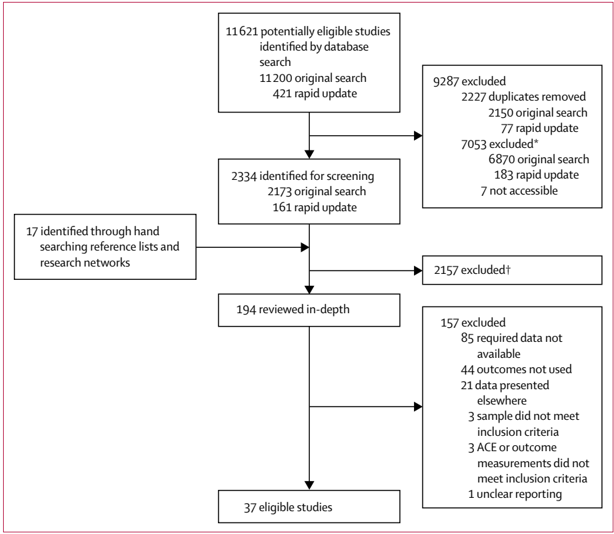
- From 11,621 references, 37 studies were included, providing risk estimates for 23 outcomes and 253,719 participants; most studies were from high-income countries, with nine samples from middle-income countries and none from low-income countries; 26 articles used cross-sectional data and 11 used cohort data, and all used retrospective, self-reported ACEs.
- Pooled ORs with 95% CIs were calculated using a random-effects model in StatsDirect; heterogeneity was assessed with I², publication bias with Begg-Mazumdar and Egger tests and funnel plots where at least ten samples were available, and sensitivity analyses and meta-regression were done in Stata.
Limitations
- The paper states that all included studies used retrospective ACE reports, which could be affected by recall or reporting bias; the number and types of ACEs varied, and summing ACEs does not account for different combinations or for variation in age at or length of exposure; confounding factors varied and some studies included no adjustments; genetic and environmental risks were largely unmeasured.
- The paper states that focusing on community settings likely excluded those with the most complex health problems (eg, homeless populations) and those who had already had ACE-related premature mortality; outcome measurement varied, rarer outcomes were less well covered by population surveys, and the study could only measure associations rather than establish causality.
- Evident from the text: most included samples came from high-income countries, with nine middle-income samples and none from low-income countries; heterogeneity was high for many outcomes; and visual funnel-plot assessment suggested possible missing small studies for smoking and early sexual initiation, although statistical tests for smoking were nonsignificant.
Model-written summary. Check it against the paper before relying on it.
Integrity signals
Registry
Cites
Statistics
Figures
Verification
Claims the paper makes
18 Valid · 0 Not valid · 4 Not checked · 126 Own results and interpretations
The sources with a verdict support this claim; the rest weren’t checked yet, have no full text we could read, or their verdicts aren’t rated yet.
In the paper
“However, five of the seven samples comprised students aged 18-25; 13 pooling of the remaining two samples 8,18 resulted in an OR of 12·53 (6·71-23·37; appendix).”
What the sources say
- Not checked — no full text of the sourcecites [8] 8 Ramiro LS, Madrid BJ, Brown DW. Adverse childhood experiences (ACE) and health-risk behaviors among adults in a developing country setting. Child Abuse Negl 2010; 34: 842-55. source
- Supportedcites [18] 18 Dube SR, Felitti VJ, Dong M, Giles WH, Anda RF. The impact of adverse childhood experiences on health problems: evidence from four birth cohorts dating back to 1900. Prev Med 2003; 37: 268-77 . source
The citation follows “the remaining two samples,” identifying studies used in the citing authors’ pooling rather than attributing the pooled estimate to either study. The cited paper’s Abstract describes a study of 17,337 adult HMO members that examined suicide attempts; its Methods identify the population as adult Kaiser Health Plan members. The OR of 12.53 is presented as the citing authors’ pooled result, not a result attributed to this source. (LLM, conf=0.85)
plainstates an associationn = 2- Asserted: passes — The authors put it forward as true.
- Checkable: passes — It can be checked against evidence.
- Load-bearing: unclear — It is unclear whether the paper’s conclusions depend on it.
- Based: passes — The paper gives a reason why it holds.
Every source the paper cites for this claim was checked and supports it.
In the paper
“However, five of the seven samples comprised students aged 18-25; 13 pooling of the remaining two samples 8,18 resulted in an OR of 12·53 (6·71-23·37; appendix).”
What the sources say
- Supportedcites [13] 13 Bellis MA, Hughes K, Leckenby N, et al. Adverse childhood experiences and associations with health-harming behaviours in young adults: surveys in eight eastern European countries. Bull World Health Organ 2014; 92: 641-55. source
The Attempted suicide section says respondents in seven of the eight countries were asked about suicide attempts. The Methods describe classroom surveys of students and state that the multi-study analyses were limited to respondents aged 18–25, supporting this paper's inclusion among the student samples described in the citing sentence. (LLM, conf=0.90)
plainn = 5- Asserted: passes — The authors put it forward as true.
- Checkable: passes — It can be checked against evidence.
- Load-bearing: unclear — It is unclear whether the paper’s conclusions depend on it.
- Based: passes — The paper gives a reason why it holds.
- Supported
The sources with a verdict support this claim; the rest weren’t checked yet, have no full text we could read, or their verdicts aren’t rated yet.
In the paper
“Supported by international work to standardise measurement of ACEs and their effects on health, these findings have since been replicated in studies from low-income and middle-income 7,8 and high-income 2,9 countries.”
What the sources say
- Not checked — no full text of the sourcecites [7] 7 Almuneef M, Qayad M, Aleissa M, Albuhairan F. Adverse childhood experiences, chronic diseases, and risky health behaviors in Saudi Arabian adults: a pilot study. Child Abuse Negl 2014; 38: 1787-93. source
- Not checked — no full text of the sourcecites [8] 8 Ramiro LS, Madrid BJ, Brown DW. Adverse childhood experiences (ACE) and health-risk behaviors among adults in a developing country setting. Child Abuse Negl 2010; 34: 842-55. source
- Supportedcites [2] 2 Bellis MA, Hughes K, Leckenby N, Hardcastle KA, Perkins C, Lowey H. Measuring mortality and the burden of adult disease associated with adverse childhood experiences in England: a national survey. J Public Health 2015; 37: 445-54. source
The citation to this paper supports the high-income-country part of the sentence: its English national survey found a strong association between ACEs and adult morbidity and premature mortality. The low- and middle-income-country studies are attributed to other citations. The decisive passage is in “What this study adds”; no page number is supplied in our copy. (LLM, conf=0.90)
- Supportedcites [9] 9 Bellis MA, Hughes K, Leckenby N, Perkins C, Lowey H. National household survey of adverse childhood experiences and their relationship with resilience to health-harming behaviors in England. BMC Med 2014; 12: 72. source
Citation 9 is attached to the high-income-country portion of the sentence. The Methods describe a national household survey in England, and the Results report that adverse childhood experiences were associated with multiple health-harming behaviors after adjustment for deprivation and other demographics. The indexed copy does not provide page numbers. (LLM, conf=0.91)
plainstates an association- Asserted: passes — The authors put it forward as true.
- Checkable: passes — It can be checked against evidence.
- Load-bearing: unclear — It is unclear whether the paper’s conclusions depend on it.
- Based: passes — The paper gives a reason why it holds.
The cited sources support only part of this claim — read each source’s verdict below.
In the paper
“For teenage pregnancy, four studies 9,33-35 had measured unintended teenage pregnancy and these studies reported higher estimates than did those measuring any teenage pregnancy 8,14,21 (appendix).”
What the sources say
- Supportedcites [9] 9 Bellis MA, Hughes K, Leckenby N, Perkins C, Lowey H. National household survey of adverse childhood experiences and their relationship with resilience to health-harming behaviors in England. BMC Med 2014; 12: 72. source
The paper is one of the studies identified in the citing sentence as measuring unintended teenage pregnancy. Its Results report an adjusted odds ratio of 5.86 for that outcome among respondents with four or more ACEs versus none. The comparison with studies measuring any teenage pregnancy is the citing authors’ cross-study synthesis, not a comparison attributed to this individual paper. (LLM, conf=0.88)
- Not checked — no full text of the sourcecites [33] 33 Bellis MA, Lowey H, Leckenby N, Hughes K, Harrison D. Adverse childhood experiences: retrospective study to determine their impact on adult health behaviours and health outcomes in a UK population. J Public Health 2014; 36: 81-91. source
- Partly supportedcites [34] 34 Bellis MA, Ashton K, Hughes K, Ford K, Bishop J, Paranjothy S. Adverse childhood experiences and their impact on health-harming behaviours in the Welsh adult population. Cardiff: Public Health Wales, 2015. sourceExperimental — accuracy not yet measured
The section ‘ACEs and their association with unintended teenage pregnancy’ reports an estimate for unintended teenage pregnancy, so this paper supports its identification as a study measuring that outcome. It does not compare its estimate with studies measuring any teenage pregnancy or establish that four studies reported higher estimates. (LLM, conf=0.83)
- Not matchedcites [35] 35 Ford K, Butler N, Hughes K, Quigg Z, Bellis MA. Adverse childhood experiences (ACEs) in Hertfordshire, Luton and Northamptonshire. Liverpool: Liverpool John Moores University, 2016.
Its entry has no title and year that we can search by.
- Not checked — no full text of the sourcecites [8] 8 Ramiro LS, Madrid BJ, Brown DW. Adverse childhood experiences (ACE) and health-risk behaviors among adults in a developing country setting. Child Abuse Negl 2010; 34: 842-55. source
- Not checked yetcites [14] 14 Anda RF, Chapman DP, Felitti VJ, et al. Adverse childhood experiences and risk of paternity in teen pregnancy. Obstet Gynecol 2002; 100: 37-45. source
Checked before — its earlier verdict is held back until a new check runs.
- Not checked — no full text of the sourcecites [21] 21 Hillis SD, Anda RF, Dube SR, Felitti VJ, Marchbanks PA, Marks JS. The association between adverse childhood experiences and adolescent pregnancy, long-term psychosocial consequences, and fetal death. Pediatrics 2004; 113: 320-27 . source
plainstates an association- Asserted: passes — The authors put it forward as true.
- Checkable: passes — It can be checked against evidence.
- Load-bearing: unclear — It is unclear whether the paper’s conclusions depend on it.
- Based: passes — The paper gives a reason why it holds.
- Supported
Every source the paper cites for this claim was checked and supports it.
In the paper
“However, our criteria also meant that studies were excluded because of alternative data analysis methods (eg, analysis of the World Mental Health Surveys 51 ).”
What the sources say
- Supportedcites [51] 51 Kessler RC, McLaughlin KA, Green JG, et al. Childhood adversities and adult psychopathology in the WHO World Mental Health Surveys. Br J Psychiatry 2010; 97: 378-85. source
The Analysis methods section identifies this paper as an analysis of the World Mental Health Surveys and describes its discrete-time survival analysis using person-years. The statement that the citing review excluded it under its own criteria is the citing authors’ decision, not a claim the source needs to make. (LLM, conf=0.88)
plainstates a cause- Asserted: passes — The authors put it forward as true.
- Checkable: passes — It can be checked against evidence.
- Load-bearing: unclear — It is unclear whether the paper’s conclusions depend on it.
- Based: passes — The paper gives a reason why it holds.
- Supported
53 more claims · 2 with their cited sources checked
Create a free account to see all 148 claims and to verify the 1 reference still open.
- It may state two separate claims as one. 44
- Probably not a substantial claim. 27
- The quote only partly states this claim. 31
Claims other papers make about this one
Each is checked against this paper’s own text: does it say what the citing paper says it does?
The source backs part of the claim, not all of it — or backs it for a different population, condition or comparison.
In the citing paper
“Early adverse life experiences, negative affectivity, neuroticism, depression, and anxiety have been identified as psycho logical predisposing conditions for persistent physical symptoms”
From Persistent physical symptoms: definition, genesis, and management (2024) · cites this paper as [64]
Experimental — accuracy not yet measuredThe source backs part of the claim, not all of it — or backs it for a different population, condition or comparison.
In the citing paper
“The impact of childhood abuse, neglect, and violence exposure on adult physical and emotional health and behaviors is significant and well documented”
From Intergenerational effects of childhood maltreatment: A systematic review of the parenting practices of adult survivors of childhood abuse, neglect, and violence. (2020) · cites this paper as Hughes et al., 2017
Experimental — accuracy not yet measuredThe source backs part of the claim, not all of it — or backs it for a different population, condition or comparison.
In the citing paper
“Early institutional rearing is associated with adverse biological and health outcomes in later life, including accelerated cellular aging as measured by telomere length.”
From Telomere trajectories from early adolescence to adulthood following early institutionalization: Protective effects of foster care in the Bucharest Early Intervention Project (2026) · cites this paper as Hughes et al., 2017
Experimental — accuracy not yet measuredThe source backs part of the claim, not all of it — or backs it for a different population, condition or comparison.
In the citing paper
“Individuals exposed to early life adversity are at increased risk of developing a broad spectrum of age-related illnesses at a young age, resulting in shorter health span, referring to the period of life free from chronic disease (Chandan et al., 2020; Hughes et al., 2017).”
From Telomere trajectories from early adolescence to adulthood following early institutionalization: Protective effects of foster care in the Bucharest Early Intervention Project (2026) · cites this paper as Hughes et al., 2017
Experimental — accuracy not yet measuredThe source backs part of the claim, not all of it — or backs it for a different population, condition or comparison.
In the citing paper
“This aligns with findings that ACEs are linked not only with SUD onset, but also with broader emotional and interpersonal dysregulation [4, 6].”
From The link of adverse childhood experiences and attachment to maladaptive personality traits in adults diagnosed with substance use disorder (2025) · cites this paper as [4]
Experimental — accuracy not yet measured
7 more claims about this paper
Create a free account to see every claim other papers make about this one.
Self-check
Percentages, sums and reported differences re-computed from the paper’s own numbers.
Each contradiction between two passages listed here was confirmed by an independent check.
Rated minor: it would not touch a result — a value no result rests on, a p-value that stays on the same side of the significance level, or a conflict that is clerical, resolved elsewhere in the paper, or outside its own findings.
In the paper
§ Summary
“respiratory disease (ORs of two to three)”
§ Discussion
“| Respiratory disease | 3·05 (2·47-3·77)”
Citations
Cites
Felitti, V. J., Anda, R. F., Nordenberg, D., Williamson, D. F., Spitz, A. M., Edwards, V., Koss, M. P., & Marks, J. S. (1998) · American Journal of Preventive Medicine · doi:10.1016/s0749-3797(98)00017-8 · Cited by 18,943
Global status report on noncommunicable diseases 2010.
Alwan, A. (2011) · Cited by 8,494
Forouzanfar, M. H., Afshin, A., Alexander, L. T., Anderson, H. R., Bhutta, Z. A., Biryukov, S., Brauer, M., Burnett, R., Cercy, K., Charlson, F. J., et al. (2016) · The Lancet · doi:10.1016/s0140-6736(16)31679-8 · Cited by 7,698
Wang, H., Naghavi, M., Allen, C., Barber, R. M., Bhutta, Z. A., Carter, A., Casey, D. C., Charlson, F. J., Chen, A. Z., Coates, M. M., et al. (2016) · The Lancet · doi:10.1016/s0140-6736(16)31012-1 · Cited by 6,596
Anda, R. F., Felitti, V. J., Bremner, J. D., Walker, J. D., Whitfield, C., Perry, B. D., Dube, S. R., & Giles, W. H. (2006) · European archives of psychiatry and clinical neuroscience · doi:10.1007/s00406-005-0624-4 · Cited by 4,292
Norman, R. E., Byambaa, M., De, R., Butchart, A., Scott, J., & Vos, T. (2012) · PLoS Medicine · doi:10.1371/journal.pmed.1001349 · Cited by 3,387
Self-citationValidity of adult retrospective reports of adverse childhood experiences: review of the evidence
Hardt, J., & Rutter, M. (2004) · Journal of Child Psychology and Psychiatry · doi:10.1111/j.1469-7610.2004.00218.x · Cited by 2,827
Childhood adversities and adult psychopathology in the WHO World Mental Health Surveys
Kessler, R. C., McLaughlin, K. A., Green, J. G., Gruber, M. J., Sampson, N. A., Zaslavsky, A. M., Aguilar-Gaxiola, S., Alhamzawi, A. O., Alonso, J., Angermeyer, M., et al. (2010) · British Journal of Psychiatry · doi:10.1192/bjp.bp.110.080499 · Cited by 2,640
Impact of child sexual abuse: A review of the research.
Browne, A., & Finkelhor, D. (1986) · Psychological Bulletin · doi:10.1037/0033-2909.99.1.66 · Cited by 2,590
Adverse childhood experiences, allostasis, allostatic load and age-related disease
Danese, A., & McEwen, B. S. (2012) · Physiology & Behavior · doi:10.1016/j.physbeh.2011.08.019 · Cited by 2,140
Cited by
Items 1,301–1,400 of 5,221
Winter, A., Gruber, M., Thiel, K., Flinkenflügel, K., Meinert, S., Goltermann, J., Winter, N. R., Borgers, T., Stein, F., Jansen, A., et al. (2023) · Molecular Psychiatry · doi:10.1038/s41380-023-02252-3 · Cited by 18
“Early aversive experiences, such as childhood maltreatment, increase the likelihood of impaired behavioral, cognitive, emotional, and social development with long-term consequences lasting into adulthood [1, 2].”
BackgroundCooke, K., Ridgway, K., Pecora, L. A., Westrupp, E. M., Hedley, D., Hooley, M., & Stokes, M. A. (2023) · Research in Autism · doi:10.1016/j.rasd.2023.102313 · Cited by 30
Greenman, P. S., Renzi, A., Monaco, S., Luciani, F., & Trani, M. D. (2024) · Healthcare · doi:10.3390/healthcare12020203 · Cited by 33
“…of adverse childhood experiences (ACEs) including physical abuse; emotional abuse; sexual abuse; emotional neglect; physical neglect; loss of a parent through death, divorce, or imprisonment; witnessing domestic violence; parental substance abuse; and mental illness in one or both parents [1,2].”
BackgroundSuicidal Thoughts and Trajectories of Psychopathological and Behavioral Symptoms in Adolescence
Uno, A., Nagaoka, D., Usami, S., Yamaguchi, S., Minami, R., Tanaka, R., Sawai, Y., Okuma, A., Yamasaki, S., Miyashita, M., et al. (2024) · JAMA Network Open · doi:10.1001/jamanetworkopen.2023.53166 · Cited by 23
O'Dea, B., Roe, Y. L., Gao, Y., Kruske, S., Nelson, C., Hickey, S. D., Carson, A., Watego, K., Currie, J., Blackman, R., et al. (2024) · Child Abuse & Neglect · doi:10.1016/j.chiabu.2024.106664 · Cited by 19
“Additionally, long-term consequences can be far reaching and include risks of developmental delays, behavioural issues, poor health, and issues related to substance misuse, mental health and violence (Hughes et al., 2017).”
BackgroundSahle, B. W., Reavley, N. J., Morgan, A. J., Yap, M. B. H., Reupert, A., & Jorm, A. F. (2024) · BMC Psychiatry · doi:10.1186/s12888-024-05752-w · Cited by 28
“ACEs are associated with an increased prevalence of physical and mental health problems across the life course, including mental health disorders, suicidal behaviours, unhealthy lifestyle behaviours and chronic non-communicable diseases [14, 15].”
BackgroundInfluentialBull, C. F., Trott, M., Najman, J. M., Arnautovska, U., Siskind, D. J., Warren, N., & Kisely, S. R. (2024) · Addiction · doi:10.1111/add.16479 · Cited by 17
Zhang, M., Chi, C., Liu, Q., Zhang, Y., Tao, X., Liu, H., & Xuan, B. (2024) · Frontiers in Public Health · doi:10.3389/fpubh.2024.1362121 · Cited by 31
Grunberg, V. A., Presciutti, A., Vranceanu, A., & Lerou, P. H. (2024) · The Journal of Pediatrics · doi:10.1016/j.jpeds.2024.114300 · Cited by 18
Yao, Q., Zhu, W., Gao, Y., Wang, J., Liu, C., Zhao, G. W., & Wang, Q. (2025) · Addiction Biology · doi:10.1111/adb.70038 · Cited by 18
Addressing Adverse Childhood Experiences: It’s All about Relationships
Zeanah, P. D., Burstein, K. S., & Cartier, J. M. (2018) · Societies · doi:10.3390/soc8040115 · Cited by 20
“[24] conducted a systematic review and meta-analysis including 37 studies and 253,719 participants.”
MethodRegal, R. A., Wheeler, N. J., Daire, A. P., & Spears, N. (2020) · Journal of Mental Health Counseling · doi:10.17744/mehc.42.1.02 · Cited by 21
Hippocampal and parahippocampal volumes vary by sex and traumatic life events in children
Badura-Brack, A. S., Mills, M. S., Embury, C. M., Khanna, M. M., Klanecky, A. K., Stephen, J. M., Wang, Y., Calhoun, V. D., & Wilson, T. W. (2020) · Journal of Psychiatry and Neuroscience · doi:10.1503/jpn.190013 · Cited by 19
The Association Between Childhood Adversity and Self-Rated Physical Health in US College Students
Krinner, L. M., Warren‐Findlow, J., & Bowling, J. (2020) · American Journal of Health Promotion · doi:10.1177/0890117120925348 · Cited by 19
“We used a conservative method to assess childhood adversity by recording exposure to a moderate/high frequency of traumatic events instead of assessing the mere presence or absence of ACEs.”
BackgroundInfluentialMood disorders, childhood maltreatment, and medical morbidity in US adults: An observational study
Stapp, E. K., Williams, S. C., Kalb, L. G., Holingue, C., Eck, K. V., Ballard, E. D., Merikangas, K. R., & Gallo, J. J. (2020) · Journal of Psychosomatic Research · doi:10.1016/j.jpsychores.2020.110207 · Cited by 15
Exposure to Early Life Adversity and Interpersonal Functioning in Attempted Suicide
Rajalin, M., Hirvikoski, T., Renberg, E. S., Åsberg, M., & Jokinen, J. (2020) · Frontiers in Psychiatry · doi:10.3389/fpsyt.2020.552514 · Cited by 18
“However, many research studies have reported that multi-victimization is frequent among children and adolescents (35, 36).”
BackgroundChildhood adversity, pubertal timing and self-harm: a longitudinal cohort study
Russell, A. E., Joinson, C. J., Roberts, E., Heron, J. E., Ford, T. J., Gunnell, D., Moran, P., Relton, C. L., Suderman, M. J., & Mars, B. (2021) · Psychological Medicine · doi:10.1017/s0033291721000611 · Cited by 24
“One of the strongest risk factors for self-harm is experiencing adversity early in life (Björkenstam, Kosidou, & Björkenstam, 2016, 2017; Cha et al., 2018; Hughes et al., 2017).”
BackgroundMethodResultInfluentialLinking Psychosocial Stress Events, Psychological Disorders and Childhood Obesity
Rojo, M., Solano, S., Lacruz, T., Ayensa, J. I. B., Blanco, M., Graell, M., & Sepúlveda, A. R. (2021) · Children · doi:10.3390/children8030211 · Cited by 20
“On the other hand, evidence has supported that the disruption caused by these stressful events increased the risk of poor childhood mental health and emotional distress [5,6,25].”
BackgroundResultSubramaniam, M., Abdin, E., Vaingankar, J. A., Chang, S. S. H., Sambasivam, R., Jeyagurunathan, A., Seow, E., van Dam, R. M., Chow, W. L., & Chong, S. A. (2021) · BMJ Open · doi:10.1136/bmjopen-2020-045167 · Cited by 15
Depression, childhood trauma, and physical activity in older Indigenous Australians
Rowland, G., Hindman, E., Hassmén, P., Radford, K. A., Draper, B., Cumming, R. G., Daylight, G., Garvey, G., Delbaere, K., & Broe, T. (2021) · International Psychogeriatrics · doi:10.1017/s1041610221000132 · Cited by 21
Living with parents with problematic substance use: Impacts and turning points
Maina, G., Ogenchuk, M., & Gaudet, S. (2021) · Public Health Nursing · doi:10.1111/phn.12888 · Cited by 22
The association of daily spiritual experiences with depression among Head Start staff
Whitaker, R. C., Dearth‐Wesley, T., & Herman, A. N. (2021) · Early Childhood Research Quarterly · doi:10.1016/j.ecresq.2021.03.001 · Cited by 18
Health Outcomes Following Childhood Maltreatment: An Examination of the Biopsychosocial Model
Watters, E. R., & Martin, G. C. (2021) · Journal of Aging and Health · doi:10.1177/08982643211003783 · Cited by 21
“…the detrimental effects of the occurrence of childhood maltreatment and abuse on biological, psychological, and social health (Barker et al., 2015; Hughes et al., 2017); however, there remains a need to further explore the association between childhood maltreatment on the biopsychosocial health…”
BackgroundResultInfluentialRelationship between Adverse Childhood Experiences and substance use in youth offenders in Singapore
Oei, A. C., Chu, C. M., Li, D., Ng, N. L., Yeo, C., & Ruby, K. (2021) · Child Abuse & Neglect · doi:10.1016/j.chiabu.2021.105072 · Cited by 19
Adverse childhood experiences and future self-rated health: a prospective cohort study
Jahn, A., Rysgaard, T. K., Andersen, J. H., & Winding, T. N. (2021) · BMC Public Health · doi:10.1186/s12889-021-10941-3 · Cited by 18
“Simultaneously, multiple ACEs have showed strong exposure response relationships with increasing risk of these adverse health problems [4, 6, 11, 14, 15].”
BackgroundPerinatal Behavioral Health, the COVID-19 Pandemic, and a Social Determinants of Health Framework
Ruyak, S. L., & Kivlighan, K. T. (2021) · Journal of Obstetric, Gynecologic & Neonatal Nursing · doi:10.1016/j.jogn.2021.04.012 · Cited by 20
“Specifically, individuals with four or more ACEs compared to individuals reporting none were at increased risk of chronic disease, problematic alcohol use, sexual risk taking, mental health problems, interpersonal violence, and selfdirected violence (Hughes et al., 2017).”
BackgroundVollmer‐Sandholm, M. J., Myhre, A. K., Otterman, G. J., Lydersen, S., & Stray‐Pedersen, A. (2021) · Acta Paediatrica · doi:10.1111/apa.16017 · Cited by 15
A latent class analysis of physical, emotional, and sexual abuse history among suicidal inpatients
Luk, J. W., Bond, A. E., Gabrielli, J., LaCroix, J. M., Perera, K. U., Lee‐Tauler, S. Y., Goldston, D. B., Soumoff, A. A., & Ghahramanlou‐Holloway, M. (2021) · Journal of Psychiatric Research · doi:10.1016/j.jpsychires.2021.07.009 · Cited by 16
Bounoua, N., Church, L. D., & Sadeh, N. (2021) · Emotion · doi:10.1037/emo0000979 · Cited by 20
Fritz, M., Rösel, F. A., Dobler, H., Streb, J., & Dudeck, M. (2021) · Brain Sciences · doi:10.3390/brainsci11081008 · Cited by 17
“Suc individuals tend to have m re physical and mental health roblems and are generally at risk for a premature death [29,30].”
BackgroundAn inter-disciplinary perspective on evaluation of innovation to support care leavers’ transition
Lynch, A., Alderson, H., Kerridge, G., Johnson, R., McGovern, R., Newlands, F., Smart, D., Harrop, C., & Currie, G. (2021) · Journal of Children s Services · doi:10.1108/jcs-12-2020-0082 · Cited by 21
van Roessel, L., Racine, N. M., Dobson, K. S., Killam, T., & Madigan, S. L. (2021) · Child Abuse & Neglect · doi:10.1016/j.chiabu.2021.105256 · Cited by 18
Kysar‐Moon, A. (2021) · Journal of Family Issues · doi:10.1177/0192513x211042849 · Cited by 18
“Although ACE research often includes, “harms that affect children directly…and indirectly through their living environments” (Hughes et al., 2017, p. e357), there is need to more precisely identify adversities putting children at risk for hazardous outcomes.”
BackgroundMethodInfluentialMYERS, B. J., Browne, F. A., Carney, T., Kline, T., Bonner, C. P., & Wechsberg, W. M. (2021) · International Journal of Environmental Research and Public Health · doi:10.3390/ijerph182111403 · Cited by 22
“In keeping with studies conducted with other populations [36], our findings suggest that the relationship between abuse exposure and risk for internalizing problems such as depression and anxiety seems nonspecific or unrelated to experiencing a particular type of abuse.”
BackgroundResultAdverse Childhood Experiences Distinguish Violent Juvenile Sexual Offenders’ Victim Typologies
Baglivio, M. T., & Wolff, K. T. (2021) · International Journal of Environmental Research and Public Health · doi:10.3390/ijerph182111345 · Cited by 18
“As such, it is argued essential to also examine cumulative traumatic exposure rather than only the independent effects of each exposure type [19] vis à vis an adverse childhood experience (ACE) score [20].”
BackgroundLaurinaitytė, I., Assini‐Meytin, L. C., & Čunichina, K. (2022) · International Journal of Environmental Research and Public Health · doi:10.3390/ijerph19063253 · Cited by 21
“Nonetheless, the prevalence of ACEs worldwide is unknown [15].”
BackgroundLin, L., Chen, W., Sun, W., Chen, M., Li, J., Shen, J., & Guo, V. Y. (2022) · International Journal of Environmental Research and Public Health · doi:10.3390/ijerph19116796 · Cited by 16
Smith, G. C., Dolbin‐MacNab, M. L., Infurna, F. J., Webster, B. A., Musil, C. M., Castro, S. A., & Crowley, D. M. (2022) · The International Journal of Aging and Human Development · doi:10.1177/00914150221106096 · Cited by 21
Childhood trauma as a predictor of reoffending in a Northern Irish probation sample
Dalsklev, M., Cunningham, T., Travers, Á., McDonagh, T., Shannon, C., Downes, C., & Hanna, D. (2019) · Child Abuse & Neglect · doi:10.1016/j.chiabu.2019.104168 · Cited by 22
Lakeman, R., Emeleus, M., Davies, S., & Anderson, S. (2020) · Advances in Mental Health · doi:10.1080/18387357.2020.1761262 · Cited by 18
“An ACE score of 4 or more is considered to greatly elevate the risk of health problems compared to a score of 0 (Hughes et al., 2017).”
BackgroundMiller‐Cribbs, J., Bragg, J. E., Wen, F. K., Jelley, M., Coon, K. A., Hanks, H., Howell, D., Randall, K., Isaacson, M., Rodriguez, K., et al. (2020) · The International Journal of Psychiatry in Medicine · doi:10.1177/0091217420951064 · Cited by 21
Webb, J. L. (2020) · Hematology · doi:10.1182/hematology.2020000104 · Cited by 18
Remmers, M. C. C., Reijs, R. P., & Hoebe, C. J. P. A. (2024) · Scandinavian Journal of Public Health · doi:10.1177/14034948241260105 · Cited by 31
“The stress response affects some of the most basic bodily functions, like blood pressure, the immune response and metabolism [13,14]. subsequently, the stress response can impact physical and mental health [1,14], which can be described as the stress effect [15].”
Aldomini, M. A. G., Lee, J. W., Nelson, A. P., Hwang, R. S., Alharbi, K. K. S., Sinky, T. H., Quronfulah, B. S., Khan, W. A. A., Elamin, M. O., & Nour, M. O. (2025) · Clinical Epidemiology and Global Health · doi:10.1016/j.cegh.2025.101933 · Cited by 20
Mortier, P., Yang, X., Altwaijri, Y. A., Holdcraft, J. A., Lee, S., Sampson, N. A., Albor, Y., AlHadi, A. N., Alonso, J., Al-Saud, N. K., et al. (2025) · Psychiatry Research · doi:10.1016/j.psychres.2025.116555 · Cited by 19
When a house is never a home: Housing instability among youth affected by parental drug abuse
Lewis, Q., Smith, B. D., Offiong, A., Prioleau, M., & Powell, T. W. (2021) · Child Abuse & Neglect · doi:10.1016/j.chiabu.2021.105131 · Cited by 25
Adverse Childhood Experiences: Are They Associated With Greater Risk of Elder Abuse Victimization?
Chen, M., & Fu, Y. (2021) · Journal of Interpersonal Violence · doi:10.1177/08862605211028328 · Cited by 16
“…demonstrates that low socioeconomic status during childhood was associated with experiences of laterlife victimization; however, this type of ACE has received less attention compared with other adversities (e.g., violence, abuse, criminality, parental separation, and divorce; Hughes et al., 2017).”
BackgroundResultInfluentialHistorical and Race-Based Trauma: Resilience Through Family and Community
Fitzgerald, H. E., Johnson, D. J., Allen, J., Villarruel, F. A., & Qin, D. B. (2021) · Adversity and Resilience Science · doi:10.1007/s42844-021-00048-4 · Cited by 23
Ramaiya, A., Zimmerman, L. A., Mafuta, E. M., Lulebo, A., Chipeta, E. K., Stones, W. R., & Moreau, C. (2021) · PLoS Medicine · doi:10.1371/journal.pmed.1003552 · Cited by 16
“While mostly described in the form of female victimization and male perpetration [33,34], our results suggest more complex gender dynamics, as differences mostly originated from a greater perpetrator–victim overlap among boys than girls.”
Does Childhood Trauma Associate with Social Media Addiction? A Cross-sectional Study from Iran
Chegeni, M., Nakhaee, N., Shahrbabaki, P. M., Shahrbabaki, M. E., & Haghdoost, A. A. (2022) · International Journal of Mental Health and Addiction · doi:10.1007/s11469-021-00718-5 · Cited by 25
Hori, H., Izawa, S., Yoshida, F., Kunugi, H., Kim, Y., Mizukami, S., Inoue, Y., Tagaya, H., & Hakamata, Y. (2022) · Brain Behavior and Immunity · doi:10.1016/j.bbi.2022.01.020 · Cited by 18
Frederick, J., Devaney, J., & Alisic, E. (2022) · Child Abuse Review · doi:10.1002/car.2743 · Cited by 19
Cárdenas, E. F., Kujawa, A., & Humphreys, K. L. (2022) · Adversity and Resilience Science · doi:10.1007/s42844-022-00062-0 · Cited by 17
Luo, Q., Chen, J., Li, Y., Wu, Z., Lin, X., Yao, J., Yu, H., Wu, H., & Peng, H. (2022) · Brain Imaging and Behavior · doi:10.1007/s11682-022-00672-3 · Cited by 16
Emotional constraint, father-son relationships, and men's wellbeing
Cleary, A. (2022) · Frontiers in Sociology · doi:10.3389/fsoc.2022.868005 · Cited by 24
“These patterns have been reported elsewhere in the literature (Afifi et al., 2009; Hughes et al., 2017) but self-medication is likely to aggravate these situations (Cleary, 2019) and, as Oliffe et al. (2022) have also demonstrated, the complexities these men brought to partnerships tended to…”
BackgroundResultInfluentialLange, B. C. L., Nelson, A. M., Lang, J. M., & Stirman, S. W. (2022) · Implementation Science Communications · doi:10.1186/s43058-022-00348-5 · Cited by 17
“If PTEs or other forms of adversity are not addressed, these events can have negative effects into adulthood, including poorer mental and physical health, and increased risky substance use and sexual behaviors [5].”
BackgroundRoyer, M. F., & Wharton, C. M. (2022) · PLoS ONE · doi:10.1371/journal.pone.0275185 · Cited by 22
Lowe, H., Dobbin, J., Kiss, L., Mak, J., Mannell, J., Watson, D., & Devakumar, D. (2022) · PLOS Global Public Health · doi:10.1371/journal.pgph.0001230 · Cited by 22
Gender Differences in Adverse Childhood Experiences, Self-Control, and Delinquency
Jones, M. S., Pierce, H., & Hoffmann, J. P. (2022) · Crime & Delinquency · doi:10.1177/00111287221134494 · Cited by 20
“Adverse childhood experiences (ACEs), potentially traumatic childhood events, can produce an array of negative life outcomes both in the short- and long-term (Felitti et al., 1998; Garf et al., 2021; Hughes et al., 2017).”
BackgroundWang, Y., Ma, S., Jiang, L., Chen, Q., Guo, J., He, H., Li, P., Gao, T., & Wang, X.-H. F. (2022) · BMC Public Health · doi:10.1186/s12889-022-14691-8 · Cited by 21
“ACEs have become an important public health concern, arousing widespread attention from researchers and the public [3].”
BackgroundResultHelminen, E. C., Scheer, J. R., Ash, T. L., Haik, A. K., & Felver, J. C. (2023) · LGBT Health · doi:10.1089/lgbt.2022.0079 · Cited by 19
Zhu, Y., Zhan, S., Anme, T., & Zhang, G. (2023) · Child Abuse & Neglect · doi:10.1016/j.chiabu.2023.106226 · Cited by 17
Singleton, S., Sneddon, C. C., Bakina, A., Lambert, J. J., & Hales, T. G. (2023) · Pain · doi:10.1097/j.pain.0000000000002925 · Cited by 15
Sociocultural influences on alcohol expectancies in early adolescence: Findings from the ABCD study.
Sánchez, M., Gonzalez, M. R., Fernández, A., Barton, A., Diaz, V. G., & Wang, W. (2023) · Health Psychology · doi:10.1037/hea0001290 · Cited by 20
Hotham, J., Cannings-John, R. L., Moore, L., Hawkins, J. L., Bonell, C. P., Hickman, M., Zammit, S., Hines, L. A., Adara, L., Townson, J. K., et al. (2023) · The British Journal of Psychiatry · doi:10.1192/bjp.2023.91 · Cited by 17
“…to clinicians, educators and policy makers that there is a need for education on the uncertainty in the evidence of benefit for cannabidiol and additional research, ideally with longitudinal data into the link between synthetic cannabinoid use and probable mental health disorders in young people.”
BackgroundAnnett, J., Tillson, M. D., Walker, M., Webster, J. M., & Staton, M. (2023) · Child Abuse & Neglect · doi:10.1016/j.chiabu.2023.106486 · Cited by 21
Miedema, S. S., Stamatakis, C. E., Tracy, A. J., Hegle, J., Kamagaté, F., McOwen, J., Augusto, Â. D. R., Manuel, P., Coomer, R., Kambona, C., et al. (2023) · Child Abuse & Neglect · doi:10.1016/j.chiabu.2023.106494 · Cited by 17
“…had the greatest odds of experiencing mental distress, even compared to other adversity classes, which complements existing research on the graded effect of ACEs on mental health: the more ACEs one experiences, the greater the toll on mental health (Hatcher et al., 2019; Hughes et al., 2017).”
BackgroundResultInfluentialPatterns of resilient functioning in early life: Identifying distinct groups and associated factors
Cahill, S., Hager, R., & Shryane, N. M. (2023) · Development and Psychopathology · doi:10.1017/s0954579423001165 · Cited by 18
Ren, Z., Du, Y., Lian, X., Luo, Y., Zheng, X., & Liu, J. (2023) · Social Science & Medicine · doi:10.1016/j.socscimed.2023.116346 · Cited by 20
The Influence of Adverse Childhood Experiences on Malevolent Creativity in Young Adulthood
Ceballos, N. A., & Watt, T. T. (2023) · Behavioral Sciences · doi:10.3390/bs13120961 · Cited by 21
“In the current study, we asked whether adverse childhood experiences (defined by whether or not participants had experienced four or more ACEs during their first 18 years of life [38]) were associated with malevolent creativity.”
BackgroundInfluentialKoolschijn, M., Janković, M., & Bogaerts, S. (2023) · Frontiers in Psychiatry · doi:10.3389/fpsyt.2023.1128020 · Cited by 17
Baerecke, L., Ornellas, A., Wamoyi, J., Wambura, M., Klapwijk, J. M., Chetty, A. N., Simpson, A., Janowski, R., de Graaf, K., Stern, D., et al. (2024) · Trials · doi:10.1186/s13063-023-07893-x · Cited by 20
Life course and mental health: a thematic and systematic review
Zhang, Y., Shaojun, C., Akintunde, T. Y., Okagbue, E. F., Isangha, S. O., & Musa, T. H. (2024) · Frontiers in Psychology · doi:10.3389/fpsyg.2024.1329079 · Cited by 27
Singareddy, C., Shrestha, S., Zheng, A., Harlow, B. L., Barrington‐Trimis, J. L., & Harlow, A. F. (2024) · Archives of Sexual Behavior · doi:10.1007/s10508-024-03024-y · Cited by 20
Schepan, M. L., Sandner, M., Conti, G., Kliem, S., & Brand, T. (2025) · Archives of Pediatrics and Adolescent Medicine · doi:10.1001/jamapediatrics.2024.5929 · Cited by 17
Middleton, J., & Shepherd, J. P. (2018) · BMJ · doi:10.1136/bmj.k1967 · Cited by 14
Risk profile of young people admitted to hospital for suicidal behaviour in Melbourne, Australia
Borschmann, R., Stark, P., Prakash, C., & Sawyer, S. M. (2018) · Journal of Paediatrics and Child Health · doi:10.1111/jpc.13938 · Cited by 18
Bellis, M. A., Hughes, K. E., Ford, K., Edwards, S., Sharples, O., Hardcastle, K., & Wood, S. K. (2018) · BMJ Open · doi:10.1136/bmjopen-2017-020591 · Cited by 16
“Exposure to ACEs is also associated with increased involvement in violence in adult life both as a perpetrator and a victim.(7) Consequently, a propensity for child abuse, domestic violence, sexual violence and self-directed violence in adults have all been linked with a history of ACEs in adult survivors.”
BackgroundSelf-citationGlatz, T., Cater, Å. K., Hellfeldt, K., & Thunberg, S. (2018) · Journal of Family Violence · doi:10.1007/s10896-018-0029-6 · Cited by 23
Condon, L., McClean, S., & McRae, L. (2020) · Primary Health Care Research & Development · doi:10.1017/s1463423620000213 · Cited by 15
“The early years are increasingly recognised as the foundation of physical and mental health through the life course (Hughes et al., 2017).”
BackgroundPlacing poverty-inequality at the centre of psychiatry
Byrne, P., & James, A. (2020) · BJPsych Bulletin · doi:10.1192/bjb.2020.85 · Cited by 15
Thepthien, B., & Htike, M. (2020) · Cogent Psychology · doi:10.1080/23311908.2020.1832403 · Cited by 18
“There are detrimental health outcomes and risk behaviors associated with ACEs (Hughes et al., 2017).”
Backgroundvan Duin, L., Robbé, M. D. V., Marhe, R., Bevaart, F., Zijlmans, J., Luijks, M.-J. A., DORELEIJERS, T. A. H., & Popma, A. (2020) · Criminal Justice and Behavior · doi:10.1177/0093854820975455 · Cited by 26
“These ACEs have since shown to be related to multiple negative outcomes in childhood, adolescence, and young adulthood (Basto-Pereira et al., 2016; Fang & Corso, 2007; Gilbert et al., 2009; Hughes et al., 2017; Kessler et al., 2010; Thompson et al., 2015), such as internalizing, externalizing, and behavioral problems…”
BackgroundWang, D. (2021) · SSM - Population Health · doi:10.1016/j.ssmph.2021.100762 · Cited by 18
Huang, C., Chen, Y., Cheung, S., Hu, H., & Wang, E. (2021) · Child & Family Social Work · doi:10.1111/cfs.12848 · Cited by 19
“2021;26:677–686. wileyonlinelibrary.com/journal/cfs © 2021 John Wiley & Sons Ltd. 677 suicidality to chronic lung disease and cardiovascular disease (see Hughes et al., 2017, for a review).”
BackgroundAdverse Childhood Events and Substance Misuse in Men Who Perpetrated Intimate Partner Violence
Rivas‐Rivero, E., & Bonilla‐Algovia, E. (2021) · International Journal of Offender Therapy and Comparative Criminology · doi:10.1177/0306624x211013519 · Cited by 17
“…change in the lives of those who suffer them, exerting a large influence on the subsequent life trajectory (Compas et al., 1993; Grant et al., 2003; Hughes et al., 2017), so that when they occur at an early age they generate serious consequences, threatening psychological well-being and leading to…”
BackgroundMkhwanazi, S., & Gibbs, A. (2021) · SSM - Mental Health · doi:10.1016/j.ssmmh.2021.100010 · Cited by 22
Proskynitopoulos, P. J., Heitland, I., Glahn, A., Bauersachs, J. K., Westhoff‐Bleck, M., & Kahl, K. G. (2021) · Frontiers in Psychiatry · doi:10.3389/fpsyt.2021.686169 · Cited by 16
Horton, M. K., McCurdy, S., Shao, X., Bellesis, K., Chinn, T., Schaefer, C., & Barcellos, L. F. (2022) · PLoS ONE · doi:10.1371/journal.pone.0262093 · Cited by 18
“ACEs are associated with numerous adult health conditions [4], but the relationship between ACEs and MS has remained elusive.”
BackgroundTesta, A. M., & Jackson, D. B. (2022) · Journal of Adolescent Health · doi:10.1016/j.jadohealth.2021.11.030 · Cited by 16
Seker, S., Bürgin, D., d’Huart, D., Schmid, M., Schmeck, K., Jenkel, N., Fegert, J. M., Steppan, M., & Boonmann, C. (2022) · Kindheit und Entwicklung · doi:10.1026/0942-5403/a000365 · Cited by 14
“…der Allgemeinbevölkerung und in klinischen Stichproben unterschiedliche Faktoren identifi-ziert, die für die Vorhersage von psychischen Problemen im Erwachsenenalter von Bedeutung sind (Copeland, Shanahan, Costello & Angold, 2009; Esser & Schmidt, 2017; Felitti et al., 2019; Hughes et al., 2017).”
BackgroundTran, C. H., Weickert, C. S., Weickert, T. W., & Sinclair, D. (2022) · International Journal of Molecular Sciences · doi:10.3390/ijms23105333 · Cited by 15
Datta, B. K., Tiwari, A., & Fazlul, I. (2022) · BMC Women s Health · doi:10.1186/s12905-022-01781-3 · Cited by 16
Takahashi, M., Yamaki, M., Kondo, A., Hattori, M., Kobayashi, M., & Shimane, T. (2022) · Child Abuse & Neglect · doi:10.1016/j.chiabu.2022.105763 · Cited by 18
Childhood adverse events and BDNF promoter methylation in later-life
Zhou, A., Ancelin, M., Ritchie, K. A., & Ryan, J. L. (2023) · Frontiers in Psychiatry · doi:10.3389/fpsyt.2023.1108485 · Cited by 19
Moving upstream: The case for ACEs screening
Watson, P. (2019) · Paediatrics & Child Health · doi:10.1093/pch/pxz043 · Cited by 16
“The brief ‘Practical Tips for Paediatricians’ format of the initial article did not allow for an exhaustive review of the evidence of the toxic effects of ACEs, but this has been well established elsewhere (1), motivating governmental bodies and professional practice associations such as the American Academy of Pediat…”
BackgroundDavenport, T. E., DeVoght, A., Sisneros, H., & Bezruchka, S. (2020) · Physical Therapy · doi:10.1093/ptj/pzaa031 · Cited by 15
Spinola, S., Hoff, R. A., & Tsai, J. (2020) · Health & Social Care in the Community · doi:10.1111/hsc.13106 · Cited by 15
Domoney, J., & Trevillion, K. (2021) · Infant Mental Health Journal · doi:10.1002/imhj.21886 · Cited by 13
Nursing Contributions to Ending the Global Adolescent and Young Adult HIV Pandemic
Guilamo‐Ramos, V., Flores, D. D., Randolph, S. D., & Etogho, E. B. A. (2020) · Journal of the Association of Nurses in AIDS Care · doi:10.1097/jnc.0000000000000227 · Cited by 18
Metadata
- Authors
- Hughes, K., Bellis, M. A., Hardcastle, K. A., Sethi, D., Butchart, A., Mikton, C., Jones, L., & Dunne, M. P.
- Affiliations
- Bangor University (GB)
- Public Health Wales (GB)
- World Health Organization Regional Office for Europe (DK)
- World Health Organization (CH)
- University of the West of England (GB)
- Liverpool John Moores University (GB)
- Queensland University of Technology (AU)
- Corresponding author
- Bellis, Mark A
- Venue
- The Lancet Public Health
- Publisher
- Elsevier BV
- Published
- 2017-08
- Volume
- 2
- Issue
- 8
- Pages
- e356-e366
- ISSN
- 2468-2667 (ISSN-L)
- OpenAlex
- W2740726397
- Semantic Scholar
- cdd633b48c3e902b5a7a012711d868cf5745c677
- Cited by
- 5,255
- References
- 70
- Citations by year
- 2026: 750 · 2025: 849 · 2024: 817 · 2023: 711 · 2022: 698 · 2021: 626 · 2020: 464 · 2019: 232 · 2018: 97 · 2017: 7
- FWCI
- 33.48
- Type
- journal article
- Language
- en
- Open access
- gold
- doi.org
- Licence
- cc-by-nc-nd
- www.elsevier.com/tdm/userlicense/1.0/ (tdm)
- creativecommons.org/licenses/by-nc-nd/4.0/ (vor)
- Locations
- The Lancet Public Health (publishedVersion, cc-by-nc-nd)
- PubMed (publishedVersion)
- Liverpool John Moores University (acceptedVersion)
- QUT ePrints (Queensland University of Technology) (submittedVersion, cc-by-nc-nd)
- UWE Research Repository (UWE Bristol) (submittedVersion, cc-by-nc-nd)
- DOAJ (DOAJ: Directory of Open Access Journals) (submittedVersion, cc-by-sa)
- Funders
- World Health Organization
- Public Health Wales
- Topics
- Social Sciences › Psychology › Clinical Psychology › Child Abuse and Trauma
- Social Sciences › Sociology and Political Science › Child Welfare and Adoption
- Social Sciences › Health › Intimate Partner and Family Violence
- Keywords
- adverse childhood experiences, child abuse, domestic violence exposure, substance use, sexual health, mental health, violence, physical health, physical activity, weight, resilience
- MeSH terms
- Health Status, Humans, Life Change Events
About these checks
Registry, retraction, Cites and statistics results are computed, not judged, with one exception: a printed reference that no index lists is read once by a model before it counts as a citation error. Claims are extracted by a model and kept only when their quote appears verbatim in the text; each cited source is then checked, with a model’s help, for whether it says what the claim relies on. Those verdicts can be wrong — read the claim’s quote and the cited source before relying on one.
The claim verdicts this report counts are experimental: their accuracy is not yet measured.
A language model drew the claims from the paper on 2026-09-28, under version 3 of the claim definition (prompt extract-v3).
A second model labelled each claim on 2026-09-28 (model jev-1.13-20260917, definition revision gold-guideline-v0.2).
Cited sources are checked with a language model’s help (gpt-6-sol).
Statistics and arithmetic are recomputed, not judged.
Confidence bands are shown only for fields calibrated on our annotated test set. None is calibrated yet, so no band is shown.
What counts as a claim ›How we measure confidence ›How we check this ›
Are you an author, or do you see a problem with this page? Request a review
Data sources
Bibliographic data: Semantic Scholar, OpenAlex, Crossref.
Contains information from the Semantic Scholar Academic Graph Datasets, made available under the ODC Attribution License (ODC-BY 1.0).
Semantic Scholar’s data is described in: Kinney, R., et al. (2023). The Semantic Scholar Open Data Platform. arXiv:2301.10140.
